




Abstract
Educational process inequality is an important branch of higher education fairness and the role difference of student leaders is one of the important phenomena of educational process inequality. Based on the employment administrative data of 2018 college graduates in a province in central China, this paper investigates the relationship between family background factors and college students serving as student cadres by using Multiple Logit Regression. The results show that the father’s work unit and the father’s educational level have a significant impact on college students as student leaders. The students whose father works in a unit within the system and whose father has a college degree or above were more likely to be student cadres. However, the poor students with disadvantaged family economic resources are more likely to serve as student leaders, which is contrary to the expected conclusion. Scholastic attainment can effectively adjust the positive influence of family background factors on the experience of student cadres and promote the relative equality of education process.
Plain Language Summary
As one of the important products of education process, student leader experience has an important impact on employment. Based on the logit regression analysis of the data of graduates from a province in central China, this paper explores the relationship between family background and the experience of student leader and the mechanism of action, so as to provide a new direction and corresponding countermeasures for promoting equality in education process. However, the research subject of this paper is confined to a certain province in China, hoping to expand to the whole China and even other countries in the future.
Introduction
Education is the dynamic mechanism of social mobility (Chesters, 2019; Aiyar & Ebeke, 2020) and the main channel of upward mobility of the lower middle class (Wu et al., 2018; Gu et al., 2022). The distribution pattern of educational opportunities among the population greatly determines the basic characteristics of social stratification and the degree of social inequality (C. L. Li, 2010). Therefore, educational equality has been placed in the central position of social stratification research (Czarnecki, 2018; Duta et al., 2018).
According to Roemer’s theory of inequality of opportunity, inequality is caused by “environmental factors” such as uncontrollable family and “effort degree” of individuals (Roemer, 1998). Hussen has conducted a large number of empirical studies, which show that the factors influencing educational inequality in developing countries are related to students’ family background (such as residence, family income, gender, and race, etc.) (Yi, 2010). Existing studies in China have conducted in-depth discussions on the influence of “environmental factors” such as family on the equality of educational opportunities in three aspects, namely equality of educational starting point, equality of educational process and equality of educational outcome (Ni & Sheng, 2004). Equality of educational starting point means that everyone has the right to enjoy education, but different classes of people should enter schools of different nature (such as different school teachers, infrastructure, etc.). Equality of educational process means that the school gives equal rights to each student in the process of entering the school, and how to obtain opportunities is the right of different families. Equality of educational outcome focuses on how to highlight individual differences in school education and ensure that everyone has the same opportunity to be treated in different ways under the same educational opportunities.
At present, it is a serious problem for Chinese college students to find employment. Especially since the impact of the COVID-19 epidemic in 2021, the number of jobs has been reduced, and the employment situation has become increasingly severe. When choosing fresh graduates, enterprises mainly consider their comprehensive quality, among which the experience of student leaders has become one of the standards for enterprises to measure. As an inevitable product of the education process, the experience of student leaders plays a positive role in the improvement of college students’ personal ability, emotional cultivation and interpersonal communication, can effectively promote the process of individual socialization (Tong, 2018), and has a significant impact on the quality of employment (Cellini & Turner, 2019; Tang, 2014), self-employment behavior (Zhou & Yue, 2019), salary level (Cui & Wu, 2018), employment satisfaction (C. J. Yue, 2013), etc. The role difference of student leaders has become an important phenomenon of inequality in the educational process (X. Zhu, et al., 2013). Therefore, it is of great practical significance to study the influencing factors of student leaders’ experience to solve the employment problem.
A large number of empirical studies in China focus on the inequality of educational starting points and educational outcomes, and analyze how families of different classes use family capital to help their children obtain higher educational starting points and educational achievements, there have been fruitful research results in this field (Xue, 2018). The experience of student leaders is an important phenomenon of the inequality in the process of higher education, and also one of the important criteria for the recruitment of enterprises. However, the existing literature in China pays little attention to the relationship between family background and the experience of student leaders in colleges and universities. This paper attempts to verify the relationship between family background and the experience of student leaders in universities, so as to verify whether family background factors have the same explanatory power in the field of equality in the educational process.
To sum up, this paper tries to answer the following questions by using the large sample data of the employment survey of college graduates in a province in Central China in 2018:
(1) Who on earth is the student leader? What are their characteristics?
(2) Is there class difference in student leader experience acquisition? How do family background factors affect college students to serve as student leaders?
(3) How to reform the selection mechanism of student cadres to promote the relative fairness of educational process?
Literature Review
The Inequality Caused by Family Background in Chinese Education
Family background usually refers to the family’s political, economic, cultural background, and other factors. Family is the core place of youth’s growth and development, which has a profound influence on it (X. W. Zhu & Ren, 2023). Since the reform and opening up, the elite education under the “identity system” has been gradually replaced by the “mass education” under the modern education system and diploma system. However, under such a system, different classes can still mobilize various resources to help their children obtain better educational opportunities, thus obtaining better human capital or institutional cultural capital (such as university diploma), and realizing social mobility (D. Li, 2018).
Equality of Educational Starting Point
With the implementation of the enrollment expansion policy of higher education in China, more and more children from different family backgrounds have access to study in universities, however, this does not mean that the inequality of higher education opportunities for children from different classes has been improved. Children from advantaged family backgrounds still have an absolute advantage in the opportunity to enter higher education (Zhou & Yue, 2019). For example, S. Li (2011) found that families obtain high-quality educational resources through social capital, economic capital and social capital, and the inequality of social class status is transformed into the inequality of educational access. Z. F. Li (2013) took the students who participated in the academic proficiency test in Jinan as samples and analyzed that the educational background and career background of parents had a significant impact on whether their children could be admitted to demonstration high schools. The study of Song and Guo (2018) found that parents’ educational background and level of education had an impact on students’ learning efficiency and results in mathematics.
Equality of Educational Outcome
The vast majority of college graduates first choose to enter the labor market after completing higher education. Most literatures have confirmed that family background has a significant positive effect on graduates’ employment and starting salary. For instance, scholars such as J. H. Zhu (2016), C. Ruan (2019), and Z. J. Li and Yuan (2019) pointed out that parents’ class status had a significant influence on their children’s careers. J. S. Chen and Wang (2011) conducted a comparative analysis of the sources of influence of family background on the employment of college graduates, and the results showed that children from urban families with higher family income had more obvious employment advantages and were more likely to get high-paying jobs. Wen (2005) made an empirical analysis of the graduation destination and employment results of college graduates, which found that there was inequality after children of different social classes received higher education. A better family background is associated with a higher employment rate, school enrollment rate, and starting salary.
Equality of Educational Process
According to the “hierarchical reproduction theory” of conflict doctrine, family background has a continuous influence on the process of higher education (Liu, 2014). Fairness in the educational process means that students have equal opportunities to acquire knowledge and experience in school, including not only the obvious knowledge acquisition such as scholastic attainment, but also the opportunities for student leaders to acquire and practice. Most of the studies on inequality of educational process in China focus on the influence of family background on students’ scholastic attainment, while little attention is paid to other inequalities in the educational process. Z. Li and Qiu (2018) made use of Chinese education data to explain that family background had a strong explanatory power on students’ scholastic attainment. Yang and Wan (2015) used the data from the junior high school graduation education Diversion survey in Q County, Gansu Province to verify the direct impact of father’s education on students’ academic achievement. Pu (2020) adopted stratified sampling questionnaire to investigate the scholastic attainment of middle school students in China, and found that there was a significant positive correlation between parents’ educational level and scholastic attainment. X. D. Lu et al. (2016) investigated a “985” university in Beijing and found that compared with urban students, the academic disadvantage of rural students lasted from freshmen to seniors.
The Literature on Family Background, Scholastic Attainment and Student Leadership Experience
It has become a consensus that family background plays a significant role in promoting students’ scholastic attainment in school (S. Y. Chen & Chen, 2018; J. Li & Hu, 2021). Relevant research points out that students who become student leaders need to have better quality. Scholastic attainment is one of the main factors affecting becoming a student leader, and students with excellent scholastic attainment have a greater chance to be a student leader (Xiao & Chen, 2016). For example, Y. Li et al. (2003) argued in their research that the selection criteria of student leaders in colleges and universities should focus on the level of scholastic attainment. L. Lu (2022) pointed out that when selecting student leaders, it is very necessary to take the examination of students’ scholastic attainment. This is because when student leaders have high cultural accomplishment, they can not only gain the recognition of teachers and students, but also play an important role in the completion efficiency of their work.
In conclusion, this study believes that scholastic attainment of college students will have a positive moderating effect on the relationship between family background and student leader experience.
Variable Definition and Data Description
Data Source
The data in this paper are from the employment survey of 2018 college graduates in a province in central China. The data, collected by the Employment office of the provincial Department of Education, covers all institutions of higher learning in the province, including graduates’ gender, ethnic group, household registration, performance during school years, graduated colleges, parents’ education, and work units. Samples with incomplete information have been deleted, and 206,428 employment samples have been implemented.
Variable Definition
Dependent Variable: Student Leader Experience
This study mainly explores the influence of family background factors on the experience of student leaders in the unequal process of higher education. Therefore, “Whether I have served as various kinds of student leaders” in the questionnaire is chosen as the measurement index. In view of the fact that the same student may hold several kinds of student leaders, in order to avoid job crossing, this survey requires students to choose their own highest position, which is named Student Leader Experience. In the data processing, we made some adjustments. According to the class, department and school level, we named the class leaders, department leaders, and school leaders respectively, and the rest were classified as non-student leaders. In this paper, class leaders account for 35.91%, department leaders account for 10.81%, school leaders account for 4.30%, and non-student leaders account for 48.98%.
Core Independent Variable: Family Background
Family background is the core explanatory variable of this paper. According to existing literature, family background can be divided into three parts: social capital, cultural capital, and economic capital.
Social Capital
In Chinese society, whether to work within the system or not becomes the “watershed” of status. People who work within the system usually have a higher social status and rich social resources. Therefore, in this study, the father/mother work unit, that is, whether the system work or not, is used as a proxy indicator of family social capital. Concrete action: the work units of the father/mother are party and government organs, scientific research and design units, higher education units, secondary and primary education units, doctors and health units, cultural, press and publication units, and state-owned enterprises, which are divided into units within the system. The rest are divided into extra-system units.
Cultural Capital
According to Bourdieu, cultural capital is recognized through legal institutions, such as academic certificates. Referring to the existing literature, parents’ education level as a measure of family cultural capital has been widely used (Jun & Changjun, 2017). Since there are many missing values of mother’s education level in the obtained questionnaire, this paper only takes father’s education level as the proxy variable of family cultural capital, which is divided into below college degree and above college degree.
Economic Capital
Economic capital is an important indicator to measure the material wealth of the family and also the main source of education expenditure (Yao & Jiang, 2022). Combing through relevant studies, it is found that most literatures generally use annual household income to measure. The questionnaire used in this paper did not collect relevant information such as annual family income, but the two indicators of poor students and household registration can roughly reflect the graduate’s family assets, so the two indicators of poor students and household registration are included as proxy variables of economic capital in this paper.
Moderating Variable: Scholastic Attainment
Scholastic attainment was an important moderator variable in this study. It is difficult to use a uniform standard to measure the scholastic attainment of college students from different schools and majors in the survey, so the study uses the relative ranking of the total grade point score of the students’ final grades in their majors during the 4 years of study. In this paper, it is treated as a continuous variable with values ranging from 0 to 1, where 1 means ranking in the top 40% of the major; 0 means ranking in the bottom 60% of majors.
Control Variable
The control variables in this paper mainly have demographic characteristics, including gender, nation, and family city level. The school dimension is mainly the school level. The dimensions of undergraduate human capital mainly include political status, minor majors, and community participation. Among them, family city level is divided into first-tier cities and fifth-tier cities according to the 2019 China City Business Charm Ranking. School level is based on schools in the province
Data Description
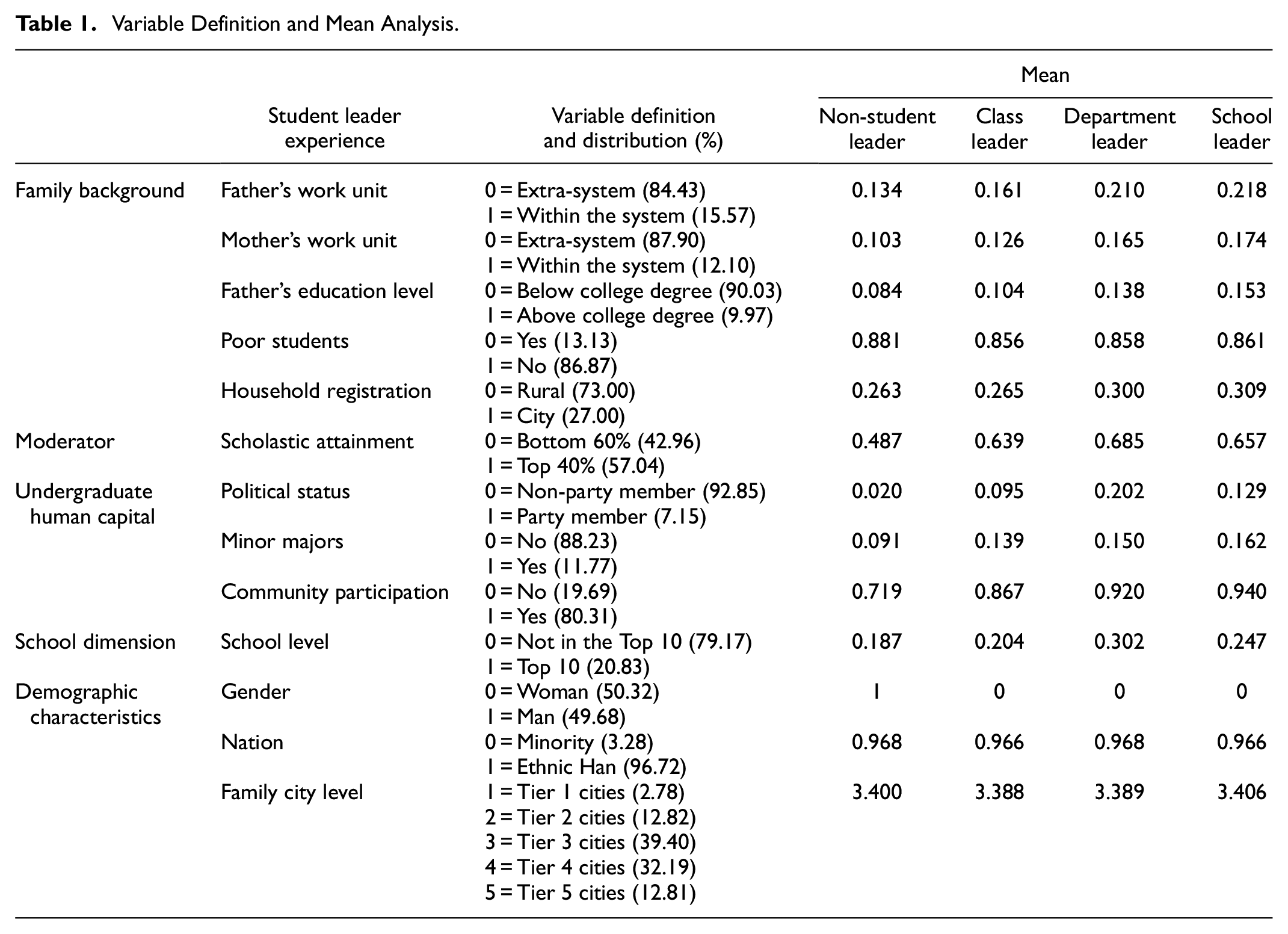
Table 1 shows the description and mean values of each main variable. The results showed that compared with the average student, in the dimension of family background, the parents of students who serve as student leaders have a higher proportion of working units in the system, and the father has a higher degree of education. The proportion of non-poor students as student leaders is higher. However, the student leader group has a higher proportion of rural residents. The scholastic attainment of student leaders ranks relatively high in all majors. In the dimension of undergraduate human capital, the proportion of non-party members and students without minor majors as student leaders is higher. The number of students with higher participation in the community as student leaders is higher.
Variable Definition and Mean Analysis.
Empirical Test and Result and Discussion
Analytical Method and Results Analysis
The dependent variables studied in this paper are four categorical variables, namely, non-student leader, class leader, department leader, and school leader, whose values are 0, 1, 2, and 3 respectively. The independent variables are mostly categorical variables, aiming to explore the influencing factors of students serving as leaders, so the multivariate logit regression model is selected for estimation. In addition to exploring the influence of family background on student leaders’ experience, this study also focuses on the role of scholastic attainment in family background and student leaders’ experience, so this paper uses the interaction term of scholastic attainment and family background to conduct the moderating effect analysis.
Table 2 reports the estimated results of the logistic model of student leader experience. Model 1 includes family background, which is the total influence of family background on student leaders’ experience acquisition.
The Logit Model Estimation Results of Student Leader Experience.

Note. z statistics are in brackets.
, **, and *** represent the significance level of 10%, 5%, and 1% respectively.
The analysis results show that: as opposed to non-student leaders, (1) From the perspective of father’s work unit, controlling other factors, father’s work unit has a significant impact on college students as student leaders. The percentage of students whose fathers worked in the system as class leaders was 1.146 (e0.1363) times higher than that of students whose fathers worked in extra-system; the ratio of department leaders was 1.469 (e0.3846) times higher than that of extra-system; the incidence rate of school leaders was 1.420 (e0.3505) times higher than that of extra-system. In other words, if a father works in the system, the chances of his children becoming student leaders are as follows: department leaders, school leaders, class leaders, and non-student leaders. (2) The proportion of students whose mothers worked in the system is 1.063 (e0.0612) times that of students whose mothers worked in extra-system. However, there is no significant influence on their children’s positions as student leaders at department level and school level. (3) Father’s education level has a significant positive influence on the students serving as student leaders. The proportion of students whose father had a above college education was 1.162 (e0.1502) times that of those with a below college education, 1.364 (e0.3107) times that of those with a below college education, and 1.543 (e0.4337) times that of those with a below college education. That is, the possibility of children serving as student leaders from high to low is school leaders, department leaders, class leaders, and non-student leaders. (4) Poor students have a significant negative impact on the experience of student leaders, and poor students have more opportunities to serve as student leaders. In other words, the possibilities of poor students to serve as student leaders are from high to low, which are department leaders, school leaders, class leaders, and non-student leaders respectively. (5) City household registration has no significant effect on students serving as class leaders, but the probability of students with city household registration serving as department leaders is 1.131 (e0.1234) times that of students with rural household registration, and that of students with school leaders is 1.162 (e0.1503) times that of students with rural household registration, that is, students with city household registration are more likely to serve as school leaders.
Model 2 incorporates scholastic attainment and control variables on the basis of Model 1. The higher their scholastic attainment, the more likely they are to become student leaders. After controlling for scholastic attainment and other control variables, the mother’s work unit has no statistical significance for student cadre experience; the other indicators of family background have significant influence on the experience of student leaders, but the influence degree is reduced compared with Model 1.
The Interaction Between Family Background and Scholastic Attainment
In order to investigate the influence mechanism of family background on student leader experience, this paper simplifies student leader experience into 0 (non-student leader) and 1 (student leader). Table 1 shows that mother’s work unit has no significant influence on student leader experience, and this section will not analyze this indicator. In Model 1 and Model 4, the interaction terms of scholastic attainment and family background were introduced respectively, and the other indicators remained unchanged. The regression results are shown in Table 3.
Mechanism Test.

Note. z statistics are in brackets.
, **, and *** represent the significance level of 10%, 5%, and 1% respectively.
The regression results show that the interaction term of father’s work unit and poor students and scholastic attainment has a statistically significant coefficient, and the coefficient is significantly negative. The specific explanation is as follows: (1) The coefficient of father’s work unit is positive, and the coefficient of interaction term is −0.0761, indicating that the positive effect of the main effect is weakened, that is, the influence of father’s work unit on student leaders decreases with the increase of scholastic attainment. (2) The coefficient of poor students is negative, and the interaction term is −0.0590, indicating that the moderating variable strengthens the negative effect of the main effect. In other words, the influence of poor students on student leaders decreases with the increase of scholastic attainment.
The interaction terms of father’s education level, household registration and scholastic attainment are not statistically significant, indicating that the influence of father’s education level and household registration on college students as student leaders will not change significantly with the improvement of their scholastic attainment.
Discussion
This paper aims to empirically analyze the employment survey data of graduates in a province in central China in 2018 to explore how family background and scholastic attainment affect the experience of student leaders. In Chinese studies on the influence of family background on educational equality in colleges and universities, there are two main viewpoints, “Performance Choice Theory” and “Social Choice Theory.” The “Performance Choice Theory” holds that individual efforts play a leading role in educational selection, while the “Social Choice Theory” holds that no matter how the society develops, family background factors are still important indicators affecting educational equity. This empirical study shows that family background has an effect on the fairness of college education process, but academic achievement can also weaken the effect of family background, that is, “Performance Choice Theory” and “Social Choice Theory” exist simultaneously.
Students from advantaged family backgrounds have a better chance to serve as student leaders. Among them, the father’s education level and the father’s work unit have the most obvious influence. This is because a good family background means better social capital, cultural capital, and economic capital, among which the economic capital of the family will provide different educational resources in the process of students’ education.
Having city household registration has no obvious effect on students serving as class leaders, but the probability of poor students serving as various kinds of student leaders is higher than that of non-poor students. This is different from the conclusion of most literatures. According to previous studies, family economic capital is the source of resources invested in children’s education. Students from families with better economic conditions have better knowledge and personality than students with weaker economic conditions, and are more likely to be favored by classmates and teachers. However, the empirical results of this paper prove that the probability of poor students serving as student cadres is greater than that of non-poor students. There are several possible reasons: (1) Poor students have fewer recreational activities, they are willing to spend a lot of time on study, and have higher independent learning ability than non-poor students. Moreover, they are more aware that hard work and social practice at school are the most powerful ways to change this gap. (2) There is a serious flaw in the school’s filing project or financial aid project. For some reason, students from better family economic conditions get the school’s financial aid project, resulting in the poor students’ self-assessment collection mistakes.
Scholastic attainment is an important moderating variable of family background affecting the experience of student leaders. The effects of father’s work unit and poor students on the experience of student leaders will be affected by the scholastic attainment, weakening the effects of father’s work unit and poor student status on the selection of student leaders. According to “Performance Choice Theory,” status in modern society mainly depends on individual ability and performance, and preexisting factors (such as the role of family background) will gradually disappear. The criterion for selecting and training talents in higher education is scholastic attainment rather than family background, and the role of family background will gradually weaken, which can also indicate that after academic performance is added, the influence of family background on the experience of student leaders is weakened. This is because China’s education sector is committed to creating a relatively fair education environment and fair access to resources for more poor students. The undifferentiated supply of educational resources provided by schools is the most obvious and effective way, and scholastic attainment is one of its results. At the same time, all kinds of evaluation mechanisms and selection mechanisms set up by the school regard scholastic attainment as a fair equalizer, which effectively inhibits the participation of “bureaucrats” and guarantees the relative fairness of the education process.
Conclusion and Suggestion
Based on the employment survey data of graduates in a province in central China in 2018, this paper makes an empirical analysis. It is found that: (1) Family background has a significant positive impact on the experience of student leaders, and students with good family background are more likely to serve as student leaders. (2) Contrary to expectation, the probability of poor students serving as student leaders is higher than that of non-poor students. (3) Scholastic attainment can weaken the influence of family background on the experience of student leaders.
If higher education can give full play to its coordinating and reshaping functions, it can give full play to the role of “Social Choice Theory” and create a relatively fair educational environment. Based on the research conclusions, this study puts forward the following suggestions.
Concerns About Inequities in the Educational Process
The theory of social reproduction points out that family capital, represented by parents’ educational background, occupational status, and social relations, has the function of intergenerational transmission, so that offspring gain advantages in access to school opportunities, educational process and results. In the final analysis, it is the problem caused by education inequality. Family background is an unalterable fact. Higher education is the weakest link of family background on educational equality. Colleges and universities should make good use of the unique adjustment function to cultivate students’ self-confidence and positive attitude toward life, stimulate students’ inner desire, and actively pursue enrichment. It is necessary to give full play to the function of promoting students and provide various learning resources, so that more students who do not have resources have the opportunity to contact different things, and encourage students to grow continuously.
Set Up an Assessment Mechanism
The selection of new student leaders in the university is basically based on the amount of interaction with teachers during the enrollment period, and the subsequent re-selection is not only the favor of teachers but also the accumulation of previous contacts, so that students who are willing to serve as student leaders have no chance to show. The establishment of an assessment mechanism can not only improve the service awareness and work efficiency of student cadres, but also optimize the team of student cadres, so that the capable will be promoted, the equal will be resigned, and the weak will retire.
Underachievers Join
Try to let students with unsatisfactory grades participate. To judge a person’s ability is not only based on scholastic attainment, but also college student leaders should have multi-dimensional characteristics. Underachieving students’ performance lags behind does not mean that other abilities are not outstanding. Underachievers should be given the opportunity to participate in selection and improve other abilities during selection and appointment.
Footnotes
Acknowledgements
The authors of this study are grateful for the data support provided by the Education Bureau of a central province.
Declaration of Conflicting Interests
The author(s) declared no potential conflicts of interest with respect to the research, authorship, and/or publication of this article.
Funding
The author(s) disclosed receipt of the following financial support for the research, authorship, and/or publication of this article: This study was financially supported by the National Social Science Foundation of China (No: 21XGL02), the Youth Jinggang Scholars Program in Jiangxi Province (No:QNJG2020047).

Data Availability Statement
Data available on request from the authors.The data that support the findings of this study are available from the corresponding author upon reasonable request.