




Abstract
Although existing studies have found that problematic parental behaviors affect children’s later life course outcomes, few have focused on the gender and urban-rural differences in the effects of these behaviors on school-to-work transition. This study traces the school-to-work trajectories of Chinese people born between 1930 and 1979 to investigate the effects of their parents’ problematic behaviors on school-to-work transition and the gender and urban-rural differences in these effects. We found that individuals whose parents drank heavily and committed crimes completed the school-to-work transition earlier and were more likely to engage in agricultural labor, enter the labor market with low education levels, and experience unemployment after leaving school. The effects of parental alcoholism and gambling on school-to-work transition varied according to urban-rural residential status. Youths with urban hukou (household registration) whose parents drank heavily were less likely to have stable jobs. Further, women and youths with agricultural hukou whose parents gambled and committed crimes had a higher likelihood of being disadvantaged in the transition from school to work and of facing multiple risks, including hazards of agricultural work, precarious work, and unemployment.
Plain language summary
This study traces the school-to-work trajectories of Chinese people born between 1930 and 1979 to investigate the effects of their parents’ problematic behaviors on school-to-work transition and the gender and urban-rural differences in these effects. The sequence analysis method was used in this study. We found that individuals whose parents drank heavily and committed crimes completed the school-to-work transition earlier and were more likely to engage in agricultural labor, enter the labor market with low education levels, and experience unemployment after leaving school. The effects of parental alcoholism and gambling on school-to-work transition varied according to urban-rural residential status. Women and rural residents were more vulnerable to these adverse outcomes. governments and society must pay attention to young people affected by their parents’ problematic behaviors and implement support programs to strengthen the help given to these families.
Introduction
School-to-work transition is a critical stage in the life course. The success of this transition is influenced by several macro factors, such as the employment system and education (Bolíbar et al., 2022). Within the family, problematic parental behaviors are an important factor affecting family functioning. The occurrence of these behaviors may have negative effects on young people’s transition to adulthood (Giordano et al., 2019; Mears & Siennick, 2016); for example, problematic parental behaviors (e.g., parental incarceration and substance abuse) are associated with increased risks in adulthood, including disadvantaged socioeconomic status, poorer health, and a higher likelihood of committing crimes (Mears & Siennick, 2016; Turney & Goodsell, 2018). Problematic parental behaviors may also significantly affect school-to-work trajectories, and those who experience such behaviors may be at increased risk of an unsuccessful transition from school to work; for example, they may find themselves unemployed or in precarious work. However, the mechanisms underlying this association remain unclear.
In this study, we operationalized the transition from school to work as a trajectory of multiple life course states and roles. We employed sequence analysis to examine the effects of experiencing problematic parental behaviors during childhood on the transition from school to work as well as the gender and urban-rural differences in these effects.
Theoretical Background
The School-to-Work Transition: Definition and Interpretation
The transition from school to work is the life stage in which people complete their education and engage in work (Nilsson, 2019). The smoothness of this transition helps determine whether people are willing to switch jobs later in life and how they cope with subsequent career changes (Saks, 2018; Takeuchi et al., 2021). A successful school-to-work transition is conceptualized as transitioning from the end of formal, secondary, or higher education to obtaining an entry-level job or continuing work-related training (Chesters, 2020). Some scholars also maintain that the criterion for a successful school-to-work transition is a state in which individuals are employed after leaving school, are performing to a level that is acceptable to their employers, and have a positive attitude toward their work environment and job requirements (Saks, 2018). Most of these definitions and standards emphasize environmental adaptability and employment stability of young people during early career transitions. When individuals fail to achieve a successful school-to-work transition, they can be at risk of high unemployment and weak links between education and work (Arifi et al., 2019).
There are many different theoretical perspectives on successful transitions from school to work. Human capital theory conceptualizes school-to-work transition as an investment decision made by young people and argues that a lack of education and training can lead to unsuccessful transitions, such as pursuing unskilled occupations and an increased risk of cyclical unemployment (Raiu, 2019). This theory also underlines the importance of family background in individuals’ decisions to invest in more education or training, with those from wealthier families having lower marginal investment costs (Blandin & Herrington, 2022). Social cognitive career theory provides another useful perspective to understand the transition from school to work. This theory views school-to-work transition as a gradual process that entails lifelong career development, not one that simply ends with graduation from school and entry into the workplace (Zainal et al., 2020).
By emphasizing career development tasks and coping behaviors, career development theory offers a practical model for understanding how adolescents move from school to work (Kintu et al., 2019; Zainal et al., 2020). The theory holds that the transition from school to work is developmental and a continuous, long-term process in people’s personal lives in which they constantly seek information and adjust their vocational skills to make choices in the process of transitioning.
Additionally, the learning theory of career counseling proposes that individuals are active problem-solving agents who pursue their own purposes and needs in interactions with their surroundings. In the transition from school to work, individuals must view their career choice as a learning process and consider other options as they mature (Evans & Furlong, 2019). In the field of sociology, socioeconomic status plays a broad structural role in people’s lives, determining access to the resources needed for adaptive transitions from school to work. Those from upper social classes are more likely to attend college, while members of lower social classes are more likely to transition directly to work or the military (Kish-Gephart et al., 2023).
However, existing studies on school-to-work transition have often focused on single events or single status changes—such as the timing of an individual’s first job and the transition from education to employment (Vancea & Utzet, 2018)—without examining them as a multidimensional, holistic, and long-term sequence in the overall transition from school to work. Since the 1970s, with the implementation of neoliberal policies, the welfare system has been reformed in Western countries, and individuals have adopted more flexible forms of work to cope with this change, including self-employment, part-time work, temporary work, and even re-entering college (Kalleberg & Vallas, 2018). This scenario produces a diverse and disorganized transition from school to work. In China, young people are spending more years in schooling, thereby delaying the transition from school to work. For example, the population with a junior college degree or above rose from 416 per 100,000 people in 1964 to 15,467 in 2020 (National Bureau of Statistics, 2021). Meanwhile, with the establishment of the market economy, young people have since acquired more occupational mobility and have experienced more job transitions. For example, the proportion of Chinese youth with multiple jobs was 4.164% in 2014 and 5.288% in 2016, an increase of about 1.13% (Song et al., 2022). Consequently, in the face of complex changes in school-to-work trajectories, the perspective of viewing labor market entry as a single event has not allowed researchers to observe different employment statuses or trace the entire school-to-work trajectory.
Parents’ Problematic Behaviors and Adulthood Outcome
A large body of literature has studied the direct effects of parents’ delinquent behavior on children, finding that children who have experienced the impact of such behavior have worse outcomes throughout childhood, including developmental delays, behavioral problems, lower academic performance, and poorer mental health compared with those who have not (Jokinen et al., 2021; Luk et al., 2023). This effect may also be age-related (Young et al., 2020). For example, children living with parents that have serious, long-term drinking issues are more likely to have adverse outcomes in a wide range of areas such as substance abuse, behavioral problems, alcoholism, and poorer physical and mental health (Jacob et al., 2021; Rossow et al., 2016). Scholars have also identified associations between parental substance use and adverse outcomes in children, including problematic behaviors and poor academic performance (Kepple, 2018; Lowthian, 2022). Overall, these studies suggest that parents’ delinquent behavior may adversely affect multiple areas of children’s lives. These studies also indicate that children’s negative reactions to their parents’ delinquent behavior can be broadly divided into two types: (1) internalized behavior, such as depression and difficulty in forming attachments with parents; and (2) externalizing behaviors, including aggressive and delinquent conduct.
The adverse effects of problematic parental behaviors on offspring may persist over time, and these behaviors are significantly related to poor adult outcomes (Kjellstrand et al., 2018). For example, several longitudinal studies have found that individuals’ experiences of parental incarceration during childhood affect their adult outcomes, with negative consequences in multiple areas of adulthood such as criminal participation, drug use, social bonding, and mental and physical health (Haskins et al., 2018; Mears & Siennick, 2016; Turney & Goodsell, 2018; Young et al., 2020). Children who have experienced parental incarceration are more likely to be arrested, commit crimes, use marijuana, be depressed, have problems in romantic relationships, and cohabit outside of marriage (Gifford et al., 2019; Mears & Siennick, 2016; NeMoyer et al., 2020). Various studies have also found evidence that parental drinking can predict drinking behavior in adolescent offspring (Mahedy et al., 2018; McCutcheon et al., 2018).
Experiencing problematic parental behaviors in childhood is also associated with a disadvantaged socioeconomic status in adulthood. For example, young adult children of incarcerated fathers have a higher rate of low socioeconomic status (Kjellstrand et al., 2018; Turney & Goodsell, 2018). Further, parental incarceration reduces children’s educational attainment and earning potential in adulthood (Arteaga, 2023; Mears & Siennick, 2016). Additionally, experiencing problematic parental behaviors during childhood can influence adult children’s life paths into their careers (Young et al., 2020), such as their first-time entry into the labor market. There is also extensive empirical evidence linking parental gambling with children’s mental health, family relationships, violence, behavior, financial status, physical health, and gambling (Suomi et al., 2022).
When parents lie, it can increase the likelihood that their children will engage in dishonest behavior (Dykstra et al., 2020) and can negatively impact children’s later psychosocial functioning (Setoh et al., 2020). In addition, children who are exposed to domestic violence are at increased risk of emotional, physical, and sexual abuse; emotional and behavioral problems; and other challenges in their lives (Sharkey, 2018).
Strain, attachment, and stigmatization theories have been used to explain how parents’ delinquent behavior can adversely affect their children’s development and conduct. Strain theory argues that negative life events may adversely impact offspring because these events produce feelings of negative affective states such as strain, anger, and sadness (Jones et al., 2018; Young et al., 2020). Meanwhile, the social, economic, and emotional impacts of parents’ delinquent behavior may also adversely affect children’s social capital by exacerbating the stress placed on children and their families, thereby increasing children’s risk of poor psychosocial development (Kim & Lee, 2021).
Attachment theory implies that children who experience problematic parental behaviors have reduced feelings of attachment to their parents (Wang et al., 2023). Stigma theory also indicates that the social stigma of criminal behavior can have adverse effects on offspring, such as causing tension (An et al., 2020). Based on these theories, scholars have undertaken extensive empirical research to understand how parents’ delinquent behavior affects their offspring. This research has found that the effects of parents’ delinquent behavior on children are often attributed to problems in the care of young children, such as parenting and family support, as well as family instability. For example, parental alcoholism and incarceration lead to separation from children, increasing the risk of family instability. These problems also greatly reduce parental care and support for young children and increase children’s risk of economic deprivation and their need to rely on public assistance (Norris et al., 2021; Young et al., 2020). However, these theories place more emphasis on the impact of parents’ delinquent behavior on children than on its cumulative effects over time. In other words, the transition from school to work has not been viewed as a longitudinal trajectory when examining the effect of parents’ problematic behaviors on this transition.
Developmental and life-course criminology (DLC) provides a more longitudinal perspective. One of the issues of this theory is the effect of life events on the course of development (Farrington, 2003). Sampson and Laub (1993) introduced the turning point theory to criminology by drawing on the paradigm of life course theory, asserting that key events such as marriage, employment, and military service can explain the change of crime or the deflection of a crime trajectory (Laub et al., 2018; Laub & Sampson, 2020). However, as highlighted by Laub and Sampson (2020), DLC tends to view turning points as positive, while the potential impact of negative turning points—which may also have a profound effect on individuals’ later development—is often overlooked. In other words, negative events such as problematic parental behaviors in childhood may have a longitudinal impact on later life.
The Current Study
Using empirical data from China, we analyzed the pattern of school-to-work transitions of Chinese young people and the role of problematic parental behaviors. We hypothesized that parents’ delinquent behavior would have a significant effect on young people’s transition from school to work; that is, we predicted that adolescents who experience problematic parental behaviors would be at greater risk of being disadvantaged or unsuccessful in their transition from school to work than those who have not experienced the impact of such behaviors.
School-to-work trajectories may vary according to gender over time (Lorentzen et al., 2019). For example, Hsin and Ortega (2018) observed that girls are more likely to enter both 2-year and 4-year colleges during the school-to-work transition; however, boys are more likely to enroll in college (Solanki & Xu, 2018). Men also tend to have more structured careers than women, indicating that women may display more diversity than men in their occupational trajectories (Bonnet et al., 2019). Some scholars have also revealed that family background factors have a significant impact on the wage premium for male college students, while the effect on girls is not significant (Becker et al., 2019). In other words, there is not yet sufficient evidence to clarify the gender differences in school-to-work transition. Hence, we also examined gender differences in the effects of parents’ delinquent behavior on their children’s transition from school to work.
In the Chinese context, urban-rural differences are another important dimension. After the reform and opening up, China’s urban areas were the first to carry out market-oriented reforms. Urban residents may rely more on the market than rural residents, meaning they may have higher career instability. We hypothesized that young people with agricultural hukou whose parents have demonstrated delinquent behavior would be more likely to be disadvantaged in the transition from school to work and would face multiple risks such as hazards of agricultural work, precarious work, and unemployment. As such, we separated our analysis by urban-rural location, which allowed us to consider possible differences in the effect of parents’ delinquent behavior on school-to-work transition.
Analytical Strategy
Data
We derived the data for our analysis from the China Health and Retirement Longitudinal Study conducted by the National School of Development at Peking University in 2014. The survey used a multistage probability proportionate to the size sampling method to select the samples and was administered in 150 counties and 450 communities (i.e., villages) across 28 provinces, autonomous regions, and municipalities. Ethical approval for the study was granted by the Institutional Review Board of Peking University, and written informed consent was obtained from the participants. The topic of the survey was the life course of Chinese people, and 20,948 people responded. This survey collected data on the main fields of an individual’s life course such as education level, marital status, childbearing history, and work history as well as the problematic behaviors of the respondents’ parents (e.g., alcoholism, drug use, gambling, getting into physical fights, criminal experiences).
This retrospective survey provided a reliable foundation for us to study the transition to adulthood during Chinese people’s life course. As the youngest cohort in the sample was born in the late 1970s, and there were few respondents born before 1930, we did not include samples born before 1930. We divided the remaining respondents into five cohorts: 1930 to 1939 (Cohort 1), 1940 to 1949 (Cohort 2), 1950 to 1958 (Cohort 3), 1960 to 1969 (Cohort 4), and 1970 to 1979 (Cohort 5). We removed samples with informational errors and missing data; we only retained and analyzed complete cases. The final valid sample included 15,777 responses.
Method
We used sequence analysis, which was introduced by biology to the social sciences by Abbott. This method treats each life course trajectory as a string of characters that resembles the characters used to code DNA molecules in biology (Sironi et al., 2020). This technique allowed us to compare the sequences of individual life course states and combine the most similar life course trajectories into clusters using hierarchical cluster analysis (Rossier, 2019), thereby identifying typical trajectories.
We operationalized the life course of school-to-work transition into a multi-dimensional sequence of life course states among individuals aged 16 to 35. We built the trajectories of this transition based on the age at which the individual experienced life events or roles in the two domains of education and employment.
First, we identified the life course states of the transition from school to work. We selected one life course state from within the domain of education and five life course states from within the domain of employment during the school-to-work transition. We also merged education and employment into one field with six states—education (ED), agricultural employment (AG), non-agricultural employment (NA), non-paid work (NP), military service (MS), and not employed (NU)—to form trajectories from school to work. Thus, according to the life course states defined above and the respondents’ education and employment histories, we used years as the unit of time to construct the trajectory sequences of Chinese people from 16 to 35 years of age, who were born between 1930 and 1979.
Second, we used optimal matching (OM) to calculate the distance between the paired trajectories from school to work. We then performed cluster analysis based on the distance matrix to form the types of state trajectories. Specifically, we performed sequence analysis by applying OM, which calculates the matrix of dissimilarities between pairs of individual trajectories, setting a single unit of insertion and deletion costs and the transition rate between states of substitution cost in order to match different multi-dimensional sequences. After completing OM, we used the Ward algorithm to perform hierarchical cluster analysis to achieve dimensionality reduction of the data so that the similarity of the sequences within the groups would be maximized and minimized between them. We tested the validity of clustering through a series of indicators, determining the optimal number of clusters according to the relevant test indicator standards.
Third, we used the clusters of trajectories from school to work as the dependent variable and estimated a multinomial logistic regression to examine the relationship between problematic parental behaviors and the probability of belonging to each of the selected clusters. We performed all data processing using R (package TraMineR and WeightedCluster) and STATA software.
Variables
The dependent variable in our model consisted of the clusters of trajectories from school to work formed by cluster analysis. The independent variable was problematic parental behaviors, encompassing alcoholism, drug addiction, gambling, lying, getting into physical fights, and committing crimes. In the questionnaire, respondents were asked to answer the question, “During the years you were growing up, which one of the following did your parents ever have/do?” The response options included alcoholism, drugs, gambling, often not telling the truth, often getting into physical fights, being involved in criminal activities, or being sent to prison. All of these aspects of the independent variable were answered via two options: “yes” or “no.” Additionally, we established the interaction terms of problematic parental behaviors and gender and hukou, respectively.
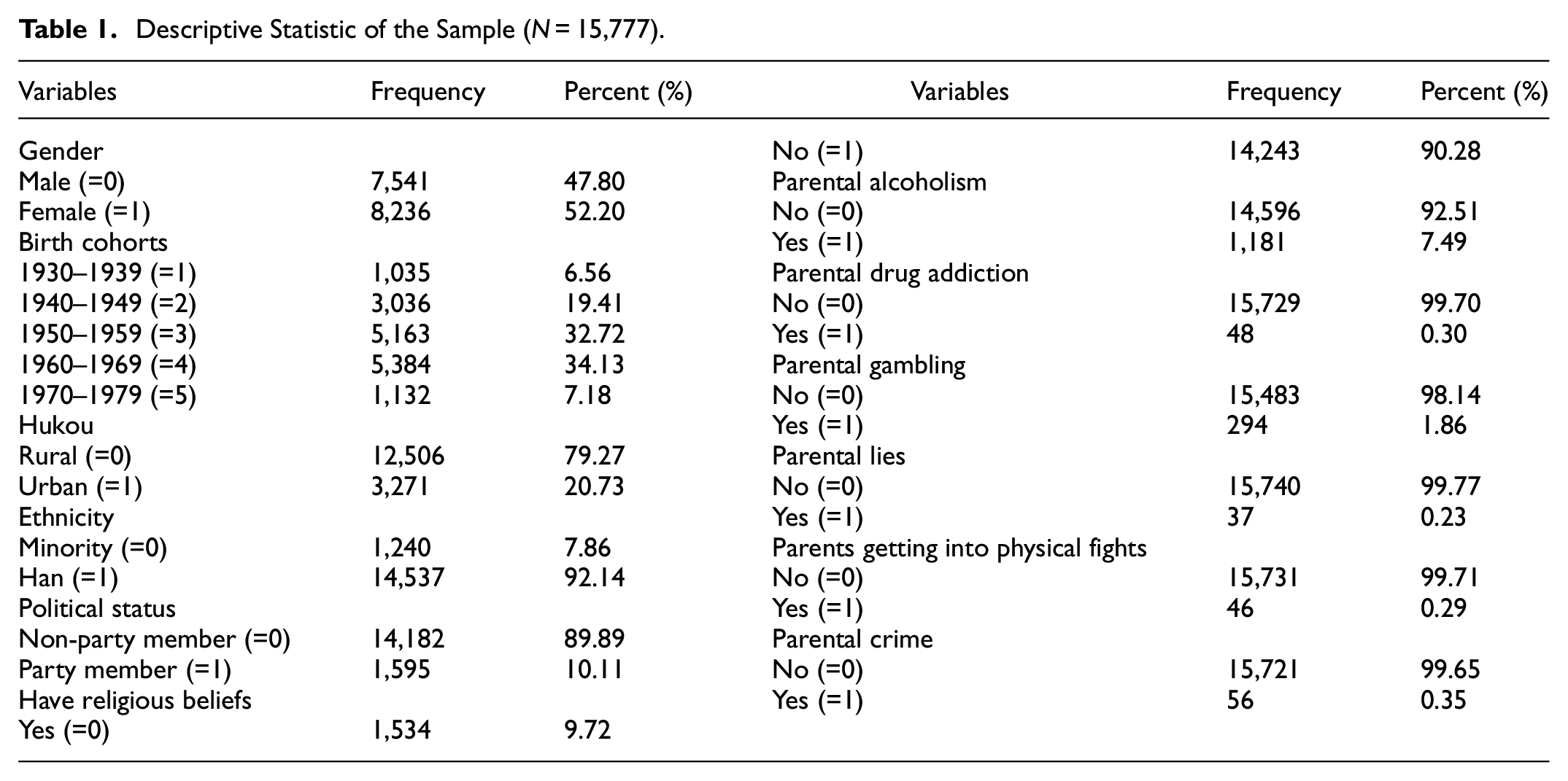
The control variables of gender, hukou, birth cohort, ethnicity, political status, and religious beliefs were also included in the models. Gender was a binary variable with male as the reference category. Hukou was also a binary variable, where rural was set as 0 and urban was set as 1. We also included the five birth cohorts. Ethnicity included two categories, with minorities as the reference category. The political status covered non-party and party membership. Religious beliefs included two categories: people with religious beliefs and people without them. Table 1 outlines the descriptive statistics of the variables.
Descriptive Statistic of the Sample (N = 15,777).
Results
Patterns of School-to-Work Trajectories
The sequence analysis helped us to identify four clusters of school-to-work trajectories (see Figure 1). We used several indicators to prove the effectiveness of cluster analysis, such as Hubert’s gamma (HG) =0.89, point biserial correlation (PBC) =.73, and R2 = .81. The closer the value of these indicators is to 1, the better the clustering effect. Cluster 1 accounted for the largest proportion of our sample (50.33%) and was characterized by the fairly low level of education of its members and their early entry into agricultural work. Cluster 2 accounted for 18.11% of the sample; most individuals in this cluster were still occupied in free-form agricultural work after a period of education, and agricultural employment occupied a dominant share of the sample. Cluster 3 accounted for 26.60% of the sample and was characterized by a somewhat high level of education among its members and their late entry into the labor market; most members of this cluster had stable non-agricultural work. Cluster 4 accounted for 4.96% of the sample and was dominated by members who were not employed; most members of this cluster may not have been in the labor market during the school-to-work transition.
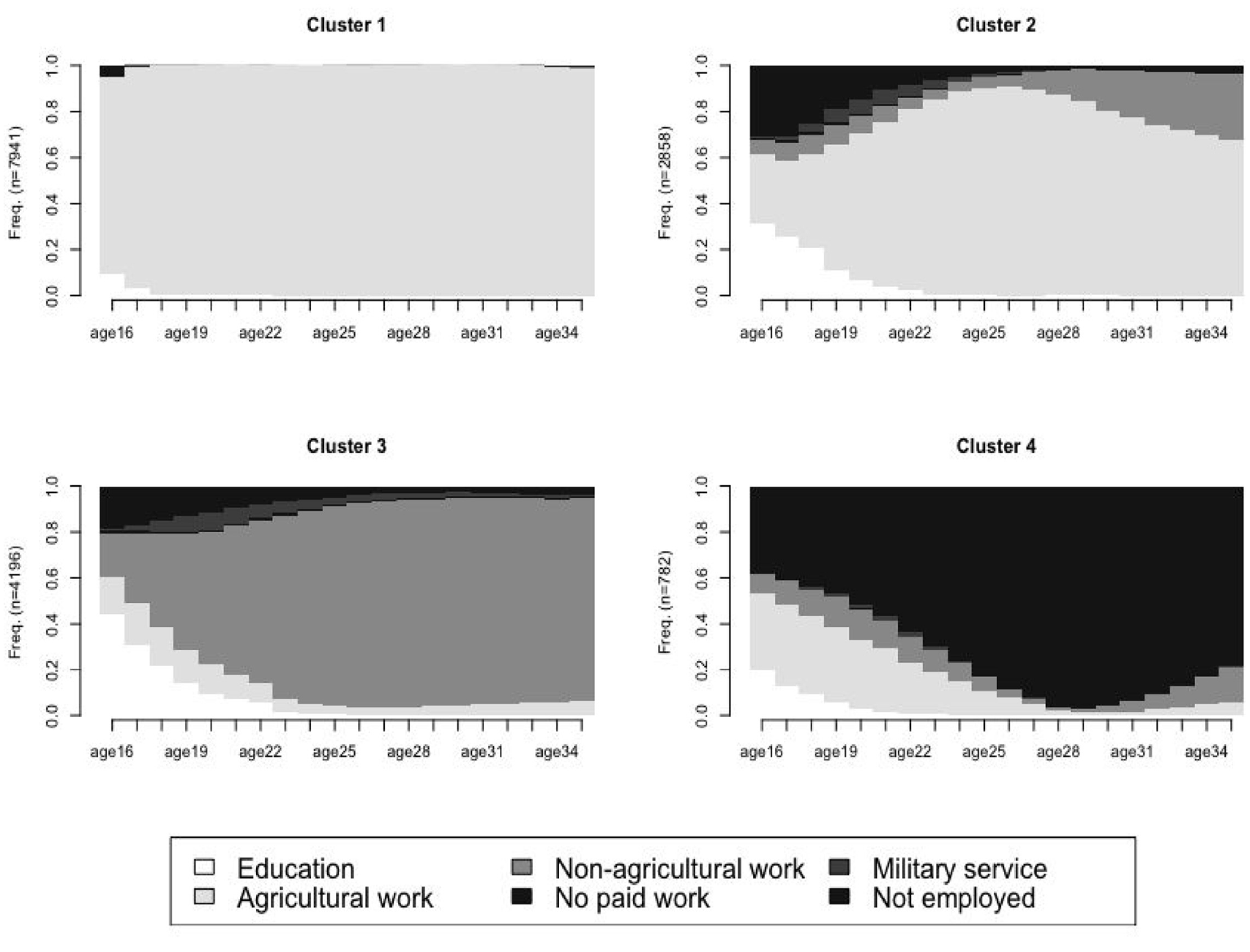
Four clusters of school-to-work trajectories identified by cluster analysis.
The Results of the Multinomial Logistic Regression Model
Table 2 displays the average probability of belonging to each cluster of the school-to-work trajectories. Models 1 through 4 incorporate the control variables and the variables of problematic parental behaviors. In terms of the control variables, women were more likely to be classified into clusters 1 and 4 and less likely to be classified into clusters 2 and 3. Respondents with urban hukou were more likely to belong to clusters 3 and 4, while those with rural hukou were more likely to belong to clusters 1 and 2. The 1940–1949 cohort had a higher probability of being in Cluster 1 and a lower probability of being in clusters 2 and 4. The 1950–1959 cohort had a higher probability of falling into Cluster 1 and a lower probability of falling into Cluster 4. The 1960–1969 cohort was more likely to fall into Cluster 3; the 1970 to 1979 cohort was also more likely to fall into this cluster. In addition, Han Chinese people were more likely to fall into clusters 3 and 4 than ethnic minorities. Party members had a higher probability of falling into Cluster 3 than non-party members.
Multinomial Logistic Regressions on the Probability of Being in Each Cluster of School-to Work Trajectories. Average Marginal Effects (N = 15,777).

Note. China Health and Retirement Longitudinal Study (CHARLS) in 2014.
p < .10. *p < .05. **p < .01. ***p < .001.
Compared with respondents who had religious beliefs, those with no religious beliefs were more likely to fall into Cluster 3. In terms of the independent variable, people with alcoholic parents were more likely to fall into Cluster 1 and less likely to fall into clusters 2 and 3 than those with non-alcoholic parents (see Figure A1). Those whose parents had committed crimes were more likely to be included in Cluster 1 and less likely to be included in Cluster 3 than those with parents who had not (see Figure A2). Overall, we found that respondents whose parents drank heavily and committed crimes were more likely than those whose parents did not drink or commit crimes to fall into clusters characterized by low levels of education, disorderly and frequent changes in work, and unemployment (such as clusters 1 and 4), and less likely to fall into Cluster 3, which was characterized by stable work.
Models 5 through 8 included the interaction terms of problematic parental behaviors and gender as well as hukou. Female respondents whose parents gambled were more likely to fall into Cluster 1 and less likely to fall into Cluster 3 than male respondents whose parents did not gamble (see Figure A3). Men whose parents frequently got into physical fights were more likely to belong to Cluster 4 than those whose parents did not. Female respondents with criminal parents were more likely to fall into Cluster 1 and less likely to fall into Cluster 3 than male respondents with parents who had not committed crimes. Further, urban hukou respondents with alcoholic parents had a higher probability of being classified into Cluster 1 and a lower probability of being classified into Cluster 3 than rural hukou respondents with non-alcoholic parents (see Figure A4). Rural hukou respondents whose parents gambled were also less likely to be classified into Cluster 3 than respondents whose parents did not gamble (see Figure A5). Additionally, rural hukou respondents whose parents had committed crimes were more likely to be included in Cluster 1.
In sum, women whose parents gambled and had committed crimes were less likely to enter Cluster 3, which was characterized by employment and stable work. This outcome suggests that parental gambling and parental crime have a greater effect on women. Urban hukou residents whose parents drank heavily, gambled, and had committed crimes were more likely to enter clusters characterized by low levels of education, agricultural work, frequent changes in work states, and even unemployment than rural residents whose parents did not drink. They were therefore less likely to be classified into clusters characterized by higher levels of education and stable work. This finding indicates that parental alcoholism and parental crime have a greater effect on rural hukou residents.
Discussion
In this study, we used retrospective life history data to construct the school-to-work trajectories of Chinese people born between 1930 and 1979 to examine the effect of their parents’ problematic behaviors on their school-to-work transition. Young people with parents who drank heavily and had committed crimes were at greater risk of being vulnerable in their school-to-work trajectories and were more likely to engage in agricultural manual labor, switch frequently between work states, and even fall into long-term unemployment. In other words, compared with offspring who had not experienced parental alcoholism and crime in childhood, these individuals did not have a smooth and successful transition from school to work, manifested by initial entry into the labor market with a lower education level; they may have also completed the transition from school to work in states of unemployment. The results indicate that problematic parental behaviors have significant long-term effects on youths’ transition from school to work.
Some studies have consistently shown that the transition to adult life has a significant impact on criminal behavior, including marriage and parenthood (Arnett, 1998; Blokland & Nieuwbeerta, 2005; Ganem & Agnew, 2007). The results of many studies have also revealed that education and full-time employment during transition to adulthood can also reduce some types of criminal behavior (Bell et al., 2022; O’Connell, 2003). For example, Blokland and Nieuwbeerta (2005) found that in the Netherlands, student status was the only role status that seemed to inhibit crime.
From an intergenerational perspective, we found that problematic parental behaviors in turn have a significant effect on children’s role transitions from school to work. This is consistent with the findings of prior studies on the impact of problematic parental behaviors on adult outcomes, in particular education level, job opportunities, and income level in adulthood. Some studies have indicated that adolescents with well-educated parents have a double advantage: high family resources and the ability to balance school and work, which is beneficial to adolescents’ educational achievement and development (Shanahan & Flaherty, 2001; Staff & Mortimer, 2008). Meanwhile, financial and housing support from parents also provides important safety nets for young people to successfully navigate the transition to adulthood (Mortimer, 2012). However, childhood adversity such as parental incarceration has deleterious effects on many domains of adult life (Mears & Siennick, 2016; Young et al., 2020). For example, young adults who were poor and lived with alcoholic relatives for many years are at greater risk of having low incomes and drinking problems in adulthood (McCutcheon et al., 2018), and young people from families with low socioeconomic status or whose parents smoke are more likely to smoke (Green et al., 1991). Studies conducted in Finland and Denmark have also shown that young people whose parents have alcohol problems are more likely to drop out of school than their peers whose parents do not suffer from alcoholism (Raitasalo et al., 2020). All these findings suggest that problematic parental behavior can have a significant effect on the life course outcomes of offspring; our results support these conclusions.
Unlike the above studies, other scholars have found that problematic parental behaviors (such as crime) can lead to different outcomes depending on the parent’s previous situation and the child’s reaction. For parents who have strong relationships with their families, incarceration undermines the bonds that parents have with their children (La Vigne et al., 2016; Sampson & Laub, 1990) and affects their children’s future development. For parents whose lives were already fractured prior to incarceration, incarceration discouraged previously destructive behavior and may have helped to rebuild severed social ties (Edin et al., 2001). Thus, in a broad sense, the effects of problematic parental behavior on children may be conditional depending on the strength of the parent-child emotional bond, which is not supported in this study.
In sum, most of the extant research and our study suggest that the impact of problematic parental behaviors extends beyond childhood and persists into late young adulthood. This finding further aligns with the implications of career development theory, suggesting that the transition from school to work is a long-term developmental pathway and that those who experience adverse life events may face an unsuccessful transition from school to work. Additionally, developmental and life course theories related to crime emphasize the important impact of life events as turning points (Sampson & Laub, 1993). Our study supports the turning point effect of problematic parental behaviors on school-to-work trajectories; that is, from the perspective of developmental and life course theories, experiencing problematic parental behaviors in childhood not only affects individuals’ income and employment opportunities in adulthood (Prakash & Kumar, 2021) but also hinders their successful transition from school to work.
Furthermore, we found that the effects of parental alcoholism, gambling, and crime on children’s transition from school to work differ according to gender and urban-rural status. Women and agricultural hukou youth with parents who drank alcohol, gambled, and had committed crimes were more likely to be disadvantaged in the transition from school to work and to face multiple risks, including hazards of agricultural work, precarious work, and unemployment. In other words, the impact of problematic parental behavior was greater for female and rural hukou respondents, who were more vulnerable to such adverse effects. The occurrence of problematic parental behaviors may mean that female and rural children grow up in an unfriendly family environment; moreover, such behaviors may lead to a disadvantaged socioeconomic status. This makes children vulnerable to education and labor market competition in adulthood; thus, it is difficult for them to successfully complete the transition from school to work.
Some studies on gender differences in the impact of parents’ problematic behaviors on children have shown that the evidence is conflicting on whether sons or daughters are more susceptible to parents’ problematic behaviors. For example, paternal incarceration is associated with higher rates of depression in girls in the absence of sexual abuse (Swisher & Shaw-Smith, 2015). Other studies have found that parental incarceration is positively associated with mortality in boys, while paternal incarceration is associated with a lower risk of child mortality in girls (Wildeman et al., 2014). However, the association is greater when the parent and child are of the same sex (Green et al., 1991; Wilks et al., 1989). For example, paternal alcohol abuse directly predicts substance use in boys, but not in girls; in contrast, maternal alcohol abuse directly predicts substance use in girls, but not in boys (Ohannessian, 2012). Hence, our findings are not entirely consistent with existing research on this point, and our results further suggest that girls who experience the effects of problematic parental behaviors may be at a greater disadvantage in their transition from school to work compared with boys.
In addition, there are few studies on rural-urban differences in the impact of parents’ problematic behaviors on offspring, but rural children have a higher parental incarceration rate, which has a greater impact on them (Wildeman, 2009). Our findings are consistent with the results of prior studies that have shown that the life course outcomes of rural residents are more susceptible to childhood adversity (Punch, 2004).
This study has some limitations. First, we used retrospective survey data, and asking respondents to recall events that occurred several years (or even decades) ago may result in memory bias or error. Although we carefully sorted the data by deleting apparent errors and contradictory observations, memory bias and bias caused by sample removal may still affect the validity of the conclusions to some extent. Second, the cross-sectional data limited the interpretation of the developmental trajectories of school-to-work transition. Long-term longitudinal tracking data may more accurately show the evolving process of school-to-work trajectories. Third, we did not characterize the cohort-dependent impact of problematic parental behaviors on school-to-work trajectories; future studies should investigate this effect.
Conclusions
This study builds on the literature about school-to-work transition to examine the gender and urban-rural differences in the effect of problematic parental behaviors on school-to-work transition among Chinese young people. We found that adolescents who experienced problematic parental behaviors transitioned from school to work earlier and showed more vulnerable and complex school-to-work trajectories. Moreover, women and rural residents were more vulnerable to these adverse outcomes. Our findings underscore the long-term impact of negative parental behavior on children’s school-to-work trajectories and have important policy implications. First, society must pay attention to young people affected by their parents’ problematic behaviors and implement support programs to strengthen the help given to these families. Second, schools should prevent adolescents from dropping out and entering the labor market early, thereby increasing the human capital of adolescents affected by their parents’ problematic behaviors. Third, governments should develop policies to strengthen employment support for adolescents and provide multi-faceted employment assistance.
Footnotes
Appendix
Acknowledgements
The authors would like to thank the project of “China Health and Retirement Longitudinal Study (CHARLS)” for providing data open services. I am grateful to Zhan Liu from Beijing College of Social Administration for his inspiration for this article.
Author Contributions
CFJ led study design, tools development, and manuscript writing. WDX led study conceptualization, design, tools development, and performed statistical analysis and manuscript writing. The authors read and approved the final manuscript.
Declaration of Conflicting Interests
The author(s) declared no potential conflicts of interest with respect to the research, authorship, and/or publication of this article.
Funding
The author(s) received no financial support for the research, authorship, and/or publication of this article.
Consent for Publication
The views expressed in the submitted article are the authors’ own and not an official position of the institution or the funders.
Ethical Approval Statement
This study was approved by the Institutional Review Board of Peking University.

Data Availability Statement
Data sharing not applicable to this article as no datasets were generated or analyzed during the current study.