




Abstract
This article compares Swedish social workers, teachers, and journalists’ experiences of workplace violence. It addresses similarities and differences between the three professional groups in terms of who exposed them to workplace violence, what it was about, and what triggered it. The article is based on an online survey study, and the findings suggest that consumer-related violence from target groups was the most common among all three professional groups. Looking at worker-on-worker relationship violence, the teachers were the most exposed, followed by social workers and journalists, and such violence suggests bullying in the workplace. Most respondents stated that the hate, threats, and harassment were about their professional competence. While all of these professional groups have a position of power in society, they also perceive that it is often in the situations in which they exercise their power (e.g., making a decision for social workers and teachers or when journalists publish) that they become targets for workplace violence.
Plain Language Summary
This article compares Swedish social workers, teachers, and journalists’ experiences of workplace violence. It addresses similarities and differences between the three professional groups in terms of who exposed them to workplace violence, what it was about, and what triggered it. The article is based on an online survey study. It was most common with workplace violence from target groups such as clients for social workers, pupils for teachers and readers/viewers for journalists. Most respondents stated that the hate, threats, and harassment were about their professional competence. While all of these professional groups have a position of power in society, they also perceive that it is often in the situations in which they exercise their power (e.g., making a decision for social workers and teachers or when journalists publish) that they become targets for workplace violence.
Keywords
Introduction
During the past year, we have read several headlines and taken part in debates in the Swedish media about workplace violence. Especially in opinion pieces, union representatives and professionals have called for more awareness on how workplace violence manifests itself and how to handle it. Such violence can range from verbal abuse such as threats, to physical assaults, and even homicides. For example, there have been headlines about social workers receiving death threats, especially when taking children into custody. There have also been headlines about how some teachers are abused and threatened on a daily basis by their pupils. Much has been debated about how social media is being used to threaten different professional groups such as journalists. There are many reports of online harassment against journalists, especially how they are being attacked by so-called social media trolls, but also how difficult it has become to handle the harsh tone on social media. In fact, recent studies show that the fear of being a target of workplace violence has started to limit social workers, teachers, and journalists’ autonomy and professional discretion (see Löfgren Nilsson & Örnebring, 2016 for journalists; Scaramuzzino, 2020).
Professional groups can be exposed to workplace violence by many different actors. It can come from people outside a work organization such as target groups and their relatives (consumer-related violence). In this article, each professional group has its own target group such as clients for social workers, pupils for teachers and readers/viewers for journalists. It can also come from people within the work organization such as colleagues, former employees, and managers (worker-on-worker relationship violence). Workplace violence is widespread (Scaramuzzino, 2020; Estrada et al., 2007; Heiskanen, 2007; Jerre, 2009; Wikman, 2016), and previous research shows it can occur almost in any work environment, including workplaces where people work against different types of violence, for instance gender-based violence (Pérez-Tarrés et al., 2019). It is important to learn more about how contemporary workplace violence manifests itself. For example, who makes the threats? What can been regarded as workplace violence can range from different forms of verbal abuse to physical abuse (Respass & Payne, 2008), and this is why it is also important to find out more about the workplace violence that different professional groups are exposed to. Furthermore, in order to be able to prevent and handle workplace violence, it is crucial to find out more about what actually triggers it, that is, the spark.
This paper draws on a survey study conducted in 2018 to 2019 (n = 1,236), and its aim is to study workplace violence toward Swedish social workers, teachers, and journalists. The paper addresses similarities and differences between the three professional groups’ experiences in terms of who exposed them to workplace violence, what it was about, and what triggered the workplace violence. All of these professional groups have positions of power in society, especially in relation to their target groups, which can trigger reactions that can turn violent.
In the coming sections I will firstly discuss workplace violence from a theoretical perspective. Then I will present each professional group, their power base and how the theoretical framework relates to their position in society.
Theoretical Starting Points and Previous Research
The paper aims at contributing to research on both workplace violence and bullying in working life. Much focus in previous research has been on workplace violence in general (see e.g., Bentley et al., 2014) or violence against health care staff such as nurses and doctors (see e.g., Menckel & Viitasara, 2002; Nowrouzi-Kia et al., 2019; Phillips, 2016). This section presents, theoretical perspectives and previous research on who usually exposes social workers, teachers and journalists to workplace violence, what the hate, threats, and harassment have been about, and what triggered the workplace violence.
Who
In exploring who exposes professional groups to workplace violence, it is important to distinguish between different types of workplace violence. One relevant distinction is based on the relationship between the workplace and the perpetrator. Two common categorizations are consumer-related violence, such as the violence of target groups or relatives of target groups against staff, and worker-on-worker relationship violence such as bullying or sexual harassment at the workplace (see e.g., Nowrouzi-Kia et al., 2019; Phillips, 2016, for different types of workplace violence against health care workers). In fact, this theoretical distinction based on the type of relationship between the two involved parties also reflects much previous research on workplace violence. There is research on workplace violence in general—often focusing on consumer-related violence—and workplace bullying—often focusing on worker-on-worker relationships.
When it comes to consumer-related violence, there is a growing body of international research on clients’ violence against social workers (see e.g., Macdonald & Sirotich, 2005; Padyab & Ghazinour, 2015; Pollack, 2010; Sarkisian & Portwood, 2003; Spencer & Munch, 2003). Comparing countries like Sweden and Iran, the prevalence was high in both countries (Padyab & Ghazinour, 2015). It is often pupils (see Reddy et al., 2018, for an overview) who expose teachers to workplace violence (85% of cases are from pupils), while 1 out of 10 teachers in Sweden also stated that it was the parents (Göransson et al., 2011, pp. 42–43). There are also several studies on how public authorities harass journalists as well as how they are victimized by corruption and organized crime (cf. Hughes & Márquez-Ramírez, 2018; Kargar & Rauchfleisch, 2019; Tandoc, 2017).
When it comes to worker-on-worker relationship violence, there are many previous studies on bullying in working life (e.g., van Heugten, 2010, 2021; Whitaker, 2012 for social workers; de Wet & Jacobs, 2021 for teachers; Kodellas et al., 2014 for journalists). It is common to acknowledge that perpetrators and victims can have different roles and relations (see e.g., de Wet & Jacobs, 2021) including perpetrators, victims and bystanders (see e.g., Farley et al., 2021; van Heugten, 2021). There are studies on negative interpersonal interactions in the workplace between colleagues, supervisors, and other allied professionals and how such negative interactions affect social workers’ occupational health (Koritsas et al., 2010; Shier et al., 2018). A study on Swedish teachers showed that 2% of the men and 4% of the women had been bullied by colleagues during the previous 6 months (Göransson et al., 2011, p. 103), and 6% of the teachers stated that it was the principal who had harassed them (Göransson et al., 2011, p. 43). The employment conditions for journalists are many times precarious, the job market is highly competitive and working conditions characterized by heavy workloads. These factors presumably contribute to the high prevalence of co-worker violence among journalists (e.g., Kodellas et al., 2014). As working life has become more and more digitalized, scholars have also started to address to what extent cyber bullying has become a problem for the work environment, and there is a growing body of research on cyber bullying at work and other kinds of ‘cyber violence’ (e.g., Coyne et al., 2017; D’Souza et al., 2018; Forssell, 2016; Hallberg & Hallberg, 2016; Kagan et al., 2018; Muhonen et al., 2017; Rayner & Cooper, 2006; Vranjes et al., 2018a, 2018b). There are data on the characteristics of targets (Whitaker, 2012) but in many countries, there is a lack of data when it comes to demographic information on the perpetrators (Rayner & Cooper, 2006; see de Wet & Jacobs, 2021 for an exception).
Previous research on hate, threats, and harassment on social media shows a complex picture of ‘who’ the perpetrators are. There has been much focus on ‘social media trolls’, that is, individuals who post hateful, untrue or off-topic comments to provoke, confuse, deceit or harm others, and many studies show that these are most often men (cf. Bladini, 2017, for an overview in the Nordic countries). Also, many recent studies on different occupational groups discuss how the perpetrators often are anonymous (see Göransson et al., 2011, for teachers; Swedish Agency for Cultural Policy Analysis, 2016, for artists and writers). In Sweden, most of the threats that the journalists received during 2016 were anonymous. However, even though the threats were anonymous, about two-thirds of the journalists stated that they believed that the perpetrators were from a far-right or racist groups, and about 83% of the perpetrators were men (Löfgren Nilsson, 2017). Waddington et al. (2006) who have compared workplace violence against police officers, emergency staff, social workers and mental health professionals argue that the identity of the perpetrator is important for how the workplace violence is experienced by the victim (for instance if the perpetrator is a child). These findings are in line with theoretical perspectives on workplace aggression, which emphasize the importance of being specific when it comes to who the perpetrator is, because different perpetrators are likely to lead to different outcomes for victims (Hershcovis & Barling, 2010).
What
Also when studying the expressions and the content of workplace violence, the distinction between different types of workplace violence and the interconnections between multiple forms of violence are relevant (see, e.g., Grych & Swan, 2012; Martinez et al., 2016). Löfgren Nilsson and Örnebring (2016) discuss how, because the forms of workplace violence can vary widely, it is of key importance to ask questions about them. Four common categorizations of workplace violence are (1) nonverbal threats/intimidation (e.g., randomly throwing objects, pounding on doors, destroying property, invading someone’s personal space, and making offensive gestures), (2) verbal assaults (e.g., different types of derogatory comments, racial slurs, and threats against life), (3) physical assaults (e.g., throwing objects, slapping, punching, biting, spitting, and kicking), and (4) sexual assaults (i.e., exposing, forced kissing, fondling, attempted rape, and rape) (Flannery et al., 2006; see also Pollack, 2010). It is also common to use grounds of discrimination to categorize violence. In Sweden, there are seven grounds of discrimination that are covered by the Swedish Discrimination Act. It is prohibited to discriminate on the grounds of (1) ethnicity, (2) religion or other belief, (3) disability, (4) age, (5) sex, (6) transgender identity or expression, or (7) sexual orientation (Discrimination Act, 2008/567).
A study on the prevalence of client violence against Canadian social workers showed that verbal harassment was the most common type of violence (56.1% of the respondents had experienced such violence in the last 2 years and 87.8% over their career) followed by threats of physical harm (19.6% in the last 2 years and 63.5% over their career). Being sexually harassed or threatened with harm to one’s family or colleagues was also quite common (see e.g., Macdonald & Sirotich, 2005, p. 777). A study on Australian social workers showed that the majority had experienced at least one form of violence in the past year and that the most common form of violence was verbal abuse followed by intimidation. Sexual harassment was the least common type (Koritsas et al., 2010; see also Jayaratne et al., 2004, for the U.S.). When it comes to workplace bullying against social workers ‘gossiping’ was described as most troubling (Whitaker, 2012). In a Swedish study, 1 in 4 of the female teachers stated that the violence regarded the discrimination grounds listed above, while more stated that it was regarding the teacher’s personality or appearance (Göransson et al., 2011, pp. 45–47). In Brazil, more than half of the teachers reported that they had been exposed to workplace violence, with the most common forms being verbal violence followed by theft or robbery and physical violence and the least being aggression or threats with a firearm or some other weapon (de Ceballos & Carvalho, 2021). Finally, a study of Swedish journalists showed that they primarily received threats of physical violence. About 40% of the journalists had received threats of violence, and the content was more or less the same as 3 years earlier when the first study was conducted (Löfgren Nilsson, 2017). When it comes to derogatory comments, 78% of the journalists stated that the comments were about their competence, and 74% stated that it was about their intelligence or judgment. About half of the journalist stated that it was about their ideology, and 19% of the derogatory comments were racist or sexist and 13% were about their appearance (Löfgren Nilsson, 2016).
Why
Power is a central concept in understanding what triggers workplace violence because without an imbalance of power workplace violence would not exist (cf. Farley et al., 2021; Patterson et al., 2018). There are many different theoretical perspectives on power, but it is often regarded as a relational concept with multiple meanings. Foucault (1980) examined the relation between social structures, institutions and the individual (see also Mills, 2003). Accordingly, people and professional groups can possess formal power (cf. Hershcovis et al., 2012) and have ‘authority linked to the organizational hierarchy’ (D’Cruz & Noronha, 2021, p. 28). Power is however situational and relational and not unidimensional (see also Mannix-McNamara, 2021). Hence, the tendency to focus on top-down relationships (i.e., manager vs. staff member) and on the powerful versus the powerless in research on workplace violence, has been criticized because in relationships there are complex dynamics involving both power and resistance (see D’Cruz & Noronha, 2021; Fahie & Devine, 2014; Mannix-McNamara, 2021; for workplace bullying). Foucauldian theories on the multi-directionality of power relations and on power and resistance have been used by scholars to understand power dynamics in the perpetrator-victim relationship (see e.g., D’Cruz & Noronha, 2021; Fahie & Devine, 2014; Mannix-McNamara, 2021 for workplace bullying).
Theoretical perspectives on workplace aggression, emphasizes that power can be understood ‘as the ability to exert influence over others’ (Hershcovis & Barling, 2010, pp. 24–25). Workplace aggression can derive from different types of power linked to for example an individual’s social position, formal position or expertise (Hershcovis & Barling, 2010). Social workers, teachers, and journalists have, as professionals, different degrees of power because of their expertise, social status, and roles as gatekeepers to resources and services and in deciding which news stories are published and how they are described. Some professional groups can also exercise power in a legislative framework (cf. Beckett & Maynard, 2013). When it comes to social workers, teachers, and journalists, the exercise of power has often been described as hierarchical and imbalanced, where one person (i.e., the professional) has control and influence over another person (i.e., the client, pupil, or public) (cf. Bundy-Fazioli et al., 2009). When a person exercises their power over somebody else, it creates an asymmetry of power between the perpetrator and victim (see e.g., D’Cruz & Noronha, 2021; Patterson et al., 2018 for workplace bullying). For example, not all clients meet social workers on a voluntary basis, but rather are compelled to do so, and going to school is mandatory, even for pupils who have no interest in being there. Much has been written on social workers’ dual role of caring on the one hand while controlling on the other (Beckett & Maynard, 2013; Stevens et al., 2020; Svensson, 2009), and this dual role places them at higher risk of being exposed to workplace violence than other (helping) professionals. Professionals can also be seen as representatives of oppressive systems (Sarkisian & Portwood, 2003).
In fact, an assumption in previous research is that these professional groups are often exposed to workplace violence because of their position of power or because of their exercise of it in terms of for instance decisions. For example, Swedish government officials have been subjected to workplace violence in order to get them to change their decisions (Wallström et al., 2009). When it comes to teachers, studies have shown that they have often been exposed to workplace violence because of a decision regarding the pupil’s grades, when the pupils were reprimanded, or when the teachers had intervened in conflicts or fights between the pupils (Göransson et al., 2011). Research on Swedish journalists shows that they are often threatened or harassed after they publish (Löfgren Nilsson, 2017). Several high-profile individuals have also received large numbers of threats and offending comments when they have been active in the public debate (Eggebø & Stubberud, 2016). It seems as though almost any topic can trigger hate-speech, but there are certain topics that are more likely to trigger extensive amounts of hate. For example, scholars have shown that Swedish journalists have been exposed to workplace violence when they have covered international conflicts, environmental issues, religion, wolves, football, and diets. The most common cause of threats or derogatory comments in Sweden was when the journalists had been reporting about immigration, refugees, or integration (34%) (Löfgren Nilsson, 2016, Löfgren Nilsson, 2017). In Norway, scholars found that there were certain topics that triggered hate such as the conflict in the Middle East and Muslims but also gender equality, feminism, gender issues, sexual orientation, obesity, and body image (Eggebø & Stubberud, 2016).
The concept “victim precipitation” has sometimes been used to capture how victims of workplace violence have attributes or does something that triggers violent reaction. However, this concept has also been criticized for putting too much focus and responsibility on victims. Accordingly, research should focus rather on perpetrator predation (Cortina, 2017). The perpetrator-victim relationship is crucial to understanding workplace violence (Hershcovis et al., 2012; Hershcovis & Barling, 2010) and so are the relationship between power and resistance. The objective of the present study is to contribute to existing research by comparing three professional groups and showing the similarities and differences in their experiences (see also Waddington et al., 2004, 2006) and developing a comprehensive picture of workplace violence. Unlike much of previous research, this study includes both consumer-related violence and worker-on-worker relationship violence.
Comparing Social Workers, Teachers and Journalists
All three professional groups are highly exposed to workplace violence, in many countries (see e.g., Koritsas et al., 2010; Novus, 2016; Respass & Payne, 2008; Winstanley & Hales, 2015, for social workers; Göransson et al., 2011, Reddy et al., 2018, for teachers; Swedish Teachers Union, 2017, Löfgren Nilsson, 2015; Löfgren Nilsson, 2016; Löfgren Nilsson, 2017; Tandoc, 2017, for journalists). These professional groups are “frontline workers” (Almond & Gray, 2017) who often have considerable amounts of interaction with their target groups (Jerre, 2009; Koritsas et al., 2010). These professional groups also often work alone or in small teams, and they work in all areas of society (Kodellas et al., 2014; Respass & Payne, 2008), and these are both risk factors when it comes to being exposed to workplace violence.
The three professional groups included in this paper also have several differences, which makes them interesting to compare. Social workers and teachers are the most similar because they both work within human-service organizations (see e.g., Hasenfeld, 2010). Related to who potentially can expose them to workplace violence, the three professional groups selected in this paper have different target groups and relationships with them. Even if it is not always the case, social workers often work with vulnerable groups and meet clients in sporadic meetings. Teachers work with pupils and often meet the pupils on a daily basis in the classroom. Journalists often work toward a broader public. They sometimes have face-to-face contact with the people they do coverage about (cf. Kodellas et al., 2014), and they also meet the public on the Internet and social media (Scaramuzzino, 2020).
Related to what the hate, threats, and harassment potentially can be about and why they get exposed to workplace violence, these three professional groups have different core tasks and different positions of power in society. In Sweden many social workers have authority and can both withhold and provide access to resources such as maintenance support or access to treatments. They can also use coercive measures such as placement of children. Social workers are often dependent on collaborating with other actors to be able to help their target groups (cf. Guidi et al., 2016). Most teachers also make decisions regarding pupils, for example, by giving them a grade, but they are also obliged to report pupils to the administration, their guardians, or to the social services if they skip classes or if there is suspicion of neglect or abuse, and their assessment of pupil’s achievements can have a strong impact on the pupil’s lives. This means that teachers also have a disciplinary role and responsibility because their target groups are often minors (Göransson et al., 2011). Even though the main work task for social workers and teachers is to offer different kinds of support and education, making decisions is an important part of the job. To produce and publish an article, a report, a television program, or a radio program is an important part of the journalist’s profession. However, professional journalism can be seen as a practice, for example, providing analysis and reporting news, but it can also be regarded as a normative ideal with a set of common principles, virtues, and ethics on how to best serve the public and democracy. Journalists have long been regarded as gatekeepers who can decide what issues should be highlighted and through what perspectives (Waisbord, 2013).
The most salient similarities and differences between the professional groups are summarized in Table 1.
Comparing Three Professional Groups.

Social workers, teachers, and journalists are professions that are in flux. Recent political, economic, and technological changes have started to transform these professions in terms of their relationships at work and with their target groups and how they work, but perhaps also in terms of their position in society. For example, much has been written about how the principles and practices of journalism are changing. Many journalists face media-consuming publics on social media that differ from publics of the past, and it has been discussed whether the media has lost their role as gatekeepers due to the use of social media (Waisbord, 2013), but also how, for example, the use of artificial intelligence and automation are changing both social work and journalism (Eubanks, 2017).
Method and Data
Data Collection and Sample
This paper is based on a survey study that was conducted between October 2018 and January 2019 on social workers, teachers, and journalists’ experiences of workplace violence and their strategies for handling such situations. The data were gathered by three online surveys that were answered by 1,236 respondents. Sunet survey, a survey tool, was used to send online surveys to members in the following three trade unions: the Union for Professionals 1 (social workers), the Swedish Union for Teachers, 2 and the Swedish Union for Journalists. 3 These unions were selected because they organize the largest numbers of social workers, teachers, and journalists in Sweden.
At the time of the launching of the surveys, the General Data Protection Regulation had recently been introduced and the three unions interpreted the regulation slightly differently. As a consequence, it was not possible to have the exact same sampling strategy for the three groups. The sample size and response rate for the three professional groups are presented in Table 2 (see also Scaramuzzino, 2020).
Sample Size and Response Rate.

The sampling strategy has been to have a random sample of union members from each professional group. When it comes to social workers and journalists the sampling was almost identical. In the case of the Union for Professionals, their membership base was rather broader and therefore only people working with social work were included in the sample. Concerning the Swedish Union of Journalists, members who were currently not working (including on sick leave or parental leave) were not included in the sample. However, the size of the samples was almost identical. When it comes to teachers a slightly different approach was needed as the Swedish Union for Teachers required that their members beforehand accepted to participate in the study. To avoid ending up with a too small sample we departed from a rather large sample (three to four times larger than with the other two professional groups) from which almost 90% were excluded as they did not give their consent to participate in the study. All in all, the three sampling strategies were based on a random sample of members. However, in the case of teachers, respondents are a product of two stages of self-selection, first to participate and then to answer the online survey.
When it comes to response-rate it ranges from 22% for social workers to 6% for teachers, if we count the original rather large sample. The rather lower response-rate for teachers is probably due to the two-step procedure for participation. There is of course a possible element of self-selection, as in any survey study, in terms of respondents that are interested in the topic, in this case workplace violence, would be more eager to answer the survey. It is also possible that professionals that have been exposed to workplace violence would be more interested in the survey. However, as the analysis relates to experiences of being exposed to workplace violence this should be a minor problem. A thorough analysis of drop-out and possible skewness of respondent groups is however important.
To test the representativeness of the sample, a dropout analysis was conducted by comparing the trade unions’ statistics on their members with some of the background information 4 about the respondents in the online surveys. The dropout analysis cannot be presented because one of the unions did not give their consent to publish the exact numbers of their members. However, the dropout analysis shows that there was no major distortion with regards to representativeness when it comes to any of the three professional groups. Due to the fact that some of the data collected and processed are considered sensitive personal data, the study has undergone ethical review by the Regional Ethic Appeal Board (registration number 2018/144) in Lund and has been approved.
Measures and Data Analysis
Table 3 shows which survey questions used in this article relate to which research questions and the different options the respondents could choose.
Survey Questions and Options.
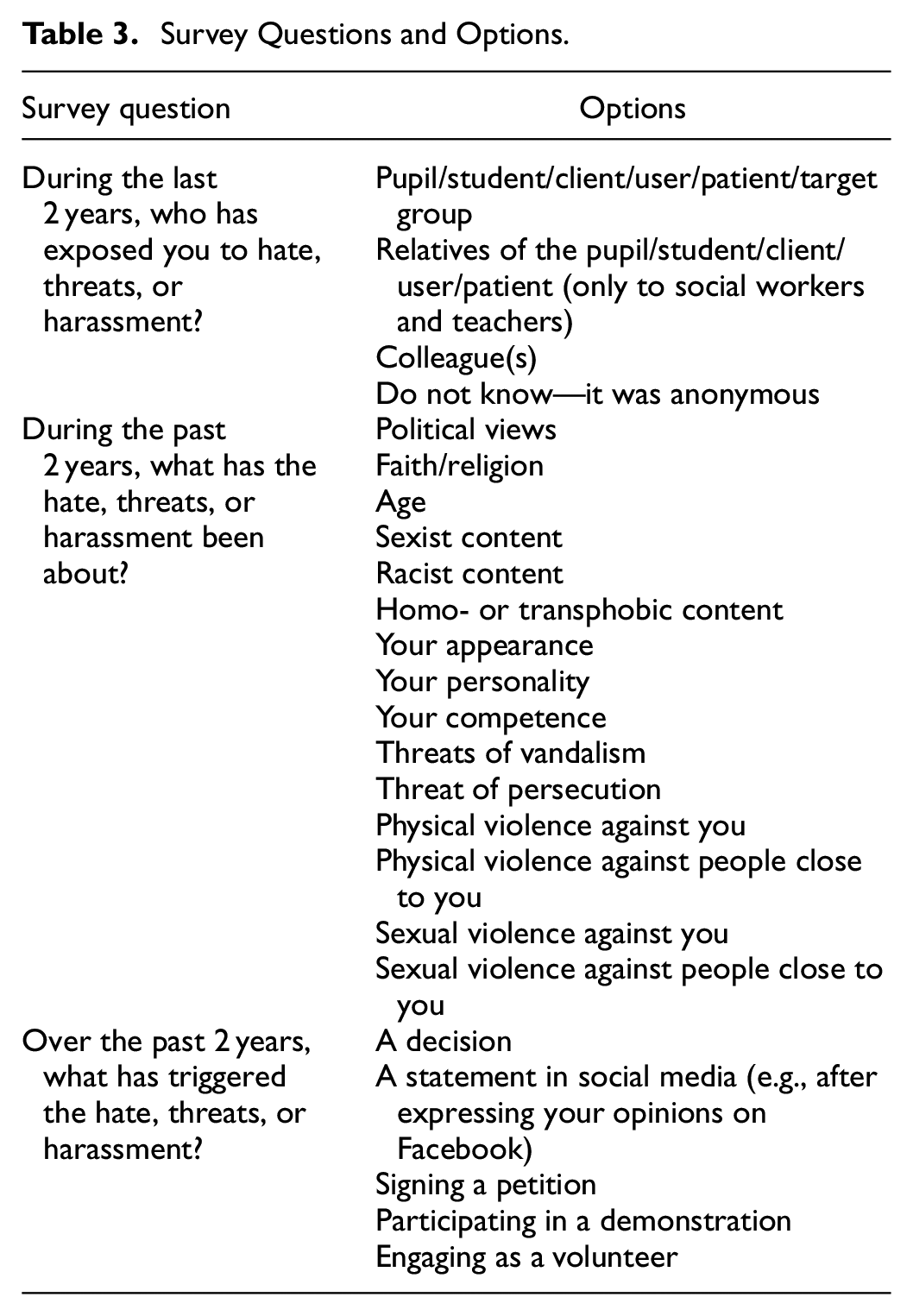
As the table shows, the three questionnaires focused on the respondents’ experiences of different forms of workplace violence. Because the three professional groups differ when it comes to relationships, the first question had to be adjusted by giving social workers, teachers, and journalists different options. Another multiple-choice question, with 15 options, was designed to address what the hate, threats, and harassment was about, and it measured the frequency of different types of workplace violence regarding the content of the violence. This survey question was inspired by Löfgren Nilsson and Örnebring’s (2016) study on intimidation and harassment of Swedish journalists. Lastly, there was a multiple-choice question with five options that measured the frequency of different triggers. Also this question had to be adjusted by giving social workers, teachers, and journalists different options. SPSS was used to process the answers and they were analyzed by using bivariate analyses. Cramer’s V was used as a measure of association in cross-tabulation between nominal variables, giving a value between 0 and +1. The value 0 represents no association, while the value 1 represents complete association.
In the questionnaires, the respondents also had the opportunity to write free text responses after each survey question. They were asked if there was anyone else who had exposed them to workplace violence, if the workplace violence was about something else, and if something else triggered it because nuances can easily get lost in fixed alternatives. See Table 4.
Number of Free Text Responses.

The three survey questions generated 306 free text responses, and these were coded thematically and analyzed by comparing social workers, teachers, and journalists’ comments. Firstly, the free text responses were compared with the answers to the multiple choice questions. The analysis focused on information that exemplified and provided understanding for the options chosen by the respondent and on information that was not covered by the options provided in the questions. Secondly, the findings of the first step of analysis were compared across professional groups highlighting similarities and differences. The analysis of the free text responses adds an understanding of what is behind the numbers and highlights the nuances.
Results
Different Relationships Between the Professional Groups and the Perpetrators
The sum is not 100% because the respondents could choose several options. As Table 5 shows, there was a significant correlation between perpetrators and groups of professionals. Most of the respondents had been exposed to workplace violence from someone from their own target group. This was most common for social workers. The prevalence rates were 94% for the social workers, followed by 90% for the teachers and 70% for the journalists. These findings suggest that consumer-related violence was the most common for all professional groups. These results are perhaps not surprising because previous research shows that frontline workers, with close relationships to their target groups, are the most exposed to workplace violence.
Who or What Exposed the Respondents to Hate, Threats, or Harassment Shown as a Percentage of the Survey Responses.

Significance: † < 10%, * < 5%, ** < 1%, *** < 0.1%.
Looking at worker-on-worker relationship violence, the teachers were the most exposed, followed by social workers and journalists. In fact, almost one in five teachers had received hate, threats, or been harassed by colleagues, which suggests bullying in the workplace. What is also striking when looking at the table is that almost half of the journalists had received threats that were anonymous, but this was very rare for both social workers (3%) and teachers (3%). In these situations the relationship between the workplace and the perpetrator is unknown. However, these results are not surprising because unlike journalists, both social workers and teachers often know their target groups. Previous research shows that journalists are often exposed to workplace violence through the Internet and social media (e.g., Scaramuzzino, 2020; Löfgren Nilsson, 2017), and by using these communication channels it is easy for the perpetrator to remain anonymous. The results might indicate that there is a connection between interacting with the target group through the Internet and social media and getting anonymous threats.
For the free text response to whether there was someone else who had exposed the respondents to hate, threats, or harassment during the last 2 years, the similarities between the three professional groups’ answers was striking. Most of the respondents’ comments were “the manager.” These comments reflect a limitation with the study, because “the manager” was not an option in the questionnaires, only “colleague(s).” Some of the respondent wrote: “The headmaster harassed me.” Another teacher explained: “My boss offends me on a regular basis by ignoring me and making decisions regarding me without involving me.” Other respondents wrote about managers who harassed an entire team or department.
Other examples when it comes to social workers were “foster families,”“politicians,”“the whole mob on Facebook and Flashback,” 5 “former employee,” and “two former workplaces.” One respondent wrote about social media: “Someone who a client had hired with a false profile. The police cannot do anything. Still visible online. Yuk.” Another social worker wrote: “People who have applied for financial support from the parish.” When it comes to teachers, there were examples like “guardians,”“anonymous,” and “social worker.” The journalists had other examples. Some stated that it was when they reported on individuals or organizations, sometimes in combination, and others wrote that it was “the public,”“viewers,”“a reader,”‘an “ordinary reader”’, “people on social media,”“youth in the suburbs,”“older men,” and “an influencer.” The journalists also wrote about social media trolls: “100 % comes from the group of trolls, the racist tail that mobilizes as soon as we report on racism or integration or simply include someone with an immigrant background.” Another journalist wrote: “Readers outside my target group, social media trolls.” Some wrote about the harsh tone on social media: “Often it is people on social media who cross the line or readers who email hateful content, but it is very rarely pure threats.” A journalist wrote: ‘A family member’s opinion opponent. Hated more on other people’s “merits” than my own’. Some wrote that it was mostly nationalists or racists: “Turkish nationalists, Swedish racists.” Another wrote that it was people with an immigrant background: “People I have come across during my work. For example, a fire in a problem area. Often by people (with an immigrant background) who try to get me out of there under threat of physical violence.” In other words, all professional groups gave examples of both consumer-related violence and worker-on-worker relationship violence, and it becomes clear that within these two large categories there are multiple relationships that make the situation regarding workplace violence complex. The respondents, especially the social workers, also highlighted one relationship that is not explicit in the theory, namely other actors who the professionals collaborate with such as “foster families,”“politicians,” or other professional groups.
Different Contents and Expressions of Workplace Violence
There was a significant correlation between what the content was about and the profession. As Table 6 shows, almost three out of four journalists and social workers reported that the workplace violence that they had been exposed to during the past 2 years had been about their professional competence. These findings are consistent with a previous study on Swedish journalists (Löfgren Nilsson, 2016). About half of the teachers had similar experiences. Many also stated that it had been about their personality, and this was most common for the teachers, followed by the social workers and then the journalists. The journalists’ experiences differed from the other two professional groups, and almost one in four journalists stated that it was either sexist or racist content or about their political views (see also Löfgren Nilsson, 2016, who had similar results). As many as 40% of the teachers and 22% of the social workers stated that it was physical violence against them, and this might be connected to how these professional groups work. To some extent, social workers might be protected by bureaucracy, and journalists by their offices. However, most teachers meet their pupils in classrooms or at preschools on a daily basis, and their pupils might also be at ages where they have not yet learned how to manage feelings such as anger.
The Content of the Hate, Threats, or Harassment Shown as a Percentage of the Survey Responses.

Note. NS = non-significant.
Significance: † < 10%, * < 5%, ** < 1%, *** < 0.1%.
All professional groups reported that the content sometimes was about their competence. A social worker wrote: ‘I have been violated by former colleagues for my competence. Everything from that I did something that was “worthless” to being judged because I was too young to be able to have a valid opinion. In both cases, I quickly changed workplaces’. A teacher wrote the following: ‘Dissatisfaction with grading and sometimes with the course/competence…’. A journalist commented:
Unspecified threats that something will happen to me because I am a journalist. Threats that they will complain about how I conduct my work to my managers, perhaps also with the goal of ensuring that I get fired or am forced to do what the one who is threatening me wants me to do (for example, not covering an issue or covering the issues that they want to be covered and in the way that they want them to be covered).
Several journalists wrote that the hate, threats, and harassment were about that they either should or should not cover something: ‘The subject should not be covered by the media’. The hate, threats, and harassment were not always directed against one specific journalist, and it could be the competence of an entire newspaper. Another example was: ‘Someone who had not received their newspaper, that I have not helped my readers with things beyond my duties’.
A teacher wrote that the workplace violence was often connected to political views: “The pupils who praised the Sweden Democrats 6 took for granted that everybody who did not agree with their political views were Social Democrats, 7 lefties or something else. Their lack of knowledge was easy to prove wrong, but that did not stop them.” A journalist had been exposed to workplace violence because of “a statement that was not political.” The teachers had also been accused of being racist: ‘Rumors that become “true” as they spread. A student is dissatisfied with a grade and then the same student spreads the rumor that I have exposed the student to racism’.
Some of the respondents also wrote about sexist content and that they had been exposed to workplace violence because of their gender. A social worker wrote: “Sexual statements from male colleagues.” Another social worker wrote: “Also my gender, as a woman born in Sweden, I am a very easy target, a man with equal knowledge as me, even a man with a great lack of knowledge of the subject compared to me, we are equal in this matter. He was not exposed and hated; he was welcomed with open arms because he was a man of foreign origin….” A journalist wrote: “Because I am a woman. The violations are sexual insinuations, or ways of threatening me during interviews or other job situations, that would not have been used against a man.” Another journalist wrote: “After the interview the interviewee wanted to hug me. This has happened two times. No evidence that it was because of my gender, but I am a 30-year-old woman and they were 60+-year-old men.” Similar to one of the quotes from a social worker, a journalist wrote that women were sometimes seen as less competent: “My gender (i.e., I am a woman = less competent).” Some of the respondents also wrote that there were a connection between gender, age, and competence when it comes to the content of the violence.
Some of the examples were not only about the content, because some of the threats had actually been carried out. The teachers gave some examples of physical violence and vandalism: ‘beat’ and ‘threw chairs, furniture.’ However, many of the examples that the teachers gave in the questionnaire were abusive comments: ‘bad words,’’you are often stupid, ugly, and a fucking idiot’, ‘hateful words like bitch,’‘verbal abuse,’‘pupil acting out,’ and ‘that I am a fucking idiot.’ A teacher also wrote: ‘Verbal. I work with children in the third grade right now and several of them act out and are fighting, verbally threatening, have extremely bad language, etc.’ Another teacher wrote: ‘A custodian who offends me over the phone by calling all teachers scum bags and “threatened.” to never help a teacher if they came to their workplace (worked at the emergency at the hospital).’ It could also be ‘slander.’ Some teachers wrote about a general feeling of insecurity and fear that could manifest itself in different ways.
Some social workers wrote that their clients had not threatened them, but it occasionally had happened that the clients threatened to commit suicide or in other ways hurt themselves: ‘A relative who said that the client will commit suicide if the intervention goes through.’ Other clients had threatened social workers with reporting how they had been treated to the media or by spreading it on social media. Social workers commented that it had been ‘delusions.’ Some of the examples were explicit threats, and murder threats, while one respondent wrote: ‘subtle threats.’ These results show that the workplace violence seems to be strongly connected to the professional role, but also to how gender, age, ethnicity, and political views appear in the content.
The Triggers of Workplace Violence
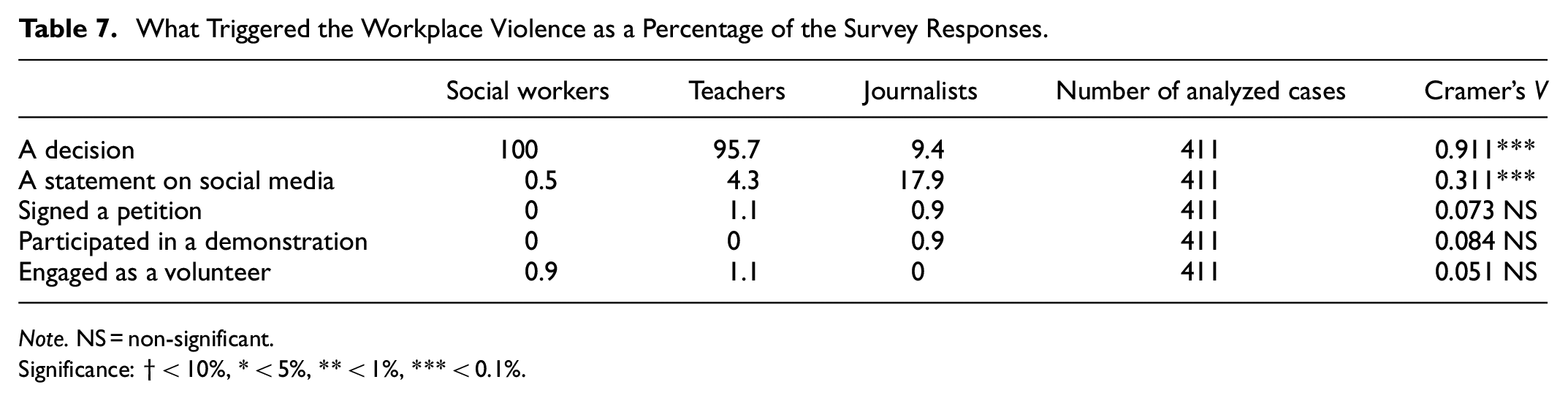
As Table 7 shows, only 411 respondents answered this question. However, there was a significant correlation between professions and that a decision or statement on social media had triggered the hate, threats, or harassment. All of the social workers responded that a decision triggered the violence, as did 96% of the teachers. These results show that for social workers and teachers making decisions is a critical point that can trigger workplace violence. Making different types of decisions about, for example, maintenance support, housing, treatments (social workers), and grades (teachers) are important tasks for these professional groups and can have considerable impact on their target groups’ lives. Only 9% of the journalists reported that the violence was connected to some type of a decision. This leads to the question of what triggered the journalists be exposed to hate, threats, and harassment. Because the selected professional groups have different work tasks, journalists were given a specific alternative in their questionnaire: An article, a report, a television program, or a radio program. Almost all of the journalists (94%) stated that it was connected to when they had published an article, report, television program, or radio program. These results therefore suggest that there is a connection between workplace violence and these professional groups’ authority roles. The three groups of professionals were also asked about social media. Almost 1 in 5 journalist reported that a statement on social media triggered the violence, but fewer teachers and almost none of the social workers wrote that a statement on social media was the spark. The results also suggest that receiving hate, threats, and harassment are very much connected to the professional role and not private engagement in social issues, for example, through demonstration or volunteering.
What Triggered the Workplace Violence as a Percentage of the Survey Responses.
Note. NS = non-significant.
Significance: † < 10%, * < 5%, ** < 1%, *** < 0.1%.
The free text responses were much in line with the results of the survey questions, but the comments gave important nuances. For example, several of the social workers wrote that it often was a decision that had caused the workplace violence, that is, their authority role, and they gave descriptions of situations where their clients had burst out after receiving a decision that the clients did not agree with, such as compulsory care, or dissatisfaction with an intervention. Some instances were: ’disagreement on assessments’, ‘clients who take out their frustration when they do not get what they want,’ and ‘for example, when I deliver a negative decision to placed youth.’ A few social workers also wrote that the violence had occurred when the clients did not get their treatment fast enough: ‘The patients did not receive different treatments and certificates as quickly as they wanted.’ Sometimes the social workers also had been exposed to workplace violence because of other authorities’ decisions: ‘My limited ability to control other authorities’ decisions.’ In the relationship between the social worker and their client there is often a power imbalance, and the same goes for the teacher and their pupils. It is interesting to notice that, in the opinion of many respondents, it is the exercise of power, that is, taking decisions that affect the target groups that triggers workplace violence.
For example, most teachers wrote that it was after they reprimanded pupils that they were threatened, that is, the trigger was their disciplinary role in the school, and they gave several examples of such situations: ‘Conflict between pupils or after reprimanding a pupil,’‘when I say that smoking is prohibited at school,’ and ‘pupils who disrupt the class and do not listen.’ One of the teachers wrote: ‘for example, when I limit the student’s time at the computer/iPad or take the computer/iPad because the student does not use it as a teaching tool. Because the pupil does not want to do the tasks they are assigned.’ Both the social workers and the teachers wrote that suspecting abuse and reporting this to the social services has also often caused them to be exposed to workplace violence.
Some of the social workers and teachers also wrote that the violence occurred because they work with a specific target group that sometimes has difficulties in dealing with their own anger, and in some of the comments it was described as ‘part of the job.’ Examples of this include: ‘Client with mental illness,’‘client with psychosis,’‘dissatisfied relative with substance abuse problems,’’meeting with drug-affected youth’, ‘angry and dissatisfied client,’‘desperate client who felt bad, attacks because he thought that he did not get enough.’ Some of the teachers wrote: ‘Children are not always aware that they violate other children or the staff, but it happens at the preschool that I work at’ and ‘At the preschool for children with special needs, there are very often kicks, shoves, and verbal threats because we have pupils who are acting out because of their diagnosis.’ Several of the respondents also wrote that it had been parents or relatives who felt discontented in some way.
The journalists stated that they had been exposed to workplace violence after media coverage: ‘A book that I have written’ or ‘often after an interview I did on television….’ Some of the journalists wrote that it was also highly related to social media: ‘Facebook posts,’‘Was searching for a case on Facebook,’ and ‘…when we have moderated comment sections or in other ways expressed ourselves in social media and I have signed with my name.’ Being a union representative was also given as an example of what had triggered the workplace violence during the past 2 years, especially for journalists and teachers. A journalist wrote: ‘Have worked within the union.’ A teacher wrote: ‘I occasionally am exposed by managers in my role as a union representative. The managers use master suppression techniques and verbal abuse. Quite delicate and maybe part of the game, but nonetheless harassment.’
What is common for all professional groups is that the workplace violence had sometimes been interpreted as non-motivated and unprovoked and they did not know what triggered it. This was evident from some of the social workers’ comments such as: ‘Not motivated,’‘unclear,’ and ‘only by providing information on what help is available.’ Along the same line, some of the teachers’ comments were: ‘no special reasons’ and ‘nothing.’ What was also common for all professional groups is that some of them had interpreted being exposed to hate, threats and harassment just because of their professional role. Some social workers wrote: ‘My professional role and my duties in the Prison and Probation Service,’‘frustrated parents who are powerless - have not felt that it was directed to me personally.’ Some journalists wrote that being a journalist in itself can create hate: ‘Because I am a journalist – that in itself causes hate by some, and simply the fact that I am a journalist can cause others to express insults, hate, or threats against me.’ Several journalists wrote that it was because of their ‘professional role,’‘my job as a journalist,’ and ‘my journalism.’ Others wrote that it was because of the hate against public service: ‘Because I work for Swedish Television’ and ‘employed in public service.’ The hate against the public service was particularly strong within certain groups, according to the respondents. Another journalist wrote: ‘It is more about efforts in general, or if I said something wrong or misunderstood. Not directly about views or values, because I work mainly with financial journalism and stocks.’ One journalist wrote: ’It has seldom been personal’. The free text responses show that all three professional groups tend to interpret the workplace violence as triggered by positions and exercise of discretion and power that is mainly inherent with their professional role and not something outside of the ordinary. As the professionals have different positions and work tasks the descriptions tend to vary both within and across professional groups.
Conclusions and Discussion
The present study has some limitations that are important to address. Firstly, established measurements have not been used in investigating workplace violence, rather they are based on self-reporting. This means that there are potential self-reporting biases that have to be taken into account when interpreting the results. As Tarraf et al. (2017) rightfully discuss, what can be considered as workplace violence differs both between individuals and between contexts, as there might be different norms and values. This means that the results from the Swedish context can’t directly be generalized to other national contexts. However, the results of this study are in line with previous international research and professional groups tend to share ethical norms and values across national contexts. That being said, the study provides insights into Swedish social workers, teachers, and journalists’ experiences of workplace violence. An important contribution to previous research is made by comparing three groups of professionals and showing the similarities and differences in their experiences (see also Waddington et al., 2004, 2006) and by including both consumer-related violence and worker-on-worker relationship violence. Consumer-related violence was the most common type of workplace violence for all three professional groups. The perpetrator was often someone the victim knew. The journalists had however partly a different situation as almost half of them had received anonymous threats, which was not so common for the other professional groups. Many of the respondents also reported that the workplace violence that they had been exposed to during the past 2 years, had been about their professional competence or their personality. However, several journalists had also experienced that the workplace violence included sexist or racist content or focused on their political views, while many teachers and social workers stated that it included physical violence against them. Almost all of the social workers and teachers responded that a decision caused the workplace violence, while for the journalists the main trigger was an article, a report, a television program, or a radio program. Some of the journalist also had experienced that a statement on social media triggered workplace violence.
The results from the quantitative analysis are consistent with and seem to confirm much of the previous research presented in this article. However, by also including and analyzing free text responses, the current study contributes with an understanding of what is behind the numbers. The free text responses have made it possible to confirm, deepen the understanding of but also challenge the results of the quantitative analysis. An example of the latter is that neither managers nor other groups that the respondents collaborate with (e.g., other professional groups, politicians or foster families) were included as alternatives in the questionnaire. The free text responses also highlight nuances within the categories (i.e., consumer-related violence and worker-on-worker relationship violence) used in the questionnaire. The similarities and differences between the professional groups also become more visible as they allow contextualization of the answers to each specific profession. The article hence also contributes to current methodological discussions regarding how workplace violence is conceptualized and how survey questions can be formulated to be able to grasp the multitudes of possible abusive relations (see e.g., de Wet & Jacobs, 2021 for workplace bullying in schools).
While all of these professional groups have a formal power position in society, they are also vulnerable in the sense that they are all highly exposed to workplace violence due to the multiplicity and variety of relationships they are involved in, in their professional roles. Drawing from this data it is not possible to show a causal relationship between position of power and workplace violence. However, in the free text responses there are indications that several of the respondents understand being exposed to workplace violence as linked to their formal position of power or to their exercise of it. This could open for two different research problems to be further investigated.
Firstly, for further research, it would be interesting to study causal relationships between formal position of power and workplace violence for instance by exploring the concrete situations when the professionals are exposed. Another approach could be to study the perpetrators’ perspective on the situation. Also the content of the hate, threats or harassment could be analyzed to get a less subjective view of the possible link between workplace violence and power positions.
Secondly, studies could focus on the more cognitive dimension of the relationship between victim and perpetrator. Waddington et al. (2006) for instance argue that how the victim experiences workplace violence is dependent on the identity of the perpetrator. In some of the free text response social workers and teachers wrote that being exposed to workplace violence to some extent was ‘part of the job’ because they worked with a target group that sometimes had difficulties in dealing with their own anger, like preschool children or clients with psychosis, mental illness or drug-addiction. The mechanisms behind how victims, make sense of and account for the workplace violence that is directed to them could also be explore further. For future research, it is therefore important to conduct more qualitative studies to explore perpetrators’ motives for exposing social workers, teachers and journalists to workplace violence as well as the impact of organizational culture on workplace violence.
The study also has some practical implications. Kodellas et al. (2014) argue that professionals who are informed about the risk of victimization are in a much better position to take the necessary precautions against workplace violence. Knowledge about workplace violence (who, what and why) is crucial in order to come to terms with the problem. For example, knowledge on what triggers workplace violence, makes it easier to prevent it. To prevent these kinds of situations, it is also important for organizations such as the social services, schools, and newspaper offices to have well-functioning channels and procedures where target groups can express both their appreciation and dissatisfaction with the services offered or decisions taken, and also opportunities to appeal against a decision.
Footnotes
Declaration of Conflicting Interests
The author declared no potential conflicts of interest with respect to the research, authorship, and/or publication of this article.
Funding
The author disclosed receipt of the following financial support for the research, authorship, and/or publication of this article: Swedish Research Council for Health, Working Life and Welfare, grant number 2017-01153
An Ethics Statement
This study has been approved by the Regional ethical review board in Lund, Sweden (Dnr 2018/144)

Data Availability Statement
Data sharing not applicable to this article as no datasets were generated or analyzed during the current study.