




Abstract
Recently, promoting inclusive education has become the central initiative for governments worldwide. The Universal Design for Learning (UDL) framework has been developed to address students’ differences and meet their learning needs. Although some literature has examined the effectiveness of the UDL framework in teaching practices, little research has explored teachers’ and students’ beliefs toward the UDL framework. This study used a scoping review methodology to locate previous studies about teachers’ and students’ beliefs regarding the UDL framework published in peer-reviewed journals in the past 10 years (2014–2023). The data analysis conceptualized three themes and indicated that most teachers and students held positive beliefs toward the UDL framework and thought that the UDL framework could support inclusive practices. However, some barriers, such as teachers’ misconceptions, inflexible curriculum, and inadequate professionals, influenced teachers’ implementation of the UDL framework. The implications for future research and the recommendations for teachers’ practices and professional development are also provided.
Keywords
Internationally, after the Salamanca Statement and Framework for Action on Special Needs Education issued in 1994, education for all, equity, and inclusion have become the central theme of special education. Governments worldwide have aimed to ensure that all children, including children with disabilities, can receive equitable access and appropriate education. The United Nations Convention on the Rights of the Child emphasizes that children with disabilities should have equal opportunities for education with their typically developing peers (United Nations Children’s Fund [UNICEF], 1989). The United Nations Convention on the Rights of Persons with Disabilities also indicated the importance of creating an “inclusive education system” to ensure that children with disabilities receive appropriate education (United Nations Division for Social Policy and Development Disability [UNDSPDD], 2006). Therefore, this highlights that teachers and schools should explore effective educational models to meet educational needs and promote inclusive education practices for all students. Based on the international inclusive education initiatives, developing flexible curricula and implementing effective teaching strategies are significant for teachers to ensure all students can access and engage in learning processes without barriers.
Universal Design for Learning (UDL) is a theoretical and practical framework that supports teachers in addressing the diversity of students in the classrooms and meeting students’ needs and interests (Centre for Applied Special Technology [CAST], 2018). Based on neuroscience research, the UDL framework includes three main guiding principles: (a) multiple means of representation, (b) multiple means of action and expression, and (c) multiple means of engagement. These three principles are essential in guiding teachers to provide multiple ways to represent course contents and knowledge, engage students in the learning process, and help students demonstrate their understanding (CAST, 2018). The principles also reflect that teachers have opportunities to design appropriate learning environments and programs to support access for all students, guide students to establish learning goals, and plan curriculum and teaching practices to meet students’ individual needs (Carrington et al., 2020).
Recently, many studies have been conducted to investigate the implementation of the UDL framework in primary and secondary schools. Some researchers also explored how the framework influenced teachers’ inclusive practices for students with disabilities in the classrooms (Adu-Boateng & Goodnough, 2022; Carrington et al., 2020; Israel et al., 2022). Thus, the research on the UDL framework has become a “hot topic” in education. There were some systematic reviews and meta-analyses of the literature, such as Capp (2017), Ok et al. (2017), Al-Azawei et al. (2016), and Almeqdad et al. (2023), to examine the effectiveness of the UDL framework in teaching practices. For example, Capp (2017) indicated that the UDL was an effective teaching strategy that could improve the learning process for students. Ok et al. (2017) also found that the engagement, access, and academic outcomes for students with disabilities were improved after implementing the UDL framework. Indeed, the UDL framework has been widely used in schools to promote inclusive education for students, especially for students with disabilities.
However, Meyer et al. (2014) mentioned that the most recent and crucial theoretical development of the UDL framework was about teachers’ beliefs or philosophies of teaching. Thus, understanding teachers’ beliefs toward implementing the UDL framework is essential to guide their practices. Based on the search of the literature, only a few studies explored teachers’ beliefs about the UDL framework. Also, little research could be found to investigate students’ perceptions of learning if teachers used the UDL framework. The lack of teachers’ and students’ perspectives seems to be a gap in the literature. Therefore, the main goal of the present study was to fill the gap, construct a clear understanding of teachers’ and students’ beliefs, and analyze how these perceptions facilitate or obstruct teachers’ implementation of the UDL framework. Two research questions that guided the current review were as follows:
(1) What are teachers’ and students’ beliefs towards the UDL framework?
(2) How do teachers’ beliefs influence their practices in implementing the UDL framework?
The authors believed that a clear understanding of teachers’ and students’ beliefs regarding the UDL framework might inform teachers’ future curriculum design and teaching practices to ensure that all students, including students with disabilities, could be engaged in classroom activities. The resulting information of this research would also provide theoretical and practical implications for promoting the equity and quality of inclusive education.
Research Methodology
This study used a scoping review methodology, a newly established review methodology, to determine the scope of literature on a specific topic, map the available evidence, and summarize and disseminate research findings (Arksey & O’Malley, 2005; Munn et al., 2018). Munn et al. (2018) stressed that the scoping review methodology was more appropriate for researchers to find evidence to inform practice and identify specific characteristics and/or concepts within studies. Thus, the scoping review was relevant for identifying teachers’ and students’ beliefs towards the UDL framework. In order to ensure that the research was transparent and reproducible, which were the central objectives of the scoping review, the researchers applied the “scoping review framework” developed by Arksey and O’Malley (2005) to conduct the current review. The framework included five steps, including (a) identifying the research questions, (b) identifying relevant studies, (c) selecting studies, (d) charting the data, and (e) summarizing and reporting the results.
The Search Strategy
The researchers followed the Preferred Reporting Items for Systematic Reviews and Meta-analysis (PRISMA; Moher et al., 2009) for the current review to ensure reproducibility and rigor. Four major electronic databases in education and psychology were used to locate relevant literature in peer-reviewed journals, including ProQuest Education Database, Eric, Scopus, and Web of Science. All selected studies for this scoping review focused on how teachers’ and students’ beliefs implementing the UDL framework influence inclusive education from early childhood to secondary education.
According to the literature related to the UDL framework, most studies conducted before 2014 focused more on the effectiveness of the UDL framework in inclusive education and how the framework guided teachers’ practices and curriculum design. Until 2014, Meyer et al. (2014) emphasized the importance of exploring teachers’ perceptions and philosophies of the UDL framework and how their beliefs influenced whole-school practices, so there have been theoretical shifts in the UDL framework after 2014. Therefore, the authors tried to find the most recent empirical literature about teachers’ and students’ beliefs about the UDL framework. The literature within the past 10 years, between 2014 and 2023, was located for the current review.
The search terms should relate to the UDL and inclusive practices, including: (“universal design for learning” OR UDL), (teacher), (student OR child), and (inclusive OR inclusion). The authors combined all searching terms with the Boolean operator “AND.”
Identifying Relevant Studies
In order to investigate teachers’ and students’ beliefs toward the UDL framework, the inclusion criteria for identifying relevant studies must focus on “beliefs” or “perceptions” and the UDL framework. Thus, the inclusion criteria to screen relevant articles for the current review were studies that (a) included special/mainstream education teachers and/or students from early childhood to secondary school levels, (b) focused on teachers’ and/or students’ beliefs, (c) related to the implementation of UDL framework, (d) published in peer-reviewed journals, (e) written in English, (f) published between 2014 and 2023, and (g) were empirical research.
The exclusion criteria that were set to eliminate articles searched from databases were articles that (a) were written in other languages except for English, (b) were not published in peer-reviewed journals, (c) focused on post-secondary school levels, (d) explored other professionals’ or school personnel’s (e.g., administrative staff, principals, etc.) beliefs and experiences, (e) did not focus on the beliefs and experiences of implementing the UDL framework, (f) compared different teaching strategies or evidence-based practices, (g) duplicated across databases, (h) published not between 2014 and 2023, and (g) reviews, editorial commentaries, opinion pieces, and grey literature. The reason for not including grey literature was that grey literature was often related to government reports or policy statements, which were less likely to investigate teachers’ and students’ beliefs toward the UDL framework.
Study Selection
The first author followed the “scoping review framework” to conduct the database search and select articles. She entered the predetermined search terms into each database to find relevant articles, created a blank table in Microsoft Word, and copied and pasted article titles, abstracts, and website links into the table. Two authors read the titles and abstracts independently to conduct an initial screening, and the results were filled into a spreadsheet. The spreadsheet included article titles, abstracts, justification for inclusion or exclusion, and a detailed list of each inclusion criterion to record screening results. After the initial screening, the two authors compared their results and discussed disagreements. Articles selected from the initial screening were used for full-text screening.
The full-text screening followed the same procedures as the initial screening described above and found articles that met all inclusion criteria. Two authors compared screening results and discussed and resolved discrepancies. Finally, 16 articles that met all inclusion criteria were selected for the current scoping review. Figure 1 is a visual representation of each screening stage via PRISMA.

Flow diagram of search results (in line with PRISMA guidelines [PRISMA’s four phases flow information diagram of a systematic review]).
Data Analysis Procedures
Data from the selected articles was analyzed using a thematic analysis approach. Thematic analysis is proper to “identify, analyze, and report patterns (or themes) within data” (Braun & Clarke, 2006, p. 79). It is particularly effective to explore teachers’ and students’ beliefs in teaching and learning (Braun & Clarke, 2006). Based on the aim of this scoping review, this data analysis approach was appropriate to meet the aim of the current scoping review.
Results and discussion sections of selected articles were analyzed to identify codes, categories, and themes. During the analysis, each article was read at least three times. The initial reading aimed to briefly understand the contents of articles, the second reading was to code information inductively, and the final reading was to review the codes and make changes. In order to ensure the reliability of data analysis, two authors coded one qualitative study and one quantitative study independently, and then, the coding results were compared. The first author followed the same coding procedures and standards to code all selected articles. Finally, two authors discussed codes and categories raised in the data analysis and eliminated disagreement. These categories were then condensed into themes reporting teachers’ and students’ beliefs toward the UDL framework.
Research Results
Demographics
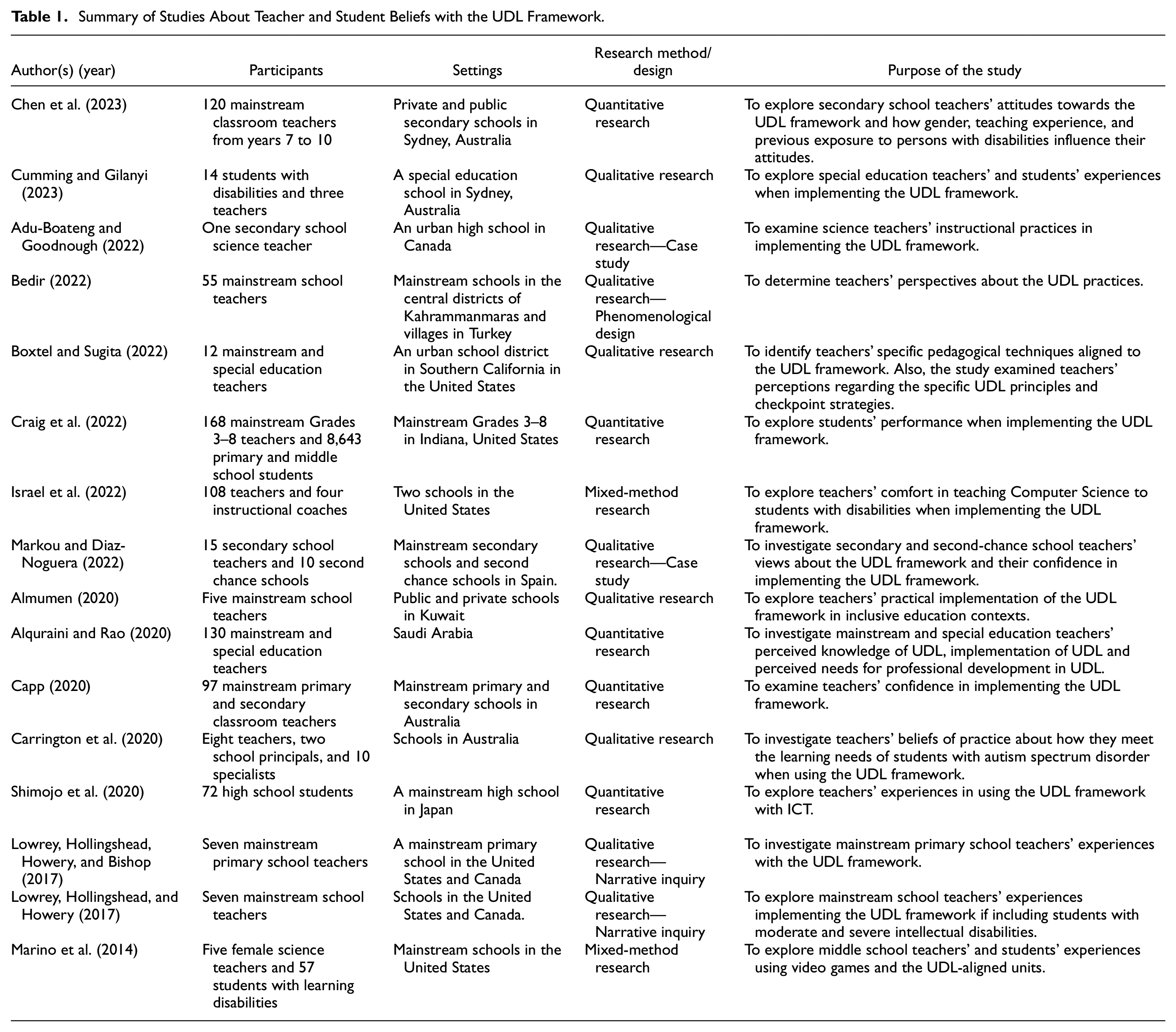
After the data analysis, 16 studies that met the inclusion criteria were selected for the scoping review. Nine studies applied a qualitative approach, five employed a quantitative approach, and two used a mixed-method design. Three studies explained teachers’ and students’ beliefs toward the UDL framework, and the other 14 studies only included teachers’ beliefs and experiences. Seven studies were conducted in North America, including the United States and Canada. Five studies were in Asia-Pacific, including Australia (four) and Japan (one). Three were conducted in the Middle East, including Turkey, Saudi Arabia, and Kuwait, and one was in a European country (Spain). 13 studies were conducted in and after 2020, and only three were before 2020 (two in 2017 and one in 2014). This indicates that more researchers have started to explore teachers’ and students’ beliefs about the UDL framework after 2020 instead of only focusing on the effectiveness of the UDL framework in teaching practices. Table 1 provides detailed information about each selected study.
Summary of Studies About Teacher and Student Beliefs with the UDL Framework.
Analytical Results
After applying the thematic analysis, 91 codes and 28 categories were generated from selected articles. Then, 28 categories were condensed into three themes to conceptualize teachers’ and students’ beliefs about the UDL framework, including (a) UDL implementation, (b) pre-requisites and benefits of implementing the UDL Framework, and (c) challenges and barriers of implementing the UDL framework. These three themes could answer two research questions. Each theme was presented separately in the following section to align with the research questions of the scoping review.
UDL Implementation
When considering the UDL implementation, the researchers divided this section into three sub-sections, including (a) beliefs about the functions of the UDL framework, (b) beliefs about three principles of the UDL framework, and (c) beliefs about how the UDL framework support the inclusive education development.
Firstly, teachers in Shimojo et al.’s (2020) study pointed out that UDL was based on learner-centered pedagogy, so the UDL framework was used for all students, regardless of their disability status and their placements in either mainstream or special education classrooms (Almumen, 2020). Research showed that UDL could benefit all students in the classrooms, including students with disabilities, and it was particularly effective in meeting students’ needs and supporting them to improve outcomes and achieve potential (Craig et al., 2022; Lowrey, Hollingshead, Howery, & Bishop, 2017). Thus, many teachers believed that the central theme of the UDL framework was to ensure accessibility and flexibility for all (Almumen, 2020; Bedir, 2022; Boxtel & Sugita, 2022; Lowrey, Hollingshead, & Howery, 2017).
During the UDL implementation, teachers in four studies thought that they must plan and create an accessible and flexible environment before practice (Boxtel & Sugita, 2022; Carrington et al., 2020; Lowrey, Hollingshead, & Howery, 2017; Lowrey, Hollingshead, Howery, & Bishop, 2017). Lowrey, Hollingshead, Howery, and Bishop (2017) mentioned that planning intentionally might help teachers overcome barriers in teaching practices, and then, students’ skills and knowledge learned from classes could be easily generalized. The creation of the environment should be based on the three principles of the UDL framework. For example, a teacher in Bedir’s (2022) study stated that the diverse learning environment she created included various visual and auditory tools and educational games. Therefore, many teachers in the selected studies believed that three UDL principles, multiple means of representation, action and expression, and engagement, could help them design a more inclusive and accessible curriculum for all students (Boxtel & Sugita, 2022; Carrington et al., 2020; Lowrey, Hollingshead, Howery, & Bishop, 2017).
Secondly, teachers believed that three principles of the UDL framework could guide their practices to meet students’ learning needs. Regarding “multiple means of representation,” teachers often used multiple resources, such as video clips, texts, Google translate software, Google Classroom, online sources, pictures, audio, etc., for representation (Adu-Boateng & Goodnough, 2022; Almumen, 2020). For example, teachers in Bedire’s (2022) study specifically explained that they used assistive technology (AT), individual tablets, and ear pods to represent lesson contents for students with disabilities and to promote their access to the curriculum. In Adu-Boateng and Goodnough’s (2022) study, Sandra (a teacher) used mnemonics to illustrate essential concepts in biology. Also, five studies discussed how teachers applied visual systems to represent information for students with disabilities.
In some selected studies, teachers emphasized the need to provide “multiple means of action and expression.” For instance, some teachers stressed that it was essential to provide different options for students to express their understandings, and assessment should be flexible to ensure that students could use different ways to finish assessments (Adu-Boateng & Goodnough, 2022; Almumen, 2020; Lowrey, Hollingshead, Howery, & Bishop, 2017). Teachers in Adu-Boateng and Goodnough’s (2022) study pointed out that “not all children do well in pencil and paper tests” (p. 312), so the assessments should include projects, drawings, group work, etc., for students’ choices. Technologies like laptops and tablets could also help students express their understanding and needs (Almumen, 2020).
In addition, in terms of “multiple means of engagement,” many teachers in the selected studies expressed how they designed different activities to promote student engagement. Almumen (2020) stated that a participating teacher in the study designed different activities incorporating students’ interests to increase engagement. Thus, it was important for teachers to provide different resources, such as technologies, pictures, tangible objects, words, activity cards, educational games, etc., to engage students in learning processes (Adu-Boateng & Goodnough, 2022; Almumen, 2020; Bedir, 2022; Carrington et al., 2020).
However, Capp (2020) found that although many teachers believed that the three principles of the UDL framework were practical to guide their practices, most teachers felt more confident using multiple ways to represent information than in promoting students’ engagement and allowing students to demonstrate their understanding in multiple ways. Since special education teachers had more knowledge of disabilities and inclusive strategies, special education teachers in Markou and Diaz-Noguera’s (2022) study showed more confidence in implementing the UDL framework than mainstream school teachers.
Thirdly, teachers believed that the UDL framework was essential to promote the development of inclusive education. According to the inclusive philosophy, meeting students’ individual needs was emphasized by many teachers in the selected studies. Teachers believed that the UDL framework guided them to provide multiple ways to promote students’ access and meet their needs (Carrington et al., 2020). Indeed, Marino et al. (2014) indicated that students felt that the curriculum resources that teachers used based on the UDL principles could meet their preferences and learning needs. Teachers also thought that technologies could help increase students’ access to learning processes, but they were responsible for providing extra support if needed (Adu-Boateng & Goodnough, 2022; Almumen, 2020; Bedir, 2022; Lowrey, Hollingshead, Howery, & Bishop, 2017). Students in Marino et al.’s (2014) and Markou and Diaz-Noguera’s (2022) studies indicated that they appreciated the availability of options that teachers provided to support them in accessing the lesson contents flexibly. Therefore, students with disabilities believed that integrating the UDL framework into teaching practices could make their learning closer to mainstream schooling (Cumming & Gilanyi, 2023). Nevertheless, primary school teachers felt more confident using the UDL framework than secondary teachers due to the lower academic pressures and the restrictions on the curriculum (Capp, 2020). Although teachers played essential roles in students’ learning, many participating teachers in the selected studies believed that involving parents and other professionals was essential when implementing the UDL framework. Some teachers in Almumen’s (2020) study indicated that all stakeholders related to students’ learning, such as school personnel, parents, faculty members, etc., should have comprehensive knowledge of the UDL framework to support teachers’ implementation.
Pre-Requisites and Benefits of Implementing the UDL Framework
Although three principles of the UDL framework were emphasized by many teachers, and they believed that “multiple means of representation, action and expression, and engagement” could support their curriculum planning, teaching practices, and assessment design, most teachers in selected studies felt that there were 10 pre-requisites to successfully implement the UDL framework, including knowing students well, holding high expectations, being flexible for change, needing clear guidelines, understanding the recent research findings, having knowledge in special education, having sufficient programming time, providing practical pre-service training in the UDL framework, collaborating with other professionals, and providing effective in-service professional development. Many teachers believed that teachers must understand their students’ abilities, needs, and interests before planning and implementing the UDL framework (Adu-Boateng & Goodnough, 2022; Bedir, 2022; Carrington et al., 2020; Lowrey, Hollingshead, & Howery, 2017). Moreover, teachers must have sufficient knowledge of special and inclusive education and be willing to change their teaching strategies and curriculum design (Adu-Boateng & Goodnough, 2022; Almumen, 2020; Carrington et al., 2020; Lowrey, Hollingshead, Howery, & Bishop, 2017; Markou & Diaz-Noguera, 2022). Hence, pre-service and in-service training was essential to support the implementation of the UDL framework for classroom teachers.
A teacher in Almumen’s (2020) study mentioned that the concepts of the UDL should be trained for future teachers during their undergraduate programs. Also, some teacher participants in four studies stressed that knowing special education, especially the UDL framework, was essential to prepare them to effectively implement the UDL framework (Adu-Boateng & Goodnough, 2022; Almumen, 2020; Lowrey, Hollingshead, Howery, & Bishop, 2017; Markou & Diaz-Noguera, 2022). Hence, many teachers stressed that professional development was essential to support their understanding of the UDL, but training should be specific and ongoing to guide their daily practices (Bedir, 2022; Cumming & Gilanyi, 2023; Lowrey, Hollingshead, Howery, & Bishop, 2017; Markou & Diaz-Noguera, 2022). For example, some teachers in Lowrey, Hollingshead, Howery, and Bishop’s (2017) study requested UDL resource persons and specialists to support their day-to-day implementation of the UDL framework and troubleshoot their instructional challenges. In addition, teachers emphasized that professional development about the UDL should align with their instructional needs, particularly around providing choice effectively, fostering students’ self-determination skills, strategies in cooperative learning, etc. (Adu-Boateng & Goodnough, 2022; Alquraini & Rao, 2020; Capp, 2020; Cumming & Gilanyi, 2023). Teachers believed that adequate training could help them gain knowledge in the UDL framework and make them believe in the advantages of implementing UDL in classrooms (Alquraini & Rao, 2020).
Many teachers felt that the most significant benefits of the UDL framework were to address students’ diversity and meet their learning needs (Bedir, 2022; Carrington et al., 2020; Lowrey, Hollingshead, & Howery, 2017; Lowrey, Hollingshead, Howery, & Bishop, 2017; Markou & Diaz-Noguera, 2022). Teachers believed that the UDL could develop students’ self-regulation and self-determination skills, and peer collaboration could be promoted if they could adequately implement the UDL framework (Adu-Boateng & Goodnough, 2022; Almumen, 2020; Boxtel & Sugita, 2022; Carrington et al., 2020; Lowrey, Hollingshead, & Howery, 2017). Some teachers in Bedir’s (2022) study thought that the UDL could provide students with equal opportunities to access learning processes. Indeed, the UDL was especially beneficial to support students with disabilities during teaching practices (Lowrey, Hollingshead, Howery, & Bishop, 2017). Teachers highlighted that the UDL framework could not only support students to be engaged in learning activities and improve students’ learning outcomes but also support their teaching to overcome potential barriers (Chen et al., 2023; Craig et al., 2022; Lowrey, Hollingshead, & Howery, 2017; Lowrey, Hollingshead, Howery, & Bishop, 2017). Therefore, getting students’ voices when implementing the UDL framework was helpful for teachers in designing a more appropriate and effective curriculum for inclusion (Lowrey, Hollingshead, Howery, & Bishop, 2017).
Challenges and Barriers to Implement the UDL Framework
Although many teachers believed that the UDL was beneficial to promoting students’ learning and supporting their teaching practices, they listed many challenges and barriers in implementing the UDL framework in real-life practice. Firstly, insufficient human resources and additional financial burdens were mentioned by some teachers (Adu-Boateng & Goodnough, 2022; Alquraini & Rao, 2020; Bedir, 2022; Cumming & Gilanyi, 2023). Alquraini and Rao (2020) found that teachers felt stressed during teaching practices due to large class sizes and low teacher-student ratios; therefore, teachers had difficulties using the UDL framework with many students.
Secondly, many teachers, especially secondary school teachers, felt overwhelmed by the inflexible curriculum and standardized testing (Adu-Boateng & Goodnough, 2022; Lowrey, Hollingshead, Howery, & Bishop, 2017; Markou & Diaz-Noguera, 2022). Some teachers mentioned that they must follow specific programs or materials during teaching, so it was challenging to adopt inclusive pedagogy (Adu-Boateng & Goodnough, 2022; Alquraini & Rao, 2020; Cumming & Gilanyi, 2023; Markou & Diaz-Noguera, 2022). A teacher said, “When the national or state governments come in and say these kids have to take this particular certification test to prove something … There is no UDL” (Lowrey, Hollingshead, Howery, & Bishop, 2017, p. 232). Although most teachers believed that the UDL was effective in inclusive education, they felt it extremely challenging not to teach to a test, as students need to graduate from high school (Adu-Boateng & Goodnough, 2022; Lowrey, Hollingshead, Howery, & Bishop, 2017; Markou & Diaz-Noguera, 2022).
Thirdly, many teachers in the selected studies highlighted the lack of professional development opportunities, and the professional development was often contradicted by an inclusive philosophy (Adu-Boateng & Goodnough, 2022; Almumen, 2020; Bedir, 2022; Markou & Diaz-Noguera, 2022). For instance, Sandra (a school teacher) shared that the professional development organized by the district and school focused on students’ achievement; then, the training sometimes compelled teachers to step away from inclusive education (Adu-Boateng & Goodnough, 2022). Also, teachers in Almumen’s (2020) study complained that the universities did not prepare them to implement the UDL framework in either theoretical learning or internship during the undergraduate study, and general education preparation programs were not concerned with the inclusion part. Due to the lack of training and knowledge in the UDL framework, many teachers believed that UDL was a great way to design an inclusive curriculum for all students in the classrooms, but they struggled to tie the UDL to day-to-day teaching practices (Almumen, 2020; Alquraini & Rao, 2020; Capp, 2020; Cumming & Gilanyi, 2023; Israel et al., 2022; Markou & Diaz-Noguera, 2022). Also, most teachers indicated that the lack of action plans to implement the UDL framework at schools was a big challenge during practices (Alquraini & Rao, 2020). Thus, although some teachers integrated the UDL framework into their classroom teaching, they were primarily under the “Engagement” principle (Israel et al., 2022).
Finally, teachers in the selected studies had misconceptions about the UDL framework. For example, some believed that the UDL was just “good” teaching and that there was nothing new compared to what they had previously done (Lowrey, Hollingshead, & Howery, 2017; Lowrey, Hollingshead, Howery, & Bishop, 2017). In addition, teachers thought that the UDL could only be implemented by using technologies (Lowrey, Hollingshead, & Howery, 2017; Lowrey, Hollingshead, Howery, & Bishop, 2017). Hence, teachers indicated that they could not use the UDL in teaching practices if students were not interested in technology, teachers were unfamiliar with technology, or schools lacked sufficient technical facilities (Alquraini & Rao, 2020; Lowrey, Hollingshead, & Howery, 2017; Markou & Diaz-Noguera, 2022).
Discussion
Gaps in the Literature
This scoping review presented the gaps in the literature focused on teachers’ and students’ beliefs toward the UDL framework. It is important to note that most studies about teachers’ and students’ beliefs regarding the UDL framework have been conducted in the last 3 years, in and after 2020. This aligns with Meyer et al. (2014), who states that the most important and recent theoretical development of the UDL framework is investigating teachers’ beliefs or philosophies about UDL practice. The answers to the research questions were clearly explained in the research results. However, there was a general lack of literature on the topic, particularly less literature that explored students’ voices in the UDL implementation, as most focused on teachers’ beliefs and experiences. Also, little research was conducted in Asian countries, as most were in Australia, the United States, and Canada.
The purpose of this scoping review was to answer two research questions: to find evidence from previous literature about teachers’ and students’ beliefs and the relationships between beliefs and practices in implementing the UDL framework. Then, some practical implications were raised after discussing the review results. Thus, this discussion section was structured based on the research questions to evaluate what beliefs were and how beliefs influenced practices.
Teachers’ and Students’ Beliefs Toward the UDL Framework
Beliefs About Inclusion When Implementing the UDL Framework
According to the scoping review, Lowrey, Hollingshead, Howery, and Bishop (2017) and Lowrey, Hollingshead, and Howery (2017) specifically highlighted that teachers had some misconceptions about inclusion when implementing the UDL framework. The research results of the current review showed that although most teachers believed that the UDL framework was beneficial in supporting inclusion for students, they thought that the UDL framework was beneficial in engaging students with disabilities in learning processes. Indeed, three principles of the UDL framework, “multiple means of representation, action and expression, and engagement” are beneficial to guide teachers’ practices in addressing students’ diversity and differences, just as Meyer et al. (2014) indicated that the primary goal of the UDL framework was to design for learners’ variability. It is worth mentioning that many teachers hold positive beliefs toward implementing the UDL framework, starting to realize the uniqueness of students, and trying to provide flexible curricula to meet individual needs during practice.
Nevertheless, the findings reflect that most teachers mainly focused on designing separate curricula for students with disabilities in inclusive classrooms instead of involving all students, including typically developing students, in teaching practices. Moreover, it conversely proves that most teachers in the selected studies still separate students with disabilities from their typically developing peers in the classroom rather than focusing on all students’ engagement in learning contents and activities. For example, one teacher in Lowrey, Hollingshead, Howery, and Bishop’s (2017) study stressed that “UDL has created for me a more individualized education for my kids” (p. 235). This indicates that although teachers try to use the UDL framework to promote inclusion, they have some misconceptions regarding inclusive education, as they just aim to involve students with disabilities in teaching practices but ignore the other students in the classrooms. This reflects that most teachers’ practices only stick to the philosophy of “integrated education”, which refers to simply integrating students with disabilities into mainstream classrooms rather than involving all students in teaching to achieve full inclusion.
Currie-Rubin (2013) and Lowrey, Hollingshead, and Howery (2017) highlighted that the UDL framework required teachers to shift their thinking about differences among students or variability as a problem; instead, teachers should recognize and teach the natural variability among all students. Therefore, planning intentionally when implementing the UDL framework is essential to reduce potential barriers and promote “full” inclusion (Hall et al., 2012). The results also emphasize the need for pre-service and in-service training about the UDL framework to prepare teachers to break down misunderstandings and change their beliefs about inclusive education. This may help teachers design a curriculum that can involve all learners in teaching based on the UDL framework and address learner variability to create a more inclusive learning environment.
Beliefs About the Relationships Between “Good Teaching” and the UDL Framework
Two studies in the current review showed that some teachers felt confusion between the UDL framework and so-called “good teaching” pedagogy. Some teachers believed that they had used UDL for several years, as they tried to engage students in different ways, but they had never realized that what they had applied was called “Universal Design for Learning” (Lowrey, Hollingshead, & Howery, 2017; Lowrey, Hollingshead, Howery, & Bishop, 2017). This finding is interesting, because the UDL framework, as an innovative theoretical and practical framework, guides teachers’ curriculum design, teaching practices, assessment, etc. Thus, the UDL framework is more than utilizing effective teaching strategies to address students’ variability and remove classroom barriers, just as Hall et al. (2012) and Meyer et al. (2014) emphasized that the UDL framework was much beyond “good teaching” pedagogy, and planning for student variability and diversity only could be seen as the foundation of the UDL framework. This suggests that teachers should extend their viewpoints about the UDL framework and change their attitudes that the UDL is just a teaching strategy. Teachers must understand that the UDL framework is used to overcome barriers before and during instructions and address potential issues during practice. The findings from the current review also highlight the necessity to adjust and update the contents of pre-service and in-service training in the UDL framework to inform teachers that the UDL is not just restricted to an effective teaching pedagogy to improve students’ engagement and academic achievement; instead, it is a theoretical and practical framework which is based on neuroscience research to guide teachers to integrate inclusive philosophy into planning and practices.
Beliefs About the Relationships Between Technology and the UDL Framework
After analyzing the selected studies, teachers in nine studies highlighted the importance of using technologies when implementing the UDL framework. Lowrey, Hollingshead, Howery, and Bishop (2017) and Lowrey, Hollingshead, and Howery (2017) mainly found that most teachers believed that technologies were the prerequisites for using the UDL framework. The results indicated that most teachers lacked the confidence to integrate the UDL framework into their curriculum design in mainstream schools, especially in science education (Bedir, 2022; Israel et al., 2022). Although the lack of knowledge of UDL is one of the main reasons that mainstream school teachers rarely apply this framework during practice (Almumen, 2020; Alquraini & Rao, 2020; Cumming & Gilanyi, 2023; Israel et al., 2022; Markou & Diaz-Noguera, 2022), some teachers in the selected studies felt that unfamiliarity with the use of technology is the other reason to limit their use of UDL framework (Lowrey, Hollingshead, & Howery, 2017; Lowrey, Hollingshead, Howery, & Bishop, 2017). Also, the scoping review showed that the shortage of technology in some schools was a severe problem limiting teachers’ implementation of the UDL framework (Alquraini & Rao, 2020). Notably, teachers in Bedir’s (2022) study pointed out that the lack of modern technology equipment was a stumbling block for mainstream teachers than for special education teachers in secondary schools.
Indeed, based on three principles of the UDL framework, technology plays an essential role in supporting the implementation of the UDL framework. However, Hall et al. (2012) and Rose et al. (2012) stressed that technology was not a requirement for the UDL implementation, as the UDL framework focuses more on what, how, and why to teach to increase students’ learning motivation, engagement, and academic outcomes. This indicates that most teachers misunderstand the functions of technologies when implementing the UDL framework and how technologies can be integrated into the UDL curriculum. Rose et al. (2012) mentioned that “UDL sets out principles that are focused on teaching and learning, not on technologies” (p. 120). Therefore, teachers must change their previous beliefs about technology, and their practices should focus more on the concepts of teaching and learning and teaching practice itself rather than relying on technology.
Beliefs About the Engagement Principle in the UDL Framework
According to the scoping review, seven studies explained how technologies increased students’ access and engagement (Adu-Boateng & Goodnough, 2022; Almumen, 2020; Boxtel & Sugita, 2022; Carrington et al., 2020; Lowrey, Hollingshead, & Howery, 2017; Lowrey, Hollingshead, Howery, & Bishop, 2017; Shimojo et al., 2020). However, Israel et al. (2022) pointed out that teachers primarily fell under the “Engagement principle” when implementing the UDL framework. This is aligned with Israel et al. (2020), who stated that teachers were more likely to apply for the “Engagement principle” than other UDL principles. There is no doubt that engagement was one of the most critical principles in the UDL implementation, as engagement was the foundation for students’ learning (Moreira et al., 2018). Nevertheless, this reflects that teachers feel confused about the three principles of the UDL framework and lack sufficient knowledge and skills to provide “multiple means of representation and action and expression” for all classroom students. On the other hand, although teachers may realize that technologies can support their teaching practices when applying the UDL framework, they still have low efficacy in using technologies during practice. Therefore, the findings provide significant implications for professional development and pre-service training about the UDL framework to gain teachers’ knowledge and skills in using the UDL framework and guide them in integrating technologies into representation, action and expression, and engagement.
Relationships Between Beliefs and Practices
Inflexible Curriculum Influences the Implementation of the UDL Framework
Regarding the UDL framework, students vary in learning abilities, motivations, and engagement during activities (CAST, 2018). Johnson-Harris and Mundschenk (2014) mentioned that all students could learn and achieve lesson objectives if teachers were flexible in instructions and curriculum design. However, many teachers in the selected studies complained that although they intended to apply the UDL framework, standardized testing and inflexible curricula limited their abilities to implement the UDL framework during practice, especially in mainstream secondary schools, as teachers believed that using the UDL framework might waste their teaching time to prepare for examination. For instance, some teachers in the current review felt that an inflexible curriculum mismatched the inclusive philosophy, so they had few opportunities to use the UDL framework during practices (Adu-Boateng & Goodnough, 2022; Alquraini & Rao, 2020; Markou & Diaz-Noguera, 2022). This indicates that although teachers believe that the UDL framework can guide their practices to meet students’ needs, most teachers lack the skills to effectively implement the UDL framework to teach lesson contents and address students’ diversity. Some teachers in the current review even held some misconceptions about how to use it. The findings highlight the need for more professional development to guide teachers in integrating standardized national curricula into the UDL implementation.
Nevertheless, some problems with professional development influence teachers’ beliefs about applying the UDL framework in practice. The current review showed that schools and local governments realized the importance of providing professional development for in-service teachers to improve their teaching skills, but professional development often focused on improving students’ academic achievement, which was averse to inclusive philosophy (Adu-Boateng & Goodnough, 2022). Although it is not new that some professional development cannot meet teachers’ teaching needs (Han et al., 2023), it is urgent to change the contents of professional development that can improve teachers’ skills to address the barriers of an inflexible curriculum and promote inclusion for all students. On the one hand, teachers must be motivated to learn knowledge and skills about the UDL framework, as the UDL framework can support teachers in being flexible in designing their teaching practices and meeting the standard teaching objectives. On the other hand, the results emphasize the need for local government and schools to organize appropriate professional development to meet teachers’ training needs, and it will be supportive if there are some strategies to help teachers actively implement the UDL framework even if they are pressured to increase students’ academic achievement.
Inadequate Professionals Influence the Implementation of the UDL Framework
Three studies indicated that inadequate teaching staff might limit teachers’ skills to implement the UDL framework (Adu-Boateng & Goodnough, 2022; Alquraini & Rao, 2020; Cumming & Gilanyi, 2023). Some even mentioned that they lacked the time and energy to use the UDL framework if the teacher-student ratio was low. The findings are consistent with previous literature that a lack of special education teachers with sufficient knowledge of the UDL framework or a lack of resource teachers was a critical barrier to inclusion (Forlin & Chambers, 2011). It suggests changing teacher arrangements to have inclusive education teachers in the classrooms to support the implementation of the UDL framework.
Beres (2001) stressed that teachers who intend to create inclusive classrooms must be specially trained and have sufficient pedagogical knowledge to understand and meet students’ different abilities, learning preferences, and needs. Thus, this highlights the need to provide ongoing professional development to train teachers with knowledge in inclusive practices. Also, actively collaborating with other professionals, such as special education teachers and resource teachers, and having co-teaching opportunities are significant to helping classroom teachers implement the UDL framework. Mainstream school teachers also need to gain knowledge in special and inclusive education, especially the UDL framework, just as Almumen (2020) indicated that everyone associated with students’ learning must have sufficient knowledge about the UDL framework. Therefore, UDL theories and practices should be included in undergraduate and postgraduate programs, and their teaching practicum supervisors must emphasize the application of the UDL framework before the internship. It is important for pre-service teachers to be ready to implement the UDL framework during practices and overcome the practical barriers to promote “full” inclusion for students.
Conclusion and Implications
In recent years, one of the leading initiatives in the education system has been promoting inclusive education to ensure that all students receive high-quality education without barriers. The UDL, as an innovative theoretical and practical framework, is essential in guiding teachers’ curriculum planning, teaching practices, and assessment design to address students’ diversity and meet their individual needs. This scoping review adds to the recent literature on the relationships between teachers’ and students’ beliefs and practices towards the UDL framework. However, due to the limited literature in this field, the authors suggest that more empirical studies about teachers’ beliefs and practices in implementing the UDL framework should be conducted in the future.
In summary, although there are several systematic reviews or meta-analyses to analyze the effectiveness of the UDL framework, very few studies have been conducted so far to systematically examine teachers’ and students’ beliefs when using the UDL framework and how teachers’ beliefs influence their practices to support inclusive education. This scoping review was the first to summarize and conceptualize teachers’ and students’ beliefs toward the UDL framework. The review showed that there has been little research to investigate students’ beliefs and experiences toward the UDL framework, as most explored teachers’ beliefs and attitudes in implementing the UDL framework during teaching practices. The research concludes that most teachers and students held positive beliefs toward inclusion, and they believed that the UDL was an effective strategy to not only promote students’ motivation and engagement but also meet students’ needs and interests. However, some barriers, such as teachers’ misconceptions about inclusion and technology, inflexible curriculum and standardized testing, and inadequate professionals, influenced teachers’ practices in implementing the UDL framework.
Recommendations for Practices
This scoping review can provide some practical implications for promoting the quality of inclusive education.
Firstly, schools and local governments should organize and provide UDL-related professional development to support teachers in gaining knowledge and skills about the UDL framework and changing their attitudes towards inclusion. According to the current scoping review, many teachers focused more on how the UDL supported students with disabilities than on how this framework could promote “full” inclusion for all students. Therefore, teachers should know that the UDL framework can effectively guide their practice involving all students in course contents and activities. Moreover, general teacher education programs should include some courses in inclusive education, especially the UDL framework that needs to be covered in the programs, and prepare pre-service teachers to be ready to use the UDL framework in future teaching practices.
Secondly, the current review indicated that providing sufficient professional development opportunities about the UDL framework was insufficient for teachers to effectively use this framework in practice. Instead, training should help teachers understand that the UDL framework is not just about a teaching strategy; it is recognized as a theoretical and practical model that guides teachers’ planning and practices. Hence, the contents of professional development should meet teachers’ training needs.
Thirdly, although technology plays an essential role when implementing the UDL framework, using technology is not a requirement to implement the framework during practice. Teachers need to realize that technology can only be seen as a tool to support teachers’ implementation of the UDL framework. As such, teachers’ familiarity with using technology should not be an issue that influences whether teachers select to use the UDL framework or not. Pre-service and in-service training should support teachers in following three UDL principles efficiently and encourage teachers to focus on the concept of teaching rather than relying on technology.
Fourthly, this study demonstrated that an inflexible curriculum could limit teachers’ practices in implementing the UDL framework. Indeed, inflexible curricula and standardized testing are the most apparent characteristics of the educational system in many countries. Although teachers are required to follow the national curriculum when designing teaching practices, they need to change their beliefs to understand that the UDL framework can be used in any classroom environment and address their practical barriers, particularly the UDL framework can support them to follow the national curriculum and represent information more efficiently, as the UDL framework encourages teachers to provide multiple ways of representation, engagement, and action and expression. These three principles not only guide teachers’ practices to meet their teaching objectives, but also help them to effectively meet students’ learning needs.
Finally, to prepare university pre-service teachers to implement the UDL framework, more theoretical knowledge about the UDL framework should be taught before practice. Supervised teachers may encourage pre-service teachers to integrate the UDL principles into teaching practices during the internship. Also, schools can recruit more teachers with sufficient knowledge in special and inclusive education, especially the UDL framework, to teach in inclusive classrooms. Collaborating with other professionals can support mainstream teachers in creating an inclusive environment for all students.
Strengths and Limitations
This scoping review has some strengths and limitations. One strength is that it is the first scoping review to analyze teachers’ and students’ beliefs towards the UDL framework. This study not only explored what beliefs were but also analyzed the relationships between beliefs and teaching practices in implementing the UDL framework. In addition, the research used the most recent literature to answer the research questions and underwent a quality review when collecting and analyzing the data from the selected articles.
However, the selection procedures in the current scoping review led to some limitations. Firstly, this review only collected peer-reviewed journal articles written in English, so some studies in other languages were avoided during the review. Secondly, studies included in the review were conducted within the last 10 years. Although the authors noticed that the research focus of the UDL framework had shifted from investigating the effectiveness of the UDL framework to teachers’ beliefs or philosophies since 2014, the authors believed that the time frame set for the selection procedure should be extended to find more studies related to teachers’ and students’ beliefs toward the UDL framework. Thirdly, it is essential to note that most studies only focused on teachers’ beliefs about the UDL framework. The lack of students’ voices should be a limitation that influences how the authors propose the practical implications and recommendations for implementing the UDL framework to meet students’ needs.
Implications for Future Research
On the one hand, more studies need to be done to explore teachers’ and students’ beliefs towards the UDL framework, especially future research should focus more on students’ perception of the UDL framework and how the UDL framework can promote students’ classroom participation and learning outcomes. On the other hand, based on the scoping review results, most studies were conducted in Western countries, only one in Japan and three in the Middle East. Thus, more empirical studies about teachers’ beliefs and practices in implementing the UDL framework should be conducted in different countries and contexts, as cultural factors might significantly affect how teachers transfer the UDL principles into their teaching practices.
Footnotes
Declaration of Conflicting Interests
The author(s) declared no potential conflicts of interest with respect to the research, authorship, and/or publication of this article.
Funding
The author(s) disclosed receipt of the following financial support for the research, authorship, and/or publication of this article: The research reported in this article was supported by the First Batch of Postdocs Overseas Talent Introduction Programme (The Ministry of Education of the People’s Republic of China); Fundamental Research Funds for the Central Universities (CCNU23ZZ002); and Fundamental Research Funds for the Central Universities (CCNU23XJ053).

Data Availability Statement
Data sharing is not applicable to this article as no datasets were generated or analyzed during the current study.