




Abstract
This article delves into the debates, both in print and digital media, surrounding copper mining and its associated concerns, particularly those related to hardrock mining. Guided by agenda-building, pragma-dialectics, and stakeholder theories, this research employs topic modeling to scrutinize the media strategies and arguments employed by key stakeholders involved in an environmental movement. The aim is to unveil implicit communication activities that contribute to the emergence of public debates, shedding light on the nuanced dynamics within stakeholder discourses. The analysis shows that by referring to authoritative arguments, the local press distributes the places of power while representing conflicting standpoints and arguments. With digital media, the opponents build a pro-environmentalist network to publicize the issues relative to the mining project and the importance of defending southwestern habitats and landscape. Mining proponents similarly rely on business communities to underscore the importance of hardrock mining for things like decarbonized energy and modern living. Across groups, stakeholder communication situates differing conceptions of the relationship between humans and their natural environment. Our findings reveal that, consistently across various groups, the discourse maintains a degree of stability as topics and arguments persist over time. On one side, discussions highlight the destructive impacts of mining, while the opposing perspective underscores the significance of sustainable and resilient mining practices. This analysis of stakeholder discourses in the media helps uncover the various ways primary actors maintain their positionality and power in this particular case.
Keywords
Introduction
This research examines debates that emerge in print and digital media around copper mining and correlated issues tied to hardrock mining. These debates take place in the context of energy transition and related conversations around water, air, soil pollution, and other types of environmental stress. Despite repeated warnings on the urgency of limiting the effects of climate change, extractive industries have been growing on an international scale since the late 1990s (Ballard & Banks, 2003). However, the United States, because of its energy choices, is emblematic of the political, industrial and environmental issues associated with extractive industries and the related international implications for climate change. In fact, the United States is one of the largest producers of copper and is the second largest copper consumer internationally (Garside, 2022), even though mining results in irreversible destruction of ecosystems, health damage in communities due to persistent environmental pollution, and to the overuse of water resources (Luo et al., 2021; Shriver et al., 2008).
The need for certain resources like copper to support the technical needs of people around the world produces a particular kind of complexity in related debates given that such needs are situated in conflict with the urgency of protecting natural environments. The preferred use of zero-carbon energy sources in order to progressively replace fossil fuels in electricity production does not mean the end of mining exploitation, as copper is one of the metals essential for the storage and transport of electricity (Barton, 2022). In fact, the evolution towards a decarbonizing energy production implies an increased demand for copper (Deetman et al., 2018). Necessarily, then, in this “new geopolitics of energy” (Bonnet et al., 2019), the global demand for copper will grow.
The majority of copper extraction in the United States takes place in the state of Arizona. As Boyer et al. (2017) pointed out, the situation observed on the mining projects revival in the United States is particularly present in the State of Arizona—known as the “Copper State” (Sheridan, 1995). For this study, we focus on Arizona, then, a state where conflicts around new mining sites abound. We center our attention on a specific case of environmental tension, the proposed establishment of an open-pit mine in the East Santa Rita Mountains, known as the Rosemont project. This venture, located near Tucson in Pima County, aims to become the third-largest copper mine in the United States.
This conflict provides opportunity to analyze the confrontation between two parties with differing points of views. On the one hand, groups emphasize industrial development that is supported by mining policies, economic goals, and claims to land rights. On the other hand, some are focused on environmental issues of ecosystem preservation, healthy environments, and have broader concerns about climate change. The hardrock mining debate in Arizona serves as a focal case for scrutiny in this research, spanning over 15 years and encapsulating the multifaceted political, industrial, economic, legal and environmental confrontations. Through this case study, we aim to delve into the intricate web of divergent interests among stakeholders, unraveling the complexities inherent in this protracted discourse.
With this case in mind, we examine the media strategies and discourses engaged by stakeholders in order to uncover the various tacit communication activities that may otherwise go unnoticed and unappreciated by researchers as well as by the various actors that tend to engage in these types of environmental movements. We investigate whether the media, through amplifying the presence of primary stakeholders or focusing on more specific perspectives, actively fulfills a democratic function in disseminating information within the public discourse. Work on media editorial logics shows that media discourses offer a subjective and plural representation of the news events reported in press articles. Media framing of news information reveals editorial choices that contribute to the visibility and intelligibility of political, industrial or associative logics at work. The local press (Comby et al., 2014) plays a central role in monitoring sensitive situations and environmental crises.
In the next section, we discuss the theoretical framework in order to situate this study theoretically and conceptually before offering a review of literature that provides the backdrop for our primary research questions. We provide description of the methodology to examine the corpora as data. Then, we provide an extensive discussion of hardrock mining histories and related legal precedent in USA that inform the Arizona case of copper mining. Finally, the findings are presented, followed by a robust discussion and conclusion.
Theoretical Framework
This project stands out for its innovative approach, guided by three interconnected frameworks: the agenda-building theory, the Stakeholder Theory, and the pragma-dialectics model for argumentative analysis. Leveraging unsupervised learning techniques such as topic modeling and named entities recognition adds a sophisticated layer to the implementation process. These frameworks are considered individually here, although there is considerable overlap and scholarly connection across these theoretical bodies of thought.
Initial work on agenda-setting theory (McCombs & Shaw, 1972) investigated, in the 1968 presidential campaign, “the agenda-setting capacity of the mass media” (McCombs & Shaw, 1972). It was followed by decades of related research, to include studies of “second-level agenda-setting” (see for review, McCombs et al., 2014). Shanahan and Good (2000) review several related studies (Wanta et al., 1989) that explore the influence of various factors and sources on the topics covered in the press. These studies were unlike those focused on the postulates of agenda-setting, and instead made the point that “the media actually take their cues from the world and transmit, or mirror, those cues back” (Shanahan & Good, 2000, pp. 2–3). In our research, then, we use agenda building theory as a guide as others have because it can aid us in exploring mutual influences between, across and beyond news media outlets.
This perspective leads us to consider, beyond news media, the interaction of stakeholders who play an active role in the debate. Initially, the objective of the stakeholder theory was to provide a framework for analyzing the relationships between a company and groups (customers, suppliers, employees, shareholders, etc.) with which it interacts (Freeman, 1984). More specifically, Freeman (1984) defined a stakeholder as “any group or individual who can affect or is affected by the achievement of the organization’s objectives” (p. 46). Over time, this theory has evolved from theoretical debate to the applicability of stakeholder theory in the real-world cases taking into account other dimensions such as ethics, responsibility, sustainability (Fares et al., 2021; Freeman et al., 2010, 2020; Hörisch et al., 2014). A flexible scheme to categorize stakeholders was proposed by Mitchell et al. (1997). According to the authors, stakeholders possessing the attributes of power, legitimacy, and urgency are deemed more salient than their counterparts. Numerous studies have employed this framework, as seen in works by Reed et al. (2009), Colvin et al. (2020), and Deaconu and Filip (2021), to analyze natural resource controversies akin to the focus of the present study.
The imperative to scrutinize both the actions and discourse of actively engaged stakeholders in the debate has driven us to leverage their arguments as a tool for discerning and understanding their respective positions in the discourse. Our argumentative analysis relies on the pragma-dialectics model developed by van Eemeren and Grootendorst (1984, 2004) and supported by decades of research. Pragma-dialectics considers that the argumentative discourse intends to resolve a conflict of opinions through the production of language acts exchanged by speakers within the framework of a standardized interaction. In a first step, an ideal mode of a critical discussion (van Eemeren & Grootendorst, 1984) was developed. In a second step, the concept of “Strategic Maneuvering” was introduced. As pointed out by Morasso (2012, p. 202), strategic maneuvering combines three aspects: “A particular choice made from the available topical potential, a particular way in which the opportunities for framing the addressee’s perspective are used [audience demand], and a particular way in which presentational possibilities are exploited [presentational devices]” (van Eemeren & Houtlosser, 2009, p. 6). Relying on this extended theory, Lewinski (2010) studied maneuvering in online political debate. This approach moves away from a purely descriptive approach of argumentation, and seeks to specify the norms followed by speakers engaged in problem-oriented discussions and debates. This model, based on three main types of arguments (symptomatic, comparative and causal), guided our interrogation of the types of stakeholder argumentation that emerge most in the data. Moreover, it provides a set of rules and principles for resolving differences of opinion through rational discussion. “The rules of the model clearly specify the rights and obligations of both parties to a discussion: the protagonist and the antagonist. In the central stage of a critical discussion—the ‘argumentation stage’—it is the protagonist who argues for, or against, a certain standpoint, while the antagonist acts as a pure critic, who does not assume any positive or negative position, but solely casts doubt on protagonist’s argumentation” (Lewinski, 2010, p. 48). In the “Findings” section, several examples illustrate how we used these rules.
However, conducting an argumentative analysis on a large quantity of texts poses a real challenge. This is why, in line with (Törnberg & Törnberg, 2016), we first carried out an analysis based on topic modeling and automatic identification of stakeholders which allows us to exhibit their enunciative markers, statements and arguments (Amossy, 2009).
In synthesis, we grounded our research in a theoretical framework extended to the conceptual and methodological openings of agenda-building. Our theoretical choices allowed us to broaden our investigation by involving stakeholders engaged in the debate, media including local newspapers, digital media including blogs, as well as websites for the communication of various actors and organizations. Throughout, we rely on the pragma-dialectics model of argumentation to guide our interpretation of stakeholder argumentation in the media. Next, and with these theoretical and conceptual perspectives in mind, we review studies of environmental conflict and related communications.
Select Literature and Research Questions
The analysis of the media coverage on hardrock mining has been the subject of several research studies. These works show the conflicts between stakeholders opposing mining companies. In their research, Ballard and Banks (2003) point to the expansion of gold and copper mining, and focus on the conflicting relationships between various actors, to include indigenous communities (Ballard & Banks, 2003, p. 289). Several works focused on official corporate frameworks and challenges by communities, native groups, and other local activists. For example, Karidio and Talbot (2020) revealed, through a content analysis of the press and corporate reports, the six “neutralization techniques” of an uranium mining company in Canada to defend its positions in controversies about extraction. Walton (2007) conducted a study of the discursive strategies employed by the parties in favor or opposed to a mining operation in a conservation area in New Zealand, examining most directly an activist group supporting the mining project as a stakeholder. Specht and Ros-Tonen (2017) conducted a study of digital media use during protests against a gold mining company in Columbia. Others (Fuller, 2014) studied “bias and scholarly strategies” in newspaper reporting of environmental damage in two West Virginian environmental conflicts.
Few works have focused on the Rosemont mining project. However, some (e.g., Le Gouill et al., 2019) studied the links between regulatory policies, public participation, and “sustainable mining” policies promoted by mining companies like Augusta Resource Corporation, involved in the Rosemont project at the time. The authors, through the analysis of 457 comments written by the public in the legal framework prepared by U.S. Forest Service (USFS), highlighted the prominent role played by pro-growth and anti-growth experts as well as their shared views on a southwestern desert lifestyle and of a nature to be domesticated. Poole (2016) collected texts from the Rosemont Mine Truth blog and press releases issued by Rosemont Copper Company. The analysis, based on the ecological discourse analysis (EDA), concluded that each stakeholder promoted an ideological position, one that gave off a sense of their relationship with the environment.
These works present several shortcomings. First, their analysis relied mainly on coding techniques (framing or content analysis) which are very dependent on the analyst who carries them out. Second, they did not identify organizations and persons mentioned in the articles to link them with the topics. Third, none of these studies combined the three theoretical frameworks used in our study. Nevertheless, the ongoing discussion in literatures shared here provides a landscape for our examination of stakeholders’ viewpoints relative to this particular case of a mining development in Arizona. However, our study differs from those referenced above in exploring, in the context of the need of metal mines development for decarbonized energy, the possibility of a democratic public media debate on copper mining, and the interrelationships between different media and stakeholders along with their viewpoints and arguments. A “public [media] logic” centered on “normative standards” is important for “a democratic society’s public debate” as advanced by Landerer (2013, p. 245) to be in competition with a “commercial logic.” In this work, we adopted a broad perspective on news media, encompassing media beyond the traditional journalistic field. We then considered digital communication to access other resources (Jensen, 2013) that are also part of public debates, in line with the works of Specht and Ros-Tonen (2017) as well as Poole (2016).
With these ideas and conceptions in mind, we pose the following questions to focus on the visibility of topics and arguments according to the social and legitimacy positions (Bourdieu, 1992) of individuals and interest groups in the press and in the digital media. Let us recall that according to Bourdieu, symbolic power or symbolic domination designates all modes of cultural and social domination, which, without appearing as such, act on the representations and actions of individuals.
RQ1: What are the topics and arguments, present in the primary stakeholders’ viewpoints, that are made visible or invisible in the press? Related to this, in what ways do press outlets give media attention to the actions, topics discussed, and arguments of the various stakeholders (government agencies, interest groups, corporate and industrial corporations, citizens) in the mine conflict?
In addressing RQ1, we examine which stakeholders have access to local press coverage of the Rosemont mine project and how the different discursive positions are relayed or how some of them are given more prominence over others. We examine if the press, by contributing to the visibility of primary or more specific stakeholders and their viewpoints, does play a democratic role in the circulation of information on the public debate. Of particular interest will be to what extent articles in the local newspaper correspond, through observable discourse markers (enunciative markers, topics, arguments), to the agenda of the legal and government sphere.
Once we’ve determined who gets featured the most in press coverage we can begin to tease out the various arguments and topics that receive the most coverage. Related to this and in line with literature provided previously is also the next research question:
RQ2: When comparing the visibility of stakeholders in the press and digital media, what are the interrelationships between topics, arguments, media and stakeholders relative to the Rosemont copper mining project?
In addressing RQ2, we identify, in the conflict of the mine project, the topics (and their lexicon), the stances and the arguments on this issue brought by the Pima County reports, the blog of Rosemont Truth, as well as the website and press releases from Hudbay. We also examine the visibility of stakeholders’ digital media and appearance in the press, and also stakeholder’ topics and arguments deployed in order to explore potential mutual influences or, on the contrary, divided media spheres. Figure 4 (see infra) illustrates these interrelationships. In the next section we describe our procedure for doing so.
Methodology
In order to gain a better understanding of the issues related to copper mining, we conducted semi-structured interviews with local academics (six University of Arizona faculty members and one Pima County staff member) on the most prominent environmental issues at stake, that is, “durable mining,” soil and water pollution, water stress, as well as socio-economic impacts in land use. These interviews did not function as data for the study but, rather, were conducted as part of preliminary ground work to provide foundational local knowledge, collect relevant documentation on the subject, and to help guide the thinking about important areas of foci for this project.
This study is conceived as a mixed-method case study, or rather an “analysis of a case” (Creswell, 2007, p. 78) that blends both inductive and deductive approaches to the data sets. The data themselves are both quantitative (e.g., counts of topics, words, temporal flows of topics) and qualitative (e.g., arguments) in form. The data set includes topics, lexicons and arguments of stakeholders that are analyzed with an instrumented and statistical modeling approach (Blei et al., 2003). At the same time, we consider the overarching themes, the arguments and values emerging from the communication (Gee, 1989, 2014). The methodological choice of engaging a mixed-method design allows for the associating of statistical with discursive analysis which has allowed us to identify topics, interest groups, enunciative markers and argumentative positions taken by the stakeholders in the conflict.
The approach to the data set (Section “Corpora”), was meant to identify topics and stakeholders’ standpoints using a topic modeling approach and text mining analysis. Topic modeling, or Latent Dirichlet Analysis (LDA), is based on the construction of a probabilistic model (Blei et al., 2003), an unsupervised machine learning approach. Formally, a topic T is a set of pairs (wi, pi) where wi is a word present in the analyzed corpus, or a lemma depending on the choice made, and pi is the probability of this word to belong to the topic T. The result of the modeling assigns to each text a topic, the one whose calculated probability is the highest. One of the strengths of LDA is proposing an indexation of each text, which allows to study the variation of the importance of topics over time, as well as to compare the distribution of topics between different articles or different sources. A large body of work has shown that LDA can successfully capture semantically consistent topic clusters in medium-length texts such as news articles, blogs, and newspapers (Maier et al., 2018), or scientific articles (Hannigan et al., 2019). The data were lemmatized, the process of grouping together the inflected forms of a word, and tagged, the process of assigning a grammatical label to a word, with part of speech categories using Gensim, version V4.3.2 (Řehůřek & Sojka, 2010), only adjective, adverb, noun, verb categories were kept before processing topic modelling step. To analyze stakeholders’ speech acts, it is necessary to identify them in the corpora, a goal achieved by using a classifier from spaCy software, version V3.4, that identifies and categorizes named entities. We retained the categorized entities “person” and “organization.” Finally, argumentative analyses (van Eemeren & Grootendorst, 2004) were conducted to support our research findings with text excerpts.
Corpora
Our research has led us to select stakeholders’ media that allow the identifying of related issues and arguments on the Rosemont mine conflict. The corpus collected combine the print media with different documentary sources and sources representing stakeholders and interest groups (e.g., regulatory bodies, companies, associations) involved in the public media debate (see Table 1).
Pro and Cons of Interest in Corpora.

It appeared that the subject of the Rosemont mine conflict, despite the industrial and economic importance of copper mining on a national scale, was little reported in Elite newspapers: centered most on legal and political issues, elite reporting on this Arizona mining project is limited to three articles published in the New York Times. The two largest newspapers in Arizona are the Arizona Republic, which covers the Phoenix area (Maricopa County), and the Arizona Daily Star, which covers the Tucson area (Pima County). The Arizona Republic published only 12 articles about the Rosemont mine project over the period 2005–2022. Consequently, the mining project as it is located in Pima County, we focused on a corpus composed of press articles published in the main local daily newspaper in Tucson area, the Arizona Daily Star (ADS). We intended to apprehend the way in which the copper mining activity is perceived in the daily life of the inhabitants, in order to understand the socio-cultural, political, and economic dimensions in a living environment marked by geographical and climatic specificities—the semi-desert ecosystem. The first articles about the Rosemont mine were published in October of 2007. The ADS corpus we analyzed, then, was comprised of 457 articles published between 2007 and 2022, 410 of them being written by the same journalist; they were collected from the newspaper’s website using a query composed of the words “Rosemont” OR “Augusta” OR “Hudbay.”
We collected the posts from the website as well as the Twitter and the Facebook accounts of the interest group Save the Scenic Santa Rita (SSSR) association. SSSR is a volunteer-based, non-profit organization, based in Tucson, Arizona. They were formed in 1996 to protect the scenic, aesthetic, recreational and wildlife values of the Santa Rita Mountains through education and outreach, including protection of the Santa Rita range from degradation due to mining activities. SSSR manages a website and the group’s President, Gayle Hartmann, opened a specific website in 2010, the Rosemont Truth (RMT) site dedicated to the opposition at the Rosemont mine project. The RMT corpus for this study includes 211 articles collected from the Rosemont Mine Truth website published between 2010 (first post) and 2019 (last post). During these 9 years, the SSSR association sent 1,116 tweets via the RMT Twitter account.
The Rosemont mine project is managed by the Canadian company Hudbay Minerals, Inc. This company, founded in 1927, is a mining company primarily producing copper concentrate zinc metal and silver/gold. Directly and through its subsidiaries, Hudbay owns mining sites in Canada, Peru, as well as copper-mining locations in both Arizona and Nevada, United States. We collected 22 reports on the website and all tweets (43) sent by this company. These data were used for the argumentative analysis (see end of Section “Findings”).
Mining Traditions in the U.S. Legal Landscape and the Rosemont Case Study
To provide clarity for an international readership, it is of paramount importance to consider the legal landscape that undergirds cases like this one under study. In the United States, mineral exploration is governed by the General Mining Act of 1872, legislation that was designed to encourage westward expansion. Still today, to establish a claim on a public land, a miner needs to physically place markers at the corners of the 20-acre claim, file an annual assessment affidavit with the Bureau of Land Management (BLM) and pay the annual claim maintenance fee (in the year of this study, the fee was $155 yearly, and slightly higher in the first year). Public lands are easily accessible to mining interests, including foreign owned companies. The 1872 act allows mining companies to remove all the minerals they found (gold, silver, copper or other ores) without paying a federal royalty, while, by comparison, the coal, oil and natural gas industries pay royalties ranging from 8% to 12.5% of the extracted supply per year. The various agendas then, across those with legal, economic, environmental, and policy perspectives are of interest for this project. When integrated with the historical and political backdrop of Arizona, these perspectives illuminate the diverse and sometimes conflicting agendas in play, bringing clarity to the complex landscape and the various roles played by stakeholders within it. An agenda-building theoretical focus is thus appropriate for this work.
Mining is part of the history and economy of Arizona, and this history is inextricably linked to copper ore extraction since the late 1880s (Ascarza, 2015; Clements, 2003). There are presently 24 large- and small-scale mining operations in Pima County. 1 In this context, the planned Rosemont site would be located on 4,415 acres, and is mainly on public land. Moreover, this mine would produce:
About 5.88 billion pounds of copper over its 25 years life.
Nearly 1.25 billion tons of waste rock.
About 660 million tons of tailings (i.e., leftover residue, a type of mining waste), which would be dumped on national forest land in piles up to 700 feet.
On the socio-economic side, an aspect always valued by pro-miners (Söderholm & Svahn, 2015), the projected number of direct jobs made available as a result of this new mine is estimated at 403 for the Pima County, and the number of indirect jobs, at the local, regional and national level, is predicted to be roughly 4,500 new positions of various kinds.
The project was first promoted by Augusta, a Canadian-based mining group, then by Hudbay Minerals, Incorporated, also a Canadian company. The timeline of the main events and stakeholders’ actions of the Rosemont Mine conflict can be found in Figure 1. We can see that actions undertaken by the mining company (under its owners’ names, Augusta then Hudbay) to purchase property and begin the mining project are in close interaction with the actions of the project opponents impacted by the project, as well as the federal agencies and the legal institutions. Also, legal and policy shifts over time can be seen as happening concurrently with these other activities.

Timeline of main events and stakeholders’ actions.
With a focus on this particular case of mining in Arizona, this research explores sources of information, the topics and arguments emerging across stakeholders, and the interplay between those sources and stakeholders as they leverage digital media to meet their needs. These findings, presented next, will be of interest for audiences in Arizona, but also for those around the globe exploring similar environmental and legal debates.
Findings
Positions of Power and Resistance: Stakeholders’ Standpoints on the Mining Project
In addressing RQ1 and RQ2 concerning the visibility of stakeholders, we need to identify the stakeholders most present in the corpus and their positions in the mine project conflict.
The mining company Hudbay, while being active in the legal field, appeared later in the public debate. Indeed, until 2020, Hudbay offered minimal information because as Poole (2016) pointed out, “From this position of power and authority, it was not necessary or even wise for RCC [Hudbay company] to engage in extensive public debate (p. 591).” But in 2020, Hudbay shifted in posture by publishing the “2020 Annual sustainability report” in which the company’s strategy was presented.
In 2021, Hudbay redesigned its website (https://www.hudbayminerals.com/), thus becoming more involved in the public debate. The company developed a well-formed argument on the importance of copper at a societal level, avoiding involvement in localized concerns relative to environmental damage: “as the world transitions away from carbon-based infrastructure to electric vehicles and renewable power, demand for copper (…) already among the most heavily consumed metals in the world.” Starting in 2021, in the context of growing alerts about climate change, the argument of the need for copper for decarbonized energy is clearly put forward by the company to justify the opening of the Rosemont mine. At the same time, in April 2021, Hudbay launched a modest one-month Twitter campaign by sending 43 tweets.
With stakeholder theory in mind, we then identified and characterized in different corpus collected the relationship (pros or cons) between the stakeholders and the mining project (cf. Table 1 and Table A1 in Annex). Those who support the project are mainly from the business community, while opponents include mainly environmentalists, elected officials, and the native tribes that use (but not own) the land for religious and cultural practices.
Topics, Standpoints, and Arguments Through Topic Modeling and Discursive Analysis
Hereafter we address RQ1 concerning the topics and arguments present in the primary stakeholders’ viewpoints, and their visibility in the press, and RQ2 concerning the topics and arguments addressed by the Rosemont Truth coalition on their website, and then comparing these various aspects. The following analysis puts into perspective the publications of articles from the local newspaper title, the Arizona Daily Star (ADS) and blog posts from the coalition Save the Scenic Santa Rita (SSSR).
From 2007 to 2012, the number of articles published is in constant progression (Figure 2). The peak from 2012 to 2013 corresponds, on the one hand, to the period of the public inquiry (Figure 1) and, on the other hand, to the higher media activity of the Rosemont Truth website.

Flow of articles by year between 2007 and 2021 in the Arizona Daily Star and in the Rosemont Mine Truth website.
In addressing RQ1, the topic modeling step allowed us, for all the topics found, to emphasize the number of texts indexed by a topic and the words with the highest probability in each topic. Basing our decision on the work of Sievert and Shirley (2014), which involves data visualization and prevalence computation for assessing topic homogeneity, we opted to configure the number of topics at 9 (Figure 3).

Temporal evolution of the importance of topics between 2007 and 2022 in ADS.
The importance of the topics, in terms of the number of articles devoted to them, is strongly related to different kind of events. This especially highlighted for topics about “Financial Aspects” (N = 64), “Legal Issues” (N = 39) and “Water Issues” (N = 50). Financial issues are related to the financial battle between Augusta and Hudbay companies in 2015, that is to say “Augusta is bought by Hudbay” (Figure 1). Water impact became important in 2018, in relationship with climate change and public drought awareness—there were concerns about feared impacts of the mine on aquifer resources and biodiversity. The various impact studies conducted by the agencies, for example when US Forest Service gave crucial OK to Rosemont mine (Figure 1), (“Regulation Issues”N = 79) is the most important topic in number of articles: In particular, the preparation and publication of the notice issued by the Forest Service on the mining project filed by the company Augusta is highly anticipated. The topic “Public Debate” which dominates in the first years of the conflict (2007–2010), when US Forest Service launched impact study by NEPA (Figure 1), will gradually lose its importance.
Still in response to RQ1, Figure 4a and b show the most frequently mentioned organizations and persons, as well as the topics that index the articles that mentioned them.
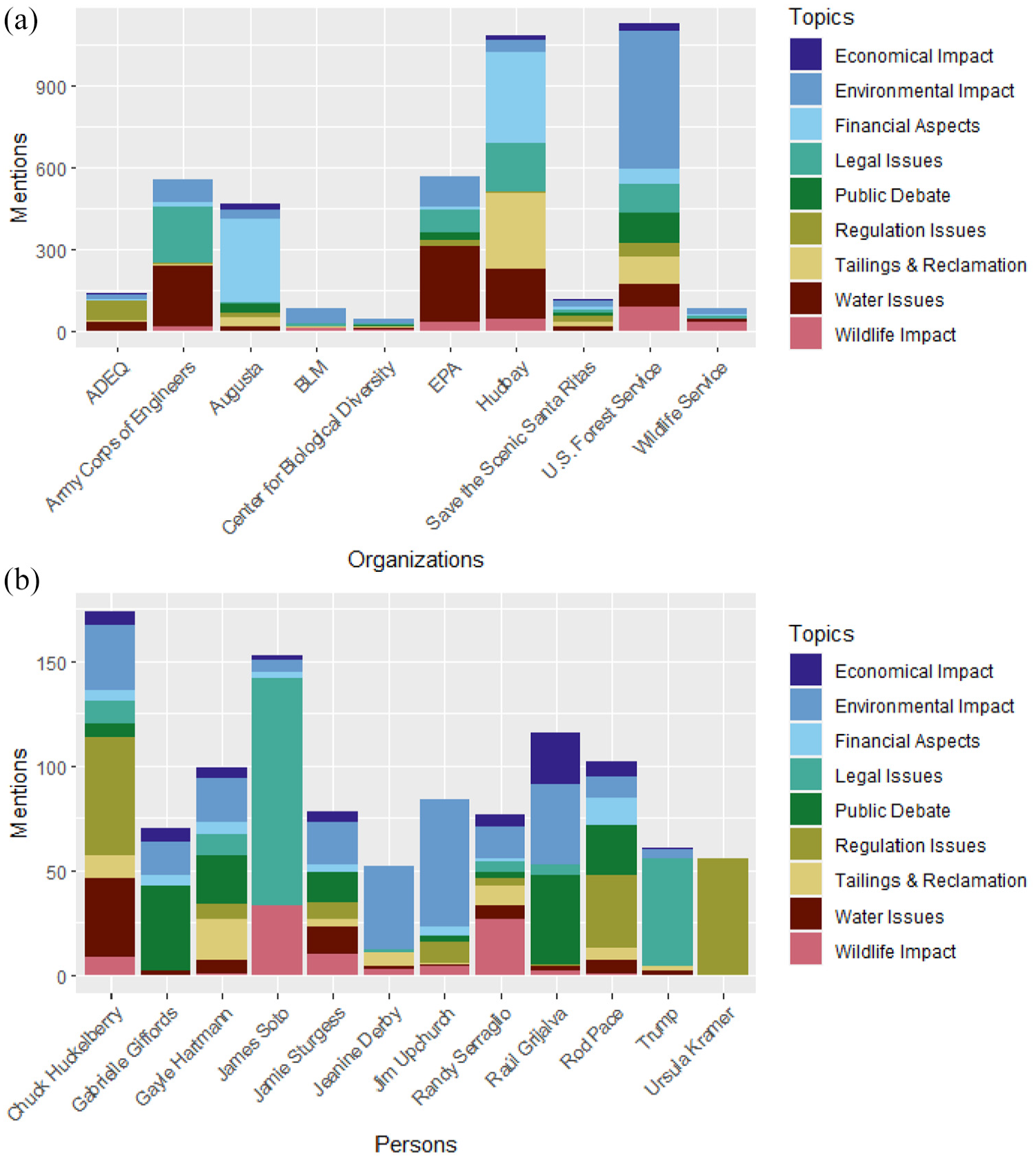
(a) and (b) Distribution of the most mentioned organizations and persons by topics in ADS.
Figure 4a shows the most frequently mentioned organizations and the topics that index the articles that mentioned them. Among these, six organizations, federal or departmental agencies, are mentioned for the topics that constitute their core business. For example, the US forest service is frequently mentioned in articles dealing with environmental impact. It appears that the Augusta and Hudbay mining companies are almost never mentioned in articles dealing with economic, environmental and biodiversity impacts. They are mainly mentioned for the financial aspects and for the issue of mine waste management. Figure 4b shows the most frequently mentioned persons and the topics that index the articles that mentioned them (see Table A1 in Annex). All of them hold positions of authority whereas representing both pro and anti-mine parties. Chuck Huckelberry is a Pima County Administrator, Jame Soto is the judge who suspended the mining permit and Raúl Grijalva was the Chair of the House Natural Resources Committee from 2018 to 2023 and remains a U.S. representative of Arizona (Democrat). The figure also shows that President D. Trump is mentioned most often in connection with legal issues, since it was under his presidency that several water and biodiversity protection laws were repealed. By referring to authoritative arguments, the journalist, while favoring the positions of power (Bourdieu, 1992), actually distributes the places of power and has a modalized assumption of distance from the reported discourses. The argumentative analysis of the articles, and in particular the analysis of concordances, shows that the verbs used by the journalist are of neutral polarity (to say, to announce, to emphasize, to offer, to propose, to reiterate, to state, to tell, to feel, to write) with some more affirmed stances (to reject, to make his point, to approve, to decline, to rebuff, to denounce, to decline, to dismiss, to accuse, to portray, to pledge, to predict).
In addressing RQ2, regarding the RMT corpus, Gayle Hartmann, president of SSSR, shared the purpose of developing the group’s website in 2010, which was and still is to focus on the two points that cornerstone the mining company’s arguments. The first point is about the benefits to the region in terms of jobs, the second one is about the necessity to extract copper. The topic modeling analysis carried out on RMT’s corpus, does not reflect these issues (Figure 5). The first observation is the very balanced distribution, in terms of number of articles, about 40 articles indexed per topic, except for the topic “Financial Aspects” (N = 61), focused about companies Augusta and HudBay. This can be explained by the fact that Hudbay bought Augusta in 2014. Another point is the relative time stability over the years of all topics, except for the topics “Financial Aspects” and “Water & Mitigation.” There exists an absence of discussion on the impact of the mining project on biodiversity and on endangered species.

Temporal evolution of the importance of topics between 2010 and 2019 in RMT.
When comparing corpora concerning topics, unlike The Arizona Daily Star’s topics, the Rosemont Truth topics and arguments can be interpreted as less sensitive to external events compared to when an event has crucial consequences. Our interpretation is that the Rosemont Truth agenda is guided by the goal of preserving the ecosystem, a goal that is fairly stable over time. Another big difference lies in the argumentative patterns. RMT used very often the pattern “X reported,” where X denotes the Arizona Daily Star (N = 47), or Augusta and Hudbay (N = 31). Indeed, there are few direct reported speeches and few mentions of people in RMT posts. This is not the case on the SSSR association Twitter accounts. Consequently, we focused our analysis on the Twitter accounts mentioned in tweets sent by SSSR (1,116 tweets) because it highlights their network of followers (persons and organizations), linked to their communication strategy (Juanals & Minel, 2017; Radicioni et al., 2021). The importance, in terms of number of mentions, of each Twitter account, which was mentioned more than 10 times, is represented in a tree map (Figure 6). This tree map shows that eight of these accounts belong to environmental groups. For example, @earthworks (16, 1k followers) account opposes fossils fuels and dirty mining; the @CenterForBioDiv (142, 9k followers) is the account of the Center for Biological Diversity which uses law and science to secure a future for all creatures hovering on the brink of extinction. The @tucsonstar account belongs to the ADS, the @tonydavis987 belongs to the ADS journalist who wrote the vast majority of the articles on the conflict. Almost all of these accounts have roughly 15,000 followers, illustrating SSSR’s strategy to try to disseminate information beyond a local circle.

Treemap of the most mentioned Twitter accounts in tweets sent by the RMT Twitter account.
Finally, for addressing argument issues of RQ1 and RQ2, we engaged in an analysis of argument. We find that arguments presented by Hudbay in their reports to promote the opening of an open pit in Rosemont are twofold. The first is the need to meet the global demand for copper, the second is its commitment to minimizing environmental impacts. Concerning the demand for copper, Hudbay’s argument is based on the logical reasoning of modus ponens. Relying on this pattern, Hudbay built a simple causal chain: A implies B, then B implies C. The first implication is about opening a new mine on Rosemont. Indeed, the 2020 Hudbay report (H20AR) and the company’s website stipulate:
(S1) “The demand for copper will grow as green economies increasingly adopt electrification and renewable energy solutions.” Consequently, the conclusion is:
(S2) “Hudbay will support America’s transition to a cleaner future, by providing the copper we need.” This implies opening new mines, and in particular, the Rosemont mine.
The second one is about economic impact:
(S3) “When the Rosemont project moves forward with development, we expect that more than 2,500 people will be employed in its construction.”
This causal chain is partly biased because copper production is a cyclical business. This argument was used by SSSR in 2015:
(S4) “Economic turmoil in China has pushed copper prices to a six-year low which is dragging down the share prices of major copper producers including Toronto-based Hudbay Minerals,” and in 2018:
(S5) “the price of copper has dropped [from near $3.30 in 2017] to $2.80 a pound.” Consequently, the second implication about jobs is no longer true as SSSR stated in 2015:
(S6) “copper prices are hovering near six-year lows and major copper producers have announced sharp cutbacks in production and layoffs at Arizona copper mines… revised plans in North America [include] the suspension of mining operations […].”
Nevertheless, in the long run, climate change implies an increased demand for copper. Indeed, in 2021, the French Petroleum Institute for New Energies (IFPEN) and the Institute of International and Strategic Relations (IRIS) jointly launched the GENERATE project (Hache et al., 2019) which concluded that “A global warming of 2°C would require multiplying the world’s known reserves by 2.55.” and that the United States and developing countries in Asia have sufficient copper resources to meet domestic demand and export. As a result, this undermines Hudbay’s argument about the need to open an Arizona mine to meet US domestic demand. This is the ambiguity of the use of the pronoun “we” in the sentence (S2) which seems to refer to American consumers when in fact it refers to world consumption. SSSR argued several times on this point:
(S7) “Falsely claiming annual production of 240 million pounds of copper concentrate will reduce the U.S. dependence on foreign copper when Augusta intends to export all the copper.”
Concerning environmental impacts, Hudbay faced strong arguments raised by SSSR:
(S8) “This permit does not set discharge limits of pollutants from the covered Rosemont facilities. Rather, it just requires monitoring and then the applicant (Rosemont) recommends discharge limits for these pollutants.”
A list of ten contaminants followed these assertions. To counter this argument, Hudbay used the argumentative pattern “Concession” (Barth-Weingarten, 2003). First, accept the issue:
(S9) “We recognize that our business activities can impact biological diversity, and stakeholders rightly expect us to maintain healthy ecosystems and conserve biodiversity throughout the mine lifecycle” (H20AR: 73).
Then commitments were made:
(S10) “Hudbay’s commitments to explore for and mine minerals and metal in a manner that safeguards the environment are expressly stated in our Environmental Health and Safety Policy. The policy […] complies with the laws and regulations” (H20AR: 73).
But, unexpectedly:
(S11) “In a major development that could impact the permitting decisions on the proposed Rosemont copper mine on the Coronado National Forest, the U.S. Fish Wildlife Service (USFWS) announced today it is seeking to establish more than 838,000 acres as critical habitat for the endangered jaguar.”
To counter this argument, Hudbay went to court to seek changes in regulations, ultimately challenging the existing legal framework and advocating for industry reforms:
(S12) “In November 2020, Hudbay filed a petition with US Fish and Wildlife Service to revise the jaguar critical habitat designation on land that includes the Rosemont project” (H20AR: 80).
In other words, when one cannot comply with regulations, they can call for changing these regulations (Gennaioli & Shleifer, 2007).
Discussion and Conclusion
The analysis of stakeholders’ standpoints on the mining project showed that the pro-mine positions are linked to the powerful world of the mining industry and business groups, whereas the resistance comes from civil associations of local opponents, a prominent environmental advocacy group, the County and the native tribes that use the land. The results show that the local printed press highly quotes and reports speeches from enunciators in position of power and authority. While the press coverage is thus strongly biased in favor of these people of power in the public debate, it appears that it also represents conflicting standpoints and arguments from those like the federal agency, the mining company, legal institutions, and open opponents to the mine project like the Pima County U.S. Representative and the President of the coalition Save the Scenic Santa Ritas.
The coalition SSSR manages successfully to obtain public visibility in the local press. Moreover, this coalition has built, using its twitter account, a different network of environmental groups and to the press (ADS), indicating its commitment to defending southwestern habitats and scenic landscapes across audiences. They initially emphasized financial aspects in their communications, and only in recent years have they highlighted the disastrous consequences on water management. In contrast, the mining company Hudbay’s media strategy relies on its high presence in the printed press and the corporate website remains focused on its industrial universe. Paradoxically, the mining company appears to promote the energy transition, participating in efforts to support America’s transition to a cleaner future, while ignoring the consequences on health and ecosystems of an open pit mine, and asserting its corporate “values” on sustainability towards environment and communities at a local level.
This study shows that the conflict cannot be solved locally because it involves questions that arise at the federal level. If we return to the 1872 Mining Law, we can see that all stakeholders, even the pro-mine actors, agree that this law is no longer adapted to current copper mining techniques. The inadequacy of this law has been noted for many years (Leshy, 2002; Seymour, 2004). In 1872, a claim for exploitation was filed by a group of miners, gathering from 10 to 30 people. The techniques used for digging and processing were at the artisanal level. However, the exploitation of modern pit mines completely changed the scale of extraction and have consequently led to a much greater volume of waste rock, as Judge Fletcher noted in the United States Court of Appeals for the Ninth Circuit decision of May 12, 2022: “The Mining Law allows miners to establish mill sites, essentially free of charge on nonmineral land near their mining operations (…) However, the amount of waste rock produced by modern pit mines is much greater than can typically be accommodated on the mill site land available to mine operator.”
Moving away from an agnostic scholarly position for a time, that is to say, presenting different perspectives without definitively endorsing or rejecting any particular viewpoint as well as recognizing the complexities and uncertainties that exist within the subject matter, we can see in the data that the arguments deployed by the stakeholders involved in the Rosemont conflict represent two points of view, pro and con. After digging in the data, considering our early interviews with local people in Arizona, and analyzing our data set, we see that these two positions, creating tension between environmentalists and those who economically depend of mining industry, are by their very nature, irreconcilable. Copper mining, while being essential to energy transition, can be viewed as destructive to the environment in several ways, raising concerns about the impacts of hardrock mining on water consumption, waste storage, pollution and collapse of water tables, soil and air pollution, along with destruction of species, biodiversity and landscape.
Our research in this region, interviews, and travel to visit copper mining areas, also raise great concerns tied to the consequences of hardrock mining on the inhabitants living in the vicinity of a mine (Photo 1). Dust containing fine particles and toxic products (e.g., arsenic, sulfuric acid, mercury) contained in the tailings are the main elements that have consequences on the health of the inhabitants. However, large-scale studies (cohorts, control samples, etc.) over a long period of time are needed (Ramírez-Andreotta et al., 2021) to prove that there is, or not, a correlation between a disease (asthma, allergies, heart problems, diabetes) and the proximity of an operating mine or non-operational open pit. Some studies carried out at local level in different countries (Herrera et al., 2017; Onello et al., 2016; Salm & Benson, 2019) found that living close to open-pit mines could increase health risks, but larger scale studies at the federal level are needed in USA. In any case, several studies (Gao et al., 2023; Le Gouill et al., 2019; Tang & Xu, 2023; Xu et al., 2023) show that government action, by establishing pollution standards, regulations and promoting green technologies, can significantly reduce the negative effects of polluting dust.

Ray Mine, Arizona, 21 May 2022, ©.
The empirical questions raised in the case of the Rosemont mine, and the methodology developed, help to motivate scholarly discussion around hardrock mining at different scales, with the aim of broadening and diversifying the scope of related studies. The characteristics of this study, focused on primary actors’ topics and arguments in print and digital media, have the limitation of not describing non-mediated stakeholders that may have been impacted by the mining project. Complementary to this work would be studies conducted with a different methodology, particularly those providing ethnographic descriptions of local experiences and interviews with non-mediated groups like indigenous and tribal peoples, union workers, or communities living in or near the “copper triangle,” to provide a clearer picture of actors’ lived experiences. We recommend a future direction of research that involves interviews with the heads of federal or regional agencies (EPA, U.S. Forest service, ADEQ) to find out their positions on the consequences of mining pollution on the health of communities and populations.
In conclusion, this study has allowed us to uncover and discuss the ways tensions and decisions around new copper mines are discussed and made. We examined the factors and mediated arguments that played a decisive role in the process and outcome of the conflict. This study can show in general terms patterns in press coverage and in digital media in terms of issues and stakeholders that may otherwise go unnoticed. These findings can speak to analyses of similar conflicts.
Footnotes
Annex
Names of the Most-Mentioned Stakeholders.

| Name of the stakeholder quoted | Number of mentions |
|---|---|
| U.S. Forest Service, managing the land | 1,129 |
| Hudbay, the Canadian-based mining group which bought Augusta in 2015 | 1,082 |
| U.S. Army Corps of Engineers (delivering mining permits) | 558 |
| United States Environmental Protection Agency (EPA) | 571 |
| Augusta, a Canadian-based mining group | 466 |
| Chuck Huckelberry (Pima County Administrator) | 174 |
| U. S. District Judge James Soto | 153 |
| Arizona Department of Environmental Quality (ADEQ) | 141 |
| Rod Pace (Rosemont Copper President and CEO) | 129 |
| Save the Scenic Santa Ritas (SSSR) is a volunteer-based, non-profit organization, based in Tucson, Arizona | 120 |
| U. S. Representative Raúl Grijalva | 116 |
| Gayle Hartmann, (President of Save the Scenic Santa Ritas) | 99 |
| Wildlife Service is part of U.S. Fish and Wildlife Service’s Fish and Aquatic Conservation Program | 88 |
| Bureau of Land Management (BLM), The Bureau of Land Management’s mission is to sustain the health, diversity, and productivity of public lands | 85 |
| Jim Upchurch (Coronado National Forest supervisor) | 84 |
| Jamie Sturges, V.P. of Projects and Environment of Augusta | 78 |
| Randy Serraglio, Southwest Conservation Advocate—Center For Biological Diversity | 77 |
| U. S. Representative Gabrielle Giffords | 70 |
| Trump (President of Unites States, 2017–2021) | 61 |
| Ursula Kramer (Director of the county Department of Environmental Quality) | 56 |
| Jeanine Derby (Coronado National Forest Service supervisor) | 52 |
| Center for Biological Diversity, The Center for Biological Diversity is a 501(c)(3) registered charitable organization | 47 |
Declaration of Conflicting Interests
The author(s) declared no potential conflicts of interest with respect to the research, authorship, and/or publication of this article.
Funding
The author(s) disclosed receipt of the following financial support for the research, authorship, and/or publication of this article: This study was partially funded by the Labex DRIIHM (ANR-11-LABX-0010, OHM Pima County) and the International Joint Unit iGLOBES (UMI 3157)

Data Availability Statement
Data sharing not applicable to this article as no datasets were generated or analyzed during the current study.