




Abstract
The development of mangrove forest environmental services plays a crucial role in human health, economic development, and the security of countries worldwide. This study aims to establish and validate a model for assessing the factors influencing the willingness-to-pay for mangrove forest environmental services. The proposed model comprises four key factors: attitude, subjective norm, perceived behavior control, and environmental knowledge. Data were collected by surveying 235 individuals from various households in Phu Long commune, Vietnam. The Partial Least Squares—Structural Equation Modeling (PLS-SEM) methodology was employed for data analysis. The research findings reveal that perceived behavior control significantly impacted residents’ willingness-to-pay, followed by attitude, environmental knowledge, and subjective norms. Furthermore, certain demographic characteristics such as gender and family size mediate the relationship between independent and dependent variables. Based on the obtained results, several policy recommendations are put forward.
Plain language summary
This study aims to establish and validate a model for assessing the factors influencing the willingness-to-pay for mangrove forest environmental services. Data were collected by surveying 235 individuals from various households in Phu Long commune, Vietnam. The Partial Least Squares - Structural Equation Modeling (PLS-SEM) methodology was employed for data analysis. The research findings reveal that perceived behavior control significantly impacted residents’ willingness-to-pay, followed by attitude, environmental knowledge, and subjective norms. Furthermore, certain demographic characteristics such as gender and family size mediate the relationship between independent and dependent variables. Based on the analysis results, this study proposes several policy recommendations to encourage the willingness of residents in Phu Long commune, Hai Phong, Vietnam, to pay for FESs. Strategies to improve the implementation of forest environmental service payments in Phu Long should emphasize enhancing the community’s understanding of the importance of mangrove forests. Information dissemination should encompass knowledge about the benefits (both economic and environmental), the current status, threats, and consequences of mangrove degradation, as well as the global significance of mangrove forests, particularly concerning climate change. Additionally, to increase the effectiveness and garner community support for environmental service payment programs in Phu Long, implementation efforts should promote residents’ sense of responsibility, pride, and love for the recognized biodiversity heritage values associated with mangrove forests
Introduction
Environmental services are the benefits people receive from natural ecosystem functions and are associated with humans (Groot et al., 2002; Mader et al., 2011; MEA, 2005). According to Millennium Ecosystem Assessment (MEA) (2005), environmental services are classified into four main groups, including (a) provisioning services, which refers to all physical goods provided by ecosystems, such as food, water, timber, and fiber; (b) regulating services, which refers to the indirect benefits brought by the ecosystem as regulation of climate, floods, and disease; (c) cultural services, helps individuals gain cultural and spiritual enjoyment and experiences as recreation, aesthetic enjoyment, and spiritual fulfillment; (d) supporting services, are ecosystem services that are necessary for the production of all other ecosystem services, such as soil formation, nutrient cycling, and provisioning of habitat. Forests are widely recognized as the primary ecosystem providing environmental services, including those in the above classification group (Pohjanmies et al., 2017; Vo et al., 2012). Forest environmental services (FESs) have recently faced numerous threats, leading to degradation or unsustainable exploitation (Langemeyer et al., 2015; Mukherjee et al., 2014). For instance, human activities such as excessive forest exploitation, changes in land use, and infrastructure development have endangered the existence of FESs, resulting in their decline across many regions (Taylor et al., 2015; Van Sand, 2012). These threats exert pressure on the environment and can have severe repercussions for human livelihoods and the ability to support future generations (Joseph, 2010). Forest environmental services are overlooked, and their value is not fully estimated (Foley et al., 2007; Li et al., 2015). Payment for FESs programs offers a means to establish new market and non-market interventions in response to threats to forest ecological services or emerging environmental issues related to forests (Kuhfuss et al., 2018).
Consumer decisions regarding environmental performance involve a complex process in which psychological, social, and economic factors play pivotal roles (Irfan et al., 2020; López-Mosquera & Sánchez, 2013). Willingness-to-pay (WTP) is a behavioral intention and must be examined within a socio-psychological context (Liu, 2020; Pouta & Rekola, 2001). However, in previous studies assessing the factors influencing WTP for FESs, attention seems to have focused on demographic and socioeconomic factors. These models are incomplete and limited in explanatory power (Ekka & Pandit, 2012; Pham et al., 2018; Ulf et al., 2011). Various behavioral theoretical models have recently been developed to explore intentions and behaviors related to the environment. Notable among these are the Theory of Planned Behavior (TPB) (Hong, 2019; Zhang et al., 2019), the Theory of Value-Belief-Norm (López-Mosquera & Sánchez, 2012), and the Theory of Reasoned Action (TRA) (Abraham & Sheeran, 2003). Among these theories, TPB has been extensively applied and prominently featured in studies examining environmental intentions and behaviors (Irfan et al., 2020). Nevertheless, some studies have revealed that TPB does not fully explain significant variations in analytical results (Han & Hansen, 2012). Recent research efforts have aimed to enhance its explanatory power by integrating new components into the TPB model (Chen & Tung, 2014; Zhang et al., 2019). Several studies have demonstrated that individuals with substantial knowledge and awareness of environmental issues are more inclined to express a WTP to support environmental sustainability (Liu, 2020; J. Yang et al., 2021). Ramdas and Mohamed (2014) asserted that environmental knowledge forms the foundation for motivating individuals to develop attitudes toward environmentally related behaviors. As a result, this study proposes a model to evaluate the factors influencing the WTP for FESs, utilizing the TPB as its foundation. This model introduces the environmental knowledge factor as a novel element. Additionally, demographic and socioeconomic characteristics are investigated as moderating factors within the model.
In Vietnam, the practice of paying for environmental services is regarded as an effective approach to enhancing natural resource management capabilities. It has been integrated into national programs, with trials conducted in the Son La and Lam Dong provinces in 2008 and subsequently incorporated into national objectives under Decree no. 99/2010/NDĐ-CP (Pham et al., 2018). Payment for FESs has yielded benefits related to forest conservation and quality improvement, increased contributions of the forestry sector to the national economy, and a reduced burden on the state budget. However, this activity also faces challenges related to global and local deforestation trends, which are complex in Vietnam. Additionally, concerns related to non-market-based valuation processes and limitations in determining the ecosystem’s added value have created barriers to policy implementation in Vietnam (Suhardiman et al., 2013). As a result, this research has adopted a community-based investigation and information gathering approach regarding payment for environmental services. This ensures that the outcomes achieved will: (a) adhere to market-based exchange principles (Shapiro et al., 2019), (b) collect objective information on forest environmental service payments from local residents (Brownson et al., 2020), (c) balance the benefits of environmental protection and resource exploitation (Mandle et al., 2021), and (d) provide supporting information for pricing processes while addressing limitations related to payment for and the provision of FESs at the local level. Identifying the influencing factors on Payment for Environmental Services (PES) also helps improve awareness of environmental benefits and the equity of PES (Jones et al., 2018), offering more diverse options related to different payment recipients’ characteristics (Brownson et al., 2020), while maintaining the sustainability of these programs even when local management activities have not achieved high efficiency (Brownson et al., 2019). Therefore, the factors influencing PES need to be identified based on community-based surveys. Subsequently, the measurement and analysis of relationships between variables are conducted to examine linear causal relationships between variables and measurement errors during the process. For this reason, Partial Least Squares—Structural Equation Modeling (PLS-SEM) was chosen for application in this study.
Literature Review and Hypotheses
Payment for Forest Environmental Services
Environmental services refer to the benefits people derive from nature and the developed environment around them (Truong, 2022). Mangrove forests provide environmental services that contributing to human well-being (Brown et al., 2006). Several mangrove FESs, characterized as public goods, are not typically reflected in market transactions, such as air quality regulation or erosion prevention. According to Ramdas and Mohamed (2014), environmental services are classified as public goods mainly because they are available to each consumer without restriction. The individual can consume them without depleting their presence or benefits to others. Simultaneously, anyone can use them, regardless of whether they have contributed to making them available (Blamey, 1998).
Human activities can jeopardize FESs in numerous ways. To address these risks, payment for environmental services has emerged as a compensation method to support activities to create or maintain sustainable environmental services (Vo et al., 2012). The main purpose of payment for environmental services is to benefit the service providers by reimbursing them for the cost of providing them (Ramdas & Mohamed, 2014). To compensate for the environment, it is first necessary to assign a price to the environmental service or good (Ulf et al., 2011). However, the value of public goods, such as pure air, unpolluted water, or biodiversity, cannot be determined by observing individual behavior in the context of the actual market.
The economic value (monetary) of compensating for environmental changes under current conditions can be calculated through WTP for environmental services. WTP represents the maximum price (equal or lower) that a consumer is WTP for a unit of good or service (Varian, 1992). WTP can be seen as the cost an individual commits to pay for an innovation or compensation for a specifically determined environmental condition. Precisely identifying consumers’ WTP for the goods helps construct a value-based pricing strategy for sustainable development (Miller et al., 2011).
Theory of Planned Behavior
The Theory of Planned Behavior (TPB), developed by Icek Ajzen in 1985, builds upon the Theory of Reasoned Action (Ajzen, 1991). According to Ajzen and Driver (1992), most human behavior is goal-directed and influenced by a key predictor, which is behavioral intention. In TPB, attitude, subjective norm, and perceived behavioral control are postulated factors directly impacting behavioral intention. Fishbein and Ajzen (1977) define behavioral intention as an individual’s beliefs and attitudes toward what they intend to do in a given situation. Attitude is the positive or negative evaluation of performing a behavior. Subjective norm is the perception of social pressure and references from relevant groups to perform the behavior. Perceived behavioral control is the perceived ease or difficulty in performing the behavior.
TPB is widely used in studies aiming to explain pro-environmental behaviors (Iosif et al., 2015). It is considered an effective tool for understanding the factors influencing consumer decisions in various research topics such as purchasing eco-friendly products, using clean energy, waste management, and green transportation (Koshta et al., 2022; Sánchez-García et al., 2021; Sujitra & Suthirat, 2018). Ajzen and Driver (1992) regard WTP as behavioral intention, providing the basis for applying the TPB to explore the significance of randomly priced measures.
While the original TPB has proven useful in predicting individual intentions and behaviors in the environmental sector (Zhang et al., 2021), some studies have shown that TPB does not account for significant variances in analytical results (Han & Hansen, 2012). Recent studies have tried to enhance explanatory power by incorporating new structures into the TPB model (Chen & Tung, 2014; Zhang et al., 2019). However, very few studies have assessed the role of knowledge in WTP. Additionally, in studies selecting TPB to develop theoretical models, the interaction between psychological variables and socio-economic demographics is often overlooked. According to Iosif et al. (2015), in studies utilizing TPB, respondents’ demographic and socio-economic characteristics may indirectly influence behavioral intention through the core structures of the models.
Attitude
Attitude (AT) refers to an individual’s positive or negative evaluation of behavioral choices; attitude measures an individual’s beliefs and assesses possible outcomes in terms of intention and behavior (Sabiha, 2008). According to Kotchen and Reiling (2000), attitude is considered one of the significant predictors of individual intentions and behaviors in the socio-psychological literature. Some studies on WTP for services such as water quality (Obeng & Aguilar, 2018), environmental protection (Stern et al., 1993), and the preservation of the environmental services of eco-parks (López-Mosquera et al., 2014) have shown that attitude is significantly correlated with behavioral intention. However, in some other research on WTP, it has been concluded that the relationship between attitude and behavioral intention is not clear, and further examination is suggested, considering the influences of other related mediators (López-Mosquera & Sánchez, 2012; Sujitra & Suthirat, 2018). Attitude toward payment for FESs in previous studies has been measured through scales considering benefits, responsibilities, urgency (Kim et al., 2021; Ngah et al., 2020; W. Yang et al., 2020; Zhang et al., 2021), and advocacy for behavior (Sari et al., 2021). From the above analysis, the following hypothesis was proposed:
Subjective Norm
In TPB theory, subjective norm (SN) refers to the social pressures that compel respondents to perform a behavior (Ajzen, 1991). SN has been proven to be directly and positively related to environmental protection behavior and WTP (John, 2006; Rambalak & Govind, 2017; Ulf et al., 2011). The impacts of this pressure can vary depending on the context, environmental goods, and services being considered (Zhang et al., 2021). Ajzen (1991) pointed out that the weights of predictors of behavioral intention can vary depending on the specific behavior being studied. This may explain why some studies have not found a significant correlation between SN and behavioral intention (Mercedes et al., 2018; Obeng et al., 2019; W. Yang et al., 2020). SN is measured in terms of an individual’s beliefs about social pressure to perform a behavior. Accordingly, respondents’ intentions are influenced by their perception of the perspectives of essential and close people, such as relatives, friends, colleagues, and communities. Additionally, the motivation to comply with social norms of a formal nature, such as the requirements of laws, decrees, and legal guidelines related to behavior, is also considered a reference measure when evaluating the influence of SN on behavioral intention (Ajzen, 1991). Some recent research has used the motivation for compliance with social norms as a scale for SN (Hong, 2019; Sari et al., 2021; W. Yang et al., 2020). In this study, since FESs have the characteristics of a public good, in addition to considering the motivation of compliance with regulations, pressure from relatives, friends, and the community will also be measured. Based on the literature on SN, the next hypothesis is as follows:
Perceived Behavioral Control
Perceived behavioral control (PBC) refers to an individual’s perception of whether it is easy or difficult to perform a behavior (Zhang et al., 2021). Several studies have demonstrated that greater PBC strengthens an individual’s intention to perform the considered behavior (López-Mosquera et al., 2014; Mercedes et al., 2018; Pouta & Rekola, 2001; Zhang et al., 2021). PBC is identified by measuring the respondents’ resources (finance, time…) to determine whether behavioral intention or performance is easy, feasible, or not possible. Identifying opportunities to decide on behavior has also been chosen as a representative scale for PBC (López-Mosquera et al., 2014). Bernath and Roschewitz (2008) suggested that PBC should be measured by the autonomy and independence of the individual in deciding to pay a certain amount of money for the goods offered. Based on the above analysis, the following hypothesis was proposed:
Environmental Knowledge
Knowledge represents all the information a person possesses or accumulates in a particular field of study (Lin & Syrgabayeva, 2016). Knowledge consists of three aspects: (a) declarative, or knowing what; (b) procedure, or knowing how; and (c) conditions, causes, or effects related to the problem. Several studies have shown that people with considerable knowledge and awareness about environmental issues tend to express a WTP to sustain the environment (Kotchen & Reiling, 2000; Liu, 2020; Sabiha, 2008; J. Yang et al., 2021). In the environmental sector, to assess ecological knowledge, indicators measuring the level of understanding of benefits, current status, environmental causes, consequences, and solutions to environmental problems have been selected as measurement scales in many studies (Ramdas & Mohamed, 2014). Additionally, awareness of the relationship between climate change and environmental issues has been used as a scale regarding factors affecting WTP for environmental services (Pham et al., 2018; Tuan et al., 2014). Several studies have examined the relationship between knowledge and a positive attitude toward the environment. Ramdas and Mohamed (2014) suggested that environmental knowledge serves as the foundation for inspiring individuals to develop attitudes related to environmentally friendly behaviors. Egea and De Frutos (2013) demonstrated that consumers’ environmental knowledge impacted on their attitudes toward the environment, either positively or negatively. Thus, the following hypotheses were developed:
Demographic Factors
López-Mosquera et al. (2014), exploring the factors affecting WTP for environmental services, initially focused on respondents’ demographic characteristics, such as education level, age, income, and gender (Pham et al., 2018; Tuan et al., 2014). However, results have shown considerable variability in the influence of these factors on environmental behavior. Liu (2020) showed that individual objective conditions, including education level, age, and income, had no significant influence WTP. This result is consistent with that of Sardana (2019), which indicated a relatively small impact of income to WTP for forest diversity conservation services. Ulf et al. (2011) also found that income did not influence on WTP for environmental public goods. Iosif et al. (2015) noted that demographic traits were viewed as statistically non-significant predictors of recycling intention. In contrast, Rotaris et al. (2020) and J. Yang et al. (2021) established that education level and income positively and significantly impacted WTP for environmental services.
Women and men are considered to have different environmentally related concerns (Asteria et al., 2014). However, previous research has produced inconsistent results about the correlation between gender and environmental behavior. Some studies have suggested that gender has an insignificant impact on WTP (Aguilar et al., 2018; Liu, 2020; J. Yang et al., 2021). Other studies, in contrast, have indicated that gender is significant in determining WTP (Getachew, 2018; Natalia & Mercedes, 2012; Rotaris et al., 2020; Obeng & Aguilar, 2018).
Research Area
Phu Long commune is situated in the west of Cat Ba Island, Cat Hai district, Hai Phong city. It serves as a crucial connection point between the Cat Ba archipelago and the mainland, linked by the Lach Huyen port, Cai Vieng ferry terminal, and cable car station. The total area of Phu Long commune is approximately 4,291.3 hectares, predominantly on the main island of Cat Ba, featuring extensive mangrove lagoons and tidal flats. The Phu Long Commune currently consists of four villages, totaling 630 households: Nam (142 households), Bac (190 households), Ngoai (188 households), and Ao Coi Hamlet (110 households). Phu Long experiences a tropical monsoon climate with cold winters, with an average annual temperature of 23°C to 24°C. Winter, from December to April, sees average temperatures of 16°C to 18°C, while summers, between May and October, have averages ranging from 26°C to 28°C. Annual precipitation totals 1,600 to 1,800 mm, with 80% to 90% occurring during the rainy season. The average annual wind speed is 5.1 m/s. Annually, the area is directly affected by 2 to 5 storms, primarily concentrated between July and September. The natural conditions in this area, including predominantly silty seabeds, sandy and muddy sand, and high tidal inundation, are highly conducive to the growth of mangrove plants. Consequently, the mangrove flora community predominantly consists of salt-tolerant, dominant species. As Pham and Yoshino (2016) noted, the main factors contributing to the reduction of mangrove areas are the excessive expansion of shrimp farming and the impact of infrastructure development, including seaport systems, ocean cable systems, and roads.
Research Methodology
Research Model
This study’s research model is constructed based on expanding the standard TPB by adding the Knowledge factor. The research proposal in Figure 1 contains four independent variables (AT, SN, PBC, and KN); a dependent variable (WTP), and moderating variables (socioeconomic and demographic factors).

Factors influencing the WTP for MFESs.
All items in the proposed model’s constructs were developed from previous studies and were adjusted to match the research context. In order to meet the conditions of the research area, the items were reviewed and adjusted by three experts in the field. The final list included 22 items presented in Table 1: KN (five items), AT (five items), SN (four items), PBC (four items), WTP (four items).
Constructs, Items, and Sources.

Data Collection
This research used both primary and secondary data. The secondary data on demography and mangrove forest information was mainly collected from reports of the People’s Committee of Phu Long Commune. These secondary data served as the foundation for interpreting the results of the analysis regarding factors influencing residents’ WTP for MFESs in Phu Long, Vietnam. This study gathered primary data by conducting interviews with Phu Long commune residents using a survey questionnaire. The survey was conducted by household: the head of the household was selected to be interviewed, and only one person per household was interviewed to ensure the consistency of the results. According to Asmare et al. (2022), household decisions are basically led by the head of the household; individual decisions from others tend to need confirmation and permission from the head of the household. Furthermore, as Mitchell and Carson (1989) noted, the expenditure for most public goods is made at the household level. The questionnaire was designed with two main sections: Part 1 included demographic characteristics questions such as education level, average household income, age, occupation, family size, and gender. Part 2 contained questions related to factors influencing willingness to pay for environmental forest services. The constructs and items are presented in Table 1. Respondents were asked to rate these items on a 5-point Likert scale, ranging from 1 (totally disagree) to 5 (totally agree). The questionnaire was prepared in Vietnamese since the residents in the research area use Vietnamese as their first language. After the respondents provided the demographic information, the enumerators provided information on the mangrove forest status before assessing the residents’ WTP for five major MFESs in Phu Long, including “control of extreme events (storms, floods, droughts),”“climate regulation (climate regulation, carbon sequestration, and storage),”“maintain genetic diversity,”“habitat for species,” and “recreational and tourism value.” To prioritize the safety, privacy, and confidentiality of participants, the questionnaire began with an assurance that all provided information would be kept strictly confidential and solely used for this study’s purposes.
Before the official survey, the questionnaire was tested by interviewing 30 randomly selected households in the research area in December 2021. The purpose of the pilot survey was to test the validity of the questions and scales. As noted by Siew et al. (2015), a pilot survey is needed for such studies. The preliminary survey results were as follows. In the construct “Knowledge of mangroves” the item “I am aware of local MFESs” was removed; In the construct “SN” the item “You will comply with the regulations of the State and local authorities related to contributions to pay for FESs” was removed.
According to Chin (1998), the minimum sample size for the PLS method should be ten times the maximum number of arrows pointing to a latent variable in the model. Therefore, the minimum required sample size for this study is 50 (10 times 5). Hoyle (1995) suggested that a sample size ranging from 100 to 200 is often a good starting point for path modeling. Another approach, as mentioned by Sekaran (2003), is to determine the sample size by multiplying it by the number of observed variables (or items). This study includes 05 latent variables with 22 observed variables, resulting in a minimum sample size of 220. However, it is advisable to have a sample size larger than the minimum requirement to ensure statistical robustness. In this study, the official survey was conducted between January 2022 and February 2022. The survey utilized a stratified random sampling method with weighting and garnered 246 responses from the heads of households in Phu Long commune. Out of these responses, 235 were considered valid, accounting for 95.5% of the total survey sample. The random sampling results distributed respondents across the four villages of Phu Long (Nam, Bac, Ngoai, and Ao Coi) at proportions of 22.6%, 30.2%, 29.8%, and 17.4% of the total, respectively. The authors confirm that informed consent was obtained from all participants in our research.
Data Analysis Techniques
This study used PLS-SEM to examine the hypothesis and explain the relationships within the model. PLS-SEM is typically used to develop a theory in explanatory research by focusing on explaining the dependent variables’ variance (Hair et al., 2010). PLS-SEM is based on two main stages: evaluating the measurement model and evaluating the structural model (Henseler et al., 2009). According to Reinartz et al. (2009), PLS has advantages over the traditional SEM (CB-SEM): (a) it is commonly applied when hypotheses are not established based on a well-constructed theoretical framework but are the result of explanatory research (Dijkstra & Henseler, 2015), and (b) it works well in studies with small sample sizes, missing values, unusual data distribution patterns, and the presence of symptoms of multicollinearity. PLS-SEM is recommended to approach and verify explanatory research models during the initial theoretical development stage. PLS-SEM also offers benefits for cause-and-effect analysis in behavioral studies (Lowry & Gaskin, 2014), and it is also widely implemented in economic research and environmental management. This research explored the appropriateness of the theoretical model extended from the TPB model by adding the Knowledge variable to assess behavioral intentions related to payment for environmental services. Smart-PLS version 3.9 was chosen as the data analysis tool.
The PLS-SEM analysis in this study comprises two primary steps: Measurement Model Assessment and Structural Model Assessment (Henseler et al., 2015).
Measurement Model Assessment
In this study, the measurement model undergoes evaluation through four steps: assessing the quality of observed variables; evaluating the internal consistency reliability; appraising the convergent validity of constructs; and assessing the discriminant validity of constructs.
The quality of observed variables is gauged using indicator loadings. According to Hair et al. (2016), to ensure quality, the outer loading of observed variables should be greater than or equal to 0.708 (since 0.7082 = 0.5, signifying that the latent variable explains 50% of the variance in the observed variable).
Many studies have employed Cronbach’s Alpha (CA) and Composite Reliability (CR) to gauge the reliability of scales (Sarstedt et al., 2022). As per DeVellis (2012), when CA exceeds 0.7, it ensures good reliability. Observed variables with outer loadings below 0.7 should be removed, and the model should be reanalyzed. Composite Reliability (CR) falls from 0 to 1, with higher values denoting greater reliability. Hair et al. (2010) indicated that CA should range from 0.7 to 0.9 for acceptance, and values surpassing 0.9 (some studies even suggest > 0.95) may indicate issues as they imply that observed variables are measuring a phenomenon. Composite Reliability (ρC) is computed based on different outer loadings of observed variables, whereas Cronbach’s alpha assumes that all observed variables have the same outer loading, making it less accurate than composite reliability. Recent studies propose using internal consistency reliability assessment (ρA), developed by Dijkstra and Henseler (2015), as a suitable supplement to reliability. The minimum acceptable value for ρA is 0.70 (or 0.60 in exploratory research), while the maximum value is set at the threshold of 0.95 (to prevent indicator redundancy). The suggested internal consistency reliability assessment range falls between 0.7 and 0.9 (Dijkstra & Henseler, 2015).
Convergence refers to the extent to which a construct converges to explain the variance of its observed variables. Convergent validity is evaluated using the Average Variance Extracted (AVE) index. According to Höck and Ringle (2010), an AVE of 0.50 or higher is considered acceptable, indicating that the construct explains at least 50% of the variance in its observed variables.
Discriminant validity indicates how effectively a construct distinguishes itself from other constructs in the model. Fornell and Larcker (1981) recommended that discriminant validity is assured when the square root of AVE for each latent variable exceeds all inter-construct correlations. However, Henseler et al. (2015) pointed out that cross-loadings and the Fornell-Larcker criterion are not the most appropriate measures to assess discriminant validity in PLS-SEM models. They suggested using the Heterotrait—Monotrait Ratio of Correlations (HTMT) as an alternative, with issues of discriminant validity arising when HTMT values are high. Henseler et al. (2015) proposed two methods to assess discriminant validity using HTMT: (a) as a criterion—comparing it to a predefined threshold, or (b) as a statistical test. When compared to a threshold, Clark and Watson (1995) and Kline (2011) suggested a threshold of less than 0.85, while Gold et al. (2001) and Teo et al. (2008) proposed a threshold of less than 0.90 to ensure discriminant validity. In the case of the statistical test, HTMT can serve as the basis for evaluating the validity of discriminant statistics. In this method, bootstrapping procedures enable the construction of confidence intervals for HTMT. If the results indicate a confidence interval containing the value 1, it suggests a lack of discriminant validity. Conversely, the two constructs are empirically distinct if the value 1 falls outside the range. In this study, besides demonstrating the validity of the cross-loading and Fornell-Larcker criterion indices, the HTMT index is analyzed using both methods to evaluate discriminant validity.
Structural Model Assessment
The structural model in this study is assessed using the following indicators:
Assessment of Collinearity and Multicollinearity
Collinearity must be addressed to ensure the validity of regression results. Specifically, multicollinearity among independent latent variables is considered a significant issue in the model, while for models constructed as reflective, there is no need to evaluate multicollinearity among observed variables. According to Hair et al. (2019), if the Variance Inflation Factor (VIF) exceeds five, multicollinearity is highly likely. Becker et al. (2015) also suggest that collinearity issues can occur even at lower VIF values ranging from 3 to 5. Ideally, VIF values should be close to 3 or lower.
Relationship Within the Structural Model (Path Coefficients)
The path coefficients represent the hypothesized relationships between research constructs. These coefficients are standardized and typically range from −1 to +1, where path coefficients close to +1 indicate a strong positive relationship, while values close to 0 usually lack statistical significance, meaning they are not significantly different from 0. The magnitude of the standardized effect size reflects the impact of independent variables on dependent variables. The order of path coefficients (Original Sample) indicates the sequence of influence of factors on variables, and a larger absolute value suggests a stronger influence. Furthermore, p-values indicate the significance of the effects in t-tests.
Coefficient of Determination (R2)
The R2 value is a measure of the predictive ability of the model, calculated as the square of the correlation between the predicted and actual values of a specific latent variable. R2 represents an in-sample predictive power measure, ranging from 0 to 1. Higher values indicate a more accurate predictive level. An R2 value of .20 is considered high in fields such as consumer behavior, while in other studies, researchers may expect values of .75 or higher. It is important to note that R2 will increase if non-significant constructs are added to the structural model, even if they have little correlation with latent variables. Therefore, selecting a model based solely on R2 values is not recommended. R2 values of .75, .50, and .25 are considered strong, moderate, and weak, respectively (Hair et al., 2019; Henseler et al., 2009).
Effect Size (f2)
The effect size (f2) measures the influence of independent variables on dependent variables, indicating whether the impact is weak or strong. The f2 and standardized path coefficients (Original Sample) are quite similar in assessing the order of the impact of independent variables on dependent variables. However, standardized path coefficients do not provide information about the strength of these impacts. Cohen (1988) suggested thresholds for evaluating the importance of independent variables: f2 < 0.02 indicates an extremely small or no effect; 0.02 ≤ f2 < 0.15 indicates a small effect; 0.15 ≤ f2 < 0.35 indicates a moderate effect; f2 ≥ 0.35 indicates a significant effect.
Q 2 Value
The Q2 value, proposed by Geisser (1971) and Stone (1974), represents the index of out-of-sample predictive power in the model. Q2 is calculated using blindfolding procedures, which involve reusing the sample while omitting all data points of interest from the latent variables and estimating parameters with the remaining data points. According to Hair et al. (2019), the threshold for evaluating predictive ability using the Q2 index is as follows: 0 to 0.25 indicates low predictive ability; 0.25 to 0.5 indicates moderate predictive ability; >0.5 indicates high predictive ability. Q2 values are computed using two different approaches: through the residual cross-loadings or the shared variance cross-loadings. Predicting Q2 through the residual cross-loadings aligns well with the PLS-SEM approach.
Effect Size (q2)
The q2 effect size allows for assessing the contribution of exogenous variables to the Q2 value of a specific endogenous variable. q2 values of 0.02, 0.15, and 0.35 indicate that exogenous variables have a small, moderate, or large predictive relationship with a specific endogenous variable.
(vii) R2 statistics are often viewed as a measure of model predictability in many studies. However, this interpretation is not entirely accurate, as R2 only reflects the model’s explanatory power within the sample—it does not speak to its ability to predict outside the sample (Dolce et al., 2017; Shmueli, 2010; Shmueli & Koppius, 2011).
(viii) Shmueli et al. (2016) introduced an out-of-sample prediction procedure (PLS-predict), which involves estimating the model on the analysis sample and evaluating its prediction performance on non-analysis sample data. To assess predictive capability using PLS-predict, researchers can rely on several prediction statistics to quantify prediction errors. These prediction statistics include Mean Absolute Error (MAE) and Root Mean Squared Error (RMSE), with RMSE being preferred in most cases. If the distribution of prediction errors is highly asymmetric, MAE may be a more suitable prediction statistic than RMSE (Shmueli et al., 2019).
Results
Descriptive Analysis
Table 2 displays the participants’ demographics. The results indicate that the age group of 46 to 60 years was the most common at 48.5%, followed by those aged 31 to 45 at 33.2%, while individuals aged 18 to 30 and those older than 60 were relatively balanced, accounting for 8.5% and 9.8%, respectively. 50.6% of respondents had completed lower secondary school, and 43% had a high school education, constituting most of the surveyed population. For other educational levels, the percentages were as follows: primary education 1.3%, college 1.3%, and university 3.4%.
Descriptive Statistical Data for Survey Interviewees.
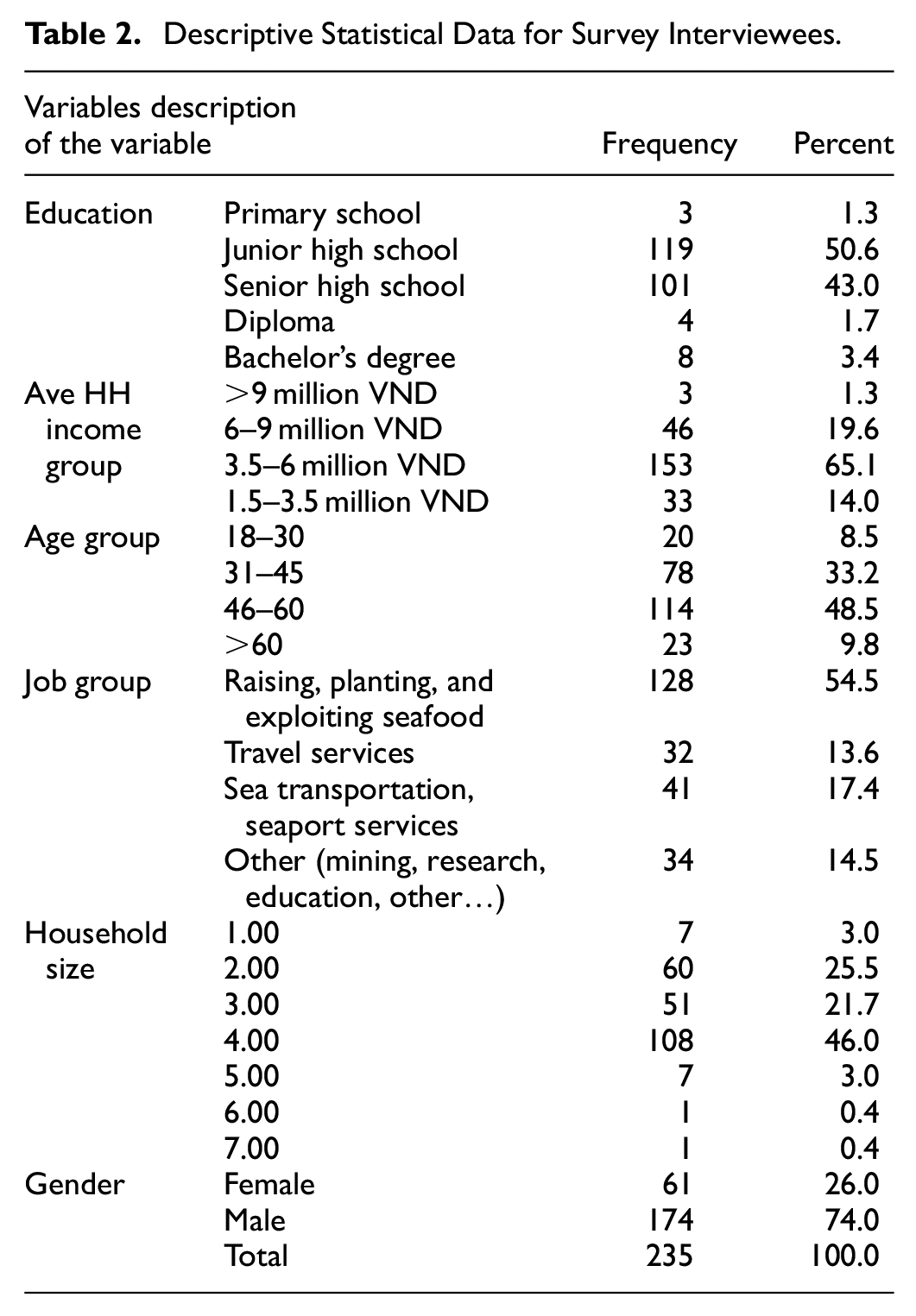
The survey data on occupation showed that 54.5% of respondents worked in aquaculture/fishing or forest product exploitation, 17.4% in shipping and seaport services, 13.6% in tourism services, and 14% in other areas (such as mining, research, and education). These statistical results align with the characteristics of the study area, a coastal region, where tourism and shipping services are developed, and the main economic activities revolve around aquaculture, fishing, tourism, and shipping services, including seaports. According to the People’s Committee of Phu Long Commune, in 2021, the average household income in Phu Long was 4.62 million VND per month, reflecting the income distribution in the sample. Specifically, 65.1% of surveyed households had an average monthly income between 3.5 and 6 million VND, followed by 19.6% with income ranging from 6 to 9 million VND per month, and 14% with incomes between 1.5 and 3.5 million VND per month.
Gender statistics revealed that 74% of interviewees were male, while only 26% were female. This distribution reflects the prevalence of male heads of households in the research area due to the predominant income-generating activities, which often require physical and good health, such as farming, fishing, and transportation services.
It was observed that 67.7% of surveyed households consisted of three or four members (21.7% and 46%, respectively), while 25.5% had two members. Households with fewer than two members or more than four members accounted for only 14% of the total, which aligns with the age profile of surveyed household heads and adheres to the family planning policy implemented in Vietnam from 1975 to 2009, which encouraged couples to limit their fertility and have one or two children.
Assessment of Measurement Model (Reliability and Validity Analysis)
In this study, the reliability of the factor scale was assessed using various indicators, including outer loading value, Cronbach’s alpha value (CR), composite reliability (ρC
Results of Reliability Analysis of the Latent Variables.

According to Höck and Ringle (2010), the convergent validity of the variables is confirmed when the average variance extracted (AVE) for each variable is higher than 0.5. The AVE values of the factors AT, KN, PBC, SN, and WTP are 0.596, 0.621, 0.621, 0.658, and 0.659, respectively (see Table 3). All factors have AVE values higher than 0.5, indicating good convergence validity.
The study used the criteria of Fornell and Larcker (1981) and the Heterotrait-Monotrait Ratio of Correlations method (Henseler et al., 2015) to assess the discriminant validity of the latent variables. Fornell and Larcker (1981) state that discriminability is ensured when the square root of the average variance extracted value (AVE) for each construct is higher than all correlations between constructs. Table 4 shows that the average AVE values (in bold on the diagonal) are higher than the off-diagonal correlations.
Discriminant Validity According to the Criteria of Fornell and Larcker (1981).

According to Clark and Watson (1995) and Kline (2011), discriminant validity of the factors is established when the Heterotrait-Monotrait (HTMT) values between the factors are less than 0.85. Table 5 shows that the HTMT values of the factors satisfy the requirements. Thus, all factors meet the discriminant validity requirements.
Discriminant Validity According to the Heterotrait-Monotrait Method.

Table 6 presents the bootstrapping results (using 5,000 resamples) with a confidence interval of 0.95. The results show that the HTMT values are significantly different from 1.00 (Henseler et al., 2015).
Heterotrait-Monotrait Ratio (HTMT).

Evaluation of Structural Model
Assessment of the structural model was carried out as follows: (a) Testing for multicollinearity; (b) Assessment of the significance of the path coefficient (hypothesis testing); (c) Assessment of exploratory power; and (d) Assessment of the in-sample and out-of-sample predictive power of the model.
In structural modeling, multicollinearity occurs when two or more highly correlated latent variables exist. According to Hair et al. (2019), the variance inflation factors (VIF) must be smaller than 5 to avoid multicollinearity. Becker et al. (2015) argued that collinearity problems can also occur with VIF values between 3 and 5; hence, to avoid multicollinearity, the VIF values must be less than 3. The results of Table 7 show that the VIF values are all less than 3; the problem of collinearity does not arise in the proposed model.
Multicollinearity Statistics.

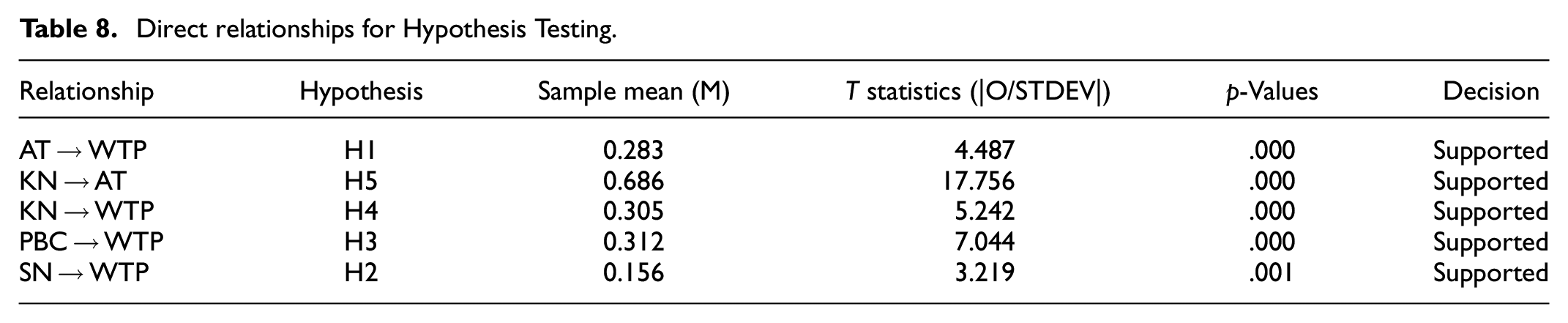
The study ran the bootstrapping algorithm in SmartPLS using 5,000 subsamples to test the hypotheses proposed in the study. Tables 8 and 9 show the impact assessment results of 04 latent variables (KN, AT, SN, PBC), and group the items controlling WTP and the impact of KN on AT. The results in Table 8 show that the impact of 04 latent variables on WTP and the effect of KN on AT is positive and statistically significant (with p-values all less than .01). Therefore, hypotheses H1, H2, H3, H4, H5 are supported. Similar results are shown in Figure 2. Based on the normalized regression coefficient, the analysis shows that the PBC has the greatest impact on the WTP, followed by KN, AT, and SN. The normalized regression coefficients of these factors are 0.312, 0.305, 0.283, and 0.156, respectively. However, with the normalized regression coefficient, it is impossible to state the strength of each variable. Cohen (1988) proposed the impact factor f2 to determine the impact of the independent variables. Specifically, f2 < 0.02 represents an extremely low level of impact or no impact; 0.02 ≤ f2 < 0.15 represents a low level of impact; 0.15 ≤ f2 < 0.35 indicates a medium impact; f2 ≥ 0.35 means a high impact. The f2 values in Table 7 show that PBC factor has a medium impact on WTP (0.15 ≤ f2 = 0.272 < 0.35). KN, AT, and SN have a small effect on WTP (0.02 ≤ f2 < 0.15), while KN has a significant impact on AT (f2 = 0.879 ≥ 0.35).
Direct relationships for Hypothesis Testing.
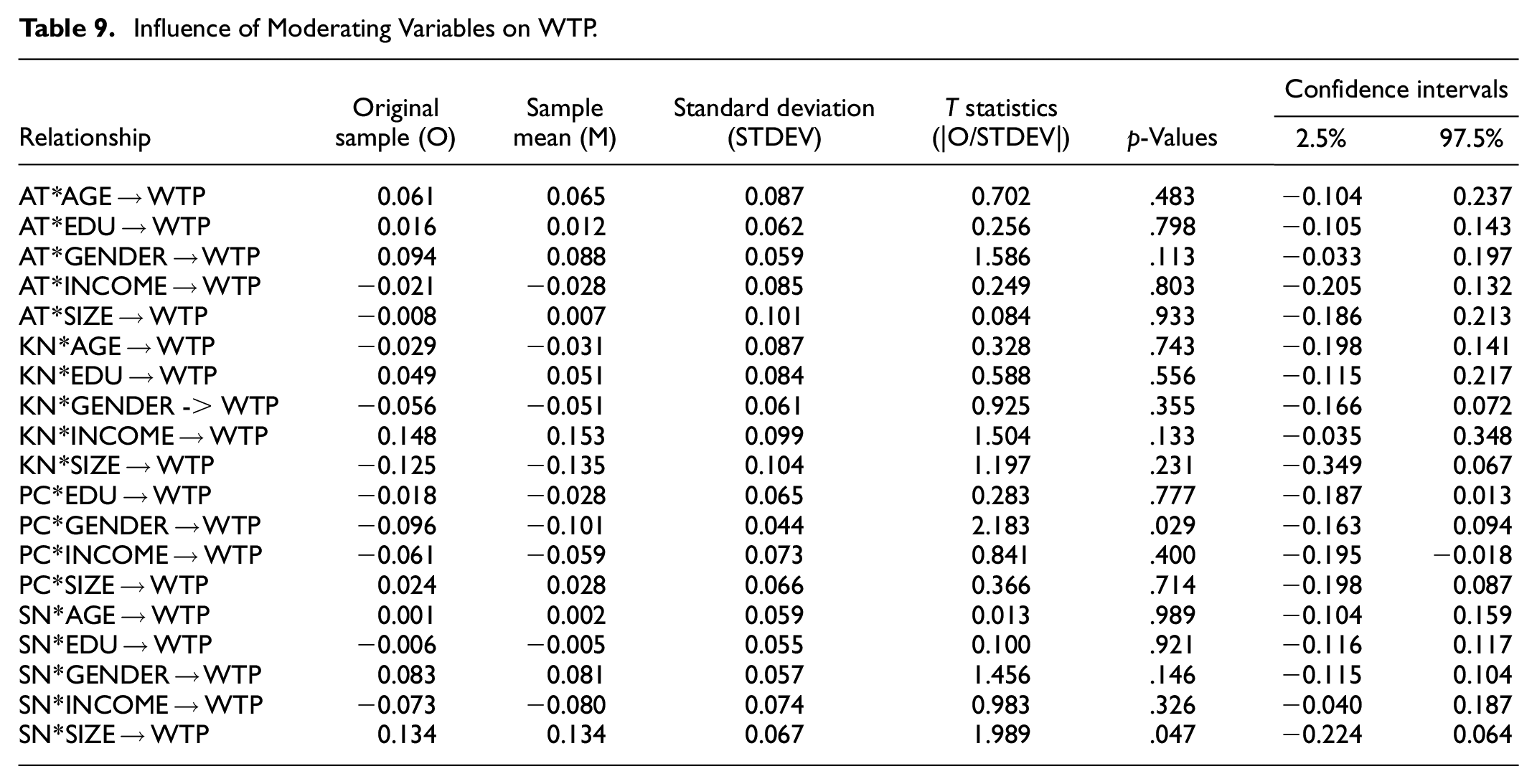
Influence of Moderating Variables on WTP.

Impact analysis results of construct and control variables on WTP.
Table 9 presents the results of assessing the impact of the moderating variables on WTP. The five moderating variables used in the model were: Income, Education level, Number of family members, Age, and gender. The results in Table 9 indicate that there were two significant moderating relationships, PC*GENDER → WTP, and SN*SIZE → WTP. The remaining moderating effects were insignificant since the t-tests produced p-values greater than .05.
The impact of PBC*GENDER → WTP was significant since p = .030 < .05. Gender (GENDER) had a role in moderating the impact of PBC on WTP. The normalized regression coefficient of the moderating impact was −0.096 < 0, thus this moderating effect was weaker in females than males. The SN*SIZE → WTP effect is significant (p = .046 < .05). Number of family members played a role in moderating the impact of SN on WTP. The normalized regression coefficient of the regulatory effect was 0.134 > 0, thus, the influence of SN on WTP was more significant in families with more members.
The study used the commonly applied adjusted coefficient of determination R2 to measure the exploratory power of the model (Sarstedt et al., 2022; Höck & Ringle, 2010). This method has three levels of R2 or adjusted R2: (a) If R2 is greater than or equal to .67, the model is strongly explained; (b) If .33 < R2 < .67, the model is explained moderately; (c) If .19 < R2 < .33 the model is explained weakly.
Table 10 shows that the adjusted coefficient of determination R2 of the dependent variable Attitude was .466. Thus, the independent variable Knowledge explained 46.6% of the variation in the Attitude. The adjusted coefficient of determination R2 of the dependent variable WTP was .721; hence, the independent variables AT, KN, PBC, and SN explained 72.1% (>67%) of the variation of WTP. The remaining 27.6% was explained by out-of-model variables and random error. Hence, the model is strongly interpreted.
R squared Values for the Assessment of the Model’s Exploratory Power.

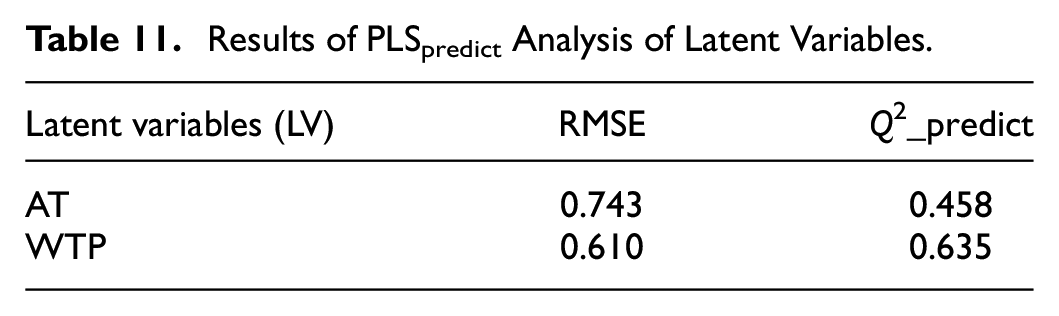
This study used the PLSpredict algorithm with the number of folds set at 10 and 10 repetitions to assess the ability of the PLS model to predict a new observation. Table 11 shows that the Q2Predict indices (comparing the prediction errors of the PLS path model with the simple average predictions) were all positive, so the PLS-SEM model offers better predictive performance than a linear regression (LM) model. In this research, Q2Predict values for latent variables were 0.458 for Attitude and 0.635 for WTP, respectively.
Results of PLSpredict Analysis of Latent Variables.
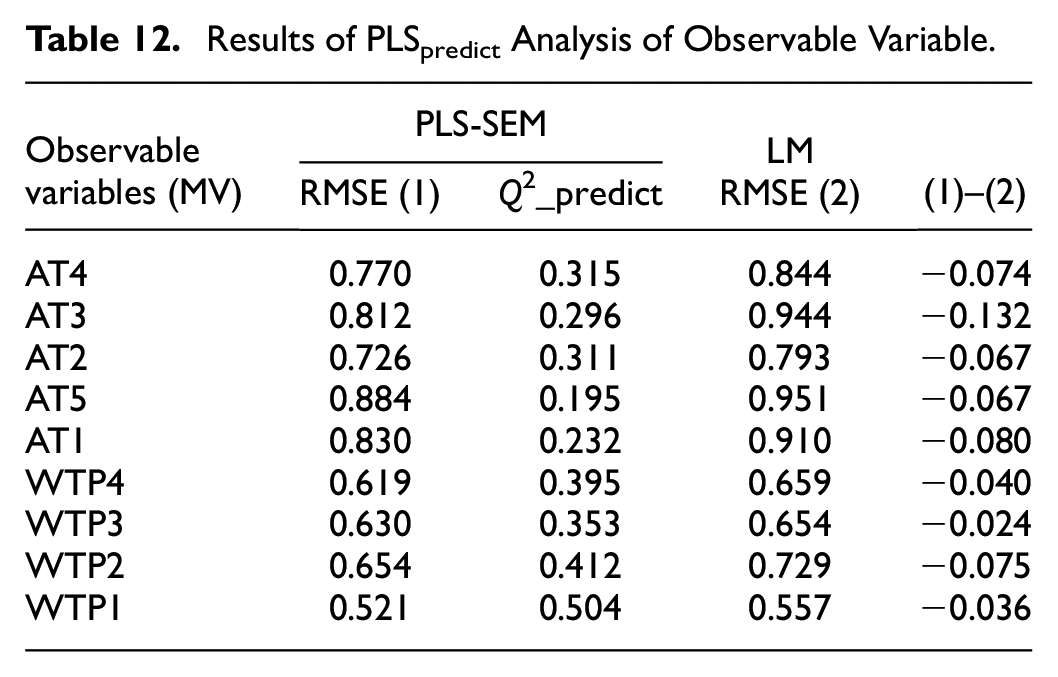
In addition, a comparison of the root means square errors (RMSE) results in Table 12 shows that the errors predicted from PLS-SEM analysis were lower than from Linear Regression (LM) analysis. According to Shmueli et al. (2019), the proposed model thus has a high predictive performance.
Results of PLSpredict Analysis of Observable Variable.
Discussion
This study aimed to assess the factors influencing WTP for MFESs among residents of Phu Long commune in Hai Phong, Vietnam. The research model was developed by extending the TPB to include the new factor of KN. The results indicate that PBC had the most significant impact on WTP, followed by AT, KN, and SN. The findings of this study serve as a foundation for developing strategies and policies to promote payments for MFESs toward sustainable mangrove development in the local area.
Environmental Knowledge (KN), a newly introduced factor in the model, enhances people’s intentions to pay, consistent with some previous studies that explored the relationship between knowledge and WTP (Sabiha, 2008; J. Yang et al., 2021). This can be explained by the idea that consumer knowledge increases an individual’s awareness of the importance of the environment and its relationship with human well-being, as highlighted by Winter et al. (2021). According to Gifford & Nilsson (2014), individuals are more likely to engage consciously in environmentally friendly actions when they possess specific knowledge about environmental issues. While knowledge is crucial in shaping intentions, there is still an indirect relationship through Attitude, in line with previous research (Egea & De Frutos, 2013; Ramdas & Mohamed, 2014). Knowledge can stimulate environmentally supportive intentions only when it triggers emotions and is assimilated by individuals (an integral part of Attitude) (Carmi et al., 2015; Geiger et al., 2018). In Phu Long, most households rely on mangrove forests for their livelihoods. However, over the past two decades, mangrove forest areas have seen significant fluctuations, with estimates for the years 1991, 2003, and 2018 being 1,175, 431.8 ha, and nearly 800 ha, respectively (Pham et al., 2018). The increase in mangrove forest area from 2013 to 2018 is attributed to afforestation efforts, while natural mangrove areas continue to decline (Hai Phong Statistical Office, 2021). These significant changes in mangrove forest areas and income sources tied to the forest seem to be two factors driving local residents’ awareness of mangrove-related knowledge. A study by Pham et al. (2018) in Phu Long revealed that local residents understood the role of the mangrove ecosystem in their livelihoods and were aware of some threats to the forest. Therefore, to ensure the benefits, positive attitudes of local people toward the forest’s existence should be promoted, and they should be willing to take action to protect it. These findings contribute to explaining how Environmental Knowledge positively influences Attitude and Intentions to pay for MFESs in Phu Long. Consequently, strategies to enhance the implementation of payments for MFESs in Phu Long should focus on environmental education and increasing awareness of the importance of mangrove forests. The content of public awareness campaigns should encompass knowledge of the benefits (economic, environmental), current status, threats, and consequences of mangrove forest degradation, as well as the global significance of mangrove forests (e.g., climate change).
Attitude (AT) has a positive influence on WTP, confirming the second hypothesis of the study. The positive correlation between supportive attitudes and intentions to pay has been found in previous research (López-Mosquera et al., 2014; Obeng & Aguilar, 2018; Shin et al., 2017; Stern et al., 1993). According to Milfont & Duckitt (2010), attitude is a crucial precursor to intentions and behaviors related to the environment. Attitude is described as a psychological predisposition to evaluate and express support for environmental issues. Therefore, when an individual has a supportive attitude toward the environment, they tend to behave in ways that are not harmful to the environment. The contributions of observed variables to this latent variable suggest that self-assessed attitudes (related to responsibility, support, urgency), and beliefs in the effectiveness of behavior (promoting happiness and benefits) are all positively and significantly related to WTP for MFESs. In the research area, Phu Long’s mangrove forests belong to the Cat Ba Biosphere Reserve, officially recognized by UNESCO as a World Biosphere Reserve in 2004 and designated as a Special National Biodiversity Heritage Site in 2013. The livelihoods of local residents have long been intertwined with pride in owning one of Vietnam’s most unique natural conservation areas. Additionally, according to Phu Long’s People Committee report (2021), most local residents are interested in and support the evaluation activities of the UNESCO World Heritage Center related to the nomination of World Natural Heritage related to the Cat Ba Archipelago in 2021. Therefore, most people here want to preserve, conserve, and maintain the unique biodiversity values of the Cat Ba Biosphere Reserve mangrove forest ecosystem for future generations. This characteristic also contributes to explaining the supportive Attitude toward paying for environmental services in the experimental results. Therefore, to enhance the effectiveness and garner public support for programs in the mangrove forest ecosystem service in Phu Long, implementation programs need to stimulate the people’s responsibility, pride, and love for the recognized biodiversity heritage values related to mangrove forests.
The analysis results indicate that Perceived Behavioral Control (PBC) has the most significant impact on WTP. Thus, individuals’ perceptions of their ability to perform a specific behavior directly affect their intentions. This finding aligns with the results of some studies on WTP for the environment (Knussen et al., 2004; López-Mosquera et al., 2014; Pouta & Rekola, 2001; Zhang et al., 2021). Perceived Behavioral Control is closely associated with perceptions of the ease or difficulty of performing a behavior. In other words, when individuals perceive more resources and fewer obstacles, their behavioral control will be higher, and their intentions to perform the behavior will be stronger. Financial resources, self-determination, self-control, and knowledge of how to participate in payments all contribute to estimating Perceived Behavioral Control. In reality, the average income of Phu Long residents in 2021 reached 4.62 million VND per person per month, higher than the average rural income in Vietnam in 2021 (3.486 million VND per person per month) (Phu Long’s People Committee, 2021). According to Vietnam’s current multidimensional poverty standards, this figure indicates no poor households in Phu Long. Moreover, during the 2016 to 2020 period, Hai Phong implemented five major projects to maintain stability, manage, and protect mangrove forests (including Phu Long mangrove forest). As a result, deforestation and forest degradation have decreased compared to previous periods (Hai Phong Statistical Office, 2021). These figures partly explain the strong impact of Perceived Behavioral Control compared to other factors on WTP for MFESs in Phu Long. Therefore, respondents are willing to contribute to forest protection if household financial resources are feasible. Furthermore, additional resources from government projects in Phu Long have helped residents see that they have support and resources to contribute to forest protection. These findings are supported by the research of He et al. (2021). To reinforce the dominant role of Perceived Behavioral Control, the implementation programs for payments for MFESs in Phu Long should consider: (a) transparently disclosing the resources for forest protection activities to avoid responsibility conflicts, (b) strengthening the positive beliefs of those who believe they can contribute to addressing this issue and changing the negative beliefs of those who feel they lack the corresponding resources, (c) conducting comprehensive assessments to evaluate the financial capacity of participants, and (d) making payment mechanisms clear and easily accessible to the public.
Subjective Norms (SN) are the factor with the weakest impact on intentions to pay, meaning that respondents believe they are less influenced by the expectations of relevant others in their decisions to pay for MFESs. This result is consistent with some previous studies (Pouta & Rekola, 2001; Sujitra & Suthirat, 2018; Zhang et al., 2021). However, as noted by Knussen et al. (2004), how subjective norms are conceptualized in the model may be a reason for not finding a significant relationship with intentions. This result was not expected in the context of Vietnam, where collective thinking is highly valued. However, when considering WTP as an individual decision, motivational strategies should focus on individuals rather than collectives as before. The weak impact of subjective norms in the Phu Long context may also be due to the inability to create the necessary enforcement pressure. Specifically, although current legal regulations on environmental service payments in Vietnam have been established, most payment programs for MFESs are implemented for business and production entities (electricity production facilities, water supply, and production facilities) rather than for individuals or households. Therefore, the implementation of existing policies in the region is ineffective, and there is a need to emphasize awareness of the responsibility to participate in environmental service payment programs in Vietnam.
The experimental results in this study have shown that some demographic characteristics, such as gender and the number of family members, play a moderating role in the relationship between independent and dependent variables. In other words, they indirectly affect behavioral intentions. Subjective norms influence the respondents’ decisions less than other factors in the experimental model. However, the characteristic “number of family members” moderates the positive relationship between subjective norms and WTP. Thus, social pressures seem to increase with the nature of “closeness” in personal relationships (pressure from family members and the number of family members is more important than pressure from friends and the community). The study also indicates that gender characteristics influence the relationship between Perceived Behavioral Control and WTP. Men seem to be more decisive than women in evaluating the ease or difficulty of payment intentions. This result is consistent with the social environment in Phu Long, Vietnam, where most households are headed by men, who are also the primary earners in the family in this area.
Conclusion and Recommendations
This study investigated the factors influencing residents’ WTP in the environmental context of a developing country, specifically Vietnam. The research extended the TPB by introducing a new factor, environmental knowledge (KN). The proposed model in this study considered four influential factors: PBC, AT, KN, and SN. A random sampling method was employed, involving 235 individuals from various households in Phu Long commune, Vietnam, who were selected for interviews. PLS-SEM was used to analyze the collected data. The results revealed that the PBC had the most significant impact on residents’ WTP, followed by AT, KN, and SN. Additionally, environmental knowledge was found to influence residents’ attitude significantly. Furthermore, the study explored the moderating effects of gender, income, education level, number of family members, and age on the model’s constructs. The research outcomes indicated that PBC had a weaker impact on WTP among females than males; besides that, the more members a family has, the more SN affects WTP.
The study makes several theoretical contributions to the literature. First, it verifies that the extended TPB model benefits forecasting modeling. Empirical data have confirmed that the model has a high predictive ability based on the values obtained for R2 and Q2 Predict. Second, the original TPB framework is expanded by including the KN variable. This KN factor is statistically significant in the model, ranking second after PC in the variables significantly impacting WTP. Third, it explores the moderating effects of demographic and socioeconomic variables on the causal relationship between psychological factors and behavioral intention. Empirical evidence shows several demographic and socioeconomic factors drive the relationship between psychological factors and behavioral intentions. In this study, gender plays a moderating role in the impact of the PBC factor on WTP. The number of family members moderates the impact of SN on WTP. Thus, moderating effects help describe a situation in which the relationship between two latent variables is not constant but depends on the values of a third variable. Testing for moderating relationships provides a means to account for heterogeneity in data analysis results. This study has improved forecasting models of factors influencing WTP. Based on the analysis results, this study proposes several policy recommendations to encourage the willingness of residents in Phu Long commune, Hai Phong, Vietnam, to pay for FESs. Strategies aimed at improving the implementation of forest environmental service payments in Phu Long should emphasize enhancing the community’s understanding of the importance of mangrove forests. Information dissemination should encompass knowledge about the benefits (both economic and environmental), the current status, threats, and consequences of mangrove degradation, as well as the global significance of mangrove forests, particularly concerning climate change. Additionally, to increase the effectiveness and garner community support for environmental service payment programs in Phu Long, implementation efforts should promote residents’ sense of responsibility, pride, and love for the recognized biodiversity heritage values associated with mangrove forests. To reinforce the pivotal role of the behavior control factor, the planned forest environmental service payment programs in Phu Long should: (a) Publicly disclose resources allocated for forest protection activities to prevent conflicts of responsibility; (b) Assess the financial capacity of participants while implementing a long-term policy aimed at increasing residents’ income; (c) Clearly define the methods and procedures for participating in forest environmental service payments to ensure easy access for local residents.
Limitations and Future Research
This study had some limitations that can be addressed in future research. First, the study selected five FESs to assess intention to pay. The community prioritized these services, but delineating beneficiaries’ interest in different environmental services is often difficult. Therefore, the study design could focus on personalizing payer preferences in future studies. Second, the generalizability of the findings of this study is limited by the sample size, although it meets the basic requirements of using PLS-SEM to study WTP. Further research could be conducted on a larger scale in terms of both geopolitical boundaries and number of respondents. Finally, demonstrating the significant role of Environmental Knowledge factors in the empirical model requires further exploration of other potential psychological factors toward better results. However, while additional predictors may increase the model’s explanatory power, they may increase the complexity and difficulty of empirical investigations. With this research, the design of the questionnaire for the field survey also needs to be considered to fit the limited budget for practical implementation. Therefore, future studies can consider combining different theoretical models to explore how psychological factors influence each other.
Footnotes
Declaration of Conflicting Interests
The author(s) declared no potential conflicts of interest with respect to the research, authorship, and/or publication of this article.
Funding
The author(s) received no financial support for the research, authorship, and/or publication of this article.
Ethical Approval
This paper does not contain any studies with human participants or animals performed by any of the authors.

Data Availability Statement
Data available on request from the authors.