




Abstract
Bootleg innovation is a common phenomenon in Chinese universities. However, little is known about its influencing factors and mechanisms. Based on the trait activation theory, the current study proposes and tests a moderated mediation model by conducting an online survey of 1,038 university teachers at four undergraduate universities using convenient sampling. The findings suggest that the influence of individualistic orientation on bootleg innovation is greater than that of collectivism. Individualism has less influence on informal organizational norms than collectivism. Such norms play a partial mediating role between individualism/collectivism orientation and bootleg innovation behavior. Environmental uncertainty positively moderates the entire mediation model of individualistic orientation but not the first half of the path of the collectivist model. This study enriches the research on antecedent variables of bootleg innovation behavior and highlights the important role of situational factors in the entire mechanism.
Plain language summary
Bootleg innovation is very common in Chinese universities, but little is known about its influencing factors and mechanisms. Based on trait activation theory, this study conducted an online survey of 1,038 university teachers at four undergraduate universities. The study found that individualistic orientation has a greater impact on bootleg innovation than collectivism. However, individualism does not have as great an impact on informal organizational norms as collectivism. The informal organizational norms play a partial mediating role in the relationship between individual collectivist orientation and bootleg innovative behavior. Environmental uncertainty had a positive moderating effect on the entire individualism-oriented model, but not on the first half of the collectivism model. This study enriches the research on the antecedent variables of bootleg innovative behavior and also highlights the important role of bond factors in the entire mechanism.
Keywords
Introduction
Although one role of higher education institutions is to build regional innovation systems (Caniëls & Van den Bosch, 2011)—and the university-industry partnerships have proliferated, and university science has been increasingly commercialized (Jongbloed, 2015), only a minority of university teachers conduct university-based innovation and entrepreneurial activities. They may have produced various innovative ideas, but the organization does not provide sufficient resources to support the elaboration of all proposed new ideas in the work context (Mainemelis, 2010). Thus, structural tension arises under such circumstances, suggesting the possibility of bootleg innovation. Bootleg innovation can bridge the gap between the rigid institutional structure of universities and the dynamic nature of modern society and exchange small resource investments to explore unauthorized innovation fields, which have the potential to promote higher education reform and research development. Although bootleg innovation has become a common phenomenon in higher education, few studies have been conducted in this field. Fortunately, the research on bootleg innovation in enterprises has several implications. Over the last two decades, an increasing number of empirical studies have documented various factors that may influence employees’ bootleg innovations. These factors are primarily at three levels: organizational, leadership, and individual variables. Organizational variables, such as strategic autonomy and rewards for innovation accomplishments (Globocnik & Salomo, 2015), perceived organizational support for creativity (Zhou & George, 2001), and management practices (Globocnik et al., 2022), have been empirically proven to be related to bootleg innovation. Leadership characteristics were the most examined among these three variables, and leadership styles such as paradoxical leadership (D. Huang et al., 2022) and agile leadership (Hooi & Tan, 2021) have a significant impact on employees’ bootleg innovation. Augsdorfer (2005) notes that research focusing on individual-level factors is important because bootlegging behavior is self-motivated. Individual-level antecedents such as self-efficacy (Globocnik & Salomo, 2015), risk propensity (Globocnik, 2019), self-identification (Nanyangwe et al., 2021), and proactive personality (C. Li & Sun, 2015) have been shown to foster bootleg innovation to some extent.
Bootleg innovation, a very special form of innovation, is usually a bottom-up, non-programmed activity, without official authorization from the relevant management, but for the benefit of the organization (Augsdorfer, 2012). The concept of bootleg innovation emphasizes the importance of personal initiative in creative processes, even though sometimes they apply unorthodox approaches (Globocnik & Salomo, 2015), or “going underground” approaches (Criscuolo et al., 2014). Exploration advantages associated with bootleg innovation may spill over to individuals’ formal work and enable them to introduce greater novelty and creative thinking into their formal projects, thus, boosting their individual ability to develop innovations within the formal system and generate value for the organization (Criscuolo et al., 2014). Although some researchers worried that bootleg innovation might contribute to deviant behavior or workplace deviance (Globocnik & Salomo, 2015; Mainemelis, 2010), many other researchers (e.g., Augsdorfer, 2012; Masoudnia & Szwejczewski, 2012) proved that the primary motivation behind bootlegging was the desire to benefit the organization. In effect, there is a high acceptance of bootleg products, which only cause minor additional costs in some companies (Augsdorfer, 2005). Thus, a significant number of researchers hold a positive attitude toward bootleg innovation and believe that both individuals and their organizations can profit from it (Augsdorfer, 2005; Criscuolo et al., 2014).
Knowledge workers have now become an innovative force with strong organizational support (Yuan & Liu, 2022), and as a part of them, university teachers are greatly expected to innovate. However, due to limited organizational resources in higher education and the risk and uncertainty of innovation results, university teachers sometimes cannot achieve their innovation goals through formal channels; thus, they are quite likely to construct bootleg innovation behavior to achieve their personal and organizational innovation goals. Moreover, when the organization’s traditional cultural norms, procedural management, and rigid hierarchical structure hinder the implementation of creativity, knowledge workers, such as university teachers will conceal or even violate the superior leadership’s insistence on innovation (Lehman & Ramanujam, 2009), which also leads to bootleg innovation. University teachers’ bootleg innovation behavior barely does any harm to the organization; instead, by tolerating the illegitimate pursuit of a new idea, organizations can extract a potential benefit with comparatively fewer resources and by displacing the risk to the creative deviant (Mainemelis, 2010). Therefore, university teachers’ bootleg innovation can be defined as innovation behavior carried out independently by teachers without the formal support of the organization or hidden from the sight of senior management but is also expected to benefit the organization. For them, bootleg innovation is a self-motivated innovation with fewer organizational resources and a complement to the type of innovation that should be under the direct control of management (Augsdorfer, 2012).
Prior research on bootleg innovation has revealed that factors such as organizational environment, individual characteristics, and managerial features are likely to have some bearing on employees’ decisions to engage in bootlegging behavior. Though many studies have explored the antecedents and consequences of employees’ bootleg innovation behavior, few have set foot in the field of higher education to explore that of university teachers. Consequently, university teachers’ bootleg innovation needs to be explored more deeply and carefully. First, the organizational environment of universities is quite different from that of businesses. Second, a significant number of university teachers, who are a group of people with the most innovative potential and are likely to gain a competitive advantage through innovation, transfer to bootleg innovation because of limited resources or any other reason.
Theoretic Framework and Hypothesis Development
Trait Activation Theory
To unlock the black box of university teachers’ bootlegging behavior, we utilize the trait activation theory to propose that organizational situations such as environmental uncertainty and informal organizational norms can explain the process through which personality traits influence bootlegging behavior. According to the trait activation theory, individual behavior is affected by “trait − situation” interaction; it is the result of external situations (organizational support, organizational culture, etc.) and personality traits (characters, values, abilities, etc.) and has been widely used in management practice (Tett & Guterman, 2000). Tett and Burnett (2003) have further pointed out that, because people can boost their intrinsic motivation by expressing their personality traits, they tend to look for trait-relevant situations for their expression. For example, extroverted individuals are more likely to experience pleasure from attending corporate gatherings and, therefore, are more likely to participate in such events.
One of the personality traits expressed in individuals’ innovation behavior is individualism-collectivism orientation, which can be viewed as a form of individual difference, not just cultural influence (Moorman & Blakely, 1995), which belongs to personality traits because it is an intra-individually consistent and inter-individually distinct propensity to behave in an identifiable way (Etherington, 2019). Z. Huang et al. (2018) considered individualism/collectivism orientation as a psychological trait, as individualism may exhibit a tendency to value personal achievement, independence, and uniqueness, whereas collectivism emphasizes social connections, cooperation, and shared goals (Z. Huang et al., 2018). As a personality trait, the individualism-collectivism orientation denotes people’s preferences for attitude, cognition, and behavior (Bechtoldt et al., 2012). Augsdorfer (2012) notes that while management and the organization can enhance or stop innovation, it is the individual who is the source of a new idea. Personality traits, thus, play a significant role in predicting and explaining employees’ organizational behavior and are expressed through their behaviors at work (Barrick et al., 2013; Durand & Kremp, 2016).
The expression of personality traits in workplace behavior, that is, trait-expressive behavior, is related to various situational features such as job demands, distracters, constraints, releasers, and facilitators (Tett & Burnett, 2003). Informal organizational norms, also known as social norms, are “unwritten rules” not promulgated by an organizational authority but based on socially shared beliefs about what people ought to do, usually involving some sort of social sanction (Petrič & Roer, 2022). Compared to formal rules, university teachers are more likely to be influenced by informal rules because the organizational structure of universities has loose unity, which dispels the control strength of bureaucratic power and formal rules (Tierney & Lanford, 2018). As an implicit job demand for university teachers, informal norms may act as a releaser and facilitator for collectivists and as a distracter and constraint for individualists.
Environmental uncertainty also influences university teachers’ bootleg innovation behavior. Duncan (1972) and Kolomytseva and Pavlovska (2020) conceptualized environmental uncertainty as the degree of complexity in external relations and the rate of change among important elements of complexity in the external environment. In the context of the current pandemic and social unrest, education is seeking a new social contract and experiencing uncertainty (UNESCO, 2022). Bootlegging can help an organization overcome its innovation inertia, recognize and act on opportunities not considered in its deliberate strategy, and facilitate innovation at low additional costs (Globocnik et al., 2022), which is favorable in uncertain environments. According to the trait activation theory, certain situations can moderate the fit between individuals and organizations (Tett & Burnett, 2003); thus, environmental uncertainty may moderate the influence of individualism-collectivism orientation on organizational behavior, that is, bootleg innovation behavior.
The discussion above shows that the individualism/collectivism orientation of college teachers, informal organizational norms, and environmental uncertainty have an impact on their bootleg innovation. Therefore, based on the trait excitation theory, this study constructs a five-variables relationship model (see Figure 1) to provide an effective empirical basis for relevant research.

Research framework.
Individualism-Collectivism Orientation and Bootleg Innovation
Individualism and collectivism are among the most important cultural values that have received abundant attention. Some researchers have suggested that individualism/collectivism may be a multidimensional construct that can be examined as an individual difference variable (Etherington, 2019; Ramamoorthy & Carroll, 1998). Although it is generally believed that China is a society with “high collectivism” or “low individualism” cultural values, the nation has witnessed a shift in cultural values; along with ecological changes, increasingly more young Chinese people have oriented to individualism and developed individualistic skills to become adaptive in a market-oriented society (Zeng & Greenfield, 2015). Thus, individualist or collectivist orientation at the individual level may differ from, although not always incompatible with, that at the cultural level (Kobayashi et al., 2010). Some researchers have proven that individual-level collectivist/individualist orientation is related to workplace behavior, attitudes, and other organizational outcomes (J. B. Li et al., 2018). Individualist orientation is associated with independent self-construal, whereas collectivist orientation is associated with interdependent self-construal. However, people with individualist orientations predominantly pursue personal preferences, whereas people with collectivist values feel obliged toward group welfare and conform to group norms (Brewer & Chen, 2007). Individuals with a collectivism orientation are more concerned with the interests of groups, but when their interests are challenged, they adopt unorthodox and innovative methods to avoid failure, as confirmed by Leicht et al. (2021). In addition, a recent study indicated that organizational identification, which may promote collectivism orientation among employees, has a significant positive effect on bootleg innovation (Nanyangwe et al., 2023). The results of this study are consistent with the argument that people in collectivist cultures are more sensitive to building consensus and preserving harmony to promote innovation, although sometimes in unprescribed ways. However, people with an individualist orientation are likely to exercise their free will to make choices regarding bootleg innovation behaviors. For example, individualism-oriented people tend to use unconventional procedures to achieve innovation so that they can obtain satisfaction and a sense of achievement from their individual behaviors (Kim & Coleman, 2015). Compared with collectivist orientation, individualist orientation may exert a greater effect on individuals’ bootleg innovation behavior. Empirical research has noted that employees with higher self-identification with work are more likely to engage in bootlegging behavior to realize innovative outcomes appreciated by their organizations to keep feeling valuable and significant in the organization (Nanyangwe et al., 2021). People with an individualism orientation emphasize autonomy, emotional independence, and individual initiative (Z. Huang et al., 2018); thus, they may more easily produce higher self-identification with their work if their work provides them with the opportunity to be individually creative.
Therefore, this study proposes the following hypothesis:
H1: Individualism and collectivism orientations both have a significant positive effect on university teachers’ bootleg innovation, and the former has a greater effect on bootleg innovation.
The Mediating Influence of Informal Organizational Norms
According to the trait activation theory, situational factors influence personality trait expression, and personality traits, in turn, are expressed in the context to which they adapt (Tett & Burnett, 2003). Thus, people with different value orientations would behave differently under certain circumstances. Compared to people with individualism orientations, those with collectivist orientations pay more attention to norms and are more likely to be affected by others’ attitudes and norms (Sreen et al., 2018). Others have also identified relationships between individualism and people’s willingness to violate norms (Etherington, 2019). Informal norms are more easily perceived and popular among Chinese university teachers as China has a tradition of advocating social norms.
Informal organizational norms, which are organizationally induced, may provide employees with implicit and explicit cues regarding expected behavioral and attitudinal responses (De Jong et al., 2014), which are pervasive components of social life that contribute, together with formal rules, to shaping human relationships (Fiori, 2018). Although modern universities have introduced more rules and regulations and stricter monitoring of teachers’ innovation work, research has shown that formal process management systems can constrain the flexibility and creativity required to explore new opportunities (Benner & Tushman, 2002; Jansen et al., 2006). Some authors have pointed out that bootleg innovation can flourish in units with relatively low levels of normative enforcement (Criscuolo et al., 2014; Mainemelis, 2010). Thus, when limiting the control of upper management or actively removing some of the inhibitions on creativity, more autonomous or deviant innovation behaviors occur (Runco & Pritzker, 2020). Informal organizational norms sometimes cooperate with and reinforce formal rules but sometimes are incompatible with formal rules (Fiori, 2018), implying that informal norms, to some extent, create individuals’ consciousness, sensitivity, and acceptance of unwanted social exchanges and external pressure. These coping strategies are needed in the process of bootleg innovation because individuals need to think of unconventional ways of circumventing distractions to accomplish creative goals (Nanyangwe et al., 2021). Hence, we argue that informal university norms can predict teachers’ bootleg innovation.
Based on the trait activation theory and the abovementioned arguments, we predict the following:
H2a: Informal organizational norms mediate the relationship between individualism orientation and university teachers’ bootleg innovation.
H2b: Informal organizational norms mediate the relationship between collectivism orientation and university teachers’ bootleg innovation.
The Moderating Influence of Environmental Uncertainty
Employees’ bootlegging behavior occurs within the broader setting of the organization; thus, the environment in the organization is likely to have some bearing on the decision of whether to engage in such behavior (Nanyangwe et al., 2021). All activities are conducted in a certain environment, and a significant characteristic of the environment is its uncertainty. Environmental variables are conditional variables that can moderate the role of personality traits in workplace behavior (De Hoogh et al., 2005; Tett & Guterman, 2000). The construct of environmental uncertainty contains two dimensions: the lack of information regarding the environmental factors associated with a given decision-making situation and not knowing the outcome of a specific decision in terms of how much the organization would lose if the decision was incorrect (Kreiser & Marino, 2002). Bootleg innovation itself is at the risk of facing uncertain results; thus, individuals’ risk propensity may explain why some secretly organize innovation, whereas others do not (Globocnik, 2019). Individuals’ risk propensity, in turn, is related to their personality traits. Some authors have confirmed that people with an individualism orientation have higher risk tolerance (Goudarzi et al., 2023). Therefore, compared with collectivists, people with individualism orientation may be more likely to implement bootlegging behavior in an uncertain situation. As the trait activation theory emphasizes, situation-trait relevance works as a moderator of trait–behavior relations and cross-situational consistency (Tett et al., 2021).
Although environmental uncertainty implies a risk of failure, Sreedevi and Saranga (2017) argue that opportunities from environmental uncertainty outweigh the risks, and uncertain environments are likely to provide a richer source of innovation opportunities than relatively certain ones (Jaafari, 2001). Some authors have concluded that environmental complexity and uncertainty influence behaviors of innovation (Lin & Ho, 2008; Sreedevi & Saranga, 2017). Some studies confirmed that small firms’ innovation activities decreased because of the lack of R&D and innovation investments in the COVID-19 crisis (Roper & Turner, 2020); an unexpected crisis aggravates environmental uncertainty. Authorized innovation has decreased; thus, we can infer that bootleg innovation may increase simultaneously because people need a new path to explore novel ideas (Criscuolo et al., 2014). In addition, environmental uncertainty may affect employees’ beliefs about the value and risks of bootlegging, which could spark their openness to bootlegging and eventually expand their engagement in this behavior. Nanyangwe et al. (2023) show that uncertain risk factors moderate multiple pathways in the mediating model of organizational identity, work engagement, and bootleg innovation, suggesting that individualist/collectivist orientation, and the antecedents of bootleg innovation can also be moderated (Jetten et al., 2002).
Based on the abovementioned arguments, we propose the following hypotheses:
H3a: Environmental uncertainty moderates each path in the mediation model of individualism orientation, informal organizational norms, and bootleg innovation.
H3b: Environmental uncertainty moderates each path in the mediation model of collectivism orientation, informal organizational norms, and bootleg innovation.
Method
Approach
Questionnaires offer an objective means of collecting information about people’s knowledge, beliefs, attitudes, and behaviors (Boynton & Greenhalgh, 2004). Anonymity ensures objectivity, with the respondents not being disturbed by others when completing the questionnaire. With the development of technology, the online survey, with its convenience of access to unique populations, saving time and cost, has been widely used in various research fields (Wright, 2005). The online survey also provided the possibility of conducting research on the limitations of interpersonal communication regulated by the local government during the epidemic period. In addition, the research goal of this study is to uncover the bootlegging behavior characteristics of university teachers. Considering that participants might be reluctant to talk about the issue, the quantitative method is more suitable in the current study.
Participants and Procedures
In this study, teachers from four undergraduate colleges in two prefecture-level cities with the largest populations in Hunan Province were investigated using convenience sampling, including professional and technical post-teachers (including full-time teachers with junior and senior professional titles) and management post-teachers (referring to relevant management personnel). All questionnaires were presented in Chinese after scientific translations and back translations from the English originals when necessary.
Prior to completing the questionnaire, the respondents were informed in detail about the purpose of the study and signed an informed consent form online. They were also notified that the research data were only used for this study and not for other purposes, that the privacy of each subject was guaranteed, and that they had the right to withdraw their research data at any stage of the study. Specifically, 1,118 questionnaires were distributed from September 8 to October 26, 2022, based on a pre-test through the online questionnaire distribution and collection tool Wenjuanxing. Eighty questionnaires were excluded because they were incomplete or had extreme values; 1,038 valid questionnaires were recovered, with an effective recovery rate of 92.84%.
Measurements
The measures used in this study were all from prior publications, and all scales adopted the 5-point Likert ratings from 1 (strongly disagree) to 5 (strongly agree). Individualist/collectivist orientation was assessed by the scale made by Oyserman et al. (2002), which includes two separate dimensions: one for individualism (seven items)—sample item: “I take great pride in accomplishing what no one else can accomplish”—and one for collectivism (eight items)—sample item: “To understand who I am, you must see me with members of my group.” The reliability of the original questionnaire was 0.89 for individualism and 0.91 for collectivism. All items were deemed suitable after item exploratory factor analyses. The reliability of the former is 0.931. The confirmatory factor analysis (CFA) results showed that the factor loads were between 0.791 and 0.832. The composite Reliability (CR) value is 0.931, which is higher than the evaluation standard of 0.7, and the Average Variance Extracted (AVE) value is 0.658, which is higher than the evaluation standard of 0.5. The reliability of the latter was 0.945 and the factor load ranged from 0.796 to 0.898. The CR value was 0.945, and the AVE value was 0.683, which were higher than the evaluation criteria (Fornell & Larcker, 1981).
The 7-item informal organizational norms scale was adapted from De Jong et al. (2014)—sample item: “being prepared to work overtime.” The reliability of the original scale is 0.92. All items were deemed suitable after item and exploratory factor analyses. The reliability of the questionnaire was 0.913. The CFA results showed that the factor load was between 0.691 and 0.861, the CR value was 0.914, and the AVE value was 0.604.
Environmental uncertainty was assessed using the three-item scale developed by De Hoogh et al. (2005)—sample item: “Your work environment is dynamic.” The total reliability of the original scale was 0.82. All items were deemed suitable after item and exploratory factor analyses. The reliability of the questionnaire was 0.881. The CFA results showed that the factor loads were between 0.808 and 0.916, the CR value was 0.883, and the AVE value was 0.717.
Bootleg innovation was assessed using the five-item scale developed by Criscuolo et al. (2014)—sample item: “I proactively take time to work on unofficial projects to seed future official projects.” After item and exploratory factor analyses, all items were found to be suitable. The reliability of the questionnaire was 0.909, and the CFA results showed that the factor loads were between 0.758 and 0.896. The CR value was 0.910, which is higher than the evaluation standard of 0.7, and the AVE value was 0.671.
Results
After the common method variance test and reliability and validity analysis of all items, descriptive statistics were computed for all the demographic variables. Difference analysis was conducted to test the difference in each variable, and regression analysis was used to explore the relationship between all variables.
Common Method Variance
A common method variance test was conducted using Harman’s single-factor test, and five factors with characteristic roots greater than one were identified. The variance interpretation rate of the first common factor was 29.411%, which was less than the critical standard of 40% (Harris & Mossholder, 1996). Furthermore, multi-factor model CFA and single-factor model CFA were used to compare the model fit. The results showed that the multi-factor model (χ2 = 854.159, df = 395) was significantly lower than that of the single-factor model (Δx2 = 13418.251, Δdf = 10, p < 0.001; Richardson et al., 2009). Therefore, the data in this study are not affected by common method bias, and the relationship between the variables derived from the data is credible.
Reliability and Validity of Measurements
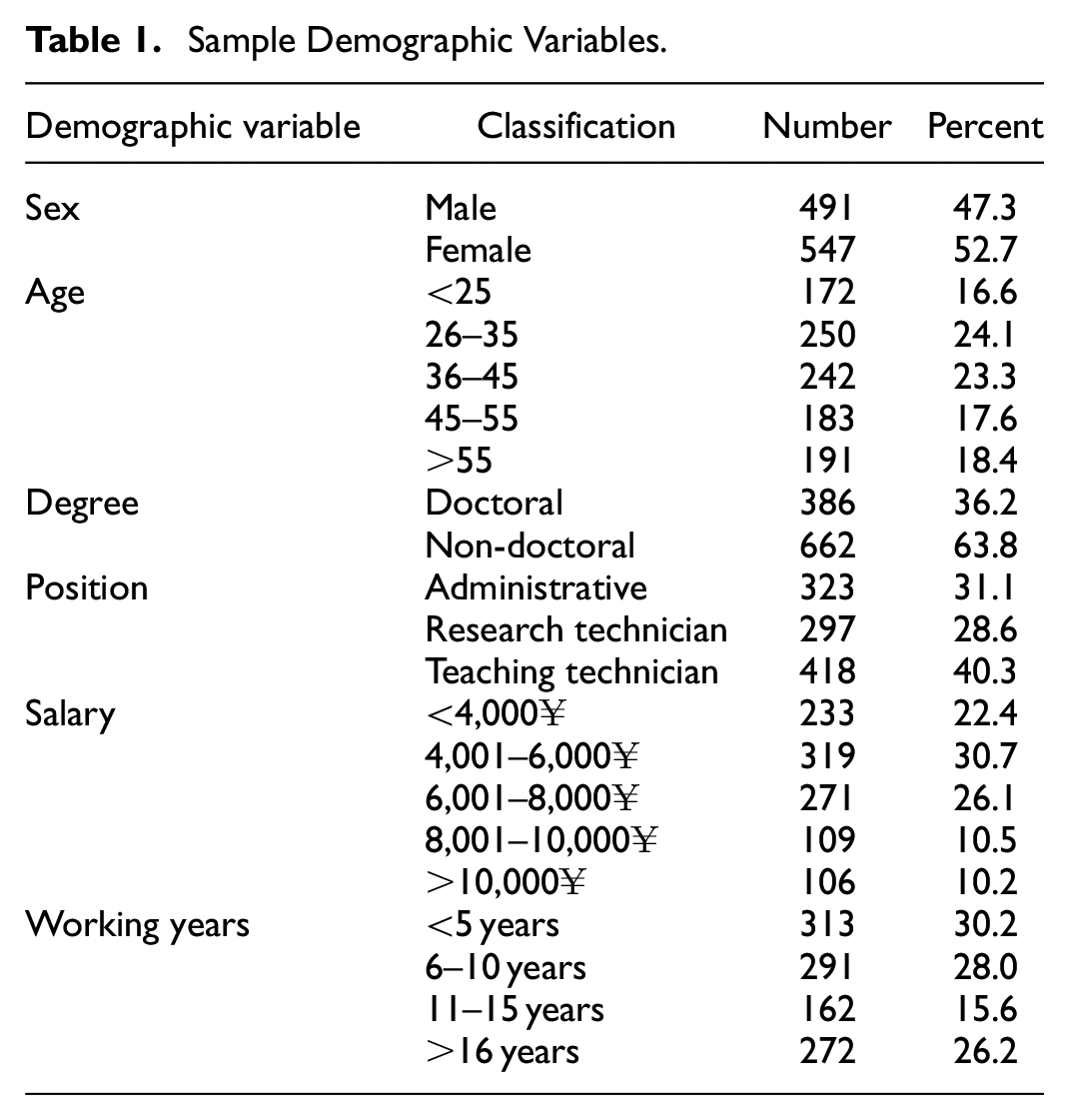
In the current study, female teachers account for 47.3%, which is close to the proportion of female employees in universities and colleges in Hunan Province according to the 2022 Statistical Year Book of Hunan Province; thus, the sample data are more reliable. Additionally, 24.1% of teachers were aged 26 to 35, 63.8% did not have a doctorate, 40.3% were in a teaching position, and 30.2% had less than 5 years of work experience (See Table 1). The average score of each variable ranges from 3.38 to 3.49, indicating that participant university teachers have a high level of individualism/collectivism perception, strong informal organizational norms, work in a changing environment, and have a relatively high frequency of bootleg innovation behavior.
Sample Demographic Variables.
After testing, the skewness (S) and kurtosis (K) values of the Individualist Orientation scale were between −0.944 and 0.148, and the Mardia value was 7.656, which was smaller than P × (P + 2) = 63 (P was the number of observed variables). The S and K values of the Collectivist Orientation scale were between −0.919 and 0.241, and the Mardia value was 7.948, which was smaller than P × (P + 2) = 80. The S and K values of the Informal Organizational Norms scale were between −0.875 and 0.486, and the Mardia value was 11.397, which was smaller than P × (P + 2) = 63. The S and K values of the Environmental Uncertainty scale were between −0.831 and 0.184, and the Mardia value was 3.231, which was smaller than P × (P + 2) = 15. The S and K values of the Bootleg Innovation scale were between −0.938 and 0.255, and the Mardia value was 3.679, which was smaller than P × (P + 2) = 35. All these tests met the reliability standards, indicating that the data of the three scales had a normal distribution (Kline, 1998; Mardia & Foster, 1983).
The results of the CFA (see Figure 2) showed that the correlation was between .194 and .333, The variables moderately correlated with one another. χ2/df = 2.162, RMR = 0.033, SRMR = 0.025, CFI = 0.979, IFI = 0.979, PNFI = 0.873, and PCFI = 0.889. This indicates that the model has a good fit (Harris & Mossholder, 1996; Schumacker & Lomax, 2004).
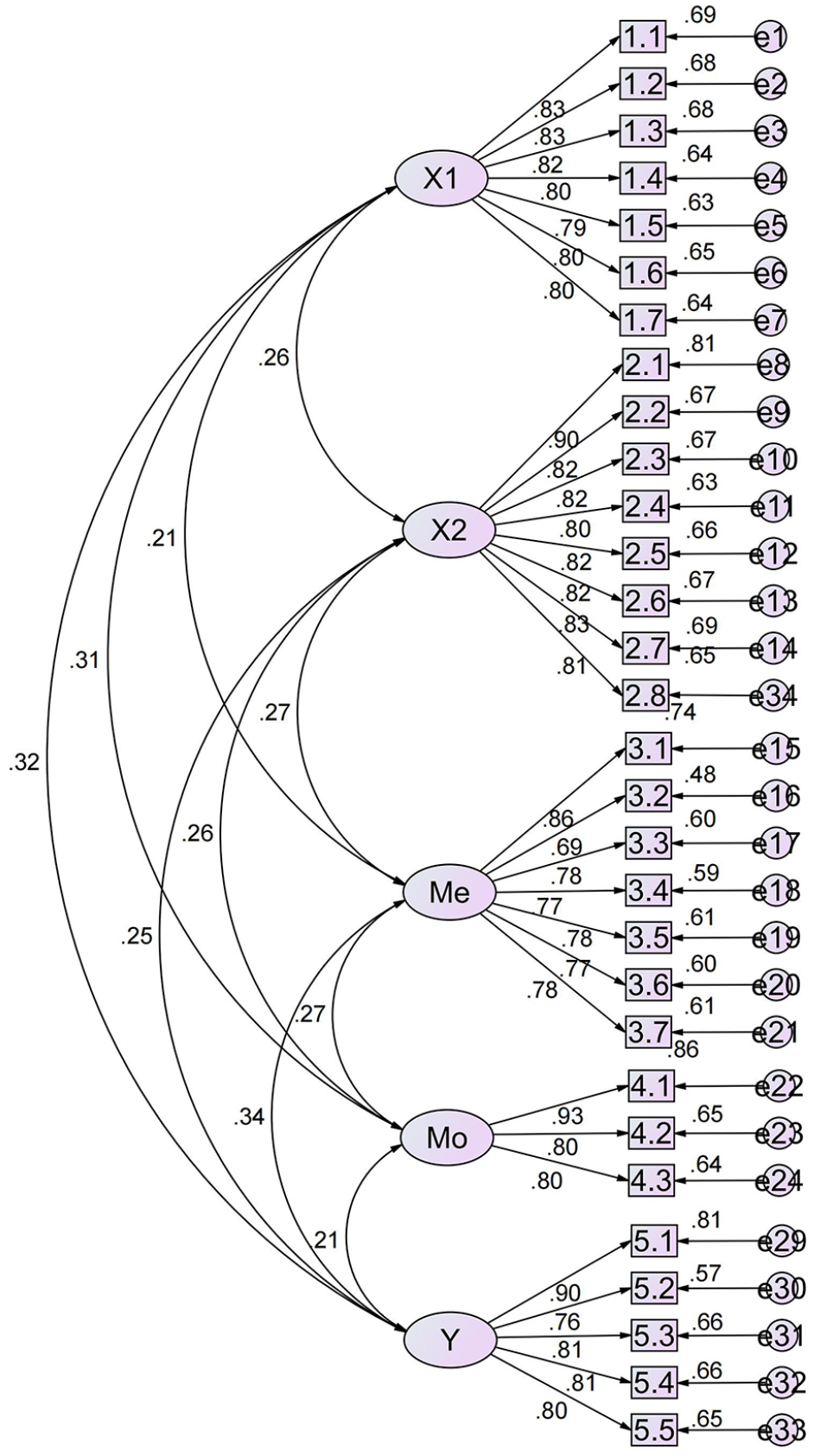
Confirmatory factor analysis.
Difference Analysis
According to the t-test, teachers with different educational backgrounds had significant differences in individualist orientation (t = 7.184, P < .001), collectivist orientation (t = 3.788, P < .01), informal organizational norms (t = 4.122, P < .01), environmental uncertainty (t = 5.579, P < .001), and bootleg innovation (t = 6.086, P < .01), and the differences were greater among teachers who had obtained a doctorate than those who did not.
In Levene test, p < .05; therefore, Dunnett T3 method is used for post-test, and it is found that teachers aged above 55 years get significantly higher scores in collectivist orientation than those aged below 25 years; moreover, teachers with more than 16 years of working experience get significantly higher scores in collectivist orientation than those with less than 5 years of working experience, and teachers older than 55 years get significantly higher scores in informal organizational norms than those younger than them, which is consistent with prior research findings (Nguyen et al., 2021).
Regression Analysis
The hypotheses were tested by regression analysis. Consistent with Cohen et al. (2013), we normalized the three variables, and the normalized scores were multiplied together to evaluate the interaction effect. In addition, we drew on the test with the Total Effect Moderation Model (Edwards & Lambert, 2007).



Note: Subscripts on the regression coefficients indicate the equation in which the coefficient is estimated and the number to which the coefficient is assigned.
If β13 in Equation 1 is significant, the moderation occurs in the direct effect path model (Edwards & Lambert, 2007), For Equations 2 and 4, if β21 ≠ 0 and β45 ≠ 0 or β23 ≠ 0 and β44 ≠ 0 or β23 ≠ 0 and β45 ≠ 0, moderated mediation model is established. The results are presented in Tables 2 and 3.
Regression Analysis of Collectivism Orientation.

Note. Sex: Male = 0; Age: 26–35 = 0; Education: No doctor degree = 0; Position: teaching professionals = 0; working years: under 5 years = 0. β = normalized regression coefficients; CI = Confidence Interval.
p < .05. **p < .01. ***p < .001.
Regression Analysis of Individualism Orientation.
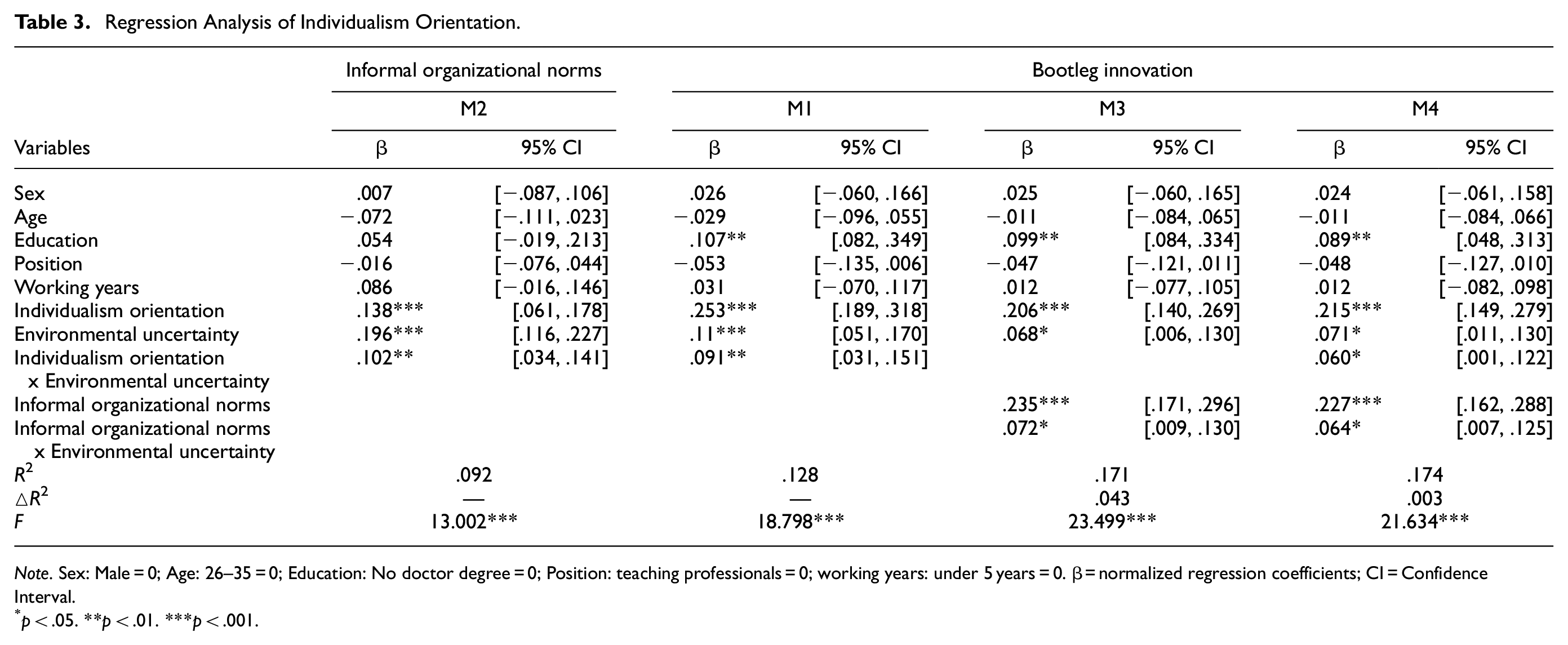
Note. Sex: Male = 0; Age: 26–35 = 0; Education: No doctor degree = 0; Position: teaching professionals = 0; working years: under 5 years = 0. β = normalized regression coefficients; CI = Confidence Interval.
p < .05. **p < .01. ***p < .001.
The virtual background variable was introduced into the regression equation, and the results showed that educational background had a significant predictive effect on informal organizational norms and bootleg innovation. Furthermore, individualism orientation can significantly predict bootleg innovation (β = .206 − 0.253, p < .001, see M1/M3/M4 in Table 3), and the predictive power is greater than the impact of collectivist orientation on bootleg innovation (β = .138 − .190, p < .001, see M1/M3/M4 in Table 2); thus, H1 is supported. The Total Effect Moderation Model shows that after controlling individualist orientation and environmental uncertainty and the interaction between the two variables and incorporating informal organizational norms into the regression equation, individualist orientation still significantly predicts bootleg innovation (β = .206, p < .001, see M3 in Table 3). However, compared with M1 whose β = .253 (p < .001), it was reduced and, thus, had a partial intermediary effect, which proved H2a. Moreover, the interaction between individualist orientation and environmental uncertainty can significantly predict bootleg innovation (β = .091, p < .01), the interaction between individualism and environmental uncertainty also significantly predicted the informal organizational norms (β = .102, p < .01), the interaction between informal organizational norms and environmental uncertainty significantly predicted bootleg innovation (β = .064, p < .05); thus, H3a is supported. In other words, environmental uncertainty positively moderates the mediating role of informal organizational norms between individualism orientation and bootleg innovation. Moreover, the Sobel test was used to examine the mediating effect of informal organizational norms between individualism orientation and bootleg innovation, z = 4.235 (p < .001), proving that informal organizational norms have a significant mediating effect (Sobel, 1982).
The Total Effect Moderation Model showed that after controlling collectivist orientation and environmental uncertainty and the interaction between these two variables, and adding informal organizational norms to the regression equation, collectivism orientation still significantly predicted bootleg innovation (β = .138, p < .001, see M3 in Table 2), which is less than β = .190 in M1 (p < .001); thus, informal organizational norms have a partial mediating effect, and H2b is supported. Moreover, the interaction between collectivism orientation and environmental uncertainty can significantly predict bootleg innovation (β = .119, p < .001, see M1 in Table 2), and the interaction between collectivist orientation and environmental uncertainty has no moderating effect on informal organizational norms, which may be the reason why collectivists believe that compliance with norms is their own obligation and has nothing to do with the external environment (Brewer & Chen, 2007). The interaction between informal organization norms and environmental uncertainty significantly predicted informal organizational norms (β = .063, p < .05, see M4 in Table 2); therefore, H3b is partially supported, namely, collectivism orientation influences the latter half of the intermediate process and the direct path of bootleg innovation through informal organizational norms, which is moderated by environmental uncertainties. Furthermore, the Sobel test was used to test the mediating effect of informal organizational norms between collectivism orientation and bootleg innovation, z = 5.409 (p < .001), showing the significant mediating effect of informal organizational norms (Sobel, 1982).
Discussion and Conclusion
The results of the difference analysis show that teachers who have obtained a doctoral degree perform better on all variables than those without doctoral degrees. Educational background can positively predict both informal organizational norms and bootleg innovations. It also shows that regardless of whether teachers have individualism or collectivism orientations, the higher the education, the stronger the sense of service to the organization; even without its support, they will still independently carry out innovative research that is conducive to the organization. Teachers over the age of 55 years who have been working for more than 16 years pay more attention to collectivism because they are either in senior positions or have rich experience and are more willing to abide by various formal and informal norms, which is consistent with Xu and Chang (2022).
Regression analysis shows that both individualism and collectivism orientations have a positive impact on informal organizational norms, and teachers with a collectivism orientation find it easier than those with an individualism orientation to form informal organizational norms and comply with them. As Barrick et al. (2013) note, individuals are more willing to express their personality traits in situations related to their personalities. Informal organizational norms are implicit rules that are observed collectively, which stimulate the expression of collectivistic traits, and people are more inclined to maintain relationships with those who express similar traits with them (Tett et al., 2021); therefore, to optimize peer relations, teachers with a collectivism orientation conform to the organization-induced norms and produce consistent behavioral expression.
In the relationship between individualism/collectivism orientation and bootleg innovation, teachers with a collectivism orientation showed lower predictive power in bootleg innovation, while teachers with an individualism orientation showed higher predictive power. Compared to collectivists, teachers with an individualism orientation will firm their own creative ideas and produce bootleg innovation as long as they recognize that their actions are beneficial to both themselves and the organization. Interestingly, in the context of informal organizational norms, no difference exists between individualism and collectivism in terms of their impact on bootleg innovation. Tett and Guterman (2000) proposed that the context, to some extent, would erase the differences between individuals accordingly; thus, individuals express their bootleg innovation behaviors after handling the situation.
In terms of moderating effect, the whole mediation model of individualism orientation is moderated by environmental uncertainty. However, in the mediating model of collectivism orientation, environmental uncertainty cannot regulate the path relationship between collectivism orientation and informal organizational norms. Under turbulent social environments, collectivist teachers’ demands for collective norms are seldom affected by external situations (UNESCO, 2022). This is beneficial for the transmission of educational norms but also produces rigid thinking and forms traditional ideas, thus, hindering individual innovation.
By comparing the regression coefficients, we found that the influence of individualism orientation on bootleg innovation is higher than that of collectivism orientation, and the influence of individualism on informal organizational norms is smaller than that of collectivism orientation, which is similar to the results of Kim and Coleman (2015). They both emphasize that collectivists are more willing to follow existing rules in the process of innovation, while individualists consider more autonomy and freedom, rather than being limited to conventions.
In this five-variables model, individualism and collectivism are both found to affect informal organizational norms and bootleg innovative behavior, which is consistent with previous research findings (J. B. Li et al., 2018; Leicht et al., 2021; Nanyangwe et al., 2023; Runco & Pritzker, 2020). However, there is some difference between the two orientations: teachers with a collectivism orientation place greater emphasis on norms, as cooperation from groups can increase adherence to norms (Brewer & Chen, 2007), while teachers with an individualism orientation are more likely to engage in bootleg innovation behavior. However, in the changing environment of higher education, teachers’ individualistic traits may be hidden as they put efforts toward common goals (Tett et al., 2021) and keep feeling valuable and significant in the organization (Nanyangwe et al., 2021). Thus, in higher education, the importance of an individualism orientation in university reform is underestimated to some extent. Innovation is an important driving force of this change. Compared to collectivism, individualism may have drawbacks in some aspects, but it cannot be denied that it has made an important contribution to the innovation and development of universities. The effectiveness of collectivism and individualism in promoting informal organizational norms and bootleg innovation requires administrators to make judgments and find coordinated ways to adapt to an organization without hindering the stable development of individuals and organizations.
In conclusion, university teachers’ bootleg innovation is beneficial in some way (Criscuolo et al., 2014; Globocnik & Salomo, 2015). On the one hand, it can reduce costs in the context of limited resources (Mainemelis, 2010); on the other hand, it can enhance personal improvement and promote more open innovative development systems in higher education (Augsdorfer, 2012). Thus, university-based training, encouragement for bootleg innovation, and improvement of teachers’ academic qualifications are effective measures for increasing the efficiency of teachers’ bootleg innovative behaviors.
Implication and Limitation
From a theoretical perspective, this study makes several contributions to the literature on bootleg innovation. First, it was the first study to focus on bootleg innovation in the higher education field, which uncovered the hidden type of innovation among university teachers that was formerly disregarded. Previously research on bootleg innovation primarily centered on employees and other knowledge workers; however, university teachers are an important pillar force for initiative innovation, and the innovative environment in universities is quite different from that in enterprises. Second, this study deepens the application of the trait activation theory in the field of bootleg innovation. By adopting this theory, we explored the individual-level predictive antecedent of such behavior, individualism/collectivism orientation, and introduced two environmental variables to explore how situational factors influence the expression of personality traits and the relationship between personality traits and bootleg innovation. This is promising research, as it can explain why some university teachers are more likely than others to engage in bootleg innovation behavior under the same contextual conditions and how situational factors promote or inhibit the path from the expression of personality traits to bootleg innovation.
From a practical perspective, as bootlegging behavior is a vital addition to formal innovation activities (Masoudnia & Szwejczewski, 2012), even though the results of university teachers’ bootleg innovation are not as good as expected, their endeavors will ultimately translate into superior individual abilities to develop innovations that generate value for the organization (Criscuolo et al., 2014). Thus, we support the idea of expanding and increasing bootleg innovation behavior among university teachers, especially when resources are limited. The findings of the current research suggest that in situations where bootlegging behavior is desirable, universities should encourage teachers with an individualism orientation to engage in bootleg innovation or otherwise try to cultivate those attributes among other teachers as well as support their creativity activities. To achieve this, university senior administrators who encourage their teachers to create and realize their own ideas could construct idea management systems so that teachers’ autonomous innovative ideas, which may not be supported at the beginning, would be transferred to authorized ones at the proper time. Second, administrators could provide teachers with more free time and autonomy and allow them to exercise some discretion in their work, as excess senior management involvement in innovation activities reduces the bootlegging tendency (Globocnik et al., 2022). Third, administrators could strengthen the training of teachers’ innovative abilities, especially for those with a collectivist orientation, so that they would have more confidence in facing innovation challenges and competition in different dynamic and uncertain environments.
This study has some limitations and recommendations for future research. First, our research adopted a published scale to measure China’s university teachers’ bootleg innovation behaviors; although the scale passed the reliability and validity test, it was more commonly used in enterprises. Thus, building a scale for teachers’ bootleg innovation in line with the current situation in Chinese universities is a strong recommendation for future research. Moreover, the bootleg innovation of teachers measured in this study is a generalized behavior that does not focus on the specific innovation behaviors of scientific research or other types of innovation. It is suggested that the relevant research can be deepened and specified in the future.
Second, we only proved that individualism/collectivism orientation serves as a possible individual-level antecedent of university teachers’ bootlegging behavior, without considering other personality traits. Future research could go deeper and examine additional individual-level antecedents, put more effort into investigating the outcomes of university teachers’ bootlegging behavior, and provide a strong theoretical framework for its consequences.
Finally, our study was limited by its dependence on self-reported questionnaires, posing the threat of common bias. However, we believe that this approach may be the most suitable for our study, as our variables are self-reflective and self-perceived, requiring the teachers themselves to give the ratings. Future research could verify the results by obtaining data over two time periods or using measures different from ours, such as assessing the prevalence of bootlegging behavior from university supervisors and administrators.
Footnotes
Acknowledgements

Declaration of Conflicting Interests
The author(s) declared no potential conflicts of interest with respect to the research, authorship, and/or publication of this article.
Funding
The author(s) disclosed receipt of the following financial support for the research, authorship, and/or publication of this article: A Project Supported by Scientific Research Fund of Hunan Provincial Education Department (Grant Number 22C0621)
Ethical Approval
The study received the approval of the Hunan Institute of Technology Ethics Committee (Grant Number: (HNGXY-22-27).