




Abstract
Since there are many advantages of servant leadership, such as altruistic calling, emotional healing, wisdom, persuasive mapping, and organizational stewardship, employers and human resources are particularly concerned about these soft skills when recruiting graduates. This study explores the impact of undergraduates’ servant leadership on their self-perception of employability. We utilized previously validated scale questionnaires (the Servant Leadership Scale and the Undergraduates Perceived Employability Scale) to predict the perceived employability of undergraduates. We used multiple linear regression analysis to examine the five subscales of undergraduate servant leadership. Our extensive research has uncovered substantial evidence supporting all five hypotheses presented in the paper. Five variables, derived from the five dimensions of servant leadership, were used to measure undergraduates’ perceived employability as the dependent variable. Our findings confirm that the altruistic calling, emotional healing, wisdom, persuasive mapping, and organizational stewardship dimensions of servant leadership have positive correlations with undergraduates’ perceived employability. Our findings suggest that undergraduates may be more employable if they exhibit the characteristics of servant leadership. Undergraduates should therefore be encouraged to enhance their soft skills in relation to servant leadership, and universities should consider offering courses on the topic. Employers and HR professionals may want to provide training to new employees on servant leadership to align better with the company culture. This study is the first to predict how undergraduate students’ servant leadership qualities affect their perceived employability. The findings indicate that undergraduates who exhibit servant leadership traits are more likely to have a positive perception of their employability.
Keywords
Introduction
Due to the rapid growth of the economy, science and technology, and globalization, along with the increasing level of education, graduates face fierce competition in the job market (Brundiers et al., 2021). In addition, economic recessions occur from time to time, making employability a major concern for both the government and higher education institutions (Clarke, 2018; Saunders & Zuzel, 2010). Graduates must acquire and develop more skills to improve their employability and adapt to the changing labor market (Succi & Canovi, 2020). Many employers focus on leadership as an employment skill (Moldoveanu & Narayandas, 2019; Pancasila et al., 2020; Sanyal & Hisam, 2018).
The term employability dates back to the early 20th century and describes the possibility of employment (Pinto & Ramalheira, 2017). Since employability is associated with the degree to which people have the skills and other qualities necessary to find and retain the job they want, many people believe it is essential for individuals to manage their careers and for organizations to train their employees (Rothwell & Arnold, 2007). On this view, employability is a combination of factors that enable an individual to move toward or enter employment, stay in employment, and progress in his or her career (Pinto & Ramalheira, 2017). Alternatively, employability can be regarded as a quality employers look for in graduates (Yorke & Knight, 2007). From this perspective, employability could include human capital, social capital, individual attributes, behaviors, perceived employability, and labor market factors (Clarke, 2018). Employers and some human resources departments regard employability as more and more diversified. They value not only academic achievement and honors but also graduates’ soft skills in communication, leadership, creativity, problem-solving, and other areas (Curtis & McKenzie, 2001; Lau et al., 2014; Lowden et al., 2011; Mackieh & Dlhin, 2019; Osmani et al., 2015; Ricketts & Rudd, 2002; Stuart et al., 2011; Velasco, 2012).
Success in an emerging economic environment requires effective leadership, which is not only an important aspect of work but also a crucial goal of higher education (Curtis & McKenzie, 2001; Kiersch & Peters, 2017). Leadership skills are important for students from middle school to university level, as they can lead to better academic performance, improved employability after graduation, and higher earnings (Deng et al., 2020; Fraser et al., 2016; Hoffman et al., 2008; Lau et al., 2014; Logue et al., 2005; Lundin et al., 2021; Skalicky et al., 2020). Many educational institutions offer leadership courses, programs, training, and hands-on activities to encourage student participation (Chesnut & Tran-Johnson, 2013; Fraser et al., 2016; Lau et al., 2014; Skalicky et al., 2020). Students can also gain leadership experience by taking on roles such as monitor, study committee member, class representative, student union cadre, or event organizer (Deng et al., 2020). In any social institution, leadership is always valued. Although there are many different models of leadership, including authentic, spiritual, and transformational leadership, servant leadership is often seen as the most representative of the ideal human factor (Astin & Astin, 2000; Daniëls et al., 2019; Day, 2000; Leithwood & Riehl, 2004; Northouse, 2016; Page & Wong, 2000; Rost, 1991). In today’s society, where artificial intelligence is becoming more prevalent, the importance of the human factor in areas such as emotion, organization, and management is even more apparent (Alves et al., 2023; Bandaragoda et al., 2020; Volkmar et al., 2022).
Servant leadership emphasizes building organizations and enacting positive change (Astin & Astin, 2000; Chughtai, 2019; Finch et al., 2013; Guchait et al., 2023; Heifetz & Heifetz, 1994). The concept was first introduced in 1977 by Robert Greenleaf in his book, Servant Leadership. Greenleaf believed that being of service should be the defining characteristic of leadership. By implementing this approach, leaders can create more substantial and successful organizations while also finding greater joy in their personal lives (Greenleaf, 2002). Scholars have identified several characteristics associated with servant leadership. These include empowering others, practicing altruism, displaying servant ethics, being authentic, managing groups effectively, demonstrating social morality, possessing wisdom, and building strong relationships (Barbuto & Wheeler, 2006; Ehrhart, 2004; Green et al., 2016; Liden et al., 2008; Sendjaya et al., 2008).
Most scholars agree that servant leaders differ significantly from other types of leaders in that they care about their followers and prioritize their growth and empowerment (Astin & Astin, 2000; Daniëls et al., 2019; Leithwood & Riehl, 2004; Northouse, 2016; Rost, 1991). They exhibit moral and pro-social behavior, and prioritize the greater good over their personal interest (Greenleaf, 2002; Kiersch & Peters, 2017; Reed et al., 2011; Van Dierendonck & Nuijten, 2011). Consequently, among various leadership styles, servant leadership best reflects the human factor (Page & Wong, 2000) and meets the criteria of effective leadership (Day, 2000; Day et al., 2014; Gandolfi & Stone, 2018; Guchait et al., 2023). It has become an ideal leadership model because it promotes integrity, focuses on others, prioritizes serving and realizing followers’ full potential, and only then attends to the leader’s own needs (Liden et al., 2015). Servant leaders act as such in all areas of life (work, family, and community) and develop followers into servant leaders (Eva et al., 2019; Zada et al., 2022).
In terms of servant leadership, with the exception of review articles, much research has concentrated on how leaders impact staff growth in the workplace (Barbuto & Wheeler, 2006; Chughtai, 2019; Eva et al., 2019; Hoch et al., 2018; Lee et al., 2020; Zhang et al., 2021). Studies have effectively utilized appropriate scales and distributed questionnaires to evaluate whether leaders and/or supervisors exhibit servant leadership. These evaluations are aimed at determining whether leaders possessing such qualities have a positive impact on the employability, re-employability, and job satisfaction of college students and employees (Dennis & Bocarnea, 2005; Gocen & Sen, 2021; Latif et al., 2021; Liden et al., 2008, 2015; Ortiz-Gómez et al., 2020; Sendjaya et al., 2008; Verdorfer & Peus, 2014). As expected, they have identified positive associations.
However, there remains an issue regarding the measurement of servant leadership in studies to date. Participants were asked whether their leader has servant leadership qualities rather than whether they themselves have servant leadership qualities. Few studies have examined the effect of leadership on either the leaders themselves or the staff (Anderson & Lu, 2017). Meanwhile, there is no existing empirical research about how undergraduates’ servant leadership affects their employability. Discussion of the leadership of undergraduates has primarily concerned the so-called social change model of leadership (Campbell et al., 2012; Dempster & Lizzio, 2007; Dugan & Komives, 2007; Haber & Komives, 2009; Roberts & Ullom, 1989). Nevertheless, soft skills such as altruistic calling, emotional healing, wisdom, persuasive mapping, and organizational stewardship hold immense value for employers and human resources departments, and these skills generally form part of servant leadership. For employers, therefore, hiring graduates with servant leadership qualities is of great importance. For undergraduate students, awareness of the hiring needs of employers and HR, as well as of trends in promotion and salary increase, is highly beneficial. Developing and honing the necessary skills, not least servant leadership, can make undergraduates’ résumés and interviews impressive (Chhinzer & Russo, 2017).
A study conducted by Chughtai (2019) has similarities with the current study. Chughtai, whose objective was to examine how servant leadership impacts perceived employability, used data from 176 employees who worked at a food and beverage company in Pakistan. The research hypotheses were tested using structural equation modeling and bootstrapping techniques. The findings indicate that servant leadership can play a key role in enhancing workers’ employability. Thus, it is important that organizations focus on creating conditions that will help them to develop servant leaders. Nevertheless, Chughtai’s study tested the impact of the leader’s servant leadership on the staff’s perceived employability, not the effect of the staff’s servant leadership on perceived employability; in other words, the questionnaire asked staff to evaluate whether their leader possessed servant leadership. In contrast, the questionnaire in the present study asks undergraduates to evaluate whether they themselves have servant leadership. We then use the undergraduates’ questionnaire responses on perceived employability to achieve the objective of our research, namely to explore the impact of their servant leadership on their self-perception of employability.
Our study is thus the first of its kind to focus on how undergraduates view their employability based on their servant leadership qualities. If the research yields positive results, it will have a number of practical implications: encouraging undergraduate students to concentrate on enhancing their soft skills related to servant leadership; favoring the establishment of courses or programs on servant leadership in various colleges and universities; and prompting employers and HR personnel to provide training on servant leadership to new hires as it aligns well with the organizational culture.
Literature Review and Hypothesis Development
Our research aligns with Rothwell et al.’s (2008) definition of self-perceived employability in terms of an individual’s perceived ability to obtain sustainable employment according to their personal qualifications. We focus on the perspectives of individual students rather than on the views of employers. Rothwell et al. (2008) created tools to measure undergraduates’ subjective employability, including internal ability perception, self-belief, and external employment market understanding. They also considered the reputation of the university, which could influence students’ perception.
We have followed Barbuto and Wheeler’s (2006) breakdown of the dimensions of servant leadership: altruistic calling, emotional healing, wisdom, persuasive mapping, and organizational stewardship. These five dimensions are derived from the potential characteristics of 11 servant leadership qualities, namely a sense of mission, empathy, listening, healing, consciousness, persuasion, conceptualization, foresight, management, growth, and community building. These qualities represent the fundamental and essential concepts of servant leadership.
The Relationship Between Altruistic Calling and Employability of Undergraduates
Servant leadership is rooted in the idea of serving others and sacrificing personal interests for their benefit. This aligns with the original message of Greenleaf and the purpose of charity, which is to serve others (Barbuto & Wheeler, 2006). It involves self-sacrifice, where the beneficiary is society or other people and the organization and its members are positively impacted. However, this differs from simply helping others, which may be driven by self-interest (Avolio & Locke, 2002). Self-sacrifice leadership, also known as altruism, can help individuals and organizations adapt to changing environments: leaders who practice selflessness and sacrifice can earn the respect and loyalty of their followers, and this can become a stable leadership model and part of the organizational culture (Choi & Mai-Dalton, 1998). Choosing service over self-interest is a defining characteristic of altruistic leaders and is akin to having a calling (Wong et al., 2007). According to some experts (Dennis et al., 2010), altruism is closely linked to courageous leadership (brave leadership).
The relevant research on servant leadership all involves the viewpoints of sacrificing individual interests to meet the needs of others, putting others (subordinates, groups, society) first, attaching importance to others, serving others, and so on, coinciding with terms such as self-sacrifice, selfless dedication, and altruism (Barbuto & Wheeler, 2006; Ehrhart, 2004; Green et al., 2016; Liden et al., 2008; Reed et al., 2011; Sendjaya et al., 2008; Van Dierendonck & Nuijten, 2011). Studies have highlighted the significance of altruism in relation to servant leadership. With the establishment of a culture centered on altruistic love, often with a focus on humanitarianism (humane orientation), followers will feel understood and appreciated (Van Dierendonck, 2011). Cultivating student leadership based on servant leadership and fostering undergraduate leaders with the drive to serve and support those around them is appropriate not only for students and their schools but also for their future employers and the future of our society (Kiersch & Peters, 2017). Research on the leadership development of pharmaceutical students, for example, has found that it is essential for the development and implementation of pharmaceutical care aimed at improving patient outcomes (Janke et al., 2016). Employers and universities value individuals with leadership experience and a commitment to serving others (Anderson & Lu, 2017). Ultimately, altruism can generate value for groups (Dennis & Bocarnea, 2005). Therefore, we propose the following hypothesis:
H1. Undergraduates’ altruistic calling is positively related to their perceived employability.
The Relationship Between Emotional Healing and Employability of Undergraduates
Demonstrating sensitivity toward others’ personal concerns is an important trait (Liden et al., 2008). Emotional healing, in leadership, refers to a leader’s ability and dedication to overcome difficulties or trauma. Those with emotional healing skills typically possess high levels of empathy and are exceptional listeners, making them a go-to for those who have experienced personal trauma (Barbuto & Wheeler, 2006). Empathetic individuals also have interpersonal acceptance skills, meaning they can understand and relate to others’ emotions, which promotes the development of high-quality interpersonal relationships (Van Dierendonck & Nuijten, 2011). According to Barbuto and Wheeler (2006), listening and empathy are crucial skills for servant leadership. As a leader or an organization, it is imperative to foster good relationships through emotional intelligence, empathy, kindness, and emotional healing, which can help prevent job burnout and cultivate a healthy workplace (Wong et al., 2007).
Volunteer supervisors who exhibit servant leadership can develop positive relationships with students who volunteer in their organization (Veres et al., 2019). Additionally, these leaders may be able to influence individuals with so-called dark personalities to shift their motivation for volunteering from a self-focused one to a more pro-social one. Research on effective leadership has identified five key attributes, one of which is encouraging the mind (Gandolfi & Stone, 2018). Emotional healing, which helps individuals recover from trauma, aligns with this attribute and should therefore be considered a characteristic of effective leadership. As a result, undergraduates should develop emotional healing skills to become successful servant leaders. Therefore, we propose the second hypothesis:
H2. Undergraduates’ emotional healing is positively related to their perceived employability.
The Relationship Between Wisdom and Employability of Undergraduates
The concept of wisdom involves utilizing one’s knowledge to set and achieve goals. However, extensive knowledge is not enough; it is also necessary to display sound and composed judgment in one’s actions. A wise person not only possesses accurate beliefs but also applies their wisdom and insight in practical situations (Bierly et al., 2000). Wisdom can be described as a combination of comprehending one’s surroundings and anticipating outcomes, as described by classical philosophers. Leaders who possess wisdom can interpret environmental cues and understand their significance, making it an optimal combination of knowledge and practicality (Barbuto & Wheeler, 2006).
Personal wisdom can be transformed into organizational wisdom in various ways, which include leadership transformation, organizational culture and structure, and knowledge transfer, according to Bierly et al. (2000). Avolio (1999) suggests that leaders’ ability to envision the future state of their organization is crucial for their effectiveness. Leaders’ skills in predicting and communicating their vision are essential to servant leadership practices (Farling et al., 1999). In the 20th century, discussions of the dimension of servant leadership already included the theme of envisioning the future (Laub, 1999), and subsequent research has highlighted the importance of expertise for supporting and assisting others effectively, which is a part of wisdom (Ehrhart, 2004; Liden et al., 2008). Therefore, undergraduates should have the intellectual ability that a group or organization needs, and we propose the third hypothesis:
H3. Undergraduates’ wisdom is positively related to their perceived employability.
The Relationship Between Persuasive Mapping and Employability of Undergraduates
Effective leadership involves the use of sound reasoning and psychological frameworks, also known as persuasive mapping. Leaders with a high level of persuasive mapping are skilled at identifying problems and conceptualizing new possibilities. They encourage others to imagine the future of the organization by providing compelling reasons to do so (Barbuto & Wheeler, 2006). Servant leaders focus on building consensus within the group, rather than using positional authority to force obedience (Page & Wong, 2000). This skill contributes to task-oriented behavior; completing one task is a step toward the next task on the way to the final goal (Barbuto & Gifford, 2010). Enabling others to take action is also crucial for effective leadership (Gandolfi & Stone, 2018). A compelling reason, rather than organizational hierarchy, serves the influence process (Spears, 1995). Research has shown that persuasive mapping has a significant impact on employees’ innovation behavior. This is because it is positively related to their perceived empowerment, giving them the ability to make their own decisions (Krog & Govender, 2015).
Servant leadership emphasizes the importance of empowering and developing individuals within an organization (Sendjaya & Cooper, 2011). Those who possess a servant attitude, along with humility and empowerment, are more likely to be successful. Studies have found a positive correlation between empowerment and role behavior, civic virtue, and responsibility (Van Dierendonck & Nuijten, 2011). Given the positive correlation between persuasive mapping and perceived empowerment of others, empowerment is one of the characteristics mentioned by many researchers in the context of servant leadership (Ehrhart, 2004; Laub, 1999; Liden et al., 2008; Sendjaya & Cooper, 2011; Sendjaya et al., 2008). Therefore, undergraduates should focus on developing their persuasion and mapping skills, which are essential for their growth and success, and we propose the fourth hypothesis:
H4. Undergraduates’ persuasive mapping is positively related to their perceived employability.
The Relationship Between Organizational Stewardship and Employability of Undergraduates
Organizational stewardship refers to an organization’s willingness to make positive contributions to society through community development projects and outreach. It involves upholding values that prioritize the well-being of the community and is closely linked to employees’ perceptions of organizational effectiveness and their willingness to go above and beyond (Barbuto & Wheeler, 2006). Essential to organizational stewardship is having a group or organization led by a servant leader who is dedicated to building a learning organization where everyone can offer unique value (Green et al., 2016; Laub, 1999; Van Dierendonck, 2011). With this approach, an organization can make positive changes and contribute to society (Barbuto & Wheeler, 2006). In management, the public interest is often considered more important than private interests (Van Dierendonck & Nuijten, 2011). By cultivating a sense of community spirit and aligning it with institutional goals, organizations can prioritize the public interest and manage resources effectively (Page & Wong, 2000).
Organizational stewardship refers to taking responsibility for the well-being of a community or group. It involves considering the needs of others, not just oneself, and creating value for people beyond the organization (Ehrhart, 2004; Eva et al., 2019). When we help the community with conscious and sincere intent, it is a moral and responsible act (Liden et al., 2008; Sendjaya et al., 2008). Ethical behavior also entails interacting openly, fairly, and honestly with others (Liden et al., 2008). This is a crucial aspect of effective leadership and is widely taught in undergraduate leadership programs (Eich, 2008; Rosenberg et al., 2012). Therefore, we propose our final hypothesis:
H5. Undergraduates’ organizational stewardship is positively related to their perceived employability.
Method
Sample and Procedure
The study utilized a convenience sampling technique. Because of the epidemic containment measures in China prior to 2023, most students and academics were unable to attend colleges or universities in person, and therefore convenience sampling was an appropriate and easy way to collect research data. A convenience sampling approach can also provide insight and initial understanding of the study’s content, as well as help to formulate hypotheses. For the purposes of this study, we chose Chinese provinces that have a significant population and a high employment rate, as these regions offer the most employment competition. Extracting the factors that impact a student’s perceived employability as an undergraduate in this situation is therefore of particular interest. The questionnaire contained 39 items, and the subject ratio had to be strictly maintained at 1:5. Therefore, the sample had to consist of no fewer than 195 participants. The research exclusively targeted students currently enrolled in vocational and undergraduate colleges, from their first to final year, within the same city. Hence, the participants selected for this study were undergraduates from three full-time private undergraduate colleges and universities located in Zhengzhou City of Henan Province, China.
The three higher education institutions have been approved by the Chinese Ministry of Education. We selected these colleges because of Henan Province’s large population, as reported by the Chinese National Bureau of Statics and Henan Province Bureau of Statics. However, the province has only one of the top-ranked universities in China, and its overall undergraduate admission rate is one of the lowest in the country. Despite this, the employment rate in the province remains high, and the three universities place immense value on forging close ties with businesses. They have formed partnerships with several prestigious companies in China, as well as the Zhengzhou Public Employment Service Center and various government agencies. These collaborations, coupled with the support of the Ministry of Education, unlock boundless prospects for their students, including practical training, hands-on experience, and promising career paths. Their graduates have earned widespread acclaim from employers and society at large. Their many exceptional students have been celebrated as exemplars of excellence, including the Star of Self-Improvement for Chinese College Students and the Chinese National College Student Person of the Year. Moreover, these universities have been showered with multiple accolades and honorary titles from Henan Province. In the data for 2002, they ranked among Zhengzhou’s top five private universities. Therefore, the samples from these three universities are both universal and representative.
Our aims were to explore whether undergraduates from these institutions possess servant leadership qualities and have a perception of their employability, and to determine whether the former influences the latter. We reached out to university administrators and teachers to distribute questionnaires to participants. We guaranteed anonymity and ensured that participation was voluntary. We also promised to share the research results with college teachers and students upon request. To save resources, we used mobile technology to distribute the questionnaires, with only one questionnaire submission per phone allowed and all questions being mandatory. To encourage sincere responses and minimize invalid data, we emphasized the importance of the questionnaire to employment and curriculum development. Teachers then distributed the questionnaires to students, resulting in 373 valid responses.
The 373 participants are all undergraduate students, and the sample size was over five times that of the scale items. The demographic characteristics of the sample are presented in Table 1. Most of the participants are male (72.1%), and the majority were aged 21 and older (76.2%) at the time of the data collection. More than two-thirds of them had an internship or part-time experience, and the responders were mostly senior students (55%).
Demographic Characteristics of the Sample.

Note. IOP experience = internship or part-time experience.
Measures
We measured all the variables using a 5-point Likert scale ranging from 1, representing the lowest value of the variable, to 5, representing the highest value of the variable. We opted for a scale developed in English, which we translated into Chinese, as Chinese universities commonly use the Chinese language as their educational medium. After the questionnaire responses were collected, we used the original English terms for analysis of the dimensions.
The Employability of Undergraduates
We used the self-perception of employability scale developed by Rothwell et al. (2008) as a measurement tool. This scale is ideal for our purposes, as it measures self-reporting. It contains four main parts: the respondent’s university, research field, external job market conditions, and self-belief. The scale assesses the brand strength of the university, the reputation of the university in the research field, the status and credibility of the research field, and the demand for the discipline in the external labor market. The scale consists of 16 items, which is long enough for the purposes of the study but does not overload respondents or create an excessively long survey tool. For example, one item assesses the students’ awareness of the brand strength of their university, while another item assesses how confident the students are in their ability to succeed in job interviews and selection activities. Overall, this scale is a reliable and efficient way to assess undergraduates’ perceptions of their employability.
Undergraduates’ Servant Leadership
We utilized the 23-item scale created by Barbuto and Wheeler (2006) to determine whether undergraduate students have the potential for servant leadership. Given the scale’s clear and comprehensive five dimensions, its high reliability coefficient, and its alignment with the aim of our study, there was no need to enhance the reliability coefficient algorithm of any of the subscales. Therefore, we did not modify the scale by adding or subtracting items. However, to maintain consistency among the subjects, analysis, and results, we changed the wording from “evaluating others” to “evaluating ourselves.” The research objects developed by Barbuto and Wheeler (2006) also include leaders themselves and their employees, meaning self-evaluation and others’ evaluation are both included.
The scale has five clear dimensions: altruistic calling, emotional healing, wisdom, persuasive mapping, and organizational stewardship. We adapted the wording in some cases to help undergraduates evaluate their sense of altruistic mission, emotional healing ability, intelligence, persuasiveness, and organizational stewardship skills. For example, we changed “This person puts my best interests above my own interests” to “I put the best interests of others above my own.” Similarly, “This person is very good at helping me solve my emotional problems” became “I am very good at helping others solve emotional problems.” We also changed “This person is good at predicting the consequences of decision-making” to “I am good at anticipating the consequences of decision-making” and “This person provides convincing reasons for me to do things” to “I provide convincing reasons for others to do things.” Finally, we changed “This person is preparing for the organization to make positive changes in the future” to “I am preparing for the organization to make positive changes in the future.”
Data Analysis
After collecting the questionnaire responses, we used Excel to arrange the data to make them neat and simple to process; for example, we put the longer items under the corresponding dimensions. Then we uploaded these data to IBM SPSS Statistics to analyze them using the functionality for descriptive statistics, Cronbach’s alpha reliability, Pearson correlations, and multiple linear regression. We also used AMOS to analyze convergent validity and discriminant validity and to carry out confirmatory factor analysis (CFA) (Zada et al., 2022). It is important to note that we opted for multiple linear regression analysis through IBM SPSS instead of constructing a structural equation model (SEM) using AMOS. This decision was based on our sample size being less than 10 times the recommended threshold (Lowry & Gaskin, 2014); using AMOS to build SEM would therefore have presented challenges in obtaining an accurate model for this study. By using multiple linear regression analysis in SPSS, we were also able to determine the impact of various independent variables on a dependent variable with a smaller sample size than required for SEM (Field, 2013).
Although we did not add or delete items from the original measurement scale, we translated it into Chinese and reworded the items of the Servant Leadership Scale from the third person to the first person (as described in Section “Measures”). We then used Cronbach’s alpha to test for reliability and CFA to evaluate convergent and discriminant validity. Cronbach’s alpha, the most widely used objective measure of reliability, provides a measure of the internal consistency of a test or scale; it is expressed as a number between 0 and 1, such that the smaller the value, the lower the reliability (Tavakol & Dennick, 2011). In general, CFA is used to evaluate scales that are mature and contain dimensions (or whose underlying structure has been established), and it takes account of coefficients such as standard factor loadings, average variance extracted (AVE), construct reliability (CR), factor correlations, and AVE square root values (Brown & Moore, 2012; Suhr, 2006; Zada et al., 2022). The results of all the analyses are presented below.
Results
Descriptive Statistics and Correlations
The means, standard deviations, and correlation coefficients among the study variables are listed in Table 2. Altruistic calling is positively related to emotional healing (r = .619, p < .01), wisdom (r = .559, p < .01), persuasive mapping (r = .597, p < .01), organizational stewardship (r = .599, p < .01), and employability (r = .624, p < .01). Wisdom (r = .835, p < .01), persuasive mapping (r = .766, p < .01), organizational stewardship (r = .745, p < .01), and employability (r = .703, p < .01) are positively correlated with emotional healing. Wisdom is positively related to persuasive mapping (r = .855, p < .01), organizational stewardship (r = .775, p < .01), and employability (r = .706, p < .01). Persuasive mapping is positively related to organizational stewardship and (r = .792, p < .01) and employability (r = .784, p < .01). Employability is also positively correlated with organizational stewardship (r = .732, p < .01). In a word, all the variables are positively associated with each other.
Descriptive and Correlations Among the Study Variables.

Note. n = 373. The discriminant validity is presented here as well, and the bold is AVE square-root value. AC = altruistic calling; EH = emotional healing; W = wisdom; PM = persuasive mapping; OS = organizational stewardship; EA = employability.
p < .05. **p < .01. Correlation is significant at the .01 level (2-tailed).
Reliability and Validity
Cronbach’s Alpha
According to the researchers who used SPSS to analyze the servant leadership scale, the Cronbach’s alpha values for the five subscales are as follows: altruistic calling α = .82, emotional healing α = .91, wisdom α = .92, persuasive mapping α = .87, and organizational stewardship α = .89 (Barbuto & Wheeler, 2006). Previous studies have shown that all alpha coefficients for the servant leadership scale were greater than .8, indicating excellent internal reliability. The internal reliability coefficient for undergraduates’ employability was .75, which is also considered good (Rothwell et al., 2008).
In the present study, we utilized SPSS to analyze the reliability of two scales. The Cronbach’s alpha coefficient for the servant leadership scale was .97. For the subscales, altruistic calling had an alpha of .87, emotional healing .92, wisdom .95, persuasive mapping .94, and organizational stewardship .95. The internal reliability coefficient for the undergraduates’ employability was .97. Overall, both scales showed an internal consistency coefficient greater than .90, indicating good internal reliability.
Convergent and Discriminant Validity
The original study showed significant results regarding the discriminant validity of the employability and servant leadership scales (Barbuto & Wheeler, 2006; Rothwell et al., 2008). However, neither study provided a specific coefficient or index explanation for convergent validity.
Before testing our research hypotheses, we therefore conducted CFA in AMOS to establish convergent and discriminant validity among the study variables (Chughtai, 2019), using scale items related to altruistic calling, emotional healing, wisdom, persuasive mapping, organizational stewardship, and employability as manifest indicators of the latent constructs. Tables 2 and 3 show the AVE square root values alongside the correlation coefficients, standard factor loadings, AVE, and CR values. In summary, the AVE square root values for the six study variables (.800, .865, .883, .863, .896, .815) are larger than the corresponding correlation coefficient (shown in Table 2), indicating relatively good convergent validity for all subscales in the study. Each scale item’s standard factor loading coefficient is above .5, the AVE is above .5, and the CR is greater than .7, indicating excellent discriminant validity (Zada et al., 2022).
Convergent Validity Among the Study Variables.

Hypothesis Testing
The research hypotheses were put to the test through multiple linear regression analysis. During the analysis, various models of the multiple linear regression equation were tested, as well as the prediction results of the independent variable on the dependent variable. The results can be found in Figures 1 and 2 and Table 4.
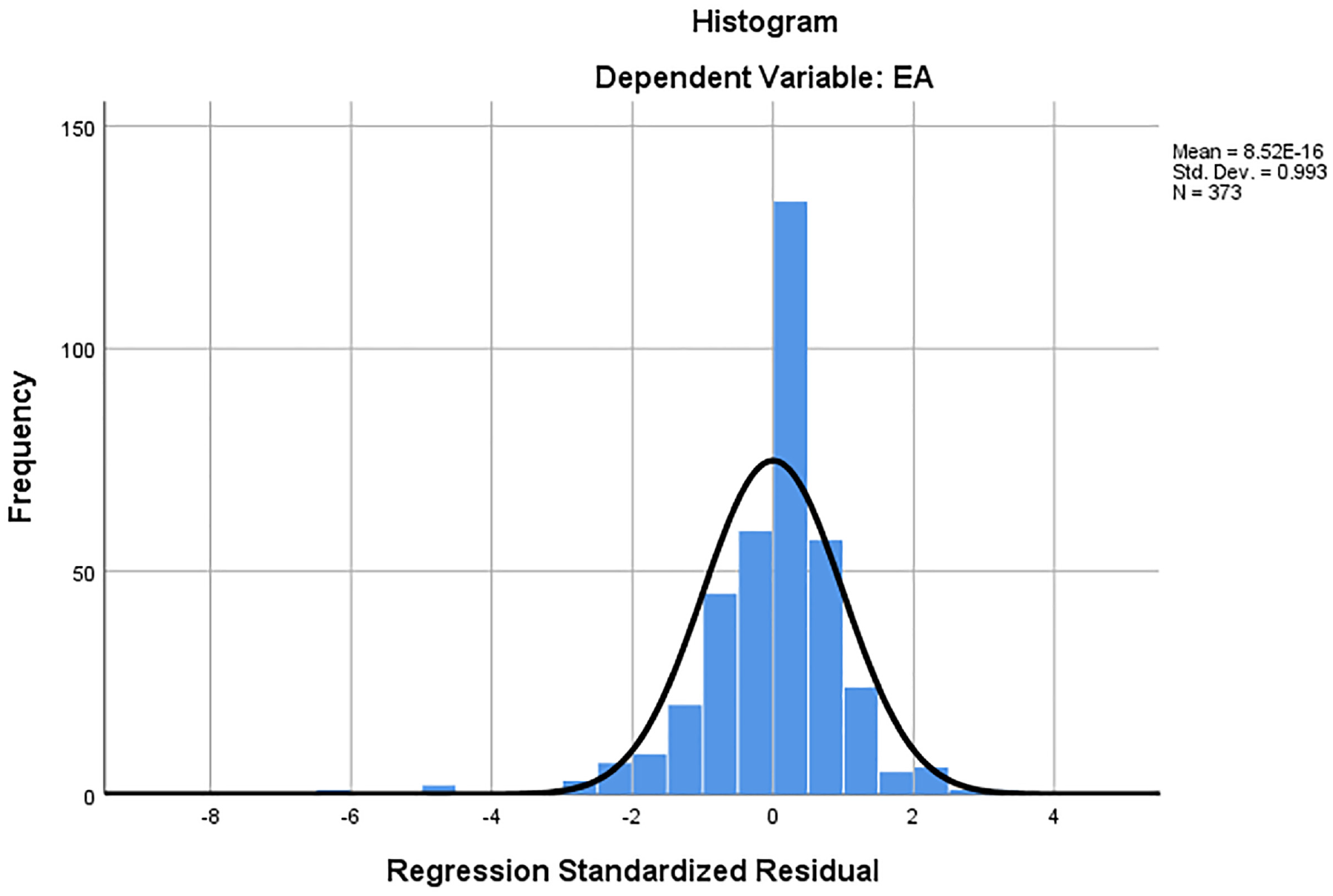
Histogram of regression standardized residuals.
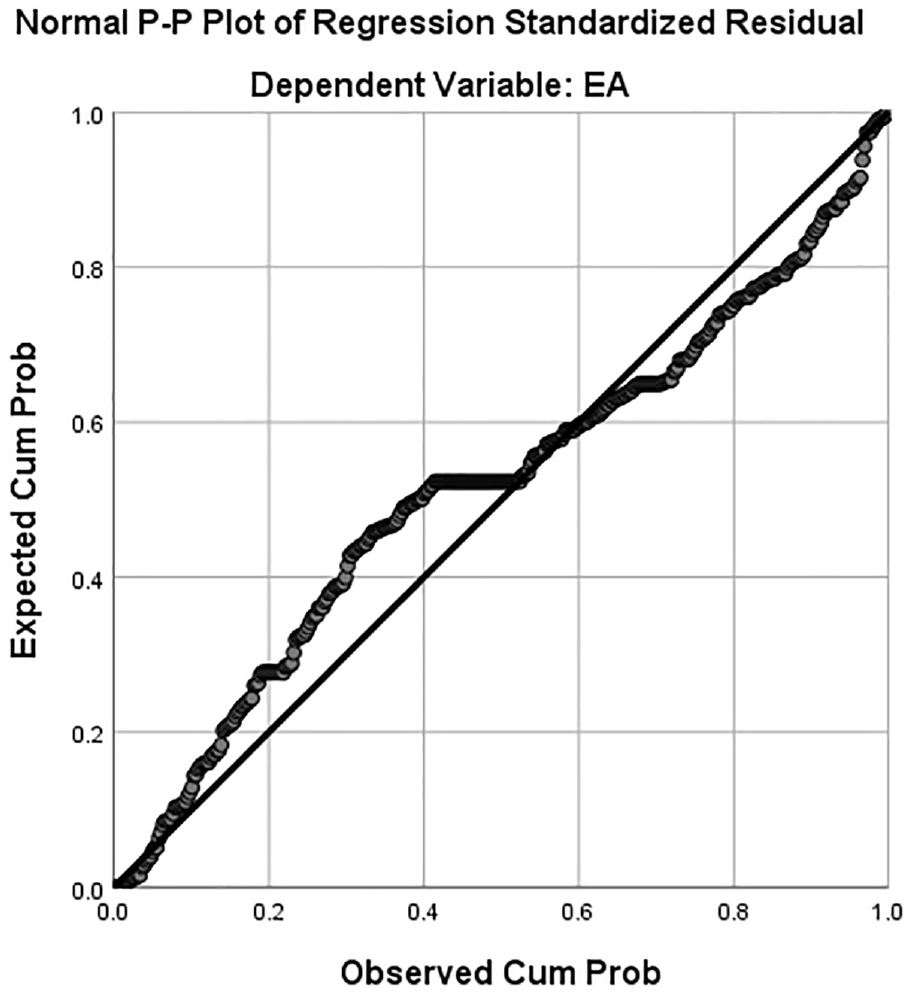
Normal P-P plot of regression standardized residuals.
Regression Analysis of the Servant Leadership Predictors of Employability.

p < .05. **p < .01.
Testing the Multiple Linear Regression Equation Model
First, the multiple correlation coefficient R is .823, revealing a strong linear correlation between all the independent variables and the dependent variable. The closer the value is to 1, the stronger the correlation. Furthermore, the coefficient of determination R2 has a value of .677, indicating that 67.7% of the variation in employability can be explained by altruistic calling, emotional healing, wisdom, persuasive mapping, and organizational stewardship. The closer R2 is to 1, the better the model fits the data. The adjusted R2 has a value of .673, which is similar to R2 and is another significant indicator of the quality of the multiple linear regression model (Table 4).
Second, regarding the ANOVA of the output results, the variance analysis results for testing the overall significance of the regression model are shown in Table 4. The F statistic is 153.822, with a p-value of less than .001. At a test level of α = .05, it can be concluded that the fitted multiple linear regression equations are statistically significant.
Third, the coefficients table in the result output indicates that there is little to no multicollinearity among the independent variables, all of which, with the exception of wisdom, have a tolerance value greater than .2. The VIF of all independent variables is less than 10. This is confirmed by the collinearity diagnosis statistics (Table 4).
Fourth, the model summary table in the results output shows a Durbin-Watson value of 2.12, which indicates that there is no significant correlation between the residuals. This satisfies the condition of the residuals being independent from each other. Typically, the range of values for this statistic is between 0 and 4, and a value close to 2 indicates independence among the residuals (Table 4).
Lastly, from the histogram of regression standardized residuals, it is clear that the residuals follow a normal distribution, with a mean of 0 and a standard deviation of approximately 1 (0.993). Additionally, on the normal P-P plot of regression standardized residuals, the scattered points are mainly located around the diagonal line of the first quadrant, providing further evidence that the residuals follow a normal distribution (Figures 1 and 2 and Table 4).
Overall, the multiple linear regression equation shows an excellent and statistically significant model fitting effect with hardly any multicollinearity among the independent variables. The residuals are independent of each other and follow a normal distribution. These results confirm that it was appropriate to proceed with hypothesis testing.
Testing the Associations Between Variables
There is a positive relationship between altruistic calling and employability (β = .172, p < .01), which supports H1. H2 is also supported by the data, as emotional healing and employability have a positive association (β = .143, p < .05). H3 is supported by the fact that wisdom and employability are positively connected (β = .071, p < .05). H4 is supported by the favorable connection between persuasive mapping and employability (β = .470, p < .01). Finally, H5 is supported by the positive connection between organizational stewardship and employability (β = .205, p < .01). Of all the factors, persuasive mapping has the highest predictive value for the employability of undergraduates, while wisdom has the lowest predictive value for undergraduate employability (Table 4).
Discussion
Theoretical Implications
Our research contributes to the study of undergraduate employability, which has become a notable concern for various stakeholders. Our hypotheses focused on undergraduates’ employability in relation to the servant leadership qualities of altruistic calling, emotional healing, wisdom, persuasive mapping, and organizational stewardship. Our findings provide compelling evidence to support our hypotheses. In essence, we have discovered that servant leadership significantly influences perceptions of undergraduates’ employability.
We found that persuasive mapping is the strongest predictor of an undergraduate’s employability in servant leadership. These students possess a strong desire to motivate and convince others to come to an understanding. This implies that compliance is usually rational and emotional rather than imposed by authority. As a result, it becomes easier to persuade individuals to take voluntary action, aligning with the ultimate goal (Gandolfi & Stone, 2018). This finding is significant for both employers and employees, because every task and activity in the workplace should move toward a specific goal. Furthermore, since persuasive mapping is closely related to empowerment, it strongly influences other people’s creativity (Krog & Govender, 2015). It is evident that empowerment is a crucial trait in servant leadership, as emphasized by most researchers who study it.
The perceived employability of undergraduates is also positively connected with altruistic calling and emotional healing. Service, which is the foundation of servant leadership, promotes positive relationships between people within an organization. Leaders who possess this skill make their followers feel valued and understood. Leaders who adopt a selfless approach within the organization can earn the respect and loyalty of their followers. If leaders continue to follow this model for a certain period, it can prove to be a reliable leadership model (Choi & Mai-Dalton, 1998). Altruism can add value to the collective, and employers therefore give more weight to individuals who have expertise in helping others (Anderson & Lu, 2017; Dennis et al., 2010). People who possess emotional healing skills possess qualities such as empathy, interpersonal acceptance, and the ability to establish significant interpersonal relationships. One way to create a strong organization is by reducing job fatigue, as suggested by Wong et al. (2007). Such leaders can even influence individuals with so-called dark personalities to adopt pro-social behavior, which can benefit the growth of the entire organization.
For a business, organizational stewardship is essential for maintaining a positive reputation and increasing employability. Effective management is crucial for ensuring smooth operations and providing growth opportunities for employees in order to make a meaningful contribution to society (Chughtai, 2019). Demonstrating ethical behavior is a key characteristic of strong leadership (Rosenberg et al., 2012). Of course, even if wisdom may not have a high predictive value for employability among undergraduates, it is still an essential quality. Knowledge is used to achieve objectives in servant leadership, and both knowledge and understanding of the organization are necessary for leaders. To make informed judgments and help the organization grow, leaders often need to combine professional knowledge with current circumstances to anticipate where things are headed (Liden et al., 2008). Planning for the future is also important. Therefore, wisdom involves combining knowledge with practicality.
Practical Implications
The results of this research are important for colleges and universities to improve their training and development programs, for undergraduates to enhance their own personal growth, and for employers and HR professionals to make better hiring decisions.
According to the findings, servant leadership predicts the perceived employability of undergraduates. To promote this type of leadership, universities can offer more courses, programs, and activities related to servant leadership and encourage students to participate actively. For instance, many colleges and universities have student unions or associations that provide opportunities for students to exercise leadership skills. By becoming leaders in these organizations (that is, by adopting roles such as monitor, class representative, or event organizer), students can gain valuable leadership experience (Deng et al., 2020).
Unofficial groups provide undergraduates with opportunities to learn various soft skills required by employers, including interpersonal communication, teamwork, contributing to the group, serving and assisting others, and decision-making (Mackieh & Dlhin, 2019). Through these experiences, undergraduates gain certain rights within the group, which can boost their self-confidence and sharpen their capabilities during interviews with HR professionals or companies. These experiences also serve as a good foundation for undergraduates, particularly those without prior experience in the field. Therefore, to succeed in various work settings in the future, it is crucial for undergraduates to focus on and deliberately cultivate their servant leadership ability.
Leaders who practice servant leadership tend to have followers who are more loyal and stay with them for longer periods of time. This is because servant leaders prioritize the interests of others over their own. They also possess a range of valuable skills, such as emotional healing, organizational stewardship, and wisdom, that can create value within and outside an organization. Employers and manpower commissioners favor undergraduates who possess servant leadership qualities, even if they do not hold leadership positions at work; such students may be more likely to receive promotions or salary increases when they join the workforce. Because of the many benefits of servant leadership, companies may want to use relevant leadership tests when making hiring decisions. Employers can also train newly hired employees in servant leadership, just as undergraduates are trained in colleges and universities.
Strengths, Limitations, and Future Directions
Although this study has successfully used the five dimensions of servant leadership to predict how undergraduates view their employability for the first time, it is important to acknowledge certain limitations.
First, we rely solely on undergraduates’ self-evaluation to capture their perception of employability and their servant leadership. However, this approach diverges from external evaluation. To gain a more comprehensive perspective, we can enhance our understanding by seeking feedback from employers or HR specialists regarding their opinions on servant leadership during graduate recruitment. This is a potential avenue for future research.
Second, the focus of this study was on three private universities in one province of China, which means that the research sample was limited. It would be beneficial to broaden the scope of the study by including provinces in both the north and south of China, and even collecting data from foreign undergraduates for further analysis. To gain a deeper understanding of how servant leadership impacts employability, it would be helpful to track the career trajectories of these students after graduation and entry into the workforce. However, obtaining the specific and detailed information necessary for this purpose may prove difficult in a questionnaire-based research design.
In terms of future directions, one potential path is to build a lasting partnership with universities in order to implement servant leadership training courses, projects, or activities for undergraduate students. This would help to cultivate more individuals with strong servant leadership qualities.
Conclusion
This research constitutes an initial effort to create and assess a multiple linear regression model that links the servant leadership of undergraduates to their perceived employability. The results demonstrate how encouraging proactive professional behaviors among undergraduates can enhance their perception of their employability. Accordingly, it is expected that the findings of the study will inspire educational institutions, corporations, and career development experts to devise strategies that prioritize the development of servant leadership and servant leaders. The findings also imply that students in higher education should concentrate on cultivating their own servant leadership abilities.
Footnotes
Declaration of Conflicting Interests
The author(s) declared no potential conflicts of interest with respect to the research, authorship, and/or publication of this article.
Funding
The author(s) received no financial support for the research, authorship, and/or publication of this article.

Data Availability Statement
Data sharing not applicable to this article as no datasets were generated or analyzed during the current study