




Abstract
TVET in Malaysia is geared toward providing quality education, training, and resources but it still needs to be strengthened and reformed toward producing a more quality and skilled workforce. This study aimed to procure feedback from TVET curriculum key-players’ (automotive) on the integration of automotive case-based simulation (CBS) as TVET future learning strategies. Collective case-study research design was used with purposive sampling design which involved 5 curriculum key-players in vocational college and 16 automotive industries as study respondents. A set of questionnaires and interview protocols were used to gather quantitative and qualitative data. Intra-class correlation coefficient (ICC) was used to obtain an average measure agreement among raters. ATLAS.ti was also used through thematic analysis to produce models. The ICC showed high values of agreement for the process and structure of the CBS. The limitation of this research focused on one program (automotive technology) through the key-players’ and industries’ perspectives toward the implementation of CBS as a tool to enhance students’ soft skills. The collation of both data showed the alignment between both parties against the CBS. The curriculum key-players agreed that CBS fulfilled its requirements as a tool to enrich TVET students’ marketability skills, supported by the automotive industries’ perspective which believed that using CBS would prepare TVET students’ readiness to the workplace. Notably, the CBS provides an opportunity to stimulate thinking and learning preferences among students, in addition to being a learning tool for future TVET learning strategies that connect theory and practice in preparation for job training.
Keywords
Introduction
Technical and Vocational Education Training (TVET) in the history of education plays an important role through UNESCO’s mandate in assisting the development of poor and developing countries. Other organizations including the World Bank have begun to put greater priority on TVET education agenda toward improving skills workers (Almeida et al., 2012; Tikly, 2013). The policy of promoting TVET by a financial institution such as the World Bank is seen as an investment in human capital in an effort to support economic growth. In fact, global organization like UNESCO is widely associated with universal human sustainability efforts in order to support sustainable development. UNESCO insists that TVET should equip all youth and adults with skills-related knowledge and competencies for workplaces which can be done through lifelong learning (Subrahmanyam, 2020). Thus, the UNESCO-UNEVOC (2020) has recommended recognition of the important role of TVET teaching by ensuring the quality and relevance of qualified and high-quality TVET staff, including teachers, instructors, coaches, tutors, managers, administrators, development agents, coaching staff, and others (Subrahmanyam, 2020). This recommendation aims to build and enhance the institutional capacity needed to ensure the relevance of TVET to the current and growing needs of the working, national, regional, and international world that impact the economy and society.
In this regard, every country should plan to have an efficient and quality workforce who are not only efficient in working but also able to think and complete work effectively. Such competent workers are usually related to the training they have in training institutions such as the vocational college. The learning experiences that they go through should have the potential to shape their thinking skills in implementing the problem-solving process related to the areas of skill they are involved in. All the skills that have been acquired meaningfully will act as a guide throughout their careers. Undeniably, TVET can contribute to the development of the aforementioned skills among the students since an effective TVET is able to generate a knowledgeable, skilled, capable, and positive labor force to increase productivity toward the nation’s development (Omar et al., 2020).
Conceptualizing of TVET Trends
Why is TVET important? It is worth acknowledging that at present labor productivity is one of the most important factors in preserving the economic turmoil of any country. In order to ensure that productivity enhancement takes place, the labor force needs to be equipped and trained with the appropriate knowledge, skills, competencies, attitudes, and aptitude so that they can function actively and meaningfully in the workplace. TVET is essential to realize the skills of the labor force. In fact, according to the view of Omar et al. (2020), globally, TVET has been recommended as the main education system to equip the labor force with all these stated skills.
Developing countries are increasingly aware of the role that TVET can play in reducing poverty and supporting economic growth (Albashiry et al., 2015), and as such, Malaysia is no exception. Consequently, strengthening TVET has become an important national priority and agenda for Malaysia (Amran et al., 2020). The preparation of educational and training programs essentially requires an appropriate curriculum. The development of the curriculum as a learning opportunity planning process affects positive changes among students and further assesses the level of curriculum effectiveness based on the goals set (Okorafor, 2009).
The development of the TVET curriculum should also be in line with 21st Century Skills. Most of these skills are associated with deeper learning, based on the mastery of skills such as analytical reasoning and complex problem-solving and all these are sure to have an impact while at work. This upsurge in skills is toward improving the substance of TVET education toward high employability. Hence, matters related to the development of the TVET curriculum should be taken into account by TVET curriculum developers as they are academic managers of the field who are expected to be able to play a critical role in maintaining and enhancing the quality of TVET programs (Albashiry et al., 2015). On this matter, Malaysia welcomes the UNESCO-UNIVOC (2020) recommendation that TVET should not only increase student intake but should also improve the quality of TVET education. This is expected to meet Malaysia’s desire to boost the country’s economy toward a high-income economy nation (Zain et al., 2017).
The Current Issues Related to the TVET Marketability Skills
TVET is an important area in producing a competent workforce in today’s industrial market. According to UNESCO-UNEVOC (2021), TVET is a combination of educational, training and skills development processes related to various fields of employment, production, and service industries. TVET’s role in human resource development has also been highlighted as one of the determinants of industry growth and job opportunities in driving global skills which in turn leads to a better world perspective (Subrahmanyam, 2020). This is in line with the study conducted by UNESCO-UNIVOC (2020) which found that the most important skill to get a good job is problem solving/critical thinking and digital/ICT skills. Meanwhile, studies conducted on government/National bodies (16%), TVET institutions (17%), and TVET practitioners (16%) agreed that problem-solving/critical thinking is the most important. Additionally, government/National bodies (14%), TVET institution (16%), and TVET practitioners (14%) agreed that having digital/ICT skills is the most important aspect to secure a highly paid job (UNESCO-UNEVOC, 2020).
The development of a TVET related skill is in line with the sustainable development goal (SDG). The evidence of its relevance is in SDG4, where target 3 highlights better access to TVET (Technical Vocational Education Training) and higher education, while target 4 is related to skills and knowledge to ensure that TVET graduates are given good job opportunities. Meanwhile, the education sub-sector is seen as an important entity in international development through the provision of human capital in the field of TVET. The empowerment of TVET can be seen since 1963 and 1976, when TVET received the highest funding (23%) of the World Bank’s education loans, and TVET as a whole, including higher and non-formal education, accounted for the bulk (51%) of those loans (McGrath & Yamada, 2023). However, TVET is increasingly facing criticism for its inability to produce human resources effectively and efficiently to strengthen social and economic equality (McGrath & Yamada, 2023). In addition, among other challenges for the field of TVET is in ensuring the smooth transition of its graduates into the world of work (Hamid & Tan, 2023; United Nations Children’s Fund, 2019). The relevance of the curriculum with the demand for skills in line with the needs of the workplace and the match between graduates and employment opportunities, can affect the economic cycle of the country and the world. Therefore, the curriculum building process can be a method for coordination between TVET curriculum implementers (instructors) and recipients of TVET educational products (students). Thus, the digital curriculum is seen as having great potential to formulate or improve the curriculum content based on feedback from the industry (World Bank et al., 2023). Furthermore, good relations between industry and TVET curriculum providers are seen as important because in Malaysia, the latest statistics show that unemployment among youths is due to a number of factors. Among them are insufficient work experience, skills, level of education, and skills that do not match the needs of the job market. Employers prioritize communication skills during the hiring process, followed by work experience, interpersonal skills, passion, and commitment (Holidi & Abu Seman, 2023; Shakur, 2020).
TVET education today plays an important role in ensuring that every prospective graduate meets the criteria required by the industry. With regards to this, TVET’s educational characteristics can contribute to a workforce that meets the industry’s criteria (Azid et al., 2019; Oviawe & Ehirheme, 2020). As advocated by Oviawe and Ehirheme (2020), TVET education emphasizes critical thinking skills and problem-solving methods in learning situations. In line with what Chan et al. (2018) say, thinking skills and problem-solving skills in the workplace or industry are the skills that employers nowadays need in securing a new workforce. One of the learning methods that can improve thinking skills is through case-based simulation (McLean et al., 2016; Sapeni & Said, 2020). Case-based simulation is a student-centered learning approach which makes students use the concept of knowledge gained in real-world scenarios (Cummins et al., 2019). In other words, case situations are given to students to be resolved through the application of concepts learned in class into real life. This is in line with the need to strengthen TVET education in Malaysia and youth today in facing future changes such as demographic change, migration, technological change, and climate (Chan et al., 2018).
The Conceptualizing of TVET Automotive Case-Based Workplace Simulation (AutoCBOS)
AutoCBOS application was developed by a number of researchers from different specializations (TVET Education, Curriculum and Instruction, and Instructional Technology in Education). Each researcher was responsible for the specific elements in the apps, such as story board development, contents-learning activities, assessments, application design, coding, multimedia development, and overall quality of the apps. As for the contents, two researchers whose expertise is in the TVET education/curriculum and instruction were given the responsibility to ensure its’ adequacy. The contents of the apps consisted of a number of questions in assessment that was set firstly to identify the students’ performance in the course. Secondly, the learning experiences aimed to trigger students’ learning preferences (

AutoCBOS front page.

Description of AutoCBOS.
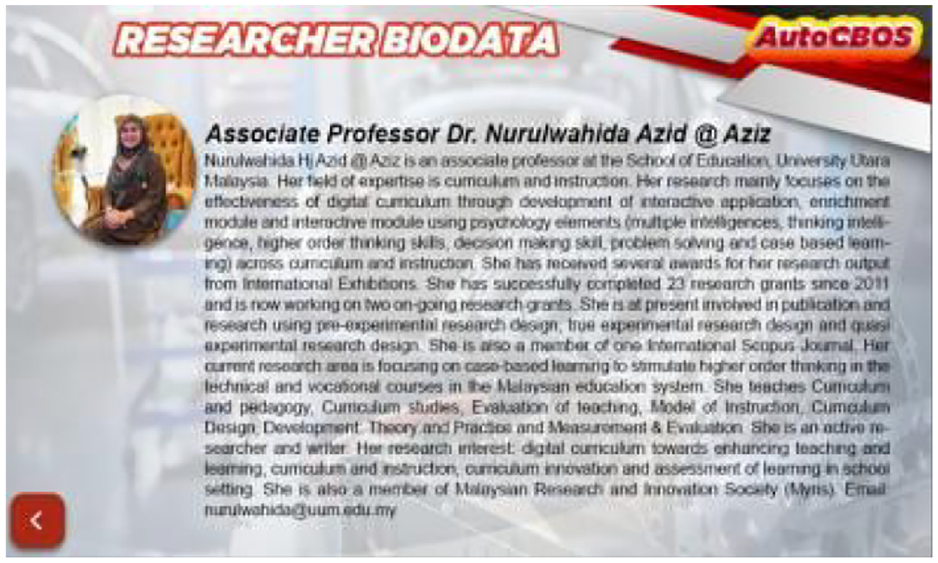
Researcher biodata interface.

AutoCBOS digital curriculum content.

Automotive courses interface.

Synopsis and learning outcomes interface.

Automotive assessment interface.

The case interface.

The audio video of the case interface.

Learning activities interface.
Automotive CBS Anatomy
Figure 11 shows the 10 principles used to produce automotive case-based simulation based on Herreid (Herreid, 2007; Herreid et al., 2012; Herreid & Schiller, 2013). Ten principles of good case construction are

TVET CBS anatomy.
Research Questions
1.6.1. What are the Intra-class Correlation Coefficient (ICC) values based on the TVET Curriculum Developers’ evaluation of the Automotive Case-Based Simulation (Automotive CBS)?
1.6.2. What are the TVET Curriculum Developers’ thoughts on the relevance of TVET Automotive Case-Based Workplace Simulation (AutoCBOS) Apps?
1.6.3. What are the industries’ thoughts on the relevance of TVET Automotive Case-Based Workplace Simulation (AutoCBOS) Apps?
Methodology
Research Design
Collective case-study research design was used in this study. The rational of using this study was because it allows quantitative and qualitative data from multiple cases (Sykes et al., 2018). Multiple cases refer to curriculum key-players consisted of curriculum developers and curriculum implementers. In fact, it also took into account the views from automotive industries. Both data sets (quantitative & qualitative) were collected during the case-based simulation evaluation session, which was divided into two sessions, whereby in session one, each curriculum key-players were given a questionnaire for the scoring of each item. A discussion session related to AutoCBOS was carried out between the curriculum key-players and the researchers (apps developers). The interview session continued for several weeks with automotive industries. After analyzing the data set separately, the researchers interpreted the quantitative and qualitative data (Creswell & Creswell, 2018). Mixed method helped researchers provide spaces for the investigators to conceptually and analytically integrate the quantitative and qualitative data. For example, in the qualitative aspect, the interview session was done. The interview data obtained have extracted viable responses from participants which explained the quantitative figure in detail. The mixed method has shown comprehensive findings to the researchers and readers (Figure 12).

Explanatory mixed-method research design.
Sampling Design
Purposive sampling design was used in this study because the respondents were selected based on their experience in teaching or designing automotive technology courses at the vocational college and are experts in the field. A total of 5 automotive technology curriculum key-players and 16 automotive industries were involved as respondents of this study.
Research Procedure
All the respondents attended the automotive case-based simulation evaluation session via a Webex meeting on the specified day and date. The letter of consent certifying that all information provided solely for the purpose of the study was signed. The automotive industries were included in this session because the AutoCBOS apps evaluation took into account the expertise on the contents of the automotive technology syllabus in the vocational college. The session started with a briefing on the purpose of the study followed by the presentation of each automotive case-based simulation whereby the respondents were given time to give ratings on each case’s process and structure. Afterwards, a recorded discussion with respondents’ permission was conducted to get the feedback for data analysis purposes. Meanwhile, 16 respondents representing 16 automotive industries were invited voluntarily to participate in the study. Furthermore, they explained the importance of feedback from the perspective of industries that can contribute to the sustainability of TVET education, especially in the field of automotive technology. All automotive industries signed a letter of consent before the interview session was held in their respective industries.
Test Analysis
Quantitative data was analyzed using intra-class correlation coefficient (ICC) to see the agreement among the curriculum key-players on the process and structure of the simulation (Landers, 2015) followed by the use of ATLAS.ti nine software to analyse the data themes (Woolf & Silver, 2018) by categorizing the data, forming a code or theme, analyzing, and structuring the data systematically (Woolf & Silver, 2018). Symbols for quotations, added documents, memos, codes, links, networks, project explorer, and A-Docs were utilized for raw data input to build codes. Memos were inserted to explain each element that has been coded from transcripts of five automotive curriculum developers’ conversations. Further the formation of a theme or code showed a network that described the relationship between one form of code to another (code-code relation). Themes based on the study questions were formed by researchers based on the findings of the study.
Instrumentation, Reliability, and Validity
The questionnaires for process and structure of the simulation were adapted from (Herreid, 2007; Kim et al., 2015), consisted of scales ranging from 1 (very weak) and 10 (very excellent). Further, a pilot test was administered to 60 automotive college vocational curriculum implementers to gauge its reliability where the Cronbach alpha value was .82. The development process of the instruments went through two stages which were (a) the developing process and (b) expert validating process in order to come out with valid and reliable construct. This process was adapted from validated process framework as illustrated in Figure 13 (Azid et al., 2023).

Nurul, Busthami & Ruzlan electrical case-based simulation process framework.
The qualitative interview protocol developed by the researchers had undergone a face and content validity test by four qualitative researchers who have 16 years of experience in qualitative research. Their comments and suggestions were followed during amendment process.
Results
Quantitative Findings
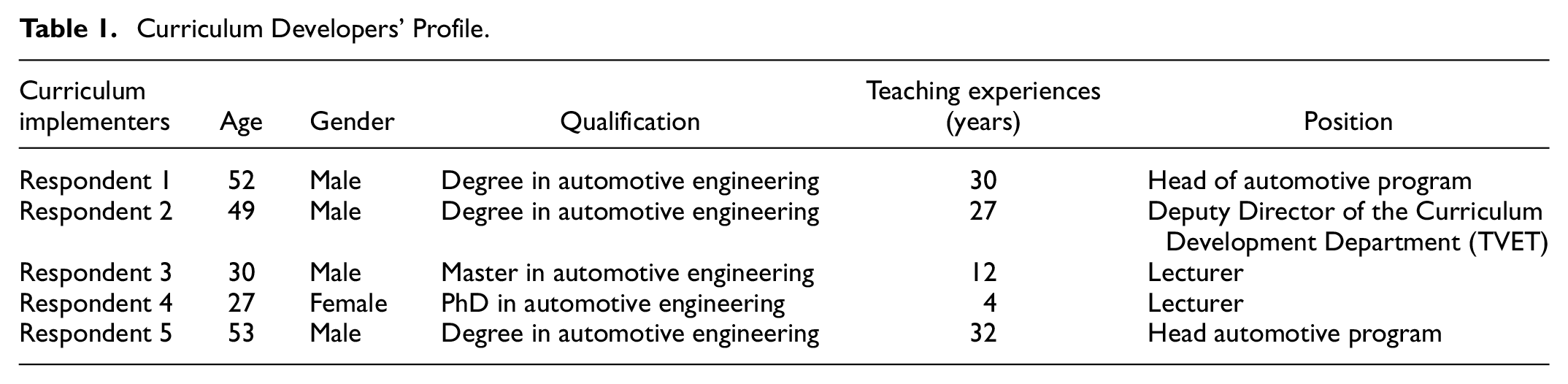
Table 1 displays the profile of five curriculum developers in the field of automotive technology. The total of three respondents have more than 20 years of teaching experience while the other two have 12 and 4 years of teaching experience, respectively. All (n = 5) are qualified in automotive engineering.
Curriculum Developers’ Profile.
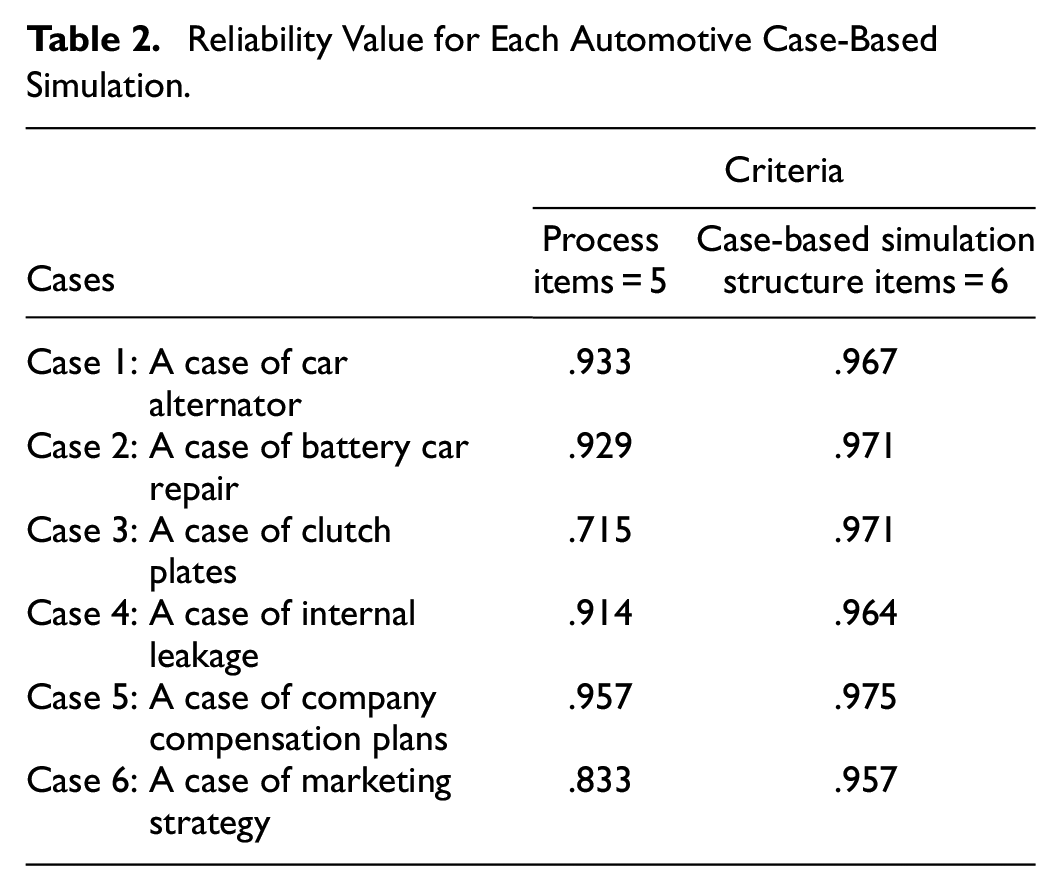
The reliability values for cases such as case 1 (Car Alternator), case 2 (Battery Car Repair), case 3 (Clutch Plates), and case 4 (Internal Leakage), case 5 (Company Compensation Plans) and case 6 (Marketing Strategy) were all high as displayed in Table 2.
Reliability Value for Each Automotive Case-Based Simulation.
Tables 3 and 4 present the automotive curriculum developers’ consensus values of all the cases. In case 1, the average intra-class correlation coefficient (ICC) score was .933 with 95% CI [0.750, 0.992] (F[4, 16] = 14.947, p < .000) for process and .967 with [0.895, 0.996] (F[4, 36] = 30.114, p < .000) for structure. In case 2, the average ICC score for process was .929 with [0.373, 0.992] (F[4, 16] = 14.154, p < .000) and .971 with [0.907, 0.997] (F[4, 36] = 34.067, p < .000) for structure.
Intra-Class Correlation Coefficient (ICC) Value Based on Automotive Case-Based Simulation Process Criteria.

Intra-Class Correlation Coefficient (ICC) Value Based on Automotive Case-Based Simulation Structure Criteria.

The consensus values in case 3 was .715 with 95% CI [−0.061, 0.967] (F[4, 16] = 3.514, p < .000) for process and .971 with [0.907, 0.997] (F[4, 36] = 33.920, p < .000) for structure. In case 4, the average ICC score was .914 with [0.681, 0.990] (F[4, 16] = 11.676, p < .000) and .964 with [0.886, 0.996] (F[4, 36] = 27.771, p < .000) for process and structure respectively. Meanwhile, in case 5, the average ICC score for process was .957 with [0.841, 0.995] (F[4, 16] = 23.500, p < .000), and .975 with [0.921, 0.997] (F[4, 36] = 40.180, p < .000) for structure. Finally, the average ICC score in case 6 was .833 with [0.378, 0.981] (F[4, 16] = 6.000, p < .000) for process, and .957 with [0.865, 0.995] (F[4, 36] = 23.500, p < .000) for structure.
Qualitative Findings: Curriculum Key Players’ Thoughts
Qualitative data was based on interviews with curriculum key players on automotive case-based simulation. The verbatim transcribed and analyzed interview data contributed to the production of three models based on three different themes namely: (a) Impact on curriculum developers, (b) Impact on curriculum implementers, and (c) Suggestion for apps improvement. Further interpretation of the data for each theme is described in detail as below.
Impact on Curriculum Developers
Referring to Model 1 (Figure 14), resulting from thematic analysis using ATLAS.ti, the impact on curriculum developers can be broken down into four important components that were mentioned by all automotive curriculum developers, namely (a) support TVET curriculum, (b) overcome learning challenges, (c) relevant with technology, and (d) initiate collaboration for curriculum improvement.

Model 1: Automotive CBS impact on curriculum developers.
Support TVET Curriculum
The construction of Automotive Case-Based Simulation (Automotive CBS) has a positive and encouraging impact from the point of view of automotive developers. From the interview, automotive curriculum developers believed that Automotive CBS supports TVET (Technical and Vocational Education Training) curriculum. This is because Automotive CBS meets the TVET Malaysian Examinations board that is, it provides for three levels to students, namely (a) knowledge, (b) combination of knowledge and experience, and (c) the manipulation of knowledge: “The Malaysian Examinations Board provides for 3 levels to our students. The first is knowledge. The second is to combine knowledge and experience, and the third is how they manipulate their knowledge” (R5), “So I can see all three of those components in this app” (R5). Curriculum contained in Automotive CBS is relevant to college students’ needs: “Relevant, curriculum in the apps is relevant to the students” (R5), “Yes I agreed with Haji” (R2), “Yes, Automotive CBS align with automotive curriculum” (R2).
Overcome Learning Challenges
Automotive curriculum developers certified that Automotive CBS is able to overcome learning challenges with the support of automotive CBS construction in the form of interactive applications. This effort goes hand in hand with the characteristics of students born in the age of technology: “Yes, I like the idea of making it more interactive, so that it becomes more fun and engaging. The generation nowadays really dislikes reading a lot. That’s why I think the app should be interactive and students do not have to read a lot. I remember a long time ago during my era; we had to read a lot although the subject was general math” (R1).
Relevant with Technology
Further, Automotive CBS is also certified as relevant to technology: “Relevant, curriculum in the apps is suitable for the students. Integrated with technology” (R5).
Initiate Collaboration for Curriculum Improvement
The interview data indicated that all five curriculum developers support Automotive CBS because it is a collaboration for curriculum improvement between the University and TVET department (Ministry of Education): “So, I think it is best we go over it again in detail before we present to the director of TVET” (R2). Automotive curriculum developers were willing to help to review the apps to ensure that the developed apps are robust and effective: “And if our boss gives his green light, all of us will present the app to our boss. We would like to review again because we do not want to have any technical mistakes later, and make the apps more effective” (R2). All automotive curriculum developers believed that the university has implemented a leading effort to help improve the TVET curriculum through this collaboration: “Alhamdulillah, the university is moving towards the change in education, we are so happy because we feel as though our burden has been lifted” (R1), “In terms of curriculum, it can help; based on the comments made by my colleagues just now” (R2), “Yes, as for the second round of presentation, we hoped to be invited again to test the app”(R2).
Impact on Curriculum Implementers
Referring to Model 2 (Figure 15), the analysis of interview data formed the second theme that was impact on curriculum implementers. The findings showed several components that support this theme, namely (a) impact on curriculum and case, (b) approach to teaching and learning and two components which were also stated in the first theme related to the second theme which was relevant with technology, and overcome learning challenges.
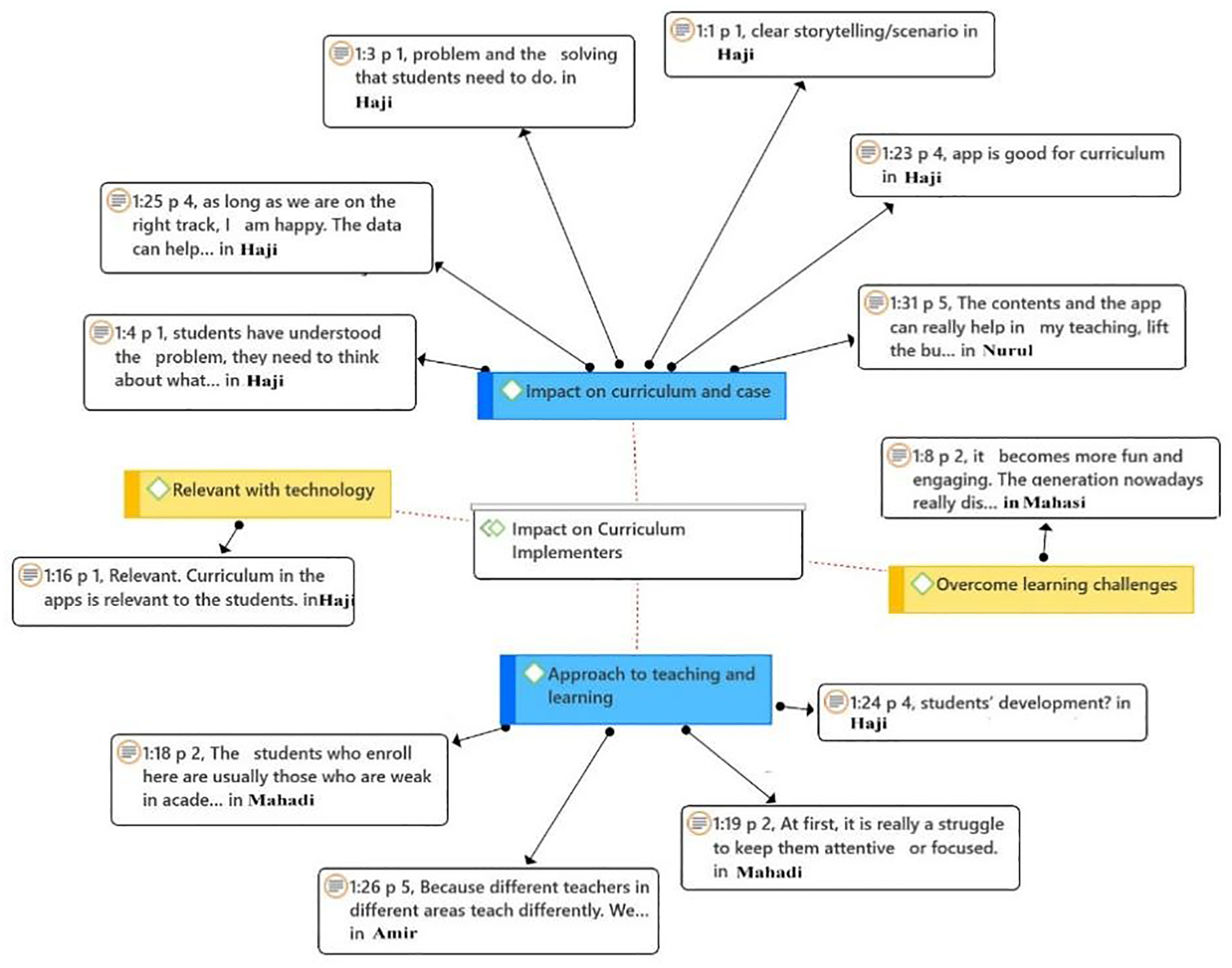
Model 2. Automotive CBS impact on curriculum implementers.
Impact on Curriculum and Case
The use of Automotive CBS gives impact on the automotive technology curriculum whereby the Automotive CBS structure provides avenues for students to think and make decisions based on the questions posed within the case: “For example when students have understood the problem, they need to think about what action needs to be taken” (R2). Automotive CBS is a good effort as it gives meaning to TVET Education and the findings obtained through this app will be beneficial to meet the direction of TVET: “Well, at least when we retired, we know we have left something that is meaningful for TVET education. For me, as long as we are on the right track, I am happy. This app is good for this level, but we have not seen the real outcome yet. So, let’s work towards that” (R5). Automotive CBS helps college students solve problems based on cases presented in apps, “about the problem and the solving that students need to do” (R5). This is because the structure of automotive cases built presents a clear scenario: “Because there’s a clear storytelling/scenario” (R5). Automotive CBS is a good app for automotive technology curriculum which can indicate students’ learning preferences (heutagogy, peeragogy & cybergogy): “This app is good for curriculum. Mr Mahadi and I are in the curriculum field so, from what we have seen, our students are less inclined in peeragogy” (R5). In fact, Automotive CBS is very interesting and can help in teaching and reduce the burden of the curriculum implementers in vocational colleges: “The contents and the app can really help in my teaching, lift the burden a bit. I think the students will also be very interested to carry on learning using this app” (R4).
Approach to Teaching and Learning
In the view of curriculum developers, automotive CBS is an approach to teaching and learning in automotive technology: “The students who enroll here are usually those who are weak in academic. But they have talents and hidden skills. That is why after a while; they become outstanding in their fields, so that point supported with this Automotive CBS will help teaching and learning strategies” (R1). Automotive CBS integrated through an interactive app means a lot because it is not only beneficial to the Ministry of Education but also to educators. The data obtained from Automotive CBS will provide information to educators in colleges of different fields to help plan and improve teaching by educators at vocational colleges: “The findings will be meaningful not for the ministry, but for educators too because different teachers in different areas teach differently. We will get to see the findings/output and not only us but the Ministry to. So, with the data, if there are any differences, we can try improve by consulting other vocational colleges. The findings can help instructors to plan their teaching too” (R3). Automotive CBS is a good apps whereby the results will be able to inform students, educators and ministries whether automotive students are inclined toward heutagogy, peeragogy, or cybergogy: “I think this app is good but we still have to see the outcome whether students are heutagogy, peeragogy or cybergogy, can only be seen from the outcome” (R3). Based on the curriculum developers’ views, automotive CBS can balance the development of vocational college students. In fact, the generated data from this apps is meaningful to the educators whereby it helps them build questions and curriculum and further improve the quality of TVET education: “So, how do we develop the curriculum based on the data so that we can help balance students’ development? The data will be meaningful to us. We can use the data to build questions or even develop the curriculum. With the data, we can improve on our curriculum and TVET education” (R5).
Similarly, two components namely (a) relevant with technology and (b) overcome learning challenges also have positive implications for curriculum implementers. This is because automotive Case-Based Simulation apps built is relevant to automotive technology curriculum and the needs of vocational college students. This situation makes it easier for teachers to implement curriculum in TVET education: “Relevant. Curriculum in apps is relevant to the students” (R5). Meanwhile, Automotive CBS is also seen as significant because it helps vocational college students overcome learning challenges: “becomes more fun and engaging” (R1).
Suggestion for Apps Improvement
All the automotive curriculum developers agreed that automotive CBS has its own uniqueness as the automotive technology learning is conducted with case-based simulation assistance. However, in the interview, the automotive curriculum developers also suggested some improvements such as to include the audio and visual effects: “Yes, why not. Audio and visual effects are an attraction. Listening can attract those who dislike reading. You know, they can listen without even looking at the screen. They can still understand the situation” (R5), “I have one concern. That is the sentences will be too long. Maybe we can add an audio too. Maybe when students click on the audio button, they can hear the problems being told such as in a dialogue. Like a story. You know, sometimes when students read, they might miss the points. But when they listen to the audio, they can already grasp the idea or content. That’s my suggestion” (R3) and “So, I agree that we see the outcome first and also add in a bit of visuals, so that the students can focus. As we all know, students nowadays are all about visuals and adventures” (R5).
Another suggestion is to integrate the interactive elements on case-based simulations produced by researchers: “I agree with Tuan Haji about the output and maybe after we get the output/outcome then we can decide maybe we can add a little bit of interactive process that we already know” (R1), “And yes. Add in also a bit of the interactive aspect. Later, we can coordinate with the sub module and the relevant topic. Yes, I like the idea of making it more interactive, so that it becomes more fun and engaging. The generation nowadays really dislikes reading a lot” (R1). There are even suggestions for conducting a flip classroom or team teaching: “So, with the data, if there are any differences, we can try improve by consulting other vocational colleges. The findings can help instructors to plan their teaching too. For example, if strategy A is not suitable, we can try strategy B. We can also practice flip classroom or collaborate based on the place of teaching. That’s all” (R4). A summary of Suggestion for Apps Improvement is shown in Figure 16.

Model 3. Automotive CBS suggestion for apps improvement.
Qualitative Findings: Automotive Industries’ Thoughts
Qualitative data was based on interviews with industries on automotive case-based simulation (CBS). Transcribed verbatim and analyzed interview data contributed to the production of model 4 (Figure 17) based on three different themes namely: (a) Automotive CBS contribute to industry needs, (b) Positive impact using automotive CBS, and (c) Suggestion for automotive CBS. Further interpretation of the data for each theme is described in detail as below. “I” represented the industry.

Model 4. Automotive industries’ views toward automotive CBS.
Automotive CBS Contribute to Industry Needs
Qualitative findings from 16 automotive industries agreed that automotive CBS meets the needs of the industry as it includes theoretical and practical knowledge that enhance the abilities of TVET students as said by (I-13), that is, “This CBS is excellent with theory and practical to enhance TVET students’ skills and soft skills such as (analytical, creative, practical) and learning preferences (heutagogy, peeragogy, cybergogy)”. Automotive CBS also follows the industry in line with the needs of the industry as through CBS can produce more competitive TVET students: “CBS aligns with industry need to prepare students become more competitive in the automotive job market” (I-11). In addition, CBS is seen as supporting the production of skilled workers in the automotive industry as said by (I-15): “CBS can support skilled workers in the automotive industry through thinking skills and problem-solving skills during solving the automotive industry cases.” The automotive industries also believed that learning through automotive case-based simulation can produce more young skilled workers in line with industry requirements “can produce more young people with vocational skills to develop the needs of automotive industry” (I-4). As a matter of fact, automotive case-based simulation can be diversified in terms of content in line with TVET’s educational goals that can trigger students’ attitude, behavior, co-facing skills and labor law as proposed by the industry “Automotive CBS can be improved which is focus on the way students behave, communication and the knowledge of labor laws”(I-12) and “this case-based simulation is good, needs to be continued and improved in term of various cases” (I-6).
Positive Impact Using Automotive CBS
Sixteen automotive industries agreed that CBS automotive provides learning activities that benefit the thinking skills capabilities of vocational college students “from my perspectives, automotive CBS activity is very good for all vocational college students to enhance their thinking” (I-1). In addition, CBS manages to promote learning through the interactive application produced, and also as an added value because graduate marketability does not only depend on grade values but should also focus on the development of students who have critical thinking, are independent, adaptable to the environment and are wise to make decisions in line with the following findings: “Graduates’ marketability is not limited in term of examination grade, but can be enhance with additional skills such as critical thinking, creative thinking, courage, dependability, wisdom, enthusiasm, and decisiveness” (I-2). Therefore, the industry proposed close collaboration with small and medium-sized companies (SMEs) to create a variety of genuine cases in the workplace. This is in line with feedback “University needs to use real workplace case studies through collaboration with industries such as collaborate with SME from the industry” (I-2). The use of CBS is also supported by the industry as it reveals the true situation in the workplace through multiple cases. The formation of these cases gave students the opportunity to gain experience in the workplace such as helping students on job training. This is in line with the feedback “Great idea as case-based stimulation provides wider view and idea to the students on what happen on real world” (I-7) and “CBS can help OJT students gain knowledge and industrial workplace experience” (I-5). CBS is also one of the ways to celebrate transformation technology in the industry in addition to being in line with the scope and content that includes theory and practice. Here is an example of an industry statement “AutoCBOS is very good because it is aligned with the scope of TVET skills that is it contains practical components and the skills of automotive” (I-9), “AutoCBOS TVET system is the best way to face with the transformation of automotive industry. AutoCBOS is a good system to implement. This is because the automotive industry change aligns with the transformation of technology” (I-8), “AutoCBOS introduced the new system for TVET students to solve problems in the automation industry practically” (I-10) and “Industry encouraged the use of AutoCBOS to align with the transformation of technology.”
Suggestion for Automotive CBS
Positively, the whole industry supported the use of CBS in automotive technology learning in vocational colleges. In fact, they also suggested that various cases be investigated by working with the industry to advice on the production of cases based on the situation in the industry. This was articulated by (I-2) “University needs to use real workplace case studies through collaboration with industries. Such as collaborate with SME from the industry.” The industry further suggested that CBS be used as an alternative material that emphasizes practical learning related to automotive. This is in line with the statement “AutoCBS as an alternative tool to teach students in term of automotive practical tasks” (I-14).
Collating Curriculum Key-Players’ and Automotive Industries’ Findings
The findings based on the curriculum key-players’ and automotive industries’ perspectives pointed to the equations as illustrated through Figure 18. It shows the parallels of thinking from both parties toward the production of automotive case-based simulation. From the perspective of curriculum key-players, several positive criteria were emphasized against the production of automotive case-based simulation while automotive industries interpreted the cases as giving impact on vocational college students in preparing themselves for marketability in the automotive industry. For example, according to the view of curriculum key-players automotive CBS gives impact on the curriculum while the cases were translated by automotive industries through the following views: (a) aligns with the scope of TVET skills, (b) students gain knowledge & industrial workplace experience, (c) develop competitive workers, and (d) college vocational students become excellent with the automotive theory and practical.

AutoCBOS meeting of minds framework.
Curriculum key-players also highlighted the second criterion that automotive CBS supports TVET curriculum and is explained through the view of industries as follows: (a) automotive CBS produces vocational skills and (b) supports skilled workers knowledge and skills. Moreover, all the key-players positively thought that automotive CBS overcomes learning challenges among the college vocational students for the third criteria. This is also in line with the industry’s view that CBS: (a) provides wider view and ideas and (b) best practices to facing with the transformation of automotive industry. Curriculum key-players also stated the fourth criterion that automotive CBS is relevant with technology which in the view of the industry they said that: (a) automotive CBS promotes learning through interactive application and align with the transformation of technology. In addition, curriculum key-players welcomed the university’s efforts to assist TVET Education through the fifth criteria, namely the automotive CBS as one of the initiated collaboration improvement and automotive industry also agreed that from the collaboration between curriculum key-players and researchers can give additional value skills to the college vocational students. The last criterion mentioned by curriculum key-players was the approach to teaching and learning. This criterion also gets the industry’s recommendation when they support that automotive CBS is a good system to implement in vocational college. Overall, the framework (Figure 18) proves that meeting of minds from both parties namely curriculum key-player and industries has worked well. The six positive criteria outlined by curriculum players were fully supported by the industry which reflects the effort toward TVET future learning that emphasizes thinking skills when solving problems based on the case of the automotive industry and students’ readiness and securing automotive job marketability.
Discussion
Thinking skills are the process of making judgments, making decisions, solving problems, and understanding of a meaning through the use of the mind (Organisation for Economic Co-operation and Development [OECD], 2018). The skill of thinking by reasoning can help in making logical and rational judgments which in turn make an individual a creative person in thinking and making decisions. The Malaysian Education Development Plan (PPPM) 2013 to 2025 emphasizes the development of thinking skills to empower the aspect of creativity among students. However, based on previous studies, thinking skills among new and old students are still weak (Azizi-Fini et al., 2015). Thus, according to Robinson (2005), poor thinking skills make students less creative in thinking. This has a less favorable effect on the economic sector as creative thinking students are an important resource in the knowledge-based economy. The study by (Deba et al., 2014), also supports that the percentage of creative thinking levels among students in polytechnics is very low.
Further, lifelong learning is a continuous development of knowledge and skills throughout life after a person has undergone formal education (London, 2019). World Bank (2019), stated that lifelong learning is considered beneficial to individuals as it can improve one’s life through improved work skills, personality improvement and also the addition of knowledge. Thus, this skill becomes important among TVET students to produce competitive and competent students in the industrial world. However, as emphasized by Hasami and Buang (2021), inappropriate learning methods lead to failure for students to apply learning knowledge in life. Buang and Mohamad (2019), claimed that students do not know the importance of lifelong learning in life. Thus, through the case-based simulation method, students can go through learning experiences that can be attributed to case situations such as those in real life.
The construction of six automotive case-based simulations has received high reliability value after an evaluation was made by the automotive curriculum developers for vocational college. Both meet the automotive case-based simulation construction criteria (reliability between .715 and .957) for processes and structures with values (reliability between .957 and .975). These findings proved that the construction of six cases based on automotive content was agreed by all experts that it meets the criteria for a good construction process when the case-based simulation provided meets the opportunity to learn components, related to automotive technology content, achieve learning outcomes, providing opportunities to analyze the cases and providing opportunities to criticize the created solution. Meanwhile, the structure of the automotive case-based simulation also conforms to Clyde Freeman Herreid’s Rules which is arousing issues, creates empathy with the central character, and includes quotations, relevant to automotive vocational college students, conflict provoking, and decision forcing (Herreid, 2007).
Both criteria for the construction of automotive case-based simulation showed that the components emphasize on simulating thinking and decision making in vocational college students through the six cases provided. Case-based simulation (CBS) is a learning tool that can be used to provide an industry workplace environment that requires vocational college students to diagnose problems and link them to case facts (Herreid et al., 2012). The findings of this study are in line with the findings of Ali et al. (2018), which claimed that the use of case-based simulation to medical students also managed to trigger students’ thinking and problem-solving skills in line with the results of this study. The characteristic of the case-based simulation provides an opportunity for curriculum developers to prepare TVET workplace environment to vocational college students (Herreid & Schiller, 2013; Nkhoma, 2016). Learning through case will promote the learning process by applying the content of the lessons required by the curriculum developer such as automotive technology (Nkhoma, 2016).
Meanwhile, the findings of the qualitative study through ATLAS.ti analysis managed to produce three models that reflect the impact of automotive CBS, namely (a) automotive CBS impacted vocational college curriculum developers, (b) automotive CBS impacted vocational college curriculum implementers, (c) proposed improvement of interactive applications containing automotive CBS from vocational college curriculum developers and implementers. The findings of the interview proved that all respondents agreed that automotive CBS has an impact on the curriculum developers because it supports TVET curriculum, particularly in the field of automotive technology in terms of the content of the lessons and assessments that take into account theoretical and practical aspects. This finding is in line with the goal of case-based simulation which is to provide students with relevant opportunity to link between theory in practice (Crosling & Webb, 2002; Herreid, 2007).
Among other things, automotive CBS provides a learning practice that challenges the thinking process of vocational college students and is connected to technology through digital curriculum that contains six automotive cases. This finding is also recognized in the Raza (2020) study which supports teaching strategy using cases because it can create active participation and remove the culture of passive participation in the classroom. Student engagement occurs when students start thinking about understanding the content of the case and solve it based on the theory in practice to achieve learning outcomes (Gasiewski et al., 2011; Heinrich et al., 2012; Raza, 2020). The use of case-based simulation shows how vocational college students respond to cases. This was confirmed in Raza (2020) when the use of cases gave rise to curiosity; students expressed their own preferences and opinions.
Further, the findings of this study showed the approval of all vocational college curriculum developers on the impact of automotive curriculum and cases. The learning process in the classroom becomes more interesting when the case is related to the automotive curriculum that the student learns in theory and the problems created through the case allow the student to relate it to the practical while in the workshop. Raza (2020), in his study proved that learning strategies using case-based simulation also contribute to a learning environment that excites students’ interest and increases students’ motivation to solve cases. In fact, the findings of this study are in line with Raza (2020) that case-based simulations can reflect how students interact with cases through their feedback. This is also proven by the findings of this study when all respondents agreed that the selection of problem solving by vocational college students could show students’ learning preferences (heutagogy, peeragogy, or cybergogy) and thinking skills (analytical, creative, or practical).
Curriculum developers agreed that automotive CBS is an approach to teaching and learning. This is also supported by previous studies (Ali et al., 2018; Gasiewski et al., 2011; Heinrich et al., 2012; Herreid & Schiller, 2013; Nkhoma, 2016; Raza, 2020) which found the application of case-based simulation in teaching increases interest to learn, creates a learning environment of constructivism and self-regulated learning, improves thinking, and problem-solving abilities, increases motivation to understand lesson content and increases students’ active involvement in learning. In addition, the formation of digital curriculum through the construction of applications is welcomed by automotive curriculum developers as it is a tool that is relevant to the age of technology-based students in their daily lives. Interactive apps also create the attraction to learning. There were several suggestions discussed through the interview findings which are the addition of audio visuals to serve students with verbal audio linguistic. Researchers see these suggestions very constructive for the construction of a case-based automotive application. In fact, the proposed interactive elements such as button, sound, automotive visualizations are elements that can add value to the construction of apps and digital curriculum for vocational college.
This is in line with the recommendations of the Organization for Economic Co-operation and Development (Organisation for Economic Co-operation and Development [OECD], 2018), for the future education and skills in 2030, students should use their knowledge including cognitive and meta-cognitive skills (e.g., critical thinking, creative thinking, learning to learn, and self-regulation); social and emotional skills (e.g., empathy, self-efficacy, and collaboration); and practical and physical skills (e.g., using new information and communication technology devices). Clearly in the framework of OEDC toward 2030 education, practical skills are also emphasized to students including the skills of using technology devices as a new communication and learning tool. This is supported by Cox (2016), who noted that only by appreciating and integrating technology in classrooms, curriculum developers and implementers will be able to prepare students to successfully overcome future workplace challenges.
Notably, CBS is a type of simulation technology that uses real-life case studies to train and develop vocational college students (Weidman-Evans et al., 2022). Hence, the automotive industries agreed that CBS automation can contribute to industry needs. This is because CBS helps vocational college students to develop critical thinking skills and decision-making abilities to solve complex problems by simulating real-world scenarios (Knight et al., 2000) CBS is an effective and efficient learning method that can contribute to the development of skilled and knowledgeable students in the automotive industry. Consequently, CBS can provide a safe and controlled learning environment (Jauregui et al., 2018), reduce learning costs and time, and improve the quality and efficiency of learning (Alshareef, 2016).
The combination of quantitative and qualitative study findings showed a match that illustrates the use of automotive CBS has a positive impact on vocational college students. This is because the construction process and structure of the six cases conforms to the rules of construction and use of case-based simulation of automotive CBS. According to the views of the vocational college curriculum developers, automotive CBS stimulates the learning process theoretically and practically. Therefore, this is seen as having a positive effect on TVET students in preparing themselves for on job training. In fact, the efforts and cooperation between the university and TVET division at the Ministry of Education is a good initiative in advancing TVET Education.
Interestingly, through the AutoCBOS app, we can learn the views of the industry as recruiters/employers to outcome-based curriculum. This is explained by the research data that there is a meeting of minds between curriculum key-players and the industry regarding AutoCBOS as a future learning tool to align with the curriculum vision and industry needs. Thus, the parallel between curriculum and industry requirements will increase the employability of vocational college graduates. In addition, the industry can be a check and balance mechanism for curriculum key-players, a reference in strengthening a balanced TVET curriculum as well as applying theory to practical in the real workplace.
Conclusions
The findings of this study showed that it is significant for curriculum developers and curriculum implementers in vocational colleges to apply automotive CBS as a future learning strategy as outlined in the OECD framework of education 2030. This is because automotive CBS enables students’ preferences in their thinking skills and learning preferences to be observed through the choices of problem solving and feedback that they have made. Both of these are part of the 2030 education agenda outlined by the OECD in the effort to support students’ potential through learning and assessment activities toward making them to function more efficiently when they are at work. These findings enabled researchers to conclude a number of things, namely (a) the construction of automotive CBS is in accordance with good case building rules to stimulate the learning process of TVET students, (b) automotive CBS learning strategies impact on TVET curriculum developers and curriculum implementers by stimulating students’ thinking skills, increasing students’ interest in seeking and gaining the knowledge, encouraging students to relate theory in practice to prepare them in the workplace, and (c) TVET curriculum developers welcome the construction of a digital curriculum containing automotive CBS to identify students’ thinking skills and learning preferences and suggest that apps be supplemented with visuals and audio related to cases to meet the needs of students who prefer to listen rather than read. The researchers’ effort in realizing the use of CBS to stimulate the thinking and learning preferences of college vocational students through digital curriculum is in line with the OECD agenda 2030 education direction. In fact, the focus of this study is to provide TVET future learning in line with the Malaysian government’s agenda which sets the Technical Education and Training (TVET) sector as the main route in providing highly skilled human resources and one of the key drivers of the economy in making Malaysia a high-income country.
Additionally, the data produced by this research is a very comprehensive data involving all parties concerned including the industry which is a yardstick in determining the success of young skills workers and the effectiveness of the implementation of curriculum. In this regard, the results of this research are valid to serve as a reference to the TVET agenda including curriculum players (designers, developers, and implementers) and industry. The results of this study also contribute knowledge to the decision maker including policy maker to strengthen TVET Education in the future.
Footnotes
Acknowledgements
We wish to thank the Ministry of Higher Education Malaysia for funding this study under the Research Excellent Consortium Grant Scheme (KKP) or KPM-Special Grant RMK-10 (JPT(BPKI)1000/016/018/25(64)) and the Research and Innovation Management Centre, Universiti Utara Malaysia, Kedah (KKP S/O code 14976) for the administration of this study.
Declaration of Conflicting Interests
The author(s) declared no potential conflicts of interest with respect to the research, authorship, and/or publication of this article.
Funding
The author(s) disclosed receipt of the following financial support for the research, authorship, and/or publication of this article: This research funding by Higher Education Malaysia under the Research Excellent Consortium Grant Scheme (KKP) or KPM-Special Grant RMK-10 (JPT(BPKI)1000/016/018/25(64)).
Ethical Approval
The study was conducted in accordance with the permission from Technical and Vocational Education Training Division, Ministry of Education Malaysia, and the protocol was approved by the Ethics Committee with reference number: KPM.600-2/2/28 (12).
Informed Consent
All subjects gave their informed consent for inclusion before they participated in the study.
