




Abstract
Attitudes toward condom use are among the best predictors of condom use. However, it is not entirely clear how these attitudes are shaped. This study aimed to assess the role of sexism in condom use attitudes. For this purpose, a total of 581 Colombian participants answered the Ambivalent Sexism Inventory, Ambivalent Toward Men Inventory, and Multidimensional Condom Attitudes Scale, including several sociodemographic and condom use questions. Non-representative sampling was virtually performed. The results show that hostile sexism is only a good predictor of negative attitudes toward condom use in men. Programs promoting sexual health should include elements that lessen this form of sexism among men.
Plain Language Summary
Attitudes toward condom use are among the best predictors of condom use. Hostile sexism is a good predictor of negative attitudes toward condom use in men; therefore, sexual health promotion programs should include elements that decrease this form of sexism among men.
Condom use effectively prevents sexually transmitted infections (STIs), including HIV, and unintended pregnancies (World Organization Health, 2022). Among the psychosocial predictors of condom use, attitudes toward condom use are among the most consistent (D. Albarracin et al., 2001; E. P. Choi et al., 2020; Elshiekh et al., 2020; Mizuno et al., 2007; Sheeran et al.,1999; Yosef & Nigussie, 2020). An attitude is a learned disposition to respond to an object, action, or event in a consistently favorable or unfavorable manner (Fishbein, 1967). It is a critical concept in the theory of planned action (TPA) and a determinant of behavioral intention (Fishbein & Ajzen, 1975). Attitudes toward condom use are often established during adolescence (Espada et al., 2015) and are modifiable (E. P. Choi et al., 2020). Many intervention programs promoting condom use also modify attitudes toward condom use (Anstee et al., 2019; Doubova et al., 2017; Gómez-Lugo et al., 2022; Meherali et al., 2021; Saragih et al., 2021). Although the predictive role of attitudes toward condom use has been extensively researched, what predicts these attitudes is a less addressed topic. However, several variables, such as gender, race, perceived normative behavior and cultural aspects (E. P. Choi et al., 2020; Mizuno et al., 2000), perception of pornography, and the negative impact on intimacy and sexual pleasure (Wu & Zheng, 2022), safety motives (focus on prevention), and pleasure motives (focus on promotion; Rodrigues & Lopes, 2022), seem to be related to condom attitudes. Motivations and attitudes toward condom use are intrinsically linked (Glasman & Albarracín, 2006). However, some studies have assessed the relationship between attitudes toward condom use and other attitudes, such as homophobia, racism, or sexism, and with which it might be related (J. Albarracin & Plambeck, 2010; Çetiner & Van Assche, 2021; Fiorentino et. al, 2021; Jeffries & Johnson, 2015; Smallwood et.al, 2017).
The effects of gender ideology on family and couple interaction processes are well known and focus on six basic aspects (S. N. Davis & Greenstein, 2009): childcare; division of domestic labor; division of domestic labor and its inequalities; couple stability and conflict; relationship quality; wife abuse; work, income, and occupations. However, within couple interactions, specifically sexual behaviors, their studies have been more modest, pointing to how more traditional ideologies are related to younger age at first pregnancy. However, the relationship between gender attitudes such as sexism and condom use in heterosexual relationships is a research opportunity, especially in a Latin American country—such as Colombia—where the gender gap is still very wide.
Sexism is an attitude. According to Glick and Fiske’s (1996) theory of ambivalent sexism, sexism is the interaction between genders that maintains inequalities due to their bipolar characteristics. On the one hand, hostility and benevolence exist. The hostility openly expresses women’s incompetence and men’s power over them. Contrastingly, benevolence romanticizes men’s paternal and protective role, allowing them heterosexual intimacy with women. Little research has been conducted on sexist attitudes and condom use. Although there is some relationship, the cause is not entirely clear. It seems that perceived sexism (Fitz & Zucker, 2014), everyday experiences of sexism (Teti et al., 2010), or even the distress that sexism generates (K. H. Choi et al., 2011) could be associated with lower condom use in women. Similarly, the relationship between sexism and condom use in women could be indirect, where, for example, sexist men would negatively evaluate a woman’s having condoms, thus limiting its use (Leung & MacDonald, 2018). On the other hand, macho men might have a negative or resistant stance toward condom use and a negative attitude toward women as sexual objects (K. Davis et al., 2014; Vincent et al., 2016). Notably, egalitarian gender values are strongly associated with condom use (Valverius et al., 2021). However, the role of sexism in condom use is not clear, but the influence of gender ideology—such as sexism—on people’s perceptions of their social world and on the decision-making process is (S. N. Davis & Greenstein, 2009), and given that using or not using a condom is a choice, it is relevant to test this relationship empirically.
Previous studies suggest the need to include a gender perspective when analyzing sexual risk, interactional aspects, such as gender norms, and attitudes toward condom use (Aventin et al., 2021; Mizuno et al., 2000; Ubillos-Landa et al., 2021). Therefore, the present study explores the relationships between gendered attitudes and attitudes toward condom use,
Method
Participants
A total of 880 Colombian participants took part in this study. Of these, 299 were excluded for the following reasons: 249 did not respond to all the study instruments, 21 only answered the sociodemographic questions, four were duplicates, 12 were foreigners, and 15 were not within the established age range. The sample inclusion criteria were youth aged 18 to 24 years, Colombian nationality, agreed with the informed consent and be able to read and write.
Thus, the final sample comprised 581 participants aged 18 to 24 years (M = 20.51; SD = 2.09). Of these, 54.91% were women, 45.14% were men, and 0.91% were gender nonconforming. Most participants (50.4%) were pursuing university studies and were single (85.9%). This is a group of mostly heterosexual participants (57.40%), with a current partner (55.50%), with Internet access and living in 73 municipalities of the country, in large, medium, and small cities and Colombian towns. (More information can be consulted in Table 1.)
Sociodemographic Sample Information.

Instruments
The short version of the Ambivalent Sexism Inventory (ASI; Glick & Fiske, 1996) was validated for the Colombian population (Martínez-Baquero & Vallejo-Medina, 2022). It measures hostile sexism (HS) and benevolent sexism (BS). It comprises12 items, with six items for each subscale. Scores are obtained using a Likert scale ranging from 0 (strongly disagree) to 5 (strongly agree). Higher scores indicate a more significant presence of sexism toward women. In this study, the alphas were .88 for the total scale, .79 for BS, and .87 for HS.
The short version of the Ambivalence toward Men Inventory (AMI; Glick & Fiske, 1999) was validated for the Colombian population (Martínez-Baquero & Vallejo-Medina, 2024). It measures HS and BS. It comprises 12 items: six to evaluate hostile attitudes and six for benevolent attitudes toward men. Scores are obtained using a Likert scale ranging from 0 (strongly disagree) to 5 (strongly agree). Higher scores indicate higher levels of sexism toward men. For the current sample alphas were .78 for the total scale, .82 for the BS scale, and .71 for the HS scale, respectively.
Multidimensional Condom Attitudes Scale (Helweg-Larsen & Collins, 1994). A version validated in Colombia (Plaza-Vidal et al., 2021) was used. It measures individuals’ attitudes toward condom use. It comprises five subscales: (1) reliability and efficacy of condoms; (2) sexual pleasure associated with condom use; (3) stigma associated with people who use condoms (identity stigma); (4) negotiation and use of condoms; and (5) shame about buying condoms. They were organized into 25 questions answered on a Likert-type scale. In the present investigation, the alphas ranged from .65 to .86.
Sociodemographic data were collected using self-applied semi-structured interviews.
The following questions were asked to establish consistent condom use and the likelihood of condom use: How frequently do you use condoms during penetrative sex? How likely are you to use condoms in your next round of penetrative sexual intercourse? They were answered on a 99 points scale from 0% to 100% (according to a proportion: 0 = never; 100 = 100% of times).
Condom-Associated Erectile Problems (CAEP): Erectile problems associated with condom use were further assessed using two questions (Sanders et al., 2015). CAEP C: How often did you or your partner lose or begin to lose erection while wearing a condom before vaginal or anal penetration? Further, CAEP D: How often did you or your partner lose or begin to lose erection while wearing a condom during vaginal or anal penetration? Higher scores implied more significant erection problems during the partner’s condom insertion and use.
Procedure
A web-based survey was used to obtain the data. The instruments were uploaded to Survey Monkey and disseminated via Facebook through a boosted post (250 USD) to individuals who met the inclusion criteria. The survey was conducted between January 20 and March 15, 2022. All the participants provided informed consent to participate in the study, which was conducted anonymously and voluntarily. First, participants answered sociodemographic questions, then questions related to condom use continued with the ASI and AMI and ended with the Multidimensional Condom Attitudes Scale. The sample of the study has not been used previously in other studies.
The Institutional Bioethics Committee approved this study (PR-PI-F-110, March 12, 2020)—complying with national and international ethical standards for research with individuals.
Data Analysis
The results were calculated using the R program (v4.2.3; R Core Team, 2022) at the RStudio interface (RStudio Team, 2022). Structural equation modeling was performed using the lavaan package (Rosseel, 2012). The syntax used, including the data, can be found in the GitHub repository of the last author (https://github.com/pableres/sexismandcondomuse).
The initial theoretical model is illustrated in Figure 1. At a first level, benevolent and hostile sexism towards women (ASIB and ASIH), as well as benevolent and hostile sexism towards men (AMIH and AMIB) as precursors of all attitudes towards condom use (negotiation of use, sexual pleasure associated with condom use, stigma associated with people who use condoms, condom reliability, and embarrassment about buying condoms). These attitudes would in turn be predictors of consistent condom use, probability of condom use at next intercourse (Prob), and condom-related erectile problems. This would be the saturated model to be tested with the data obtained.

Path diagram of the saturated theoretical model.
Results
First, we intended to separately observe whether there was a relationship between the sexism variables and those related to condom use for men and women. As shown in Table 2, there was a general relationship between sexism and some variables associated with condom use. However, the magnitude of these relationships was much more robust in men than in women. For both the ASIH and the ASIB (for men), the significant correlations identified are all negative, oscillating in low or moderate ranges. As for the CAEP, very low or non-significant correlations are observed with the sexism variables, but higher and more significant correlations with attitudes. Finally, attitudes appear to have low to moderate correlations with both sexism and CAEP, as do the likelihood and consistency of condom use.
Means, Standard Deviations, and Correlations Between Main Variables in Men and Women.

Note. M = mean; SD = standard deviation; ASIH = Hostil Sexism toward women; ASIB = Benevolent Sexism toward women; AMIH = Hostil Sexism toward men; AMIB = Benevolent Sexism toward men; Con s = consistent condom use; Prob = probably of condom use; CAEP P = condom associated erectile problems previous; CAEP D = condom associated erectile problems during; Neg = negotiation; Pleas = pleasure; ST I = stigma; Rel = reliability; Sham = shame.
p < .05. **p < .01.
From the above results, sexism is crucial regarding condom use, particularly in men. Notably, for women, the proposed structural equation models did not associate attitudes toward condom use with sexism. However, as can be seen in Figure 2, an acceptable explanatory model (χ2 = 149.21(26); p < .01) was obtained in the men’s model. Here, hostile sexism toward women was negatively and significantly related to all positive attitudes toward condom use, except for shame about buying condoms (Shame). Furthermore, of all these, negotiation of use and sexual pleasure associated with condom use is related to consistent condom use. In particular, to the likelihood of condom use in the next sexual intercourse and the CAEP.
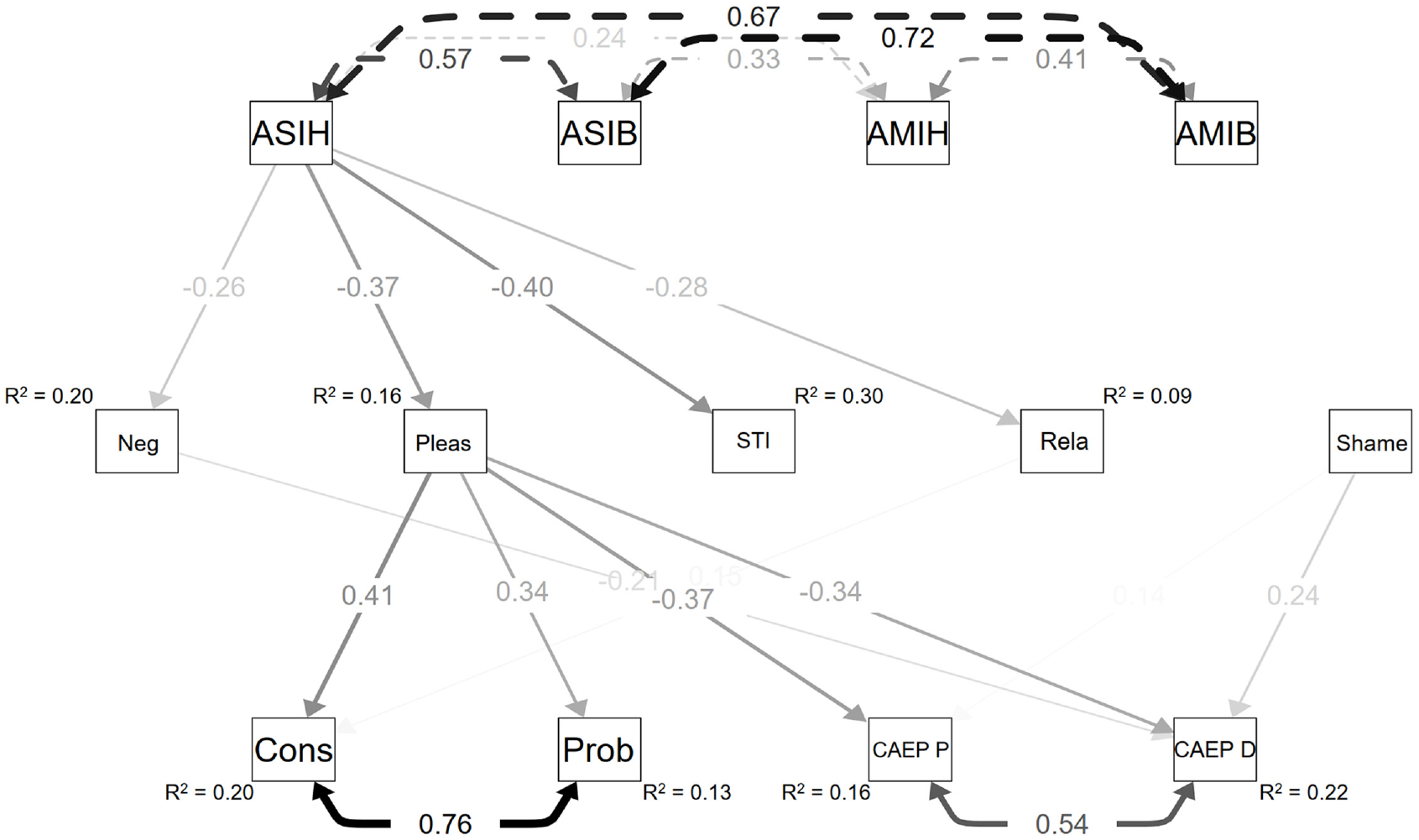
Path diagram with the standardized weight of the final model.
Discussion
Notably, attitude is essential in condom use. However, what predicts these attitudes are not entirely clear. The present study shows how sexism is associated with attitudes toward condom use. The results showed a clear trend. On the one hand, sexism does not seem to affect either attitude toward condom use or condom use itself. On the other hand, only hostile sexism toward women seems to predict attitudes toward the stigma associated with condom use in men, the sexual pleasure associated with condom use, reliability and efficacy of condoms, and negotiation of use. This would be related to both consistent use and the likelihood of future use, including erection problems associated with condom use.
First, in an exploratory fashion, we calculated two correlation matrices (one for men and one for women), where we observed a greater magnitude of correlation for men in general. Whether significant or not, in women, all the relationships between sexism and attitudes toward condom use or condom-related variables were low, except for attitudes and stigma associated with condom users, where in some cases, they were moderate. Other recent studies (Ertl et al., 2022; Ramiro-Sánchez et al., 2018) also found a weak association between sexism and condom use in women. Therefore, if the goal of interventions is exclusively to reduce risky sexual behaviors, it does not seem clear that an intervention aimed at reducing sexism in women will improve this aspect (Haberland & Rogow, 2015; Ubillos-Landa et al., 2021). Therefore, the effect of sexism on condom use in women, which has been supported by different hypotheses, such as adherence to traditional gender roles, would give less power to the couple’s relationship. Thus, better self-efficacy in condom use (Fitz & Zucker, 2015; Seabrook et al., 2017) or the effect of everyday experiences of sexism (Teti et al., 2010) would need more research to clarify. Previous studies (Plaza-Vidal et al., 2021) have shown that men have more positive attitudes toward condom reliability and effectiveness and less embarrassment about negotiation, but more negative attitudes toward stigma than women. It appears that the male lead attitude is maintained in condom use behavior.
This study explored the relationship between sexism and some variables related to condom use, including attitudes toward condom use, one of the best predictors of condom use (D. Albarracin et al., 2001). Additionally, because the population we had to focus on was men, we attempted to find a predictive model in which sexism is one of the antecedents of negative attitudes toward condom use. Notably, hostile sexism toward women is the only predictor strong enough to hold up in the model. This is related to four of the five attitudes toward condom use. For instance, the more hostile sexism toward women, the more negative the attitudes toward (1) condom negotiation; (2) sexual pleasure associated with condom use; (3) stigma associated with condom users; and (4) condoms as a reliable method of protection. Of these four attitudes, only sexual pleasure associated with condom use was a significant predictor of the four dependent variables (consistent condom use, likelihood of use, and the two variants of CAEP). Therefore, and in line with previous research (Haberland & Rogow, 2015; Ubillos-Landa et al., 2021), sexism may be one component that, when addressed in condom promotion programs, can lead to a reduction in risky sexual behavior. Thus, interventions should focus on men, hostile sexism toward women, and addressing condom use as a constraint on sexual pleasure, at least to impact both the likelihood and consistent use of condoms and the impact of condoms on erection. This idea is associated with evidence from sexual health promotion programs. Specifically, sexual pleasure is one of the most critical components of these interventions as it constitutes a key sexual motivator (Cecil et al., 2010; Crosby et al., 2010; Ford et al., 2021, 2019; Gruskin et al., 2019; Singh et al., 2021) that is also related to CAEP (Plaza-Vidal et al., 2021). In particular, CAEP can be modified into interventions to improve sexual health (Anstee et al., 2019; Baldwin et al., 2019; Graham et al., 2006; Mallett & Fraser, 2020).
From a socio-anthropological point of view, Colombians are diverse due to the variety of geographical, climatic and cultural factors in which they live. It is the Catholic religious component that influences the Colombian people as a unifying cultural factor of this diversity (Díaz, 2012).Thus, there is still the assignment of people, especially the elderly and less educated, to traditional gender roles and the display of sexist attitudes, which, although they have decreased in the last 20 years, are still considerably high compared to other first world countries (Glick et al., 2000; Martínez-Baquero & Vallejo-Medina, 2024). These rules of interaction between men and women remain in the cultural patterns of the majority population and are transmitted to children from a very early age through the stereotyped sexual models that are socialized (Caricote, 2006). Studies on the characteristics of gender roles in Colombia have been quite limited to the study of political violence in the country and in specific groups (Saldarriaga et al., 2021), and previous studies relating sexism and sexual behavior variables, such as condom use, were not identified in our review, so there are no results with which to contrast our findings.
In Colombia, previous research has shown moderate and low levels of knowledge regarding condom use due to the lack of a public policy on adolescent sexual health in schools (Sánchez-Mendoza et al., 2022). However, in Colombia there are different programs for the prevention of risky behaviors and the promotion of condom use, following the approach of the United Nations, Profamilia, the red Somos, the National Program of Education for Sexuality and the Construction of Citizenship (Ministry of National Education), or COMPAS (Gómez-Lugo et al., 2022) among others, as well as specific actions in different cities and educational scenarios at the secondary and university levels, which in different ways seek to reduce the risks in the sexual behavior of young people. These programs use a variety of activities, such as workshops, diversity fairs, group and individual interventions, street activities, etc. (Cristancho, 2020), although the impact on increasing condom use and changing sexual risk behaviors has not been systematically studied. In addition, young people express little satisfaction with the sex education provided in schools, which for them is reduced to the prevention of early pregnancy and sexually transmitted diseases, leaving aside other important issues that are part of the integrity of a healthy sexuality (Leiva & Medina, 2022). Therefore, previous analyses emphasize the need to include in sex education programs topics related to sexual identity, expression and orientation, as well as consent to sexual relations at appropriate ages, free from social pressure and violence, taking into account the self-efficacy, reliability, effectiveness and refusal of condom use (Aguirre & Restrepo, 2022; Plaza-Vidal et al., 2021; Sánchez-Mendoza et al., 2020).
This study has several limitations. First, the fact that the instruments are applied online reduces the probability that young people who do not have access to the Internet will be able to answer the study, considering that Colombia is a country where many places are without good Internet connections. Second, the number of questions in the study, which can be extensive for the participants, means that many who wish to participate do not complete all the questions. Third, possibly, many of the participants’ real beliefs do not correspond to what is socially desirable, and many conceal their fundamental attitudes toward men and women. The results are consistent with previous studies that underline the determinant role of attitudes on the consistency and probability of condom use and how variables related to gender roles are essential in their prediction. Similarly, sexist attitudes are also associated with experiences of this type. Thus, it is possible to continue including studies on sexual behavior and variables related to prejudice, gender roles, and sexism. This is because they could complement understanding the factors that influence and explain risk behaviors. Therefore, prevention programs on risky sexual behaviors should consider the inclusion of aspects related to gender roles.
Footnotes
Authors Contributions
Both authors did equal contributions to the conception and design, acquisition of data, analysis, and interpretation of data, and drafting and revising of the content of the article.
Declaration of Conflicting Interests
The author(s) declared no potential conflicts of interest with respect to the research, authorship, and/or publication of this article.
Funding
The author(s) received no financial support for the research, authorship, and/or publication of this article.
Ethical Approval
This study was approved by the Institutional Ethics Committee of Fundacion Universitaria Konrad Lorenz (March 13, 2020. We don’t have a committee approval number). We used informed consent for human participants. This study complying with national and international ethical standards for research with individuals.
