




Abstract
Public open space is an essential component of support for active ageing in place, whilst in a high-density, high-rise housing context, it plays a more crucial role. The public health field has provided much research on the association between public open spaces and active ageing. However, changes to public open spaces during the Covid-19 crisis, including movement restriction, lockdown, social distancing and isolation, have a severe impact on the quality of life among the older group. This study examined the quality of life among older people living in densely populated districts during the COVID-19 pandemic by evaluating how changes to public open spaces due to pandemic prevention impeded active ageing, and further explored pandemic-resilient urban strategies. Macau, a densely populated ageing city, was selected for case study. Forty-five in-depth interviews were conducted in two high-density districts of Macau with the aim of understanding the perceptions and uses of public open spaces among older people during pandemic conditions. The results indicate that the active ageing process has been impacted to a large degree by prevention measures, particularly in regard to movement and accessibility, everyday activities, social interaction, and emotional health. It is difficult for denser urban spaces to effectively guarantee an active life for older people during the emergent crisis. However, older people’ adaptive responses to pandemic conditions have reduced the negative impact on active ageing. Moreover, the active ageing principle is not applicable to all, since subjective well-being can be perceived and defined differently, and people have unique aging principles as they age. It is important to pay more attention to the well-being of older people by exploring pandemic-resilient strategies which would take into account both the target of active ageing and pandemic prevention.
Plain Language Summary
Purpose: This study examined the quality of life among older people living in densely populated districts during the COVID-19 pandemic by evaluating how changes to public open spaces due to pandemic prevention impeded active ageing, and further explored pandemic-resilient urban strategies. Methods: Macau, a densely populated ageing city, was selected for case study. Forty-five in-depth interviews were conducted in two high-density districts of Macau with the aim of understanding the perceptions and uses of public open spaces among older people during pandemic conditions. Conclusions: The results indicate that the active ageing process has been impacted to a large degree by prevention measures, particularly in regard to movement and accessibility, everyday activities, social interaction, and emotional health. However, older people’ adaptive responses to pandemic conditions have reduced the negative impact on active ageing. Implications: It is difficult for denser urban spaces to effectively guarantee an active life for older people during the emergent crisis. It is important to pay more attention to the well-being of older people by exploring pandemic-resilient strategies which would take into account both the target of active ageing and pandemic prevention. Limitations: Older people who do not often use public spaces were excluded, which may have caused bias in the results.
Keywords
Introduction
Public open space is an essential component of support for active ageing in place, whilst in a high-density, high-rise housing context, it plays a more crucial role, as a compensation for limited private living space. The public health field has provided much research on the association between public open spaces and active ageing, in regard to physical activity, place attachment, social participation and inclusiveness, and emotional and mental health (Barnett et al., 2017; Cerin et al., 2017; Chen et al., 2020; Cherrie et al., 2018; Nutsford et al., 2013; Padrón Nápoles et al., 2020).
Changes to public open spaces during the Covid-19 crisis, including movement restriction, lockdown, social distancing and isolation, have a severe impact on the quality of life among the older group (Armitage & Nellums, 2020; Costa et al., 2021; García-Fernández et al., 2020; Killgore et al., 2020). Denser urban areas such as old high-density inner-cities seem to be more vulnerable during the crisis (Buenaventura et al., 2020; Mouratidis & Yiannakou, 2021). Therefore, older people living in denser urban areas, such as Eastern and Southern Asian cities, seem to be the more vulnerable group whose quality of life can be more likely to be affected.
This study examined the quality of life among older people living in densely populated districts during the COVID-19 pandemic by evaluating how changes to public open spaces due to pandemic prevention impeded active ageing, and further explored pandemic-resilient urban strategies. Macau, a special administrative region (SAR) in China, was selected for case study. Macau is a typical case for its high population density and rapid growth of older population—it is the world’s most densely populated region and ranks fourth where the proportion of the older population will rise the fastest in the next 30 years (UN, 2019). The older population is usually clustered around older, dense districts because of the relatively affordable housing and familiar communities. Public open spaces in these old, dense districts plays an important part in supporting active ageing. However, changes to those public open spaces due to pandemic prevention may have considerable effect on active ageing.
The research question focuses on the perceptions and uses of public open spaces during pandemic among older people living in highly dense districts, in order to understand the challenges that the prevention and control measures pose to active ageing: first, the extent to which prevention measures have affected the perceptions and uses of public open spaces among older people; second, the extent to which the perceptions and uses of public open spaces during pandemic have affected active ageing, and third, what attributes of public open spaces associated with older people’s active ageing are affected and what pandemic-resilient urban strategies could possibly be suggested. While the research acknowledges that the existing literature provides a range of viewpoints on the social behavior of older people in public open spaces, some focusing on high-density districts, the attempts that have evaluated older people’s experience in high-density districts in the special context of pandemic prevention remain scarce. In addition, since the Covid-19 crisis began in early 2020, pandemic-resilient urban planning and management are increasingly explored in response to virus control, social impact mitigation and related adaptation measures (AbouKorin et al., 2021; Afrin et al., 2021; Mouratidis & Yiannakou, 2021), exploring pandemic-resilient urban strategies from a perspective of active ageing for higher-quality higher-density urban living aims to expand the body of knowledge on post-pandemic urban studies.
Active Ageing, Public Open Spaces, and Pandemic
Concept of Active Ageing
The term “active ageing” was articulated in 2002 as a process for achieving “continuing opportunities for health, participation and security in order to enhance quality of life as people age” (WHO, 2002, p. 5). “Active” refers to the continuing ability to participate in social, cultural, economic, spiritual and civic activities (WHO, 2002, p. 6). Active ageing is based on the idea that all people should have equality of opportunity in all aspects of life as they age. The potential to contribute to the social and mental well-being of older people is addressed in addition to physical well-being.
One strand of active ageing studies focuses on physical activities, such as walking, exercise and mobility (Koohsari et al., 2015; Swallow et al., 2018; Van Cauwenberg et al., 2016). The second strand concerns the optimization of opportunities for participation in several domain of life, including mental, social and cultural life (Mendoza-Ruvalcaba & Fernández-Ballesteros, 2016; Plouffe & Kalache, 2010; Temelová & Dvořáková, 2012), while a third strand discusses how to support older people to remain independent and autonomous (Aird & Buys, 2015; Woo et al., 2010). Thus, this research, which focuses on the use of public open spaces in pandemic situations and the challenges this poses to older people’s well-being, contributed to active ageing studies.
Public Open Space and Support for Active Ageing
Public open spaces can be defined as places used mainly for recreation and enjoyment that offer an equal right of access to all, where people from different social groups and ages have opportunities to connect, participate in social activities, and receive social services in an open, democratic, inclusive and unpredictable way (Askari et al., 2014, pp. 93–94; Lamb et al., 2019, p. 68; Low & Smart, 2020, p. 2).
In regard to the benefit of public open spaces, there is evidence showing that the physical settings of neighbourhoods are influential on the walking ability and physical activity of old adults (Barnett et al., 2017; Cerin et al., 2017). In addition, Chen reports that perceived street walkability is associated with an increased level of place attachment, which is in turn beneficial to the emotional health of older people (Chen et al., 2020). Padrón Nápoles reports that bus stops, as interconnected public spaces, have the potential to increase the social inclusion and quality of life of older people (Padrón Nápoles et al., 2020). Moreover, some researchers emphasize the important role of green spaces in enhancing physical health and participation in physical activities among older people (Gong et al., 2014). Some also report that exposure to green spaces is beneficial for the mental health of older people (Nutsford et al., 2013). Cherrie additionally suggests a positive correlation between cognitive ageing and lifetime availability of public parks (Cherrie et al., 2018).
Active ageing envisions social participation and security, while public open spaces are intended to approach that by encouraging diverse physical and social activities, inclusive of all and providing sufficient environmental protection. The question is: what are the underlying attributes of public open spaces that support older people’s health and active ageing process? That is, what attributes can an ideal public open space offer to meet older people’s needs in active ageing. These attributes have to be considered prior to the evaluation of public open spaces in this research. Therefore, a comprehensive literature is studied in order to create a prototype public open space. The prototype depicts an ideal public open space that enhances active ageing. The prototype (Table 1) encompasses four domains—physical setting, movements and accessibility, senses and perceptions, and everyday life—with specific attributes located in each domain. The extent to which these attributes are affected under pandemic controls is worthy of evaluation.
The Prototype Public Open Space That Supports Active Ageing.

The Impact of Pandemic on Public Open Spaces, Well-Being, and Active Ageing
To cope with the spread of Covid-19 pandemic, many public spaces were closed or subject to strict controls to avoid dense public gathering and interaction. The nature of public spaces as a place for social mingling thus changed (Eck et al., 2020, p. 375). Leaving one’s private zone and going out in public was perceived as a burden (Kasinitz, 2020, p. 491). When people try to avoid streets, parks and public transport, the spaces in which people live move away from being cosmopolitan to being more privatized and segregated (Kasinitz, 2020, p. 493). Withdrawal from public, social distancing and isolation become new norms, in a “medicalized” form (Low & Smart, 2020, p. 3).
The new norms of space management can lead to new social inequality and exclusion. For example, a health inequality can be identified with regard to those living in higher-density residential neighbourhoods with limited room for private green spaces and restricted access to public open spaces (Stevens et al., 2021, pp. 2–3). Age inequality can also occur. Older people might be more likely to stay away from public spaces (Honey-Rosés et al., 2020, p. 3). Older people living in higher-density neighbourhoods, where the risk of viral transmission is understood to be higher, may feel more resistant to public exposure. Moreover, pandemic controls in public spaces as “a new excuse for surveillance, gating, exclusion, unequal access” may restrict “any chance of imagining a more democratic and socially just future” (Low & Maguire, 2020, p. 309).
Several studies have stated that the social isolation, loneliness and change of everyday routine that pandemic controls entail have a significant impact on mental health and quality of life, as well as physical health, among older people (Armitage & Nellums, 2020; Banerjee, 2020; Berg-Weger & Morley, 2020; Bidzan et al., 2020; Macdonald & Hülür, 2021; Rantanen et al., 2021; Stolz et al., 2021). This research looks further into the association between pandemic and older people’s well-being, focusing specifically on high-density, high-rise urban context.
Methods
Case study strategy was employed. Macau, a high-density ageing city, was selected as a study case. The current proportion of elderly population (≥65 years) in Macau is 12% (DSEC, 2021a). It is predicted that the proportion of old population in Macau will reach 16.0% by 2026, which exceeds the UN’s standard for an aged society (14.0%). By 2036, the predicted proportion will be 19.9%, meaning that Macau will be close to entering a super-aged society (DSEC, 2017). Many older people living in high-density historic areas in Macau spend most of their daily life in the surrounding public spaces (Meng et al., 2020, p. 2). However, the fear of exposure in crowded places and access restrictions to public open spaces due to the Covid-19 crisis have to a large degree reduced their social contact and engagement (Seng et al., 2020). Macau serves as a representative for cities of high proportion of older population and high-density high-rise housing, attempting to clarify to what extent pandemic prevention measures in public open spaces have affected active ageing, and in particular, what attributes of public open spaces that promote active ageing are under threat during the pandemic. Moreover, two urban districts were selected to conduct the data collection—Hak Sa Wan Kap Yau Hon district and San Kiu district. The selection of the two districts was based on the fact that they are both old urban districts with a high proportion of high-rise housing. The two districts also have the highest population density in Macau: both are home to over 120,000 people/km2. The majority of housing was built between the 1980s and 1990s (DSEC, 2021b).
A comprehensive literature review was undertaken in order to identify a list of attributes for an ideal public open space that enhances active ageing (the prototype; Table 1). In-depth interviews were conducted in two high-density districts of Macau with the aim of understanding the perceptions and use of public open spaces among older people during pandemic conditions. The information collected from the interviews was compared with the list of attributes, in order to evaluate what attributes are affected under pandemic controls in public open spaces, and how they are affected.
Potential participants were initially approached in public open spaces (parks, gardens, sidewalk greening, and cafés) in the two selected districts based on a simple random sampling principle. Through pre-interview conversations, potential participants’ basic living situations and outlook on life were ascertained to ensure their suitability for the interview. Those who met the interview criteria were finally selected as participants which included those aged 56 and above, who lived in one of the two sites, had a clear goal to stay as independent and active as possible, and had no communication barriers. The participants were then informed of the research and its significance. Their agreement to participate was ensured before the interviews.
Open-ended questions were employed to guide the interview. Participants were informed that all responses would be anonymously reported and were encouraged to speak openly and honestly. With the consent of participants, the interview was audio taped, then transcribed and reviewed before coding.
Individual interviews lasted between 20 and 50 min. The guideline of interview questions is as follows:
What is your daily life in public open spaces like during the pandemic? Is it different from pre-pandemic (e.g., physical activities, community activities, going to library, clinics and markets)?
Do you find any change in access some public open spaces during the pandemic or any difficulty in movement?
How do you feel about public open spaces during the pandemic (e.g., safe, attractive, pleasant, sense of belonging)?
Do you think control measures in public open spaces have any benefit or limitation to you?
Do you have any suggestion or special need in using public open spaces during the pandemic?
The number of participants was determined by the theoretical saturation of data—a situation where no new information or themes can be found from the data, and thus no more data were needed (Nelson, 2017). We approached participants in public open spaces because we were more likely to meet older people who were more independent and active than in private spaces. However, this was a limitation of the study because older people who do not often use public spaces were excluded, which may have caused bias in the results.
Interview Results
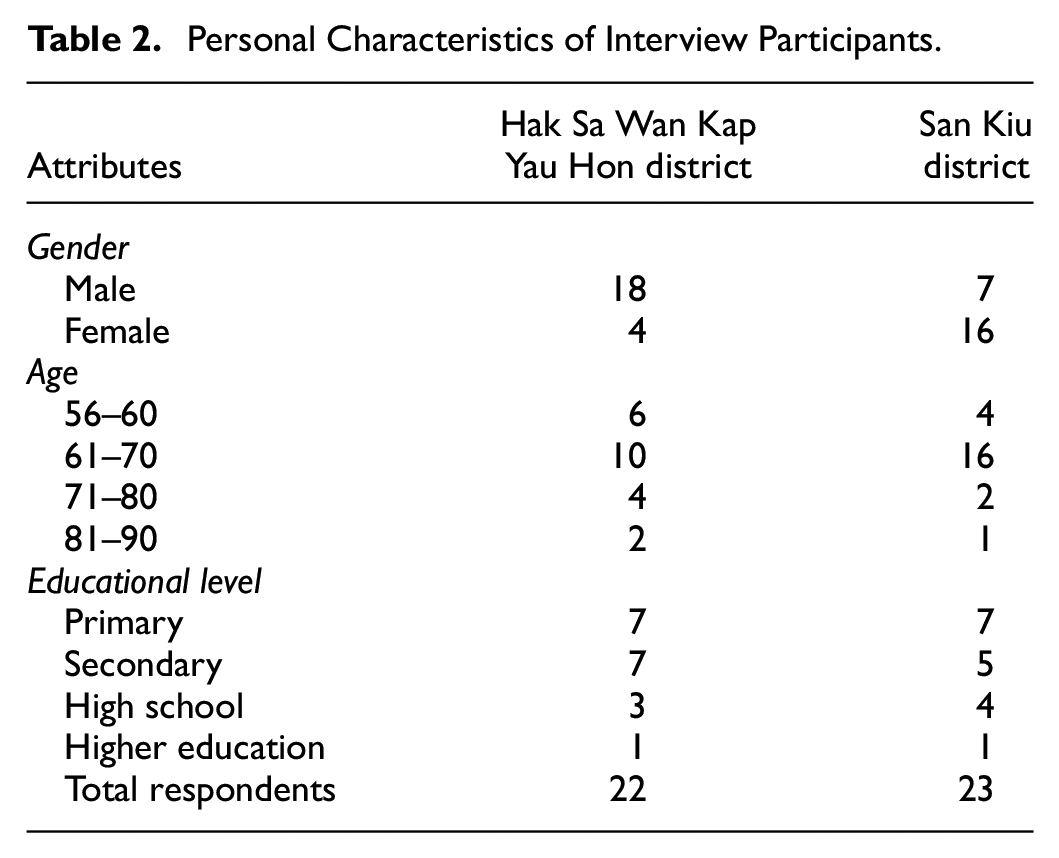
Forty-five interviews were conducted in two districts between September and November 2021, at a time when there was a coronavirus wave in Macau. Several places in and around the two districts were temporarily locked down. Table 2 shows the personal characteristics of the interview participants. Figure 1 shows the weekly hours that participants spent in public open spaces before and during the pandemic. The number of participants who spent less than 1 hr in public open spaces during the pandemic is much greater than that before pandemic.
Personal Characteristics of Interview Participants.

Weekly hours spent in public open spaces before and during pandemic.
The interview transcriptions were imported into NVivo 12. A thematic analysis strategy was adopted, where the data from interviews was coded into pre-established nodes (themes). The nodes were categorized according to the four domains of attributes from the prototype public open space, which was previously identified from the literature (see Table 1). Each node has its corresponding frequency—the number of participants who responded to the node (in the “Files” column) and the number of times the node was responded to (in the “References” column) (see Figure 2).

NVivo coding based on the interview results.
Table 3 illustrates that the responses from the older people for each question asked in the interviews (as shown by the representative statements) match the corresponding attributes of the prototype public open spaces, which was previously identified in Table 1. Six out of 19 from the list of attributes were more concerned with the older people living in the two old and dense urban districts, which means these six attributes were more affected during the pandemic than the remaining 13 attributes.
Representative Statements from the Interviews and the Corresponding Attributes of the Prototype Public Open Spaces.

Bold emphasis indicates that more than 50% of respondents agree on the attribute.
As indicated in Table 3, “physical, recreational, cultural and other living activities” and “social contact, participation and inclusion” were two attributes commented on most often. This reflects the fact that the participants were most concerned with their everyday activities and social network. In relation to occasional lockdown and continued movement restriction in public open spaces, two attributes were commented on by the majority of respondents: “connectivity” and “access to landscapes, parks and natural scenery.” Furthermore, “emotional health” was frequently discussed, as participants often expressed depression or anxiety resulting from social isolation. In addition, older people often commented on “appropriate management and maintenance” of public open spaces, such as access control, controls over gatherings, health code checking and rearrangement of physical settings.
Discussions
Participants expressed strong expectations of a return to their pre-pandemic daily routines. Their complaints focused mostly on social isolation; a reduction in physical, recreational, and social activities; movement restrictions; and emotional health. The specific attributes of each theme, impacted to varying extents, clarifies the ways in which active ageing is hindered by pandemic prevention measures.
The participants’ responses to five open-ended questions are further discussed in the following subsections, and consider specific attributes that may hinder active ageing as well as possible pandemic-resilient urban strategies.
Changes in Daily Activities
In high-population-density cities, personal living space is limited, and public open spaces such as local parks, community centers, café and tea shops are preferred places for exercise, leisure and catching up with friends. During pandemic outbreaks, most of the participants reported a huge reduction in out-of-home activities, because of public space restrictions and a fear of public exposure.
Participant 24: I only go out for daily necessities, because I am afraid of coronavirus…. I engage much less in community activities and meeting friends.
Participant 30: There was no outside activity for me at all in pandemic waves … I even didn’t go to breakfast bars and tea shops.
Older people’s daily routines were partially changed to adapt to pandemic conditions. For example, some had changed outdoor physical exercise to light exercise at home instead; some had changed outdoor social activities to indoor personal activities; some had changed the location of physical and leisure activities from local communities to suburban hills and the seaside further away, in order to avoid crowds of people and access restrictions, and some had changed to nearer places to avoid taking the bus. There is a positive relationship between activity levels and life satisfaction in elderly people, as a person’s self-identity is built through interactions with others and the environment (Diggs, 2008). The participants’ adaptive responses to the pandemic helped to maintain a level of daily activity and interactions, which reduced the psychosocial impact of the pandemic. This sustained active ageing to some extent.
Older people have long-established place attachment. They have a strong preference for ageing in a place of familiarity, in relation to home community and neighbourhood. Several people claimed that they often came to familiar places near home to socialize with familiar friends. It is suggested that older people consider familial relationships as fundamental to ageing well (Carr et al., 2013, p. 2). In older districts there are well-formed social circles, which older people try to maintain. Engaging in familiar activities within their home community and neighbourhood is important for older people in terms of whether they perceive themselves to be active, independent and a valuable part of society. Restrictions on social interaction in community public spaces to some degree endanger the possibilities of active ageing in place.
Changes in Connectivity, Accessibility, and Mobility
Reduction in spatial connectivity and mobility is identified. Connectivity issues were often addressed among participants who had lived near controlled areas, where Covid-19 breakouts had recently been reported. Participants perceived a sense of panic in these areas. They pointed out the necessity of choosing alternative routes to avoid high-risk places, which resulted in an increase in walking distance and time. A fear of public buses was also expressed. This resulted in a change of travel method from public bus to walking. However, walking in public also brought with it concerns about the risk of virus infection, especially in high-density areas with narrow pedestrian spaces and high levels of foot traffic.
Participant 18: It is not convenient that some places I don’t dare to go. Those areas are blocked and of course I have to take a detour.
Participant 23: The frequency of bus-taking is decreased. My family are worried about the risk of taking the bus, so now I always go to work on foot. I can do some exercise from it, but the commuting time is longer than before…
Participant 17: Sidewalks are so narrow and people are too close to each other, so I always bypass crowded areas, and sometimes walk on the vehicle road, which is quite dangerous.
More than half of the participants complained about the difficulty of accessing public spaces like parks and markets because of health code checking. Access to most public spaces has been restricted in Macau unless an electronic green health code can be showed that proves a person has not been to higher-risk places. Health code application is processed through mobile apps which require considerable amounts of personal information. Due to a lack of technical skills on mobile devices and apps, there were difficulties for many older people to apply for a health code independently, which in turn generated accessibility issues.
Participant 16: Park access needs health code. I don’t know how to use those mobile apps. I can only ask my children to apply the health code and save the picture for me, but sometimes I cannot find the picture.
Participant 38: Taking bus also need to show the health code and temperature measurement, which always cause a long queue, I feel very inconvenient.
Access to surrounding environments, especially green spaces, has proven to be beneficial to older people’s psychosocial well-being during the pandemic (Jamaluddin et al., 2022; Luo et al., 2021). Restrictions to public spaces is not helpful for healthy ageing. Moreover, mandatory restrictions on freedom of access and movement have resulted in social isolation, and older people in isolation are more likely to suffer from mental health problems (WHO, 2021).
Accessibility is strongly associated with positive mental and physical health because of its importance in facilitating everyday activities and social engagement (Annear et al., 2014; Feng et al., 2018). Restrictions in the accessibility of public spaces affects not only the ageing population’s everyday routine but also their continuing ability to actively and independently participate in social activities. Public spaces are a source of welfare in urban life, which has to be equally shared by everyone in society regardless of age. Social inequality in elderly people caused by the COVID-19 pandemic has already been identified. For example, one study highlights the substantial reduction in older people’s life-pace mobility, leading to inequality (Perracini et al., 2021), while another study clarifies the disproportionate impact of COVID-19 on older people that creates new and reinforces existing inequality (Buffel et al., 2021). This study established that mobile application-aided prevention measures generated social inequality among older people. Older people should not be discriminated against for technical or other reasons, and consequently have a poorer experience in public spaces.
Senses and Perceptions of Public Open Spaces
Most participants considered that open spaces were pleasant places in which to engage in social life and come into contact with natural landscapes and fresh air, even when there were pandemic controls in place public open spaces. They revealed that engaging in public spaces could relieve stress, increase positive emotions and strengthen resilience in the face of pandemic. But meanwhile, social segregation led to negative emotions. Though a couple of respondents felt more environmental comfort in public spaces because of the reduced numbers of people and greater environmental cleanliness and sanitation, more respondents perceived such spaces as less pleasant due to social distancing controls and fear of public exposure. Older people’s negative feelings about the pleasantness of places are associated with their sense of safety. In densely packed districts, the spaces between buildings are small and narrow. Having a large population sharing limited public open spaces brings more social anxiety about virus transmission.
Participant 20: We felt happier in the park before the pandemic. But now during the pandemic, everyone has some anxieties and feels unhappy … Such an atmosphere does make the park very unpleasant.
Participant 6: I don’t like it when people get too close to me, like when I am talking to him, I asked him to sit at a distance to me. Like those people site around one table, they are too close, I don’t agree with that.
There are differences that can be noted in the emotional reactions to pandemic restrictions among older people. Some participants showed an extremely negative attitude toward social isolation, while some performed more positively—learning to adapt and emerging resilient in the face of the evolving pandemic situation. Such a difference in emotional reaction probably depends on individuals’ environmental adaptability, ability to withstand pressure and psychological resilience. It is argued that psychological resilience is important to cope with pandemic stresses (Vinkers et al., 2020). A higher level of resilience is linked to a lower level of psychological distress during the COVID-19 lockdown (Fernández et al., 2020), while lower psychological resilience often results in negative emotions (Killgore et al., 2020).
Personality is also a factor to different emotional reactions: some older people are naturally more socialized and some like being alone and thus less affected by social isolation. Life status is perhaps another factor related: some people’s emotional well-being was less associated with social involvement than that of most of other participants. Therefore, the well-being of older people cannot always be evaluated under the framework of active ageing. What is advocated in the active ageing discourse is more like “unified normative stereotypes about how individuals are expected to age” in line with state policies (Rozanova, 2010, p. 215). A critical gerontological perspective argues that social gerontology tends to reproduce stereotypes of older people but obscures differences between them (Doheny & Jones, 2021), and suggests that people find their own unique ageing ideology as they age (Moody, 2008).
Benefit and Limitation of Prevention Measures
Several prevention measures related to physical settings and management have been undertaken during the pandemic: access control, social contact restriction and environmental sanitation. Health code checking is one specific technique; others include benches being sealed off, cleaning and disinfection, and an increase in the number of security guards. Although there was dissatisfaction with spatial arrangements and prevention measures, they were widely realized as effective methods to maintain a sense of safety in society. This is because prevention measures ensure and shape people’s protective behaviors which possibly reduces anxiety levels (Lim et al., 2021). Prevention measures were taken as reassurance aids for anxiety relief and norms for reassurance-related behaviors (Kobori & Salkovskis, 2013), so that the participants presented a degree of adaptability to the changed physical settings and had a positive attitude toward their daily activity change.
Participant 37: I feel uncomfortable actually. We old people like chatting together, but we are not allowed to gather … But this is for everyone’s safety, especially for those ones who are weaker … Gathering is not good for pandemic prevention.
Participant 34: Since the pandemic outbreak began, the seats have been sealed to separate people, then more old people are walking around the park instead of seating… It should be a lifestyle change. We get used to the change, and it makes us to do more exercise.
Some participant disclosed that tree canopies were cut down during pandemic outbreak, to prevent people from gathering, and they could not find shaded places to stay comfortably in the park. It is claimed that appropriate arrangement of the physical setting is required to make it comfortable for long-term stay in a high-density, high-rise housing context in hot weather (Peng & Maing, 2021). Well-maintained natural landscapes can offer pleasant places and thus promote physical and social activities.
In addition, older residents have begun to manage their living environments spontaneously in some communities. It is known that older people draw meaning and a sense of security from the place they live in, and community participation is related to higher feelings of security and place attachment (De Donder et al., 2012; Wiles et al., 2009). Older residents know their communities well and already have a well-established sense of attachment. Their participation in community management can further facilitate a sense of security and attachment. The active and productive role of older people also proves one’s social value, which presents a mutually beneficial situation that sustains one’s personal identity and contributes to the public good (van Dyk, 2014).
Social Needs in Using Public Open Spaces During the Pandemic
As participants suggested, having more local community parks of smaller size is better than having one big park shared by a neighbourhood and its surroundings, so that older people can reach the park easily and simultaneously protect themselves from too much contact with the wider public. Considering this suggestion, along with the complaints of narrow sidewalks, easy access to inclusive and well-maintained public open spaces, with a focus on the provision of a wide range of public resources within short distances, could ensure the resilience capacity of older people in facing pandemic crises.
High-quality built environments and good access to social services are key components of community resilience that foster positive health outcomes (Wild et al., 2013, p. 141). A self-sufficient community can be a specific strategy to encourage an active life for older people. The community should contain all the necessary public facilities, including green spaces, healthcare services, and commercial, leisure and social places, within a short walk from home, easily approachable for ageing residents. The community-wide sharing of public resources makes people self-sufficient within the community, while isolated them from the rest of the city. Active ageing in place can be achieved through this strategy by providing daily necessities, facilitating social participation and ensuring mental health. Proximity-centered strategy, such as 15-min city, is often discussed as a post-pandemic planning principle, since local access to a wide range of daily amenities and activities becomes essential for quality of life under pandemic situations (Moreno et al., 2021; Mouratidis & Yiannakou, 2021; Pozoukidou & Chatziyiannaki, 2021). A self-sufficient community makes everything more proximate within a community-range, which could be more applicable for higher-density ageing cities.
Conclusions
Due to the continuing implementation of pandemic prevention measures, older people’s perceptions and uses of public open spaces have changed to a large degree. The major changes involve the reduction in physical, recreational and social activities, movement restrictions and emotional senses. This implies that it is difficult for densely populated urban spaces to effectively guarantee an active life for older people during the emergent crisis of pandemic outbreaks. However, older people’ adaptive responses to pandemic conditions have reduced the negative impact on active ageing. Moreover, the active ageing principle is not applicable to all, since subjective well-being can be perceived and defined differently, and people have unique aging principles as they age.
Ageing well has its own challenges, while the pandemic crisis has created additional obstacles. Ageing cities are currently facing a dual challenge—the pandemic crisis in addition to their ongoing ageing problems. Urban resilience for ageing cities in a post-pandemic context has two dimensions: first, to make urban environmental systems more resilient to cope with virus transmission; and second, to make older people more resilient so that they can adapt to evolving pandemic situations without hindering the active ageing process.
Ageing in place is popular among older people who want to remain in their communities, however, they may face difficulties in accessing necessary resources and social services (Torres, 2018). The pandemic has increased their difficulties and, therefore, threatened ageing in place. Therefore, it is important to pay more attention to the well-being of older people by exploring pandemic-resilient strategies. This would take into account both the target of active ageing and pandemic prevention. In this sense, local authorities have a responsibility to complete a civic survey on the special social needs of older people during pandemic and take that into consideration in urban management and resilient strategies.
China’s recent loosening of key aspects of the zero-COVID-19 strategy has led to continuous outbreaks all over the country, which brings new risks to public health. Public open spaces remain places most likely to be associated with virus transmission. Although major compulsory measures have been abandoned, social isolation remains an essential method to prevent infection. The role that public open spaces play in maintaining and promoting active ageing in the post-pandemic context is still worth highlighting in future studies. The more effective management of higher-density urban spaces that can offer adequate public resources to all ages while guaranteeing public health requires further exploration.
Footnotes
Declaration of Conflicting Interests
The author(s) declared no potential conflicts of interest with respect to the research, authorship, and/or publication of this article.
Funding
The author(s) received no financial support for the research, authorship, and/or publication of this article.

Data Availability Statement
Data sharing not applicable to this article as no datasets were generated or analyzed during the current study.