




Abstract
In recent years, there has been an upswing in the research on cyber incivility and its impact on individuals and organizations. Despite its negative consequences, cyber incivility has become increasingly common in the workplace as an increasing number of employees use technology to communicate. This study investigated the impact of cyber incivility on the service innovation of Jordanian hotel workers and the mediating effects of leadership change. A comprehensive survey involving employees of Jordanian hotels was conducted, and responses were subjected to structural equation modeling analysis using Smart PLS 4.0 software. The analysis reveals that cyber incivility has a significant negative direct impact on service innovation, while transformational leadership demonstrates a positive and significant direct effect on service innovation. Additionally, the mediating role of transformational leadership in the relationship between cyber incivility and service innovation is negative and significant (β = −.171, ρ = 0.000), emphasizing its crucial contribution to mitigating the adverse effects of cyber incivility on service innovation in the hotel industry. These findings have important implications for hotel managers seeking to improve their employees’ service innovation and mitigate the negative effects of cyber incivility.
Plain Language Summary
In this study, we looked at how cyber incivility affects the ability of employees in Jordanian hotels to come up with new ideas for better service innovation. We found that when people experience cyber incivility, it makes it harder for them to think of new ways to improve service. However, we also found that having a good leader who inspires and motivates employees (transformational leadership) can help counteract the negative effects of cyber incivility. This means that good leadership is really important for making sure that cyber rudeness doesn’t hurt the ability of hotel employees to come up with innovative ways to serve customers better. Hotel managers should pay attention to this and make sure they have strong leadership in place to support their employees.
Introduction
The context of social interaction in the workplace has changed intensely over time from an era dominated by face-to-face interactions with the organizational community where technology-mediated interactions ruled. Instead, with our changing circumstances and the context of workplace communication, there is limited knowledge about how individuals communicate through messages. This leads to the changing behavior of individuals toward their work and misleading them from their company. Cyber incivility is an emerging field of misbehavior in the workplace (V. K. G. Lim & Teo, 2009). Cyber incivility includes the behavior of individuals through email that the recipient perceives as insensitive, disrespectful, and a violation of standards for mutual respect within an organization (Porath & Erez, 2007). Cyber incivility includes an anti-social behavior that violates social norms and injures others (Cortina, 2008). This rude behavior was perceived to be offensive by the target before the conceptualization of incivility (S. Lim & Cortina, 2005). At the end of the workday, workers who bear cyber incivility report higher distress, leading to distress the following day (Park et al., 2018). Cyber incivility leads to stress, increased workloads, and high blood pressure in individuals with computer workloads and tends to cause adverse effects that become insidious and powerful (Krishnan, 2016). Thus, it is evident that cyber incivility threatens the well-being of an organization and poses serious consequences. Cyber incivility leads to a decline in service innovation, which is improving the services of companies for their customers. As cyber incivility increases, customer satisfaction for company goods also decreases. All these factors may be due to leadership effects because there is stress on workers from their leaders that would lead to increased cyber incivility (Williams & Loughlin, 2016). Service innovation is a process of problem identification followed by the generation of ideas and their implementation (Scott & Bruce, 1994).
Transformational leadership is essential to promoting organizational innovation to enhance service innovations (Basu & Green, 1997). Transformational leadership is vital in changing and transforming processes by inspiring individuals to grow and develop innovative behavior. Transformational leadership improves organizational innovation through intellectual stimulation by using new perspectives (Megeirhi et al., 2018). Intellectual stimulation increases exploratory thinking and innovative behavior, which insists followers have strong intentions. Transformational leadership should fulfill such intentions (Afsar et al., 2014). Transformational leaders support workers to work on a new perspective, change the current process and system to have long-term benefits and lead to new opportunities. Workers are inspired to show creative ideas and increase their analytical capability in solving problems related to their customers (G. Wang et al., 2011). Instead, transformational leadership has positive and negative impacts on its workers. After all, it can affect the physiological capital of subordinates (C.-H. Wang & Chen, 2020) because it can cause an increase in workload on workers that leads to workers’ stress, the disrespect that ultimately leads to generating cyber incivility.
Cyber incivility is directly related to service innovations and transformational leadership because it leads to changes in the behavior of individuals and the customers’ perspectives toward the organization (Yagil, 2021). Individuals under transformed leaders may be involved in emotional labor in the reaction of leader behavior by preventing negative emotions like anger, fear, obstruction, and rudeness that change their work perspectives because a leader’s behavior in the workplace has various effects on a person’s physiological state that make them mentally disturbed. This results in lower job satisfaction and reduces mental and physical health due to increased job stress and turnover of individuals’ intentions (Cortina, 2008). Cyber incivility in consequence of workplace tends to decrease the level of relationships of workers with their workers and supervisors as well as a lower level of productivity and commitment in employees, which tends to reduce the innovative services as the workers are not satisfied with their leaders and organizations (S. Lim et al., 2008). In contrast, rudeness in emails leads to lower mental health and low commitment to leaders, which tend to decrease the leadership benefits for the organization (Bentley et al., 2012).
Salman Chughtai and Ali Shah (2020) noted the financial, physiological, social, and economic effects of cyber incivility on the organization and its employees. The negative impact of cyber incivility in various fields, including the tourism and hospitality industry, increases the need to address its stress on organizational value (C.-H. Wang & Chen, 2020). Instead, transformational and authentic leadership is inversely related to adverse impacts of workplace behaviors such as cyber incivility (B. George et al., 2007) because it can act as a pillar for the success of the organizations by motivating employees (Mukwevho et al., 2020) making them able to develop their and organizational performance and enhance the person’s ability to face various challenges (Salama, 2021). Contrastingly, some studies reported that transformational leadership and cyber incivility are linked together to form positive interactions that lead to improving the innovative capability of the employees because if there is positive leadership, the organization’s culture supports values and behavior and enhances employees’ attitudes toward their work and vice versa (Tichaawa, 2017). Organizations having strong leadership have good relations with managers and subordinates, which leads to a pleasant environment in the organization to achieve goals, develop performance and strive for stress.
In recent years, scholars have paid increasing attention to the digital world’s dark side, such as cyber incivility, cyberbullying, and cyber aggression (Kowalski & Robbins, 2022; Madan, 2014; Ophoff et al., 2015). However, studies on how cyber incivility affects innovation in hotels are scant. This is a surprising research gap, given the ubiquity of digital platforms and tools in public organizations and the growing body of evidence on the harmful effects of online incivility on organizational performance. Only a few studies have examined the relationship between cyber incivility and creativity. Furthermore, the existing studies are mostly correlational, leaving room for interpretation about the direction of the relationship between cyber incivility and creativity. There is a lack of empirical studies on how cyber incivility affects service innovation in public organizations. Therefore, this study was designed to evaluate the direct impact of cyber incivility on counter-workplace employees’ and its indirect impact via transformational leadership. We used a questionnaire-based survey with participants selected based on strict inclusion criteria. The items were developed based on semi-structured interviews with top management experts in Jordanian hotels and the literature review. The survey included items related to cyber incivility, service innovation, and transformational leadership, as well as demographic information.
Literature Review
Service Innovation in Organizations
Service innovation involves generating, promoting, and implementing modern service schemes to heighten the competitive advantage in service industries (Yang et al., 2021). It has progressively become a vector of sustainable growth and competitive advantage at firms, industry, and economy levels (Randhawa & Scerri, 2015). Organizations employ it to protect & expand market share. Moreover, consistent and well-organized service innovation is the only sustainable solution because copyrights or patents do not cover new service ideas and delivery designs. It advances operational efficiency, increases staff skills, and marketplace recognition of organizations. It is implemented by altering the service, delivery process, and organizational and managerial structure. Moreover, to lead the market, being proactive in defining good service attributes is the prerequisite for organizations, accomplished through utilizing specialized expertise, technological changes, faster response time, and emerging customer needs (Scisco et al., 2019). Service innovation encompasses a range of strategies, including product use enhancements, customer support, and information and education. Several companies have effectively employed service innovation to develop alternative customer-centric services, such as Uber, Zipcar, and Airbnb in the transportation and hospitality sectors, AngelList in venture capital, and Castlight Health and Healthgrades in healthcare (D’Emidio et al., 2015). It is becoming increasingly important in Jordanian organizations as they seek to remain competitive in the global market. The impact of service innovation practices on organizational performance has been studied extensively in Jordan. Several studies have documented the positive impact of service innovation on organizational performance in the technology sector. Moreover, innovation adoption within an organization is critical to enhancing electronic tax filing services in the country, while a learning culture and transfer climate can lead to greater perceived innovation within Jordanian organizations (AbuAkel & Ibrahim, 2022; Aladwan & Alshami, 2021).
Technology and Workplace Cyber Incivility
The utilization and dependence on technology by organizations have risen significantly in recent times (Ophoff et al., 2015). The adoption of digital tools and platforms has made it possible for employees to work remotely from anywhere, increasing flexibility and promoting work-life balance. Employers have also benefited from improved productivity and cost savings in terms of office space and equipment (Ferreira et al., 2020). Organizations prefer and widely use emails and business-related electronic messages for communication and information exchange to facilitate organizational coordination and productivity. Daily, billions of official emails are received and sent worldwide. Over half of the world population used digital communication channels such as emails in 2020 due to the COVID-19 pandemic onset. Additionally, employees have to spend around 28% of their working hours dealing with electronic messages-related issues (Aljawarneh et al., 2022). Electronic communication systems have diminished physical interactional constraints increasing organizational vertical and horizontal communication (Yuin, 2006).
However, cyberspace has a negative side; email communication can be an advantage in disguise. Indeed, the increased reliance on email communications at work allows employees to engage in electronic aggression through workplace cyber incivility (Ophoff et al., 2015). It is defined as “communicative behavior exhibited in computer-mediated interactions that violate workplace norms of mutual respect” (V. K. G. Lim & Teo, 2009). The widespread use of email communication creates an opportunity for individuals to engage in electronic aggression through workplace cyber incivility, which can violate workplace norms of mutual respect (Krishnan, 2016; V. K. G. Lim & Teo, 2009). Studies found that workspace incivility via email is four times more prevalent than in-person communication, and an upward trend in its occurrences was reported worldwide (Yuin, 2006). This is because individuals cannot obtain feedback or seek immediate clarification in negative online interactions via emails since the senders and recipients may be separated geographically (Brynjolfsson et al., 2020). Technology-mediated communications have less capacity to observe facial expressions and body language than face-to-face communication (Kock, 2005). Targets of cyber incivilities more conceivably interpret even benign words as offensive because technology-mediated communication is relatively ambiguous and duller in emotional tone. Moreover, greater anonymity and lack of supervision ingrained in cyber communications encourage frequent and severe incivilities, provoking dreadful emotional responses (Niven et al., 2021).
Likewise, cyber incivility substantially affects employees and their well-being (Ophoff et al., 2015). Over time, the increased prevalence of emails and persistent exposure to uncivil cyber acts become detrimental to employees. For instance, its exposure in the recent past amalgamated job dissatisfaction, psychological distress, job withdrawal, and a daily increase in the experience of fear, anger, and sadness (Niven et al., 2021). It also increases turnover intentions and decreases organizational commitment, impairs performance, creativity, and innovation, and creates a toxic work environment (V. K. G. Lim & Teo, 2009). Moreover, research suggests that employees who experience multiple forms of mistreatment, such as both workplace aggression and cyber incivility, are likely to experience even stronger negative effects on their well-being and job outcomes (Park et al., 2018). Organizations should address these issues by implementing policies and procedures that promote a respectful and supportive workplace culture and providing employees with resources to address cyber incivility.
The Negative Impacts of Cyber Incivility
Cyber incivility harms the work environment and employee productivity (Workman, 2015). It negatively affects employees’ work attitudes and perceptions of their superiors. Specifically, two forms of behaviors linked with cyber incivility include (1) active cyber incivility, that is, uncivil email behaviors directly and openly targeting victims (making sarcastic, demeaning, and hurtful remarks) and (2) passive cyber incivility, that is, uncivil behaviors displaying through indirect manners such as procrastination and ignorance (e.g., ignoring requests made through emails, not replying to emails at all) (V. K. G. Lim & Teo, 2009). Although having milder intensity than aggression and physical violence, cyber incivility violates norms for mutual respect through interpersonal mistreatment. The emails facilitated fast-paced interactions feed incivility as people “do not have time to be ‘nice’ and impersonal contact mode do not require interaction courtesies”; becoming a significant source of stress and anxiety that negatively affects employees emotionally and physically (Ballon et al., 2018). Further, cyber incivility affects their lives in different ways, such as work performance, innovative work behavior, efficiency, and family life leading to a high psychological burden. Mentally strong employees dare to rise against these challenges, while others cannot and try to escape these challenges by resigning to endorse workplace cyber incivility (Samma et al., 2020).
Furthermore, cyber incivility results in psychological distress, revenge, lower motivation, job satisfaction, and organizational commitment (Ballon et al., 2018). Employees report higher physical distress on workdays when they experience cyber incivility, which is associated with higher distress the following day. Conversely, in the workday evenings, psychological detachment from work weakens the lagged relationships between the workday end and the subsequent morning distress (Park et al., 2018).
Transformational Leadership and Cyber Incivility
Cyber incivility experiences not only affect employees directly but also have negative impacts on organizations (Yuin, 2006). The extent of its prevalence in the workplace entails costs for organizations. Further, if an organization wants to be innovative, it must encourage and facilitate employees to be creative because individual creativity leads an organizational success. Organizational leadership is responsible for engaging employees in cognitively complex tasks and designing strategies that create an effective working environment to motivate subordinates (Li et al., 2019). Therefore, transformational leadership has become the need of the hour. Its definition comprises four major components: individualized consideration (support employees), intellectual stimulation (encouraging employees to think positively about problems), inspirational motivation (develop and communicate an organizational vision), and idealized influence (charisma; enact behaviors’ ideal’ to organizational functioning as a role model) (Arnold & Walsh, 2015). It is associated with more positive consequences than other leadership styles, such as transactional (monitor actions of employees and their performance goals attainment), laissez-faire (avoid engagement in leadership-like activity), and reduction in workplace deviance (Astrauskaite et al., 2015). A study involving 147 participants working in 35 different work teams compared the relationship between transformational leadership and other important leadership styles such as democratic versus autocratic or relations-and task-oriented leadership. The findings showed that transformational leadership is highly correlated with other important leadership styles as it has a greater effect on these outcomes. The study also found that relations-oriented and task-oriented leadership were the most frequently used styles by supervisors, followed by democratic leadership and then transformational leadership. Autocratic leadership and contingent reward were the least frequently used styles (Molero et al., 2007).
Work environments and managerial leadership styles are critical factors in preventing cyber incivility. Organizations that offer higher support to employees experience less in-person or cyber incivility (Miner et al., 2012). Moreover, constructive leadership styles are associated with lower workplace face-to-face or cyber incivility as they can prove an effective approach to addressing cyber incivility (Lee & Jensen, 2014). A transformational leader with higher inspirational motivation encourages employees to view their cyber incivility experiences as contributions to a greater goal aligned with a compelling vision. In contrast, employees without a transformational leader have a different motivational level, affecting their primary appraisal process (Arnold & Walsh, 2015). Cyber incivility by leadership is positively related to burnout, absenteeism, and turnover intentions, highlighting the need for organizations to address these issues by implementing policies and procedures that promote a respectful and supportive workplace culture, as well as providing employees with resources and support to address workplace cyber incivility (Giumetti et al., 2012; Ophoff et al., 2015).
Transformational Leadership and Service Innovation
Besides, among many attractive positive dimensions of transformational leadership, intellectual stimulation enables employees to mitigate the challenges of cyber incivility by developing creative coping strategies, such as problems-focused coping processes, and converting the cyber incivility experience into an opportunity for skills improvement. They encourage employees to “think outside the box” and adopt creative ways to lessen its adverse impacts, such as facilitating coping through supportive team structures. The problem-solving skills enhancement further improves employees’ self-efficacy in handling cyber incivility. Transformational leaders invigorate emotion-focused coping while providing a “shoulder to cry on” when subordinate feels overwhelmed at the hands of cyber incivility. Similarly, through the individual consideration ingredient of transformational leadership, leaders exhibit supportive behaviors toward employees, for instance, by considering individual needs while making organizational decisions (Arnold & Loughlin, 2010). Employees having such support from their leaders; build affection with their leaders and comfortably discuss how cyber incivility impacts them. Individual consideration permits employees to adopt emotion-focused coping styles because they are backed by organizational support in the shape of a transformational leader who has the potential to buff adverse consequences for employees, like decreasing feelings of depression, alienation, perceptions of stress, and job strain (Kelloway & Barling, 2010). Transformational leadership also has positive moderating effects, such as moderating the relationship between work commitment and emotional exhaustion (Arnold & Walsh, 2015).
The study highlighted two research hypotheses outlined as under:
Objectives of the Study
Globally, the hotel industries are one of the fastest-growing industries, contributing significantly to the economic growth of a country (Gom et al., 2021). The aggravated usage of cyber communications in contemporary workplaces, including hotel industries, made the pervasiveness of cyber incivility occurrences (Krishnan, 2016). Therefore, cyber incivility is the central focus of the current study in an innovative service environment, dealing with interactions and communication mediums among employees from peer to peer or superior to assistant. Moreover, many workers face cyber incivility at their workplace but do not disclose their worries due to fear of being discriminated against. This affects their work efficiency, reducing their interest in work and organization. Their work performance is also undermined, creating a toxic workplace environment among co-workers. Therefore, the intervening role of transformational leadership will also investigate how transformational leadership effectively curbs cyber incivility in the service innovation environment. Finally, this research is an effort to be helpful for entrepreneurs to decrease cyber incivility and achieve purposes of service innovations.
Methods
Participants
The institutional review board, reviewed and approved the current study. There are many different ways to select survey participants, each with its advantages and disadvantages. One technique often used is purposive sampling because it allows researchers to select a specific type of person they want to include in their study. It can be a more efficient way to select participants since the researcher does not have to sift through a large pool of potential respondents. Finally, purposive sampling can help ensure that the survey participants are representative of the population of interest (Ames et al., 2019; Rai & Thapa, 2015). Despite the usefulness of the purposive sampling method, it also comes with certain limitations. For example, it takes longer to recruit participants using purposive sampling than probability methods like simple randomization because researchers actively seek out individuals who meet specific criteria instead of randomly assigning them from a larger pool (Etikan et al., 2016). To avoid such limitations, we explicitly followed strict inclusion and exclusion criteria for selecting the participants. Participants were identified as employees of 4 and 5-star Jordanian hotels through personal contacts and their social media profiles (Twitter, LinkedIn). The participants were selected based on strict inclusion criteria, which stated that each participant must have at least 3 years of experience in hotel management and hospitality, be part of the hotel’s administrative setup, and be actively involved in decision-making. However, participant selection was eased out for the ethnicity and origin of the participants. This diversity of respondents strengthened the richness of the collected data.
Instruments
Initially, semi-structured interviews were performed involving 15 experts from the top management of Jordan hotels to assess their first-hand experiences and perspectives on cyber incivility within their workplaces. Through in-depth conversations, the experts shared instances of specific behaviors, dynamics, and leadership challenges related to cyber incivility. The thematic content analysis of these interviews yielded a rich set of attributes that were essential in crafting the questionnaire items for the cyber incivility variable. The attributes for cyber incivility were derived from the interview data and available literature, whereas attributes for transformational leadership and service innovation were sourced and validated from established instruments in the literature, including the Multifactor Leadership Questionnaire (MLQ) for transformational leadership and a survey instrument developed by Škerlavaj et al. (2010) for service innovation. Ultimately, a questionnaire comprising 14 attributes for cyber incivility, 9 for service innovation, and 6 for transformational leadership was developed. The questionnaire encompassed four axes: the first gathered demographic data, including age, social gender, educational attainment, scientific title, and years of service, while the subsequent axes included items related to each tested variable (Table 1).
Tested Variables and Their Respective Items Listed in the Questionnaire Survey.

Cyber Incivility
For the measure of cyber incivility, participants were first given a list of possible behaviors that define the experience of incivility, such as being condescending, making demeaning remarks, ignoring someone, doubting someone’s judgment, or spreading rumors (Cortina et al., 2001). Then, participants read a definition, “The following questions are about being the victim of cyber incivility at work. When we say cyber incivility, we mean incivility that takes place through email, instant messaging, in a chat room, on a website, or through a text message sent to a cell phone.” After reading the definition, participants indicated how often they experienced cyber incivility through different media at the workplace using a 5-point Likert-type scale ranging from 1 (never) to 5 (several times per day). The participants were asked 14 questions related to cyber incivility to be assessed by the participants (Table 1).
Transformational Leadership
This variable was based on the multifactor leadership questionnaire (MLQ) developed by (B. M. Bass & Avolio, 1995) (Form 5X). Participants were asked to indicate the extent to which they agreed with three statements using a 5-point Likert scale ranging from 1 (strongly disagree) to 5 (strongly agree).
The multifactor leadership questionnaire is a well-known instrument for measuring the transformational leadership, given its extensive research and validation. The MLQ manual by Avolio and Bass demonstrates strong evidence of validity. The MLQ has been used in numerous research programs with positive outcomes for transformational leadership (B. Bass & Avolio, 2004). One of the most common applications of the MLQ is to help organizations select and develop leaders. This is because the MLQ is an instrument that can measure an individual’s transformational leadership capabilities. The MLQ can also be used to assess an individual’s leadership style and identify development areas. The MLQ can also be used to select leaders for special programs or to help identify leaders who are likely to be successful in a particular role (Kilpatrick, 1996; Rowold, 2005). The MLQ consists of 21 items that assess four key elements of leadership that create significant results for followers: (1) idealized influence (ID), (2) inspirational motivation (IM), (3) intellectual stimulation (IS), and (4) individualized consideration (IC) (B. M. Bass & Riggio, 2006).
Service Innovation
To measure the level of service innovation in Jordanian hotels, a survey instrument developed by Škerlavaj et al. (2010) was used, which included nine items indicating the extent of acceptance of novel and innovative ideas (Table 1). The survey instrument was modified to fit the study objectives, taking into account the unique context of Jordanian hotels and their specific characteristics related to service innovation. The modified survey items were designed to assess the hotel’s level of innovation in different areas as a result of transformational leadership. The participants’ responses were assessed on a 5-point Likert-type scale ranging from 1 (strongly disagree) to 5 (strongly agree).
Survey Procedure
A pilot study was conducted with five respondents to validate the survey instrument and identify areas the respondents found challenging to apprehend. Changes were made where necessary to ensure that the survey instrument was clear and suitable for its intended purpose.
Participants were informed via an email invitation about the study’s objectives of the study along with a consent form and a link to the online survey developed by Qualtrics, an online survey platform (Baker, 2013). All participants completed an informed consent form to acknowledge their participation agreement. The survey took approximately 15 to 20 min, and participants were under no time limit while taking the survey. A total of 450 invitations were sent; out of them, 340 responded to the request, whereas 317 finished the study. The response rate was 70.4%, well above the accepted rate of 60% (Kamaruddin et al., 2019). A reminder was sent every 2 week to those participants who did not respond to all the questions completely in time.
Statistical Analysis
The data analysis employed a causal-predictive structural equation modeling (SEM) approach using Smart PLS 4 software (Ringle et al., 2015). Covariance-based SEM (CB-SEM) relies on the ambiguity of item scores (Rigdon et al., 2017). In contrast, PLS-SEM works with fixed latent scores and aims to maximize the prediction of endogenous components rather than focusing solely on model fit (Hair et al., 2019). The reliability and validity of the models were rigorously evaluated through established statistical methods. To gage internal consistency, Cronbach’s alpha (α) values exceeding .70 were employed, ensuring that the items within each construct consistently measured the same underlying concept. Additionally, composite reliability (CR) values greater than 0.70 were utilized to confirm the reliability of the measurement model, indicating the degree to which the observed variables reliably reflected their corresponding latent constructs. For construct validity, the average variance extracted (AVE) was a key metric. AVE values exceeding 0.50 indicated that a substantial proportion of the variance in the construct was captured by its associated indicators. Furthermore, the Fornell–Larcker criterion was applied to assess discriminant validity. This involved comparing the square of each variable’s AVE with the inter-correlations between constructs. The criterion was considered satisfied when the square of each variable’s AVE exceeded its correlations with other constructs (Radomir & Moisescu, 2019).
Results
Demographic Information of the Participants
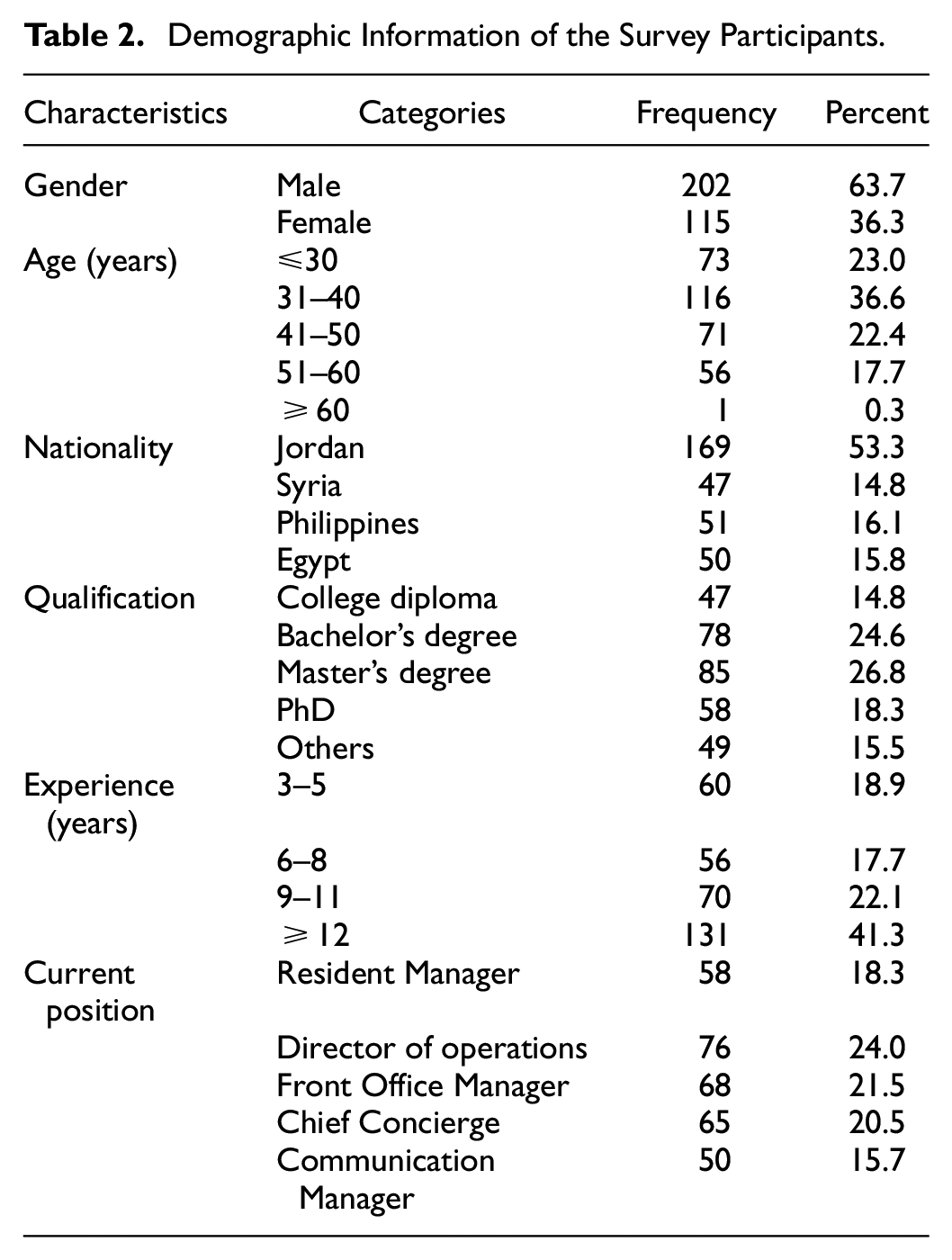
Table 2 illustrates the demographic information of the survey participants. The frequency distribution revealed that 63.7% of participants were male, whereas 36.3% were females. Concerning age, 36.6% of participants were between the ages of 31 and 40, whereas 23.0% were under 30. The survey participants were from mixed nationalities, with 53.3% comprising Jordanians, followed by the Philippines (16.1%) and Egypt (15.8%). Regarding the qualification of the participants, 26.8% had a master’s degree at the time of taking part in the survey, whereas 24.6% of participants held a bachelor’s degree. About 41.3% of the participants had more than 12 years of work experience, followed by 22.1% with experience between 9 and 11 years. Concerning their current position in hotel management, 24.0% of participants were operations directors, followed by front office managers (21.5%).
Demographic Information of the Survey Participants.
Assessment of the Measurement Model
To assess and evaluate the interactive relationships among the model variables, we employed a causal-predictive structural equation modeling (SEM) approach using Smart PLS 4 software. PLS-SEM is particularly advantageous for handling challenging and intricate structural models, including second-order models and small sample sizes, and it is less stringent regarding data normality. In Figure 1, the loadings of items from various scales and R2 for each variable within the inner model are presented. Figure 2 displays the significance levels of each scale item in the outer model, as well as the significance levels of the relationships between the variables within the inner model.

Items loading.

p-Value and R2.
In Figure 1, the outer model loadings predominantly exceeded the 0.7 threshold, and their corresponding p-values played a crucial role in Figure 2. Additionally, Table 3 indicates that Cronbach’s alpha (α) >.70, composite reliability (CR) >.70, and average variance extracted (AVE) >.50, further supporting the reliability of the measurements. Furthermore, Table 4 demonstrates the fulfillment of the Fornell–Larcker criterion, as the square of each variable’s AVE surpasses the inter-correlations.
Convergent Validity of the Tested Variables.

Divergent Validity Based on the Fornell–Larcker Approach.

Table 5 presents the coefficient estimations for the structural model. The observed direct impact of cyber incivility on service innovation is both negative and significant (β = −.641, ρ = 0.00), while the direct effect of transformational leadership on service innovation is positive and significant (β = .272, ρ = 0.00), also, the direct effect of cyber incivility on transformational leadership is negative and significant (β = −.631, ρ = 0.00). Additionally, the mediating impact of transformational leadership on the association between cyber incivility and service innovation is negative and significant (β = −.171, ρ = 0.00). Furthermore, the model’s R2, explaining the variance, is .704, equivalent to 70.4% for service innovation. Falk and Miller (1992) proposed a benchmark for R2 values, suggesting that the lowest recommended level should be .10.
Direct and Interaction Effects.

Note.β = beta value; ρ = ρ-value; T = T-value.
Discussion
The study investigated the relationship between cyber incivility, service innovation, and transformational leadership in Jordanian hotels. The results of the assessment of the measurement model, conducted through a causal-predictive structural equation modeling (SEM) approach using Smart PLS 4 software, provide valuable insights into the interactive relationships among the variables in the study. In contrast to covariance-based SEM, the chosen PLS-SEM approach, known for its flexibility in handling complex structural models and small sample sizes, prioritizes the prediction of endogenous components. The robustness of the model is further examined through the examination of Cronbach’s alpha, composite reliability, and average variance extracted. The Fornell–Larcker criterion is employed to assess discriminant validity, affirming the distinctiveness of each variable by comparing the square of its AVE with inter-correlations. The structural model’s coefficient estimations unravel the direct impacts of cyber incivility and transformational leadership on service innovation. Notably, cyber incivility demonstrates a significant negative effect on service innovation, while transformational leadership exerts a positive and significant influence. Furthermore, the mediating role of transformational leadership in mitigating the impact of cyber incivility on service innovation is explored. The achieved R2 of 70.4% for service innovation, raises important considerations and aligns with established benchmarks. Falk and Miller (1992) suggest a minimum R2 level of .10, prompting a nuanced exploration of the explanatory power of the model.
Megeirhi et al. (2018) found that workplace cyber incivility had a negative impact on service innovation, but this negative effect was reduced by the presence of transformational leadership. The results are supported by the findings of Pearson and Porath (2005) who showed the negative effects of cyber incivility on workplace workers’ attitudes, leading to a decrease in innovative services. This is further concluded by S. Lim and Cortina (2005), who showed cyber incivility decreases organizational satisfaction and commitment and leads to the development of new ideas for innovative services in the workplace. Our findings are also supported by the results of Ali et al. (2017) who studied the relationship between workplace incivility and innovative behavior. Sharifirad (2016) studied the effect of personal cyber incivility on social interactions, hardworking and innovative behavior which affects the behavior of employees. The findings of Jung et al. (2008) identified the effects of cyber incivility on innovative services and employees’ innovative behavior by comparing the effects of transformational leadership and cyber incivility on innovative behavior and learning (Crawford & Sue Strohkirch, 2002). Arici et al. (2020) reported that transformational leadership was associated with reduced workplace incivility, while also noting that it had a positive and mediating effect on service innovation.
The findings of the current study align with previous literature that suggests a significant negative impact of workplace incivility on service innovation. The results also support the findings of V. K. G. Lim and Teo (2009) who developed the cyber incivility scale for employees with an unwanted workload that shows the negative impact of cyber incivility on innovative services. Other studies have also supported the negative impact of workplace incivility on service innovation. For instance, Hur et al. (2016) found that workplace incivility negatively affects employees’ creativity and innovative behavior, which ultimately hinders service innovation. Furthermore, Qin et al. (2020) identified that interpersonal mistreatment and abusive supervision lead to reduced creativity and innovative performance. Similarly, Lan et al. (2020) found that workplace incivility negatively impacts employees’ proactive behavior, which is critical for service innovation. It is important to note that the negative impact of workplace incivility on service innovation is not limited to the hotel industry. Several studies have demonstrated the same negative impact in other industries such as healthcare (Armstrong, 2018), information technology (Prabhu et al., 2023), and manufacturing (Loh & Loi, 2018). Therefore, organizations across different industries need to address workplace incivility and promote a positive work environment that encourages service innovation.
Results of our findings showed that transformational leadership plays a mediating role in promoting innovation and creativity in the workplace. It has been studied that physiological factors play a mediating role in the relationship between transformational leadership and innovative behavior. These results are similar to Jung et al. (2008), who argued that transformational leadership has a positive relationship with group cohesiveness and efficacy. Krishnan (2016) argued that transformational leadership plays a mediating role between the quality of life and work in the workplace that enhances the innovative behavior of the workers. Kahai et al. (2003) also showed that transformational leadership plays a mediating role between innovation and organizational behavior, which matches our findings that transformational leadership plays a mediating role in enhancing the behavior and attitude of workers toward the organization. Cook et al. (2013) showed the direct effect of transformational leadership on innovative services via the cyber incivility that causes social impacts on labor behavior. Chu et al. (2010) argued the emotional link of labor with cyber incivility that links with organizational outcomes, such as a lack of organizational commitment that affects the innovation of services. However, some studies reported the negative impacts of transformational leadership on service innovation. Søndergaard et al. (2007) stated that a leader helps to develop a unique network of knowledge and provides the best coordination and collaboration activities that lead to developing new and innovative ideas but it causes a negative impact on workers by causing work stress and workload on workers. Thus, transformational leadership brings changes in worker behavior and increases cyber incivility that affects service innovation.
Harborne and Johne (2003) mentioned that leadership is one of the most influential factors in encouraging workers’ innovative behavior because leaders introduce new ideas to the organization and support innovative ideas. Still, cyber incivility affects the innovative services of the workplace and leads to decreased job satisfaction. Kahai et al. (2003) concluded that transformational leadership acts as a supportive medium for innovative services that would be affected by cyber incivility that leads to rude email behavior and decreases customer satisfaction with the organization. Reuvers et al. (2008) found a positive relationship between transformational leadership and innovative services. Afsar et al. (2014) were in line with the previous findings that transformational leaders influence the creativity and generation of ideas as well as the implementation of ideas of followers that may affect the innovative behaviors of workers and lead to increased cyber incivility. Goleman et al. (2002) showed that a person bearing incivility has low job satisfaction due to stress from the organization, which affects innovative service behavior. These findings are in line with S. Lim et al. (2008), who stated that a person with cyber incivility merely affects the innovative services that would lead to decreased ideas to develop. Snygans (2019) stated that leadership directly affects workers’ innovative behavior in the workplace and reduces counter-workplace behavior. Jafri and Hafeez (2020) concluded that there is a relationship between cyber incivility and transformational behavior that would lead to affecting innovative services. Tamunomiebi and Ukwuije (2021) revealed that cyber incivility positively affects the innovation behavior of workers in an organization, which is not consistent with the current findings.
Conclusion
In conclusion, this study delved into the pervasive issue of cyber incivility within the rapidly growing hotel industry, specifically focusing on its impact on employees in the context of service innovation. The findings underscore the significant negative association between cyber incivility and service innovation, highlighting the detrimental effects of such uncivil behaviors on the innovative capacities of hotel organizations. On a positive note, the study also illuminates the role of transformational leadership as a mitigating factor, revealing its positive influence on service innovation and its mediating effect in curbing the adverse impact of cyber incivility. However, the study has some implications. The practical implications of this research extend to hotel industry practitioners, emphasizing the importance of fostering a workplace environment that actively discourages cyber incivility. Organizations may benefit from cultivating transformational leadership qualities among their managerial staff, as this study indicates its positive correlation with service innovation. By addressing cyber incivility and promoting transformational leadership, hotels could create a conducive atmosphere for employees to thrive, fostering creativity, and driving service innovation.
For society, this study highlights the broader impact of cyber incivility on the overall well-being of employees and the organizational culture. As hotels play a pivotal role in the global economy, the well-being of their workforce is crucial not only for individual job satisfaction but also for the societal contribution of the industry. Promoting respectful communication and transformational leadership in the workplace contributes to a healthier work environment, influencing societal perceptions of the hotel industry. Finally, for researchers, this research contributes to the existing body of knowledge by shedding light on the specific dynamics of cyber incivility in the hotel industry and its ramifications on service innovation. The study provides a comprehensive understanding of the mediating role of transformational leadership, adding nuance to how leadership styles can influence organizational outcomes.
Building on the insights gained from this study, future research endeavors could explore the effectiveness of interventions designed to reduce cyber incivility and promote transformational leadership in hotel settings. Longitudinal studies could provide a deeper understanding of the evolving dynamics and assess the long-term impact of such interventions. Furthermore, investigating the role of organizational culture and employee training programs in mitigating cyber incivility would contribute to a more holistic understanding of this complex issue. Finally, extending this research to different industries and cultural contexts would provide a broader perspective on the universality of these findings.
Footnotes
Declaration of Conflicting Interests
The author(s) declared no potential conflicts of interest with respect to the research, authorship, and/or publication of this article.
Funding
The author(s) received no financial support for the research, authorship, and/or publication of this article.

Data Availability Statement
All the data collected and analyzed can be made available upon reasonable request to the corresponding author.