




Abstract
China’s energy transition (CET) is a vital foundation and long-term goal for improving sustainable development potential. Exploring development patterns and core driving actors involved in policy discourse (PD) is effective in suggesting future policy directions by finding the universality and specificity of China in the energy transition process. In this study, we examined the change pattern of CET and the change of keywords for actors involved in policy promotion at a macro level. Text data of over 22 years were collected from Chinese online channels with CET as the subject word. A text mining-based network analysis and core-peripheral analysis were performed by building datasets in units of the five-year plan (FYP). Following network analysis, the pattern of PD in CET process indicated a tendency to gradually converge toward diversified participants and global environmental issues. Core-peripheral analysis results revealed that the actors leading the PD changed from the government to the private sector, and the core issue indicated a shift from a domestic energy issue to an international environmental issue. Based on our analysis results, we suggested three dimensions of direction in CET: integration with digital transformation, expansion of the employment ecosystem, and inducement of balanced regional development.
Plain Language Summary
This study explores the discourse surrounding China’s energy transition policy at a macro level, uncovering prevalent patterns and actors within this discourse. - Through an extensive literature review, this study identifies three distinct research spectrums and formulates research questions derived from them. - Employing methodologies such as text mining, network analysis, and core-surrounding analysis, this study analyzes unstructured data. - The analysis results demonstrate a gradual convergence of China’s energy transition, involving diverse stakeholders and global environmental concerns. - Furthermore, the key figures driving discussions on China’s energy transition policy are shifting from governmental entities to the private sector. Notably, the central concern is transitioning domestic energy issues into global energy considerations. - Building upon the findings, this study proposes three pathways for the energy transition process: integration with digital transformation, expansion of the employment ecosystem, and fostering balanced regional development.
Keywords
Introduction
Following the reform and opening-up, China has been implementing energy policies focusing on energy efficiency improvement for approximately 20 years (Guilhot, 2022). This is because economic growth was a vital development goal that surpassed inequality and environmental problems. However, as environmental issues were discussed in earnest in the international diplomatic arena, China revised its energy policy (EP) goals. The direction of the goal was focused on “energy transition (ET)” to reduce fossil fuels and prevent environmental pollution. This shift in the goals has caused considerable ripples in the Chinese economy, society, and industry. Economic development that emphasized qualitative growth rather than quantitative growth was promoted, and the movement for environmental protection and ecological civilization construction began in earnest in each field and class of society. Moreover, the industrial sector participated in energy conversion and environmental protection on the basis of various technological developments and government subsidies. Rapid and simultaneous change was promoted in each field of society.
Notably, the ET should be approached from a long-term perspective. This goal of ET can be achieved only through consensus, concession, and action of society as a whole (Gottschamer & Zhang, 2020). CET should also be understood and promoted in the same context. Because the existing Chinese policies emphasized efficiency, they were advantageous temporally and physically in achieving the objective. Indeed, they have been quite successful. However, policies that require long-term planning and implementation, such as ET, require a different approach from the existing Chinese policies. In other words, even if the efficiency may be slightly lower, policies should be formulated by reflecting the opinions of various members of society, reflecting regional specificities, acknowledging the diversity of stakeholders, and inducing citizens to lead policy implementation (Cherp et al., 2018). Indeed, the process of converging social consensus in this process is difficult. This is because in China, the Communist Party and the government are still spearheading policies, public opinion, education, and social movements across various fields. Nevertheless, since ET is closely related to the total transformation of society’s production and consumption system, long-term and short-term goals should be appropriately distributed with reference to PD, central and local region goals should be specified, and a social practice guideline should be established for government, industry, and civil society.
This study focuses on how China’s energy PD play a role in the ET process in this dimension. CET should be pursued in conjunction with the sustainable economic growth goal, and a major transformation of the social system must occur. In particular, the rapid economic growth that occurred over the past 40 years after reform and opening-up created various economic classes and resulted in the aggravation of inequality among the classes. While the power of national wealth has grown, a robust structure of wealth has not yet been achieved. It is the price of pursuing only efficiency and rapid growth. However, the ET should be different from economic growth policies. This is because emphasizing only efficiency may not necessarily yield good results, and the foundation for future growth may be affected by a poor social system. This is precisely where the ET needs to be made while using PD feedback to revise long-term macro direction and establish short-term detailed strategies.
Importantly, ET should be viewed from a long-term macro perspective in the field of research, just as ET policies are promoted from an integrated perspective. In addition, ET as a long-term macroscopic goal requires social consensus and needs to be reflected in policy by closely examining the feedback from PD. Therefore, this study focuses on PD related to ET. We examine PDs related to ET as a complement to existing studies and analyze patterns, trends, and policy-leading keywords that appear in them. This analysis will provide a good insight into establishing a sustainable ET goal and strategy that reflects the will of the people along with China’s top–down policy.
This study is organized as follows. Section 2 examines recent research trends and summarizes CET policy. Section 3 describes the data and methodology, and Section 4 presents and interprets the analysis results. The last chapter presents policy implications and constructive suggestions for China’s future ET policy based on the analysis results.
Brief of Literature Reviews
Three Spectrum of CET Research
Unlike the intense debates surrounding topics like the validity of the environmental Kuznets curve and the dual effects of FDI on growth and the environment, CET doesn’t generate such fervent discussions. The bulk of earlier research pertains to energy conversion technology, and apart from these technical inquiries, it can be classified into three distinct spectrums. The first spectrum is studies related to CET policy. More specifically, these studies examined the goals, strategies, and characteristics by dividing EP by time period (primarily the five-year plan). Li and Taeihagh (2020) analyzed EP combinations through Chinese policy documents from 1981 to 2020. They confirmed changes in policy intensity, density, and policy tool combinations. In particular, Guilhot (2022) explained three changes in China’s energy policy (CEP) over the past 40 years since 1981: energy efficiency in the early stage, energy security in the medium term, and the current ET with a focus on climate change and low carbon. In addition, a carbon-neutral ET policy facing the post-COVID-19 era was analyzed in the national development plan that began in 2021 (Hepburn et al., 2021). Furthermore, a study analyzing the history of CEP over 60 years was conducted, explaining that CEP passes through six stages (emergence, socialist construction, turbulence, reform, contestation, and transition) (L. Zhang et al., 2017). More specific policy studies can also be found. S. Wu and Han (2022) classified local rural energy policies into five categories and analyzed how the policies developed with the increase in energy conversion intensity. The central inquiry within this field revolves around the inception of CET institutionalization and the resulting effects on policy. Guilhot’s (2022) analysis reveals that EP was aligned with national objectives during the period of reform and opening in 1978. Post the 2000s, there is a diverse array of viewpoints suggesting that the gradual ET took root as China’s economy transitioned from quantitative expansion to qualitative development, concurrently establishing extensive collaborations with the global community (Guilhot, 2022; Hepburn et al., 2021; Li & Taeihagh, 2020; Liu & Hei, 2022).
The second spectrum is studies on the direction of energy conversion. Key keywords such as climate change, carbon neutrality, and environmental protection are mainly established as the direction of ET. Liu and Hei (2022) explained the significance of institutional incentives through quantitative studies for low-carbon ET. ET has emerged as a core strategy in the process of establishing integrated policies related to climate change (J. Wu et al., 2022), and the need to build a low-carbon economic system that considers the economy, society, and environment was emphasized (Shi et al., 2022). This series of measures is ultimately aimed at achieving carbon neutrality, for which China has recently expressed its active will to practice. Furthermore, research has revealed that a strategy should be established according to an integrated carbon neutrality scenario (S. Zhang & Chen, 2022a). Environmental regulations in China positively affect ET (Huang & Zou, 2020), and related infrastructure establishment/development of policy tools/market reform were also analyzed as important influencing factors (C. Chen et al., 2019). In this field, there is a lively discussion on the roadmap to achieve ultimate carbon neutrality in relation to CET. China, which has declared a carbon peak in 2030 and carbon neutrality in 2060, needs a fundamental change in its energy system, and requires 47% to 78% renewable energy supply and 45% to 62% electrification rate (S. Zhang & Chen, 2022b). Ren et al. (2015) argued that shale gas is China’s strong alternative energy for carbon neutrality and ET, requiring government subsidy and reasonable standards. In addition, the CET cost, which is as important as the energy conversion and carbon neutral path, requires about 10.8 trillion dollars, which can reduce carbon by more than 80% over the next 40 years (Qi et al., 2023). Ultimately, China’s carbon neutral roadmap needs to be approached by dividing it into 2060 and after 2060, and it is necessary to establish/evaluate its achievement goals and strategies according to the performance of ET (e.g., solar power generation scale, building electrification rate, renewable energy use rate etc.) (Kong et al., 2023).
The third spectrum is energy conversion analysis research from a multidimensional perspective. Mainly, media data and policy documents were used to analyze CET from the socio-political and socio-technical dimensions. First, Y. Chen and Rowlands (2022) analyzed media discourse related to energy storage during ET. They presented the development path of energy storage and institutional uncertainty. In the socio-technical study related to ET, China’s development stage for new energy vehicles was divided into four levels (the initial pre-development, core technology and market share expending, strengthen, sprint; Z. Wu et al., 2021). Xu (2021) viewed CEP from a socio-technological perspective. He emphasized that the ET requires the co-evolution of social, economic, political, and technological factors. In particular, he stressed that stable energy conversion is possible only by removing social and economic obstacles from a multidimensional perspective. Some studies have been conducted to explore public will by using text data. Through a post by Sina Weibo (blog), Liang et al. (2021) revealed that there was public dissatisfaction with policy design, corruption, cost increase, and safety issues in the ET process. Yu et al. (2020) categorized 10 major indicators in CET process in an analysis using unstructured data. They explained that although nuclear power, particularly in China, is valued as a vital energy source, renewables are the solution to the ultimate ET. In addition, they expressed regret that CET policy did not provide a clear long-term vision and emphasized the need for global energy international cooperation.
In sum, studies on energy conversion in China are actively conducted in various and complex perspectives, themes, and methodologies. Indeed, it is encouraging that various studies are being conducted in consideration of the universality and specificity of China, and it is appropriate to quickly respond to the rapidly changing internal and external political, social, and economic environment. However, along with long-term macro-level policy analysis on CET (representatively Li & Taeihagh, 2020; L. Zhang et al., 2017), PD as a process in which policy spreads to society -> practice -> feedback should be analyzed in the same context. Therefore, in terms of filling the gaps and supplementing the results of existing studies, this study analyzes the long-term patterns and flows of PD related to CET as well as the core keywords that set the stage for the discourse by each period. It is always necessary to adjust the direction of policies reflecting the will of people, and this analysis can be used as the most useful evidence for such direction adjustment.
Brief of CET Policy
The discovery and development of energy resources are influenced by organizations or ideologies that function in society. Therefore, the relationship between energy and society can be comprehensively understood through the overall process of energy development, production, supply, and use (Buttel, 2003). As explained by Guilhot (2022), CEP has undergone the process of energy efficiency–energy security–energy transition. ET is a mechanism implemented within the guidelines of EP, and its importance is increasing more than it was in the past. Accordingly, we searched for energy-related policies in China’s FYPs and summarized their essence.
The first mention of the energy sector in China’s official documents was in 1981 in the 6th Five Year Plan (6th FYP). The next 20 years were a period of energy supply stabilization for economic growth based on China’s reform and opening-up policy. There have been gradual changes in energy use technology, power supply infrastructure, and improvements in energy consumption structures. Since the 2000s, when China’s economic growth entered a full-fledged growth trajectory, China has practically strengthened its strategic awareness of ET. As industrialization and marketization accelerated, strategic measures designed to stabilize energy supply and demand began in earnest. Energy security was highlighted. After the mid-to-late 2000s, measures to improve energy saving and efficiency were prepared by spurring reform of the energy consumption structure as well as the supply system. After the 2010s, specific policies and strategies to replace the fossil fuel-centered energy system with new and renewable energy became activated.
The 10th FYP’s energy development strategy mentions that it is necessary to enhance energy efficiency and increase the usage rate of clean energy. However, stabilizing energy supply and demand in line with the increasing demand for electricity and reducing external dependence was a more important objective. Furthermore, in the 11th FYP, eco-friendly energy measures became concrete. In the 12th FYP, the role of companies and the market was emphasized, such as electricity price adjustment, energy efficiency improvement, and consumption system reform, rather than the government unilaterally leading policies. In the 13th FYP, EP in China reflected global issues and responded to the country’s energy security, clean energy, low carbon, and climate change. In particular, policies were established with the main target of improving the quality and efficiency of energy development. During the 14th FYP period, a strong ET action plan was established for CEP in line with global environmental issues. In particular, huge infrastructure and policy funds are being invested in strict control of fossil fuels and new energy technology, production, provision, and application. A summary of policies related to energy generation for each period is presented in Table 1.
Summary of China’s Energy Generation Strategy by Period.

Source. Author’s summary based on the website of the Ministry of Ecology and Environment of China (https://www.mee.gov.cn/zcwj/).
In sum, CEP specifies concrete goals that can be realized over time and emphasizes the role of various participants in society, especially that of companies and markets. In addition, it promotes an eco-friendly and sustainable development through the discovery of new energy sources and technological development while maintaining energy security. Although this policy summary indicates major changes that represent the government’s position, as mentioned above, to maintain a sustainable ET policy, the PD representing society’s position should play a role in which the direction of policy goals can be constantly modified. In addition, in this process, the pattern of PD and core keywords that play a leading role are revealed because long-term macro-level energy conversion can cause social diffusion and settlement.
Through these previous studies and policy analysis, this thesis proposes the following two research questions. Furthermore, text mining and network analysis using ET PD text data have been used as a search process for these two questions.
RQ 1: How is the pattern of long-term PD changing in CET processes?
RQ 2: What are the core keywords that lead PD for each period in CET processes? What role are they playing?
Data and Methodology
Data
We used the Python algorithm to collect PDs related to CET. The collection period was from 2001 to June 2022, when energy conversion began to appear in the policy document. The collection channels were Baidu, CNKI, and Sina Weibo. These channels are China’s largest portal site, China’s largest academic site, and China’s largest community site, respectively, and provide PDs from a variety of spectra. The main collection keyword was “energy transition,” and documents related to this keyword were collected by year in three channels. In addition, in accordance with China’s FYP, documents were collected in 5-year increments. Accordingly, excluding duplicate documents, 8107, 12227, 14601, 25459, and 18003 documents were obtained during the 10th FYP (2001–2005), 11th FYP (2006–2010), 12th FYP (2011–2015), 13th FYP (2016–2020), and 14th FYP (2021–2022), respectively.
Methodology
Text Mining
Text mining has established itself as a representative field of big data analysis or data science and is contributing to various academic fields by extracting information contained in a language into structured data using computer technology such as machine learning (D. Zhang et al., 2019). In particular, since this technique is useful for identifying long-term pattern changes in large texts, it is currently widely used in the fields of library and information science, political science, sociology, economics, engineering, and medicine (Lu & Park, 2022).
Preprocessing was undertaken to extract useful information from the text data we collected. The text was tokenized to eliminate stop words. Subsequently, stemming and lemmatization of words were performed. Next, the functions and forms of words were clearly classified by performing part-of-speech tagging and morpheme analyzing using a Chinese morpheme analyzer. Accordingly, we extracted 30871, 41007, 48935, 66082, and 52633 words for each period.
For text mining, we extracted two analysis values. One was the TF-IDF value, and the other was the degree centrality value. The former weighs frequency values based on their relative importance (Salton & Buckley, 1988). Through this, the actual importance of words in a document was measured. If a specific word (t) appears f times in a random document (D) out of a total of N documents and the number of documents in which t appears among the N documents is n, TF-IDF is calculated as follows.

The degree centrality value is a measure of how much a specific word is related to other words. It is useful to understand the structural characteristics of words in a network. In this study, it was measured based on the simultaneous occurrence frequency of words at the Window size 5 level. As this value increases, the word has many connections with other words in the data, and it can be seen as a word with a lot of influence. In data with g words, the connection centrality of a specific word i is obtained by adding up the number of connections between the word i and the remaining (g-1) other words, and its formula can be expressed as follows (Freeman, 1978).

Here,
Through these two analyses, we extracted the top 50 significant words from the collected data and compared the two indicators to examine the macroscopic flow of policy keywords appearing in PD. In addition, network analysis was performed using these words.
CONCOR Analysis
CONvergence of iterated CORrelation (CONCOR) analysis is an analysis of constructing a matrix based on the Pearson’s correlation of words that appear simultaneously (Knoke et al., 1996) and clustering the relationships between keywords with similarity. CONCOR analysis helps identify clusters corresponding to a group of keywords as well as the relationships among these clusters. The CONCOR analysis first computes the Pearson’s correlation coefficients for all rows and columns of a binary sociological matrix. After obtaining the correlation coefficient matrix, the same process is repeated to derive a new correlation, and this is the same as performing a correlation analysis again using the correlation coefficient generated in the previous step (Park, 2022). The process is repeated until the cell values of the correlation coefficient matrix repeatedly generated through this process converge to +1 or −1. Through the repetition of such processes, the process of division is repeated until desired by the researcher. CONCOR analysis enables structural analysis of which words are used and how they are arranged in a specific topic, and the advantage of network analysis through CONCOR analysis lies in its ability to extract structured information from unstructured data to visualize the semantic system and patterns of the communication process. The correlation derivation formula for CONCOR analysis is as follows.

Here,
Core-Periphery Analysis
Core-periphery analysis explores the core-periphery structure based on the degree of proximity of words to the center of the network. A measure of how close a word is to the core in the network is called coreness, which corresponds to the distance from the centroid in the block from the point of view of the Euclidean scale. The (l, j) cell value of core-perimeter matrix of

Through this analysis, we can measure a network composed of a dense central actor layer and a peripheral layer of actors loosely connected to this central layer but are not well connected to each other. This network relationship structure is often observed in the social, economic, commerce, and political diplomacy fields (Rombach et al., 2014). We applied this analysis to derive the policy keywords that guide China’s energy PD. This is because the words located at the core by each period play a key role in the network and can be seen as leading the PD related to CET (D. Zhang et al., 2019). In addition, we conducted the multi-dimensional scaling (MDS) analysis with two dimensions using a matrix. Thereafter, the words close to the center in the network were placed at the center of the graph, and the words in the periphery were located outside them. Whether the words are core or peripheral words and where they are located on the borderline of the core or in relation to the core and periphery can be observed on a continuous line. Through this, we can more intuitively understand the core keywords that guide CET PD for each period.
Results
Result of Text Mining
Through text mining related to CET PD, we measured and ranked TF-IDF values and degree centrality values. In addition, words with more than 5 levels of ranking difference between the two values were extracted and set as main analysis targets. The results of analysis and arrangement are presented in Table 2 below.
Result of Text Mining by Period.

Note. ① and ② refer to degree of centrality and TF-IDF rankings, respectively. Significant words are when the ranking of ① is 5 steps higher than the ranking of ② or vice versa.
The most notable macroscopic change in the results was the change in the number of words. Words with a high or low difference in the ranking of the two values gradually increased from the 10th FYP and markedly increased in the 14th FYP. This quantitative change implied that the PD related to in the early days was promoted under the government’s policy guidance without much of a particular disagreement. However, with passage of time, various execution actors, environmental issues, industrial restructuring issues, and detailed technology related words related to energy conversion appeared, and words with many differences in frequency and importance of connection emerged. In addition, words related to research, scope, action plan, technology, international/domestic environment, and regional specificity related to ET appeared additionally, showing a tendency to diversify themes.
Specifically, market, cooperation, climate change, and mechanism during the 10th FYP period were notable words because they had a higher connection centrality than their frequency of appearance. This was the period when the growth of the market and the cooperative development of various social actors were important because it was before China implemented practical actions on ET. Indeed, with the rudimentary discussion of the climate crisis, changes in the mechanism for ET or industrial restructuring were carefully discussed. Conversely, it can be understood that words such as goal, strategy, and direction indicated a low level of importance as perceived by people, even though China set various goals, strategies, and directions in the early stages of the ET.
During the 11th FYP period, China set a new economic growth target and emphasized qualitative growth rather than quantitative growth. In response, drastic industrial restructuring was performed, and development was promoted while actively responding to global environmental issues concurrently. Thus, words like eco-friendly, environmental protection, and ecological environment received attention. In particular, restructuring was carried out at the supplier level to adjust the economic growth rate and model and respond to environmental problems and climate change. Furthermore, words such as new country, natural gas, and challenge had a relatively low connection strength compared with the number of times they were mentioned in the discourse. During this period, as the initial stage of energy conversion, China set the focus on rural areas and linked it with the new rural construction and modern agriculturalization policies that were being continuously promoted. It also recommended the active use of natural gas as an alternative energy to fossil fuels and recognized this change in the energy supply and demand system as a massive challenge. However, since the initial energy conversion process required a change in the overall mechanism rather than an emphasis on a specific region or specific energy source, the ranking of the relative connection strength of these words was low.
In the 12th FYP period, more words were found to have a difference in ranking compared with the previous period. As new actors of energy conversion, local government and public began to receive attention, and nuclear energy and wind power was shown to have a relatively strong connection as new energy resources. The smart grid was actively promoted for a stable energy supply and demand in the eastern coastal region of China, and science and technology valuing the environment and the circular economy became the topics of development. Notably, words such as carbon trade, NGOs, hydropower, intelligent, and digitization emerged during this period. However, compared with the extent to which people actively mentioned these words in discourse, the connection among such words was actually low. Although ICT development, low carbon, and hydrogen resources emerged as keywords that increased the speed and efficiency of energy conversion in China, these concepts are not yet actively recognized or expanded by society.
In the 13th FYP, the ranking of connection importance was higher than the ranking of frequency importance of words related to social practice of ET. For instance, words such as policy, market, collaboration, environmental protection, hydropower, natural gas, and wind power indicated that collaboration among China’s policy strategy collaboration for full-scale ET, environmental protection-economic growth collaboration, and various energy resources is required. Furthermore, low carbon, college, and energy security were notable among the words mentioned higher than the connection strength in the discourse. They implied the direction in which China’s immature ET policy should flow. Along with carbon neutrality, practice through education is an important direction for ET. It represents the national concern and importance for energy security.
Finally, in the 14th FYP, complex thoughts, policies, discourses, and ideas related to the ET in the process of overcoming COVID-19 appeared as a result of text mining. During the process of overcoming of COVID-19, China decided to pursue a “new big deal” policy, and one of its core strategies was infrastructure investment and carbon-neutral practice of the entire society. In these two macro strategic processes, energy conversion is an essential condition for achieving the given objectives. Therefore, ET was actively discussed as a PD, and various words appeared in a complex development structure. Among the words with relatively high connection strength, enterprise, green economy, community, zeitgeist, and green consumption were notable. The role of companies was emphasized in ET, and they led the green economy and green consumption. There was also an emphasis on the various groups and communities that generate policy feedback. Importantly, actors at each level of society should recognize and share the meaning of ET as a value of the times. From the opposite dimension, we can focus on diversification, solution, soft power, and responsibility. Although the connection strength with other topics was relatively low, many people socially discussed diversity, solutions, and responsibility related to energy conversion.
Result of CONCOR
With 50 words obtained through text mining, we analyzed the Chinese EP discourse network for each period. Through this, the relationship among the words appearing in the network was assessed. Based on this, the meaning of the PD keyword network was derived from the long-term dimension. In general, a simultaneous correlation matrix of words was created, and a network was built based on this. To this end, we first verified the significance of the data used in the analysis. Using bootstrap, 5,000 random word arrangement matrices were created, and their density was calculated. Next, an average bootstrap density comprising the calculated density was generated. During the entire period, the networks indicated values of 3.2729, 4.6832, 5.3141, 17.9296, and 22.7219, respectively. Z-score values were calculated as 4.9584, 4.5358, 5.0758, 4.661, and 4.0123 for each period, and the differences between the absolute and observed values were 0.0002, 0.0002, 0.0002, 0.0004, and 0.0008, respectively, based on the significance level of 1%. The relationship between the data was found to be statistically significant. Table 3 presents the statistical significance verification of network data for each period.
Hypothesis Test for Network Density at Each Period.

Next, CONCOR analysis was performed to classify the clusters of the network for each period. From a long-term perspective, we observed the process of cluster migration and aggregation for each period and analyzed the macro direction and trend of CET PD after text mining. We observed 8, 6, 7, 5, and 4 clusterings for each period, respectively. In addition, average degrees were 14.56, 16.6, 26.28, 36.88, and 26.04, respectively, and clustering coefficients were 9.457, 13.985, 9.656, 26.338, and 47.235, respectively. In general, the average degree indicated the power of the structural position of words in the network. As a set of words with high practical influence as a PD, the same value increased (Hanneman & Riddle, 2005). Thus, we found that words appearing in each period had higher cohesiveness and explanatory power as a discourse. The 14th FYP period indicated a relatively low number compared with the previous period. Considering that the analysis period was only about 2 years, it can be evaluated as a high result. Through this, we can see that energy PD has formed an increasingly strong social discourse in the long-term and time-series dimension. In particular, during the 13th FYP period, ET formed a strong discourse network in conjunction with policies such as the shift in China’s economic growth policy, common wealth for the social gap between the rich and the poor, and industrial advancement of Made in China 2025. Next, the clustering coefficient was an index indicating the degree to which words were clustered with structural equivalence in the network. When this value was high, large and strong clustering was formed in the network, and when this value was relatively low, several clusterings with a loose structure of cohesion appeared. We discovered an overall increase in the clustering coefficient for each period through the analysis results. From a time series perspective, this implies that clusters of various sizes and loose clusters were formed in the initial ET PD, but clusters with large sizes and strong influence were created over time. The PD related to CET in the early days started out with homogeneous themes, sporadic discussions, and various directions, but they gradually formed a trend with several axes with a unified and massive theme and direction. In other words, the initial stage of the ET was pursued under various expressions such as contradictions with economic growth; conflicts among stakeholders, complexity of government, private, and business initiatives; and regional specificities. They converged on a macroscopic and coherent path such as the government guidelines, model and innovation district, evolution into global issues, participation of NGOs, and promotion and research in the media and academia.
Next, we observed that the number of clusters gradually decreased with each period. In the 10th FYP, eight small clusters appeared. Among them, four clusters with relatively strong cohesion of words can be noted, and the words that operated as the main hubs in clustering were energy, development, global, and strategy. The meaningful words were enterprise, goal, clean, effect, and challenge. During the same time period, China focused on global economic growth, and the ET was only a conceptual discussion. No actual action was taken. Of course, goals related to the ET were set, and the roles and sacrifices of companies were demanded. However, this was more of a challenge than a strategic dimension. In the 11th FYP, one large cluster and four relatively small clusters were derived. The main hub words were energy, development, party central committee, and new energy, all located within a large centrally located cluster. Next, notable words within the clusters were low carbon, industrial upgrade, global, new countryside, and enterprise. During the same time period, the key energy-related policy goal was to reduce energy consumption per unit of GDP by 20%. Therefore, the central government of China controlled the rate of GDP growth, actively promoted qualitative development through industrial restructuring, and promoted policies to protect the environment through energy conversion and carbon reduction. This series of measures were carried out in parallel with the Chinese New Rural Reconstrucion Movement. Just as China’s various rural movements in the past triggered a change in history, the practice of energy conversion was also promoted mainly in the rural areas. In the 12th FYP, two large clusters and five relatively small clusters were observed in the network. As the main hub words, energy and development, which appeared in the previous period, still indicated high hub influence, followed by new energy, eco-friendly, and enterprise as network hubs. Notably, eco-friendly plays a role as a hub word for ET starting with this period. This indicates a new development direction with the common goal of China’s economic growth and environmental protection, which means that the entire social structure is taking “environmentally friendly” as the momentum of the times. Local government, green consumption, carbon trading, and circular economy were found as meaningful words in clustering during the same period. Among the two relatively large clusterings at this time, one was strongly clustered with words related to the change of power generation method, and the other was found to be a cluster composed of various participating actors and clean energy resources in the energy conversion strategy. Furthermore, we focused on motivational words for ET. The emergence of words such as local government and NGOs is a testament to the fact that ET in Chinese society is not only pursued under the strong leadership of the central government but is rather a huge and consultative goal that must be pursued by participants from various social levels. In the 13th FYP, we observed that more participants existed as network hubs. Public participated in the ET as a new hub word, and development changed to sustainable development. In addition, the appearance of value as a hub word in the network is a testament to the fact that energy conversion increased the overall influence and social awareness, and the transition to an eco-friendly society and sustainable development were being accepted as important by people. Network clustering in this period, as in the previous period, also yielded two relatively large clustering. One was a set of words related to the concept and action plan of energy conversion, and the other included words related to the subject of energy conversion and macro direction indicating close cohesion. Within clustering, noteworthy words were system, community, NGOs, big data, and investment. These words indicated that CET has entered into an active phase of action during this period. Various investments related to energy storage, consumption, technology, and security were made, and it can be seen that energy conversion was being promoted in an integrated and systematic management system. In addition, it can be seen that diversified issues and various classes participated in communities and strived to pursue the values of environmental protection and sustainable development. Finally, in the network of the 14th FYP, four relatively evenly sized clusters were found, each explaining issues related to carbon neutrality, green power generation, market domain, and energy supply. Notable hub words were green development, low carbon, and carbon neutral. In 2020, the global economy entered a recession due to COVID-19, and China also suffered a significant economic blow, requiring new development goals and development methods. China announced a goal and action roadmap for carbon neutrality to overcome the COVID-19 pandemic and actively respond to global environmental issues. Under the core guideline of green growth, they tried to upgrade the entire social structure to an environment friendly and sustainable state. In addition, these efforts were considered by the Chinese government and citizens to be the core of the modernization process necessary for China to emerge as a global advanced country in 2049 (the 100th anniversary of the founding of New China). Notable words in the network appeared as hydropower, environmental protection, responsibility, collaboration, and soft power. In the ET of this period, hydrogen energy received attention as a next-generation energy source, and the responsibility of the present generation for environmental protection was highlighted. In addition, cooperation and collaboration between various fields were made, which resulted in active convergence in fields such as technology and business for energy conversion. In addition, it can be seen that China’s soft power has begun to attract attention as a major capability that drives such changes. The above CONCOR analysis results are summarized in Table 4 and Appendix A.
Brief of CONCOR Result.

Result of Core-Periphery Analysis
Through central-periphery analysis, we derived keywords that actively led policies in time-series changes in CET PD. For each period, 7, 4, 4, 6, and 11 core words with high correlation coefficient were recommended, respectively. Next, a matrix generated by multiplication of the coreness of each word was constructed, and an MDS analysis with the matrix in two dimensions was performed. Examining the MDS results in detail, we first confirmed that 7 words (energy, development, global, enterprise, strategy, low carbon, goal) were located in the core in the 10th FYP. This was a structure where enterprise, low carbon, and goal were added to the hub words of the same period. We found that low carbon played a pivotal role in CET discourse since 20 years. This can be seen as a sign that China has been constantly worrying about low carbon to improve the efficiency of energy resources in the midst of achieving its rapid and strong economic growth goal. Although it was not a complete core, the words scattered around the core were clean, new energy, effect, and eco-friendly, implying that in the early days of energy conversion, quiet a few discourses about the efficiency of various energy sources and clean energy appeared. At the 11th FYP, energy, development, and party central committees were located at the core of the network and led the ET PD. These words were found to exist in the network as both a hub and a core actor of the network. In particular, the party central committees played a substantial role in enacting policy guidelines during this period, and new energy began to be highlighted as a practical alternative for energy conversion in fields such as politics, economy, society, media, and technology. In the 12th FYP, four words (energy, development, new energy, eco-friendly) were found at the core of the network playing a role in guiding the discourse. Compared with the previous period, eco-friendly entered the core, and the party central committee, which was in charge of policy guidelines, was excluded. This implies that the role of the central government gradually spread to the provinces or other social classes, and the discourse was led by diversified energy conversion agents. Their common theme can be seen as an approach to environmental and energy issues based on the eco-friendly discourse. In the 13th FYP, six words (energy, diversification, public, government, system, and sustainable development) were identified as leading PDs. These words suggest that systematic and diversified social classes and policy actors are needed to promote China’s new mode of development (transition from quantitative development to qualitative development). Furthermore, it indicates that CET can be successful through the universal practice of not only the government but also the public. Of course, adjacent words around the core, such as NGOs and community, also had diversified policy making, spreading, and implementing actors emerging, implying that the PD they lead is important. Finally, in the 14th FYP, 11 words (energy, green development, carbon neutral, climate change, environmental protection, reform, carbon peak, electricity supply, industrial upgrading, enterprise, and soft power), which were relatively more than those in other periods, were confirmed to lead ET policy. In fact, this is the period when China exercised its global environmental leadership in the process of overcoming the pandemic while setting the development direction under the theme of “environment” as a new development engine by turning the crisis into an opportunity. This means that China is making an ET in line with the three pillars of climate change, environmental protection, and carbon neutrality among the global environmental issues. In this process, the role of companies and intangible resources was emphasized. Based on this, it can be seen that industrial upgrade and reform of society were strongly promoted. The overall MDS analysis result is presented in Figure 1–5.

Result of MDS by period.
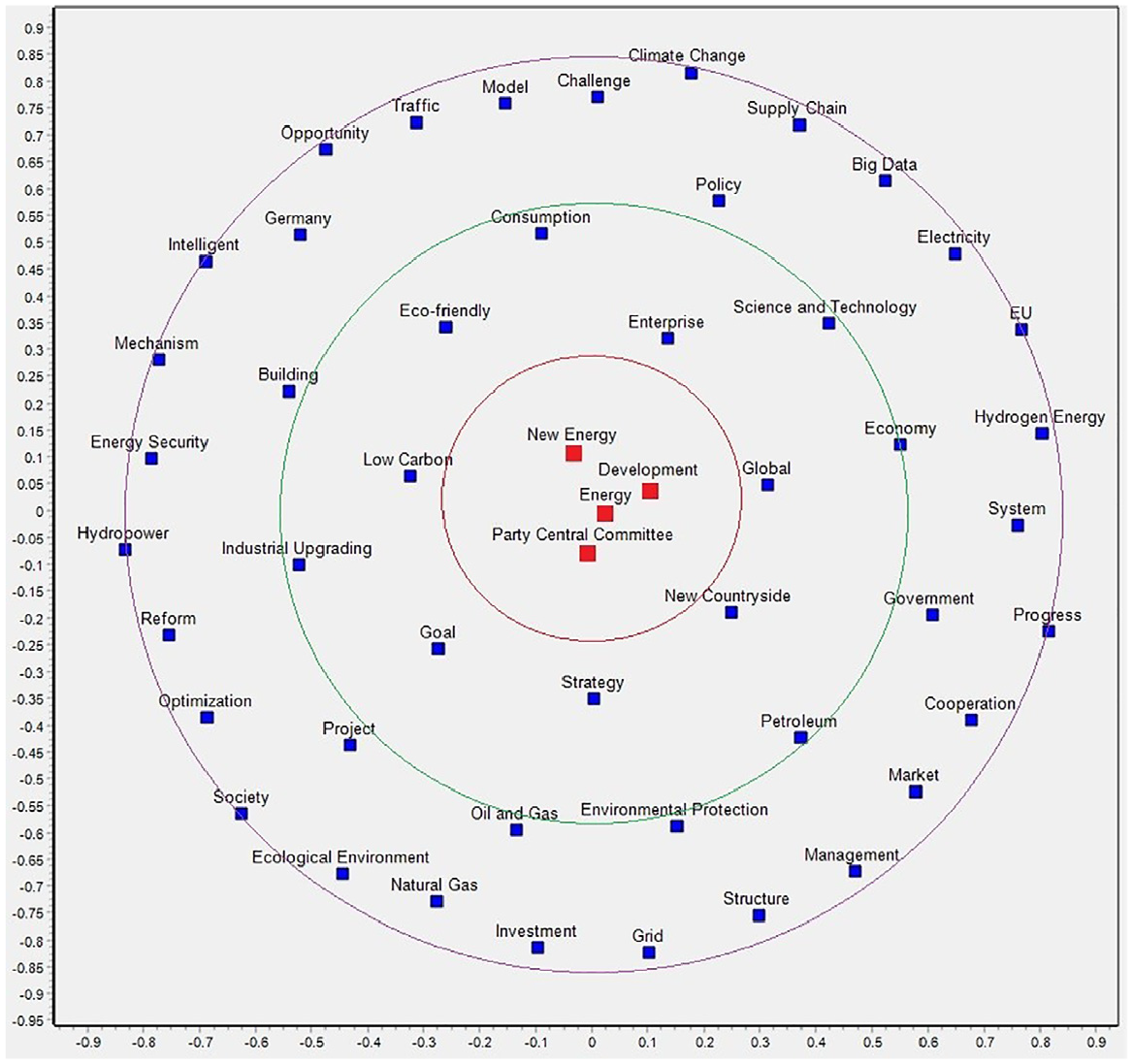
Result of MDS by period.

Result of MDS by period.

Result of MDS by period.
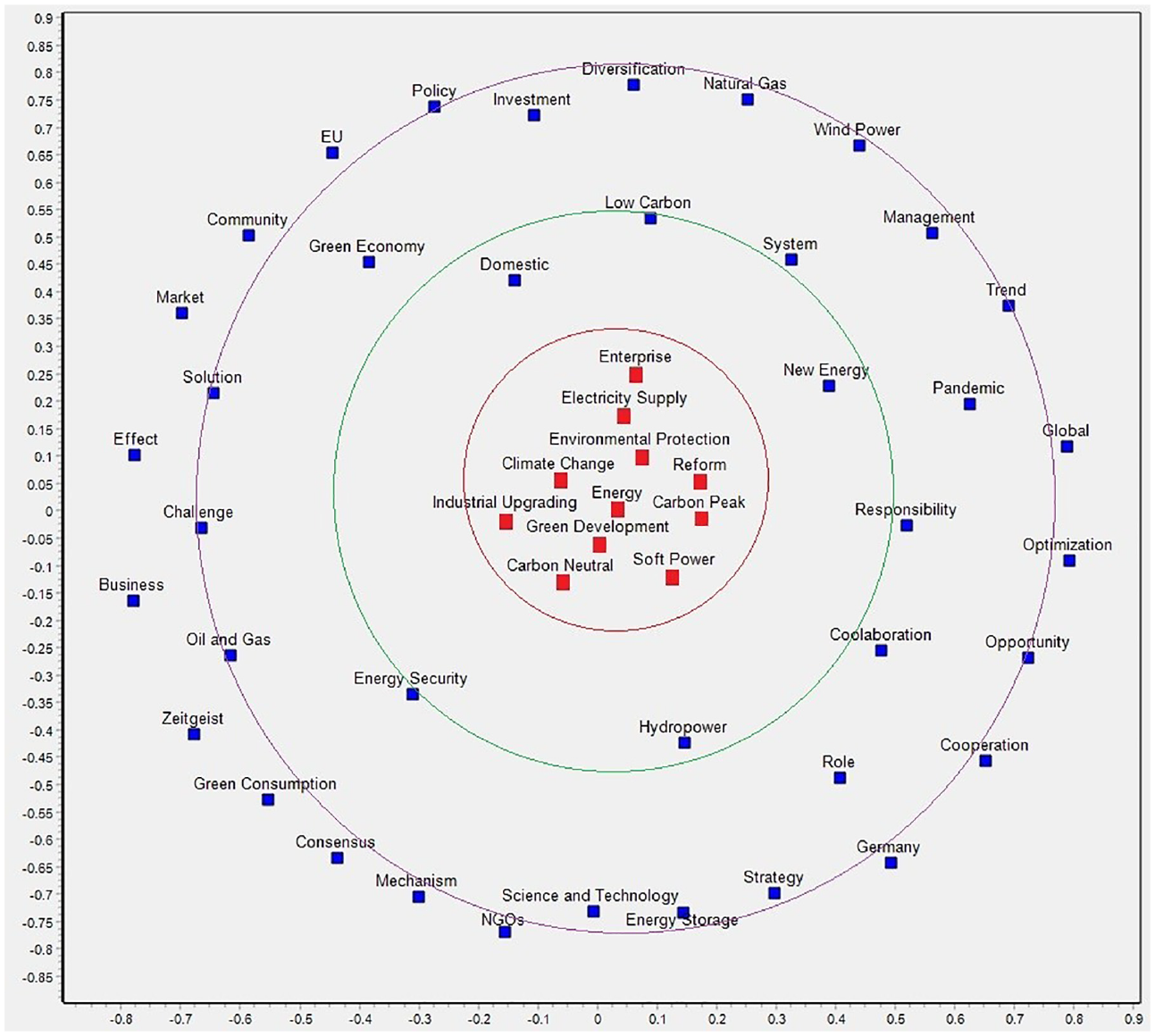
Result of MDS by period.
Discussion
CET process has been progressing gradually for over 20 years. It was highlighted less only because the spotlight on China was focused on its economy, politics, and diplomacy. A huge population and abundant resources have brought about the development of various productive forces, but in the process, issues related to energy efficiency, security, distribution have always been raised. The time has come to promote and discuss the ET from a macro perspective rather than as a fragmentary energy issue. Accordingly, from this macro perspective, we analyzed PDs related to CET in a time series dimension. Based on the analysis results, the two research problems mentioned above need to be discussed in the following dimensions.
First, it was observed that the pattern of long-term PD in the process of CET gradually converges toward diversified participants and global environmental issues. China’s diversified participants imply active changes occurring in the government-led policy making, spreading, implementation, and evaluation system, and active participation of all social classes. This emphasizes the need for ET in the process of social system transition through active participation of Chinese citizens. In fact, the International Energy Agency (IEA) explains that energy conversion through government support and investment is approximately 40% and that the remaining 55% should be realized through citizens’ voluntary and active participation (IEA, 2021). In short, it explains that changes in behavior such as efficient energy consumption habits, resource recycling, and adoption of innovative technologies of the public should run parallel with technological changes related to ET. Diversified participants act as practitioners in the ET process as well as controllers overseeing policies. They also perform a positive function of adjusting the policy direction to the circumstances and social environment of the times, but their adverse effect of degenerating into interest groups that claim unreasonable demands or delay time cannot be excluded. However, the diversification of CET participants can be expected to have a higher net function in modern China. In the smart era, the public can access a variety of energy conversion-related information, action plans, and communities, and diversified participants play the role of a hub for policy diffusion in these channels. This means that the ET should go beyond a simple energy system and technology transition and contribute to realizing various social values, such as protecting the energy poor, improving the quality of life, and resolving social inequality.
Next, the convergence of macro patterns of ET from China’s issues to global environmental issues can be seen as a sign that China will no longer evade responsibility and instead will actively exercise a stance of responsibility and cooperation in the global environmental issue responsibility debate. In the past, China’s economic modernization process took priority over development in any other field. As of 2011, China’s total GDP rose to the ranks of the G2 after the United States and has now grown into a global hegemon in various fields such as global trade, global supply chain, and advanced technology. However, strong growth-oriented state management has created various side effects much like the two sides of the same coin. Among them, the environmental problem threatens public health and sustainable economic growth. China’s internal awareness of environmental issues was only at the level of tacit agreement, and other issues pertaining to economic growth overshadowed environmental issues. Regarding external pressure from the international community, China counter criticized the developed countries’ growth through environmental destruction, calling it “kicking the ladder” (Chang, 2002). However, since 2015, China’s environmental problems have been combined with other social issues, such as the gap between the rich and the poor and industrial development, and the awareness of internal issues has gradually increased. In addition, as the direction of economic growth shifted from quantitative growth to qualitative growth, the environment has come to be taken for granted as a keyword for sustainable development. Due to the 2020 COVID crisis, environmental issues and global health issues are receiving more political momentum. China is actively responding to global environmental issues. Economic growth, industrial upgrades, production and consumption restructuring, and energy conversion are all being formulated and promoted as policies in connection with the environment. In particular, carbon peak and the declaration of carbon neutrality declared by China at the end of 2020 accelerated the ET. Such moves by China imply that the ET has evolved into an issue that is visible and publicized from the existing internal problem consciousness stage. At the same time, it is becoming a prerequisite for environmental protection and the construction of ecological civilization.
Next, the key to leading the PD for each period in the ET process was the change of actors involved in policy promotion from the government to the private sector as well as the transition from energy issues to national/international environmental issues. CET started with policy making and policy implementation based on the strategic choice of the central government. Subsequently, local governments set goals suitable for local characteristics and implemented actual policies based on the central government guidelines and policy achievement indicators. This indicates the process of implementing policies with Chinese characteristics in which universality and specificity are reflected in the ET process. In addition, these policy-leading forces are expanding from the government to corporations and to private and social groups. In particular, the role of the private sector and social organizations has been emphasized over the past decade. This means that true energy conversion can only be achieved when citizens’ voluntary actions, not coercive instructions from the government, are guaranteed. The development of various smart technologies served as a catalyst for the faster diffusion of information, values, responsibility, and communities related to ET. Furthermore, it implies that the ET is taking place in a more democratic way different from the existing method through which the government has consistently led economic growth. This shows that an active role of the government is required for a speedy ET and that the citizens and the private sector are important for a robust ET.
Finally, the issues leading the ET show a tendency over time to shift from issues such as domestic energy, new energy, and eco-friendliness to words such as low carbon, ecological civilization, and carbon neutrality, which are international practical tasks. These changes imply that China has come to consider more fundamental environmental issues in the technological, energy security, and energy efficiency aspects of the ET process. While low carbon should be achieved through ET, it is also a concept that can be implemented in the context of changes in the entire social structure beyond the energy field. The carbon-neutral goal presents a roadmap for sustainable development where the environment, industry, and humans coexist while meeting the global environmental issues. Through this series of processes, China has presented a long-term goal to build an ecological civilization. This means that it will create a virtuous cycle ecosystem in which the earth and mankind coexist at the global level and create a sustainable virtuous cycle ecosystem in conformity with the nature rather than having efficiency and economic value as the top priority.
CET can be considered from three aspects in the future. One is the integration with digital transformation. We have entered an era in which energy generation and consumption are accurately predicted and produced based on digital technology. Energy conversion can be effectively achieved only when all entities that consume energy, such as companies, schools, and industrial complexes, are converted into smart and eco-friendly spaces. The government’s digital transformation should be systematized in terms of energy statistics, energy distribution, and security. At the corporate level, it can be applied to energy efficiency, technology, and autonomous environmental index management. The government needs to play an appropriate role in various R&D and subsidy disbursements so that companies can have a digitalized system as a major axis of energy production and consumption. The integration of digital conversion and energy conversion in the private sector is possible in personal energy consumption control, real-time energy status check, auto home system, new energy vehicle lifestyle, and eco-friendly product use. It is necessary to accelerate the change toward enabling real-time energy use control in a wide range of smart devices used by individuals or raising the sense of responsibility for energy conservation by showing energy footprints. Practical changes for this need to think about the fourth industrial revolution and the use of AI, which is getting smarter day by day. In the process of policy decision-making at the government level, technological changes and social changes related to energy conversion should be considered at the same time, and mid/long-term investments should be made to settle them into the social system.
The other is that EP should not only change the characteristics and structure of Chinese society but also become a future growth engine such as job creation. It is necessary to focus on technological independence and to secure the ecosystem so that the employment creation effect in the renewable energy sector is greater than the employment substitution effect in the fossil fuel sector. The ET should be done in a way that grows the pie, not in a way that changes the distribution of the pie. The government should establish policies, R&D assistance, and manpower nurturing plans that can help various energy-related industries and talents grow. In addition to the government’s policy support such as taxes and subsidies, companies should strive independently to establish business plans, production activities, and logistics lines based on energy. Furthermore, it is necessary to actively recruit relevant talents to pay attention to technology development patents and standardization work. It is also possible to cultivate practical talents related to energy conversion through a government–industry–school partnership and maintain a certain employment ratio in the industry. This is because, in the end, nurturing talented people and securing them to enter society will become an important resource for stably and continuously promoting the entire social ET. In precise terms, EP makers should focus on constructing a fresh ecosystem that encompasses knowledge, technology, and distribution, while duly considering shifts in demographics and the rapid strides of technology. Moreover, a pivotal aspect of this new framework involves the expansion of opportunities within which adept individuals can contribute creatively and sustainably.
Finally, it should be an ET policy that contributes to balanced regional development. Local industries based on fossil fuel power generation should effectively transform their industries, and balanced energy development should be achieved through the establishment of distributed energy. In other words, it is necessary for the government to set a macro vision and goal as well as decentralize and localize the implementation of the ET to achieve China’s sustainable development goals and ultimately to successfully implement the ET. Core projects for energy conversion, such as expanding the supply of new and renewable energy and improving energy efficiency, are highly regional and have superior information regarding the situation and characteristics of the region than the central region. Considering these characteristics, it can be said that the implementation of energy conversion through strengthening the role of regions is essential. To realize regional-led ET, it is necessary to design policies with “decentralization” and “local industrialization” as two major axes. The decentralization of the energy system is about realizing the concept of decentralization to the extent that most local civil complaints and conflict issues can be resolved within the region. Achievement-based local industrialization is about establishing the base conditions and evaluation system to allow for the region to become business actors and maximize their own benefit. It is necessary to avoid fragmented transfer methods such as simple window division and execution tasks and to give local governments an active role such as planning in consideration of the overall workflow.
Conclusion
Confronts substantial hurdles due to its integration with ambitious objectives like environmental preservation, the construction of an ecological civilization, and achieving carbon neutrality. This undertaking necessitates a comprehensive overhaul of the entire societal framework. Analyzing the broader trends in and the shifts among key actors by delving into PD yields significant advantages, especially in the complex aftermath of COVID-19, encompassing intricate domestic and foreign political, economic, and social landscapes. Consequently, drawing from the discourse surrounding EP, we executed methodologies such as text mining, network analysis, and center-periphery analysis. This approach yielded a range of strategic implications and alternatives crucial for ensuring the sustained progression of ET in the times to come. This research identified a diverse array of participants and their convergence on global environmental concerns. More granularly, it illuminated a shift from government-driven initiatives to private sector involvement and a transition from domestic energy matters to international environmental considerations. As unfolds in the future, it demands strategic sustainable development that encompasses three core facets: amalgamation with digital transformation, the expansion of employment ecosystems, and the facilitation of balanced regional progress.
This study, nevertheless, has the following limitations. While we collected as much text data as possible, we were not able to collect data from channels that can actively explore private discourses, such as WeChat. Moreover, our efforts were directed toward eradicating affiliated advertisements, stakeholder viewpoints, and potential biases to bolster the dependability of the data. Nonetheless, the intricate nature of handling extensive datasets rendered achieving flawless preprocessing a formidable task, emphasizing the necessity for heightened stringency in future research investigations. In addition, China’s various new deal strategies to overcome the COVID pandemic and the global energy security situation caused by the Russia–Ukraine crisis had to be considered in a limited manner. In particular, the Chinese government places great significance on mitigating social upheaval caused by economic recessions. If growth decelerates due to sluggish domestic demand and volatile international conditions, it could trigger a significant reevaluation of the energy conversion goals and strategies. It is hoped that these two limitations will be complemented and addressed in future studies.
Footnotes
Appendix A
Declaration of Conflicting Interests
The author(s) declared no potential conflicts of interest with respect to the research, authorship, and/or publication of this article.
Funding
The author(s) received no financial support for the research, authorship, and/or publication of this article.
Ethic Statement
Not applicable.

Data Availability
All relevant data are available from the authors on request.