




Abstract
Teachers are the key to the success of the learning process, so teacher perceptions are fundamental in supporting educational goals. This study aims to evaluate the impact of teachers’ personal and professional resources in elementary education on school-based human resource management. This research method is a cross-sectional study involving 474 elementary school teachers in Magetan Regency, East Java, Indonesia. The collected data was structured by PLS Structural Equation Modeling and analyzed by SmartPLS version 3.0 application. The study results found that all aspects of teachers’ personal resources (years of service, teachers’ online learning perception, and positive mental health) affect school-based management. Meanwhile, aspects of teacher certification status and literacy learning implementation affect school-based human resource management for teachers’ professional resources. Interestingly, the status of teachers, whether public or contracted, does not affect school-based management. This study benefits the government in formulating education policies, especially in implementing the teacher certification program and improving the competence of teachers and school principals. Further research is needed on strategies to improve the quality of school-based management especially in human resource.
Plain language summary
Teachers are an essential component that must be considered in an educational institution. Through this research, we are curious about what components can influence school-based management, especially from the teacher aspect. We surveyed 476 teachers at the elementary school level in Indonesia, and the data was then analyzed. This research found that the length of time a teacher works does not affect school-based management, nor does the teacher’s perception of online learning and mental health. This means that even though the school is filled with new or old teachers, its management is acceptable. On the other hand, teachers who have received teacher certification allowances have an impact on their professionalism. Therefore, providing certification allowances to professional teachers is crucial to improve the school-based management system. Unexpected findings regarding teacher status, whether private or civil servant, apparently have no effect on school-based management.
Introduction
School-Based Management is fundamental to the effectiveness of educational goals. Previous studies found that school-based management affect the effective learning (Setia & Nasrudin, 2020; Stamatis, 2021). However, not all aspects of school-based management have an effective effect on learning. Previous research, the implementation of school-based management in Embu North District, Embu County, Kenya showed ineffective results in supporting learning objectives (Nzoka & Orodho, 2014). Until now, researchers are still guessing on the factors that contribute to supporting school-based management.
The essence of school-based management is the management of all components in the school. According to (Mulyasa, 2019), there are seven components that are an inseparable part of school-based management, namely (1) curriculum management, (2) management of educators and education personnel, (3) student management, (4) financial management, (5) management of educational facilities and infrastructure, (6) management of school-community relations, (7) management of special services.
Management of educators and education personnel can be interpreted as human resource management. Human resource management is essential in school (Middlewood & Lumby, 2012). Therefore, in this article, more emphasis is placed on school-based human resource management. Human resources are important factors that affect the quality of an organization (Farnsworth, 2016; Mathews, 2021; Rachman, 2021). A key aspect of school-based human resource management is teacher perception. Previous research has shown that teachers’ perceptions of human resource management influence the successful implementation of school-based management. The teacher is an important actorin the learning process (Hassan & Rahmatullah, 2014).
Recently, there has been renewed interest in this topic because of the pandemic Covid-19 situation. The Covid-19 pandemic has changed everything. Online learning is the only alternative to learning, thus causing limited interaction between school components (Ngussa et al., 2021). Although there are many reports that mention the success of online learning, it is still not as effective as normal classroom (Tarihoran et al., 2021). Online learning causes students to become stressed (Ngussa et al., 2021). Other challenges are the lack of learning facilities such as media and internet networks (Priyadarshani & Jesuiya, 2021). In addition, the lack of interaction causes new problems, especially in literacy learning. In literacy learning, real situations are needed in learning so that students are free to express themselves (Jannah et al., 2021; Khusna et al., 2022; Su & Ma, 2021).
Online learning is a major problem in the current education situation. However, the Covid-19 pandemic situation and online learning may cause disruption of positive mental health for teachers (Ngussa et al., 2021). Previous research reported that the triggers for teacher stress were busy times of the year, such as assessment periods, the pressure of extra curricula activities, the unexpected, keeping up with the pace of change and changes in school leadership (Allison & Ramirez, 2016; Glazzard & Rose, 2020; Yang et al., 2019). This problem is of course serious for schools because teachers are the main key to successful learning (Whittle et al., 2018).
Even though many research results find factors that influence school-based management, the majority are students, not teachers, even though the teacher factor is the spearhead of successful learning. There is no research that examines the impact of personal and professional resources of teachers in elementary education on school-based management. Personal resources in this study are Years of service (YoS), age, teacher’s online learning perception (TOP), positive mental health (PMH). Meanwhile, professional resources are certification (CRT), employment status (EMS), literacy learning implementation (LLI).
An objective of this study was is to evaluate the impact of personal and professional resources of teachers in elementary education on school-based management. This work will produce new insights about the factors that influence the school-based management, and open up opportunities for further researchers to explore other influencing factors.
School-Based Management
School-based management means that school management tasks are defined according to the characteristics and needs of the school itself. In this case, all school components have much greater autonomy and responsibility in using resources to solve problems. All school components must carry out practical teaching activities and develop the school’s long-term school program (Cheng, 1993).
School-based management is the key to the success of an educational unit. The application of school-based management has affected the quality of education, especially at the basic education level (Iswan et al., 2021; Karmila & Wijaya, 2020). The concept of school-based management is that the government gives autonomy to schools to manage independently. The research results by (Ko et al., 2016) suggest that school-based management has a positive effect because schools have autonomy over school governance and management, teacher work, school-based curriculum, and student learning. These elements will be even more qualified when supported by strong leadership, comprehensive continuous professional development, and a positive and collaborative school climate. These fundamental elements work with school autonomy to facilitate positive change.
Implementation of school-based management has a significant positive effect on community involvement, especially parents of students. The results of this research from (Khattri et al., 2012) indicate that community participation will be high when the school can manage all existing components.
Human Resource Management
Human Resource Management is a process for developing and releasing human expertise through training and organizational development and development to improve performance. Learning is at the core of all HR efforts. Indeed, the main focus is learning and performance, which defines education in the workplace (Werner & DeSimone, 2011). School-based human resource management is a long-term educational process that uses systematic and organized procedures. So that managerial employees learn conceptual and theoretical knowledge for organizational purposes (Sutrisno, 2019). The research results from (Vekeman et al., 2019) show that human resource management, in this case, teachers and principals, is closely related to person-organizations. This study contributes to the field of school-based human resource management research. Thus, managing human resources can be interpreted as managing person-by-person because it will see the values of the teacher’s self.
This article will discuss the components of school-based human resources, namely: (1) Personal Resources of Teachers Matter; (2) Professional Resources of Teachers Matter; (3) Teacher’s Positive Mental Health.
Personal Resources of Teachers Matter
Personal resource in this study are Years of service (YoS), teacher’s age, teacher’s online learning perception (TOP), positive mental health (PMH). In the last 2 years, the impact of the COVID-19 pandemic has led to an increase in the number of schools and colleges implementing online learning (Dhawan, 2020; Ngussa et al., 2021). Previous research stated that students were satisfied with online learning with the help of teachers. Lack of preparation for knowledge, weak internet network, and availability of tools are challenges in online learning (Priyadarshani & Jesuiya, 2021).
Previous studies revealed that students feel comfortable with online classes and get sufficient support from teachers, but they do not believe online courses will replace traditional classroom teaching. Teachers also face difficulties conducting online courses due to a lack of proper training and development to conduct online courses. Technical problems are the main problem in the effectiveness of online classes (Kulal & Nayak, 2020). It can be concluded that online learning was effective because the conditions that required online study and the lecturer-students talk as not as effective as in the normal classroom (Tarihoran et al., 2021). Previous literature states that teachers are essential to successful learning (Hassan & Rahmatullah, 2014; Whittle et al., 2018). Weak positive mental health in teachers is a serious problem that needs attention (Darimis et al., 2022; Halida et al., 2022).
Some things that trigger stress on teachers are such as assessment periods, the pressure of extra curricula activities, the unexpected, keeping up with the pace of change and changes in school leadership, economic problems, and health (Glazzard & Rose, 2020; Yang et al., 2019). On the other hand, learning activities with students have been shown to improve the psychological well-being of teachers in Australia (Brunzell et al., 2021).
Professional Resources of Teachers Matter
Teachers professional resource includes certification status (CRT), employment status (EMS), and literacy learning implementation (LLI). In 2015, the Indonesian ministry of education paid attention to two international studies; Progress in International Reading Literacy Study (PIRLS) and Program for International Student Assessment (PISA). The results of the research stated that Indonesia’s achievement was relatively low in reading. PISA research on fourth-grade elementary school students, Indonesia ranks 45 out of 48 countries (International Energy Agency, 2012). Meanwhile, PISA in 2009, 2012, and 2015 found Indonesia’s ranking at 75 out of 63 countries, 64 out of 56 countries, and 64 out of 72 countries (Organisation for Economic Cooperation and Development, 2016).
Based on this low achievement, the Ministry of Education and Culture issued Ministerial Regulation number 23 of 2015 concerning the growth of character, written about habituation of literacy culture. This regulation then gave birth to the School Literacy Movement (Gerakan Literasi Sekolah [GLS]), which is a program to create a school environment with literate citizens (Faizah et al., 2016; Fitriyah et al., 2022; Metafisika et al., 2022).
The definition of school literacy in the context of the GLS is the ability to access, understand, and use things intelligently through various activities, including reading, viewing, listening, writing, and speaking. GLS is an overall effort to make schools a learning organization whose citizens are literate for life through public involvement (Faizah et al., 2016).
Teacher’s Positive Mental Health
Mental health has traditionally been defined as the absence of psychopathology, but mental disorders do not mean positive mental health. Positive mental health is related to the positive influence of both emotions and thoughts as well as life satisfaction (Lukat et al., 2016). For the last 15 years, teacher wellbeing has been a priority area of exploration within education and positive psychology literature, especially during the current covid-19 pandemic (Brunzell et al., 2021). Previous literature states that teachers are essential to successful learning (Fitriyah et al., 2021; Hassan & Rahmatullah, 2014; Ngussa et al., 2021; Whittle et al., 2018). Weak positive mental health in teachers is a serious problem that needs attention.
Some things that trigger stress on teachers are such as assessment periods, the pressure of extra curricula activities, the unexpected, keeping up with the pace of change and changes in school leadership, economic problems, and health (Glazzard & Rose, 2020; Yang et al., 2019). On the other hand, learning activities with students have been shown to improve the psychological well-being of teachers in Australia (Brunzell et al., 2021).
Method
Research Design
A cross-sectional survey was conducted by distributing online questionnaire to PGRI Magetan as the community of the elementary schools in Magetan, Jawa Timur. Purposive and snowballing approaches were applied as non-probabilistic sampling method. The survey has successfully invited participation of 474 teachers as the respondents. The collected data was structured by PLS based Structural Equation Modelling. Based on proposed research model the data was calculated by Smart PLS version 3.0. There are two type calculation, (1) PLS Algorithm, for conducting validity and reliability analysis and (2) Bootstrapping with 500 subsamples for testing the hypothesizes.
For accommodating the hypothesis examination, research model was developed with one dependent variable (school management system), three independent variables (positive mental health, teacher’s online learning perception, literation learning implementation), and three moderating variable (years of service, teacher status, teaching certification, availability internet access). Independent and dependent variables was structured in first order constructs. The proposed research model was displayed in the following figure.
Figure 1 explains school management system is hypothesized influenced by personal capability of the teacher which consist of positive mental health and online learning perception as well as implementation of literation learning. This study also try to elaborate some situations which faced by teacher—for example, years of service, teacher status, teaching certification, and availability internet access do differentiate the impact of those hypothesized influential factors on school management system.

The proposed research model.
Participants
A total of 474 elementary school teachers under Indonesian republican teacher union, Magetan district branch, East Java, Indonesia, participated in this study. Table 1 shows the demographic characteristics of respondents.
Demographic Characteristics Details of Respondents.

Procedure
Participants in this study are voluntary without any compensation. The data collection method used an online questionnaire distributed to primary school teachers in Magetan Regency, East Java, Indonesia. Online questionnaires were distributed via social media WhatsApp. Researchers asked participants to fill out a questionnaire to measure their perceptions of school management system, online learning, literacy learning implementation, and positive mental health through the google form.
Measurement
In this study, we used four questionnaires; the School Management Scale (Smith et al., 2015), Teacher’s Online Learning Perception, Literacy Learning Implementation (Faizah et al., 2016), and Positive Mental Health (Lukat et al., 2016). Three of the original questionnaires were in English, so an adaptation process was needed. The three instruments are the school management scale, teacher’s online learning perception, and positive mental health.
The adaptation process follows WHO standards; forward translation, expert panel back-translation, pre-testing and cognitive interviewing, and final version (World Health Organization, 2021). For the forward translation section and the back-translation expert panel, we have passed the ethical clearance test, including all questionnaire which also has passed such a test. In the pre-testing and cognitive interviewing section, we used 60 respondents from elementary school’s teachers. We also took into account gender and age composition in the test. Subsequently, we revised the non-conforming questionnaire items based on evaluations at the cognitive interview and cultural adjustment stages and then published the final version of the questionnaire for use. This effort was made to make the questionnaire suitable for application in Indonesia according to its culture.
School Management Scale (SMS)
The school management scale is used to measure teachers’ perceptions of the school management system in their schools. This questionnaire was developed by Smith et al. (2015). From 17 indicators, only two are excluded from the research model (SMS10, SMS15). Because their outer loading (OL) scores are less than 0.6. As a variable, SMS is valid because it has AVE score more than 0.50. SMS is reliable too, because it has Cronbach Alpha’s (CA) or composite reliability (CR) score more than .70 (Hair et al., 2021). Based on validity and reliability, SMS are valid and reliable with valid indicators is displayed in Table 2.
Validity and Reliability Analysis of School Management Scale (SMS).

Teacher’s Online Learning Perception (TOP)
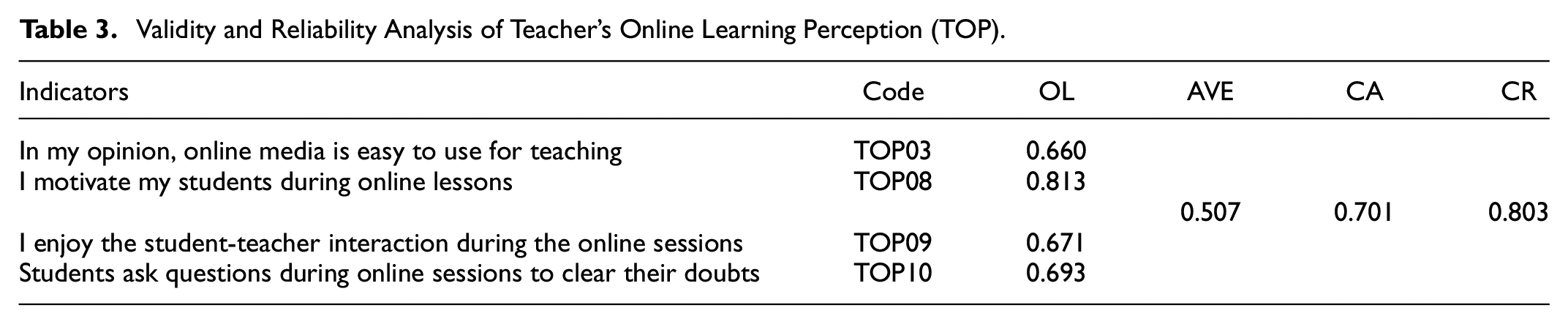
To measure teacher’s online learning perception, we used the Teacher’s Online Learning Perception (TOP). The questionnaire was developed by Priyadarshani and Jesuiya in 2021 (Priyadarshani & Jesuiya, 2021). From 17 indicators, only four are valid. Those are TOP03, TOP08, TOP09, and TOP10 (see Table 3). The rest of them are excluded from the research model because its OL score is lower than 0.60, as variable, TOP are valid. It has AVE score more than 0.5. It is also reliable because it has CR or CA score more 0.70. (Hair et al., 2021). Teacher’s Online Learning Perception (TOP) is valid and reliable with four valid indicators which is presented in Table 3.
Validity and Reliability Analysis of Teacher’s Online Learning Perception (TOP).
Literacy Learning Implementation (LLI)
Literacy learning implementation is measured using achievement indicators in the habituation stage in the School Literacy Movement or GLS guidelines in elementary schools (Faizah et al., 2016). From 10 indicators, only 4 are valid. The rest of indicators have OL score of less than 0.60. Those are LLI06, LL07, LLI08, and LLI09 (see Table 4). Those are excluded from the research model. AVE score is 0.509 more than 0.50. It indicates that LLO are valid. Although CA score is less than 0.70, but CR score more than 0.70. It indicates that LLI is reliable (Hair et al., 2021). Table 4 demonstrate the LLI as valid and reliable variable with four valid indicators.
Validity and Reliability Analysis of Literacy Learning Implementation (LLI).

Positive Mental Health (PMH)
The instrument for measuring positive mental health for teachers uses the Positive Mental Health Scale (PMH). All indicators of PMH are valid, because its OL scores are more than 0.6. AVE score is more than 0.50; CR or CA scores is more than 0.70. Those indicates that PMH is valid and reliable variable with nine valid indicators which is shown in Table 5 (Hair et al., 2021).
Validity and Reliability Analysis of Positive Mental Health (PMH).

For confirming validity analysis, Table 6 demonstrates the result of discriminant validity. All independent and dependents are discriminant valid. Because the diagonally bold scores as squared root of AVE are higher than 0.70 and become the highest score in each column (Hair et al., 2021).
Discriminant Validity.

Data Analysis
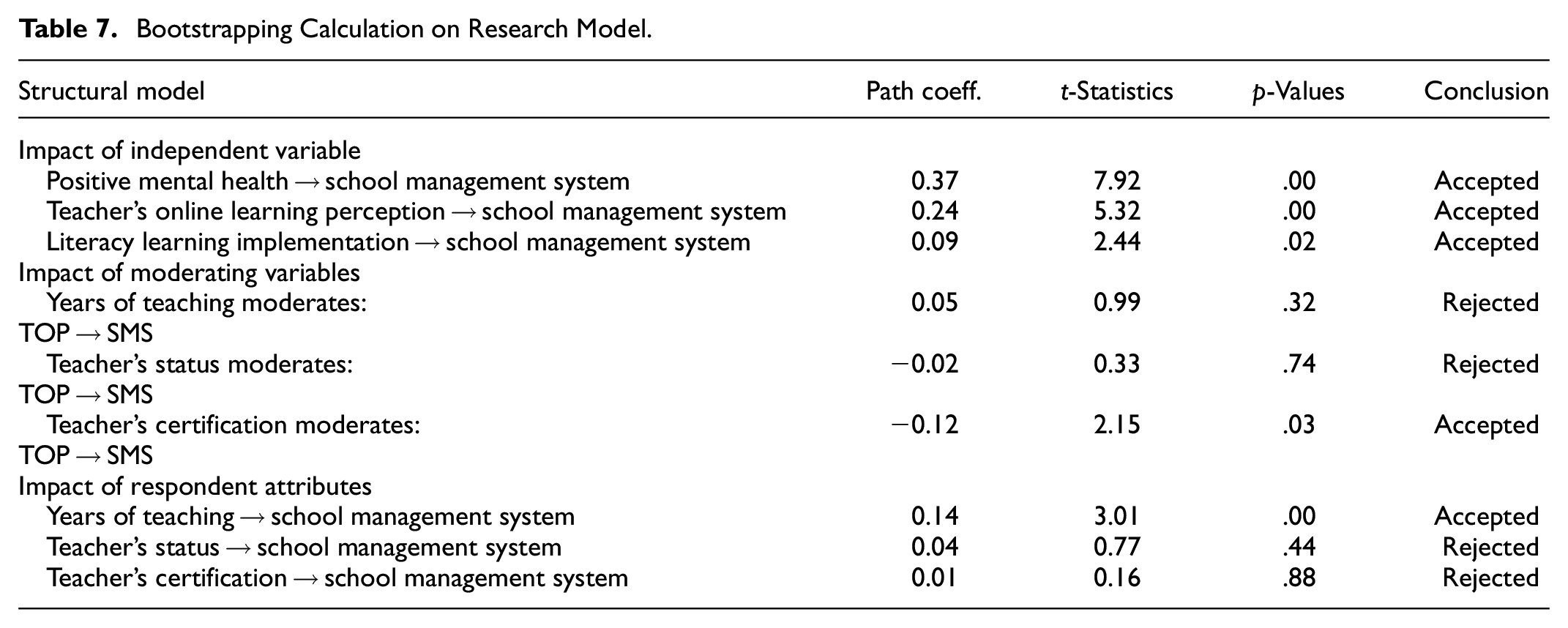
The collected data was analyzed by SmartPLS version 3.0 into two step analysis: PLS Algorithm and Bootstrapping. Validity and reliability analysis was based on PLS algorithm calculation. Figure 2 shows the result of PLS algorithm analysis. Meanwhile, bootstrapping analysis was conducted for testing the hypothesizes. Table 7 and Figure 3 demonstrate the result of the hypothesis testing.

PLS algorithm analysis.
Bootstrapping Calculation on Research Model.

Bootstrapping analysis.
Results
From PLS algorithm analysis, we found that SMS is influenced simultaneously by all independent and moderating variables about 31% (adjusted r2). There are about 69% effect come from influential variables which does not elaborate yet. This study have proven about 69% effect of tested influential factors on SMS. Effect of other influential factors which are not discussed in this study are about 31%. It is a room for the further studies.
Table 7 shows the result of bootstrapping analysis. Path coefficient with t-Statistics more than 1.96 or p-values less than .05 indicates the significance impact of a variable on SMS as the independent variable. All independent variable (PMH, LLI, TOP) has positive and significant impact on SMS by indicating t-Statistic more than 1.98 ( from 2.44 until 7.92) or p-value less than .05 (from .00 until .02). It means that positive mental attitude, teacher’s online learning perception, and implementation of literacy learning has significant positive impact on school management system.
From moderating variables, only teacher’s certification has significant but negative impact on SMS. Teacher’s certification moderates’ impact of teacher’s online perception toward school management system. It means that online learning perception has significant effect on school management system, especially among teachers who has certified. Years of service and teacher’ status has no significant impact on SMS. But years of teaching has significant impact on SMS as representation of respondent attributes. It indicates that teacher certification was based on years of teaching. For being certified by governmental institution, years of teaching is used as pre-requisites for teacher certification.
Table 7 shows the School Management System is influenced positively and significantly by positive mental health, teacher’s online learning perception, and literacy learning implementation. Based on Figure 2, PLS Algorithm calculation on research model explains that three variables—PMH, LLI, and TOP—simultaneously impact on SMS about 31.4%. They are about 68.6% impacts of other variables which does not elaborates in this article yet.
Closer inspection of the table shows only teacher’ certification plays a moderating role on relationship between teacher’s online perception and school management system. The most interesting aspect of this table is only years of teaching as population attributes impact on SMS.
Discussion
Several reports have shown that the school management system affects learning progress (Setia & Nasrudin, 2020). An initial objective of the project was to evaluate the school management system in influencing teachers’ perceptions of online learning, literacy learning, and positive mental health. Teachers are the main factor that determines the success of a school management system. Therefore, the teacher is the main factor that needs attention (Mulawarman et al., 2022). The current study found that the school management system regarding teacher personal resources is positively and significantly influenced by years of service, teachers’ online learning perception, and positive mental health.
Previous studies provide conclusions that align with this study’s results. Years of experience or service positively affect classroom management and student achievement (Berger et al., 2018; Podolsky et al., 2019; Ünal & Ünal, 2012; Wahlstrom & Louis, 2008). Experienced teachers identify the establishment of classroom management as one of the main goals that need to be achieved in the first week of the year. Beginning teachers cite classroom management as one of their most serious challenges. School administrators make indicators of poor classroom management the main reason for low evaluation and the main reason for dismissing teachers (Podolsky et al., 2019).
This finding is consistent with previous studies. Previous studies found that the teachers’ aspect in the school management system affects effective learning (Setia & Nasrudin, 2020; Stamatis, 2021). Another study found that the cause of this effectiveness is the ease of access in all academic activities, all with clear indicators of success as learning objectives.
The new finding of this study is the effect of the school management system on literacy learning. No previous study reported the relationship between the school management system and literacy learning in schools. In the other hand, teacher perception on online learning is also influenced by the school management system. This finding is in line with the results of previous research that teacher’s willingness is able to help teachers adapt to online learning when Covid-19 hits (Herawati et al., 2022).
One unanticipated finding was that the school management system affected the positive mental health of teachers. These results corroborate the findings of a great deal of the previous work in Australia (Lester et al., 2020). This result may be explained by the fact that the school management system is an essential school component. Another source of uncertainty is a school principal with an important role in supporting the quality of student graduates by optimizing the use and procurement of school facilities and infrastructure (Sakallı et al., 2021; Setia & Nasrudin, 2020).
By providing a good school environment, by respecting the psychological well-being of teachers, and by providing adequate training to fulfill their “gatekeeper” role, the prerequisites for improving the mental health of the students they teach will be achieved. These suggestions align with the whole school approach to mental health promotion (Sisask et al., 2014).
Many factors can affect teacher mental health, from the aspect of the teacher himself and the environment. Aspects of teacher certification status and the implementation of literacy learning have an effect on school-based human resource management for teacher professional resources. This is in line with the results of previous research that teacher certification status has a positive effect on the performance of elementary school teachers in teaching, this may also be related to the welfare that teachers get so that they can increase their motivation in teaching (Tjabolo & Herwin, 2020; Uchtiawati, 2020). Interestingly, teacher status, whether civil servant or contract, does not affect school-based management. The status of civil servant teachers may be seen as having a comfortable position, thereby negatively affecting their performance and activeness in school (Utami et al., 2021).
The dual role of the principal as a school leader and teacher needs to be emphasized because it is feared that there will be a compromise between roles (Lekchiri et al., 2018; Lingam et al., 2021). Educational leaders must be trained following the requirements of the information age; such as thinking methods (creativity, critical thinking situations, problem-solving, decision making, learning), operating procedures (communication and collaboration), working tools (information technology, communication technology, information literacy), and skills to live in the world (citizenship, life, and career, personal and social responsibility), in fields of education, to contribute to the success and quality of education (Ates & Artuner, 2013). There are still many unanswered questions about how the style of the school management system which causes.
On the other hand, the results of this study show different results from previous studies. The results of research on school-based management in Embu North District, Embu County, Kenya, showed ineffectiveness in supporting learning objectives, and this is because many school principals still need to receive management training, even though this training is crucial. Therefore, since managers conversant with management practices will become more fruitful partners of the government in policy implementation, it is recommended that school managers undergo intensive leadership training on all aspects of school management to improve students’ academic achievement (Nzoka & Orodho, 2014). Various factors cause the effectiveness or failure of school-based management, which has differences between agencies, especially countries.
Implication
The implication of this research is centered on the principal figure because the results of the study state that the school management system is the key to success in the implementation of online learning, literacy learning, and teacher’s positive mental health. On the other hand, the key to the school management system is a school principal.
A school principal should be an expert in online learning to support teachers who have difficulty implementing online learning. Even though principals do not have responsibilities in class, they must still learn about education because a principal must be more competent than the teacher. In addition, a principal must understand and support the GLS program. Given that the results of the study state that the status of teacher certification is a factor that affects the school management system, it is better if a principal is a teacher who has been certified. Training is needed to support the capacity of a school principal. In addition, the experience factor as a teacher can also be a consideration in determining a principal in a school. Given that the school management system in each school may be different, school supervisors and the government should conduct regular supervision to determine the effectiveness of each school program more precisely.
Limitation
A limitation of this study is that data collection using online questionnaire and voluntary report, it may have given rise to some bias, especially in the area which the internet connection is difficult.
Conclusion
This study aims to evaluate the impact of teachers’ personal and professional resources in elementary education on school-based human resource management. This study has shown that the school management system is positively and significantly influenced by positive mental health, teacher’s online learning perception, and literacy learning implementation. Another finding of this study is that teacher certification status affects the school management system. This study suggests that improving the school management system through a teacher certification program is needed. The findings will be of interest to provide input to the government to pay attention to the welfare of teachers through teacher certification programs and improve the quality of the school management system. Greater efforts are needed to create a new model which is effective for the school management system. The scope of this research is beneficial in the field of education, especially educational management, guidance and counseling, and language education.
Footnotes
Acknowledgements
We are grateful to all respondents involved in this research project.
Declaration of Conflicting Interests
The author(s) declared no potential conflicts of interest with respect to the research, authorship, and/or publication of this article.
Funding
The author(s) disclosed receipt of the following financial support for the research, authorship, and/or publication of this article: We are also grateful to Institute of Research and Community Service, Universitas Nahdlatul Ulama Surabaya, which supports funding of this study with contract number: 040/UNUSA/Adm-LPPM/III/2021.

Data Availability Statement
The dataset generated during and/or analysed during the current study are available from the corresponding author on reasonable request.