




Abstract
This paper reports part of a doctoral study which investigated the resettlement experiences of African migrants in Australia (N = 115), and focuses upon the findings of those who participated in individual face-to-face interviews (N = 30). It examines the resettlement challenges facing African migrants in Western Australia (WA), such migration having increased in recent years. Although migrating to relatively wealthy countries such as Australia may be a cause for optimism among African migrants, the challenges associated with resettlement may have a negative effect on their well-being. The findings indicate that participants experienced a variety of resettlement challenges including separation experiences, language difficulties, parenting and cultural issues, under-employment and unemployment, financial problems, and racial discrimination. The study confirms the limited existing research, contributes to a better understanding of the major challenges affecting African migrants in Australia, and has implications for the formulation of effective policies and practices aimed at mitigating resettlement challenges.
Plain Language Summary
In the last decade, a significant community of African migrants and refugees has developed around Perth, Western Australia. This paper reports a study examining the challenges faced by members of this community in their efforts to resettle and become active members of Australian society. Data was gathered from 115 participants, of whom 30 also participated in face-to-face interviews. The findings confirmed existing research indicating difficulties in acquiring English language and in using English when dealing with everyday issues. Participants also reported significant problems in reconciling their traditional culture with their new surroundings, and fears that their children were too readily adopting attitudes and behaviors that conflicted with that culture. They reported widespread racial discrimination, and difficulty in obtaining employment. The study was limited in that it used a convenience sample, so participants were those who could read the information sheets, understand the nature of the research, and provide informed consent. The findings are significant, however, in pointing to those areas in which government agencies need to provide increased support and in furthering understanding of the problems migrants and refugees face when trying to settle into Australian society.
Introduction
This paper examines the resettlement challenges facing African migrants in Western Australia (WA). It is worth noting that the first author is an African migrant from a Sub-Saharan African country and also resided in Perth WA whilst the study was conducted. She shared insider knowledge and networks of specific African communities such as the African Community Association of WA, and the Somali and Sudanese communities in Mirrabooka area. (Perth metropolitan area) where many Africans live.
Refugees are individuals who are forced to leave their homeland and cannot go back because of persistent danger, whereas voluntary migrants, also referred to as economic migrants, move to other countries in search of better standards of living (Grinberg & Grinberg, 1989). In this study, we have used the term migrants to designate immigrants from Africa who live in Australia since the main issue of investigation is that of ethnicity and how it impacts on their resettlement. A key rationale for undertaking this study was the significant rise in the number of African migrants in Australia from about 250,000 in 2006 to around 338,000 in 2011, an increase of 35% in 5 years (Australian Bureau of Statistics, 2006, 2011). In addition, between 1996 and 2007, over 20,000 Sudanese refugees resettled in Australia, constituting a significant proportion of the country’s humanitarian program (Murray, 2010). We therefore identified the timely importance of understanding the experiences of African migrants.
Although there is often an initial sense of relief and excitement on arriving in Australia, and optimism for the future, these are liable to yield to the reality of multiple losses, separation, unemployment, discrimination, marginalization, impoverishment, and cultural estrangement. Separation from the family and friends they left behind affects migrants’ resettlement and undermines their mental health, creating an acute and deeply felt sense of loss. This is especially keenly felt if the individuals left behind cannot be contacted, are believed to be suffering, or lose their lives. This can lead to feelings of guilt and depression. Baird’s (2012) study established that many refugee women from South Sudan who resettled in the US had been separated from their husbands and older sons, who were left behind to fight the civil war, and that often these women subsequently became widows. The refugee women in Baird’s study had been forced to leave behind their homes, families, and communities, and for some this led to multiple problem relating to separation and loss. Their sense of loss is compounded by the experience of social isolation and loneliness common among all migrants to new countries, particularly in the early stages of migration when separation from extended family members, friends and the loss of social networks is especially keenly felt (Murray, 2010; Ward, 2000).
Previous studies have established that the challenges facing African migrants coming to Australia relate to separation, employment, and acculturation issues (Baird, 2012; Hinsliff, 2007; Murray, 2010; Omar, 2003; Pittaway et al., 2009). According to Ward (2000), homesickness is also very common among migrants, and Hack-Polay (2012) established that it undermines the well-being of migrant workers and expatriates. It is well-known that homesickness can have a devastating effect on the lives and academic performance of overseas students who come to Australia to study, and universities have well-established services to help mitigate the effects. The importance of homesickness should not be underestimated; severe homesickness is associated with significant distress and impairment, which can result in almost suicidal misery. This was the main cause of desertion among soldiers who were relocated during World War I, even though it potentially attracted a death penalty. Grieving for one’s homeland can result in melancholia, and Freud observed that “mourning is regularly the reaction to the loss of a loved person, or the loss of some abstraction which has taken the place of one, such as fatherland, liberty, an idea, and so on” (Freud, 1917, p. 153).
The number of migrants to Australia has increased as a result of changes to Federal Government policy relating to multiculturalism made in 1973, and many African migrants have since resettled in Australia. The majority of Africans flee their countries because of war or fear of persecution for their ethnic, religious or political affiliation (Omar, 2003). In response, the Australian government increased the annual intake of refugees from Africa from 33 to 70% between 2003 and 2005, and 13,000 people were accepted under Australia’s refugee and humanitarian program, with majority from the Horn of Africa Refugee Council of Australia, 2011. More than 20,000 refugees from the Horn of Africa have been resettled in Australia since 2002 and the majority are from Southern Sudan (Pittaway, Muli & Shteir, 2009, p. 133).
Literature Review
In the last decade, the attention of researchers has turned to migrants coming to Australia from the Middle East, in particular Syria and Iraq, and this is reflected in the dated nature of much of the literature relating to African migrants. Nonetheless, a significant literature has accumulated exploring their experiences (Abkhezr, et al., 2018; Burns, 2004; Gichunge et al., 2015; Hancock, 2009; Sheikh-Mohammed et al., 2006), and in particular relating to Sudanese refugees (Abur & Spaaij, 2016; Bennett, 2014; Dubey, 2011; Gaillard & Hughes, 2014; Khawaja et al., 2008; Losoncz, 2011; Lucas et al., 2011; Marlowe, 2011; Marlowe et al., 2014; Milner & Khawaja, 2010; Murray, 2010; Robinson, 2011; Savic et al., 2013).
This literature addresses a wide range of topics. Burns (2004) conducted interviews with 45 Somali refugee women who had arrived in Australia during the preceding 5 years, in order to document their food habits; and, Gichunge et al. (2015) used a quantitative design to explore the diets in 71 households of refugees from Central Africa now living in Queensland. Gaillard and Hughes (2014) reported a pilot study which gathered data from four key informants in order to identify initiatives that could provide employment opportunities for female Sudanese refugees settled in Western Sydney. Abkhezr et al. (2018) reports interviews with three African women who had come to Australia as young children 18 years earlier, and focused specifically on career development. The statistical study by Sheikh-Mohammed et al. (2006) assessed barriers to refugee families from Sub-Saharan Africa accessing health care in Sydney; families had to have arrived in Australia no more than 5 years earlier (i.e. between 2000 and 2005). Westoby (2008)used a participative action research approach involving the established Southern Sudanese community in Brisbane, Queensland, in order to identify factors that might facilitate community development, empowerment and social healing; the report provided no information as to how long participants had lived in Australia. Milner and Khawaja (2010) provided a review of the literature relating to the Sudanese community in Australia. The study by Murray (2010) explored the resettlement challenges facing a sample of Sudanese refugees in Queensland, including mental health issues; the need for culturally appropriate interventions was discussed by Murray et al. (2014). The study by Savic et al. (2013), which gathered data from key informants associated with supporting Sudanese refugees settled in the Adelaide area of South Australia, looked exclusively at the impact of separation on refugees’ mental health.
Comparatively little has been published, however, relating specifically to the experience of African migrants in Australia, and it is unknown to what extent the results can be generalized. The recent qualitative study by McCann et al. (2018) explored the stigma attaching to mental illness and substance abuse among sub-Saharan African migrants living in the Melbourne area. Shame, fear and community rejection were found to be significant factors in deterring individuals from disclosing their problems and from seeking help.
Challenges Facing African Migrants
African migrants who have come to settle in Australia will encounter certain resettlement challenges regardless of their migration status. The first will be separation from family and friends. Baird (2012) found that many refugee women from South Sudan who resettled in the US had been separated from their husbands and older sons who were left behind to fight in the civil war, and often these women later became widows. In their study of Sudanese in Australia, Savic et al. (2013) concluded that separation from family members often creates sadness, worry and continuing stress.
The language barrier is another critical factor affecting the resettlement process of migrants from non-English-speaking backgrounds (NESB), when they settle in countries where English is the predominant language. Many African migrants in Australia lack basic English language skills, and this contributes to their social isolation and stress (Ahmed, 2006). They struggle to communicate their needs, to interact socially or instrumentally with other people, and importantly to obtain vital information about support services (Murray et al., 2014). Pittaway et al. (2009) and Abur and Mphande (2019) found that a lack of English proficiency negatively affected the ability of migrants from the Horn of Africa to pursue employment, obtain further education and access support services in Australia.
Migrants who arrive in a new country with a cultural system that is very different from their own, can find acculturation very challenging. Brand, Loh and Guilfoyle (2014) found that during the process of acculturation, non-dominant groups may experience a great deal of emotional distress when trying to adjust to their new life; this may create “cultural conflict” as they struggle to decide which cultures or behaviors should be forfeited and which should be retained (Brand et al., 2014). Migrants with young families may also face acute parenting challenges in response to the expectations and norms of their new cultural context. Conflicts can also arise in relation to the transition between childhood and adulthood, which may have drawn on established traditions in their country of origin but which no longer apply; this plays a major role in the resettlement process of young migrants (Aronowitz, 1992).
Having what the individual perceives as a good job and a good wage can provide a feeling of self-sufficiency and self-worth. However, the literature highlights the extent of unemployment and underemployment among African migrants in Australia and elsewhere (Batrouney, 1991; Heger Boyle & Ali, 2010; Hugo et al., 2011; Omar, 2003). Heger Boyle and Ali (2010) found that many Somalis live at or near the poverty line in Minnesota, for example, unable to find formal employment and often working more than one informal job. Furthermore, their professional and academic qualifications, and their skills acquired through previous experience, were not recognized by employers, and they were liable to end up in low-paid, unrelated jobs, such as parking-lot attendants, factory workers or taxi drivers. Ogunsiji et al (2012) and Ikafa and Hack-Polay (2019) found this was also the case for African migrants in Australia. Racial discrimination, both indirect and direct, can be experienced in public places and workplaces, and can have a significant impact on the mental health and well-being of the victims. Because of their dark skin, African migrants can easily be subjected to blatant discrimination in a systemic and subtle way within their workplaces or communities (Guilfoyle & Harryba, 2009; Guilfoyle & Taylor, 2010; Murray, 2010; Salleh-Hoddin & Pedersen, 2012).
There are obvious gaps in the literature, and the Australian studies reviewed have limited coverage of the experiences of African migrants specifically. The present study, sought to address these gaps by exploring the resettlement challenges faced by this group.
Method
The study employed an exploratory interpretive research design, which aims to promote an understanding of people’s experiences and situations, thereby enhancing the development of the themes and theories that best encapsulate these experiences (McMillan, 2015). This approach allows researchers to explore the topics in question, and for the participants to express their experiences and feelings in the context of their personal circumstances (Schneider et al., 2016). As stated earlier, this paper is part of a larger study which was geared to investigating the resettlement experiences of African migrants in Australia. For the wider study, 115 participants were recruited for a survey. However, the present paper reports only the findings from interviews conducted with a sub-set of 30 participants.
Study Sample
The sample for this study included ethnic African migrants from Sub-Saharan African countries living in Western Australia (WA), that is, migrants from African nations lying fully or partially south of the Sahara Desert. Selection criteria were that participants be ethnic African migrants of either gender, from Sub-Saharan African countries with permanent residence or citizenship status, and that participants be adult African migrants, aged ≥18 years. Temporary visa holders were excluded because they may not have been allowed to stay in Australia. Sampling methods included convenience snowballing. The participants were also recruited through word-of-mouth in the first author’s social networks: as an African migrant from Sub–Sahara, the first author shared inside knowledge and networks of specific target communities like Sudanese and Somali communities living mainly in the Mirrabooka area, a suburb in the Perth Metropolitan district, Western Australia, and an area with a large African migrant population.
Data Collection
The qualitative data were generated from 30 participants who agreed and consented to be interviewed. Some interviews took place in March 2014 and others in February 2020 to try to establish whether there has been a change in the African migrants’ perception of their experience of resettlement. The participants were not offered any incentive for their time, and were eager to participate in the study to tell their stories. They were interviewed face to face at a mutually agreed place and time. The interviews helped to find out what is in a person’s mind (Patton, 1990). Participants were asked about barriers hindering their successful resettlement in Australia, and to describe the barriers hindering their successful resettlement in Australia, and to indicate the most challenging situations they had encountered since coming to Australia. Those with children were also asked to state how their children had reacted to migration, and to indicate any particular concerns for their children. The interviews (N = 30) took 45 to 60 minutes each.
Data Analysis
The interview data were analyzed using thematic content analysis as outlined by Braun and Clarke (2006), using open coding as each transcript was read and re-read to ascertain its meaning. Similarities and differences in the data were identified and color coded, and words capturing similar ideas were reduced in each line: the main categories were created and various themes identified. The principal investigator coded the data and subsequently shared the coding with the other authors to check against the transcribed data. No additional codes were added but the grouping of the codes with similarity was done by co-authors. Finally, a number of major themes and subthemes were identified, which were then cross-checked with the data.
Findings From the Interviews
Demographic Data
Of the 115 participants, 54% were male and 46% were female. Most were married (53.5%) while the age group of participants was from 18 to 60 years of age. Most participants in this study were refugees from countries affected by war (71.9%). The remaining participants (28.1%) were voluntary migrants from countries not affected by war. Specific age was not requested. The residence status of participants was 73.5% Australian citizenship, while the remainder held permanent residence. The length of time in WA varied from 1 to 17 years (Table 1).
Demographic Information of Participants.
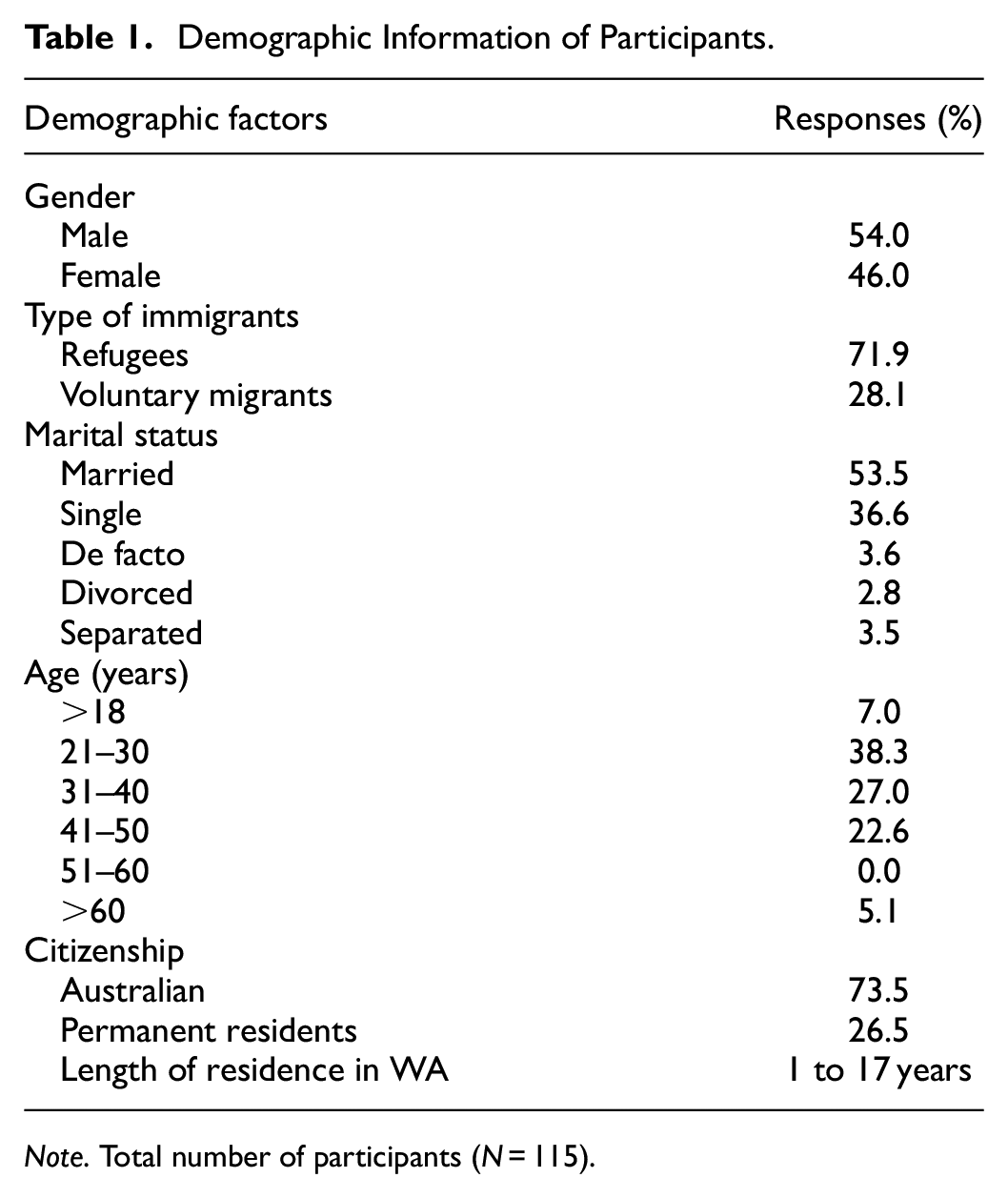
Note. Total number of participants (N = 115).
Separation Issues
Refugee participants who were separated from their families found this to be the greatest emotional challenge, and consequently developed psychological problems and homesickness. For example: I was always crying because I was homesick—you know! I was really homesick and was thinking about my people all the time, but the good thing is that I was with my husband and we shared our problems and issues. (Participant 26) I migrated here without any members of my family, apart from my husband and my children. When I arrived, I expected a sibling to join me to make life a bit easier [with children] but I found the migration process quite cumbersome, especially when it comes to family reunion. It really affected me mentally to the extent that I had to use counselling services. (Participant 8)
Language Barriers
Many migrants considered using English language to be the prime challenge affecting their resettlement process. Some participants came from English-speaking countries, but others came from French-speaking countries, such as the Democratic Republic of Congo (DRC). They had lived in refugee camps for a long time before coming to Australia, and had not had any opportunity to acquire familiarity with English language. Some participants explained such difficulties as follows: When I speak, they keep saying “pardon?,” like I’m not speaking English. That makes me feel like, “just shut up and don’t say anything.” (Participant 13) One of the greatest challenge is language, of course most of us have English as a second language; therefore, English will be one of the greatest barriers. (Participant 27)
Colloquialisms proved especially problematic and were liable to be taken literally. Participant 12, for example, said: “I think the most confusing and challenging part for me was when somebody would ask me, “how are you going?” and you tell them, “I’m going by bus,” but the person meant, “how are you doing?.”
Cultural Issues
Participants found themselves in a new society that was very different from their homeland, and felt confused by Australian culture. This applied both to societal values and structures. Participant 6, for example, stated: Well, when I came to Australia I found that we Africans are culturally very different from Western society in terms of values because in Africa, we tend to be very communal based, and in Western countries, it’s very nuclear and very individual based. So I miss the togetherness, the communal aspect of our culture in Africa, where people have time for each other and your neighbour is like your family. (Participant 6)
Adapting to a new culture extends to all aspects of daily living. New arrivals are faced with dramatic changes to diet, and to the purchase and preparation of food. They must make choices relating to clothing, their appearance and self-care. They now have ready access to “Western” medicines and modern health care, and must meet the bureaucratic requirements of citizenship, manage their financial affairs within the new system, and seek to participate in the community in a new and quite different way. The complexity of Australian society can represent a continuing and all-embracing source of anxiety for migrants.
Parenting Issues and Concerns
Nineteen participants had children with ages ranging from 1 to 28 years: most of the 11 childless participants were adults living with their parents, and aged between 18 and 28 years. All participants with young families were worried by the rapid adoption of the new culture by their children, and especially about them becoming acculturated into morally lax behavior including drug or alcohol abuse. Participant 14 said: Yes, with my big daughters, from their talking, I realise they are drifting into or they are sailing into these … and I’m able to bring them back. I tell them, ‘remember where we come from—Africa—with our culture. I don’t want you to get lost into the things you see here. You are not going to walk naked … in front of me. (Participant 14)
Unemployment and Underemployment
A significant challenge and cause of frustration for participants related to finding employment. Ten interviewees were unemployed, of whom four were studying at university: the remaining 20 were employed in various occupations. Having their non-Australian qualifications recognized by the Australian system was particularly difficult; furthermore, their previous experience was undervalued and their lack of work experience in Australia counted against them. Some of their responses were as follows: I’d say, not finding work in my field that I studied [is a challenge]. I did my university degree here, but I haven’t got the job related to my career, which is so distressing and frustrating. (Participant 7) Though we may have education back in our homeland, you come here, you struggle to have your qualifications recognised, and if they are recognised, the next battle is to find a job in your profession. (Participant 8) It’s not easy to get job opportunities. When you come and you are new—they always look at your experience in Australia, so it’s very hard to find a job. (Participant 24) The main problem I’ve encountered is getting a professional job with my Australian educational qualifications. I’ve also tried to improve them by getting additional university qualifications, which still doesn’t appear to help me getting a professional job. (Participant 20)
It is unclear whether the inability of the participant in the last example to obtain work commensurate with their Australian qualifications reflected a general shortage of employment opportunities or racial discrimination in a competitive climate. As “head of the family,” the men felt responsible for providing material and financial support, but this was undermined by the difficulty in finding appropriate employment. It was easier to find poorly paid jobs than professional ones, and this placed them in financial difficulty. Participant 6 said: Of course there are financial difficulties because when we Africans come to Western countries like Australia, we have a financial handicap because of unemployment. It’s very difficult for us to financially keep up. Then there are barriers of stereotyping, whereby people look at you and then they assume certain things about you which affects you in a harmful way—mentally when you’re looking for jobs. (Participant 6)
Racial Discrimination
Many participants in this study reported that they or their family members had experienced some form of racial discrimination in their workplaces, public places and their communities in Australia, and felt that equal opportunity laws provided inadequate protection. For example, they believed that employers circumvented these laws by manufacturing other reasons for refusing to employ them. The following participants stated: It’s more racist here—racist on the way to where you are going from your house or bus stop or shopping centre. I was going to school, somebody shouted at me when he was driving saying I should go back to Africa. This was not good because they say there’s no racism here, but I can see [it] and it’s too much. Even my brother-in-law also faced the same problem when somebody wanted to crash him with the car. The man stopped and never even apologised and started saying, “Why are you here? Go back to Africa.” He forgot his mistake started saying what was in his heart, contributing to the pain. (Participant 21) Number one I would start with work—work situation has always been difficult. It’s only recently that I’ve been able to settle, but four and half years of the five years I’ve been here have been a nightmare. You have to make ends meet, so you have to work, but you go to work and people treat you like you are nothing; nobody wants to listen to you. You’re bullied at work and nobody cares—not even the boss. You make a report, all that will be done is that it’s okay, you will work with someone else, but basically that other person who bullied you isn’t given a warning or anything like that, so they’ll come around and do it again. You spend most of your time at work fighting people. (Participant 23)
Overall, then, participants talked freely about their resettlement challenges and the impact they had upon them.
Discussion
The barriers to resettlement were elicited by examining the occurrences of narratives about negative resettlement experiences in Australia. The researchers read through the transcripts three times to identify such occurrences. As per inductive analysis, the researchers allowed the data to construct the barriers to resettlement. Not only explicit negative words were considered but also the researchers derived meanings from narratives of acceptance and normalization by the participants of aspects of disadvantage as a “natural” process.
The major challenge identified by the majority of participants in our study was the language barrier and the problem of using English effectively. This concurs with the study by Pittaway et al. (2009) who found that lack of proficiency in the English language negatively affected African migrants in securing employment, gaining further education and gaining access to community and support services in Australia. Similarly, the earlier study by Chile (2002) found that while African migrants to New Zealand were eager to participate in the activities of their host country, those who lacked English language skills could not do so. Therefore, it is imperative that in order to help the smooth settlement of migrants, not only must written and verbal information be made available in their first language, but the teaching of English, both formal and colloquial, should be a priority. Community participation, involving migrants who have already acquired bilingual fluency, and who understand the cultural issues, is the ideal way to address the problem. It has also been noted that since children acquire language more readily than adults, they may become useful intermediaries between adults and official agencies (Hyman et al., 1996).
Male participants identified financial constraints as undermining their traditional role as head of the family and principal breadwinner, and finding employment was a significant cause of frustration and challenge reported by Pittaway et al. (2009), who found that unemployment among African migrants in Australia was aggravated by racial discrimination and lack of work experience. Given the significant unemployment rate, this is a potential problem for many Australians, and dedicated resources are available across the country aimed at helping individuals obtain work. However, according to the Refugee Council of Australia (2011, pp. unnumbered), “Generalist employment services, such as job active, are ineffective in supporting this group in finding work.” According to the Australian Institute of Family Studies (Smart et al., 2017), only 6% of refugees find work within 6 months of arrival, but that increases to nearly 25% after 2 years.
Perhaps the most that can be expected is that all those seeking work receive the same degree of assistance, free of racial discrimination. Unfortunately, more than half of the participants interviewed (18 of 30) felt there was a significant amount of either open or subtle racial discrimination in Australia. Consistent with previous studies, participants reported that they or their family members had experienced some form of racial discrimination, consistent with Farida and Silvia’s (2008) conclusion that refugees in Australia experienced high levels of discrimination. Murray (2010) found that one-third of participants in her study (N = 90) experienced discrimination; Shakespeare-Finch and Wickham (2010) reported that six out of a sample of 12 Sudanese refugees reported experiences of racial discrimination, and recounted examples of verbal abuse; and, Sudanese refugees (N = 20) in Abur and Spaaij’s (2016) study linked unemployment to racial discrimination.
Concerns found in Australia over the rapid acculturation of their children, and their adoption of what migrants viewed as unsavory habits, were also reported by McBrien (2011) among Vietnamese, Somali, and Iranian refugee mothers in the U.S. This is consistent with a number of earlier U.S. studies (Aronowitz, 1992; Titzmann & Jugert, 2017), which found that the transition between childhood and adulthood generated significant conflicts between young migrants and their parents and that this played a major role in the resettlement process. Renzaho and Vignjevic (2011) also established that refugees to Australia from Liberia, Sierra Leone, Democratic Republic of Congo (DRC), and Burundi were faced with challenges arising from the markedly different parenting practices in their host country.
The American experience suggests that the receiving society must accommodate the previous cultural norms to the extent that is both practical and legal, whilst assisting in the acculturation process.
Limitations
The study used a convenience sample, rather than a randomized sample, which limits the generalizability of the results. It is possible that participants in this study may have self-selected by being able to read recruitment fliers because no participant required help with reading or an interpreter. We therefore recommend that future studies use a larger probability sample which captures more African countries of origin to ensure that the possibility of bias is minimized and to increase generalizability.
Recommendations
Around two-thirds of the participants in this study were Christians. They reported that attending faith communities/organizations was helpful and made their resettlement easier. The implications of these findings are that the Government’s Migrant Support Service Providers (MSSPs) should recognize the importance of religion in the resettlement process and revise the service policy to reflect the importance of the spiritual needs of newcomers. Simply providing them with the location of churches, mosques and religious organizations, would be a useful start. Other key issues that clearly need to be addressed more intensively, include the education of recently arrived migrants about childhood risks, child protection, bullying and the rights and protections available to children in Australia. As in the case of the language problem, these are best addressed through cultural mentors. It is also worth mentioning that the sophisticated technology taken for granted by most Australians is likely to prove confusing for migrants from under-developed countries, and that community education needs to ensure that they are not thereby disadvantaged.
More than half of the interviewees reported that they or members of their families had experienced racial discrimination in one form or the other. The implications of these findings are that the entire resettlement process demands collaboration, acceptance and mutual respect between individual African migrants and members of the Australian community. Governments at federal, state and local level, and the media, should provide education to host communities about the impact of racial discrimination and the importance of accepting migrants regardless of the country of origin or colour of their skin, to help them integrate into Australian society both socially and economically.
Conclusion
The present study was undertaken because of an increase in the number of African migrants to Australia, and addressed major resettlement challenges affecting African migrants. The existing research exploring the resettlement challenges of both groups is limited, the focus having been consistently on migrants. The study confirmed that for both groups, migrating to Australia can generate much optimism but the challenges associated with resettlement can have a significant negative impact on their well-being.
The study suggested that the greatest challenge for migrants from non-English-speaking countries concerned the language barrier, and for men especially this dovetailed into the challenge of obtaining employment. This in turn was identified by male participants as undermining their traditional role in the family as the principal breadwinner. Our study also found that the majority of participants, or their family members, experienced racial discrimination which affected them mentally and resulted in feelings of marginalization. Participants with families had concerns over the acculturation of their children into “bad habits,” including drug or alcohol abuse.
The findings of this study confirm and support existing research as it concerns African migrants and highlights the major challenges they face in Australia. The findings strengthen the knowledge base informing the development of effective ways to facilitate their resettlement.
Footnotes
Acknowledgements
The authors would like to acknowledge all participants in this study because, without them, it would not have been possible to undertake this study.
Author Contributions
Dr. Irene Ikafa designed the study, data collection, and data analysis and developed the first draft of the article. Dr. Colin Holmes oversaw the development and revision of the article, contributed to the revisions, and proofread the final document. Dr. Dieu Hack-Polay and Dr. Maria Kordowicz contributed to the literature review and reviewed the series of drafts. All authors reviewed the initial coding developed by Dr. Ikafa and reviewed and approved the final draft.
Declaration of Conflicting Interests
The author(s) declared no potential conflicts of interest with respect to the research, authorship, and/or publication of this article.
Funding
The author(s) received no financial support for the research, authorship, and/or publication of this article.
Ethics Approval and Consent to Participate
The Murdoch University Human Research Ethics Committee approved the study (Ref: 2007265) to conduct this investigation. Informed consent was obtained from all participants. Each prospective respondent was provided with a Participant Information Sheet, which detailed the aims and scope of the study. The participants were assured of complete confidentiality and anonymity, and that any response would be identified only by a number or pseudonym that could not be traced to any specific individual.
Consent to Publish
As part of Murdoch University’s consent form, consent for publication was obtained from all participants.

Availability of Data and Materials
The datasets generated and analyzed during the current study are available in the Murdoch University repository.