



Abstract
A vital goal of this article is to examine waterfront development and creative class roles. It also discusses the importance of critical evaluation for sustaining social inclusion on urban waterfronts. Testing took place on the Kyrenia waterfront upgrade for creative classes and other people to determine waterfronts’ physical, functional, social, and cultural suitability. To determine the preferences, needs, and satisfaction levels of urban waterfront users, a survey, along with structured observations, was conducted: cultural and creative places and activities, appropriate rules and regulations, motivated entrepreneurs, continuous fund opportunities, preserving the historical context, cultural heritage, and unique values, physical and functional sufficiency, social well-being, and adequate accessibility, as well as tolerance and open-mindedness. A survey was conducted (sample size = 250), and subsequent systematic observations were conducted to obtain the data. As the survey findings indicate, the Kyrenia Waterfront has physical, functional, cultural, and social barriers that challenge both creatives and prospective creatives, including students and employers. Physically, inadequate infrastructure and accessibility challenges were reported. Functionally, limited amenities and inefficient land use were identified. Culturally, a lack of preservation of historical elements was evident. Socially, a sense of exclusion and inadequate community spaces were noted. These obstacles result in reduced attractiveness, limited community engagement, and hindered economic potential for the Kyrenia Waterfront. While the severity may vary, similar issues likely extend across the city, suggesting a broader urban challenge rather than a unique problem specific to the Kyrenia Waterfront alone. Critical evaluation is an essential component of the design process. Critical evaluation should involve collaboration among design professionals, clients, users, communities, public officials, and relevant experts to ensure a holistic and practical design outcome. Comprehensive policies should address the results of such an evaluation. Hence, it should be considered when determining what is required to create a community inclusive of all creative class segments.
Introduction
There are many types of waterfronts—such as lakefronts, waters of rivers, canals, harbors, or bay fronts (Iwata & Del Rio, 2004). Settlements appear to form around waterfronts due to their relationship with communities. These areas were once predominantly used for export and transportation (Hoyle, 2002). Besides, historic waterfronts began to be reused, renovated, regenerated, restored, or redeveloped. The governance of the Kyrenia waterfront is tied to the place’s competition by preserving its historical function as a trading hub. It maintains historical structures through regulations, adaptive reuse, and community engagement while integrating modern uses, attracting visitors seeking authenticity, and contributing to sustainable economic growth (Üzümcüoğlu & Polay, 2022c). The city’s identity is becoming increasingly shaped by environmental, social, and economic factors (Iwata & Del Rio, 2004). Therefore, waterfront impacts draw the interest of many disciplines, including planners, urban designers, politicians, and key decision-makers. Besides being used for industry, waterfronts have other functions as well. Their location also makes these areas ideal for transport, trade, entertainment, and tourism. Due to this, these areas can be ideal sites for building new housing environments, hotels, recreational areas, sports facilities, and employment opportunities. These waterfronts provide breathing spaces for residents and ample space for memorials, housing, recreation, and mixed-use development. By using case studies in urban studies, this study contributes to a new research line of examining waterfront impacts. Since the creative class is the most productive in society, it should be integrated into the development process. Productivity is the most significant concern for developing cities in today’s competitive world. This article ultimately provides an opportunity to critically examine the values and impacts of waterfront areas and articulate new perspectives that could be useful to future studies.
Waterfront regeneration projects are often rooted in urban entrepreneurial governance, which involves the active participation of local governments, private investors, and community stakeholders to revitalize and develop waterfront areas for economic growth and social enhancement. Local boosterism plays a significant role in this process, as it entails promoting and marketing the local area’s unique attributes and potential to attract investment, tourism, and business opportunities (Hermelin & Jonsson, 2020). Here are how these concepts are interconnected:
First, urban entrepreneurial governance refers to the approach taken by local governments to stimulate economic development through collaborative efforts with private sector entities (Bruns-Berentelg et al., 2022; Hermelin & Jonsson, 2020). In the context of waterfront regeneration, this involves creating an environment conducive to investment, innovation, and business growth. Local governments often streamline regulations, offer incentives, and foster partnerships with private developers to drive the transformation of underutilized waterfront spaces.
Second, waterfront regeneration projects aim to transform neglected or underdeveloped waterfront areas into vibrant, economically viable, and socially appealing spaces. These projects often include residential, commercial, recreational, and cultural elements. Examples include constructing waterfront parks, mixed-use developments, cultural centers, marinas, and entertainment venues (Üzümcüoğlu & Polay, 2022a, 2022b, 2022c).
Third, local boosterism is the practice of promoting and highlighting the positive aspects of a city or region to attract outside investment, tourism, and attention. It often involves creating a positive narrative about the area’s history, culture, natural beauty, and economic potential (Balsas, 2022; Croese, 2021; Hermelin & Jonsson, 2020). In the context of waterfront regeneration, local boosterism can attract developers, investors, and visitors by emphasizing the unique qualities of the waterfront, such as its historical significance, scenic beauty, and recreational opportunities.
The interconnectedness between these concepts can be understood as follows:
Urban entrepreneurial governance involves collaboration between stakeholders, including local governments, private developers, community organizations, and investors. Local boosterism fosters this collaboration by presenting a compelling vision of what the regenerated waterfront could offer to the local community and external interests (Bruns-Berentelg et al., 2022; Hermelin & Jonsson, 2020). Besides, Local boosterism attracts private investment by highlighting the potential for financial returns in the regenerated waterfront area. Investors are more likely to commit resources when they see a positive narrative that aligns with their business objectives. Moreover, a regenerated waterfront can become a magnet for tourism and economic growth. Local boosterism helps create a brand identity for the waterfront area, making it more attractive to tourists and businesses (Croese, 2021). It can lead to increased foot traffic, higher property values, and the growth of local businesses.
Furthermore, Effective local boosterism involves engaging the local community in the regeneration process. When residents feel a sense of pride and ownership in their surroundings, they are more likely to support and participate in development efforts. This collaboration between local government, the private sector, and the community is essential for the success of waterfront regeneration projects (Enqvist et al., 2019; Üzümcüoğlu & Polay, 2022c).
Waterfront regeneration projects benefit from urban entrepreneurial governance by leveraging collaborative partnerships and investment opportunities. Local boosterism contributes to these projects by shaping a positive narrative, attracting investment, and fostering community engagement, all of which are crucial for the overall success of waterfront revitalization.
The comprehensive urban design considers all user needs and works to design non-segregated spaces and allow every person to participate in contemporary facilities. By applying the main principles of comprehensive urban design, almost everyone, including the creative class, can enjoy improved livability, and quality of life. By involving creative class members in every phase of urban space design, built-environment professionals can better understand how to create environments that enhance productivity. Quality measurements allow for continuous improvement of redesign projects during the design process. Urban waterfronts can gain a more comprehensive understanding of their users by implementing critical evaluations.
Critical evaluation can be used to determine the effectiveness of an environment. A user-based evaluation is conducted after a construction or redevelopment project is completed. Critical evaluation research seeks to assess the level of user satisfaction and the suitability of space for its intended purpose in architectural or urban contexts. A primary determinant of evaluations is the effectiveness of functional programs, and the type of program end users require. It is possible to obtain reliable data by employing objective criteria instead of subjective judgments, which can be shared with other designers. The evaluation of a facility is conducted after the project has been completed to evaluate its success or failure, determine immediate problems and their solutions, determine the feasibility of creative concepts and ideas, adjust the operation, and examine the effect on the urban environment.
Critical evaluation emerged as an academic field in the 1960s and 1970s, focusing on human behavior and architecture. Environmental evaluation remains a continuous process to meet the demands of current social trends, such as accountability, accessibility, and sustainability.
There have been few critical evaluations of the design requirements of the creative class, employers, employees, tourists, and locals, and little attention was given to this group of people: engineers, scientists, advertisers, and LGBT individuals. It is also pertinent to note that no study has identified the needs of all urban waterfront users. While this paper focuses on the importance of physical, functional, social, and cultural performance measurement around the waterfront, the analysis of the exclusion of the creative class, employers, employees, tourists, and locals can be precious.
The present study is intended to examine the environmental quality of the waterfront. This study uses demographic information to propose critical evaluation criteria for the creative class, employers, employees, tourists, and locals. Research in this article is limited to the creative environment patterns in urban waterfront spaces; therefore, it did not include other user groups. A critical evaluation was conducted on the Kyrenia Waterfront. Kyrenia, one of Cyprus’ major coastal settlements, has an urban core with a large mix of residential, retail, and recreation uses and many cultural, historical, and architectural attractions. Both residents and tourists can take advantage of the numerous opportunities in the urban core through its attractiveness as a place to live, work, and play. The urban core has declined recently due to accessibility concerns and physical limitations. Local governments have responded by providing access to public spaces and functional opportunities. A critical evaluation study may contribute to the success of a development project still in its infancy.
The study aimed to establish links between the creative environment and urban waterfront considerations, including defining a critical evaluation methodology. This method focuses on their functional, physical, cultural, and socio-environmental qualities to understand how urban open spaces perform for their users. Evaluation maps are developed Based on survey data, systematic observations, and a critical evaluation methodology. A waterfront suitable for all aspects of society can be designed and planned using the study results.
Criteria for Establishing a Creative Environment in Urban Waterfronts
Waterfronts have been considered open public places. Open public places have been acquired through contemporary urban development strategies. Numerous waterfronts have been exposed to political, socio-cultural, economic, and technological circumstances throughout history. Consequently, these factors have influenced urban design and created new trends. It is imperative to evolve waterfront requirements continually. Waterfront areas also tackle creative environmental issues (Carta, 2012; Jones, 2017; Kostopoulou, 2013; McGovern, 2008; Sepe, 2009, 2010; Sepe & Di Trapani, 2009). Carta (2012) suggested the definition of the third generation for waterfront planning. The first generation is based on leisure, the second on cultural and service investments, and the new third-generation waterfront must use creativity to drive city competitiveness and quality.
The study focused primarily on this framework and focused on the connections between urban waterfront considerations and creative environment criteria, such as adequate policies, motivation of relevant stakeholders, creative and cultural places and activities, motivation of entrepreneurs, the protection of unique values, physical and functional sufficiency, social well-being, and accessibility, tolerance, and open-mindedness. Consequently, the creativity and environmental quality at urban waterfronts are enhanced. The following paragraphs provide an overview of the criteria for establishing a comprehensive urban waterfront development program.
To provide comprehensive urban spaces, the motivation of the creative class has a significant role in producing innovative ideas. The planning authorities should have adequate rules and regulations to guide them in determining which design statements are necessary to check the suitability of planning proposals (Hall, 2000). Policies had to support a creative class that included scientists, engineers, architects, designers, writers, artists, musicians, writers of poetry, advertisers, film editors, software engineers, and fashion designers to reach a place like a studio, laboratory, R&D centers, and relevant creative hubs (Cheng & Chen, 2023; Florida, 2002). In other words, the key stakeholders need a place to discuss and create (Florida, 2002; Hall, 2000; Rodrigues & Schmidt, 2021). Waterfronts play significant roles with their emotional atmosphere and attractive appearance (Kourtit & Nijkamp, 2013). Besides, locating the needed functions along the waterfronts is sufficient to increase productivity. Port cities can enlarge their creative spaces and capacities by protecting historic harbors as both a showcase and reusing them and accommodating creative industries. Creative and cultural activities play an essential role in waterfront-diversified development by providing wealth and employment opportunities and upgrading the city and area image (Chang & Huang, 2010; Miloš & Dragana, 2021; Rasal, 2012; Zhang et al., 2021; Q. Zhou, 2020).
In order to enable continuous improvement in urban areas, relevant policies are also significant to motivate entrepreneurs for investment activities (Hall, 2000; Rodrigues & Schmidt, 2021; L. Zhou et al., 2023). These activities are essential for continuous fund opportunities. By providing adequate policies and entrepreneurial activities, the creative class becomes motivated, and productivity has increased (Grubbauer & Čamprag, 2019). Moreover, each waterfront has its unique values and importance. Exiting and essential historical context, cultural heritage, and unique values had to be protected (Fernandes et al., 2017). It is essential for an attractive cultural and creative environment.
Besides protecting historical values, contemporary achievements should be followed to catch the required physical well-being and modern functional opportunities (Iwata & Del Rio, 2004; Oakley & Johnson, 2013; Sousa et al., 2016). Some activities that motivate creative productivity along the waterfront are festivals, exhibitions, techno fests, symposiums, conferences, culinary workshops, and art craft workshops (Cheng & Chen, 2023). The creative environment is not just based on the visit of heritages; it also includes the visit to contemporary culture.
In creative environments, different social groups had to feel safe and attracted. Different age groups, ethnicities, education level individuals, and genders provide a variety of society, an essential pillar for creative productivity. Moreover, disabled individuals, cyclists, pedestrians, and public vehicles need adequate accessibility opportunities (Andersen & Røe, 2016). It is vital for comfort, safe use, and well-being at the waterfront. For a safe and comfortable destination, a sufficient level of tolerance is also significant (Ibert, 2019). The waterfront users, including locals, employers, employees, the creative class, and regular tourists, had to be open-minded and face an open-minded society. People with different ideologies, beliefs, and ethnicities had to share the area in the secured ground (Rodrigues & Schmidt, 2021). Moreover, LGBTQ individuals had to feel safe and secure (Florida, 2002).
The urban waterfront has undergone a paradigm shift in the last several decades as researchers began to investigate the dynamic interaction between people and the environment rather than focusing solely on individuals and their environment. New paradigms of urban design and planning study focus on the creative class, employee/employer relations, tourists’ perspectives, and inclusive design. All these studies argue that inadequate waterfront facilities hinder people’s full access and participation in contemporary urban life. Urban waterfronts are inadequate for some people because of cultural, physical, and social barriers. The primary solution is to remove barriers by expanding creative and cultural places and activities, establishing adequate rules and regulations, and motivating entrepreneurs, besides enhancing the availability and accessibility of funds, protecting the existing and essential historical context, cultural heritage, and unique values, ensuring physical and functional sufficiency, as well as promoting a sense of inclusion, tolerance, and open-mindedness.
Creative classes are motivated in creative environments, and creative and cultural environment activities are attractive (Richards, 2020; Zhang et al., 2021). It is an essential pillar for economic growth at the waterfronts. Tourism has always positively affected city identity, regional cultural practices, sports, nature, and vice versa. Cultural tourism causes the growth of mass tourism. Nowadays, mass tourism has more creative forms (Duxbury et al., 2021; Roberts, 2010).
In this study, the values and impacts of creative waterfronts were simplified by developing a section that represents the features. The section was developed by considering the literature review during this study.
A “creative waterfront” finds its place within urban literature as a multifaceted idea that melds urban development, cultural vibrancy, and economic regeneration. Positioned as a subcategory, the imagery of the place and city branding theory emerges as a potent approach to unify the six discernible qualities (as depicted in Figure 1). This integrated perspective serves as a pragmatic bedrock for meticulous analysis and a strategic framework for policy formulation and urban planning. By leveraging place branding principles, this notion becomes a conduit to elevate public consciousness about innovative thinking (Eugenio-Vela et al., 2019; Shirvani Dastgerdi & De Luca, 2019a, 2019b). Doing so lends vital support and impetus to the diverse spectrum of recommended activities, effectively fostering an environment where creativity thrives and flourishes.

Summary of values and impacts of creative waterfronts.
Study Area: Kyrenia Waterfront, Cyprus
A critical analysis of the Kyrenia Waterfront was undertaken as part of this study. The city of Kyrenia is situated on Cyprus’ coast and has a thriving mix of historical, architectural, and cultural attractions. Most islanders and numerous tourists currently visit Kyrenia. With its natural beauty, history, castle, and harbor, it is considered one of the most beautiful urban waterfronts in the world.
Since 2000, however, urban sprawl has been a problem in Kyrenia. Generally, new buildings do not consider the three-dimensional qualities of their surroundings or the activities occurring within the outdoor area. In response to these recent developments and their negative impact, Kyrenia’s municipal government has developed a scheme to upgrade the city’s urban space. The city of Kyrenia introduced A new scheme in 2005 to improve accessibility in the city for both locals and foreign tourists. Unfortunately, the modifications for the creative class were not incorporated into the plan. All movement areas have been upgraded, including urban furniture, sidewalks, pedestrian crossings, and parking spaces. Delineating large portions of the urban waterfront as pedestrian zones and adding additional landscaping and streetscape elements have enabled users to enjoy urban waterfronts comfortably and safely. Some improvements have been made (Guvenbas & Polay, 2020).
Establishment of additional parking facilities for vehicles by designating or adding parking spaces and access aisles for people with disabilities; Displaying warning signs for drivers to ensure pedestrian safety; Installing safety bollards to provide pedestrians with protection from vehicular traffic; Establishing regular maintenance schedules and increasing their frequency; The installation of additional sitting elements; Renovation of public restrooms; New laws are enacted relating to parking and traffic management to ensure pedestrian safety.
Political and financial obstacles prevented adopting the redeveloped waterfront improvement plan as of 2017. The Municipality is looking for ways to implement the proposal as part of its development. The study will examine the physical, functional, cultural, and social characteristics of Kyrenia’s waterfront following the completion of several improvements. In addition, the project will contribute to the Municipality’s future redevelopment and redesign plans.
Preliminary site visits were conducted to select representative samples from the area of the Kyrenia Waterfront that has been developed. Kyrenia Castle and Atatürk Square, the central attractive zone between those two sites, were selected for critical evaluation. This zone is the central activity axis of Kyrenia, so most visitors travel to Kyrenia through this travel link. It contains a variety of urban spaces within its borders. The Ataturk Square, Children’s Park, and streets along the ancient harbor were evaluated according to the comprehensive waterfront development criteria (Figure 2).

Kyrenia waterfront.
Procedure
Focus Group
This study seeks to identify the unique needs of individuals with various well-being characteristics, including creative class members, employers, employees, and tourists. Creative class refers to a large group of productive individuals, including artists, engineers, advertisers, architects, and photographers. Further, employers, employees, tourists, and students may not be considered creative class, but they may enjoy the same physical, functional, social, and cultural accommodations.
Methods
The research design, data collection, analytical processes, and analysis of the findings were all carried out within a systematic framework. An initial content review was conducted by reviewing literature reviews, completing questionnaires, and performing on-site surveys utilizing photographs and AutoCAD drawings. A study design was selected for collecting and analyzing the data. A survey was undertaken, followed by observations to complete the functional map. Various comparative statistics were conducted on the data collected, such as percentiles, averages, and standard deviations. Correlations were determined through statistical analysis. Lastly, the results of data analysis were evaluated and compared to the expected criteria for comprehensive design.
Survey
Randomly selected participants were drawn from the general public, residents of other cities in Northern and Southern Cyprus, and tourists. A simple random sampling procedure was used to select the focus group for the survey, ensuring everyone had the same opportunity to be chosen. Since it is impossible to estimate the exact number of users, the sample size was calculated using the formula for non-finite populations, a 95% confidence interval, and a 5% margin of error. The formula for calculating sample size is shown in Equation 1.
Equation 1. Daniel and Terrell’s (1995) formula

n = sample size, Z = confidence coefficient (z = 1.96 for 95% confidence level), N = population size, p = proportion of the sample in the population (as the proportion of the sample in the population was unknown initially and due to the lack of a preliminary investigation, values p and q were taken equal and 50%), q = 1−p = 0.5, D = Sampling error (10%)

By using this formula, n is calculated to be 95. Therefore, a random sample of 250 people was taken for reliable results. From September to November 2020, residents and visitors were interviewed directly on weekdays and weekends.
Results
This section presents the results of the data analysis within the survey framework. Even though observation and survey results were presented together, significant correlations are also included.
Respondents’ Profiles
Respondent profiles were compiled to get a sense of their demographic characteristics, such as their gender, age, socio-economic status, and their education status. According to the survey results, most young people prefer to use the case space with the 18 to 44 age groups (81.0%). The male population (67.6%) was more than female (27.9) and LGBTQ individuals (4.5%). It is found that the bulk of respondents have a university education level. Besides, the foremost are employed or university students (55.9%). Generally, Cypriots (49.0%) and Turkish citizens (32.8%) are visiting the location. The creative class (38.5%) conducts most of the users. Local (36.4%) and residents of Kyrenia (44.9%) were the central part of users throughout the site visit. Besides, they visit the site weekly and monthly (Figure 3).
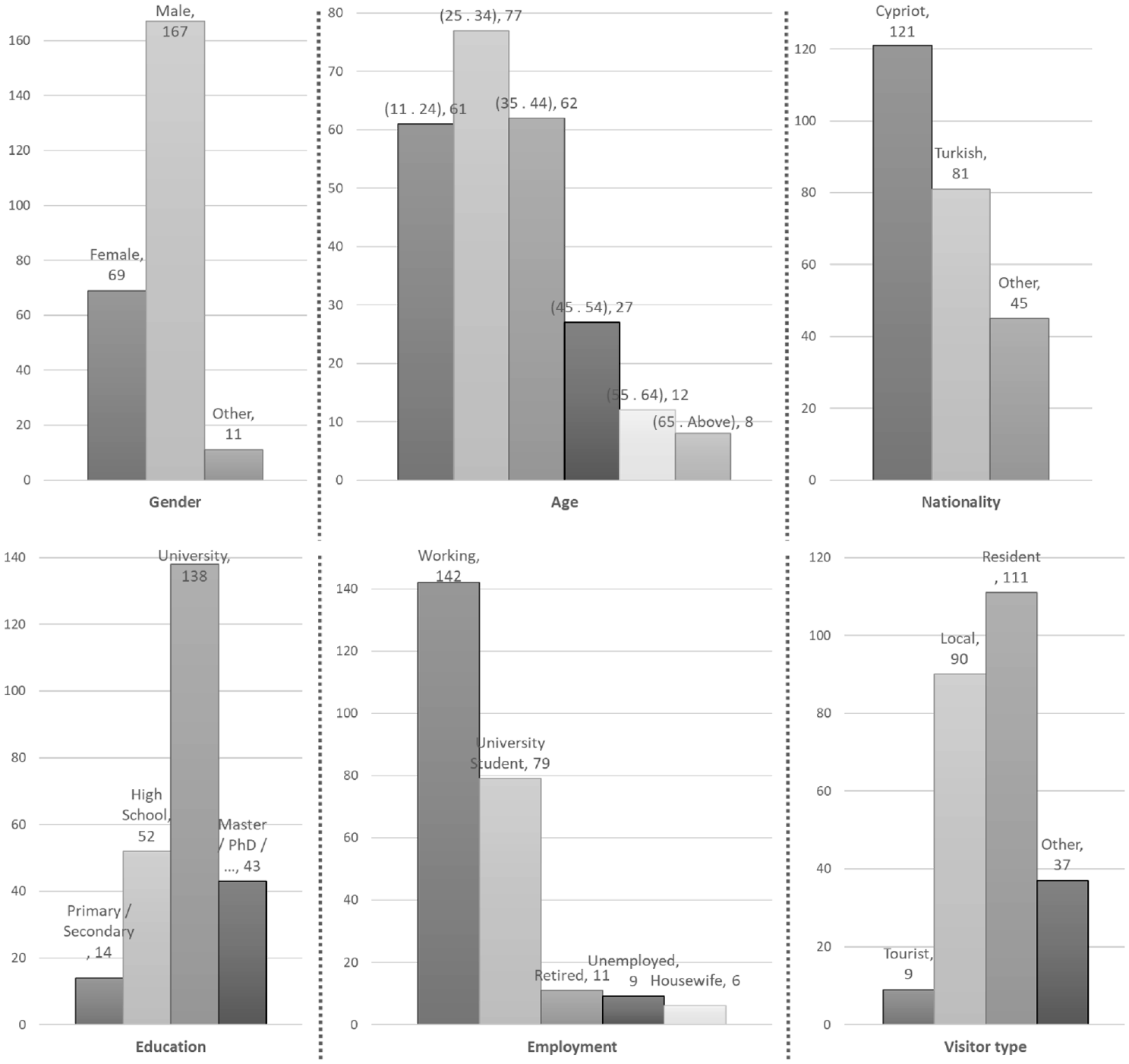
Socio-demographic characteristics of the sample.
Most users prefer to pay their time at the Kyrenia Waterfront (89.9%). Moreover, they are suggesting this place to others (74.1%). On the other hand, they are not well satisfied with all the urban area amenities of the site. Moreover, they are not satisfied with the accessibility level of transportation, the sufficiency of disabled access, cycling access, the physical condition of pedestrian access, and, therefore, the condition of vehicle access (62.3%) (Figure 4).

Satisfaction of the participants.
In order to identify the impact of the values of waterfronts as creative environment destinations, respondents were asked to rate the influence of several features the area possesses. All the items were assessed through a five-point Likert scale ranging from 5 = completely agree to 1 = disagree entirely.
The results of the descriptive analysis of the questionnaire variables in Table 1 showed that all variables had a normal distribution. T skewness and kurtosis scores for all variables were between the limits of ±3.3 (Sposito et al., 1983).
Perceived Values of Creative Environment Destination at Kyrenia Waterfront.

Note. Std. Dev. = Standardized Deviation; Min. = Minimum; Max. = Maximum.
As seen in Table 1, in each set of values, several features are rated as the most influential on the creative environment; according to the number that occurs most often in the data set, tolerance, and open-mindedness (Value 6) achieved a high rating by most respondents. Value 2 to 4 seems in the average range by the respondents. Value 1 and 5 are the worst features of the area. According to most respondents, creative and cultural places and activities had to be increased, so social well-being and adequate accessibility needed to be provided.
Amongst several conditions making the creative environment, Kyrenia Waterfront, as the sufficiency of tolerance and open-mindedness (Value 6), achieved the highest rating by the respondents. On the other hand, there are significant differences among the user groups for Value 6 (Figure 5). These results showed that the creative class is the most similar user group regarding tolerance and open-mindedness (mean = 2.981), while others are the most disagreed user groups (mean = 3.819). The mean differences between these two groups are the largest and most significant differences between user groups (mean difference = 0.839). This difference for the groups’ employees, employers (mean = 3.129), and locals and students (mean = 3.167) compared to the other tourists’ group is also significant (mean difference = 0.690 and 0.653, respectively).

The means plot of “tolerance and open-mindedness,” and user groups.
It was mentioned that Kyrenia Waterfront, as the sufficiency of “tolerance and open-mindedness” (Value 6), achieved the highest rating by the respondents in general. Besides the significant difference among the user groups, there is a major difference among the genders (Figure 6). These results revealed that males are more agreed or neutral about the sufficiency of “tolerance and open-mindedness” (mean = 3.051) than females (mean = 3.539). That is, the mean differences between these two groups are the largest and the most significant differences between the genders of participants (mean difference = 0.488). It is essential to mention that LGBTQ individuals rate the sufficiency of “tolerance and open-mindedness” as low. The place had to be secure at an appropriate level to ensure all society’s safety. Besides, the awareness level of the locals and residents had to be increased by educative events like seminars, workshops, courses, and symposiums. Knowledge-sharing events and society’s safety are two essential pillars of creative environments.

The means plot of “tolerance and open-mindedness,” and gender.
The link between the creative class and their satisfaction using the Kyrenia waterfront was established through statistical analysis examining correlations between demographics, behaviors, attitudes, and overall satisfaction. A survey or study may have been conducted to collect data from individuals who frequent the waterfront.
The six values correlated with the satisfaction of the creative class, based on the results:
In this context, the emphasis on tolerance and open-mindedness is justified because these traits align with the characteristics often associated with the creative class. The creative class comprises individuals who value diversity, new experiences, and cultural interactions, making these attributes crucial determinants of their satisfaction. By focusing on these traits in the analysis, the study sought to pinpoint specific factors that resonate with the creative class, enhancing their enjoyment of the waterfront environment and aligning with the broader goals of the article, which likely aim to attract and retain creative individuals to contribute to the area’s cultural and economic growth.
Discussion and Conclusion
Reviewing the results of previous urban design projects is beneficial to creating urban spaces that meet the demands and interests of all users. In critical evaluation, one can comprehend user needs and open possibilities for improving urban spaces’ performance and quality. This paper demonstrates that a critical perspective can address the comprehensively designed waterfronts according to what has been referred to as a “user-friendly” waterfront. Creative and cultural places and activities, adequate rules and regulations, motivated entrepreneurs, continuous fund opportunities, protecting the existing or essential historical context, cultural heritage, and unique values, contemporary physical and functional sufficiency, social well-being, and adequate accessibility, as well as tolerance and open-mindedness, contribute to waterfront development’s physical, functional, social, and cultural success.
Kyrenia was partially refurbished to upgrade the area’s public amenities and enhance the quality of public open spaces. Equal opportunities for all people, including the creative class, became an integral part of the improvement plan for the town center. The critical evaluation analysis analyzed the experience of waterfront users of inclusion in Kyrenia to assess the degree of inclusion in this area. Generalized results were obtained with representative samples to comprehend usage problems. The case study’s evidence reveals that even with existing upgrade schemes and project implementation, environmental barriers have still produced traces of exclusion. There are aspects of both the physical environment and the social environment that are not conducive to the needs of the creative class. Even so, these qualities remain desirable in general.
As in the findings, the number of creative places and activities is insufficient. It makes the place attractive less for the creative class or other visitors. Insufficient support from governmental authorities, decision-makers, and relevant stakeholders caused a lack of adequate rules and regulations for continuous maintenance. It makes the place motivation less for entrepreneurs or other investors. While existing cultural, historical, and unique values are generally protected, they are not sufficiently promoted. It reduces the awareness of unique values. Even though the place offers a variety of functions, its physical quality is inadequate. Generally, street furniture is not properly maintained. The area is not designed to accommodate disabled people, so disabled people cannot safely use the treads. Pedestrians, cyclists, and people with disabilities cannot use the area safely. Neither the waterfront nor its facilities are safe or comfortable for them.
Furthermore, the tolerance levels in society should be raised so that all age groups and people with different ideologies, cultures, and beliefs can find a safe and welcoming environment. Several factors prevent urban spaces from being inclusive environments. As a result, several recommendations were made to improve comprehensibility in waterfront:
Increasing public awareness of creativity, creative spaces, and creative activities (e.g., development centers, R&D centers, research areas, simulation areas, workshops, and conferences) can serve to enhance the dignity of the creative class as productive individuals by enabling them to belong to those whose territories have been diminished by society’s policies.
Under the framework, an inclusive policy must be developed, and the process of policy development and planning must include a deeper collaboration of efforts among diverse groups of users. For example, government policy needs to involve people who are vulnerable in decision-making processes, and frequent meetings can be organized to develop effective, comprehensive design solutions. Additionally, the community must be consulted during the planning phase of any upcoming design or development project to establish maintenance strategies. With the help of training programs, waterfront professionals can better understand integrated universal design approaches. University departments must add a comprehensive design course to their curriculums (i.e., architecture, regional planning, and urban design).
First, authorities have put in place upgrading strategies matching efficiency with traditional values; second, they have developed new developments while preserving traditional values; third, they have developed modern marketing methods that are culturally sensitive; and fourth, they have built ties between new and old. Tradition- or cultural-related stakeholders have a better chance of successfully renewing their relevant competitive advantage in the building or open environments value chain if they carefully balance the need to preserve and modernize critical processes in the relevant value chain.
As part of a more comprehensive approach to planning, pedestrian access must be prioritized. Urban design agendas must include pedestrian-oriented details and design considerations, such as buffer zones and expanded sidewalks to increase pedestrian comfort and safety. Adaptability and ergonomics of disabled people must be considered when designing street furnishings. It is necessary to increase the quantity and quality of parking spaces. By developing public transport, the need for parking can be reduced. To maintain comprehensibility at Kyrenia Waterfront, master plans for pedestrians and public transportation should be developed. Cycling lanes should also be provided with appropriate strategies.
A comprehensive development process must evaluate and reimagine design processes in light of performance benchmarks. Critical evaluation strategies must be developed To evaluate the effectiveness of implemented design initiatives based on comprehensive or universal design considerations. Future works should adopt an effective resolution aligned with critical evaluation to ensure future success.
In most cases, conducting a critical evaluation is beneficial to understand why individuals are excluded. The results of this study will be helpful in Kyrenia Municipality since the project will be ongoing. Further, the Municipality should perform critical evaluations on other projects regularly to determine the effect the newly designed or renovated environment will have on all users. This research is not just beneficial to Kyrenia. A systematic review like the one conducted at the Kyrenia Waterfront can assist the other interested authorities in creating more desirable and sustainable urban environments. A quality system should never be terminated for the sake of long-term success. These processes must be repeated to obtain valuable input on waterfront development guidelines. Therefore, the study’s methodology can be applied to other urban contexts with similar characteristics. However, further studies may assist with developing a more integrated approach for assessing the inclusion of other social classes not considered in this study.
Footnotes
Acknowledgements

Declaration of Conflicting Interests
The author(s) declared no potential conflicts of interest with respect to the research, authorship, and/or publication of this article.
Funding
The author(s) received no financial support for the research, authorship, and/or publication of this article.
Data Availability Statement
Data sharing not applicable to this article as no datasets were generated or analyzed during the current study.