




Abstract
Highly cited papers showcase high-quality research and encompass significant themes in the field. This study examined a total of 435 highly cited papers based on Essential Citation Indicators in the Web of Science (WoS) category of sport sciences with a bibliometric method. In particular, the bibliometric indicators of the highly cited papers including publication venues, authors, countries, institutions, and the top cited publications were presented and analyzed in detail. An Abstract corpus was constructed to help identify the most frequently explored topics. VOSviewer was employed to visualize the co-occurrence networks of keywords. The study revealed the trending information of important contributors at the levels of journals, authors, countries, and institutes. The top cited publications can be grouped into three categories: guidelines, recommendations based on systematic reviews, and evaluations. The most frequently explored topics based on the Abstract corpus and the most frequently used keywords from VOSviewer mapping overlap to a great extent. Specifically, topics such as meta-analysis, systematic review, sport-related concussion, sedentary behavior, football, rehabilitation, and osteoarthritis are among the most frequently mentioned. The results provide the most updated publication characteristics and hot topics of highly cited papers in sport sciences and offer insights for academic researchers in future research.
Plain Language Summary
What are the top cited papers in the area of sport sciences? What are the publication characteristics of these highly cited papers? What are the most frequently explored topics? Researchers in the areas of sports and its neighboring disciplines are keen to find the answers. This paper uses a corpus-based bibliometric analysis to explore the highly cited papers based on Essential Citation Indicators in the Web of Science (WoS) category of sport sciences. An Abstract corpus was constructed to help identify the most frequently explored topics. VOSviewer was employed to visualize the co-occurrence networks of keywords. The study revealed the trending information of important contributors at the levels of journals, authors, countries, and institutes. Specifically, topics such as meta-analysis, systematic review, sport-related concussion, sedentary behavior, football, rehabilitation, and osteoarthritis are among the most frequently mentioned. The results provide the most updated publication characteristics and hot topics of highly cited papers in sport sciences and offer insights for academic researchers in future research.
Introduction
Academic professionals are highly motivated to publish under such perceptions as “publish or perish” (Aliukonis et al., 2020) or “visible or vanish” (Barton & Merolli, 2019),leading to a significant rise in the number of publications produced at an unprecedented pace and a growing concern for quality in recent years. The citation has been regarded as an important indicator of research quality. However, citation distributions display an extremely skewed pattern. A large part of scientific publications is never or seldom cited while some papers receive a very large number of citations (Aksnes & Sivertsen, 2004). It is generally acknowledged that papers with more citations are more influential and deserve more attention in their fields. In other words, citations are strong indicators of research quality in research assessments. On the one hand, researchers are consistently interested in seeking high citations for their work and tend to follow the research with high citations. This enables them to remain up-to-date with the research trends and make informed decisions about potential research topics (Yan et al., 2022). On the other hand, high citations indicate more visibility, often accompanied by more support from public or private funders. “Many countries are moving towards research policies that emphasize excellence; consequently; they develop evaluation systems to identify universities, research groups, and researchers that can be said to be “excellent” (Danell, 2011). In addition, highly cited papers (HCPs) are crucial in maintaining the credibility of scientific institutions. Researchers feel a sense of pride if their papers are selected as HCPs.
Essential Science Indicators (ESI), an analytic tool offered by Clarivate Analytics for identifying the top-performing research, is frequently employed to evaluate the HCPs in Web of Science (WoS)-indexed journals, providing information such as the countries/regions (e.g., Csajbók et al., 2007; Fu et al., 2011), organizations (e.g., R. Ma et al., 2008), and authors (Harzing, 2015), among others. ESI-HCPs represent the top 1% in each of the 22 ESI subject fields and vary by fields and by years in a 10 years rolling period. To be considered a HCP, a paper must have acitation count that exceeds the 1% citation threshold of the corresponding research field and publication year. The top 1% HCPs are considered as the vanguards of the sciences because they showcase high-quality research and encompass important themes in the field.
In recent decades, studies have been conducted based on ESI-HCPs in many fields as countries, financial institutions, and universities strive to evaluate research performance by HCPs. For example, Hsu and Ho (2014) identified, analyzed, and visualized the characteristics of HCPs in the WoS category of healthcare sciences and services including years, journals, and institutions. Ioannidis et al. (2014) interviewed the top-cited authors in biomedical research for their views on their HCPs. Most of the authors claimed that their most important papers were indeed their top HCPs (. Some studies even try to predict the HCPs by building mathematical models, implying “the first mover advantage in scientific publication” (Newman, 2008, 2014). That is, papers published earlier in a field generally accumulate more citations than those published later.
Bibliometrics, a term coined by Pritchard (1969), is a set of methods in library and information science to study publication patterns and to track academic progression (Li & Lei, 2019; Wang et al., 2015; Zhu & Lei, 2022). Researchers used bibliometric methods to evaluate scientific developments, determine research impacts, and identify emerging fronts. There have been quite a few bibliometric studies in specific disciplines such as applied linguistics (Lei & Liu, 2019), management sciences (Liao et al., 2018), computer sciences (Banshal et al., 2015; Xie & Willett, 2013), etc. In sport sciences, some bibliometric studies have been conducted on specific sports such as Judo (Mancebo et al., 2013) and Rugby (Ríos et al., 2013) or certain sport-related topics such as aging and physical activity (Lidor et al., 1999), anabolic steroids and drug abuse (Agulló-Calatayud et al., 2008), and sport psychology (Baker et al., 2003), etc. Some other bibliometric studies in sport sciences focus on specific journals (e.g. Coronado et al., 2011; Grimby, 2011) or specific countries/regions (e.g. Valcarcel et al., 2010). In these studies, bibliometrics has been used to delineate the developmental trends and hotspots of a specific subject, generating bibliometric information including the most cited publications/journals and the most frequently explored topics, etc. Such information is of huge academic interest to researchers to bridge the gap between the present and the future. Academic institutions and government/private agencies may also take advantage of their findings in making funding and science policy decisions.
However, to our knowledge, no comprehensive corpus-based bibliometric study has been conducted in the specific WoS category sport sciences, which applies the study of science to sporting activities. As a relatively new and multi-disciplinary field, sport sciences includes the knowledge, methods, and applications of sub-disciplines of human movement studies (i.e., exercise physiology, biomechanics, motor control and motor development, exercise, and sport phycology) as well as how they interact. With the groundbreaking advances in sports technology and medicine, researchers in sports sciences are receiving significant funding and the related publication outputs are tremendous. A thorough bibliometric investigation of the discipline helps comb the existing literature, especially the HCPs, keep researchers informed of the current state of the field and its hotspots, and even provide guidance for future research.
Considering that there has not been much research in the WoS category of sport sciences, this study aims to spotlight the publication characteristics and hot topics of the HCPs with the bibliometric analysis and inform researchers of the most updated information in the field for future study. The study addresses two research questions as follows:
RQ1. Who are the most productive and impactful contributors of the HCPs in the WoS category of sport sciences in terms of publication venues, authors, countries, and institutions?
RQ 2. What are “the best of the best”? That is, the top HCPs.
RQ3. What are the most frequently explored topics in HCPs?
Materials and Methods
Data
The data were obtained from Clarivate Analytics’ ESI and WoS databases. As one of the most comprehensive literature databases, WoS is frequently used in bibliometric studies (e.g. Chavarro et al., 2018; Keramatfar & Amirkhani, 2019). The retrieval strategies are shown in Table 1. Following Yan et al. (2022),we extracted the bibliometric indicators of all the HCPs such as publication years, authors, publication titles, countries, organizations, abstracts, citation reports, etc, and saved them in Excel 2013 for computation and ordering. We removed the publications with missing or incomplete information. A total of 435 HCPs were harvested for further analysis. The data retrieval was completed on 18 March, 2022 at the portal of our university library. We collected the impact factor (IF) of each journal from the Journal Citation Reports (JCR) in 2021.
Retrieval Strategies.

Several points are to be noted. First, for the publications’ maximum quality, we searched the WoS Core Collection because it is one of the biggest and the most authoritative literature databases. It has been widely employed in previous bibliometric studies in natural sciences (Chen et al., 2018; Kalantari et al., 2017) and social sciences (Lei & Liu, 2019; Yan & Zhang, 2023). Van et al. (2018) and Ruggeri et al. (2019) indicate that the WoS core collection adopts high inclusion thresholds and guarantees the validity of any bibliometric analysis. Second, there is no need to restrict the document types because only articles and reviews are considered in ESI-HCPs selection. In the same vein, there is no need to set the date range becausethe dataset of ESI-HCPs is automatically renewed on two-months basis to include the most recent 10 years of publications. Third, all the retrieved HCPs are written in English except two in French. We translated their bibliometric information into English for further analysis.
Data Processing and Analysis
RCR Analysis
The citations a paper receives are closely related with the number of years since its publication (Yan et al., 2022). Generally, an earlier published paper will have more time to accumulate citations than a recently published one. Therefore, Raw Citations (RC) is not a reliable metric to evaluate paper impact. ). In our study, Citation Rate (RCR), a new metric that uses citation rates to measure influence at the paper level, was used to locate the most impactful papers. Based on weighting the number of citations a paper receives to a comparison group within the same field, RCR has been used to identify the most highly cited papers. The icite tool is used to generate RCR metrics for the HCPs (https://icite.od.nih.gov/).
Corpus Analysis
Corpus-based frequency analysis is an important method to explore the hotspots in one domain. The rationale behind this is that words or phrases that occur with greater frequency are more likely to form research topics. In this study, we built an Abstract corpus with all the abstracts of the 435 HCPs, totaling 116,351 tokens. The n-grams (2-4) in the corpus were then retrieved and analyzed to single out the most frequently researched topics in the HCPs. The procedures of the retrieval were as follows. First, the 435 pieces of abstracts were saved as separate txt. files in one folder. Second, Anthony’s AntConc, a corpus analysis toolkit for concordancing and text analysis (Anthony, 2022), was employed to automatically extract lists of n-grams of two to four continuous words in decreasing order of frequency. Following Lei and Liu (2019) and Yan et al. (2022), we also produced a list of individual nouns because sometimes individual nouns can also constitute important research topics. Individual pronouns, modals, and many other functional words are excluded because they usually do not constitute research topics. For topic candidacy, we adopt both frequency (5) and range criteria (5). That is, a candidate n-gram has to appear at least 5 times and in at least 5 different abstract files. The frequency threshold ensures the significance of the candidate topics while the range threshold ensures that the topics are not overly clustered in a limited number of papers. In this process, the authors tested the frequency and range thresholds for several rounds to include all the potential topics. In total, we got 443 nouns, 104 2-grams, 17 3-grams, and 4 4-grams. Third, concerning the list of n-grams and monograms (nouns here), the authors discussed extensively to decide their roles as potential research topics until full agreements were reached.
Keyword Analysis
In addition to the Abstract corpus-based word frequency analysis, we used VOSviewer1.6.18 (www.vosviewer.com) for knowledge mapping, a tool for constructing and visualizing bibliometric networks, in which we focused on the “link strength” between keywords. Knowledge mapping enables the mapping of the scope and structure of the discipline while revealing key research clusters. By using fractional counting, which assigns co-authored publications fractionally to each author (Waltman & Eck, 2015), we obtained proper field-normalized results. This process produced the co-occurrence network of the most frequently used keywords. Keyword analysis has been widely used to identify hotspots and research trends in recent years (Gong et al., 2019; Q. Ma & Zhang, 2020). Knowledge mapping of the keywords was an essential complement to the Abstract corpus-based investigation.
Results
Main publication venues
Of the 48 journals which published HCPs, 20 journals have contributed 5 or more (Table 2), around 89.4% of the total examined HCPs (389/435). The highest contribution comes from Br J Sports Med (#HCPs=102; #citations=26945), followed by Sports Med (#HCPs=53; #citations=13428), Am J Sports Med (#HCPs=42; #citations=11070) and Med Sci Sports Exerc (#HCPs=32; #citations=18152). The publications from these top four journals almost accounted for more than half of the HCPs (52.6%), indicating that researchers have strong inclinations to cite papers from these prestigious journals.
Main Publication Venues of HCPs.

Note. HCPs = the number of high cited papers; R = ranking of each journal for each indicator; HCPs(%) = the percentage of HCPs in each journal in total of 435 HCPs; TP = total number of papers in each journal in the examined timespan (2011–2021); HCPs/TP (%) = the percentage of HCPs in the total journal publications in the examined time span; TC = total number of citations of the HCPs in each journal; C/HCP = average citations per HCP; IF = Impact Factor; Q = Journal Citation Reports (JCR) quantile rankings. Br J Sports Med = British Journal of Sports Medicine; Sports Med = Sports Medicine; Am J Sports Med = American Journal of Sports Medicine; Med Sci Sports Exerc = Medicine and Science in Sports and Exercise; ARTHROSCOPY = Arthroscopy-The Journal of Arthroscopic & Related Surgery; J. Strength Cond. Res. = Journal of Strength and Conditioning Research; Appl Physiol Nutr Metab = Applied Physiology, Nutrition and Metabolism; Arch. Phys. Med. Rehabil = Archives of Physical Medicine and Rehabilitation; J. Athl. Train = Journal of Athletic Training; J. Int. Soc. Sports Nutr = Journal of the International Society of Sports Nutrition; J. Appl. Physiol = Journal of Applied Physiology; J Sci Med Sport = Journal of Science and Medicine in Sport; J Sport Health Sci = Journal of Sport and Health Science; Psychol Sport Exerc = Psychology of Sport and Exercise; Scand J Med Sci Sports = Scandinavian Journal of Medicine & Science in Sports; Int J Sports Physiol Perform = International Journal of Sports Physiology and Performance; J. Sports Sci = Journal of Sports Sciences; Eur. J. Appl. Physiol = European Journal of Applied Physiology; Knee Surg. Sports Traumatol. Arthrosc = Knee Surgery, Sports Traumatology, Arthroscopy; Eur J Sport Sci = European Journal of Sport Science.
Because the total number of papers published in each journal varies greatly per year and the HCPs are also connected with journal circulations, the total number of papers (TP) in the examined years (2011-2021) was divided by the number of HCPs to acquire the HCP percentage for each journal (HCPs/TP). As it is shown in Table 2, only four journals boast a HCP percentage above one: Sports Med (3.11), Br J Sports Med (2.68), and J. Int. Soc. Sports Nutr. (1.67), and J Sport Health Sci (1.29). On the one hand, it implies that papers published in these journals have a higher probability to enter the HCPs list. On the other hand, we can infer that the selection of HCPs in the WoS category of sport sciences is very competitive as the probability is comparatively low across all journals. From the perspective of average citations per HCP, HCPs from Med Sci Sports Exerc, Appl Physiol Nutr Metab, and Scand J Med Sci Sports had the highest C/HCP, with citations at 567, 314, and 292, respectively.
According to the latest journal impact factor (IF) in 2021, the top four journals with the highest IF are Br J Sports Med (13.8), Sports Med (11.14), J Sport Health Sci (7.179), and Am J Sports Med (6.203). The number of the HCPs in the four journals takes up a large share of the total HCPs (over 47%), implying a close relationship between the journal IF and the number of HCPs in the journal. That is, high IF journals are more likely to generate more HCPs.
As regards Journal Citation Reports (JCR) quantile rankings in sport sciences, of the top 20 journals, 13 belong to Q1 (top 25%), 6 to Q2 (between top 50% and top 25%). Only one journal (Appl Physiol Nutr Metab) in Q3 (between the top 75% and the top 50%) enters the list with 15 HCPs.
Top Country Contributors
The 435 HCPs were contributed by authors from 61 countries. The top 20 productive countries with 15 HCPs or more are presented in Table 3. A total of 171,536 publications in the WoS category of sport sciences were retrieved during the examined timespan. The USA took an overwhelmingly leading position in the number of HCPs (232, 53.33%), followed closely by Australia (#HCPs=144, 33.10%), England (#HCPs=127, 29.20%) and Canada (#HCPs=90, 21.38%), manifesting their high productivity and strong influence as a traditional scientific powerhouse in this field. These four countries also took the lead in other indicators including TP, TC, and h-Index. However, as regards the TP (%), Qatar tops the list (2.3), which means that 2.3 HCPs emerge out of every 100 publications in the WoS category of sport sciences in Qatar. Norway comes next at 1.35, followed by Switzerland and Scotland at 1.06. Considering the average citations for each HCP (C/HCP), Norway stands out as the most influential country with an average of 340 citations for each of the 38 HCPs published, followed by Switzerland (318) and South Africa (307).
Top 20 Countries With 15 HCPs or More.

Note: HCP = the number of highly cited papers; R = ranking of each country in each indicator; HCPs (%) was obtained by dividing the total 435 HCPs with the HCPs from each country; TP = total publications during this period for each country in WoS category of sport sciences; TP(%) was obtained by dividing the total 171,536 publications with the HCPs from each country; TC = total citations of the HCPs for each country; C/HCP = citations for each highly cited paper.
Top Productive Institutions
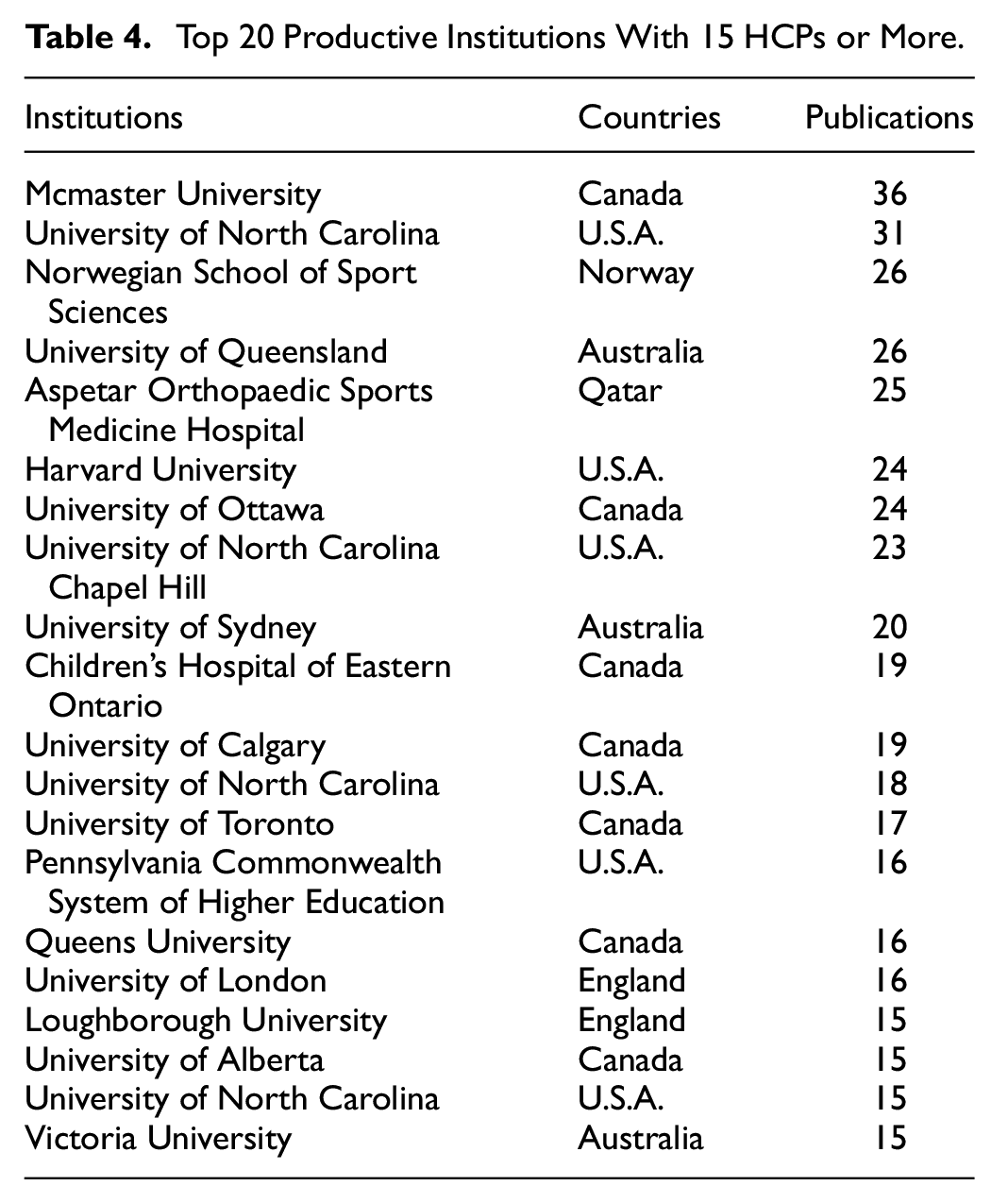
A total of 1202 institutions were reported as author affiliations in the 435 HCPs. The 20 most productive institutions which contributed 15 HCPs or more are listed in Table 4. Mcmaster University, the University of North Carolina, and the Norwegian School of Sport Sciences stand as the biggest contributors. Largely consistent with country distributions of HCPs in Table 3, institutions in North America contributed prominently. To be specific, 13 of the 20 most productive institutions are based in North America (Canada, 7; USA, 6). Still, Asian institutions are highly underrepresented in the table. However, it is comforting to find that Aspetar Orthopaedic Sports Medicine Hospital in Qatar vigorously enters the list and holds the fifth position with 25 HCPs.
Top 20 Productive Institutions With 15 HCPs or More.
Top Authors
A total of 2542 authors had their names listed in 435 HCPs, of whom 17 authors published at least 8 HCPs as shown in Table 5. Engebretsen L tops the list with 15 HCPs (TC=5869), followed by Tremblay MS (#HCPs=13; TC=4334) and Putukian M (#HCPs=16; TC=4819). Although Engebretsen L had more HCPs published and hence accumulated the most citations, Dvorak J from Switzerland ranks first in terms of the average citations per HCP (C/HCP=497), followed by Guskiewicz KM from USA (C/HCP =466) and Chaput JP from Canada (C/HCP =453). Considering the country distributions of the most productive HCP authors, 7 authors from Canada enter the list with a total of 68 HCPs. Besides, there are 3 HCP authors from Switzerland and USA respectively. From the perspective of the h-Index, Engebretsen L, Dvorak J, and Katzmarzyk PT are the top three most influential authors.
Top 17 Productive Authors With 8 HCPs or More.

Note. TC = total citations of the HCPs from each author; C/HCP = average citations for each HCP from each author; R = ranking of each author on each indicator.
It should be noted that each author listed on the HCPs is treated equally in our analysis, disregarding the ordering on the author list. And not all influential authors in the field can be included in the list since some researchers publish relatively fewer in number but higher-quality papers. Besides, we notice that there is not one single-authored HCP on our list. Some authors even report multiple affiliations from more than one country. For example, the top HCP author Engebretsen L was affiliated with multiple organizations in Switzerland and Norway on each HCP he published, testifying the close international collaborations in HCP publication. In addition, all these indicators are calculated with only the HCPs of the authors, rather than all the papers the authors published, thus painting a clearer picture of the HCPs of each author.
Top HCPs
The 143 HCPs are ranked by their relative citation rates (RCR) to identify the top HCPs as shown in Table 6. A quick glimpse of the list shows some interesting patterns. First, 8 out of the top 20 HCPs were published in Br J Sports Med, which helps corroborate the findings on the main publication venues. Second, in terms of the document types, reviews (11) slightly outnumber articles (9), which may imply that systematic reviews share the same amount of citation opportunities as the original articles in the field of sport sciences if not more. Third, PMIDs (a unique identification number used in PubMed) can be obtained for all the top 20 HCPs, meaning that HCPs in the WoS category of sport sciences are mostly biomedicine literature in nature. A close look at the titles and abstracts reveals three types of research orientations from the top 20 HCPs: guidelines from top organizations or institutes such as the World Health Organization (WHO), International Olympic Committee (IOC), American College of Sports Medicine (#1, 2, 3, 4, 5, 6, 8, 11, 14); recommendations based on systematic reviews (#7, 9, 10, 13, 18, 19); Evaluations (#12, 15, 16, 17, 20). The guidelines all address the most important and urgent issues in sport sciences, such as sport-related concussions, fracture and dislocation classification, exercise guidelines for cancer survivors, standardized methods for coding sports data, exercise for developing musculoskeletal and cardiorespiratory fitness, etc. Based on the systematic review of the studies on the topics such as musculoskeletal pain, exercise as medicine, protein supplementation and resistance training-induced gains, and exercise interventions for cognitive functions, researchers provide evidence-based recommendations for practice.
Top 20 HCPs Ranked by RCR in Decreasing Order.

Note. To save space, not full information about the HCPs is given. Some titles have been abbreviated if they are too lengthy. PMIDs are provided to help pinpoint the papers. For the authors, only the first author who appeared in the author list was given. For the document type (DT), R means Reviews while A means Articles. RC = raw citations; RCR = relative citation rate.
Besides, it is also interesting to find two new COVID-19-related articles (#12, 16), each exploring the effects of physical inactivity during the confinement periods on multiple physiological indicators. The yearly citation distributions of the top 20 HCPs are presented in Figure 1, which shows a steady increase in citations for most HCPs.

Yearly citation changes of the top 20 HCPs.
Most Frequently Explored Topics
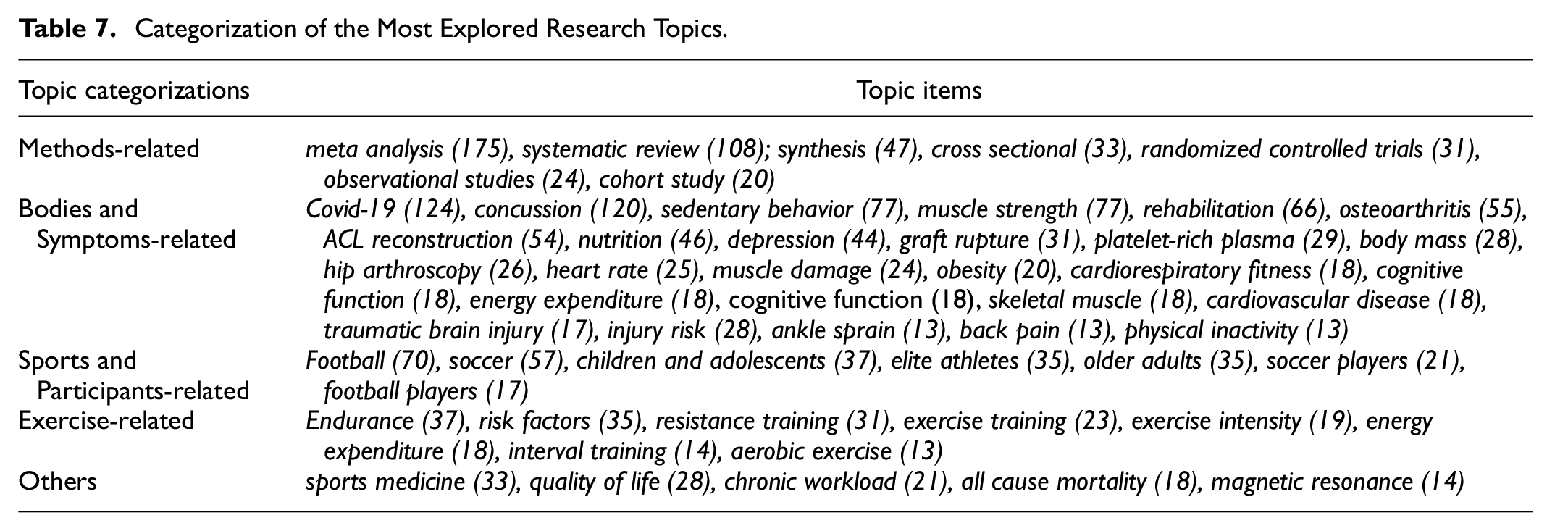
To guarantee the value of the extracted topic items, we checked the titles of the 435 HCPs to see whether they contained these topics. Considering the relatively small corpus data of the present study, we decided that a candidate topic has to appear in the titles of at least 3 HCPs to be selected as a real topic. Table 7 presents the top 46 research topics with an observed frequency of 13 or above based on the word frequency analysis of the Abstract corpus. We grouped the topics into five broad categories: Methods-related, Bodies and Symptoms-related, Sports and Participants-related, Exercise-related, and Others. The observed frequency count for each topic in the abstract corpus is included in the brackets. As seen from Table 7, topics in the groups of Bodies and Symptoms-related take up a large share. This finding will be validated by the analysis of the keywords.
Categorization of the Most Explored Research Topics.
Several points should be mentioned regarding the topic candidacy. First, for items with different spellings (e.g. meta analysis and meta analyses), or nouns of singular and plural forms (e.g. review and reviews), we combined the frequency counts. Second, we found that some longer items (3 grams and 4 grams) could be subsumed to short ones without loss of essential meaning (e.g. cardiovascular disease from cardiovascular disease risk). In this case, the shorter ones were kept because of their higher frequency.
Most Frequently Used Author Keywords
By analyzing the keywords in HCPs, we can get a glimpse of research emphasis, the areas of interest of researchers and the developmental trends. A total of 2748 keywords were retrieved including author keywords and keyword plus. To capture the most frequently used keyword, we set the minimum number of occurrences at 10. Then, 57 keywords meet the threshold. For each of the 57 keywords, the total strength of the co-occurrence links with other keywords was calculated.
The top 40 keywords with a frequency of 13 or more were shown in decreasing order along with their total link strength in Table 8. Exercise is the most frequently used keywords (63), followed by performance (41), physical activity (41), and risk (36). VOSviewer classified the 57 keywords into 4 clusters, as shown in different colors. The keywords in the same cluster tended to occur together in the same publications. The top 5 keywords with the strongest link strengths were exercise, risk, and physical activity (247, 176, 167), respectively. The thickness of the lines determined by the frequency of the keywords shows the link strength between the keywords as shown in Figure 2. We can see that the corpus-based research topics and the top keywords from VOSviewer overlap to a great extent, testifying to the validity of corpus methods in unveiling the hotspots from the HCPs in sport sciences.
The Top 40 Keywords in HCPs Ranked by Decreasing Occurrences.

Note: O = Occurrences of the keywords; TLS = Total Link Strength of the keywords.
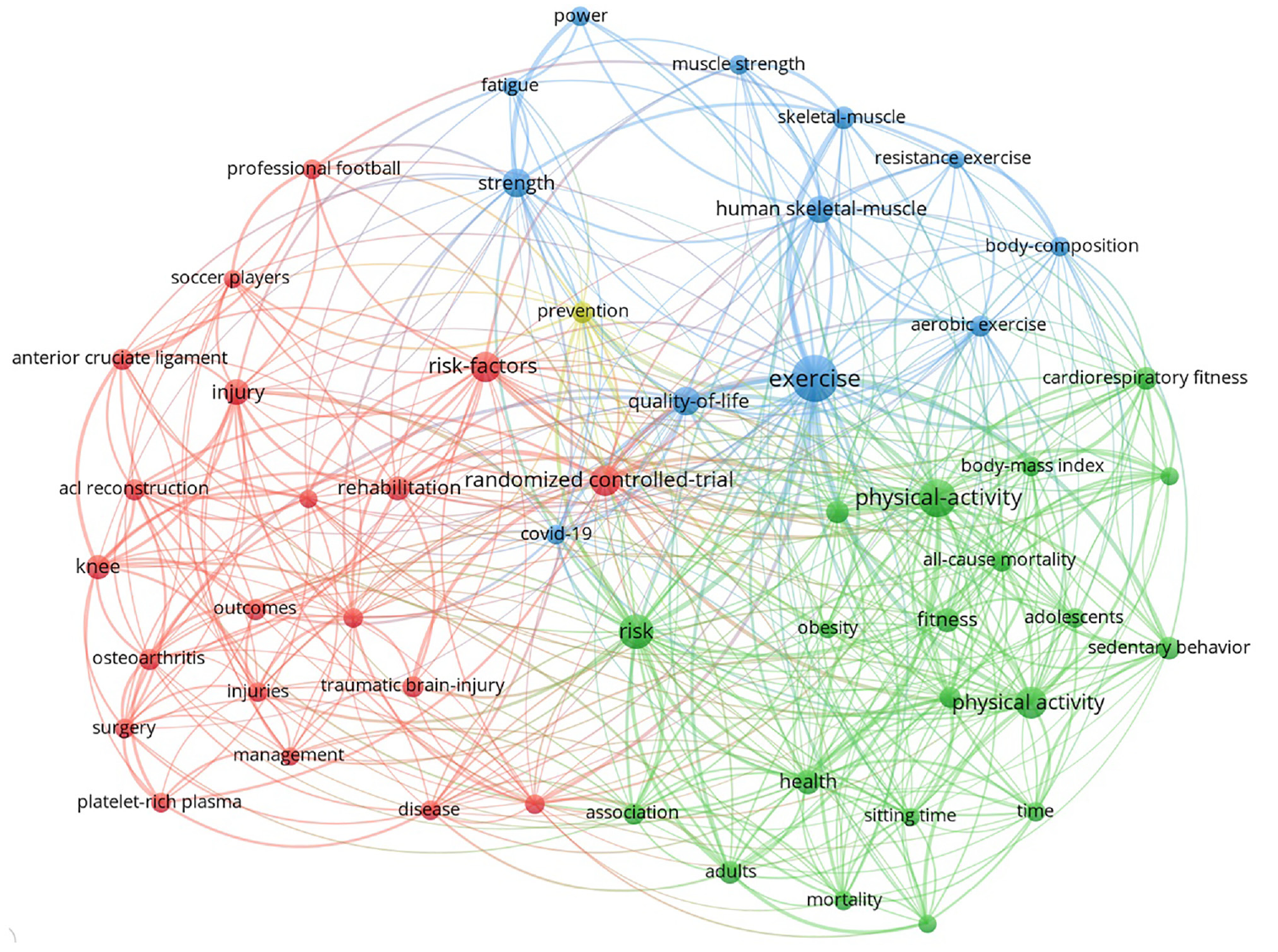
The co-occurrence of the authors’ keywords.
Discussions
To our knowledge, this is the first comprehensive corpus-based bibliometric study of HCPs in the WoS category of sport sciences across the years spanning from 2011 to 2021.The results showed that Br J Sports Med, Sports Med, and Am J Sports Med had the largest number of HCPs published, implying that researchers are more attracted to cite papers from these high-impact factor journals. The traditional academic and athletic powerhouses such as the USA, Australia, England, and Canada are leading the HCP publications, in line with their excellent performance in international sports competitions. They are also the biggest producers of publications in the field. Two countries deserve special attention, Qatar and China. With 31 HCPs, Qatar surprisingly tops the list when it comes to the HCPs and total publications ratios. A further investigation reveals that most HCPs in Qatar are affiliated with Aspetar Orthopaed & Sports Medicine Hospital, specializing in sports-related injuries and staffed by the world’s leading sports medicine practitioners and researchers. Besides, after Qatar was awarded the right to host the 2022 FIFA World Cup in 2010, sports were regarded as a driving force in Qatar’s national developments and huge direct investments poured into sports-related industries along with surging research interests in sports, which might explain their high-quality publication outputs. With 7 HCPs, China was not able to enter the list even though Chinese researchers contributed a total of 5072 publications during this period. This was in line with previous studies which claimed that China has caught up in numbers in overall scientific outputs while the publication quality is still lagging (Zhao et al., 2021), maybe at least in sport sciences. Publication numbers are just one indicator that a country’s science is thriving (Phillips, 2017). The situation is about to change as China’s latest major science policy, World-Class 2.0, aims to develop first-class universities and academic disciplines (Qi, 2017).
With 15 HCPs, Engebretsen Lars from Oslo tops the most productive HCP author list. Specializing in Orthopaedic and general surgery, he holds positions in several world-renowned organizations including the Oslo Sports Trauma Research Center, the International Olympic Committee (IOC), and the University of Oslo Medical School, which might explain his multiple affiliations in all his publications. The topics he addressed in his HCPs mainly include cognitive impairment, postconcussion syndrome, traumatic brain injury, postural control, etc, which are the core topics in sport-related research. It should be noted here that a HCP is usually the joint efforts of multiple authors from different institutions and/or countries. The WoS generates all the bibliometricsof the papers, not restricted to the information about the first author or the corresponding author. In other words, all the countries and institutions listed on the HCPs will be treated evenly. Hence, a clearer picture of the HCPs distribution across countries, institutions, and authors can be painted.
For the top 20 HCPs, three types of research orientations can be detected: guidelines (9), recommendations based on systematic reviews (6), and evaluations (5). It confirms the previous findings that most HCPs are mainly about documented guidelines or official recommendations (Yan et al., 2022), which serve as baselines for individual studies. It may also partially explain why reviews slightly outnumber articles in terms of document types in the top 20 HCPs. Bull’s “World Health Organization 2020 guidelines on physical activity and sedentary behavior”(Bull et al., 2020) tops the list with RCR at 237. As the most recently updated version of the previous WHO guidelines released in 2010, Bull et al. (2020) systematically reviewed new evidence to assess associations between physical activity and sedentary behavior, produced renewed exercising recommendations for different population groups, and thus unsurprisingly accumulated wide citations from diverse sport sciences disciplines. It may also imply that RCR may be a more valid metric than RC in identifying influential papers in citation analysis.
A great overlap between the most frequently explored topics based on corpus analysis and the keywords has been identified. The hot topics can be generally grouped into five broad categories: Methods-related; Bodies and Symptoms-related; Sports and Participants-related; Exercise-related; and Others. A quick glance of the hot topic items reveals the following points. First, meta analysis (175) and systematic review (108) are the most frequently used research methods as many HCPs are reviews. Phrases such as synthesis, cohort study, and cross-sectional may imply the diversified research paradigms. However, long-term longitudinal studies are rarely seen. Second, in the second category, sport-related concussion is the most frequently explored symptom as it is a very common sports injury, followed by sedentary behavior, rehabilitation, osteoarthritis, and ACL reconstruction. As a multidisciplinary field concerned with the understanding and enhancement of human sporting capabilities, sport sciences focuses on maximizing performance and endurance while lessening the risk of injury. Its multidisciplinary nature can be easily seen from such phrases as muscle strength, nutrition, graft rupture, etc. Third, the most popular sports explored in HCPs are football and soccer, testifying to their widespread global participation and maybe immense academic funding. Fourth, although sport sciences allegedly covers four key sciences (psychology, physiology, biometrics motor, and control/learning), we do not find any hot phrases associated with psychological and cultural issues in sports, such as sports psychology and sports communications, which may deserve more academic attention and efforts in future studies.
Although quantitative data have been used to map the HCPs from different bibliometric indicators, our study also involves qualitative analysis. Besides the several rounds of discussions among the authors, we also seek expert advice in related disciplines of sport sciences such as sports medicine and exercise physiology. The decision of candidate topic items and topic categorizations was not easy and inevitably involves subjectivity. However, the frequency and range criteria guarantee that these items are more explored in multiple HCPs, thus indicating values for further investigations. Some n-grams are discarded because they are too general or not meaningful topics in sport sciences. For example, physical activity and exercise are too general to be included. By meaningful topics, we mean the n-grams can help journal editors and readers quickly locate their interested fields, as the author keywords such as sport medicine, resistance training, and knee function. Besides, the examination of the limited 3/4-grams and monograms (nouns) revealed that most of them were either not meaningful topics or they were topics already identified in the 2-grams such as cardiovascular disease risk and maximal power production. Therefore, the final list is mostly 2-gram topics. As a relatively new field, sport sciences has experienced rapid development and gained huge popularity. More bibliometric research is needed in the future to keep us accurately informed about the trends in sport sciences studies.
Our study also has some limitations. Our study focuses on the apex of the publishing pyramid in sport sciences, the HCPs. And the bibliometric indicators are all retrieved from the WoS SCI and SSCI journals. Although these journals contribute some of the most celebrated papers, some other papers of similar importance or highly localized papers that do not have the chance to enter the list and are not indexed in the WoS are not given due attention in our study. This less widely cited research is a rich vein for future study. Besides, our study shows that a review paper might accumulate more citations than an article in sport sciences. Due to their distinct research focus, the two types of papers can be investigated separately in future method designs. Finally, it should be noted that our topic selection, following bibliometric analysis conventions, is frequency-based, which is likely to miss some important topics due to their relatively low frequencies. Therefore, a combination of other approaches (e.g., research synthesis and systematic review) will help corroborate and enrich our understanding of the area of sport sciences in future studies.
Footnotes
Author Contributions
Conceptualization, S.Y., HT.Z., Q.Z., and CH. L.; methodology, S.Y.; writing-original draft, S.Y. and HT.Z.; writing-review & editing, S.Y., Q.Z., HT.Z., and CH. L. All authors have read and agreed to the final manuscript.
Declaration of Conflicting Interests
The author(s) declared no potential conflicts of interest with respect to the research, authorship, and/or publication of this article.
Funding
The author(s) disclosed receipt of the following financial support for the research, authorship, and/or publication of this article: This work was supported by China Scholarship Council and Humanities and Social Sciences Youth Fund of China MOE under the grant 20YJC740076.
IRB Approval
This study does not involve animals or human subjects.

Data Availability Statement
All data are fully available without restriction on web of science.
With the submission of this manuscript,we would like to undertake that:
All authors of this Article have directly participated in the planning, execution, or analysis of this study;
All authors of this paper have read and approved the final version submitted;
The contents of this manuscript have not been copyrighted or published previously;
The contents of this manuscript are not now under consideration for publication elsewhere;
The contents of this manuscript will not be copyrighted, submitted, or published
elsewhere, while acceptance by the Journal is under consideration