



Abstract
In order to promote the innovative development of mobile fitness APP, based on value cocreation theory of customer-dominant logic, this paper discusses how the customer knowledge management, flow experience and customer involvement affect customer value cocreation in mobile fitness APPs. This study used convenience sampling and structural equation modeling to test the relationship between variables from questionnaire. Results revealed that customer knowledge management significantly and positively affected customer flow experience and customer flow experience significantly and positively affected customer value cocreation. Customer flow experience played a partial mediating role in the relationship through which customer knowledge management affected customer value cocreation, and customer involvement played a moderating role in the relationship through which customer flow experience affected customer value cocreation. Moreover, the results indicated that customer involvement significantly and positively regulated the effect of customer flow experience attention focus on customer value cocreation. Customer involvement not moderates the effect of perceived enjoyment in customer flow experience on customer value cocreation. Therefore, mobile fitness app enterprises or service organizations must strengthen knowledge management in industrial chain innovation development for strengthening the relationship with customers. Moreover, they should ensure flow experience to strengthen the psychological connection with customers and promote value cocreation to strengthen the behavioral connection with customers. These enterprises should improve the level of involvement to strengthen the emotional connection with customers.
Plain Language Summary
Purpose: In order to promote the innovative development of mobile fitness APP, based on value cocreation theory of customer-dominant logic, this paper discusses how the customer knowledge management, flow experience and customer involvement affect customer value cocreation in mobile fitness APPs. Methods: This study used convenience sampling and structural equation modeling to test the relationship between variables from questionnaire. Conclusions: Results revealed that customer knowledge management significantly and positively affected customer flow experience and customer flow experience significantly and positively affected customer value cocreation. Customer flow experience played a partial mediating role in the relationship through which customer knowledge management affected customer value cocreation, and customer involvement played a moderating role in the relationship through which customer flow experience affected customer value cocreation. Moreover, the results indicated that customer involvement significantly and positively regulated the effect of customer flow experience attention focus on customer value cocreation. Customer involvement not moderates the effect of perceived enjoyment in customer flow experience on customer value cocreation. Implications Mobile fitness app enterprises or service organizations must strengthen knowledge management in industrial chain innovation development for strengthening the relationship with customers. Moreover, they should ensure flow experience to strengthen the psychological connection with customers and promote value cocreation to strengthen the behavioral connection with customers. These enterprises should improve the level of involvement to strengthen the emotional connection with customers. Limitations: This study has several limitations that can be addressed in future research. First, this study did not examine the extent to which the theoretical model applied to the sports fitness industry and other digital sports industries. Second, because of the universality of flow experience, researchers have yet to create a unified classification dimension of customer flow experience. The researchers of this study selected customer perceived enjoyment and attention focus as the classification dimension and measurement dimension, respectively, and did not consider the application of other classification dimensions.
Keywords
Introduction
In recent years, advancements in mobile technology have led to the rapid growth of fitness apps. These apps, designed for smartphones and wearable devices, offer fitness guidance, data tracking, community engagement, and other sports-related features (Cai et al., 2022; Z. Wang et al., 2023). According to data from China’s Ministry of Industry and Information Technology, as of June 2018, the number of mobile fitness app users in China had reached 142 million. As of February 2019, the number of apps in the online sports and fitness industry in China had reached 9,944. However, in the face of an increasingly complex market environment and a rapidly changing interactive digital media, mobile fitness apps are facing substantial development problems (Cai et al., 2022). For example, because of the wide variety of fitness apps, their functional differentiation is not pronounced, resulting in customers continuously choosing different apps, affecting their fitness experience and satisfaction. Relevant data indicate that the retention rate of most fitness apps within 7 days is <20%, and user stickiness is low. Moreover, only one-third of retained customers actively use the app (Arie Consulting, 2021).Thus, the innovation development of mobile fitness apps is the major priority of sports fitness industry.
Studies have shown that customer value creation plays a crucial role in innovation development (Füller et al., 2009). Value co-creation theory of customer-led logic shows that partners (enterprises, customers, and stakeholders) in the network economy can exchange interactions and create value through interactive platforms or brand communities (Yang & Leposky, 2022). As a product that integrates the interactive digital media and sports fitness, mobile fitness apps have become an important platform for customer value creation (Hartmann et al., 2015). Through diverse communication channels, such as virtual brand communities, live interactions, and sports communities, customers can establish social contact with enterprises or other stakeholders, participate in product design and new product development, provide feedback on products, and engage in other innovation activities, thereby facilitating the achievement of the strategic goals of innovation development (D. E. Kim et al., 2016; Santos et al., 2019). Therefore, understanding the crucial role of customer value cocreation and the influencing factors of customer value cocreation in mobile fitness APP service situations is essential for the innovation development of mobile fitness apps. However, studies on the innovative development of mobile fitness apps have covered extensive topics, primarily focusing on fitness app technology development and marketing strategies (Oyibo et al., 2019) as well as on the factors affecting customers’ willingness to use these apps (Cai et al., 2022; Z. Wang et al., 2023), no related studies have elucidated the mechanisms underlying customer value cocreation, and its theoretical basis remains underexplored.
According to value cocreation theory in the context of customer-led logic, value cocreation is the process in which businesses cocreate experiences with customers (Heinonen & Strandvik, 2015). Businesses and service organizations should identify and manage customer experiences to enhance customer satisfaction, and they should encourage customers to actively participate in the cocreation process (Prahalad & Ramaswamy, 2004). Scholars believe that by improving customer knowledge through interactive social media platforms, enterprises can increase the participation of customers in value cocreation (Chua & Banerjee, 2013). Such knowledge management is pivotal for continuously improving customer experience and meeting customer requirements (Bag et al., 2021). Furthermore, effective customer knowledge management can transform customers into essential enterprise partners (Valacherry & Pakkeerappa, 2018). For example, in a virtual brand community, customers can interact freely, express their needs, and share feedback on product or service quality. Enterprises and service organizations should adopt corresponding knowledge management strategies to understand customer needs or feedback and improve product or service quality (Chen & Chen, 2012; Delshab et al., 2022; Koenigstorfer & Wemmer, 2022; Lenka et al., 2017). Thus, in the value cocreation of mobile fitness apps, customer knowledge management is a crucial factor affecting customer value cocreation.
Research has revealed that customers’ perceived experience regarding mobile fitness app services is affected by their level of participation and the interactive media used; their experiences differ from traditional perspectives (Farrokhi et al., 2021). The use of such apps involve a state of flow experience that integrates participation, interaction, and user experiences (An et al., 2021; M. Y. Lee et al., 2013). For example, customers can live stream workouts or engage in virtual brand community discussions through these apps. Customer flow experience in a virtual brand community is a crucial factor affecting user interactions (Sha et al., 2009). In this experience state, customers engage in creative activities that promote the brand (An et al., 2021; Farrokhi et al., 2021; Sha et al., 2009). Therefore, the role of flow experience in customer knowledge management and customer value cocreation for mobile fitness apps should not be underestimated.
From the customer perspective, customers can share experiences and express ideas through platforms or communities (e.g., experiences, information, knowledge, and social skills). The focus of enterprises has shifted from technological innovation to user experience (Heinonen & Strandvik, 2015; Prahalad & Ramaswamy, 2004). The willingness of customers to cocreate value with enterprises is determined based on their product and service experiences (Prahalad & Ramaswamy, 2004; Rather et al., 2022). In this process, the extent of customer involvement determines their willingness to participate in value sharing and cocreation (Cui & Wu, 2016). Therefore, when examining customer value cocreation in the mobile fitness app industry, customer involvement emerges as a crucial moderating variable. The impact of customer knowledge management and flow experience on customer value cocreation should be examined under different levels of customer involvement.
In the context of mobile fitness apps, customer value cocreation plays an obvious role in the innovation development of mobile fitness APP. What are the influencing factors of customer value co-creation? What is the process of its action? There is no research revealed in the existing relevant theoretical research. To address the aforementioned research gaps, according to the theory of value cocreation in customer-led logic, This study introduces variables such as customer knowledge management, flow experience and customer involvement to analyze the factors influencing customer value co-creation in mobile fitness APP service scenarios. In contrast to most previous studies focusing on the innovation development of mobile fitness apps, theoretically, this study provides a new research perspective on the innovative development of mobile fitness apps but also introduces new variables for research on customer value cocreation in mobile fitness APP. Practically, this study serves as a roadmap for mobile fitness app companies, helping them understand the causes and processes of customer participation in value cocreation. By understanding these factors, companies can strategize marketing techniques that promote customers’ participation in value cocreation initiatives, eventually enhancing the innovation development of their products or overall enterprise.
Literature Review
Mobile Fitness Applications
Mobile fitness apps integrate sports fitness activities with interactive digital media, aiding users in tracking fitness data, acquiring sports knowledge, and cultivating healthy habits (Beldad & Hegner, 2018; Cai et al., 2022; Z. Wang et al., 2023). Studies on the innovative development of mobile fitness apps have covered extensive topics, primarily focusing on fitness app technology development and marketing strategies (Oyibo et al., 2019) as well as on the factors affecting customers’ willingness to use these apps (Beldad & Hegner, 2018; Gupta et al., 2021).
For example, based on the theme analysis method, Ghalyan et al. (2023) constructed a theme model for Iranian users to accept and use mobile fitness apps. They suggested that the relevant sports staff in Iran should pay attention to the design of themes, such as application quality, digital literacy, social impact, and convenience, in the development and application of mobile fitness apps. Suherman and Sultoni (2021) developed a fitness app to guide online learning students in the context of the COVID-19 pandemic. The fitness app had various features, including body composition metrics and measurement as well as personalized training plans.
Several studies have examined the factors affecting customers’ willingness to use mobile apps based on the technology acceptance model (TAM). For example, Cai et al. (2022) reported that customer motivation is the most important driving force affecting the use of fitness application apps, along with exercise, costs, and interest. B. Kim and Lee (2022) determined the factors affecting fitness app customers’ willingness to use the app based on the TAM model. They found that performance expectation, effort expectation, hedonic motivation, and perceived privacy protection are crucial variables affecting customers’ use of fitness apps (B. Kim & Lee, 2022).
In brief, relevant scholars have studied mobile fitness apps from different research perspectives (Ghalyan et al., 2023; Suherman & Sultoni, 2021). Their collective objective has been the optimization of products or services to promote customer acceptance or use of mobile fitness apps (Cai et al., 2022; B. Kim & Lee, 2022). However, only paying attention to the value provided by new technology to customers for the innovative development of mobile fitness apps is inadequate. Technological advancements and digital interactive media have changed the role of customers in the mobile fitness app industry (D. H. Lee, 2013). Customers are no longer a single value recipient but an important participant and collaborator in the innovation process of mobile fitness app (D. E. Kim et al., 2016; K. Kim et al., 2020). Thus, in the process of the innovation development of mobile fitness apps, the relevant enterprises or service organizations must pay attention to the influence and process of customer value co-creation.
Theory of Value Cocreation in Customer Logic
With the development of interactive digital media, the position and guiding role of customers have respectively become more prominent and clearer, Prahalad and Ramaswamy (2004) proposed the concept of customer-dominant logic within the framework of value cocreation theory. They argued that value cocreation is a dynamic process through which interactions between enterprises and customers generate a personalized customer experience that is highly valuable (Heinonen & Strandvik, 2015). According to customer-dominant logic, customers form the central entity in value creation. The value creation process involves positive dialog and interaction between enterprises and customers and the identification of customer needs. The aim of this value creation process is to provide an optimal experience to customers (Prahalad & Ramaswamy, 2004).
Under customer-led logic, value creation is a process in which customers are the main entity, customer experience is the value basis, and enterprises actively identify the needs of customers through interaction (D. H. Lee, 2013; Pinho et al., 2014). Studies have distinguished two types of customer value co-creation, namely customer participation behavior and customer citizenship behavior (Yen et al., 2020). Customer participation behavior refers to the active participation of customers in value co-creation activities, whereas customer citizenship behavior refers to the spontaneous behavior of customers wanting to safeguard the interests of all stakeholders in the community and to create additional value (Yi et al., 2011). Customer participation behavior includes four dimensions: information seeking, information sharing, responsible behavior, and personal interaction. Customer citizenship behavior includes four dimensions: feedback, advocacy, helping, and tolerance (Revilla-Camacho et al., 2015).
In the context of customer-led logic, mobile fitness app related enterprises or service organizations can create a flow experience environment through customer knowledge management (Heinonen & Strandvik, 2015; Prahalad & Ramaswamy, 2004). They can constantly motivate users to invest their time and energy for sharing, needs and experience in communication and sports activities initiatives (Chen & Chen, 2012; Delshab et al., 2022; Koenigstorfer & Wemmer, 2022). Such as, information search, information sharing, help and feedback behavior etc. (Revilla-Camacho et al., 2015; Yi et al., 2011). Moreover, the extent of customer involvement is a crucial factor affecting customer perception and behavior decisions (Cui & Wu, 2016). So, the researchers of this study believe that the value cocreation theory of customer-led logic is a suitable theoretical foundation for examining influence and relationship of customer knowledge management, flow experience and customer involvement on customer value cocreation in the context of mobile fitness apps.
Customer Knowledge Management
Customer knowledge management implies customers sharing knowledge, enterprises interacting with customers, and customers and enterprises creating value together (Bag et al., 2021; Gebert et al., 2003; Randhawa et al., 2017; Wilde, 2011). Research has extensively demonstrated that customer knowledge management is an important antecedent variable affecting customer consumption behavior, including innovation behavior (Behnam et al., 2022; Cepeda-Carrión & Cepeda-Carrion, 2018). In addition, existing research has confirmed that customer knowledge management in digital interactive media makes customers an important partner for the enterprise, and customers can exchange or share value with the enterprise through knowledge sharing (Valacherry & Pakkeerappa, 2018). For example, Chua and Banerjee (2013) conducted a qualitative case study to explore customer knowledge management in Starbucks, an international coffee chain. The authors determined that in the context of customer knowledge management facilitated by online social media, social media platforms transform the role of customers from knowledge producers to knowledge creators (Chua & Banerjee, 2013).
In summary, customer knowledge management is a crucial variable affecting customer innovation behavior and customer knowledge management, making the customer an important partner of the enterprise and enabling customers to exchange or share value with enterprises through knowledge sharing (Behnam et al., 2022; Chua & Banerjee, 2013; Valacherry & Pakkeerappa, 2018). Interactive channels, such as virtual brand communities in mobile fitness apps, provide customers with various social platforms for interaction (Cai et al., 2022; Z. Wang et al., 2023). Enterprises and customers can share and use knowledge on these platforms. Thus, customer knowledge management by enterprises or service organizations is a crucial factor affecting customer value cocreation (e.g., knowledge sharing behavior) in mobile fitness apps. However, no study on customer knowledge management has focused on this topic. Therefore, this study examined whether customer knowledge management affects customer value cocreation in mobile fitness apps and services.
Flow Experience
Flow experience is described as a holistic sensation that people feel when hey act with total involvement, such as fullness, immersion, and pleasure (Csikszentmihalyi, 2014; Hoffman & Novak, 2009; Xin et al., 2010). Many scholars support the multidimensional classification of flow experience (Xin et al., 2010; Zaman et al., 2010). In the aforementioned studies, the two dimensions of perceived enjoyment and attention focus are considered as the most significant features of flow experience (Hoffman & Novak, 2009) They are the most widely used classification and measurement dimensions of flow experience (Zhou & Lu, 2011). In the mobile fitness app service scenarios, customers easily become addicted to these services (e.g., fitness guidance exercises, live training, etc.). This leads to a highly focused state of attention among customers (Zhou & Lu, 2011). Moreover, the interactive digital media can easily increase consumers’ interest in related sports products and services (e.g., virtual brand community interaction, sports mall product discussion area exchange, etc.), which are perceived to be different from the monotony of offline exercises. Thus, customers derive more psychological satisfaction and enjoyment from related activities (Zaman et al., 2010). On the basis of the multidimensional perspective of flow experience, this study classified flow experience into two dimensions: perceived enjoyment and attention focus.
Flow experience, as a positive emotional response of customers, has been widely examined in research on customer consumption behavior (J. Kim & Kim, 2020). Most relevant studies have used it as an intermediary variable to demonstrate the mechanism of customer flow experience induction in different research scenarios (D. Kim & Ko, 2019). For example, An et al. (2021) explored the mediating role of flow experience in virtual reality tourism centers in the relationship among sensory experiences, information quality, and customer satisfaction. In addition, some studies have confirmed that flow experience is an important factor affecting individual creativity and creative behavior (Csikszentmihalyi, 2014; Sha et al., 2009). Moreover, flow experience has been identified as a vital precursor to high-level creativity and innovation in the splicing process of Lego games (Primus & Sonnenburg, 2018).
Studies have confirmed the relationship between flow experience and customer consumption behavior (An et al., 2021; J. Kim & Kim, 2020; D. Kim & Ko, 2019). In addition, flow experience has been identified as a relevant precursor of individual participation in creative activity or work (Csikszentmihalyi, 2014; Primus & Sonnenburg, 2018; Sha et al., 2009). Customer value cocreation is a crucial creative activity for customers (Heinonen & Strandvik, 2015). As a precursor of individual creative activities, the impact of flow experience on customer value cocreation remains unclear. Thus, this study identified the factors affecting customer value cocreation in mobile fitness apps. On the basis of the mechanism of flow experience reported in previous studies, this study determined whether flow experience affects the relationship between customer knowledge management and customer value cocreation in mobile fitness apps. This study examined not only the relationship between flow experience and customer value cocreation but also the intermediary role of flow experience in such relationship.
Customer Involvement
Customer involvement refers to customers’ perception of enterprise products or services under the influence of their individual needs, interests, and values. It represents the level of customers’ attention to a product or service and affects their perception and behavior (Feng et al., 2014). Most studies have regarded customer involvement as a single dimension variable and have not subdivided it into different dimensions. Only based on the different customer involvement of the research object, customer involvement is divided into advertising involvement, purchase decision involvement, and product involvement (Cui & Wu, 2016). According to the definition of customer involvement and the object of this study, customer involvement in this study can be classified as product involvement (Cui & Wu, 2016; Feng et al., 2014).
In relevant research, customer involvement has been primarily examined as a moderating variable that regulates the relationship between customer perception and customer consumption behavior. For example, Zhang and Zhao (2023) explored the moderating role of customer involvement in the relationship between deviant service communication and brand trust behavior from the perspective of customers. They observed that customer involvement plays a negative role in the relationship between deviant service communication and perceived uncertainty. Chakraborty and Paul (2023) conducted a survey among health-care app customers and determined the moderating effect of customer involvement on the relationship between customer perceived value and brand love behavior. They found that customer involvement significantly and positively regulates social and emotional value for health-care app brands (Chakraborty & Paul, 2023).
Studies shows that the crucial moderating effect of customer involvement on customer perception and customer consumption behavior (Chakraborty & Paul, 2023; Zhang & Zhao, 2023). Flow experience is a crucial immersion experience perceived by customers regarding related products or services (An et al., 2021; Csikszentmihalyi, 2014). Moreover, customer value cocreation is an important consumption behavior of customers for related products or services (D. H. Lee, 2013; Pinho et al., 2014). Whether customer involvement plays a moderating role in the path of customer flow experience affecting customer value cocreation remains to be determined. In order to verify this problem, this study introduced a new research context, namely smart fitness app services, to investigated the influence relationship of customer involvement, customer knowledge management, flow experience, and customer value cocreation and determined the moderating effect of customer involvement in the relationship between customer flow experience and customer value cocreation.
Theory and Hypothesis Development
Customer Knowledge Management and Flow Experience
Existing studies have confirmed the relationship between customer knowledge management and customer experience (Cepeda-Carrión & Cepeda-Carrion, 2018). In this relationship, through customer knowledge management, enterprises or organizations can comprehensibly understand customers’ historical purchase information, needs, expectations, and other purchase activities and then provide corresponding services to improve customers’ experiences (Behnam et al., 2016). In addition, through knowledge interaction, enterprises or organizations can obtain knowledge on products or services used by customers and suppliers, eventually creating an optimal consumption experience for customers (Gebert et al., 2003). Flow experience is the best positive emotional response produced by individual when focusing on an activity (Csikszentmihalyi, 2014; Zhou & Lu, 2011). Flow experience comprises two aspects: perceived enjoyment and attention focus. Perceived enjoyment indicates that customers feel enjoyment and pleasure when they use products and services. Attention focus refers to the immersion of customers when using a product or service (Zaman et al., 2010).
Flow experience depends on the degree of alignment between customer needs and experiences (An et al., 2021; J. Kim & Kim, 2020). When customer needs are adequately met, their immersion and enjoyment are enhanced (da Silva DeMatos et al., 2021). Customer knowledge management is the process of identifying, transferring, and utilizing customer needs (Behnam et al., 2020). Theoretically, through customer knowledge management, customers can achieve satisfaction from related products or services, resulting in flow experience (Behnam et al., 2016). For example, Alexandris et al. (2017) demonstrated that when sports service organizations provide more refined sports services to athletes, it fosters their better immersion and enjoyment in sports (Alexandris et al., 2017). Therefore, we propose the first hypothesis as follows:
H1. Customer knowledge management would significantly and positively affect flow experience. Flow experience comprises perceived enjoyment (H1a) and attention focus (H1b).
Flow Experience and Customer Value Cocreation
Customer value cocreation results from customer engagement and participation in the innovation process for value creation between customers and enterprises (Prahalad & Ramaswamy, 2004). Previous studies have indicated that customer value cocreation occurs through the formation of some relationship and emotional embeddedness of customers with enterprises and service providers (Yen, 2023). For example, X. Wang et al. (2020) revealed that relationship commitment and trust play positive roles in promoting customer value cocreation in virtual brand communities (X. Wang et al., 2020). Flow experience represents a profound emotional and relational connection between an individual and the environment (Csikszentmihalyi, 2014). Such a high degree of emotional and relational experiences substantially affects customers’ creative and innovative activities (Primus & Sonnenburg, 2018), including online interactions such as live broadcasts and game-watching discussions. Given that customer value cocreation requires a certain connection and emotional embedding, and that flow experience denotes a highly concentrated emotional relationship connection state, a relationship exists between flow experience and customer value creation.
Customer value cocreation is divided into customer participation behavior and customer citizenship behavior (Yen et al., 2020). According to social exchange theory, when individuals obtain perceived value, including benefits, happiness, and enjoyment from others, they usually return to their social environment, resulting in the development of customer citizenship behavior and customer participation behaviors, such as information search, guidance, help, recommendation, and tolerance (Bruhn et al., 2014). Some studies have indicated that flow experience is the perceived value obtained by customers from subjective experiences involving happiness and enjoyment, including perceived enjoyment and attention focus (Holbrook, 2006). When customers enjoy related services and products and have increased attention, they exhibit increased enthusiasm, subsequently participating in value cocreation more actively (H. S. Kim & Choi, 2016). For example, in the mobile fitness app industry, when customers experience good sports services, they exhibit customer participation behaviors, such as service inquiry and sharing. Simultaneously, customers display behaviors such as feedback provision, support, and tolerance, all of which increase the value innovation of sports services. Therefore, we propose our second hypothesis as follows:
H2. Flow experience would significantly and positively affect customer value cocreation. Perceived enjoyment of flow experience positively affects (H2a) customer participation behavior and (H2b) customer citizenship behavior. Attention focus of flow experience positively affects (H2c) customer participation behavior and (H2d) customer citizenship behavior.
Mediating Effects of Flow Experience
According to H1 and H2, customer knowledge management exerts a significant positive impact on customer flow experience, and flow experience exerts a positive impact on customer value cocreation. From a statistical perspective, flow experience plays a crucial indirect role in the relationship between customer knowledge management and customer value cocreation. In addition, customer knowledge management can stimulate customers’ subjective cognition by improving their service experience level (Gebert et al., 2003). Moreover, flow experience can create a more favorable participation environment for customers through the use of customer knowledge, enabling customers to achieve the psychological and physical state of perceived enjoyment and attention focus more easily (Behnam et al., 2022).
According to the theory of social exchange, individuals have the motivation to pursue positive emotional experiences, and emotions in this social exchange are infectious, affecting individuals’ related behaviors. The realization of this infectious emotional experience is highly susceptible to external stimuli and the environment (Bourguignon et al., 2023). According to social exchange theory, customers are highly vulnerable to the external stimulate of customer knowledge management by enterprises or organizations, producing internal emotional experiences such as flow experience (perceived enjoyment and attention concentration). On the basis of this experience, customer value cocreation in the value process is realized (e.g., actively fulfilling customer participation behaviors such as information search and interpersonal interaction, recommending services to others, sharing service experience or skills, and other customer citizenship behaviors) (Bourguignon et al., 2023). Thus, we hypothesize the following:
H3. Flow experience will mediate the association between customer knowledge management and customer value cocreation. Perceived enjoyment and attention focus of customer flow experience play a mediating role in the mechanism through which customer knowledge management positively affects (H3a) customer participation behavior and (H3b) customer citizenship behavior.
Moderating Effects of Customer Involvement
Customer involvement has been mainly used as a moderating variable to demonstrate the mechanism underlying the relationship between customer perception and customer behavior (Chakraborty & Paul, 2023; Zhang & Zhao, 2023). Customers with high involvement pay more attention to products they like and are willing to invest more time and energy to understand the products, search for service information related to the products, experience services provided by enterprises or organizations, and have a higher perception experience of related products or services (Cui & Wu, 2016). When customers have a high level of subjective perception of related products and services, they quickly and easily obtain detailed product and service information and compare selected products, which affects their decision-making in the consumption process (Xie et al., 2023). Customers with a high level of involvement experience the convenience resulting from the service at the enterprise level, producing a good consumption experience; this eventually affects their behavior in the consumption process. By contrast, for customers with low involvement, the quality of products or services reduces their psychological assessment of the related products or service levels of enterprises or organizations and diminishes the impact of customer perception experience on their behavior (Sabatini et al., 2023). On the basis of H1, H2, and H3, this study proposes the following research hypotheses:
H4. Customer involvement will moderate the association between flow experience and customer value cocreation. Customer involvement positively regulates the effect of the perceived enjoyment of flow experience on (H4a) customer participation behavior and (H4b) customer citizenship behavior. Customer involvement positively regulates the effect of the attention focus of flow experience on (H4c) customer participation behavior and (H4d) customer citizenship behavior.
In summary, the structural model of this study is shown in Figure 1 below:

Structural model.
Method
Survey
This study mainly collected relevant data through questionnaires and selected customers of mobile fitness apps as research participants. In the Chinese sports fitness market, mobile fitness apps are mainly divided into four categories:
Fitness apps record functional attributes, such as speed, distance, heart rate, and blood pressure, through a precise motion tracking system; thus, these apps provide consumers with analysis, learning, and utilization through visual data analysis (e.g., Gudong and Joy running circle).
Fitness guidance apps mainly guide customers’ fitness exercises (such as strength training and yoga training). Related sports videos are provided to explain and demonstrate each action. This functional attribute guides customers through the fitness exercises and provides teaching and training content suitable for different customers according to big data (such as Keep).
Auxiliary fitness apps mainly record customers’ fitness diet and exercise data. By recording calories consumed by customers and their exercise regimens and intensity, these apps guide customers on reducing weight and fat or increasing muscle (e.g., millet exercise and mint app).
Venue consultation and subscription apps involve offline activities. The main function is to provide customers with offline fitness venues and fitness coaches’ appointment services (such as setting up appointments).
Among these categories, fitness record, guidance, and auxiliary apps involve more frequent interactions of customers with employees or enterprises providing additional services compared with venue consultations and subscription apps (Cai et al., 2022). In these apps, customers can interact with online or offline service personnel frequently to obtain resources according to their needs. The interaction between customers and employees or enterprises facilitates the mutual understanding of fitness goals, promotes value creation, and contributes to goal realization (Füller et al., 2009). Therefore, considering the differences in the functions of fitness apps, this study mainly focused on the first three types of fitness apps when surveying customers.
From October 2021 to May 2022, this study used the questionnaire star platform(Is a professional online questionnaire survey, evaluation, voting platform, focusing on providing users with online design questionnaire, data collection and other services) to create and administer the questionnaire for data collection. On the basis of the availability of samples, convenience sampling was employed, primarily targeting college class groups and mobile fitness groups for distributing questionnaires. During the investigation of respondents in the class group of colleges and universities, we examined their communicate with the teachers of relevant colleges and universities and then contacted respondents under the introduction of the teacher to issue and collect the questionnaire. By using the community section of the app, we conducted a survey of a mobile fitness group to collect data. To improve the effectiveness of participants’ answers, material rewards were set after each questionnaire.
Customer analysis of mobile fitness apps in China’s intelligent sports and fitness industry revealed that most customers using mobile fitness apps are mainly reside in densely populated areas in China, including Henan Province, Hubei Province, and Fujian Province (Arie Consulting, 2021). Therefore, the survey samples were concentrated in Fujian Province, Hubei Province, and Henan Province. Customers of mobile fitness apps are defined as those who have engaged with fitness apps through registration, exercise activities, and purchasing related services (Cai et al., 2022; Z. Wang et al., 2023). To ensure the authenticity and reliability of the research sample, we introduced a screening question at the outset of the questionnaire specifically designed to identify these users. For example, this questionnaire targeted customers who had used mobile fitness apps (such as Keep, Yuedong, and Gudong). If respondents had engaged with these apps, they were invited to continue with the questionnaire; if not, they were kindly asked to disregard the survey.
Prior to the formal research, 30 respondents with experience in using fitness record apps, fitness guidance apps, and auxiliary fitness apps were selected to complete the full questionnaire to ensure its accuracy. On the basis of the feedback provided by these respondents, the questionnaire items were further modified for clarity, and the resulting version was used as the final questionnaire. As of June 1, 2022, a total of 550 questionnaires were distributed throughout the investigation period, and 515 questionnaires were received. Among them, invalid questionnaires, such as those with short completion time and evident logical errors (e.g., contradiction in the selection of front and back items and highly consistent scoring of different latent variables), were eliminated. Finally, 450 valid questionnaires were obtained. The total number of samples exceeded the recommended minimum requirement of the number of analysis items by 10 (41) times. Thus, the sample size met the requirements for structural equation modeling (Westland, 2010). The questionnaire recovery rate was 94%, and the effective questionnaire rate was 87%. Table 1 lists the demographics of the respondents.
Sample Demographics.

Measures
The measurement tools used in this study have been validated in previous studies. Customer knowledge management was examined using a scale adapted from Behnam et al. (2022). The scale consists of five items. A sample item is “The fitness app asks about my interest in sports activities.” Flow experience was measured using a scale developed by Zhou and Lu (2011). The scale consists of eight items across two dimensions: perceived enjoyment and attention focus. Perceived enjoyment includes four items, such as “I think the process of using a fitness app is pleasant.” Attention focus includes four items, such as “When using the fitness app, I concentrate on sports products and services.” Customer involvement was examined using a scale developed by Feng et al. (2014). This scale consists of three items, such as “When there are many fitness apps to choose from, I carefully select the fitness app I use.”
Customer value cocreation was measured using a scale developed by Y. Lee and Kim (2022). In Lee’s research, customer value co-creation is divided into two dimensions: customer participation behavior and customer citizenship behavior. Customer participation behavior includes four dimensions: information seeking, information sharing, responsible behavior, and personal interaction. Customer citizenship behavior includes four dimensions: feedback, advocacy, helping, and tolerance. Refer to the research of the above scholars, this scale consists of 28 items across two dimensions: customer participation behavior (includes four dimensions: information seeking, information sharing, responsible behavior) and customer citizenship behavior (includes four dimensions: feedback, advocacy, helping, and tolerance). Customer participation behavior includes 15 items, such as “I ask others about related sports products and service types offered by a fitness app.” Customer citizenship behavior includes 13 items, such as “When I encounter useful service content while using the fitness app, I am willing to comment on it.”
All the scales were scored on a 7-point Likert scale, ranging from “strongly disagree” (1) to “strongly agree” (7). In addition, to ensure the cultural adaptation of the scales from English to Chinese, two experts (one with a Ph.D. in marketing and another with a Ph.D. in physical education) were invited to independently translate the original English scale, and the Chinese version of the translated scale was discussed in groups. According to the results of the discussion, the modified scale was provided to two experts who majored in English for reverse translation. The content of the Chinese version of the scale was revised and adjusted again according to the results of reverse translation. Before the formal investigation of the study, one expert in the field of enterprise management and one expert in the field of sports science were consulted to evaluate the measurement scale. At the same time, 30 postgraduates majoring in sports sociology were invited to predict the questionnaire and measure its readability. According to the suggestions of experts and testers, the measurement scale was modified to ensure the scientificity and accuracy of the measurement scale.
Data Analysis
Currently, empirical studies using a questionnaire survey method have used SPSS and AMOS for data analysis and for examining the effect of each variable (Lee & Kim 2022; Zhou & Lu, 2011). Thus, SPSS and AMOS version 23.0 were used to perform data analysis and verify the influence relationship of each variable. Descriptive statistics were used to measure the demographic characteristics of participants and correlations among major variables. Confirmatory factor analysis (CFA) was employed to estimate the factor structure and construct validity of measures, including convergent and discriminant validity. A structural equation modeling test was conducted to examine the relationships between variables. The goodness of fit of the measurement model and the structural model were assessed by adopting multiple fit index criteria: chi-squared statistics, the comparative fit index (CFI), the Tucker–Lewis index (TLI), and the root mean square error of approximation (RMSEA). Path coefficients were produced and used to assess both the direct and indirect effects of factors on customer value cocreation behavior.
Data Analysis and Results
Measurement Model
To test data reliability and validity, a CFA was performed using AMOS 23.0 software. The results revealed that the measurement models exhibited a good fit: χ2 (500) = 1134.348, χ2/df = 1.569, root mean square residual = 0.063, goodness-of-fit index (GFI) = 0.902, adjusted GFI (AGFI) = 0.865, TLI = 0.981, CFI = 0.986, and RMSEA = 0.036. As presented in Tables 2 and 3, the composite reliability of all structural variables ranged from 0.910 to 0.9889, and the Cronbach’s alpha value ranged from .907 to .988; both these values exceed the recommended minimum of .7.
Questionnaire Items.

Correlation Coefficient of Latent Variables.

Note. Data on the diagonal are square roots (average variance extracted). CI = customer involvement; To = tolerance; He = helping; Ad = advocacy; Fe = feedback; PI = personal interaction; RB = responsible behavior; IS = information sharing; ISe = information seeking; AF = attention focus; PE = perceived enjoyment; CKM = customer knowledge management.
Furthermore, the average variance extracted (AVE) was greater than the recommended minimum of 0.50. These results demonstrate the reliability of the measurement of related structural variables. The standardized factor loading of structural variables was >0.6 and was significant at the level of α = .01, indicating the high aggregate validity of the scale. Furthermore, the square roots of the AVE were greater than the correlation coefficients of the rows and columns, indicating the high discriminant validity of the scale.
Structural Model
The structural model exhibited a good fit: χ2 (500) = 1718.157, χ2/df = 2.325, GFI = 0.946, AGFI = 0.921, TLI = 0.960, CFI = 0.964, and RMSEA = 0.054. Table 4 displays the results obtained from a path analysis based on a structural equation model.
Model Path Coefficient Table.

Note. CKM = customer knowledge management; PE = perceived enjoyment; AF = attention focus; CPB = customer participation behavior; CCB = customer citizenship behavior.
p < .001.
The findings of the structural equation model revealed that customer knowledge management had a significant positive effect on perceived enjoyment (γ = 0.525, p < .001) and attention focus (γ = 0.424, p < .001). Furthermore, in the path of customer flow experience influencing customer value cocreation behavior, perceived enjoyment had a significant positive effect on customer participation behavior (γ = 0.470, p < .001) and customer citizenship behavior (γ = 0.410, p < .001). Moreover, attention focus had a significant positive effect on customer participation behavior (γ = 0.431, p < .001) and customer citizenship behavior (γ = 0.418, p < .001). The results of bootstrap sampling supported H1a, H1b, H2a, H2b, H2c, and H2d.
Mediating Effect Testing
This study investigated the mediating effect of perceived enjoyment and attention focus. The bootstrapping method and AMOS software were used to examine the parallel mediation effect. The results are presented in Table 5.
Mediating Effect Testing Results.

Note. Relevant numbers in the table are non-standardized values. CKM = customer knowledge management; PE = perceived enjoyment; AF = attention focus; CPB = customer participation behavior; CCB = customer citizenship behavior.
In bootstrap sampling, the bias-corrected and percentile method was used for bias correction, the number of bootstrap samples was set as 5,000, and the confidence interval (CI) was set as 95%. The results revealed that perceived enjoyment (95% CI: [0.052, 0.117], excluding 0) and attention focus (95% CI: [0.059, 0.108], excluding 0) played a significant mediating role in the path of customer knowledge management affecting customer participation behavior. The results of bootstrap sampling support H3a. Furthermore, perceived enjoyment (95% CI: [0.111, 0.112], excluding 0) and attention focus (95% CI: [0.033, 0.070], excluding 0) played a significant mediating role in the path of customer knowledge management affecting customer citizenship behavior. The results of bootstrap sampling support H3b.
The results indicated a direct effect of customer knowledge management on customer participation behavior. The direct effect had a value of 0.087, with a 95% CI of [0.055, 0.122] (excluding 0), thus confirming the direct effect. Similarly, the results indicated a direct effect of customer knowledge management on customer citizenship behavior. The direct effect had a value of 0.117, with a 95% CI of [0.077, 0.162] (excluding 0), thus confirming the direct effect. On the basis of these findings, this study identified the model as a partial mediating model, where perceived enjoyment and attention focus played a partial mediating role in the mechanism through which customer knowledge management affects customer participation behavior and citizenship behavior.
Testing of the Moderating Effect
To investigate the moderating effect of customer involvement on the influence path of customer flow experience on customer value cocreation, this study standardized all continuous variables and used Model 1 of the Process 4.0 version of the SPSS plugin developed by Hayes. In the analysis, demographic variables such as gender, age, education level, monthly income, and monthly app usage were controlled (Hayes & Preacher, 2014). The results are presented in Tables 6 and 7.
Moderating Effect Testing Results.

Note. PE = perceived enjoyment; CI = customer involvement; CPB = customer participation behavior; CCB = citizenship behavior.
p < .001. *p < .05.
Moderating Effect Testing Results.
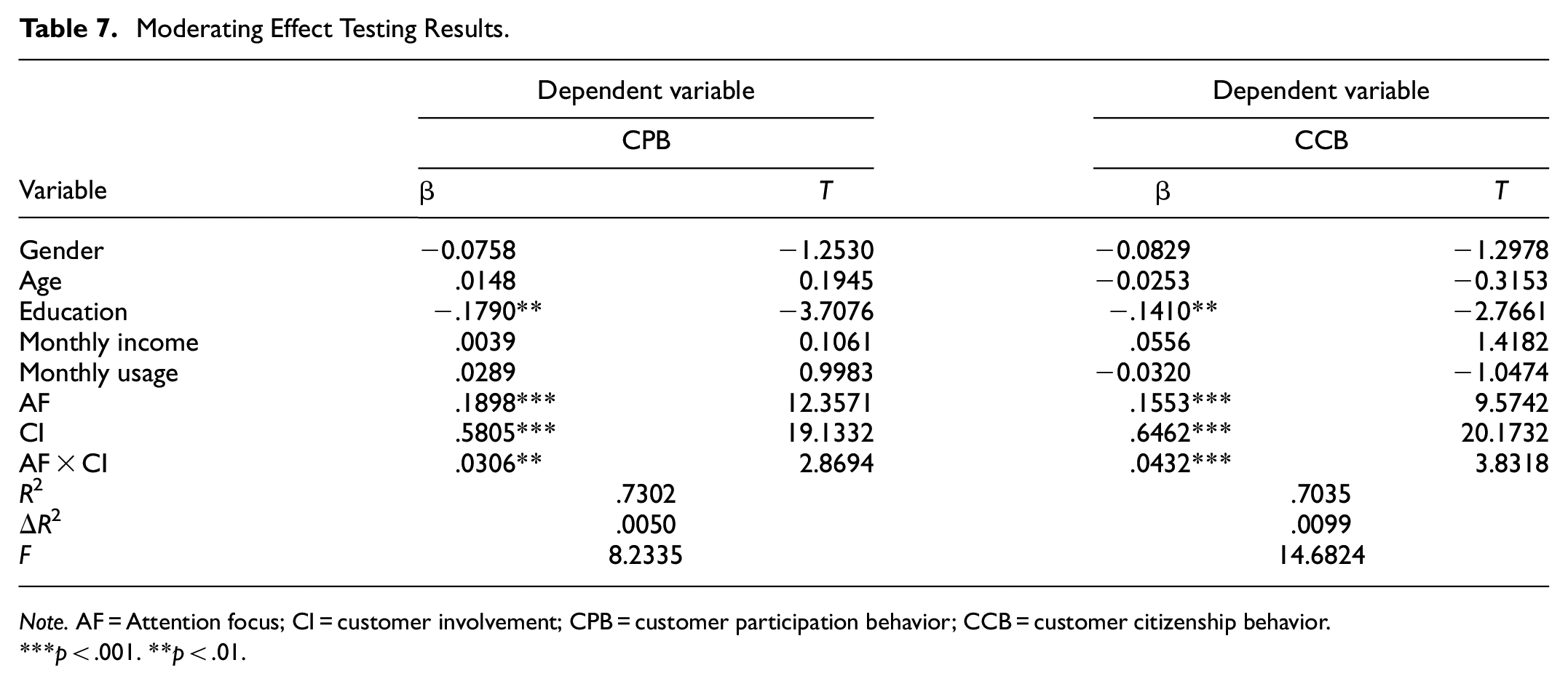
Note. AF = Attention focus; CI = customer involvement; CPB = customer participation behavior; CCB = customer citizenship behavior.
p < .001. **p < .01.
The establishment of the moderating effect is based on whether the interaction between the independent and moderating variables has a significant positive effect on the dependent variable. When customer involvement was included in the model, the interaction term between perceived enjoyment in customer flow experience and customer involvement exerted no significant effect on customer participation behavior in customer value cocreation (β = .0059, bootstrap SE = 0.0113, t = 0.5231, bootstrap 95% CI [−0.0163, 0.0281], p = .6012). The interaction term between perceived enjoyment and customer involvement had no significant effect on customer citizenship behavior in customer value cocreation (β = .0049, boot SE = 0.0121, t = 0.4093, bootstrap 95% CI [−0.0188, 0.287], p = .4093). This finding indicated that customer involvement did not play a mediating role in the mechanism through which perceived enjoyment affects customer participation and citizenship behavior. The results do not support H4a and H4b.
When customer involvement was incorporated in the model, the interaction term between attention focus in flow experience and customer involvement had a significant positive effect on customer participation behavior in customer value cocreation (β = .0306, boot SE = 0.0107, t = 19.1312, bootstrap 95% CI [0.0097, 0.0516], p = .0043). The interaction term between attention focus and customer involvement had a significant positive effect on customer citizenship behavior in customer value cocreation (β = .0432, boot SE = 0.0113, t = 3.8318, bootstrap 95% CI [0.0210, 0.0654], p = .0001). This finding indicated that customer involvement played a positive moderating role in the mechanism through which attention focus in flow experience affects customer participation and citizenship behavior. The results support H4c and H4d.
To investigate the moderating effect of customer involvement, this study used a moderating effect diagram to visually illustrate the interaction between variables (Figures 2 and 3). Customer involvement was divided into high and low levels in accordance with the standard deviation of the mean. A simple slope test analysis was conducted to examine the effect of customer involvement on the relationship between attention focus and customer participation behavior. When customer involvement was at a high level (M + 1SD), the attention focus of flow experience exerted a significantly stronger effect on customer participation behavior in customer value cocreation than when customer involvement was at a low level (M − 1SD). The findings support H4c.
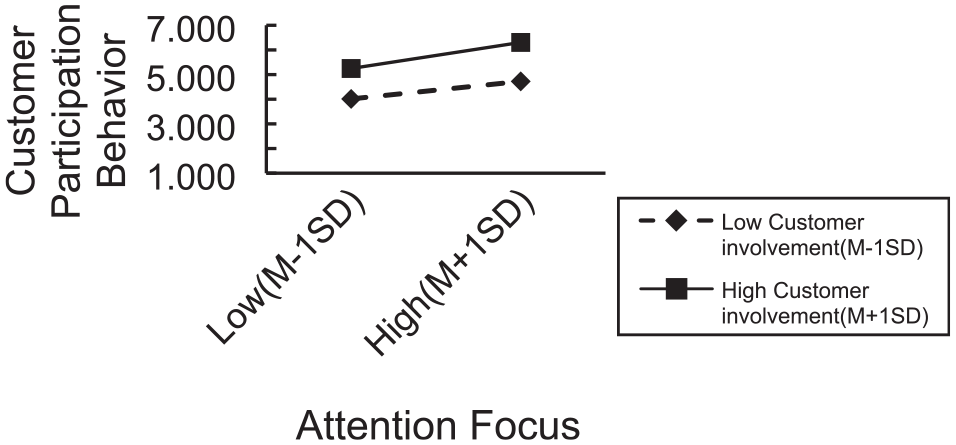
Moderating effects of customer involvement on the relationship between attention focus and customer participation behavior.

Moderating effects of customer involvement on the relationship between attention focus and customer citizenship behavior.
In Figure 3, the slope under a high customer involvement level (M + 1SD) is significantly larger than that under a low customer involvement level (M − 1SD). When customer involvement was at a high level, the attention focus of flow experience had a stronger effect on customer citizenship behavior in customer value cocreation. However, under a low level of customer involvement, the attention focus of flow experience had a weaker effect on customer citizenship behavior in customer value cocreation. These findings suggest that customer involvement played a positive moderating role in shaping the effect of attention focus in flow experience on customer citizenship behavior in the context of customer value cocreation. This finding supports H4d.
Discussion
The results of this study indicated the effect of customer knowledge management, flow experience, and customer value cocreation in the context of mobile fitness app services. In addition, the findings demonstrated the partial mediating role of customer flow experience in the mechanism through which customer knowledge management affects customer value cocreation and the moderating role of customer involvement in the mechanism through which customer flow experience affects customer value cocreation.
Customer Knowledge Management and Flow Experience in Mobile Fitness APPs
The results revealed that customer knowledge management affects customer flow experience in mobile fitness apps. Customer knowledge management exerts a significant positive impact on the perceived enjoyment of flow experience (H1a = 0.525, p < .001). Customer knowledge management has a significant positive impact on the attention focus of flow experience (H1b = 0.424, p < .001). These findings align with those of Behnam et al. (2016) and da Silva DeMatos et al. (2021), indicating that customer knowledge management can effectively improve the quality of relevant services, such as the service response speed and product experience; better service quality leads to a better relationship of customers with service organization, more immersion in services that they enjoy, and more enjoyment the consumption process (Alexandris et al., 2017; Behnam et al., 2016; da Silva DeMatos et al., 2021).
Different from the above research, this study verified the relationship between customer knowledge management and customer flow experience in the mobile fitness app service context and examined the relationship between customer knowledge management and customer flow experience (perceived enjoyment and attention focus). The results revealed that the recognition and utilization of customer knowledge in mobile fitness apps, including customer needs, skills, and opinions, can improve customers’ enjoyment in the process of use and immersion in mobile fitness apps. For example, mobile fitness apps should conduct the data processing and mining of the entire exercise cycle to summarize customers’ behavior pattern sand health status. According to the relevant knowledge obtained from the exercise database, the app should predict changes in customer health status, provide exercise plans, and help consumers correct exercise postures. The app can provide customers with various types of information, such as fitness data ledger and exercise prescription, and can attempt to achieve the flow experience of customers in the process of use.
Customer Flow Experience and Customer Value Cocreation in Mobile Fitness APPs
The results revealed that customer flow experience affects customer value cocreation in mobile fitness apps. The perceived enjoyment of flow experience exerts a significant positive impact on customer participation behavior (H2a = 0.470, p < .001) and customer citizenship behavior related to customer value cocreation (H2b = 0.410, p < .001). Moreover, the attention focus of flow experience exerts a significant positive impact on customer participation behavior (H2c = 0.418, p < .001) and customer citizenship behavior in terms of customer value cocreation (H2d = 0.431, p < .001). This result is consistent with those of Primus and Sonnenburg (2018), D. E. Kim et al. (2016), and Sha et al. (2009). Customers have a state of flow experience, which increases their relationship and emotional connection with service providers (Primus & Sonnenburg, 2018). In this experience state, customer’ creative ability and thinking are considerably enhanced, and they continue to invest in product value interaction and creation with service providers (Sha et al., 2009).
In contrast to the findings of the aforementioned studies, this study specifically examined the relationship between customer flow experience and customer value cocreation in the context of mobile fitness app services. The results show that mobile fitness APP customers will produce value co-creation such as customer participation behavior and customer citizenship behavior in the state of flow experience of perceived enjoyment and attention focus. For example, mobile fitness apps can seamlessly migrate many offline fitness activities, such as dance, cycling, yoga, and snooker, to products or services through hardware technology (Cai et al., 2022; Z. Wang et al., 2023). This not only improves the enjoyment and immersion of customers in the process of use but also enhances the connection with customers through sports activities of interest. Moreover, the users of mobile fitness apps can dynamically express themselves and display fitness results in virtual online communities value cocreation, including body photos, sports records, and training prizes.
The Mediating Role of Flow Experience in Mobile Fitness APPs
The results of this study indicated that customer flow experience partially mediates the mechanism through which customer knowledge management affects customer value cocreation in mobile fitness apps. The results revealed that perceived enjoyment and attention focus of customer flow experience play a mediating role in the mechanism through which customer knowledge management positively affects customer participation behavior (supporting H3a) and customer citizenship behavior (supporting H3b). The results indicate that customer knowledge management can indirectly affect customer value cocreation through flow experience. The findings are consistent with those of the aforementioned previous studies and confirm the intermediary role of flow experience (An et al., 2021; J. Kim & Kim, 2020; D. Kim & Ko, 2019). Previous studies have confirmed that flow experience is easily stimulated by the external service environment, such as information service quality. Moreover, flow experience stimulated by external environment affects individual behavior in related activities, such as loyalty (An et al., 2021).
However, in contrast to previous studies, this study further determined the effect of customer knowledge management on two dimensions of customer flow experience (perceived enjoyment and attention focus) and customer value cocreation behavior in the context of mobile fitness app services. This study enables a new understanding of factors affecting customer flow experience and the determinants of its outcomes. As a method of enterprise service, customer knowledge management can effectively enhance customers’ perceived enjoyment and attention focus of flow experience through the management of knowledge shared by customers (such as experience, information, and skills). When customers have the aforementioned experience, they will unconsciously revisit the relevant situation and actively seek interaction and value creation behavior with relevant service organizations. For instances, in mobile fitness apps, such as “Keep,” users’ knowledge (such as demand knowledge, experience knowledge, and evaluation feedback) is displayed, adopted, and encouraged, creating a good experience environment and attention for users and gradually transforming the knowledge produced by users from user-generated content (UGC) to professionally generated content. Moreover, content consumers gradually change to UGC users under satisfactory consumption experience.
The Moderating Role of Customer Involvement in Mobile Fitness APPs
The results of this study revealed that customer involvement exerted a positive moderating effect on the relationship between customer flow experience and customer value cocreation. Specifically, customer involvement moderated the effect of attention focus in customer flow experience and exerted a significant positive effect on customer value cocreation (customer participation (H4c = 0.0306, p < .01) and citizenship behavior (H4d = 0.0432, p < .01). However, customer involvement does not moderate the relationship between perceived enjoyment in customer flow experience and customer value cocreation (customer participation (H4a = 0.0059, p > .05) and citizenship behavior (H4b = 0.0049, p > .05). The results of this study have similarities and differences with the findings of related studies (Chakraborty & Paul, 2023; Zhang & Zhao, 2023). Previous studies have indicated that customer involvement has been primarily examined as a moderating effect, such as, the relationship between the perceived value of medical application APP and brand love behavior is affected by the level of customer involvement. Customers at a high level of involvement can better perceive the value of medical application APP to promote physical health, and have a strong willingness to generate favourite behaviors for related brands (Chakraborty & Paul, 2023).
This study confirms the moderating effect of customer involvement. In contrast to the findings of the aforementioned studies, this study confirms that customers with high involvement levels are more likely to pay attention to mobile fitness app-related products or services. This high level of attention increases the reciprocity and intimacy between customers and mobile fitness app-related enterprises or service organizations. Moreover, customers are more likely to exhibit value cocreation behavior. For example, when mobile fitness app customers need sports services, such as fat reduction and shaping, customers tend to pay attention to relevant products and services on the app. After a series of sports information preparation, customers take the initiative to exercise and actively participate in relevant sports services. Simultaneously, the emotional or behavioral responses generated during the exercise process are stronger, which exert crucial effects on consumer behavior decisions, such as sharing exercise effects, providing feedback to service organizations, and guiding other customers to exercise.
In contrast to previous studies, this study not confirms the moderating effect of customer involvement on the relationship between perceived enjoyment and customer value cocreation. This inconsistency results from the limitations of the research background (Chen & Chen, 2012). Studies have reported that customer involvement reflects the degree to which processed product or service information aligns with customer psychology (Cui & Wu, 2016). In the context of mobile fitness APPs, enterprises have a low entry threshold and easy participation (e.g., customers can freely register accounts, establish social connections, etc.) (Cai et al., 2022; Z. Wang et al., 2023). Thus, an increasing number of customers can result in information overload and spam overflow, considerably affecting customer information search and processing (Chen & Chen, 2012). With a continual increase customer involvement, customers become more proactive in collecting relevant information. However, because of the effect of information quality in the service environment, information obtained by customers may not meet their expectations, resulting in weakened customer involvement (Zhang & Zhao, 2023). This implies that the level of customer involvement does not affect customers’ interest, concerns, and participation with regard to a product or service. The results of this study are consistent with those of the aforementioned studies. The findings indicate that in the context of digital network services (mobile fitness apps) and under the effect of information quality in the service environment, customer involvement does not moderate the significant positive effect of perceived enjoyment on customer value cocreation (customer participation and citizenship behavior).
Conclusion
This study mainly examined the effect of customer knowledge management, flow experience and customer involvement on customer value cocreation in the context of mobile fitness apps services. The following conclusions were drawn on the basis of the findings of quantitative analysis.
First, customer knowledge management significantly and positively affected customer flow experience in the context of mobile fitness apps. Customer knowledge management enables improvement in customers’ enjoyment and their attention focus of these products and services.
Second, customer flow experience significantly and positively affected customer value cocreation in the context of mobile fitness apps. In the context of products or services related to sports apps, customers flow experience of perceived enjoyment and attention focus will encourage customer participation and citizenship behavior.
Third, customer flow experience played a partial mediating role in the mechanism through which customer knowledge management affects customer value cocreation in the context of mobile fitness apps. In the context of fitness APP usage, the impact of customer knowledge management on customer value cocreation is achieved to some extent by triggering the flow experience of customers who are in the process of using a fitness APP.
Fourth, customer involvement exerts a moderating effect on the relationship between customer flow experience and customer value cocreation in the context of mobile fitness apps. Customer involvement significantly and positively moderates the effect of attention focus in customer flow experience on customer value cocreation. Customer involvement not moderates the effect of perceived enjoyment in customer flow experience on customer value cocreation.
Theoretical and Practical Implications
Theoretical Implications
First, this study overcomes the limitations of research innovation development in mobile fitness apps and provides a new theoretical perspective. The innovation development of the mobile fitness APP is a topic of concern for both scholars and practitioners (Beldad & Hegner, 2018; Gupta et al., 2021; Oyibo et al., 2019). Understanding the role of customer value cocreation is crucial for industrial transformation and innovation (Füller et al., 2009). However, most existing studies focusing on the fitness APP technology development and marketing mode research (Oyibo et al., 2019) and fitness APP in the customer’s willingness to use the influence factors (Beldad & Hegner, 2018; Gupta et al., 2021). This study introduced value cocreation theory of customer-led logic to investigate the effect factors and process on customer value cocreation in mobile fitness APPs, providing a new perspective that further supplements the research on innovation development in the industry.
Second, by introducing variables, such as customer knowledge management, flow experience, and customer involvement, this study verifies the antecedents and processes of customer value cocreation in mobile fitness apps. The influence of customer knowledge management has received considerable research attention (Behnam et al., 2022; Cepeda-Carrión & Cepeda-Carrion, 2018). In addition, customer knowledge management in social media promotes the sharing and creation of customer knowledge (Chua & Banerjee, 2013; Valacherry & Pakkeerappa, 2018). However, no study has examined the impact of customer knowledge management on social media, such as mobile fitness apps. This paper links customer knowledge management with customer value cocreation, proving that customer knowledge management is a crucial factor affecting customer value cocreation. The findings not only enrich research on customer knowledge management but also promote our understanding of the factors affecting customer value cocreation in mobile fitness apps.
The mediating role of flow experience (An et al., 2021; J. Kim & Kim, 2020) and the moderating role of customer involvement have been confirmed by scholars in related service research (Chakraborty & Paul, 2023; Zhang & Zhao, 2023). Flow experience is considered by scholars as an important prerequisite for individuals to participate in creative activities (Sha et al., 2009). Thus, to better understand the mechanisms underlying the impact of mobile fitness app customer value cocreation, this study examined the mediating and moderating effects of flow experience and customer involvement in the relationship of customer knowledge management with customer value cocreation and how flow experience affects customer value cocreation. By including these variables, this study not only expands the application scope of flow experience and customer involvement but also enriches the research on the influence process of customer value cocreation, mobile fitness apps.
Practical Implications
Based on the above research findings, this study provides the following enlightenment for the innovative development of mobile fitness APP-related enterprises and service organizations:
First, enterprises must enhance customer knowledge management and strengthen the relationship between customers and enterprises in the context of fitness apps. Customer knowledge management with regard to fitness apps is realized through intelligent identification, human–machine matching, and interactive communication. Therefore, to ensure improved customer perception and a stronger customer–enterprise relationship, enterprises must establish accurate information matching mechanisms and interactive communication channels to effectively reach customers. Enterprises must increase the frequency and intensity of interaction with customers and optimize customers’ knowledge output, absorption, and feedback.
Second, enterprises should ensure customers have a flow experience and strengthen the psychological connection between customers and enterprises. To improve customers’ recognition of intelligent fitness products or services, enterprises can create exclusive fitness products or services by considering customers’ characteristics and thus enhancing customers’ perceived enjoyment. Moreover, enterprises can enhance customer engagement by extending service scenarios and perfecting services. This can enable customers to maintain their attention during the consumption process.
Third, enterprises must promote customer value cocreation and strengthen the behavioral connection between customers and enterprises. Customer-oriented value cocreation theory determines that to achieve innovation, we must ensure the initiative of customers. Therefore, enterprises must continue to innovate to connect with customers and gain an in-depth understanding of the psychological characteristics of customers to promote customer participation behavior (in-role behavior) and customer citizenship behavior (role appearance).
Fourth, enterprises should improve the level of customer involvement and strengthen the emotional connection between customers and enterprises. In the innovative development of fitness apps, related enterprises or organizations should implement marketing strategies related to customer involvement. Specifically, customers should be provided with fewer and better recommendations to allow them to easily find the goods or services they want to buy, reducing their information search costs and improving customer enjoyment. Second, practitioners should actively engage customers by discussing hot topics.
Limitations and Future Research
This study has several limitations that can be addressed in future research. First, this study did not examine the extent to which the theoretical model applied to the sports fitness industry and other digital sports industries. Future research scenarios must be further expanded for analysis. Second, because of the universality of flow experience, researchers have yet to create a unified classification dimension of customer flow experience. The researchers of this study selected customer perceived enjoyment and attention focus as the classification dimension and measurement dimension, respectively, and did not consider the application of other classification dimensions. Future studies should include more classification dimensions of flow experience in the theoretical model and verify its mediating role in the mechanism through which customer knowledge management affects customer value cocreation.
Footnotes
Declaration of Conflicting Interests
The author(s) declared no potential conflicts of interest with respect to the research, authorship, and/or publication of this article.
Funding
The author(s) disclosed receipt of the following financial support for the research, authorship, and/or publication of this article: (1) Scientific research project of Hubei Education Department (B2021186). (2) Youth Scientific Research Fund of Wuhan Sports University (2022S05).

Data Availability Statement
Data sharing not applicable to this article as no datasets were generated or analyzed during the current study.