




Abstract
Several recent studies have used virtual reality (VR)-based exercise to enhance functional fitness in older adults. However, most of these studies exclusively focused on short-term intervention outcomes. Therefore, this study aimed to determine the effect of VR-based exercise on older adults’ retention of functional fitness after intervention and at follow-up.This study was a randomized controlled trial wherein older adults (mean age: 72.16 ± 4.9 years) were assigned to experimental (n = 48) and control (n = 50) groups. Experimental group participants engaged in VR exercise sessions for 75 to 90 minutes biweekly over 12 weeks. Control group participants did not participate in the intervention. Functional fitness was assessed using the Senior Fitness Test. Functional fitness changes were compared using a generalized estimating equation. Pre-, post-, and follow-up tests were conducted at weeks 1, 13, and 24, respectively. After VR-based training, the experimental group performed better in functional fitness tests, including upper body flexibility, lower body flexibility, upper body strength, cardiorespiratory fitness, balance, and agility, than the control group immediately after the intervention. Improvements in lower body flexibility, upper body strength, cardiorespiratory fitness, balance, and agility persisted in the experimental group for up to 12 weeks. This study demonstrates that VR-based training potentially improves community-dwelling older adults’ functional fitness. Its findings may support the future development of novel exercise technologies and serve as a reference for the implementation of physical health promotion strategies for older adults.
Plain Language Summary
This study aimed to determine the effect of VR-based exercise on older adults’ retention of functional fitness after intervention and at follow-up. This study was a randomized controlled trial wherein older adults (mean age: 72.16 ± 4.9 years) were assigned to experimental (n = 48) and control (n = 50) groups. Experimental group participants engaged in VR exercise sessions for 75 to 90 minute biweekly over 12 weeks. Control group participants did not participate in the intervention. Functional fitness was assessed using the Senior Fitness Test. Functional fitness changes were compared using a generalized estimating equation. Pre-, post-, and follow-up tests were conducted at weeks 1, 13, and 24, respectively. After VR-based training, the experimental group performed better in functional fitness tests, including upper body flexibility, lower body flexibility, upper body strength, cardiorespiratory fitness, balance, and agility, than the control group immediately after the intervention. Improvements in lower body flexibility, upper body strength, cardiorespiratory fitness, balance, and agility persisted in the experimental group for up to 12 weeks. This study demonstrates that VR-based training potentially improves community-dwelling older adults’ functional fitness. Its findings may support the future development of novel exercise technologies and serve as a reference for the implementation of physical health promotion strategies for older adults.
Introduction
The global population is aging rapidly. According to the United Nations (2020), the number of individuals aged 65 years and older is projected to have increased by 16% in 2050. With increasing age, older adults become more susceptible to poor health and disability and more reliant on healthcare resources (Fulop et al., 2010; Nylen et al., 2010). Therefore, adopting effective interventions to maintain the physical health of older adults is imperative.
The physical and psychological benefits of regular physical activity for older adults are well documented (Chodzko-Zajko et al., 2009; Fox et al., 2007). The World Health Organization’s 2020 Physical Activity Guidelines indicate that healthy older adults also need to engage in various multicomponent physical activities. Additionally, they recommended that adults engage in 150 to 300 minute of moderate-intensity or 75 to 150 minute of vigorous-intensity aerobic physical activity per week. Previous studies have suggested that combined exercise programs are effective in improving all functional fitness components related to routine activities in older adults (Sousa et al., 2014). Furthermore, older adults are urged to engage in balance and strength training to enhance functional capacity and prevent falls (Bull et al., 2020). Functional capacity appears to be an important predictor of regular physical activity and should be included when designing physical activity programs for older adults (Gretebeck et al., 2007).
In addition to developing effective interventions, the selection of valuable assessment tools to measure functional fitness in older adults is another issue. The Senior Fitness Test (SFT) has been recommended for the measurement of physical health status in older adults aged 60 to 90 years, and it has also been used in several clinical trials and community assessments (Lin et al., 2015; Noradechanunt et al., 2017; Rodrigues et al., 2022; Sousa et al., 2014; Zhao et al., 2017). The SFT includes a six-component assessment of the physical fitness required for daily living, including upper and lower body flexibility, upper and lower body muscular strength, cardiorespiratory fitness, and balance, and it has proven to be reliable and valid (Rikli & Jones, 1999, 2013). Functional fitness performance appears to provide valid predictive guidance for reducing the risk of falling among older adults (Ho et al., 2021) and is also indicative of independent living ability and a superior quality of life (Bouaziz et al., 2016; Geirsdottir et al., 2012; Pedersen et al., 2017).
In a worldwide survey of fitness trends in 2021, virtual reality (VR)-based training recently secured a top-10 spot (Thompson, 2021). Innovative technologies are desperately required to help transform how humans age and ensure favorable health during the aging process. VR exercise is used to promote health and wellness in older adults (Gao et al., 2020), with the effects being improved self-perceived health (Lee et al., 2015), decreased levels of anxiety and depression (Zeng et al., 2018), and increased cognitive function (Park & Yim, 2016). In addition, VR exercise is an effective way to improve the functional fitness of older adults; however, findings regarding its effectiveness remain inconclusive and limited (Barsasella et al., 2021; Kim et al., 2013; Rendon et al., 2012) possibly because of the small sample sizes (experimental group, n = 16–18; control group, n = 14–18) or lack of ample intervention time (6–8 weeks). To overcome these limitations, this study expanded participant recruitment to the community so that older adults can understand the physical health benefits of VR exercise and thus increase their interest and the duration of their participation. The development and popularization of novel technology-based exercises in the community may reduce the burden on human and material resources.
On the other hand, physical function in older adults deteriorates with age (Smee et al., 2012). One study revealed that multimodal training can affect and improve the long-term retention of functional fitness, with the effects lasting 12 to 18 months after the baseline measurement (Gudlaugsson et al., 2012). However, other studies found components of functional fitness, such as flexibility (Carvalho et al., 2009; Toraman & Ayceman, 2005), agility with balance (Toraman & Ayceman, 2005), and both upper and lower body strength (Carvalho et al., 2009), to be affected after detraining. These studies focused on the notable decline of functional fitness after detraining in traditional face-to-face multimodal training. Observations at follow-up after the removal of the exercise intervention may be important, as this may allow for the examination of functional capacity with or without maintenance in older adults. However, studies on the effectiveness of VR-based intervention and retention on the health of older adults are limited; most of these studies focused on participants with unique characteristics, that is, those with a history of falls, cognitive impairment, or Parkinson’s disease (dos Santos Mendes et al., 2012; Mirelman et al., 2016). Although three-dimensional VR combined with hands-on horticultural therapy has been found to improve the mental health status of institutionalized older adults, such as “meaning in life,” depression, and loneliness, its effects persisted for up to 2 months (Lin et al., 2020). However, this was a static intervention rather than an exercise intervention.
Evidence generated by previous follow-up studies on traditional exercise interventions has been inconsistent. Additionally, the large-scale implementation and expansion of the time observation effect after participation in VR exercise in healthy older adults remain unclear. Thus, this study primarily aimed to assess the effects of VR exercise on the functional fitness of older adults after 12 weeks of intervention and another 12 weeks of follow-up. We hypothesized that older adults who engage in these VR exercise programs improve and maintain their functional fitness more than those who do not.
Methods
Participants
This study utilized a randomized, controlled design and included data from several districts of Taipei City involving participants who had been recruited from neighborhoods. During the recruitment process, a nurse initially evaluated the participants’ health conditions, ensuring that they all met the health requirements and were free of major chronic illnesses and physical impairments. To be eligible for study inclusion, participants had to satisfy the following criteria: (1) age ≥ 65 years, (2) living independently and capable of walking without assistance, (3) normal or corrected-to-normal vision, (4) absence of the medical conditions found in the Physical Activity Readiness Questionnaire (PAR-Q), and (5) interest in VR exercise.
The sample size employed in this study was based on a previous study (Lin et al., 2020). A total of 108 older adults were recruited in this study. The first phase excluded three participants because they were (1) aged <65 years (n = 1) or (2) unfit to participate in the study based on the PAR-Q (n = 2). A research assistant divided the participants into two groups using an online random assignment tool (https://www.randomizer.org/). Fifty-three and 52 participants were assigned to the control and experimental groups, respectively. During the intervention period, several participants did not complete the entire experimental process. Seven participants withdrew from this study owing to personal reasons, such as travel distance, weather, and injury (control group, n = 3; experimental group, n = 1), or incomplete attendance (missed ≥20% of the exercise program; experimental group, n = 3). This resulted in a total of 98 participants (control group, n = 50; experimental group, n = 48; Figure 1).
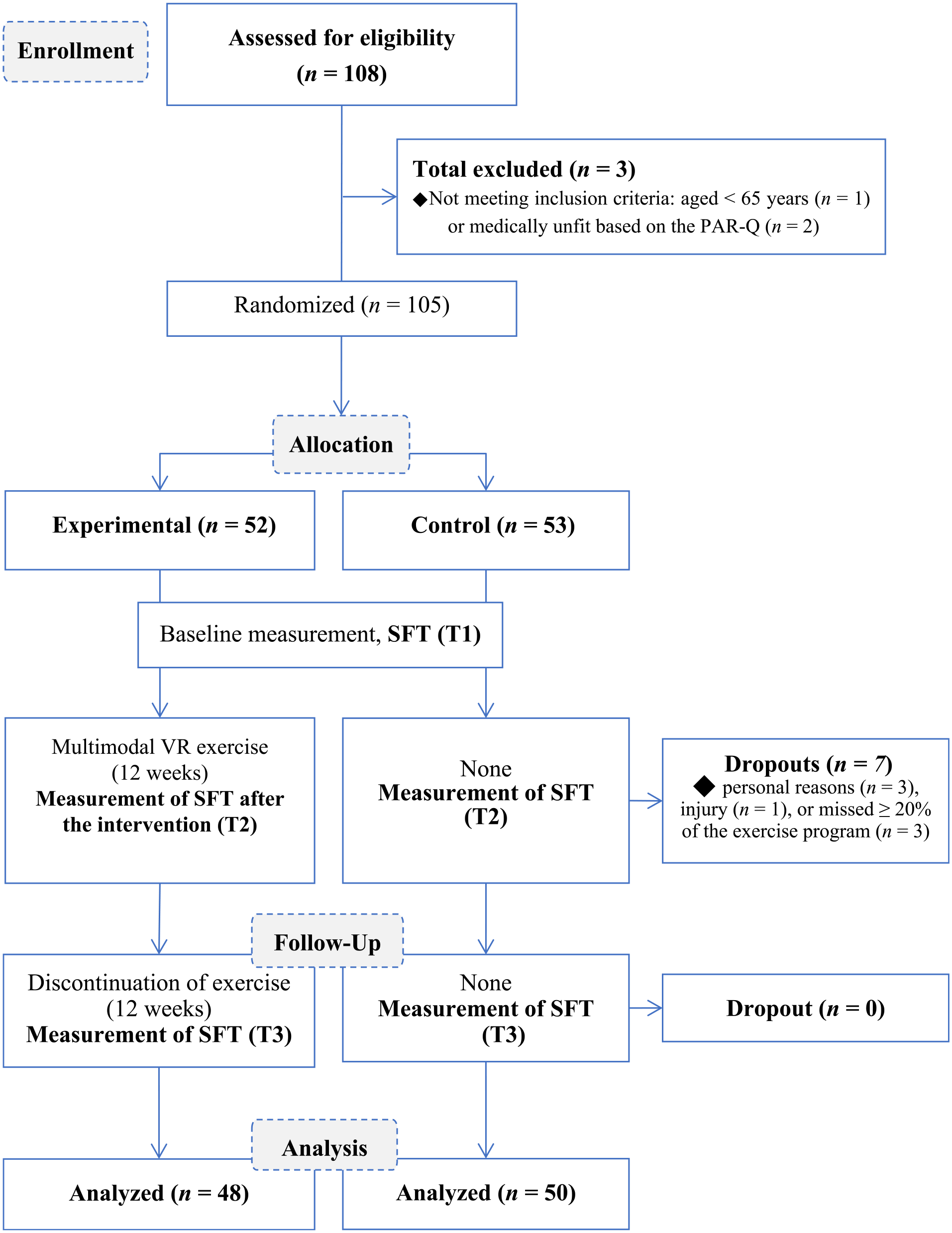
Flowchart of participant assessment in the randomized, controlled trial.
Prior to trial commencement, we explained the contents of the informed consent form to each participant, including intervention procedures, activities requiring cooperation during the study, and participant rights, among others. After personal assessments and confirmation, sign provided written informed consent, and research ethics approval was received from the National Taiwan Normal University. Data were stored in the researcher’s office, with full confidentiality of the participants’ identities, and were to be destroyed at the end of the retention period. Data were collected between September 2020 and March 2021, and all eligible participants were compensated with 10 USD.
Intervention Study Design
This study used Uniigym Interactive Somatosensory Fitness (https://www.uniigym.com/) as an intervention tool. Three large projectors (Panasonic PT-VMZ60T Laser Business Projector) were used to project videos on to the wall in a wrap-around state, thus creating a semi-immersive VR environment (Mujber et al., 2004).
According to a study conducted by the American College of Sport Medicine (Chodzko-Zajko et al., 2009), exercises must target flexibility, muscle strength, cardiorespiratory fitness, balance, and agility training. Furthermore, 150 minute of moderately strenuous physical activity per week, 75 minute of strenuous physical activity per week, or their combination (U.S. Department of Health and Human Services, 2018) are the recommended levels of exercise for seniors in average health.
Participants were categorized into experimental (VR exercise) and control (no intervention) groups. In the experimental group, Uniigym was utilized for biweekly exercises (75- to 90-minute sessions) and interventions for a duration of 12 weeks. For flexibility, participants followed 15- to 20-minute videos (e.g., Yoga or Tai Chi) that focused on stretching and breathing during their warm-up and cool-down routines to enable joints and muscles to have sufficient mobility and stabilization. The main exercises included boxing and aerobic dance at various paces, with coordination based on the style of the video instructor. These exercises focused on the strength of the upper and lower limb muscles, cardiopulmonary function, and balance and ranged in difficulty from beginner to intermediate (55–60 minute). Participants followed the projected exercises.
By so doing, they were able to enjoy the immersion elicited by VR exercise. VR intervention during the exercises in this study is shown in Figure 2. Considering the intervention’s impact on functional fitness, the participants’ attendance rates had to exceed 80% to be considered in the study’s final sample.

VR exercise: (a) VR equipment, (b) projectors, and (c) participants following VR movements.
Functional Fitness Tests
The SFT was used to evaluate the functional fitness of the older adults in this study (Rikli & Jones, 1999, 2013). Participants had to undergo the SFT, with pre-, post-, and follow-up tests conducted at weeks 1, 13, and 24, respectively. The examiners were certified physical fitness instructors, and a nurse was on standby to ensure participant safety. During the tests, the examiners were blinded to the participants in the experimental and control groups. The measurement methods and schematic diagram are shown in Figure 3.

Schematic diagram of the functional fitness tests: (a) back scratch test, (b) chair sit-and-reach test, (c) arm curl test, (d) chair-stand test, (e) 2-minute step test, and (f) 8-ft up-and-go test.
Statistical Analyses
All statistical analyses were performed using SPSS software (version 22.0; IBM Inc., Armonk, NY, USA), with the level of significance set at p < .05. To show the social demographics of the participants in this study, categories such as age, sex, working status, educational attainment, living status, marital status, smoking and drinking statuses, and body mass index (BMI) were used for classification data calculation, which was facilitated by the Health Promotion Administration of the Ministry of Health and Welfare (Health Promotion Administration, 2020). A chi-square (χ2) test was conducted to compare the differences across the demographics of the experimental and control groups.
The normal distribution of the functional fitness outcome data between the experimental and control groups was confirmed using the Kolmogorov–Smirnov test. This study used a GEE as a tool for analyzing the functional fitness test data at different time intervals (pre-test, post-test, and 12-week follow-up), comparing the experimental and control groups, and assessing the interactions between the outcome variables (back scratch test, chair sit-and-reach test, arm curl test, chair-stand test, 2-minute step test, and 8-ft up-and-go test). Furthermore, it enabled the elucidation of changing patterns over time at group level. Statistical significance was set at p < .05.
Results
Description of Participant Data
The mean age of the participants was 72.16 (±4.9) years. The total number of women was 78. No statistically significant differences were noted between the groups in terms of age, sex, working status, smoking status, drinking status, and BMI. However, significant differences in educational attainment (p = .004), living status (p = .002), and marital status (p = .030) were observed between the two groups (Table 1). Due to the significant differences in educational attainment, living status, and marital status between the groups, these confounding variables were controlled in the GEE analysis.
Demographic Characteristics of Participants.

Note. Number of participants (percentage); BMI, body mass index: <18.5–24 kg/m2 = underweight and normal weight, ≥ 24 kg/m2 = overweight and obese. SD = standard deviation.
p < .05.
Effects of VR Exercise on Improvements in Outcome Variables
The results of the GEE analyses indicated that the members of the experimental group made significant improvements compared with their control group counterparts in terms of the back scratch, chair sit-and-reach, arm curl, 2-minute step, and 8-ft up-and-go tests. A significant group × time 2 interaction was noted for the five outcome measures. The GEE results also indicated that the experimental group exhibited significant effects compared with the control group between the pre- and 12-week follow-up tests in terms of the chair sit-and-reach, arm curl, 2 minute-step, and 8-ft up-and-go tests. A significant group × time 3 interaction was also observed for four of the outcome measures.
Pre- and post-test results revealed that the experimental group demonstrated a significantly greater improvement in the back scratch test than the control group (group × time 2: β = 3.95; 95% confidential interval CI [1.80, 6.10], p < .001). However, the pre- and follow-up tests revealed that the experimental group exhibited no significant retention effect (group × time 3: β = 1.94; 95% CI [−0.85, 4.69], p = .166). These results indicate that VR exercises can only increase upper body flexibility in older adults. Pre- and post-test results showed that the experimental group demonstrated a significantly greater improvement in the chair sit-and-reach test than the control group (group × time 2: β = 2.52; 95% CI [0.99, 4.04], p = .001). Pre- and follow-up test results also displayed a significant retention effect in the experimental group (group × time 3: β = 3.77; 95% CI [1.65, 5.88], p < .001). These results indicate that VR exercises can increase and maintain lower body flexibility in older adults.
Moreover, pre- and post-test results revealed that the experimental group displayed a significantly greater improvement in the arm curl test than the control group (group × time 2: β = 3.27; 95% CI [2.55, 3.98], p < .001). Pre- and follow-up test results also demonstrated a significant retention effect in the experimental group (group × time 3: β = 1.78; 95% CI [0.90, 2.66], p = .001). Thus, VR exercises can increase and maintain upper body muscle strength in older adults. In the chair-stand test, no differences were noted between the pre- and post-test results of the experimental group (group × time 2: β = −.14; 95% CI [−0.87, 0.59], p = .705). Pre- and follow-up tests results also revealed no significant retention effect in the experimental group (group × time 3: β = −.18; 95% CI [−1.11, 0.76], p = .771). The results indicate that VR exercise neither improved nor maintained lower body muscle strength in older adults.
Furthermore, pre- and post-test results demonstrated that the experimental group exhibited a greater improvement in the 2-minute step test than the control group (group × time 2: β = 6.84; 95% CI [3.52, 10.16], p < .001). Moreover, pre- and follow-up test results revealed significant effects in the experimental group (group × time 3: β = 6.60; 95% CI [0.40, 12.79], p = .037). The results indicate that VR exercise can effectively improve and maintain cardiopulmonary fitness in older adults.
In addition, pre- and post-test results showed that the experimental group displayed a significantly greater improvement in the 8-ft up-and-go test than the control group (group × time 2; β = −.51; 95% CI [−0.68, −0.34], p < .001). Furthermore, pre- and follow-up test results also revealed a significant retention effect in the experimental group (group × time 3: β = −0.73; 95% CI [−1.04, −0.42], p < .001). Thus, VR exercises can improve and maintain balance in older adults. The changes in each variable over time are shown in Table 2.
Functional Fitness Test Changes in Outcome Variables Between the Two Groups (n = 98).
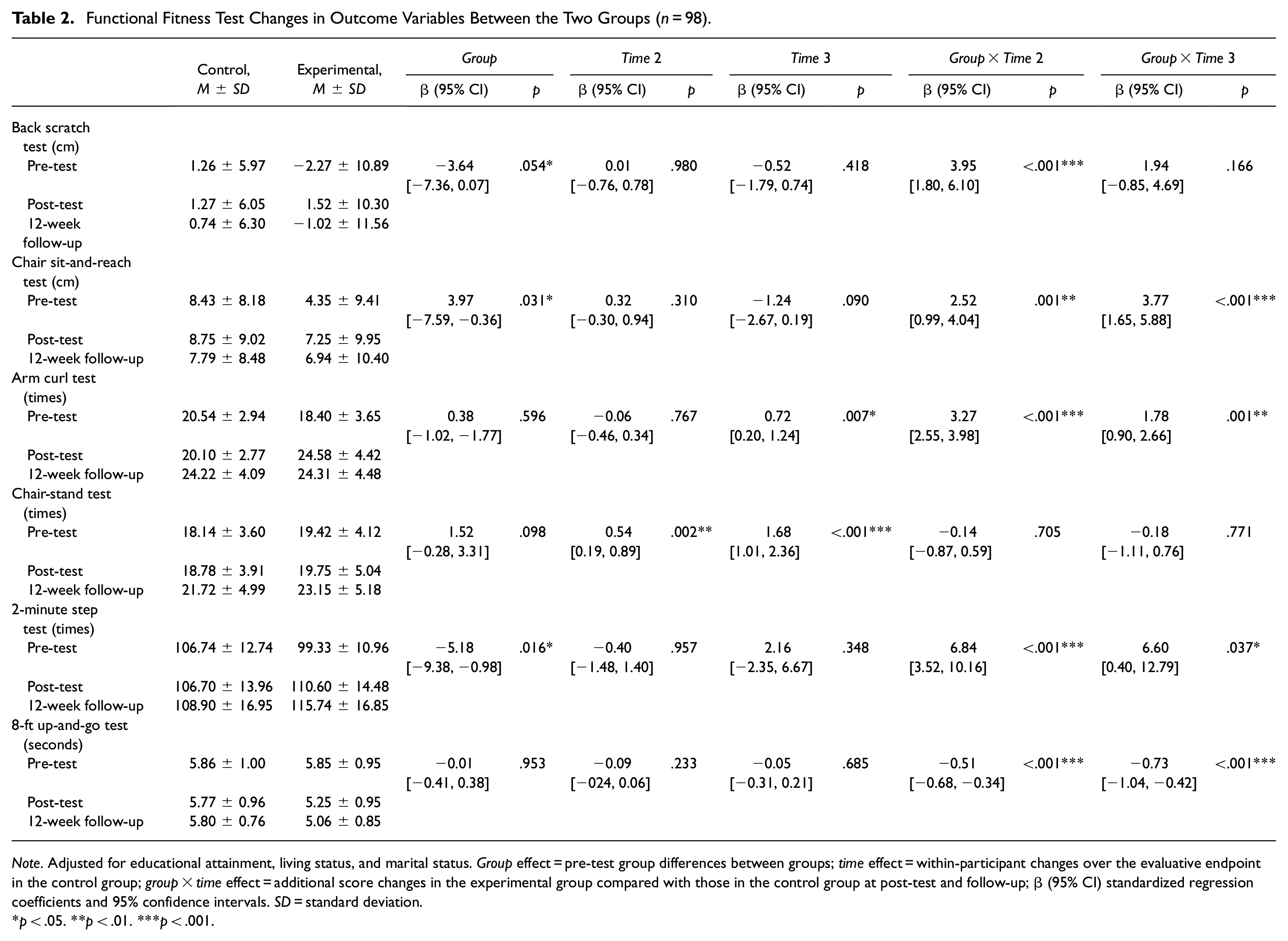
Note. Adjusted for educational attainment, living status, and marital status. Group effect = pre-test group differences between groups; time effect = within-participant changes over the evaluative endpoint in the control group; group × time effect = additional score changes in the experimental group compared with those in the control group at post-test and follow-up; β (95% CI) standardized regression coefficients and 95% confidence intervals. SD = standard deviation.
p < .05. **p < .01. ***p < .001.
Discussion
This study aimed to elucidate the effects of VR-based exercise intervention and retention on the functional fitness of older adults. Overall, 12-week VR exercises can significantly improve upper and lower body flexibility, upper body strength, cardiorespiratory fitness, and balance. Favorable retention of benefits was also noted in the follow-up results after discontinuing exercise, as functional fitness in terms of lower body flexibility, upper body strength, cardiorespiratory fitness, and balance was maintained. Thus, our findings confirm the proposed hypothesis of a positive and significant effect of exercise intervention on physical fitness, which persisted for up to 12 weeks, in community-dwelling older adults.
This study’s results are partly consistent with those of previous studies (Barsasella et al., 2021; Kim et al., 2013; Rendon et al., 2012), such as one that used 15-minute biweekly VR exercises over 6 weeks, resulting in a significant improvement in upper limb flexibility (Barsasella et al., 2021). Another study employed unsupervised VR exercises, which resulted in significant improvements in hip muscle strength and balance after 8 weeks (Kim et al., 2013). In addition, a study indicated that older adults who engaged in VR exercises three times a week for 6 weeks exhibited improved dynamic balance (Rendon et al., 2012). These findings are also similar to those of previous traditional-exercise interventions (Lin et al., 2015; Noradechanunt et al., 2017; Rodrigues et al., 2022; Sousa et al., 2014; Zhao et al., 2017).
The functional fitness performance of older adults after intervention may be influenced by the intensity and time interval of exercise-effective interventions. A systematic review and meta-analysis revealed that an intervention program, entailing 10 to 15 minute of warm-up, 30 to 40 minute of main exercise, and 5 to 10 minute of cool-down stages for 2 to 3 sessions per week and continued for 12 to 16 weeks, is the most effective intervention for healthy older adults to enhance their lower body flexibility, upper body strength, and agility balance (Yang et al., 2019). Moreover, the VR exercise intervention follows a multicomponent physical activity called mixed-motor training (Bouaziz et al., 2016; Bull et al., 2020; Sousa et al., 2014; Wang et al., 2015; Yang et al., 2019; Zhuang et al., 2014). Furthermore, as described in recent multicomponent exercise programs, it can be efficient in improving several aspects of health-related physical fitness (Borges-Machado et al., 2021; Li et al., 2023). Therefore, several possible explanations justify the success of our intervention, such as the effectiveness of the intervention design, entertaining aspects of VR, increase in people’s interest in participation, and its relaxing effect.
According to our results, no significantly positive effect was found on the chair-stand test. However, this can be explained by pre-existing strong lower limb muscles in older adults (e.g., chair-stand test [times] in the experimental group: pre-test = 19.42 ± 4.12 times vs. follow-up test = 23.15 ± 5.18 times). Although no significant improvement was noted, a trend toward increased lower limb muscle strength was observed in the experimental group. In previous studies, traditional exercise interventions also proved effective in enhancing the lower body strength of older adults. For example, Tai Chi focuses on lower body stabilization, which has a positive effect on lower body strength in older adults (Yang et al., 2021; Zhou et al., 2016). Accordingly, the Tai Chi component included in this study’s VR exercise intervention appears to be one of the reasons for the maintenance of lower limb muscle strength in older adults. Given that older adults with lower levels of functional fitness have been predicted to be at higher risk of falling (Ho et al., 2021), it is thus recommended that even healthy older adults continue maintaining good lower body muscle strength.
To date, exercise therapies have been found to possess short-term advantages; however, their long-term effects remain unknown. Our study revealed that the effects of the 12-week VR exercise intervention can be retained for up to 12 weeks after discontinuing exercise. This result is consistent with that of previous studies that utilized traditional multimodal training (Gudlaugsson et al., 2012; Seco et al., 2013). On the other hand, a previous study was conducted to investigate the effects of an 8-month training period followed by a 3-month detraining period on the functional fitness of older women. The study revealed that both upper and lower limb strength and flexibility declined significantly after detraining (Carvalho et al., 2009). In the current study, a similar result was found for upper limb flexibility, wherein no retention was observed in the back scratch performance test after 12 weeks of detraining. In general, aging is associated with reduced flexibility, such as shoulder abduction flexibility, which decreases with age (Stathokostas et al., 2013). This evidence and our results underline the importance of older adults participating in regular exercise to maintain their everyday physiological functions. Besides physical health, a study on three-dimensional VR combined with hands-on horticultural therapy confirmed the use of technological product interventions to enhance the mental health status of institutionalized older adults. These effects persisted for up to 2 months (Lin et al., 2020). The use of VR to promote physical and mental health in older adults has evidently been proven in research, although it is only one of the several possible strategies for achieving this.
VR is a useful tool for promoting physical and mental health through imaging interventions, and its content may be the key to reinforcing intervention outcomes. In a previous study, cognitive interventions based on local cultural background did not significantly improve cognitive function in older adults with mild cognitive impairment; nevertheless, the study suggests that culturally contextualized VR training is feasible (Park et al., 2020). In our study, yoga, Tai Chi (Asian specialty sport), and popular boxing aerobics familiar to older adults in the Taiwanese community were selected as the main components of the exercise intervention. This potentially explains the partial preservation of functional capacity in healthy older adults following the cessation of the exercise intervention.
This study’s strengths are as follows. First, semi-immersion VR provided abundant visual feedback, thus facilitating the learning of correct movement, and resulting in increased motivation among participants to continuously engage in the exercises. Second, our study comprised a relatively large sample size, which addressed the limitations of previous studies with smaller sample sizes. Finally, we utilized an intervention and follow-up design, thus yielding results consistent with those of traditional multimodal exercises.
Notwithstanding, this study has limitations. First, previous studies (Seco et al., 2013; Toraman, 2005) have demonstrated that age has an impact on functional fitness performance. Hence, future studies should consider examining age-related differences. Second, all participants were reminded to avoid other physical activities during the post-test period until follow-up; nonetheless, whatever activities were accomplished during their daily lives were beyond the control of the researchers. This might have affected retention. Finally, different types of VR products are currently available on the market. We suggest adding relevant empirical studies in the future to further compare intervention results and explore additional applications of this technology.
Collectively, the current study’s findings indicate that a semi-immersive VR exercise intervention for community-dwelling older adults promotes physical functional capacity and provides meaningful outcomes. To facilitate the maintenance of overall functional fitness, exercise interventions should utilize a combined design, and it is recommended that items that do not retain effect be the primary focus of subsequent exercise training.
Conclusions
This study confirms the positive effects of semi-immersive VR exercise training on the functional fitness of community-dwelling older adults. This study’s findings can support the future development of novel exercise technologies and serve as a reference for government departments evaluating health promotion strategies for older adults.
Footnotes
Acknowledgements
We would like to thank several district community in Taipei City, Taiwan for helping with recruitment and support.
Declaration of Conflicting Interests
The author declared the following potential conflicts of interest with respect to the research, authorship, and/or publication of this article: The author declares that the research was conducted in the absence of any commercial or financial relationships that could be construed as a potential conflict of interest.
Funding
The author received no financial support for the research, authorship, and/or publication of this article.
Research Ethics and Patient Consent
The studies involving human participants were reviewed and approved by the Research Ethics Committee of the National Taiwan Normal University (REC number: 202008HM007).

Data Availability Statement
The raw data supporting the conclusions of this article will be made available by the author, without undue reservation.