



Abstract
The purpose of the study was to compare United States and Polish university women in regard to demographics, victimization experiences, sensation seeking, fear of dangerous situations, perceived likelihood of victimization, and confidence about managing dangerous situations. A total of 520 women completed the online instruments, which consisted of Perceptions of Dangerous Situations Scale (PDSS), Brief Sensation-Seeking Scale (BSSS), and a demographic questionnaire. Overall, in regard to Fear, Likelihood, and Confidence about dangerous situations, Polish women scored significantly higher in Fear and Likelihood than U. S. women. Differences in Confidence between the two groups were not statistically significant. The two groups differed in the frequency of victimizations in terms of violent crimes, rape, and abusive relationships. The groups also differed in Likelihood scores depending on prior victimization. U. S. women made less of a distinction than Polish women between their emotional (Fear) and their cognitive (Likelihood) appraisals of dangerous situations. Neither group of women scored higher in Fear if they had been previously victimized. The researchers found differences between Polish and U.S. university women in Fear and Likelihood scores, some of which may be related to cultural differences. Sensation seeking did not differ between the two groups. Regardless of country membership, women did not acknowledge rape by a known person to be as likely as rape by a stranger, nor did they acknowledge the greater likelihood of being beaten up by a known person than by a stranger. It is clear that more education is still needed.
Plain language summary
Security is a basic human need, connected with stability, freedom from fear, anxiety and chaos, and a feeling that there is no threat or risk of losing essential goods. A sense of security depends on numerous objective factors: scope of real danger, gender, age, and place of residence, but also on subjective perceptions– resources, social support, and individual personality features. Thus, it follows that a sense of safety and a sense of danger result from a way of thinking, as well as the temperament and personality of a particular individual. The purpose of our study was to compare United States and Polish university women regarding demographics, victimization experiences, sensation seeking, fear of dangerous situations, perceived likelihood of victimization, and confidence about managing hazardous situations. A total of 520 women from Poland and the United States completed the online instruments: the Perceptions of Dangerous Situations Scale (PDSS), a Brief Sensation-Seeking Scale (BSSS), and a demographic questionnaire. In our study, we found differences between the groups. Polish women scored significantly higher in Fear and Likelihood than U. S. women. Differences in Confidence between the two groups were not statistically significant. The two groups differed in the frequency of victimizations in terms of violent crimes, rape, and abusive relationships. Our results show that cultural diversity might affect the perception of dangerous situations.
Keywords
Recent findings show that approximately one-fourth of students fear crime on campus (Maier & DePrince, 2020a). However, we know that women are more fearful than men in matters of crime and experiences (Daigle et al., 2021). Race (Boateng & Adjekum-Boateng, 2017) and prior victimization often increase fear levels, as well (Maier & DePrince, 2021b; Mider, 2021).
Although it is obvious that levels of crime vary from country to country, less is known about fear of crime from country to country (Valente & Vacchiano, 2021). Two types of predictor variables for fear of crime have been described by Vázquez et al. (2021): individual-level, such as direct and vicarious victimization, avoidant and defensive behaviors, awareness, and sociodemographic characteristics, and country-level fear of crime, such as index of gender equality and the prevalence of intimate partner violence against women. Little is known about the interplay of cultural factors influencing the fear of crime and victimization, and there are few comparisons of fear of crime cross-culturally among female university students (Boateng, 2018; Daigle et al., 2021).
In the current context, two additional sociological constructs are important to understand: the likelihood of victimization, and confidence to manage dangerous situations. These factors combine to influence the capability to be safe from/in dangerous situations.
Perception of risk and likelihood of victimization both involve a cognitive appraisal of the chances of experiencing crime. Though fear of crime has been studied since the 1980s, perceived risk has not received the same attention. Researchers have, however, found various factors that affect the risk of sexual assault in particular, including alcohol use, class standing, previous sexual assault, classmates talking about previous assault, and sexual assault education Senn (Hertzog & Yeilding, 2009; Senn et al., 2015).
Often, women cannot accurately gauge the likelihood of negative events. Many of the things fearful women consider highly likely are actually not very likely to occur (Wilcox et al., 2006). At the same time, fearful women also tend to underestimate the likelihood of things that commonly occur (Hengen & Alpers, 2019).
The corollary to fear of crime is confidence in managing crime and dangerous situations. Confidence related to successfully protecting one’s well-being, however, has rarely been addressed as a salient topic for researchers. Research examining confidence to defend oneself is a small body of literature, compared to the available knowledge about fear of crime (Hollander & Cunningham, 2020; Ozer & Bandura, 1990; Ullman, 2020). Ozer and Bandura (1990) were the first to examine self-efficacy in relation to women’s perceived ability to defend themselves successfully, but were followed by others, most recently Hollander and Cunningham (2020) and Ullman (2020).
The purposes of the current investigation were to compare U. S. and Polish university women regarding demographics, victimization experiences, fear of dangerous situations, perceived likelihood of victimization, and confidence about managing dangerous situations. It is unknown if university women from disparate parts of the world report similar or different experiences with fear, perceived likelihood of victimization, or confidence about managing dangerous situations. The researchers chose U. S. and Polish students because the two countries differ geographically, politically, historically, ethnically, and socially. Additionally, the primary instrument had already been translated into and validated in Polish.
Method
The U. S. group (n = 267) consisted of upper-class undergraduate women within a College of Education that maintained a research resource enabling undergraduate students to participate in faculty and graduate student research projects (at Oklahoma State University, Stillwater US). Some faculty required participation, while others granted extra credit for involvement. In Poland, the researchers recruited nursing student volunteers (n = 253) at a medical college (Jagiellonian University Medical College, Krakow, Poland).
Prior to data collection, institutional review boards approved the research at both universities. No personally identifying information was collected from participants. Course instructors made participation in the study part of the course activities, although women were allowed to opt out if they felt discomfort participating. No repercussions occurred for not participating. Data was stored on secure university servers.
Data were collected at two sites: a large (25,000) comprehensive research university in a small city (50,000 without university students) in the southern United States, and a large university (30,000) in a large urban setting (750,000) in Poland in 2019 and 2020.
Instrumentation was threefold: Demographic questions contained personal information about age, ethnicity, home town size, fitness level, and whether they were currently participating, or had in the past participated in counseling, assertiveness training, self-defense, or martial arts. Additional items consisted of personal and family victimization history, both sexual and nonsexual.
Perceptions of Dangerous Situations Scale (PDSS) was developed by Hughes et al. (2003), with Bandura’s self-efficacy theory serving as the theoretical basis. The PDSS consists of 41 statements of potential or certain danger about which women answer three questions: how fearful (emotional judgment) they are of the situation, how likely (cognitive appraisal) the situation is to occur to them in the next 12 months, and how confident they are to manage the situation successfully. Women answered from 1 to 5 on a Likert scale with a score of 1 indicating almost none, and 5 signifying almost complete. Sum scores can range from 41 to 205 for each of the three subscales. The PDSS underwent extensive validation for university women, including content and construct validity. The PDSS was recently validated and translated for use with Polish university women (PDSS-P), and the factor solution was comparable to the original validation (Lickiewicz et al., 2021). The English version of the PDSS appears in Appendix A.
Brief Sensation-Seeking Scale (BSSS) was also completed by the women. Sensation seeking was described by Zuckerman (1979, p. 10) as “the need for varied, novel, and complex sensation and experiences and the willingness to take physical and social risks for the sake of such experiences”. In the current investigation, we sought to determine if sensation-seeking was related to victimization experiences in a meaningful way, as suggested by Monks et al. (2010), in their investigation of sexual sensation-seeking.
Although the original SSS contained 40 items, subsequent revisions resulted in an eight-item brief version that was validated in 2002 by Hoyle, Stephenson, Palmgreen, Lorch, and Donohew, and was found to have adequate validity and reliability. Respondents answer each item using a Likert-type scale, with choices from “strongly disagree” to “strongly agree.” The instrument is scored as a sum, with possible scores ranging from 8 to 40.
Before beginning the online questionnaires, women put an “x” in a box to indicate consent to participate. In the current study, data were collected via Qualtrics software (Version January, 2019), and the data were entered simultaneously by the software (Qualtrics Corporation, 2019). No follow-up to initial data collection occurred.
Demographic data were analyzed with descriptive statistics, including means and crosstabs. The investigators analyzed distributions with Shapiro-Wilk analyses. Differences between groups for PDSS items were analyzed with Mann-Whitney U test. The researchers also employed a stepwise discriminant analysis to determine whether the two samples had scored items relating to automobiles differently. In addition, Kendall’s coefficient of concordance was calculated in order to determine the similarities of the two groups in how they answered F, L, and C questions. SPSS version 27 (IBM Corporation, 2021) was used for all analyses.
Results
Due to mistakes, omissions, and obviously illogical response patterns, we initially excluded some records (U. S., n = 24 and Poland, n = 64), resulting in a data set of 674 participants (U. S. n = 317 and Poland n = 357). Across the demographic questionnaire, women in Poland chose “prefer not to respond” about twice as often as women in the U.S. In regard to victimization questions, between 0.4% and 3.2% of Polish women chose not to respond. In contrast, the nonresponses from U. S. women ranged from 0.7% to 1.5%. The ages of participants ranged from 18 to 26 (U. S. X = 20.99, SD = 2.02, and Polish X = 20.20, SD = 1.99).
The ethnicity of the Polish sample was 97% native Poles, with the remainder Ukrainian, all Caucasian. Within the U. S. sample, ethnicity consisted of approximately 80% Caucasian, 4% Hispanic, 4% African origin, 3% Asian, 4% mixed, and 3% other. Thus, the researchers examined both samples by ethnicity using Kruskall-Wallis test to determine if their scores on F, L, or C differed. No significant differences were found for either sample, so all data from both samples remained intact.
Knowing that previous experience in martial arts, self-defense, or assertiveness training might influence perceptions and attitudes toward crime and dangerous situations, the researchers investigated whether trained women differed in F, L, or C from untrained women. Although more women in the U. S. had attended counseling (37.7% vs. 8.4%), a larger percentage of Polish women had participated in self-defense and/or assertiveness training (29.1% vs. 13.3%). The researchers performed a Mann-Whitney U test to determine whether the groups differed based on past or present exposure to self-defense or assertiveness training and found differences. Previously trained U. S. women scored significantly lower for Likelihood (U = 4101, Z = −2.58, p = .01). Experienced Polish women scored lower on Fear (U = 16803.5, Z = −2.04, p = .04). Thus, we eliminated the data from trained women from the set to be analyzed, resulting in 253 Polish cases and 267 women from the United States.
Because most Polish university women use public transportation and not private automobiles, the researchers examined all automobile-related items, of which there were eight, to determine if the Polish women rated them significantly different than the U. S. women, to ensure whether the items compared between countries would have similar cultural relevance. Thus, the researchers used stepwise discriminant analysis to predict country membership. One significant function was the result, and related findings indicated that the strongest difference between the groups was in fear, with Polish women having a larger mean than U.S. women.
Of considerable interest to researchers was the extent to which the two groups of women had been exposed to violent crimes not of a sexual nature, sexual crime, stalking, and abusive relationships. Women also answered if a family member had experienced a violent crime. Significantly more Polish women had experienced a violent nonsexual crime than U. S. women. However, significantly more U. S. women had experienced sexual crimes and had been involved in abusive relationships. About two-thirds as many Polish women reported having been sexually assaulted, and only half as many stated they had been in abusive relationships as the women in the U. S. Being stalked and knowing someone who had been a victim of a violent crime did not differ significantly between the two groups (see Table 1).
Victimization Experiences of University Women in Poland (n = 357) and United States (n = 308).
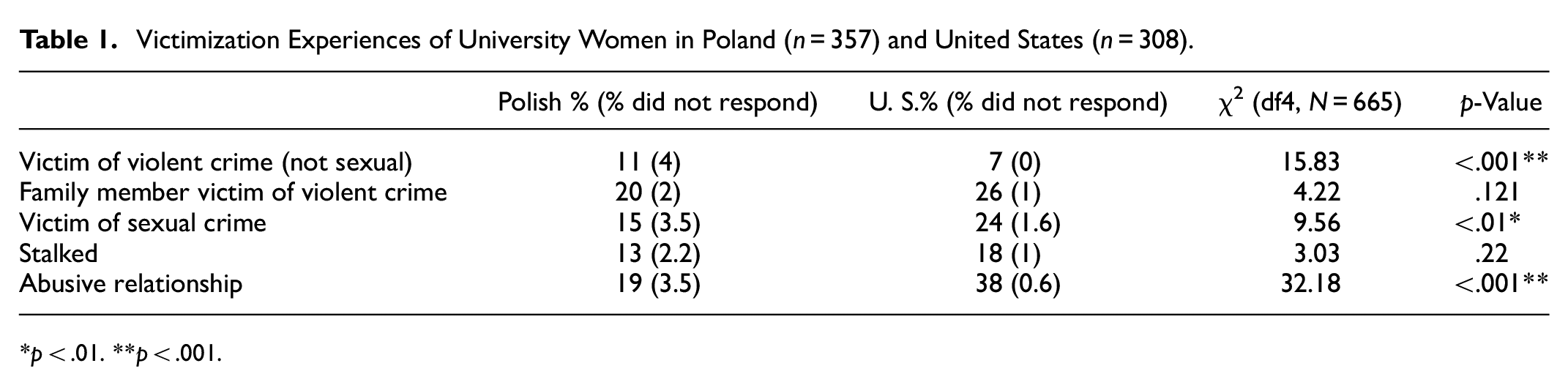
p < .01. **p < .001.
In Poland, among women who had experienced sexual and nonsexual crimes, Likelihood scores were similar to those who had not been victimized (p = .51 and .99). In the U. S., however, women who had experienced sexual and nonsexual crimes believed the likelihood of becoming a victim was significantly higher (p = .02 and .01).
PDSS
The researchers screened the data to determine if scores for the PDSS were normally distributed. The Fear sum did not follow a normal distribution in the U. S. sample, D(267) = 097, p = .001 or the Polish sample D(253) = 0.97, p = .001. Likewise, the Likelihood sum for the U.S. sample was not normally distributed D(267) = 0.97, p = .001, nor was the Polish sample, D(253) = 0.58, p = .001. For Confidence sums, the U. S. sample was not normally distributed D(267) = 0.97, p = .001, but the Polish sample was, D(253) = 0.99, p = .09.
Ultimately, the comparison of U. S. to Polish women who did not train in Self Defense, Martial Arts, or attend Assertiveness classes confirmed statistically significant differences in levels of Fear (Z = −10.42, p < .001) and Likelihood (Z = −5.10, p < .001) with Polish women scoring higher in both, but not statistically significant differences between the two groups in Confidence (Z = −1.49, p = .13).
Kendall’s coefficient of concordance determines the extent to which two groups are similar. According to our calculated Kendall’s coefficients of concordance (Kendall & Babington-Smith, 1939), Polish and American groups indicated “very good” agreement for Likelihood (.908) and Confidence items (.916), and “good” for Fear items (.769).
Using a Mann-Whitney U test, the researchers investigated whether victimization status for selected crimes was related to scores for F, L, and C. As the groups had been previously shown to not be equivalent, investigators analyzed the two groups separately.
The researchers screened the data to determine if scores for the PDSS and BSSS were normally distributed. For the BSSS, both the U. S. [D(267) = 0.99, p = .17] and Polish samples [D(253) = 0.99, p = .37] were normally distributed.
United States
Three significant relationships emerged: (1) women who had been a victim of a nonsexual crime scored higher in Likelihood than those who had not been (Z = −3.12, p = .02), (2) women who had survived sexual assault scored higher in Likelihood than nonvictims Z = −2.55, p = .01), and (3) survivors of a nonsexual crime scored higher in Confidence (Z = −2.13, p = .03).
Poland
Only one relationship differed significantly. Women who reported having been sexually assaulted/abused ranked higher in Confidence than those who had not been (z = −1.93, p = .05).
Differences in Fear
Overall, Polish women scored significantly higher than U. S. women on Fear (Mann-Whitney (Z = −10.42, p < .001). Mean scores ranged from 1.47 to 4.29 for Polish women, and 1.46 to 3.47 for women in the U. S.
In relation to individual items, Polish women did not distinguish between fear of rape by a stranger and rape by someone known (m = 4.1 and 4.1), while in the U.S., women did (m = 3.3 and 2.8). Likewise, Polish women scored high in fear both for being beaten by someone known and beaten by a stranger without a weapon (m = 3.8 and 4.1). Women in the U.S. scored significantly lower for fear of being beaten by someone known (m = 1.94) than being beaten by a stranger without a weapon (m = 2.9).
Although overall mean Fear scores were higher for the Polish women, item means were higher on six items for the American women: parking in a desolate area, being home alone, having a flat tire, using a walk-up ATM at night, being approached by a stranger asking for directions, and asking a stranger for help with your car. All but one of the items related to being outside and having a car.
Of the 11 most feared occurrences for the Polish women, all mean scores were above 4.0, while none of the items were for the U. S. women. U. S. women feared being attacked by a stranger with a weapon as the most feared event on the PDSS (fifth place in Poland), and women in Poland ranked having their drink drugged as the most fearful event (fifth place in U. S.). The mean for fear being raped by a stranger was the second most feared occurrence on the PDSS for the U. S. women, but the ninth most feared for Polish women. In the top 11 feared events in the U. S., four of the items did not occur in the top Polish items, all occurring outside and none involving physical contact (parking in a desolate area (3.15), hearing prowler outside the house (3.11), being followed in your car (3.03), and running or walking alone (3.02)). Four of the top 11 Polish fears did not appear in the U. S. top 11 feared items: being attacked by more than one person (4.20), being attacked by a stranger without a weapon (4.17), being the target of an intentional car accident with intent to isolate and capture (4.12), and home break-in while not at home (4.09). See Appendix B for means and standard deviations of all PDSS Fear items.
Differences in Likelihood
Overall, Polish women believed in a higher likelihood of dangerous situations occurring than women in the United States (Z = −5.10, p < .001). Polish women’s scores ranged from 1.49 to 3.83, and U. S. women’s scores ranged between 1.37 and 3.65. The top three items in Likelihood were the same for both groups (being home alone, running alone, and being out at night). Of all 41 items, both groups scored being beaten up by someone you know as the least likely of all events on the PDSS (41st). Women in both countries stated that being beaten by a known person was LESS likely than being kidnapped, being trapped in a burning building, or being held prisoner with intent to murder.
Women in the United States and Poland both rated the likelihood of being raped by a stranger (2.15 and 2.40) as higher than being raped by someone known (1.67 and 1.5). Of note, U. S. women ranked the items closer in Likelihood (1.67 and 1.5) than women in Poland (1.50 and 2.40).
Partner verbal abuse means were in 37th place for Polish women, but in 24th place for U. S. women. U. S. women’s mean Likelihood scores for being raped by a known person was rated as the 33rd most likely event, while Polish women scored it in 40th place. Stranger rape ranked 16th of 41 for American and Polish women. A full table of Likelihood means and standard deviations is available in Supplemental Appendix C.
Differences in Confidence
Overall, Polish and U. S. women did not score statistically differently overall in Confidence (Z = −1.49, p = .13). For individual items, Polish and United States women scored fairly congruently in Confidence. The lowest item for both groups was being held prisoner with intent to murder (1.86 and 1.81). The second lowest item was being victim of a car accident with intent to isolate and murder (2.0 and 1.95). The third lowest item for both groups was being kidnapped (2.04 and 2.24). Being beaten by a known person was similar for both groups (2.53 and 2.59). Confidence about being raped by a known person scores were very similar (2.12 and 2.19), but they varied somewhat for being raped by a stranger (1.88 and 2.17), with U. S. women more confident.
Although not the most feared item, women in both groups were the least confident about being held prisoner by someone who wants to murder you. Both groups were more confident to manage a rape by someone known than by a stranger (U. S. = 2.19 and 2.17, Poland = 2.12 and 1.88). U. S. women rated being subjected to partner verbal abuse as the item they were the fourth most confident to manage successfully, and Polish women rated it sixth. Being beaten by someone known was ranked in the U.S. as 22nd most confident (2.59), and Polish women ranked it 28th (2.53). Confidence means and standard deviations are included in Appendix D.
Differences in BSSS
The two groups did not score significantly differently (F = 8.28, t(511) = −0.285, p = .77).
Regarding BSSS and F, L, and C
We saw small correlations among the variables, mostly from .13 to .28 (absolute value of both), considered weak (Cohen, 1988). The only correlation larger was for the U. S. women, which was Fear and Likelihood, which was medium (.46) (Cohen, 1988).
Discussion
Whether or not prior victimization influences fear of crime is still open to debate. Recently, Köseoglu (2021) reported that among university students, previous victimization did not influence fear of crime. Mider (2021) in Poland, however, found that prior victimization did influence fear of crime. And yet a third group of researchers (Maier & De Prince, 2020b) stated that victimization “might” make students more fearful. Fear levels are important to consider, as unfounded fears are a sign of poor mental health (Kluczyńska et al., 2019). In the current study, prior victims (Polish and U. S. students) did not score higher on Fear than nonvictims, thus showing a lack of support for previous findings of victimization resulting in higher fears. There are few comparisons about fears cross-culturally, which has been previously noted (Boateng, 2018; Daigle et al, 2021).
Sexual assault among university populations in the United States has increased over the past 30 years, according to Koss et al. (2022). As outlined in Table 1, there was a higher reported rate of victimization among the U. S. group of women. There appear to be two possibilities for the differences in reported rates of sexual assault between the participants. In our study, 15% of the Polish women reported having been sexually victimized, however, Grabowska and Grzybek (2016) found 22% of their Polish sample (n = 541) had been sexually victimized, but their statistic was heavily criticized as being unrepresentative. One possibility is that there are fewer rapes experienced by Polish university women. The second possibility is that there are more unacknowledged survivors—in other words, the women do not realize that their experiences with someone known to them constitute rape, a phenomenon first described by Koss et al. (1988), and subsequently confirmed by others (Koss, 2011; Littleton et al., 2017).
Even though domestic violence and sexual assault are now relatively common terms, women’s understanding of them still is not. Researchers have reported that often women still do not realize that violence in a relationship is considered abuse (Cervantes & Sherman, 2021). In the same manner, many women fear being victimized by strangers, although the likelihood is much lower than victimization by known people (Lennox, 2021; Linder & Lacy, 2020). Previous experience of being in an abusive relationship was not related to Likelihood scores for women in either country on two items. In other words, even after stating they had been in an abusive relationship, the Likelihood scores for being beaten by someone you know and being called demeaning names and criticized did not differ from women who had not been in abusive relationships.
All three dimensions yielded higher scores from the Polish students—they showed higher levels of Fear, as others have found (Kluczyńska et al., 2019), higher Likelihood, but not significantly higher scores in Confidence than the students in the U. S. The first potential explanation is that the women may have had unrealistic thinking regarding this type of situation or a lack of experience in coping with dangers.
According to Nationmaster (2014), a website that compiles data from more than 100 countries, the overall crime rate in the United States is 68% higher than in Poland. For specific crimes, the murder rate is four times higher in the U. S., the rape rate is seven times higher in the U. S. and the murder rate is 30 times higher. However, many fears are higher in Poland: the fear of walking alone at night is 30% higher, and the fear of walking alone during the day is 17% higher in Poland.
A second potential explanation may be that students in the U. S. are simply desensitized to danger more so than Polish students, as has been found elsewhere (Di Tella et al., 2019).
Another third explanation relates to the possibility that Polish women are more fearful in general. In a study of 25 European countries and 70,000 respondents, feelings of unsafety were highest among residents of Bulgaria, Greece, and Poland (Visser et al., 2013).
Trust, or lack of it, may be relevant to the current study. The Polish women showed a reluctance to answer more PDSS items and demographic questions, especially those relating to victimization, a trend also noted by Grabowska and Grzybek (2016). Although Communism fell in 1989, the “culture of cynicism” associated with post-communist societies is still alive and well (Filimonau et al., 2018; Jaskulowski & Surmiak, 2016). Mider (2021) found post-Communist citizens to be uniquely distrustful of both government and society.
While Poland is overwhelmingly Catholic (92%), only 24% of Americans claim Catholicism as their affiliation (Pew Research Center, 2013). The current political and religious climate in Poland creates expectations of women as mothers and wives, devoted only to their families (Graff, 2020; Krotofil et al., 2022; Żuk & Żuk, 2020). The issue of violence against women is still not well-documented or accepted in Polish society (Grzyb, 2019). Grzyb wrote in 2019: “The whole situation, namely a denial of violence against women, is actually part of a wider phenomenon observed in Polish politics since transformation that has exacerbated in recent years, namely the withdrawal of an entire women’s agenda in democratic Poland” (p. 29).
Grzyb (2019) further argued that since the fall of Communism in 1989, the state has pursued an anti-feminist stance, further influenced by the Catholic church, which holds the position that family violence should be kept within the family, and that it is the husband’s place to keep the family in line. Although there is legislation in place in regard to domestic abuse, wording is nonexistent regarding the gendered nature of it. During the 1990s and 2000s, reforms under Communism to benefit working women were eliminated—day care facilities, reproductive rights, social insurance, and others (Grzyb, 2019). Fast forward to 2014, when Polish political leaders stalled signing the Istanbul Convention for 2 years, arguing that domestic violence was not an issue in Poland, and no further legal safeguards were needed for women or children. Even after Polish officials belatedly signed the Istanbul Convention in 2016, the Polish government cut funding to nongovernmental agencies helping victims of domestic violence, stating that the agencies were discriminatory because they only assisted women (Grzyb, 2019). For women to speak out against familial violence in Poland is neither encouraged nor acknowledged. Thus, it may be logical that women in the current study reported such a low rate of victimization.
In the only study located regarding risk perception of Polish citizens (ages 28–50 years), the risk perception factor structure was identical to those found in American, Hungarian, and Norwegian samples, with the greatest similarity between the Polish and American samples. There was considerable agreement in risk perceptions in Polish and American samples (Goszczynska et al., 1991). In the current study, the U. S. women, however, made less of a distinction between Fear (emotional) and Likelihood (cognitive appraisal) of dangerous situations than Polish women did. It may be that Polish women are better informed than U. S. women.
The researchers found a negative correlation between Fear and Confidence in the Polish group, which means that higher self-confidence was related to lower levels of fear. If fear reduction is a goal of self-defense training, then it perhaps may be accomplished through raising confidence. Correlations among all of the other variables were weak.
Persson and Dhingra (2021) reported women had more self-blame when they had been raped by an acquaintance than by a stranger. In the current study, we saw different levels of F, L, and C for stranger versus acquaintance rape in both samples. Thus, we should be approaching the topic in educational venues differently, depending on the perpetrator. Beliefs about a lower likelihood of acquaintance rape in disparately geographical groups of women and lower fear about acquaintance rape indicate that women have not yet acknowledged the origins of legitimate danger.
Limitations
One limitation of the current study related to the sampling of university students.
The two samples of university women were drawn from different city sizes. However, both groups reported similar hometown sizes (2.34 vs. 2.25). Previously, researchers have established that current residency was more important in determining perceptions of safety than prior place of residence (Pritchard et al., 2015).
Another possible limitation of the study was related to participants, as sampling was not random. College of Education majors were represented in the U. S. sample, while all of the Polish students were majoring in Nursing. Although participants represented different majors at each university, the authors assert that participants at both universities were majoring in helping professions dominated by women, indicating an outward focus and service. Because of the different fields of study, however, the results of the research, therefore, cannot be generalized to all Polish and U.S. university women.
As with all self-report methods of data collection, there is a possibility that respondents provided inaccurate responses. Potentially biased answers were also included, although many participants chose nonresponses when they were uncomfortable with the queries. The authors visually inspected the data and deleted obvious patterns of responses that were unlikely (such as all “1”s).
Implications
The current effort is the first to investigate fear of crime, likelihood of victimization, and confidence about dangerous situations in a cross-cultural context. A number of significant findings emerged in the study. Polish women were more hesitant to answer questions than students in the U. S. Potential explanations were explored. We saw higher reported rates of victimization among U. S. women. Many factors may account for the differences in reported rates. We saw statistically significant different levels between the two groups in Fear and Likelihood, but not Confidence. Polish students scored higher in all three dimensions than U. S. students.
Women in both countries feared stranger danger more than danger from a known person. Both groups considered the likelihood of being abused (physical or verbal) by a known person as less likely than the same events perpetrated by a stranger. For both groups, regardless of country membership, education efforts continue to be inadequate for teaching women where legitimate danger resides.
Conclusions
In the current investigation, the authors noted several significant findings. Overall, women in both countries underestimated the likelihood of sexual and physical violence perpetrated by known people and overestimated the same acts by strangers.
Women in Poland were more hesitant to disclose and complete study items than women in the U. S. Possible explanations were offered.
Levels of fear and likelihood were higher for Polish women, but Confidence levels were similar for both groups. Possible cultural factors were offered. Sensation seeking was similar for both groups. Previous victimization impacted Polish and U. S. women differently.
Supplemental Material
sj-doc-1-sgo-10.1177_21582440231216177 – Supplemental material for Fear of Crime, Perceived Risk, and Confidence About Dangerous Situations Among University Women in the United States and Poland
Supplemental material, sj-doc-1-sgo-10.1177_21582440231216177 for Fear of Crime, Perceived Risk, and Confidence About Dangerous Situations Among University Women in the United States and Poland by Jakub Lickiewicz, Patricia Paulsen Hughes and Marta Makara-Studzińska in SAGE Open
Supplemental Material
sj-docx-2-sgo-10.1177_21582440231216177 – Supplemental material for Fear of Crime, Perceived Risk, and Confidence About Dangerous Situations Among University Women in the United States and Poland
Supplemental material, sj-docx-2-sgo-10.1177_21582440231216177 for Fear of Crime, Perceived Risk, and Confidence About Dangerous Situations Among University Women in the United States and Poland by Jakub Lickiewicz, Patricia Paulsen Hughes and Marta Makara-Studzińska in SAGE Open
Supplemental Material
sj-docx-3-sgo-10.1177_21582440231216177 – Supplemental material for Fear of Crime, Perceived Risk, and Confidence About Dangerous Situations Among University Women in the United States and Poland
Supplemental material, sj-docx-3-sgo-10.1177_21582440231216177 for Fear of Crime, Perceived Risk, and Confidence About Dangerous Situations Among University Women in the United States and Poland by Jakub Lickiewicz, Patricia Paulsen Hughes and Marta Makara-Studzińska in SAGE Open
Supplemental Material
sj-docx-4-sgo-10.1177_21582440231216177 – Supplemental material for Fear of Crime, Perceived Risk, and Confidence About Dangerous Situations Among University Women in the United States and Poland
Supplemental material, sj-docx-4-sgo-10.1177_21582440231216177 for Fear of Crime, Perceived Risk, and Confidence About Dangerous Situations Among University Women in the United States and Poland by Jakub Lickiewicz, Patricia Paulsen Hughes and Marta Makara-Studzińska in SAGE Open
Footnotes
Declaration of Conflicting Interests
The author(s) declared no potential conflicts of interest with respect to the research, authorship, and/or publication of this article.
Funding
The author(s) received no financial support for the research, authorship, and/or publication of this article.

Supplemental Material
Supplemental material for this article is available online.
References
Supplementary Material
Please find the following supplemental material available below.
For Open Access articles published under a Creative Commons License, all supplemental material carries the same license as the article it is associated with.
For non-Open Access articles published, all supplemental material carries a non-exclusive license, and permission requests for re-use of supplemental material or any part of supplemental material shall be sent directly to the copyright owner as specified in the copyright notice associated with the article.
