




Abstract
The curriculum-designed internship in hospitality management education has diverse impacts. Adopting the Career Construction Theory, this research explores how internships affect students’ career choices before, during, and after their hotel internships. The methodology of this research consists of semi-structured interviews, focus group discussions, and documentary investigations on international students’ internship diaries. Results show that the curriculum design is critical to the success of an internship. The empirical findings indicate that internship preparation, cultural adaptation during the internship, and reflexivity after the internship are important elements in an effective internship. Research findings reveal the current status of international student internship programs in the Chinese context and provide implications for internship curriculum development in hospitality management and international students’ career development. The present article recommends that it is crucial to manage students’ career construction route through a proper arrangement of an effective internship program. Theoretical and practical implications are further discussed.
Plain Language Summary: How do Hospitality Internships Shape Students’ Career Choices?
Hospitality management curriculum-designed internships have numerous implications. This Career Construction Theory research investigates students’ job choices before, during, and after hotel internships. Semi-structured interviews, focus groups, and documentary research on international students’ internship diaries comprised this study. We found that a good program design affects internship success. Successful internships need planning, cultural flexibility, and reflexivity. An good internship schedule is recommended for managing students’ careers.
Keywords
Introduction
The tourism industry in China has gained widespread recognition as a pivotal driver of economic growth (Geng et al., 2021; Tang, 2017; J. Zhang & Zhang, 2021; J. J. Zhu & Airey, 2021). Concurrently, the hotel industry, being integral to tourism, experiences significant growth to meet market demands. However, this surge in the labor-intensive hotel sector creates a pressing need for well-trained hotel professionals, necessitating high-quality practical education in hospitality (Chen et al., 2012; Lam & Xiao, 2000; Liu & Wall, 2005). The hospitality management curriculum design highlights the importance of off-campus internships, serving as a crucial link between the program and the industry due to its focus on practical skills, professional orientation, and career-centricity (Foucar-Szocki et al., 2013). Despite occupying a considerable proportion of hospitality management programs in China’s vocational and technical colleges (Geng et al., 2020; Jiao et al., 2009; Sonnenschein et al., 2017; Zhou et al., 2018), the effectiveness of off-campus internships remains insufficiently explored. Additionally, the growing trend of international students choosing China as a study destination presents research gaps in the academia. This phenomenon, particularly evident in hospitality majors, calls for attention to the cross-cultural challenges faced by international students, especially in internship settings, where limited research has been conducted. To bridge these gaps and enhance understanding, investigating the experiences of international students in hospitality internships becomes imperative.
Although numerous existing researches have investigated the diversified dimensions of internships and their impacts on career construction theory (Chen et al., 2012; Lam & Ching, 2007; Lam & Xiao, 2000), and yet there are a couple of untouched issues that remained to be addressed, waiting for empirical investigation. For instance, how does the hotel internship act concern the lifespan career instruction? What is the tri-dimensional relationship among the facets like university educational curriculum design, hotel internship and the student’s future career adaptability capacity construction? How the perspective pros and cons from the feedback of the students to hospitality placement affects their future job intentions and career capacity construction? Thus, the main target in this article is to consolidate a conceptual framework to the issue of hospitality management internship, under a systematic review of the existing literature on Career Construction Theory.
In response to the aforementioned gaps, this study delves into the preparation, experiences, and post-internship feedback of international students during their hospitality internships to investigate the impact on their career adaptability and future career trajectory. Drawing on the career construction theory (Maree & Hartung, 2011; Taylor et al., 2018), this research commences with a comprehensive review of existing literature on the Career Construction Theory and hospitality education internships, focusing on international students who have chosen this discipline for their undergraduate studies in China. Employing a narrative perspective, the current study examines the dynamic process through which international students perceive their hotel internships before, during, and after the experience, aiming to unravel the implicit intrinsic interaction among university cultivation, ability assimilation, self-construction, hospitality placement, and future career intentions.
Literature Review
Career Construction Theory
The Career Construction Theory (Savickas, 2002; Savickas et al., 2009; Savickas, 2013) provides an interpretive and interpersonal lens to explore the process by which individuals construct their self capacity, envision their vocational positioning, and make future choices on their careers. The significance of hotel industry internships within the realm of hospitality education has been studied by scholars (Adler & Loughrin-Sacco, 2003; Arago et al., 2019; Busby & Gibson, 2010; Callanan & Benzing, 2004; Cole et al., 1981). These internships hold pivotal importance in the realm of professional practice teaching in hospitality management and significantly contribute to the development of students’ career adaptability. The level of satisfaction derived from hotel internships profoundly impacts students’ practical teaching outcomes, employment intentions, and overall career adaptability within the industry upon graduation. Existing literature in the academic domain highlights the core values of internships and work placements within the hospitality service education sector (Farmaki, 2018). The academia notes that the internship during the educational process may enhance student’s confidence (Ko, 2008), help students with smooth transit from higher education atmosphere to professional employment settings (Silva et al., 2016), increase career satisfaction (Gault et al., 2010), building up confidence and international vision (Adler & Loughrin-Sacco, 2003; J. J. Zhu & Wang, 2022), as well as accumulating capacities for future tourism sector leadership responsibilities (Behnke et al., 2014; X. Zhang et al., 2012). Internship or working placement consists of crucial components to most of the hospitality management curriculum in universities all over the world. As O’Mahony et al. (2001) have noted that the internship is considered to play an essential role in the student’s capacity building and career preparation process. Students are designed to be physically and psychologically exposed to an experiential in-situ learning atmosphere where the assessment criteria are embedded in the hands-on assignment in actuality. The aim of the short-term internship is extensively designed in the hospitality education sector, which has become gradually a consensus as standard setting the curriculum design (Snodgrass, 1974). These internships offer hands-on experiences, academic curriculum integration, and practical exposure to groom future industry leaders. Thus, it is appropriate to adopt this theory to analyze the research subjects, namely international students pursuing a hospitality management major in China.
Career Construction Theory in University Higher Education
University hospitality education, as a significant contextual factor, plays a crucial role in enhancing students’ career capacities, adaptabilities, adaptivity, and future career adaptations. Existing research articles have explored various dimensions of hospitality education. For instance, Divine et al. (2008) discusses the philosophical issues regarding internship program design, which is also studied as an academic outcome (Grantz & Thomas, 1996; Ryan, 1999). Callanan and Benzing (2004) assessed the role of internship within career-oriented employment. Busby and Gibson (2010) summarized that overseas internships are not only increasing students’ familiarity with a real professional working environment but also augment their professional value in the job market and their maturity. Scholars have also examined internship issues from the perspective of market demand (Sapp & Zhang, 2009), with the tourism industry seeking qualified talents to meet high-profile hospitality service standards. The tourism industry has long demanded qualified tourism talents whose competencies could meet the high-profile standard hospitality services. The students are expected to possess long-term vocational focus, career-oriented vision, and willingness to provide timely and quality services. As Airey (2008) pointed out that the “mature stage” of tourism education should not only be satisfied with preparing the students with first employment but also need to reach a common consensus on curriculum design, to meet the challenging knowledge environment. Furthermore, studying internship issues via individual perspectives are also popular (Cooper et al., 2012; Hanson, 1984). Wang et al. (2014) also analyzed the intern’s anxiety, their expected outcome, which related to their career visions. Third, the measurement of internship quality is also studied by researchers (Bailey et al., 2000; Gamboa et al., 2013; True, 2002). Gault et al. (2010) studied the impact of business internships on job marketability via the employer’s angle. Cai (2012) also engaged in the Finnish universities’ global promotion and proposed that the attractiveness and quality of Finnish university higher education could be enhanced by the positive feedback of the employers, who have direct contact with the interns from these universities. O’Neill (2010) also reflected on the quality of internships as a high-impact practice.
Cross-Cultural Adaptation in Vocational Theories
Vocational behavior research has long been a diversified and substantial discipline that flourished over the past years (Spurk, 2021). Yet, there remains a need to reevaluate and to further reorganize the significance of those pieces of literature and engage in a more comprehensive discussion of career development, cross-culture adaption, and vocational education theories. For instance, Spurk (2021) made an overview of the past literature of vocational behavior researches and makes a reflexive investigation of those essential future studies and challenges. Such conceptualization to topics of career preparation, choices and achievement (Choi & Kim, 2013), long-term effects of a youth work internship (Silliman et al., 2020), employability and effectiveness (Espinoza et al., 2020), self-efficacy and productivity (Y. Zhang & Hussain, 2021), as well as career development through an overseas internship (Boo et al., 2021; van Klooster et al., 2008) have been studied and reviewed in the existing literature. To deepen the topic of cross-cultural adaptation in vocational settings, several researchers have conducted trending studies relating to vocational interests (Su, 2020), career choices and designing through an internship (Rothman & Sisman, 2016), and career adaptability (Johnston, 2018), as well as the newly studied career shock imposed by the COVID-19 pandemic (Akkermans et al., 2020). The extant literature is facilitating our efforts to further connect these theories with the following empirical data collection using a qualitative research approach.
Understanding the evolving expectations of the industry, the paper argues that well-organized hospitality internships can yield fruitful outcomes for interns and enhance their determination regarding future career choices. The study focuses on a specific group of interns—increasing numbers of international students studying hospitality management as bachelor students in China—who have received limited attention from academia. Bridging this gap, the article seeks to investigate the multifaceted dimensions of internships in relation to international students’ career decisions and future career planning. This innovative implementation of Career Construction Theory in the context of hospitality management education for cross-cultural international students contributes novel theoretical and practical insights to sociological understanding in hospitality education.
Research Methodology
Qualitative Research Method
This research adopted a qualitative research methodology (Hellawell, 2006; Mason, 2017). The research methodologies adopted in this research consist of philosophical theory review on students’ internship, face-to-face semi-structured interviews, as well as documentary investigations and discourse analysis to international students’ internship diaries, which will figure out the relationship between internship and their future career choices. The purpose of applying qualitative research methodology is to explore specific phenomena and their internal relations and to focus on human practical intrinsic reasons and explore practical knowledge from the empirical data collected (Aliyu et al., 2015; Aspers & Corte, 2019; Gonot-Schoupinsky & Garip, 2019). The theory in qualitative research is not a conceptualization and formalization of social reality, but rather the authors’ interpretation of this particular social phenomenon from a specific perspective through specific research methods (Chong & Reinders, 2021; Hammersley, 1995; Yukiko et al., 2022). Similar to Denzin and Schwandt’s comments on the qualitative research approach, this research adopted an ethnographic participation inquiry for the investigation (Denzin & Lincoln, 1998; Schwandt, 1994). The reasons for adopting such a research methodology is due to its reflective virtues (J. Zhu et al., 2022). Delving into the essence of qualitative methodology, it presents an ideal avenue for exploring the authentic perceptions of the interviewees, allowing us to grasp the intricate nuances and lived experiences that may otherwise remain concealed in quantitative approaches. Secondly, through meticulous analysis and interpretation of their responses, we unearth profound insights, revealing layers of meaning that might elude simpler methods of inquiry (Merriam & Grenier, 2019). The richness of the data we gather empowers us to grasp the complexities and interconnections within the participants’ narratives, unraveling the intricacies of their thoughts, emotions, and perspectives, to go beyond the interviews (Kendellen & Camiré, 2020). Thirdly, qualitative methodology’s inherent flexibility enables the authors to traverse uncharted territory and venture into unexpected territories of knowledge, reaching valuable to formulate a pondering discussion and conclusion through the whole research process (Ehls et al., 2020). And thus, the research project was then guided through the framework in Figure 1 below:
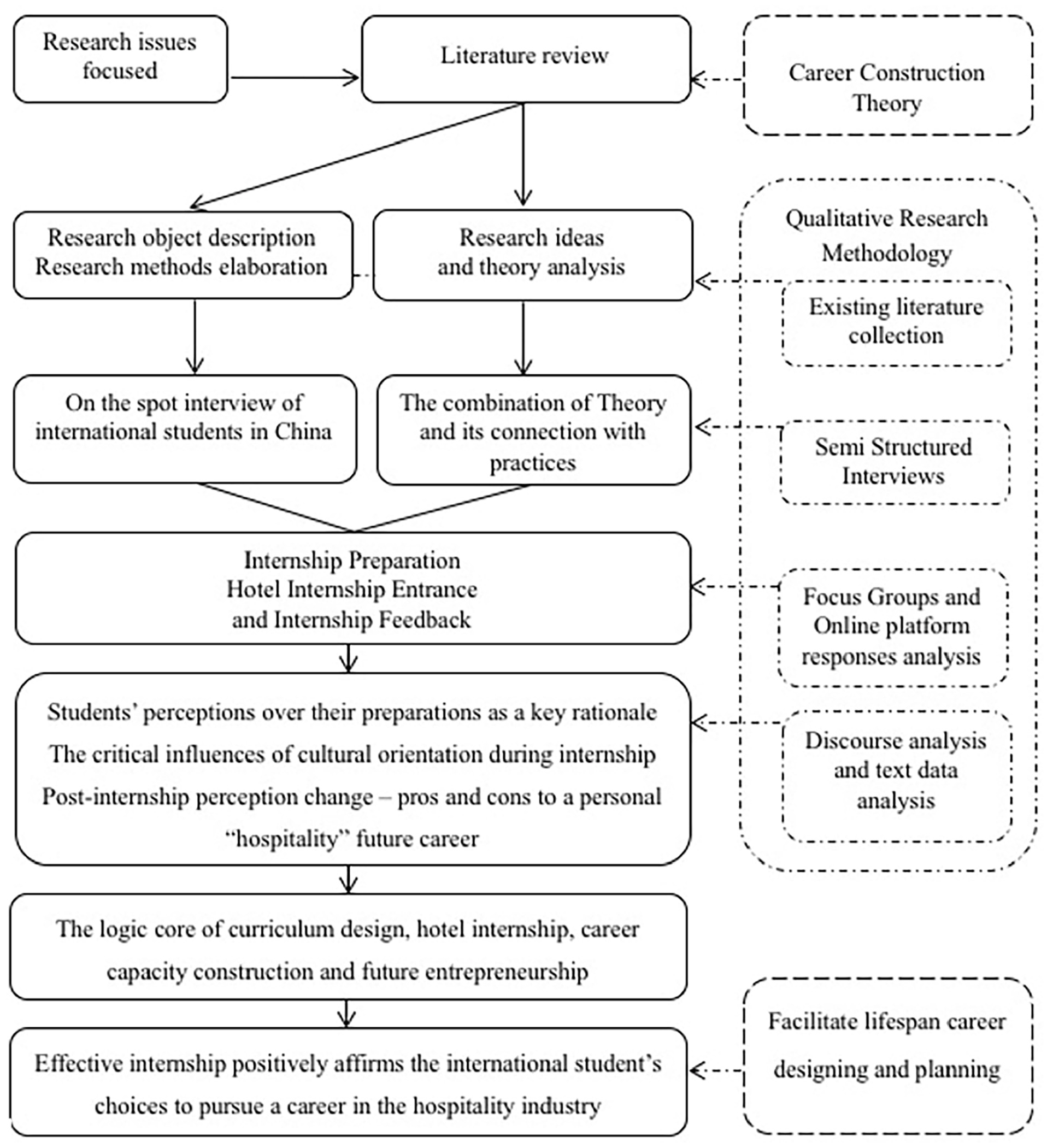
A framework of research agenda.
Research Sites and Agenda
The research was conducted at a prestigious university located in the Guangxi Zhuang Autonomous Region, China. This university is renowned for its excellence in hospitality management education and attracts a diverse international student body, with enrollments from countries such as Azerbaijan, Cambodia, Indonesia, Kazakhstan, Korea, Lao PDR, Russia, Thailand, Uzbekistan, Vietnam, and Zambia. Among these, hospitality management studies are particularly popular among students from Southeast Asian countries, especially Indonesia. In 2017, a full cohort of 37 students from these countries enrolled to pursue hospitality management studies. After 2 years of hands-on on-campus training and classroom coaching, these students embarked on an 8-month internship. The research involved conducting 37 open-ended semi-structured interviews with this group of international students, both before, during, and after their internships. These internships took place in renowned international five-star chain hotels, including S Hotel in Guilin, B Hotel in Yangshuo, and W Hotel in Shenzhen. The demographic information of these students is presented in Table 1 below. Most of these students are from Southeast Asian countries, such as Indonesia, Vietnam, Cambodia, Thailand, and the Philippines. Additionally, two students are from Kazakhstan, one from Panama, and another from Uzbekistan. Out of the participants, 27 are female students and 10 are male students. It is worth noting that all these students were required to complete an 8-month mandatory internship as part of their curriculum, with many of them receiving internship salaries.
Interviewee Profile.

Aligned with the objectives of this paper, the interviews were conducted in three phases. The initial round of interviews took place before the students commenced their internships in January 2019. During this phase, the aim was to explore the international students’ perceptions and their physical and psychological preparations before embarking on their internship journeys at the hotels. The second round of interviews was conducted using internet and mobile apps as communication platforms, facilitating follow-up investigations during the students’ internship period. Through these online interactions, the authors gathered insights into the students’ personal experiences, their responses to pressure, and any grievances they might have faced during the internship. Additionally, the authors organized focus-group interviews for students who had completed their 8-month internships at W Hotel in Shenzhen and B Hotel in Yangshuo. These sessions aimed to discern any implicit connections between the university-arranged internships and the students’ decisions regarding their future careers. Two focus group meetings were held: the first, a month after the interns began their internships in February 2019, and the second in June 2019, a month before the interns’ scheduled completion of their internship period. Despite the considerable diversity in the participants’ backgrounds, the interviews were conducted in English, as the majority of the participants demonstrated sufficient proficiency in English communication. Simultaneously, transcribing the interviews in the English language saved the authors from the burden of dealing with translation work overload. To ensure ethical compliance, the investigation involving the international students received full approval and support from the Ethics Committee at the authors’ respective university. All participants provided their consent to be part of the interviews, which were recorded and later transcribed by the authors.
Questions Prompted to the Research Participants
Based on the theories of investigation of off-campus internship (Cooper et al., 2012; Scott et al., 1990; Snodgrass, 1974; X. Zhang et al., 2012), the international students who study undergraduate program in hospitality management major in G University are studied. Developed from the above-mentioned literature, a guideline for the content of the interviews included the introductory of the research project, some leading questions to gather personal profiles to draw a demographic picture, and three levels of open-ended questions on (1) internship preparation, (2) challenges during the internship, and (3) the general post-internship evaluative feedbacks. Considering that both the leading researchers and the international students were in the same program, their rapport relationship helped facilitate the process of the focus group discussion, by creating a free-to-talk atmosphere and interactive discussions. To conduct a comprehensive analysis of the research data within the established framework, we employed the discourse analysis approach. Our data collection involved engaging in interviews and facilitating focus group discussions, followed by meticulous transcription of the recorded material. Subsequently, the data were thoughtfully summarized, considering three distinct phases: before, during, and after the internship period. The identified themes were then diligently categorized into different topics, ensuring their seamless integration into the relevant sections of our research findings. The mass text data collected from the multiple runs of in-depth interviews, for instance, in the preparation stage, in-situ online group dialog during internship and focus group discussion, were then further processed by the authors.
Findings
Students’ Preparations Before Experiential Learning in an Internship
The first phase of empirical data collection was done in March 2019, right before the students are setting out to join the internship program. The internship serves as an experiential learning process, which covers fundamental aspects of curriculum design, internship monitoring and students’ performance evaluation. Thus, it is subjected to be investigated through a beginning-to-ending sequence. Thus, as it was mentioned in the literature review, as a starting point, the prime research question was schemed as, “Before your internship, what preparations have you done? What dimensions do you believe is necessary to create an effective and successful internship?” The respondents expressed their opinions on the necessary abilities of the potential hotel staff. Students generally believe that professional knowledge, learning ability, Chinese language, adaptability, hands-on ability, expression ability and cooperative mindset are the most critical competencies to be well-armed before the internship started, in line with the Career Construction Theory that Savickas and Watson have studied with (Savickas et al., 2009; Watson, 2013). One student wrote in a pre-internship manuscript to state her perception of internship:
The internship is an important part of practical education in our university program. It is an important practice teaching step to cultivating independent working ability. Through the internship, we will deepen our understanding of our major, the current situation of the industry, the organization, production and operation of the hotel. It will motivate us to study harder and master the basic skills to reach the requirement of the curriculum. It will further strengthen our capacity for theory and practice and cultivate our independent critical thinking (Student A, Indonesian, Female, interviewed in a face-to-face communication before internship in January 2019).
The interview was shown in line with Aitchison’s (2003) idea: nationalities of the international students is one of the essential elements for the international students who study hospitality management. Chinese hotel-working environment, China’s gradual openness to the international world, international students’ internship working visa, their capacity to effective communication, their psychological readiness to perform under pressure, as well as their own competencies preparation, should be dimensions considered by the students. One of the primary concerns is Chinese language proficiency and the international students are willing to participate in programs by which Chinese-language is the intermediary teaching language (Ding, 2016). Some of the students expressed that their Chinese language ability is insufficient to cope with the working environment with many Chinese customers.
As an Indonesian, I did not know the Chinese language before I come to China. After 2 years of learning here, I think my Chinese proficiency is not sufficient for me to undertake an intern’s responsibility in a Chinese hotel. I need to work much harder to improve my Chinese for better catering the mainstreaming hotel guests (Student J, Indonesian, Male, interviewed in a face-to-face communication before internship in January 2019).
Some of them think that their adaptability and innovation capacity is deficient. Flora and Hirt (2008) point out that the out-of-campus exposure should focus on the cultivation of the student comprehensive capacity during their internship process, expanding social networks and having a reciprocity impact. Leadership capacity and leader efficacy should also be developed by the off-campus employment and cooperation internship (Dugan et al., 2013). Targeting their future employability, some prominent students seems to be fully armed with virtues for a hotel industry internship. One student expressed prominently about his preparation to go for internships as follows:
As for me, I think a successful internship would facilitate me with a better vision of the hotel industry and management settings, which will enhance my future employability. It requires 30% of mentality preparation, 30% on my aptitude and attitude, 20% on luck and another 20% on my comprehensive capability (Student H, Kazakstanian, Male, interviewed in a face-to-face communication before internship in January 2019).
While discussing their psychical preparations, we could trace back to their original routine, to the decision-making moment when they decided to study in China. The purpose to choose to study hospitality in China is essentially diversified. Social and cultural capital accumulation is one of the prime targets for these international students. Some of the students chose to enroll in this specific major due to their job-oriented life expectations, as one of the students expressed:
I have long expected to study in China. The full-Chinese living environment is what I have long pursued before I graduated from high school. I come from a tourist city in Indonesia where many Chinese tourists are visiting my city. If I can speak Chinese fluently and with a clear accent, I believe that after I study the hospitality major, I can find a good job in the five-star chain hotel back in my city (Student O, Indonesian, Female, interviewed in a pre-internship meeting held in January 2019).
These students, who have a clear vision about themselves, would be the part of students willing to undertake challenges. Internship to them is a process of the personal profile adding up and increasing their potentiality of future employability (Gross, 1987; Huang, 2013). This is one of the prospects that Chinese investment in the e-commerce business in Indonesia has been booming over the past several years owing to the reason that political proximity, symbiotic sustainability, and globalized survival for the firms (J. J. Zhu et al., 2021). Additionally, regarding that these international students who have chosen to travel thousands of miles to study in a transcultural context, they have already partially thought about their future-oriented career choices, by which internship itself serves as facilitation to enhance the vision.
Despite the well-prepared majority, some students are still negative about their expectations and their feelings. Not all internships are well prepared, both physically and psychologically, as Roberts (1998) calls them “innocents.” Students are faced with awkward incidents, are thrown in sink-or-swim choices, and without preparation before that start to tackle existing problems. Before the internship, some of the students expressed their perplexing attitude toward the internship:
My internship will start soon, however, I think I am not prepared. Internship to my perception is just a period of working-class labor work. My seniors in the university mentioned many times to me that hotel managers will treat us like low-wage labor workers, who are much less demanding than full-employed staff (Student F, Vietnamese, Male, interviewed in a pre-internship meeting held in January 2019).
Considering these comments before they set off for hotel internships, we continued to conduct a follow-up investigation via an internet connection and constantly visit their working sites from time to time all through their actual internships. The empirical shreds of evidence are also interesting findings in the following sections.
During Internship—The Cross-Cultural Adaptation
The impact of an effective internship program would be essential and startling. According to the interviewing investigation, the management of interns in the hotel is relatively essential during their internship periods. The hotel is exerting its managerial influence on the interns via the implementation of the internship program. General management of the hotel implements for internship program consisting of a three-level management system. First of all, the personnel department shall act as a coordinating agency to manage, control, and supervise as a whole. Many runs of hotel orientation debriefings are needed to enhance the capacity and adaptability before the students start the formal internship, in which the hotel senior staff will explain the hotel culture, organization motto and hotel management rules, as well as managerial regulations to the students. Some hotels even would organize a welcome ceremony of the internship for the newcomers. Secondly, the acting department manager of the internship shall be responsible for the internship itself. The department manager will also give the internship the pre-job training in the working department, including the position responsibilities clarification and code of ethics demonstration. In this part, the hotel directly assigns interns to all departments, most of which are based on the needs of the hotel, and students have little independent choice. Finally, the managers of each department assign the interns to the experienced old employees. The old employees take the interns with them. According to the hotel’s instructions, in case of sufficient personnel, the interns are usually one-to-one with the old employees, but the employees of the catering department are deficient. As one of the informants mentioned:
I’m joining the front office department, but even so, I have to understand the basic procedures of different departments in the hotel. We have to learn basic principles like hotel guest welcoming, hotel product introduction, daily promotional items sharing as well as handling the guest’s complaints, further learning subjects include the OPERA system to handle guest profiles (Student A, Indonesian, Female, interviewed in W hotel in a focus group interview meeting in March 2019).
University also plays a critical role in a student internship program. Even though Tam (2001) contests that there are diversified perceptions over the multiple connotations of standard hospitality higher education quality (Tam, 2001), Supervisors from the university to these interns are subjected to act as mentoring consultants to the international students’ career choices. If the university staff act in a proactive role to the interns, it will foster positive internship experiences and these experiences could be followed with positive outcomes that benefit both the interns and the organizing hotels. Corcoran and Andrew (1988) study the university role to foster integrated internships through five areas: immersion, adjustment, expansion, analysis and autonomy. As one student notified in his working notes:
I had a very fruitful and energy-demanding internship. I am very grateful for the university staff to have selected this hotel for us. In this hotel, we have opportunities to rotate our position, as well as go through a hierarchical level of position orientations, cultural experiences and job responsibility training. My internship could serve as an asset in my future career (Student B, Panamanian, Male, interviewed in W hotel in a focus group interview meeting in March 2019).
A collaboration between the hotel and the university is indispensable to safeguard the quality of the internship program. The mechanism for school-enterprise cooperation facilitate students’ skills mastery and fosters professional quality. Students internships are targeted to exercise their vocational skills. This cooperation mechanism helps train students’ comprehensive ability and shape professional and technical personnel. The successful implementation of a hotel management professional internship has its consistency with the curriculum design ideas, goals, and content. Therefore, the school-enterprise collaboration can provide directional guidance for the student competence construction. In the context of Chinese hotel internships for international students, besides finishing the job responsibilities, international students are required to enhance their comprehensive capacity during the whole student training process. Practical internship facilitates students with good skills at finding problems, solving problems, and increasing core competitiveness.
An efficient internship program consists of hotel cultural orientation which will better facilitate individual growths during the internship process. The involvement level of the students could be largely increased with an effective and informative hotel welcoming ceremony and cultural orientation, which would be facilitating individual improvement. As one student make her feedback like this:
All of us had a hotel orientation meeting with the hotel managerial board on the first day of our routine job in the hotel. The HR manager distributes the brochure of S hotel to us, including the core value, S hotel’s CSR, as well as the philosophy, vision, mission, manifesto, cooperate culture and the guiding principles (Student D, Uzbek, Female, interviewed in S hotel in a focus group interview meeting in March 2019).
Off-campus internships are designed as extracurricular activities in the real settings of a hotel environment (Ayikoru et al., 2009). Students are expected to be put into a learning-in-practice circumstance. The service mindset could be acquired during the internship process, which is highly valued for future employment. Concurring with the existing findings, the feedbacks from the student are positively expressed with the following sentences:
During our internship program, we learned things beyond our knowledge, like “how to handle the emergency,” as well as “the standardization of food safety managerial system.” It was beneficial to my career in many ways. I would want to put the skills I’ve gained via my internship experiences to use, particularly in the hospitality business (Student T, Cambodian, Male, interviewed in S hotel in a focus group interview meeting in March 2019).
Language proficiency is also one of the concerns for international students in China. The previous studies might only focus on interns’ English language proficiency since the precedential studies are targeting the non-English speaking students’ international exposure (Van Hoof, 2000). In concord with the language acquisition angle, the international students we interviewed in this research also expressed their concerns on doing an internship in a cross-cultural environment:
The hotel staff gave us some training lessons on the Chinese language about hotel services, like Qing wen nin de fang jian hao ma shi duo shao? (Could you tell me your room number, please?). I’ve discovered that these few Chinese words are really helpful when we are attending to the needs of our visitors. I feel that it will improve our capacity to communicate in Chinese, which will in turn raise our future employability in China as well as in my own country (Student Q, Thai, Female, extracted from students’ internship every working diary, date unavailable).
The foremost competence is the capacity to adapt to the new environment to face pressure. As Berg et al. (2010) have noted, the capacity to perceive and respond to workplace challenges reflects a personality virtue. That is to say, when workplace proactivity requires one intern to increase the adaptability, they are generating individual adaptabilities and enhancing the personal capacities. Interpersonal communication, personal feeling expression, capacity to perform under pressure and their sense of accomplishment are concerned in the previous studies. After entering the hotel, the students will live in the staff dormitory according to the arrangement of the hotel. For a new accommodation environment, everyone needs time to adapt and get used to it. Moreover, for the students, a sudden change from the campus to the hotel makes the surrounding environment of the students changed, which will make the students suffer from different degrees of psychological and spiritual pressures.
To the international students who do their practical internship in a Chinese hotel, it is also a cultural exchange opportunity, which is also similar to those students with overseas internship experience (Toncar & Cudmore, 2000). These international students bear the inborne cultural advantages and their constituencies of variety, bringing cultural flavor to the internship program (Bryan & Sprague, 1997). A substantial chance for cultural travel and heritage touring are some of the cultural activities included. Conversely, the international students are also excited to bring in their cultural essences to the working place, sharing their diversified cultural heritages. One student expressed her excitement as follows:
When we performed our traditional Bali Dance at the Chinese New Year Grand Performance for the staffs of S hotel and all of the guests, my amazing recollection was still very much alive in me at the time. That night was so incredible for me because it gave me the opportunity to share our Indonesian culture with people all around the globe, particularly in China. Immediately at this point, I had an epiphany: diverse cultures had the potential to be shared, and even blended, provided that I make some kind of contribution (Student A, Indonesian, Female, interviewed in S hotel in a focus group interview meeting in June 2019).
However, not all positive feedbacks were collected from the interview. Due to insufficient factors such as students’ inadequate knowledge of professional internships and the inability of some problems encountered during the internship to be resolved promptly, students may have some psychological problems, which affects the final effect of hotel internships. Some of these students think that working as a waiter or waitress is not beneficial to their careers, and as a consequence, they have negative opinions about internships and express their discontent with the school’s internship arrangement. During this process, the interns are prone to impetuous emotions. After the internship program is gradually more familiar to them, the interns will slowly feel that the hotel service work is a dull, mechanical, and high-intensity physical labor. What they have learned in school do not apply to their practical work. As the internship continues to deepen, the enthusiasm and responsibility of the intern gradually diminished.
Post-Internship Reflexivity—Pros and Cons to a Person’s Future Career in Hospitality and Tourism
The third phase of focus-group interviews was conducted in August 2019, right after their internships terminated. After the interview, some informants expressed that their enthusiasm and efficiency in work placement are essential to their personal growth. The purposes of the off-campus internship in most of the hospitality educational programs are to expand the social network, establish a critical thinking mindset to act under pressure, and assert the self-positioning as pursuing a future hospitality career, increasing their competitiveness for the future, as well as accumulating bits of knowledge to those who already have basic knowledge in hospitality.
Becoming a guest relations officer, we have been trained for over two weeks to learn the front desk service. It was so hard for me due to language barriers, since some of the hotel PSP systems to handle guest profiles are mainly Chinese systems, which is beyond my capacity. However, I tried so hard to push myself to be more strongly in my mentality side and encourage myself to improve, to survive in this industry in the future (Student E, Thai, Male, extracted from students’ internship every working diary, date unavailable).
International undergraduate students in China interviewed in this research project also expressed their aspiration shift:
I feel that I have accomplished a lot during my internship in this S hotel. The prime accomplishment was my stronger mentality. My professional capacity to deal with guest complaints has been cultivated, and my competence in cross-cultural communication has been enhanced due to my growing confidence. I believe these experiences would be helpful for me to enter the hospitality industry upon graduation (Student L, Uzbek, Female, interviewed in a post- internship recap meeting back in the university in 2019).
Scholars have investigated the internship year from a negative perspective, mentioning that the internships are formidable tasks and energy-demanding. Without enough joint efforts (Akomaning et al., 2011) and effective communication (Hamilton & Pajari, 1997; J. Zhu & Siriphon, 2019) from the stakeholders of the internship programs, that is, student, university and the hotel, the students won’t be able to bear a positive perception on the internship itself:
My internship ended last week. However, I could not shake off my sick feelings to my manager in the F&B section. For over months, we were just treated as low-wage laborers. I finally realized that my internship was nonetheless much different from my peer. My manager has never tutored me in any one-on-one training. I could never enjoy any guidance from my manager, comparing to all my peers (Student K, Viet, Male, interviewed in a post- internship recap meeting back in the university in 2019).
Regarding this phenomenon, for building a successful internship framework, it is necessary to form a model of the learning experience of flexibility, working with every sector of stakeholders (Clements, 2009). It is necessary to pay attention to psychological counseling before the internship and clarify the meaning and goals of the internship. The pre-internship consultancy will let students understand the psychological dilemma that may arise during the internship in advance, clarify the purpose and significance of the internship, and enhance their sense of honor and responsibility. In addition, students should be prepared before the internship to avoid being too optimistic or pessimistic after entering the internship. We must attach importance to the hotel practical practice, hands-on experience, and foster a sense to cherish the opportunity for their internships. Referring to all these interviews, it is time to conclude the international students’ perception change from beginning, during and after the hospitality major curriculum-arranged internships.
Discussion
The findings of this article increased and expanded the scope of application for the Career Construction Theory. The study explores the international students’ preparation before their actual 8-month internship, during their internship process, as well as the aftermath feedbacks from the international interns, trying to examine the relationship between internship and the international student’s future career orientations. It elucidates the argument that an effective internship positively affirms the international student’s choices to pursue a career in the hospitality industry, and facilitates a successful lifespan career crafting by escalating overall career competencies (Akkermans & Tims, 2017). With the continuous development of China’s tourism industry, there are higher requirements for qualified talents in tourism and hotel management higher education. To train more outstanding and skilled tourism and hotel personnel, the development of professional internships in tourism management colleges plays a significant role. Hotel internships are of great practical significance to students, schools and hotels. Only by continuously strengthening the management of school education and internship, handling the relationship between the school, the hotel and the interns, timely understanding and solving various problems of students during the internship, and gradually improving the internship of the hotel, can students be taken seriously, and provide to these future hotel professionals with professional and vocational skills. By analyzing and summarizing the problems in the students’ internship process, we can find out the virtues and deficiencies in the hospitality teaching process and improve the teaching effect. It can also fully reflect the school’s quality and characteristics, thereby making the school-enterprise relationship closer. For hotels, choosing an intern means not only reducing management costs but also enriching the hotel’s human resource database. As per the international students, hotel internships not merely enhance their practical skills, but also improve their interpersonal skills, and also exposing them to the authentic Chinese cultural atmosphere, which helps students to combine learned theoretical knowledge with real practice. To further illustrate the theoretical and practical contribution, the authors formulate a conclusive research framework of the guiding process of career construction theory through proper arrangement of a full process of the internship program as follows (Figure 2):
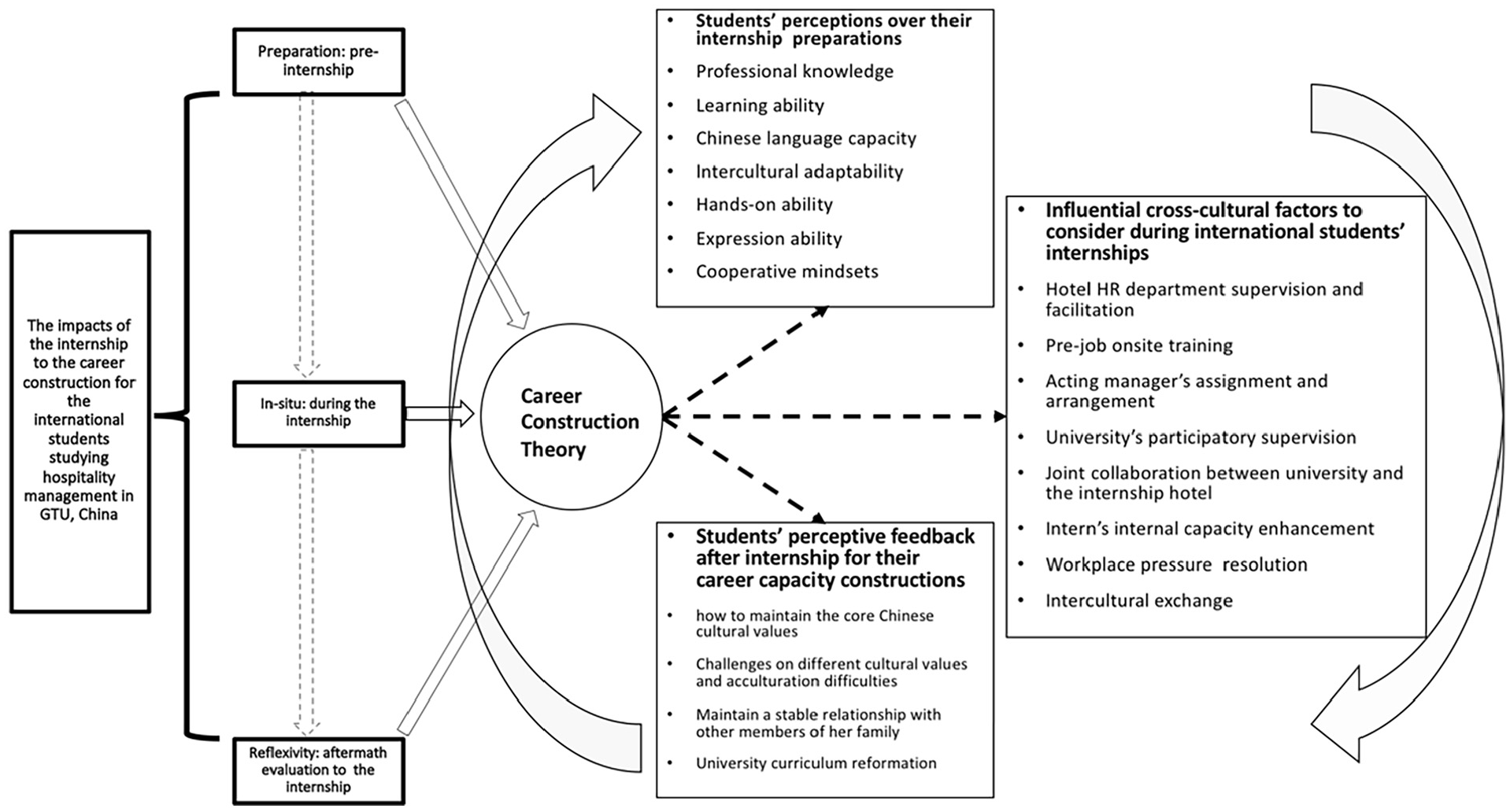
Career construction route via a proper arrangement of a full process of an internship program.
Conclusion
Based on Career Construction Theory, the present research adopts a qualitative research approach to investigate the internship program impacts on international students who chose to study hospitality management in a cross-cultural context. Through further analysis of the qualitative data collected in the research, namely, the preparation, the in-situ internship and perceptive feedback of the international students, this article is contributing in its theoretical discussion to the guiding position of Career Construction Theory. In the meantime, it is also contributing to the practical implementation of this theory on proper educational projects. The future decades will a witness growing number of international students studying hospitality management in the Chinese context, some of whom will be working in the Chinese language-related context, both in China and back in their own countries. Their hospitality educational experiences, especially a fruitful and meaningful internship program, could be one of the most necessary life spans for them. Both the industry and the university should be in close collaboration together to ensure a positive outcome while the international students work through their internships. In this regard, how to strengthen the real acquisition of students’ comprehensive ability while we are improving the practical teaching schema and put the adaptability and innovation capacity as one of the priorities. Off-campus placement is an effective talent incubator. The effectiveness of off-campus placement practice is a direct dimension to the success of the hospitality management teaching system. It is necessary to fully exercise the school-enterprise cooperation resources and platforms to provide students with valuable hotel placement and provide students with diverse and multi-level internship opportunities. Hotel internships can facilitate students with professional insights, broaden their career development opportunities and build up their capacity to respond to market changes more efficiently. In terms of job selection after off-campus placement internships, including rotation internships and grassroots management training, the existing school-enterprise cooperation consolidates a solid foundation and resources for the students.
Limitations
A few limitations of this research findings can be summarized as follows: Firstly, the sample volume of this research was limited to merely 37 international students. The interview data developed via the career construction theory framework might not cover a wider range of students. Secondly, due to the limitation of the length of the paper, the research findings did not include the perspectives from the university staff, hotel employers, and those true employers after their graduation, who are supposed to be included to make a systematic capacity-building value chain analysis. Future research in this area should be focusing more extensively on different stakeholders in the hospitality industry. These internship stakeholders’ perceptions, including internship hotel managers, university administrative staff, the faculties of these students who undertake curriculum teaching, the curriculum designer in the faculty, etc. A more comprehensive and multi-angled investigation should be implemented to implement how these international students could benefit from a valuable internship, trying to figure out their future career intention.
Footnotes
Author Contributions
Jinsheng (Jason) Zhu: Conceptualization, Data collection, Research work, Writing, Revision, Fund beneficiary, Corresponding and communicating. Ying (Tracy) Lu: Conceptualization, Research work, Proof-reading, Revision. Yun (Michelle) Zhao: Conceptualization, Data collection. Hailin Zhang: Supervision (reviewing and editing), Fund beneficiary. Fang Ran: Revision, Fund beneficiary.
Declaration of Conflicting Interests
The author(s) declared no potential conflicts of interest with respect to the research, authorship, and/or publication of this article.
Funding
The author(s) disclosed receipt of the following financial support for the research, authorship, and/or publication of this article: It is supported by the ASEAN Tourism Research Center of Guilin Tourism University, Guangxi Cultural Tourism Master Studio, and Guangzhou Culture and Tourism Development Research Base of China. This article is part of academic achievements of first-class universities and disciplines in tourism management discipline (project) in Guangxi, China. This research project is financially supported by Guangxi Tourism Vocational Education Teaching Steering Committee - 2021 Tourism Vocational Education Research Project on Teaching Reform in Tourism Education (2021LYHZWZ001).
