




Abstract
The current study explored the representation of biomedical treatment and mental health treatment in the television series Bates Motel. We used a sample of episodes from the fourth season of the series to create a set of codes inductively. We did this to answer two research questions about the topics of conversation and verbal expressions with character dialogue. Results revealed the distinctions in topics of conversation and verbal expressions by examining dialogue between either the biomedical patient and mental health patient and a conversation partner. Appendix A shows a detailed listing of episodes coded. Results also showed that communication was more hopeful and agreeable in the biomedical settings, more procedural (or direct), worried, and urgent in the mental health setting. In both settings, we found communication was caring between provider and patient. Future research should expand on this small yet important sample, even considering smaller samples of episodes as case studies of media representations of health settings.
Introduction
Television and film are a source of entertainment as well as information for viewers. Research on this topic has a long history of investigation into the effects of fictional and non-fictional media on viewer attitudes and beliefs (Iyengar, 2017; McLemore, 2019). They are so interwoven in daily life that individuals are likely to take these as given. The enormous volume of contemporary media consumption, the ever-changing media environment, and the significance of media in our daily lives all strongly suggest that we must comprehend our connection with media as both producers and viewers (Dill, 2013).
The presentation of health-related topics on television and in film represents a subject to focus on this intersection between entertainment and information. Sometimes, in popular media, health conditions and treatments are misrepresented and hence misunderstood by the viewers. Two such examples of this are the simplistic and clichéd characters that have been used to portray mental health and sensationalized presentation of biomedical care. The use of sensationalized cinematic plots, coupled with the increased production time of media narratives, has widened the reach of these images to audiences (Guarinos & Berciano-Garrido, 2022). Yet, few studies have compared the presentation of mental health or psychiatric care with biomedical patient care. This research aims to do as such by examining a small yet rich sample of scenes in a single series, the A&E drama Bates Motel.
Rationale
It has been repeatedly reported that the manner in which health issues are represented in the media influences media viewers’ perceptions of specific health problems (Riles et al., 2015). The literature on this subject has shown that media messages have a significant impact on people’s knowledge, beliefs, perceptions, and decisions when it comes to health-related issues (Foss, 2022). The prevalence of health information in the media, including television, movies, news reporting, and social media, has drawn the attention of health organizations and communication scholars (The Kaiser Family Foundation [KFF], 2022; Pavlova & Berkers, 2022). One popular method for conducting investigations on the media messages about health is content analysis (Hoffner & Cohen, 2012). A number of benefits of conducting content analysis have been discussed in the literature.
Separate content analysis studies have demonstrated that media representations of biomedical care and mental health care have been portrayed in ways that are comparatively divergent from one another yet, independently, relatively consistent over time (Meyer & Yermal, 2021; Parrott & Parrott, 2015). Few studies, if any, have compared medical and mental health treatment within the same media narrative. Moreover, a paucity of research has highlighted film and television portrayals of mental illness, relative to research examining news coverage of mental illness (Riles et al., 2021). An aim of our investigation was therefore to build on research that has examined media representations of mental health treatments and biomedical treatments. This study examines the representations of medical (i.e., biomedical) and mental health treatments in fictional media narratives by examining a small yet rich sample of mental health and biomedical health treatment in the fourth season of the A&E series, Bates Motel. We selected this particular series, as well as the specific episodes, because it exhibited a unique sample contrasting biomedical care with mental health care. We only sampled nine of ten episodes in season four as these were the only episodes in which psychiatric or mental health care and biomedical care were delivered. Thus, the criteria for inclusion into the sample was scenes with dialogue about health care, scenes taking place in a health care facility, or, oftentimes, both. By investigating the simultaneous delivery of biomedical and psychiatric healthcare using the fourth season of the American television series Bates Motel as a case study, the current study aims to fill this gap in the literature. We selected this series because it provided parallel scenes of characters receiving mental health psychiatric care, juxtapositions with scenes of biomedical care. A review of the narrative’s contrasting scenes is provided in the sections below, which cover the main characters receiving care, Norman and Emma, respectively. Before reviewing these character’s stories, a summary of the television series is afforded for background purposes.
The Television Series Bates Motel
Bates Motel was developed by Carlton Cuse, Kerry Ehrin, and Anthony Cipriano, produced by Universal, and originally broadcast on the A&E Network (Cipriano et al., 2013–2017). It aired from 2013 to 2017, with a total of five seasons containing ten episodes per season, ultimately forming an ongoing and cohesive narrative (Gerrard, 2019). The show is based on some of the characters in the Alfred Hitchcock film Psycho (Hitchcock, 1960). Alfred Hitchcock’s film is known as a classic in the horror genre, but it has also been studied as an example of the sensationalizing and stigmatizing portrayals of mental illness in popular media narratives (Pirkis et al., 2006). The series follows Norman Bates’ life as a teenager (prior to the events in Psycho), a time he is unaware that he has transient loss of consciousness episodes related to dissociative identity disorder. The series treatment narratives can be split into two categories: (a) Biomedical treatment and (b) Mental illness treatment. The representations of biomedical and mental health care in media narratives, particularly in television and film, are discussed in the section that follows. Following a summary of the series and a spotlighting of two of the series’ health treatment stories, our research questions and methodology will then be discussed.
Literature Review
Biomedical Care in Media Narratives
Several case studies of medical dramas on television have highlighted that media representations also impact individuals’ perceptions of health care (Lee & Taylor, 2014). Medical dramas, such as E.R. and Grey’s Anatomy, have evolved over time in their representations of doctors, hospital settings, and medical practices (McClaran & Rhodes, 2021; Meyer & Yermal, 2021). Previous analyses have demonstrated that physicians were portrayed as heroes in the early days of television. For example, the series Medic, which ran from 1954 to 1956, was an “exposition on the process of translating scientific advances into the ability to cure diseases were presented as treatable for the first time” (Tapper, 2010, p. 394). However, since the 1970s, storylines have mostly featured medical doctors as anti-hero figures (Quick, 2009), integrated into narratives that glorify bodily trauma (Hetsroni, 2009) and make exceedingly rare conditions appear common (Meyer & Yermal, 2021). In other storylines, doctors are presented in more humanizing ways, as esteemed professionals as well as flawed individuals. In the film The Doctor, a renowned surgeon is given a cancer diagnosis, transforming from a revered practitioner to a patient and taking on a new, entirely different capacity in the hospital where he is still employed. Every event during the course of his illness seems to drastically change him, and his approach to treating patients, coworkers, and even trainees shift their attitudes toward treatment (Baños & Bosch, 2015). A similar metamorphosis takes place in the 2016 movie Doctor Strange (Derrickson, 2016), which portrays the story of the renowned but arrogant surgeon Dr. Stephen Strange, who loses the functional capacity in his hands following a car accident, and subsequently loses his skill in performing medical surgery. Similar analyses have been conducted by others examining mental health and mental illness in media narratives. Before turning to the representation of mental illness, a review of Emma, the character receiving biomedical treatment, is provided for context.
Emma’s Narrative
Overall, the depiction of medical doctors in film and media has been represented a great deal over time, but these presentations did not parallel the depiction of mental health treatments in the same show (as it is done in Bates Motel). In the present study, we looked at the treatment and rehabilitation of Emma, a lead character who dealt with cystic fibrosis throughout the series up until season four, when Emma was going to receive a lung transplant at Portland All Saints Medical Center. After a successful operation, the audience sees several instances in which Emma is supported by her father, romantic partner, and medical physician, leading to a favorable treatment outcome. The appearance of mental health treatment occurs in the scenes adjacent to Emma’s operation during the fourth season. In scenes depicting mental health treatment (or symptoms of mental illness), Norman displays symptoms of dissociative identity disorder (DID) (American Psychiatric Association, 2013).
Mental Health Treatment in Media Narratives
In the late 1950s, academics started to take an interest in the representation of mental health in the media. Taylor (1957) discovered that the content of print and broadcast media that covered mental health was a daily concern in terms of public safety (i.e., mental illness was dangerous). Taylor noticed that the majority of allusions to mental illnesses in both play and news stories included criminal activity. Due to their distinctive appearance and actions, those with mental illness were generally perceived as being dangerous. Even though there was stricter television censorship at the time, none of the three major broadcast networks allowed the use of mental disorders “for shock or humorous purposes” (Gerbner, 1959, p. 294). In an early report, O. F. Wahl and Harmon (1989) found that media depictions of mental illness contributed enormously to the negative stigma related to mental health patients (Anderson, 2003). Domino (1983) focused on the film One Flew Over the Cuckoo’s Nest, administering a questionnaire to a sample of college students before and after the release of the film. According to Domino, no significant differences were found in measured attitudes prior to the film, but students who saw the movie showed significantly fewer positive attitudes toward mental illness after the film than those who had not seen the film. According to Chapman et al. (2017), modern media, particularly children’s programming, continues to frequently discuss mental illness. The pioneering cultivation theory researcher Gerbner (1980) supported this form of representation, stating that “the mentally ill are most likely to be both violent and victimized in the world of television” (p. 20). They discovered a wealth of sinister characters with hidden agendas who frequently broke moral laws. Lawson and Fouts (2004) reviewed Disney animated films and showed that a high majority of films addressed mental illness, with stigmatizing phrases labeled. The majority of Disney animated films, according to Lawson and Fouts (2004), featured an average of five spoken allusions to mental illness, and 21% of characters were easily recognizable as having a mental condition. Eighty percent of children’s cartoons, 46% of children’s television shows, and a quarter of all G/PG-rated movies, many of which are at least partially directed at children, all contain references to mental illness (O. Wahl, 2003). Information gleaned from media representations of mental illness affects how the general public views those who have been diagnosed with and are afflicted by mental health conditions (Ma, 2017).
Furthermore, the significant proportion of the characters with mental illnesses was used to ridicule and scorn. One in four mentally ill characters commit murder, and half are shown hurting others, making the mentally ill the group most likely to be involved in violence (Signorielli, 1989). The consequences of these images for people with a mental illness are profound (Stuart, 2006). Klin and Lemish (2008) assessed roughly 100 books and articles on the stigma of mental illness published in the media between 1985 and 2005 and discovered that not only were depictions of people suffering from mental illnesses exaggerated, but so were depictions of mental health professionals and even the causes and treatments of mental illnesses. Diefenbach and West (2007) demonstrated that characters with mental illnesses were ten times more prone to criminal activity than those without mental illnesses. Their findings were echoed in Parrott and Parrott (2015), who showed that individuals with mental illness were both more prone to crime and more likely to be victimized by members of the general population. From the analysis of traditional media, discourses of mental illness patients use descriptors of criminality or danger, disparaging terms (“crazy,”“insane”), adverse emotional states (“disturbed,”“unstable”), and a victimization lexicon (“hopeless victim”) (Pavlova & Berkers, 2022). In their influential summary of mental illness in media narratives, Pirkis et al. (2006) observed that representations of mental illness in fictional films and television programs can negatively influence public images of mental illness, which in turn can perpetuate stigma. Pirkis et al. (2006) provided a detailed analysis of the extent and nature of portrayal of mental illness using detailed taxonomies highlighting a pattern of negative stereotypes used to present mental illness in fictional films and television programs (see Table 1) introduced by Hyler et al. (1991):
Pirkis et al. (2006) Classifications.

Dissociative Identity Disorder
In scenes depicting mental health treatment (or symptoms of mental illness), Norman displays symptoms of dissociative identity disorder (DID) (American Psychiatric Association, 2013).The Parisian medical scientist Pierre Janet is credited as the foremost scholar to record the series of patient symptoms modern practitioners would diagnose as dissociative identity disorder (DID) (Lebois et al., 2022). Kohlenberg and Tsai (1991) described DID as a complex post-traumatic developmental disorder that typically manifests before age 6, whereby individuals isolate different aspects of their identity to protect themselves from reliving the trauma. A child is consciously aware the abuse is happening to them but, for protection, creates a type of psychological distance apart from the trauma in order to maintain a sense that their emotional relationships with others are ordinary (Phelps, 2000). The term “dissociation” in this diagnosis refers to a breakdown in the functionally typical integration of the psyche. Dissociation manifests as changes in a person’s affective behavior, social demeanor, self-awareness, memory, subjective perception, cognitive processing, and/or sensory-motor functioning (Urbina et al., 2017). This means that the biopsychosocial factors of a person’s psyche that ought to be integrated and harmonized are not connected. DID thus develops as a coping mechanism to curtail trauma caused by threats and feelings of helplessness in chronically dysfunctional and abusive situations (Spiegel et al., 2011). As a result, people may encounter identity and memory discontinuities that either go unnoticed by others or are covered up with an effort to mask the discontinuity. According to the DSM-V (2013), people with dissociative identity disorder frequently experience intrusions into their conscious awareness and sense of self (such as intrusive thoughts and emotions), changes to self (such as the perception that one’s body or actions are not one’s own), and unusual changes in perception.
Norman’s Narrative
Norman, the main character of the show, is a teen who lives in Oregon with his mother and sometimes with his brother. He shows signs of DID throughout the whole series, but he doesn’t get a diagnosis or treatment until the fourth season. In the first two episodes of this season, Norman is shown to exhibit symptoms of DID. On his first visit for treatment, he was transported to Willamette County Hospital, where he was held for three days of “observation.” Norman is then admitted to the Pineview Institute, where he is diagnosed with DID. The Pineview Institute is a more modern facility than the one in Willamette County. It also has highly trained medical professionals who can treat DID. Before turning to a review of media representations of biomedical (in Emma’s narrative) and mental health (in Norman’s narrative), we first give a brief summary of DID according to the DSM-V manual (DSM-V, 2013).
Our research questions were inspired by the background provided by that same narrative. We thought it would be important to examine these settings side-by-side because of the distinctively divergent ways the two types of care have been presented to audiences. As a result of the media’s stereotypical portrayals, people with mental health disorders are often reluctant to approach a mental health clinician and avoid treating conditions that have scientifically valid treatments (Uban et al., 2021). There is also some evidence that media portrayals of mental illness influence our everyday mental health conversations (Li & He, 2021), which feature talk that stigmatizes these conditions (Ma, 2017). Parrott and Eckhart (2021) investigated media attention on illnesses (biomedical and mental illness) and stigma over time and determined that mental illness was most frequently associated with stigma.
The television show Bates Motel offers viewers a side-by-side comparison of the two treatment environments, which we use as a case study in our qualitative content analysis. This study used qualitative content analysis to compare the health care given in a medical facility and a mental health treatment facility. We used the nine episodes as a case study to look at how one media story told about certain health care situations. This study used the TV show as a way to look at how patients, providers, and people in the patients’ social circles were shown in different treatment settings. Our research questions were inspired by the background provided by that same narrative.
RQ1: How does the verbal communication content differ in scenes with (a) mental health treatment compared with (b) biomedical treatment scenes?
RQ2: What are the most frequently discussed topics of conversation in (a) mental health treatment and (b) biomedical treatment?
Method
The goal of qualitative research is not to explain or predict, but rather to understand the phenomena taking place (Arnett, 2016). The analytical perspective corresponds to that of the field of audio-visual communication, and, within it, fictional series depicted in media. We employed an inductive coding approach to study the series. Qualitative content analysis involves seven steps (Croucher & Crohn-Mills, 2022): (1) review existing literature; (2) data collection (3) data preparation for analysis, (4) beginning coding, (5) development of a coding framework, (6) identifying categories and themes, and (7) interpreting what you learned from your analysis of the data. The approach for determining which scenes to code is illustrated in the figure below.
After reviewing the relevant literature (see literature review), we began the process of data collection (Venkatasubramanian, 2021). Two coders viewed the episodes and recorded our observations using computer spreadsheets. We identified episodes that featured at least one scene with either mental health treatment or biomedical treatment. In order to generate our codes, we first watched each episode on its own while keeping the study questions in mind. To prepare the data for analysis, we watched the episodes and recorded episode information on a spreadsheet. The spreadsheet contained the season and episode number (e.g., 04 × 01 indicated season 4 episode 1), the title of the episode (e.g., “A Danger to Himself and Others”), a time stamp for each coded scene (e.g., 2:00–4:01), and a title for the particular scene (e.g., “We made it!”) (see Figure 1). We created codes for the nine episodes of the television series that dealt with mental and/or biomedical health care using an inductive approach. On average, episodes lasted 42 to 44 minutes, and required approximately 7 and a half hours of viewing.

Scene selection strategy.
We watched the series, letting the main themes come to us as we watched. Following accepted standards for inductive coding reliability (Croucher & Crohn-Mills, 2022; Sundstrom et al., 2018), we generated themes for topics discussed and communication styles in terms of valance and affect (Hsieh & Shannon, 2005). Our sampling unit was the scene in which the discussion around treatment occurred. Altogether, 57 unique scenes were coded, which, in the end, made up approximately 2 hours of season 4. The recording unit was the characters’ interaction sequence in the unique scene, and the context units were verbal affective content of the interaction (RQ1-2) and topic of conversation (RQ3).
Codebook Categories
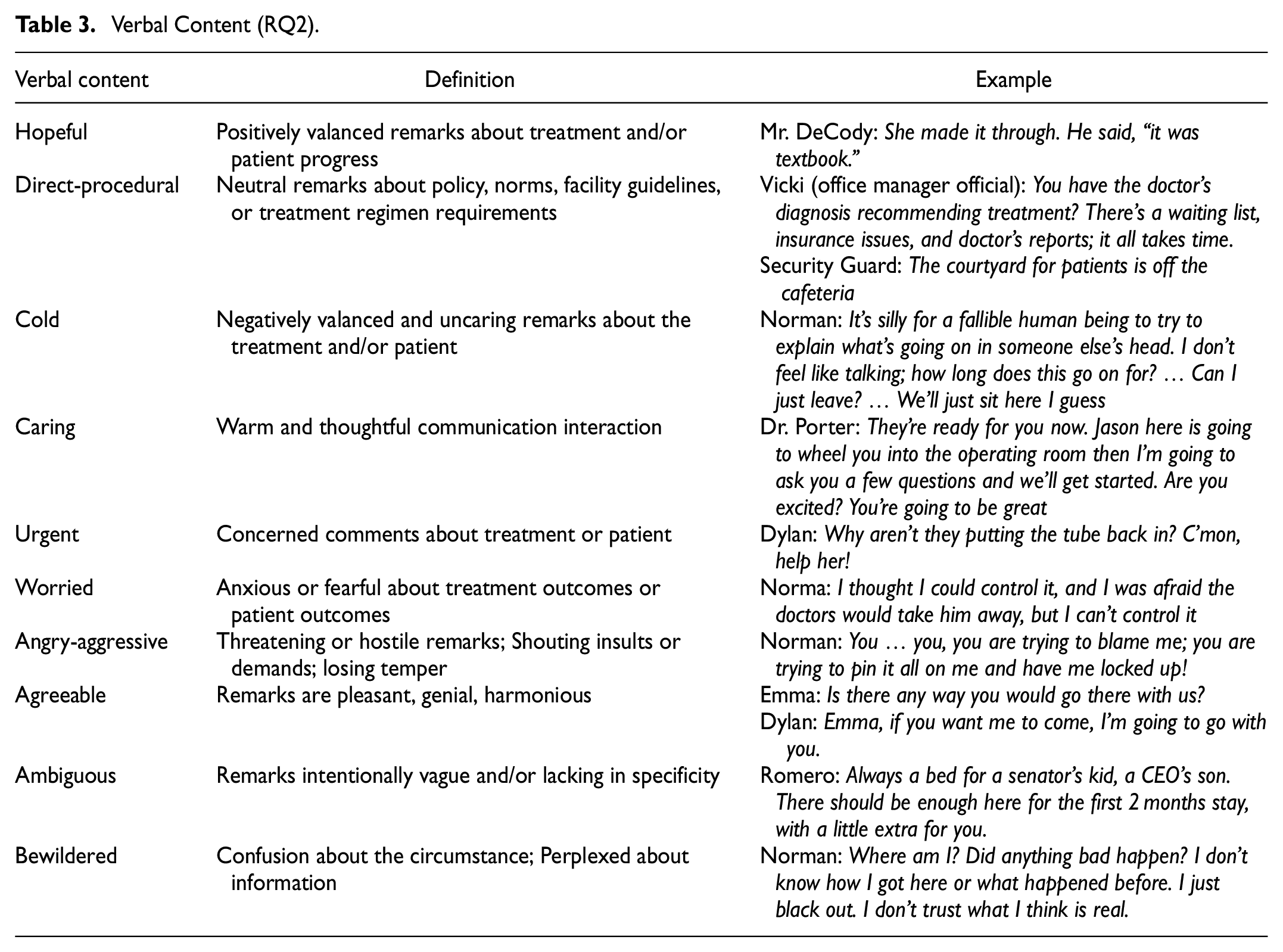
Verbal content was hopeful when the discourse in the scene was positive about the treatment success or treatment efficacy. Verbal content was direct when the discourse in the scene emphasized procedural or technical aspects of treatment. Verbal content was caring when the scene featured at least one interactant communicating in a warm, concerned, or kind manner about treatment. Verbal content was worried or urgent when the scene featured at least one speaker showing deep concern about some aspect of treatment. Verbal content was angry-aggressive when the scene featured at least one speaker act antagonistically in the treatment scene. Verbal content was agreeable when the scene featured at least one speaker expressing a willingness to begin or continue treatment or showed favorability to treatment processes. Verbal content was bewildered when the scene featured at least one speaker showing general and genuine confusion about an aspect of treatment. We also coded for conversation topics. Our final analysis covered these broad topics.
The conversation topics (RQ2) that we coded were time for treatment completion, health insurance, treatment efficacy, facility location, patient history, facility policies, symptoms, commitment to treatment routines, post-treatment goals, and personal or social life. Time for treatment completion conversations focused on the duration of treatment. For example, when speakers discussed Norman’s stay at Pineview and Emma’s recovery at home after she left the hospital, it was coded as time for treatment completion. Conversations about health insurance occurred when one or both speakers mentioned health insurance for admission or payment. For example, Romero added Norman to his insurance by marrying his mother Norma in order to get Norman a spot in Pineview. Treatment efficacy conversations occurred when one or both of the characters commented on the success of some facet of their care. For example, Emma remarked to her romantic partner, Dylan, that she was feeling better every week following the lung transplant and when her father reported to Dylan that the operation was successful (e.g., “It was textbook”). Topics about the care facility included communication about the location and services provided by the treatment center. When Norma makes a final attempt to admit her son into Pineview, rather than having him return to Willamette County Hospital again, she tells him “Pineview is different. It’s a nice place.” Conversations about the patient’s medical history featured talk about the patient’s history with the condition being treated. This occurred when Norma, Norman’s mother, was interviewed at Willamette County Hospital about her son’s loss of consciousness episodes (“blackouts”). We also coded patient medical history in sessions with Dr. Edwards, particularly when Dr. Edwards asks Norman about his symptomatic history dating back to childhood. Scenes with conversation topics related to facility policies occurred when one or both speakers discussed logistical factors such as paperwork as well as policies related to patient movement around the facility. For example, when Norman tried to leave out from the front of Pineview he is told the courtyard for patients can be accessed in the back. Topics related to symptoms occurred when Dr. Edwards and Norman met for therapy sessions. For example, Dr. Edwards sees Norman dissociated from himself during a session, an observation that leads to his diagnosis with DID. This also occurs when Edwards informs Norman he becomes “a different person” when he has blackout episodes. Conversations about the commitment to treatment occurred when the patient or another speaker remarked about the importance of staying with the treatment plan. For example, after Norman is found unconscious by Dr. Edwards, Norman proclaims he is dedicated to a treatment plan for DID. Conversations about post treatment goals occurred when one of both speakers remarked about what they would do after they completed their treatment plan. For example, Emma intended to begin college and move to Seattle. Personal and social topics occurred when one or both speakers remarked about social life, such as when Emma informed Norma that she and Dylan had started seeing each other. A list of characters and their roles is provided in Table 2 below.
Major Characters and Their Relationship With the Patient.

Results
The findings of this content analysis case study helped to clarify how medical treatments are portrayed in television stories. Additionally, these findings offer some of the earliest evidence regarding the distinctions between media portrayals of biomedical treatment and mental health treatment. To answer the first research question, we analyzed the verbal content of scenes featuring either biomedical or mental health treatment discussions and/or contexts in season four. Our analysis showed that hopeful, caring, agreeable, and urgent communication dominated the conversations about Emma’s lung transplant, the biomedical context. In scenes with Norman, the verbal interaction treatment, which occurred at two hospitals and only 3 times at his home, was coded bewildered, urgent, direct/procedural, and aggressive verbal communication. All documents were combined for data analysis, and, following suggestions in Corbin and Strauss (2015), we used a constant comparative method to analyze and interpret our data.
RQ1: Verbal Expressions
Verbal expressions of the interlocutors’ speech in biomedical and mental illness treatment scenes was considered in order to code the affective manner of verbal communication. Scenes with Emma’s surgery and post operation were primarily hopeful, agreeable, and caring. For instance, after Emma’s surgery, her father tells Dylan, Emma’s boyfriend, that the procedure was successful. When they are discussing the time her treatment will take, her father is agreeable, remarking “let’s get comfortable.”
Emma’s anesthesiologist, Dr. Porter, shows concern for her by encouraging her and answering her questions prior to surgery. The mother of Norman, Norma, is mostly worried and sometimes angry about how long the hospital keeps Norman under observation. In fact, very few interactions in mental health treatment settings resembled those in biomedical treatment settings. Unlike Dr. Porter, Emma’s anesthesiologist at Portland All Saints Hospital, the unidentified specialist at Willamette County Hospital was observed as cold and unequivocally direct to Norma, owing to the specialist’s dismay that Norma refused to seek help for her son up until this point. However, as Norman is brought to Pineview, we witness Dr. Edwards, his psychiatrist, speak to him in a caring manner about the efficacy of treatment and specific symptoms, a message Norman did not hear for the first three seasons of the series, and will not receive after he departs from Pineview. When he is not in therapy with Dr. Edwards, Norman is often heard talking about how important it is for him to leave Pineview. His mother, Norma, agrees with this decision, but Dr. Edwards and the rest of his family think it is wrong.
RQ2: Verbal Communication Topics
To answer research question two, we looked at the conversational topics in mental health treatment scenes and biomedical treatment scenes. The most common topics of conversation in biomedical treatment scenes were time for treatment, treatment efficacy, and commitment to treatment. Because we also coded scenes related to recovery from surgery, another prominent topic in biomedical scenes was future goals following the patient’s successful recovery. All of the most prominently discussed topics were coded as positively valanced. In mental health treatment scenes, we also discovered that time for treatment was routinely discussed. However, dissimilar from biomedical treatment, the time for treatment was negatively valanced and regularly cited as a problem by the patient, Norman during his stays at Willamette County Hospital and Pineview. Furthermore, in contrast with biomedical treatment scenes, mental illness treatment scenes also featured regular discussions about care facility policies and patient symptoms. Policy discussions could be interpreted as educational, as Norman, his mother Norma, and the health providers caring for Norman were regularly seen by audiences discussing the procedural steps for being committed to the facility, what patients were allowed to do versus restricted from doing, and ways that therapy, group discussions, medication management, and visitors were coordinated in the facility. The symptoms of dissociative identity disorder were also featured as a conversation topic in therapy sessions and shown in scenes where Norman hallucinates. The symptoms are framed as a result of deeply rooted psychological traumas that Norman experienced around the age of five. In contrast to biomedical scenes, mental illness scenes did not include many discussions about post-treatment goals (Table 3).
Verbal Content (RQ2).
Discussion
The present study analyzed 57 scenes from the fourth season of Bates Motel. A few conclusions can be drawn from this study. The findings indicated there was a discrepancy in communication topics and communicative valence in biomedical and mental illness treatments scenes during the fourth season of Bates Motel. This corroborates with findings of media representation literature focusing on one setting or the other. The divergent topics of conversation and effective verbal communication valence suggest there is a discrepancy in media narratives about health care. From our analysis, we did discover one interesting similarity between the settings. The primary caregiver’s communication with Emma at All Saints Hospital and Norman at Pineview was mostly caring and agreeable. The verbal communication did not transfer to others in Norman’s situation in the way it did for Emma. In part, it could be argued that Norman was unwilling to continue his treatment, while Emma was willing to do so. Unlike Emma’s family, however, the audience observes Norman’s family, particularly his mother, acting casually or skeptical toward Norman’s need for medical treatment for DID. These scenes are in sharp contrast with those featuring Emma’s father and her partner (Norman’s brother) Dylan supporting her through her recovery after she leaves the hospital. This observation has important implications for our understanding of media narratives about health treatments; mainly, the role of the health provider was mostly positive in both settings. Multiple studies have previously noted mental health care providers (e.g., psychiatrists) have been portrayed negatively in major motion pictures (e.g., One Flew Over the Cuckoo’s Nest) and in television series (e.g., Law & Order) (Domino, 1983; Parrott & Parrott, 2015). Although these are important findings, our research must be interpreted in light of certain limitations.
People have formed ideas and established biases well before they ever meet someone who has a mental illness or come into contact with a professional in the field of mental health (Brouwers, 2020; Stuart, 2006). The media reinforce mental illness prejudice and prejudice by repeatedly portraying the mentally ill, mental health experts, and mental health therapies in unflattering and misleading ways. Regardless of the genre explored, media portrayals of mental illness have been observed to be disproportionately sensational and inaccurate, emphasizing danger, crime, and unpredictability (Stuart, 2006).
Altogether, this study aimed to make some key contributions to advance our understanding of health representations in media narratives. By examining a sample frame of scenes, rather than a sample frame of episodes, we were able to look at the granular components of the health topics covered in the story. Although there are limits to using a smaller sample of episodes, there were also many benefits. The specific verbal dialogue allowed the researcher to study the portrayal of different forms of care in a single episode. By examining the episodes as a line-by-line phenomenon, this research was able to investigate how these issues play out, for instance, how each scene represented the continual uncertainty of those receiving care and the confusion of those caring for them. The advantages in case studies such as this one are afforded this kind of granular detail.
In terms of Norman’s psychiatric care, the audience sees that in favorable settings, psychiatric facilities are quite safe and beneficial but also exclusive and expensive. In fact, paying for high quality care appears to be a factor in both Emma’s operation and Norman’s admittance to the Pineview Institute. The overall message has the implication that high-quality health care is available but also financially expensive. Without Dylan’s financial support for Emma’s operation from the local drug trade, and without Romero’s readiness to pull strings to get Norman committed to Pineview, the high-quality care that Emma and Norman have could be out of reach. This issue is featured in both biomedical and psychiatric care scenes.
Further, the Pineview Institute where Norman receives psychiatric care sharply contracts with other series and films presentation of mental health facilities. One of the limitations of this study is that we did not give an in-depth look into place or environment care was received. Future work should compare biomedical and psychiatric settings across series, including Bates Motel, to explore how place shapes the narrative. One idea for this would include a sample of episodes across genre categories, from medical dramas to horror and suspense. This study also adds to a conversation about stereotyping in entertainment series (Krizner, 2002). Media producers decide what stories to tell about various topics, groups, and situations. Guarinos and Berciano-Garrido (2022), writing poignantly about representations of non-western groups stated, “whereas western populations experience a more positive representation, everything not-western tends to be shown in a polarized, negative way” (p. 130). Could a similar statement apply stigmatized afflictions, such as the persons with a mental illness portrayed as dangerous, unreliable, or even unimportant? In terms of the condition reviewed earlier, dissociative identity disorder, one could argue that untreated individuals are routinely portrayed as dangerous in media. Perhaps future work can investigate media and popular representations of DID in texts such as Sybil (Schreiber, 1973), the Marvel character known as Moon Knight (Brousard, 2022; Moench, 2022) and the main character of M. Night Shyamalan’s 2017 film Split (Shyamalan, 2017). Bates Motel should be examined as an entire series alongside these stories.
This study is limited by the fact that we used only a small slice of a single television series. This was intentionally done to illustrate scenes that juxtaposition both treatment contexts and because none of the previous or future seasons of the series contained these scenes. Nonetheless, there are undoubtedly other shows that can be included into this area of research. A larger sample may look at more recent television series and Bates Motel, therefore expanding the sample of data to be examined. We also found a disproportionate amount of time was spent on mental health settings compared with biomedical settings. Future research could use quantitative or mixed methods research that would account for an equal amount of time spent in each context. Future work should also include non-English television and film narratives featuring mental illness, such as the Argentinian classic Hombre mirandi al sudeste (Subiela, 1986). Because of these limitations, generalizable conclusions are difficult to reach, but we hope that this study can spark a discussion about case study analysis in content analytic research examining familiar health treatment settings.
Footnotes
Appendix
Coded Episodes.

| Season × episode | Scene title | Duration (minutes: seconds) | Scene location |
|---|---|---|---|
| 04 × 01 | They’re ready for you now | 06:44–7:37 (0:53) | Portland All Saints Hospital |
| 04 × 01 | How long have I been here? | 07:38–8:41 (1:03) | Willamette County Hospital |
| 04 × 01 | Admitted to County Hospital | 09:40–10:27 (0:47) | Willamette County Hospital |
| 04 × 01 | Admitted to Portland All Saints | 10:29–11:01 (0:32) | Portland All Saints Hospital |
| 04 × 01 | It could be seen as negligent | 11:04–13:09 (2:05) | Willamette County Hospital |
| 04 × 01 | It was textbook | 16:50–17:42 (0:52) | Portland All Saints Hospital |
| 04 × 01 | He really needs help … immediately | 17:44–20:40 (3:06) | Pineview Institute |
| 04 × 01 | You look awesome | 24:28–25:30 (1:02) | Portland All Saints Hospital |
| 04 × 01 | Social services will be contacting you | 27:12–29:03 (1:51) | Willamette County Hospital |
| 04 × 01 | Episode Title: A Danger to Himself and Others | ||
| 04 × 02 | Breathe On Your Own | 05:54–08:02 (2:08) | Portland All Saints Hospital |
| 04 × 02 | Enough here for two months | 14:51–15:55 (1:04) | Pineview Institute |
| 04 × 02 | Voluntary Commitment | 20:22–22:12 (1:50) | (Outside) Pineview Institute |
| 04 × 02 | Having a Future | 23:39–24:39 (1:00) | Portland All Saints Hospital |
| 04 × 02 | Nothing Holding You Back | 23:40–26:20 (2:40) | Portland All Saints Hospital |
| 04 × 02 | You’re not here | 26:24 –27:39 (1:15) | Bates Motel |
| 04 × 02 | Pineview is different | 38:00–41:44 (3:44) | Bates Motel |
| 04 × 02 | Episode Title: Goodnight, Mother | ||
| 04 × 03 | Phantom Tank Syndrome | 6:45–8:15 (1:30) | Portland All Saints Hospital |
| 04 × 03 | House Rules | 8:16–9:08 (0:51) | Pineview Institute |
| 04 × 03 | That’s not what therapy is | 9:09–11:01 (1:52) | Pineview Institute |
| 04 × 03 | 72 hours | 11:02–11:55 (0:53) | Pineview Institute |
| 04 × 03 | Nut Bars | 13:50–15:51 (2:01) | Pineview Institute |
| 04 × 03 | Morning Yoga | 12:28–12:53 (0:25) | Pineview Institute |
| 04 × 03 | No one comes here for the food | 32:18–34:32 (2:14) | Pineview Institute |
| 04 × 03 | It’s good to see you too | 35:52–38:52 (3:00) | Pineview Institute |
| 04 × 03 | My mother is insane | 41:14–42:40 (1:26) | Pineview Institute |
| 04 × 03 | Episode Title: ’Til Death Do You Part | ||
| 04 × 04 | I was locked in there like a prisoner | 1:19–2:25 (1:06) | Pineview Institute |
| 04 × 04 | Dial 9 to get out | 3:26–5:12 (1:46) | Pineview Institute |
| 04 × 04 | Hi, you’re a new face | 9:40–10:40 (1:00) | Pineview Institute |
| 04 × 04 | There’s a lot of stairs. | 10:41–12:40 (1:59) | Portland All Saints Hospital |
| 04 × 04 | You are under my care … you don’t believe me | 12:41–13:40 (0:59) | Pineview Institute |
| 04 × 04 | The Courtyard for patients is out the cafeteria | 13:50–14:52 (1:02) | Pineview Institute |
| 04 × 04 | Keeping me in the loop | 14:54–16:10 (1:16) | Portland All Saints Hospital |
| 04 × 04 | Hey, we’re free! | 20:44–22:10 (1:26) | Pineview Institute |
| 04 × 04 | We’re the crazy ones, remember? | 23:41–25:50 (2:07) | Pineview Institute |
| 04 × 04 | Please just help me. | 38:36–42:20 (3:44) | Pineview Institute |
| 04 × 04 | Episode Title: Lights of Winter | ||
| 04 × 05 | Is it important for your relationship to be normal? | 4:05–7:05 (3:00) | Pineview Institute |
| 04 × 05 | Parade | 07:07–08:33 (1:26) | Emma’s Home (Returning from Portland All Saints Hospital) |
| 04 × 05 | Phone Call | 8:34–10:08 (1:34) | Pineview Institute |
| 04 × 05 | Are you that desperate to see me naked? | 10:12–11:38 (1:26) | Emma’s Home (Returning from Portland All Saints Hospital) |
| 04 × 05 | I’m sorry they did this | 19:40–20:21 (0:41) | Pineview Institute |
| 04 × 05 | People here can be so crazy | 20:22–23:03 (2:41) | Pineview Institute |
| 04 × 05 | Talk to the person who knows him best | 26:11–32:15 (5:04) | Pineview Institute |
| 04 × 05 | I was just embarrassed that I have one | 34:00–36:35 (2:35) | Emma’s Home (Returning from Portland All Saints Hospital) |
| 04 × 05 | I never want you to feel alone here | 38:40–39:36 (0:56) | Pineview Institute |
| 04 × 05 | Episode Title: Refraction | ||
| 04 × 06 | Dissociative Identity Disorder | 4:00–7:31 (3:31) | Pineview Institute |
| 04 × 06 | Croquet | 11:04–13:43 (2:39) | Pineview Institute |
| 04 × 06 | Remember, you’re just watching | 20:45–23:14 (2:29) | Pineview Institute |
| 04 × 06 | Hide | 30:52–34:55 (4:03) | Pineview Institute |
| 04 × 06 | Episode Title: The Vault | ||
| 04 × 07 | One thing I can do is make sure you don’t starve | 0:48–1:48 (1:00) | Pineview Institute |
| 04 × 07 | NewsPaper Mache | 3:00–4:27 (1:27) | Pineview Institute |
| 04 × 07 | Necessary Paperwork | 9:46– 11:00 (1:14) | Pineview Institute |
| 04 × 07 | This phone is no longer in service | 12:14–13:48 (2:34) | Emma’s Home (Returning from Portland All Saints Hospital) |
| 04 × 07 | Letter | 15:17–17:17 (2:00) | Pineview Institute |
| 04 × 07 | It’s not because you’re normal | 21:56–24:35 (2:39) | Pineview Institute |
| 04 × 07 | Options | 24:36–26:15 (1:39) | Pineview Institute |
| 04 × 07 | Pineview is Expensive | 27:10–31:03 (2:53) | Pineview Institute |
| 04 × 07 | You become a different person | 33:15–37:23 (4:08) | Pineview Institute |
| 04 × 07 | Signing Out | 40:08–42:00 (1:52) | Pineview Institute |
| 04 × 07 | Episode Title: There’s No Place Like Home | ||
| 04 × 08 | Better Every Day | 18:41–21:21 (2:40) | Bates Motel |
| 04 × 08 | Scars | 27:00–29:20 (2:20) | Emma’s Home (Returning from Portland All Saints Hospital) |
| 04 × 08 | Episode Title: Unfaithful | ||
| 04 × 09 | Things will be better now | 1:38–2:50 (1:12) | Bates Motel |
| 04 × 09 | I see what is really there | 5:39–8:29 (2:50) | Pineview Institute |
| 04 × 09 | The goal is for him to get better | 8:33–9:45 (1:12) | Pineview Institute |
| 04 × 09 | I don’t think he should home either | 12:04–14:07 (2:03) | Local restaurant |
| 04 × 09 | I can’t do this anymore | 16:46–19:00 (2:14) | Bates Motel |
| Episode Title: Forever |
Declaration of Conflicting Interests
The author declared no potential conflicts of interest with respect to the research, authorship, and/or publication of this article.
Funding
The author received no financial support for the research, authorship, and/or publication of this article.
