




Abstract
This article examines how antimicrobial resistance (AMR) is covered in four elite North American newspapers and whether the dailies act as sites of reflexive modernization. I draw on risk society theory to situate AMR as a modern risk and news media as key spaces for reflexivity. Through a qualitative content analysis of 89 news stories on AMR, this study shows that this risk is communicated through inaccurate definitions and oversimplified accounts of the causes, populations at risk, and preventive measures. Media representations of health risks affect public perceptions of risk and risk prevention. The dailies, however, seldom expressed reflexive modernization, a key function of “mass media” in the Risk Society, which I argue could be due to the very complexity of “modern risks.” Lack of reflexivity in the media regarding AMR could delay crucial policy and institutional changes necessary to tackle this risk.
Keywords
Introduction
Antibiotics are one of the most important technologies of modern medicine. Without them, even a small scrap or routine surgery can become life-threatening. Antimicrobial resistance (AMR) is one of the greatest public health risks, threatening to make antibiotics useless. Resistance, the evolutionary defensive mechanism that allows bacteria to protect themselves against antibiotics’ power to kill them, “threatens the very core of modern medicine” (World Health Organization, 2015, p. VII) causing more than 1.5 million deaths annually worldwide (Hall et al., 2018). In the last two decades, there has been an increase in multidrug resistant bacteria, which cause infections that do not respond to multiple antibiotics. Health authorities have described antibiotic resistance, and more broadly AMR, 1 as a public health emergency caused by extensive antibiotic misuse, which has not been met with an equally prolific development of new antibiotics (O’Neill, 2016). In addition, resistance to the few new drugs available is also being developed (Cassir et al., 2014).
Today antibiotics are prescribed to treat a host of different bacterial infections but they are also consistently prescribed when unnecessary—for example, to treat viral infections—and are seldom taken by patients as indicated (Centers for Disease Control and Prevention, 2015; Hall et al., 2018). Furthermore, since the 1940s, antibiotics have been routinely used in farming by administering them in large doses to otherwise healthy livestock to promote growth. Currently more than 63,000 tons of antibiotics are used annually on livestock around the world (McKenna, 2017). The rise of antibiotic resistant infections, however, has led to debates over physicians’ prescription practices (e.g., Duane et al., 2016; Wilcock et al., 2016), recommended length of antimicrobial treatments (e.g., Langford & Morris, 2017; Llewelyn et al., 2017; McGow, 2019), and the use of antibiotics in livestock and crops for non-therapeutic purposes (e.g., Makary et al., 2018).
Emerging risks, such as AMR, bring a pervasive sense of uncertainty, and in trying to make sense of them, multiple narratives are generated that attempt to define the hazard, its causes, populations at risk, responsibility, and as well as preventive measures (Beck, 1992b, 2009; Douglas, 1992). These definitions then become discourses that guide how particular risks are understood and regulate risk behavior (Beck, 1992b, 2009). News media are important sources of scientific and health information (Nelkin, 1995) and they contribute, along with other social actors, in the discursive co-production of public health risks, affecting public perceptions of risks and risk behavior (Briggs & Hallin, 2016; Caulfield et al., 2019). In the theory of risk society, mass media are described as key sites of risk definition and reflexive modernization (Beck, 1992b, 2009); however, how the media achieve this reflexive function is not fully developed.
In this article, I examine how the risk of AMR is discursively constructed in North American newspapers and whether the dailies act as sites of reflexive modernization, by questioning expert knowledge and modern medical and industrial practices. I draw on risk society theory to situate AMR as a human-made risk, a consequence of modern medical and industrial practices with global repercussions extending in time, and news media as sites for risk definition and, potentially, where reflexive modernization is expressed. This study sheds light on how news media’s reflexive function is enacted when covering a “modern risk.” The analysis focused on five elements: risk definition, reported causes, populations identified at risk, assigned responsibility, and preventive measures suggested.
Risk Society and Reflexive Modernization
Risk has been conceptualized in various ways, ranging from objectivist to constructivist approaches. Objectivist approaches borrowing from cognitive psychology tend to focus on how individuals’ form their perceptions of risk through the information they receive about the risk and the heuristics they rely on to make sense of the risk, for example, trust in institutions such as government and media (e.g., Choi et al., 2018; Fischhoff et al., 2000; Shin, 2010). Cultural approaches to risk, on the contrary, are constructionist in orientation, conceptualizing risk as the outcome of a combination of material conditions and sociocultural processes (Fox, 1999; Lupton, 1999a, 2013) In this study, I draw on the critical theory of risk society, a constructivist approach to risk that argues that in late modernity, social and political order are threatened by unprecedented anthropogenic risks, resulting from scientific and industrial development (Beck, 1992b, 2009). Modern risks are pervasive and not limited by time (they will affect future generations) or space (global nature), and their management requires international cooperation (Beck, 2009). The risks created by modernity are almost impossible to calculate and have unimaginable consequences, making any attempts to manage their impact inadequate (Beck, 1992a; Giddens, 1997). For example, global environmental degradation and accelerated spread of zoonoses are risks that emerged as a direct consequence of the success of industrialization (Beck, 1992b, p. 21; Shah, 2016). Similarly, AMR can be understood as a modern risk: exacerbated by the unregulated consumption of antibiotics, with global effects, requiring international cooperation, and with repercussions that will extend to future generations.
Cultural theorists conceptualize risk as the combination of material conditions and sociocultural processes (Fox, 1999; Lupton, 1999a, 2013) and risk definition, perception, and estimation as dependent on values and cultural understandings (Bradbury, 1989, p. 2). In that sense, risk definition is susceptible to change, magnification, dramatization, or minimization, that is, to social production through complex claims-making processes by various social actors (Beck, 1992b), who not only identify risks but also assign blame and responsibility (Tansey & O’Riordan, 1999). Processes of risk definition can lead to reflexive modernization, a critique of the process of modernization given that the main institutions of late modernity—government, industry, medicine, science—have become the main generators of risk (Beck, 1992). Reflexive modernization supposes a process of “self-confrontation with the consequences of risk society which cannot (adequately) be addressed and overcome in the system of industrial society” (Beck, 1996, p. 28). In this context, scientific progress does not reduce risks but make them more evident leading to the demystification of science and the demonopolization of scientific knowledge claims (Beck, 1992b), which not only multiply but also contradict one another and frequently lose their validity, leading to “reflexive scientization” (Beck, 1992b, p. 166). Despite this, most modern risks cannot be perceived by the senses, so dependency on expert knowledge increases (Beck, 1994), and scientists and experts maintain their definitional power (Beck, 2009).
In the risk society, mass media are described as sites of risk definition and reflexive modernization. Media discourses and representations contribute greatly to the construction of risk (Beck & Levy, 2013) by providing the definition and language that lay people will use to make sense of risks, assigning responsibility and blame, and validating some forms of knowledge while discrediting or ignoring others. Media discourses express reflexive modernization as experts, scientists, political leaders, advocates, policy makers, and other stakeholders communicate and challenge each other’s views on the definition and causes of risks, and how to manage them.
In this article, I examine how AMR is covered in four elite North American newspapers and whether the dailies act as sites of reflexive modernization. Through a qualitative content analysis (QCA), I assess (a) how the risk of AMR is defined in the news coverage, (b) who is identified as responsible for causing and/or managing the spread of AMR, (c) who is said to be at risk, (d) which prevention measures are suggested, and (e) whether the newspapers acted as sites for reflexive modernization by questioning expert knowledge and/or modern medical and industrial practices.
Media Coverage of AMR
Media are important sources of scientific information and health information, affecting public understanding of health issues and risk (Nelkin, 1995; Vasterman et al., 2005; Woloshin & Schwartz, 2006). News media play a crucial role in “producing and circulating information about health as well as competing forms of knowledge and culture” (Briggs & Hallin, 2016, p. 77) that intersect with health and medicine. Studies in risk communication of AMR have mostly focused on the use of the “superbug” frame in news coverage, that is, the use of hyperbolic language to refer to resistant organisms and to describe apocalyptic post-antibiotic scenarios. Focusing mostly on how press and broadcast media describe the causes, incidence, and measures of control and prevention, these studies draw on the information deficit and social amplification of risk models of risk communication to examine whether enough expert information is provided to the public (e.g., Bie et al., 2016; Desilva, 2004; Singh et al., 2016) and how media coverage amplifies feelings of anxiety and risk (see Brown & Crawford, 2009; Nerlich & James, 2009; Washer & Joffe, 2006).
Washer and Joffe (2006) examined the coverage of methicillin-resistant Staphylococcus aureus (MRSA) in the British press. They found that the coverage shifted from reproducing the rhetoric of the medical literature in the early 1990s, that is, explaining it as an infection resistant to antibiotics, to depictions of a “killer superbug” since 1997. Apocalyptic predictions are now a common trope in the coverage of AMR, including the anticipation of both natural devastation and personal tragedy (Brown & Crawford, 2009). The feeling of doom is emphasized by focusing on the ability of bacteria to evolve resistance to new antibiotics in a short period of time (Brown & Crawford, 2009; Washer & Joffe, 2006). Media resort to the reification of resistant bacteria as “superbugs” (Nerlich & James, 2009; Washer & Joffe, 2006) and depicting them as having human-like qualities, being “clever” and outsmarting the scientific community (Brown & Crawford, 2009; Washer & Joffe, 2006). In addition, the bacteria’s ability to move across space and corporeal boundaries is also recurrent in the media rhetoric, highlighting its ubiquitousness and uncontrollability (Brown & Crawford, 2009). These depictions emphasize feelings of danger and human vulnerability, and reinforce the idea of conflict between nature and medical progress (Washer & Joffe, 2006), a rhetorical tool used to raise public awareness, but can also induce fear and promote misinformation (Nerlich & James, 2009). Furthermore, unlike outbreak narratives that offer the promise of medical solution (Wald, 2008), the coverage of AMR contradict expert knowledge by suggesting alternative therapies, potentially leading to loss of trust in medicine (Washer & Joffe, 2006).
More recently, a study examined two decades of coverage of AMR in the German press (Boklage & Lehmkuhl, 2019) and found a similar trend, noting that the overall tone of the coverage was alarmist. The authors warn that apocalyptic media messages can increase skepticism of scientific expertise. Similarly, a study examining Australian media representations of AMR found that the use of military metaphors, anthropomorphizing of bacteria, and doomsday framing were common rhetorical tools across media platforms (Bouchoucha et al., 2019). In addition, Collins and colleagues (2018) found that in newspaper coverage of AMR in the United Kingdom, not only are the resistant organisms anthropomorphized but antibiotics are also depicted as instilled with agency.
Desilva (2004) examined antibiotic resistance in the Canadian press and compared it with U.S. coverage. They found that Canadian and U.S. media seldom mention the causes of resistance or how to reduce exposure. Washer and Joffe (2006) found a similar trend in British news coverage of MRSA, which seldom offered an explanation of how bacteria evolve resistance to antibiotics or the role of physicians overprescribing practices. Chan et al. (2010) showed that the British media blamed “dirty hospitals” and the government for the rise of MRSA but did not explain the evolutionary process that leads to resistant bacteria or the human actions that accelerate that process or preventive measures. Similarly, in the Swedish print media, the most commonly reported cause of antibiotic resistance was antibiotic over-prescription, while risk-reduction measures at the societal level were more commonly reported than to the individual level (Bohlin & Höst, 2014). Collins et al. (2018) found in newspaper coverage of AMR in the United Kingdom that responsibility for inappropriate use of antibiotics was multidirectional, and identified a tension between blaming doctors-as-prescribers or patients-as-users and the collectivization of the general public as an unspecified “we.” Furthermore, they found that livestock farming and pharmaceutical industry were rarely reported as social actors with responsibility in the AMR crisis.
Another recent study on newspaper coverage of AMR and antimicrobial stewardship in the United Kingdom found that when covering sepsis, the newspapers preferred personal narratives which can generate greater public interest, which are rarely included in articles about AMR (Rush et al., 2019). However, the articles usually did not balance messages about crucial early antibiotic treatment in sepsis with the need to reduce unnecessary prescribing. The authors suggest integrating media discourses about AMR and sepsis to improve public understandings of the importance of antimicrobial stewardship (Rush et al., 2019).
Method
The theory of risk society refers broadly to “mass media” and “news media,” explaining that they have definitional power through their agenda-setting function, identifying particular victims and laying blame on certain groups (Beck, 2009; Beck & Levy, 2013), as well as a reflexive function; however, how media achieve the latter is not fully developed. Furthermore, news coverage of health risks affect public perception of risks and risk behavior (Briggs & Hallin, 2016; Caulfield et al., 2019). This study examines how the risk of AMR is discursively constructed in four elite North American newspapers 2 —The Globe and Mail and the National Post in Canada, and The New York Times and The Washington Post in the United States—and whether the dailies expressed reflexive modernization.
The global decline of news consumption in legacy news outlets, such as newspapers, radio, and television networks, led legacy media to heavily invest in developing digital and mobile news applications (Westlund, 2013). North American newspapers have seen an increase in online readership (News Media Canada, 2019; Pew Research Center, 2019). For example, readership of Canadian newspapers is at an all-time high due to online news consumption, with 88% of Canadians reading a newspaper at least once a week (“Stop the Presses,” 2019). In this study, I examined news coverage in four North American newspapers with print national daily editions as well as strong online presence. The New York Times is based in New York city and has a weekday print circulation of 487,000 copies (Watson, 2019). Its presence online however continues to expand and the paper now makes 40% of its revenue from online subscriptions (Benton, 2019). The New York Times has around 2.33 million paid digital-only news subscribers (Wang, 2018). Canadian subscribers make up around 27% of the Times international subscriber base with around 94,000 subscriptions (Wang, 2018). The New York Times has a left-leaning media bias (AllSides, 2019). The newspaper is owned by The New York Times Company, which is publicly traded and is controlled by the Sulzberger family. The Washington Post is based in Washington, D.C., and has a weekday print circulation of about 293,000 copies (“The Washington Post Had 80.8 Million Readers in June 2018,” 2018), as well as a strong online presence with more than 80 million unique visitors on their website per month in 2018 (WashPostPR, 2018). The Washington Post is considered a left-leaning newspaper (AllSides, 2019). The newspaper is owned by Nash Holdings, a holding company established by Jeff Bezos, owner of Amazon.com. The Globe and Mail is based in Toronto, Ontario, and is considered the “newspaper of record” in Canada. It is the largest newspaper in the country with a weekday print circulation of 899,000 copies in 2019 (“Globe Weekend Edition,” 2019). The Globe and Mail has a center-right editorial line (Media Bias/Fact check, 2018). The newspaper is owned by The Woodbridge Company Limited, which is a Canadian private holding company based in Toronto. The National Post is based in Toronto, Ontario. In 2016, it had a weekly combined print and online readership of 4.5 million (“National Post Boosts Weekly Print and Digital Readership to 4.5 Million,” 2016). The National Post has a right-center bias, placing it further right in the political spectrum than The Globe and Mail (Media Bias/Fact Check, 2019). The National Post is published by PostMedia, which owns several right leaning media outlets throughout Canada.
The analysis of the newspaper coverage of AMR was guided by the following research questions:
Through a QCA of 1 year of coverage, I examined how the risk of AMR was defined, how blame and responsibility were assigned, and whether modern institutions and practices were questioned for their role in the exacerbation of AMR and emergence of this public health threat. With QCA, the content and meaning of texts are systematically described through the process of coding and the identification of themes and patterns (Hsieh & Shannon, 2005; Schreier, 2012). Mayring (2015) defines QCA as a mixed-methods approach consisting of two steps: first, a qualitative-interpretative phase in which categories are assigned to text passages through coding, and second, a quantitative analysis of frequencies of those codes. Following Marying’s two-step approach, my analysis first identified the presence or absence of five topics—(a) whether the text explained what resistance is (definition); (b) what causes it (cause and blame); (c) who is at risk (population at risk); (d) who is responsible for managing it (responsibility); and (e) how it can be prevented (prevention)—and described how these topics were expressed in the news stories. Second, I determined the frequency with which those topics were expressed in the news coverage to determine which angles were most prevalent in the discursive construction of AMR.
On September 21, 2016, the United Nations (UN) General Assembly held a high level meeting on AMR, in which all the member-states committed to taking a broad, coordinated approach to address its root causes across multiple sectors, especially human health, animal health, and agriculture. The analyzed sample spans a year of coverage—6 months prior to the UN’s declaration on AMR (March 21, 2016) to 6 months after the declaration (March 21, 2017). The sample was collected through Factiva database 3 and the search terms used were “antibiotic,” “antibiotic resistance,” “antimicrobial resistance,” and “superbug.” 4 There were 239 articles, of which 150 were duplicates and unrelated stories (e.g., stories about diseases that require antibiotic treatments but that did not mention resistance, business reports that mentioned antibiotic-free meat, obituaries of scientists that contributed to the development of various antibiotics, etc.). The final sample was composed of 89 articles published in the newspapers’ websites and in print. There were two peaks in coverage; the first in May 2016 when an American woman was diagnosed with a resistant urinary tract infection caused by colistin-resistant E.coli, and the second in September 2016 when the UN held its high-level meeting on AMR.
Legacy media still have an important definitional role in health news (Greenberg et al., 2017), and they repurpose news content for their websites, mobile applications, and social media (Westlund, 2013), thus reproducing the same definitions and narratives online, which are later shared and distributed among other social media users, including journalists (Russell et al., 2015). This study focused exclusively on newspaper print and online coverage due to archive accessibility, but future research could also include news coverage of AMR in radio and television, as these media formats could have specific implications on how AMR is covered and reflexive modernization expressed.
I created a codebook (Table 1) with five main codes that express the definitional and reflexive function of the media as described in the theory of risk society: definition, cause, population at risk, responsibility, and prevention. In addition, a code was created to record how resistant bacteria were qualified in the coverage (e.g., “superbug,” anthropomorphism, etc.), and another one for whether the UN’s action plan on AMR was mentioned or not. Sub-codes were generated for each code after a preliminary reading of the sample, and others were included as they emerged during the coding process. The sub-codes were not mutually exclusive, as the analyzed news stories could have more than one definition of AMR, or mention more than one cause. Therefore, all the codes present in each story were recorded during the coding process. I conducted the coding of the sample as an open process, nine new codes were created as they emerged in the coverage 5 and the codebook 6 was revised accordingly. The publication date, newspaper, type of story (hard news, editorial, column, etc.), and angle (political, economic, scientific, etc.) were also recorded.
Code Book.
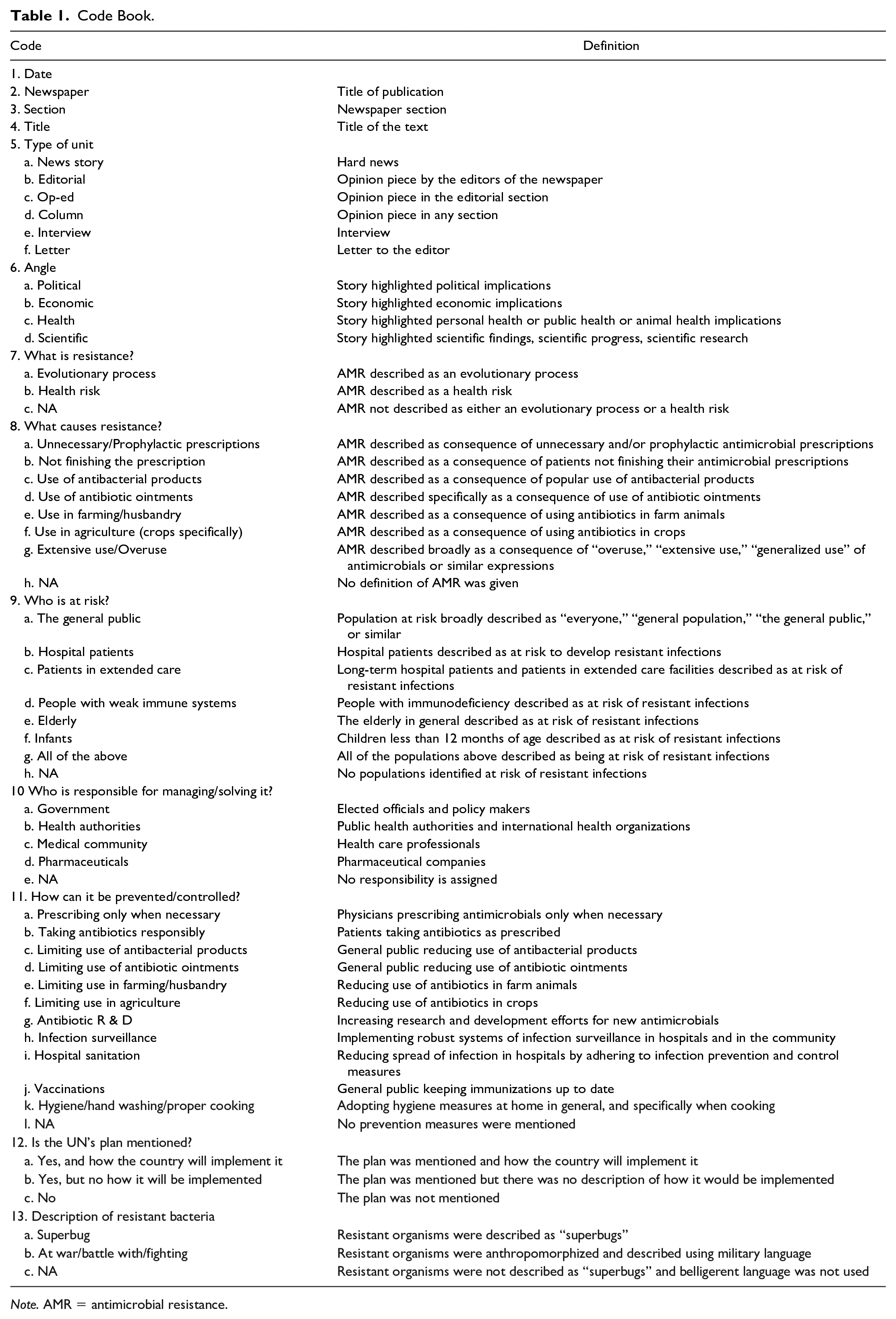
Note. AMR = antimicrobial resistance.
Results
Antibiotic resistance received greater coverage from newspapers in the United States (75%), with The Washington Post publishing almost half of the news stories (n = 44), and The New York Times a quarter of the sample (n = 23). The two Canadian dailies published a similar volume of stories on AMR comprising the last quarter of the sample. The Globe and Mail had 10 stories and the National Post had 12. Although 65% of the coverage was composed by hard news (n = 58), one quarter of the sample were opinion pieces (n = 22).
The analysis revealed that the newspapers had partially drifted away from the “superbug” frame. AMR bacteria were still referred to as “superbugs” in 43% of the coverage (n = 38), and in 10% of them, humans are described as being “at war” with resistant bacteria, a common narrative that negates the symbiotic relationship humans have with bacteria. However, 54% of the coverage did not use these anxiety-inducing frames and instead chose to use more informative, non-belligerent language. Below, I present the results for each of the research questions.
RQ1: How Is AMR Defined?
Antibiotic resistance was mostly covered as a health story (63%, n = 56), explaining how it affects human health and the consequences of resistant infections for individuals, sometimes recommending preventive measures. Other aspects of AMR that were salient in the news coverage were the need for political action (39%, n = 35), scientific discovery and development of new antibiotic treatments (35%, n = 31), and the economic impact of AMR and distribution of resources in prevention plans (21%, n = 19). Most stories combined various angles.
Although 88% of the stories described resistance as a health threat (n = 78), only 29% of the coverage (n = 26) explained the evolutionary process that leads to it, that is, that after prolonged exposure to antimicrobial treatments, organisms evolve resistance to them in which case the traditional treatments become ineffective and the infection poses a more serious threat. This is consistent with previous research showing that news coverage of AMR seldom use the word “evolution” or explain the evolutionary process involved in it (Antonovics, 2016). In addition, 16% (n = 11) of the stories had no definition of AMR, why it is a public health threat, or an explanation of the evolutionary process that causes it, thus leaving readers without basic information to understand the risk.
For example, a story in the National Post warns that “a U.S. woman has died of an infection immune to virtually every antibiotic doctors could throw at it is adding to growing concerns medicine is losing its standoff with superbugs” and adds that it “may not be the drug resistant ‘apocalypse’ some fear, but the case is raising new alarm over what has become one of the most serious public health threats worldwide” (Kirkey, 2017). Despite the dire description of the risk and mentioning the possibility of an “apocalypse,” the story does not define resistance or how bacteria become resistant to antibiotics.
There were some instances in which the dailies published stories detailing the ordeal that patients with resistant infections go through, but missed the opportunity to explain what antibiotic resistance is and how organisms evolve it. For example, The Globe and Mail published a story about a woman who was kept alive for 6 days without lungs (Ubelacker, 2017), describing in detail the novel medical procedure used to save her life after a “superinfection” resistant to antibiotics had compromised her lungs; however, the story did not explain what resistance is nor how it happens. Similarly, both The Washington Post (Karidis, 2016) and The New York Times (Rabin, 2016) published stories on the Centers for Disease Control and Prevention declaring sepsis a medical emergency and mentioned antibiotic resistance as a cause of sepsis; however, neither explained what resistance is.
RQ2: What Causes AMR?
The three most cited causes of AMR were extensive use of antibiotics in farming and husbandry
7
(n = 29), extensive use or general overuse of antibiotics
8
(n = 24), and unnecessary antibiotic prescriptions for humans (n = 22). Other causes mentioned were antibiotic use in agriculture,
9
use of antibacterial products—such as gels and wipes—incomplete doses of antibiotics (not finishing the prescription), and use of antibiotic ointments. The following excerpts are examples of this: Concern has been growing among scientists, consumers and shareholders that the overuse of (antibiotics) is contributing to rising numbers of life-threatening infections from antibiotic-resistant bacteria dubbed “superbugs.” (Polansek & Baertlein, 2016) The rate at which new strains of drug-resistant bacteria have emerged in recent years, prompted by overuse of antibiotics in humans and livestock, terrifies public health experts. (McNeil, 2017) Because the indiscriminate use of drugs in animals can destroy the drugs’ effectiveness for humans, the Food and Drug Administration has issued regulations that it says will reduce antibiotic use in livestock. (“The United Nations Takes on Superbugs,” 2016)
Reporting the causes of AMR indirectly lays blame on several actors. In this case, responsibility for causing and spreading antibiotic resistance is laid principally on the farming industry and the medical community, and onto patients to a lesser degree for demanding antibiotics and not taking them responsibly. In addition, over a quarter of the stories stated that antibiotics are being “overused” or “misused,” thus pointing to the need to correct this generalized practice across industries and countries and move toward judicious use of antibiotics. For example, a story in The New York Times explains, Infectious disease doctors have long warned that overuse of antibiotics in people and in animals puts human health at risk by reducing the power of the drugs, some of modern medicine’s most prized jewels. The problem is global, because the bugs are mobile. Overuse in pig production in China, for example, has spawned superbugs that have surfaced in the United States and Europe. (Tavernise, 2016)
RQ3: Who Is at Risk of Contracting Resistant Infections?
Lay citizens tend to look for information related to health risks and how to minimize exposure in legacy media either print or online (Greenberg et al., 2017). It is therefore crucial in risk communication to define populations at risk along with preventive measures (Abraham, 2009). However, in 45% of the coverage (n = 40), there was no mention of populations at risk of AMR. In 38% of the articles (n = 34), populations at risk were broadly defined—implicitly or explicitly—as “everyone” or the general public. Despite this, the newspapers still referred to AMR as a nosocomial risk, even though community-acquired strains of resistant bacteria are a common occurrence. Some investigative journalists have already sounded the alarm about the risk of community-acquired strains of resistant bacteria that can cause lethal infections (see, for example, McKenna, 2010), an aspect that remains underreported in the dailies.
While portraying antibiotic resistance as a hospital-based risk, the newspapers identified five populations at risk of acquiring a resistant infection: hospital patients (n = 13), patients in extended care (n = 7), people with compromised immune systems (n = 5), infants (n = 5), and the elderly (n = 3): Most of these deaths occur among older patients in hospitals or nursing homes, or among transplant and cancer patients whose immune systems are suppressed. But some are among the young and healthy: A new study of 48 American pediatric hospitals found that drug-resistant infections in children, while still rare, had increased sevenfold in eight years, which the authors called “ominous.” (McNeil, 2017) The Public Health Agency of Canada says this is one of the biggest public health risks facing the country, with 18,000 Canadians contracting drug-resistant infections each year in hospitals and 700,000 dying from them annually around the world. (Bronwell, 2016)
Reporters identified the obvious populations at risk of developing resistant infections, but they did not mention that antibiotic resistant bacteria also exist outside hospitals, in the community, affecting healthy people who would not normally be considered a vulnerable population. While hospitals are most often the epicenter of resistant-infection outbreaks, community-acquired resistant infections are becoming more common and affecting a broader population (O’Neill, 2016).
RQ4: Who Is Responsible for Controlling/Managing the Risk of AMR?
The management of AMR is considered in the analyzed coverage as a political task, and the government and policy-makers are most frequently mentioned as responsible for it (n = 31). Doctors were mentioned in relation to their prescription practices and expected to prescribe less antibiotics, while nurses were considered responsible for the hygiene of medical settings which is a key infection prevention and control measure (n = 20). Public health authorities were expected to regulate antibiotic use across industries (n = 18), and pharmaceutical companies (n = 18) were mentioned as responsible for developing new antibiotics. For example, an editorial in The Washington Post regarding a proposed health bill described members of the U.S. Congress as responsible for encouraging antibiotic stewardship: Lawmakers should ensure that a proposed adjustment to rules on the approval and use of new antibiotics does not have the unintended side effect of encouraging antibiotic overuse and resistance—the very problem the provision is supposed to combat. (“A Bill Fit for Lame Ducks,” 2016)
Similarly, an editorial in The New York Times highlights the role of the government in managing the risk of AMR as well as the need for global cooperation: This puts a burden on governments to invest more in research and development. Governments could also offer incentives—prizes have been suggested, for instance—to companies that develop new vaccines and antibiotics, and they could contractually agree to buy medicines to assure companies that they will have a market for their products. The United Nations was right to ring the alarm about superbugs, a growing danger that requires a global response. (“The United Nations Takes on Superbugs,” 2016)
Although a portion of the coverage identified various actors as responsible or implicated in the management of the AMR crisis, almost half of it (n = 40) did not mention who should manage this public health hazard. In addition, the UN’s Global Action Plan on Antimicrobial Resistance (World Health Organization, 2015) was mentioned 8 times, five of them explaining how the plan will be implemented by the national government.
RQ5: How Can the Spread of AMR Be Prevented?
Regarding risk prevention measures, over a third of the coverage did not mention any (n = 31), leaving readers uninformed of how to avoid behaviors that put them at risk of contracting resistant infections and spreading them. Two thirds of the coverage, however, did identify preventive measures. This shows improvement since the study by Desilva (2004) who found preventive measures in only one fifth of the North American coverage of AMR. There were four preventive measures repeatedly mentioned: limiting the use of antibiotics in farming (n = 21), developing new antibiotics (n = 20), prescribing antibiotics only when necessary (n = 16), and infection surveillance (n = 15). These four recurrent preventive measures correspond to the actors identified as responsible for managing the risk: government, health authorities, pharmaceuticals, and medical community. For example, Through the use of good animal husbandry techniques, vaccines, probiotics and other alternatives, the animal agriculture industry can and should move away from low-dose antibiotic use for routine disease prevention and use antibiotics only to treat sick animals. (Heil, 2017) In addition, doctors and nurses need to take practices like hand washing and equipment sterilization much more seriously to reduce widespread drug-resistant infections in hospitals. Consumers must make sure they and their children are vaccinated, which helps prevent infections in the first place. (“The United Nations Takes on Superbugs,” 2016)
Other preventive measures mentioned in the coverage included taking antibiotics responsibly (n = 7), improved hospital sanitation (n = 4), vaccinations (n = 4), hygiene (n = 3), and limiting the use of antibiotic ointments (n = 1).
The newspapers suggested preventive measures that are mostly out of the control of the individual; they depend on political action, scientific development, and improved medical practices. However, challenging the lack of regulation regarding antibiotic use and infection surveillance, the economic interests that dissuade pharmaceutical companies from developing new antibiotics, and questioning how physicians prescribe antibiotics show evidence of some reflexive modernization in the coverage of AMR, particularly in editorials, opinion pieces, and letters to the editor. For example, the National Post explained lack of economic incentive to develop new antibiotics: Another reason pharmaceutical companies have little incentive to invest in research and development is that if researchers discover an effective new antibiotic, public health officials want to reserve it for use in emergencies to keep bacteria from becoming resistant to it as well. As a result, only a handful of the world’s major drugmakers are pursuing antibacterial research today. (Bronwell, 2016)
A reader, however, points out in a letter to the editor that developing new antibiotics does not revert AMR and mentions the continued use of antibiotics in modern farming as the main problem: As bacteria resistant to our existing drugs flourish, new classes of antibiotics are indeed needed. But introducing new antibiotics into a broken system won’t solve our problem; it merely buys time. The overuse of antibiotics is the foundational problem, and the routine use of antibiotics on food animals is particularly troubling. (New antibiotics, 2017)
Of all the preventive measures suggested, only the ones mentioned on a few occasions—taking antibiotics responsibly, getting vaccinated, proper hygiene, and reducing the use of antibiotic ointments—can be done by individuals. Furthermore, lay experience and public concerns were seldom considered in the newspaper coverage of AMR. For example, some letters and columns blamed patients for expecting antibiotic prescriptions from their doctors or for not finishing their prescriptions; however, there was no explanation regarding antibiotics being useless for viral infections or why physicians will not prescribe them for mild bacterial infections, such as ear infections.
An interesting exception was a story written by a health reporter who narrates his experience with a tooth infection and his objection to take prophylactic antibiotics, describing how he negotiated his personal interest versus what he perceives as his societal responsibility: Taking a series of single-dose antibiotics doesn’t seem like a good idea: Surely my gut won’t thank me, and it seems like just the sort of antibiotic use that contributes to the problem of resistance that everyone is concerned about. On the other hand, my tooth has an infection! [ . . . ] I’m not under any illusion that my personal actions will have great consequences for national policy on antibiotic use. As Quinn puts it, “bacterial resistance is a societal problem, not individual.” But I like to think I’m doing my bit. You’re welcome. (Lindley, 2016)
Discussion and Conclusion
In this article, I examined how the risk of AMR is discursively constructed in four elite North American newspapers and whether these publications acted as sites for reflexive modernization, a necessary step for modifying our antibiotic consumption and assuming a stewardship mind-set. The results of this study show that AMR is being communicated through inaccurate definitions and incomplete accounts of its causes, responsibility in managing the threat, preventive measures, and populations at risk, with potential negative implications for public understanding of AMR and public awareness efforts. Furthermore, this study shows that by oversimplifying this complex modern risk, the newspapers seldom acted as sites of reflexive modernization, therefore obscuring the necessary changes to medical and industrial practices required to tackle this threat.
First, the newspapers preferred simplistic expressions, such as “superinfection,” instead of explaining basic evolutionary processes and who is at risk, and did not explain why extensive use of antibiotics accelerates the evolution of resistance either. Studies have shown that oversimplified accounts of AMR can lead to confusion regarding the way antimicrobials function and perpetuate misconceptions, such as believing that the body becomes resistant to antibiotics and not the bacteria (Davis et al., 2017; Kamata et al., 2018). Providing a clear explanation of the biological process behind antibiotic resistance could improve scientific literacy and public understanding of the risk, its causes, and potentially reduce risk exposure. In addition, by presenting a limited and incomplete account of who is at risk of resistant infections, the newspapers reinforced the idea that AMR is not a widespread health hazard, thus minimizing the crisis it represents and potentially generating a false sense of security (Nisbet, 2017). A low perception of risk can affect risk behavior and lead to the rejection of necessary changes in policy and medical practice to manage the risk.
Second, half of the coverage did not mention any causes of AMR, and the rest broadly identified “general overuse” of antibiotics as the main cause. The persistent lack of clear causes of the risk is a common trend in media coverage of AMR (e.g., Chan et al., 2010; Desilva, 2004; Washer & Joffe, 2006). Broad explanations seldom acknowledged key political and economic interests and activities that contribute to the spread of resistant bacteria, thus ignoring necessary changes in current industrial and medical practices. Similarly, the newspapers suggested that governments and pharmaceutical industry should manage the risk, but mostly ignored other actors who can also contribute to improve antibiotic stewardship. In doing so, other sources of responsibility remain obscured, for example, government and policy makers who have failed to put in place adequate regulations regarding antibiotic use. This contributed to a distorted perception of antibiotic resistance as being created by one or two industries instead of describing this health risk as collectively caused by various modern practices, from medicine and farming, to air travel and environmental degradation, as well as deficient health care systems and globalized economies.
Third, in almost half of the sample (42%), the dailies did not explain what causes antibiotic resistance. This omission was higher than the 33% found by Desilva (2004), showing that over the past 15 years, the North American print media has not improved in terms of contributing to public awareness and understanding of this growing public health risk. In most cases, the dailies failed to inform audiences about the causes of AMR or laid all the responsibility on a few specific actors or industries, therefore oversimplifying the complex networks of actors, practices, and interests that underpin the acceleration of AMR.
When suggesting preventive measures, the newspapers focused on those that are out of the control of individuals, thus leaving citizens disempowered regarding how to prevent a resistant infection. Saliently, half of the coverage did not mention any causes of antibiotic resistance, actors responsible for causing the threat, populations at risk, or preventive measures, all crucial information that could potentially allow citizens to avoid risky behavior. Describing a risk and not identifying risk behaviors and explaining how to avoid them could lead to increased public anxiety. Furthermore, misinformation or incomplete information about a health hazard could lead to false beliefs regarding causes and prevention.
Fourth, the UN’s plan to tackle AMR, which outlines infection surveillance systems, public awareness campaigns, international cooperation, and other measures governments can adopt, was mentioned only in eight articles in the sample, thus the newspapers oversimplified the global nature of AMR by suggesting that this health hazard that can be dealt with within the national borders. Fifth, in the risk society, mass media are spaces for reflexivity, where scientific and expert knowledge about hazards is discussed and challenged. This, however, is not evident in the analyzed coverage, which for the most part follows a deficit model of risk communication in which expert knowledge is reproduced as a way to educate publics (Lupton, 1999b). Not acknowledging public concerns while reiterating expert views can deepen public anxiety and reinforce the feeling of powerlessness, which can further reduce public trust in experts and decrease compliance with prevention measures, such as using antimicrobials judiciously and vaccinating.
It is crucial to examine news media representations of health risks as they affect public perceptions of risk and risk behavior (Briggs & Hallin, 2016; Capurro et al., 2018; Caulfield et al., 2019). If news media are expressing reflexivity, this could potentially lead to political action. In this case, reflexive news coverage of AMR could increase public awareness of the threat. This could lead to increased public pressure for robust infection surveillance systems, additional efforts to increase public awareness of AMR and how to reduce risk exposure, supporting initiatives to foster antimicrobial stewardship in medical practice, as well as push for increased political commitment at the national and international levels. This study, however, shows that the news media are not fulfilling their reflexive function as predicted in the theory of risk society given that the newspapers acted only on a few occasions as sites of reflexive modernization, questioning expert knowledge (e.g., how physicians prescribe antibiotics) and modern practices (e.g., the use of antibiotics in industrial farming).
My analysis suggests that this function was limited due to the complexity of AMR as a risk, which was impossible to address comprehensively in short newspaper stories. The very complexity of modern risks (Beck 1992b, 2009), with many layers of responsibility by a wide array of actors, could be hindering the reflexive function of news media, which privilege fast news cycles and short stories, and thus minimize the feeling of risk instead of leading to the pervasive feeling of it described by in the risk society theory. Future research could explore whether a more reflexive narrative is found in specialized publications, particularly online, that are more flexible with the length of their stories, thus inviting their audience to critically think about the impact of modern institutions and practices in human health.
This study has two limitations that could be addressed in future research. First, the analysis did not differentiate between different types of stories (hard news, editorial, column, letter, etc.), an aspect that could be further explored as opinion pieces could be a more suitable space for questioning industrial practices, policies, and lifestyles, while hard news could be a more likely genre to identify populations at risk and suggest preventive measures. Second, the analysis was limited to four elite North American newspapers’ 1 year coverage of AMR, thus shedding light on current representations and discussions of AMR. The sample could be expanded to include more publications—for example regional coverage could vary—or a longer period of coverage. In addition, further research could compare representations of AMR in legacy newspapers with those in news websites with sections dedicated to health-related and scientific topics.
Footnotes
Declaration of Conflicting Interests
The author(s) declared no potential conflicts of interest with respect to the research, authorship, and/or publication of this article.
Funding
The author(s) received no financial support for the research, authorship, and/or publication of this article.
