




Abstract
Using the Finnish Labour Force Surveys merged with register-based follow-up data, we analyzed how different characteristics of part-time work predict employees’ and entrepreneurs’ employment trajectories in an 8-year follow-up. We analyzed careers by the length of weekly working hours and the reason for part-time work, that is, childcare, studies, health, part-time pension, other voluntary choice, or if full-time work was not available (involuntary part-time). We applied sequence analysis to define work career clusters based on the continuum of spells spent in different labor market statuses, that is, in upper and lower white-collar, manual, or entrepreneurial employment, unemployment, studying, pensioned, or inactivity. According to the results, involuntary part-timers have a significantly higher probability of entering the unemployment trajectory than full-time workers. Those working part-time hours due to care responsibilities were also more likely to face frequent periods of unemployment, whereas part-time work combined with studies was associated with stable white-collar trajectories. Our results also show that weakened labor outcomes following marginal part-time jobs associate with disability retirement instead of unemployment later in time, most probably determined by ill health. Therefore, we suggest further studies to consider marginal part-time workers’ health as the determinant of weakening career outcomes. Overall, our results highlight the need to improve part-time working conditions, a concern that organizations like the OECD have also raised. This improvement could reduce the risk of unemployment, promote health, extend work careers, and consequently increase the employment rate.
Keywords
Introduction
Part-time employment has steadily increased across Europe during the 2000s as the service economy has expanded (Eurofound, 2017). Many policy makers and employers welcome this development, arguing that it provides flexibility for firms to meet fluctuating demand. At the same time, from the worker’s perspective, part-time work is often considered inferior to full-time employment.
Of particular concern is the possible scarring effect that reduced hours have on subsequent labor market advancement. Part-time jobs may offer limited options for promotion, involve higher risks of dismissal, and trap women and other disadvantaged groups into precariousness (Eurofound, 2011; Fagan et al., 2014). However, it has also been argued that part-time employment is an instrument for career progress and a stepping stone toward more standard employment. From this perspective, it facilitates access to the core labor market after career breaks, strengthens women’s labor market participation, and brings employment opportunities when full-time jobs are unavailable (Eurofound, 2011; Isusi & Corral, 2004).
Part-timers’ later employment has been widely investigated (Connolly & Gregory, 2010; Farber, 1999; Gash, 2008; Månsson & Ottoson, 2011; Nätti & Nergaard, 2019; O’Reilly & Bothfeld, 2002). While some studies support the view of part-time employment as a transitory state to more stable employment (Farber, 1999), others indicate that part-timers end up being trapped in precarious jobs (O’Reilly & Bothfeld, 2002). However, prior studies have two major shortcomings.
First, most studies do not analyze part-time work in enough detail by distinguishing the different characteristics of such employment. Part-timers vary significantly not only by their socio-demographic background, but also by their working hours and reasons for working part-time and the degree to which it is a voluntary choice (Eurofound, 2011). Marginal (≤15 hours/week) and involuntary part-time employment are often considered to indicate precarious employment (Fagan et al., 2014; Kalleberg, 2018). There is a growing body of evidence that these part-timers have fewer opportunities for skills development and face a higher risk of dismissal and unemployment (Broughton et al., 2016; Kauhanen & Nätti, 2015). Against this background, when part-time work is marginalized as a secondary form of employment, it may reflect more fragmented careers with spells of non-employment and fewer opportunities for career progression. We therefore hypothesize that working hours and reasons for part-time employment shape part-timers’ career paths and opportunities to access more standard employment.
Second, part-timers’ employment trajectories have seldom been analyzed holistically. Largely due to data limitations, previous studies have typically focused on single transitions between part-time employment and non-employment or full-time employment. However, by focusing on single transitions rather than trajectories, there is the danger of losing sight of the full career pathway. It is particularly important to capture longer mobility patterns if employment is insecure and vulnerable to seasonal fluctuations (Kurt et al., 2021; Schellenberg et al., 2016). Otherwise, it is not possible to determine whether spells of part-time employment have an impact on long-term employment trajectories.
We contribute to the earlier literature by investigating how different characteristics of part-time work influence workers’ employment trajectories. We shed light on the ongoing debate about different career outcomes of part-time employment and to what degree part-timers’ career paths are discontinuous and fragmented as opposed to more stable and standard. Furthermore, we analyze how different reasons for part-time work (childcare, studies, health, part-time pension, other voluntary choice, or if full-time work was not available) and working hours (≤15, 16–30, 31–36, and >36 hours/week) influence part-timers’ subsequent employment stability. The Finnish Labour Force Surveys from 2004 to 2008, merged with register data on the respondents, allow us to analyze different subgroups of employees and entrepreneurs and follow their employment patterns for 8 years up until 2013 to 2016.
Our approach is to provide a more holistic perspective on part-timers’ careers, analyzing career paths as a succession of multiple labor market statuses over time. We apply sequence analysis for 8-year periods and define career clusters based on the continuum of spells spent in different labor market statuses, including employment, unemployment, studying, inactivity, and different types of pension statuses. We also investigate whether there are statistically significant differences between part-time and full-time workers in terms of how they are divided between the sequence clusters. This approach captures part-timers’ career paths in more detail than focusing on single transitions.
The article is structured as follows. First, we present relevant theories pertaining to part-time employment and its consequences for career development. Second, we summarize the main findings of earlier research on part-timers in Finland and beyond, focusing on longitudinal analyses. Then, we define the rationale of our study. In prior studies, the voluntary versus involuntary nature of part-time work or different working-time hours within part-time work have seldom been considered. Our analysis fills these gaps in the literature. Next, we outline our empirical setting, describe the data and methods, and finally present the results and conclusions.
Background
Key Theories on Part-Time Employment Pertaining to Careers
Research on the career outcomes of part-time employment often revolves around the question of whether it provides a stepping stone to the core labor market or whether it is a trap. The former perspective suggests that part-time work is a way out of inactivity or unemployment into better labor market positions. It represents an opportunity to gain work experience and increase individual productivity that provides a path to more stable and permanent employment. The trap scenario, in contrast, maintains that marginal labor market positions have long-lasting negative career consequences. From this perspective, a history of part-time employment decreases the likelihood of finding a permanent full-time position, and thereby traps workers in the peripheral labor sector.
Theoretically, these two opposite views are grounded in human capital theory, signaling theory, and segmentation theory (Månsson & Ottoson, 2011; Munoz-Comet & Steinmetz, 2020; O’Reilly & Bothfeld, 2002). Whereas the human capital and signaling perspectives focus on individuals and their skills as part-time workers, the segmentation approach discusses the dualization or segmentation of the labor market as a structural issue that necessitates the use of part-time arrangements.
From a human capital perspective (Becker, 1964), part-time employment offers an opportunity to acquire skills, work experience, and social contacts that will deepen attachment to the labor market and improve career prospects. Part-time work experience should increase the likelihood of entering full-time permanent jobs and sustaining employment, as opposed to applicants with a history of unemployment. Furthermore, signaling theory suggests that there are many signals sent by an employee that help employers to differentiate more productive workers from less productive ones (Spence, 1973). Employers often lack information on potential employees and therefore a history of part-time employment may give a positive signal about the motivation and abilities of the applicant when it is difficult to estimate it by other means (Månsson & Ottoson, 2011).
In contrast, it has also been suggested that a history of part-time jobs and violating ideal worker norms may stigmatize employees and signal low productivity and a lack of qualities to potential employers (Månsson & Ottoson, 2011; Munoz-Comet & Steinmetz, 2020; Weisshaar, 2018). This may be the case especially with short and low-skill part-time jobs that hardly enhance human capital (Munoz-Comet & Steinmetz, 2020). In this scenario, part-time employment may be a career trap that leads to a cycle of low-quality part-time jobs alternating only with non-employment. The trap scenario is supported by the dual labor market/segmentation theory, which suggests that the workforce is divided into distinct segments with weak mobility between them (Doeringer & Piore, 1971). Part-timers are often called peripheral workers, whereas those in a standard employment relationship are placed in the core segment. While jobs in the core segment offer long-term stable employment and opportunities for career advancement, peripheral jobs are characterized by meagre career prospects, poor working conditions, and unstable employment. As opposed to the position of full-time employees, the flexibility of this segment is of advantage to employers, who use part-time positions to adjust to economic fluctuations (Borowczyk-Matins & Lalé, 2020).
Longitudinal Research on Part-Time Workers’ Careers
The increasing availability of longitudinal data on individual work histories has made it possible to explore part-timers’ subsequent employment. Previous research has largely focused on women and the gendered nature of part-time employment (Cai et al., 2014; Connolly & Gregory, 2010; Gash, 2008; Kelle et al., 2017; Kitterød et al., 2013; Munoz-Comet & Steinmetz, 2020; O’Reilly & Bothfeld, 2002). These studies highlight that part-time employment can have two contrasting outcomes: it can serve as a stepping stone toward full-time positions and stable career path, or it can confine workers to precarious and insecure “dead-end” jobs.
O’Reilly and Bothfeld (2002) found that very few women in Germany and the UK were able to use part-time employment as a bridge to full-time positions after experiencing unemployment. A substantial portion of them either kept working reduced hours or returned to unemployment, implying that part-time employment is a career dead-end for many female employees. Buddelmeyer et al. (2005) found that in 11 EU countries, only a small number of both female and male workers used part-time jobs as a transitional phase to full-time employment. Similarly, Biemann et al. (2012) also observed very little movement from part-time to full-time employment in Germany, suggesting that the stepping-stone effect is modest.
However, some studies provide a different perspective, showing that part-time jobs may offer a bridge to more standard labor market positions. Cai et al. (2014) discovered a significant stepping stone effect in Australia when comparing part-time employees to those outside the labor force. Connolly and Gregory (2010) identified two clear transition patterns among British female part-timers. Those who had experience of full-time work before working part-time tended to return to full-time positions, whereas those with a history of part-time work combined with non-employment were unlikely to find full-time work. In the Nordic context, Nätti and Nergaard (2019) studied part-timers’ mobility patterns in Norway and Finland and found that the transitions from part-time to full-time positions were more common than to unemployment. Furthermore, they argue that gender differences are quite minor in Finland, given that the share of part-timers who ended up in full-time employment was the same for men and women.
The contradictory findings from different countries suggest that the consequences of part-time work are shaped by institutional arrangements (Nicolaisen et al., 2019). In Finland, part-time work is less widely spread among those in stable labor market positions and more common among socioeconomically disadvantaged groups, including younger adults, women, low-skilled and uneducated workers, and employees with temporary contracts (Nätti & Nergaard, 2019). Despite the differentiated workforce, part-time employment still ensures a high rate of positive transfers. Nätti and Nergaard (2019) explain the stepping stone effect observed in Finland through its strong labor market regulation, broad coverage of collective agreements, and comprehensive welfare policies. The institutions provide an environment where the quality of working life is relatively high, and workers are not obliged to accept the most poor-quality “dead-end” jobs. Furthermore, Finland, as well as many other European countries, offer part-time unemployment benefit schemes for job seekers who opt for part-time employment when full-time positions are not available. Although potentially discouraging some benefit claimants from searching for regular (unsubsidized) positions, Kyyrä (2010) finds limited evidence of such lock-in effects in Finland. On the contrary, part-time work combined with partial unemployment benefits may act as a stepping stone from unemployment toward stable employment, at least as far as men are considered (Kyyrä, 2010).
Gash (2008) has argued that the country differences in the transitions depend on the norms and policies that maintain maternal employment and gendered divisions of paid and unpaid labor within families. Countries with inadequate public childcare tend to push the maternal workforce into low-quality part-time jobs with few opportunities for upward mobility. Gash (2008) has demonstrated that British women are less able to work their preferred hours and face significant constraints on taking up full-time employment due to inadequate public childcare.
The Nordic countries have traditionally supported working motherhood by removing barriers to women’s equal participation in the labor force. Earner-carer models combining paid parental leave with publicly subsidized childcare services were launched in the 1970s. Finland, however, is a peculiar exception among the Nordic countries since there is a cash-for-childcare scheme for children under three not using childcare services (Ellingsæter, 2014), combined with a lowered employment rate of mothers, hence detaching mothers from employment at fertility age. Simultaneously, parental employment is supported by public childcare available for children aged more than 10 months. After parental leave, working part-time due to childcare is less frequent compared to other Nordic countries (Eurostat, 2021). Given the above, the decision to work reduced hours in Finland should be less restricted by family obligations.
Voluntary and Involuntary Part-Time Employment
The present study takes into account the diverse nature of part-time employment. With few exceptions (e.g., Gash, 2008), previous studies view part-timers as one unified group. However, there is a rising awareness that part-time employment and its consequences vary significantly by working hours, reasons for working part-time, and the degree to which it is a voluntary choice (Eurofound, 2011; Fagan et al., 2014). Especially involuntary part-time jobs have been associated with a lack of social protection, insecure employment, and high turnover (Kalleberg, 2018; Kauhanen & Nätti, 2015). At the same time, however, some employees have chosen part-time work voluntarily and enjoy rather similar working conditions and benefits as full-time workers.
A key distinction between part-timers is whether they work part-time voluntarily or involuntarily. There are numerous reasons why employees may choose part-time work willingly. Part-time employment can be an individual coping strategy when full-time work is too demanding and/or an employee requires more leisure (Drange & Egeland, 2014). Employees may also choose to work reduced hours as a means of combining employment with studying or partial retirement (Eurofound, 2011; Fagan et al., 2014).
Various survey studies have shown that care responsibilities are common reasons for choosing part-time work voluntarily (e.g., Walsh, 1999). Especially parents of young children may decide to work shorter hours to achieve a better work–life balance. However, this type of “voluntary” part-time work does not always imply a preference for reduced hours. External constraints, such as the lack of public childcare and gendered divisions of labor in families, limit the availability of employment opportunities especially for women (Gash, 2008). Thus, it may be difficult to differentiate between a voluntary choice to work part-time and an external constraint on full-time work. However, as discussed in the earlier section, this problem should be less prevalent in Finland, which has adopted social policies that enable parents to combine work and family, offering more opportunities for women to work their preferred hours.
Some part-timers may also be constrained regarding their hours of work. Reasons for involuntary part-time work are beyond the individual worker’s control and they revolve around obstacles to full-time employment. For instance, employees may end up working part-time involuntarily because of a reduction in hours by the employer, job loss caused by economic slack, or a shortage of full-time jobs in their region or occupational sector (Isusi & Corral, 2004). Involuntary part-time employment is often taken as a proxy for lower quality employment. For example, involuntary part-timers have earnings below the poverty line more often than other workers (Glauber, 2013), fewer opportunities for training, skills development, and learning at work (Kauhanen & Nätti, 2015), and lower overall life satisfaction (Allan et al., 2020).
While involuntary part-time employment has adverse consequences for individuals, these consequences are not as substantial when part-time employment is followed by a better labor market position. Therefore, it is important to ask whether involuntary part-time employment is only a temporary career phase and whether it enables progression out of precarious employment to more stable labor market positions.
In the Nordic context, involuntary part-time employment has been associated with the trap scenario. According to Kauhanen and Nätti (2015), those working in part-time positions reported a higher threat of unemployment and had more previous unemployment spells compared to other forms of employment, including voluntary part-time employment. They also reported fewer opportunities for skills development, such as participation in employer-funded training and learning and growing at work. Moreover, in a 4- and 8-year follow-up study of a limited sample of wage and salary earners in Finland, those engaged in involuntary part-time employment experienced a greater duration of unemployment compared to those who worked part-time for studying or childcare purposes (Ojala et al., 2015). Similarly, Månsson and Ottoson (2011) show that involuntary part-time work is not categorically followed by more standard employment. Instead, they conclude from Swedish registry data that undertaking part-time employment involuntarily is very unlikely to lead to full-time employment for women and those in temporary part-time jobs and with work-related disabilities.
Working Hours of Part-Time Employment
Previous research on the labor market outcomes of part-time employment has underlined the need to separate between involuntary and voluntary part-time employment. Importantly, there are differences in part-time employment based on the number of hours worked. Part-time jobs with marginal hours (e.g., less than 15 hours/week) or without established hours at all (e.g., 0-hour jobs) are marked by poorer career prospects, lower job and income security, and less training investment by the employers (Broughton et al., 2016; Fagan et al., 2014; Rasmussen et al., 2019). Depending on the regulatory and protective framework in the country, those working marginal hours may also be excluded from social protection benefits due to the requirement of minimum hours worked or earnings, deepening the polarization between part-time and full-time employment.
However, those in marginal part-time employment are also a very heterogeneous group in terms of their working-time preferences. Whereas some work marginal hours against their will, it may also be a voluntary choice for some (e.g., for those who combine work with studying or who wish to achieve a better work–family balance).
These concerns about the poor quality of marginal part-time employment raise the question of whether there are long-term career consequences for these employees. So far, there is very little longitudinal evidence on the subsequent employment of part-time workers that distinguishes between different working-time groups. A notable exception is Munoz-Comet and Steinmetz’s (2020) study that examined the migrant-native gap in labor market transitions in Spain. Overall, immigrant women in part-time employment were less likely to transition to full-time employment or increase their weekly working hours than natives and more likely to become unemployed. They conclude that part-time employment acts as a stepping stone for native women regardless of their working hours, whereas immigrant women experience part-time work as a trap, notably marginal part-time (<l5 hours) and substantial part-time employment (21–34 hours). The study underlines the need to distinguish between different working time categories when studying career outcomes of part-time employment.
Aims and Hypotheses
In this study, we investigate the employment trajectories of different groups of part-time workers and compare them to those in full-time employment, tracking upper and lower white-collar, manual, and entrepreneurial employment separately. Our first objective is to define the trajectories based on the continuum of spells spent in different labor market statuses. Previous studies tend to examine part-timers’ mobility by focusing on single transitions between part-time employment, full-time employment, or non-employment. However, analyzing transitions between single time points provides limited evidence on how career paths develop over time, in terms of moving through different labor market positions. It has been hypothesized that those in more insecure and precarious forms of employment have an increased risk of facing more unpredictable, fragmented, and complex career paths compared to more standard employment (Kalleberg & Vallas, 2018). Therefore, we consider the number as well as the order and length of various statutes during the follow-up period.
After defining the latent trajectories for the whole working population in the baseline years, we analyze how different types of part-time employment (by reason and working-time hours) are associated with different employment trajectories. We consider to what extent the different types of part-time employment influence future employment prospects and labor market attachment.
In the Nordic countries, workers who have undertaken part-time employment involuntarily part-time have been associated with fewer opportunities for training and skills development and an increased risk for unemployment (Kauhanen & Nätti, 2015; Månsson & Ottoson, 2011; Ojala et al., 2015). Therefore, we hypothesize the following:
Hypothesis 1: Those who have undertaken part-time employment involuntarily are more likely to follow a trajectory that involves more frequent and longer spells of unemployment.
Similarly, marginal part-time employment (e.g., less than 15 working hours/week) is often marked by poorer career prospects, lower job and income security, and less training investment by the employers (Broughton et al., 2016; Fagan et al., 2014).
Hypothesis 2: Those who are working under 15 hours are more likely to follow a trajectory with more spells of unemployment compared to full-time and other part-time employees.
Hypothesis 3: Along with involuntary and marginal part-time employment, we also expect that part-time employment conducted because of poor health decreases the chances of achieving a stable employment trajectory consisting mainly of full-time employment.
Hypothesis 4: Considering the voluntary nature of part-time working in certain life stages such as while studying or taking care of one’s children, we expect to find stable or increasingly stable employment trajectories among these groups of workers.
Data and Methods
Data
The study population was selected from the time series of the Finnish Labour Force Survey (LFS) by Statistics Finland. The survey, harmonized by Eurostat across countries, captures a wide range of data on the economic activities of the population aged 15 to 74 years, including information on employment, unemployment, reasons for part-time work, hours of work, and other demographic and labor force characteristics. We selected those who participated in the survey between the years 2005 and 2008, focusing on the working population aged 20 to 55 years, because they were not due to retire on an old-age pension during the follow-up period. Only those in gainful employment with identified occupational employment categories were included in the data. The survey data from the years 2005, 2006, 2007, and 2008 were pooled.
To construct the trajectories for the population under study, we merged the LFS data with the register-based follow-up data for 8 years. The first follow-up year is 2006 and the last is 2013 for the LFS participants in 2005 (for the LFS participants in 2006, 2007, and 2008, the follow-up years are 2007–2014, 2008–2015, and 2009–2016, respectively). The register data were combined by Statistics Finland from official census data. They include information on each respondent’s annual main activity (employed, unemployed, student, retired, and other) and their occupational employment category (lower white-collar, upper white-collar, manual occupation, or self-employed entrepreneur). The variables are based on the main status of the person at the end of a follow-up year, judged by the spells covered by the employer’s or self-employed person’s insurance, drawn from official registers. Occupational category is measured according to the international Standard Classification of Occupations 2008 (ISCO). These official follow-up data are full data since only people who move out of the country or die during the follow-up become excluded from the register data and thus the analysis.
Methods
First, we apply sequence analysis to define the employment trajectories among the LFS 2005 to 2008 participants based on the continuum of spells spent in different labor market statuses. For the analysis, a 75% random sample of data was formed, comprising a total of 35,896 respondents. In order to provide a more nuanced view on the employment outcomes, we also consider occupational positions by distinguishing between entrepreneurs, lower and upper white-collar employment, and manual employment. To our knowledge, this is the first time the career follow-up of part-time workers has been combined with such a detailed career follow-up indicator. We compared different dissimilarity measures (e.g., optimal matching (OM) with several different cost matrixes), clustering algorithms (hierarchical clustering; partitioning around medoids (PAM)), and number of clusters to determine the best typology for employment trajectories. Several indexes (e.g., point biserial correlation; average silhouette width; and pseudo R2) were utilized to measure the quality of different clustering solutions (Studer & Ritschard, 2016). Similar six cluster solution was supported across different clustering methods. PAM clustering applying OM with transition rate costs produced the highest quality. Sequence analysis was conducted with TraMineR and WeightedCluster packages in R. After defining the trajectories, we present the clusters for the studied population by applying descriptive analysis to compare different groups of part-time workers with full-time workers. Here we apply cross-tabulation with its accompanying chi-square statistical hypothesis test of independence.
Following the descriptive analysis, the association between the different forms of part-time employment and labor market attachment is then examined with multinomial logistic regression analysis, with stable upper white-collar employment as the reference group. We build a model studying the part-time job characteristics and adjust for the social background and employment characteristics in a step-wise manner. We report relative risk ratios (RRR) along with 95% confidence intervals (CI), which indicate the effect of different types of part-time employment on the likelihood of being in each employment trajectory.
Dependent Variable: Employment Trajectory
As described in the previous section, we define the dependent variable by using sequence analysis, which treats the annual states of each individual as a sequence, and then by using cluster analysis we group these sequences into clusters representing common career paths. We construct individual employment trajectories for 8 years by coding each year according to one of nine states: employed as a manual worker (ISCO 0, 5–9), lower-level white-collar worker (ISCO 3–4), or higher-level white-collar worker (ISCO 1–2); entrepreneur; unemployed; student; retired for different reasons (given our age selection 20–55 years, those on retirement are disability pensioners); other (referring to inactivity); or NA (died, or moved out of the country, including some marginal information in the ISCO data). Based on the results, we choose to present a six cluster solution which captures the latent employment trajectories taken by the selected population. These trajectories are named as retirement, unemployment, lower white-collar, upper white-collar, entrepreneur, and manual employment trajectory.
In Figure 1, the employment trajectories are visualized as a sequence of annual spells. The first type, which we call the retirement trajectory (3% of the cases in the sample) includes people who move to a pension sooner or later during the follow-up period. Similarly, the second trajectory (6%) is characterized by weak labor market attachment. This trajectory shows more frequent and longer spells of unemployment combined with short and occasional periods of employment mainly in manual and lower white-collar jobs. The other four trajectories comprise individuals who held stable employment for practically the entire 8-year follow-up period, with only short and temporary interruptions of other statuses. Lower white-collar trajectory is the dominating stable employment trajectory, comprising 36% of the workforce. Other stable employment trajectories include upper white-collar (21%), entrepreneur (10%), and manual work (25%).

Sequence clusters of employment trajectories.
Overall, the selected study population (those in employment in the baseline years) stay in employment in a rather stable manner. Furthermore, the occupational status once acquired—whether it be manual, lower or upper white-collar employee, or entrepreneur—stays the same over years in about four out of five workers within these clusters. In line with other recent career studies (e.g., Riekhoff et al., 2021), this finding contrasts with the expectations about weakening or increasingly fluctuating employment careers.
Independent Variables: Reason for Part-Time Work and Working Hours
The first independent variable is based on the reason given for part-time work by workers. In the LFS, workers are asked their major reason for part-time employment, with the following pre-set response options: studying, health, could not find full-time work, childcare, retirement or partial retirement, did not want full-time job, and other reason. Involuntary part-time is considered when working part-time was related to not finding full-time work. Since we found a similar age division in workers who had selected either health or part-time pension as their reason to work part-time, we combined these two groups. We assume that those working part-time due to being retired in this age group (below 55 years) can only access part-time pension schemes owing to health reasons. Before combining these two groups of part-time workers, we analyzed them separately, finding that both entered the employment trajectories rather similarly.
The second independent variable, working time, is based on the number of hours respondents usually work in their main job per week. We use this variable to classify marginal part-time work, which is defined as employment where the worker’s self-reported weekly hours are ≤15 (Fagan et al., 2014). Furthermore, we distinguish between employees working 16 to 30, 31 to 36, and >36 hours/week.
Control Variables
In the multinomial logistic regression analysis, we adjust for the factors that are associated with part-time employment and future employment pathways. In the first model, we control the survey year (2005, 2006, 2007, and 2008). Proceeding step-wise, we then adjust for social background: First, immigrants are over-represented in part-time employment across Europe, and the evidence suggests that they face fewer opportunities for career advancement compared to native part-timers. For instance, Munoz-Comet and Steinmetz (2020) established that in Spain there is a constant disadvantage for immigrant women in terms of movement from part-time to full-time work. We therefore adjust for the respondent’s native language (official languages Finnish or Swedish vs. other).
Next, there is a substantive gender gap in part-time working, also in Finland (Eurostat, 2021), and therefore our controls include gender. Having a partner, especially one with a high income, may also impose more childrearing responsibility on women, affecting their full-time employment probability, as well as the future employment trajectory (Kitterød et al., 2013). Moreover, being or becoming a mother, and a young age are associated with more vulnerable labor market positions (Kuitto et al., 2019). Therefore, social background is also controlled with age and household type (single with children, single without children, married/cohabiting with children, and married/cohabiting without children) in the baseline year. We also consider the number of children in the baseline year, and whether a new baby was born during the 8-year follow-up period (two dummy variables covering the first and last 4 years of the follow-up period). Furthermore, we control for the worker’s level of education (primary, secondary, lower-level tertiary, and upper-level tertiary/doctoral), as workers with limited education tend to be less likely to move from part-time to full-time positions (Fagan et al., 2014).
In the final model, we adjust for employment characteristics. First, working in occupations with strong norms for part-time employment and fewer full-time job opportunities might restrict the transition to full-time work. For example, Kitterød et al. (2013) found that transitions from part-time employment to full-time employment are less likely in occupations in the health and service sector. Similarly, in many jobs in the hospitality industry, comparably high shares of all jobs are atypical and allow for fewer opportunities for career advancement (Ilsøe et al., 2017). We therefore control for the worker’s level of industry (based on the classification of economic activities NACE, combined into nine classes). Secondly, we control whether a person is working as a temporary or permanent employee, self-employed, or an entrepreneur. Thirdly, considering LFS respondents’ labor market attachment, we also control for holding a side job (yes/no) and the employment status 1 year before the survey indicating whether a person is employed (lower white-collar, upper white-collar, manual worker, or entrepreneur), unemployed, student, retired for disability, or outside the labor force for other reasons. We present the associations of these control factors with the career clusters in the (online) Supplemental Appendix.
Results
Descriptive Findings
Table 1 displays the distribution of employment trajectories across the full-time workers and different groups of part-time workers. Involuntary part-timers are over-represented in the unemployment trajectory (19%), indicating that they face more frequent and longer spells of unemployment in their careers compared to other groups. This supports our first hypothesis; namely, that those working reduced hours involuntarily are more likely to follow the unemployment trajectory. At the same time, the share of those who entered the unemployment trajectory was similar among full-time workers (6%) and those who worked part-time voluntarily while studying (7%), caring for children (8%), and having health/retirement reasons (5%).
Employment Trajectories of Full-Time and Part-Time Workers Aged 20 to 55 Years by the Reason for Part-Time Work (%).

Source. Authors’ own calculations using the Finnish LFS (2005–2008) and the Finnish register-based follow-up data (2006–2013).
Note. Chi-square test of independence χ2(15) = 3,100, p < .01. N = 35,896. PT, part-time work.
In line with our third hypothesis, those working part-time hours for health/retirement reasons transited from employment to retirement more often during the follow-up period. Over half (55%) of the part-timers in this group followed the retirement trajectory, whereas the corresponding figure for other part-timers and full-time workers was 5% at the highest.
Part-time workers with care responsibilities and students who combined part-time working showed an increasing attachment to employment, as indicated by their high concentration in stable employment trajectories (entrepreneur, manual employment, lower white-collar employment, and upper white-collar employment). Thus, the descriptive findings already support the fourth hypothesis, stating that these part-time workers will often be found in stable employment. In fact, there was practically no difference in comparison to full-time workers. While 92% of the full-time workers entered the stable employment paths, the corresponding shares for the part-time workers with care responsibilities and for those who were studying were 91% and 92%, respectively. Furthermore, full-time workers and part-time workers with care responsibilities or combining work with studies were most often following the upper white-collar trajectory (correspondingly 22%, 21%, and 17%), whereas only 7% of involuntary part-time workers entered this path. Thus, involuntary part-timers are not only more frequently unemployed, but they also seem to be more often working in lower-level jobs. Similarly, pensioned part-time workers and those with health issues are also less often employed in upper white-collar (6%) and lower white-collar jobs (19%).
Turning to the relationship between working-time and subsequent employment, Table 2 examines the trajectories of workers with different working hours. Here, the differences are not as distinct as in the previous comparison between different groups of part-time workers. According to the second hypothesis, we expect to find that those in marginal part-time employment (≤15 hours/week) are more likely to follow a trajectory with spells of unemployment. However, the differences in proportions of workers who followed the unemployment trajectory is remarkably similar between marginal and long part-time work: 10% of workers in marginal part-time jobs and of those working 16 to 30 hours/week suffered from extended periods of unemployment during the follow-up. However, among those working >36 hours/week only 6% belong to this cluster, indicating that they are slightly more protected from the risk of unemployment compared to those with fewer working hours.
Employment Trajectories of Workers Aged 20 to 55 Years by Weekly Working Hours (%).

Source. Authors’ own calculations using the Finnish LFS (2005–2008) and the Finnish register-based follow-up data (2006–2013).
Note. Chi-square test of independence χ2(15) = 561.3, p < .01. N = 35,919. PT, part-time work.
Those working ≤15 or 16 to 30 hours weekly were also associated with differentiated occupational prospects compared to full-time workers. Both groups were slightly over-represented in the lower white-collar trajectory (41% and 38%, respectively) compared to those working 31 to 36 hours (37%) or >36 hours (33%) per week. However, only 14% of those in marginal part-time employment followed the upper white-collar trajectory. Compared to those working >15 hours, there is a considerable difference since more than a fifth were on the upper white-collar employment trajectory.
Multivariate Results
Next, we address whether our descriptive findings remain robust after controlling for relevant socio-demographic and other factors. Table 2 presents multinomial logistic regression, showing whether there are statistically significant differences in the likelihood of following each employment trajectory between full-time and part-time workers, distinguished based on the reason for part-time work. The stable upper white-collar employment trajectory and full-time employment were used as a reference group. We present coefficients as relative risk ratios, which can be interpreted similarly to odds ratios. A value greater than one signifies an increased relative risk, while a value less than one signifies a decreased relative risk. Control variables are entered in steps to determine whether the association between part-time work and the trajectory group remains while assessing the extent to which each variable contributes to the prediction of the employment trajectory.
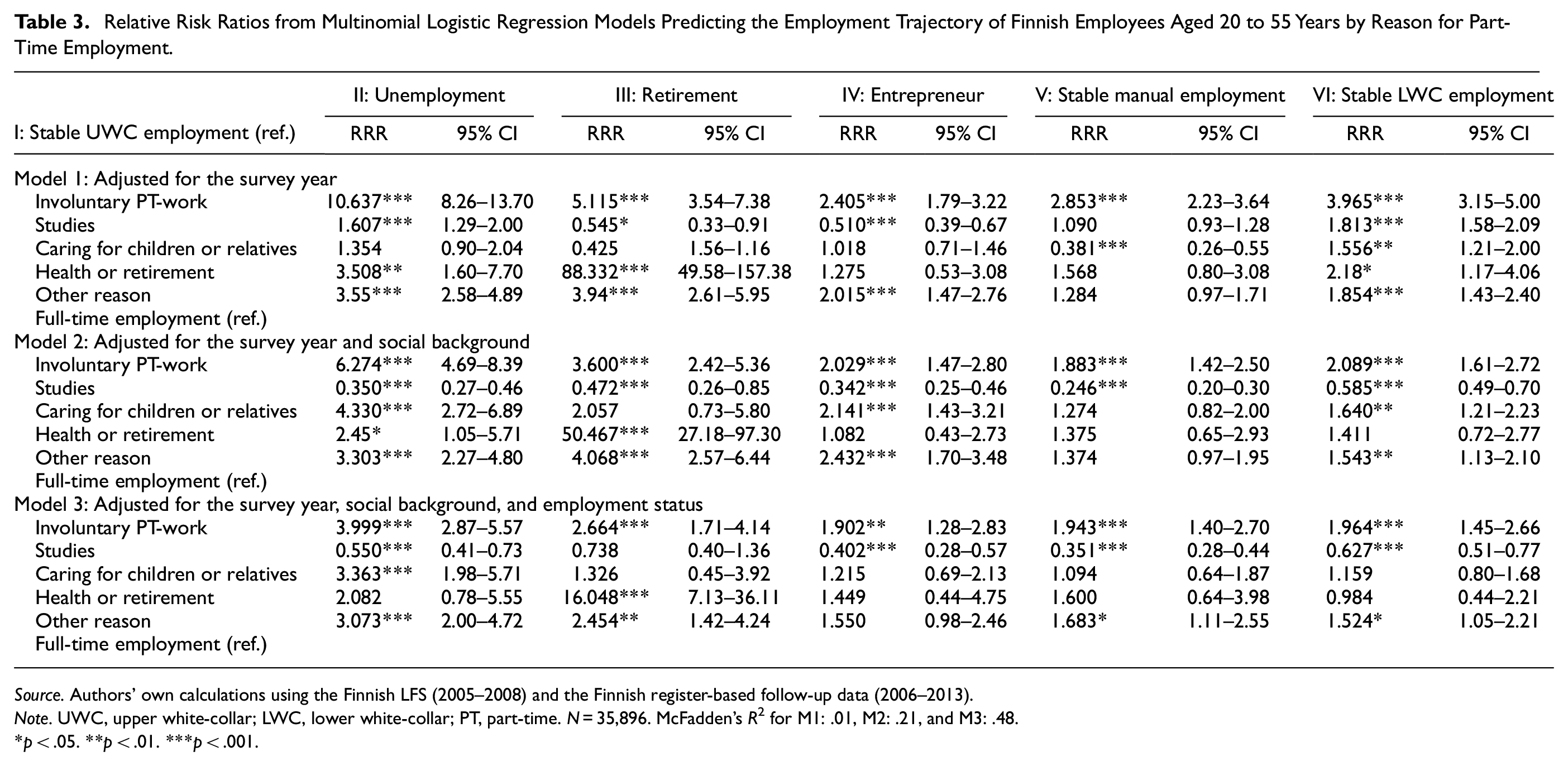
The first model analyzes the association between employment trajectory and part-time employment while adjusting for the survey year. The findings give strong support to the first hypothesis that involuntary part-time workers are more likely to become unemployed. Among all workers, they had by far the highest likelihood (RRR = 10.6) of belonging to the unemployment trajectory, instead of the upper white-collar path (which is used as the reference category). Furthermore, as expected, it was very probable (RRR = 88.3) that those part-timers who worked reduced hours due to health reasons or retirement followed the retirement trajectory compared to full-time workers. Similarly, involuntary part-timers and those who conducted part-time work for other reasons were also more likely to end up in the retirement trajectory.
As with respect to occupational attainment, all the subgroups of part-time workers were more likely to follow the lower white-collar employment trajectory than the upper white-collar trajectory in comparison to full-time workers. Furthermore, each of the employment trajectories was a more common destination for involuntary part-time workers than the upper white-collar trajectory. This implies that involuntary part-time jobs are rarely followed by stable employment in upper white-collar jobs. Whether the results remain valid after controlling for various control variables is tested in the following models.
The second model adjusts for social background, including gender, age, education, family, number of children, and whether a baby was born during the 8-year follow-up period. Involuntary part-time employment and part-time employment for other reasons remain strongly associated with the unemployment trajectory in comparison with the white-collar path, even when controlling for socio-demographic characteristics. Moreover, the relative risk of belonging to the unemployment trajectory is now positive and statistically significant for those who are working part-time because of caring responsibilities. Also, all risk ratios for those who worked part-time hours alongside their studies are significant and below 1.0, indicating a strong association with an upper white-collar trajectory.
The third model includes additional controls regarding employment status, industry, and side job. The results presented in Table 3 indicate that involuntary part-time employment, part-time employment due to care-giving, and other reasons are significant predictors of being in the unemployment trajectory compared to the upper white-collar trajectory. Thus, the first hypothesis is confirmed. Furthermore, working part-time involuntarily and part-time work due to other reasons and poor health/retirement is strongly associated with the retirement trajectory. This provides considerable support for the third hypothesis that part-time employment conducted because of poor health decreases the chances of achieving stable employment later on. However, those who are working part-time hours because of studying do not suffer from decreasing attachment, thus providing support for the fourth hypothesis. Instead, they are more likely to step onto an upper white-collar path, whereas they are less likely to follow entrepreneurial, lower white-collar and manual employment and unemployment trajectories compared to full-time employees. Hence, combining studies and part-time working predicts strong labor market attachment later on.
Relative Risk Ratios from Multinomial Logistic Regression Models Predicting the Employment Trajectory of Finnish Employees Aged 20 to 55 Years by Reason for Part-Time Employment.
Source. Authors’ own calculations using the Finnish LFS (2005–2008) and the Finnish register-based follow-up data (2006–2013).
Note. UWC, upper white-collar; LWC, lower white-collar; PT, part-time. N = 35,896. McFadden’s R2 for M1: .01, M2: .21, and M3: .48.
p < .05. **p < .01. ***p < .001.
The third model also shows that the fourth hypothesis is partially rejected since working part-time hours due to care responsibilities is associated with, on the one hand, an equal likelihood of entering the stable lower and upper white-collar trajectories in comparison to full-time workers, while on the other hand, a significantly increased likelihood of ending up on the unemployment trajectory (RRR = 3.4) compared to full-time employees.
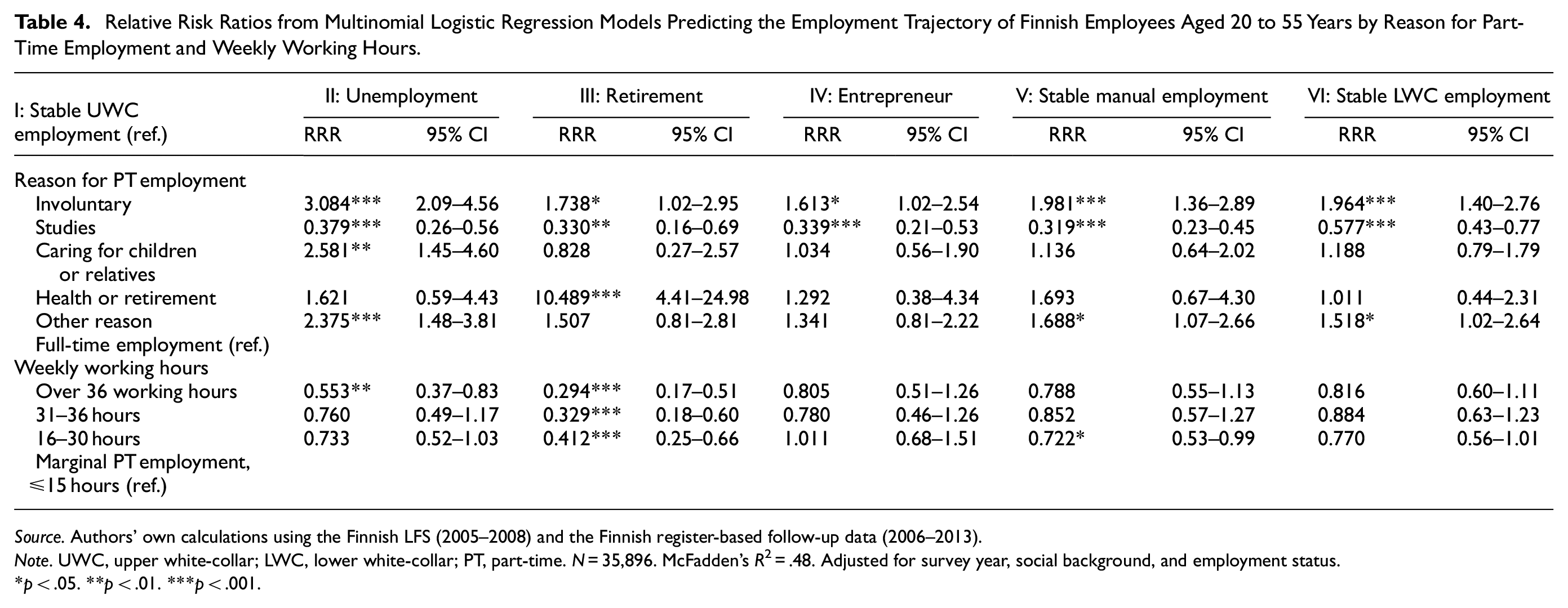
Finally, Table 4 shows whether there are statistically significant differences in the likelihood of following each trajectory between workers with different weekly working hours. Here, the effects of the reason for part-time work and all the control variables are held constant to determine the effect of working hours on belonging to the trajectories. With this analysis, we test whether the reason for part-time work, or working marginal or longer part-time hours, predict part-time workers’ employment trajectories at the end. As discussed in the earlier sections, the literature stresses the weakening labor market attachment of marginal part-time workers (Broughton et al., 2016; Fagan et al., 2014; Kalleberg, 2018; Rasmussen et al., 2019). Our contribution is to more closely define this association.
Relative Risk Ratios from Multinomial Logistic Regression Models Predicting the Employment Trajectory of Finnish Employees Aged 20 to 55 Years by Reason for Part-Time Employment and Weekly Working Hours.
Source. Authors’ own calculations using the Finnish LFS (2005–2008) and the Finnish register-based follow-up data (2006–2013).
Note. UWC, upper white-collar; LWC, lower white-collar; PT, part-time. N = 35,896. McFadden’s R2 = .48. Adjusted for survey year, social background, and employment status.
p < .05. **p < .01. ***p < .001.
First, instead of the number of hours, the reason for part-time work more strongly associates with employment outcomes in the long run. Practically all the strong associations as regards the reason for working part-time remain the same even after adjusting for the number of hours. The only considerable difference we found is that the associations between involuntary part-time employment and retirement and entrepreneurial paths become weaker.
Secondly, our second hypothesis suggested the increased probability of unemployment following marginal part-time working. This hypothesis is partially confirmed, since we only find such an association when comparing marginal part-time employees with those working >36 hours/week. However, when comparing marginal part-time employment with longer part-time hours (16–30 and 31–36 hours), relative risks are closer to 1.0 and non-significant. Furthermore, we find that marginal part-time workers more probably enter the disability retirement path than all the other workers who work longer hours weekly, in comparison to the white-collar trajectory. We therefore suggest that workers with a decreased ability to work are more likely to work only marginal hours while facing an increased risk of entering the disability retirement trajectory later on.
Discussion, Conclusions, and Implications
This research stemmed from the observation that longitudinal studies on part-time work typically do not analyze part-time work in enough detail. Part-timers are a heterogenous group whose employment outcomes have been hypothesized to vary depending on the reason for part-time work, the length of the workweek, and whether part-time work is a voluntary or involuntary choice. Our results indicated that the reason for working reduced hours (childcare, studies, health, part-time pension, other voluntary choice, or if full-time work was not available, i.e., involuntary choice) most strongly determine the career outcomes of part-time workers. Involuntariness, caretaking, poorer health, and part-time retirement decreased the likelihood of achieving stable employment.
The group of students taking part-time jobs more often entered the upper white-collar path than the baseline full-time workers, associating with the fact that many students in higher education combine part-time work with their studies. Hence, the manual employment path was less likely to be followed. For students, part-time work typically is a voluntary choice that suits their life situation, although there is a trade-off between work and study. Working while studying may postpone graduation, but it may also boost human capital and job-specific skills, and help in resumé-building, thus signaling positive individual attributes to potential employers (Spence, 1973; Weisshaar, 2018).
The story is very different for those part-timers working reduced hours due to care responsibilities, as we did find evidence about increased unemployment, that is, the trapping of some parents into combining part-time work with caregiving. Weisshaar (2018) has proposed and empirically tested a resumé signaling theory in which opting out of the labor market for family reasons produces negative perceptions about employees’ work orientation, signaling a violation of ideal worker norms. Given that employers often expect their employees to dedicate themselves fully to work, it may evoke a moral evaluation of the individual’s work–family choices. As a result, employers interpret opting out as a sign of reduced commitment to the job. Although Weisshaar’s analysis focused on labor market re-entry after family-related employment lapses, her theory goes on to explain why part-time workers with care responsibilities are a group discriminated against in the labor market.
Given the above, our findings align with earlier European studies, such as those conducted in Germany and the UK, which have underscored the “dead-end” nature of part-time work, particularly for women (Biemann et al., 2012; Buddelmeyer et al., 2005; O’Reilly & Bothfeld, 2002). However, given the increased share of Finnish families (mothers) relying on the home care allowance with children under 3 years (Ellingsæter, 2014), the share of part-time workers who combine childcare with some work is rather low. Most parents (mothers) stay at home full-time after parental leave, and then enter full-time employment again. Given the full-time working hour culture of the country, which supports Weisshaar’s (2018) theory, especially white-collar parents most often return to working full-time after combined parental leave and 6 months or a maximum of 1 year of home-caring for a small child. Instead, parents with less education and weaker labor market status, often working in the service sector, are more likely to combine part-time jobs with childcare, thus being exposed to weaker careers and unemployment. Compared to other countries, this finding concurs with studies noting that after family formation, women often enter part-time jobs and are exposed to downward occupational mobility and lower wages (Buchmann et al., 2010). We may conclude that there are dualistic labor market options for white-collar families and mothers who, according to the signaling theory, would re-enter working full-time rather soon after family leave, whereas workers in the secondary segment may not have full-time jobs waiting for them and must return to lower quality jobs while combining some partial homecare of the children.
We have also shown that involuntary part-timers have a significantly higher probability of facing unemployment than full-time workers. Furthermore, involuntary part-time employment seems to hinder opportunities for career advancement in terms of occupational attainment. Our findings suggest that a history of involuntary part-time employment significantly decreases the likelihood of following an upper white-collar career trajectory. These results are in line with those of Kauhanen and Nätti (2015), who found that compared to full-time workers, involuntary part-timers experience less job security and access to training in the workplace as well as fewer career opportunities. Moreover, our results lend support to prior studies suggesting that involuntary part-time work has negative consequences especially for socioeconomically disadvantaged groups (Månsson & Ottoson, 2011). In the Finnish context, however, it is worth noting that rather comprehensive welfare policies and strong labor market regulation provide protection for the vulnerable.
Furthermore, one of our main contributions has been to show the importance of addressing the issue of the reason for the weakened labor market attachment of those working marginal part-time hours weekly. We suggested that the determinant for weakening career outcomes associates with lowered work ability. According to our findings, marginal part-time working associated significantly more with the increased probability of entering the disability retirement trajectory than the unemployment path. Since the selected respondents of our study were less than 55 years old in the baseline years, they were not supposed to retire during the 8 years of follow-up. We suggest further studies to consider marginal part-time workers’ health as the determinant of weakening career outcomes.
Overall, our results highlight the need to improve part-time working conditions, a concern that organizations like the OECD have also raised (OECD, 2020). This improvement could reduce the risk of unemployment, promote health, extend work careers, and consequently increase the employment rate. Specifically, our results indicate that at the policy level priority should be placed on recognizing and addressing gender disparities in part-time work.
As a limitation of our study, the results may only tentatively be generalized to other developed countries known for individually protective and collectively collaborative labor market regulation, especially those in the Nordic region. Circumstances affecting part-time workers may differ in other national contexts, raising the need for replication studies.
Supplemental Material
sj-docx-1-sgo-10.1177_21582440231210690 – Supplemental material for Part-Time Workers’ Employment Trajectories by Length of Hours and Reason for Working Part-Time: An 8-Year Follow-Up Study
Supplemental material, sj-docx-1-sgo-10.1177_21582440231210690 for Part-Time Workers’ Employment Trajectories by Length of Hours and Reason for Working Part-Time: An 8-Year Follow-Up Study by Niklas Mäkinen, Jussi Tanskanen, Satu Ojala and Pasi Pyöriä in SAGE Open
Footnotes
Declaration of Conflicting Interests
The author(s) declared no potential conflicts of interest with respect to the research, authorship, and/or publication of this article.
Funding
The author(s) disclosed receipt of the following financial support for the research, authorship, and/or publication of this article: Funded by NordForsk, Nordic Program on Health and Welfare (grant no 74809, Working Hours, Health, Well-Being and Participation in Working Life—WOW 2015–2021).

Supplemental Material
Supplemental material for this article is available online.
Data Availability Statement
Data sharing not applicable to this article as no datasets were generated or analyzed during the current study.
References
Supplementary Material
Please find the following supplemental material available below.
For Open Access articles published under a Creative Commons License, all supplemental material carries the same license as the article it is associated with.
For non-Open Access articles published, all supplemental material carries a non-exclusive license, and permission requests for re-use of supplemental material or any part of supplemental material shall be sent directly to the copyright owner as specified in the copyright notice associated with the article.
