




Abstract
Bullying is a perennial problem in correctional institutions. This study aims to investigate the prevalence of bullying perpetration in young correctional institutions, and to identify environmental and personal factors as predictors of bullying perpetration. A cross-sectional survey was carried out among 289 male and female young people from eight correctional institutions in Malaysia. The Direct and Indirect Prisoner Behavior Checklist (DIPC-SCALEDr) was used to measure both bullying perpetration and victimization. The study reported more than 90% of the participants engaged in at least one behavior indicative of bullying others during the 1 month period. Participants reported involvement across six bullying forms. Direct logistic regression analysis identified eight significant predictors of bullying perpetration i.e. time served in the institution, disciplinary punishment; gang membership, no self-injury, respect, bureaucratic legitimacy, fairness, and family contact. To conclude, this study confirms bullying perpetration is determined by both personal and environmental factors. Juvenile justice system can use these key findings to anchor future interventions to prevent bullying and other forms of violence in correctional institution. In the future, this study might include a focus on staff-offender bullying and protective factors for bulling perpetration in correctional institutions.
Keywords
Introduction
Bullying in correctional facilities is one of the major public health challenges facing by the criminal justice system in many countries. Much of the studies reveal that the prevalence of bullying in correctional institutions is high, with over half of offenders involved in bullying perpetration with significantly deleterious effects (Ireland et al., 2016; Mazzone et al., 2018; Sekol et al., 2021). Bullying increases risks of unhealthy behaviors and mental health problems to not only victims but also bullies, such as anxiety and depression (Grinshteyn et al., 2021; Hysing et al., 2021), attention deficit hyperactivity disorder (ADHD) (Hysing et al., 2021; Simmons & Antshel, 2021), suicide ideation and suicidal behaviors (Hinduja & Patchin, 2019; Koyanagi et al., 2019).
Bullying perpetration is a serious misconduct that is difficult to define due to its complex nature. Most definitions of bullying perpetration specify aggressive behavior that involves unwanted actions that is intended to cause harm and fear (Ireland, 2005; Olweus, 1993). In can take on six major forms, including physical, verbal, sexual, psychological, theft-related and indirect (Ireland, 2005). Regardless the forms, bullying perpetration involves a pattern of behavior repeated over time and it involves an imbalance of perceived power between bullying perpetrators and the victims (Olweus, 1993). In correctional settings, single incident of aggression can be viewed as bullying perpetration if the individual believes they have been aggressed toward, and an incident must involve at least a bully and a victim; nonetheless, an imbalance of power between the bully and the victim is not necessarily involved (Ireland, 2005).
Bullying perpetrators are predicted to have high traits of aggression and exhibit beliefs that supporting bullying perpetration in correctional institutions (Adams & Ireland, 2017; Hassan et al., 2020). Some bullying perpetrators are found to have high traits of hostility and fearful, in which they use aggression as a coping response to overcome threats (Adams & Ireland, 2017). Bullying perpetrators demonstrate poor psychosocial functioning, have trouble resolving problems, exhibit high impulsiveness and low empathy (Farrington & Baldry, 2010). They are popular and make friends easily and often affiliate with ones who support bullying perpetration (Ireland, 2011; Sabramani et al., 2021). For many bullies, bullying perpetration may be effective to maintain social status and to gain social dominance (Guy et al., 2019; Hassan et al., 2020).
Theoretical Explanations of Bullying Perpetration
The occurrence of bullying perpetration in correctional settings is very much an outcome of the effects of the personal characteristics and the institutional environment (Ireland, 2011). These effects can be explained by two dominant models in prison research—the importation model and the deprivation model (Crewe, 2009). Importation model asserts that personal characteristics and lifestyle prior to confinement, which offenders “import” into the correctional institutions may affect variation in inmates’ behaviors and experiences (Goffman, 1961; Irwin & Cressey, 1962). In other words, the background of an offender has a strong impact on how that person behaves in the correctional institutions (Crewe et al., 2017; Mertens & Laenen, 2019; Sampson & Smith, 2021). Drawing on importation model, past empirical studies on bullying perpetration in correctional settings found significant difference between groups of age, gender, prior incarceration and aggression history (Connell et al., 2016; Klatt et al., 2016; Wooldredge & Steiner, 2016). Some studies found significant differences between types of offenses, time served and gang affiliation (Alemayehu et al., 2019; Valentine et al., 2015; Wooldredge & Steiner, 2016). Nonetheless, these studies produced mixed findings and further research is needed.
Deprivation model can also be utilized to explain bullying perpetration in correctional institutions. Sykes (1958) claimed that the core “pains of imprisonment” that is, the loss of freedom, lack of supplies (e.g., hygiene supplies, foods, medicines), deprivation of (heterosexual) romantic relationships, and the isolation from outside community can have a strong impact on how offenders behave in correctional institutions. Studies found lack of supplies increased risk of theft-related bullying (Guo et al., 2019; Hassan et al., 2020), and sexual deprivation can be linked to sexual bullying in correctional institutions (Banbury et al., 2016; Carr et al., 2020) . Researchers agreed that some features of the institution generate enormous pressure that may increase the risk of bullying or other forms of aggressive behavior (Adams & Ireland, 2017; Ireland et al., 2016; Sekol et al., 2021), but not limited to these five Sykes’s deprivations. Some scholar associated deprivation measures with the lack of safety and security and poor staff-prisoner relationships (Gonçalves et al., 2014; Ireland et al., 2016). Liebling (2004), in her comprehensive study of prison life, has proposed 21 aspects of institutional environment (e.g., fairness, bureaucratic legitimacy, staff-offender relationships and security) that classified into five major dimensions that is, harmony, professionalism, security, conditions and family contact, wellbeing and development. How inmates perceive these aspects could affect their behavior during incarceration (Liebling, 2004). The environment could be perceived to be moderate, certain, severe or swift, and these different perceptions may result in different behaviors in the same environment (Crewe, 2009). Theoretically, where individuals perceive a good atmosphere in correctional facilities, a low rate of bullying perpetration in facilities might be expected (Hassan et al., 2020; Ireland et al., 2016).
The link between 21 aspects of institutional and bullying perpetration is still uncovered, and this study aims to fill this gap by focusing on Malaysia context. Malaysia is a home to over 33 million people (Department of Statistics Malaysia, 2022). It has 52 prison establishments across 14 states operated by the federal government. The incarceration rate is 212 per 1,00,000 individuals and this exceeds the global average of 145 per 1,00,000 (World Prison Brief, 2022). Correctional institutions in Malaysia are gender segregated, consist multiracial offenders, high security system and overcrowding and understaffed facilities (Hassan et al., 2020; Kamaluddin et al., 2021; Sulaiman et al., 2016). Nonetheless, medium security system institutions are available for young people. Either adult or young people, incarcerated individuals in Malaysia are susceptible to bullying perpetration that often associated with their confinement experience that can be explained using Liebling’s 21 aspects of institutional environment.
The Present Study
Deprivation and importation theories have explained the potential of institutional environment and personal factors to influence bullying perpetration. Hence, this study had two aims. Firstly, this study aims to investigate the prevalence of bullying perpetration in young correctional. In so doing, six different forms of bullying perpetration will be investigated that is, physical, verbal, sexual, psychological, theft-related and indirect. Secondly, this study seeks to further investigate environmental and personal factors as predictors of bullying perpetration among young people in young correctional institutions. In this regard, this study tested young people in correctional facilities to investigate 21 institutional environmental factors and 11 personal factors as predictors of bullying perpetration. This study had two specific hypotheses: that bullying perpetration is influenced and predicted by specific institutional environment factors, and that bullying perpetration is influenced and predicted by specific personal factors.
Methods and Measurements
Sample
A cross-sectional survey was carried out involving young people recruited from eight correctional institutions in peninsular Malaysia, comprising five male and three female institutions. Using a stratified random sampling technique, a total of 293 young people were selected. Nonetheless, with approximately 99% response rate, only 289 involved in the analysis. Table 1 demonstrates distribution of participants by sociodemographic variables. A total of 37% of female young people and 63% of male young people (63.0%) aged 12 to 21 years old were included in the analysis. A total of 12% participants reported history of incarceration and about 88% reported to serve their first custodial sentence. More than half participants (63%) reported they have been institutionalized between 7 and 11 months, and slightly more than 30% have been institutionalized more than a year. About 35% of participants were charged with property crimes, 18% were charged with drug-related crimes or activities, and less than 10% were charged with violent and sexual crimes. Meanwhile, 30% of participants were charged with offenses related to status offenses, including truancy, running away from home and violating curfew. A small number of participants were charged with multiple offenses due to the fact that they committed more than one crime, and about 2.4% were transferred to the current institution due to repeatedly absconding from previous institutions. Also, particicpants the length of sentence between one and 3 years.
Distribution of Participants by Sociodemographic Variables.

Measurements
Data were collected using a set of self-completion questionnaires, including demographic information, Measuring the Quality of Prison Life scale (MQPL; Liebling, 2004) and the Direct and Indirect Prisoner Behavior Checklist—Scaled Version Revised (Ireland, 2007). Permission to use these instruments were granted from both authors. The MQPL is a self-report questionnaire that measure individual perceptions and experiences toward correctional environment. It highlights the aspects of correctional environment, including authority, power and control, treatment and services, security, and staff-offender relationships. MQPL consists of 147 statements representing 21 environmental factors that categorized into five subscales or dimensions that is, harmony, professionalism, security, condition and family contact, and well-being and development. Each subscale has between two and seven factors, and each subscale reported reliability between between 0.56 and 0.89 (Liebling et al., 2012). Also, a pilot study reported reliability between 0.62 and 0.92. Each item used a five-point scale, that ranges from “strongly disagree” to “strongly agree.” For the purpose of the influence and logistic regression analysis, all factors were classified into ordinal-level categories (i.e., positive, moderate and negative) by using split analysis.
The DIPC-SCALEDr was used to examine individuals’ tendencies to engage in behavior indicative of bullying and/or being bullied. The DIPC-SCALEDr contains 126 items describing both direct and indirect experienced events and actions and is separated into two sections that is self-report victimization (68 items) and self-report bullying (58 items). For the purpose of this study, only self-report bullying perpetration was used. All items are categorized into six subscales or bullying forms, including physical, verbal, sexual, psychological, theft-related; and indirect. Indirect bullying is a covert aggressive behavior, employed as a means to harm others through, for example exclusionary, defamatory and divisive behaviors such as gossiping, ostracizing and spreading rumors (Ireland, 2005). Each subscale consists of between 2 and 33 items, and each item is addressed by indicating either “never,”“rarely,”“sometimes,”“often” or “always.” Participants were asked to identify frequency of actions and events that have occurred in the past month. The DIPC-SCALEDr has strong consistency in measuring bullying perpetration with overall consistency with Cronbach’s alpha between .83 and .96 (Ireland & Qualter, 2008). Also, a pilot study reported overall consistency of 0.97 for self-report bullying perpetration.
For the purpose of the influence and logistic regression analyses, participants were classified into two groups by using median split analysis on the total score of DIPC-SCALEDr. The total score distributed between 0 and 180. The Median of overall score was 24. This means, “24” is the mid-point of scores distribution. Participants scored above the median (≥25) were classified or categorized as high bullying perpetration and participants scored below the median (≤24) are classified as low bullying perpetration (see Table 4).
Data Collection Procedure
Permission for data collection in eight Malaysian young correctional institutions was approved and granted by the Department of Social Welfare Malaysia (JKMM 100/12/5/2:2019/ 002). This is the authority that responsible for the operation of young correctional institutions in Malaysia. All young people that were placed in correctional institutions established under the Child Act (2001) were included in this study. In Malaysia, children and young people are protected by the Child Act (2001) (or Act 611). The Act consists of 135 sections that consolidate and amend the laws relating to the care, protection and rehabilitation of a person under the age of 18. The Act recognizes children and young people in conflict with law need to be protected on every stage of juvenile justice process, and they shall be treated differently from an adult. With regard to institutionalization, the Act clearly stated (in the Part IX) the need of special establishments for the care, protection and rehabilitation of children and young people in conflict with law, including places of safety and refuge, detention centers, probation hostels, approved schools and Henry Gurney Schools. Today, there are at least three Henry Gurney schools, eight juvenile approved schools and 11 probation hostels that are operating throughout the country.
An exclusion criterion in this study was young people with severe physical and mental health conditions, including serious injuries and serious psychiatric problems. Also, young people on parole were excluded in this study because they were unreachable. The exclusion of all these groups was confirmed after consulting mental health experts as well as correctional officers during the study conducted.
Eight correctional institution were approached consecutively. In each institution, the study began by approaching the warden of the institution as a gatekeeper. The warden assigned a correctional officer to attend the researchers along the study was conducted. The officer gave the list of young people available for the study. From the list, a total of 30% of participants in each institution were selected to participate in the study. Using systematic sampling technique, the researchers took a sample in every “nth” from a listing unit in each institution by considering variances in the estimates. The “nth” was determined by using a specific formula (nth = number of required sample size/total number of listing units). Selected young people were approached in groups of five to 10 young people in a communal space of the institutions for example, library, meeting rooms, hall or classroom. Young people were given the information sheet (that entails a brief summary of the research project) and they were allowed to ask questions. Agreed participant were asked to sign a consent form. The questionnaires were then distributed and it took approximately 30 to 60 min to complete. Participation in this research was entirely voluntary so that potential for coercion of participants was avoided. To ensure on-going consent, participants were reminded that they could withdraw at any time during the survey session. At the end of the session, participants were debriefed about the research project by emphasizing the dissemination of research findings. The anonymity of the participation were guaranteed. All these steps were applied in all institutions. The data collection process completed in February 2018. This study was supported by the University of Strathclyde, Scotland. Ethical approval for this research has been granted by the University Ethics Committee, University of Strathclyde (UEC14/40).
Results
The Prevalence of Bullying Perpetration and Victimization in Young Correctional Facilities
Overall, 95% of participants reported at least one behavior of bullying others. Using median split analysis, a total of 49.1% of participants reported high level of involvement in bullying others, and the rest of participants (50.9%) reported low level of bullying perpetration. Across gender, approximately 46.7% female young people and 48.1% male young reported high level of bullying perpetration.
Table 2 demonstrates the distribution of participants across five-point response scale of bullying behavior. It can be explained that majority participants experienced more than one form of bullying perpetration. For the “physical” form of bullying perpetration, slightly less than 80% participants (79.6%) reported physical bullying in the past month and the rest never engaged in such form of behavior. Similar to this, about 77% of participant reported engaging in “theft- related” form of bullying perpetration. Turning to “verbal” and “indirect” forms, more than 85% participants involved in such form of bullying perpetration and less than 20% never reported such behavior. Meanwhile, less than 35% young people reported “sexual” bullying perpetration. Overall, “verbal” and “psychological” forms of bullying perpetration were more prevalent than other forms as these two forms reported a higher Mean value with 0.88 for “verbal” and 0.85 for “indirect” forms of bullying perpetration.
Distribution of Participants Across Five-Point Response Scale of Bullying Behavior.

The Influence of Personal and Environmental Factors on Bullying Perpetration
Drawing from importation model, this study tested the influence of 11 personal factors on bullying behavior. Using asymmetrical measures (i.e., Somer’s d and Lambda), Table 3 shows that only eight factors were found to be significantly influenced bullying behavior.
Influence of Personal Factors on Bullying Behavior.
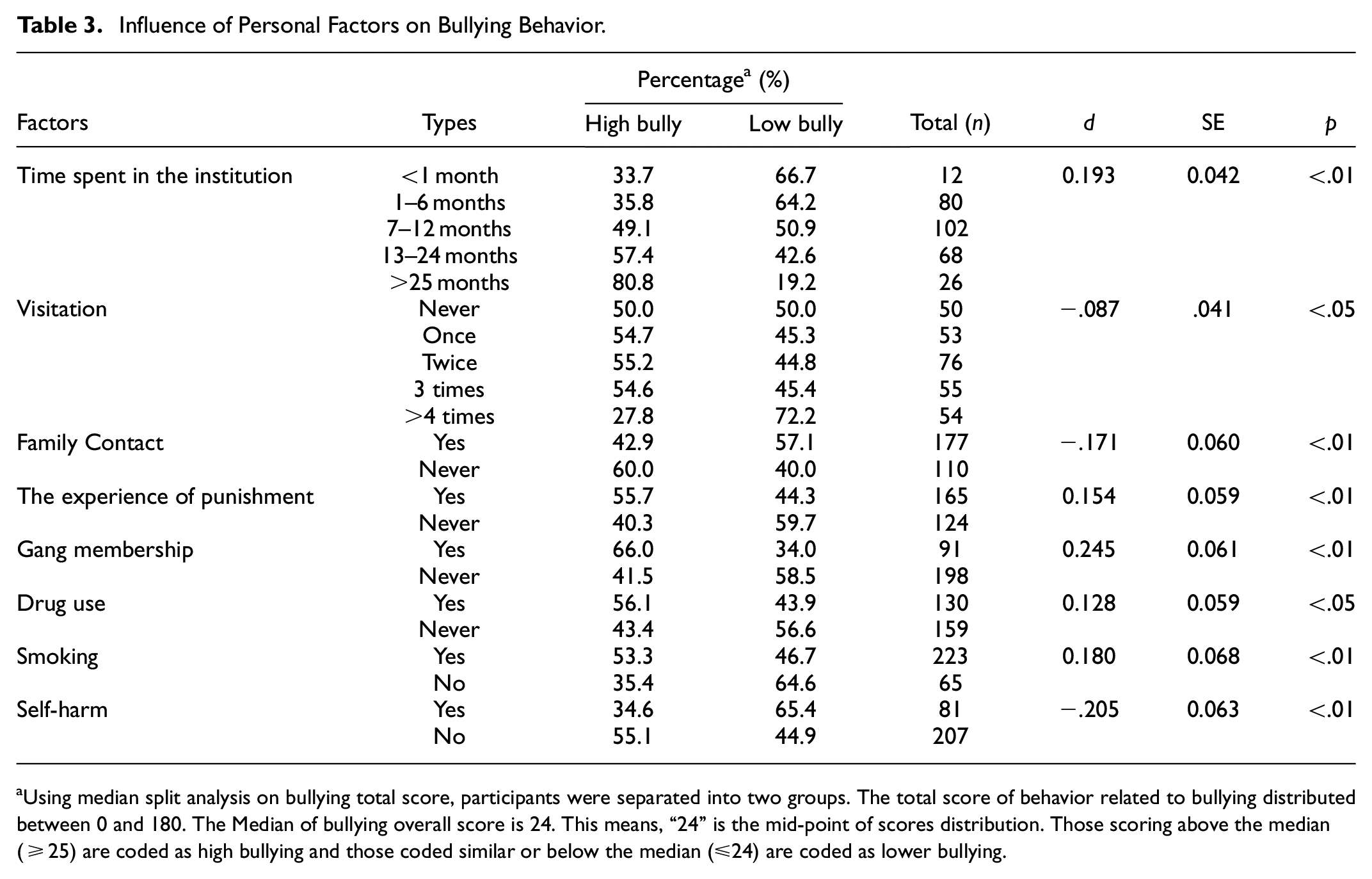
Using median split analysis on bullying total score, participants were separated into two groups. The total score of behavior related to bullying distributed between 0 and 180. The Median of bullying overall score is 24. This means, “24” is the mid-point of scores distribution. Those scoring above the median (≥25) are coded as high bullying and those coded similar or below the median (≤24) are coded as lower bullying.
With an exception of “visitation,” the influence of personal factors on bullying are slightly moderate. The “gang membership” factor reported the highest influence as compared to other significant personal factors with Somer’s d = 0.245, p < .01. The value specifies a corresponding increase of 24.5% in bullying perpetration to those affiliated with gang in the institution. Turning to “self-harm,” this factor reported a corresponding decrease of 20.5% in bullying perpetration for some participants who experienced self-harm (Somer’s d = 0.205, p < .01). “Time spent in the institution” reported significant influence on bullying perpetration with Somer’s d = 0.193 and highly significant (p < .01). The value indicates that there is a corresponding increase of 19.3% in bullying perpetration by increasing amount of time spent in the correctional institutions. The situation for “visitation” is different. Although this factor reported a weak association, it shows a significant negative influence on bullying behavior (Somer’s d = −0.087). This indicates that for every frequency of increased visitation, there is a corresponding decrease of 8.7% in bullying perpetration. Similarly, there is also a negative influence on bullying perpetration for the “contact.” For “contact” factor, the degree of influence is Somer’s d = −0.171 and highly significant (p < .01). This value indicates that the tendency to bullying others by 17.1% is due to never having contact with family members. With regard to “punishment” factor, there is significant influence on bullying with Somer’s d = 0.154 (p < .01). This explains a corresponding increase of 15.4% in bullying perpetration for some participants who experienced punishment inside the institution. Turning to the “experience of drug use,” there is also significant influence on bullying with Somer’s d = 0.128. It reveals that some participants who used drugs before the incarceration are predicting increase of 12.8% in bullying perpetration. Similar to this, “smoking” reported influence of Somer’s d = 0.180 (p < .01). This means that there is predicted increase of 18% in bullying perpetration for some smoking participants.
Turning to institutional environment factors, the study tested the influence of 21 factors on bullying perpetration. By using split analysis, participants were separated into three levels of perception: That is, positive, moderate and negative for each factor (see Table 4). Table 4 shows only nine factors significantly influenced bullying perpetration. The direction of the influences are negative, which indicates that a positive attitude toward environmental factors is associated with a lower involvement in bullying perpetration, and vice versa. “Fairness” emerged as the highest influence in comparison to other factors, and it shows a moderate influence on bullying perpetration (Somer’s d = −0.359). This value indicates that there is a corresponding increase of 35.9% for some participants who reported negative or low perception on “fairness” factor. In other words, the perception of the unfairness of the legality of punishment and procedure (procedural injustice) in the correctional institution contributes to bullying perpetration. Inversely, some participants with a more positive perception on “fairness” were less likely to bully others.
Influence of Environmental Factors Toward Bullying Behavior.

All factors were recorded into ordinal-level categories (i.e., positive, moderate and negative) and associated with dichotomous outcome (i.e., young people with higher bullying behavior or bullies and young people with lower/no bullying behavior or non-bullies).
Apart from “fairness,” all other factors show a slightly moderate influence on bullying perpetration, that is, between Somer’s d = −0.135 and −0.280. “Safety” shows the lowest value with Somer’s d = −0.135. It reveals that the influence of some participants involved in bullying perpetration is only 13.5% due to the negative perception of respect or courteousness by staff. “Humanity” and “wellbeing” factors also show lower influence with Somer’s d less than 0.20. Therefore, it explains that the influences of “humanity” and “wellbeing” on bullying perpetration are less than 20%. Nonetheless, it supports that, for some participants, the feelings of being treated inhumanely and feelings of pain in the institution were prone to bullying others. In contrast, some were less likely to bully others as they showed a positive perception toward “humanity” and “wellbeing” factors. Similarly, “bureaucratic legitimacy” factor also shows influence of less than 20% (Somer’s d = -. 177). It explains that some participants with negative perception toward the transparency and responsiveness of institutional systems have a predicted increase of 17.7% in bullying perpetration. With regard to other factors, there is more than 20% influence on bullying perpetration. “Respect” factor shows coefficient of Somer’s d = −0.280. This value indicates that the increase of bullying perpetration by 28% is due to the negative perception toward the “respect” factor. Furthermore, it reveals that some participants who felt disrespected by correctional staff and officers were prone to bullying others. Turning to the “staff-inmate relationship,” this factor has been found to influence about 23% of bullying perpetration (Somer’s d =-. 234). This means that some participants who had received less support for their behaviors from the correctional staff were more likely to bully others. The “family contact” factor also shows about 23% influence on bullying perpetration (Somer’s d = −0.230). By this, it reveals that some participants who had less opportunity to maintain contact with their family were more prone to bullying others. With regard to “personal autonomy” factor, there was a significant influence on bullying perpetration with Somer’s d = −0.244. This means that the increase of bullying behavior by 24.4% is due to negative perception toward “personal autonomy” factor. In other words, some participants who felt less control over themselves were more likely to exhibit bullying perpetration.
Table 5 shows the result of direct logistic regression. Direct logistic regression is performed to assess the impact of a number of factors on the likelihood that some participants exhibited bullying perpetration. Logistic regression allows a more sophisticated exploration of the interrelationship among a set of significant variables (i.e., eight personal factors and nine institutional dimensions) in the one model. It has been used to make much more powerful and accurate predictions about bullying perpetration. This makes it ideal for the investigation of more complex real-life data. Although some of the predictors showed a significant influence with bullying perpetration in the cross tabulation in the logistic regression, after controlling association between predictors, some were no longer significant predictors.
Logistic Regression Predicting Likelihood of Reporting Bullying Behavior.

The full model containing all predictors was statistically significant, X2 (17, N = 284) =119.47, p < .01, indicating that the model was able to distinguish between some participants exhibited higher involvement and lower involvement in bullying perpetration. The model as a whole explained between 34.3% (Cox & Snell R Square) and 45.8% (Nagelkerke R square) of the variance in bullying status, and correctly classified 76.4% of cases. As shown in the Table 5, only eight predictors (four personal factors and four institutional environment factors) made a unique statistically significant contribution to the model. The strongest predictor of reporting a bullying perpetration is “time spent in the institution,” recording an odds ratio of 3.20. This indicated that some participants who spent a longer period of time in the institution were over three times more likely to report bullying perpetration than those incarcerated for less time. “Self-harm” reported the lowest odds ratio of 0.30. This value indicated some participants who experienced self-harm are 0.30 times less likely to report bullying perpetration. “Gang membership” recorded 2.62 odds ratio. This indicated that some participants affiliated with gang members in the institutions are almost three times more likely to bully others. With regard to “punishment,” this predictor reported an odds ratio of 2.0. This means that some participants who experienced punishment during incarceration are two times more likely to report behavior perpetration than those who never experienced punishment. Apart from this, all institutional environment factors reported an odds ratio slightly less than 1.0. This indicated that participants who exhibited a more positive perception toward “respect,”“bureaucracy legitimacy,”“fairness” and “family contact” dimensions are one time less likely to bully others than those who reported negative perception toward these factors.
Discussion
Unsupportive Correctional Environment and Self-Worth
The results of the logistic regression indicated four institutional environment predictors affecting the onset of bullying perpetration. Participants who perceived being disrespected by staff members, who perceived institutional bureaucracy as lacking legitimacy, who perceived that they were being treated unfairly, and who were less likely to receive visitation were more likely to exhibit in bullying perpetration. Findings suggest that these “unsupportive” correctional environments contributed to high levels of frustration, anger and depression (Alemayehu et al., 2019). Scholars argued that unsupportive prison environments are “pains” inherent in the nature of incarceration that might challenge the inmate’s ego and attack his/her sense of self-worth, resulting in frustration and poor adjustment (Crewe et al., 2017; Mertens & Vander Laenen, 2019). Individual’s feelings of worth rely on the social evaluation of the group or community with which an individual is identified. “Feelings of worthlessness tend to arise from membership in underprivileged or outcast groups” (Cartwright, 1950, p. 440). Correctional institutions are warehouses for outcasts (Braithwaite, 1989). Self-worth may be easily threatened. When feelings of self-worth are threatened, some young people tend to use aggression (including bullying others) as a coping response to overcome threats (Adams & Ireland, 2017; Farrington & Baldry, 2010).
Feeling disrespected can be related to the feelings of humiliation and embarrassment as a consequence of the way staff members treated them. If staff do not treat, speak or talk to young people in a respectful manner, this perception can lead some young people to feel humiliated and embarrassed. Past studies agreed that perceived insults and disrespect increase risk of bullying perpetration (Hassan et al., 2020; Ireland et al., 2016; Sekol et al., 2021). Such feelings contributed to perceived devaluation that diminished feelings of one’s self-worth. Disrespect entails actions (either verbal or nonverbal) that are degrade, demean or objectify (Sparks & Bottoms, 1995). The need to be respected, in a situation where some young people are shown very little respect, intensifies the urge to dominate others and this leads to bullying perpetration (Adams & Ireland, 2017).
The perceived illegitimacy of the bureaucratic processes of correctional institutions also led to feelings of worthlessness. Some young people may manifest frustration toward inconsistent and unpredictable decisions made about them in the institution and the use of authority by some officers and staff members. Control is present elsewhere in correctional institutions. The task of controlling requires the use of authority or the legitimate power of a person, and the pursuit of order (Crewe et al., 2017; Day et al., 2015; Liebling, 2011). Tyler (1990) argues that “the effectiveness of legal authorities ultimately depends on voluntary acceptance of their actions” (p. 24). Power in many ways are highly visible. It must be practiced more fairly so that the decision making in the correctional institutions is able to be navigated and accepted. This, as a result, generate normative commitments toward cooperation, compliance, and conformity. In this study, the lack of clear structure and decision-making are assumed to manifest a lack of clear authority or unfairness. Past studies agreed significant association between the unfair procedural justice and bullying perpetration (Gonçalves et al., 2014; Sampson & Smith, 2021). There is ample evidence of mainly negative effects on young people’s behavior in relation to a sense of unjust treatment or procedural injustice (Gonçalves et al., 2014; Liebling & Crewe, 2012; Sampson & Smith, 2021). Unfair punishment or procedural injustice through the use of coercion and harsh punishment were abusive and conveyed disrespect. Indeed, this threatened their self-worth. Oppression or unjust treatment or perceptions of the mis-exercise of authority may threaten the integrity of the ego, and turn to feelings of shame, and create a negative self-image (Sherman, 1993; Tyler, 1990). This can give rise to the tendency to retaliate against that other person. To increase their self-worth, therefore, some young people sought to devalue others through bullying actions. Family also plays an important role in influencing bullying. As reported in this study, young people who received less opportunity to maintain contact with their family were more likely to conduct bullying behavior. They were less likely to receive visits, as well as being unable to maintain meaningful contact with their family and these reflected receiving less social support. Scholars agree that social support from family members is associated with at least lower levels of anti-institutional behavior (Cochran, 2012; Hassan et al., 2020; Rocheleau, 2015). In fact, strong family ties can foster prosocial behavior in the institution (Wright et al., 2001). Overall, these findings supported and advanced deprivation model by identifying four institutional environment deprivations that increase risk of bullying perpetration. Bullying perpetration was induced by negative or low perception toward these four deprivations.
Personal Factors and the Social Status
In this study, bullying perpetration is also reported to be strongly associated with dynamic personal factors. Empirical studies support this finding, claiming that some longer-serving sentenced young people are more likely to engage in bullying or other misconducts (Valentine et al., 2015; Alemayehu et al., 2019; Wooldredge & Steiner, 2016). The decision to bully others is increased due to the sense of power or control over other young people, that is, shaped by social status, gang affiliation and familiarity with institutional cultures (Dâmboeanu & Nieuwbeerta, 2016). Power, as explained previously, meant being respected, and this is closely linked to the process of prisonization. Clemmer (1940) refers to prisonization as the adoption of the folkways, mores, customs and general culture of the inmate subculture (p. 270). As compared to short-term sentenced young people, longer serving sentenced young people were more prisonized. Prisonized young people were more likely to value social status and be integrated into the inmate social system that is, gang (Reid & Listwan, 2018). Some young people who conform to these measures seek to acquire appraisal, respect or power (Beijersbergen et al., 2016). Nonetheless, some young people often feel threats to their power and autonomy. Some young people compensated for deficits in power and autonomy through interpersonal exploitation such as bullying. For them, bullying is one way in which they can acquire power among peers (Sekol et al., 2021).
Apart from this, participants who experienced disciplinary punishment inside the institution were two times more likely to report behavior indicative of bullying others than those who never experienced punishment. Scholars agree that aggressive behavior might be an outcome of severe punishment or coercive experiences (Crewe, 2009; Day et al., 2015). Staff’ use of punishments, such as loss of privileges or solitary confinement, as a reactive consequence of rule infractions appeared to predict poor adjustment. The experience of being punished in the institution contributed to fearlessness of threats of sanction. For them, the more exposure to punishment, the more they got used to it, diminished any deterrent effect. Therefore, some young people come to view disciplinary punishment as less threatening and less severe than other possible sanctions. Past studies support that disciplinary punishment increasing the risk of bullying perpetration (Hassan et al., 2020; Walters & Espelage, 2018).
The contribution to bullying decisions was also explained in terms of young people’s involvement in or affiliation with gang membership. Gang membership presents continual threats to correctional safety. As argued by many scholars, affiliation with gang members is a strong determinant of bullying perpetration in the correctional institution (Alemayehu et al., 2019; Valentine et al., 2015; Wooldredge & Steiner, 2016). Increased bullying is in fact due to association with delinquent peers and which implies a social learning process through direct conditioning and through imitation of friends’ behavior (Akers & Jensen, 2008). In this regard, bullying is seen as a consequence of behaviors learned from peers. As Warr and Stafford (1991) argued, such behavior more likely stems from other social learning mechanisms, including pressure to peer/group conformity, imitation or vicarious reinforcement. In particular, when deviant behavior is learned, attitudes favorable to the violation of law are acquired. Indeed, favorable attitudes toward bullying are a necessary, although not sole, condition for bullying perpetration (Ireland, 2011; Ireland et al., 2016). Adapting to theory of differential association, bullying can be understood as a consequence of attitudes favorable to aggression and bullying, and attitudes that are learned through social interaction with peers (Sutherland & Cressey, 1966).
Finally, bullying behavior can be differentiated between young people with self-harm and no self-harm. Young people who engaged in self-harm were more likely to be bullied. Some young people chose to harm themselves as a way of dealing with very difficult thoughts and feelings which resulted from stressful life events. Self-harm or suicide attempts are very common in people with mental health problems (Hawton et al., 2013; Hinduja & Patchin, 2019; Koyanagi et al., 2019). Young people with mental health problems often experience high rates of bullying, teasing and social exclusion (Koyanagi et al., 2019; Mulvey et al., 2020). Overall, these findings advanced importation model by identifying four personal characteristics that can explain bullying perpetration in correctional institutions.
Conclusion
This study has produced new knowledge about bullying perpetration in correctional institutions in Malaysia context. It enhanced knowledge about the prevalence of bullying perpetration among incarcerated young people, in which 90% reported at least one behavior indicative bullying others in a month. Also, this study has identified four deprivations or “pains” of institutional environment that can predict bullying perpetration that is, respect, bureaucratic legitimacy, fairness and family contact. Turning to importation model, this study identified four personal characteristics that can be linked to bullying perpetration that is, time-served, disciplinary punishment, gang membership, and no self-harm.
This study has some limitations. Technically, this study use self-report measures and data obtained can be affected by an external biases, in which participants may make the more socially acceptable answer and not be able assess themselves accurately. To minimize the biases, this study used the validated self-report instruments, focused on frequent events and for short recall period, and most importantly, ensured participants’ confidentiality. Using validated self-report measurements and short recall period may assist researcher to overcoming biases (Althubaiti, 2016). Sampling bias maybe occurred in this study. Nonetheless, the stratified random sampling technique used in this study can be one of the best method to avoid bias (Nguyen et al., 2021).
Another aspects of the limitation, this study did not involve correctional officers (e.g., correctional warden, correctional officers, social workers, counselors). Correctional officers have a great capacity to shape the correctional social life. They have the ability not only to make decisions and to give order to staff members, but also to form judgments about inmates’ behavior and make decisions about them in correctional institutions (Liebling & Crewe, 2012). Officers are highly skilled and have strong knowledge about correctional rules as well as policy relating to inmate’s right (Liebling, 2011). For these reasons, their voices and perceptions about phenomenon of bullying in correctional institutions are important. Another aspect, this study did not emphasize the risk factors of victimization. Therefore, future research in this area might include a focus on victimization experiences by exploring the risk factors of different forms of victimization. Future research may focus on qualitative exploration about young people experiences of particular forms of bullying and victimization. How it happens, how they experience it and cope with it and how the correctional facility helps them are questions that future study might attend to. Apart from this, it would be very interesting to assess protective factors for bullying perpetration in correctional institutions. Such findings can be useful to improve anti-bullying programs, policy and practice (Zych et al., 2019). In fact, protective factors can reduce negative impacts on mental health (Sabramani et al., 2021; Tharshini et al., 2021). Future study may investigate this impact or investigate the link between mental health and the bullying perpetration and/or victimization. This study assessed the influence of mental health on bullying perpetration, but no significant influence was found. It is perhaps the factor was assessed through the history of receiving mental health treatment, and this may not be accurate way to assess the effect. Future research may use specific mental health scales or instruments. Lastly, it would be useful for future research to include an explanation or exploration of bullying perpetration between staff and young people. This phenomenon is understudied, and much research emphasized on staff-prisoner relationships (Crewe et al., 2015; Liebling & Arnold, 2012).
This study significantly contributes toward improving future practice. In particular, all these evidences and knowledge can inform interventions, approaches and practices that may help in reducing the frequency and prevalence of bullying and victimization in juvenile correctional settings. It can be done by educating young people and correctional staff about the nature of bullying and victimization, its effects as well as how to handle bullying situations. Young people might be ignorant about what constitutes bullying. Education of this nature, in particular, can raise young people’ awareness of the wrong of their actions and thus decrease the likelihood to engage in such misconduct (Vreeman & Carroll, 2007). Indeed, using the information about eight bullying predictors, juvenile justice system can create a bullying preventative measure as a guideline to control bullying behavior and peer violence in correctional institutions.
Footnotes
Acknowledgements
This research was fully supported by the Department of Social Welfare Malaysia and the eight Malaysian Juvenile Justice Institutions for their participation in this research project. This research was partially supported Prof. Andrew Kendrick and Dr. Elizabeth Weaver from the School of Humanities and Social Sciences, University of Strathclyde, Scotland who provided insight and expertise that greatly assisted the research.
Declaration of Conflicting Interests
The author(s) declared no potential conflicts of interest with respect to the research, authorship, and/or publication of this article.
Funding
The author(s) disclosed receipt of the following financial support for the research, authorship, and/or publication of this article: This research was partially supported by GGPM Research Grant (GGPM 2018-042), the National University of Malaysia, Malaysia.
Ethical Approval
The study was conducted according to the guidelines of the Code of Practice on Investigations Involving Human Beings, and ethical approval for the study was approved by the University Ethics Committee of University of Strathclyde, United Kingdom (UEC14/40). Also, permission and ethics to conduct the study in eight juvenile institutions was approved by the by the Department of Social Welfare Malaysia (JKMM 100/12/5/2:2019/ 002).
Informed Consent Statement
Informed consent was obtained from all participants involved in the study and written informed consent has been obtained from the participants to publish this paper. Nonetheless, their identities remain anonymous.

Data Transparency/Availability
The datasets generated during and/or analyzed during the current study are available from the corresponding author on reasonable request.