




Abstract
The proliferation of unsafe behavior in underground-construction sites has been widespread, which leads to accidents in underground construction from time to time. Accidents are not only a threat to the personal safety of construction workers but also cause property losses. Intervention on how to prevent the propagation of unsafe behavior among underground-construction workers in a timely manner, further improvement in the safety-management level of construction enterprises, and ensuring smooth implementation of projects are urgent measures to solve this problem. In this study, an SCIMR (Susceptible-Contacted-Infective-Removed) model was developed to study the spread of unsafe behavior among underground-construction workers. Increase in the improvement, control, and awareness rates could provide a preventive effect on the spread of unsafe behavior among underground-construction workers, whereas increase in the adoption and forgetfulness rates could facilitate increase in unsafe behavior. This work combined the SIR (Susceptible-Infective-Removed) theory with the underground-construction context to enrich the theory of underground-construction safety personnel management, which provides a reference solution and suggestions for construction companies to intervene and predict the proliferation of unsafe behavior and a novel method of planning and direction for safety management.
Introduction
Safety is a primary prerequisite to ensure that engineering projects can be smoothly carried out. Any unsafe behavior can cause delay and loss in the construction of engineering projects and adversely affects the society. Following the rapid development in urbanization, the scale of China’s transport infrastructure construction has rapidly increased. Among the transport infrastructure, underground construction is characterized by a complex construction environment, long construction period, and high technical requirements, which make it a complex and high-risk system project. Accidents are usually accompanied by little trust in arbitrary safety, which can adversely affect underground construction.
Researchers mostly start their research at the level of safety-management concept and system. Wang (2010) believed that accidents could be prevented by observing ominous events (Yanfang, 2017). Qian (2017) pointed out that improvement in the railway construction capacity must rely on the support of information technology. Newaz et al. (2019a) pointed out that accidents mainly arise from human unsafe behavior and can be prevented by controlling human behavior.Wang (2010) introduced the theory of complex socio-technical systems into the field of underground construction and analyzed the construction system using a model form.
Many researchers have analyzed the causes of unsafe behavior. According to current researchers, safety incidents during metro construction are mainly caused by unsafe behavior of metro construction workers. Jinfei and Kai (2019) pointed out that management and operational-level factors provided the greatest effect on the risk of metro tunnel construction, followed by work ability and psychological and safety-awareness factors. Responsibility factors provided the least effect on the risk of systemic safety (Jinfei & Kai, 2019). Weike and Rui (2014) used the behaviorist theory to study the unsafe behavior of metro construction workers and noted that the situational context in which workers were directly assigned influenced the display of behavior. Further, minimizing the unsafe behavior of workers could reduce the probability of accident (Weike & Rui, 2014). Current researchers believe that the main cause of accidents is the unsafe behavior of people and that control of unsafe behavior can help reduce the frequency of accidents. In terms of the causes and influencing factors of unsafe behavior, Ye et al. (2015)developed a three-level four-order recursive structural model by explaining the structural model. They also explored the internal logical relationship and hierarchical structure of the influencing factors of unsafe behavior by analyzing the unsafe behavior of construction workers on site (Ye et al., 2015). Liang (2012) used a questionnaire survey to investigate the influence of organizational and environmental factors on unsafe behavior based on factor analysis. Liang (2012) used a questionnaire survey to investigate the influence of organizational and environmental factors on the propensity of unsafe behavior. In addition, some researchers have explored human unsafe behavior from the perspective of human cognition and behavioral intentions (Feng et al., 2021; Meng et al., 2021; Wang et al., 2021). Zhao et al. (2017) explored the formation mechanism of unsafe behavior based on structural equation modeling. Le Bon (2014) was the first to propose the behavioral contagion effect and argued that individual emotions and behavior are contagious among the masses and that an individual can sacrifice his own interests for the benefit of the group. In his study, Wheeler (1966) provided the first definition of behavioral contagion, which he considered as a process wherein the recipient of the behavior controls or alters his behavior to become more similar to the initiator of the behavior.
There is a growing interest in addressing behavioral transmission (Chen et al., 2023), particularly unsafe behavioral transmission (Liang et al., 2023; You et al., 2019). However, most of the existing research focuses on the causes of unsafe behavior and how to control it, and less on how it is contagion among construction workers. Liu et al. (2021) point out that interpersonal contagion effect of unsafe behaviors widely exists in construction. But Liang et al. (2023) point out that despite the prevalence of unsafe behavior on construction sites, limited attention has been paid to why and when construction workers imitate the unsafe behavior of their colleagues. Manapragada and Bruk-Lee (2016) found that construction workers would observe and imitate the unsafe behavior of their colleagues and develop unsafe habits. Liu et al. (2021) found that imitation of unsafe behavior led to a 148% increase in the frequency of unsafe behavior through their investigation.
Existing research shows that the urban rail industry has gradually conducted in-depth research on human-factor safety and has proposed some positive countermeasures to prevent accidents, although a more systematic theoretical system has not yet been developed. Research methods are also more traditional, such as structural equation modeling, social-network analysis, factor-analysis methods, and theories related to behavioral psychology.
The key objectives of the study is mainly reflected in the following two points.
(1) Identify the factors influencing unsafe behavior in metro construction through literature analysis and questionnaire surveys.
(2) Build SCIMR model to analyze unsafe behavior during underground construction; explore the process of transmission of unsafe behavior among construction personnel and provide assistance for targeted management activities.
Responding to current research gaps, the innovation of the present study is mainly reflected in the following two points.
(1) In the study of safety management in underground construction, most scholars studied the concept of safety management and safety-management systems, although in recent years, the study has been combined with information technology. However, little consideration has been given to the study of human psychology and behavior (Bo et al., 2022; Qiu et al., 2020; Widodo et al., 2022). Therefore, this current study seeks a breakthrough point from the perspective of “the propagation of unsafe behavior of underground-construction personnel” and explores the pattern of the propagation of unsafe behavior at construction sites with a view of providing a theoretical basis for the safety management of underground construction.
(2) The present study combines the SIR theory with underground construction and develops an SCIMR model, which can further enrich the theory of underground-construction safety management and provide scientific decision-making advice for the control of unsafe-behavior propagation in underground-construction sites.
Materials and Methods
Model Design
From the study of infectious diseases to the development of infectious-disease models, the SIR theory has become a well-established theoretical system in the current academic world. Daniel Bernoulli used this theory to first develop a model of smallpox virus infectious disease in 1760 to study the transmission of smallpox virus. In 1911, D. H Ross was the first to solve the model by establishing differential equations to further understand the transmission mechanism of infectious diseases. In subsequent studies, some scholars discovered that the transmission mechanism of infectious diseases follows similar transmission mechanisms in many fields (Aadland et al., 2020; He et al., 2021). By constructing an SCIR model about the spread of online public opinion, Fang and Qian (2020) discovered that the model could better reflect the propagation pattern of topics in social networks. Xu et al. (2020) found that the SIR model could better describe the mechanism of associated credit risk and its contagion. Shi et al. (2021) studied the spread of unsafe behavior among laboratory personnel and developed the SD-SEIR model, which demonstrated that the model could better reflect the spreading process. The present paper proposes the development of an improved SCIMR model based on the SIR model according to existing research.
In metro construction works, construction workers usually work in teams, and avoiding daily contact in a closed environment is difficult. In addition to the working relationships, construction workers may also have relationships with others such as mentors and apprentices, families, friends, and neighbors. These relationships link them together and form a simple social network; thus, avoiding cooperation, communication, and behavioral interaction during normal work is difficult. Once a member of the group practices unsafe behavior, this unsafe behavior can easily spread over a large area within the group. One communicator is linked to multiple receivers, as shown in Figure 1.

Diagram of the “point-to-multiple” communication model.
In the multiplication process of unsafe behavior, the previous SIR model cannot reflect the propagation of unsafe behavior of construction personnel in underground construction. In the underground-construction process, once the generation and propagation of unsafe behavior is discovered by safety-management personnel, the safety management department must take measures to stop this unsafe behavior and provide effective safety education and training to the workers. Therefore, new control node M is added to develop an SCIMR model for underground construction. The SCIMR model for the propagation of unsafe behavior by underground-construction personnel is shown in Figure 2.

SCIMR model for the propagation of unsafe behavior by underground-construction workers.
SC is defined as the process in which construction personnel in a construction site that are not yet exposed to unsafe behavior are transformed into exposed personnel after being exposed to unsafe behavior.
CI is defined as the process in which construction personnel in a construction site who have been exposed to unsafe behavior begin to develop unsafe behavior and spread it, transforming them into disseminators.
IM is defined as the process in which the propagating person temporarily stops the unsafe behavior and transforms this person into a controlled person after the unsafe behavior at the construction site has been controlled.
MR is defined as the process in which controlled construction personnel, after being subjected to strict safety education and supervision by the construction company, reject unsafe behavior, and they are transformed into immune personnel.
CR is defined as the process in which construction personnel are exposed to unsafe behavior at the construction site and outright reject it, transforming them into immune personnel.
IR is defined as the process in which construction personnel who have developed unsafe behavior and are spreading it realize and reject the unsafe behavior to become immune.
RI represents the probability that over time, construction personnel gradually forget their knowledge on safety education and develop unsafe behavior again, transforming them into transmitters.
Modeling Assumptions
This study makes the following assumptions in relation to the underground-construction context.
Hypothesis 1: The total number of construction workers in the construction site is constant over a certain period. This study classifies construction workers into five states.
(1) Susceptible persons S who have not been exposed to unsafe acts during the construction of a project for the time being.
(2) In the project construction, contact person C is exposed to unsafe behavior but has not practiced it.
(3) In the project construction, disseminator I is exposed to unsafe behavior and spreads it.
(4) In the project construction, person M is bound by superior control and laws and regulations and stops spreading the unsafe behavior.
(5) In the project construction process, immune person R no longer spreads the unsafe behavior.
Hypothesis 2: We denote the percentage change in the construction personnel in each state with time t using
Hypothesis 3: The construction workers in each state complete the transition with a certain probability, which is defined in this study as the transition rate. A denotes the contagion rate, B denotes the adoption rate, D denotes the improvement rate, F denotes the control rate, G denotes the awakening rate, H denotes the forgetting rate, and J denotes the immunity rate.
Hypothesis 4: The propagation of unsafe behavior in underground construction is influenced by three dimensions, namely, individual, organizational, and environmental, which influence the conversion rate.
Hypothesis 5: Propagator I has an equal access to construction personnel in other states per unit time.
Table 1 provides a definitions of the new meaning of the basic terms in the infectious disease model in the field of unsafe behavior transmission.
Corresponding Concepts of the Model for Underground Construction.

Parameterization of the SCIMR Model for the Propagation of Unsafe Behavior of Underground-Construction Workers
To reasonably determine the influencing factors of each conversion rate in the SCIMR model of unsafe-behavior propagation in underground-construction personnel developed in the present study, we screened the influencing factors using the Delphi method based on the identified initial indicators.
Analysis of Factors That Influences the Spread of Unsafe Behavior Among Underground-Construction Personnel
In this study, semi-structured interviews were conducted with project managers and underground-construction safety managers. Thus, the interviewees were reasonably identified to ensure effectiveness of the interviews. At the end, 15 interviewees were selected in which 13 were interviewed offline and 2 were interviewed online. The initial influencing factors were identified. The interviewees were then introduced to keywords such as “safety management in underground construction,”“unsafe behavior in underground construction,”“dissemination of unsafe behavior in underground construction,” and “SIR model” to further investigate the theoretical influencing factors. Table 2 provides definitions of the parameters in the model construction and the sources from which they were determined. The finalized preselection set of influencing factors of the model parameters is listed in Table 2.
Preselected Set of Influences on Model Parameters.

Screening of Unsafe-Behavior Parameters for Underground-Construction Workers
Because the parameter settings in the above paper were obtained through literature research and expert interviews, they were subjective in nature. Thus, the reasonableness of each parameter setting needed to be verified. A questionnaire survey was used to verify the reliability and validity of the collected data.
On the basis of the aforementioned developed model framework, the questionnaire was designed using seven dimensions: conversion, adoption, improvement, control, awakening, forgetting, and immunity rates. The questionnaire was administered on a 5-point Likert scale to the construction workers in the underground-construction site and was distributed online and offline.
To select the factors that were comprehensive and critical and with reference to relevant studies, when the mean value of the evaluation index of an influencing factor was lower than 3.5, its importance was weak. Therefore, in this study, a score of 3.5 was chosen as the threshold value for screening, and the factors that more corresponded to a real working condition of construction personnel were retained.
Tables 3 and 4 provide the Mean value, Credibility of each influencing factor respectively. The list in Table 3 indicates that the three influencing factors of climatic conditions for underground construction (Q11), safety climate for construction crews (Q15), and investment in safety production (Q19) needed to be excluded. Thus, 29 influencing factors were retained for the subsequent analysis. The confidence-validity analysis is listed in Table 4.
Materiality Analysis Table.

Materiality Analysis Table.

The overall reliability of the scale was .915, which indicated that the items were reasonably set and had high reliability. In the reliability analysis of each item, the reliability of underground-construction lighting situation (Q5), work experience (Q26), and reward and punishment system (Q31) were all greater than the total reliability. Therefore, these three influencing factors were excluded. The total validity of the scale was 0.914, which indicated that each question in the scale contained high efficiency and validity, and the data were suitable for factor analysis.
Differential-Equation Construction
The differential kinetic equations constructed in this study based on the SIR theory and model associations are listed as follows:


Including: transmission rate
Weighting Table of Influencing Factors.

Simulation Analysis
Differential-Equation Construction
To verify the realistic results of the model simulation of the underground-construction scenarios, this study used the actual data from a construction site as the basis for the simulation analysis of the model. In this work, a team in an underground-construction project in Changsha, Hunan Province was considered as the research object. Interviews were conducted online and offline to obtain in-depth understanding of the state of unsafe behavior of construction personnel and propagation of the unsafe behavior. The safety supervision strategies adopted on site were recorded and analyzed to obtain the initial values of the model. The results of the onsite field research showed that 46 people composed the team, including 1 team leader, 1 deputy team leader, and 44 construction personnel. Because of social ties such as families, friends, mentors, and apprentices, each crew member is connected to approximately four other crews, and their scope of work was fixed. The research started in August 2021, and the total duration of the research was 30 days. At the beginning of the study, most of the workers were vulnerable, and unsafe behavior such as not wearing helmets and throwing cigarette butts around the construction site did not lead to accidents and were not punished. However, the rest of the vulnerable workers observed and copied this unsafe behavior and spread it.
According to real-world research situations, expert-interview results, and related literature research, the initial values of the model were set as follows: S(t) = 90%, E(t) = 0%, I(t) = 10%, M(t) = 0%, and R(t) = 0%. Each conversion rate was set as A = 0.2, B = 0.2, D = 0.3, F = 0.3, G = 0.2, H = 0.2, and J = 0.2. The simulation duration was 30 days, and the model was simulated using the Matlab2018b software to obtain the initial simulation results of the model, as shown in Figure 3.

Change in the proportion of people in each node.
The number of contacts tended to increase and then decreased over time, reaching a peak of 20.99% on the third day and eventually decreasing to 0%. The number of exposed persons tended to briefly decrease and then increased over time until it reached a stable level of approximately 22% on day 20. The number of controlled persons tended to increase over time until it reached a stable level at approximately 27 days with a stability value of approximately 22%. The number of immune persons tended to increase over time until a stable level was reached at approximately 27 days with a stability value of approximately 55%. According to the SIR theory, when the spread of unsafe behavior reaches a stable state, the system is also in a stable state, and the number of people at each node stays at a stable value in the stable state.
Effect of Adoption Rates on the Spread of Unsafe Behavior
Without changing the other parameters, the effect of adoption rate B on the unsafe behavior of underground-construction workers at large, small, and very small effect, that is, the change pattern of unsafe behavior propagation when B = 0.4, 0.6, and 0.8, was investigated (see Figure 4).

Simulation of the change in the adoption rate.
From the simulation results, we could observe that the peak of the curve of contact person E(t) decreased with gradually increasing adoption rate (decline of nearly 50%). The speed of convergence after the peak became faster, the stability time of the system decreased, and the stability value remained basically unchanged. No significant change was observed in the curve of contact person E(t) except for the significant change in the curve of contact person E(t). Therefore, we could assume that the change in the adoption rate was proportional to the rate of propagation of the disturbing behavior, that is, an increase in the adoption rate can accelerate the rate of propagation of unsafe behavior.
Adoption rates reflect the level of adoption rate of unsafe behavior by construction personnel, and the level of adoption rate of unsafe behavior by individuals toward their colleagues usually depends on the perceived importance they place on organizational safety. Existing research also suggests that when construction personnel find that their organization values safety behaviors, they make it their implicit obligation to behave safely, and that the safety behaviors of the company influence the safety behaviors of individuals (Newaz et al., 2019b). According to the simulation results it can also be found that the number of unsafe behaviors increases as the adoption rate rises. Therefore, achieving control of unsafe behavior requires the involvement of the construction company. Construction companies should take their safety practices seriously and take their safety commitments seriously, and set up adequate supporting safety programs and safeguards to reduce the adoption of unsafe practices by construction personnel.
Effect of Improvement Rates on the Spread of Unsafe Behavior
Without changing the other parameters, the effect of improvement rate D on the unsafe behavior of underground-construction workers at larger, smaller, and very small effects, that is, the change pattern of unsafe-behavior propagation when D = 0.4, 0.6, and 0.8, was investigated (see Figure 5).

Simulation of the change in the improvement rate.
The simulation results demonstrated that as the improvement rate gradually increased, incremental rate of propagation curve I(t) decreased, and the stability value when it tended to stabilize also decreased. Susceptible-person curve S(t) and exposed-person C(t) curve remained basically unchanged, and controlled-person curve M(t) exhibited a slight increase in the rate of increment and an increase in the stability value with the system stability time remaining basically unchanged. Therefore, we could assume that the rate of improvement exerted a greater effect on the spread of unsafe behavior with the decrease in the number of transmitting persons. In addition, we could observe an increase in the number of controlled and immune persons as the rate of improvement increased, which suggested that an increase in the rate of improvement could reduce the rate of spread of unsafe behavior. Therefore, by controlling the unsafe behavior of onsite construction, control of key influencing factors was strengthened. Thus, the number and quality of safety education and training must be improved, whereas construction of effective reward and punishment measures as well as conducting safety briefing before construction must be focused on to achieve effective control of the unsafe behavior of onsite construction.
The improvement rate represents the likelihood of construction workers stopping unsafe behavior. An improvement in the improvement rate plays an important role in controlling unsafe behavior. In addition to providing safety education, and technical briefings to establish regulations to control unsafe behavior, managers should also encourage mutual supervision among construction personnel. In addition, silence among employees about unsafe behavior may lead to the spread of unsafe behavior (Manapragada & Bruk-Lee, 2016). Therefore, companies and managers should establish a sound monitoring system to avoid silence among construction personnel when they are faced with unsafe behavior.
Effect of Control Rates on the Spread of Unsafe Behavior
Without changing the other parameters, the effect of control rate F on the unsafe behavior of underground-construction workers at large, small, and very small effects, that is, the change pattern of unsafe behavior propagation when F = 0.4, 0.6, and 0.8, is explored (see Figure 6).

Simulation chart of the control-rate variation.
As the control rate continued to increase, the rate of increase in the R(t) curve of immune personnel slightly accelerated with a significant increase in the final stability value, that is, the number of immune personnel significantly increased as the system reached stability. Simultaneously, the rate of increase in controlled-personnel curve M(t) slightly accelerated, and the final stability value decreased, that is, the number of controlled personnel decreased. The rest of the curve remained basically unchanged from the time of stabilization of the system, which indicated that as the control rate increased, controlled personnel were transformed to immune personnel. Therefore, we could assume that the increase in the control rate exerted a dampening effect on the spread of unsafe behavior, and its change significant affected the spread of unsafe behavior. Thus, when the control rate is to be regulated, supervision should be strengthened to improve the effectiveness of management and contribute to the reduction in the number of unsafe actions.
Effect of Wake-Up Rate on the Spread of Unsafe Behavior
Without changing the other parameters, the effect of wake-up rate G on the unsafe behavior of underground-construction workers at larger, smaller, and very small effects was investigated, that is, the pattern of change in the propagation of unsafe behavior when G = 0.4, 0.6, and 0.8 (see Figure 7).
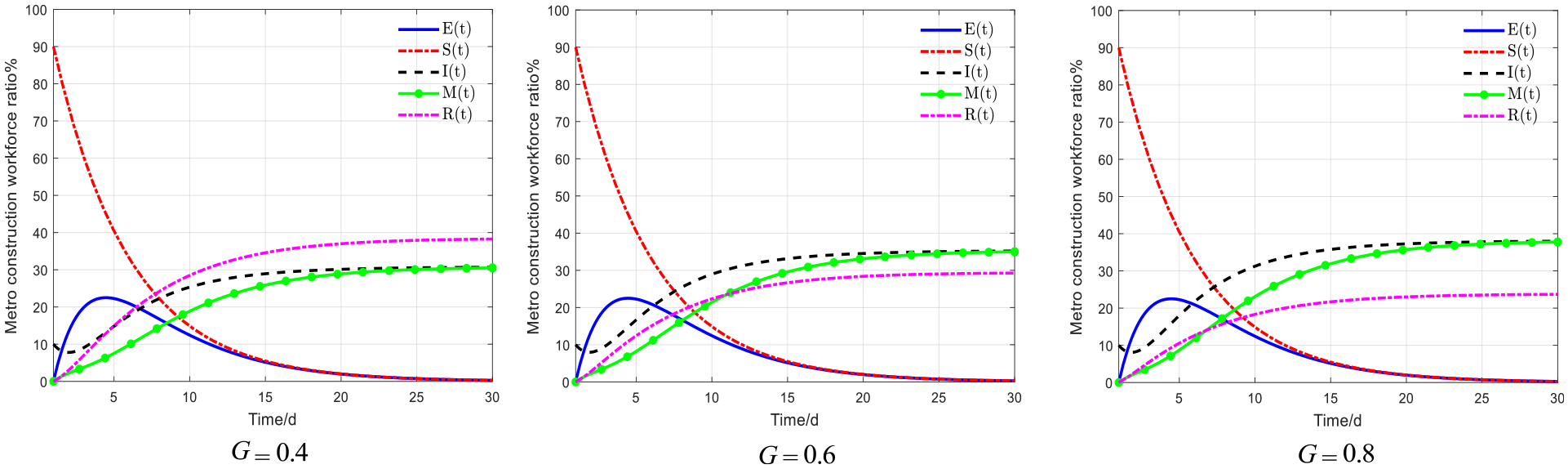
Simulation of the change in the wake-up-call rate.
The rate of increase in immune-personnel curve R(t) accelerated, and the final stability value significantly increased, that is, the number of immune personnel significantly increased when the system became stable. Simultaneously, the rate of increase in spreader curve I(t) and controlled-person curve M(t) decreased. The final stability value decreased, whereas the rest of the curves did not significantly change with respect to the system-stability time. The change in the awakening rate simultaneously affected the curves of the immune, disseminated, and controlled persons, which indicated that the change in the awakening rate significantly affected the spread of unsafe behavior. This result is inversely related to the change in the number of disseminated and controlled persons and positively related to the number of immune persons. Control of unsafe behavior could be effectively achieved by improving and controlling the psychological safety awareness of construction personnel.
Effect of Forgetting Rate on the Unsafe-Behavior Transmission
Without changing the other parameters, the effect of forgetting rate H on the unsafe behavior of underground-construction workers at greater, less, and very less effects was investigated, that is, the pattern of change in the propagation of unsafe behavior when H = 0.4, 0.6, and 0.8 (see Figure 8).
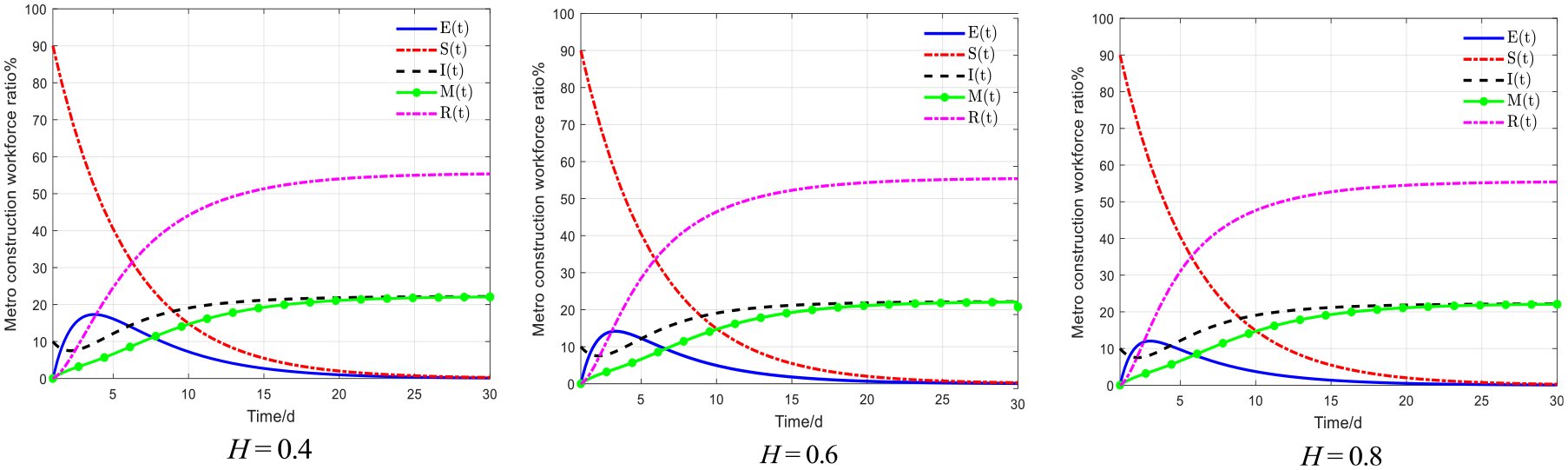
Simulation chart of the forgetting-rate effect.
As the forgetting rate continued to increase, the rate of increase in immune-person curve R(t) significantly decreased, and the final stability value significantly decreased, that is, the number of immune persons significantly decreased when the system achieved stability. Simultaneously, the rate of increase of spreader curve I(t) slightly increased after falling to a minimum value. In addition, the final stability value increased, whereas the rate of increase of controlled-person curve M(t) increased. The final stability value also increased, whereas the rest of the curves remained basically unchanged with respect to the time of system stability. Therefore, we could conclude that the change in the forgetting rate was positively related to the number of transmitter and controlled persons and inversely related to the number of immune persons. An increase in the forgetting rate could accelerate the rate of unsafe behavior transmission, and its change significantly affected the unsafe-behavior transmission.
This finding suggests that the control and management of construction personnel’s unsafe behavior not only enhances safety in the short term, but also has an impact on the final evolutionary outcome. This finding is also supported by a number of existing studies (Choi et al., 2017; Jiang et al., 2018). Therefore, safety education should be increased in the management process to enhance safety intentions and build a psychological contract for safety.
Results and Research Limitations
Results
(1) The SCIMR model for propagation of unsafe behavior among underground-construction workers developed in this study can better describe the propagation process of unsafe behavior among construction workers. In the model, the adoption, improvement, control, awareness, and forgetting rates play a key role in the transmission of unsafe behavior. By adjusting the influencing factors that affect the abovementioned conversion rates, control of unsafe behavior and prediction of the transmission trends can be achieved.
(2) Increasing the improvement, control, and awakening rates can reduce the number of transmitters and increase the number of immune persons, which play a suppressive role in the spread of unsafe behavior among construction workers. Increasing the adoption and forgetting rates can reduce the number of immune persons and increase the number of transmitters, which play a facilitating role in the spread of unsafe behavior among construction workers. Changes in the infection and immunity rates exert a small effect on the rate of spread of unsafe behavior.
(3) From the simulation results, we can observe that the rate of unsafe behavior is faster in the early stage of transmission and eventually reaches a stable value. Control of unsafe behavior should be implemented at the early stage of transmission, and unsafe behavior must be stopped as soon as it is detected by identifying its source and nipping it in the bud at a small scale and in a short time.
Theoretical Implications and Practical Implications
(1) Theoretical Implications: This study provides some theoretical insights into the spread of unsafe behaviors in metro construction projects and contributes to safety control research. First, we constructed a SCIMR model to study the propagation of unsafe behavior by adding M control nodes with the help of SIR theory in the context of metro construction. Second, this study identifies the influence index system of the propagation of unsafe behaviors in metro construction through interviews and questionnaires to improve the scope of the study of unsafe behaviors in metro construction. Finally, this study demonstrates that controlling the propagation of unsafe behavior helps to control the occurrence of unsafe behavior and provides a new research horizon for achieving better safety management of the metro construction process.
(2) Practical Implications: The findings of this study provide practical implications for reducing the likelihood of unsafe behaviors and mitigating the consequences of unsafe behaviors. In the actual metro construction management process, it is important to reduce employees’ exposure to unsafe behavior and achieve control of unsafe behavior before it spreads; project managers can make construction personnel aware of the risks of unsafe behavior through various measures, build internal monitoring mechanisms, and pay attention to the fulfilment of safety obligations to attenuate the impact of individual unsafe behavior on the rest of the personnel.
Research limitations and Future Directions
(1) In the model simulation developed in this study, only the influence of a single transformation-rate change on the propagation of unsafe behavior is considered, and the trend of unsafe-behavior propagation when the transformation rates are changed together is not considered. In the future, we will consider including more influential factor indicators in the model and integrating the impact on the propagation of unsafe behavior when multiple indicators of the same category change.
(2) The SCIMR model for the propagation of unsafe behavior of underground-construction workers developed in this work is an abstract description of the propagation of unsafe behavior. The initial values of the model are based on qualitative research method in the literature research and on expert interviews, which can only analyze the propagation of unsafe behavior in terms of the overall situation. In the future we will consider further optimization of the model so that it can better analyze the propagation of unsafe behavior at an individual level.
(3) All participants in this study were from China and the findings obtained may have some limitations. In future studies, consideration will be given to expanding the research group so that the conclusions obtained will have a wider international value.
Footnotes
Declaration of Conflicting Interests
The author(s) declared no potential conflicts of interest with respect to the research, authorship, and/or publication of this article.
Funding
The author(s) disclosed receipt of the following financial support for the research, authorship, and/or publication of this article: This research was funded by National Natural Science Foundation of China (71771031).
