




Abstract
This study examines the factors affecting media researchers’ selection of media research problems. Combining qualitative and quantitative methods, in-depth interviews with a purposive sample of Arab media researchers were conducted, followed by applying a 22-item questionnaire on a sample of 247 from Arab media researchers. The impact of internal/subjective factors and external/objective factors, on the selection of research problems by Arab media researchers, and their perceptions were investigated. Findings revealed that internal factors are perceived to have a higher impact than external factors. However, external factors are perceived to have a stronger negative impact than positive ones. Findings also raise several issues regarding scientific considerations, institutional requirements, and socio-political conditions that lead researchers to either avoid certain topics or change the angle of their view for their research. The study proposed a theoretical framework regarding the process of selecting research problems in the media field of Arab countries.
Keywords
Introduction
The objective of this study is to investigate Arab media researchers’ perceptions of the factors that affect their research problem selection in the media field and analyze how these factors affect media research practice.
The literature review revealed the scarcity of studies focused on the factors affecting the identification of research problems in general and in the field of media research in particular, which indicates the significance of this study and its possible contribution to addressing this gap and determining the factors affecting the selection of research problems in media research as perceived by media researchers. This research also provides suggestions for improvements in the Arab academic workplace and helps to get a better understanding of what factors affect the decision-making process of media researchers in choosing research topics and the knowledge production in Arab media research.
A problem is defined as a gap between expectations and facts. Human beings have high expectations and strive to fulfil them by acquiring knowledge. This striving leads to perplexing or conflicting situations. (Jha, 2014). The research problem is the topic a researcher should select to address, investigate, or study (Wesely, 2012). Putting the research problem forward is the most important component of research (Bahçekapili et al., 2013).
Elliott (2019) proposed six approaches to defining problems in research as follows: (1) treating problems as unmet goals; (2) treating the evolution of science as being reliant on the solving of such problems; (3) treating problems either as unanswered questions or concepts tightly connected to unanswered questions; (4) treating problems as sets of constraints on solutions; (5) focusing on the relationship between agents and problems; and finally, (6) providing taxonomies of problems.
A research problem, according to Walliman (2011), can be based on a question, an unresolved controversy, a gap in knowledge, or an unrequited need within the chosen subject.
In media research, Wimmer and Dominick (2014)noted that some media researchers select a research problem by focusing on a specific research area of their interest. Therefore, a lot of media researchers come to identify studies of specific types, such as studies on children and media violence, newspaper readership, marketing, or media law.
Media Research in Arab Countries
Communication research in the Arab countries has been closely connected with the rise and development of mass communication as an academic field in these countries. Academic teaching of journalism in the Arab region began in 1935 at the American University in Cairo, Egypt. Since this program was offered by a foreign university, the Institute of Editing, Translation, and Publishing, established at Cairo University in 1939 is considered the first Arab national academic institution to teach journalism (Ayish & Breslow, 2014).
Since its early beginnings, Arab media research has mainly relayed the history of the media industry, publishing books that describe its beginnings and recent trends or focus on journalists and the challenges they encounter (Kozman, 2020).
After the second half of the 20th century, Arab media research developed extensively and gradually increased quantitatively, with the spread of mass communication departments in Arab academic institutions. However, this period also witnessed a heavy reliance on Western media research, including following Western countries’ agendas in terms of research topics (Al-Beblawy, 2007).
The introduction of mass media studies in Arab countries was marked by strong Western (especially American) influences (Ayish, 1998). Abdelrahman (2005) noted that two main models dominate scientific media research in the Arab world. The first is linked to the American model and the other to the European-Francophone model.
Some Arab scholars have historically ignored empirical research, preferring to rely on critical and interpretive approaches that place culture at the center of the investigation, rejecting Western concepts and methodologies (Kozman, 2020). Although quantitative approaches have been extensively utilized in Arab media studies, interest in qualitative methods has grown as well (Khasawnah, 2016; Sayed, 2019).
Despite the fact that there has been a great deal of research on the Arab media produced in the Arab world at the beginning of the 21st century, it has tended to be narrowly, empirically, and functionally focused as a result of several factors (Ayish & Breslow, 2014, p. 70).
Political, technological, and military developments were bound to impact media research trends in Arab countries at the beginning of the 21st century. Researchers began looking into the role of the media in either promoting or combating terrorism after the September 11th attacks on the United States and their consequences in Afghanistan and Iraq. The rise of the internet and social media also had an impact on media studies, especially research focused on armed conflicts and terrorism. The region’s political turbulence during what has been called the “Arab Spring” had a significant impact on Arab media research during this period (Ayish & Breslow, 2014, p. 62).
Arab communication researchers face several challenges, including sampling, especially accessing the population and the ability to get a sampling frame. Another issue confronting Arab scholars is a restriction on the type of knowledge production they want to engage in. In addition, some junior Arab researchers are sensitive to the issues that Western scholars consider important to investigate. Newcomers to the discipline are required to continue traditions that are dominated by research themes that are investigated by senior researchers and media research heavyweights (Kozman, 2020).
Other limitations can also be apparent in certain Western journal editors’ decisions when a study is conducted in a region that is thought to have little to contribute to knowledge advancement. When Arab media researchers experience such desk rejections, they feel a loss of interest in studying topics related to the region. Language also poses a problem in terms of journal rankings. Many researchers would choose to write and publish research in English in a highly ranked journal over writing and publishing in Arabic in an unranked journal to satisfy the policies of their institutions, which have come to rely on journal metrics and indexing bodies to gauge the quality of faculty’s research (Kozman, 2020).
Literature Review
Considering the topic of the current research and the nature of the related literature that was found, the literature review’s structure can be determined by two key recurring themes: (1) studies that examined factors affecting selecting research problems and (2) studies focused on media or communication research in Arab countries.
Several studies in various scientific fields have addressed the first theme, the phenomenon of selecting research problems (Bahçekapili et al., 2013; Ellis & Levy, 2008; Jeszka, 2013; Lund, 2021; Saleh, 2020; Sarathchandra, 2013; Yalçın et al., 2016). Some of these studies examined factors that may influence study problem selection, but this was not their primary objective (Bairagi & Munot, 2019; Ellis & Levy, 2008; Jha, 2014; Isaac et al., 1989; Kozman, 2020; Sarathchandra, 2013; Wesely, 2012).
Research focused on the selection or identification of research problems differentiated between the identification and selection of research problems, arguing that identifying a research problem means identifying the area of a problem, while problem selection is a choice that depends upon several factors. Researchers utilise diverse criteria for the selection of research problems, most of which reflect individual motivational factors and aspects of scientific and professional norms such as “enjoyment of doing research,”“scientific curiosity,” and “intellectual freedom,” as well as “reputation,”“financing,” and “professional and ethical norms” (Jha, 2014; Sarathchandra, 2013).
Other studies emphasized the importance of individual\internal factors in choosing a research problem and confirmed that researchers select their research problems based on their mindset and the passion they have for investigating a specific problem. Moreover, a researcher’s interest is necessary to study a topic; otherwise, it will be difficult to sustain the effort needed to complete the research with any measure of quality or validity (Bairagi & Munot, 2019; Wesely, 2012).
In terms of external\contextual factors, it was argued that problems researchers face in their working environments, literature, academic exchanges, and academic sharing were the main factors influencing the identification of research problems (Bahçekapili et al., 2013).
A study found that digitization and capitalism have a negative impact on meaningful productivity in academic research. Furthermore, there is increasing work anxiety and other psychological problems among academic researchers due to an increased emphasis on institutional assessment measurements (Saleh, 2020).
Other studies offered different perspectives on the identification and selection of the research problems, suggesting that identifying research problems entails an element of creativity, perceived risks and awareness of the research type (Ellis & Levy, 2008; Jeszka, 2013; Lund, 2021; Sarathchandra, 2013; Yalçın et al., 2016).
The creative element enables researchers to resist a mechanical, highly structured process orientation and to distinguish between research-worthy and non-research-worthy problems (Ellis & Levy, 2008). Moreover, the selection of a research problem implies four dimensions of perceived risk, including intellectual challenges, competition, career risks, and societal risks (Sarathchandra, 2013). In contrast, Lund (2021) argued that the choice of research problems is linked to the proposed distinction between basic or general and applied research. Basic or general research aims to generate theoretical or general knowledge, whereas applied research aims to generate knowledge that may be implemented in general professional/practical settings.
Some other literature focused on scientific and methodological considerations (Jeszka, 2013; Yalçın et al., 2016), found that taking into account the relationship between a research problem, the aims, and the hypotheses of the study makes the research problems fall into three categories: cognitive, axiological, or normative (Jeszka, 2013). In addition, factors such as the extent of limits in identifying research problems, assessment, the resources available, and theory-practice balance in research problems are the key scientific factors affecting the identification of research problems according to Yalçın et al. (2016).
Furthermore, some studies found that the lack of financial resources, the inefficient research policies followed by Arab academic institutions, the insufficient incentives, and the technical problems in digital transformation in many Arab academic institutions, all are challenges inhabit the growth of Arab research in general (Al Khatib, 2020).
Further challenges related to the lack of time, the increasing duties overload especially admission tasks in addition to teaching loads, and the absence of a clear vision for improving research on the national level have been reported by Zanoun (2014), Ebrahim (2015), and El Shalhob (2018) as the most challenges Arab media researchers face.
Media and communication research focused on issues close to research topics or research problems could be divided into three pathways: studies examined dominant research topics\trends (Ayish, 1998; Carradini, 2020; Livingstone, 1996; Mheidly & Fares, 2020); studies investigated dominant common features of media research (Abdulmajeed, 2016; Al Kaa’by, 2017; Ayish & Breslow, 2014; Mellor, 2013; Sayed 2019); and studies addressed the factors that influence media research (Elhamy, 2014; Douai, 2010; Meller, 2013).
Studies examining dominant research topics\trends revealed that published works on Arab communication can be classified, according to Ayish (1998), into six subject categories: propaganda, development communication, historical accounts, international news flow, technical and professional works, and general theoretical works. Herkman (2008) concluded that there are three categories of media and communication research: (1) political and social questions in relation to media or communication; (2) cultural aspects of communication, and (3) media and communication technology. Also, Communication research tended to focus according to Carradini (2020) on technical, business, and professional communication.
A bibliometric analysis of health communication-related research activities in the Arab world revealed that there were three key themes: the role of media in health promotion, health communication in conflict and the role of health communication in the battle against health risk factors (Mheidly & Fares, 2020).
Within the studies investigated dominant common features of Arab media research, it was found that media research in the Arab countries tended to be functional in nature, has been dominated by the national context during the period of Arab nation-building and has also been highly influenced by empirical perspectives imported from American perspectives of research, as well as by the institutional policies inherent in the relationships between the Arab state and national media institutions (Ayish & Breslow, 2014).
A critical analysis of Arab audience research, Mellor (2013) concluded that Arab researchers are positioned as experts separate from their audiences, placing themselves in a knowledge hierarchy above the subjects of their research and viewing Arab audiences as passive recipients of information and possible victims of current technological communication innovation.
It was found that there is a shortage of Arab media research in examining new research topics, in addition to the overuse of quantitative methodologies (Al Kaa’by, 2017) in comparison to the very limited usage of qualitative research tools (Sayed, 2019)
There are several common problems in Arab research in social media and interactive media including repetitive research topics, methodologies, and the use of traditional media theories (Abdulmajeed, 2016).
Studies addressed the factors that influence media research found that the factors influencing the production of scientific knowledge in media research included personal factors, academic socialization, characteristics of the scientific field, social and professional factors, knowledge production process, and the evaluation processes of scientific production (Elhamy, 2014). Several challenges faced by media researchers in Arab countries include Sociocultural barriers that either make access to the required samples or getting the needed information difficult and sometimes insufficient. Douai (2010) outlined five main challenges in the process of audience research in the Arab countries including recruitment strategies, time issues, group dynamics, gender issues in interviews and the significance of culture. In another context, Moller (2013) stated that the call to document and counter Western cultural hegemony has influenced audience studies in the Arab world.
From a macro-contextual perspective, Kozman (2020) argued that factors such as the historical foundations of Arab countries, traditional communities, educational systems, and conflicts in the region have an impact on Arab media researchers’ engagement with research. Kozman (2020) proposed a culture-sensitive approach to Arab media research that springs from or adapts to local realities while safeguarding the scope of the results and the generalizability.
In the same context, the concept of “Academic cosmopolitanism” has been supported by researchers in the field of media and communication studies as they push for more diversity and inclusion of epistemic perspectives from different cultures (Badr & Ganter, 2021).
Reviewing of existing literature in both the broad and specific areas of current research has highlighted key knowledge gaps that have not been well addressed in research, most notably a lack of interest in investigating perceived factors that may influence one of selecting research problems, as well as the lack of interest in explaining how those perceptions affect their research decisions.
In addition, despite there is increasing interest in studying the state of Arab research, studies do not answer the principle question about what factors affect Arab media researchers’ selection of their research topics.
Research Questions
This research answers the following questions:
RQ1: What are the factors that affect Arab media researchers’ selection of their research problems?
RQ2: What possible relationships could exist between gender, age, experience, and type of academic institution with Arab media researchers’ perceptions of the factors affecting their selection of research problems?
RQ3: How do Arab media researchers perceive the factors affecting their selection of research problems?
Methods
In terms of research design, a mixed-method design integrating qualitative and quantitative research methodologies was employed to address research questions using research methods appropriate for the subject matter. In an inductive manner, qualitative analysis was conducted utilizing in-depth, semi-structured interviews with a small purposive sample of Arab media researchers to investigate realistically the main factors that Arab media researchers believe impact their decision to choose media research problems. Within the qualitative approach, the thematic analysis technique was applied to the interview data to extract and identify themes\factors. A quantitative descriptive approach was then used to measure and describe the frequencies, averages, and correlations of these factors as perceived by a sample of Arab media scholars, utilizing a questionnaire with measurement scales.
In-depth interviews were conducted during June and July 2020, with a purposively selected sample of Arab media and communication researchers. Following this, a 22-item online questionnaire was distributed, utilising a 3- and 4-point Likert scale to collect data from a separate sample of Arab media researchers during July and August 2020.
Sampling
Twenty Arab media researchers from 10 Arab countries were interviewed, and 247 respondents from 13 Arab countries responded to the questionnaire.
The snowball sampling technique was used to avoid bias in sample selection. Gender, age range, academic ranking, type of academic institution (government vs. private), and country of nationality have all been used to establish demographic groups for this purpose. The characteristics of the questionnaire sample are shown in Table 2.
Arab media researchers who were interviewed did not receive the questionnaire. Both the interview and questionnaire samples were chosen according to several criteria, including: (1) They must be an Arab national and live in an Arab country, (2) work in a university or research center in an Arab country, and (3) have at least a PhD degree.
The participants were reached through their official email addresses and their official accounts and groups of Arab media academics or researchers on social media, mainly LinkedIn and Facebook. Respondents who are not living currently in Arab countries or are not PhD holders had been excluded from the sample. After applying these criteria, 247 responses were analyzed. Table 1 shows the characteristics of the in-depth interview sample.
Interview Sample Characteristics.

Table 2 summarises the characteristics of the questionnaire sample regarding gender, age, type of academic institution, and years of experience in communication research.
Descriptive Statistics for Online Questionnaire Respondents’ Characteristics.

Note. N = 247 respondents.
Research Tools
In-Depth Interviews
Interviews were conducted using open-ended questions including: What do researchers think about while selecting a research problem? What concerns researchers during the selection process? What obstacles do researchers often think about during the selection process? How do researchers deal with the obstacles they face? What are the factors that influence their choice of research problems?
A qualitative thematic analysis was used to identify patterns of themes\factors related to the process of selecting media research problems.
In the qualitative study, saturation was sought. Saturation is defined as the point in data where there are few or no new relevant codes and/or categories (Hennink & Kaiser, 2022).
Two strategies were used to assess saturation, the first strategy is to converge on a consistent sample size for saturation. According to Hennink and Kaiser (2022), studies using empirical data can reach saturation within a narrow range of interviews (9–17). The current qualitative study included a sample size of 20 respondents.
The second strategy is the saturation of categories\theme. The stopping criterion approach was employed to analyze the interviews. According to this approach, an initial sample of five interviews was examined to identify starting themes that would serve as pre-determined stopping points. It was determined that saturation of categories\theme should be confirmed by two researchers after no new issues\themes were found in three consecutive interviews.
Coding and Analyzing the Qualitative Interviews
The semi-structured interview technique was used. Semi-structured interviews, according to Alston & Bowles (2003), are an ideal research technique for exploratory and descriptive designs in which the researcher has little prior knowledge of the participants’ thinking.
The process of preparing qualitative interviews begins with determining the objective for which the interviews will be conducted; the objective is to explore the factors that affect the media researcher’s selection of research problem as perceived by the researchers.
With this objective in mind, an interview guide including open-ended questions has been created. Face-to-face and zoom interviews were conducted, recorded, and transcribed. When it came to coding and analyzing the interviews, respondents were only identified by a code. The interviewees were arranged in the order in which they were interviewed.
The coding process involved labelling and organizing interviews with qualitative data in order to identify different themes and the relationships between them (Braun & Clarke, 2006). For each response, labels were formed into phrases that describe essential themes, specifically, the topics that constitute factors that influence the researcher’s thinking, selection, or decision-making regarding the research problem.
A researcher other than the interviewer analyzed and coded the interview data. The thematic analysis examined the structure of words and sentences to extract themes related to the factors influencing selecting media research problems from texts.
During the thematic analysis, both inductive and deductive analysis were applied (Fereday & Muir-Cochrane, 2006). Using inductive analysis, initial codes representing the factors were established, and then a codebook was created, grouping the codes into possible themes.
The deductive analysis was then carried out by rereading the material and calculating the frequency of each theme by counting the number of interviewees who referred to it.
After the initial themes were set, themes were reviewed and revised by researchers to ensure that each theme had enough data to support it and was distinct, merging themes that were similar, and removing themes that didn’t have enough supporting data. At that point, the themes were written in their ultimate form.
The Questionnaire
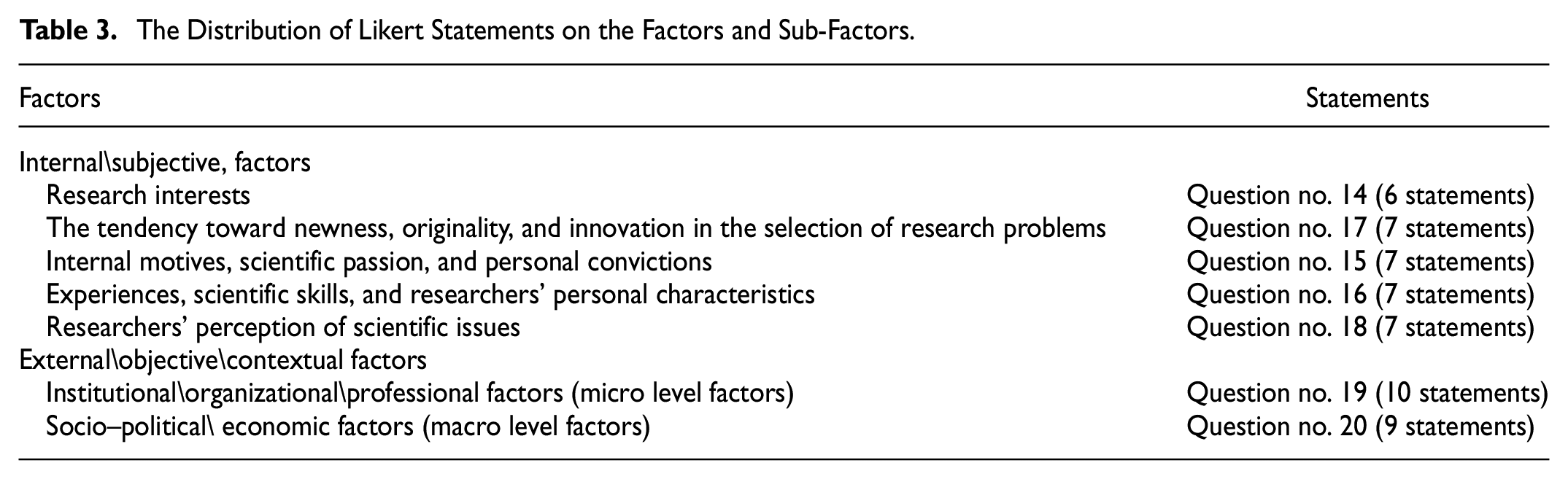
The questionnaire aimed to quantitatively measure Arab media researchers’ perceptions of what factors affect their selection of research problems. These factors were incorporated into the questionnaire using the 3- and 4-point Likert Scale. Guided by the thematic analysis of the interview data, factors were divided into three major types: (1) Internal\subjective factors, (2) External\Academic\professional\institutional context factors: (External micro-level factors), and (3) External\Socio-political and economic context: (External macro-level factors).
A set of Likert statements was created for each factor and sub-factor extracted from the interview data analysis and literature review. A total of 53 statements about factors impacting research problem selection were formulated and reviewed. Statements were administered using a 3- and 4-point Likert Scale, with response categories ranging from extremely agree to extremely disagree and from strongly affect to not effective at all.
The statements on the factors and sub-factors are distributed as shown in Table 3:
The Distribution of Likert Statements on the Factors and Sub-Factors.
The calculation of the weighted mean of scores is used to estimate attitude toward the factors. Simple and weighted averages were used to calculate the factors (León-Mantero et al., 2020). This allowed the estimates for each factor to be compared to one another.
Before using the questionnaire, researchers conducted a pre-test for the instrument with a smaller sample (five respondents from five different Arab countries).
To ensure that the questionnaire had satisfactory construction and was fully representative of what it aimed to measure, the questionnaire was reviewed by three Arab communication researchers. Based on the pre-test and face validity, the items and wording have been changed to fit the purpose of the questionnaire.
Test-retest reliability of the questionnaire was conducted. The coefficients of stability were between ≥.7 and <.8, indicating acceptable reliability.
Results
The results were divided into three sections. Each section responds to a different research question. The first two sections respond to RQ1 and RQ2 by conducting a statistical analysis of the quantitative data gathered from a survey of Arab media scholars. The final section uses a thematic analysis of the interview dataset to answer RQ3. The third section is divided into three sub-sections: (1) the impact of internal factors on interviewees, (2) their perceptions of external micro-level factors, and (3) their perceptions of external macro-level factors
To answer RQ1 about what factors affect Arab media researchers’ selection of their research problems, the study performed a statistical analysis of the survey results. Results in Table 4 demonstrate that the most influential factor in Arab media researchers’ decision to choose a research problem is the “Research interests” of the researcher (M = 14.79, SD = 1.96), with a value of approximately (82%) of the percentage of ratings. It is followed by “The tendency toward newness, originality, and innovation” in the selection of research problems (M = 16.55, SD = 2.90), with a percentage of nearly (79%), and “Researchers’ perception of scientific issues” (M = 21.43, SD = 4.03) with a percentage of (77%).
Main and Sub-Factors that Affect the Selection of the Research Problems as Perceived by the Respondents.

Note. N = 247 respondents.
The percentage of ratings for each scale was calculated by dividing the mean for the scale by the maximum total score of the scale, and then multiplying the result by 100.
The “Socio-political\economic factors” (M = 20.41, SD = 3.87), which account for nearly (76%), comes in the fourth place, followed by the “Internal motives, scientific passion, and personal convictions factors” (M = 15.86, SD = 1.85), with nearly (76%), and then “Institutional\organisational\professional factors” (M = 21.62, SD = 4.51), with (72%).
Based on the above results, we conclude that factors perceived by respondents to be influential on their selection of research problems are (in order): the “Research interests,”“tendency toward newness, originality, and innovation,”“Researchers’ perception of scientific issues,”“Socio–political\economic factors,”“Internal motives, scientific passion, and personal convictions factors,” and“Institutional\organisational\professional factors.”
Results also reveal that the “internal\subjective” factors (M = 81.92, SD = 6.14) obtained a higher weighted mean and percentage (75%) than the “external\objective\social/contextual” factors (M = 42.04, SD = 7.41) with (74%). Results show also that the macro-level external factors (socio-political and economic factors) (M = 20.41, SD = 3.87), with nearly (76%), were higher than the micro-level external factors (institutional/professional factors) (M = 21.62, SD = 4.51), with (72%).
RQ2 wanted to know what possible relationships could exist between gender, age, experience, and the type of academic institution and Arab media researchers’ perceptions of the factors influencing their research problem selection.
The T-test is used when comparing the means of two groups; however, one-way ANOVA is used when comparing the means of three or more groups (Lester et al., 2014, p. 37).
Independent samples t-test was employed to examine differences in researchers’ perceptions based on gender and the type of academic institution to which the researcher belongs.
To examine gender differences in researchers’ perceptions, an independent samples t-test was performed. The t-test value was statistically significant (p > .05) in researchers’ perceptions of two factors, these being: “Research interests”t(245) = 2.135, p = .005, and “The tendency toward newness, originality, and innovation in the selection of research problems”t(245) = -0.277, p = .040.
The comparison of the male and female scholars indicates that female (M = 16.6, SD = 3.12) had slightly higher perceptions than male (M = 16.5, SD = 2.67) regarding the “The tendency toward newness, originality, and innovation in the selection of research problems” factor. On the other hand, males (M = 15.05, SD = 1.71) were higher than females (M = 14.52, SD = 2.17) in the “research interests” factor.
Independent samples t-test revealed that there was no significant effect (p > .05) for the type of academic institutions on researchers’ perceptions of any of the factors or sub-factors. There was no statistical significance, neither in Arab researchers’ perception of internal\subjective factors, t(233) = 1.350, p = .358, nor in researchers’ perception of external\objective\contextual factors, t(233) = 1.225, p = .063.
These results indicate that researchers in government institutions have the same perceptions of the factors influencing research problem selection as their peers in private institutions and that the type of academic institution has no clear effect on their perceptions of these factors.
One-way ANOVA was carried out to investigate if the means of researchers’ perceptions of factors influencing research problem selection differed significantly based on “age” and “years of experience.”
There are no statistically significant differences between respondents’ perceptions of factors affecting their selection of research problems, related to the “age,” and “years of research experience.” The one-way ANOVA tests indicated that the values were not statistically significant with any of the factors or sub-factors (p > .05).
The One-way ANOVA test was not significant in terms of the effect of age on the researchers’ perception of internal\subjective factors, F(2,244) = 1.452, p = .236, or their perception of external\objective\contextual factors, F(2,244) = 1.532, p = .218.
Similarly, the application of the One-way ANOVA test did not show any statistically significant differences in terms of the effect of age on the researchers’ perception of internal\subjective factors, F(2,244) = 0.038, p = .963, or their perception of external\objective\contextual factors, F(2,244) = 1.078, p = .342.
To answer RQ3, about how Arab media researchers perceive the factors affecting their selection of research problems, the study conducted semi-structured in-depth interviews to get a deeper understanding of how internal and external factors are perceived by the Arab scholars. As shown in Table 5, the study conducted a thematic analysis to identify patterns of themes in the interviews.
Distribution of Interviews Themes/Factors.

Note. N = 20.
Interviewees’ Perceptions of the Internal Factors
The sub-factor “Research interests and personal observations” was the one in which all the interviewees highlighted its strong impact in driving them toward a certain topic to study. For example, interviewee number 2 said: All the ideas I got and then selected to be research problems emerge from my observations about fields of interest.
Interviewee number 1 referred to the importance of his research interests as being the main triggers toward certain topics. He said: My readings in research, in general, is the main factor that directs me toward research topics, of course, based on my personal research interests. I usually set a plan or self-research agenda to follow in my research work.
Interviewees also pointed out that their personal observations have a strong impact on their research topic selections. Some interviewees referred to their personal observations about social phenomena in relation to media. Interviewee 18 explained: During the COVID-19 pandemic, the way how media covered this topic and how public awareness was raised, are among several topics that caught my attention.
In addition to the “Research interests and observations” comes the perceived “newness of a research idea” as one of the first factors that directed most of the interviewees toward selecting research topics. This sub-factor motivates the researcher to observe the gaps or deficiencies in the conducted and published scientific literature, and then seek to bridge the gaps by researching phenomena, topics, methodological methods, or theoretical approaches that the previous research activities did not address or cover.
Some of the interviewees explained that at the beginning of the selection process, they may find themselves impressed by a specific research problem, but after reading the related scientific literature, they may discover that it has been discussed and examined heavily. Consequently, they abandon that idea despite their admiration and conviction that it is researchable. For example, interviewee 8 explained:
I lose passion for the research topic once I feel the findings are already expected, or I find many other researchers already discussed that topic. Then, I reconsider the research problem and focus on a new perspective.
In other cases, if the research topic is perceived as completely new and contains no previous research related to it, this could turn the researcher away from selecting it. It seems that Arab media researchers seek to research new topics; however, they also need to convince the scientific community that the topic has a scientific background and previous literature.
The newness of a research topic makes it a priority to be studied, especially when the topic falls in line with the researcher’s interests. This can be interpreted as an attempt to apply best practice toward choosing a research topic.
Unlike the above sub-factors, interviewees referred to the “Researcher’s skills and experiences” sub-factor which could push them away from selecting some research topics. According to them, the lack of research experience with methodological tools, scientific methods, and theoretical approaches could lead a researcher to select research problems from what is prevalent or usual, rather than choosing something new or different.
Some of the interviewees pointed out that they avoid selecting a research topic due to the difficulty they perceive in conducting research on it. Their “perceptions of the ease or difficulty in conducting research” on a certain topic strongly impact their selections. The difficulties that interviewees mentioned include not knowing the appropriate approach, theory, or methodology to research a topic. Interviewee 4, for example, clarified that sometimes she could not figure out the appropriate theory or methodology to apply in examining certain topics, so these topics had to be abandoned, despite her being interested in them.
Notably, interviewees’ responses showed how researchers’ perceptions of the ease or difficulty in pursuing a research topic interlaced with their need to get promoted during a certain time period.
Interviewees’ responses about the impact of their experience and their perceptions of how difficult a research topic to be successfully examined in avoiding selecting some research problems, do not contradict some interviewees’ indication that their need for “enhancing scientific competencies” motivates them to select research problems to enhance their capabilities, skills, experiences, and scientific knowledge. They emphasized that the enhancement of such attributes is important to the researcher’s personal and professional record and may contribute to building their scientific or academic reputation in the scientific community.
Although the above sub-factors fall under internal factors, in one way or another the impact of those factors can be best interpreted according to the overall context of the working conditions and the culture of the academic community to which the researcher belongs to.
The scholarly community of a researcher could affect the selection of research problems in many ways, some perform as internal factors but they are related to the surrounding academic context of the scholarly production. Some interviewees indicated that their selections of research problems are affected by the need to “keep up with the dominant or prevailing scientific trends” (in terms of researching certain phenomena or researching specific theories, approaches, or methodological tools). Accordingly, they try to select their research problems in line with the perceived research trends.
In the same context, some interviewees indicated that every few years, media research concentrates on specific issues or focuses on using specific methodological approaches. For example, the previous decades witnessed a large focus on the Internet, digital media, and social media research. There was also an increase in the use of quantitative methods and content analysis in media research. This indicates that some media, social, or scientific changes may influence the choices of specific scientific research problems. This result has an indication especially when we consider the argument for the de-westernization of media studies in Arab countries. As the exclusion of scholarly work from non-western countries in media and communication studies is still one of the challenges non-western media scholars face (Ganter & Ortega, 2019).
However, some researchers prefer not to keep pace with the mainstream research trends but rather adopt their own research agenda or interests. Interviewee number 14 argued that: There are researchers who tend to deviate from this societal context and have more rational orientations, as they prefer to select their research topics based on their scientific sense of the existence of a certain problem or their scientific vision about challenges that must be addressed scientifically.
In addition to the above sub-factors, the “goal of publishing the research paper” also affects how Arab media scholars select their research problems. Interviewees mentioned that the chance of publication includes the prospect of promotion, increasing their scholar publishing rates, or being published in internationally prestigious journals, which can increase their research record of citations to meet the requirements or policies of the academic institution in which they work. From another perspective, international publishing can enhance the representation of Arab media scholars in the global academic community. International publishing as one of the aspects of supporting academic cosmopolitanism gives an opportunity for diversity of epistemic paths and open and inclusive media and communication studies (Badr & Ganter, 2021).
Interviewees’ Perceptions of the External Micro-Level Factors
The external micro-level refers to the academic, professional, and institutional context factors. Interviewees confirmed the impact of several external factors on their selection of research problems. One of the most sub-factors they agreed on was the “Academic institutions’ research strategies.” This refers to the research strategy and priorities (especially for funded research) for a college/department that faculty are required to follow has an impact on how Arab media researchers select their research topics. Interviewee number 2, for example, stated that the research strategies of the affiliation she recently worked in affected her research topic selection.
In addition to the internal sub-factor “the goal of publication” which has been stated by the interviewees to influence their selection of research problems, interviewees also pointed to the impact of the external sub-factor the “Academic institutions’ criteria for research publishing.” Interviewees said that their affiliations require international publishing according to certain criteria. This criterion plays an important role as it ensures the quality of publications and ultimately can influence the international ranking of universities. According to the interviewees, following their affiliation’s publication guidelines and criteria is imperative in securing a promotion, and more importantly, passing the faculty annual evaluation.
The majority of the interviewees highlighted the impact of the criteria of the publication set by their affiliations, the requirements they have to achieve to get promoted or to have their work contracts renewed, and the publishing cycle in the most recommended and prestigious journals.
From another perspective, some interviewees’ responses showed that international publishing has a strong impact on the selection of research problems and topics. It offers Arab researchers a safe alternative for publishing controversial research topics, which they would not be able to publish locally. Arab media researchers take into consideration the “Academic norms and the academic freedom” they have. Thus, sometimes an important phenomenon or subject may not be addressed due to deterrence or rejection whether in publishing or in the promotion process. This makes some Arab media researchers avoid discussing certain research problems that are outside the ordinary, usual, or stereotypical topics.
According to interviewees 2 and 4, sometimes Arab media researchers go for international publishing, rather than local publishing when they are interested in studying controversial issues, in order to avoid any possible problems.
This shows the interlace between some internal and external sub-factors. As Arab media researchers select their research problems with the consideration of the goal of publishing and the academic institution’s research publishing criteria.
The lack of “Research incentives, encouragement and recognition” is another sub-factor that inhibits Arab media researchers from taking new, different, and serious research problems. According to the interviewees, one of the most prominent incentives that affect their selection of research problems is the research grants they can obtain especially from their academic institutions. This result emphasizes the obstacles that have been reported by AL Khatib (2020) including the lack of encouragement, lack of research incentives, and the weak and slow digital transformation in higher education institutions. Interviewee 4, for example, clarified the importance of the research grants saying:
To get any internal research grant, I should select a research topic that is consistent with the university’s criteria in this regard.
The majority of the interviewees refer to the impact of the recognition and encouragement from the academic community they work in. According to them, if a researcher has negative experiences that result in a lack of self-esteem, encouragement, or support, this will surely lead the researcher to hesitate in selecting research problems freely. This is an important indication, especially for Arab researchers who found themselves having to shift from publishing research in the Arabic language to English to meet their academic institutions’ criteria for scholarly publishing. This is not only a pressure that some Arab media researchers have to deal with, but also it highlights how the academic institution and the requirements of international scholarly publishing could direct researchers toward selecting certain topics and avoiding others.
In the same context, interviewees pointed to the impact of the “Collaborative research work, research teams, and co-authoring.” Interviewees 7 and 8 referred to the difference between the selection of research topics as an individual and the collaborative research initiated by their affiliations. Interviewee 7 referred to the obstacle she faced when she could not join a research team about topics that were beyond her specialization. This, in turn, delayed her eligibility for promotion. According to Interviewees 7 and 8, it is quite clear that working on a team sometimes does not facilitate research work, but rather, adds difficulties for them.
Interviewee 4 clarified that co-authoring research work often directs her attention to ideas that the research team develops through their discussions, therefore affecting the selection of a certain topic. Some interviewees highlighted that their affiliations encourage co-authoring research especially with high-profile researchers.
Interviewees’ Perceptions of the External Macro-Level Factors
Macro-level factors include the socio-political and economic context in which Arab scholars work and practice research. Interviewees pointed to the influence they perceive of the “socio-political considerations,”“people’s attitudes toward research,” and the “availability of research resources” when choosing their research problems. Public issues within the local scope in Arab countries are one of the largest topics that grab the interviewees’ attention. Interviewee 3, for example, said:
Once, I find a new and important topic related to the needs or problems that my society faces, I will go for it.
Interviewee 10 mentioned that in his research, he usually tries to first start searching for a topic that is considered a problem in a professional or social reality that needs to be solved.
According to the interviewees, the frameworks and values of the society in which the researcher lives and to what extent there are “red lines,”“sensitive topics,” or “topics that society does not wish to address” influence how they select research problems.
Moreover, they clarified that the inability of some researchers to freely deal with topics makes research activities limited and hinders achieving their academic or career goals. The majority of the interviewees said that the publishing conditions are important considerations when they contemplate research problems. For example, interviewee 2 revealed that in many cases there are implicit but powerful considerations that affect what topics researchers select to study, and what they avoid. She said:
To be able to get promoted, the articles I can submit for that purpose should be consistent with the implicit attitudes and considerations of the research context in my society, which identify red lines we, as researchers, should not cross, unless we could face many problems, like delay or even prevent promotion.
In the same context, interviewees 2, 4, and 11 pointed out how there may also be an inability for the research to be published in some societies for no coherent reason. However, Arab media researchers are trying to overcome this obstacle with various methods and techniques, including, but not limited to, publishing beyond the local boundaries in their societies. Interviewee 2 said: I try hard to select “safe” research topics, however, if I am interested in a topic that I know will not go smoothly for publishing locally, I would go for international publication.
Moreover, interviewee 1 referred to the impact that socio-political factors have on the methodologies he would use to study some topics, saying: I could avoid conducting surveys to study certain topics and apply another perspective like content analysis if I find that it will not be appropriate to collect data from people about those topics.
People’s awareness of the importance of research, and having positive attitudes toward research in their countries, is another external sub-factor perceived by the interviews to be influential when they chose research problems. It simply refers to how much people are ready to cooperate effectively with media scholars.
Interviewees revealed that they often face several challenges related to people’s awareness that make the data collection process more difficult and sometimes affect the accuracy of data they get from respondents. Interviewee 6 described the lack of awareness about surveys and field studies, as being the first and biggest obstacle media scholars face in her country, and added, that societal conditions often force me to avoid discussing some issues or rethink the possible methodologies I can use.
Interviewee 18, emphasised:
Usually, there is the negative impact of contextual factors or societal considerations that often prevent researchers from examining some topics that are considered as being taboo. In such cases, I have no other option, therefore, I change my research topic.
The interviewees emphasised that the “availability of resources” to conduct the study was an important factor in selecting a research problem. However, they were divided about how they interpreted the term “resources.”
In this context, interviewees refer to the availability of financial resources, information, scientific sources, and references, and the availability of enough time.
According to the interviewees, the availability of financial resources is influential, especially when the researchers must finance the research themselves. The lack of financial resources causes Arab researchers to turn away from certain research problems that may require higher expenditures. This result is consistent with Al Khatib (2020) results about the state of Arab research from 2008 to 2018. His study acknowledged that the shortage of financial resources in most Arab countries badly affects overall Arab research production and growth.
Additionally, Arab researchers tend to move away from research topics where necessary literature, information resources, and references are not available. Another challenge is when the only information available is written in a foreign language.
The time available for conducting research could be either a facilitator or an inhibitor. Some interviewees clarified that they tend to move away from research problems that may require a long time to prepare and prefer research problems that can be prepared quickly. Some interviewees indicated that the time they devote to conducting research may often be limited due to their teaching and administrative obligations to their respective institutes.
Finally, one of the most important resources that researchers consider when selecting a research problem is the availability of research samples that can be applied, the researcher’s ability to access them, and to what extent they may respond to the research tools. Moreover, interviewees pointed out that the previous consideration also applies to “the non-availability of content analysis samples” they need for analytical studies. Figure 1 summarizes the difficulties that affect the selection of Arab media research problems and how interviewees address these difficulties.

Difficulties that affect the selection of Arab media research problems and how interviewees deal with them.
Factors Affecting the Selection of Research Problems: A Theoretical Framework
Herzberg et al. (1959) proposed that one’s motivation to work can be interpreted by two sets of factors. First, hygiene factors (extra-job factors) that relate to the job context, including interpersonal relations, supervision, company policies, administration, physical working conditions, status, benefits, and job security. Second, motivational factors (job factors) are task-related and include recognition, achievement, the work itself, responsibility, professional advancement, and the possibility of intellectual growth (Aydin, 2012; Teck-Hong & Waheed, 2011).
The results of the thematic analysis of Arab media researchers’ interviews and the survey in this study reveal that Arab researchers perceive two main factors that affect their selection of media research problems.
While the subjective/internal factors have a higher impact than the external factors in guiding their decisions toward certain topics, the impact of external factors mostly pertains to what obstacles the researchers perceive and how they deal with them.
Results highlight that the most influential perceived factor is an in-between factor, namely, researcher’s perceptions of some scientific issues (e.g., the novelty of a research topic, the ease in pursuing it, the dominant scientific trends, and the outcome of the scholarly publishing). As this is individually driven, it interacts with external factors. The factor “researcher’s perceptions of scientific issues” constitutes a mixture of the researcher’s perception of scientific considerations and also reflects the awareness of scientific considerations developed by academic institutions and publishing entities. Figures 2 and 3 describe the theoretical framework proposed to interpret the process of research topic selection as perceived by Arab media researchers.
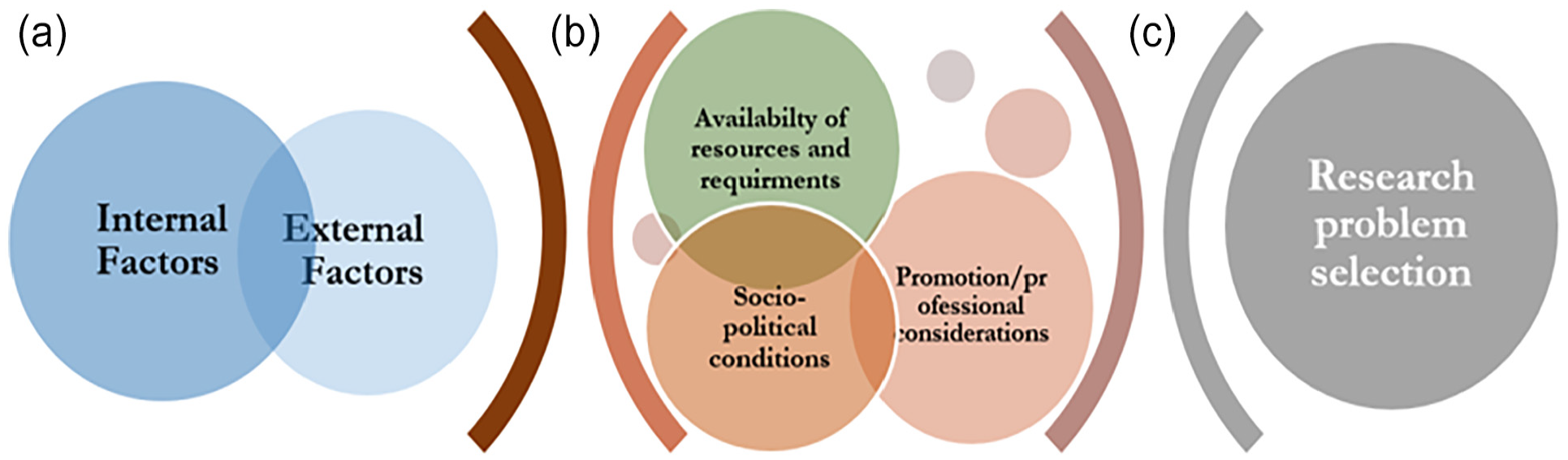
The process of media research problems selection: (a) factors, (b) considerations\obstacles, and (c) outcome.

A proposed framework for the perception of internal and external factors affecting the selection of media research problems.
Discussion
The stated aim of this research was to explore the factors affecting the selection of media research problems as perceived by Arab media researchers through qualitative and quantitative methods, using semi-structured interviews with a purposive sample of 20 Arab media researchers was conducted, followed by a questionnaire applied on a sample of 247 respondents.
Questionnaire Findings showed that factors perceived by respondents to be influential on their selection of research problems are (in order): the “research interests,”“tendency toward newness, originality, and innovation,”“researchers’ perception of scientific issues,”“socio–political\economic factors,”“internal motives, scientific passion, and personal convictions factors,” and “Institutional\organisational\professional factors.”
The “internal\subjective” factors obtained a higher weighted mean and percentage than the “external\objective\social/contextual” factors. The macro-level external factors (socio-political and economic factors) were higher than the micro-level external factors (institutional/professional factors).
In finding an answer to RQ 2, statistical tests revealed that females had higher perceptions than males regarding the “The tendency toward newness, originality, and innovation in the selection of research problems” factor, whereas males scored higher than females in the “research interests” factor. On the other hand, there was no significant effect of type of academic institution, age, and years of experience on researchers’ perceptions of any of the factors or sub-factors.
According to the results of the interviews and the questionnaire, the “research interests” factor was the most influential in pushing respondents toward a specific study topic. This result is consistent with the results of some studies (Bairagi & Munot, 2019; Jha, 2014; Sarathchandra, 2013; Wesely, 2012), which found that researchers utilize diverse criteria for the selection of research problems, most of which reflect individual motivational factors such as “enjoyment of doing research,”“scientific curiosity,” and researchers’ mindset and the passion they have for investigating a specific problem.
It seems that researchers begin the research problem selection process by thinking about their research interests and some scientific considerations. However, this logical beginning in the process of thinking about a research problem does not continue, as thinking about scientific considerations does not remain the determining factor in the remaining stages of the mental process of selecting a research problem, where the researcher begins to think about other considerations such as their personal abilities, personal skills, research interests, institutional\academic considerations, and social context.
When comparing the researchers’ perceptions of macro-level external factors (socio-political and economic factors) to their perceptions of micro-level external factors (institutional/professional factors), the results revealed that the researchers’ perceptions of macro-level external factors were higher than their perceptions of micro-level external factors. This can be explained by the fact that researchers usually think that they can overcome, resist, or adapt to institutional factors, but they cannot affect or control socio-political and economic factors and often perceive them as difficult to resist.
According to interviews and literature review, institutional/professional factors affect the selection of research problems, either directly or indirectly, through a wide range of mechanisms, including the organizational climate and culture, the level of academic freedom, the nature of norms and institutional academic traditions, the nature of prevailing scientific and knowledge norms and traditions, the power to impose these norms, the academic mechanisms of career development, mechanisms of encouraging scientific research, and the balance between teaching, research, and administrative work, among others. Moreover, the increasing interest in establishing Arab media research outcomes in indexed, high-impact publications puts more stress on Arab media researchers and affects their selection of research topics.
There are several practical implications of the results of the current research for researchers, academic institutions and policymakers. The most prominent implications are the identification and classification of the factors that affect the media researcher’s choice of the research problem into various levels and circles of factors between internal factors and external factors, based on empirical evidence. Identifications of such factors may improve the research quality by enhancing the mechanism for deciding on a research problem based on an understanding of the elements that influence the researcher’s decision to choose one problem over another.
Another implication of the findings is that they will enable researchers to exercise more effective control over the process of selecting scientific problems, based on a conscious awareness of factors influencing this process and neutralizing the influence of pressures that may be exerted on the researcher in various contexts to select specific problems that may not fit with society’s needs and real problems, or with the most research-worthy communication phenomena.
The identification of such factors may also help academic institutions, research publishing entities, journal editors and reviewers to determine the extent of the importance of research topics and the extent to which they stem from real societal and scientific needs, or, in turn, caused by invisible or hidden pressures exerted on researchers that push them, perhaps unconsciously, to choose specific scientific problems for research.
The study recommends strengthening research freedom in Arab countries, revising research policies, supporting collaborative research work, launching campaigns in Arab societies to raise people’s awareness of research and its importance, raising researchers’ awareness of the factors and pressures that they may face during research work and strategies to address these pressures, conducting periodic analyzes of the trends of research in the field as well as taking into account the factors that may have pushed them toward focusing on specific problems and neglecting others.
Research Limitations
There are some possible limitations in this study. The first is the lack of previous research on the topic, either in the media research, or research in other scientific fields. Related to the previous limitation is the lack of identification of the factors that affect the selection of scientific problems. Therefore, the in-depth interviews in this paper were necessary to get to identify these factors.
The interviews had another limitation related to sample size and representativeness of all Arab countries. However, the interviews were used as a guiding indicator to explore the factors affecting the selection of research problems to be used in the quantitative study. It is also worth noting that the goal of the qualitative interviews was achieved in a satisfactory manner according to the qualitative data saturation strategy that was applied during the research.
Suggestions for Future Research
It might be preferable to research more gaps in our knowledge about identifying research problems as well as several factors affecting researchers and the research process. It would be useful as well to extend the current findings by examining specific types of factors that influence the selection of research problems, such as individual/internal factors, institutional factors, or socio-cultural factors. It would also be helpful to in-depth examine such factors in various scientific fields, cultures, or ethnicities, as well as in other institutional or socio-political contexts.
Conclusion
In conclusion, the study showed that “research interests,”“tendency toward newness, originality, and innovation,”“researchers’ perception of scientific issues,”“socio-political-economic factors,”“internal motives, scientific passion, and personal convictions factors,” and “institutional\organizational\professional factors” are all factors that Arab media believe have an impact on their research problem selection.
The “internal subjective” factors had a larger weighted mean and percentage than the external\objective\social/contextual factors. The macro-level external factors were found to be more influential than the micro-level external factors.
Researchers who are affected by internal factors are driven by their interests. Both interviews and the questionnaire results revealed that the “research interests” factor was the most influential in pushing respondents toward selecting a specific research problem.
Females had higher perceptions than males regarding the “The tendency toward newness, originality, and innovation” factor. Males scored higher than females in the “research interests” factor. There was no any significant effect of type of academic institution, age, and years of experience on researchers’ perceptions of any of the factors or sub-factors.
It can be concluded that the researcher tends to go through a kind of compromise between the internal and external factors, to resolve the conflict between these factors.
Footnotes
Acknowledgements
We would like to express our great appreciation to the Arab media researchers who agreed to cooperate in the in-depth interviews and participate in the questionnaire survey.
Declaration of Conflicting Interests
The author(s) declared no potential conflicts of interest with respect to the research, authorship, and/or publication of this article.
Funding
The authors received financial support from Ajman University for the publication of this article.
Ethical Approval
Ethical approval for this research was obtained from the Research Ethic Committee, Ajamn University (Approval Reference Number: C-H-F-April 13).
