




Abstract
This study compares the effects of Spherical Video-Based Virtual Reality (SVVR) and Conventional Video (CV) on students’ writing achievement and motivation. A quasi-experimental method was used in a primary school’s Chinese Descriptive Article Writing courses. Twenty-eight fourth-grade students were randomly divided into two groups. In the SVVR group, students observed the writing scenes using SVVR devices. In the CV group, students watched the writing scenes through conventional video. SPSS software was used for the statistical analysis of the data. The results show that: (1) there is no significant difference (U = 714, p = .061) in the overall writing achievement between SVVR and CV groups. However, students in the SVVR group performed significantly better in Organization (U = 693, p = .029) and Content (U = 609, p = .003) than those in the CV group. (2) Overall writing motivation improved in both SVVR and CV groups. The improvement of writing expectations in the CV group was significantly higher than that of the SVVR group (t = −2.119, p = .044). Therefore, we suggest that schools: (1) design the integration method of SVVR and writing learning to solve the problem of the gap between students’ immersive situational experience and completing their writing goals. (2) use the immersive and interactive features of SVVR technology to create virtual experience scenes to improve students’ observation and description abilities. (3) add activity clues to guide students to experience SVVR scenes purposefully and plan and transform situational interest into learning ability. (4) further optimize SVVR devices to improve their usability during learning.
Keywords
Introduction
Descriptive article writing is an important component of learning in the language arts curriculum. Writing is not only a means of communication but also a way to improve an individual’s reading, comprehension, and critical thinking (Wang & Matsumura, 2019). However, the previous studies showed that there were still some problems with descriptive article writing for primary school students. For example, they would exhibit lower writing interest, careless observation, and chaotic and emotionless writing content (Yan, 2019; Zhang et al., 2015). One of the reasons for these problems is that in traditional writing activities, students generally lack the immersive experience, and so do not know how to start writing (Li, 2004). To address this issue, some scholars suggest that teachers need to pay more attention to students’ perception and experience of real context, rather than being limited to knowledge presentation (such as syntax and grammar; Y. F. Lan et al., 2011). Therefore, to support students’ learning of descriptive article writing, Conventional Video (CV) and Spherical Video-Based Virtual Reality (SVVR) were adopted to help students build positive connections between their own life experiences and writing topics. Some educators use CV to provide students with writing scenes and help students observe scene contents, record the video information, and conclude their writing ideas (Anggraeni, 2012; Maru et al., 2020; Pratiwi, 2011). Some educators developed a Spherical Video-Based Virtual Reality (SVVR) writing system, and help students write descriptive articles through role-play, interactive experience, and collaborative learning (Huang et al., 2020; Patera et al., 2008).
In recent years, SVVR, as an emerging but remarkable technology, has been increasingly used in writing learning. Existing studies have confirmed the positive effect of SVVR in supporting students’ writing learning and improving students’ writing performance to a certain extent (Parmaxi, 2023; G. Yang et al., 2021). Some schools have even invested in buying SVVR equipment and building SVVR-supported writing laboratories instead of a CV writing environment. However, there is not enough empirical research to prove that the teaching effect of SVVR is better than that of CV in students’ descriptive article writing learning process, especially in primary school (Y. Chen et al., 2022). This attracts researchers to conduct a study to compare the effects of SVVR and CV learning environments on primary school students’ descriptive article writing learning outcomes.
Literature Review
Descriptive Article Writing
Writing is a complex process that allows students to explore ideas and make them visible and concrete (Harlena, 2020). Developing students’ writing competencies can not only improve students’ language literacy but also help enhance their learning abilities, including the ability to reflect, select, evaluate, critically, and transcript (Yeung et al., 2013). Descriptive article writing is a basic and useful form of writing learning. In China, The National Language Curriculum Standards of Compulsory Education require primary school students to have certain descriptive article writing competencies. For example, in grade 4, students should be able to “observe the world around you, and write down what you’re seeing, feeling, and imagining in Chinese characters. Write the novel, interesting, and moving things that you think about” (Ministry of Education of the People’s Republic of China, 2011). According to the curriculum standards, the descriptive article writing competencies were summarized in the following three aspects: whether students can describe things in order, observe effectively, and clearly express their feelings. It is also important to make sure that the writing is smooth, that words are used correctly, and that they are using accurate punctuation marks. Thus, the instructional focus of descriptive article writing is on organization, contents, feeling, and vocabulary use.
Used CV Learning Environment in Descriptive Article Writing
CV, as a kind of multimedia that combines motion, color, and sound, can simulate the real condition of the activity by using video to present content (Rapiyadi et al., 2018). Thomson et al. (2014) pointed out that video is an effective medium to help learners interpret visual cues and can replace photos, text, or audio. Mayer (2002) analyzed dual coding from the information processing method and proposed a multimedia learning model under the dual-channel mechanism. The research results based on the multimedia learning model showed that the simultaneous presentation of text and images is better than the presentation of static text, and the simultaneous presentation of auditory and visual materials is more effective than sequential presentation (Mayer, 2014). Therefore, the audio-visual dual-channel learning mode has many advantages compared to the single-channel learning mode (Chandrasekaran et al., 2014; Lubashevsky et al., 2017; Yu, 2017).
As multimedia material that students can easily accept, CV had been used in teaching endlessly (Abdulrahaman et al., 2020). In the writing learning process, CV presents events, or scenes and is a source of information that evokes thoughts, creative thinking, and aesthetic reactions (Hadijah, 2016). In a relaxed writing atmosphere, students critically discover clues of descriptive article writing, and simulated the feelings, and perceptions from the video into impressions and ideas, and finally into writing products (Maru et al., 2020). By observing video teaching activities in the process of narrative text writing, Fauzia and Novita (2020) found that most the 10th-grade students like video media, and agreed that the use of video in narrative text teaching helps them to develop and organize their ideas systematically. To allow students to build a bridge between new scenes and mental schemas while watching the video, researchers strive to create a CV writing environment for learners carrying out dual-channel learning which provides students with (1) CV playback equipment, including High-definition display, and surround sound equipment (2) CV learning scene resources, which were presented to students for observing and writing.
Used SVVR Learning Environment in Descriptive Article Writing
Virtual Reality (VR), as a simulation of a three-dimensional space environment, can make participants feel as if they are in the real world, and observe and participate in the 3-D space (Chang & Wang, 2019). Its key features are immersion and interactivity (Maas & Hughes, 2020). Immersion refers to the extent to which the user feels that the protagonist exists in the simulated environment (Southgate et al., 2016). Csikszentmihalyi (2014) described the immersion state as people being completely attracted to the activity and throwing themselves into the situation, filtering out all irrelevant perceptions, and entering a state, also known as “flow experience.” Interactivity refers to the user’s operability of objects in the simulated environment and the degree of natural feedback from the environment (Roussou et al., 2006). These bring a new sensory experience to users, enabling VR to be used in entertainment, medicine, aviation, and many other fields. However, the use of VR in education was initially restricted due to the high cost and technical difficulty of VR (Merchant et al., 2014; J. C. Yang et al., 2010). Therefore, educators urgently need a low-cost, easy-to-implement form of VR.
SVVR is a Virtual Reality technology that matches the needs of the school environment. SVVR primarily employs spherical video (360° video or photos) to present virtual environments, allowing viewers to look around from all directions and allowing them to control what they want to see, rather than the fixed perspective of traditional video (Rupp et al., 2019). SVVR not only solves the problems of high technical level and high cost of traditional 3D graphics-based VR, but also provides users with a good immersive interactive experience (Geng et al., 2021; R. Liu et al., 2020; McFaul & FitzGerald, 2020). The immersion and interactivity of SVVR can put learners at the center of active learning. In the writing learning process, the SVVR learning environment supported students to conduct reflective observation, and abstract conceptualization, encouraging them to interact with the contexts to respond to the questions and obtain the hints and messages of the writing (Huang et al., 2020). M. Chen et al. (2021) surveyed 21 secondary school teachers who used SVVR environments in writing classes. They agreed that a SVVR learning environment could improve students’ writing skills and promote students’ learning participation and motivation. Patera et al. (2008) created a SVVR learning environment to stimulate motivation and creativity in English imaginative writing at primary school. The findings appeared that SVVR boosted students’ writing motivation, increased their engagement with the task, and settled them into writing faster than usual. It can be seen that to enable students to enter the immersive writing state and observe the writing scene comprehensively and deeply, researchers strive to create a SVVR writing environment, which provides students with (1) SVVR observation or operation tools (e.g., the Crystal Eyes stereo goggles provide separate images to the left and right eyes for stereoscopic depth perception.) (2) SVVR learning scene resources (e.g., the scene of street views on the way to the mountain to encourage students to conduct reflective observation and abstract conceptualization.)
The Purpose of the Study
As SVVR devices are becoming more accessible and affordable, more and more teachers use a SVVR learning environment to support students in learning descriptive article writing. Is a SVVR learning environment better than a CV learning environment for improving students’ descriptive writing learning outcomes? This study uses SVVR and CV learning environments to examine the impact of the two environments on students’ writing achievement and motivation in a quasi-experimental study. Specifically, the purpose is as follows:
(1) To examine whether there is a difference in the impact of SVVR and CV learning environments on the writing achievement of primary school students’ descriptive article writing.
(2) To examine whether there is a difference in the impact of SVVR and CV learning environments on the writing motivation of primary school students’ descriptive article writing.
Experiment Design
Participants
Before the descriptive writing experiment, we randomly selected 28 grade-four students from the experimental school to participate in our experiment. Among them, there are 14 boys and 14 girls. Then, we used a random lottery method to randomly divide them into two groups with 14 students in each group. In the SVVR group, the SVVR learning environment was used for writing, and students observed the writing scenes using the SVVR devices. In the CV group, the CV learning environment was used for writing. Both groups of students were taught by the same teacher and assistant teacher.
Procedure
The experimental process of this study is shown in Figure 1. Before the activity, both groups of students spent about 10 min completing a pre-test of writing motivation. Next, the teacher introduced the writing tasks to the students. At the beginning of the teaching activity, the teacher spent 30 min on writing teaching together. And then the two groups of students were separated and watched the contents of the same scene through SVVR or CV learning environment for 10 min. After watching, students were provided with 60 minu of writing time. There are three lessons in this teaching activity, including “The Fireworks Show,” “Roller Coaster,” and “Dragon Boat Racing.” Through the two learning environments, the SVVR group and CV group students experienced different writing feelings. The whole teaching activity lasted for 3 weeks. After the teaching activity, students completed a post-test on writing motivation.
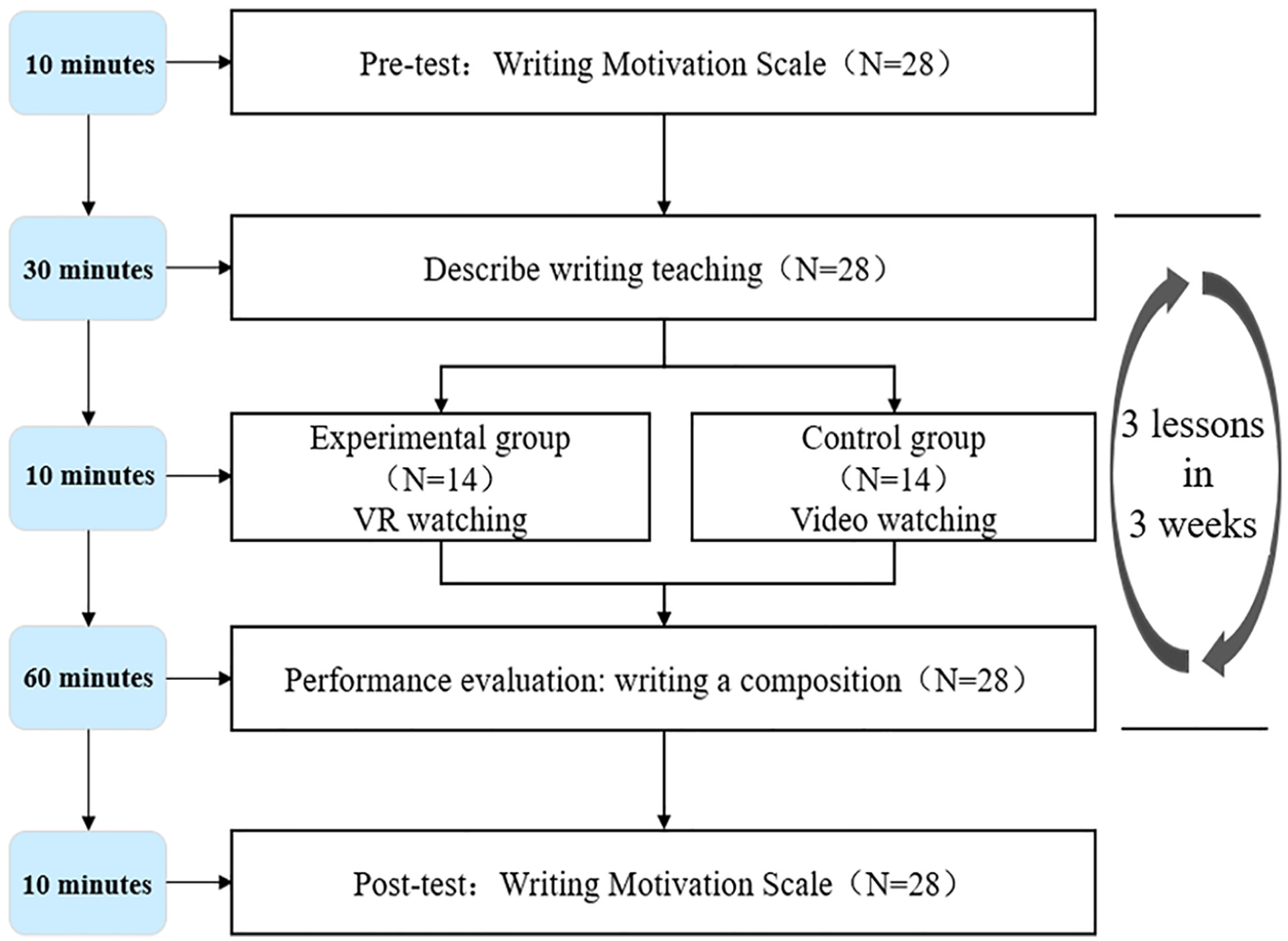
Experiment process.
Materials
SVVR and CV Learning Environments
This experiment adopted a head-mounted SVVR device (PICO G2 4K VR all-in-one machine) that can present immersive scenes without other equipment. The set of equipment provides elastic straps to adapt to students with different head shapes. Students who wear glasses can use them directly without taking off their glasses to have a good immersive interactive experience. Through collaboration with equipment providers, we have customized and developed 3 SVVR learning resources that match the writing teaching themes. For each SVVR learning resource, the spherical video is shot by the Insta360 pro 8K panoramic camera, then designed and created using the SVVR production software. The duration is controlled within 10 min. For the CV group, CV learning resources with writing teaching contents were presented in class in MP4 format using a computer and a projector. The content and duration of the CV learning resources are the same as those of the SVVR learning resources—only the watching experience is different (see Figure 2).

SVVR and CV learning environments.
The Rubric of Descriptive Article Writing Competencies
Following the National Language Curriculum Standards of Compulsory Education (Ministry of Education of the People’s Republic of China, 2011), the research team adopted the Delphi method, conducted three rounds of expert argumentation, and compiled a descriptive article writing score rubric. The rubric examines students’ writing achievement from four dimensions: organization, contents, feeling expression, and vocabulary use. To examine whether students can describe things in order, observe effectively, clearly express their feelings, and use vocabulary correctly, the research team designed Level A, and Level B in the rubric. Level A means that the criteria are met, and Level B means that the criteria are not met, as shown in Table 1. If three to four dimensions of the student’s article are “Level A,” the overall achievements are “Level A.” If the two dimensions are “Level A,” the evaluation teacher and the teaching teacher will discuss and decide whether the students’ overall achievements are “Level A” or “Level B.” If only one dimension is “Level A” or 0 “Level A,” the overall achievements are “Level B.”
The Rubric for Descriptive Article Writing Achievement.

Writing Motivation Scale
Writing motivation was measured using the Writing Motivation Scale adapted by J. M. Liu (2007). The scale includes four dimensions: writing interest, writing importance, writing emotion, and writing expectation. The number of questions in each dimension is 7,6,6,6 respectively, with a total of 25 questions. The five-point Likert scale was used. According to “very consistent,” “basically consistent,” “somewhat consistent,” “basically inconsistent,” and “very inconsistent,” the students give each question 5, 4, 3, 2, or 1 point. Some questions are negative statements and should be scored in reverse. The internal consistency of the scale was good, and Cronbach’s α of the scale was .923.
Instruction Design for Descriptive Article Writing Lesson
In cooperation with the Chinese writing teachers of the experiment school, the writing course for the grade 4 students, include descriptive article writing activities The Fireworks Show (the first lesson), Roller Coaster (the second lesson), and Dragon Boat Racing (the third lesson), was developed. In each writing activity, the instruction design is divided into five stages: goal clarification, case teaching, observation experience, writing process, and writing evaluation. Figure 3 summarizes the main instructional process.
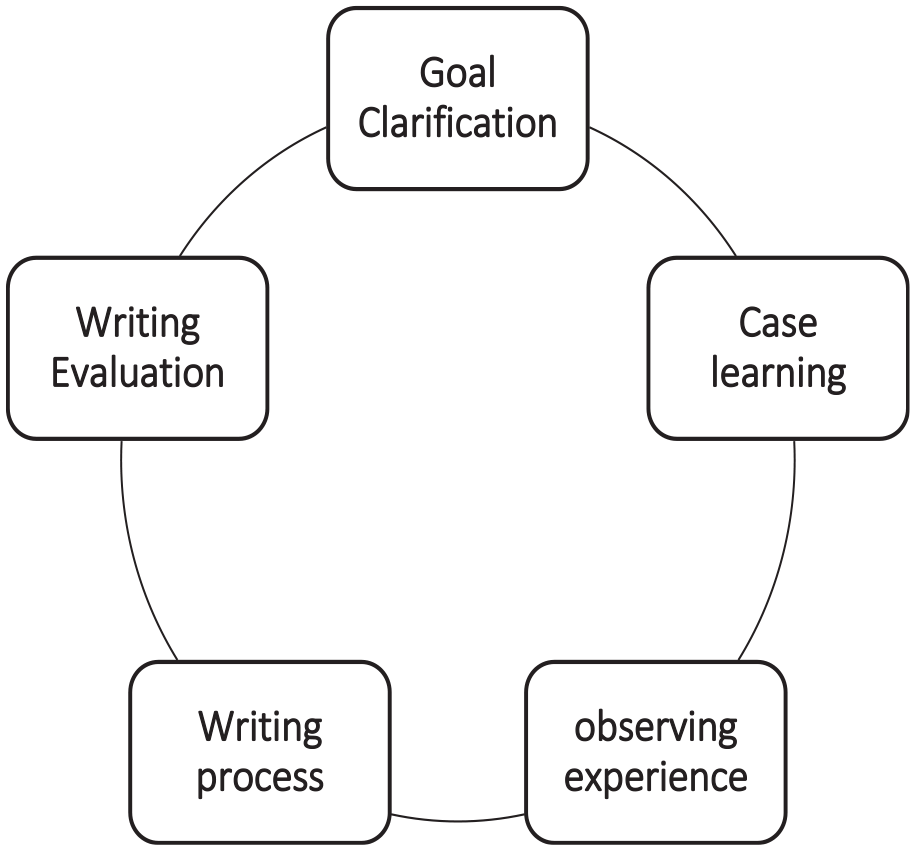
Writing instructional design.
We took The Fireworks Show activity as an example to explain the above instructional process:
At the Goal Clarification stage, the teacher leads the students to place themselves in the River Thames, “Let’s enjoy the New Year fireworks show by the River Thames, how do you think we should describe the fireworks show?” After the students explain their views, the teacher summarizes to make the students clear the goal of writing.
At the Case learning stage, the teacher presents specific writing cases and asks the students what is good about the cases and what are the problems. Then, let the students read the examples together and summarize their writing skills. Here are three contrasting examples:

At the Observing Experience stage, students in the SVVR group wore SVVR headsets to experience an immersive firework show. Students in the CV group watch the CV of the fireworks show. After watching, the students began to write descriptive articles.
At the Writing Process stage, the SVVR and CV groups of students write the descriptive writing article according to the tasks arranged by the teacher. They should complete the article within 60 min, and then submit the article to the teacher (if completed in advance, they can submit them in advance).
At the Wrinting Evaluation stage, to avoid Halo Effect, the evaluation teacher is another one from the Chinese language writing teaching team. This teacher judges the eligibility of each dimension according to the rubric. When the evaluation teacher cannot make a judgment on a descriptive writing sample, the evaluation teacher, and teaching teacher will discuss and make a joint judgment.
Results
We collected students’ Chinese descriptive articles three times to indicate their writing achievement. Writing motivation of two groups was also obtained for two tests (Pre-test & Post-test). After collecting the writing motivation questionnaire, we found that one student missed a question and did not answer it in the Post-test. Therefore, the number of effective motivation questionnaires in the post-test of the control group was 13. SPSS software was used for the statistical analysis of the data.
Writing Performance
The teacher assessed the students’ descriptive article writing achievement as Level A and Level B according to the rubric. We counted the number of Level A and Level B obtained by the two groups (Table 2). On the whole, the writing achievement of the SVVR group is better than that of the CV group, but the performance of the SVVR group is relatively stable, while the CV group is constantly improving. The total number of Level A results obtained in the SVVR group was more than that in the CV group, which indicated that the overall writing performance of the SVVR group was better than that of the CV group. However, we can see that the number of Level A results in the CV group is increasing, gradually exceeding the SVVR group’s writing achievement in the third lesson.
Writing Level Results for Two Groups.

Since the hierarchical order data were obtained, Mann-Whitney tests were used. Mann-Whitney Test is a non-parametric rank sum hypothesis test, a t-test method for independent samples without normal distribution. When the sample size is greater than 20, the test is most accurate (Divine et al., 2010). Table 3 shows there were no significant differences (U = 714, p = .061) between the SVVR group and the CV group in the total descriptive writing assessment results. However, there were significant differences (U = 49, p = .024) between the SVVR group and the CV group in the lesson on The Fireworks Show. In addition, there were no significant differences between the SVVR group and the CV group in the lesson on The Roller Coaster Show (U = 84, p = .541) and Dragon Boat Racing (U = 91, p = .769). It can be inferred that SVVR and CV show differences in the experimental early stage, and the differences gradually narrow as the course progresses.
Mann-Whitney Test Results for Writing Achievement.

According to the rubric of descriptive article writing performance, we divided students’ writing performance into four dimensions: Organization, Contents, Feeling, and Vocabulary use. We counted the number of Level A and Level B obtained by the two groups in four dimensions, and the results are shown in Table 4. In the writing activities, the results of the SVVR group have higher values of Level A results in Organization and Contents than that of the CV group. The two groups performed similarly regarding Feeling and Vocabulary use.
Writing Level Results for Writing Achievement in Four Sub-Dimensions.
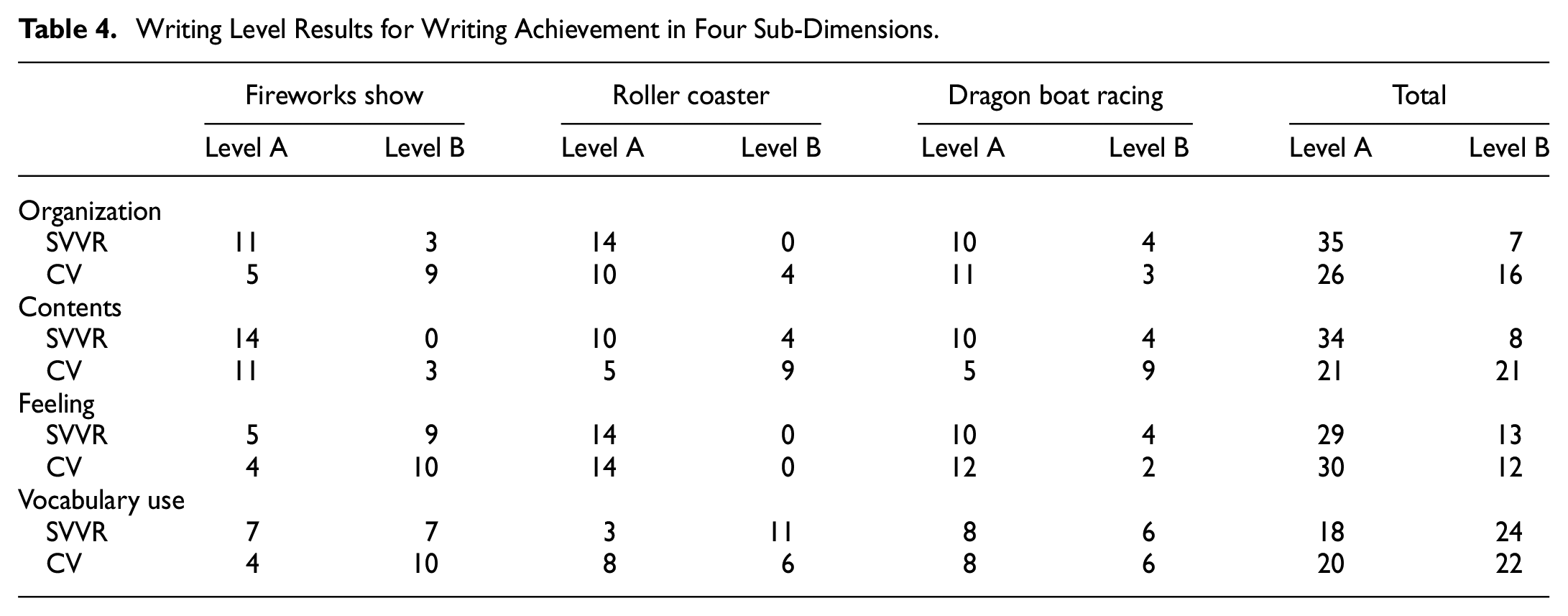
We examined whether the two groups of students showed significant differences in the four dimensions, and the results are shown in Table 5. As can be seen from the results, there are significant differences in the writing achievement of the two groups in the dimensions of Organization (U = 693, p = .029) and Content (U = 609, p = .003), but there was no significant difference in Feeling (U = 861, p = .812) and Vocabulary use (U = 840, p = .663) between two groups.
Mann-Whitney Test Results for Writing Performance in Four Dimensions.

Writing Motivation
Table 6 shows the average scores of writing motivation (with four sub-dimensions) of two groups on the Pre-test and Post-test. Overall, the writing motivation of the SVVR group was higher than that of the CV group whether pre-test or post-test. However, among the sub-dimensions, the Expectation of the CV group (4.08) was higher than that of the SVVR group (3.83) in the post-test.
Motivation Scores in the Pre-Test and Post-Test of the Two Groups.

We further analyze whether there were significant differences in the improvement of writing motivation between the two groups. We first subtracted the score of the pre-test motivation from the score of the post-test motivation to get the motivation improvement of the two groups, and then carried out the independent sample t-test. Results show in Table 7. There were no significant differences between the two groups on the writing motivation increase score (t = −0.792, p = .436). But among the sub-dimensions of writing motivation, there are significant differences in the writing Expectation dimension (t = −2.119, p = .044). This indicates that the improvement in writing expectations of the CV group is significantly higher than that of the SVVR group.
Difference Between Post-Test and Pre-Test of Two Groups.

Discussion and Suggestions
This study explores the differences in writing achievements and motivation between the grade 4 students in the SVVR group with SVVR learning environment and the CV group with the CV learning environment.
On the whole, the results showed that there is no significant difference (p = .061) between the students in the SVVR learning environment and CV learning environment for their descriptive article writing achievement. A possible explanation for this result is that while the SVVR environment creates rich situational stimuli for students, it also increases the difficulty of students’ content selection. It is difficult for students to determine what to choose and exclude in writing stories (Patera et al., 2008). In this experimental teaching process, we also observed that students had some problems writing in SVVR environment; for example, while using SVVR, some students were completely immersed in virtual activities and ignored their writing tasks. After watching the SVVR scenes, some students were more willing to communicate with other students, and express their ideas, but couldn’t concentrate on completing the writing tasks.
Suggestion
Comparing writing achievements in sub-dimensions, the SVVR group is significantly higher than the CV group in the dimensions of organization and contents. It can be inferred that the SVVR environment is more helpful to improve students’ organization ability and content expression ability than the CV environment. This result can be explained by experiential learning theory, which pointed students can obtain personal experience, create, and reflect on their learning process in four stages: concrete experience, reflection, and observation, abstract concept, and active verification (Cantor, 1997; Kolb, 1984). The immersive learning environment created by SVVR can help students experience the activities of the above four stages and gain in-depth experience like in a real environment. In the writing experiment, the behavior of students in the SVVR group confirmed the above view. For example, in the process of watching the scene, students in the SVVR group are constantly amazed at the impact of the scene content and make corresponding actions with SVVR scene viewing (e.g., moving forward, dodging, etc.).
Suggestion
From the perspective of writing motivation, this study explored the changes in students’ writing motivation in the SVVR group and CV group respectively. The results showed both SVVR and CV learning environments can improve learners’ writing motivation. There is no significant difference in writing motivation improvement (p = .436) between the students in SVVR and CV learning environments. The reason for this result could be explained by situational interest theory. Situational interest is an immediate emotional response derived from specific stimuli and changes in conditions in the learning environment. It is a short-term and situational-related learning interest (Schiefele, 1996; Schraw & Lehman, 2001). Once students understand or adapt to the characteristics of the environment, their learning interests will decrease. Therefore, whether in SVVR or CV learning situations, students tend to be curious when they first use these resources. However, as they become familiar with and adapt to the environment, their interest in the situation gradually weakens, and the impact of external situational factors on students’ writing motivation tends to be consistent. In fact, during the experiment, the writing level of the SVVR group was significantly higher than that of the CV group in the first lesson, while the writing level of the two groups was gradually consistent in the second and third lessons. This also confirmed this view.
Suggestion
It is worth noting that the CV group students’ writing expectations improved significantly more (p = .044) than that of the SVVR group students. From this result, it can be inferred that the CV learning environment is more helpful to improve students’ writing expectations than the SVVR learning environment. The teachers who participated in this experiment explained, “Students in the video group could watch the video while recording the contents that they thought were important. However, students in the SVVR group had to take off their SVVR headsets to record. Writing and watching SVVR cannot happen at the same time.” It can be seen that SVVR devices also brought inconvenience to students in the process of writing.
Suggestion
Limitations
This study was conducted with only 28 fourth graders, so future studies will include more participants and consider the effect of grades on the results of the study. In addition, only three lessons were conducted to evaluate students’ writing performance after short-term learning in two learning environments, so the impact of the two learning environments on students’ long-term descriptive writing learning needs to be further explored.
Footnotes
Acknowledgements
All authors read and approved the manuscript.
Declaration of Conflicting Interests
The author(s) declared no potential conflicts of interest with respect to the research, authorship, and/or publication of this article.
Funding
The author(s) disclosed receipt of the following financial support for the research, authorship, and/or publication of this article: This research was supported by the National Social Science Foundation for Education of China (BCA210081).
