




Abstract
Lack of funds and poor agricultural-product sales are the main problems that limit agricultural development, which can be well solved by agri-food crowdfunding. How to attract more backers to invest in the early stage of a project is extremely crucial for agri-food crowdfunding. Using a unique sample comprising 1,136 agri-food crowdfunding campaigns on Crowdfunding Net, among the most influential crowdfunding platforms in China, a model is constructed that includes the five dimensions of people, product, promotion, cost, and convenience. Drawing on the classic 4P and 4C marketing theories, multiple regression analysis is used to examine the mechanism through which a project’s presentation information influences the number of early backers. The results reveal that the factors in the three dimensions of people, product, and convenience positively impact the number of early backers in agri-food crowdfunding. In contrast, the cost-dimension factor is negatively related to the number of early backers. The promotion-dimension factors fail to pass the significance test. Additionally, the number of first-day backers partially moderates the effect of the initiator category, investment threshold, and lottery on the number of early backers. The effects of the trademark registration and number of reward categories on the number of early backers are completely moderated by the number of first-day backers. The evidence also shows that early backers’ rational investment decisions are based on reliable information and lucrative rewards. The research conclusions offer practical enlightenment for initiators, crowd-funding platforms, and regulators in the agri-food crowdfunding industry.
Introduction
As a new investment and financing model of Internet finance, crowdfunding is favored by investors for its unique characteristics of low threshold, diversity, and creativity. For entrepreneurs who lack the credit and experience required to obtain funds from other finance sources, crowdfunding is an effective mechanism to help them overcome these challenges. Crowdfunding can be divided into four types: equity-based, lending-based, donation-based, and reward-based crowdfunding (Arena et al., 2018; Faudzi et al., 2021). Reward-based crowdfunding can be considered the main form of crowdfunding, whereby backers will actively participate in the product-development process along with investment (Pinkow, 2023). For developing countries, crowdfunding is increasingly becoming a major source of funding for entrepreneurs to start and grow their own businesses (Alsagr et al., 2023; Bagheri et al., 2019; Gama et al., 2023). According to World Bank projections, the crowdfunding investment amount in China is expected to reach between $46 billion and $50 billion by 2025. Globally, crowdfunding contributes to job creation, innovation, and economic development by providing a source of funding for entrepreneurs (Enani & Khan, 2021; Yasar, 2021). Generally, a crowdfunding campaign comprises six main elements: initiator, backers, crowdfunding platform, project, funding, and reward. An initiator can be an individual with an entrepreneurial idea or a company with a financing need. Through crowdfunding, initiators can obtain customers, publicity, and feedback for their products or services as well as low-cost funds and additional market information. Backers are not restricted by region, income, age, race, gender, etc. Therefore, crowdfunding using Internet technology has different characteristics from those of traditional finance, which is conducive to promoting innovation, employment, and economic growth (Estrin et al., 2018). For agricultural development, crowdfunding offers new ideas in China. Currently, to solve the problems of agriculture, rural areas, and farmers and to consolidate the achievements of poverty eradication and comprehensively promote rural revitalization, the policy of e-commerce for rural areas has been prioritized in the No. 1 Document of the Central Committee for many consecutive years since 2013. Additionally, the State Council and Ministry of Finance have formulated several measures to support rural e-commerce and crowdfunding poverty alleviation from the perspectives of policies and funds, respectively, and have increased publicity to help farmers in poor areas to increase agricultural-product sales and achieve targeted poverty alleviation. With the promotion of various policies at all levels, along with the popularization of the Internet, e-commerce has developed rapidly in rural areas. Statistics from China’s Ministry of Commerce show that online transactions involving agricultural products developed strongly in 2019, reaching 397.5 billion yuan, up 27% year-on-year. Selling agricultural products through e-commerce platforms innovates the sales mode for agricultural products and helps small farmers to bring agricultural products to the big market, which effectively solves the problems of farmers’ financing constraints, unsalable agricultural products, and expensive consumer purchases at source.
The development of rural e-commerce cannot be separated from financial support. As an emerging business model combining traditional agriculture and Internet crowdfunding, agricultural crowdfunding provides a new approach to agricultural financing (Allen et al., 2021). Based on the Internet platform, it constructs a link between farms around cities and urban residents and opens up new sales channels for traditional agricultural products. Agricultural crowdfunding can be divided into two forms: agri-food crowdfunding with agricultural products as a reward and agricultural-equity crowdfunding with investment as the goal. Of these, producers in agricultural crowdfunding can disperse risks and improve benefits through pre-sale orders. Meanwhile, investors can also obtain high-quality agricultural products that meet their individual needs and are safe and nutritious. Agri-food crowdfunding efficiently realizes the connection between agricultural-product production and agricultural-product sales, which is a win-win result for both investors and initiators and solves the dual problems of financing and sales in agriculture (Y. Li et al., 2020). Against the background of the “Rural Revitalization” strategy, agri-food crowdfunding provides a new idea for solving rural financial and economic problems. However, most of the products involved in agri-food crowdfunding are raw and fresh foods without any processing (such as vegetables, aquatic products, poultry eggs, meat, etc.), which are seasonal, perishable, and vulnerable. Therefore, agri-food crowdfunding has high requirements for timeliness, and it is necessary to attract many backers to invest in the early stage of a campaign to complete the financing in the shortest possible time. Actual statistics show that the average rate of funding-target completion for agri-food crowdfunding is 63.75%, indicating that most projects take approximately two-thirds of the funding window to complete their funding targets. The percentage of projects that successfully complete the funding target on the last day of the funding window is found to be 20.47%, indicating that the overall investment by project backers does not progress quickly. These conditions suggest that an initiator must attract more backer investment early in a project to accelerate funding. The importance of attracting more backers in the early stages of a project is as follows: First, the adverse effects of information asymmetry can be eliminated, thus prompting more subsequent backers to invest, expanding the scale of financing, improving financing performance, and accelerating the project’s financing schedule. Second, the intended financing goal can be rapidly achieved, which helps the project to obtain more funds, ensures that the sponsor’s funds are in place and more secure, and enhances the farmers’ confidence in production. In other words, if there are two projects with an 80% financing-completion rate, potential backers will believe that the project with 15 days left to raise funds is more successful than the one with 2 days left to raise funds. Third, the popularity of a project’s products can be enhanced to help the initiator to keep abreast of changes in market demand, initiate subsequent projects, and expand the products’ sales. Fourth, project financing can be accelerated, which helps backers to obtain early rewards and enjoy fresh food. Therefore, to improve crowdfunding projects’ success rates and fundraising performance, it is crucial to deeply understand backers’ participation motivation and investment behavior in agri-food crowdfunding.
Presently, research on crowdfunding mainly focuses on the factors in crowdfunding fundraising performance, crowdfunding motivation, and backers’ investment willingness (Bagheri et al., 2019; Bassi et al., 2020; Huang et al., 2021; Zhang et al., 2022). The success or failure of crowdfunding, crowdfunding fundraising performance, and backers’ behavior have been the focus of scholars’ attention. Mollick (2014) found that having more early backers for a campaign created a sense of “there is nothing if they are slow” for other potential backers, accelerating investment by potential backers and allowing the campaign to rapidly raise funds. This leads to the herding behavior of follow-the-leader investments and promotes rapid campaign success. Vulkan et al. (2016) found that a crowdfunding campaign’s funding goal could be achieved within the first 30 days of the set 60-day campaign window. Even for failed campaigns, the funds raised in the first 30 days could reach more than half of the funding goal. Song et al. (2019) found that previous backers’ investment behaviors and comments were positively related to backers’ investment-decision making at a later stage. There are both synergistic and substitution effects. Essentially, backers’ participation in a crowdfunding campaign is determined by their intrinsic psychological motivation (Baber & Fanea-Ivanovici, 2023). Only by deeply understanding the relationship between backers’ motivation and willingness to participate can we determine the focus of a campaign’s presentation and stimulate backers to actively participate in agri-food crowdfunding.
Agri-food crowdfunding is essentially a pre-sale of agricultural products (Y. Li et al., 2020). The initiator of a crowdfunding campaign is the producer and seller of agricultural products, and accordingly, the backer is the buyer and consumer of the agricultural products. The transaction between the initiator and the backer constitutes the online consumer market. Using marketing theory to analyze the transaction phenomenon in crowdfunding can help improve the understanding of backers’ investment behavior (Shneor et al., 2020). This can provide a theoretical basis for an initiator of crowdfunding to select a campaign’s display information according to marketing strategies to rapidly attract more potential backers. 4P and 4C are two representative theories in marketing (Yan et al., 2021). The 4P theory proposes that the product sales of enterprises in marketing activities are affected by product, price, place, and promotion, and that marketing should focus on the product market. The 4C theory (customer, cost, communication, and convenience) was developed based on the 4P theory and emphasizes the central position of consumers in marketing. As a new financing method combining the Internet and traditional agriculture, agri-food crowdfunding is not only constrained by the 4P theory but is also guided by the 4C theory. Therefore, studying backers’ behavior in crowdfunding consumption transactions from the perspectives of 4P and 4C can fully reveal the internal mechanism affecting the success or failure of crowdfunding and financing performance. This study extends the research on backers’ behavior in crowdfunding. It focuses on ways to obtain more investment from backers in the early stage of a campaign, which has rarely been addressed in previous studies. Existing research can be improved in the following main areas: First, existing research on agri-food crowdfunding is relatively scarce. Second, there is a lack of research on early backers’ behavior. Third, even fewer studies integrate the 4P and 4C theoretical perspectives to design marketing-mix strategies for crowdfunding backers’ behavior. Previous studies have mainly focused on crowdfunding financing performance based on signaling, trust, social-capital, and customer-value theories. This study examines the design of a campaign’s marketing scheme in agri-food crowdfunding from the perspective of marketing in order to induce more backers to participate in the campaign in the early stage. This study enriches the literature on backers’ behavior in crowdfunding, particularly in the field of agri-food crowdfunding.
The remainder of the study is organized as follows: A literature review of backers’ investment behavior in crowdfunding is presented in the following section. A theoretical analysis and research hypotheses are then developed based on the preceding section. A description of the database and variables used follows. Next, an empirical analysis of the proposed model is presented. Finally, the paper concludes with a discussion of the main findings.
Literature Review
Successful crowdfunding campaigns are multifaceted in nature and depend on marketing and organizational features (Lagazio & Querci, 2018). Backers’ active participation positively impacts a project’s financing performance and success in crowdfunding (Baber & Fanea-Ivanovici, 2023; Efrat & Gilboa, 2020). Campaigns that raise funds quickly are more likely to be successful than those that raise funds slowly. Consequently, crowdfunding platforms, such as Indiegogo, encourage projects to rapidly achieve funding. While the maximum window of as many as 90 days was initially allowed for project financing, this timeframe is now limited to 60 days, and 30-day funding windows are encouraged (Lagazio & Querci, 2018). This shows that crowdfunding platforms are also beginning to focus on the fundraising speed. However, to accelerate the fundraising speed, backers’ active participation is a key factor. Recently, research on backers’ participation behavior in crowdfunding has attracted scholars’ attention (Y. Li et al., 2020).
First, the investment behavior of backers participating in crowdfunding shows a herding effect. Herding refers to backers’ following others’ decisions on whether or not to invest in a campaign. Bretschneider and Leimeister (2017) confirmed that backers’ reward motivation was enhanced by their herding behavior. Based on a panel dataset from Kickstarter, Tian et al. (2021) find that it is the rational herding effect rather than information cascade that positively affects fundraising performance in crowdfunding. That is, later backers make investment decisions based on combining their private information about projects with others’ contributions. The intensity of the herding effect present in crowdfunding will gradually weaken under the target-gradient effect. Therefore, the herding effect is only prominent in the early project-funding period, before the financing target draws near (Hou et al., 2020). Agrawal et al. (2015) find that backers are twice as willing to invest in campaigns that have completed 80% of the financing target as in those that have completed 20% of the target. Therefore, campaigns with more backers at the early stage can attract more backers’ investment later (Hartono et al., 2021). Generally, backers believe that crowdfunding campaigns with rapid financing in the early stage have high quality and are more willing to invest in such campaigns (Hildebrand et al., 2017).
Second, the herding effect of backers’ investment behavior will gradually weaken in the middle and later stages of crowdfunding campaigns. Owing to significant information asymmetry, the herding-behavior effect is particularly prominent during the early stage of a campaign (Liu et al., 2018). As the campaign proceeds to the middle and late stages, the bystander effect becomes dominant (Chen et al., 2017). Based on an analysis of a unique dataset that records the bi-hourly backer support for 1,058 successful Kickstarter projects, G. Li and Wang (2019) revealed that the number of backers was much higher in the days before the threshold was reached than in the days thereafter. Kuppuswamy and Bayus (2017) found that the number of existing backers negatively impacted potential backers’ investment behavior, and that potential backers would instead invest in crowdfunding campaigns with fewer backers. A goal-gradient effect exists in the crowdfunding process; that is, backers are more willing to invest in crowdfunding campaigns that are close to meeting their funding goals. Moreover, once a campaign is successful, the goal-gradient effect disappears, at which point the campaign’s support declines. Existing studies have shown that a social-network effect exists in the crowdfunding financing process, that is, some backers are members of a social network such as family, friends, or relatives of a campaign initiator’s (Kim & Koh, 2023). These social-network members typically only invest in a campaign when it is not successfully funded, especially in the early stage. Once the campaign financing is successful, such members’ investment will be reduced.
Finally, some studies show that campaigns with many early backers outperform those without in terms of funding speed and success rate. Zhao et al. (2019) confirmed that the value of leading customers was important in crowdfunding. The presence of experienced investors in a campaign can send positive signals to later investors. Backers’ investment behavior in the early stage will affect other backers’ investment decisions in the middle and late stages. Using data from Kickstarter, Tan and Reddy (2021) constructed a weighted backer network to explore the impact of backers in central positions on campaign outcomes. The evidence showed that backers in the early stage positively impacted the number of backers contributing to the campaign in the middle and late stages. In crowdfunding, the investment decisions of backers on a campaign are affected not only by their rational thinking regarding products, but also by emotional factors such as emotion and feelings. Therefore, a full understanding of whether backers’ investment behavior in agri-food crowdfunding is rational or irrational can help initiators design a project’s marketing plan from a marketing perspective to attract more backers in the early stage of the campaign launch. Therefore, based on the 4P and 4C theories, this study investigates ways to attract backers to invest in the early stage of a campaign launch from the perspective of modem marketing; it also provides answers to the question of whether early backers’ investment-decision behavior is rational or impulsive.
Compared with the existing literature, the contribution of this study is unique in several important respects. First, this paper extends the application of the 4P and 4C theories in agri-food crowdfunding and finds that backers are more rational and pay attention to initiators’ reputations, product quality, cost, and return. Second, this paper explores ways to obtain investment from more backers in the early stage of crowdfunding, which enriches the research on backers’ investment behavior. Finally, the marketing strategies of crowdfunding campaigns designed from the perspectives of 4P and 4C theories can encourage more backers to make investment decisions in the early stage of a campaign, which provides a new approach to studying backers’ behavior in the early stage of crowdfunding.
Theory and Hypotheses
As a classical theory in marketing, the 4P theory proposes that whether a product meets market demand has an important effect on its sales from the perspective of management decision making. With fierce market competition, consumers command more market dominance, which requires the upgrading of marketing theory. From the perspective of customer demand, Lauterborn, an American scholar, proposes the 4C marketing-integration theory including consumer, cost, convenience, and communication, which corresponds to the 4P theory (Wang et al., 2011). First, the 4C theory emphasizes that the primary task of enterprises facing fierce market competition is to obtain customer satisfaction. Second, cost should be reduced and conveniences provided for consumers. Finally, communication with consumers should be strengthened to understand their shopping experience and demand changes in time.
For agri-food crowdfunding, initiators should not only ensure that the agricultural products are original, ecological, and healthy green products with regional characteristics, but should also pay attention to potential backers’ demands. Therefore, to obtain more investment from backers in the early stage of a campaign and subsequently attract more potential backers to invest, agri-food crowdfunding initiators must craft the campaign’s marketing strategies. First, obtaining high-quality products is consumers’ ultimate demand in agri-food crowdfunding. Thus, a crowdfunding project’s product dimension can be measured by the product’s quality, which is consistent with the product-centered idea of the 4P theory. Initiators’ credibility (as owners of products) is critical to backers because the latter cannot access products until crowdfunding is successful. Therefore, the variable used to reflect the people dimension in the 4P theory can be represented by the initiator category. In addition, pictures and videos used to showcase products and promote sales in agri-food crowdfunding can be considered as variables that reflect the promotion dimension of the 4P theory. Second, backers in crowdfunding are more concerned about the cost of investment and convenience of obtaining rewards, which is consistent with the core idea of the 4C theory. Thus, setting a reasonable lottery and reward can provide convenience for backers. Based on the relevant literature and actual situation of agri-food crowdfunding in China, the research model in this study is constructed based on the 4P and 4C theories, as shown in Figure 1.
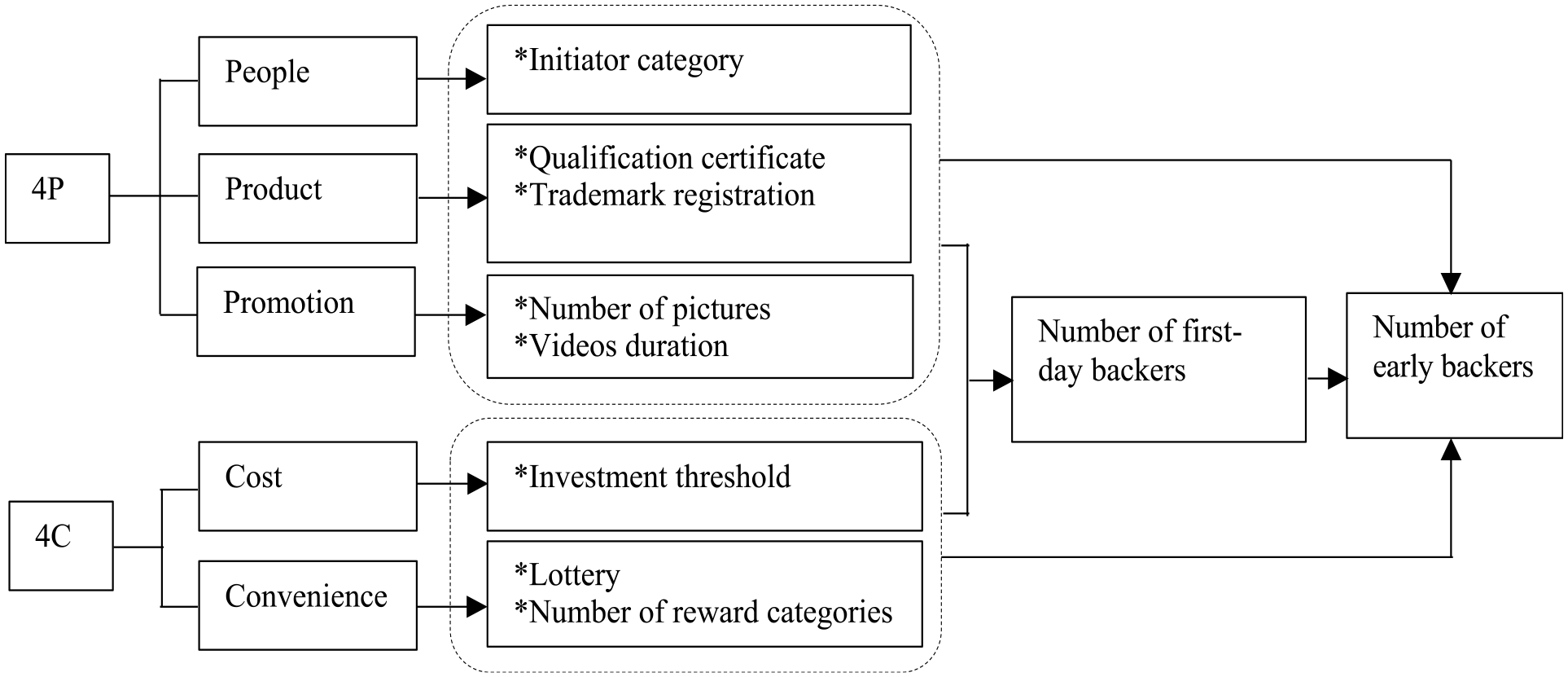
Research model.
4P Theory and Number of Early Backers in Crowdfunding
According to the 4P theory, a seller’s reputation has an essential impact on a commodity’s transactions. Typically, consumers believe that reputable sellers can provide high-quality products. In agri-food crowdfunding, an initiator’s credibility is a prerequisite for a transaction when backers conduct transactions with an unknown product holder, namely, the initiator. Text and pictures are the main ways to convey information about project initiators’ qualifications and identities in crowdfunding. Compared with individual ones, institutional initiators can show more legally valid certification materials to their backers, such as business licenses, production and operation licenses, and commodity-circulation certificates. For potential backers, institutional initiators’ default risk is low in terms of business scale and overall financial strength. Thus, I hypothesize the following:
For agri-food crowdfunding, campaigns with high-quality agricultural products can attract mass consumers to invest. To understand the quality of a product, potential backers are generally identified by browsing the product information posted online by initiators. Campaigns whose products have qualification certificates issued by authoritative institutions can easily win backers’ trust and investment. These qualification certificates, such as certificates of origin, geographical indications, organic products, and quality inspection reports, can reflect products’ high quality, thus enhancing backers’ trust in a campaign and attracting more backers to invest. Here, this paper holds the opinion that a product with a certificate issued by an authority can eliminate investors’ doubts and attract more backers to invest in the early stage of a campaign. Thus, I hypothesize the following:
The 4P theory proposes that enterprises should strengthen products’ publicity to improve their visibility and market influence in order to enhance their market share in the face of fierce market competition. Therefore, building an expeditious product-distribution channel can increase the attractiveness of agri-food crowdfunding to backers. Existing studies show that the number of videos and pictures displayed by initiators online positively impacts the success of crowdfunding campaigns (Ahlers et al., 2015). Abundant videos and pictures can fully reflect an initiator’s careful preparation for the campaign financing. Vivid pictures and videos in an agri-food-crowdfunding campaign can stimulate consumers’ senses and willingness to buy, thus attracting many backers in the early stage. Furthermore, more potential backers will invest under the influence of the herding effect. Thus, I hypothesize the following:
4C Theory and Number of Backers in the Early Stage
The 4C theory, a new marketing theory developed from the 4P theory, emphasizes the core position of consumers. A product’s value must match the consumers’ consumption-cost expectations. Consumers prefer higher-quality, low-cost products. Therefore, the monetary cost, which is the main cost borne by backers in crowdfunding, should be appropriately reduced from the perspective of the 4C theory. Ahlers et al. (2015) argued that lowering the investment threshold could decrease backers’ investment risk and motivate more potential backers to invest. The main participants in agri-food crowdfunding are backers who provide small amounts of money. Frydrych et al. (2014) concluded that the minimum investment amount set by the initiator significantly impacted the success of a campaign. Therefore, agri-food crowdfunding should set a reasonable minimum-investment threshold to meet the consumption needs of backers at all levels in order to obtain more money from backers. Thus, I hypothesize the following:
Providing convenience to consumers is among the core ideas of the 4C theory and can improve companies’ market competitiveness. For agri-food crowdfunding, appropriate measures should be developed according to backers’ needs and funds, such as establishing multiple levels of rewards and providing more investment options for backers. Cumming et al. (2017) pointed out that crowdfunding campaigns with more types of rewards could obtain funding quickly and thus achieve a better funding performance. In addition, lotteries are widely used in online sales as a promotional tool that can encourage speculative consumers to participate in crowdfunding. Currently, some projects on crowdfunding platforms have established lotteries to attract more potential backers. Therefore, initiators can exploit backers’ speculative mentality to establish appropriate lotteries in their projects to attract backers. Thus, I hypothesize the following:
Mediating Effect of Number of First-Day Backers
Information asymmetry is most severe on the first day of a campaign’s launch, affecting subsequent backers’ investment behavior. Therefore, it is meaningful to explore ways to attract more backers on the first day of a campaign. In the early stage of a crowdfunding campaign, backers will follow an investment trend, causing a significant herding effect. Therefore, an initiator must apply the 4P and 4C marketing theories to carefully design marketing strategies from the five dimensions of people, product, promotion, cost, and convenience in order to encourage supporters to invest as soon as possible. First, initiators’ reputations can influence backers’ investment decisions. Compared with individual ones, institutional initiators can reduce backers’ distrust perception by providing them with certificates such as business licenses and product-circulation licenses. Second, high-quality products can attract more backers. The quality of a product can be guaranteed by the quality certification issued by an authoritative organization. Third, videos and images in crowdfunding help promote product sales. Scholars have confirmed that the number of videos and pictures positively impacts crowdfunding success. Fourth, investment cost, as an important factor in backers’ investment decisions, should meet different crowdfunding backers’ multiple needs. Fifth, as one of the marketing strategies, providing consumers with rewards, a lottery, and other conveniences can attract crowdfunding backers’ attention.
For agricultural products with apparent seasonality and high storage requirements, timely funding from backers has an important impact on their production and sales. Moreover, it guarantees that backers can obtain fresh agricultural products on time. Severe information asymmetry in the early stages can cause a significant herding effect, leading to a considerable impact of the number of first-day backers in crowdfunding campaigns on subsequent backers’ investment decisions. In the mid to late stages of a campaign, the bystander effect will predominate. Typically, a campaign with more investors in the early stage can raise more money. The feeling of “fast, some, slow, none” in crowdfunding will drive potential backers to make quick investment decisions, which in turn creates a herding effect and accelerates a crowdfunding campaign’s success. Zhao et al. (2019) revealed that leading customers had a vital role in reward-based crowdfunding. Therefore, this study believes that a campaign with many backers on the first day will subsequently attract more backers due to the herding effect. Thus, I hypothesize the following:
Data and Variables
Data
As the earliest and most representative crowdfunding platform in China, Crowdfunding Net (www.Zhongchou.cn), founded in February 2013, is the largest crowdfunding platform for agricultural products. We selected 1,136 agri-food crowdfunding campaigns with complete information from the Crowdfunding Net platform from October 31, 2013 to February 28, 2018 as the research sample. The number of a campaign’s backers in the early stage and number of first-day backers were calculated from the crowdfunding records. Other data were directly collected from the platform.
Definition of Variables
To test the hypotheses, this study constructs several variables based on the 4P and 4C marketing theories, which correspond to the five dimensions of people, product, promotion, cost, and convenience. The dependent variable is the number of early backers. The independent variables, which are a mix of categorical and continuous variables, are shown in Table 1. Among the independent variables, the initiator category is the independent variable in the people dimension. A crowdfunding campaign’s product dimension is described by the qualification certificate and trademark registration. The number of pictures and video duration are used to measure the promotion dimension. The indicator for the cost dimension is the investment threshold. The convenience dimension is reflected by the lottery and number of reward categories. The number of first-day backers is a mediating variable. The control variables include the fundraising goal, funding success rate, and investment window.
List and Definitions of Variables.

Results
Descriptive Statistics
Table 2 reports descriptive statistics for the variables involved in the crowdfunding campaigns. The number of early backers ranged from a minimum of 1 person to a maximum of 524 persons, with an average of 35, indicating a wide variation in the number of early backers across campaigns. The agri-food crowdfunding projects initiated by institutional initiators accounted for 30% of the total. Few crowdfunding campaigns had trademark registrations for agricultural products. Most campaigns featured images and short videos in their project profiles. In 80.99% of the campaigns, the investment threshold was less than RMB 100. Some campaigns had established lotteries and less than five types of rewards. On the first day, 978 (86.09%) campaigns attracted fewer than 30 backers, which must be increased.
Distribution Statistics for Variables Reflecting 4P and 4C Marketing Theories (N = 1,136).
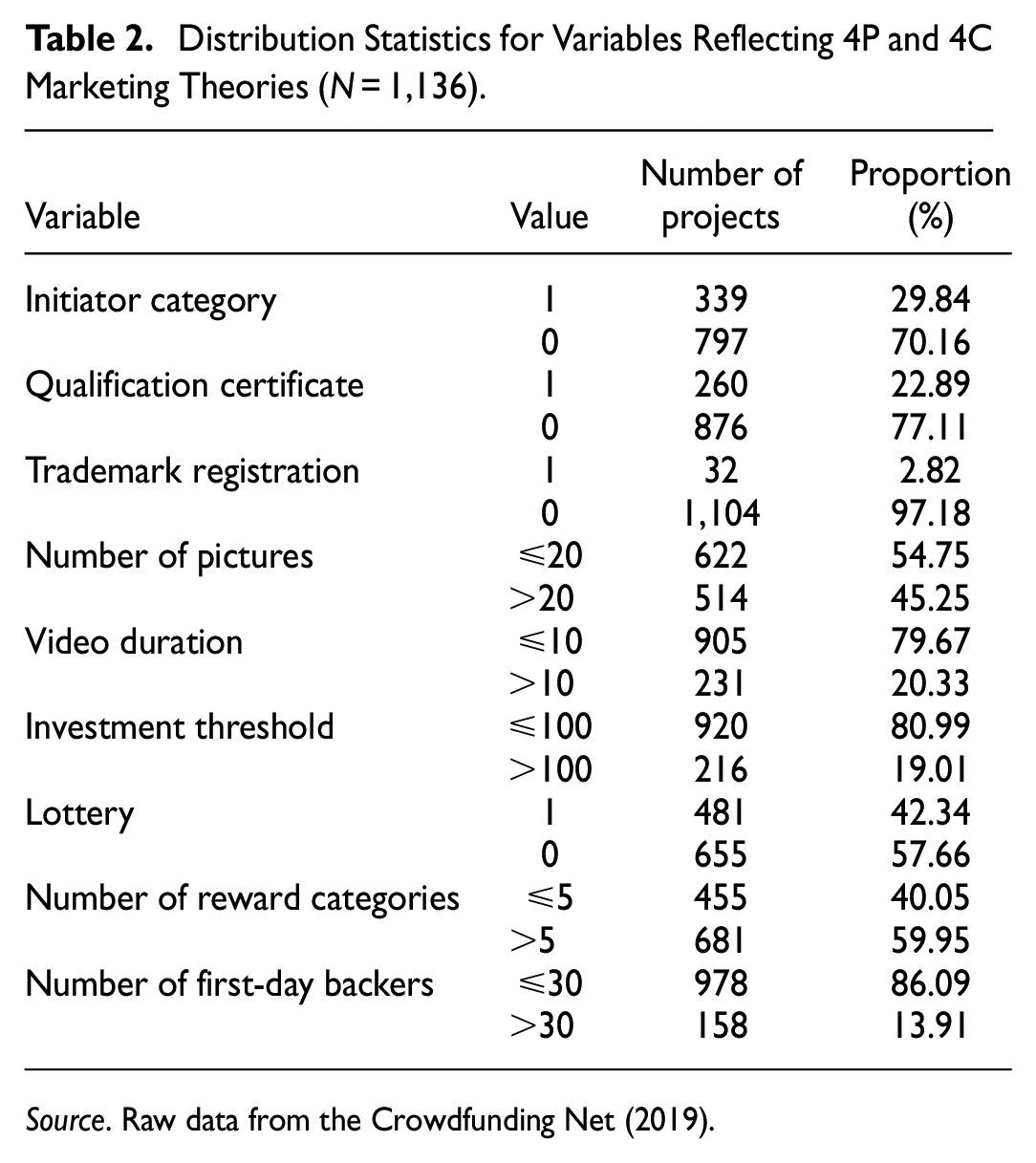
Source. Raw data from the Crowdfunding Net (2019).
Regression Analysis and Hypothesis Testing
Pearson correlation analysis showed that the correlation coefficients between the independent variables were less than 0.5, indicating that multicollinearity was insignificant. The reliability of the test data and regression equations were demonstrated by the variance analysis. Thus, the original hypothesis that all coefficients are zero should be rejected.
Referring to Baron and Kenny’s (1986) method, this study used the three-step test to explore mediating effects. In Model 1, the effects of three control variables (fundraising goal, funding success rate, investment window) on the dependent variable (number of early backers) were tested. Model 2 tested the effects of the control variables and independent variables on the dependent variable. In contrast to Model 2, Model 3 added a mediating variable (number of first-day backers) and tested the combined effects of the independent, control, and mediating variables on the dependent variable. Model 4 tested the effects of the control and independent variables on the mediating variable (number of first-day backers). The regression results for the hypothesis tests are shown in Table 3. The variable in the people dimension (initiator category) positively impacts the number of early backers, with a correlation coefficient of 0.395 at the 1% level, indicating that institutional initiators have a better reputation and can increase backers’ confidence in investing (Y. Li et al., 2020). Hypothesis H1 is supported. The qualification certificate and trademark registration are positively correlated with the number of early backers, with correlation coefficients of 0.219 at the 10% level and 0.630 at the 5% level, respectively, thus supporting H2-1 and H2-2. This indicates that agricultural products with quality certification are of good quality and can enhance early backers’ confidence to invest. However, the number of pictures (significance level of 0.475) and video duration (significance level of 0.608) failed to pass the significance test, indicating that the pictures and videos provided by initiators in agri-food crowdfunding have no influence on early backers’ investment decisions. H3-1 and H3-2 are not supported. However, Kolbe et al. (2022) confirmed that video pitches helped startups achieve higher valuations. The variable reflecting the cost dimension, the investment threshold, has a significant and negative effect on the number of early backers, with a correlation coefficient of −0.230 at the 1% level, thus supporting H4. Therefore, an agri-food crowdfunding campaign with a low investment threshold can attract many backers in the early stage. The number of early backers increases by 97.76 for every standard deviation decrease in the investment threshold. Similarly, Ma et al. (2022) found that a price incentive had a positive effect on funding performance in the funding stage. Lotteries and the number of reward categories have significant and positive effects on the number of early backers at the 5% level, with the correlation coefficients of 0.897 and 0.188, respectively, which supports H5-1 and H5-2. It shows that diverse rewards and lotteries can enhance early backers’ interest in a campaign (Gong et al., 2020). Model 3 demonstrates the significant correlation between the number of first-day backers and the number of early backers. Model 4’s results show the considerable effect of the initiator type, trademark registration, investment threshold, lottery, and number of reward categories on the number of first-day backers. The number of first-day backers is positively correlated with the number of early backers at the 1% level, with a correlation coefficient of 0.664, implying an increase of 21.44 in the number of early backers for each standard deviation increase in the number of first-day backers. Therefore, increasing the number of first-day backers can increase the number of early backers. The regression results from Models 2, 3, and 4 show that the five variables of initiator category, trademark registration, investment threshold, lottery, and number of reward categories are significantly correlated with the number of early backers (in Model 2) and number of first-day backers (in Model 4), while the number of first-day backers also has a significant effect on the number of early backers. The number of first-day backers can partially mediate the effects of the initiator category, investment threshold, and lottery on the number of early backers, and completely mediates the effects of the trademark registration and number of reward categories on the number of early backers.
Regression Results of Research Models.

Source. Raw data from the Crowdfunding Net (2019).
p < .1. **p < .05. ***p < .01.
Robustness Assessment
As shown in Table 4, to verify the robustness of the regression analysis and impact of the sample selection on the regression results, this study selected a sample of 823 campaigns with a fundraising goal of less than RMB 10,000 for the regression. The results showed that the regression coefficients and significance levels of the variables in the model did not vary significantly, verifying the robustness of the model. Furthermore, 569 successful projects with funding success rates no higher than 110% were selected for model-robustness testing, and the results indicated the robustness of the models.
Robustness Assessment: Samples with the Funding Target Below 10,000 Yuan (N = 823).

Source. Raw data from the Crowdfunding Net (2019).
p < .1. **p < .05. ***p < .01.
Conclusions
From a marketing perspective, evaluation models were constructed to examine the factors in the number of early backers and empirically investigate the impact of each factor on the number of early backers in agri-food crowdfunding. Based on the 4P and 4C marketing theories, backers’ investment-decision behavior and factors in crowdfunding were revealed. This study’s findings can help guide initiators to formulate a reasonable marketing plan for agri-food campaigns based on backers’ investment behavior to quickly raise funds and achieve successful crowdfunding. The results are as follows: First, as consumers, backers are more concerned about product quality in agri-food crowdfunding. Consequently, because the products in campaigns initiated by institutional initiators have qualification certificates that enhance the backers’ trust, the campaigns can attract many backers in the early stage. Second, to reduce the investment risk, early backers prefer to invest in an agri-food crowdfunding campaign with a small investment threshold, rewards, and lotteries. Third, early backers of agri-food crowdfunding campaigns generally make investment decisions based on rational thinking, not influenced by the pictures and videos provided by the initiators. They value the initiators’ credibility and rewards in a campaign. Fourth, early backers’ investment behavior in agri-food-crowdfunding campaigns exhibits a significant herding effect. A campaign that has many backers on the first day after launch will continue to gain many backers on the second and third days. Thus, the time to complete the fundraising goal will be shortened.
Implications for Theory
The theoretical contribution of this study is threefold. First, the factors in early backers’ perception of trust in crowdfunding and their mechanisms of action are analyzed from the perspective of marketing. Second, early backers’ investment-decision behavior in agri-food crowdfunding is rational. Third, the herding effect generated by the number of first-day backers in agri-food crowdfunding is validated. Previous studies mainly focused on the factors in the success of financing in agri-food crowdfunding, and they paid less attention to backers’ behavior. This study enriches the research on backers’ behavior and marketing research in agri-food crowdfunding.
Implications for Practice
From a practical perspective, this study suggests several implications for agri-food entrepreneurs. First, initiators in agri-food crowdfunding must fully consider early backers’ rational investment behavior when developing a project’s marketing plan from the perspective of the 4P and 4C marketing theories. Second, initiators should take advantage of the herding effect of the number of first-day backers to attract more backers’ investment in the early stage and achieve the fundraising goal as soon as possible. Third, initiators, crowdfunding platforms, and regulators should endeavor to improve backers’ trust perception in crowdfunding campaigns. Sound laws and regulations related to the crowdfunding industry and a credit system should be established to strengthen the supervision and punish trust-breaking behaviors, in order to force trust-breaking actors to strengthen their own management and improve their credit. Backers should be accorded the right to report and complain to reduce their investment risk, create a healthy and honest crowdfunding market environment, and accelerate the healthy development of the crowdfunding industry.
Footnotes
Declaration of Conflicting Interests
The author(s) declared no potential conflicts of interest with respect to the research, authorship, and/or publication of this article.
Funding
The author(s) disclosed receipt of the following financial support for the research, authorship, and/or publication of this article: The author would like to thank the High-level talent research start-up fund project of Hefei Normal University (grant number: 2022rcjj18) and the Social Science Planning Project of Anhui Province (grant number: AHSKF2018D62) for their financial support, and crowdfunding Net ( ) for supplying the data.