




Abstract
Online social networking sites are places where users spend a lot of their time and leave a huge number of narratives. In the virtual world of Facebook, moving in a space is limited to only a slight hand movement. The aim of this study was to examine the relationship between the level of Facebook intrusion, time perspective, and the contents of Facebook narratives. The participants were 83 Polish Facebook users, aged 18 to 62 years. We used the Facebook Intrusion Questionnaire, the Zimbardo Time Perspective Inventory, and the Linguistic Inquiry and Word Count program. The results suggest that Facebook intrusion is connected with the low future perspective of Facebook users. Moreover, the stronger the Facebook intrusion, the more swear words in Facebook narratives. There were significant positive relationships between a present fatalistic time perspective and words expressing aggression in Facebook narratives. The results were interpreted in the context of the theory of embodied cognition.
In the virtual world of Facebook, moving in a space is limited to only a slight hand movement, necessary to type on a keyboard or touch the screen. In the real world, what we look at and hear is related to the movements that our body undergoes when we move and perform various activities. There is no such dependence in the virtual world. There is also no connection between space and time in the virtual world—you can move virtually at one moment over very large distances on the Internet. In this article, we were looking for an answer to the question of how being in the virtual reality of Facebook is related to time. More precisely, the aim of the presented research was to examine the relationship between Facebook intrusion (Elphinston & Noller, 2011), time perspective (Zimbardo & Boyd, 1999, 2008), and the contents of Facebook narratives.
Social networking sites (SNSs) have become an important means of communication used for professional, private, recreational, and informational purposes. In addition to from Twitter, LinkedIn, and MySpace, Facebook is one of the most popular ones. It was launched in 2004 and currently has about 1.49 billion monthly active users, giving them the opportunity to communicate and share information (Facebook, 2017). For many people the virtual reality of Facebook is a daily reality that consumes even more time than reality. There is an increasingly problematic use of Facebook (Brailovskaia & Margraf, 2017; Chittaro & Vianello, 2013; Elphinston & Noller, 2011). Elphinston and Noller (2011) describe problematic Facebook use as a Facebook intrusion which is characterized by excessive attachment to Facebook, a loss of control over time spent on social networks and which deeply influences day-to-day activities. Facebook intrusion contains several symptoms: salience, tolerance, mood modification, relapse, withdrawal as well as conflict (Błachnio et al., 2015; Brailovskaia & Margraf, 2017). Facebook intrusion is expressed in the large amount of time spent on Facebook, distress in the case in which the use of Facebook is impossible, ineffective attempts to limit the use of Facebook, and very positive emotions during Facebook use.
Spending such a lot of time in a virtual world and involvement with this world has an influence on several aspects of life (Korkeila et al., 2010). A large number of studies examine the influence of Facebook use on the mental and physical health of Facebook users (Andreassen, 2015). Involvement in Facebook causes the loss of control and the need to spend more and more time on Facebook (Brailovskaia & Margraf, 2017). Facebook addiction can lead to negative outcomes namely was a predictor of depressiveness and insomnia (Brailovskaia et al., 2019) as well as increase the risk of suicide-related behaviors (Brailovskaia et al., 2020). Moreover, the results of research suggest that high preoccupation with Facebook is linked with problems with sleeping (Wolniczak et al., 2013; Woods, & Scott, 2016), somatic symptoms, such as stomachache, weakness, or headache (Cerruti et al., 2017). It turns out that Facebook use can lead to a decrease in well-being, especially if an individual has received negative feedback on Facebook (Valkenburg et al., 2006). The studies by Banjanin et al. (2015) and Błachnio et al. (2015) suggest a positive significant relationship between involvement in Facebook and depression. Moreover, the results of the research indicate that problematic Facebook usage has an influence on social relationships in the real world. Elphinston and Noller (2011) showed a positive correlation between Facebook intrusion and problems in romantic relationships. The research by Muise et al. (2009) suggests that the more time people spend on Facebook the more jealous they feel in romantic relationships. Problematic Internet use correlated positively and significantly with work- or school-related problems (Caplan, 2005; Kraut et al., 1998; Young, 1998). The study by Stronge et al. (2015) showed that using Facebook is positively correlated with body dissatisfaction.
In this article the relationship between Facebook intrusion and time perspective was tested. Time perspective is a general tendency to focus on the past, present, or future, connected with an emotional evaluation of a given area of time (Zimbardo & Boyd, 1999, 2008). Zimbardo and Boyd (1999, 2008) have distinguished five kinds of time perspective: past-negative—a tendency to focus on the past, which is connected with negative emotions; past-positive—a tendency to focus on the positively evaluated past; future—a tendency to think about the future, planning and formulating goals; present-hedonistic—a tendency to concentrate on pleasures in the here and now; present-fatalistic—a tendency to passivity, waiting for a destiny, connected with beliefs that time is beyond our control, and the future is determined by the fate.
The results of the research indicate a significant relationship between time perspective and several aspects of a physical and psychological functioning. For example, focusing on the negative past correlated positively with depression, fear, and problems in social relations, and the propensity for addiction (Howell & Zhang, 2011; Klingeman, 2001; Stolarski et al., 2014; Zimbardo & Boyd, 1999). Concentration on the positive past was positively related with social support, amicability, and energy (Bryant et al., 2005; Zimbardo & Boyd, 1999). Focusing on the future was related with health-promoting behaviors and academic achievements (Barber et al., 2009; Zimbardo & Boyd, 1999, 2008). Present hedonistic perspective was positively correlated with risky behaviors and addiction (Daugherty & Brase, 2010; Zimbardo et al., 1997). Present fatalistic perspective correlated positively with addiction, depression, and neuroticism (Howell & Zhang, 2011; Zimbardo & Boyd, 1999, 2008; Zimbardo et al.,1997).
Time perspective was also examined in the relationship with activity in a virtual world. The results of the research indicate a positive significant relationship between present time perspective and gambling and a reverse relationship between future perspective and gambling (Lukavska, 2012; MacKillop et al., 2006; Sharif-Razi et al., 2012). In the studies by Chittaro and Vianello (2013) and Przepiorka and Blachnio (2016), past-negative perspective and fatalistic perspective were predictors of problematic Internet use. Przepiorka and Blachnio (2016) obtained positive significant correlations between Facebook intrusion, past-negative perspective, present-hedonistic, present-fatalistic, and past-positive perspectives and a reverse correlation between Facebook intrusion and future perspective.
Online social networking sites are places where users leave a huge number of their narratives every day in the form of comments, notifications, and other types of verbal messages. That is why we used linguistic analysis of Facebook narratives, in addition to questionnaires, to measure time perspective. The Linguistic Inquiry and Word Count (Pennebaker et al., 2007) program was applied to the analysis of narratives. The language someone uses provides a rich and practical source of data (Kern et al., 2014; Pennebaker et al., 2003; Schwartz et al., 2014). Analysis of messages posted on social networks is an increasingly appreciated way of researching the psychological aspects of activity in the virtual world (see Naam et al., 2010). Naam et al. (2010) studied the characteristics of social activity and patterns of communication on Twitter. Three hundred and fifty Twitter users were surveyed. Naam et al. (2010) developed a content-based categorization of the type of messages. They distinguished two types of Twitter users: “Meformers” and “Informers.”“Meformers” usually post messages regarding themselves, their experiences, thoughts, and emotions. “Informers’” messages are informational in nature.
Park et al. (2016) analyzed messages posted on Facebook and Twitter to test the past, present, and future orientation of users. According to Park et al. (2016) questionnaires measuring time perspective based on self-report to some extent overlap with questionnaires measuring personality traits. For example, in the case of consciousness scale and future scale, there are very similar items on both scales. That is why it is also worth using a behavioral method to measure temporal orientation (Roberts et al., 2006). As a first step, Park et al. (2016) analyzed 6,000 messages from Twitter and Facebook. They analyzed users’ messages from the microblogging platform from Twitter, while from Facebook they analyzed 3,000 status updates from users of the MyPersonality application. Song lyrics, famous quotations, and post by bot were removed from analyses. Researchers also used LIWC (Pennebaker et al., 2007). The results of the research revealed that the older participants were the stronger future- and past-oriented and less present-oriented. Respondents who were more future-oriented were more satisfied with life and had fewer depressive symptoms than present-oriented respondents.
To summarize, to date, there has not been a study connecting Facebook intrusion with linguistic analysis of Facebook narratives. Moreover, researchers have not simultaneously used questionnaires and linguistic methods to test Facebook users time perspective. Finally, time perspective was examined as an independent variable in relation to Facebook intrusion, but it was not analyzed as a dependent variable, shaped by involvement in Facebook. Our study fills these gaps in existing knowledge about Facebook activity and time perspective.
In our study, we postulated that there would be a significant relationship between the level of Facebook intrusion, time perspective, and the contents of expressions regarding time in Facebook narratives. This relationship model is based on the embodied theory of cognition (Barsalou, 1999; Boroditsky, 2000; Boroditsky & Ramscar, 2002; Lakoff & Johnson, 1980; Margolies & Crawford, 2008; Niedenthal et al., 2005; Wilson, 2002). Embodied theory of cognition assumes that actions and objects are cognitively represented by sensomotory information (Mahon, 2015). This means there is a relationship between cognitive processes, emotions, body movements, and the position of the body in space. According to embodied theory of cognition, knowledge is “embodied”, that means grounded in bodily states. The body is closely related to the processing of social and emotional information (Niedenthal et al., 2005). Studies show, for example, that nodding a head when listening to a message is associated with a more positive attitude toward that message than shaking a head (Wells & Petty, 1980). In the study by Duclos et al. (1989), adopting body positions expressing anxiety, anger, and sadness modulated the affective state. Linguistic analyses show that words expressing downward direction are associated with negative affective states (e.g., being depressed) and those expressing upward orientation are associated with positive emotions (e.g., elevated mood; see Lakoff & Johnson, 1980).
Activity in Facebook is related to attitudes toward time in several aspects: it consumes a lot of time, there is no connection between space and time, and in Facebook time is governed by different rules. The user can freely return to various moments from the past, recorded on Facebook in the form of photos and entries by means of a slight hand movement on a keyboard or a screen, or can talk to someone in real time. While many abstract concepts of time have a common domain space (see Lakoff & Johnson, 1980; Niedenthal et al., 2005). The results of the research confirm relationships between the experience of space and attitudes toward time (Boroditsky, 2000; Boroditsky & Ramscar, 2002; Lakoff & Johnson, 1980; Lee & Ji, 2014; Margolies & Crawford, 2008). Facebook intrusion is characterized by the large amount of time spent on Facebook (Elphinston & Noller, 2011) and the loss of control in using Facebook (Brailovskaia & Margraf, 2017). Facebook users can move freely between the past and present and also have the impression that time stands still when the people on Facebook still look the same in the pictures, which are attached to verbal messages. On the one hand, it can give you a sense of independence from time, but on the other hand, a sense of lack of control over time. Activity on Facebook is based on visual tracking of images, words, and other characters appearing on the screen of the monitor, telephone, or other similar device. Sensual, tactile, and aromatic sensations associated with changing body position are not related to what is happening on the observed monitor. Therefore, it is probable that the stronger the involvement in Facebook’s virtual world, the weaker the experience of real physical space and oneself in space-time. Emotions and thought of Facebook users are expressed in the form of comments posted on Facebook pages. That is why we proposed the relationships between Facebook intrusion, time perspective, and the content of expressions on Facebook. We assume that frequent presence in Facebook virtual reality and preoccupation with it affects time perspective, especially since time perspective is a variable susceptible to environmental influences and intentional action (van Beek et al., 2009, 2011; Zimbardo & Boyd, 1999, 2008; Zimbardo et al., 1997).
Based on theoretical reflections and previous studies, we formulated the following specific hypotheses and a research question:
Hypothesis 1: There is a negative relationship between Facebook intrusion and a future perspective.
Hypothesis 2: There is a significant positive relationship between the level of Facebook intrusion and a present fatalistic perspective.
Hypothesis 3: There is a significant negative relationship between the level of Facebook intrusion and number of words regarding time in Facebook narratives.
Research Question: What are the relationships between Facebook intrusion, time perspective, and contents of Facebook narratives regarding other aspects of human functioning?
Method
Participants
The participants (aged 18–62 years, M = 24.86, SD = 7.24) were N = 83 Polish Facebook users (50 females and 33 males). Most of the participants had secondary school education (39%); others university (32%), or primary school education (29%). Respondents participated in the research voluntarily, and they did not receive payment. Potential participants were selected at random. They were informed about the aim of the study and were asked if they wished to participate in this study. Participants who agreed were given a link to the set of questionnaires. The respondents were selected at random. All studies were conducted online. All participants had no serious health problems. The studies were carried out between October 2017 and May 2018. Ethical standards for Internet-based research were maintained. The necessary sample size was determined using the G*Power program (Erdfelder, 2007). We based on the average effect size in individual differences research (r = .20; Gignac & Szodorai, 2016). The power analysis was applied to the correlation analyses and the regression analyses. The power test analysis that indicated the size of the group allows for the detection of the average effect with a power of 0.88.
Procedure
The respondents filled in questionnaires via the Internet. All participants returned them. The tasks were completed in all tests. Comments and messages posted on their Facebook pages in the last 6 months were collected.
Measures
The Facebook Intrusion Questionnaire (Elphinston & Noller, 2011; the Polish version by Błachnio & Przepiorka, 2016) was used to measure preoccupation with Facebook. High scores indicate that the respondent spent a lot of time on Facebook, felt stressed when the use of Facebook was impossible, unsuccessfully tried to limit the use of Facebook, and was excited when using Facebook. This scale consists of eight items (e.g., “I often use Facebook for no particular reason”) measured on a 7-point Likert scale from 1 (strongly disagree) to 7 (strongly agree). Cronbach’s coefficients alpha values ranged from .76 to .91, depending on the country.
Zimbardo Time Perspective Inventory (ZTPI; Zimbardo & Boyd, 1999; Polish version by Przepiorka et al., 2016) was used to measure time perspective. This questionnaire consists of five scales: past-negative—to test focusing on a negatively evaluated past; present-hedonistic—to measure focusing on pleasures here and now; present-fatalistic—to test passivity in the present connected with the belief that the future is determined by fate; past-positive—to measure focusing on a positively evaluated past; future—to test thinking about the future, planning, and formulating goals. Respondents answered on the 5-point Likert scale from 1 (very untrue of me) to 5 (very true of me). Cronbach’s alphas in the Polish version of ZTPI were as follows: .86 for Past Negative, .80 for Present Hedonistic, .74 for Present Fatalistic, .69 for Past Positive, and .81 for Future.
Linguistic Inquiry and Word Count (LIWC) program (Pennebaker et al., 2007; Polish adaptation by Szymczyk et al., 2012) was used to analyze the contents of Facebook narratives. Linguistic Inquiry and Word Count 2007 contains a set of predefined categories of words and word stems. The outputs of this program are in the form of percentages of a text falling into a given category (e.g., a score of 6.54 on causations indicates that 6.54 % of the words in the text are in the causations category). Categories of words include the main linguistic dimensions (e.g., unique words, words containing more than six letters, nouns); affective (e.g., happy, ugly, bitter), cognitive (e.g., cause, know, ought), sensory (e.g., see, touch, listen), and social constructs (e.g., talk, us, friend); categories related to time (e.g., hour, day, oclock), space (e.g., around, over, up), and movement (e.g., walk, move, go); domains connected with personal functioning (work, leisure, money, metaphysical issues, and physical state). The results of the research suggest a good external validity of a LIWC, 2007 (Hirsh & Peterson, 2009; Weston et al., 2016). We analyzed narratives for spelling accuracy, and mistakes were corrected.
Statistical Analyses
We used SPSS Statistics 26 software to analyze data. We computed the internal consistency using Cronbach’s alpha for all scales (Table 1). Descriptive statistics (M, SD) were estimated on sample characteristics. In order to estimate the differences between women and men in terms of studied variables, t-tests were performed. Correlation analyses was conducted to investigate the general relationships between Facebook intrusion, time perspective, and the contents of Facebook narratives. We used hierarchical multiple regression analysis to test the relationship between Facebook intrusion and time perspective.
The Correlations Between Facebook Intrusion and Time Perspective.

Note. ZTPI = Zimbardo Time Perspective Inventory.
p < .05. **p < .01. ***p < .001.
Results
Scores on FIQ and ZTPI were normally distributed. There were no significant differences between men and women in the results of these questionnaires. The correlations showed that Facebook intrusion was significantly negatively related to future perspective, r (83) = −.26; p < .05. There were no significant correlations between Facebook intrusion and others type of time perspective (Table 1).
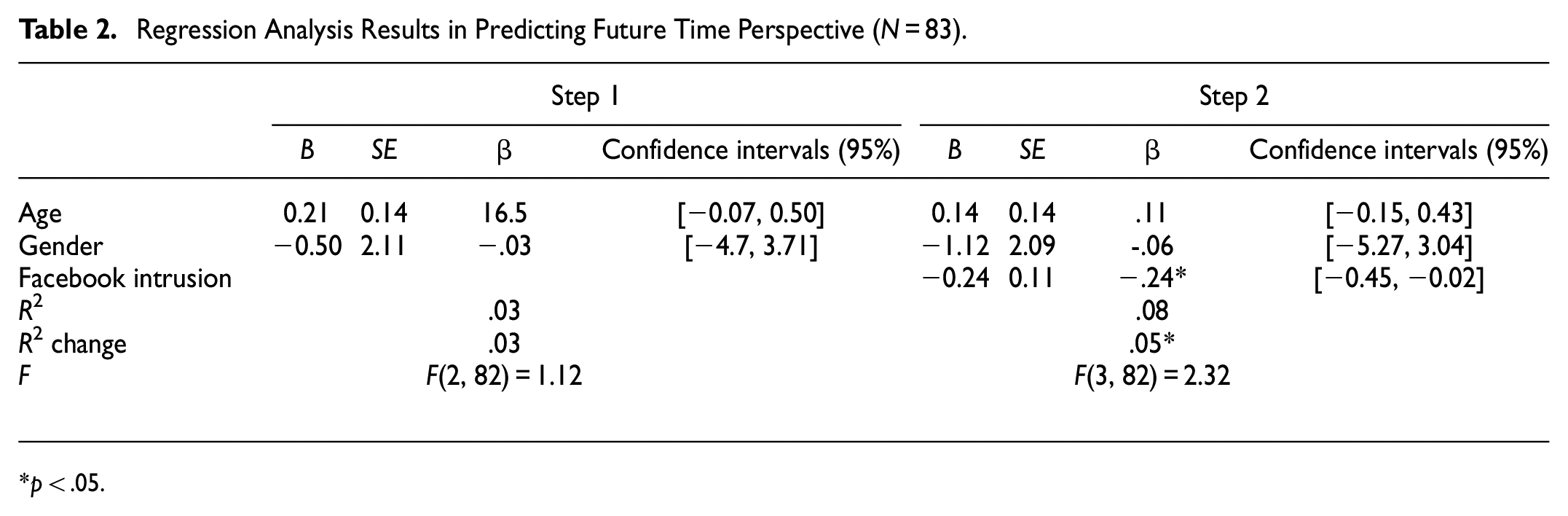
Hierarchical multiple regression analysis was used to test the associations of demographic variables and Facebook intrusion with time perspective. Demographic variables (age and gender) were entered in the first step, while Facebook intrusion was added in the second step. Based on the results of a correlation analysis, we introduced only future time perspective as a dependent variable (Table 2).
Regression Analysis Results in Predicting Future Time Perspective (N = 83).
p < .05.
In the first step, gender and age of participants turned out not to be predictors of future time perspective. Introducing Facebook intrusion in step 2 led to a significant increase in the explained variance. Facebook intrusion predicted negatively future time perspective, β (83) = −.24; p < .05 (Table 2).
We conducted correlation analyses to investigate relationship between Facebook intrusion, time perspective, and the contents of Facebook narratives (Table 3). There was no significant relationship between Facebook intrusion, words regarding time, and number of verbs in future tenses. However, there were positive, significant relationships between Facebook intrusion and the number of swear words r (83) = .15; p < .05 in Facebook narratives, and negative correlations between Facebook intrusion and words concerning money r (83) = −.15; p < .05 (e.g., “for those moments that no money can buy them”) and TV (e.g., “to be as great as Hollywood cinema”). Moreover, the results showed a significant relationship between time perspective and the contents of Facebook narratives. There were positive significant correlations between future perspective and the number of words regarding seeing (e.g., “you haven’t seen it yet”) and money. Past-negative perspective correlated significantly negatively with words expressing causality (e.g., “so I thought that after a few months I would achieve this effect”) and words regarding home (e.g., “I can have such mirrors at home”). A present-fatalistic perspective was correlated with the number of words expressing anger (e.g., “I think I’m living out of spite”).
The Correlations Between Facebook Intrusion, Time Perspective, and Selected Categories From Linguistic Inquiry and Word Count.

p < .05. **p < .01.
Discussion
The aim of this article was to test the relationship between Facebook intrusion, time perspective, and the contents of Facebook narratives regarding time. The results of our study were partially consistent with the hypotheses. As we supposed (Hypothesis 1), there was a significant reverse relationship between Facebook intrusion and future perspective. In a statistical sense, Facebook intrusion weakened Facebook users’ concentration on the future. In the context of the concept of embodied cognitions (Barsalou, 1999; Boroditsky, 2000; Boroditsky & Ramscar, 2002; Clark, 1997; Lakoff & Johnson, 1980; Lee & Ji, 2014; Mahon, 2015; Margolies & Crawford, 2008; Niedenthal et al., 2005; Prinz, 2003; Wilson, 2002), it can be said that Facebook users do not have the physical experience of the constant, continuous passage of time on Facebook. Embodied theory of cognition assumes the connections between actions, emotions, body movements, the position of the body in space, and objects which are cognitively represented by sensomotory information (Mahon, 2015). That is why knowledge is grounded in bodily states (Barsalou, 1999; Boroditsky, 2000; Boroditsky & Ramscar, 2002; Clark, 1997; Lakoff & Johnson, 1980; Lee & Ji, 2014; Mahon, 2015; Margolies & Crawford, 2008; Niedenthal et al., 2005; Prinz, 2003; Wilson, 2002). While Facebook users do not have experiences of space-time—they do not move and do not change their position in space to move in time. They “exist” as attractive photos on Facebook, which are usually permanent over a long time. Moreover, there are representations of the past (photos and messages from the past) and representations of the present time (current photos and messages), but there are no representations of the future on Facebook. That is why the more people are involved in this virtual world of Facebook, the less they think of the future. It is possible to do a lot of activities by means of social networking sites, it can be done now, without waiting. Users do not wait to meet their friends in real life; they can do it now on Facebook.
Contrary to the Hypothesis 2, the results of our study indicated a lack of significant relationship between Facebook intrusion and a present-fatalistic perspective. This result is different from the results obtained by Błachnio and Przepiorka (2016). They obtained positive significant correlations between Facebook intrusion and past-negative perspective, present-hedonistic, present-fatalistic, and past-positive perspectives and a reverse correlation between Facebook intrusion and future perspective. While they measured time perspective by employing the Polish short version of the ZTPI developed by Cybis et al. (2012), in our study the full version of the ZTPI was applied.
Contrary to the Hypothesis 3, there was no significant relationship between Facebook intrusion and the contents of Facebook narratives concerning future and time. However, our results suggest some interesting relationships between Facebook intrusion, the time perspective of Facebook users, and the contents of their Facebook narratives. The positive relationship between Facebook intrusion and number of swear words may connect with the level of aggression and frustration in users highly involved in Facebook. The results of the research confirm that problematic Facebook usage is related with dissatisfaction and bad mood (Caplan, 2005; Stronge et al., 2015; Young, 1998). Reverse correlations between Facebook intrusion and words regarding money and TV can be seen in the study by Naam et al. (2010), who distinguished two types of Facebook users: “Meformers” and “Informers.” Assuming that words related to money and TV come from messages aimed at providing information on, for example, movies, prices, and purchases, the results of our research suggest that people highly involved in Facebook are rather “Meformers” than “Informers.”
The results showed that the higher the level of present-fatalistic perspective, the more the aggression in Facebook narratives which may suggest that a sense of lack of control over time and life causes anger. Because persons with a high level of fatalism feel powerless and inefficient, their anger is also powerless, expressed in the form of symbols on the Internet.
The results indicating connections between focusing on the future, thinking of the future, or in other words, looking ahead, and words expressing seeing in Facebook narratives are also intriguing. People who concentrate highly on the future are usually focused on financial issues (Zimbardo & Boyd, 1999, 2008), so it is easy to interpret a positive correlation between future perspective and number of words concerning money, while an interpretation of reverse correlations between past-negative perspective and words regarding causation and home is not so obvious. Perhaps it means that people with strong negative-past perspective want to cut themselves off from the unpleasant past; they prefer not to notice the cause-effect relationship between the past and the present. They are also reluctant to come back in their mind to their childhood and family house. These entertaining relationships between Facebook users’ time perspective and the contents of their Facebook narratives should be made the subject of further research.
The present study has some limitations. The study had a correlational nature, which is why we can only speak about the statistical impact of Facebook intrusion on time perspective. Further research is required to test causal relationships between these two variables—experimental studies and longitudinal studies are especially needed. Another limitation is the small size of the sample. Future research should examine a generalization of these results with samples representing a variety of populations. The next possible limitation pertains to analyzing only the contents of Facebook narrative. Other social networking sites should be analyzed in future studies.
The result of our study may have implications for practitioners. They suggest that when working with people highly involved in Facebook, special attention should be paid to the future perspective of these people. Therapeutic work should focus on, among other issues, practicing planning skills and formulating goals for the future, and on discussions about the future. It would be worth checking, in further research, what effects there are for people highly involved in Facebook by visiting Facebook pages devoted to planning the future and thinking about the future. This kind of exercise could be offered to patients with intense Facebook intrusion. The presented results also indicate the importance of psychological work on increasing the sense of control over time in people using verbal aggression on the Internet.
The presented study has increased the knowledge concerning activity on Facebook and regarding time perspective. This study is the first to examine the impact of Facebook intrusion on time perspective and the relationship between Facebook intrusion, time perspective, and the contents of narratives in Facebook. The results of the presented study add to previous research which suggests that Facebook intrusion impacts future time perspective. It can be said that in the virtual world of Facebook, there is no future. These results also indicate the relationships between time perspective and the contents of Facebook narratives. In summary, there is a significant relationship between Facebook intrusion and future time perspective. People highly involved in Facebook may have serious problems with thinking about the future, formulating plans, and realizing future aims. Additionally, a present-fatalistic perspective can be combined with verbal aggression on the Internet. The results of the present study can be used in psychological work with people highly involved in Facebook.
Footnotes
Declaration of Conflicting Interests
The author(s) declared no potential conflicts of interest with respect to the research, authorship, and/or publication of this article.
Funding
The author(s) disclosed receipt of the following financial support for the research, authorship, and/or publication of this article: Preparation of this manuscript was supported by the grant “Time perspective and circadian rhythm disruptions as predictors of stress and postpartum depressive symptoms: A longitudinal study” 2019/35/B/HS6/00611 from the National Science Centre (Poland).
Ethical Approval
The study protocol and the consent procedure received approval from the ethics committee (University of Wrocław Ethic Committee, consent number IPE 0048, 03.01.2019).
Compliance Eith Ethical Standards
The authors of this manuscript have complied with APA ethical principles in their treatment of individuals participating in the research, program, or policy described in the manuscript. The research has been approved by the ethics committee (University of Wroclaw Ethics Committee, IPE 00143).
Consent to Participate
Informed consent was obtained from all individual participants included in the study.
