




Abstract
Visual art is a fast-expanding field in Malaysia, especially on the development and exploration of visual appearances in visual artworks. Based on the researchers’ observation, research which are focused on producing guidelines for rules and regulations in visual art from the Islamic perspective are scarce. In all, there is only one reference that is relevant to guidelines for visual art which was produced in 1987; no improvement is implemented since then. Moreover, the guideline covers matters pertaining visual appearance in general. For this paperwork, the objective is to produce a checklist for two-dimensional visual appearance in Malaysian Visual Art. Hermeneutic intrinsic case study is the research design applied and the researchers utilize systematic review approach as well as information from interviews with experts to learn about the practices in visual appearance in the current context. Results from both types of data are analyzed using the triangulation method to produce a two-dimensional visual appearance checklist. This checklist will be used in collecting Islamic Shariah perspectives with regards to current situations in visual art.
An Overview of Malaysian Visual Art and It’s Influenfed
Malaysian visual art development involves several genres such as contemporary visual art, Islamic art, Muslim art, traditional art, and crafts. All these genres are influenced by three main factors namely: (1) socio-political situation, and government policy which influences visual art; (2) development in local visual art education; (3) The role of Islamic Institutions in the development of Visual Art in Malaysia; and (4) Visual art exhibitions with Islamic theme.
Socio-Political Situation, Socio-Cultural, and National Policy Which Influences the Development of Visual Art in Malaysia
The state of socio-politics in Malaysia since its independence in 1957 is governed by Democratic Parliamentary System based on the Constitutional Monarchy approach; that makes the Seri Paduka Baginda Yang Di-Pertuan Agong as the nation’s Supreme Head; and the country is administered by a Prime Minister. Seri Paduka Baginda Yang Di-Pertuan Agong is chosen among nine Malay Rulers (Raja-Raja Melayu) by rotation according to decision made by The Conference of Malay Rulers or Majlis Raja-Raja Melayu (Malaysia has nine states with Sultans who are the Head of States); and the Prime Minister is chosen through general election and the candidate is one of the parliament members. He is selected among the Malays who speak Bahasa Melayu, a Muslim and practices the Malay tradition and customs.
Socio-culture among the communities in Malaysia is based on the multi-cultural society which was formed since the independence in 1957. Geographical factors are also the fundamentals of various art, culture, and heritage that are unique to Malaysia. Malaysians are basically divided between bumiputera (natives) and non-bumiputera (non-natives). The bumiputera is represented by the Malays (in the constitution, the Malays are those who speak Bahasa Melayu, a Muslim and practice the Malay’s customs and traditions; from Commissioner of Law, 2010), the aborigines and indigenous tribes in Sabah and Sarawak; the bumiputera has its own privileges as allocated in the Malaysian Federal Constitution (Commissioner of Law, 2010). However, the Indians and Chinese as well as other ethnic groups are categorized as non-bumiputera; their rights are protected in the Malaysian Federation. The composition of Malaysian population in 2020 is 32.7 million people; the number is divided among the Bumiputera at 69.6%, Chinese 22.6%, Indian 6.8%, and others 1.0%; more than 60% of the Malaysians are Muslims.
Malaysian Socio-political and socio-cultural background has directly influenced the development of a dynamic, local visual art. There are efforts to form the Malaysian identity framework and some of the government policies are Federation of Malaya (1957, changed to Federal Constitution of Malaysia in 1963), Malay Culture Congress or Kongres Kebudayaan Melayu (1957-1958), National Cultural Congress or Kongres Kebudayaan Kebangsaan (1971), National Cultural Policy or Dasar Kebudayaan Kebangsaan (1971), Culture Congress or Kongres Budaya (2017), and National Culture Policy or Dasar Kebudayaan Negara (DAKEN 2021).
The main influential factor in visual art is the Federation of Malaya 1957 (and later gazetted as Federal Constitution of Malaysia 1963) clearly stated that the Islam is granted as the official religion of the Malaysian federated Malaya and Malaysia, and matters pertaining the privileges of the Malays are included in the constitution (Commissioner of Law, 2010). In an article by Zakaria (2012), Omran Zailuddin (2017), and Omran Zailuddin et al. (2018), after Malaysia obtained its independence on 31st August 1957, a Malay Culture Congress in 1957 was carried out on 30th December 1957 to 2nd January 1958, and it was stated in its resolution “The first Malay Culture Congress is for us to make decisions and progress to renew our national culture on the basis of our heritage as we search for nationality in this blessed nation that is changing with a new pattern. In this transformation, the Malays and their culture must be the basis of our national cultural growth which will expand and earn its place among the cultures of other communities in the future.” This resolution is the continuation of the efforts in upholding the Federation of Malaya 1957 to create a national identity in Malaysia at that time.
Then, in 1979, National Culture Congress was formed to create a national art and culture resolution. As a result, one National Cultural Policy has been gazetted after being presented in the National Parliament and three major elements have become the structure to form a national identity that are: (1) Malaysian national culture must be based on the culture of people from this region; (2) Other cultural elements that are suitable and reasonable can be accepted as part of the elements of National Culture; and (3) Islam becomes an important aspect in the development of this National Culture (Dasar Kebudayaan Kebangsaan [National Cultural Policy], 1971; Omran Zailuddin, 2017; Omran Zailuddin et al., 2018; Wan Mohd Daud, 2017). Clearly, national culture must be formed through these three main frameworks. In several studies, Omran Zailuddin (2017) and Omran Zailuddin et al. (2018) had analyzed a number of visual artwork which were selected among the young artists in the millennium, based on the framework of National Culture policy; and it was found that the visual artwork created were still in line with the framework that exists in the policy. In 2017, the government had organized a Cultural Congress to observe the latest development after National Culture Policy 1971, 46 years ago. As a result, the most significant issue which was highlighted in the implementation of Cultural Resolution (Resolusi Budaya) 2017 was to strengthen and uphold the Federal Constitution in which there are matters pertaining the dignity of Islam and the privileges of the Malays.
In short, even though the socio-political situation in Malaysia is organized by the Malay rulers; in terms of socio-culture, Malaysia does not practice the principles of “cultural assimilation” which could threaten and destroy our culture and religion of the Chinese, Indians, and others. Malaysia practices the principles of “cultural acculturation” which celebrates the diversity in culture and religious beliefs in a harmonious situation. National Culture Policy does not only embrace the culture of people from this region, but it also accepts other cultures and Islam remain as the important element and concept in forming a culture. It is undeniably the most accurate policy in celebrating the diverse multicultural society of different races.
Visual Art Education in Malaysia
From the aspect of visual art development in education field, there were several local students who were given scholarships (from the government or private institutions) to study visual art in the era of 1950s. They were sent to pursue their studies abroad (especially in Europe and America) to obtain a degree and postgraduate studies; and these students were offered places to be lecturers in local colleges and universities. They had learned modern visual art and applied them in the creation of their visual artwork and emerged as visual art artists (Ramli, Masrek, Ab Gani, Md Zain, Osman, et al., 2017).
After graduation, these visual art artists had actively involved in many local and international exhibitions. Moreover, they had formed visual art groups such as Wednesday Art Group and Matahati (just to name a few; Mahamood, 2001). Next, higher learning institutions which offer visual art programs (also known as fine art) are Universiti Teknologi MARA (UiTM, formerly known as Institut Teknologi MARA), Universiti Sains Malaysia (USM), Universiti Malaysia Sarawak (UniMaS), Universiti Malaysia Sabah (UMS), Universiti Malaysia Kelantan (UMK), Malaysia Insitute of Art (MIA), Universiti Malaya (UM), and many other colleges. Some of the visual art artists were appointed as teachers or lecturers at visual art institutions in Malaysia. Visual art artists who studied abroad and came back to Malaysia appointed as teachers or lecturers were Syed Ahmad Jamal, Sulaiman Esa, Khatijah Sanusi, Dzul Haimi Mohd Zain, Ponirin Amin, Jalaini Abu Hassan, Ramlan Abdullah, Sharmiza Abu Hassan, and many others.
For courses in visual art, which is related to Islam, only Universiti Teknologi MARA offers a subject entitled Islamic Art to both undergraduate and postgraduate students; however, it is part of elective subjects. In addition, there is no specific program that is offered to discuss “the perspective of Islam on visual art.” Even though Malaysian institutes of higher learning are dominated by Malay and Muslim academicians, but comprehensive discussions and collaborative efforts among academicians in Islamic art or Islamic perspectives on visual art is still lacking. There are a few opinions and guidelines produced by Islamic Institute in Malaysia on visual art issues (this will be elaborated in the next sub-topic) and improvements in collaboration between higher learning institutions with Islamic Institutions to ensure the development of contemporary visual art. Universities must ensure that issues on visual art are discussed collectively with Islamic institutions according to the context of current development specifically in Malaysia.
The Role of Islamic Institutions in the Development of Visual Art in Malaysia
Islam in Malaysia is constitutionally the country’s official religion (Commissioner of Law, 2010). In Malaysia, Islamic governance is divided into several situations: (1) governed by the Sultan as Head of Islam for states with Sultans; and (2) Islam is governed by Yang Di Pertuan Agong as Head of Islam for states or federal territories without a Ruler (Commissioner of Law, 2010). Moreover, in Malaysian legal system, the country has a dual court structure namely the civil court and the Shariah court. Shariah court is established out of state law and in line with the existence of Islamic Council in each state in Malaysia. Unlike civil court, the Shariah courts have jurisdiction over matter pertaining Islam as stated in the Malaysian Federation (Commissioner of Law, 2010). Matters pertaining Islam and people professing the religion, as well as visual art, must be parallel with the Malaysian Federation as it is under the jurisdiction of the Federal Constitution, State Federation, Islamic Council, and state Shariah court for each state in Malaysia. With this regulation, the status and sanctity of Islam is preserved without having to deal with other religions and their followers.
Based on the analysis, there were efforts by the State Islamic Council since 1970 to discuss visual art issue. More than 50 fatwas have been produced by State Islamic Council; however, the view of the fatwa is on “case-by-case basis,” and it does not provide an insight into the whole picture of visual art in Malaysia. In 1987, Malaysia Islamic Council (now Department of Islamic Malaysia, JAKIM) produced a guideline entitled “Garis Panduan dan Penjelasan Mengenai Seni Tampak dari Kaca Mata Islam” or Guidelines and Explanation on Visual Art from The Islamic’s Perspective (Jabatan Kemajuan Islam Malaysia, 1987). However, based on the researcher’s study, there has been no improvement even though the guideline is now more than 30 years old; and the Malaysian local visual art scene has grown by leaps and bounds since then. Hence, efforts to improve the guideline for visual art practitioners are crucial; and the same goes to visual art enthusiasts in general, who need the guidelines to sustain creative art industry which complies to Shariah laws.
Islamic Visual Art exhibitions
There are various visual art exhibitions conducted in Malaysia; and some of them are visual art exhibition with Islam as its main theme. From the researcher’s observation, there were 20 visual art exhibitions with Islamic theme in Malaysia. Other than shaping the national identity, these exhibitions signify the awareness among visual art practitioners who have obtained an understanding of Islam and they apply the elements of Islam in the process of producing their art. Table 1 shows the list of visual art exhibitions with Islamic theme in various parts of Malaysia.
List of Islamic-Related Visual Art Exhibition in Malaysia.

Source. Ramli (2021).
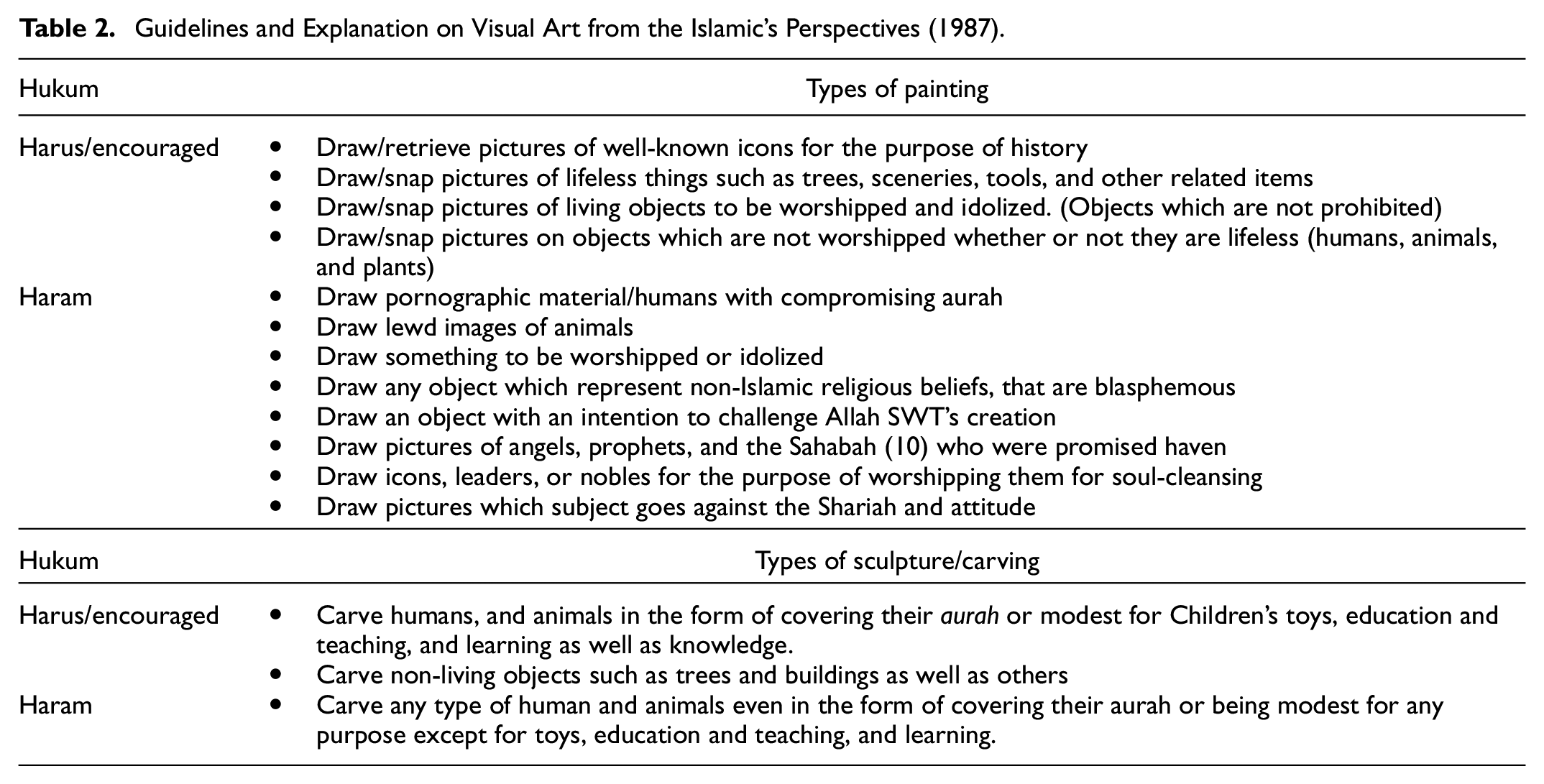
Guidelines and Explanation on Visual Art from the Islamic’s Perspectives (1987).
Collectively, these exhibitions encourage the spirit of diversity in the creation of visual art and trends which are celebrated through an Islamic approach. Most of the visual artwork apply western visual art approach which is based on using canvas on easel and they are exhibited in the gallery. Acceptance of philosophical background and theory from the west must be thoroughly discussed from the aspects of formalistic, content, philosophy, and psychology. These exhibitions are in line with the elements in National Culture Policy (Dasar Kebudayaan Kebangsaan) that are elements of other suitable cultures (western culture and visual art). They must be accepted as part of the elements of National Culture; and Islam becomes a crucial element in filtering the diversity of other cultures (western visual art).
Research Problem and Objective
Since the visual art scene in Malaysia is monopolized by the Malays (who are Muslims); and Islam is acknowledged as the official religion of the federation as stated in Malaysian Federal Constitution (Federal Constitution, 2010) and as an important element in National Cultural Policy (Dasar Kebudayaan Kebangsaan [National Cultural Policy], 1971), it is crucial to study visual art from the perspective of Islam. Visual art and its Islamic connection is dominated by two main movements known as “Islamic art” and “Muslim art” genres (Ali, 1993, 2006; Feldman, 1967; Hamidon, 2012; Ramli, Masrek, Ab Gani, Md Zain, Osman, et al., 2017; Soganci, 2005; Wan Mohd Daud, 2017). Nevertheless, the development of contemporary visual art in this country has relied heavily on visual art approaches from the West instead of “Islamic art” and “Muslim art.”
Based on the observational research on visual art development from the Islamic perspective in Malaysia, there is only one guideline which states its rules and regulations (Jabatan Kemajuan Islam Malaysia, 1987). In that guideline, a general discussion on visual appearance revolves around two types of visual arts namely: (1) painting; and (2) carving. From the researchers’ observation, these two types of visual arts involve two kinds of dimensions on visual appearance that could be explained as these: (1) paintings involving two-dimensional visual art—2D; and (2) carvings which are made of three-dimensional visual art—3D (Ramli, Masrek, Ab Gani, Md Zain, Osman, et al., 2017). Discussions on these issues are too general and they refer to only several types of visual subjects such human, animal, plants, and man-made objects. Unfortunately, no information is available for other variety of visual styles. The guidelines are listed below:
The absence of a thorough discussion on such issues creates a gap in guidelines (Jabatan Kemajuan Islam Malaysia, 1987) for Islamic compliant visual artwork production that could be checked and re-examined. There are many types of visual appearance produced by contemporary visual art artists which are not listed in the guideline ; such as visual appearance which combines the image of human and animal, and a combination of animal and other animal (printing art by Samsudin Wahab, refer to Figure 1; Ramli, Masrek, Ab Gani, Md Zain, Osman, et al., 2017). Figure 1 shows visual appearance that has a combination of human and another human, and human and animals which were not discussed in the 1987 guideline.

Bab III Jelmaan, Samsudin Wahab, 21 cm × 21 cm, Etching & Aquatint on Paper (Edition of 20), 2015 (Wahab, 2018).
It becomes a pressing matter when this type of visual appearance approach becomes a trend among young visual artists who are searching for identities in creating their artwork. Each visual appearance development must be discussed among Islamic Shariah experts to ensure that it does not go against the Islamic rules in creating visual artwork. However, the Islamic Shariah perspective on visual appearance is not recorded because comprehensive empirical studies on the development of visual appearance have not been carried out. Hence, the objective of this study is to produce a comprehensive checklist regarding two-dimensional visual appearance in Malaysian visual art.
Research Focus
The main focus of this research is constructed based on the research gap that is to improve guidelines (1987) on issues pertaining visual appearance in visual art from the perspective of Islamic shariah compliance. Taking into consideration the scope and limitations in this research, the researchers emphasize on these two issues: (1) visual appearance (visual subject and visual style); (2) opinions on compliance with Islamic Shariah. Addressing these issues indicates that, “visual appearance” has been studied from the perspective of Islamic Shariah compliance. The following (in Figure 2) is the initial research framework that is inclusive of “visual appearance” and “Islamic Shariah compliant.”

Initial research framework.
Nevertheless, in this study, the researcher focuses only on constructing a comprehensive checklist on existing visual appearance in Malaysian Visual Art. The researcher is not going to list the Islamic Shariah Compliance perspective in this article.
Visual Appearance
Initial discussion in developing the framework for this research is based on references derived from Model of Three Basic Components of Art that highlights subject (the “what”), form (the “how”), and content (the “why”; Ocvirk, Stinson, Wigg, Bone, & Cayton, 2006). It is a model that is often elaborated from various types of art including literature, music, theater, and the list goes on. Nevertheless, for visual art, this model becomes the basic reference in identifying each material produced by the artists and viewed by the audience in the contemporary visual art scene. In the scope of this research, the relationship highlighted by the researcher is related to Model of Three Basic Components of Art since the focus is set on a collection of contemporary artworks (involving drawings, paintings, and printing art); and the list is not inclusive of Islamic arts as commonly conducted by Islamic art researchers (artwork such as Islamic calligraphy, design of al-Qur’an manuscript, coinage, textiles, and others).
In the discussion on visual art components, “the subject” refers to a person, thing and an idea (Ocvirk et al., 2006; Ramli, Masrek, Ab Gani, Md Zain, Mokhtar, et al., 2017; Ramli, Masrek, Ab Gani, Md Zain, Osman, et al., 2017). As for “form,” it consists of few things such as: (1) material and technique; (2) elements and principles of art; (3) style; (4) composition; and (5) dimension of the artworks (Ocvirk et al., 2006; Ramli, Masrek, Ab Gani, Md Zain, Mokhtar, et al., 2017). In addition, “content,” involves several aspects namely: (1) context of the artwork; (2) historical, social, or cultural influence; (3) philosophical background; and (4) issue and messages of the presentation (Ocvirk et al., 2006). In general, when all three components are interrelated and described, “organic unity” which is closely related to beauty and esthetics, is attained.
For this study, the researcher emphasizes on two components from the Model of Three Basic Components of Art namely subject (a thing) and form (style). Both components are significant because from the observation on Guidelines and Description on Visual Art from Islamic Perspective (Garis Panduan Dan Penjelasan Mengenai Seni Tampak Dari Kaca Mata Islam, 1987), the only component discussed is visual subject. Nevertheless, there is a lack of depth in the discussion on visual subject; and based on the local development of visual art, improvements are required based on demands of the current situations. The researcher believes that it is imperative to add visual style in efforts to improve the guidelines since the items must reflect the development of current visual art scene.
Visual Art
In any research involving Islamic art, there are numerous images which are unraveled and listed such as abstract, calligraphic, culture, cosmos/nature, expression, symbol, and humanity (Wan Mohd Daud, 2017). The author in his research analyzed the existence of subjects in Islamic art exhibitions held in Malaysia. His study categorized visual subject in general; and no research from the perspective of Islam is available for the same subject.
In addition, there are researches who bring forth issues/ themes that are part of visual artwork; however, the diversity of visual subjects is categorized as the verses of al-Qur’an, the spiritual and religious expression, the cultural issues, the social issues, the decorative expression, and the abstract expression (Hasan, 2010; Hasan et al., 2005). This categorization is based on a research scope which was used in 1980 to 2000. In Malaysia, research in this category lean toward rebranding of “modern contemporary painting” to “contemporary Islamic art” by summarizing it into three categories namely: (1) explicit Islamic manifestation; (2) implicit Islamic manifestation; and (3) exclusive Islamic manifestation. Therefore, the subject discussed in this research is thematic in nature (as mentioned earlier).
In other researches, one could find elaborations on types of visual subjects such as landscape, animal world, portraiture, abstract, non-abstract, and figurative (Mokhtar, 2012). Mokhtar has prepared a list of subjects which is inclusive of “visual subject” and “visual style.” Generally, the author has given only a brief image of visual subject. Comparatively, researches on Islamic calligraphy paintings provide different styles found in visual arts (Hamidon, 2012; Hamidon et al., 2012; Hamidon & Ishak, 2015; Seyedi et al., 2017).
Based on the observation made, the researchers have come out with an initial framework for “visual subject” in which four subjects are selected: (1) human; (2) animal; (3) nature; and (4) man-made.
Visual Style
Even though “form,” one of the components listed in Model of Three Basic Component of Art by Ocvirk et al. (2006), provides detailed explanation on five major issues (namely: 1. material and technique; 2. elements and principles of art; 3. style; 4. composition; and 5. dimension of the artworks); the researchers have chosen to discuss “visual style” in this study. The other four components in “form” are excluded. “Visual style” also refers to a specific artistic character or dominant trend of form noted during a period of history or during an art movement (Ocvirk et al., 2006). Moreover, in relation to the researchers’ observation on the development and diversity in Malaysian visual art, each “visual subject” is formed through various “visual styles.”
In the miscellany of visual art genres, Malaysian artwork boasts of variety which is derived from visual styles such as those from impressionism, cubism, abstract-expressionism, pop art, realism, and the list go on. In addition, visual style is also categorized according to objective, formal order, emotion, naturalistic, realistic, semi-abstract, abstract, naturalism, denaturalism, and others. There is also another categorization by History (2018) which is more general as it divides visual style into two main categories known as representational and nonrepresentational.
Visual art scholars have also discussed visual style’s diverse nature. According to Ahmad (1983), Feldman has his own explanation on visual style which involves four distinct aspects such as style of objective accuracy, style of formal order, style of emotion, and style of fantasy. Nevertheless, the research conducted by the author is limited to only three types of styles which excludes style of fantasy. Ahmad (1983) in his explanation of style of objective accuracy, referred to it as visual representational style. As for style of formal order, it is described as a visual style which is non-representational. In his attempt to explain style of emotion and style of fantasy, Ahmad (1983) used a term which was the same with stylization or abstraction.
In contrast, Mohd Zain (2000) believed that visual art is adapted from various shapes and form. Form is made of four categories that are often discussed and they are commonly known as naturalistic, non-naturalistic, stylized, and abstract. Discussion on these forms could involve either three or two-dimensional art. Moreover, the author also mentioned several art movements which encompass non-objective abstract—one of them is Cubism. In discussing abstract style, it is inevitable to relate it to other visual art movements. Changes in style as presented by Mohd Zain (2000) suggested that the process of art appreciation and production must begin with imitating something that is impressive, and then, denaturalizing it. These are followed by the process of stylization and abstraction of the imitation. Furthermore, the author stated that “creative force” must begin with the artist’s relationship with humans or art enthusiasts through language and visual style presented. Three stages namely imitation, stylization/denaturalization, and abstraction of the real world are required to establish the connection. In retrospect, these stages exemplify visual art category and methods that can be utilized in the imitation process to the abstraction process of visual artwork.
A study by Mahamood (2005), elaborated visual style by using slightly different terminologies namely naturalistic, realistic, semi-abstract, and abstraction. He also emphasized the significance of knowledge in the process of analyzing interpretations of visual artwork. All four terms used by Mahamood (2005) are similar with those stated by Ocvirk et al. (2006). Mahamood (2012) provided a basic image in formalistic Islamic art from the elements such as stylization, changes in nature (denaturalization), and object repetition. Similar issues were described by Islamic art scholar, Ismail Raji al-Faruqi (Farida, 2014). By going through all three processes, Mahamood (2012) explained that there would be an art style which was half-abstract and abstraction in nature. In general, the Islamic visual art is derived from nature and abstract designs (geometrical). According to Mahamood (2012), Mohd Zain suggested four steps in the making of Islamic artwork namely imitation of nature, conception process, stylization, and abstraction. All these processes are part of the general attempts to alter the nature of the object referred to in the drawings. In addition, the author also argued that the geometrical concept that applies mathematical approaches was a matter discussed in Islamic esthetics. Muliyadi categorized geometrical and mathematical effects under the abstraction style. His elaboration takes into consideration the concept of beauty through mathematical concepts such as pairs, symmetries, balance, repetition, and circles. Bakar (1993) supported this notion by emphasizing on the characteristics of pairs are crucial mathematical concepts in the theory of beauty. Mathematical concepts reveal the balance in artwork and spur the expression of beauty in the language of geometrics and mathematics.
Puteh (2005) clearly stated the integration of categories in appearance style found in visual art : they are known as imitation or naturalism, idealization, stylization, and abstraction. Imitation or naturalism is a process which features the actual appearance in visual art based on the subject observed. For idealization, description of a visual art involves exaggeration from the aspects of idea and artefact design itself. Stylization process takes into consideration overall changes in design while maintaining the characteristics of the image used. As for abstraction process, it is closely related to the complete change of a subject’s image by leaving only the essentials or basic characteristics in abstract interpretation.
Based on this discussion, for the purpose of this research, as identified from the observation made, the term visual style used is established on representational, stylization, and abstraction approaches. “Representational approach” that is used in this study refers to realistic visual style; result of imitation does not change and it remains the same as referred to in the process of producing visual appearance (Mohd Zain, 2012). As for the term “stylization approach,” it refers to visual subject of which its appearance has been changed either to make it simpler or the one that is representational in nature (Mohd Zain, 2012). Lastly, for “abstraction approach,” in this study it refers to objective-abstraction—a visual appearance which can be clearly identified; however the production process involves many objects (Mohd Zain, 2012; Ocvirk et al., 2006).
In addition, the explanation on visual style involves three main aspects namely presentational approach, stylization approach, and abstraction approach since visual style “is too broad a reach for text devoted primarily to the theory and creation of artistic form to cover the history of art as well” (Ocvirk et al., 2006). Moreover, the researchers’ decision to choose three types of visual style takes into consideration the entire stylistic movement available (to list a few movements): (1) representational approach (style of Neoclassicism, Romantic, Realism, and Impressionism); (2) stylization approach (style of Post-Impressionism, Expressionism, Cubism, Dadaism, Surrealism, and Pop Art); and (3) abstraction approach (style of Abstract-Expressionism, Neo-Expressionism, and Neo-Abstraction). Hence, in this study the researchers have clearly explained the detailed discourse that encompasses visual style. The researchers lean heavily on opinions explained by Mohd Zain (2012) that visual style has three approaches namely representational, stylization, and abstraction.
Visual Appearance Studies: Research Framework
Having studied the above visual subject and style, the researchers develop a diagram that combines both styles by using the terms “visual appearance.”
As determined in the previous discussion, visual subject in this research has four types that are known as human, animal, nature, and man-made subjects. As for “visual style,” there are three approaches listed by the researchers namely representational, stylization, and abstraction approaches. “Visual subject” is separated from visual style because for every single subject that needs to be visualized, it has to be able to be displayed and described by one of three types of “visual style” suggested. Figure 3 is the diagram which illustrates the “visual appearance”:

Visual appearance: a research framework.
Research Method
For this research, qualitative intrinsic case study research design is applied. Hermeneutic intrinsic case study research design is an approach that gives “focus on the case itself because the case presents an unusual or unique situation and searching detailed description of the case, set within the context of surroundings, still hold true” (Creswell & Poth, 2018) and “when the case itself is of interest” (Creswell, 2012). Main factors that make this study stands out from others is to produce comprehensive check list for visual appearance in Malaysian visual art. Hence, with hermeneutic approach which involves text comprehension, contexts, and contextualization (Hafidhin, 2016), the researchers studied: (1) “texts” through data documentation, (2) “contexts” through data derived from interviews with experts based on current visual art scene; and (3) “contextualisation” through triangulation data from “texts” and “contexts” to develop a comprehensive checklist for Malaysian visual appearance.
Hence, interview and documentation are the methods chosen in this research. Interview sessions with visual art expert are required to provide an understanding in the situation of visual appearance in Malaysian visual art scene. As for documentation, materials referred to are hadith, fatwa, and guidelines; these documents provide valuable insight into the relevant lists of written information and the depth of visual art discussion, thus far, in Islam. Both data are completed through the process of triangulation to provide a comprehensive checklist. In addition, the researcher uses “direct-observation” approach to list any additional information which might not be found in the interview and documentation.
All data collection processes refer to the research framework developed by the researchers. Limitation of this research lies in the type of visual appearance studied as it involves only two-dimensional visual appearances.
Interview
The researchers have also collected data from experts’ opinion through open-ended interviews, and documentation. Open-ended interview provides more room so that “participants can best voice their experiences unconstrained by any perspectives of the researcher or past research findings” (Creswell, 2012). The researcher explains interview protocol, data collection, and data analysis that are carried out in this research.
Interview Protocol
In order to conduct the interviews according to the right procedure, Castillo-Montoya (2016) produced a framework in managing interview protocol which has helped a lot of researchers in conducting a systematic and consistent interview protocol. Castillo-Montoya (2016) explained that according to the proposed framework produces “a well-vetted interview protocol that can help a researcher obtain robust and detailed interview data necessary to address research questions.” Interview protocol framework is divided to four stages (1) Ensuring interview questions align with research questions; 2) Constructing an inquiry-based conversation; (3) Receiving feedback on interview protocols; and (4) Piloting the interview protocol.
For the first stage, in constructing interview questions, the researchers added that the study refers to research question and research framework because reference to literature review, has produced limited comprehensive data on “visual appearance.” In fact, most reference to it is too general. Therefore, developing interview questions based on research question, could be achieved by referring to the research framework.
These are part of the interview protocol framework proposed by Castillo-Montoya (2016) and additional information from the researchers: 1. Ensuring interview questions align with research questions and research framework (To create an interview protocol matrix to map the interview questions against the research question “and research framework (added by the researcher); 2. Constructing an inquiry-based conversation (To construct an interview protocol that balances inquiry with conversation); 3. Receiving feedback on interview protocols (To obtain feedback on interview protocol [possible activities include close reading and think-aloud activities]); and 4. Piloting the interview protocol (To pilot the interview protocol with small sample).
Ensuring Interview Questions Align With Research Questions and Research Framework
Interview requires a procedure to ensure each question directed at the interviewee is related to the research scope. Research question that is the basis for constructing interview questions for this study is: What are the types of visual appearance (visual subjects and visual styles) practiced by the Malaysian visual artists? And the research framework is explained in the above sub-topic 4.3. The researchers have clearly referred to mapping related to research question and research framework in developing open-ended interview questions.
Constructing an Inquiry-Based Conversation
It is crystal clear and comprehensible for the researchers that research question is different from interview question. Maxwell as cited in Castillo-Montoya (2016) stated that “your research question formulate what you want to understand; your interview question are what you ask people to gain the understanding.” The researcher was focused on general enquiry on the background of Malaysian visual art development. Next, the researchers led the interview session to a more specific area relevant to the study (based on the research question). Lastly, the researchers brought up the issue of Islamic Shariah awareness to the participants in this thematic research. Interview protocol matrix was developed based on research question 1 and research framework. Furthermore, the researcher had gathered information on the subjects’ background information which concerned several important aspects such as: (1) Interview consent; (2) Confidentiality of interview data; and (3) Approval to be recorded. In addition, the interview process ended with asking the subjects for the second round of interviews and their willingness to become the evaluator for the product—the checklist.
Having ensured the need to align interview questions with research questions and framework, the interview protocol matrix is established. Table 3 shows the interview protocol matrix that was prepared to ensure that each interview question is in line with the research question and framework:
Interview Protocol Matrix.

Receiving Feedback on Interview Protocols
In order to review each interview question’s relevance to research question and research framework, the interviewers carried out an interview with a research team member who was involved in the visual art to obtain feedbacks. Brinkmann and Kvale as cited in Castillo-Montoya (2016), explained that each individual who conducted close read must provide positive interaction to ensure an excellent flow of conversation, provide responses toward the subject discussed based on his experience and feelings.
For the process of close reading the checklist carried four most important matters (as suggested by Castillo-Montoya, 2016) namely: (1) interview protocol structure; (2) writing of interview questions and statements; (3) length of interview protocol; and (4) comprehension. Based on the close reading conducted, it was found that the checklist did not need any enhancement due to the open-ended style of its interview questions. Interview issues which were listed must be linked to other matters via the use of different verbs such as what, why, when, where, and how. Therefore, the interview protocol developed was maintained and used for the pilot interview.
Piloting the Interview Protocol
Pilot interview is carried out to ensure the interview data gathered is almost accurate. In her explanation, Merriam (2009) posited that best way to tell whether the order of your questions works or not is to try it out in a pilot interview. Hence, in the process of this pilot interview, the researcher has chosen a participant who has visual art background just as explained in sampling method elaboration. In this research, there were 90.59 minutes of interview (two round of interviews) and 38 pages of transcriptions for piloting interview protocol of one participant. In all, the interview with visual art expert (Case Pilot) for pilot interview lies on the required data collection. All themes (visual appearance) and sub-theme (visual subject and visual style) can be accessed. Nevertheless, details in coding are not entirely accessible. Findings from the pilot interview show that there is an additional aspect in the initial reference on research question and framework. Visual subjects which are found in the literature review also been highlighted by the experts which have four types (human, animal, nature, and man-made) and three types of visual styles (representational approach, stylization approach, and abstraction approach).
Data Collection
Results from the pilot case interview has helped the research in carrying out the actual data collection. The selection criteria for visual art experts are listed in Table 4.
Visual Art Experts Criteria and Reason.

Based on the above criteria which have been determined, the researchers had invited eight visual art experts from several public universities in Malaysia, and four of them had responded for the interview sessions. From these four experts, only three were able to participate in the interview. All three visual art experts were interviewed to obtain their views on various visual appearances which are available in Malaysia. Interview sessions took 191.13 minutes (two rounds of interviews for one expert and one round of interview for two experts) through audio recording and 112 pages of transcription which was inclusive of three participants. Data collection processes for these interviews were carried out at the experts’ workplaces through one-to-one session.
Data Analysis
All 112 pages of transcription were analyzed based on thematic analysis approach by utilizing Atlas.ti version 8 software. Thematic analysis process began with “coding” which was based on “theme, sub-theme, and code” that were generated from the “research framework” in this study. The list of “sub-theme” in this research consisted of “visual style” and “visual style”; and “code” were represented by human, animal, nature, and man-made subjects; and representational, stylization, and abstraction. Table 5 below tabulates the theme, sub-theme, and code to provide accurate reference in explaining the codes that were derived from this research:
Theme, Sub-Theme, and Code for Analysis Process.

Documentation
In data collection for documentation technique, Yin (2018) stated that formal document analysis has the potential in “adding depth to a case and for clues to understanding the cultures.” The researcher has listed three types of documentation namely hadith, fatwa, and guideline to develop a comprehensive checklist for visual appearance for the process of interpretation from Islamic Shariah experts. To ensure the documents collected are well-arranged, the researcher applies systematic review process (Kowalczyk, 2017; Shaffril et al., 2018) that has four main steps namely (1) Identification of Search Term or Keyword Used; (2) Document Screening by Title/Content-Related Analysis; (3) Document Eligibility through Full-Text Analysis; and (4) Document Included.
Systematic Review Process
Systematic review process was executed in March 2018. This search was done based on the eligibility and exclusion criteria determined by the researchers. Table 6 showed the four phases were carried out and completed in this systematic review process:
Systematic Review Process.

Identification of Search Term or Keyword Used
Identification of document was executed by the researchers. “Search term” or “keyword used” used is based on a discussion with other researchers and thesis writing supervisor. Search term process took into consideration several important factors which involve the effectiveness in document collection. Below (Table 7) are the terms used:
Search Term or Keywords.

Results from the researchers’ exploration have shown that there are differences in the process of document search among three types of documents gathered from different websites.
Document Screening by Title/Content-Related Analysis
For Documentation of Hadith, the researcher discovered that in making document search using Mutiara Hadis website, there were only two (2) choices of search terms: (1) arrange according to numerous words; and (2) thesaurus. From seven “search term” suggested, as a result from academic discussions with other researchers and supervisors, the researcher would only use two “search term” or “keywords used” for the choices of “arrangement according to various words”; (1) gambar (picture); and (2) lukis (draw). Thesaurus was not used in this search since it did not offer any help. In the search for hadith-related documents, the researcher used two approaches: (1) use one term; and (2) combine two relevant terms. Other than one term search, the researcher did not separate “search term” or “keywords used” since the search engine in Mutiara Hadis is able to perform a search using term/keyword together. Search result from the two terms/keywords garnered 53 documents of hadith (for keyword “gambar (picture),” 15 hadith (for keyword “lukis (draw)” and 61 hadith (for keywords “gambar dan lukis (picture and draw)” from six books of hadith (kitab sohih hadith) on Mutiara Hadith website. Below (Table 8) are the table for screening process for documentation of hadith:
Screening Process for Documentation of Hadith.

In order to search for fatwa documentation through Sumber Maklumat al-Ahkam al-Fiqhiyyah website, the researcher referred to categories of “fatwa/pandangan hokum.” Researchers had used all 14 keywords to process the search as listed by other researchers and and supervisors. These keywords are: (1) gambar (picture); (2) lukis (draw); (3) khat; (4) kaligrafi (calligraphy); (5) logo; (6) tulisan (handwriting); (7) bentuk (form); (8) tulis (write); (9) menulis (writing); (10) rupa (shape); (11) lambang (symbol); (12) warna (color); (13) cetakan (print); and (14) mencetak (printing). To search for fatwa documentation, the researcher used different keyword for each search due to search engine’s limitation which enables only single term search each time. All documents gathered are divided into two types of screening namely: (1) screening process for the first layer which involves 225 documents; and (2) screening process using title analysis (visual related document) as many as 109 documents. Table 9 show the tabulated data of the search:
Screening Process for Documentation of Fatwa.

In addition, search process for documents on guidelines and acts on visual art was carried out on these websites: (1) e-SMAF Sumber Maklumat al-Ahkam al-Fiqhiyyah; (2) Official website for Jabatan Kemajuan Islam Malaysia [JAKIM]; and (3) Film Censorship Board of Malaysia. In these searches, the initial planning was to use two keywords namely “seni” (art) and “visual.” However, the researcher had explored and re-evaluate the guideline title which led to additional keywords: (1) penerbitan (publication); (2) penyiaran (broadcasting); (3) penapisan (filtering); and (4) hiburan (entertainment). Only seven documents are found to be relevant to “seni visual” (visual art). Table 10 are the number of documents collected are as follows:
Screening Process for Documentation of Guideline.

Document Eligibility Through Full-Text Analysis
For document eligibility, the researcher used full-text analysis approach to ensure each document collected is relevant to the topic, research question, and research framework of this study. In the research involving eligible documents for documentation of hadith, the researcher analyzed each hadith listed. The main criteria for the study at this stage is the content related to the issue of picture and drawing. Results from findings and full-text analysis, the researcher found that there were some hadith collected through search term method were not related to “visual appearance” in this research. Hence, from the collection derived from keywords “gambar” (53 hadith), “lukis” (15 hadith), and “gambar + lukis” (61 hadith), the researcher analyzed them; repetitive hadith as well as those which were irrelevant with the research scope (two-dimensional visual) were removed. From the number of hadith collected, having gone through the process of analysis, 49 hadith are used for this research. Listed below are suitable eligible documents in Table 11:
Eligible Document for Documentation of Hadith.

From the list of eligible texts for documentation of fatwa, the researcher analyzed full-text documents collected. Results from the screening process shows that there are 109 documents listed; some of them are repetitive as per search term used. Having completed detailed analysis on the full-text documents, it is found that there are 49 repetitive documents. Therefore, there are only 60 eligible documents to be used in this research. Below is the Table 12 for the list of those documents:
Eligible Document for Documentation of Fatwa.

As for documentation of guideline, the researcher had identified 6 guidelines for eligibility of documents to be chosen for this study. One factor in the guideline was removed since it was no longer relevant after the production of the second edition of the list. Table 13 shows all of these documents:
Screening Process for Documentation of Guideline.

Documents
Having gone through the identification process, screening and identification of eligible documents, the researcher lists all documents which will be used on this research. The lists of documents vary depending on the source of materials from which they are gathered. For hadith, Mutiara Hadis website has listed its sources which are derived from: (1) Source of hadith (from Sohih al-Bukhari, Sohih Muslim, Sunan Tirmidzi, Sunan an-Nasa’I, Sunan Ibnu Majah atau Sunan Abu Daud); (2) hadith book volumes (depending on the number of volumes in hadith); and (3) hadith numbers (as provided in the list). Hence, in this research, all 49 hadith which are referred to are listed as shown in the list of eligible documents.
In documentation of fatwa, the list of fatwas featured on e-SMAF Sumber Maklumat al-Ahkam al-Fiqhiyyah website is arranged chronologically. Therefore, after going through the process of identification (using 14 keywords), screening (109 documents are listed), and eligibility (60 documents analyzed [49 documents excluded—non-visual fatwa]); the researcher is left with only 55 documents of fatwa. Five documents were removed because the content was on three-dimensional visuals. In addition, for documentation of guideline, the researcher had used all six eligible guidelines. These guidelines are related to visual issues in general.
Document Analysis Using Thematic Approach
In the process of data analysis for documentation, the researcher has chosen qualitative document analysis (QDA) or also known as document analysis as suggested by Bowen (2009). Document analysis is a systematic procedure for reviewing or evaluating documents both printed and electronic (computer-based and Internet-transmitted) material (Bowen, 2009). By using thematic analysis, the researcher is able to carry out within case analysis and cross case analysis in order to produce a comprehensive analysis.
Data Triangulation of Documentation and Interview
Results from both analysis of data were used in the triangulation of data in order to create a comprehensive visual appearance checklist in this study. As stated by Yin (2018), triangulation process produces data that are “likely to be more convincing and accurate if it based on several different sources of information, following a similar convergence.” The purpose of data triangulation was to produce a checklist regarding visual appearance in Malaysian visual art. In addition, in the triangulation process, the researcher had conducted “direct observation.” As explained by Yin (2018), direct-observation serve as yet another source of evidence; from formal to casual range of data collection activities in doing case study research. During data collection and analysis, there was a lot of information that can be utilized as source of evidence to construct the checklist. This had contributed to the process of constructing a comprehensive list.
Findings and Discussion
Findings From the Interview
Findings from the interview are based on the interview sessions that were carried out and the search for keywords based on the codes established. The researchers have found that discussion on visual appearance with three informants was too general.
Informant 1 (based on his experience in teaching fine art—bachelor’s degree studio) stated each visual appearance as featured in the code namely human, plants, and man-made items; however, no specific elaboration was made. In discussing visual style, informant 1 had mentioned “semi-abstract”; at the end of the interview session, the researcher, had asked the informant’s agreement about his agreement on the diversity of visual styles. Informant 1 had agreed that diverse visual styles are based on representation, stylization, and abstraction.
For informant 2 (his experience is in teaching visual culture course—full lecture), the discussion in his interview session was directed toward the discourse on humans as visual art subjects. Informant 2 mainly emphasized on matters pertaining Malaysian and Indonesian artists’ artwork which involved humans as visual art subjects. The researcher only managed to mention other “code” but informant 2 did not touch on the matter and the remaining discussion was riveted on human visual art subjects. For the discussion on visual style, informant 2 linked these together: humans as subjects in visual representation style, visual representation, semi-abstract, abstract, and imitation.
As for informant 3, similar questions were given to him. Nevertheless, based on his experience in teaching art foundation, the variety in discussion on visual art subjects such as humans, animals, and plants were not discussed. Informant 3 only mentioned issues related to art fundamental namely element and principles. Variation in visual subject and style was not mentioned in the session with informant 3. Table 14 below, shows the types of visual appearances that have been analyzed in this session:
Findings of the Visual Appearances That is Mentioned in Open-Ended Interview.

All themes obtained were general due to the open-ended concept of the interview itself Hence, the researcher included terms which were arranged in “theme,”“sub-theme,” and “code” in research framework since it is very general. After thematic analysis process was completed, it was found that there were similarities in “code” that involved two types of visual appearances discussed by visual art experts namely: (1) visual subject (human, animal, nature, and man-made); and (2) visual style (representational, stylization, and abstraction). Experts’ discussion on visual subject was too general despite the use of different questioning methods during the interview. Most experts discussed the issue from a non-specific scope.
Findings for Documentation
In discussing findings for documentation for this study, the researchers have explained findings based on each type of document as listed below:
Findings: Hadith
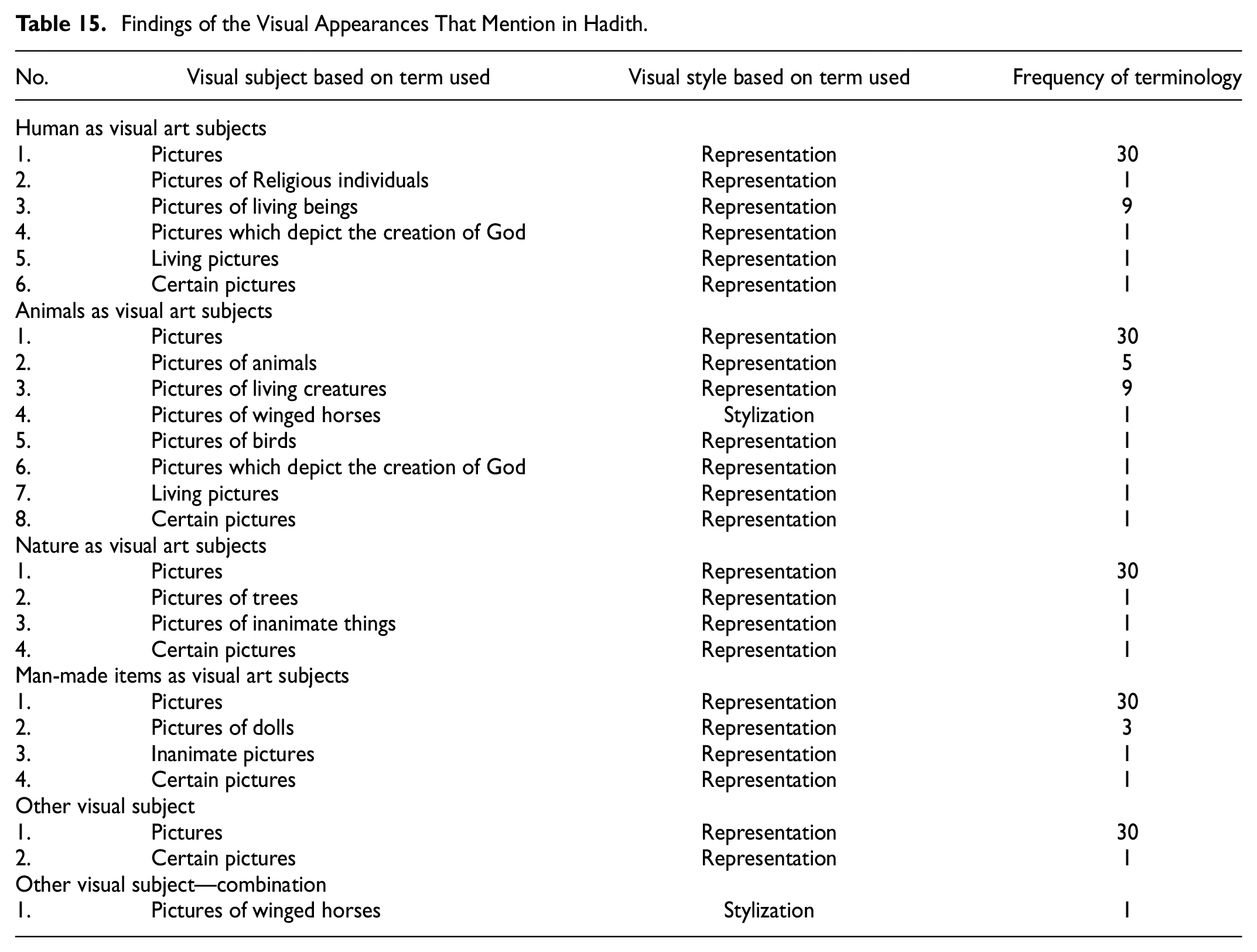
Overall, based on analysis within the document and cross document analysis on all hadiths collected for this study, findings were divided into categories namely visual art subject and style. Having processed the repetitive list, from all 55 types of visual subjects listed, there are: (1) Human visual art subject [six type]; (2) Animal visual art subject [eight types]; (3) Nature visual subject [four types]; (4) Man-made visual art subject [four types]; and (5) Other visual art subject [two types]; (6) Other visual art subjects—Combination [one type].
In addition, for visual style, after the listing of visual subject, it was found that 23 types of visual art subject were involved with visual art style namely representation; moreover, two 2 types of visual art subjects were part of the stylization. Table 15 below presents the table of findings for documentation of fatwa:
Findings of the Visual Appearances That Mention in Hadith.
Findings: Fatwa
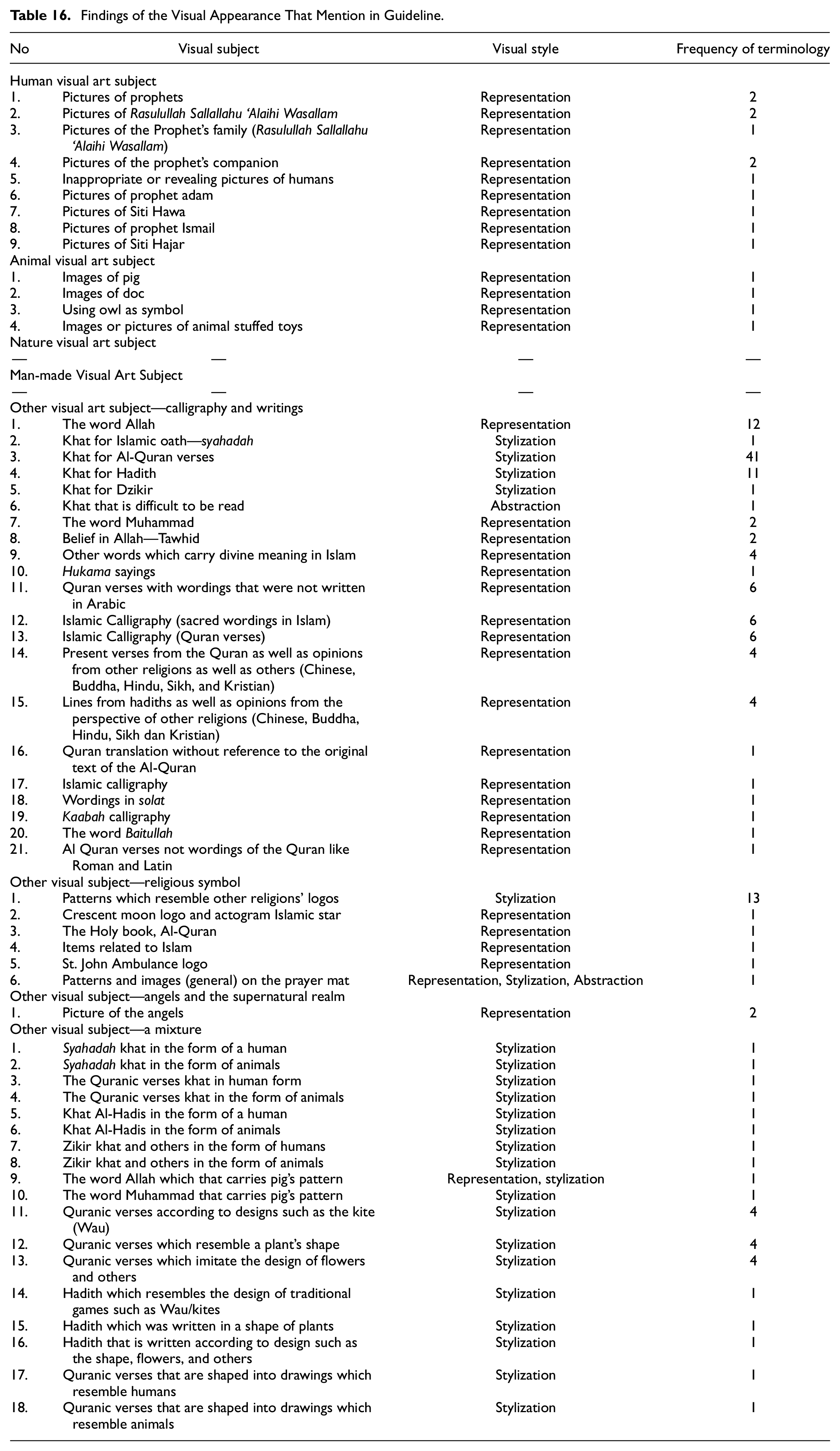
All in all, based on analysis within document and cross document analysis on all documented fatwas that were collected, the researchers had categorized the findings into visual subject and visual style. From all 129 types of visual subjects listed, after the cross-checking of repetitive list, a list of visual subjects types was determined: (1) Human visual art subject [9 types]; (2) Animal visual art subject [4 types]; (3) Nature visual art subject [none]; (4) Man-made visual subject [none]; and (5) Other visual subjects—Calligraphy and writings [21 types]; (6) Other visual art subjects—Religious Symbol [6 types]; (7) Other visual subjects—Angels and the Supernatural Realm [1 type]; and (8) Other visual art subjects—Combination [18 types].
In addition, for visual style, after the listing process on visual subject, there was 1 type of visual subject that was involved with all 3 types of visual art styles namely presentation, stylization, and abstraction; 2 types of visual art subject involved were visual art styles representation and stylization; 34 types of visual art subjects belong to the representation visual style; 21 types of visual art subjects were part of stylization visual art subject style; and 1 type of visual art subject was involved in abstraction visual style. Table 16 below presents the tabulated data for findings based on documentation of fatwa:
Findings of the Visual Appearance That Mention in Guideline.
Findings: Guideline
In all, based on document analysis on guidelines which were collected, the findings were categorized according to different categories of visual art subjects. From all 19 types of visual art subjects which were listed, after the process of cross checking of repetitive list, there were several types of visual art subjects which were listed. They are: (1) Human visual art subject [12 types]; (2) Animal visual art subject [7 types]; (3) Nature visual art subject [6 types]; (4) Man-made visual subject [4 types]; 5) Visual subject of others—Religious Symbol [4 types]; (6) Visual subject of others—Angels and the Supernatural Realm [1 type]; (7) Visual art subject of others—the practice of superstitious belief and blasphemy [5 types]. Table 17 below indicates a table of findings for guidelines documentation:
Findings of the Visual Appearance That Mention in Guideline.

Findings for Data Triangulation
Results Findings from both data analysis was further analyzed using the triangulation approach to produce a guideline for visual appearance in Malaysian Visual Art book. Moreover, in listing comprehensive visual subjects and visual styles, the researcher has used “researcher’s opinion” through the method known as “direct-observation” in preparing the checklist. As a result, the researcher produced nine (9) visual subject categories in the checklist such as: (1) Humans; (2) Animals; (3) Nature; (4) Man-made; (5) Religious symbols; (6) Creatures and invisible realms; (7) Supernatural and mystics; (8) Words/Calligraphy; and (9) Combinations. From all nine categories of visual subjects, the researcher listed 95 visual subjects and three visual styles in the checklist of two-dimensional visual appearance in Malaysian visual art. These 95 visual subjects listed contain one to three different scopes of discussion such as (1) Character; (2) Type; and (3) Mannerism/action. Table 18 shows the complete list that is collected as a result of the triangulation process from interview data, documentation, and direct observation, compiled by the researcher:
Findings of Categories, Scopes, and Lists of Visual Appearance Analysis.

In addition, for each scope of discussion on the visual subject, the researcher has arranged the table of checklist for visual appearances in Malaysian Visual Art in this order: (1) Category of Visual Subject; (2) Character or Type or Mannerism/Action (whichever relevant) of the visual subject; (3) Element of the visual subject—explanation of (form) or shape (shape) or line (line) which is used to produce a visual subject; (4) Visual style—aims to describe various styles found in visual artwork; and (5) Visual artwork which is enclosed (if any) is suitable with the visual subject’s character or types or mannerism/action. Table 19 is an example of table that is produced in the Checklist of visual appearance in Malaysian Visual Art book.
Example of Table in Checklist’s Book for Visual Appearances in Malaysian Visual Art.

All checklist of visual appearance in Malaysian visual art can be produced based on the current situation. This checklist book clearly indicates the diversity in visual appearance that is produced in this country. For the purpose of comparing the list of visual subjects derived from the literature review (four categories—human, animal, nature, and man-made), the researcher has listed another nine categories collected from interview data, documentation, and direct-observation (additional—religious symbol, creatures and invisible realms, supernatural and mystics, words/calligraphy, and combinations of images). Variations in visual subject categories must be discussed to place them together with other opinions on the development visual appearance.
Discussion
Based on the findings discussed, the researchers could clearly present the grouping that was made as compared to the list of “visual appearance” that is available in Guidelines 1987 as prepared by Jabatan Kemajuan Islam Malaysia (1987). The Guideline (refer Table 2) provides only 12 types of visual appearances. Hence, the researchers carefully analyzed the list of visual appearance available in the guideline as stated in Table 17. As a result, there are 39 lists of visual appearances found in the guideline; but there was a repetition in explaining the diversity of visual appearances that had been shown. Many parties involved were confused with the list when they referred to the guideline, especially when they need to obtain the Islamic Shariah view on the creation of a specific visual appearance.
With the efforts put in re-examining the visual appearance list, numerous issues found in the list could be combined to ensure that each type of visual appearance available could be discussed from the perspective of Islamic Shariah. Between the 12 types of visual appearances list (refer to Table 2), and 39 visual appearance list (refer to Table 17) which was repetitive, this study is able to list as many as 95 list of visual appearance (refer Table 18) which had been detailed.
Conclusion and Recommendation
In conclusion, the objective of this research which is to produce a comprehensive check list for visual appearance in Malaysian visual art scene is achieved. All items in the checklist encompass all types of visual appearance that are available. The checklist has the potential to be further developed in Malaysia. Moreover, there is room for continuous improvement depending on the development of visual appearance as time progresses. Visuals listed in this study are selected based on the opinions of three visual art experts; the researcher suggests that opinions from young visual art artists who are more innovative and creative in producing new visuals, must be obtained, and studied.
Such comprehensive interpretation implies that for each visual to be created, it must be acknowledged by experts in Islamic Shariah based on the laws. This research also recommends future potential researchers that process and results from the creation of this checklist will assist those who are interested to assign a selection of Islamic Shariah experts’ opinions on the list of visuals. Hence, to produce a complete visual appearance, the researcher is obliged to gather views from the Islamic Shariah experts to contextualize rules and latest opinions. This is imperative in order to ensure that each individual who is involved in two-dimensional visual art (Muslim artists, Muslim buyers, and Muslim art enthusiasts) would be able to adhere to Islamic guidelines as well as rules and regulations. With the checklist, the researcher will be able to process art interpretation according to Islamic shariah perspectives.
Footnotes
Declaration of Conflicting Interests
The author(s) declared no potential conflicts of interest with respect to the research, authorship, and/or publication of this article.
Funding
The author(s) disclosed receipt of the following financial support for the research, authorship, and/or publication of this article: This research was funded by the Ministry of Higher Education, Malaysia and managed by the Research Management Centre, Universiti Teknologi MARA under the Fundamental Research Grant Scheme [600-IRMI/FRGS 5/3 (002/2017) and 600-IRMI/FRGS 5/3 (277/2019)].
