




Abstract
The purpose of this paper is to investigate antecedents and consequences of self-disclosure in subjective well-being with social support as a mediator. The study model was validated by an online survey of 244 respondents. Results demonstrate that self-disclosure is significantly dependent on information, social influence, social media use, and enjoyment and it positively influences social support and subjective well-being. In addition, social support mediates the relationship between self-disclosure and subjective well-being. In the context of social networking sites, social interaction (social support) impacts more than solo action (self-disclosure) toward an individual’s online social well-being in the Covid-19 situation. Moreover, people who are prepared to share more information on Facebook may develop deeper bonding with their dear ones. This study assessed the proposed model’s functionality and reliability in light of Covid-19 pandemic in Bangladesh and our findings have implications for existing ideas of self-disclosure and social support exchange theories that are currently held.
Introduction
In terms of its capacity to transmit data and facilitate information sharing, the internet has revolutionized the worlds of computers and communication (Rahman et al., 2021; Sharif et al., 2021). The evolution of information and communication technology (hereafter ICT) has had a great impact on social networking sites (SNS) and its users’ ability to communicate and disseminate information via social media, developing and maintaining everyday social relationships and interactions (Liu & Brown, 2014). ICT enables people to build personal profiles and social networks, interact, and establish relationships across all barriers and ethnic diversity (Dhir & Tsai, 2017). Thus, a number of SNSs emerged, transforming communication between teams and individuals with shared interests in education, music, movies, and friendship (C. Cheung et al., 2015). Almost every SNS is designed to facilitate sharing information, uploading, accessing, downloading, and reasoning skills (Wiederhold, 2020). The common goals of information sharing are to garner peoples’ attention, build social capital, strengthen interpersonal relationships, attract like-minded individuals, and foster information and wisdom communities (Al Masud et al., 2021; Arıkan, 2021; Merchant & Lurie, 2020; Zhao & Zhou, 2021). Users of SNSs, particularly Facebook users, typically create profiles and share their personal information on these sites (Rahman et al., 2021; Sharif et al., 2021). This profile may involve personal and/or private details, such as user name, photographs, e-mail identity, street address, phone numbers, ethnicity, and preferences (Nie et al., 2019). ALQadheeb and Alsalloum (2021) estimate that 94% of Internet users will have at least one social media account. Global Web Index (2019) reports, six out of ten Internet users worldwide were online continuously in 2019. Facebook is the most well-known social networking website, and in the second quarter of 2022, the global total of monthly active Facebook users topped 2.93 billion (Statista, 2022). This number is growing exponentially, and as of 30 June 2021, there were over 2.89 billion Facebook members worldwide with an active account monthly. In Bangladesh, the number of social media users and mobile social users accounts for 18% and 17% (Ishtiaque et al., 2017; Rahman et al., 2021). Young entrepreneurs in Bangladesh are encouraged to conduct their enterprises through social media channels, and some initiatives already do so. Thus, Bangladesh’s prospects for quick expansion in this prolific area are very promising (M. A. Hossain, 2019).
In addition, the global pandemic of Covid-19 has a profound effect on individual lifestyles. Due to rules aimed at preventing the virus’s spread, such as the “shelter-in-place” order (Gajanan, 2020; Sharif et al., 2021), individuals willing or not, are transitioning from offline to online activities (Al Masud et al., 2021; Arıkan, 2021; Zhao & Zhou, 2021). Along with online experience and planning, many of them spent their time on social media (SM), such as Facebook and Twitter, which may satisfy their needs for catastrophe information, amusement, and interpersonal interactions (Merchant & Lurie, 2020). However, Yu et al. (2022) discovered new business opportunities by utilizing social media, and expertise in social media can help with crisis management, particularly in Covid-19 (Y. Zhou et al., 2022).Thus, it is critical to analyze how users use Facebook, one of the most widely used social media platforms, and its impact on addressing their social and psychological needs and its antecedent consequences of self-disclosure of user’s habit of Facebook in the COVID-19 pandemic. Since Covid-19 disrupts peoples’ mental health, anxiety, depression, and quality of life at work (Aqeel et al., 2022), having the right knowledge of social media applications can be a tactical way to overcome these serious psychological conditions. Therefore, the current study aims to demonstrate the antecedents and consequences of self-disclosure in the subjective well-being of Facebook users with a social support mediator in the context of Bangladesh. The majority of the study on this topic originates from industrialized countries, specifically from North America, Europe (see Beuker, 2016; Nie et al., 2019; Salehan et al., 2018; Schultheiss & Kalmer, 2018). However, very little is known about emerging regions (Moura et al., 2020). Since developing nations usually lack resources and expertise in a variety of fields, it is crucial to do research in emerging nations to understand their current situation, difficulties, and potential. The present study examines the characteristics associated with antecedents and consequences of self-disclosure on subjective well-being with social support as a mediator on Facebook. And data obtained from Bangladesh, an emerging country, is likely to fill these research gaps. Extending these objectives, we address a few research questions (RQs); RQ1; Is there a link between the evolution of self-disclosure and its implications for the social media Facebook case? RQ2; how does social support on Facebook mediate the effects of self-disclosure on subjective well-being? The findings could help researchers gain a better understanding of the phenomena that are occurring in the area which can positively improve self-disclosure behavior, hence improving a person’s well-being and assisting them in developing social support.
Background
Self-Disclosure and its Antecedents
Since 1970s, self-disclosure has been extensively investigated in psychology and related disciplines such as social science and communication science (Ignatius & Kokkonen, 2007). It has been described as “verbally disclosing to another individual personal information about oneself” (Forgas, 2011; Rains et al., 2016). On the other hand, Pearce and Sharp (1973) are referring to how the speaker makes themselves known to others mean as self-disclosure. Bazarova and Choi (2014) recently coined the phrase “public disclosure,” which refers to anything that can be shared in an online community or with a network of friends or coworkers. Usually, activities of self-disclosure contain information about oneself to others (Rains et al., 2016; Sharif et al., 2021). Parks and Floyd (1996) noted in essence, information sharing involves self-disclosure; people share their knowledge. Without self-disclosure, no information can be shared therefore this means that it is difficult to share information without self-disclosure (J. Y. Kim et al., 2014). So, it may be opined that sharing information is the major antecedent of self-disclosure. Venkatesh et al. (2003) defined social influence as “the degree to which an individual feels that significant individuals believe he or she should implement the new system.”
Social influence (SI) is a term that relates to a person’s belief and how it is shaped by the influential people in the society. Researchers discovered that influential individuals such as friends, close relatives, coworkers, academic staff, teammates, peers, and academics recommend to embrace e-learning platforms (Ofori et al., 2017; Rahman et al., 2021; Ristic & Stefanovic, 2020; Yueh et al., 2015). Rahman et al. (2021) discovered that SI would be the essential component for self-disclosure in predicting college students’ usage of Facebook to make and maintain connections with others. Table 1 lists several related studies on the causes and effects of self-disclosure on subjective well-being (Hsu et al., 2020; Meshi et al., 2016; Rahman et al., 2020; Sharif et al., 2021).
Literature Summary.

As mentioned previously, prior research indicates a relationship between SNS use and online self-disclosure that can be explained by both socializing and selecting effects (Trepte & Reinecke, 2013). Based on recent advances in media effects research (Slater, 2007), we believe that the use of SNSs and individuals’ desire for online self-disclosure are continually increasing. Slater (2007) proposes a “’reinforcing spirals method” to better understand user profiles and media effects and researcher’s strategy includes three steps: (1) media use affects cognitions or behaviors, and (2) cognitions or behaviors media content use. (3) Over time, this process should be continually increasing. So we can say, use of SNS is the major antecedent of self-disclosure. Venkatesh et al. (2012) defined habit as “the degree to which persons tend to perform behavior automatically as a result of learning.” Additionally, Venkatesh et al. (2012) stated that behavioral intention had been established as the most robust predictive determinant of technological innovation and habit. As a result, habit is crucial for anticipating and deciding self-disclosure. Consumers’ risk perception is defined as their degree of uncertainty or concern about the activity of another significantly party and the probability of adverse consequences resulting from that behavior (Mandrik & Bao, 2005; Rahman et al., 2020). When users evaluate digital services, they construct a set of metrics, includes their perception of the risk level associated with the e-service platform or the possible loss associated with them.
This view has an impact on purchase intention to use e-services (Featherman & Hajli, 2016). Users concerned about privacy may wonder if service providers can protect their data. They may also suspect that service providers may improperly exploiteor monetize their data. So they perceive risk concern as a relation to self-disclosure (Mandrik & Bao, 2005; Rahman et al., 2020; T. Zhou & Li, 2014).
Moon and Kim (2001) defined enjoyment as “the objective pleasure an individual has while engaging in a particular behavior or activity.” They also discovered that “enjoyment” is a significant component in an individual’s Internet adoption which has a good relation with self-disclosure (Sharma et al., 2016; T. Zhou & Li, 2014). Van der Heijden (2004) revealed that “perceived enjoyment” is a significant predictor of the propensity to use an information system. Thong et al. (2006) discovered that perceived enjoyment is a critical element influencing the acceptance of information systems. Social networking services (such as Facebook) provide various applications for users’ amusement, such as playing games, sharing amusing videos, and praising others’ accomplishments. Online social networking (OSN) offer students a more engaging learning environment than traditional classroom-based teaching and learning. Hamid et al. (2015) claim that students are more calm and eager to voice their views via online forums like Facebook. So we can say, enjoyment of SNS is the major antecedent of self-disclosure.
Self-Disclosure and its Consequences
Subjective well-being is characterized as a person’s consciousness and emotions, including pleasant perception, good moods, and a sense of well-being (Kahneman & Krueger, 2006). Self-appraisal encompasses an individual’s emotional responses, moods, and judgments regarding their level of life pleasure and satisfaction (Diener et al., 2003). Previously conducted research has defined well-being as the content, pleasure, or happiness that results from good psychological function (Chida & Steptoe, 2008; Hsu et al., 2020; J. Y. Kim et al., 2014; McDowell, 2010). On the other hand, some academics argue that well-being expresses an individual’s sense of enjoyment and how it contributes to their overall quality of life (Dennis & Valacich, 1999). Affective learning and motivation were strong across students who watched an instructor’s Internet site with high levels of mediated accessibility, including self-disclosure (O’Sullivan et al., 2004). This means that learning about others can make us feel good or friendly toward the individual who revealed the knowledge. It may be claimed that self-disclosure permits both people to experience a sensation or attitude. Self-disclosure, particularly via social media, has the potential to elicit certain emotions and shape opinions. So from this study, we can say subjective well-being is a consequence of self-disclosure.
The term “social support” refers to the resources made available by other members of a social group (Eastin & LaRose, 2005; Hsu et al., 2020; Langford et al., 1997; Liu & Brown, 2014). Similarly, some researchers describe social support as an individual’s perception of being cared for, reacted to, and assisted by many in their social group (Cobb, 1976; House, 1981). According to H. F. Lin (2008) by combining these concepts, we understand that social support entails sharing values (both tangible and intangible) among at least two members of a social group. According to prior research, people require psychological, informational, and practical services to overcome distress (Hsu et al., 2020; Liang et al., 2011; Liu & Brown, 2014). Social support and self-disclosure activities are expected to have a beneficial effect on subjective well-being in this study. According to prior research, one of the primary reasons people use social media is to seek assistance and social support.
Theoretical Foundations
Theoretical Framework
Self-disclosure can be defined as any information about oneself that a person discloses verbally to another person. The phrase “self-disclosure” has been used by several individuals, even though alternative phrases such as “verbal accessibility” (Polansky, 1965), and “social accessibility” (Rickers-Ovsiankina, 1956) have been used interchangeably to refer to the same concept. The term “self-disclosure” is employed in this paper because (a) It is the most widely used term in academia, and (b) the term refers to both a personality trait and an interactional process. Self-disclosure is the act of communicating information, enjoyment, or use to another person, and this study was conducted using the Self-disclosure theory. There is no universally accepted definition of self-disclosure among researchers. But some scholars said that the expression is also used to describe any type of communication that reveals personal information (Cozby, 1973; Ignatius & Kokkonen, 2007; Rains et al., 2016; Sharif et al., 2021).
The current study uses the later meaning of self-disclosure. In that context, self-disclosure refers to a speaker’s inclination to actively introducing themselves to another. Our review (see Table 1) demonstrates that these determinants can roughly be separated into two groups. First, prior research reveals that a person’s disclosure behavior is formed and affected by platform providers’ qualities (Forgas, 2011). Medical and psychology research has demonstrated that perceived social support, information, use, and enjoyment lead to higher self-disclosure in physician interaction and mutual support groups (Davison et al., 2000). Other researchers like Berg and Archer (1982) discovered that people regulate the content and duration of their self-disclosure process. The substance and style of self-disclosure differ between persons seeking interpersonal interactions and those seeking knowledge or enjoyment. Cho and Park (2013) found that self-disclosure in online chatting varies amongst groups with varied chatting goals. Informative online chatters outperform personal and social chatters regarding the intent, depth, and negative/positive disclosure. Research shows that online communication can lead to more self-disclosure than in-person interactions.
Hypotheses Development
Information, Social Influence, Use, Habit, Risk Concern, Enjoyment and its Relation to Self-Disclosure to Use a Social Networking Site (Facebook Case)
Self-disclosure is the process whereby an individual communicates with others their thoughts, beliefs, experiences, and information (Derlega et al., 1993). Social networking sites encourage the exposure of basic personal information about oneself and true feelings and emotional responses (Mazer et al., 2007). This type of disclosure is important in the process of information sharing and relationship development. Young people share more information on Facebook than they would in offline situations (Mohammadbagher et al., 2016). The characteristics highlight the critical role of self-disclosure information’s on social networking sites in promoting cultural power, particularly during late adolescence (C. Y. Lin et al., 2021; Park & Kim, 2020). So the following hypothesis is developed.
Social influence has frequently been shown to explain aggregate and social behavior. On the other hand, prior IS psychotherapy models focus exclusively on one type of social influence, particularly normative beliefs, which reflect social pressure to do a behavior from relevant others (C. M. K. Cheung & Lee, 2010; Thieme et al., 2012). According to Sánchez et al. (2014) social influence is the most important element in determining Facebook adoption since users tend to follow with those they share interests. In a similar spirit, we anticipate that users will be more willing to provide personal information on social networking sites to live up to the expectations of their peers.
As stated previously, prior research reveals a link between SNS use and online self-disclosure that includes both socialization and selection effects. Based on present research, it is unclear if SNSs socialize users to be more open to online self-disclosure (socialization effect) or whether users who are more open to self-disclosure prefer to use SNSs more (selection effect) (C. M. K. Cheung & Lee, 2010; C. M. K. Cheung et al., 2011). According to SNS usage research, most SNS users are highly active online and self-disclosing: On an average day, 22% of Facebook users comment on another user’s post or Facebook post, 20% comment on another user’s picture, 26% “like” another user’s subject matter, and 10% send private messages to other network members (Hampton, 2011). Thus, with SNSs, self-disclosure is rewarded by user comments including online friendships (Baturay & Toker, 2019).
A habit is a trained series of acts that automatically respond to certain stimuli and are useful for achieving specific aims or end states (Ko, 2013; Verplanken & Aarts, 1999). According to the definition, the first characteristics of a habit is a history of repeating. The more frequently someone engages in an activity, the more likely it will become habitual. It has been discovered that those who often use information technology devices develop an automatic behavior (Limayem et al., 2007). Gefen (2003) shown that consumers’ self-disclosure on a website is significantly influenced by habit. The current study defines a user’s habit in the self-disclosure social media context as the degree to which users use the SNS habitually. From the above discussion we draw the following hypotheses:
The Internet not only benefits individuals but also presents criminals with opportunities. Malicious agencies can collect a large amount of personal data from Web users in the twinkling of eye (Chen et al., 2016; Fenigstein, 1984; Rahman et al., 2020; T. Zhou & Li, 2014). Marketers can tailor their solicitations to the internet posts of Web users. Invasion of privacy online could lead to financial losses and interpersonal strife with online acquaintances (M. Hossain et al., 2019; Pratt et al., 2010; Reisig et al., 2009). Therefore, show-off posts on Facebook are risky for anyone concerned about privacy. Self-disclosure has been shown to increase trust and intimacy, resulting in the formation and maintenance of relationships (Park et al., 2011; T. Zhou & Li, 2014). As a result of the debate above, self-disclosure includes the risk of data loss and privacy concerns. It may result in cyberbullying, spying, and identity or data theft. As a result, scholars have spent considerable time exploring how worries about security may affect self-disclosure digitally (Dienlin & Metzger, 2016; Metz-Sipple, 2020; Wu & Cheng, 2018). So, the risk concern has a negative relationship to self-disclosure and there the following hypothesis is posited:
Enjoyment is the perception that technological equipment is pleasurable to use, despite as to whether it performs properly (Davis et al., 1992; Dhir et al., 2017; Sharma et al., 2016). For task-oriented systems, enjoyment has an indirect effect on Intention to Use. However, enjoyment is critical for pleasure-oriented systems. According to Shin and Choo (2011), “robots with more complex social abilities exert a bigger influence on social presence, which in turn increases perceived enjoyment,” resulting in a greater desire to accept and utilize. Thus in this study, we propose the following hypothesis:
Self-Disclosure Relation to Social Support and Subjective Well-Being to Use a Social Networking Site (Facebook Case)
Self-disclosure is important for relationship development and maintenance (Collins & Miller, 1994). According to Collins and Miller (1994), there are mainly three disclosure-liking consequences: 1. making affectionate disclosures increase the likelihood that people might like you much more than making non-intimate disclosures. 2. People are encouraged to disclose more if they initially like someone. 3. Disclosing yourself to somebody increases the likelihood that you will like this anyway person. Valkenburg et al. (2006) found that SNS users get some more responses from friends. Other studies suggest that persons who reveal their names on SNSs get higher social support. Moreover, receiving intimate disclosures obligates recipients to reply with an equally intimate disclosure (Derlaga & Berg, 1987). These discussions suggest that self-disclosure may be related to increased social support. However, when it comes to actual evidence, the impacts of self-disclosure are unclear. Several studies indicate that those who receive a greater amount of social support may have a greater sense of well-being (J. Kim & Lee, 2011; Ko & Kuo, 2009). Self-satisfaction with social networking sites is associated with psychological well-being (Ellison et al., 2007; Lampe et al., 2007). According to J. H. Kim et al. (2010), subjective well-being may be the ultimate goal of SNS users. Additionally, Ellison et al. (2007) discovered that Facebook usage affected psychological well-being and recommended that Facebook may be more beneficial for users who have low self-esteem and life satisfaction. Figure 1 presents our conceptual research model with proposed hypothetical relationships.

Research model.
Though some research has demonstrated that self-disclosure affects subjective well-being such as pleasure, and found that self-disclosure had a statistically significant effect on subjective well-being. Accordingly, the following three hypotheses are proposed:
The Mediating Role of Social Support
Self-disclosure is a distinguishing feature of SNSs. Online conversations via SNSs encourage greater self-disclosure, and a user shares more about themselves than in face-to-face conversations (C. Cheung et al., 2015; G. Lee et al., 2011). Self-disclosure is the act of communicating with others personal facts, ideas, and emotions (Archer, 1980). On SNSs, users can engage in self-disclosure through profile creation, status updates, image management, and message posting, and replying to messages sent by their friends, among other activities (Hsu et al., 2020). The hypothesized positive relationship between self-disclosure and subjective well-being (SWB) remains an unresolved question, as does the extent to which perceived social support mediates this relationship. In terms of the reality that social support is a significant source of happiness (C. Cheung et al., 2015; Hsu et al., 2020; Myers, 2000). The social support generated by self-disclosure probably has a beneficial effect on the users. One idea is that the more self-disclosure social media user’s one has, the more social support one is likely to receive in aggregate from these users, which will make the user happier. However, because self-disclosure users of social media are not as closely connected and mutually connected as genuine users, they may not serve as a large means of support; in this scenario, social support will not be a mediating factor between self-disclosure and SWB. To solve this problem accordingly, the following hypotheses are proposed:
Methodology
Study Design
Existing validated question items were adapted to develop the items included in our questionnaire, keeping in mind the definitions of the constructs to be assessed. The items were refined by discussions of experts in the respective field. The ambiguity of any item constituting the questionnaire has been checked accordingly. After that, a pilot test with 20 Facebook users was carried out on a random sampling method, and minor changes were made to improve the clarity and readability of the questionnaire. To test the proposed model, we collected data from Facebook users in Bangladesh using an online survey. The survey was available for 2 weeks from February 5 to 20, 2020. Typically, online data collection can be extended for cross-sectional studies, due to the changing situation of the Covid-19, data collection time has been limited to 2 weeks only. Respondents were identified using a random sampling technique, a screening question was included to ensure that respondents had at least 6 months of experience using social media. Respondents were assured to keep their information highly secure and to use it only for research purposes.
Sample
Overall, 287 responses were collected, and after successive data cleaning, removing missing samples and outliers, the final valid samples were 244. As many other notable researchers employed samples in their studies as similar to us, we believe that our final sample size is representative. For instance, the sample sizes of Dhir et al. (2017), M. A. Hossain (2019), Zane and Ku (2014), and Wang et al. (2016) were each 141, 241, 110 and 238, respectively. Out of our valid samples, 64% of respondents are male and participants aged 20 to 25 lead the percentage of 39%. Student (43%) is the highest participation and 30% of participants use Facebook for 30 to 50 min per day. In addition, the leading percentage (37%) of respondents have more than 600 friends on Facebook. Table 2 presents the demographic features of the respondents.
Demographic Characteristics of the Respondents (n = 244).

Measures and Techniques
This study measured nine constructs that were somewhat changed to fit the setting of the current investigation. The constructs considered in this study are information, social influence, use, habit, risk concern, enjoyment, self-disclosure, social support, and subjective well-being. Multiple items were utilized to measure each of these constructs, and a seven-point Likert scale was employed. Items measuring information and subjective well-being are taken from studies (Huang, 2016; J. Y. Kim et al., 2014). Questionnaire items for use intention and social support were collected from (Huang, 2016). Measures of enjoyment were drawn from (C. Cheung et al., 2015; J. Y. Kim et al., 2014), risk concerns were drawn from (C. Cheung et al., 2015). Furthermore, the items for habit have been adopted from (Huang, 2016).
The collected data was analyzed using SPSS − 24 and Amos − 24, and a two-step process was applied; confirmatory factor analysis (CFA), and structural equation model (SEM). CFA was used to assess the validity and reliability of the data, and SEM is performed to see hypothetical relationships among the studied variables. Bootstrapping using Amos 24 is also performed to examine the mediating effects in the model according to the principle of Baron and Kenny (1986).
Empirical Results
Common Method Variance (CMV)
The current study conducted CMV using Harman’s single factor test. The results of the Harman’s single-factor test shows that first factor explained 24% of the variance and several factors have an Eigenvalue greater than 1. The calculated value was less than 50% of the variance, indicating that CMV is not a problem in the data (Podsakoff et al., 2003).
Validity and Reliability Test
This study validated its proposed model by assessing convergent and discriminant validity. Convergent validity was tested by Chronbach’s alpha, factor loadings, average variance extracted (AVE), and composite reliability (CR). According to Hair et al. (2014), satisfactory factor loadings and Chronbach’s value should have values greater than .70. As shown in Table 3 all constructs have factor loadings and Chronbach’s alpha value greater than .70, revealing that the data has good internal consistency and has achieved convergent validity. Table 4 shows that the factor loadings in CFA also exceed its critical thresholds. The AVE is an indicator that shows the convergence of the items toward its constructs and its cut-off value is 0.50 (Fornell & Larcker, 1981). Tests results showed that all AVE values are higher than 0.50. Furthermore, the CR is an indicator that assesses the precision and quality of the constructs and its threshold value is greater than 0.70 (Hair et al., 2014). The test results also showed that all CR values are greater than 0.70. Therefore, the convergent validity of the data is achieved.
CFA Analysis.
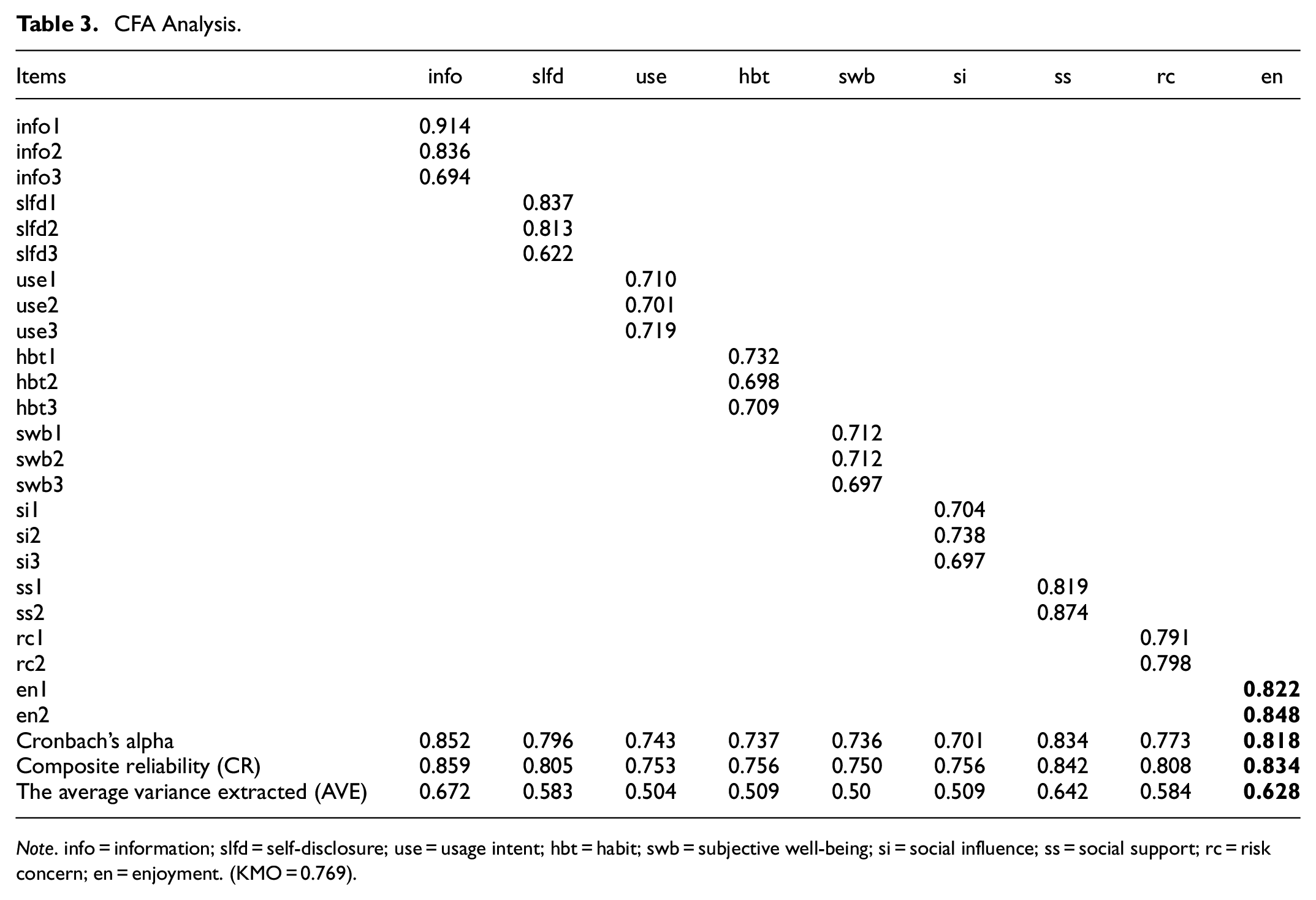
Note. info = information; slfd = self-disclosure; use = usage intent; hbt = habit; swb = subjective well-being; si = social influence; ss = social support; rc = risk concern; en = enjoyment. (KMO = 0.769).
Discriminant Validity.
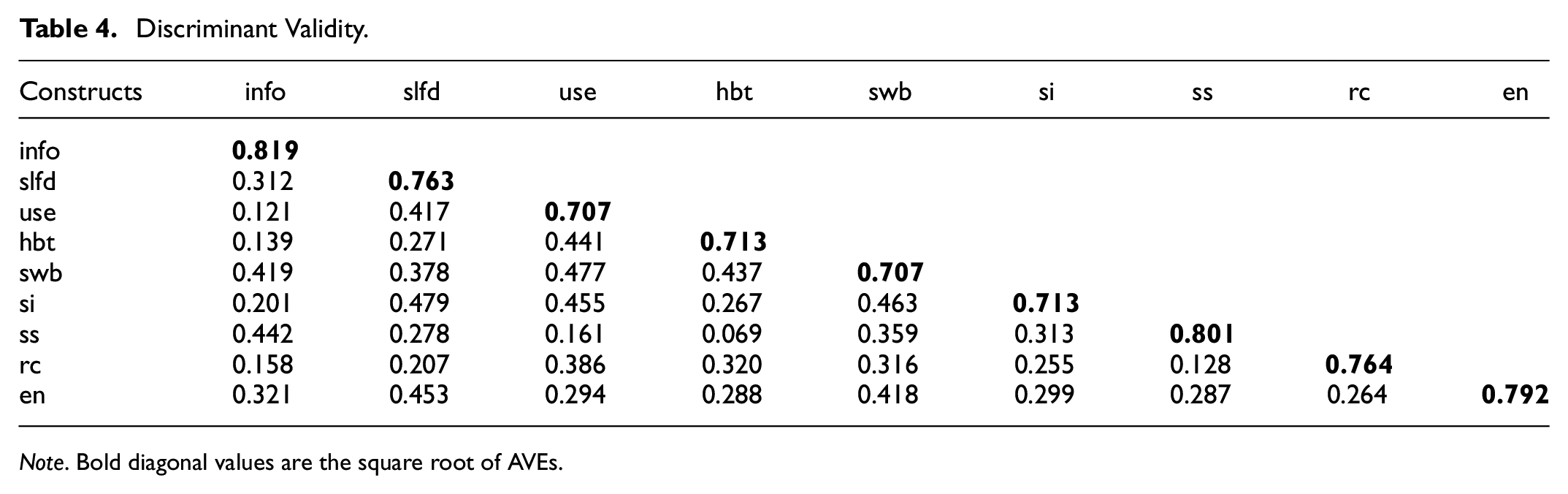
Note. Bold diagonal values are the square root of AVEs.
Discriminant validity clarifies the distinction between constructs, showing the degree of differentiation between a construct compared to other constructs (Hair et al., 2014). The current study followed the principle of Fornell and Larcker (1981) that the inter-construct correlation value should not be higher than the square root of AVE. The results shown in Table 4 evidenced that the discriminant validity was also achieved as no inter-construct correlations are not higher than the square root of AVE.
Next, the goodness of the model fit was examined for both the measurement and structural model. Table 5 showed that most common model-fit indices such as chi-square to degrees of freedom (x2/df = 1.862), root mean square error of approximation (RMSEA = 0.060), comparative fit index (CFI = 0.91), average goodness of fit index (AGFI = 0.84), incremental fit index (IFI = 0.92) and Tucker-Lewis index (TLI = 0.90) beaten their cut-off value. Therefore, the measures used in this study are fit and adequate to test the hypothesis.
Model Fit.

Hypothesis Test
The structural model also retained a good model fit (x2/df = 2.130, RMSEA = 0.068, CFI = 0.90, AGFI = 0.81, IFI = 0.89, TLI = 0.90). The structural model explained 46% of the variance in self-disclosure, 10% of the variance in social support and 25% of the variance in subjective well-being. Furthermore, the model shows most of the hypotheses are supported at p < .001 and <0.01 (see Figure 2). Overall, Figure 2 shows that information (β = .18, t = 2.57), social influence (β = .34, t = 3.50), use (β = .18, t = 1.81) and enjoyment (β = .30, t = 3.69) have significant and positive influence on self-disclosure, therefore H1, H2, H3 and H6 are supported. Self-disclosure has significant impact on social support (β = .33, t = 3.88) and subjective well-being (β = .38, t = 4.13), thus supporting H7 and H8. Furthermore, social support significantly influence subjective well-being (β = .24, t = 2.84), referring H9 is accepted. However, beyond our expectation, paths habit (β = .03, t = 0.31) and risk (β = −.04, t = −0.55) concern to self-disclosure H4 and H5 are not supported.
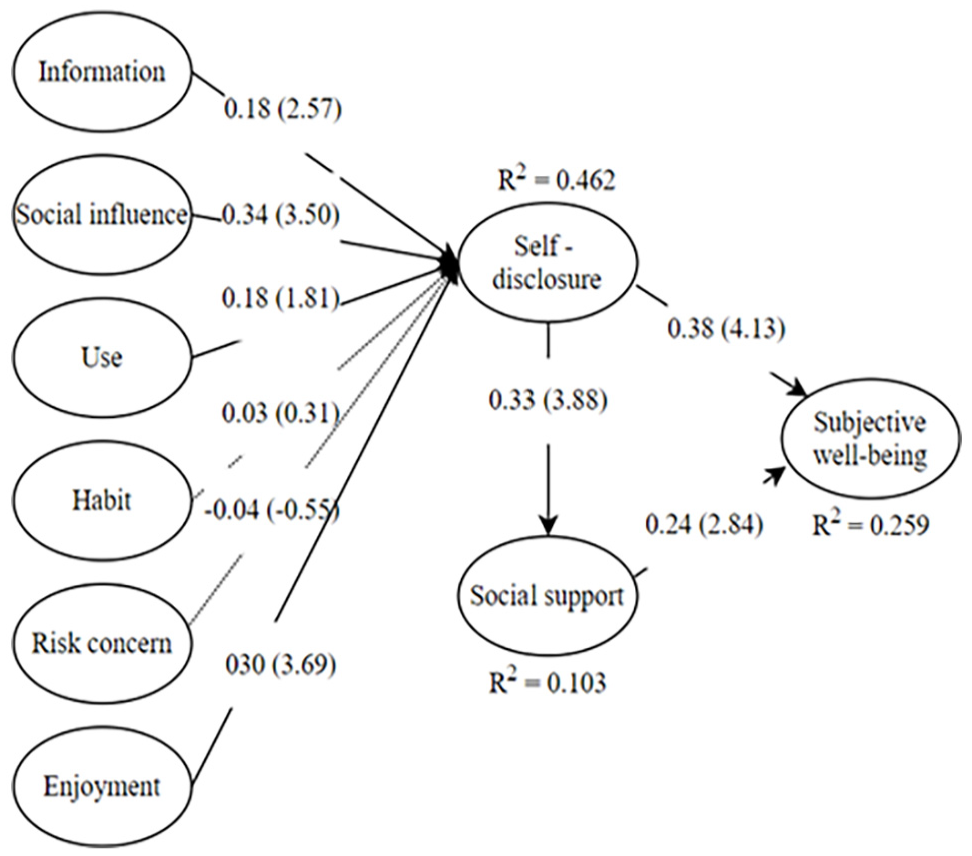
Structural model.
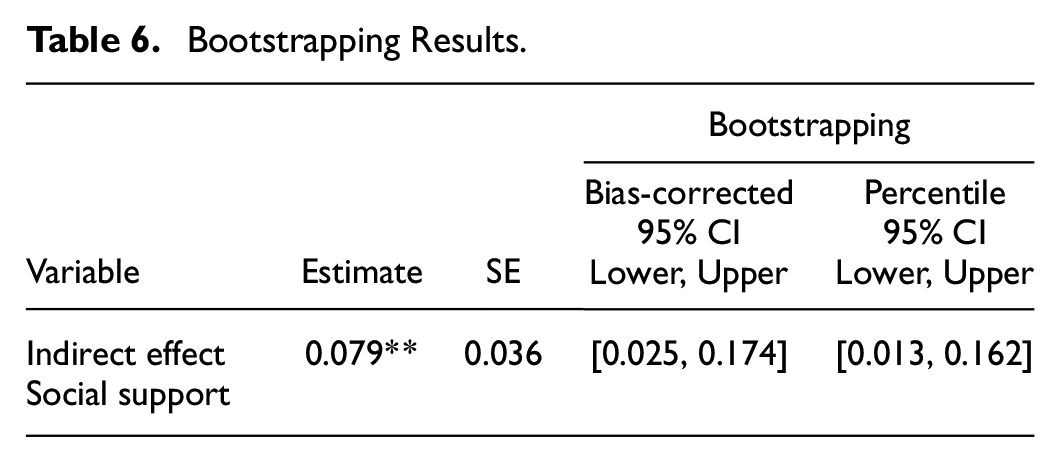
Following Baron and Kenny’s (1986) concept, we conducted a bootstrap analysis as a post-hoc study to determine the mediating role of social support. The principal claim is that if there is a significant indirect effect between independent and dependent via a mediator, and there is no zero between the lower bound and upper bound, then there is a mediation.
Our test result (see Table 6) shows that self-disclosure has a significant indirect effect via social support and that in the bias-corrected model and the percentile model, there is no zero between the lower and upper bound, revealing that there is a mediation. And with a p value smaller than .01 the indirect effect of the self-disclosure on the subjective well-being via social support is 0.079.
Bootstrapping Results.
Discussion and Implications
The study attempted to gain insight into antecedents and consequences of self-disclosure in subjective well-being with a holistic mediating link of social support. Convergent and discriminant validity were verified for the measurement model. The structural model, however, exhibits strong model fit. The structural model explained 46% of the variance in self-disclosure, 10% of the variance in social support, and 25% in subjective well-being. The model also demonstrates that the majority of the hypotheses are supported.
General Discussion of the Results
People use social media to express themselves since there are many possibilities for sharing and exchanging personal information on them, including views, photographs, and videos. In line with our expectations, the findings of this study show that the sharing of information
Additionally, behavioral intention has been shown to be the most reliable predictor of technological innovation and habit, according to Venkatesh et al. (2012). As was previously said, a habit is an automatic activity established through accumulating information and abilities (Ko, 2013). Foreseeing and deciding self-disclosure requires habit. But our results show that Habit
Friends can provide SNS users with better responses, and Name-revealing SNS users receive more social support. Receiving intimate revelations also requires reciprocity. The findings of this study show that the sharing of self-disclosure
Self-disclosure is one of SNSs’ distinguishing features. Online talks via SNSs promote greater self-disclosure, and users provide more information about themselves than they do in face-to-face conversations. The proposed positive association between self-disclosure and subjective well-being (SWB) is clear, as is the extent to which perceived social support mediates this relationship. Because social support plays a crucial role in determining happiness (C. Cheung et al., 2015; Hsu et al., 2020; Myers, 2000). Our test result indicates that self-disclosure has a large indirect effect via social support and that there is no zero between the lower and upper bounds in the bias-corrected and percentile models, indicating that there is mediation. So our findings evident that social support has a mediating
Theoretical and Policy Implications
This study was conducted utilizing the Self-disclosure theory. In light of the research findings, this study would like to draw attention to a number of issues that should be taken into account while developing theories. First of all, we claim that humans create intimate interpersonal relationships by self-disclosing. This study has helped us grasp the benefits of self-disclosure in the setting of SNS, particularly Facebook. Self-disclosure has two benefits on the SNS; firstly, those who self-disclose on SNS can profit from the other party’s concern. Secondly, they can boost their mental health by telling others their stories (Attrill, 2012; Huang, 2016). Additionally, in the context of Covid-19, our findings have important significant practical implications for recognized theories of self-disclosure as well as social support exchange.
This study uncovers some intriguing facts about sharing of information behavior and self-disclosure. Self-disclosure and social support were revealed to have a significant effect on subjective well-being. People who are prepared to share more information on Facebook may develop deeper bonds with their dear and near ones. They may eventually benefit from receiving social support via these same technologies. However, according to some experts, the word is also used to characterize any communication that reveals personal information (Cozby, 1973; Ignatius & Kokkonen, 2007; Sharif et al., 2021). The research demonstrates that self-disclosure information benefits and the support of the Facebook community have a significant and direct effect on personal information sharing behavior. This study uses online social support and well-being to consider the benefits of self-disclosure through SNS. The findings suggest that self-disclosure affects social support in the time of Covid-19 and virtual networking well-being toward SNS. This means people seeking support can open out on social media.
On the other hand, exposure to social media helps people’s mental health. In other words, individuals would use the SNS (Facebook) to seek support or to express themselves. Thus, self-disclosure through SNS can deliver specific values that provide the framework of the individual’s total judgment of the benefits. Self-disclosure on an SNS is desirable behavior (Bayer et al., 2020; Masur, 2018). This study emphasizes the psychological-behavioral relationship. Intention to continue using SNS is tied to an individual’s psychological or affective state. Also, online social well-being is a significant driver of an individual’s continued use of SNS that has been overlooked in the previous study. However, the measure of satisfaction focuses on the entire pleasurable experience of utilizing the SNS, as K. Y. Lin and Lu (2011) found. Thus, this study can better comprehend the relationship between online social well-being and SNS (Facebook) retention.
Finally, when considering the individual- and social-related elements that influence online social well-being, social support is marginally more essential than self-disclosure in this research. This study this corroborates with the findings of Vandeweerd et al. (2014) assertion that social support is a necessary component of happiness. Thus, in the context of SNSs, the outcome of social interaction (social support) may be slightly more significant than solo action (self-disclosure) in terms of contributing to an individual’s online social well-being in the Covid-19 situation.
A conclusion that may interest managers of social networking sites is that online social well-being has a significant impact in determining members’ inclination to continue using the service. The concept of online social well-being, such as enjoyment/pleasure, is a dynamic one. Support tools (e.g., pictures and online video) enhance the impact of a great online social life. Managers of social networking sites should continue to produce unique and enjoyable support tools or services that meet members’ needs for a joyful online social life. People who are more aware of the benefits of self-disclosure practice more frequently. Thus, SNSs (Facebook) users should be educated on self-disclosure and its benefits. Psychologists and academics or managers who encourage people to share personal information to prevent loneliness should realize that people will do so if they think it is valuable. People must therefore be informed about the advantages of self-disclosure in the Covid-19 era by psychiatrists, educators, or managers.
Conclusion
The study contends that a variety of aspects, including people’s information perceptions, social influence, habit, risk concern, and enjoyment, affect self-disclosure behavior and that well-being is a result of self-disclosure. Our findings demonstrated that social support is a potent mediator between self-disclosure and subjective well-being. To further comprehend the SNS’s continuing purpose, this study also investigates the relationships among self-disclosure, social support, online social well-being, and repetitive behavior. Our findings thus supported the research questions we had proposed; RQ1; Is there a link between the evolution of self-disclosure and its implications for the social media Facebook case? RQ2; how does social support on Facebook mediate the effects of self-disclosure on subjective well-being?
In particular, our study explores the favorable impacts of self-disclosure inside the setting of the SNS (Facebook case). While our data indicate that users’ habits and risk aversion have no beneficial effect on self-disclosure, they help people grasp the potential benefits of self-disclosure. Similarly, those who view private information sharing as risky will engage in much less self-disclosure with the medium and its community members, resulting in less personal information sharing on Facebook. The findings reveal that an individual’s contentment with their online social life is a significant predictor of their intention to continue using the SNS. Self-disclosure on social networking sites is advantageous to people as well. Not only may people gain social support from other users on social networking sites, but it can also help them find contentment and fulfillment with their online social lives. We believe that the approach suggested in this research is not conceptually limited to SNSs but should also apply to other types of online services. Future studies in this crucial area may use the model presented in this paper as a suitable starting point.
While this work has generated several beneficial conclusions, it does have certain limitations as well that can be addressed in further research. Despite our best efforts to design and implement this research successfully, some constraints remain. First, to begin, the survey’s responses were confined to Bangladeshi Facebook users. As a result, this study’s application to other regions may be limited. Secondly, the study relies on purposive sampling; hence the findings cannot be generalized. Since this study only used independent and moderating factors, comparative research could use other potential moderators that affect confidential information sharing behavior. Unfortunately, the frequency of Facebook usage was not quantified, which is another study weakness. Third, self-selection bias may have influenced our findings. The sample for this study is made up of active accounts.
Users who have previously abandoned Facebook may also have varying perspectives on the role of social support and social networking well-being. Given the study’s focus on a single country, the validity of the influence of multiple demographics and cultures may be questioned. To confirm that, a global study may be undertaken to see if the variables create similar outcomes. Fourth, the data was gathered from a single social networking site: Facebook. Although Facebook is the most popular SNS globally, further research is required to determine the model’s and findings’ generalizability to other SNSs. Finally, the world of technology is constantly evolving. While our study identified specific determinants of personal information sharing behavior, it does not imply that our proposed model would accurately reflect future events.
The risk of rejection or exploitation by others is present even if self-disclosure can increase one’s self-worth (Kelly & McKillop, 1996). Individuals who divulge confidential information and emotions may face danger. According to Derlega et al. (1993), those who understand our personal information or emotions may share it with others we do not understand or like; people who share their details may find which others avoid or dislike after discussing them. In other words, disclosing one true personal feelings to another exposes the deceiver to potential dangers. As a result, another intriguing subject of future research could be the detrimental effect of self-disclosure on the SNS.
Footnotes
Acknowledgements
All authors are acknowledged for their equal contribution to this research. Informed consent is obtained from all stakeholders included in the study
Declaration of Conflicting Interests
The author(s) declared no potential conflicts of interest with respect to the research, authorship, and/or publication of this article.
Funding
The author(s) received no financial support for the research, authorship, and/or publication of this article.
Ethical Statement
This manuscript is an original work, which has not been previously published and is not currently being considered for publication elsewhere.
Data Availability Statement
The datasets generated during and/or analyzed during the current study are available from the corresponding author on reasonable request.
