



Abstract
During the COVID-19 pandemic, Swedish universities had to shift from face-to-face teaching to internet-based distant learning (DL). DL differs from classroom teaching and may have a negative impact on students’ emotions while studying. Students’ experiences related to DL may reflect their personality, resilience, that is, Sense of Coherence (SOC), and preference for the education method. In this study, students’ emotions related to DL and the relationship between personality factors, SOC and positive and negative emotions related to DL were studied. One hundred ninety-seven university students filled in an online survey about positive and negative emotions related to DL, personality factors (Big-5), SOC, frequency of applying COVID-19 distancing measures, and frequency and freedom to choose DL. The survey was completed in March-April 2021 (Sample 1), when all lectures were delivered from a distance and in November 2021 (Sample 2), when lectures were on the campus. There were no differences between the frequency of negative and positive emotions. Agreeableness (Sample 1) and Neuroticism (Sample 2) correlated positively with negative emotions. SOC correlated negatively with negative emotions in Sample 2. In regression analyses of the combined data, Agreeableness was positively and Openness to Experience was negatively related to negative emotions. Agreeableness was negatively and Openness to Experience positively related to positive emotions related to forced DL. DL—even forced one—has both positive and negative effects on students’ emotions. These effects depend on students’ personality characteristics to some degree. SOC might reduce the negative effects of forced distance learning.
Keywords
Introduction
So far (May 15th, 2022), over 517 million confirmed COVID-19 cases and over 6.2 million deaths have been reported (Ritchie et al., 2020; World Health Organization, 2022). In addition to long and short term health consequences directly related to COVID-19 infection, also several impacts on psychological well-being have been observed, such as post-traumatic stress symptoms (Carenzo et al., 2021) high levels of psychological distress (Qiu et al., 2020), depression (Wang et al., 2020), anxiety (Lima et al., 2020; Rajkumar, 2020), extreme fear and uncertainty (Shigemura et al., 2020). The pandemic seems to influence especially young people. In one study, nearly 40.4% of the young people tended to have psychological problems (Liang et al., 2020).
Many countries have adopted restraint measures such as restrictions on public events, the closure of schools and universities, and distance work in workplaces. In Sweden, for example, public schools such as primary and middle schools have been open while university students have faced home confinement and distance education. The COVID-19 pandemic forced many higher education institutions to adopt internet-based teaching methods without time for preparing proper distance learning pedagogics. As a result, seminars, lectures, group work, home assignments, and examinations were moved to the internet in the same format as they were applied in face-to-face classroom teaching. A general impression in higher education educators seems to be that this forced move to internet-based education methods was experienced mainly negatively among students. This assumption might, however, be far too simplistic, and students might also experience some aspects positive in internet-based distance learning even if the “distance learning” pedagogics is limited to transferring a lecture to the internet instead of the lecture room. For example, reduced need for commuting and time saved, comfortable, and controllable work environment, technical tools (e.g., recording, screen captures, low threshold to ask questions in chat), and higher concentration due to reduced distraction in lecture room might actually benefit some students.
Earlier research, however, seems to suggest that forced distance learning due to the COVID-19 pandemic lockdown has impacted students mostly negatively. In an Italian study, distance learning was associated with being more distracted when studying and having difficulties in organizing studies (Commodari & La Rosa, 2021). In a Mexican study, especially time management and separation between work and free time seemed to be challenging among higher education students (Zapata-Garibay et al., 2021). In another study, the negative effects of distance learning seem to focus on concentration and learning abilities among students (Giusti et al., 2021). It should be noted, however, that the effects of the pandemic and distance learning are overlapping and, therefore, it is difficult to know how distance learning alone contributes to stress and problems with concentration. Uncertainty and possible anxiety during the pandemic can be expected to influence the learning experience and outcomes negatively among students.
Some studies show that the effect of distance learning on the students’ performance, mood and wellbeing, in general, is moderated by students’ grade and gender (Buško & Bezinović, 2021), cognitive strategies and competence with online interactive communication (Fernández Cruz et al., 2020), learning style (Baherimoghadam et al., 2021), and resilience components such as social and emotional flexibility (Valieva & Ivanova, 2020). Moreover, situational anxiety seems to be an important factor in coping with distance learning (Eshet et al., 2021; Steinberger et al., 2021; Valieva & Ivanova, 2020). In a study comparing face-to-face learning and distance learning during the pandemic, personality factors were related to the anxiety felt about statistics courses in both settings (Steinberger et al., 2021). Hence, students’ personality factors and resilience seem to partly predict how they can cope with distance education and, thus, positive and negative emotions felt in distance education during the COVID-19 pandemic.
The Five-Factor Model of personality (FFM) (McCrae & Costa, 1987) is currently the most widely used model in personality research. The Five-Factor Model splits personality into five different traits: Openness to Experience (being intellectually curious and interested in new experiences); Conscientiousness (being organized and goal-directed); Extraversion (being sociable and liking lively social settings); Agreeableness (being likeable, warm, and trusting); and Neuroticism (emotional instability, moody, and easily stressed). While the FFM based personality tests measure these five dimensions, it should be noted that the test scores do not yield to categorical personality “types” such as “neurotic” or “extravert” but describe the respondent in the given continuum of scores, that is, a person’s degree in the scale concerned. It could be assumed that students whose personality is characterized by extraversion might find distance learning and isolation more difficult than others because people scoring high in Extraversion enjoy meeting people and lively social interactions. People scoring high in Agreeableness, on the other hand, enjoy intimate communication with a few good friends. Possibilities for this kind of communication are limited in distance education when the communication takes place on the internet via technological appliances such as phones and computers. It can also be expected that Neuroticism correlates with negative experiences during distance education because distance education is a new platform with its own challenges (e.g., connection problems and technical issues) that may increase stress among students. Conscientiousness can be hypothesized to facilitate coping with interned based distance education because a person scoring high in conscientiousness understands the necessity of social distancing and is probably, therefore, readier to accept the internet as means of education. Openness to experience might not be related to emotions during distance education simply because new experiences can be found equally in internet and face-to-face teaching.
In addition to certain personality factors such as Conscientiousness and emotional stability, resilience seems to improve students’ ability to cope with distance learning during the pandemic (Commodari & La Rosa, 2021; Quintiliani et al., 2022). One crucial resilience-related mitigating factor seems to be the Sense of Coherence (Antonovsky, 1996) among the general public (Barni et al., 2020; Schäfer et al., 2020) and higher education students (Li et al., 2021; Misamer et al., 2021; Shorey et al., 2022) and teachers (Padmanabhanunni et al., 2022). Sense of Coherence (SOC) refers to the holistic and lasting view of life and the world around us “making sense cognitively, instrumentally, and emotionally” (Antonovsky, 1996). SOC includes three interrelated components: Comprehensibility (i.e., seeing life as understandable), Manageability (i.e., feeling of having resources and skills to cope with stressful events in life), and Meaningfulness (i.e., seeing life as worthy and full of motivation). Earlier studies conducted in educational settings have found that a high Sense of Coherence is related lower COVID-19 related depression, anxiety, and stress among college students (Li et al., 2021; Shorey et al., 2022). Especially the sense of meaningfulness seems to be an important protective factor among students (Misamer et al., 2021) and teachers (Padmanabhanunni et al., 2022). It can be expected that students scoring high in SOC can cope better with the challenges of distance education and isolation due to the pandemic.
The aim of the present study is to investigate how personality factors and the Sense of Coherence are related to positive and negative emotions experienced during distance education in two samples collected in different phases of the pandemic. The first sample was collected in March-April 2021 when all higher education institutes applied distance education solely, many restrictions were in force, and when the COVID-19 vaccination program was not yet applied among young adults. The second sample was collected in November 2021 when almost all courses were moved back to campus (since November 1st), many restrictions were lifted, and the vaccination program also covered young adults.
Method
Procedure
An internet-based survey was distributed among students of social sciences in March-April 2021 (sample 1) and November 2021 (sample 2). Hence, the first sample was collected when all studies were the distance, and the second sample was collected when the vast majority of studies were face-to-face (after November 1st, 2021). Because of the drastic difference in students’ situations, the students had a very different perspectives on forced distance learning. In April/May 2021, the situation with pandemic was alarming, and students had no chance but to study from a distance. The COVID-19 full vaccination rate in 4th of April 2021, was 5.4% and the vaccination program had not reached young adults (Ritchie et al., 2020).
In November, the situation was different in many senses: lectures were moved back to classrooms, the infection rate was relatively low and hopes for the pandemic to end high. The full vaccination rate was 68.0% and the vaccination program had been extended to university students (Ritchie et al., 2020). The health authorities provided easy ways to get vaccinated such as a vaccination bus and the vaccinations were actively promoted by the university. The Omicron variant had not yet been discussed in the media.
The Participants
The participants were 197 students of social sciences (26.4% men). The mean age of the sample was 24.9 years and the standard deviation 5.9 years. Sample 1 included 122 students (61.9%), and sample 2 included 75 students (38.1%). The students participating in general psychology courses for non-psychology major students were sent an invitation to participate in an internet-based survey. Hence, a participant’s major could be anything else but not psychology. The students answered the survey anonymously and did not receive any reward for participation. When asked about the frequency of studying at home, 72.1% of respondents reported having been studying at home (i.e., via the internet) almost always during the pandemic, while 14.7% of respondents had studied mostly at home and rarely at school. The rest of the respondents had been studying at home and at school equally (8.2%) or mostly at school (4.6%).
Measures
Positive and Negative Emotions Related to Forced Distance Education
Students were asked to evaluate how much they experience positive (five items) and negative (five items) emotions related to forced distance education with a 4-point scale ranging from “not at all” (1) to “to a great degree” (4). These emotions were selected from the PANAS scale, which measures Positive and Negative Affectivity, that is, emotions and feelings (Watson et al., 1988). Positive emotions included such feelings as “Comfortable,” “Easy,” “Fun,” “Peaceful,” and “Relaxing” while negative emotions included feelings of being “Bored,” “Depressed,” “Frustrated,” “Lonely,” and “Exhausted.” Earlier studies show that PANAS scales correlate with Big-5 factors Neuroticism and Extraversion (Burger & Caldwell, 2000; Díaz-García et al., 2020) while being both conceptually and empirically distinct constructs. The reliability for the positive affectivity scale was 0.78 and for the negative affectivity scale 0.83, indicating a satisfactory level of internal consistency.
COVID-19 Related Behaviours and Distance Education
COVID-19 related precautionary behaviors (e.g., “using a face mask”) were measured with 10 items developed for the present study. The respondents were asked how often they followed each of the 10 behaviors with a 5-point scale ranging from “never” (1) to “always.” The reliability of the COVID-19 behavior scale was 0.86.
The respondents were also asked the share of studying at home and studying away from home (e.g., at university, libraries) answers ranging from “almost never from home” to “almost always from home.” In addition to the frequency of distance studying, the respondents were asked to what degree they have a chance to choose whether to study at home or at school with a four-point scale (from “not at all” to “yes, as often as I want”).
Five-Factor Model of Personality
Big-5 factors of personality factors (Extraversion, Agreeableness, Openness, Conscientiousness, and Neuroticism) were measured with a 20-item mini-IPIP scale (Donnellan et al., 2006). The reliability coeffects for Extraversion, Agreeableness, Openness, Conscientiousness, and Neuroticism were 0.85, 0.76, 0.80, 0.71, and 0.71, respectively.
Sense of Coherence
Antonovsky’s Sense of Coherence concept (Antonovsky, 1996) was measured with a 12-item Orientation to Life Questionnaire (Feldt & Rasku, 1998). The OLQ measures how manageable, meaningful, and understandable the respondent finds his/her life. In that sense, OLQ combines meaningfulness with self-efficacy. The OLQ scale shows an acceptable level of internal consistency in the present sample (Cronbach’s alpha = .80).
Results
Comparison Between Sample 1 and Sample 2
The two samples were compared by using a t-test. Table 1 shows that the pre-vaccine sample estimated their chance to choose between distance studies and studying at school as higher than the post-vaccine sample. This is somewhat surprising since, in April 2021, most of the classes were based on distance learning and in November on face-to-face education.
Descriptive Statistics for Sample 1 and Sample 2.

p < .01. **p < .001.
Table 1 also shows that the spring 2021 sample was following recommended behaviors more often than November 2021 sample. This is understandable because, in Spring 2021, the situation with the pandemic was much worse than in November. Moreover, the vaccine was not available for the age group in Spring 2021, and, therefore, the motivation to avoid COVID-19 infection was higher.
Table 1 shows that no difference was found in positive and negative emotions related to forced distance education between Sample 1 and Sample 2. Interestingly, the negative emotions associated with distance education did not differ from positive emotions, t195 = 0.59, p = .553. This means that forced distance education evokes positive and negative emotions to the same degree.
Relationships Between Emotions Related to Distance Education and COVID-19 Related Variables, Personality Factors and Sense of Coherence
Table 2 shows Pearson product-moment correlations between emotions (positive and negative) related to distance education and the other variables included in the study. In Sample 1, the possibility to choose between distance and face-to-face education correlated with positive emotions. These results could indicate that possibility to choose distance education increases positive emotions when the risk of infection is high (since no vaccination was available and the number of daily cases was high). Extraversion and Agreeableness had (non-significant) negative correlations with positive emotions, whereas SOC and Openness to Experience had (non-significant) positive correlations to positive emotions. Agreeableness had a statistically significant (positive) correlation with negative emotions. Also, Extraversion and Neuroticism correlated positively with negative emotions, but these correlations did not reach statistical significance. SOC and Openness to Experience had negative (non-significant) correlations to negative emotions. The positive correlation between Agreeableness and negative emotions may be based on the fact that agreeable people like being in close contact with friends and emotional sharing, which is not as easy in distance learning as in face-to-face situations. Therefore, forced distance learning and avoidance of close contacts is experienced negatively among people scoring high in Agreeableness.
Pearson Product-Moment Correlations Between Negative and Positive Emotions and Study Variables.

p < .05. **p < .01.
In Sample 2, Extraversion, Agreeableness, and neuroticism correlated negatively and conscientiousness and SOC positively with positive emotions, but the correlations were not statistically significant. Extraversion, Agreeableness, and Conscientiousness correlated negatively but non-significantly with negative emotions. Openness to Experience correlated positively but non-significantly with negative experiences. Neuroticism had a statistically significant positive correlation, and SOC had a statistically significant negative correlation with negative emotions. Neuroticism is characterized by emotional instability and negativity, so it is understandable that it correlated positively with negative emotions in both samples. It is possible that the effects of Neuroticism on negative emotions are moderated by the situation so that in the riskier stage of the pandemic in March-April, forced distance education is perceived more necessary than in November. SOC seems to protect the individual against negative affectivity related to forced distance education. This was especially visible in Sample 2.
Predictors of Distance Learning-Related Negative and Positive Emotions: Regression Analyses
In the first regression analysis, negative emotions related to forced distance education were used as the dependent variable. To reach a larger sample size, Sample 1 and Sample 2 were merged.
Table 3 shows that the variables included in the model accounted for 15% of the variance in negative emotions. Personality characteristic “Agreeableness” was positively and “Openness to Experience” negatively related to negative emotions.
Predictors of Negative Emotions Related to Distance Education: Hierarchical Regression Analysis.
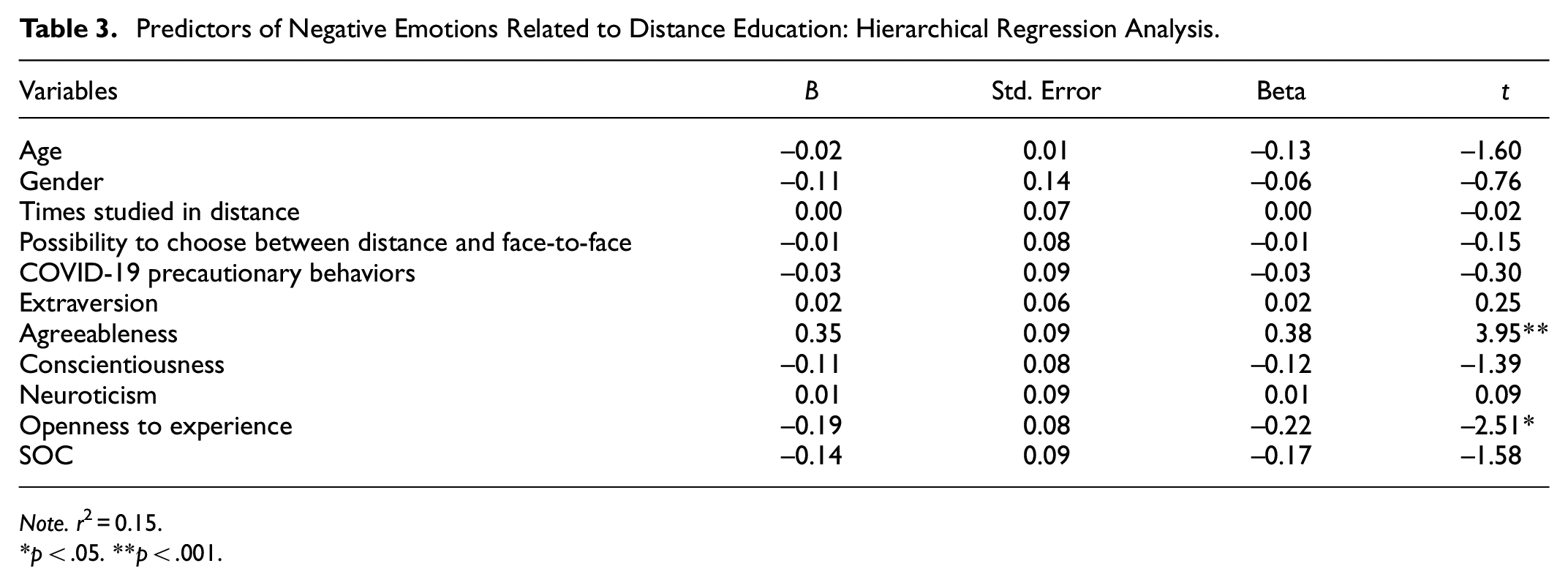
Note. r 2 = 0.15.
p < .05. **p < .001.
In the second regression analysis, positive emotions related to forced distance education were used as the dependent variable. Table 4 shows that the variables included in the model accounted for 14% of the variance in positive emotions. Personality characteristic “Agreeableness” was negatively, and “Openness to Experience” positively related to positive emotions. Sense of Coherence (SOC) was positively related to positive emotions, although the effect was not statistically significant (p = .077).
Predictors of Positive Emotions Related to Distance Education: Hierarchical Regression Analysis.

Note. r 2 = 0.14.
p < .05.
Discussion
COVID-19 pandemic has forced many countries to adopt restraint measures to control and to slow down the spread of the COVID-19 pandemic. In addition to measures related to work-life, public transportation, and public events, many countries like Sweden have adopted restrictions to education at universities. Until November 1st, Swedish universities, including the Gothenburg University, had most of the lectures as distance education. After November 1st, the restrictions were removed gradually, and most of the educational activities started to return to campus. In the present study, samples were collected in March-April 2021 and in November 2021 in order to study if the different pandemic situation was reflected on students’ perception of forced distance education. While in March-April 2021, the pandemic situation was difficult with a high number of daily infections, in November 2021, Sweden had one of the lowest infection rates in the European Union. In addition, vaccinations were available for the age group, unlike in March-April 2021. Therefore, a comparison of these two samples was assumed to reflect differences in the pandemic.
Earlier studies have demonstrated the negative effects of distance learning on students’ concentration and ability to organize their studies (Commodari & La Rosa, 2021; Giusti et al., 2021) and time management (Zapata-Garibay et al., 2021). A common impression among students and educators is that forced distance learning has negative effects on students’ motivation and mood. In the present study, however, the negative affect score did not differ from the positive affect score when measured with PANAS items (Watson et al., 1988). Since PANAS has been validated in numerous studies and also showed high reliability in the present study, this finding means that forced distance learning evokes negative emotions to the same degree as positive emotions. While some students might find distance learning boring, difficult to concentrate and often too lonely, other students might enjoy the benefits such as time-saving, flexibility and independence. A recently published Swedish study investigated people’s answers to the question, “During the past 24 hours, is there anything that has made you feel good or helped you in your life?” among 693 respondents (Eklund et al., 2022). The study showed that psychological responses were “not all negative or all positive” (Eklund et al., 2022). In this study, similarly, both positive and negative emotions were felt in internet-based forced distance learning.
The results of the present study might indicate that a student’s personality characteristics influence the way how she/he feels about distance learning. Earlier studies show that student-related characteristics such as age and gender (Buško & Bezinović, 2021), cognitive strategies and learning style (Baherimoghadam et al., 2021; Fernández Cruz et al., 2020), and social and emotional flexibility (Valieva & Ivanova, 2020) influence how students cope with distance learning. Such personality as proneness to anxiety (a component of Neuroticism) has been found to have a negative effect on coping with distance learning (Eshet et al., 2021; Steinberger et al., 2021; Valieva & Ivanova, 2020). In the present study, the relationship between the main personality factors measured with the Five-Factor Model of Personality (Donnellan et al., 2006) and emotions related to distance learning was studied. The regression analysis results showed that the Big-5 factors Openness to Experience and Agreeableness were related to negative and positive affects related to distance learning. The results were very coherent and understandable: Agreeableness was positively related to negative emotions and negatively related to positive emotions. Agreeable people are characterized by being overly friendly and enjoying emotional exchange in personal one-to-one relationships. People scoring high in Agreeableness actually get emotional satisfaction mostly from these encounters with friends and family members. In such applications as Zoom or Teams, these personal encounters are much more difficult and emotional sharing much more superficial than in face-to-face meetings. Facial expressions are more difficult to detect, and touching the other person is not possible. Therefore, it is not a surprise that Agreeableness increases the likelihood of negative and decreases the likelihood of positive emotions in distance education.
The other personality characteristic significantly related to emotions evoked by distance learning was Openness to Experience. Openness to Experience was positively related to positive emotions and negatively related to negative emotions. Openness to experience is characterized by curiosity and creativity. The protective effect of Openness to Experience could be explained by the fact that people scoring high in Openness are independent and often eccentric people following their own interests. Distance learning provides more freedom than classroom teaching, and these self-directed and independent people may actually enjoy that freedom.
Earlier studies emphasize the importance of resilience on performance in distance learning settings (Valieva & Ivanova, 2020). In the present study, resilience was measured with the Sense of Coherence, which is composed of experiencing one’s life as meaningful, manageable, and comprehensible (Antonovsky, 1996; Feldt & Rasku, 1998). It was assumed that a person with a high Sense of Coherence would find meaning also in the COVID-19 distancing, understand its necessity, and manage one’s life in the new situation. In earlier studies, SOC has been related to lower levels of COVID-19 pandemic related to stress, anxiety, and depression among students (Li et al., 2021; Misamer et al., 2021; Shorey et al., 2022). In addition, SOC seems to reduce COVID-19 related fears among teachers (Padmanabhanunni et al., 2022) and help to adjust to the post-covid face-to-face education (Li et al., 2021). In the present study, SOC was negatively related to negative emotions and positively related to positive emotions, although the relationships were not statistically significant in both samples. One explanation for the relatively weak relationships between SOC and emotions in the present study might be that we measured the total SOC instead of the individual components of SOC, that is, meaningfulness, manageability, and comprehensibility. In earlier studies especially the sense of meaningfulness has been an important predictor of mental health and coping with stress in schools during the COVID-19 pandemic (Misamer et al., 2021; Padmanabhanunni et al., 2022). Unfortunately, the shortness of the SOC measure used in the present study did not allow the use of SOC components separately. In future studies among university students, a longer version of the SOC instrument (e.g., the 29-item SOC) should be used so that reliable sub-scale scores can be calculated.
Conclusions
This study shows that emotional responses in the two different stages of higher education during the COVID-19 pandemic (forced distance learning vs face-to-face) did not differ from each other. Opposite to general beliefs, the students felt both positive and negative emotions related to internet-based distance learning. In fact, the total score of positive emotions was exactly the same as the score of negative emotions. Distance learning—even forced one—has both positive and negative effects. These effects depend on students’ personality characteristics to some degree. Students scoring high in Agreeableness showed more negative and less positive emotionality than low scoring students. Openness to Experience had the opposite effects on emotionality as Agreeableness. The Sense of Coherence might reduce the negative effects of forced distance learning.
Footnotes
Acknowledgements
We would like to thank Saga Stenberg for helping with translation to Swedish and data collection.
Declaration of Conflicting Interests
The author(s) declared no potential conflicts of interest with respect to the research, authorship, and/or publication of this article.
Funding
The author(s) received no financial support for the research, authorship, and/or publication of this article.
Ethics Statement
Not applicable according to the rules of Norwegian Centre for Research Data (NSD). Since the study was conducted on the internet and no identification data were collected and since the survey does not contain any sensitive data as defined by NSD, no ethical permission was required.
