




Abstract
The word “kawaii” is ubiquitous in contemporary Japan and has spread to the rest of the world with the dissemination of Japanese pop culture. Although the word is conventionally translated in English as “cute,” its meaning is more nuanced than “cute,” and it is used for a wider variety of objects. The primary aim of this study was to determine if Spanish has an equivalent to the word “kawaii”; additionally, similarities and differences across Japanese, English, and Spanish were explored. An internet survey was conducted in which respondents from Japan (n = 486), the United States (n = 365), and Argentina (n = 303) were presented with various photographic images that were often described as “kawaii” in Japanese and asked to write three adjectives to describe the images. They were also instructed to rate their affective states when looking at each image in the valence and arousal dimensions. The results showed that babyish objects (e.g., human, animal, and toy) were most frequently defined as “kawaii” in Japanese, “cute” in English, and “tierno” in Spanish. The average frequency at which these words were used as primary adjectives was higher for “kawaii” (57.5%) than for “cute” (26.8%) or “tierno” (22.4%). All of these images were associated with positive and moderately-aroused affective states similarly across all three countries. The present study demonstrates that the adjectives “kawaii,” “cute,” and “tierno” can be used almost equivalently for describing babies and pets, but that the Japanese adjective “kawaii” encompasses wider categories than the other two words.
“Kawaii” is one of the most popular words in Japan today. It has been ubiquitous since the 1990s with the rise of Japanese pop culture; it has been introduced to the world along with anime, video games, and cartoon characters (Belson & Bremner, 2004; Lieber-Milo & Nittono, 2019a; Okazaki & Johnson, 2013; Yano, 2013). It is said that the appreciation of its concept can be traced back to more than 1,000 years ago and was revived in different forms by Japanese school girls in the modern consumer society (Kinsella, 1995; Nittono, 2016). This word is often translated in English as “cute.” Although it is currently used as an attribute adjective like “cute,” it was originally an affective adjective that expressed one’s feeling toward an object. It has been alleged to be derived from the ancient word “kawa-hayushi” (literally “face aglow” or “face flushing”) that meant “ashamed” or “pitying” toward weaker members of society. Over time, its use evolved to express gentle and tender feelings of affection; the negative connotation has disappeared almost completely today (Nittono, 2016). According to the Oxford English Dictionary (Oxford University Press, 2021), this word appeared for the first time in Western literature in 1603 in the Japanese–Portuguese dictionary Vocabulario da Lingoa de Iapam as “Cauaij,” glossed as “thing one feels pity or compassion for, or the feeling of compassion.” The word “kawaii” has been in the Oxford English Dictionary since 2010.
In recent years, interest in studying the concepts of cuteness and kawaii have increased not only in Japan but also in other Asian and Western countries (Dale et al., 2017; May, 2019). A recent survey showing that “cute” and related concepts are equally liked and considered to be positive has been conducted in Japan, the United States, and Israel (Nittono et al., 2021). Research on cuteness and kawaii has been conducted in various fields, including the arts and humanities (Dale et al., 2017; May, 2019; Ngai, 2012), psychology (Álvarez-San Millán et al., 2022; Aragón et al., 2015; Nittono et al., 2012; Sherman & Haidt, 2011), neuroscience (Hahn & Perrett, 2014; Kringelbach et al., 2016), marketing (Nenkov & Scott, 2014; Shin & Mattila, 2021; Wang et al., 2017), and engineering (Marcus et al., 2017; Ohkura, 2019). Not only as a local cultural phenomenon, kawaii and cuteness have also been emerging as a new field of research around the world (Dale, 2016).
The words “kawaii” or “cute” are typically used to refer to human and animal babies. Based on Lorenz’s (2010) seminal idea of kindchenschema (baby schema), it has been proposed that humans tend to respond instinctively to certain physical attributes such as a large head relative to body size, a high and protruding forehead, and large eyes below the horizontal midline of the skull—all features which are typical of the human baby’s face and body. However, the scope of “kawaii” and “cute” is not limited to this. Other objects such as pretty pastel-colored objects (kawaii without baby schema; Nittono & Ihara, 2017) and funny and playful things (whimsical cuteness; Nenkov & Scott, 2014) can also be called “kawaii” or “cute.”
Cross-Linguistic Considerations
One serious issue in conducting human science research in different countries is language gap. Although “cute” and “kawaii,” as well as their Hebrew equivalent “hamud,” have similar semantic meanings (Nittono et al., 2021), differences in nuance and usage also exist. For example, Buckley (2016) mentioned that the English language does not have a word that describes the feeling of perceiving cuteness. Steinnes et al. (2019) stated that Uralic languages such as Hungarian, Estonian, and Finnish have a word for an emotion evoked by seeing something cute, whereas Germanic languages such as English, German, or Norwegian do not. In the English language, feelings toward baby animals could best be expressed by the word “tenderness” (Piazza et al., 2018). Kalawski (2010) proposed that tenderness is an emotion that is associated with both joyful (cute) and sad (pitiful) situations. This feature of tenderness is reminiscent of the etymologic origin of the Japanese word “kawaii” in that it was previously an affective adjective that had a negative valence such as “pitying” or “ashamed” in archaic usage, but the word has come to have positive connotations such as “adorable,” “lovely,” or “pretty.”Steinnes et al. (2019) have argued that kama muta (“moved by love” in Sanskrit) is an affective response to cuteness cues. Kama muta is a positive emotion evoked by the perception or observation of a sudden intensification of a communal sharing relationship in which those affected feel they are equivalent and belong together (Fiske et al., 2019). Although this emotion seems to be related to the feeling expressed by “kawaii,” they are not equal. Whereas kama muta may often be labeled as “moved” or “touched” by English speakers, the feelings evoked by kawaii are not always as deeply experienced as those typical of kama muta. As an emotion, the feeling of kawaii has been characterized as “positive, unthreatened [in that the subject does not feel under threat], moderately aroused, approach-motivated and socially oriented” (Nittono, 2016, p. 89). The word “kawaii” is used more casually than “moved” or “touched” with a wide variety of objects in contemporary Japan.
In experimental psychology, stimuli used in a study are often needed to be validated by subjective ratings with verbal labels. However, the authors of the present article, Japanese and Argentinian researchers of experimental psychology and neuroscience, had difficulty in determining a Spanish word equivalent to “kawaii” or “cute” when they started planning a kawaii/cute-related experiment in Argentina. Spanish has the second highest number of native speakers in the world (471 million), following Mandarin Chinese (921 million) (Eberhard et al., 2021). In Chinese, the word “kě-’ài ( )” is used similarly to the Japanese word “kawaii” (“
 ”) (Marcus et al., 2017; Urakami et al., 2021). In contrast, there is no straightforward equivalent adjective for “kawaii” or “cute” in Spanish. Compared to English, Spanish has an abundant emotional lexicon with features that allow more nuanced affective expressions, including the frequent use of suffixes that can minimize (-ito or -ita) or exaggerate (-ísimo or -ísima) word meanings easily. Based on these characteristics, Llabre (2021) has proposed that the Spanish language is conducive to emodiversity, which means heterogeneity in emotions experienced by people in dimensions such as valence, arousal, or strength. In contrast, Perlovsky (2009) has suggested that English would be a more cognitive and less emotional language, possibly because the connection between language and sounds has weakened with the loss of inflections following the transition from Middle English to Modern English. Moreover, the Spanish language has more positive words than negative words compared to other languages such as English, German, French, Russian, and Chinese, although human language in general has a positivity bias (Dodds et al., 2015). In English–Spanish dictionaries, the English “cute” is translated as “mono,” “cuco,” and “rico” for baby and face in the Oxford Spanish Dictionary (Jarman & Russell, 1994) or “lindo,” “precioso,” “mono,” and “rico” for face, animal, and baby in the Collins Spanish Online Dictionary (The Collins Spanish Online Dictionary, 2021). In the Crown Japanese–Spanish Dictionary, “kawaii” is translated into “bonito,” “lindo,” “rico,” “precioso,” and “encantador” (Rubio et al., 2004). As can be seen in these examples, there appears to be no standard adjective equivalent in Spanish for either “kawaii” or “cute.”
Current Study
The primary goal of this study was to determine the Spanish adjective that corresponds to the Japanese “kawaii” and English “cute.” Similarities and differences in this semantic category across the three languages were also examined. We took the simplest route to find equivalent adjectives to answer this question: presenting people in different countries with the same images and asking them to write appropriate adjectives to describe the images. Although a similar attempt has been made in which both Japanese and American students rated the same images that were described as “kawaii” in Japan (Berque et al., 2019), no detailed lexical analysis has been reported. In a Spanish-speaking country, no such survey has been conducted thus far. Given that attention to and interest in cuteness and kawaii are increasing globally, empirical research to establish a Spanish synonym for “kawaii” or “cute” is worthwhile.
An online survey was conducted in Japan, the United States, and Argentina to examine verbal and affective responses to various images that were often described as “kawaii” in Japan. Among the Spanish-speaking countries, Argentina was chosen because this study began out of the authors’ practical necessity of selecting a Spanish word equivalent to “kawaii” or “cute” used in psychological experiments conducted in Argentina, as mentioned in the previous section. Although minor differences may exist between Spain and Latin American countries culturally and linguistically, this study will serve as a first step in this subject. Respondents were presented with color photographs one by one and asked to write three adjectives to describe each image. The respondents then rated their affective feelings induced by the image using the self-assessment manikin (SAM), a non-verbal pictorial assessment technique (Bradley & Lang, 1994), to confirm that each image induced similar affective reactions in all three countries. Because kawaii can be characterized as a moderately aroused, positive emotion (Nittono, 2016), these images were expected to be associated with a high valence and moderate arousal state. A neutral image that would not be considered kawaii was included as a control stimulus. The affective reactions to the neutral image would be expected to be associated with a lower valence and lower arousal state than the kawaii images.
Method
Participants
The respondents in Argentina were unpaid volunteers who were solicited via the social media networks (mainly Facebook) of the last author. The respondents in Japan and the United States were recruited via two crowdsourcing services, Crowdworks, Inc. (Japan) and Amazon MTurk (the United States), for a compensation of 88 Japanese yen or 0.8 USD per participation, respectively. In principle, the participants in the same survey should be compensated equitably. However, we had to collect participants with different methods because we had no participants pool in the last two countries and no comparable way of compensating Argentina participants. Including this issue, the survey protocol was approved by the Behavioral Research Ethics Committee of the Osaka University School of Human Sciences (HB020-054).
The numbers of complete submissions were 328, 491, and 502 for the Argentinian, Japanese, and American surveys, respectively. The obtained data were screened using the following exclusion criteria: (1) the age of the respondent was under 18 years old; (2) either the nationality or native language was not among those targeted; (3) age and/or gender responses given at the beginning and end of the survey did not match; (4) obvious violation of instructions (e.g., writing digits instead of words, multiple submissions by one person); and (5) the answers for all 18 affective ratings (i.e., valence and arousal ratings for nine images) were identical. Consequently, respondents from Argentina (n = 303), Japan (n = 486), and the United States (n = 365) were retained for further analysis. Table 1 shows the constitution of the final dataset.
Summary of Survey Samples.

Conducted through Crowdworks, Inc. on December 1, 2020.
Conducted through Amazon Mechanical Turk on December 1, 2020.
Conducted through a personal posting during November and December 2020.
Procedure
The survey was conducted using the online platform SurveyMonkey (Momentive Inc., San Mateo, CA, USA) in November and December 2020. The questionnaire was prepared in an identical format in Japanese, English, and Spanish. At the beginning of the survey, prospective candidates were informed about the goals of the study, their voluntary participation, and privacy policy that none of their personally identifiable information would be retained. At the end of the survey, they gave consent to using their data in the analysis.
Figure 1 shows the images used in the present study. The first and second authors selected images from a royalty-free image website hosted in Japan (Photo AC, https://www.photo-ac.com). A group of Japanese students then discussed the images and agreed that eight of them could be called “kawaii.” The images included (1) human baby, (2) stuffed bear, (3) young woman, (4) baby monkey, (5) kitten, (6) barricades, (7) old woman, and (8) macaroons. In addition, a simple white plate (9) was used as a neutral image, which was necessary to demonstrate that Japanese people did not apply the word “kawaii” to any item without discrimination. They were resized to 1,024 × 768 pixels. The order of the nine images was randomized across participants. Due to technical error, the image of a kitten was always presented at the fifth position while the other eight images were randomized in the Argentinian survey. All the nine images were fully randomized in the survey conducted in Japan and the United States. Although slight differences existed, it is unlikely that this factor biased the words reported by participants because each participant received these images virtually in a random order.

The nine images used in the present study. The primary adjectives given for these images are shown in Japanese, English, and Spanish. The adjectives in bold font were used by more than 10% of the respondents. Spanish adjectives are given in the masculine form. The plots show the mean values of valence (1 = unhappy/sad to 9 = happy) and arousal (1 = calm to 9 = excited) for respective subgroups. Error bars indicate 95% confidence interval. Error bars that are very short are not shown. All the photos are royalty-free images with model release (signed portrait rights license agreement to publish their images) on Photo AC (https://www.photo-ac.com). Image identification numbers are 62806, 130123, 168499, 245168, 278528, 1886063, 2736856, 3071469, and 4136277 for Image no. 1 to no. 9, respectively.
Question Items
The respondents were presented with each image and were asked to write three adjectives that came to their minds to describe the image. They were explicitly instructed to use only adjectives, not nouns. They then described how the image made them feel on the valence (Happy–Unhappy/Sad) and arousal (Excited–Calm) scales of the SAM (Lang et al., 2005) with the instruction “How does the above image make you feel? Choose one from nine points on the Happy–Unhappy/Sad (or Excited–Calm) scale below.” Each scale had five graphical figures depicting a spectrum of expressions, with a happy or excited face on the far left (coded as 9) and an unhappy/sad or calm face on the far right (coded as 1). The respondents could select any of the five figures or a point between any adjacent two figures, resulting in a 9-point rating in which a larger value indicated a higher rating of valence or arousal. At the end of the survey, respondents from the United States were asked if they were familiar with the Japanese word “kawaii”; if their response was yes, they rated their impression of the word from very negative (1) to very positive (5). This question was not included in the Argentinian survey by mistake. The responses were not timed.
Analysis
For each image, the frequencies of primary adjectives (i.e., the words written in the first place) and first three adjectives (i.e., the words written anywhere) were counted. Non-adjective words such as nouns and verbs were ignored. Words with inflection forms were transformed into the original forms that are listed in dictionaries. For convenience, words using the feminine form (−a) of the Spanish language were converted to their masculine form (−o). For the SAM scales, the mean scores and 95% confidence interval (CIs) of the valence and arousal ratings were calculated for each image. Because the female/male ratio was different across countries and there might be gender differences in affective ratings, the mean scores were obtained separately for female and male respondents. All the data are available at https://osf.io/werhm/.
Results
The median time for completing the survey was about 10 min in all three countries. The mean age was about 10 years younger in Argentina (M = 27.2, SD = 10.3) than in Japan (M = 38.3, SD = 9.8) and the United States (M = 38.0, SD = 11.8), probably reflecting different sampling methods: unpaid volunteers solicited via SNS posting versus paid crowdsourcing workers.
Affective Ratings
Figure 1 illustrates the mean scores and 95% CIs of the affective ratings for the nine images. As expected, the mean values of all images except for the neutral one were located in the second quadrant on the plot, indicating that they were associated with a high valence and moderate arousal. If the 95% CI does not cross the X or Y axis, the mean is significantly different from the midpoint (5). The mean values and the ranking of images in their respective subgroups are shown in Supplemental Table S1. Although the values differed slightly across country and gender subgroups, most of the kawaii images were rated higher than the neutral image in both valence and arousal dimensions.
Adjectives
Figure 1 also shows the primary adjectives used to describe each image in the three countries. Table 2 gives the frequencies of all adjectives written by 2% or more respondents. As expected, the word “kawaii” was used by the Japanese respondents for all images except for the neutral one. The frequencies were generally high. In particular, more than half of the Japanese respondents used “kawaii” as the primary adjective to describe the human baby (no. 1, 57.0%), stuffed bear (no. 2, 58.4%), and kitten (no. 5, 69.3%) images. In contrast, the adjectives used in the United States and Argentina were not extremely biased toward particular words. It is noteworthy that there was a common adjective combination: “kawaii,” “cute,” and “tierno.” These words were used for the human baby (no. 1), stuffed bear (no. 2), baby monkey (no. 4), and kitten (no. 5), all of which can be categorized as kindchenschema-related images. Table 3 shows the percentages for the use of “kawaii,” “cute,” or “tierno” as the primary adjectives for describing each image. The average frequencies of using these words for the four kindchenschema-related images as the primary adjective were 57.5%, 26.8%, and 22.4% in Japan, the United States, and Argentina, respectively.
Primary Adjectives Used for Describing Each Image in Japanese, English, and Spanish.

Note. Only items with greater than 2% occurrence are reported. Items with greater than 10% occurrence are shown in bold font.
The Percentages of “Kawaii,” “Cute,” or “Tierno” as the Primary Adjective for Describing Each Image, and Gender Difference in the Use of These Adjectives.
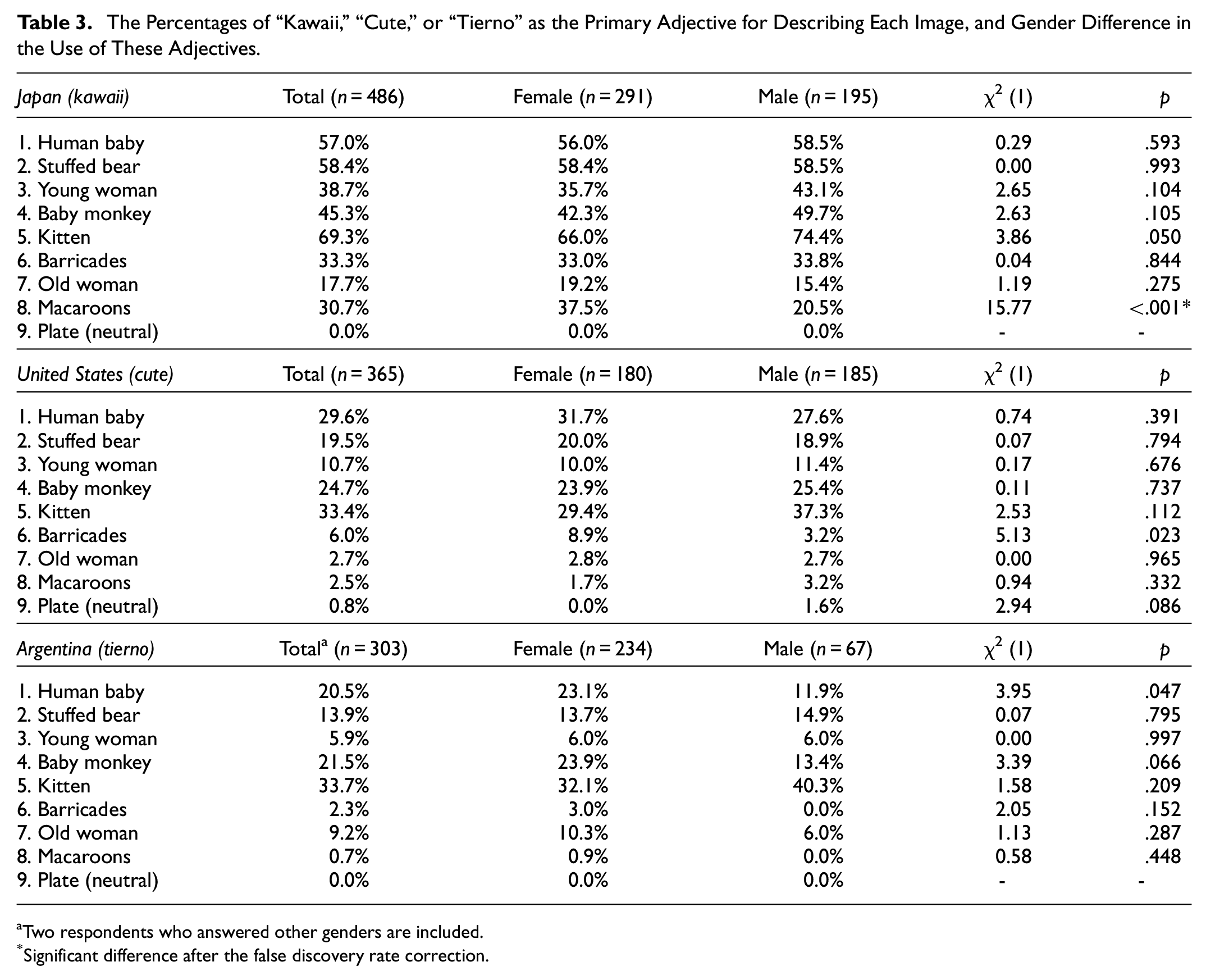
Two respondents who answered other genders are included.
Significant difference after the false discovery rate correction.
The image of a young woman (no. 3) was also referred to as “cute” (10.7%) and “tierno” (5.9%), but those frequencies were lower than that of “kawaii” (38.7%). In the United States and Argentina, this image was associated more frequently with “happy” and “amoroso [loving].” In Japan, “kawaii” was also used for images of funny and weird objects, such as barricades (no. 6, 33.3%). The English and Spanish words “cute” (6.0%) and “tierno” (2.3%) were also used for this category, but only infrequently. An important cultural difference was found for the image of a smiling old woman (no. 7). This image was sometimes described as “kawaii” (17.7%) in Japanese, whereas it was predominantly associated with “old” (20.8%) and “viejo [old]” (14.2%) in the United States and Argentina, respectively. In Japan, few respondents referred to the model’s age explicitly.
Similar trends were obtained for the first three adjectives. The results for the most frequently used adjectives were almost the same as the results for the primary adjectives, with a few minor exceptions in the Argentinian data (Supplemental Table S2). The word “feliz [happy]” (6.4%), rather than “amoroso [loving]” (5.7%), was used most frequently for the young woman. The word “infantil [childish]” (6.2%) was used more frequently for the barricades than “raro [odd]” (5.9%). The percentages for “kawaii,” “cute,” or “tierno” were higher for the kindchenschema-related images (nos. 1, 2, 4, and 5). The average frequencies of these words among the first three adjectives for these images were 76.3%, 45.5%, and 41.5% in Japan, the United States, and Argentina, respectively (Supplemental Table S3).
Gender Differences in Word Usage
Based on the above findings of the initial analysis, an exploratory analysis was conducted to examine potential gender differences in the frequency of the use of “kawaii,” “cute,” and “tierno.” The images for which these words were used as the primary adjectives were analyzed; these consisted of eight images for Japan and four images each for the United States and Argentina. Cross-tabulation was made by gender (female or male) and whether the word was or was not used as the primary adjective or in the first three adjectives. Possible differences in distribution were examined using Chi-square tests. To compensate for multiple comparisons, the false discovery rate of a total of 32 tests (i.e., eight images for the Japanese survey, four images for the American survey, and four images for the Argentinian survey for both the primary and first three adjectives) was controlled at 0.05 (Benjamini & Yekutieli, 2001). The details are shown in Table 3 for the primary adjectives and Supplemental Table S3 for the first three adjectives. A significant gender bias in word usage was found only in the Japanese survey for the image of macaroons (no. 8). Female respondents used the word “kawaii” to describe this image more frequently than male respondents did as the primary adjective (37.5% vs. 20.5%) and as one of the first three adjectives (64.6% vs. 42.1%), χ2s(1) = 15.77 and 24.05, uncorrected ps < 0.001, respectively. No significant gender differences were found for any of the other images in any of the three countries. Specifically, the frequencies of using these words as the primary adjectives for the baby-related images (nos. 1, 2, 4, and 5) were 55.7% versus 60.3% in Japan, 26.3% versus 27.3% in the United States, and 23.2% versus 20.1% in Argentina for female and male respondents, respectively. Similarly, the frequencies in the first three adjectives for female and male respondents were 75.3% versus 77.8% in Japan, 46.3% versus 44.7% in the United States, and 43.1% and 36.6% in Argentina, respectively.
Recognition Rate of “Kawaii”
In the United States, 51.2% of the respondents (187 out of 365) said that they were familiar with the Japanese word “kawaii.” Their impression of the word was positive (M = 4.28, SD = 0.70).
Discussion
The primary aim of this study was to determine the Spanish adjective that corresponds to the Japanese “kawaii” and English “cute.” In addition, similarities and differences in this semantic category across the three languages were examined. People in Argentina, Japan, and the United States were presented with various images of items that are often described as “kawaii” in Japan. Similar affective responses were obtained across all three countries in that these images produced positive valence and moderate arousal. The images of human and animal babies and a stuffed toy were described as “kawaii” in Japanese and “cute” in English, as expected. The Spanish adjective “tierno” was used most frequently for these images.
In Japan, the frequency of the use of “kawaii” was about twice as high as the frequencies of “cute” in the United States and “tierno” in Argentina. This might be because the images were originally selected by Japanese people and therefore are attuned to the cultural tastes of the Japanese population. However, the high occurrence rate of “kawaii” does not mean that Japanese people use this word indiscriminately, because the neutral white plate was seldom described as “kawaii.”
It is interesting that “tierno” appears rarely as a translation of “cute” in English–Spanish dictionaries or as a translation of “kawaii” in Japanese–Spanish dictionaries. The Spanish word “tierno” is often translated as “tender” in English (Lexico, 2021). However, it is noteworthy that the English word “tender” seldom appeared among the words chosen to describe the images in the present survey. Therefore, it may be confusing to use the English word “tender” in the context of research on the concept of cuteness. For instance, Piazza et al. (2018) conducted online experiments in the United States and reported that viewing baby animals’ images reduced the appetite for meat and that the negative correlation between babyness (i.e., baby vs. adult animals) and appetite for meat was mediated by feelings of tenderness rather than by the appraisal of cuteness. Feelings of tenderness are assumed to be evoked by the perception of vulnerability (Lishner et al., 2011). Therefore, when one focuses on one’s feelings toward an object (especially a kindchenschema-related object) and their potential effects on one’s behavior, it may be more appropriate to use the word “tender” rather than the word “cute” in English. The English word “cute” is an attribute adjective in that cuteness is perceived rather than felt. In contrast, the Spanish word “tierno” focuses more on one’s feelings toward an object. This distinction may reflect the generally more emotionally expressive characteristic of the Spanish language compared to the English language, as described in the Introduction (Llabre, 2021; Perlovsky, 2009). The Japanese word “kawaii” is both an affective and an attribute adjective (Nittono, 2016). Expressions like “This image is kawaii” and “I feel kawaii when looking at this image” are both possible. The former usage is closer to “cute,” whereas the latter usage is closer to “tierno.” The word “kawaii” appears as one of many translations of “tierno” in a Spanish–Japanese dictionary (Yamada et al., 2015). Because the Japanese word “kawaii” encompasses the meanings expressed by both “cute” and “tierno” in their respective languages, it is used very frequently in everyday language in Japan as compared to the other two words in the United States and Argentina, respectively.
If emodiversity in language is important for public health as proposed by Llabre (2021), whose idea was described in the Introduction of this paper, the oligopoly of the single word “kawaii” in Japan to describe many different things might have a detrimental effect. However, this lack of variety has often been compensated for since the mid-1990s by the use of compound words that include “kawaii” like a suffix, such as “kimo-kawaii” (creepy-cute), “busa-kawaii” (ugly-cute), “otona-kawaii” (adult-cute), and so forth. Kiyosawa (2014) listed 24 kawaii-derived compound words. Because these words are mainly used as slang or as bizarre words that are intended to attract the attention of an audience in media, they are constantly changing. These kawaii-derived words have likely been coined to reduce the gap between the general meaning of “kawaii” and specific feelings that people want to express. This may be an adaptive response in a language with less emodiversity.
While the adjectives used for typical kindchenschema cuteness were consistent across the three countries, other images were described with different adjectives which may highlight cultural differences among the three languages. The image of a young woman (no. 3) was described as “kawaii” more frequently by Japanese respondents. Specifically, 38.7% of Japanese respondents used “kawaii” as the primary adjective and 59.7% used “kawaii” as one of the first three adjectives. Americans (10.7%/23.0%) and Argentines (5.9%/15.8%) also used the words “cute” and “tierno” for this image but with lower frequencies (the first value in parentheses means the rate at which it was used as the primary adjective and the second value means the rate at which it was used as one of the first three adjectives; see Table 3 and Supplemental Table 3). The familiarity of the female model’s ethnicity may have also affected the result. The survey using the semantic differential scales showed that the words “cute” and “kawaii” were characterized by high approachability in contrast to words like “beautiful” or “cool” (Nittono et al., 2021). Because facial impressions of approachability are affected by in-group bias (Trent & Ferguson, 2021), Japanese respondents might have felt this female model more approachable (and thus more kawaii) than American and Argentinian respondents. The image of barricades (no. 6) would be an example of whimsical cuteness (Nenkov & Scott, 2014). It was described as “kawaii” frequently by Japanese respondents (33.3%/55.6%). The same image was much less frequently described as “cute” by Americans (6.0%/14.8%) or as “tierno” by Argentines (2.3%/6.9%). Macaroons (no. 8), which are pastel-colored sweets, are often featured as a typical kawaii object that is not related to baby schema (Nittono & Ihara, 2017). Japanese people used “kawaii” frequently (30.7%/55.6%) for this image; women used “kawaii” more frequently (37.5%/64.6%) than men (20.5%/42.1%). The words “cute” (2.5%/6.6%) and “tierno” (0.7%/5.0%) were used only rarely for the macaroons by American and Argentinian respondents.
The image of an old woman (no. 7) is a special example showing that cuteness is not limited to infantile objects. Japanese people used “kawaii” (17.7%/29.8%) for this image. Although less frequently, American and Argentinian people also used “cute” (2.7%/10.4%) or “tierno” (9.2%/17.8%), respectively. The approachability of this smiling model seems to be a key feature of this evaluation, as discussed earlier. Interestingly, while American and Argentinian people described this image with the word “old” (20.8%) or “viejo” (14.2%) frequently, Japanese people did not (less than 2%). This unexpected difference cannot be explained clearly. One possible explanation could be that Japanese people might have a cultural norm to avoid referring to a person as “old” in public. Or, in this special case, the unusual gesture and expression of the model, who belongs to their ethnicity, might have stood out much more than her physical age.
As can be seen here, Japanese people are accustomed to using the word “kawaii” for various objects. For these objects, “cute” and “tierno” are sometimes used by Americans and Argentines, but the absolute frequency for both words was low. On the other hand, kindchenschema-related objects seem to be associated with the specific words “kawaii,” “cute,” and “tierno” consistently. This is probably because this sense is intrinsic and has biological foundations (Lorenz, 2010), as discussed earlier.
About half of Americans were familiar with the word “kawaii” and considered it to have positive connotations. A similar result was obtained in a previous survey conducted in May (2019) (Nittono et al., 2021), where 41.5% of Americans (298 out of 718) responded that they were familiar with the word and thought it had positive connotations (M = 4.01, SD = 0.80, calculated from the dataset available at https://osf.io/hjgwv/). In a survey conducted in Israel during August and September 2018 (Lieber-Milo & Nittono, 2019b), the recognition rate was 85.6% (381 out of 445), and the impression was also positive (M = 3.99, SD = 0.84) among those who answered (n = 373). This Israeli’s recognition rate might have been inflated because of sampling bias (e.g., the researchers’ acquaintances in a social media group). Although the present and previous studies were based on relatively small samples and thus not comprehensive, the available results suggest that the Japanese word “kawaii” is now disseminating throughout the world, with generally positive connotations.
There are several limitations to this study. First, the data were obtained from relatively small samples. Data mining of the internet corpora would provide much more plentiful data. However, an experimental approach like that of this study provides narrower but more precise answers to the questions. Although this study focuses on a concept that is rooted and prevailing in Japan, a similar methodology may be useful to examine what kinds of words are used to describe an idiosyncratic concept in other cultures, such as Latin American culture’s. Moreover, the inclusion of other types of stimulus images may produce more varieties of adjectives and lead to a more nuanced understanding of the differences in semantic concepts in different countries. Second, the survey did not control for demographic variables that may affect language use, such as educational background and age. For example, the mean age of the Argentinian sample was 10 years younger than those of the other two samples. It is unclear how this feature of the present sample affects the findings. Third, the respondents’ expertise in other languages was not assessed. For example, recruiting English–Spanish or Japanese–Spanish bilingual people would provide a more nuanced view of the language differences. Finally, the survey was conducted only in Argentina as representative of Spanish speakers. According to the Oxford Spanish Dictionary (Jarman & Russell, 1994), the word “tierno” is also used for describing meat, not only for describing people as “affectionate” or “loving.” It may have different connotations in different Spanish-speaking countries and populations. Dialect differences should be examined in future studies.
In conclusion, the present study demonstrates that the Spanish adjective “tierno” is the closest equivalent of “cute” and “kawaii” for kindchenschema cuteness. At the same time, using the affective English word “tender” may be useful in a cuteness study that uses the English language in focusing on the affective response to cuteness. One of the reasons why the Japanese word “kawaii” is used so frequently may be because it encompasses both an object’s attribute (cute) and a viewer’s response (tierno).
Supplemental Material
sj-docx-1-sgo-10.1177_21582440231152415 – Supplemental material for English and Spanish Adjectives That Describe the Japanese Concept of Kawaii
Supplemental material, sj-docx-1-sgo-10.1177_21582440231152415 for English and Spanish Adjectives That Describe the Japanese Concept of Kawaii by Hiroshi Nittono, Hatsune Saito, Namiha Ihara, Dante Nicolas Fenocchio and Jorge Mario Andreau in SAGE Open
Footnotes
Acknowledgements
We thank Felix Hernández Vieyra and Lucia Eugenia Terradas for their help with data processing.
Declaration of Conflicting Interests
The author(s) declared no potential conflicts of interest with respect to the research, authorship, and/or publication of this article.
Funding
The author(s) disclosed receipt of the following financial support for the research, authorship, and/or publication of this article: This work is supported by JSPS KAKENHI Grant Numbers JP17H02651 and JP21H04897 to Hiroshi Nittono.

Supplemental Material
Supplemental material for this article is available online.
References
Supplementary Material
Please find the following supplemental material available below.
For Open Access articles published under a Creative Commons License, all supplemental material carries the same license as the article it is associated with.
For non-Open Access articles published, all supplemental material carries a non-exclusive license, and permission requests for re-use of supplemental material or any part of supplemental material shall be sent directly to the copyright owner as specified in the copyright notice associated with the article.
