




Abstract
Recent research shows the importance of purchasing local products for development the local and national economy. In developing countries, consumption of domestic products is a rapidly growing trend as it contributes to the development of brands and images of local companies. Faced with a foreign product preference in Vietnam, the Vietnamese government has organized a campaign entitled “Vietnamese people prioritizing Vietnamese products” in which local companies are encouraged to enhance their product quality, and consumers are encouraged to buy locally manufactured products. This study seeks to investigate how the Vietnamese government has shaped consumer behavior for domestic goods by framing public interest in the campaign. An analysis of 274 news articles in popular newspapers showed four main frames: campaign’s policy framing (CP), benefit of using Vietnamese goods (VG), advanced role models (RM), and criticizing foreign product preference (CF). A survey with 526 Vietnamese consumers indicated that four frames significantly predicted consumer attitudes. Results of the linear regression model were significant, the R-squared (R2) value was .25, indicating that approximately 25% of the variance in LP was explained by CP, VG, CF, and RM. RM, VG, and CP significantly predicted LP, but CF did not significantly predict LP. The findings suggest that further studies test the framing theory by using media coverage as a secondary source.
Introduction
Recent research shows the importance of purchasing local products. Purchasing locally produced items is considered a vehicle to enhance the development of the local economy (Ferguson & Thompson, 2021; Nygaard, 2020; Raworth, 2017). In addition, the use of domestic products brings about health, environmental, economic, and social benefits (Cleveland et al., 2014; Schnell, 2013). In developing countries, consuming domestic products is a rapidly growing trend (Aprile et al., 2016; Bianchi & Mortimer, 2015) as it contributes to the development of brands and images of local companies (Keller, 2003). Bentham et al. (2013) and Vignali et al. (2008) argued that governments should have an important role in promoting buying local products by issuing a policy.
In Vietnam, consumers have an increasing demand for foreign products. Faced with this situation, the Vietnamese government has applied several measures to preserve and develop national physical values (Mai et al., 2009). Realizing the importance of promoting domestic consumption, the Ministry of Industry and Commerce organized a campaign titled “Vietnamese people prioritizing Vietnamese products” (VietNam’s Politburo, 2009). The campaign has utilized media to disseminate the propaganda by linking it to such concepts as patriotism, self-reliance, and national pride in the hope to build a culture of domestic consumption and production. Also, to compete with well-known imported products, local companies are encouraged to manufacture high-quality products and display their products in exhibitions and funfairs.
As in other centralized societies, the information in media is usually controlled by the government. Media are considered “secondary definers” because they convey the views of those in power (Nisbet et al., 2003). This process is also seen as a way of framing information about the policy. They define who is regarded a valid stakeholder in the policy process and what sorts of information and evidence are deemed important and acceptable (Rein & Schon, 1991; Smith, 2013). Framing analysis is frequently used to determine how ideas are perceived and expressed in social discourses, including news in the media. It is critical to understand framed discussions by diverse social groups, as well as how the campaign is accepted and prioritized by the general public and in policy agendas (Benford & Snow, 2000; Shiffman, 2009).
Research issues on promoting domestic consumption have been receiving more attention in recent years. However, previous studies encountered many limitations in sampling and expanding the study in different national contexts (e.g, Skallerud & Wien, 2019; Watson & Wright, 2000). Studies in Asian countries, especially those with socialist economies like Vietnam, are lacking.
Previous studies have shown the influence of communication strategies on the consumption behavior of domestic goods (Ayob et al., 2016; Demont et al., 2013). However, most theories of economics, business, and mass communication have been developed in Western countries. How Asian governments support local companies by implementing campaigns and disseminating information remains underexplored.
Consideration of framing theory in government media campaigns has been carried out extensively in European and American countries. However, understanding the manner and impact of information framing in Asian and socialist countries has still been missed. Therefore, this study will explore and fill the gaps left by previous studies in the case of Vietnam. It is important to investigate how the Vietnamese government has shaped consumer behavior for domestic goods by framing public interest in this campaign. The results will contribute to the effective use of media to disseminate business information. Therefore, based on the framing theory, this study seeks to answer the following research questions:
RQ1: How do the Vietnamese media frame public interest in the “Vietnamese people prioritizing Vietnamese products” campaign?
RQ2: What is the effect of framing the campaign on Vietnamese consumers?
Literature Review
Local Purchase
There are many reasons for consumers to buy local products, the most important of which is the pride in their homeland and product quality (Mettepenningen et al., 2010). As such, consumers mainly emphasize the importance of supporting local producers (Januszewska et al., 2013) and give a sense of belonging (Zepeda & Deal, 2009). Literature on local product marketing shows that consumer ethnocentrism positively impacts attitudes toward local products (Bianchi & Mortimer, 2015). Intriguingly, consumers link local products to certain traditions and traditional characters, which may increase producers’ and retailers’ confidence in communication with consumers (Pícha et al., 2018).
Purchasing local products may bring about changes in the quality of domestic products (Demont et al., 2013) because consumer choice depends mainly on quality attributes (Ayob et al., 2016). Consumers may want to develop the local or national economy by buying domestic products even when they have a lower quality than imported products, which shows the importance of consumers’ attitudes toward local product selection (Shimp & Sharma, 1987; Watson & Wright, 2000).
Research shows some relationship between consumer behavior and the community. The local setting should thus significantly influence consumers (Siemieniako et al., 2011). Local nationalism is community-wide altruism defining the field within which a local loyalist will help others (Hardin, 1993). Regarding local product favorability, local support can thus be understood as a belief that buying the local product will help promote the development of local frugality. In terms of economy, the most substantial effect of consumers’ nationalistic tendency is on their amenability to use domestically produced goods and services (Moon, 2003). To subsidize this effect, communication should portray local manufacturers as nationalistic abettors who are just as pious to the local community as the local product consumers. Local producers should be shown to keep the local community serving as a feasible force in different areas of public competition (Skallerud & Wien, 2019).
There are a number of studies that have been done in different country contexts, for example, the study by Januszewska et al (2013) conducted in 15 different countries, Watson and Wright (2000) research conducted in 6 different countries. Most studies have been conducted in Europe and America, only a few studies have been conducted in Asian contexts, such as the Philippines (Januszewska et al., 2013), Singapore (Watson & Wright, 2000), and Malaysia (Ayob et al., 2016). No studies have been conducted in countries with socialist economies, including Vietnamese economy.
The previous studies all encountered some limitations, such as the limitations to their research approach and data collection procedure, the sample’s representativeness being compromised, and the sample size being rather limited. In addition, the generalizability of the results is somewhat limited to the country in which the study was conducted.
As such, past studies have left a number of gaps that need to be addressed such as the replication of these studies in other countries (Skallerud & Wien, 2019; Watson & Wright, 2000), performing further studies with a similar focus, targeted in different environmental settings (Demont et al., 2013), or investigate the influence of ethnocentrism, local patriotism on evaluations in local products through communication strategies (Skallerud & Wien, 2019).
The Media’s Framing Effect on Public Attitudes
Media should be useful channels to implement the government’s force-fed campaigns in which consumers are oriented to certain products and form consumer behavior (A. G. Anderson, 2014; Brandenburg & Hayden, 2003). In turn, media coverage influences policymakers’ perceptions of policy challenges, urgency, and the acceptability of policy solutions, which significantly impacts the agenda-setting process (Hawkins & Holden, 2013; Russell Neuman et al., 2014; Weishaar et al., 2016). Important variables include communication channels, messages and sources, and the context related to the campaign (Benoit, 2007). Therefore, news may need to create public awareness of the framed campaign, influencing the public decision process, and creating messages with great pervasiveness (Gerth et al., 2009; Schill et al., 2017).
Recent research indicates that public attention does not entirely account for changes in the policy agenda and that qualitative characteristics of media coverage are affected by several other factors such as policy outcomes, agenda change, individual political attitudes, and institutional rules (Walgrave & Van Aelst, 2006; Wolfe et al., 2013). In fact, one major impact on public attention is the framing of media. Issue framing refers to changing human perceptions, attention, and attitudes toward an event or issue (Entman, 1993; Rein & Schön, 1996). Media framing can be supportive of present policies, but it can also have implications for policy change (Wolfe et al., 2013).
In a few studies (Clark & Nyaupane, 2020; Rowbotham et al., 2019), people’s attitudes toward policy changes are framed by how the media broadcast them. The kind of information transmitted through media has potential impacts on shaping public understanding, attitudes, and behaviors (P. Anderson et al., 2009; Tewksbury & Scheufele, 2009), which is mainly used to see how exposure to different argument frames change people’s views of policy (Barry et al., 2013; Coleman et al., 2011; Rowbotham et al., 2019). Previous studies on framing were inconclusive. Some recommended the use of media to shape public attitudes to products, but others argued that such interventions aiming to change consumer behavior should not be allowed because consumers should have the right to choose the items to buy on their own (Brewer & Wise, 2010; Gollust et al., 2009). The study by Nagelhout et al. (2012) used a correlational method to examine the relationship between media exposure and policy support. Results showed that people who saw negative media coverage of smoke-free bar and restaurant legislation were less likely to support the policy.
Studies on the media’s framing effect on public attitudes are mainly carried out in European and American countries. There are still many gaps in the research field in Asian and Socialist countries. Besides, prior studies have mostly employed content analysis. While there is a rising interest in this field, the findings of these studies indicate that new methodologies and questions must be explored to progress beyond describing how arguments are framed to comprehending how framing affects attitudes and beliefs regarding public policy.
The current study investigates the implementation of the campaign “Vietnamese people prioritizing Vietnamese products” through an understanding of the campaign’s information framed in the press, and its impact on Vietnamese consumer attitudes. They will provide insight into how to disseminate domestic consumer policy issues successfully and provide implications for the effective use of media to frame public attitudes.
Methods
Data Collection and Procedure
Data were collected from January 2018 to January 2019. From the approval of the Ethics Committee, data collection consisted of two main phrases. In the first phase, we collected data to answer RQ1. Subsequently, we administered a questionnaire to address RQ2. As part of a larger project, the data presented in this study were approved by the Academic Board.
To answer RQ1, we used a multi-methods approach. The analysis of news from popular resources provided qualitative data; this process had three steps: data collection, thematic analysis, and synthesis of themes (Goffman, 1974; Rocha, 2018; Sievert et al., 2022). We also quantify and describe how journalists selected and filtered information during the framing process by systematically examining textual data from news with content analysis data (Elo & Kyngäs, 2008; Mayring, 2015).
We sought articles from popular sources in Vietnam, including e-newspapers (vnexpress.net and daidoanket.vn) and local newspapers (Nhan Dan, Tuoi Tre) by using the keywords “Vietnamese/domestic/local products/goods” and “prioritizing Vietnamese goods/ products.” After screening, 274 articles were considered relevant. After that, we focused more on detailed information about sentiment (i.e., the degree to which media coverage supports or opposes the local products, Vietnamese goods) and framing of media coverage. Such information was highlighted and stored in the datasheets for analysis.
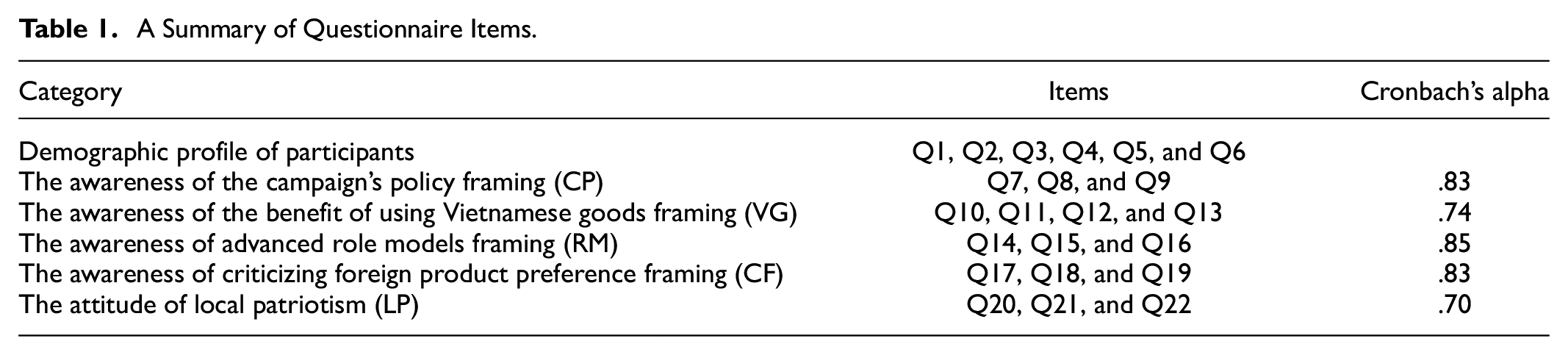
To answer RQ2, we administered a survey to understand public attitudes toward the event based on previous studies (Olsen et al., 1993; Shimp & Sharma, 1987; Skallerud & Wien, 2019). The questionnaire consisted of two main parts (Table 1). Part 1 investigated participants’ demographic information. Part 2 was composed of five main categories: (1) CP, (2) VG, (3) RM, (4) CF, (5) LP (see Appendix A1). All categories used the 5-point Likert scale, ranging from 1 = “strongly disagree” to 5 = “strongly agree.”
A Summary of Questionnaire Items.
We selected the survey according to the convenience sampling technique. Realizing that this campaign was likely to directly affect the local economy as well as consumers, we chose to select two major places in Northern Vietnam: Hanoi City and Thai Nguyen Province. After removing 74 respondents who provided invalid responses, the sample size consisted of 526 participants (see Appendix A2).
Data Analysis
Analysis of news articles to answer RQ1 had three steps. First, we used a thematic approach to qualitative data synthesis (Braun & Clarke, 2006) and coded data inductively to find significant themes across studies. The process started with coding the gathered data, then synthesized it into main themes and sub-themes.
Second, when we identified key themes, we looked for commonalities and differences in framing these issues. Four factors (Entman, 1993; Rein & Schön, 1996; Scholten, 2011) were used to operationalize the frames: (1) the problem description, (2) the details of how the issue came about, (3) the target groups involved, and (4) the approach specified for resolving the issue. Issue-specific frames (Semetko & Valkenburg, 2000) were considered appropriate for our study, and we call that campaign’s frames.
Third, we analyzed quantitative data collected from the content analysis (Entman et al., 2009) to show how these issues had been framed through news sources and sentiment in the articles (Baden, 2019). Basic data, including article characteristics (authors, title, topics, sources, and publisher) and overall article sentiment, were entered into an Excel spreadsheet. To measurement article sentiment, articles were classified as “reporting positively,” “reported neutrally,” or “reporting negatively” regarding the subject matter. The articles were classified by calculating the proportion of positive, neutral, and negative sentences, with the majority opinion serving as the final rating. The computed inter-reliability between researchers was 92%. Where category consensus could not be established, the researchers engaged in discussions to resolve disagreements. The researchers reviewed each article fully and discussed the findings to reach a consensus on each interpretation. After consensus was reached on a final list of predetermined themes, such information was highlighted and stored in the datasheets for analysis. The quantitative data collected from the content analysis were entered to SPSS 25 (IBM Corporation, NY, USA) for analysis.
To analyze quantitative data collected from the questionnaire to answer RQ2, we evaluated the relationship between the campaign’s frames and Vietnamese consumers’ local attitudes. The study used linear regression analysis to assess whether independent variables (Campaign’s frames) significantly predicted dependent variables. The data was processed through SPSS 25 (IBM Corporation, NY), this study’s statistical significance level was set at p < .05. The process of linear regression analysis was performed according to the following steps: (1) Calculate Cronbach’s alpha coefficient for scales, (2) Exploratory Factor Analysis (EFA), (3) Pearson correlation analysis, (4) Test of regression assumptions, and (5) Linear regression model analyze.
Results
RQ1: How Do the Vietnamese Media Frame Public Interest in the “Vietnamese People Prioritizing Vietnamese Products” Campaign?
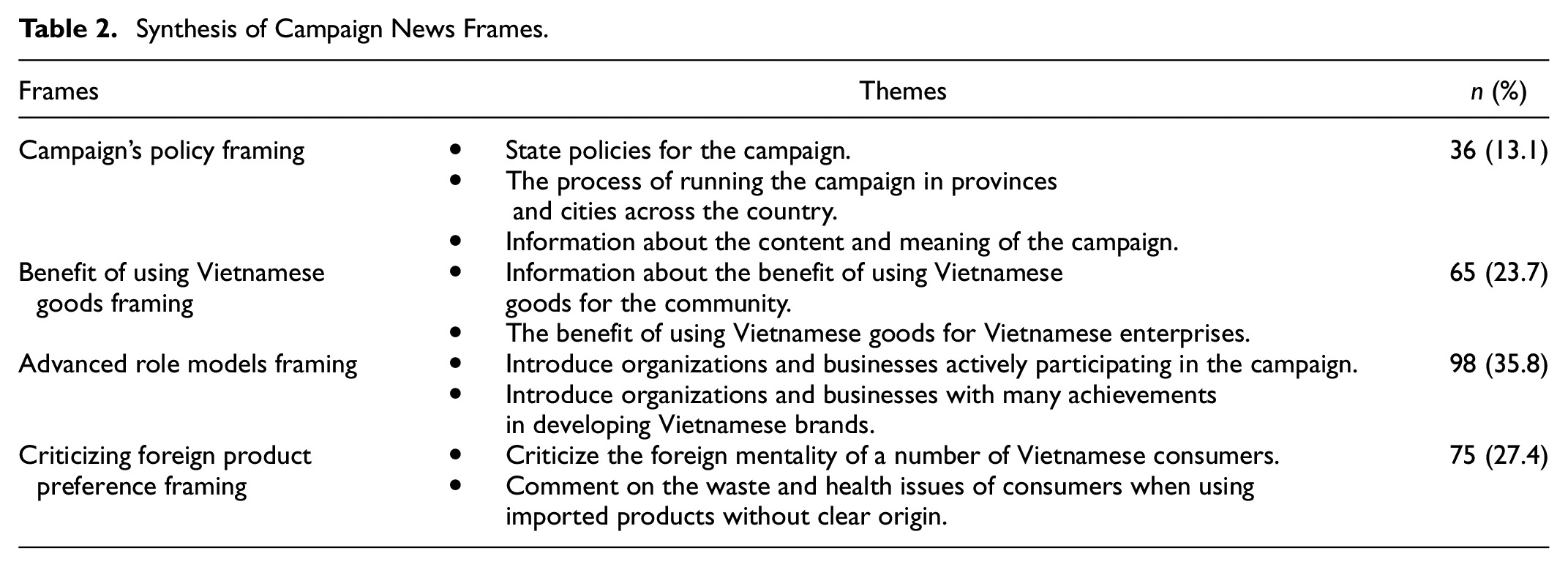
Results from the thematic analysis and synthesis showed that Advanced role models framing accounted for the most significant percentage of the articles found (35.8%), followed by Criticizing foreign product preference framing (27.4%), and Benefit of using Vietnamese goods framing (23.7%). Accounting for the smallest percentage was Campaign’s policy framing (13.1%) (Table 2). Results showed that Vietnamese media were very interested in framing Advanced role models, Criticizing foreign product preference, and Benefit of using Vietnamese goods. Frame of Campaign’s policy was used the least frequently.
Synthesis of Campaign News Frames.
Campaign’s policy framing
There were three main themes in the campaign’s policy framing on the campaign “Vietnamese people prioritizing Vietnamese products” (see Table 2). The themes showed that the central government and local governments positively supported enterprises and consumers in this campaign. These policies were implemented synchronously from the central to local departments and agencies across the country, this frame mainly explicitly stated policy about the campaign’s issues and policies. For example,
The campaign continues to contribute to raising people’s awareness in choosing and consuming Vietnamese goods, making businesses be aware of their roles and responsibilities, hence constantly improve and apply science and technology, innovate the production and management process to create quality products, ensure the competitiveness of products and goods to meet the needs and tastes of consumers (Hieu, 2018)
Benefit of using Vietnamese goods framing
Data analysis showed dual benefits: benefits for the community and benefits for enterprises. The articles on these themes showed the benefits of using Vietnamese goods as helping local producers and preserving Vietnamese cultural values through traditional products. Besides, it also helped Vietnamese enterprises get more opportunities to develop the market. An excerpt is as follows:
Prioritizing the use of materials contributes to promoting consumption, associated with the campaign Vietnamese people prioritize using Vietnamese goods, helping to solve the problem of finding output for Vietnamese agricultural products (Thi, 2018)
Advanced role models framing
Themes in advanced role models framing revolved around introducing awards and programs honoring individuals and groups who actively responded to the campaign. In fact, the press reflected the advanced role models of the campaign that the main purpose was to replicate the role models and create a ripple effect on businesses, increasing competitiveness toward the perfection of the products and benefits for consumers. Reflecting advanced role models was a way which enterprises wanted to promote and affirm the quality of their products to consumers to expand markets and build product brands. Also, it recommended effect for another enterprise. A typical excerpt is given below:
Typically, Big C Vietnam and Central Group Vietnam have implemented programs to support farmers to consume pumpkins, white radishes, pork, watermelons, old bananas… LOTTE Mart Viet Nam affirms to always support the spirit that “Vietnamese people prioritize using Vietnamese goods”, at LOTTE Mart, there are up to 95% products of domestic origin; especially a variety of agricultural products and foodstuffs. (TTXVN, 2018)
Criticizing foreign product preference framing
Criticizing foreign product preference refers to critical statements of using foreign products although local products with a comparable quality were available. The themes in this frame included providing arguments to counter the consumer’s preference for imported and branded goods or providing perspectives and expressing concerns about foreign mentality affecting the development of Vietnamese brands. In addition, there were concerns about waste and consumer health insurance when using imported goods of unknown origin. For example, a news article reported below:
The psychology of preferring “branded goods”, is partly an extreme development of the above perception, as well as a result of market communication, when the trend of using consumer goods, bags, clothes, and other personal belongings, from world-famous brands at super expensive prices, often used by some famous personalities in the showbiz world or rich people is exaggerated. Commercial media and tabloids have created a new perception among today’s young generation consumers that the more expensive foreign goods are, the more likely their owners have a chance to stand out. (Phong, 2018)
News sources with the campaign’s frames
Related to the campaign’s frames in the selected sample (n = 274) showed information from four basic sources, namely government (28.83%), enterprises (40.15%), experts (11.68%), and consumers (19.34%). The sources depended on the topicality of the issue, the topic, and the communication channel. Also, framing the news was a transition from the source frames entering to the news frames exiting the newsroom. The frames published in the news subsequently influence a wide range of news readers, including sources and journalists themselves to shape public beliefs, attitudes, and behaviors (Baden, 2019).
A Chi-square Test of Independence was conducted to examine whether frames and news sources were independent. The Chi-square test results were significant with χ2(9) = 51.77, p < .001, suggesting that campaign frames and news sources were related to one another. The data analysis showed that news sources from the government and enterprises are the primary sources in the four campaign frames. Consumer sources are only heavily exploited in the contexts of Benefit of using Vietnamese goods framing and criticizing foreign product preference framing. Sources from experts made the lowest percentage in most frames of the campaign (see Figure 1).

Frequency of news sources in four frames from the included sample (n = 274).
Media sentiment toward the campaign
Results showed that 177 articles expressed positive and supportive views, while 47 articles showed neutral attitudes, and 50 articles had doubtful, concerning, and negative tones. A chi-square test of Independence was conducted to examine whether frames and sentiment were independent. The chi-square test results were significant with χ2(6) = 128.95, p < .001, suggesting that campaign frames and sentiment were related to one another.
Data analysis showed that the campaign frames were conveyed positively in the articles. Some negative sentiments are found in the Criticizing foreign product preference framing. However, these negative sentiments aimed to criticize Vietnamese consumers’ consumption behavior of foreign goods, which meant that it would positively affect the campaign “Vietnamese people prioritizing Vietnamese products” (see Figure 2).

Frequency of positive, neutral, or negative sentiment of articles in four frames from the included sample (n = 274).
RQ2: What Is the Effect of Framing the Campaign on Vietnamese Consumers?
Cronbach’s alpha, EFA, and Pearson correlation analysis
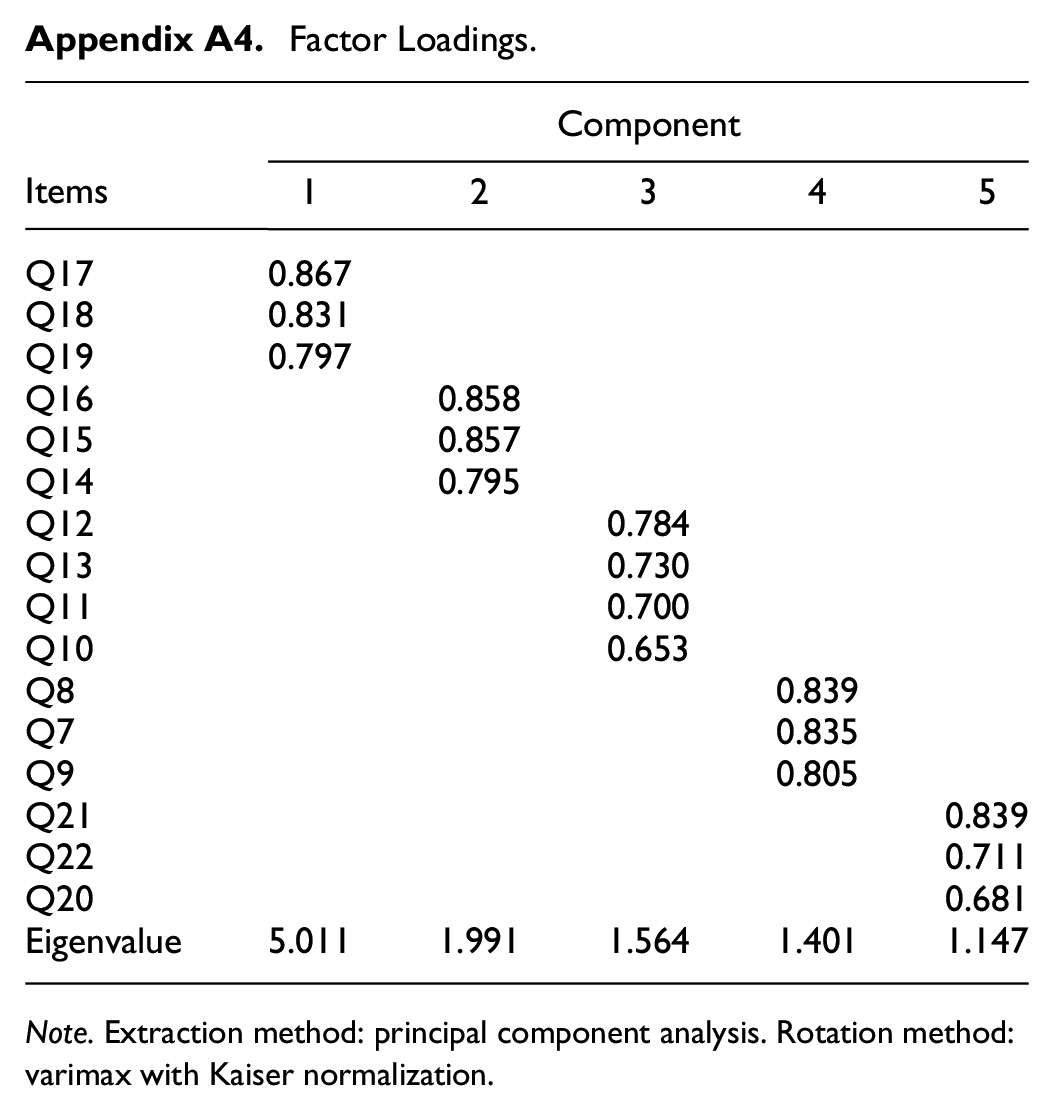
The reliability of data in Table 1 and latent variables are measured with Cronbach’s alpha values. The recommended criteria value for Cronbach’s alpha >.70 (Taber, 2018). Cronbach’s alpha values for CP, VG, RM, CF, and LP are higher than 0.7. Exploratory factor analysis was performed to explore the factor structure. The Kaiser-Meyer-Olkin (KMO) value was 0.825 while the Bartlett sphericity test was significant (χ2 = 3,304.998, df = 120, p < .001), suggesting that the data was suitable for EFA. Five factors had an eigenvalue higher than 1. The factor loadings are shown in Appendix A4.
Table 3 shows the results of the correlation coefficient which describes the relationship of one variable with another variable. CP, VG, RM, and CF have a highly significant positive relationship with LP; therefore, it shows that The media frames a significant role in influencing the attitude of local patriotism.
Correlation Table.

Correlation is significant at the .01 level (two-tailed).
Test regression assumptions
The assumption of normality was assessed by plotting the quantiles of the model residuals against the quantiles of a Chi-square distribution, also called a Q–Q scatterplot (DeCarlo, 1997). Figure 3 presents a Q–Q scatterplot of the model residuals. Results showed that the parameter estimates were reliable.

Q-Q scatterplot for normality of the residuals for the regression model.
Homoscedasticity was evaluated by plotting the residuals against the predicted values (Bates et al., 2014; Field, 2017; Osborne & Waters, 2019). Figure 4 presents a scatterplot of predicted values and model residuals. Results showed that the assumption of homoscedasticity was met.
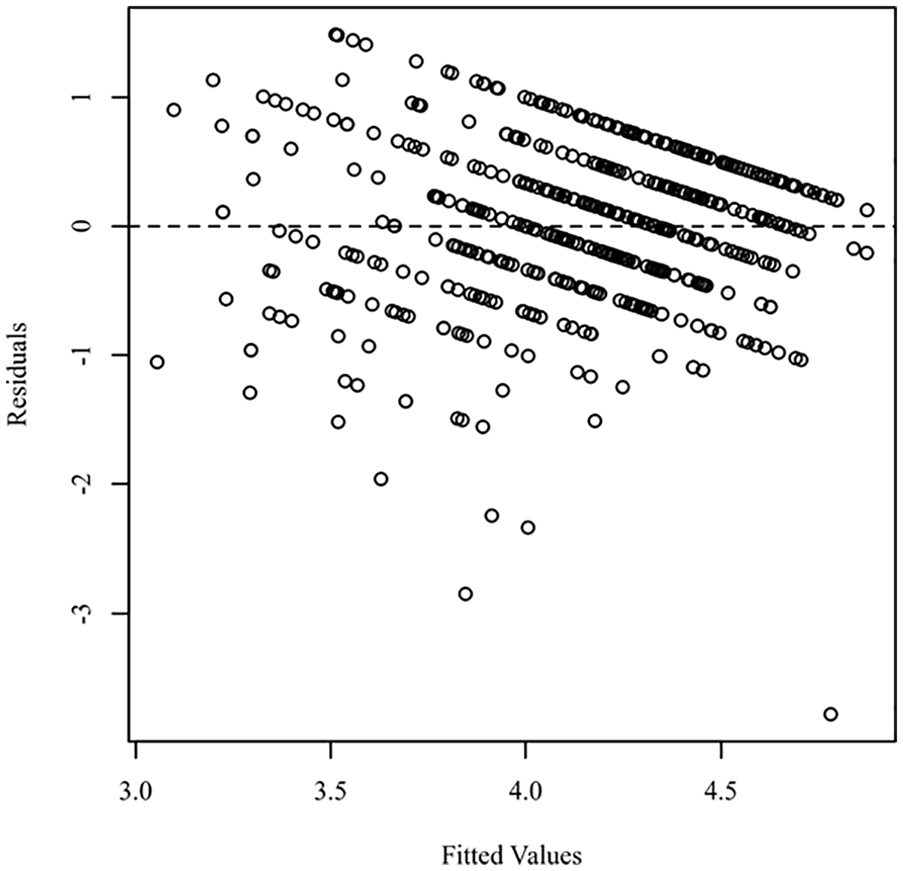
Residual’s scatterplot testing homoscedasticity.
Variance Inflation Factors (VIFs) were calculated to detect the presence of multicollinearity between predictors. VIFs larger than 5 cause worry about the increased effects of multicollinearity in the model (Menard, 2010). Table 4 presents the VIF for each predictor in the model; all predictors in the regression model have VIFs less than 2, which is good.
Variance Inflation Factors for CP, VG, CF, and RM.

Results of the linear regression model
A linear regression analysis was conducted to assess whether CP, VG, CF, and RM significantly predicted LP. The results of the linear regression model were significant, F(4,521) = 44.03, p < .001, R2 = .25, indicating that approximately 25% of the variance in LP is explainable by CP, VG, CF, and RM. RM significantly predicted LP, B = 0.24, t(521) = 7.02, p < .001. CF did not significantly predict LP, B = 0.00, t(521) = 0.02, p = .983. The results indicated that CP, VG, and RM significantly predicted LP (Table 5).
Results for Linear Regression with CP, VG, COF, and RM predicting LP.

Note. Results: F(4,521) = 44.03, p < .001, R2 = 0.25. Unstandardized regression equation:
An analysis of variance (ANOVA) was conducted to determine whether there were significant differences in LP by Gender, Employment, Education, Age, and Income (see Appendix A3). The ANOVA was examined based on an alpha value of 0.05. The results of the ANOVA were not significant, F(17, 508) = 1.16, p = .294, indicating the differences in LP among the levels of Gender, Employment, Education, Age, and Income were all similar (see analysis of Variance Table in Appendix). The results indicated gender, employment, education, age, and income did not have a significant effect on LP (p > .05).
Discussion
The results showed that there were four issue-specific frames about the campaign “Vietnamese people prioritizing Vietnamese products” in the collected articles, including Campaign’s policy framing, Benefit of using Vietnamese goods framing, Advanced role models framing, and Criticizing foreign product preference framing. It can be explained by the framing theory by Entman (1993) that four frames in this campaign are to select aspects of perceived reality in Vietnam about purchasing Vietnamese goods and make them more salient in the collected news. This finding confirmed the study by David et al. (2011) and Matthes and Kohring (2008) that issue-specific frames are broken down into elements delineated based on Entman’s four framing functions: problem definition, causal interpretation, treatment recommendation, and moral evaluation. This can be a reference for Vietnam/ the world in using economic campaigns to disseminate information that changes public attitudes.
Also, content analysis results showed the disparity in news sources selected in the four frames we found. One possible explanation may be the press does not exist independently but about political institutions, forming power relations, few of which can be revealed through the media (Lester, 2010). Hall et al. (2013) explained that those used by news sources shape journalists’ frames; in general, sources from government, business, and scientists often have an advantage in accessing the media. Journalists choose and integrate noteworthy sources, relying on their frames and role conceptions and their professional framing tactics and templates, to transform the available information into significant news frames (Baden & Tenenboim-Weinblatt, 2017). However, such coverage is also standard in the media, where journalists can decide what information to make public and vice versa (Crow & Lawlor, 2016).
The articles’ sentiment showed a tendency to rely on framing according to positive arguments about policies and benefits in consuming products or praising advanced features, similar to other studies (Brewer & Wise, 2010; Henderson et al., 2009). The frames theory assumes that an articles’ positive or negative sentiment has different effects on public attitudes. However, some studies have shown that in a new media environment like today, the public has become more active in accessing and exchanging information and forming social opinions with great pervasiveness; they can even become a source of information instead of the press (Harcar et al., 2006). Therefore, content that is mainly positive praise will quickly make the public feel drained and look for other sources on the internet to replace it (Entman, 1993).
The results from the survey with residents in Ha Noi and Thai Nguyen showed that advanced role models actively responding to the campaign framing had the most substantial impact on local patriotism, followed by the benefit of using the Vietnamese goods framing and the campaign’s policy framing. The frame of criticizing foreign product preference does not affect local patriotism. This finding confirmed the study by Granzin and Painter (2000) that showed that consumers often favor their fellow human beings in most respects; they often tend to consume in accordance with similar role models. Positive perceptions will be created by the arguments about the benefits of buying Vietnamese goods for the community, society, and businesses. We must buy local goods to support the people and the local economy (Navin, 2014). Information about the cultural values of local goods also brings about a sense of belonging and a sense of pride in the homeland (Januszewska et al., 2013). One possible explanation for the lack of impact of the criticizing foreign product preference frame on local patriotism is that traditional value orientation negatively correlates with a preference for imported brands (He & Wang, 2015). Another reason is that people love their country, homeland, and traditional culture. However, they also accept the culture and traditions of other countries because they consider them equal and legal (Granzin & Painter, 2001).
From the statistical analysis, Gender, Employment, Education, Age, and Income did not significantly influence local patriotism. From the researchers’ knowledge, this is the first attempt to explore the impact of the framing effect on public attitudes in Vietnam. This result also complements recent studies that qualitative aspects of media coverage are secondary factors (Walgrave & Van Aelst, 2006; Wolfe et al., 2013). The impact of policy communication campaigns on the public is not a causal process. Linearity includes complex causal interactions (Boydstun, 2013; Dekker & Scholten, 2017).
As the first attempt to investigate how the government frames information in media, this study contributes to the literature in the field both theoretically and practically. It expands the literature of effective use of media to disseminate governments’ policy and campaign that newspapers can be a tool for authorities and governmental agents to frame information and attract public attention. In centralized contexts, governments can use media to shape public attitudes. As this study was context-bound, the central government and local governments in Vietnam can take the results as reference for future implementation of campaign.
This study encountered some limitations. First, the campaign “Vietnamese people prioritizing Vietnamese products” has been launched since 2009, and the number of news and articles in the media in the early stages of the campaign is enormous. However, due to limited access to old news and article data, the authors only selected news and articles from 2018 to 2019, likely leading to the omission of many previous campaign frames. Future studies can perform real-time information frame studies to avoid omissions. Second, because the communication campaign has been carried out in Vietnam for a long time and continuously, this study omitted a framing effect analysis through experiments combined with panel approach surveys with data from content analysis. The use of surveys from the content analysis data of this study is still limited. Further studies can be conducted by combining experiments and questionnaires to increase reliability. Third, the scope of the study was confined to the northern region, which may have compromised the sample’s representativeness. Future research can investigate the implementation of campaigns on a larger scale in other contexts. Therefore, this research should be treated as a pilot study. It may be replicated in countries like the Vietnamese context. This research’s indicative findings should also be considered in any future research.
Conclusions
This study investigated how Vietnamese news articles convey the message of the campaign “Vietnamese people prioritizing Vietnamese products” by examining news frames, thereby assessing the impact of these frames on the local patriotism of consumers. The results point out positive impacts of news frames related to advanced role models and benefits of Vietnamese products; news frames regarding policies are not really effective in changing consumers’ attitudes.
This campaign was deployed on a wide scale, with many different public target groups, with the participation of many press agencies. Within the scope of the study, we only selected a certain number of samples that can be generalized for the survey, so we have not been able to go deep into the analysis as well as interview many other public groups. In addition, the development of new media, especially social networks, is creating intense competition for information for the traditional press, so the evaluation of the effectiveness of social mobilization without referring to this information channel will bring some limitations to the research results.
Footnotes
Appendix
Factor Loadings.
| Items | Component | ||||
|---|---|---|---|---|---|
| 1 | 2 | 3 | 4 | 5 | |
| Q17 | 0.867 | ||||
| Q18 | 0.831 | ||||
| Q19 | 0.797 | ||||
| Q16 | 0.858 | ||||
| Q15 | 0.857 | ||||
| Q14 | 0.795 | ||||
| Q12 | 0.784 | ||||
| Q13 | 0.730 | ||||
| Q11 | 0.700 | ||||
| Q10 | 0.653 | ||||
| Q8 | 0.839 | ||||
| Q7 | 0.835 | ||||
| Q9 | 0.805 | ||||
| Q21 | 0.839 | ||||
| Q22 | 0.711 | ||||
| Q20 | 0.681 | ||||
| Eigenvalue | 5.011 | 1.991 | 1.564 | 1.401 | 1.147 |
Note. Extraction method: principal component analysis. Rotation method: varimax with Kaiser normalization.
Author Note
Data and consents will be submitted on request. We declare the authorship of this paper, except where sources are properly cited.
Suggested Reviewers
1. Bui Phu Hung, PhD—University of Economics Ho Chi Minh City, email;
2. Bui Thanh Khoa, PhD—IUH, email:
3. Yuliyanto Budi Setiawan, PhD—Editor in chief of JTM (Indonesia), email:
4. Prof. Rohit Sharma—Editor of Elsevier, Springer, and Wiley IET, email:
Declaration of Conflicting Interests
The author(s) declared no potential conflicts of interest with respect to the research, authorship, and/or publication of this article.
Funding
The author(s) received no financial support for the research, authorship, and/or publication of this article.
Ethical Approval
This study was approved by the Academic Committee at University of Social Sciences and Humanities, Vietnam National University.
