




Abstract
The construction of hydropower projects has resulted in a significant number of reservoir displacements. Resettlement is unavoidably going to be a difficult problem to solve. Employment can provide endogenous economic sources for resettles as a key measure to address the issues of resettlement and development. While most researchers focused solely on its exogenous impact, they overlooked the employment psychology and internal drive intention of resettles, which are critical factors for resettlement programs to be successful. It is critical to study the resettles willingness and action mechanism for employment in order to obtain stable living resources through employment. Based on this, we use the China Three Gorges Project reservoir resettlement as an example and employ grounded theory to survey resettled employees’ employment willingness and the mechanisms underlying their employment behaviors. Our research concludes that: (1) Asset expulsion affects resettles’ employment, and the primary reason for their employment is an urge to reclaim their livelihood. (2) Government incentives and market opportunities foster favorable conditions for employment after resettlement. Family pressures and social ties are important motivators for resettled workers. (3) Individual characteristics are the most important factors influencing whether someone chooses to work. Hence, our findings could pave the way for a specific path to guide resettlement employment and serve as a reference for promoting the stable development for resettles.
Keywords
Introduction
Global economic development and climate change have pushed each country to set new higher targets for reducing carbon emissions. This has increased their demand for clean energy. Since hydropower reduces pollution, are relatively inexpensive with long-term utilization, all countries around the world prefer it to other forms of energy. As a result, the construction of water conservation projects has accelerated (Ma, 2017). Even though water conservation projects provide significant social and economic benefits, they also result in land inundation and numerous resettlements may curtail the development opportunities for local people. People who have been moved by a dam project, in particular, may struggle to adjust (Wiejaczka et al., 2020) and build new livelihoods (Schulz & Skinner, 2022), and are frequently worse off following dam construction (Hay et al., 2019). Researchers continue to emphasize the social injustice of depriving resettles from the economic benefits of hydropower development (Zhao et al., 2020). Currently, dam projects have displaced approximately 80 million people worldwide (Kirchherr et al., 2019), with the total number of people resettled from reservoirs expected to reach 48.73 million in China by 2020 (Tan, 2019). With the increase in the construction of water conservation projects, the resettlement issue is becoming more visible (Jackson & Sleigh, 2000). The livelihood of resettlement is linked to the advancement of major project construction and the development of local people’s welfare. These are also critical to social stability and economic development.
Particularly developing countries support the development of reservoir resettlement by implementing inclusive support policies in the later stages of reservoir resettlement or by implementing special poverty alleviation policies. However, as the economy and society grow, people’s general cost-of-living rises, whilst also demand for a high-quality life (An et al., 2022). These requests for simple material compensation and onetime subsidies no longer meet the demand for a better quality of life. Employment can provide a sustainable and stable income for resettles, with the characteristics of stability (Orona et al., 2022), psychological protection (Lianos & Cavounidis, 2010), and sustainability (Clair & Sandelands, 1994). As a result, the ability to participate in employment and earn a sufficient income (Tang et al., 2010) is an important way to address the issue of resettles’ long-term livelihood (Ke & Pan, 2011; Zhao & Luo, 2017).
In terms of theoretical understanding related to employment, Keynesian Economics examines the fundamental causes of employment from the standpoints of economics and market structure (Diesing, 1982). Development economics examines the impact of wage distribution and employment from the standpoint of labor market characteristics, such as race, gender, industry, and geographical differences (Naudé, 2010). According to the above summary, it can be known that the labor employment is influenced by a variety of internal and external factors. The economy, market and policy have a certain impact on employment. Firstly, economic growth is conducive to resolving the employment problem, and high economic growth will cause high employment (Li & Liu, 2011). While the research found that public employment and economic growth have an inverted U-shaped relationship, and explained that employment is related to the employees’ own factors (Baerlocher, 2022). Then, as one of the elements of market-oriented employment system, the establishment of market-oriented employment mechanism had an important impact on the improvement of employment quality (Lim & Lee, 2019). Finally, active fiscal policy at the local level can also help to increase the employment rate (Yang, de Sherbinin et al., 2020). At the same time, scholars conducted research on the impact of resettlement employment, poverty alleviation, and social environment (Abdullah & Rahman, 2021; Jenkins, 2004; Vanclay, 2017), and they believed that timely renewal of resettlement policies was the only way to develop resettlement employment (Mcdonald et al., 2008). With the pressure on resettlement employment continues to grow, the continuous adjustment and reform of resettlement policy can improve resettlement’s sense of gain and belonging in life (Azizpuor & Amiri, 2018; Guo & Li, 2019).
With the development of social economics, scholars began to pay attention to the internal influencing factors of employment, and employment research combining specific groups and individuals began to appear. Some studies have found that the psychological stability of job seekers has an important impact on their sustainable employment (Abdullah & Rahman, 2021). For secondary employees, there is a linear relationship between their employment and expected income, and their employment intention is closely related to the family structure and locations (Manurung et al., 2019; Yin et al., 2021). However, the employment status of resettlement is affected by many variables such as community integration, family structure, and their own abilities. Furthermore, resettles’ own labor quality and new environment cognition will influence employment stability. While research about this is not enough.
To sum up, it is found that most of the relevant studies analyze the impact of external factors on employment, and there is insufficient research on the internal mechanism of employment intention and employment action of resettlement. To fill this research gap, we analyze the resettlement’s internal and external conditions, as well as resettles willingness to work, and excavate the main driving force of their employment in the Three Gorges Reservoir Area. The main contributions are outlined as: (1) Using the grounded theory research method, the paper constructs a theoretical model of the formation of reservoir resettlement’ employment intention and behavior decision-making process, and analyzes the influencing factors and their relationship and interaction mechanism. (2) We investigate the reservoir resettlement decision-making logic in terms of employment intention and action in order to provide a decision-making basis for better endogenous resettlement and poverty alleviation.
Research Methods and Data Collection
Research Methods
The formation of employment intention and behavior results from multiple factors influencing and driving them. The intention-driven analysis must investigate the psychology of the case object, extract the details of the text and language materials from the research cases, and identify the elements influencing consciousness and behavior. Then finally analyze the logical relationship reflected in the text and materials. Traditional statistical analysis methods, on the other hand, have limitations in analyzing the digitization of social relations.
Grounded theory is a qualitative research method founded on empirical data by Glaser and Strauss. This method does not require a theoretical assumption prior to the start of the research. The researchers begin with direct observation, summarize the experience from original materials such as relevant literature, media reports, and field interview records, extract the relevant concepts and categories. Then the researchers investigate the interaction relationship between various categories before arriving at the system theory. Grounded theory research is directly based on real-world data. Following the systematic collection of data, the core concepts reflecting the essence of things are extracted, and the relevant theories are constructed based on the relationship between concepts. As a result, grounded theory offers distinct advantages in analyzing decision-making motivation and research mechanisms. It can effectively grasp the detailed information of the data content for induction, classification, deduction, and summary by combining rich qualitative data with inductive and deductive analysis.
Grounded theory is a method of developing substantive ideas from the ground up. This method is supported by empirical evidence. The new concept theory is based on experience and reality, whereas grounded theory is used to discover rather than justify reasoning. One of the most important aspects of grounded theory is that data collection and interpretation are done concurrently and in a continuous loop. This is accomplished through the use of three-level coding and a theoretical saturation scale.
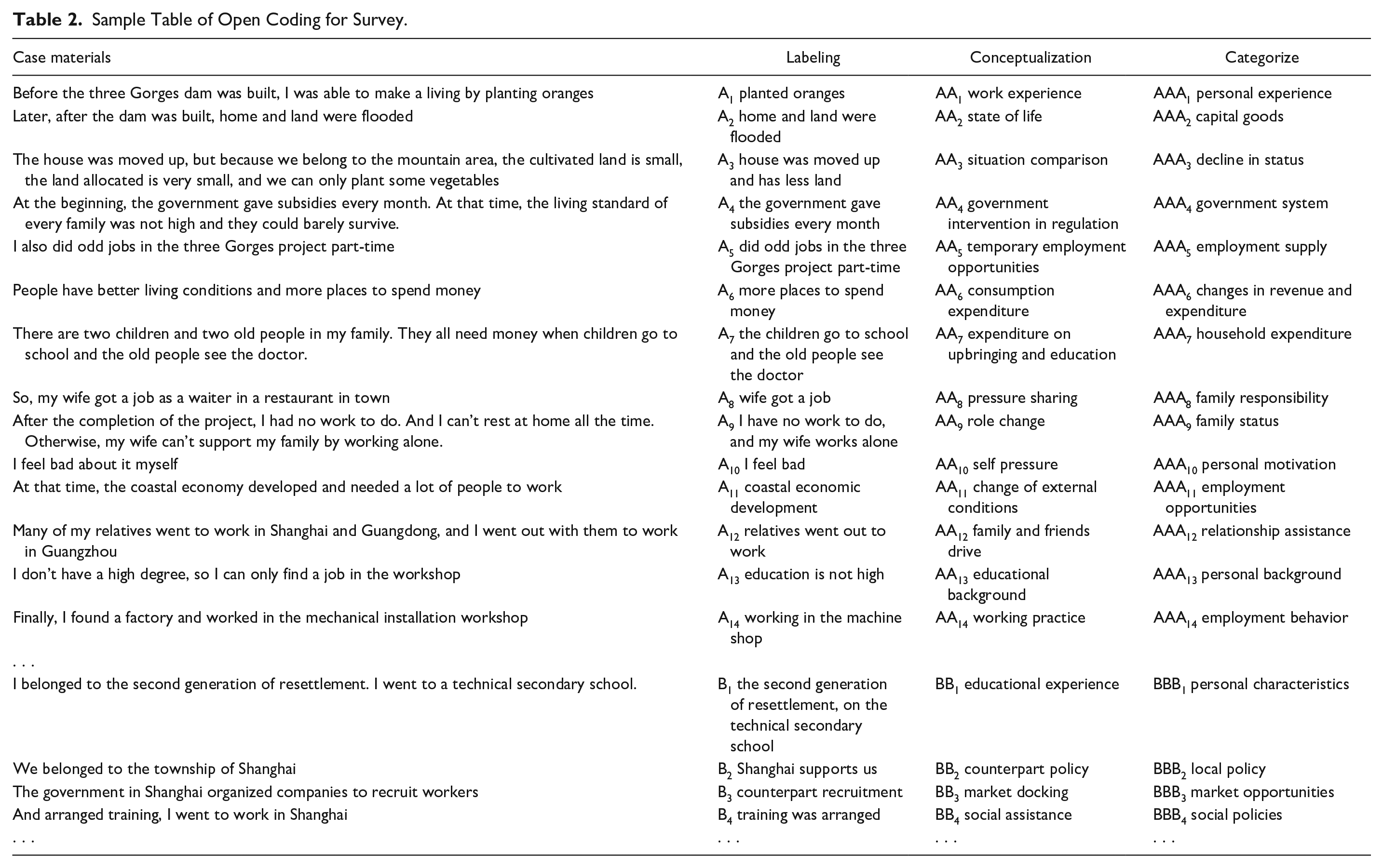
There are three levels of coding, according to the grounded theory process: sequential open coding, axial coding, and selective coding. Open coding entails conceptualizing and categorizing the data that has been collected. The general stages are tagging, conceptualizing, and categorizing. In this article, the samples are labeled A, B, C, D, and E. AA and AAA are related concepts and divisions that are related. Multiple concepts, such as AA1 and AAA2, can be expressed numerically, with AA1 representing the first original data. Axial coding is a grounded theory-based paradigm model. The authors can sort and mine data using open coding to find secondary categories, then summarize the major categories. Finally, selective coding is the induction and deduction of the major category from axial coding, as well as the selection of the core category. The theoretical saturation test is a method of confirming the reliability and validity of a theoretical model by introducing a set of recent cases to test the results and conduct analysis, comparison, and verification. Figure 1 depicts the basic research method.

Flow chart of grounded theory method.
Case Study and Data Collection
According to Siggelkow’s research, a representative sample can meet research needs if the case study is a “talking pig” (Siggelkow, 2007). As a result, the theoretical sampling principle is used to collect data in this article (Chun Tie et al., 2019). In the meantime, the subjects should not be statistically significant representative samples, but they should be closely related to the research goal and capable of reflecting or clarifying the phenomenon under investigation (Yu et al., 2016).
The research objects in the article were San Douping Town, Tai Pingxi Town, Le Tianxi Town, and Maoping Town of Zigui County in Yiling District, Yichang City. The Three Gorges Project’s headquarters are in San Douping. It is the first town beneath the Three Gorges Reservoir and a popular tourist destination in China. The town has 6,091 resettlements. The reservoir area includes the towns of Tai Pingxi, Le Tianxi, and Maoping, which are located upstream of the Three Gorges Dam. The overall percentage of people resettled is greater than 25%. Agriculture and resettlement workers are the most common types of resettlements and employment in Tai Pingxi and Le Tianxi. Maoping is a new town that sprang up after the completion of the Three Gorges project, with the majority of its residents being self-employed entrepreneurs and resettlement workers. The authors choose the data collection items at random from the employed resettles. Fifty of these objects have since been resettled, while two remain unemployed to compare job motivation. The employment objects are 50 resettles, 40 of which are key objects and 10 of which are verification objects. The overview of some research objects is shown in Table 1.
The Survey of Research Objects (Part).

For this study, data was gathered through on-the-spot interviews, investigations, and the compilation of videos, photographs, and newspaper reports. Structured and semi-structured interviews are the most common types of on-the-spot interviews, and the interview content consists of three components: The first is an employee self-introduction, which includes information about their educational background, work experience, family, and social relationships. The second category is general employment or entrepreneurship ideas and behavior, which focuses on key events, psychological changes, challenges, and solutions in the employment process. The third category is the employment environment, which includes the natural environment, social environment, family economic status, and basic supporting conditions. The interview is audio-recorded and then converted to text. The authors also interviewed workers from various local government agencies in order to gain a better understanding of local social and environmental conditions.
Data Arrangement
This article summarizes the concepts, clarifies the categories, and analyses the relationship using grounded theory. On this basis, the authors construct a theoretical model based on the reservoir resettlement employment situation. Initially, 52 representative samples are collected, and sorted from four resettlement towns. The text and language data are analyzed, translated, and labeled word for word. Second, the authors investigate association coding and explain the hierarchical logic of coding by employing the sequential logic of situation, behavior, and consequence. Finally, the definitions are constructed using sociological and economic theories, and the categories are summarized to bring the open coding process to a conclusion.
Hierarchical Coding and Theoretical Construction
Open Coding
The process of word-by-word coding, labeling, and registering the original interview data to generate initial concepts and categories is known as open coding. When processing raw data, you can choose to code word by word, sentence by sentence, or event by event. Categories are the fundamental concepts that summarize and reflect the essential attributes and universal relationships of things. The terms relating to employment intention and actions in the original data of 52 respondents are marked and condensed into 146 labels. The labels describing similar phenomena across all data are summed and defined into 61 concepts. The authors then classify and summarize the established concepts using regression analysis, yielding 45 initial categories. Table 2 displays some examples of sorting results.
Sample Table of Open Coding for Survey.
Axial Coding
The goal of open coding is to find categories, whereas the goal of axial coding is to find major categories. Based on the principle of open coding and the initial category, the grounded theory model extracts 23 subcategories, including “loss of livelihood,” “backward technology,” “declining status,” “family consumption,” “imbalance of income and expenditure,” “family responsibility,” “economic climate,” “job environment,” and “educational history,” among others. To explain the sense and logical stage, the subcategories are further classified and arranged. Six key categories have been identified after much deliberation and refinement. Factors to be considered include resource depletion, government incentives, family strain, business opportunity, social relationships, and personal characteristics. Table 3 displays the categories generated by the axial coding, which includes the main category, subcategories, and internal relationships.
Main Categories, Subcategories, and the Internal Relationships.

Selective Coding
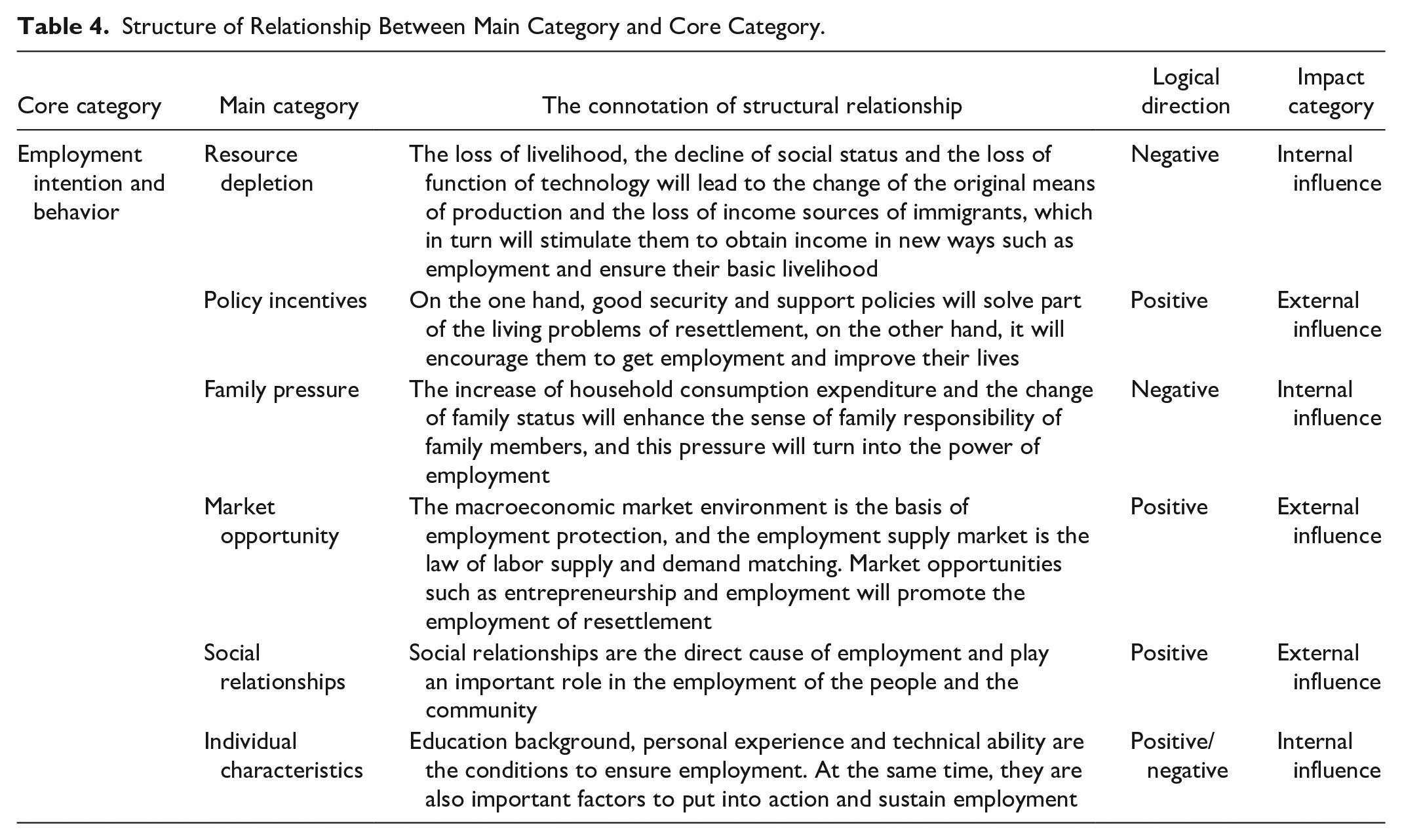
In relation to the research topic of reservoir resettles employment willingness and behavior mechanism; this article investigates the core category and its relationships with other categories, as well as the type of recognition. The authors discovered that policy incentives, business opportunities, and social relationships are external factors that influence reservoir resettlement employment willingness and behavior. While resource depletion, family pressure, and individual characteristics are internal factors. According to the logical effect of the affects, resource depletion and family strain are negative effects. Whereas, government incentives, business opportunities, and social relationships are positive effects. While active job selection is an employment performance. The primary focus of this study is “employment intention and behavior.” To explain the behavior phenomenon between categories, the process logic of cognition-attitude-purpose-behavior is used. Table 4 depicts the main category-core category relationship structure.
Structure of Relationship Between Main Category and Core Category.
Theoretical Saturation Test
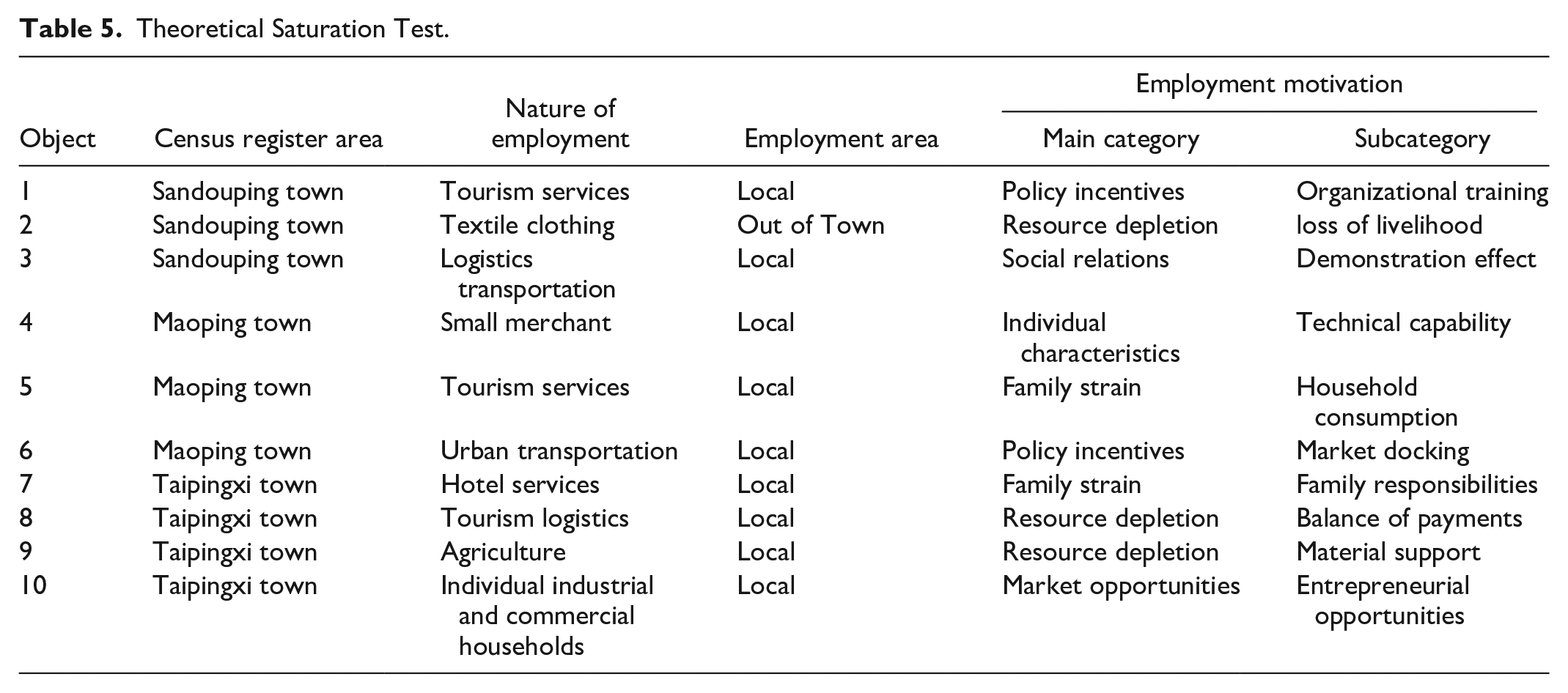
The theoretical saturation test is a critical link in determining whether the authors can stop collecting sample data in grounded theory research. When there are no new initial definitions or categories in the entire sample data set, it indicates that there is no new theoretical implementation, indicating that the theory is saturated (Bloor & Wood, 2006). The saturation test is frequently used to evaluate the reliability and validity of grounded theory research findings, as well as to improve the reliability and validity of research theory and performance (Wagner et al., 1968). This research is aimed at resettlement employment samples drawn at random from four towns in the Three Gorges Reservoir district. There were 52 people chosen, with 10 samples set aside for testing. After coding and analyzing the 10 samples three times, this article discovers no concepts or categories that are novel or controversial in comparison to previous research. As a result, the category coding and model construction in this article are theoretically saturated. The results are shown in Table 5.
Theoretical Saturation Test.
Model Results and Mechanism Analysis
The employment of reservoir resettlement residents has a significant impact on their income, social status, and long-term growth. Reservoir resettlement, as a distinct category, has its own peculiarities in the study of employment mechanisms. According to the study, a combination of factors results in reservoir resettlement employment willingness and actions. Figure 2 depicts the role’s organizational structure.

Structure chart of model influencing factors.
According to the study of employment’s analysis purpose and behavior process, the cut-off of resources is a significant factor causing economic income strain, and the burden and obligation of families even aggravates their psychological vulnerability. Whereas government action offers positive incentives for the development of resettlement employment. The impact of reservoir resettles’ internal employment environment is more sensitive than that of other objects. The regulation and guidance of its external environment has a greater influence. Individual characteristics have a significant impact on employment actions after the formation of willingness. In reality, the research reveals two types of phenomena: having an employment goal but not taking action, and relying on government subsidies but not working.
Internal and External Factors
Based on the results of the data analysis and theoretical model, it is possible to analyze the influencing factors of reservoir resettlement employment from the internal and external degrees. On the one hand, from the standpoint of internal control, data severance is the most important influencing factor of resettlement, which is distinct from other objects. This type of influence manifests itself not only in the loss of means of production and the shift in income source, but also in the identity shift caused by the disintegration of original living habits and relationships. It incorporates community development because of a change in the original production mode and technological operation, as well as culture as a result of a change in the original identity and habits. Workers in their place of residence receive job information through the local social network, but because of their relocation to a new living area, their employment opportunities are reduced, their original social capital is lost, and the social network is broken. While the time to relocate to a new area is relatively short and as the new social network is still being established, resettles face difficulties to obtain better jobs through interpersonal relationships. As a result, their self-awareness will deteriorate, as will their ability to obtain resources, and they cannot meet the production requirements when seeking new employment. This will affect their employment income and resulting in an income-to-expenditure imbalance. In severe cases, it can even lead to unemployment. As a result, resource depletion is a significant motivator for resettles seeking passive employment and willingness to work. Another internal factor that influences reservoir resettlement job motivation is family pressure. The resettlement families’ livelihood mode and development strategy will be affected to some extent because of the relocation caused by the construction of water conservancy projects. Although the state and local governments go to great lengths to help them, their satisfaction with life after resettling remains low. Because of the advancement of the social economy, maintaining a minimum standard of living is no longer a development goal for resettlement, and most resettles now expect to improve their lives continuously. Increased household spending adds to income pressures, making family members feel more responsible. Changes in family status are caused by changes in family roles, which increases job willingness and behavior for reservoir resettlement. Personal characteristics affect the basic conditions and psychology of employment, and then affect employment purpose and behavior. The most basic requirements for reservoir resettlement to generate job willingness and actions from outside are policy incentives and business prospects. Macroeconomic policies and the climate exacerbate the external pulling effect on resettlement jobs under the resettlement compensation mechanism. It has long regarded a series of national resettlement support policies in the reservoir area as critical factors in promoting resettlement income growth and establishing a long-term mechanism for the economy’s and society’s stable development. The marginal utility of policy performance improvement is directly related to policy implementation accuracy. It is critical not only for the long-term development of reservoir resettlement but also for the effectiveness and comprehensiveness of poverty alleviation for poor displaced people. Through transitive help and knowledge exchange, social relationships play an important role in fostering work purpose and action practice. People’s social lives are intertwined by social relations, which are essential to their survival and development. Because of the disintegration of the original social relations, it is impossible to obtain consistent information and resources in a timely manner. As a result, transmission support can assist reservoir resettlement in integrating into the new social structure. Furthermore, it assists in understanding employment information and obtaining relevant resources in a timely manner, and encouraging resettles to find work as soon as possible.
Positive and Negative Effects
Reservoir resettlement, job intentions, and behavior are all influenced by macro policies, external factors, and their individual characteristics. First, policy incentives and business opportunities are critical in reservoir relocation communities. They are skewed in terms of knowledge distribution, incentive provision, and wage treatment. As a result, the government’s policy support and market employment opportunities have become a powerful force in encouraging reservoir resettles to seek employment, and they play an important role in shaping job intentions and behavior mechanisms. This eases the practical difficulties that reservoir resettlement workers face once they have moved to their new home. Then, for some groups and non-governmental organizations, social relationships are the primary source of income. If they have enough social connections, reservoir resettlement can benefit from effective social help, support, and even more security. As a result, social relationships assist them in regaining and developing their production and way of life in the new resettled area. Positive effects such as relationship support, peer reinforcement, cluster effect, and demonstration effect are easy to achieve in this type of environment. Reservoir resettlement passive employment is influenced by resource depletion and family pressure. They have a stimulating effect in the opposite direction, with the promise of financial gain and the prospect of a future life acting as motivators. High living standards make it difficult for reservoir resettles to sustain a livelihood, and employment is critical to promoting long-term sustainable development of resettlement in the new area. Reservoir residents will actively seek suitable employment after relocating in order to improve their quality of life. Finally, personal characteristics have both positive and negative effects on the research subject. Individuals with a high level of technical ability, a stable psychological quality, and an adventurous spirit are almost certain to find new employment opportunities.
Employment Intention and Behavior Mechanism
The phenomenon of planned employment activity does not imply the emergence of a job intention. First, business opportunity and other macroeconomic conditions are the most important contexts of employment intention. Policy and social relationships are the driving forces of employment intention. Because reservoir resettlement will have to choose between cost and utility in employment. Excellent policy measures and social relations can reduce the employment costs of reservoir resettlement, increasing their employment intention. Resource depletion and family pressure are the driving forces behind employment intentions. When reservoir resettlement workers relocate to a new location, they rarely find new employment. Because of the negative impact on family life and development, life security provided by their own families may reduce per capita consumption expenditure. This will exert some employment pressure on unemployed resettlers and encouraging them to seek employment more actively as soon as possible. Personal characteristics are the most important factors in putting the intention into action. Individual resettlement characteristics have a direct impact on their proclivity to work and an indirect impact on the success of their job search.
External factors provide macro data for individual decision-making, while resources and family pressure increase employment intentions. According to research evidence and theoretical construction logic, education history, technology, and skill are the basic conditions for employment. Individual psychology and personality are the final determinants of decision-making. Hence, the department of resettlement management should coordinate various training resources and integrate reservoir resettlement skill training with government policies and social relations.
Discussion
The reservoir project typically consumes a large number of resources and results in widespread resettlement. For a long time, the main concern associated with development-induced resettlement has been the limited source of employment opportunities that must be redistributed for resettles. Compared to exogenous factors, research on internal mechanisms of resettlement employment is limited. In this paper, the employment of nearby-resettles in the Three Gorges Reservoir Area was investigated using the grounded theory research method. Similarly, the reservoir resettlement employment intention and behavior mechanism were analyzed from the perspectives of internal and external influence, as well as positive and negative effects.
External influencing factors are necessary conditions and have a positive impact on the reservoir resettlement, employment will, and behavior. Many people face serious risks because of the reservoir project’s material relocation and resettlement (Peng et al., 2020). Millions of reservoir resettles will not receive adequate compensation at the outset of the relocation, making it impossible for them to restore their livelihoods and property in a timely manner (Asiama et al., 2017). Many prominent problems exist in resettlement areas for nearby-resettles, such as loss of livelihood and a weak ability of resettles to self-develop, making them more reliant on later support policies. According to Yan et al., the government’s full consideration of the long-term development of resettlement and the provision of compensation, subsidies, follow-up support, and counterpart help improved resettles living and production conditions during the construction of the Dan Jiangkou Dam. The most important factors are the government’s commitment, adequate funding, and a sound incentive model (Yan et al., 2017). However, China’s compensation system only compensates for monetary losses, making non-monetary losses, such as lost job opportunities, difficult to compensate (Yan et al., 2018). As a result, the government should broaden policy support for reservoir resettlement employment, foster a social environment conducive to resettlement employment, and boost resettlement employment enthusiasm in order to increase resettlement employment participation.
Internal influencing factors, according to the study, are critical aspects that distinguish reservoir resettlement from other employment subjects. It has a reverse stimulating effect on resettles’ willingness and behavior to work. Reservoir resettlement will disrupt the original social network, making reconstruction in settlement difficult. However, because there are so many types of complex social relationships, integrating into the new social relationship network requires a significant amount of time and effort. Hence, it makes it difficult to obtain new information and establish trust. The living conditions of reservoir resettlement families will deteriorate because of reservoir project construction, and their income will suffer. According to Bui and Schreinemacher (2011), the net income of households moved because of Vietnam’s Son La hydropower development project will be reduced by 66%. As a result, reservoir resettlement families’ normal income and self-development are temporarily disrupted by relocation, and all of their material, human, and social capital is lost. Resettlement must pay more costs in order to improve their living standards, resulting in increased expenditure and family pressure. This will stimulate the resettles sense of responsibility, further promoting employment willingness and behavior.
In order to gain development opportunities, reservoir resettles seeks new technical means. They seek employment information and opportunities, and improve their competitiveness through changes in macro conditions, such as policy incentives and market changes. In terms of employment, the intentions and actions of resettles are inextricably linked to their surroundings (Sivongxay et al., 2017). Policy support is a significant means of resettlement and compensation for employment, accounting for over 20% of total research. Policy incentives are frequently realized through market docking and high-quality training (Hang Bui & Schreinemachers, 2018). According to the respondents, individuals with a strong educational background, technical ability, and psychological quality are more active in employment. Because of their active participation, individuals can obtain employment information and opportunities. Those who are empowering among them frequently achieve success far beyond their previous living conditions after working or starting a business.
Conclusion and Suggestions
Conclusion
Reservoir resettlement contributes significantly to the provision of national public goods, and its endogenous placement and employment are critical for long-term and sustained prosperity. The main direction for revealing a group’s employment regular pattern and decision-making rationale is to examine its willingness to work and behavior mechanisms. Fifty-two reservoir resettlement samples from four major resettlement areas in the Three Gorges Reservoir district were examined using grounded theory to guide data sorting and coding. Finally, various internal and external factors were constructed using 146 labels, 61 terms, 45 initial realms, 23 subcategories, 6 key categories, and 1 core category.
Below are the theoretical framework for reservoir resettlement, employment goals, and actions, with various positive and negative outcomes.
External factors influence reservoir resettlement and employment willingness, and the compensation framework strengthens the role of policy incentives and business opportunities. Unique classes, such as reservoir resettlement, amplify the peer effect, agglomeration effect, and demonstration effect by increasing the impact of social relationships.
Internal factors are important aspects of reservoir resettlement that set it apart from other occupations. The reservoir resettlement’s ability to employ people is being hampered by a lack of funding. The effect can be exacerbated by family pressure. The dual separation of traditional and modern societies created a labor shortage for the resettlement, resulting in a drop in economic income and social status. Thus, this stimulated the reservoir resettlement’s employment willingness and behavior.
After determining their employment purpose, the reservoir resettlement must decide based on the resettles’ personal basic circumstances, based on both the internal and external factors. Their distinct characteristics influence their behavior.
Suggestions
The following steps should be taken to ensure reservoir resettlement’s long-term self-sufficiency and to establish an endogenous process of sustainable growth and prosperity:
The government should compensate for the scarcity of resettlement’s original resources by providing funds, information, training, and other new elements. They should reinforce resettlement areas’ resource supply and integration guidance, and improve their sense of identity and community integration.
To create a favorable work environment for resettles, the government and businesses should consider both the consumer environment and employment preferences, as well as reinforce policy incentives and market guidance.
To increase public goods supply, the government should increase investment and compensation in areas such as housing, family care, and community development.
Given the combined effect of the internal and external environments, a long-term mechanism for resettles’ employment compensation and resettlement, as well as job opportunities tailored to the needs of resettlement groups and individuals should be developed.
Further Study
Taking the Three Gorges Reservoir area resettlement as an example, this paper explored and analyzed the influencing factors, their mutual relationships and action mechanisms by using the grounded theory method, which provides a decision-making basis for the endogenous resettlement and poverty alleviation of resettlement. However, this study only made qualitative analysis, subsequent research can consider combining qualitative and quantitative methods.
Footnotes
Appendix

| Serial number | Questions |
|---|---|
| 1 | What is your name? |
| 2 | How old are you? |
| 3 | How many people are in your family? |
| 4 | What are the jobs of you and your other family members? |
| 5 | What is income of your family? |
| 6 | What did you do before you moved here? |
| 7 | What was your income before relocation? |
| 8 | Please tell me about your feelings after the relocation? |
| 9 | What is your employment history? |
| 10 | Do you find it difficult to find a job? |
| 11 | what are the difficulties? |
| 12 | Do you think the government has taken enough job and employment measures? Why? |
| 13 | Which policies do you think are better for you? |
| 14 | What do you think of the current employment environment? |
| 15 | Do you feel happy now? Why? |
Acknowledgements
The authors gratefully acknowledge numerous colleagues who reviewed and helped refine earlier versions of this article. We also thank the anonymous reviewers of SAGE Open, who enthusiastically engaged in the improvement of this manuscript.
Author Contributions
Data Transparency
All authors make sure that all data and materials as well as software application or custom code support their published claims and comply with field standards.
Data Availability Statement
The data that support the findings of this study are available from the corresponding author, [Mengfei Song], upon reasonable request.
Declaration of Conflicting Interests
The author(s) declared no potential conflicts of interest with respect to the research, authorship, and/or publication of this article.
Funding
The author(s) disclosed receipt of the following financial support for the research, authorship, and/or publication of this article: The author(s) received financial support for the publication of this article from the Fund of Research Centre for Reservoir Resettlement, China Three Gorges University (Grant No. 2020KF10).
