




Abstract
The aim of this study is two-fold. Firstly, to analyze the relations between the perceptions of job insecurity and financial threat and general mental health during the early stage of the COVID-19 pandemic. And secondly, to identify the potential moderating effect of the support network. We carried out a cross-sectional study on a non-probabilistic sample aimed at a general Chilean adult population to analyze this. The results show that both job insecurity (β = −.183; p < .001) and financial threat (β = −.309; p < .001) are associated with a decline in general mental health. Likewise, the results indicated a positive relationship between support network and general mental health in the two models analyzed (βs = 0.322 and 0.182; ps < 0.001 and = 0.012, respectively), as well as a moderating effect of support network on the relationship between job insecurity and decreased general mental health (β = .232; p < .001). The theoretical and applied scope of these findings are analyzed, and their challenges and limitations are discussed.
Introduction
The disruptive effects of social distancing, confinement, and quarantine adopted to confront the COVID-19 pandemic have affected multiple vital areas. Since March 2020, with the rapid expansion of the pandemic throughout the world, work activities have changed drastically. On the one hand, governments and businesses imposed or recommended working from home or remotely, which affected all activities, except for important sectors and services in which being present was essential, such as hospitals, primary product sourcing, pharmacies, food sales, etc. On the other hand, a large number of companies in the industrial and service sector suddenly suspended their activities, affecting most of the commerce, small services, and hospitality businesses as well as the industry in activities considered non-essential; this resulted in the loss or temporary layoffs for a large number of workers. The economic implications of the global pandemic, called “Coronanomics” (Eichengreen, 2020), are still difficult to estimate in all their macro and micro magnitude on a worldwide scale and per country (Barua, 2020). However, the effects on people and their families who lost jobs, suffered temporary layoffs, or kept jobs but worried about possible loss or deterioration in working conditions must be analyzed.
Research conducted in the last two decades, mainly since the beginning of the Great Recession of 2008, has uncovered the relationship between perceptions of risk in employment and its accompanying financial risk with a myriad of consequences for people’s well-being and health. Job insecurity (e.g., Burgard et al., 2009; Lübke, 2021) and financial insecurity (e.g., Kiely et al., 2015; Rajani et al., 2016) negatively affect physical, mental, and psychosocial health. Both can directly affect mortality when health is fragile (László et al., 2010) and can lead to suicidal behaviors (Yip et al., 2007). Insecurity also can affect family and partner relationships (Mauno et al., 2017). Concerning the immediate consequences of the COVID-19 pandemic, some studies have detected the negative effects of job insecurity, financial concerns, and economic hardship on mental health (Dawel et al., 2020; Ganson et al., 2021; Obrenovic et al., 2021; Wilson et al., 2020; Witteveen & Velthorst, 2020).
At the same time, previous research has shown the moderating effect of support networks and social support on the negative impact of job insecurity (Näswall et al., 2005; Schreurs et al., 2012). Thus, the support received at work can mitigate the negative effect of job insecurity on specific work-related outcomes, such as job dissatisfaction and non-compliant job behaviors. There is also empirical evidence of the moderating role of instrumental social support in the relationship between financial stress and psychological well-being and psychosomatic disorders (Åslund et al., 2014). This effect has also been verified for emotional support (Whelan, 1993).
In Chile, where this study was conducted, social distancing and confinement were adopted in mid-March 2020. This decision meant shutting down and closing multiple productive activities with the resulting temporary layoff or suspension of the work contract for a high number of workers. Likewise, the anti-pandemic measures increased the uncertainty about future job continuity for many employees in vulnerable work situations. To analyze the potential negative consequences of these experiences, the aims of this study are two-fold. Firstly, to analyze the relationship between the perceptions of job insecurity and financial threat and general mental health during the first month of the pandemic in a sample of the Chilean adult population. The second aim was to identify the potential moderating effect of the support network on the relationship between the two variables. Thus, our goal was to carry out an initial analysis of how work and economic factors can affect people’s mental health in a context of a prolonged health emergency and the accompanying economic crisis.
Theoretical Background and Hypothesis
Consequences of Job Insecurity on Mental Health and Health Correlates
Job insecurity refers to “the perceived threat of job loss and the worries related to that threat” (De Witte, 2005, p. 1). It is a subjective anticipatory perception, the core of which is concern and fear regarding the future of one’s current job in the short or medium term. Such concerns include involuntary loss of one’s job with all the related negative consequences for well-being and mental health, job attitudes and behaviors, and quality of life (Sverke & Hellgren, 2002; Vander Elst, De Witte et al., 2014). Further, experiences of job insecurity depend on three threat features: perceived situational control, threat duration, and volition (Shoss, 2017). Consequently, lower control, longer-term, and lower volition will cause increased distress in workers (Shoss, 2017), with detrimental effects on personal physical and psychological health and work-related well-being (De Cuyper et al., 2019; Lübke, 2021; Shoss, 2017). Finally, other authors (Jiang & Lavaysse, 2018) have proposed differentiating the cognitive components of job insecurity from the affective components related to the emotional reactions to job loss or potential job change. The meta-analysis of Jiang and Lavaysse (2018) shows that affective job insecurity was more strongly related to correlates and outcomes, such as affective commitment or turnover intention, than cognitive job insecurity. However, most research has used the one-dimensional perspective of quantitative job insecurity (De Witte, 2000; Sverke & Hellgren, 2002; Vander Elst, De Witte et al., 2014). This is the approach adopted in this study.
Extensive prior research has identified three relevant effects of job insecurity. First, meta-analytic studies have shown an overall negative impact of insecurity on general mental health (Cheng & Chan, 2008; Sverke et al., 2002) on specific disorders such as anxiety, depression, as well as on decrease in psychological well-being, emotional exhaustion, or life dissatisfaction (Llosa et al., 2018). Job insecurity is also associated with increased anxiety, irrational thoughts, and psychological distancing at work. Furthermore, negative effects of job insecurity have also been found on physical health, including headaches or eyestrain and skin problems (Caroli & Godard, 2016), and incident coronary heart disease (Virtanen et al., 2013).
Second, the negative effects of job insecurity on health indicators and life satisfaction are greater in workers with low levels of employability or lack of opportunities to find a new job in case of losing the current one (Caroli & Godard, 2016). These effects are compounded for people over 40 years of age (Otterbach & Sousa-Poza, 2016).
Finally, an indirect effect of job insecurity on health can occur when people reduce their investments in health to save for coping with a possible job loss. Although this potential effect could only be verified in the long term (Caroli & Godard, 2016), it is essential to consider it as a factor that increases the accumulated vulnerability of workers with fewer resources since there is evidence that job insecurity also affects negatively daily expenses and some major life decisions (Otterbach & Sousa-Poza, 2016).
Specifically, some studies conducted since the beginning of the COVID-19 pandemic have shown that greater job insecurity and job loss were related to greater depressive symptoms (Wilson et al., 2020; Witteveen & Velthorst, 2020). Additionally, recent or expected employment loss of a nuclear family member was associated with a greater risk of poor mental health, measured via four anxiety and depression measures (Ganson et al., 2021). Consequently, in this pandemic context, this study analyzes the relationship between job insecurity (and the other variables included in this work) with a general mental health screening, operationalized through the General Health Questionnaire (Goldberg & Williams, 1988).
Based on these rationales and prior data, we formulate the following hypothesis:
H1: In the COVID-19 pandemic context, the perceived job insecurity is negatively related to general mental health.
Consequences of Financial Threat on Mental Health and Health Correlates
The financial threat is an emotional state that refers to “self-reported fearful-anxious uncertainty regarding one’s current and future financial situation” (Fiksenbaum et al., 2017; see also Marjanovic et al., 2013). Financial threat perception, or financial distress, is usually associated with people or households that experience job insecurity when their jobs are less secure and have low protection against unemployment (Giannetti et al., 2014). Data confirms that the financial threat is higher for people who experience many economic problems in their everyday life (Marjanovic et al., 2015). Economic challenges can also become a chronic stress situation in families, which can generate distressing thoughts about paying household expenses and can lead to feelings of fear, anxiety, and uncertainty regarding one’s ability to maintain the current standard of living (Fiksenbaum et al., 2017; Marjanovic et al., 2013).
Prior research has found that economic insecurity is a socio-economic determinant of mental health (Kopasker et al., 2018). The financial threat preceded or not by debts already incurred is associated with greater psychological distress, characterized by higher levels of depression, anxiety, and fatigue (Fiksenbaum et al., 2017), lower subjective well-being (Netemeyer et al., 2018), greater emotional exhaustion and lower psychological well-being (Marjanovic et al., 2015), and psychological distress and mental health issues (Marjanovic et al., 2013). Additionally, it has been shown that the perception of future financial risk (without future unemployment necessarily occurring) affects mental health more negatively than actual volatility, affecting all income levels and being more detrimental for men (Kopasker et al., 2018). Worry and rumination about financial risk can also exacerbate negative consequences on mental health, psychological well-being, and cognitive functioning (de Bruijn & Antonides, 2020). It has also been found that the perception of financial risk mediates the relation between economic difficulties and suicidal thoughts, and cognitive confusion/bewilderment affects women and men equally (Fiksenbaum et al., 2017). Specifically, analyses of representative samples of active members of the labor force of six European countries indicated a positive relationship between immediate economic hardships during the COVID-19 lockdown and indicators of mental health deterioration, such as feelings of depression and health anxiety (Witteveen & Velthorst, 2020). This association between financial hardship and poor mental health is more pronounced when workers have a lower occupational status. In a similar vein, Wilson et al. (2020) found that greater financial concern due to COVID-19 was related to greater anxiety symptoms in a sample of employed U.S. individuals, and Dawel et al. (2020) found that financial distress due to the pandemic consequences was a key correlate of poorer mental health in Australian population measured via anxiety, depression, and psychological well-being measures.
The combination of job insecurity and financial insecurity or risk significantly affects vitality and mental health (Rajani et al., 2016). Also, it has been demonstrated (Lam et al., 2014) that in situations of economic turbulence (such as great crises and recessions, or like the one caused by the COVID-19 pandemic), workers perceive a loss of sense of control (Glavin, 2013), so that the adverse effects of job insecurity on mental health are even higher. Wilson et al. (2020) found that greater job insecurity due to COVID-19 was indirectly related to greater anxiety symptoms due to greater financial concern.
Based on these rationales and prior data, we formulate the following hypothesis:
H2: In the COVID-19 pandemic context, the perceived financial threat is negatively related to general mental health.
Support Network as a Moderator in the Relationship Between Job Insecurity, Financial Threat, and General Mental Health
Prior research shows a direct association between social relationships and mental health (House et al., 1988; Uchino, 2006). In the study of these associations, social connections have been conceptualized in terms of a structural perspective, namely social networks (with properties such as size and composition); and from a functional perspective or the social support stance, understood as the subjective feeling of being supported by others (Santini et al., 2015).
Studies about the role of social networks on mental health informed that restricted social networks could turn into social isolation and negatively impact mental health and life satisfaction (Harasemiw et al., 2019). Also, weak social networks have been associated with higher depressive symptoms among men and women (Chan et al., 2011). Moreover, studies on older people have stated the association between depression and social isolation (Landeiro et al., 2017) and loneliness (Tomaka et al., 2006), confirming the protective role of social connectedness for mental health. Additionally, there is evidence about the role of social networks on job insecurity. Studies stated the negative relationship between solid ties and job insecurity (Mehreen et al., 2019) and the moderating effect of social networks on the financial strain and depression (Sicotte et al., 2008).
From the social support view, the protective effect of the perceived social support on mental health and wellbeing has a long trajectory in psychosocial research (Thoits, 2011). In their classic study, Cohen and Wills (1985) found support for the moderating model when social support refers to the perceived availability of interpersonal resources that respond directly to people who are experiencing stressful events. Given that both job insecurity and financial threats constitute powerful work-related stressors (De Witte, 2005; Fiksenbaum et al., 2017; Marjanovic et al., 2013; Sverke & Hellgren, 2002), identifying the potential moderating effect of social support from a person’s social network is of great relevance to offsetting their negative consequences for health.
Theoretical models (Greenhalgh & Rosenblatt, 1984) and previous studies have demonstrated that social support moderates the negative effects of job insecurity on work outcomes, such as job satisfaction and vigor (Cheng et al., 2014), and on well-being and mental health (Lim, 1996; Näswall et al., 2005). It has also been found that women use social support more often and efficiently than men (Matud, 2004). These results were confirmed in a recent study that showed that when women actively access their social support network, this acts as a buffer for the negative consequences of job insecurity (Menéndez-Espina et al., 2019). These conclusions agree with Cohen and Wills (1985) that the effectiveness of this interpersonal-social resource depends on it serving specifically to manage the stressful situation. However, another recent study (Giunchi et al., 2019) clarified previous results that supported the moderating effect of the perception of social support, as they showed that the negative relationship between job insecurity and psychological well-being is reduced when the perception of job insecurity is low, but not when it is high.
There is also empirical evidence of the moderating role of instrumental social support in the relationship between financial stress and psychological well-being and psychosomatic disorders (Åslund et al., 2014) and in the relationship between financial stress and alcohol-related behaviors, including drinking to deal with problems, excessive consumption of alcohol and problems with alcohol (Peirce et al., 1996). The moderating effect has been verified for instrumental and emotional social support (Whelan, 1993). These last results lead to the assumption that instrumental support can serve as a strategy centered on confronting the problem. In contrast, emotional support can be used as a strategy centered on negative emotional responses. These relations may be important in designing interventions to reduce the negative effects of insecurity and financial threats.
Although social network and social support are separated variables, both are closely related and provide a comprehensive view of the role of social relationships as sources of coping with environmental and work stressors. To combine social network and social support perspectives, we adopt the notion of support network: the number of close bonds or intimate relationships that provide support.
Based on these rationales and prior data, we formulate the following hypothesis:
H3: In the COVID-19 pandemic context, the support network is positively related to general mental health.
H4: In the COVID-19 pandemic context, support network moderates the relationship between perceived job insecurity and general mental health.
H5: In the COVID-19 pandemic context, support network moderates the relationship between financial threat and general mental health.
Materials and Methods
A cross-sectional correlational study was conducted on a non-probabilistic sample of the general Chilean adult population. The project underwent assessment by an Ethics and Bioethics Committee (# 650-2020, March 2020).
Sampling Strategy
The Government of Chile began to decree social distancing and confinement measures on March 16, 2020, and they progressively increased restrictions on productive, commercial, and consumption activities as different regions detected contagions and deaths. The data were collected via an online questionnaire (Questionpro) between March 24 and April 23. The recruitment strategy combined professional networks, social networks, professional associations, undergraduate and graduate students, and personal contacts who were invited to participate and disseminate this invitation among their network of contacts (snowball strategy). Before beginning the study, the participants read and signed informed consent. Participants took an average of 27 minutes to complete all the instruments. When necessary, they could save their progress and take it up again when convenient. The battery of questionnaires included other instruments not considered in this study that corresponds to a complementary line of research aimed at exploring several personal and social factors that could affect people’s well-being and health in the context of the COVID-19 pandemic.
A total of 591 participants completed the study (592 full responses to the online questionnaire were obtained, of which a duplicate case identified through the informed e-mail was eliminated). All the participants resided in Chile.
Instruments
Job insecurity
Job Insecurity Scale (De Witte, 2000) was used, adapted, and validated in Spanish (Vander Elst, De Witte et al., 2014). It includes four items (e.g., “I fear that I might lose my job”) scored on a 6-point Likert scale (1 = Strongly disagree to 6 = Strongly agree). This measure has shown acceptable reliability and validity in the literature (Cronbach’s alphas generally above 0.80; e.g., Vander Elst, De Witte et al., 2014).
Financial threat
The Financial Threat Scale adapted to Spanish (Marjanovic et al., 2015) was used to measure this construct. The instrument contains six items (e.g., “How much do you feel threatened by your financial situation?”) that are evaluated on a 5-point Likert scale (1 = Not at all; 5 = A great deal). The scale has shown acceptable reliability and validity in the literature (Cronbach’s alphas generally above .80; e.g., Marjanovic et al., 2015).
General mental health
To measure the perception of general mental health, the 12-item version of the General Health Questionnaire (Goldberg & Williams, 1988) was used in its version previously applied in Chile (Garmendia, 2010; Rivas-Diez & Sánchez-López, 2014). This instrument is widely used for mental health screening (Gnambs & Staufenbiel, 2018). It contains 12 questions (e.g., “Are you able to concentrate on what you do?,” “Have you felt constantly under strain?,” “Have you felt unhappy or depressed”) answered on a 4-point Likert scale (1 = Never; 4 = Always). Although more than one underlying factor has been detected in the literature, the instrument’s structure is recognized as essentially one-dimensional. This way it is used in the present study as recommended (Gnambs & Staufenbiel, 2018). Literature has reported reliability and validity for this instrument (Cronbach’s alphas above .85; e.g., Garmendia, 2010; Rivas-Diez & Sánchez-López, 2014).
Support network
The support network was measured by a single item about the size of the family/friends support network (i.e., Approximately, how many close friends or relatives do you have? (people with whom you get along and can talk to about everything happening). This measure is included in the Medical Outcome Study (MOS) social support survey (Sherbourne & Stewart, 1991). The use of single items in general, and social support measures, in particular, has already been widely discussed and accepted as appropriate in the field of occupational health (Fisher et al., 2016), and previous research has shown that it is a good predictor of health outcomes (e.g., Janevic et al., 2004).
Control variables
The variables gender, age, and educational level were included in this study as control variables. The decision to include these control variables is based on those employed in previous studies in this research field (e.g., Bentley et al., 2019; Hellgren & Sverke, 2003; Watson & Osberg, 2017) and in particular, in studies conducted during pandemic-induced confinement (see specifically, e.g., Dawel et al., 2020; Ganson et al., 2021; Wilson et al., 2020; Witteveen & Velthorst, 2020).
Data Analysis
First, we analyzed univariate and multivariate normality. There is no consensus regarding an acceptable degree of univariate non-normality, but cut-off values are often +/3 and ±7 for skewness and kurtosis, respectively (Curran et al., 1996; DeCarlo, 1997). Multivariate normality was tested using Mardia’s coefficient. In this regard, two criteria are considered: (a) it is recommended a critical ratio of multivariate kurtosis lower than ±1.96 (p > .05); (b) taking into account that the p-value could be affected by the sample size, it is recommended a critical ratio of multivariate kurtosis lower than 5 (Bentler, 2005; Byrne, 2010). The internal consistency reliability was examined using Cronbach’s alpha (α), McDonald’s omega (⍵), and composite reliability (C.R.), for which values above .80 are considered acceptable (Hair et al., 2014; Lance et al., 2006). Convergent validity was tested through the average variance extracted (AVE), for which values greater than 0.50 are considered acceptable (Hair et al., 2014).
As this is a cross-sectional study, it is important to control the effect of the common method variance (CMV) and to analyze the discriminant validity of the measures. Strategies for CMV were used a priori and post hoc. Regarding the a priori strategy, instruments with different scale formats were used in this study, which helps to prevent CMV (Podsakoff et al., 2012). Regarding the post hoc strategy, the Harman single factor test was carried out via exploratory factor analyses (Chang et al., 2010). This is the most widely used method to examine the pernicious presence of CMV (Podsakoff et al., 2003; Tehseen et al., 2017). The assumption is that if CMV exists, the first not rotated factor (eigenvalue >1) on a principal components analysis that includes all the involved items account for more than 50% of the variance.
Discriminant validity was analyzed in two ways. First, we test if the correlation between constructs is lower than the square root of the AVE for any single latent construct. Second, the scales’ confirmatory factor analysis (CFA) was performed in two steps. The first step analyzes the fit of a model in which the items of the different scales are collapsed in a single-latent variable. Then, the fit of the theoretical model is analyzed. The discriminant validity of the constructs is sustained when the fit of the single-latent model is not satisfactory and the theoretical model shows an acceptable level of fit (Anderson & Gerbing, 1988).
To test the hypotheses, structural equation modeling (SEM) was performed. The latent moderator variable was included by multiplying the items pairs of the corresponding variables as the observed values (Schumacker, 2002).
Both CFA and SEM used the diagonal weighted least squares method (DWLS; Muthén, 1993) with robust estimation of errors. This method is recommended for models including continuous and categorical variables (Kline, 2016). It is also effective for small samples and variables that are not normally distributed (Rhemtulla et al., 2012). The evaluation of the models fit considered the following criteria to be considered acceptable: χ2/df ratio <3, root mean square error of approximation (RMSEA) ≤0.06, standardized root mean square residual (SRMR) ≤0.08, comparative fit index (CFI), and Tucker-Lewis index (TLI) ≥0.95 (Hu & Bentler, 1999). Z-scores for all the observed variables were used in the analysis. For processing data, JASP, an open-source software, and Lavaan were used (JASP Team, 2021; Rosseel, 2012).
The analyzes related to the financial threat variable are carried out on the total sample (n = 591). The analyses involving job insecurity measures are carried out on the subsample that includes full-time, part-time, and independent workers (n = 394). Z-scores for the analyzes were calculated into the corresponding sample.
Results
The demographic information of the participants is presented in Table 1. It is observed that females and people with higher education are more represented. The latter may be because the snowball technique used to obtain the sample started from networks and contacts close to the university context.
Demographic Information of the Participants.

Univariate and Multivariate Normality
Regarding skewness and kurtosis, the items of both financial threat and job insecurity scales showed values within the acceptable range, except for one item of the general mental health scale that showed a kurtosis over 4 (“Moving or speaking so slowly that others may have noticed. Or the opposite: being so restless or agitated that you have been moving from one place to another more than usual”) in which the responses were accumulated to a greater extent in the central scores of the scale. On the other hand, the variable support network showed skewness and kurtosis outside the range that would indicate a normal distribution (4.418 with a critical ratio >43; and 33.360 with a critical ratio >160, respectively) which is consistent with previous research where this variable has been freely reported as a continuous measure (e.g., Bruine de Bruin et al., 2020; Fung et al., 2001). This occurs because most people have a small support network, and very few have a large one, which was an expected distribution.
Regarding multivariate normality, Mardia’s coefficients do not support this assumption (kurtosis >100; critical ratio >37; p < .001).
Internal Consistency Reliability and Convergent Validity
Cronbach’s alpha (α), MacDonald’s omega (⍵), composite reliability (C.R.), and the average variance extracted (AVE), together with means, standard deviations, and latent variable correlations are shown in Table 2. Results show acceptable internal consistency levels when observing the Cronbach’s alpha, McDonald’s omega, and composite reliability (>.8). Regarding convergent validity, AVE values show acceptable levels (>0.5), except for general mental health, which is lower than the benchmark. However, we can accept its AVE value of 0.4 in combination with composite reliability higher than 0.6 (Fornell & Larcker, 1981), and having in mind that it is a widely used measure, so keeping all the items allows better comparability of the results.
Mean, Standards Deviation, Cronbach’s Alpha, McDonald’s Omega, Composite Reliability, Average Variance Extracted and Latent Variable Correlations.

Note. n = 591, except those results involving job insecurity, where n = 394.
C.R. = composite reliability; AVE = average variance extracted; (___) = square root of AVE; JI = job insecurity; FT = financial threat; SN = support network; GMH = General Mental Health.
p < .01.
Common Method Variance (CMV) and Discriminant Validity
Harman’s test showed that the first not rotated factor (eigenvalue >1) explains 26.83% of the variance; thus, CMV does not affect covariance among variables. Regarding discriminant validity, the diagonal of Table 2 presents the square root of AVE, showing in all cases values higher than the latent variable correlations, which support the discriminant validity of the variables.
Confirmatory Factor Analyzes
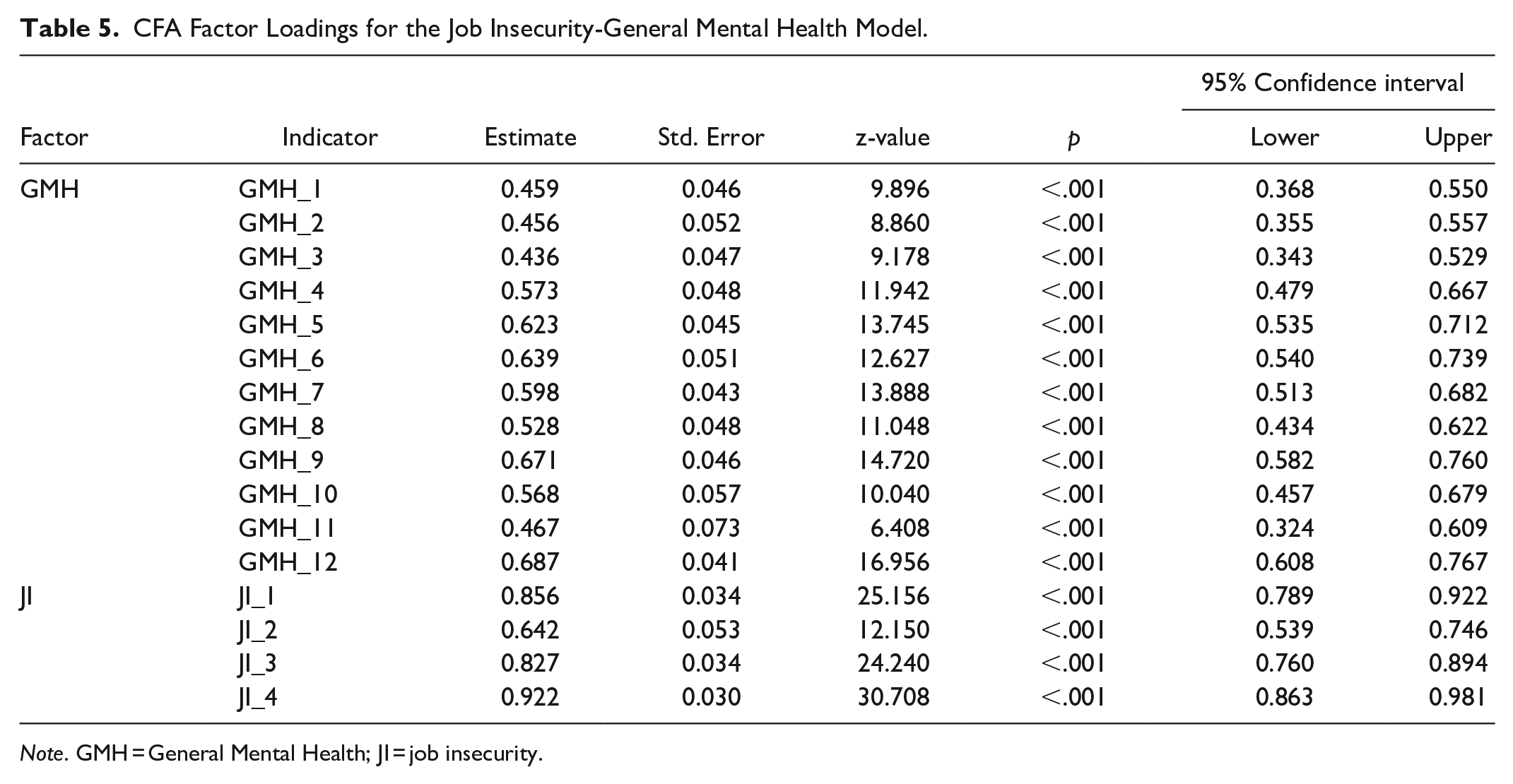
The factorial structure of the scales was analyzed in two CFAs. Model 1 included the measures of job insecurity and general mental health in the subsample of workers (n = 394). Model 2 included the financial threat and general mental health measures in the general sample (n = 591). As seen in Tables 3 and 4, these analyses were carried out in two steps. First, it was tested whether a single-factor model fit the data, and then the hypothesized theoretical model was analyzed. The results supported the discriminant validity, and the theoretical structure of the instruments since the level of fit leads to rejecting the single-factor model. In contrast, the fit for the theoretical model (two-factors) is acceptable. Loadings factors are presented in Tables 5 and 6.
CFA Fit Indices for the Model 1, that Includes the Job Insecurity and General Mental Health Measures.

Note. N = 394. χ2 = chi square; df = degrees of freedom; SRMR = standardized root mean residual; RMSEA = root mean square error of approximation; CFI = comparative fit index; TLI = Tucker-Lewis index.
CFA Fit Indices for Model 2, that Includes the Financial Threat and General Mental Health Measures.

Note: N = 591. χ2 = chi square; df = degrees of freedom; SRMR = standardized root mean residual; RMSEA = root mean square error of approximation; CFI = comparative fit index; TLI = Tucker-Lewis index.
CFA Factor Loadings for the Job Insecurity-General Mental Health Model.
Note. GMH = General Mental Health; JI = job insecurity.
CFA Factor Loadings for the Financial Threat-General Mental Health model.

Note. GMH = General Mental Health; FT = financial threat.
Structural Equation Modeling
To analyze the hypotheses, two SEMs were carried out. The first model (Figure 1) was performed in the subsample of workers, including job insecurity, support network, and its interaction as antecedents of general mental health, controlling for age, educational level, and gender (one person who was self-categorized as “other” was excluded from the analysis because it is not enough quantity to draw conclusions; n = 393). In this model, Hypotheses 1, 3, and 4 were analyzed. This measurement model has acceptable fit levels (x2/df = 1.395; SRMR = 0.079; RMSEA = 0.032 [0.023–0.040]; CFI = 0.977; TLI = 0.973) explaining 15.9% of the variance of general mental health. Regarding Hypothesis 1, job insecurity showed a direct negative and significant effect on general mental health (β = −.183; p < .001), and for hypothesis 3, the support network was positively and significantly related to general mental health (β = .322; p < .001). Regarding Hypothesis 4, the analysis shows a positive and significant effect of the interaction between the support network and job insecurity on general mental health (β = .232; p < .001), that is, the greater the support network, the lower the negative effect of job insecurity on general mental health. Only age showed a positive and significant effect on general mental health (β = .099; p = .043).

This model tested hypotheses 1, 3, and 4 in the subsample of workers, including job insecurity, support network, and its interaction as antecedents of general mental health, controlling for age, educational level, and gender. The latent moderator variable (interaction) was included by multiplying the items pairs of job insecurity and support network as the observed values.
The second model (Figure 2) was performed in the general sample, including financial threat, support network, and its interaction as antecedents of general mental health, controlling for age, educational level, and gender (two people who were self-categorized as “other” were excluded from the analysis because it is not enough quantity to draw conclusions; n = 589). In this model, Hypotheses 2, 3, and 5 were analyzed. This measurement model has acceptable fit levels (x2/df = 1.288; SRMR = 0.052; RMSEA = 0.028 [0.022–0.033]; CFI = 0.986; TLI = 0.985) explaining 23.5% of the variance of general mental health. Hypothesis 2 was confirmed since financial threat showed a direct significant negative effect on general mental health (β = −.309; p < .001). The support network was positively and significantly related to general mental health (β = .182; p = .012), confirming Hypothesis 3. Regarding Hypothesis 5, the support network did not moderate the relationship between financial threat and general mental health (β = .093; p = .199). Age (β = .205; p < .001) and educational level (β = .082; p = .049) was positively related to general mental health.
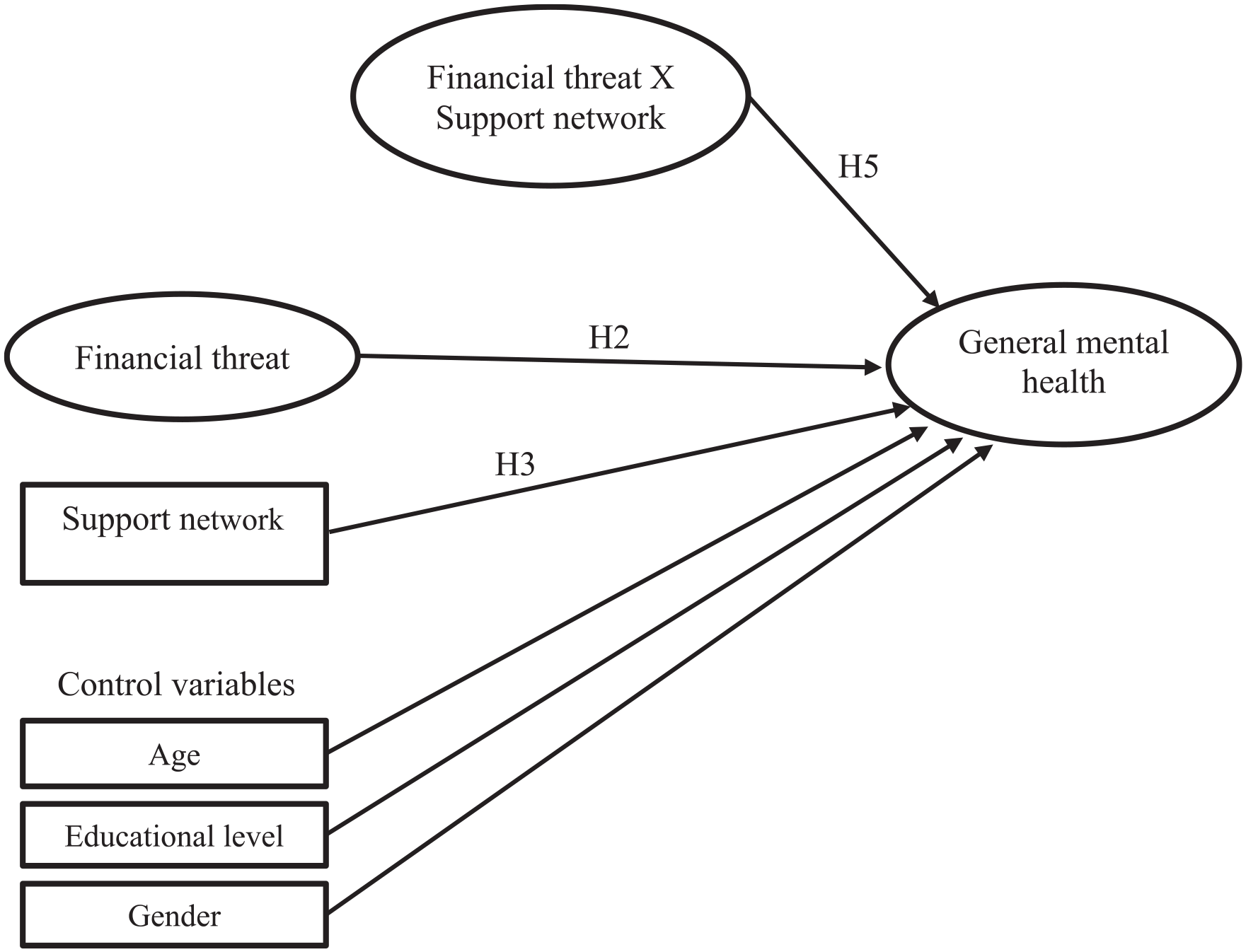
This model tested hypotheses 2, 3, and 5 in the general sample, including financial threat, support network, and its interaction as antecedents of general mental health, controlling for age, educational level, and gender. The latent moderator variable (interaction) was included by multiplying the items pairs of financial threat and support network as the observed values.
Complementary Analysis
Bearing in mind that hypothesis 5 was not supported, we explored whether the number of children could deepen the negative relationship between financial threat and general mental health and the moderating effect of the support network on this relationship because having more children at home implies greater sensitive expenses and the need for a support network. We found that for those who have three or more children (n = 64; eliminating a participant that commit a typing error [children = 236]), the model explains a higher percentage of the variance of the general mental health (38.6%), showing a significant direct effect of financial threat (β = −.491; p < .001), the support network (β = .289; p = .012), as well as their interaction (β = .177; p = .048). This, on the other hand, does not occur for the group of people who report two children or less (n = 524), in which the model explains only 21.2% of the variance of the general mental health, with a significant direct effect of financial threat (β = −.292; p < .001), but neither the support network directly nor its moderating effect on the relationship between financial threat and general mental health showed a significant level (β = .164 and .090; p = .097 and .327, respectively).
Discussion
Our results indicate, in line with H1 and H2, that people already perceived the impact of the COVID-19 pandemic during the first stage of the lockdown through job insecurity and financial threat and that these perceptions related negatively to their general mental health. Likewise, confirming H3, a relationship between the support network and general mental health was observed. Additionally, consistent with H4, a moderating effect of the support network was found in the relationship between job insecurity and general mental health; but this moderation was not significant in the relationship between financial threat and general mental health, so H5 wasn’t confirmed. We discuss these findings below.
Job insecurity is perceived as a threat in Chile in the context of the COVID-19 pandemic. However, job insecurity scores are not extreme, which suggests that the sample’s education level, and therefore its perceived employability, might play a protective role on the perception of job insecurity and its negative psychological consequences (De Cuyper et al., 2012; Green, 2011). Notwithstanding the above, some studies have not identified a moderating effect of employability on the positive relationship between job insecurity and decreased psychological well-being (Cheng & Chan, 2008; Kirves et al., 2011; Llosa et al., 2018).
The results show a statistically significant relationship between job insecurity and mental health, agreeing with the evidence obtained in other socioeconomic contexts (Cheng & Chan, 2008; Llosa et al., 2018; Sverke et al., 2002). The current situation brought by COVID-19 fulfills some of the conditions that characterize job insecurity according to Shoss (2017)—lower control and lower volition—since the impact generated by the pandemic has been sudden and uncontrollable for governments and organizations, and workers alike. Although the long-terms effects are still unknown (Shoss, 2017), it must be remembered that Chile had undergone a “social uprising” in October and November 2019 with consequential social and economic effects, that could also contribute to increasing the perception of job insecurity.
Parallel to this, results show a perception of financial threat at values slightly above scale’s midpoint. The relatively rapid measure approved by the Chilean Senate and Congress to make unemployment insurance more flexible due to the COVID-19 emergency (March 31), which extended coverage for the most vulnerable sectors, could control the perception of immediate financial risk. The finding that perceived financial threat is correlated with general mental health is consistent with previous findings after the effects of large economic recessions (Fiksenbaum et al., 2017; Marjanovic et al., 2013, 2015; Netemeyer et al., 2018). There is an increasing body of evidence that economic insecurity is experienced the same regardless of the income distribution, with an identical effect of psychological distress (e.g., Kopasker et al., 2018).
In previous crises brought about by epidemics and pandemics, the effects of financial threats are present during the quarantine period, especially, in the medium and long term (Brooks et al., 2020; Jeong et al., 2016). Thus, given that our study was completed during the earliest stage of the COVID-19 pandemic, it is foreseeable that the economic stressors will increase as the current situation endures. Prior research is consistent in showing that the negative and adverse effects of repeated financial threats (Watson & Osberg, 2017), associated with both job insecurity and unemployment, are multiple and severe for people and their personal and social environments—affecting in particular social relations and family functioning (Klehe et al., 2012; Probst, 2005); therefore, the outcomes obtained in this study can serve to warn of the foreseeable consequences for mental health in an employment and economic situation that may continue over time.
The results show that the perceptions of job insecurity and financial threat are significantly related to each other which agrees with what has been found in previous studies in situations of recent large-scale economic crises (Lam et al., 2014; Rajani et al., 2016). In addition, both are associated with a decline in perceived mental health, which is also consistent with prior results (e.g., Klehe et al., 2012; Kopasker et al., 2018; Rajani et al., 2016), thus agreeing in part with the prior evidence (Greenhalgh & Rosenblatt, 1984), but not with the results obtained by Rajani et al. (2016) in the context of the Great Recession of 2008 in European countries, which conclude that job insecurity and financial worries affected mental health in the same way. Nor are they in line with those obtained in Sweden by Richter et al. (2014), who confirmed that job dependency due to economic issues did not mitigate the relation between job insecurity and psychological well-being. These discrepancies with some prior research may be because in Chile, social protection systems are much less robust than those generally available in European Union countries with welfare states (Rajani et al., 2016), and in particular in Sweden (Richter et al., 2014), and they are close to those that predominate in the US (Greenhalgh & Rosenblatt, 1984). Thus, in Chile, where the population generally carries high debt levels and a fragile unemployment insurance system, people who view their financial situation with concern react more negatively to the threat, which is reflected in their mental health. In this sense, we argue that the moderating effect of the support network will be higher if the person is responsible for a larger number of children, which generates a considerable difference in terms of financial expenses in this country. In line with the previous reasoning, the complementary analysis provided in the results section shows that when comparing those who report three or more children with those who have two or fewer, the results showed that the direct effect of the support network and its interaction with financial threat is only related to a low decrease to general mental health in the group of up to three children. Additionally, the percentage of variance explained by these models is greater in this group, which is why these variables, to a large extent, explain the worsening of general mental health in the group with more dependents. Prior results (Kopasker et al., 2018) also show that the negative effects of economic insecurity are greater in men, who, due to socioeconomic and cultural reasons, continue to be the main providers in families, as can also occur in Chile.
Finally, the study results indicate a medium moderating effect of the support network since it moderates the association of job insecurity with the decline in perceived mental health. In contrast, this moderating effect is not found for financial threat in the general sample, and it is only observed among those who have three or more children. These results are similar to those obtained in previous studies about both constructs (Cheng et al., 2014; Näswall et al., 2005; Whelan, 1993), although we have not found differences between men and women in terms of the moderating effect of perceived social support, as other studies have found concerning job insecurity (Menéndez-Espina et al., 2019). The result obtained concerning the lack of effect of the support network with financial threat may be due to the perception that economic insecurity has a generalized impact, not limited to one’s situation. Consequently, there is no expectation of receiving help from the support network to deal with economic problems.
Although the debate on what is the average size of people’s support network (around 150; Hill & Dunbar, 2003) is currently still open, when distinguishing between the size of the close support group (family and friends), the sympathy group, and the rest of the support network, the size of the former is usually the smallest, ranging from 5 to 20 members (Pollet et al., 2011; Wrzus et al., 2013). However, this number also varies across age groups and may also be sensitive to national culture (Wrzus et al., 2013). In our study, the support network of the participants can be considered medium size (mean of 8.13); what seems important is the perceived effectiveness of this network to manage job insecurity and financial threat. Given that the response on the support network includes family members and close friends, it can be inferred that the perception of social support in case of need has a reasonable level of certainty. This perception of primary, reliable, and robust bonds directly affects the reception of various types of social support (Thoits, 2011). The participants seem to perceive that the support network is a powerful resource to cope with financial stress and job insecurity. In addition to this direct influence, the perception of the support network may also expand through the experience of trust, where its members increase their social capital through their contacts.
Finally, although more than 2 years have passed since the pandemic started and several studies have been published about the effect of variables related to financial stress, job insecurity or social support, between others, and mental health (e.g., de Miquel et al., 2022; Göktaş & Özdinç, 2022; Mousa & Samara, 2022; Said et al., 2022; Yao & Wu, 2022) the results obtained are still timely and relevant. The psychological reaction in a situation of abrupt limitation of social routines, such as the beginning of the lockdown, is not exhausted in this event, and it can be extrapolated to other hard and inadvertent situations. Thus, these findings help to better understand and to be prepared for other public health crises, natural disasters, and armed conflicts, among other situations, that can profoundly affect people’s lives.
Practical Implications
First, the outcomes obtained have direct practical implications related to the need to implement psychological support measures for workers and the unemployed to equip them with coping strategies to manage uncertainty and stress. These psychosocial supports should be available in organizations, and primary care centers to be accessible and have an ongoing positive effect on mental health in the medium and long term (Pfefferbaum & North, 2020).
Second, the conclusions drawn here should serve as an alert to the risk that the double perception of job insecurity and financial threat can generate by increasing psychological self-pressures of productivity and the over-commitment to the job, one of the first consequences that have already been detected since the pandemic began (Mukhtar, 2020; Stanhope & Weinstein, 2021; Zhang et al., 2021). The COVID-19 crisis place explicit or implicit demands that are responded to by people with work overload, increasing working days (in person or remotely), reducing or giving up days off or vacation days, or accepting abusive working conditions that can also increase the perception of qualitative job insecurity (Hellgren et al., 1999), lower perceived control and the resulting negative effects on mental and physical health (Vander Elst, Richter et al., 2014; Zhang et al., 2021). Therefore, it seems urgent to regulate and monitor working conditions compliance during the COVID-19 crisis and the so-called “new normal” in the post-pandemic period. In this sense, it is necessary to guarantee the workers’ and unemployed labor rights so that their job insecurity (subjective and objective) does not increase. In a similar vein, it is advisable to ensure that the new work arrangements (e.g., teleworking or hybrid work) do not have negative psychosocial consequences, such as work-family conflict. These measures can favor the maintenance of appropriate well-being and physical and mental health levels.
Third, the results also have important implications for designing strategies and psychosocial interventions that can strengthen support networks and potential social support. Given the strong connections between social relations, support, and mental health (House et al., 1988; Uchino, 2006), actions aimed at reinforcing interpersonal ties and support networks through, for example, support groups, community initiatives, or networks of people who share similar characteristics (studies, profession, etc.) (Cohen et al., 2000) can be highly effective at equipping those who experience financial threat and job insecurity with social coping and resilience resources that increase personal resources. Despite being subjective perceptions, financial and job insecurity have objective components, such as contractual status, the volume of layoffs in a productive sector or level of unemployment in a region (Ellonen & Nätti, 2015; Helbling & Kanji, 2018) and, consequently, are not an individual but a collective problem; therefore, the possible tools to confront them will also need to be collective and social. In this regard, organizational measures that can be beneficial in preventing negative mental health consequences are those aimed at reducing financial threat levels. Thus, employers may, for example, offer advice, counseling, or training on financial and debt management and planning for health care, mortgage, or college costs, as well as subsidizing employee lunches and transportation costs. In terms of government measures, regulations and laws aimed at increasing coverage for temporary and long-term unemployment and those aimed at avoiding gender discrimination, especially in the case of female workers with family responsibilities, would also be beneficial.
Additionally, and fifth, occupational health, job insecurity, and job precariousness are three of the 10 critical areas for research and practice in WOP due to the impact on them by COVID-19 as identified by experts (Rudolph et al., 2021); thus, this study makes an important contribution to knowledge in this context, but it must be broadened or complemented.
Limitations and Future Research
First, the cross-sectional nature of the design only allows us to identify relations between the variables. However, the importance of having preliminary data on the disruptive impact caused by the scale and speed of the global pandemic in Chile justifies the urgency of obtaining an initial approach to the consequences for the mental health of work-related variables.
Second, the participants in our study did not form part of a probabilistic sample, at the outcomes cannot be generalized to the Chilean population. Also, in this case, future studies should include representative samples or concentrate groups of workers, specific people or contexts (concrete professions, young or older workers or vulnerable groups, etc.) to most accurately identify the differential effects of “Coronanomics” in each setting.
Third, our measure of support network calls for quantity and lacks assessment of the quality of the social network. Further studies should include an additional measure of closeness/frequency of connections, abusive/negative relationships, symmetrical/asymmetrical relationships, and so on.
Fourth, the influence of gender on the results was controlled in both models analyzed. Despite this, the sample imbalance in this variable can be considered a possible study’s weakness.
Finally, and fifth, this study has only considered the variables mentioned as moderating antecedents and consequents, but we are aware that in the experiences people are living during this economic and health crisis, other personal, family, organizational and social variables are involved that interact in a complex way, which is reflected in the rather low percentage of variance explained by the contrasted models. The inclusion of variables such as gender, contract status, work-family conflict or cultural differences, among others (Kniffin et al., 2021), in future studies will be needed to understand the real impacts and to design strategies and interventions that can prevent, reduce or alleviate the effects for the well-being, health, and safety of people and their families as well as for the functioning and effectiveness of organizations.
Footnotes
Acknowledgements
We are grateful for the support of Matías Arriaga in the data analysis process of this study.
Data Availability Statement
The data corresponding to this study is available on Open Science Framework (OSF) website (https://osf.io/p7xdf/; Salgado, 2020).
Declaration of Conflicting Interests
The author(s) declared no potential conflicts of interest with respect to the research, authorship, and/or publication of this article.
Funding
The author(s) disclosed receipt of the following financial support for the research, authorship, and/or publication of this article: This research has been supported by project CONICYT MEC CON80190085 (Chile), and by the Project DIUFRO DFP20-0015 of the Universidad de La Frontera (Chile).
Ethics Statement
The project underwent assessment by the Ethics and Bioethics Committee of the Universidad de Concepción (CEBB 650-2020, March 2020).
