




Abstract
This paper presents a Turkey-wide analysis of 1,000 femicide cases, collected from 100 newspapers between 2010 and 2017. The study seeks to contribute to the international femicide literature by highlighting the background and reasons for these murders, as characterized by the newspapers. The methodology involved frequency and chi-square analysis of the data retrieved from 100 newspapers collected from the homepage of kadincinayetleri.org. The study reveals that a woman’s intimate partner is the perpetrator in the highest number of femicide cases. The most common motives for femicides in international micro-level studies are (1) possessiveness and jealousy and (2) loss, separation, or divorce. The present study found these to be the first- and third-highest motives for femicide in Turkey. The motives of femicides can be interpreted in the macro-level analysis as women’s resistance to men’s domination; their demand for control over women escalates to murdering the woman as a form of backlash.
This paper analyzes the reasons and motives for femicides in Turkey and their relationship to other forms of violence against women (VAW). This analysis used data collected from newspapers between 2010 and 2017 to study 1,000 femicides in Turkey. Female intimate partner murder is a consequence of intimate partner violence, particularly domestic violence (Dugan et al., 1999; Campbell et al., 2003; Johnston & Campbell, 1993). A variety of disciplines and approaches including psychology, sociology, political science, criminology, and feminist studies have examined femicide from various perspectives. Feminist theorists have highlighted the “socio-cultural and political dimensions” of VAW and femicide, in contrast to approaches that tend to pathologize and individualize the aggressors’ acts (Carcedo, 2000, p. 12). The feminist standpoint on gender-based violence examines masculinity as performance. Discussion focuses on gender as a power relationship, questioning patriarchy as structure and gender as performance (Butler, 1990, 1993; West & Fenstermaker, 1995). Within the context of VAW worldwide, the present study views femicide in Turkey as resulting from societal power relations and performative gender norms. A review of previous theoretical work suggested the following research questions: (a) Who are the perpetrators of femicide and what are their motives? (b) Do the motives behind femicides and the category of person who commits femicide reveal a relation between intimate partner femicide and gender domination? (c) Is there any relation between history of violence and intimate partner femicide, and if so, what does it reveal about gender domination? (d) Is there a relation between femicide and the lack of institutional protection of women?
The present study aims to better understand femicide in Turkey and contribute to the international femicide literature by highlighting the reasons for these murders with reference to the feminist standpoint on femicide and gender-based violence.
Literature Review
Conceptual Background of Femicide
The concept of femicide, used as early as the 1800s to refer to the killing of a woman, was reintroduced by Radford in 1976 at the Tribunal on Crimes Against Women as the misogynous killing of women by men (Radford & Russell, 1992; Russell & Van de Ven, 1976). In the 1970s, the concept of femicide became popular and was modified by the feminist movement into a political concept (Laurent et al., 2013, p. 49). The feminist movement insisted upon the sexist dimension of female homicide, in contrast to the neutral term “homicide.” Femicide discourse represents a political “objective of recognizing and making the discrimination, oppression, inequality, and systematic VAW visible that in its most extreme form culminates in death” (Radford & Russell, 1992, p. 3). The definitions of femicide and VAW present “shared characteristics” (Dimitrijevic et al., 2015, p. 23). Both are rooted in a culture of “violence and discrimination against women” as well as “in patriarchal concepts of the inferiority and subordination of women” (Dimitrijevic et al., 2015, p. 23). These characteristics are constructed through culture, mindsets, and customs and are not random cases of violence (Dimitrijevic et al., 2015, p. 23). Other discussions extend the concept of femicide beyond the misogynist killing of women to include institutional violence, male dominance, and direct male violence. Latin American feminists discussed femicide as taking place in a context of gender-based power relations at the institutional level (Dimitrijevic et al., 2015, p. 22; Lagarde, 2006; Saccomano, 2015) and related “the misogynist killing of women by men” to “the mass killing of women committed by men based on their group superiority” (Dimitrijevic et al., 2015, pp. 22, 23); the murder of women is “the extreme form of gender-based violence, understood as violence inflicted by men against women in their desire to obtain power, domination, and control” (Dimitrijevic et al., 2015, pp. 22, 23). Dimitrijevic et al. (2015) note that within this definition of femicide, the state’s failure to “fulfill its international obligations, including the duty to investigate and punish” is another form of misogyny. It is for this reason that Lagarde includes “institutionalized violence at many levels” within the context of femicide (as cited in Dimitrijevic et al., 2015, pp. 22, 23). Men who commit femicide enjoy impunity as a direct consequence of institutional violence, which occurs at many levels, such as “discrimination in the administration of justice and law enforcement which demonstrates lack of credibility or underestimation of women’s reports” (Lagarde, 2006, pp. 223, 224), as well as lack of punishment by the state and the judicial system (Carcedo, 2010, p. 443; Lagarde, 2006, pp. 223, 224; Saccomano, 2015, p. 10). This argument emphasizes the role of the justice system and other institutions of state in allowing VAW to continue (Agrast et al., 2013, 2014).
Women globally and historically have been much more likely than men to be murdered by their intimate partners; this disparity suggests a strong asymmetry in intimate partner homicide (Corradi & Stöckl, 2014, p. 602; Dawson, 2018, p. 16; Deirdre, 2016, p. 17; Dobash & Dobasy, 2015, p. 25; Laurent et al., 2013; Saccomano, 2018, p. 35; Stöckl et al., 2013, p. 862). The roots of the strong asymmetry in intimate partner homicide worldwide include gender-based power relations and masculinity as gendered performance (Butler, 1990, 1993; West & Fenstermaker, 1995). Latin American countries constitute an exception. Laurent et al. (2013) note that despite the high incidence of femicides in Latin America, fewer of the victims are murdered by their intimate partners or families (p. 92). The reason for this is connected to the high level of lethal violence in the countries of Central America, the Caribbean, and Latin America, in which the greatest number of femicides happen in the public sphere, and the perpetrators are mainly gangs and organized criminal groups (Laurent et al., 2013, p. 51).
Radical feminists contributed an important part to the analysis of violence against women. The concept of patriarchy played an important aspect of explanation about male violence against women (Brownmiller, 1975; Caputi, 1989; Firestone, 1972; Griffin, 1971; Millet, 1970; Russell, 1975)” (Hunnicutt, 2009, p. 555). Male power is a central concept of theories of violence against women and should be situated within a patriarchal order (Hunnicutt, 2009, p. 560). Masculinities are constructed hierarchically and men “secure masculine identities through prestige and authority” (Chodorow, 1978, as cited in Hunnicutt, 2009, p .560). Systems of male domination and prestige allow men to differentiate themselves from women and incentivizes them to distance themselves from femininity (Hunnicutt, 2009, p. 560).
The feminist standpoint underlines the dimension of male violence as an instrument of male domination and female subordination (Edwards, 1987, pp. 13–29). Violent acts demonstrate that “a person is a man” (Hearn, 1998, p. 37) and are used to put women in an inferior position (DeKeseredy, 2011). Masculine identities are constructed through practices at the symbolic and discursive levels, including acts of violence and discourses about violence. Feminist approaches to violence underline the pervasiveness of gender-based violence at many levels, recognized as a conglomeration of cultural (Galtung, 1990), epistemic, symbolic (Bourdieu, 2002), institutional (DeKeseredy, 2011; Winstok, 2011), structural, and direct violence (Sauer, 2008, pp. 55–58; Swigonski & Raheim, 2011). Intimate partner violence, intimate partner murder, and other forms of femicide have the same roots, including institutional, symbolic, epistemic, and cultural violence (Carcedo, 2000; Lagarde, 2008; Saccomano, 2015, p. 7; Toledo, 2009; Walby, 1990). The feminist standpoint regarding intimate partner violence emphasizes that VAW is a direct means of masculine domination over women and that VAW within the family is an indication of the family as a patriarchal institution (Millet, 1970; Walby, 1990). The family violence approach sees male dominance as one of the contributing factors as violence against women and not as the central organizing aspect (Hunnicutt, 2009, p. 556).
Intimate partner femicide often results from “the culmination of ongoing violence in the relationship” (Dugan et al., 1999, p. 189), and can thus be defined as an extension of domestic violence (Johnston & Campbell, 1993). Femicide studies show that there was almost prior violence and physical abuse from the same perpetrator against the intimate partner violence-related (IPV-related) femicide victims (Campbell et al., 2003, p. 1,091). There is obvious evidence about the existence of intimate partner violence before femicide happens. There is a history of violence, coercion, harassment, stalking, psychological aggression, threats, and other manifestations of aggression by men to state who murder their female partners (Campbell, 1992; Crawford & Gartner, 1992; McFarlane et al., 1999; Nicolaidis et al., 2003). In many cases, it is reported that there is post-separation violence when the partner already used violence pre-separation (Hardesty, 2002, pp. 559, 600). Terms such as “ongoing or episodic wife battering” (Johnston & Campbell, 1993, p. 191), “domestic violence as terrorism” (Dawson, 2016, p. 30), and “intimate terrorism” (Michael et al., 2014, pp. 186–207) explain the process of which the murder of the female intimate partner is the climax (Goussinsky & Yassour-Borochowitz, 2012; Kaser-Boyd, 2004, 2008).
Other research on femicide suggests that the risk for intimate partner femicide increases in cohabiting relationships compared to married relationships (Dawson, 2018; Reckdenwald & Parker, 2010, pp. 951–958; Wilson & Daly, 1988; Wilson et al., 1993, 1995). Dimitrijevic et al. (2015) describe the potential reasons as follows: cohabiting and dating relationships may be less likely to “benefit” from the kinship networks associated with marital relationships. Networks that are more likely to provide various forms of social control and “legitimate” intervention in support of marital relationships. . . and in this respect marriage may act as a protective factor. (p. 113)
International Studies on Motives for Femicides
Studies on femicides focus on three types of motive. The first two motives are at the micro-level of analysis: (a) possessiveness, jealousy, and sexual entitlement and (b) separation, divorce, and a sense of loss. An additional level of analysis introduces a third, macro-level motivation: (c) backlash.
The first dimension of findings points to possessiveness, jealousy, and sexual entitlement (Adams, 2007; Campbell, 1992; Campbell et al., 2007; R. E. Dobash & Dobasy, 2015; Goussinsky & Yassour-Borochowitz, 2012, p. 554; Polk, 1994; Wilson & Daly, 1998). Possessiveness, jealousy, and male sexual entitlement are highlighted among the motives for femicide as a consequence of male partners losing female obedience, loyalty, and dependence (Hardesty, 2002, p. 611; Sev’er, 1997). Men with this motive may be jealous of another man, believe they are being cheated on, or simply feel they have lost control over their partner.
The second dimension of findings points to separation, divorce, and a sense of loss. Studies show that separated and divorced women have a greater risk for post-separation violence than women currently in a marriage or relationship (Arendell, 1995; Brownridge, 2009; Johnson & Sacco, 1995; McMurray et al., 2000). Exit from the partnership presents women with the greatest danger of being killed. A woman’s risk of being murdered increases two to four times after a separation (Goussinsky & Yassour-Borochowitz, 2012, p. 554; Wilson & Daly, 1993; Wilson et al., 1995), and a large proportion of women are killed during the first 2 or 3 months following the separation (Brownridge, 2006, p. 521; R. E. Dobash & Dobasy, 2015, p. 28). In intimate partnerships, men use violence to repress their partners’ independence and autonomy (Kurz, 1996). When women initiate separation, men may see this as a challenge to their authority. Men feel their selfhood affirmed in the use of violence to restore their rights and their role of dominance over their former partner (Brownridge, 2006, p. 519).
The third dimension of the findings focuses on the backlash. In the early 1970s, the backlash argument became a part of the discourse about the motives for male VAW. This theory focuses on men’s fear of losing dominance over women, and their attempts to retaliate, regain control and re-establish power over women (Reckdenwald & Parker, 2010, pp. 951–958; Vieraitis & Williams, 2002; Whaley et al., 2002). It states that male VAW (both lethal and not) increases with gender equality and empowerment (DeWees & Karen, 2003; Vieraitis & Williams, 2002; Whaley et al., 2002). Campbell et al. (2003) cite “decreasing domesticity, increasing the education of women, advancing women’s economic status, increasing the female participation in the labor market, independent income” as factors that reduce women’s dependency on their male partners (p. 1,089). Another such factor is a woman’s financial security (Pridemore & Freilich, 2005; Whaley et al., 2002). The backlash theory views masculinity as performance; men who lash out at empowered women are engaged in constructing masculine identities, asserting themselves as masculine subjects, and reacting to circumstances that make them feel vulnerable in their masculine identity.
The micro-level of analysis about femicide reveals the two most predominant motives: (a) possessiveness, jealousy, and sexual entitlement and (b) separation, divorce, and a sense of loss. These can be summarized within the macro-level of analysis as backlash. The empowerment of women can result in women acting independently and deciding on separation and divorce. Masculine domination escalates to VAW and intimate partner femicide is an extreme attempt to resist female independence and empowerment.
Femicide Studies in Turkey
The existing studies about femicides in Turkey analyze the relation of the perpetrator to victim and the motives for femicides (Toprak & Ersoy, 2017, p. 2). According to studies by Beyaztaş et al. (2015), Çetin (2015), Karbeyaz et al. (2018), Taştan and Yıldız (2019), Toprak and Ersoy (2017), Erden and Akdur (2018), Yıldırım (2018), and Yayak (2020) femicides happen mainly within the intimate partner relationship. The most common perpetrators are a husband or ex-husband, followed by a current partner or ex-partner. The third most common category of murderers is close relatives, cousins, elder brothers, siblings, or someone else whom the victim knows. Karbeyaz et al. (2018, p. 58) analyzed 25 years of data and found a history of violence in 31.1% (n = 46) cases. Beyaztaş et al. (2015) found that spousal murders are frequently committed “during the period of separation” (p. 208).
The study of Seven et al. (2015) examines 140 femicide cases committed in 2014 in the three newspapers Zaman, Posta, and Hürriyet. It notes that the main reasons for the femicides are the victims’ divorce or desire to divorce. The main perpetrators are the husband, ex-husband, or current partner of the victim (p. 71). Erden and Akdur’s (2018) study examines 335 femicide cases between 2014 and 2015 and presented the results on the website (anitsayac.com) as a digital memorial. Their research shows that murderers had romantic jealousy and doubts about their partner’s faithfulness. The risk factors for women homicides are low educational and economic levels of perpetrators and victims and the patriarchal gender system (p. 134). The murderers explained their acts as resulting from disputes, separation, a woman demanding to separate, deception, jealousy, discord, unemployment, economic problems, psychological problems, money, robbery, and so-called traditions (p. 135).
Yıldırım (2018) examines 1,260 femicide cases of 2,380 women murders collected from newspapers, internet, and web programs within the last 10 years (2008–2018; p. 2). The main reasons given by the murderers included arguments, separation, the woman’s demand to separate, the man rejecting the woman, alleged deception, jealousy, dissension, unemployment, economic problems, psychological problems, money, robbery, and so-called traditions (Yıldırım, 2018, p. 13). Yayak (2020) analyzes 10 femicides of 2,878 cases reported in the press between 2010 and 2019 and noted that the motives for femicide included “honor motive, defamation of family honor, jealousy and outbursts of anger, transphobia-based hatred, resistance to rape, the desire of women for separation from their spouses/lovers, violence, aggression, and threat” (p. 2740).
According to the statistics from Turkish nongovernmental organizations such as Kadin Cinayetlerini Durduracağız (Reasons for Murder of Women in Turkey Between 2008 and 2013 (www.kadincinayetlerinidurduracagiz.com, as cited in Çetin, 2015, p. 351), women are mainly murdered because they demanded a divorce. In second place are women’s independent decisions about their lives. In third place is jealousy, in fourth is rejection of the man’s presence, and in fifth place refusal to do what the man wants. This is followed by conflicts about conflict over money (6), honor killing (7), sexual assault (8), forced suicide (9), and “unknown” (10). These data are based mainly upon newspaper reports. As an interpretation of motives is based upon media sources, they may be questionable but indicate popularized explanations for the murders. The study shows that a minority of femicides relate to honor. According to this research, the main reasons for femicides involved divorce/separation, women deciding for their own life, jealousy, and rejection of the man (Demir & Yenilmez, 2016, p. 15; Kaya & Ural, 2018, pp. 364, 365). The police academy’s statistics identify the main perpetrators of femicides as a current partner or husband (63.5%), a relative (32%), a neighbor (17%), a friend or acquaintance (0.8%), and a stranger (2%) of the women. (When women murder women but according to the concept of femicide this can’t be cited as femicide.) The motives are psychosocial (42.6%), sexual (36.2%), psychological and physical (13%), and economic (7.7%; Taştan & Yıldız, 2019, pp. 20, 21).
A comparative study of two cities, Diyarbakir in eastern Turkey and Tekirdag in western Anatolia (Yılmaz et al., 2015, p. 20), reveals dispute as to the main reason for femicides in both cities, while in Diyarbakır custom crime comes in the second place, jealousy/honor in third place, and financial reasons in fourth place. In Tekirdag, envy-honor comes at second and financial reasons at third place. The data suggests that 200 to 250 honor killings are committed annually in Turkey (Aktaş et al., 2006, p. 1243). Many cases of “honor killing” fall under the heading “töre (custom) killing” in Turkey (Çetin, 2015, p. 347). On the meaning and connotations of töre Arın (2001) writes: The word custom in Turkish is töre and used for rule, law, morals, and ethics. Honor killings or “customary murders” are murders as an outcome of the intention to control women’s sexual life in the broadest sense (p. 822).
Töre killing includes not only the murder but also the family as an actor, involved in the organization, decision making, and carrying out the decision (Çetin, 2015, pp. 347, 348). In Turkey, honor killing can take a traditional or nontraditional form. According to a report authored by Kardam (2005) and released by the United Nation Development Program on the dynamics of honor killing in Turkey, respondents who distance themselves culturally from custom-related killings and the customs that inspire them to consider honor-related murders separately as fundamentally individual acts that can happen anywhere and to anyone under the right circumstances, such as a jealous husband murdering his unfaithful wife (p. 62). Kardam (2005) concludes that these respondents articulate the distinction between custom- and honor-related femicides not in terms of reasons and consequences but by referring to individual conditions surrounding the murders (p. 62).
The work of Uğurlu and Akbaş (2013) relates honor crime to the perception of honor within the culture, which includes family norms controlling a woman’s behavior and sexuality. The terms onur and şeref, honor in English, describe the respect from other people (Türk Dil Kurumu Çevrimiçi Sözlük, 2013, as cited in Uğurlu & Akbaş, 2013, p. 78). Because masculinity has been constructed as a responsibility to ensure respect from others for family norms, the empowerment of women becomes a threat to masculine honor. Because masculinity has been constructed as a responsibility to ensure respect from others for family norms, the empowerment of women becomes a threat to masculine honor.
The term honor affects men and women in different ways. The closely related terms şeref, iffet, onur, ar, and namus do not explain the same thing. They explain the dimension of masculine perception of honor as having the responsibility to protect women’s honor and to play the role of protecting the şeref, iffet, and onur of the family. In contrast, this understanding of family honor legitimizes male violence punishing women who seek to control their own behavior and sexuality.
The research of Bağlı and Özensel (2011) about 190 imprisoned perpetrators noted the high social acceptance of those imprisoned because of so-called honor crimes, and most of the murderers do not regret their crime. Also, the research of Işık and Sakallı-Uğurlu (2009) reveals that the perpetrators feel legitimized in their crime against women because of the perception of honor involving symbolic violence against women and giving men the right to murder women (Işık & Sakallı-Uğurlu, 2009). A Turkish criminal law implemented on 1 June 2005 has penalties for customs-related, symbolic violence against women (Gökçe, 2007). Turkey’s perception of honor that mainly focuses on controlling the sexual behavior and other perceived inappropriate behavior of women has its background in a patriarchal culture and masculine domination over women (Işık & Sakallı-Uğurlu, 2009). As shown by the different surveys, femicides cannot be explained with only the culturalist perspective (Çetin, 2015; Doğan, 2014; Koğacıoğlu, 2007). It should be understood with the dimension of gender-based violence (Gazioğlu, 2013). Men murder women to re-establish their weakened authority (Messerschmidt, 2017, as cited in Kaya & Ural 2018, pp. 358, 359). Çetin differentiates between two terms, honor crimes and crimes of passion. The crimes of passion result from feelings such as jealousy and revenge; the actions happen after losing control over emotions (Healey, 1990, as cited in Çetin, 2015, p. 348). According to Abu-Odeh (2004), the crimes of passion have common denominators such as jealousy, cheating, honor (in terms of iffet), which are also reflected within the honor crimes. These terminologies can also change. Cinzia Tani emphasized the reference to honor crime among Italians 30 years ago is now called “crime of passion” (Mamigliano, 2010, as cited in Çetin, 2014, p. 354). The main reason why women are murdered is that their boyfriends or husbands regard women as possessions and do not accept the idea of divorce or separation (Çetin, 2014, pp. 51–54). The possessiveness of men is also reflected in the idioms such as “ya benimsin ya da toprağın” which means “you are either mine or you deserve to die” (expressed metaphorically as “you belong to me or you belong to the black earth”). This kind of obsessive “love” shows that a husband regards a woman as his property and does not accept a woman’s demand for divorce (Çetin, 2014, p. 56).
The study of Kaya and Ural (2018) analyzed femicides concerning symbolic violence. In three examples of femicides in Diyarbakir, women are murdered by their boyfriends or husbands because of the existing gender roles. The murder happens when men perceive that women trespass the gender roles. Regardless of marital status, almost 4 women out of 10 in Turkey have experienced physical violence from their lifetime physically intimate partner (Arat & Altınay, 2008, p. 81; Hacettepe Üniversitesi, T.C. Aile ve Sosyal Politikalar Bakanlığı, 2015, p. 83). Based upon the conceptual framework of Grzyb (2016) using the Bourdieusian concept of symbolic power and symbolic violence, the Kaya and Ural (2018) study analyzed in the processes leading to femicide the issue of constructing femininity with the symbolic meaning of “worthless” (and thus “worth” killing; p. 357). This study suggests that symbolic power mechanisms that when women lack submissiveness, docility, and respectability in diverse ways they are more likely to be murdered in an attempt to restore and reinvigorate symbolic power (Kaya & Ural, 2018, p. 357).
The study of Erden and Akdur (2018) states that most perpetrators and victims of femicide are younger than 50 years (p. 135). Other studies in Turkey note that women between 20 and 34 years face the highest risk of femicide (Beyaztaş et al., 2015; Çilingiroğlu & Erbaydar, 2016; Karbeyaz et al., 2018) and the age of perpetrators is between 21 and 40 (Toprak & Ersoy, 2017; Yılmaz et al., 2015). Also, a study in Spain notes that being young is a risk factor for femicide (Echeburúa et al., 2009, as cited in Erden & Akdur, 2018, p. 136).
The study of Toprak and Ersoy (2017) shows that using excessive violence or overkilling is an exceptional characteristic of spousal and intimate partner femicide. In every third case of femicides, the perpetrator uses overkill (p. 13). Comparing the homicide cases between women and men, men use overkilling as a method much more than women (Campbell, 1992, p. 103).
Studies of weapons used in femicide note that most femicides are committed with a gun (Beyaztaş et al., 2015; Campbell et al., 2003; Erden & Akdur, 2018; Toprak & Ersoy, 2017; Yıldırım, 2018). Other studies identify other technical means in femicide such as knife, strangling, beating, electrical power, pushing off a higher place, and torture (Erden & Akdur, 2018; Yıldırım, 2018).
The study of Akgül and Uğurlu (2021) about the violence against women and femicide states that women are mainly murdered at home by their husbands. The second place where their husbands murder them is in public places such as streets, parks, cafes, and so on. Mainly brothers and relatives kill women in the public space, while the murderers of women in the isolated public area are unknown (p. 137).
Another study by Erükçü-Akbaş and Karataş (2020) considers how children whose father murdered their mothers cope after the femicide. The study notes that the children and caregiving siblings mainly deal with the tragic murder through (a) siblings’ solidarity, (b) constructing the mother as a role model, (c) recognizing the mother’s legacy, (d) relying upon the preventive and supportive social environment, (e) fighting against violence, and (f) starting new activities (p. 153).
Hypotheses
This study sought to analyze femicide based upon the theoretical background and the international and national studies on femicide. The following two hypotheses suggested themselves: H1: There is a significant relationship between the relation of perpetrator and victim and the apparent reason for the murder. H2: There is a significant relationship between dispute, jealousy (suspicion of cheating), demand for divorce/separation, and femicide.
Methodology
Data
Data about femicide are scarce. Even in countries with advanced homicide monitoring systems, the data is limited. In Turkey the data about homicide monitoring is not developed (Toprak & Ersoy, 2017, p. 2) and there is institutional lack of femicide statistics. Most existing statistics are gathered from women’s organizations and through interviews. Statistics about femicides are not sufficient. Either the legal or judicial institutions working on gathering data on cases of violence against women, do not contribute solid statistics. The institutional lack about recognition of violence against women as crime such as not-reporting, under-reporting, under-recording by legal authorities such as police, prosecution, and health officers, as well as women’s hesitation to tell their stories because of fear, shame, and other related reasons, can be counted among the reasons why there is lack about gathering data of statistics. Because of the institutional lack of collecting data, there are nongovernmental organizations (NGOs) that collect data about violence against women (Demir & Yenilmez, 2016, p. 15).
The numbers of femicides reported by the Turkish Statistical Institute (TÜIK-Türkiye İstatistik Kurumu) and NGOs in Turkey differ from those found by academic researchers (Çavuş, 2018). There is a political dimension to the data collected and publicized by the state (Weil, 2016, p. 8). Statistics can reflect political priorities, so even the lack of statistics collected by institutions can also be interpreted as a political decision (Weil, 2016, p. 8).
Data obtained from the Ministry of Justice states that the murder rate of women grew by 1,400% between 2002 and 2009. The number of murdered women in 2002 was 66 which rose in 2009 dramatically to 1,126. Within the years from 2008 to 2015, 1,415 women in average were murdered, and 277,115 women in total are exposed to domestic violence (Demir & Yenilmez, 2016, p. 14). Statistics published by the NGO Kadın Cinayetlerini Durduracağız Platformu [We Will End femicide Platform] show that in 2016, 328 women were murdered by men; in 2017, the number was 409 women, in 2018, 440 women, in 2019, 474 women, and in January 2020, 27 women were murdered by men (n.d.). According to the report on femicides by Bilim ve Aydınlanma Akademisi (2021) “Türkiye’de Kadın Cinayetlerinin Nedenleri ve Öneriler,” Turkey has never had sufficient data about gender-based violence in Turkey. Still, the data has become especially limited during the AKP (Adalet ve Kalkınma Partisi—Justice and Development Party), which is in general related to the fact that the societies sources to get information has been diminished during the AKP period since 2002. The women’s movement has never had the sufficient infrastructure to collect data about gender-based violence against women. The director of “The Association of First Women and Children” (Önce Kadınlar ve Çocuklar Derneği), the lawyer Müjde Tozbey Erden, notes that in 2019 the state, as represented by the police academy, first began to collect statistics about femicides (Polis Akademisi’nin Son Raporlarından, 2019).
The police academy reports a much lower number of femicides than data collected by Kadın Cinayetlerini Durduracağız Platformu (KCDP). One reason is that state institutions define femicide as when a man murders a woman who is his wife or his girlfriend. This concept does not include the murder of trans-women or sex workers (Bilim ve Aydınlanma Akademisi, 2021). Erden says they have access to almost all data collected by the state. There are just a few statistics that are not entered into social media. Women forced to commit suicide are hidden from the news. The statistics of the women’s organizations reflect many, but not all, suspicious murders of women (Bilim ve Aydınlanma Akademisi, 2021). The general representation of the Stop the Femicide Platform (Kadın Cinayetlerini Durduracağız Platformu (KCDP)) Gülsüm Kav, says that many suspicious femicide cases remain closed to further investigation. These doubtful cases refer to the suicide of women. Kav notes the increasing number of these kinds of cases without further investigation. The news media reports on only some of these cases. Kav says that in this kind of suspicious murder, the families of women inform them, and the KCDP collects data through that family-reported information (Bilim ve Aydınlanma Akademisi, 2021). Most of the statistics about femicides are gathered by interviews and from women’s organizations and associations. There is a lack of the statistics collected by legal, juridical institutions, legal authorities, police, or health officers, and/or women’s own reluctance to report the violence. NGOs are the main actors which make gender-based violence and femicides visible in the public space and collect data and information on femicides in Turkey (Demir & Yenilmez, 2016, p. 15). Access to official sources is limited. The women’s shelter Mor Çatı issued a report about the models of collecting data about gender-based violence and noted a lack of states institutions collecting data about gender-based violence against women (Ekal & Doğan, 2017, p. 21).
Sample
The sample for the present study was collected through news articles about femicides in Turkey. News from 2010 to 2017 in national newspapers was collected on the online platform kadincinayetleri.org. The site reports 1,964 femicide cases between January 1, 2010, and December 31, 2017. These figures are close to those reported by NGOs and in the news. A major news source states the number of femicides in the same time period as 1,915 (Habertürk, 2017). It can be assumed that the statistics on kadincinayetleri.org represent with an acceptable level of accuracy the reported femicide cases in Turkey between 2010 and 2017. The online platform kadincinayetleri.org collects data on related news items, which are archived according to age, the relation of the perpetrator with the victim, motive of perpetrator, whether the victim filed a police report or other legal appeal, and whether violence before the murder is known to have occurred. This study selected 1,000 out of the 1,964 femicide cases reported between 2010 and 2017 and analyzed them according to the categories shown in the frequency analysis.
A sample of 497 news items was determined to be sufficient to represent a total of 1,964 items with 99% certainty. However, a sample size of 1,000 items was chosen for increased representability. The data consisted of excerpts from 100 newspapers collected by the online platform http://kadincinayetleri.org/. The number of news items included in the sample for each year was in proportion to that year’s share of the total. For example, there were 248 news reports on femicide in 2010. That number constitutes 12.6% of the total of 1,964 news items for the entire period. Therefore, 126 news items from 2010 were included in the sample. The news items for each year were randomly assigned to the sample randomly. A breakdown of sample and population sizes is given in Table 1.
Sample Weighted for Distribution by Year.

Study Limitations
The main limitation of this work is that the data was sourced from news reports. The present study is based upon data collected by kadincinayetleri.org and upon the categories constructed by kadincinayetleri.org. The categories are constructed according to the information in the news and rely upon the accuracy of news coverage. Total elimination of incorrect information or misinterpretation of the facts by news reporters is thus not possible, and this may result in weak points in the analysis. The use of different newspapers provides popular categories or discourses reflected in the speech of the perpetrators and in the authorized storytelling on the backgrounds and motives for the femicides. The categories created within the stories of kadincinayetleri.org state make possible a chi-square analysis of the public discourse on the perpetrators’ motives.
Data Analysis
The study used words within newspapers articles to create categories that were coded with the SPSS 25.0 program. The analysis was performed in multiple stages. In the first stage, news items were read, the resulting data were used to create frequency charts, and the answers were sorted according to their levels. At the second stage, the variables sorted from the news were analyzed with descriptives such as average, minimum, and maximum. At the third stage, variables within the news were analyzed with the help of the chi-square test at the 99% confidence level, and it was determined whether there was a relation between them. Chi-square analysis is among the most used nonparametric tests. It can be implemented at different points in data analysis. Chi-square variable analysis can be used to determine the relationship between two quantitative variables (Bakan & Büyükbeşe, 2004). The chi-square independence test 2 × 2 or frequencies observed in r × c cross charts (Gij) can be used to calculate their similarities to the theoretical frequencies (Tij; Bircan et al., 2003).
Results
The frequency analysis regarding the identity of the perpetrator and the relation of the perpetrator to the victim shows that the husband, ex-husband, current partner, or ex-partner are the most common perpetrators, followed by relatives and family members. The distribution of frequencies in terms of the perpetrator’s relation to the victim is as follows: husband 572 (57.2%), current partner 163 (16.3%), ex-husband 103 (10.3%), relative 65 (6.5%), ex-partner 42 (4.2%), an obsessive man 29 (2.9%), and brother 26 (2.6%).
The frequency analysis showed the following distribution of the murder reason: dispute, 248 cases (24.8%), desire for a divorce, 114 cases (11.4%), suspicion of being cheated on, 103 cases (10.3%), refusal to reconcile, 83 cases (8.3%), divorce, 61 cases (6.1%), domestic violence, 54 cases (5.4%), desire to separate, 49 cases (4.9%), jealousy, 36 cases (3.6%), material reasons, 35 cases (3.5%), honor killing, 27 cases (2.7%), and “other,” 19 cases (1.9%). The reasons for the remaining 171 cases (17.1%) are unknown.
The desire for a divorce (114 cases), divorce (61 cases), desire to separate (49 cases), and refusal to reconcile (83 cases) are important motives of femicides committed by the intimate partners of the victim. These can be compounded under the overarching motive of “separation and loss,” accounting for a total of 307 cases, which makes separation and loss the biggest reason for femicide. Suspicion of being cheated on (103 cases) and jealousy (36 cases) can be categorized within the motive “possessiveness and jealousy,” accounting for 139 cases; this category comes after “dispute” as the third-biggest motive for femicide. Domestic violence comes after possessiveness and jealousy and constitutes the fourth most common reason for femicide, with 54 cases. The fifth biggest motive is “material (pecuniary) circumstances” with 35 cases, followed by 27 cases of “honor killing.”
The murder was committed with a gun in 526 cases (52.6%), and with a knife or blade in 346 cases (34.6%). Strangling comes third, with 56 cases (5.6%), and in 72 cases (7.2%) the method of murder is categorized as “other.” The frequency of stabbings and gunshots shows that in about 278 cases the murder involved a so-called “overkill.” In 122 cases the victim was shot two to five times, and in 21 cases she was shot six or more times. In 40 cases, the victim was stabbed two to five times, and in 95 cases, she was stabbed six or more times. Most murders were committed in big cities (797 cases; 79.7%), and fewer in small towns (203 cases; 20.3%). Most murders were committed within the home (655 cases; 65.5%), with 229 murders (22.9%) committed in the street and 116 (11.6%) committed in a location categorized as “other.”
In 45 (4.5%) of the cases, the victim had previously reported the perpetrator for violence, in 24 cases (46.7%) to public prosecutors, and in 21 cases (46.7%) at the police station. In 39 of the cases, this had occurred just one time, and in 6 cases at least two times. In 22 (48.9%) of the 45 cases the perpetrator had received a punishment, and in 23 cases (51.1%) he had not. In 464 (46.5%) of the 1,000 total cases the perpetrator was arrested, in 146 cases (14.6%) he turned himself in, in 177 cases (17.7%) he escaped, in 211 cases (21.1%) he committed suicide, and in 2 cases (0.2%) there was no information given about the fate of the perpetrator. Out of 1,000 cases, in just 7 cases the victim was reported to have sought protection in a shelter, and in 3 of the cases, there was no information about it. In 2 of the 1,000 cases, there was information about family reunification (i.e., the victim and perpetrator were a couple that had separated and reconciled). In 40 (4.0%) of 1,000 cases there was information about the criminal record of the perpetrator, and in 12 cases (1.2%) there was information about substance abuse by the perpetrator.
The frequency analysis reveals that in 143 cases (14.3%) there was an additional victim other than the perpetrator’s current or former intimate partner. In 58 cases (33.72%) the additional victim was a child or children, in 39 cases (22.67%) it was the mother of the current or ex-partner, and in 23 cases (13.37%) it was the father of the current or ex-partner. It can be assumed that children are murdered for revenge and the mother and father of the perpetrator’s partner are murdered because they provided shelter to her. This kind of murder is thus a form of revenge murder.
The frequency analysis regarding the age of the victim shows that the average age of the perpetrator is 40 and the average age of the victim is 35. The minimum age of the perpetrator is 15 and the minimum age of the victim is 11, while the maximum age of the perpetrator is 90 and the maximum age of the victim is 88. Underage perpetrators are typical brothers of the victim and commit honor killings as a result of manipulation by their families. Analysis of the work status of the victim and perpetrator shows that most perpetrators were unemployed at the time of the murder (603 cases; 60.3%), as were most victims (770 cases; 77%).
Out of 47 cases in which information about the perpetrator’s education level was provided, in 38 cases (80.8%) the perpetrator had a university degree, and in 9 cases (19.2%) a high school degree. Out of 65 cases in which information about the victim’s education level was provided, in 42 cases (64.6%) she had a university degree, and in 23 cases (35.4%) a high school degree.
Table 2 below shows a chi-square analysis conducted between the relation of the perpetrator and victim and the place where the murder was committed.
Relation Between Perpetrator-Victim Relationship and Murder Location.
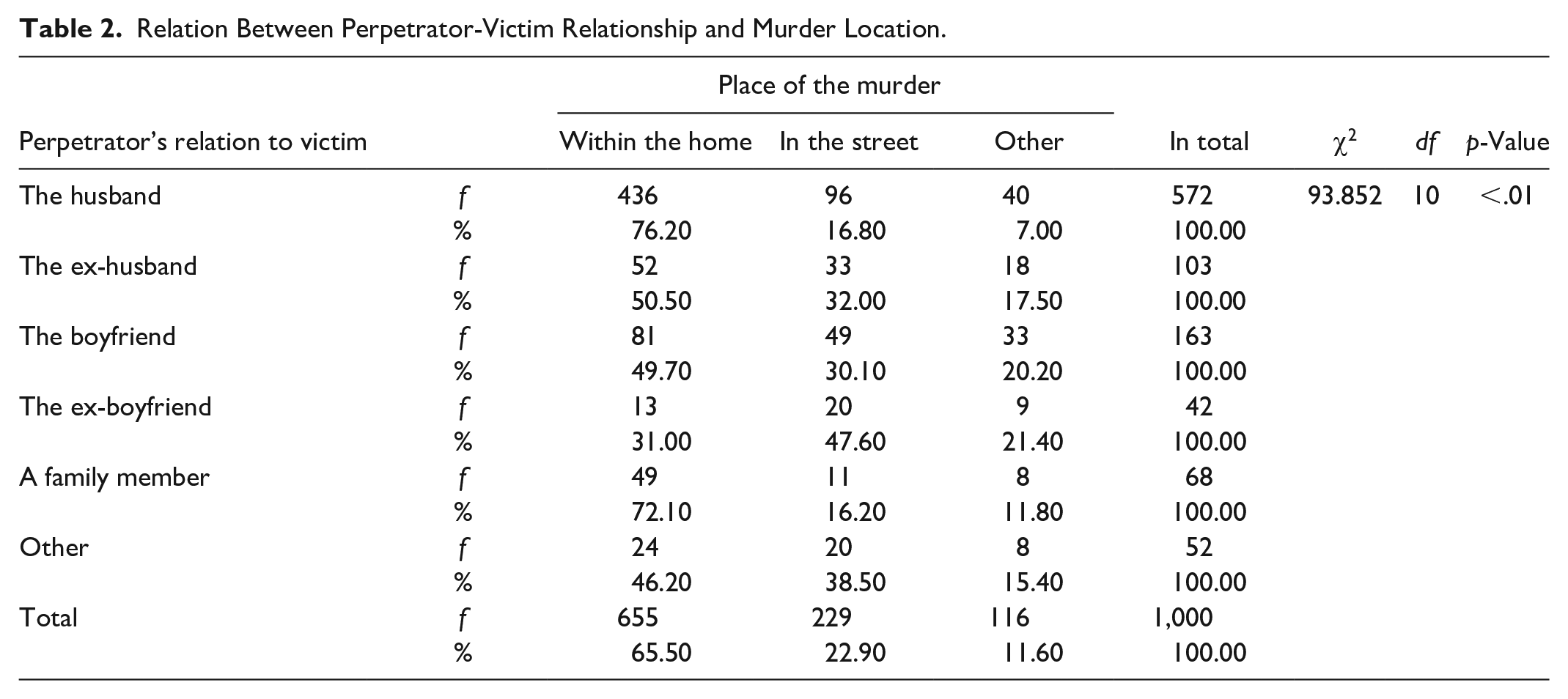
The analysis shows a significant relation perpetrator-victim relationship and the place where the murder took place (χ2 = 93.852; p < .01). Husbands, ex-husbands, current partners, ex-partners, and family members were murdered mainly within the house, and ex-partners were murdered mainly in the street.
Of all perpetrators, 76.20% of husbands, 72.10% of family members, 50.50% of ex-husband, 49.70% of current partners, and 31% of ex-partners of the victim perpetrated the murder within the home. By contrast, 47.60% of ex-partners, 32% of ex-husbands, 30.10% of current partners, 16.80% of husbands, and 16.20% of family members perpetrated the murder in the street. Those who had a relation with the perpetrator categorized as “other” perpetrated the murder in the home in 46.20% of cases.
Table 3 below shows a chi-square analysis conducted between the relation of the perpetrator and victim and the motive for the murder.
Relation Between Perpetrator-Victim Relationship and Murder Motive.

Note. χ2 = 1,025.26; df = 55.
p < .01.
**Chi-square analysis shows a meaningful relation between perpetrator-victim relationship and motive (χ2 = 554,244; p < .01). In the 931 cases in which information was provided about the perpetrator, the main reason for committing the crime was “dispute” (248 cases). The second most common reason was attempted divorce (114 cases), the third most common reason was suspicion of cheating (103 cases), and the fourth most common reason was a refusal to reconcile (83 cases). The number of perpetrators who were the husbands accounts for 572 cases; 28.80% of husbands murdered because of a dispute, 19.90% of husbands murdered because of attempted divorce, and 15.20% of husbands murdered because of suspected cheating. Perpetrators who are the ex-husbands murdered mainly because of divorce (43.70%), then because of refusal to reconcile (20.40%), and thirdly because of a dispute (16,50%). Perpetrators who were the current partners and ex-partners were murdered mainly because of a dispute (24.50%), and then because of a demand for separation (23.90%). The main motive of ex-partners to murder was a refusal to reconcile (54.80%), then jealousy and dispute (11.90%). Family members were murdered mainly because of custom and honor crime (26.50%), then because of a dispute (20.60%), and least commonly because of material reasons (11.80%).
Table 4 below shows a chi-square analysis conducted between the relation of the perpetrator and victim and the reporting of the perpetrator by the victim.
Relation Between Perpetrator-Victim Relationship and Reporting the Perpetrator.

Chi-square analysis shows a significant relation between the perpetrator-victim relationship and the reporting of the perpetrator by the victim to authorities (χ2 = 15,665; p < .01). In 45 cases there was an institutional appeal to the police or the justice system regarding the perpetrator; 73.30% of the reported perpetrators were husbands of the victim, 11.10% of them were ex-partners, 8.90% of them were ex-husbands, and 4.40% of them were current partners.
The number of appeals to institutions is very low. It is likely that the main reason is low trust in institutions. In many cases, the institutions do not provide sufficient support and protection for the woman, and such appeals may instead cause an escalation of violence against the woman seeking protection.
Discussion
This study had findings similar to those of international and national femicide analyses. As will be discussed further below, existing studies identify three dimensions of motives for femicides: micro-level motives (a) possessiveness and jealousy, (b) loss, separation, or divorce; and the macro-level motive (c) backlash against feminism. These motives are attached to perpetrators who are the victims’ intimate partners. International research has analyzed the relationship between intimate domestic violence, institutional violence, and partner femicide (Dawson, 2018; Reckdenwald & Parker, 2010, pp. 951–958; Shackelford, 2001; Wilson & Daly, 1988; Wilson et al., 1993, 1995). The term “institutional violence” refers to impunity and discrimination in justice and law enforcement (Lagarde, 2006). Lack of institutional protection, lack of punishment (Carcedo, 2010, p. 443), and impunity are the leading causes of increased VAW (Carcedo, 2010). The present study is not able to give evidence of a lack of institutional protection since available information on the 1,000 femicide cases reveals only 45 cases of women seeking institutional protection against men’s violence. In all of these cases, the institutions could not protect women. Still, the number of appeals to institutions is too low to sufficiently analyze institutional failure to deter violence.
Micro-Level Motives for Femicides: “Separation and Loss” -Divorce and the Desire for Divorce-; -Desire to Separate, and Refusal to Reconcile-
The present study and the national surveys have similar findings regarding the relationship between the perpetrator and victim. Most perpetrators are husbands, ex-husbands, and current partners or ex-partners. The main motives of femicides in international micro-level studies are: (a) possessiveness and jealousy and (b) loss, separation, or divorce; these match with the first- and third-highest motives in the existing survey. The most common reason for femicide by intimate partners, accounting for 307 cases, could be considered as “separation and loss”: desire for divorce (114 cases), divorce (61 cases), desire to separate (49 cases), and refusal to reconcile (83 cases).
Micro-Level Motives for Femicides: “Dispute”
Dispute (248 cases) is the second most-cited motive for femicides. However, the femicide cases never mention the specific underlying reasons for the dispute. The diverse reasons for disputes could be related to previous domestic violence.
Micro-Level Motives for Femicides: “Possessiveness and Jealousy”
The third most-cited motive involved “possessiveness and jealousy”: suspicion of being cheated on (103 cases) and jealousy (36 cases). These results correlate with the statistics provided by the three NGOs: Stop Homicide of Women, We Will Stop Femicide Platform, and Morçatı.
Other Motives for Femicides
Domestic violence comes after possessiveness and jealousy and is the fourth biggest motive of femicide (54 cases). The fifth biggest motive is material circumstances (35 cases) and crimes against customs and honor crimes (27 cases). This study could not develop definitive conclusions about VAW in relation to femicide, but within the study’s analytical category of “dispute,” domestic violence was a factor in the findings of 54 cases and one can assume that domestic violence played a role in the history of the relationship.
An international study conducted by Dimitrijevic et al. (2015, p. 113) showed higher femicide rates within cohabitation relationships; however, in Turkey, husbands, and ex-husbands most often murder women. This may be the Turkish cultural construction of marriage as an essential institution with the wife regarded as the husband’s property. The desire to control and possess his wife may be more significant for Turkish men than for men in countries where cohabiting partnerships are considered to have the same value as marriages. Men in Turkey may feel a greater desire to murder their wives when women rebel and seek to separate from or escape their husbands’ control rather than when their relationship is only an intimate partnership.
About the Place and the Method of Femicide
As mentioned in the international studies, femicides happen mainly at home, and the gun is the most commonly used weapon to murder a woman. Moreover, as mentioned in other national studies, overkilling occurs. Women are mainly murdered by their husbands, ex-husbands, current partners, ex-partners at home, with a gun, and using overkilling.
Macro-Level Motives for Femicides: Backlash
The micro-level motives of previously mentioned femicide studies in Turkey can be summarized at the macro-level as “backlash.” Women’s growing independence and empowerment (Çetin, 2015, pp. 353–355) can be explained as a transformation of rural to urban areas, the cultural transformation from traditional to modern, the higher participation of women in the labor force, increasing acceptance of divorce, and increasing involvement of the woman in the public space (Göle, 2002). Çetin (2015) notes an inconsistency between modernity and traditionality (p. 347). Women experience murderous violence when they start to occupy a new social position. Çetin (2015) emphasizes two different outcomes of this reality: honor crimes and crimes of passion. The honor crime has its roots in culture directly linked to a so-called traditionality (p. 349). The crime of passion has its roots in individualism and reflects obsession over a woman and strong feelings such as jealousy, hatred, and insanity. Çetin (2015) developed the concept of revolt killings related to femicides in Turkey and linked it to the transformation of Turkish society from traditional toward modern (p. 365). Women are becoming more visible in the public space, participating more in the labor force, and occupying a new social position. Revolt killings have become a destructive force that men use against women’s new status within society. Men rely upon their traditional gender roles and rebel against the transformation of gender roles and women’s empowerment. The traditional male role reflects masculinity protecting the masculine hegemony, and women’s revolt against this masculine hegemony threatens the “borders of masculinity” (Sancar, 2013, as cited in Çetin 2014, p. 57) so that men want to protect “the status quo” against a revolt (Çetin, 2014, p. 57).
Reestablishment of Masculine Domination and Institutionalized Backlash Versus Muslim Conservative Backlash
Both women’s NGOs and the CHP (Cumhuriyet Halk Partisi/The Republican People’s Party) deputy Erbay Isparta publicized on 26 February 2020 an increase in femicides in Turkey (Kadın cinayetlerinde yüzde altıyüz artış var, 2020). According to the general secretary of Femicide Platform (Kadın Cinayetlerini Durduracağız Platformu) Gülsüm Kav, the increase of femicides in Turkey accompanies a rising public consciousness of this crime. The main reasons, according to Kav and Müjde Tozbey Erden (the president of Önce Çocuklar ve Kadınlar Derneği—First Children and Women Association), relate to men attempting to reestablish masculine domination and to restore masculinity (Kav & Erden, as cited in Bilim ve Aydınlanma Akademisi, 2021). Thus, the ambivalent move toward women’s empowerment results in male and institutionalized backlash.
The institutionalized backlash can be explained by the state’s structural transformation, such as the increasing power of Mafia-like structures and Mafia-like images of masculinity. According to Kav, structural transformation interacts with increasing governmental impunity and conservative Muslim backlash along with upsurges in symbolic violence. This then paves the way toward increasing femicides (Bilim ve Aydınlanma Akademisi, 2021). Backlash politics in Turkish politics reacted to comprehensive gender-equality policies, implemented in the 2000s, that started to become the subject of moral-political critique. When Turkey sought to improve gender equality as part of its candidacy to the European Union, the new Civil Code and Penal Code in the early 2000s was restructured to improve gender equality and feminist collectives became more politically active (Acar & Altunok, 2013; Korkman, 2016 as cited in Sarıoglu, 2018, p. 57). Instead of the positive gender-equality policies changes of the AKP government undertaken in the 2000s, President Erdoğan spoke against the principle of gender equality and claimed that gender equality is alien to native and national culture in Turkey (Sarıoglu, 2018, p. 57). Since 2007, the AKP politics also turned to reinforce the politics of strengthening the patriarchal family (Acar & Altunok, 2013; Korkman, 2016 as cited in Sarıoglu, 2018, p. 57).
The withdrawal of the AKP governments from the Istanbul Convention on preventing violence against women and the arguments which essentialize Turkish culture by promoting so-called local values can be interpreted as a backlash against the West and at the same time as the outcome of the demand of representing the authentic and local values. The political trend of the AKP government since 2013 shows a tendency toward becoming more local with their “own” values referred to as Neo-Ottomanism (Köroğlu, 2014; Uzer, 2020; Yavuz, 2016), Islamic and Turkish family structure, and protecting Islamic and Turkish family values (SuffaVakfı, 2020; T24, July 15, 2019). The AKP government’s backlash against feminists interacts with its backlash against the West. This necessary process of developing distance from the “Western world” has become significant since 2013 and emphasizes “cultural relativity” (Aktoprak, 2016). The AKP government’s arguments for withdrawing from Istanbul Convention can be interpreted as a conservative Muslim backlash against feminism and the feminist interpretation of violence represented in the Istanbul Convention.
The conservative groups influencing AKP and the men within the party wanted to withdraw from the Istanbul Convention because they claimed that the Istanbul Convention opposes Islamic and Turkish family values (Sayın, 2020). They complained about the Istanbul Convention’s feminist interpretation of gender-based violence. Also, the AKP government and conservative Muslim groups criticized campaigns of the women’s movement against femicides and the terminology used by the feminist movement. These actors, such as the ex-Imam of Hagia Sophia mosque Mehmet Boynukalın and the AKP Kayseri deputy Nergis’, supported the withdrawal from the Istanbul Convention. They criticized feminist discourse about femicide and women’s murder (Ayasofya baş imamı, “kadın cinayeti” söyleminden rahatsız oldu, 2021): Women condemn those people for murdering women. Don’t women have any part in this violence? The speeches always accusing the men are wrong. Defending the feminist speech so much and that everybody using the same language disturbs me (Evci, 2021).
These arguments reject the feminist interpretation of patriarchal structures and gender-based violence. The conservative Muslim backlash legitimizes forms of direct male violence and state institutions such as courts that grant impunity to perpetrators of this violence. (Evrensel, 2015). Integral discourses of anti-feminism and anti-secularism of conservative Muslim AKP politicians involve state actors and institutionalized discourses about the sacralized family, the attempt to decrease the support for poor women (Ersöz, 2018), and the state’s intervention in private life, such as women’s choice over natality, (Başbakan 3 çocuk doğurun diyor ama. . ., 2008) and women and men cohabitating before marriage (Kızlı erkekli eve ilk ceza kesildi, 2013). The AKP government supported the Istanbul Convention that forbids family reunification after domestic violence. These policies ignore the reality of a direct link between femicides and divorces.
The Turkish state glorifies the number of women who no longer seek a divorce (Bilim ve Aydınlanma Akademisi, 2021). Kav emphasizes that the higher number of femicides in the cities should be considered against the background of increasing divorce rates and women seeking to become independent. She adds that women in the rural areas face traditional forms of repression and cannot separate from abusive partners. Kav also suggests that with the increasing conservativism in Turkey, the traditional forms of violence and murdering of women because of “family honor” can rise (Bilim ve Aydınlanma Akademisi, 2021).
The concept of backlash or “revolt killings” is explained by the women’s empowerment within Turkish society. Recent decades have seen a cultural, economic, and social transformation of women’s role within society (Çetin, 2015, p. 354). Men murder women who “demand divorce/separation or make decisions about their own live” as a form of revolt (Çetin, 2015, p. 354). The motive for femicides can be interpreted with macro-level analysis as anger at the women’s resistance to male domination. This desire by men to dominate escalates to murdering a woman. Additionally, this general male resentment is supported by AKP’s conservative Muslim backlash against secularism and women’s rights and its association of LGBTI+ rights as threatening the conservative Turkish Muslim family values. The AKP government’s conservative Muslim backlash increases, on the one hand, the symbolic violence against women and, on the other hand, the male domination over women. This results in men murdering women who desire emancipation.
The feminist standpoint on VAW and femicide includes both micro-level and macro-level analyses of motives. Femicide and VAW result from an accumulation of masculine domination. The present study is based on news reports of overt instances of violence. Therefore, it cannot fully address the cultural, epistemic, symbolic, institutional, and structural components of violence against women as detailed in feminist literature. However, the current study’s findings on the perpetrators’ motives might shed light on how these structural components are reflected in individual cases. Another important implication of the present study suggests a relationship between femicide and institutional violence. Under conditions of perpetrator impunity and insufficient institutional support, the victims of violence against women are left to face their aggressors unprotected and are exposed to potential murder.
The Muslim conservative backlash against secularism, western values, and institutionalization of the conservative Muslim gender roles can be interpreted with Bourdieu’s (2002), Connell and Messerschmidt’s (2005) concepts of masculine domination and hegemony over women. Cultural transition becomes a contested field with such ongoing phenomena as urbanization, weakened traditional family structures, and women empowered to increasingly make decisions about their own lives. Globalization also relates to the turn toward conservative Muslim ideology in Turkey and the reactionary, so-called orthodox Islamic cultural backlash against western and secular values (Lieber & Weisbergy, 2002). Femicide motivated by a male desire to dominate, which includes feelings such as possession, jealousy, loss of control, and insult to honor, is consistent with a cultural and institutional masculine backlash and direct violence. The rising women’s movement and increased visibility of feminist discourses within the public sphere since the 1980s also had an impact on implementing the Istanbul Convention in 2011, which was accompanied by the feminist movement in Turkey and its advocates at the government’s level (Atagün, 2021). The conservative Muslim backlash against the visibility of the feminist movement also can be seen in forbidding, since 2018, the International Women’s Day (8 March) Night March at Istiklal street (8 Mart Feminist Gece Yürüyüşü: Kadınlar yasağa rağmen yürüdü, 2020) and since 2016 the Gay and Trans Pride March (Gay ve Trans Onur Yürüyüşleri yasaklandı, 2018). The WAV and femicide analyses clarify how institutionalized masculinity seeks masculine domination over women. The current Turkish government supports the culturalist backlash with claims to the so-called local, authentic Neo-Ottomanist and Turkish-Muslim roots. Also, these studies note that other motives seem more important than honor killing. The main reasons for femicides in Turkey are revolt killing and masculine backlash. However, the dimension of honor reflects the symbolic violence and the male domination over women found in other motives for femicides in Turkey.
Backlash as the Consequence of Patriarchal Culture and Weakening Masculinity
VAW and femicide as backlash should be seen as a consequence of the patriarchal culture of Turkey in which honor culture and male-dominated social systems influence social life (Sakallı & Akbaş, 2013). Some claim that Turkish culture legitimizes violence against women when it relates to a man’s honor, and the violence responds to the threat of man’s honor and status in society (Ceylan, 2016). Studies that focus on Turkish masculinities identify the specific situations when Turkish men worry about potential threats to their masculinity, such as humiliation in front of friends, financial problems weakening household support, sexual dysfunction, and disclosure of emotions (Bolak-Boratav et al., 2017, p. 356; Sarioglu, 2018; Türkoğlu & Cingöz-Ulu, 2019). Men in these situations see violence as a legitimate response to women’s provocation (Weldon & Gilchrist, 2012) and disobedience (HÜNEE, 2015; Whiting et al., 2014). They use violence to gain social status (Próspero, 2008, as cited in Türkoğlu & Cingöz-Ulu, 2019, p. 179). Bailey and Peterson (1995) found masculinist operations of power, in which men increasingly use physical violence to compensate for their loss of control over women. Empirical studies identify relations between women’s empowerment and honor killings (Grzyb, 2016), rape (Avakame, 1999), and spousal violence (Chin, 2012 as cited in Sarioglu, 2018, p. 56).
Muslim conservative backlash offers only a partial explanation of revolt killings related to the concept of patriarchy. Macro-theoretical analyses of patriarchy as a social condition note that VAW serves as a tool of dominance to enforce gender and power relations (Brownmiller, 1975; R. P. Dobash et al., 1992; Hunnicutt, 2009, p. 553; Mooney, 2000; Yllo, 1993). Men use violence for the social control of women (Brownmiller, 1975; Caputi, 1989; Firestone, 1972; Griffin, 1971; Millet, 1970; Russell, 1975) and to maintain their advantage in the most disadvantaged situations (Hunnicutt, 2009, p. 560). Also, the backlash hypothesis supports this perspective, such as men feeling threatened by and reacting to women’s liberation with increasing violence to reclaim their diminishing power (Hunnicutt, 2009, p. 564). Griffin (1971) discusses male violence as an integral part of patriarchy as Brownmiller (1975) and MacKinnon (1991) discuss male violence as an outcome of patriarchal culture. The classical and current feminist literature considers male violence as a tool of power and control (Ertürk 2004; MacKinnon 1991; Sancar, 2009; Savran, 1994; Segal 1992). Hall (2002) describes male violence as more than hegemony, but as an outcome of anger and revenge. Other authors such as Mac an Ghaill (1994), Faludi (1999), Jefferson (2002) underline the aspect of the loss of masculinity within the capitalist system, and that masculinity doesn’t satisfy the expectations of the capitalist system. Giddens (2014) and Hollstein (1988) argue that modernization is a reason for the weakening of masculinity and the diminishing of the power of men within modern society, which is an essential factor of the male violence against women. Kimmel (1987) and Kaufman (1987) underline the aspect of the modern market system, the development of technology, the increasing competition, and the transformation of the traditional role models between men and women which are among the reasons for the crisis of masculinity. The masculinity studies identify violence as inherent to male role norms (Mahalik et al., 2003; Messerschmidt, 1993; Thompson & Pleck, 1986) and are used to reclaim manhood (Bosson et al., 2009; Schmitt & Branscombe, 2001). As discussed within this study, femicides in Turkey as revenge murder and revolt killing result from losing control over women and as a response against the threatened masculinity. It can be analyzed as an issue of structural patriarchy and masculinity losing power and domination over women and facing the transformation of the gender roles and weakened masculinity.
Conclusion
Femicides expose the fact that gender trouble is a Turkey-wide problem at many levels and is an outcome of masculine possessiveness and domination at the micro-level and backlash at the macro level. According to traditional gender roles, women did not have the right to exit a partnership even if there was a history of violence. That is why the thesis of backlash—that femicides are an attempt by men to reinstitute their power over women—seems appropriate in the case of Turkey. It can be speculated that the lack of institutional protection, the lack of shelters, and the male-dominated nature of the courts affecting the use of laws (and in many cases reducing the sentences for femicides, a practice referred to by the women’s movement in Turkey as “maleness reduction,” creates conditions of impunity that allow femicide to happen. Iyi hal (good behavior) or haksız tahrik (unjust agitation), is a legal classification used to shorten a murderer’s sentence. The women’s movement in Turkey refers to reducing the sentences of those who commit VAW as the “maleness reduction” (Dumrul, 2012). Furthermore, the withdrawal of the AKP government from the Istanbul Convention shows that institutionalized masculinity and conservative Muslim backlash at structural and cultural levels are accompanied by institutionalized violence of the conservative Muslim government and supports the thesis of backlash as a macro level of explanations femicides in Turkey. The existing impunity and the conservative Muslim backlash against feminists increase the symbolic and institutionalized violence stated among the reasons of VAW and femicides. This is the result of revolt killing of men against a semi-empowerment of women and against weakening masculinity with urbanization and modernity, but furthermore, the dimension of institutionalized feminist backlash shows that institutionalized masculinity does not want to hear the voices of women. The patriarchy and masculinity theoretical perspectives identify femicides in Turkey as revolt killing that result from engendered power relations and male response to losing masculinity, weakening power, and losing control and dominance over women. This study indicates that a link probably exists between backlash, impunity, and rising numbers of femicides in Turkey. The feminist movement recognizing VAW seems to endanger the existing institutionalized masculinity.
Footnotes
Data Availability Statement

Declaration of Conflicting Interests
The author declared no potential conflicts of interest with respect to the research, authorship, and/or publication of this article.
Funding
The author received no financial support for the research, authorship, and/or publication of this article.