




Abstract
This paper interrogated The Channels TV Facebook audiences’ discourse on selected top five farmer-herder violent conflicts related news stories from January 1st to July 31st, 2018 in Nigeria. We specifically examined how the audience enacted, reproduced, and/or resisted social power abuse and dominance in their discourses on the selected news stories and their act of stancetaking. We did this by drawing on Van Dijk’s principles of Critical Discourse Analysis (CDA) and Du Bois’s acts of stancetaking. We analyzed 84 (out of the 500) comments and images that directly or indirectly made reference to Fulani Ethnic Group (FEG). Finding revealed that besides lack of access to discourse control by FEG; online audiences’ discourses were crafted to enact or reproduce socio dominance against FEG using the strategies of generalized “positive self-representation” and “negative representation of Others.” Findings also showed that the commenters aligned with and amplified existing stances like Fulanization/Islamization, political conspiracy, leadership failure, and the need to disintegrate the country into smaller governable sizes in their comments. We therefore concluded that such thread of discourse that generalized criminal acts of few individuals on the entire ethnic group could be inimical to the nation’s goal of national integration, security objectives, and continued peaceful and harmonious co-existence among various ethnic groups in Nigeria and therefore called for further investigation into why the online audiences approached the issues as they did in their discourses.
Keywords
Introduction
Since Nigeria came into existence, the country has contended with a plethora of security challenges including armed robbery and kidnapping, Niger Delta militancy, banditry in the Northern Nigeria, terrorism (exemplified by Boko Haram activities), but of greatest concern in recent times is the renewed violent conflicts between farmers and herders. Annually, cattle herdsmen operate in a more or less predictable pattern in a to and fro movement between their main base within the Northern states (where they operate majorly during the rainy season) and the southern states (especially during the dry season) in search of natural pasture and water as well as marketing of their animals and products (Shettima & Tar, 2008). Most often, these migrations and open grazing of farm areas often triger conflicts of different forms between farmers and herders (Olaniyan et al., 2015; Yahaya, 2019). Between January 2016 and October 2018 alone, violent clashes (between members of farmers’ and herders’ communities across the country) associated with such movement and other factors resulted in the death of not fewer than 3,641 people and displacing many (Amnesty International, 2018). However, over the years, narratives on herders/farmers clashes in Nigeria has often being (mis)construed as a fight between Fulani Ethnic Group (FEG) and Non-Fulani Ethnic Groups (NFEGs).
The Fulani Ethnic Group (FEG) are often believed to have Senegambia origin (Cruciani et al., 2010; Scheinfeld et al, 2010; Winters, 2010). They are highly dispersed across many West African countries. They also constitute the largest migratory ethnic group (MEG) in the world (Ducrotoy et al., 2018), and as such, are among the minority of the population in all the countries where they can be found (Dupire, 1970). However, the largest national group of Fulani is in Nigeria where they constitute the fourth largest ethnic group (EG; out of 250–300 ethnic groups in Nigeria) with a population estimate of over seven million (Burton, 2016). The Fulani were said to have arrived in Nigeria in the 13th century following the Jihad war with herding as their major occupation. They are predominantly Muslim and account for about 90% of different cattle (Keteku, Zebu, Muturu, and Kuri) ownership in Nigeria which constitutes one-third of agricultural GDP and 3.2% of the nation’s GDP (Fabusoro, 2007). To this end, the Fulani remain the major suppliers of meat, milk, skin, horn, and bone for both domestic and industrial use in the country (Adeoye, 2017; Oli et al., 2018). Over the years, three types of Fulanis have evolved. These according to Ducrotoy et al. (2018, p. 2) include:
Settled Fulani (SF): Many of this group of Fulani are descendants of the aristocratic elite of what was previously known as Hausa-land. They are settled, intermarried with the Hausas, and tirelessly working to ensure that the “Nomadic Pastoral Fulani” or Bororo enjoyed right of passage and access to pasture as they move around the country.
Semi-Sedentary Fulani (SSF): This group of Fulani are often agro-pastoralists and are usually settled in their home states within the country; and
Nomadic Pastoral Fulani (NPF): This refers to a minority group of Fulani who live completely off their herds. They can handle animals (especially cows) as professional shepherds and take cattle offspring or farm produce as reward for taking livestock for grazing. They equally constitute the most migratory and less educated set of Fulani in Nigeria and dominated the cattle rearing industry in the country. This may account for the reason why “Fulani Herdsmen” is often used by most Nigerians including the media to refer to those usually involved in cattle rearing across the country even though few Non-Fulani herders can be found among modern days herders in Nigeria.
Cattle rearing has been a part of African history especially in places like the Guinea, Sudan, and Sahel Savanna belts in Nigeria long before the dawn of 20th century (Onoja, Bebenimibo, & Onoja, 2020). In the early years of cattle rearing, the cattle herders could access a lager grassland for open grazing without encroaching into other people’s farmland because crop production was not only seasonal but carried out on subsistence level coupled with lower population among other factors. However, recent advancement in agricultural activities in the Savanna belt in Nigeria coupled with the increased withering of pasture during the dry season has made pasture less available for cattle (Oli et al., 2018). Consequently, cattle herders often move their cattle back and forth to the Southern part of the country (which is characterized by longer rainy season) for fresh grass and water for their cows (Ofuoku & Isife, 2009). Most often, these migrations and open grazing of farm areas by these less-educated set of Fulani often come with encroachment into cultivated farmlands or killing and rustling of cows by local farmers and criminals thereby resulting in conflicts of different magnitude between farmers and herders (Olaniyan et al., 2015, Onoja, Bebenimibo, & Onoja, 2020).
Although the herders were reported to have been involved in different shades of violent clashes with local farmers as far back as many centuries ago (Aliyu, 2015, Onoja, Bebenimibo, & Onoja, 2020), there seems to be a renewed increase in the number of such clashes in recent times. For instance, a report by the Global Terrorism Index released in 2015 listed Fulani militants as the fourth deadliest militant group in the world after killing 1,225 people in 2014 alone. According to Amnesty International (2018), clashes between herdsmen and farmers communities resulted in more than 549 deaths and displacement of thousands in 12 states in 2017 alone and the figure went to 2,075 between January to October 2018 following the mass killing of members of some communities in Benue (Logo and Guma LGAs), Plateau, Adamawa, Taraba, and Kaduna (Ndujihe & Udochukwu, 2018). Between January 2016 and October 2018 therefore, Benue state has the highest number of deaths (726) as a result of the clashes followed by Adamawa (540), Plateau (492), Zamfara (489, Taraba (453), Kaduna (414), and Nassarawa (196) among others (Amnesty International, 2018).
Beyond loss in human lives as seen above, violent conflict and clashes equally portend economic implications for the affected states and the nation at large. According to the research report carried out by Mercy Corps, a Global Humanitarian Organization funded by the British Department for International Development (BFID) between 2013 and 2016, the country lost $14 billion in 3 years alone (Onoja, Bebenimibo, & Onoja, 2020). The report further revealed that the attacks were threatening the economic development of the country and if not well and urgently managed, could see further income decrease among the members of the affected communities. Besides, the attacks have affected the food security quest of the country (Ofem & Inyang, 2014); led to gross economic and human loss and displacement on the part of either the farmers or the herders or both in some cases (Adelakun et al., 2015; Ofem & Inyang, 2014; Ofuoku & Isife, 2009; Umeh & Chukwu, 2016).
Generally, farmer-herder clashes could be blamed on the fight over control of the scarce resource (land), cattle destruction of crops, farmers’ encroachment on grazing reserves, and indiscriminate bush burning by nomads which normally leads to loss of crops (Adeoye, 2017; Ofem & Inyang, 2014; Olaleye et al., 2010). In some quarters, the situation is perceived as mere farming, grazing land, and water dispute; as well as reprisal attacks in defence of livestock from banditry in farming communities (Eyekpimi, 2016; Mikailu, 2016), changing climatic condition and increased urbanization. However, with the emergence of President Mohammadu Buhari (a Fulani man) in 2015 as President of Nigeria, the narratives on herders/farmers clashes seems to have taken an ethnic and ideological dimension. For instance, leaders of some of the affected communities believed that the recent attacks were motivated by the move for Islamization, Fulanization, Northern Political Dominance, as well as political conspiracy against affected farming communities (Adamu & Ben, 2017; Enor et al., 2019; Onoja, Bebenimibo, & Onoja, 2020). These narratives seem to have gained popularity among many so much so that all intervention moves by President Buhari (like the military option; proposal for the establishment of cattle colonies; the 2015 National Grazing Reserve Bill, 2016; National Grazing Routes and Reserve Commission Bill; and 2016 National Grazing Reserves Agency Bill among others) to curtail the conflict have been rejected by the masses (Okewu et al., 2019; Onoja, Bebenimibo, & Onoja, 2020).
However, scholarship has demonstrated the role of mass media in conflict resolution (Dunu et al., 2017; Gever & Essien, 2017; Onoja, Bebenimibo, & Onoja, 2020). With the advent of the internet and emergence of social media platforms like Facebook, Twitter, Youtube, LinkedIn, etc, the mass media role in conflict resolution has further been stretched. Mainstream media now strive to maintain high degree of interactivity with their audience by making room for and allowing news “readers to comment on published news reports” (Abdul-Mageed, 2008, p. 59). Audience in a democratic environment like Nigeria where government control and censorship of internet content production and consumption is relatively low (Babajide & Odumesi, 2016) could now converge on and or engage the social media feedback walls of mainstream media organizations like The Channels TV to discuss issues contained in specific news story reported by the TV station.
Mass Media Online Audiences’ Comments
Constructing a generally acceptable definition of “audience” has been problematic. This is partly due to the changing nature of communication technologies and environment. At the early days of the mass media for instance, audience was “characterized as singular and passive” mass of individuals who receive media message in the form of a bullet and respond to the stimuli identically (Zhao, 2019). However, critical cultural studies had resisted the “magic bullet theory” of the media highlighting the fact that audiences are active receiver of the message who actively select what they get exposed to, what they pay attention to and what they retain as exemplified in active audience theories. Recent technological advancement in the media landscape that necessitated the emergence of the internet and the social media has further stretched the meaning of “audience” beyond the initial conceptualization as passive audience or active audience to what could be regarded as online audience or “participatory audience” (Stamenković, 2020, p. 32), who are constantly “shaping, sharing, framing and mixing media contents and exchanging same online” (Jenkins et al., 2013).
The concept of online media audience therefore refers to “participatory audience” (Stamenković, 2020); “networked publics” (Boyd, 2010); “ad hoc publics” (Bruns & Burgess, 2011); or “affective publics” (Papacharissi, 2015) who are linked by the algorithm and affordances of social networking sites or the internet as a whole; who comments on or like/share stories of common interest; supplement media stories on farmers-herders clashes, offer a different interpretation of the conflict or open up new angles that may not be on the agenda of The Channels TV in its reportage of the conflicts.
In this study, we examined the Facebook wall of The Channels TV within a period of 7 months (January–July 2018) to ascertain its audiences’ discourse on herdsmen attacks news in Nigeria and how they took stance on the issue. The Channels Television (Channels TV) was founded in 1992, licensed in June 1993, but never started transmission until 1995. The TV station was set up to meet the broadcasting needs of the Nigerian populace and as well as to offer to its audience objective and fair news report. Shortly after establishment, the TV station commenced operation in other three locations including Abuja, Edo, and Kano states and as well as established bureaus in every state in Nigeria as well as stringers and affiliates in other parts of Africa. In less than three decades, the station has grown a listenership of over 20 million people with a heavy online presence (https://www.channelstv.com/aboutus/, August 28th, 2020).
It should be noted that television, traditionally regarded as a broadcast media, has recently become widely available online. Online versions of television especially their social media channels allow their audience to react to any news story of their interest in real-time with the opportunity to write comments, take stance, and share on other social media platforms (Giaxoglou & Johansson, 2020; Lee & Jang, 2010).
The Internet and social media profile of Nigeria generally and The Channels TV specifically suggests a considerable online audience for traditional mass media on social media like Facebook, Twitter, Youtube, Instagram, and so on. Nigeria has 107,547,723 active internet subscribers, 21.17 million general social media users, and 20.59 million Facebook subscribers as at October 2018 (NCC, 2020; Statista, 2020). Channels TV has 1,520,371 likes and 1,927,532 followers on Facebook besides its popularity on other social media like YouTube, 1,170,000 subscribers; Twitter, 4,000,000 followers; and Instagram, 856,000 followers (https://web.facebook.com/channelsforum, September 2nd, 2020), maybe because The Channels TV mobile apps are available on Nokia store, Microsoft Windows Store, Google Play Store (for Android phones), Apple (iOS) Store, and Blackberry; and The Channels TV’s programs are available on Smart TVs—Apple, Android, Fire, and Roku (https://www.channelstv.com/aboutus/, August 28th, 2020). The Channels TV’s heavy presence on social media allows it to maintain high degree of interactivity with its audience by making rooms for and allowing news “readers to comment on published news reports” (Abdul-Mageed, 2008, p. 59).
Generally, in the feedback section of the mainstream media’s Facebook accounts, audiences are often at liberty to extend and contribute to discourses on any news item of their interest by commenting, sharing, liking, and so on. The feedback comments in the context of this study therefore refer to the mainstream media online audience’s reactions to specific news items of their interest. This section according to Chiluwa and Ajiboye (2016, p. 40) “serves as a platform for public interactivity, which is comparable to the traditional media’s letter to the editor but different in the sense that they are usually unedited.” Nevertheless, the editors are often at liberty to remove any comment considered to be offensive or that is against their editorial guidelines (Unuabonah, 2012), thereby maintaining some level of censorship. Besides, many Nigerians believed their internet usage is being monitored by the government (Babajide & Odumesi, 2016, p. 223) even though there is no specific law defining internet control and surveillance in the country.
As earlier noted, the farmer-herder attacks have been part of the media and public agenda, especially under the current political dispensation in Nigeria. Stories related to the attacks have equally attracted world-wide attention and varied reactions, most especially on the Internet as digital communication and social networks, in particular, continued to offer people the platform to express their concerns about social and political events that affect their wellbeing or the wellbeing of others around them (Smith, 2010). From the Arab Spring to Brexit, and the prevailing social crusade against perceived social injustice across the world, news audiences have been employing the opportunities available in online social media platform to reject repressive regimes and enthrone accepted ones; react against institutional crimes, terrorist attacks, and demand for greater protection against violent crimes. They are equally taking the advantage of the flexibility of social media platforms to not only take stance on burning issues but to also, perhaps, enact, reproduce, and/or resist social power abuse, dominance, and inequality. We therefore aimed to understand their act of stanctaking on farmers-herders conflicts news stories as well as to expose, and ultimately resist social inequality inherent in audiences’ virtual discourse on herders-farmers conflicts in Nigeria. Our interpretation was driven by our understanding of acts of stancetaking (Barton & Lee, 2013; Du Bois, 2007; Giaxoglou & Johansson, 2020) and Van Dijk’s (1993, 2001, 2015) principles of critical discourse analysis. This is without prejudice to the perspectives of other scholars of CDA like Potter & Wetherell (2001), Willig (2008), Fairclough (2009), and Adjei (2013) among others whose works as cited in this paper have equally contributed to the understanding and application of CDA within the emerging social media genre.
Social Media Audience (Networked Publics) and Stancetaking
Stancetaking in online interactions is considered among scholars to be central property of communication. According to Jaffe (2009, p. 3) stancetaking is “taking up a position with respect to the form or the content of one’s utterance.” The act of taking a stance is therefore both a linguistic act and a social act that entail evaluations at different levels (Du Bois 2007, p.140). According to Du Bois, stance processes mobilize and deploy sociocultural value invoked in the evaluative act with a focus on a precise target that gets selected as salient, noting that “stance is a public act by a social actor, achieved dialogically through overt communicative means, of simultaneously evaluating objects, positioning subjects (self and others), and aligning with other subjects, with respect to any salient dimension of the sociocultural field” (Du Bois 2007, p. 63).
Du Bois (2007, p. 140) opines that “in many cases the current stance act resonates both formally and functionally with a stance taken in prior discourse. Thus, the value of any stance utterance tends to be shaped by its framing through the collaborative acts of co-participants in dialogic interaction.” In this study, we situated our understanding and application of stancetaking within the emerging scholarship that tend to emphasize the relevance of the social, dialogic conceptualization of stancetaking to the study of interaction and participation among “networked” audiences. For instance, Barton and Lee (2013, p. 31) observe that stance within the sphere of digital communication is “a position taken by a speaker in relation to what is said and to whom the utterance is directed.” We therefore examined how the Channel TV’s networked publics, through their use of language, took stance on news related to herders/farmers clashes within the period in question. We equally applied the principles of staketaking as exemplified by Du Bois (2007) and Barton and Lee (2013) to evaluate the actual stance taken by the networked publics in their comments on herders/farmers violent clashes news stories.
Critical Discourse Analysis: Theory and Method
Critical Discourse Analysis (CDA) is a form of discourse analysis that studies power play in written or spoken words. Put it succinctly, it is the branch of discourse analysis that studies how people within socio-political contexts enact, reproduce, and/or resist social power abuse, dominance, and inequality (Van Dijk, 2001). CDA as a theory and method shows how language works in sociocultural and political contexts, focusing on power relations and ideological perspectives reflected in discourse text, and their wider implications for the society (Chiluwa & Ajiboye, 2016). This is in line with Taylor’s (2001) summary definition of CDA as “the close study of language in use” (p. 5). In CDA, Potter and Wetherell (2001) opine that the analysts espouse the principle that people construct versions of their social world through the instrumentality and functionality of language.
Because participants in social interaction strategically deploy discursive devices to demonstrate their keenness and stake in conversations in pursuit of their interpersonal and social objectives (Willig, 2008), CDA “aims to contribute to addressing the social wrongs of the day (in a broad sense—injustice, inequality, lack of freedom, etc.) by analyzing their sources and causes, resistance to them and possibilities of overcoming them” (Fairclough, 2009, p. 163). The preoccupation of discourse analysts in a nutshell is to investigate how people, through the variability of language, represent versions of reality within discursive contexts and its implications for knowledge production (Adjei, 2013). The approach according to Willig (2008) primarily focuses on the analysis of texts and/or utterances within the specific socio-cultural contexts and indicates a method of data analysis that can tell researchers about the discursive construction of a phenomenon.
Some arguments of the developers of CDA theory that were considered relevant to this paper are that: “facts can never be isolated from the domain of values or removed from some form of ideological inscription. . .” and “that language is central to the formation of subjectivity (conscious and unconscious unawareness). . .” (Kincheloe & McLaren, 2005 as cited in Darder, 2014). Also, in line with Chiluwa and Ajiboye’s (2016) argument, this paper examined how a certain level of discourse (e.g., language use in online reactions to the herdsmen attacks in this study) reveals value judgments and ideological perspectives—how individuals or groups with specific identities represent themselves or are represented by others online.
This study was carried out using Van Dijk’s (1993, 2001, 2015) CDA model and principles by examining discourse access and discourse structure in the analysis of the selected corpus. Access to discourse and communication is referred to as social resources on which power and dominance are based. According to Van Dijk (1993, p. 256), “the more discourse genres, contexts, participants, audience, scope and text characteristics they (may) actively control or influence, the more powerful social groups, institutions or elites are.” We focused on discourse access from the perspective of Fulani by examining their level of education, access to social media, and technology usability compared to the NFEG.
In the same vein, the theory and practice of CDA suggest that we focus on the structures of text and talk. Here, we specifically focused on the reproduction of dominance through discourse understanding (Van Dijk, 1993, 2015). This includes the interpretation of discourse as a dominant act by the dominated FEG; and reproduction of dominance by the dominant group through justification or legitimation of dominance by the dominant NFEG. At this point, we applied two contemporary strategies for justification of inequality as itemized by Van Dijk (1993, 2015): the positive representation of the own (non-Fulani) group and the negative representation of the (Fulani group) Others. We evaluated the formation of models of events and attitudes schemata in which US and THEM were thus represented.
We also went further to examine how the online news audience (dis)align themselves with the existing stances using the act of stancetaking (Du Bois, 2007; Jaffe, 2009; Giaxoglou & Johansson, 2020) on violent crisis in Nigeria
Data for this Study
Data for this study comprised Facebook comments by The Channels TV’s online audiences on selected farmer-herder clashes/conflicts related news in Nigeria between January 1st to July 31st, 2018. This period marks the peak of such conflict within the last few years. The choice of The Channels TV was premised on its national coverage, perceived popularity, and accessibility as well as its perceived general leadership position in the industry coupled with its consistent Facebook news reportage.
The top-5 farmer-herder conflicts related news stories reported on The Channels TV Facebook wall (https://web.facebook.com/channelsforum) were selected from a total of 23 related stories for this study (see table below). That is one most popular farmer-herder conflicts news story from Zamfara, Taraba, Adamawa, Plateau, and Benue states each was selected. The selected stories were considered the most popular because they attracted the highest number of feedback (comments, shares, and reactions) from the online audience within the period. We used the Facebook account of our lead author to search through the Facebook account of The Channels TV (https://web.facebook.com/channelsforum)’s posts by applying different filters such as the year of the post and alternatively searching key phrases that include “herdsmen attack,” “Fulani herdsmen,” “Farmer-herder clash,” “Cattle attack,” and substituting each of the selected five states with one another in the search. The process yielded 23 stories within the study period out of which we selected five of the stories with the highest number of comments (see Table 1).
Selected Farmer-Herders Clash/Conflict News Stories, States, Dates, Sites, Comments, and Selected Comments.

The five news stories above yielded 500 comments in all. However, inclusion and exclusion criteria were developed based on a pilot study of 30 randomly selected comments. Subsequently, we only included 84 comments which included 71 text only and 13 images and texts that met the inclusion criteria. The inclusion criteria include: (1) that the comment was related to the farmer-herder clash/conflict news story or topic of discussion and (2) that the comment explicitly or implicitly made reference to Fulani Ethnic Group (FEG). Given the aforementioned criteria, any other comments that did not possess all of the above conditions were excluded from the study.
Results/ Discussion of Findings
Critical Discourse Analysis of the Selected Corpus
Following the dictate of the CDA that requires researchers to describe, explain, and interpret data, we examined the corpus selected for the study by looking at audiences’ level of access to social media genre, interpretation of discourse as a dominant act, and discourse structure, and strategies in the enactment and reproduction of social inequality within the selected corpus. We equally examined the act of stancetaking among the commenters.
Control of text and discourse
We found that language users or online news audiences (the networked publics) have more access to social media genres and therefore participated more freely in discourse generation on farmer-herder clashes in Nigeria. Although social media are relatively “free” for participants within Nigeria, there are certain preconditions that impact on the level of access among different strata of Nigerian society in the actual sense. The algorithm of social media where The Channels TV Facebook wall belongs requires certain conditions for access. Those conditions may include ownership of communication gadgets like internet-enabled mobile phones and (personal) computers; ability to operate these gadgets where available; nearness to data network areas; ability to afford data subscription or to buy time at available cybercafe; and ability to read, write, and communicate effectively on social media using the English language which has been Nigeria’s official language. The aforementioned conditions and other variables work individually or collectively to deprive the FEG access to social media and as such, hardly participated in social media discourse on Farmer-Herder clashes in Nigeria.
Our study showed that the online commenters (mostly anti-FEG members) who are mostly educated and techno-savvy have the advantage of active access to social media compared to the Nomadic Pastoral Fulani (NPF) who are mostly illiterate (especially in writing and reading in the English language) and live in the remote areas where access to telecommunication network was a challenge. To this end, discourses on farmer-herder’ clashes were skewed against FEG as their versions of the discourse were conspicuously missing. This, therefore, may account for the unavailability of sufficient counter opinions in most of the selected corpus except few from Adamawa, Plateau, and Taraba states where Fulani elites (the SSF and SF) could be found in considerable number.
Reproduction of dominance
According to Van Dijk (1993, p. 263), in evaluating the reproduction of dominance through discourse understanding, the researcher would have to pay attention to “the interpretation of discourse as a dominant act by the dominated group members” and the justification or legitimation of inequality by the dominant group. Here we focused on the interpretation of the news stories and comments on farmer-herder clashes by the dominated (pro)FEG. Commenting on the news of the attacks from Adamawa, Plateau, and Taraba states, the dominated (pro)FEG interpreted both the news stories/the audiences’ comments on the news (e.g., that herdsmen attacked the affected communities), and the context (non-Fulanis have no reason to ascribe the killings to Fulani when the killing was allegedly perpetrated against the Fulanis in the affected communities). For instance, while commenting on the July 9th, 2018 news story from Adamawa State with the headline: “Many feared killed as suspected herdsmen attack Adamawa, Taraba communities” a few of the commenters who seemed to be (pro)Fulani refuted The Channels TV’s narrative on the incident as follows:
Dear Southern Dominated Media, why can’t you endure to tell the truth even for once, an eye witness told us that it is Bachama militia that attacked Fulani in their sleep, but with hatred that beclouds your sense of reasoning, you chose to turn the story upside down! I’m Afraid Channels TV that I used to watch has lost integrity
Why is Channels TV and other Southern media always lying. . . Bachama, Yadang, and Mumuye militia groups have attacked Fulani communities in Adamawa and Taraba states. . . Over 50 were killed. . . Thousands are now refugees. . .
People should short up here, no one is condoning killing from any facet of this country, but why do you only report and support killings made in the name of Fulani, while you vividly know that most killings were orchestrated by selfish politicians that always want to save their asses. Channels you are too bias. . .
Channels you have to be careful the way you report your news: everything in Nigeria now is herdsmen, do herdsmen go about in the bush on motorbike?
May God punish those of you breaking this fake news as you can see in pictures it was Fulani villages that were attacked by armed militia.
Also, commenting on the news story from Channels TV on March 23rd and April 4th, 2018 about Plateau and Taraba attacks with the headlines: “Suspected herdsmen kill three in Plateau” and “Suspected herdsmen kill four in Taraba community attack” respectively, the pro-Fulani commenters lamented that: “Even [when] Robbers Killed, it will be suspected herdsmen not Robbers,” thereby ascribing every “killing to herdsmen, chai dez [there] is God ooo.” Another rhetorically asked: “what happened in Mambilla Plateau was it 20 herdsmen all with Ak47 as you are now allegedly saying?” while another commenter said that “Suspected herdsmen stole baby napkin in Lagos and APC government shielded the culprits.” Due to lack of sufficient alternative pro-Fulani ethnic audience discourses, and because of their own best interests and corresponding ideologies and attitudes, many members of the audiences tended to adopt the media’s negative models in their discourse on Fulani ethnic group.
As seen in the corpus above, the pro-FEG interpreted the discourse as dominant act by the dominant Non-FEG and challenged The Channels TV and their online audiences (although, quite insufficiently) for ascribing the alleged violent attacks within the states to Fulani (herdsmen) while portraying the farmer’ communities as innocent victims even when the context of the news sometimes clearly suggested that they were attacks on Fulani communities. The above corpus lends credence to Van Dijk’s (1993) assertion that discourse understanding requires the researcher to demonstrate the presence of “the interpretation of discourse as a dominant act by the dominated group members.” Because such negative social representations were established against the FEG, it could in turn be used in the formation of models that promote discriminatory acts against THEM within other contexts and contents.
Justification or legitimation of inequality
Having examined the interpretation of discourse as a dominant act, we went further to explicate how the networked audiences of Channels TV lend credence to the acceptability of ethnic opinions and thereby enacted discursive discrimination against the Fulani ethnic nationality through their application of discourse structures and strategies. According to Van Dijk (1993), “reproduction of dominance in contemporary societies requires justification or legitimation. . .and denial” of inequality or dominance. However, we only focused on the former as the features of the corpus studied did not give room for the enactment of the latter. We found that the justification of inequality and marginalization or social domination of Fulani ethnic group by the non-Fulani was achieved using the strategies of “positive Self-representation” and “negative representation of Others” (Van Dijk, 1993, p. 263). We found that models were expressed by the commenters in such a way to persuasively convey generalized contrast between US and THEM by contrasting farmers’ communities who were also predominantly non-Fulani as “innocent victims” of Fulani’s mindless killings. For instance,
6. . . .What is their gain for killing innocent Indigenes unjustly?
7. Dem go [they will] kill Benue finish ooo. . . they need help
8. Core Hausas are also victims of ethnic cleansing. . .
9. We are now like Israelites under the captivity of the Egyptians. . .
10. When will Fulani herdsmen stop killing in Nigeria?
11. Everyday killings is just to reduce the number of Christians ahead of the 2019 Election, for Fulanis is too much than Boko Haram, Everywhere Fulanis.
12. Living with this kind of demonic blood tasty animals is self-suicidal
13. I want to ask questions are these herdsmen spirit that they can’t be arrested these is getting out of hand the blood of innocent people shedding every day will speak against this government
14. When will Fulani herdsmen stop killings in Nigeria?
We found that the corpus did not only establish US as victims of THEM but also indicted the sitting President Muhammadu Buhari and his service chiefs for supporting THEM in their onslaught against the US as seen in comments like: “Buhari why not stop killing the innocent people,” “Buhari’s kinsmen on the rampage. Killing spilling blood everywhere,” and “Buhari and his Fulani headsmen government is always a suspects until they finished slaughtering everyone.” This line of thought seemed to support the prevailing mood of the nation (as seen under the analysis of stancetaking among the commenters) where many, especially those from the Southern part of the country believed that most key appointments into the security architecture of the country under President Muhammadu Buhari has been lopsided in favor of Fulani ethnic group but considering how long the clashes have lasted, it may be misleading to place the cause of the clashes solely and directly at the feet of the President because of his Fulani ethnic orientation.
We also report that The Channels TV online audiences discredited the Fulani ethnic group by paying extensive attention to their alleged threat to the interests and privileges of the non-Fulani farmers’ communities as seen in the corpus above. By so doing, the Fulani ethnic group were often associated with mindless killings, act of terrorism supported by the sitting government, illegal migration and residence, forcefully occupying places not meant for them, crime, and being a burden on the land resources in the affected states. The online commenters, therefore, paid excessive attention to alleged herdsmen’s threat to the interests and privileges of the dominant (non-Fulanis) group: “we” will get access to less land in our own place because of them, “we” will be killed or chased out of our own ancestral land because of them, and they are even “favored” against us by the Federal Government led by President Muhammadu Buhari and his security chiefs who were also accused of having Fulani ethnic origin. These were done both subtly and overtly by (dis)aligning with prevailing stances. In the next section, we try to examine how the online news audience align or disalign themselves with the existing stances on the crisis in Nigeria using Giaxoglou and Johansson’s (2020) acts of stancetaking to further our argument.
Act of Stancetaking
Since 2015 when President Mohammadu Buhari (a Fulani man) assumed office, narratives on herders-farmers clashes seems to have been dominated with assertions that tend to attribute famer-herder clashes to the perceived Fulani agenda of Islamizing and Fulanizing the country; or Northern elites’ drive for continued political dominance; as well as political conspiracy against affected farming communities; and national disintegration (Adamu & Ben, 2017; Enor et al., 2019; Onoja, Bebenimibo, & Onoja, 2020). Examination of the available corpus equally suggests that The Channels TV’s online audience also took their stances on farmer-herder clashes in the country following the existing narratives as seen below.
Fulanization/Islamization
Fulanization according to Onoja, Bebenimibo, & Onoja (2020), “is an ideological belief which states that the Fulani ethnic group has been working secretly toward expanding their geographical territory and control over places that were not hitherto under their control”; while Islamization is a concept that suggests Fulani drive to impose Islamic religion on every other parts of Nigeria especially in the non-Fulani states’. These two ideologies have their roots in the 18th century Jihad war in the early history of Northern Nigeria. Going through the selected corpus, one could find instances how the online audiences aligned with this stance. For instances, while commenting on the news story, “Suspected herdsmen kill three in Plateau” one of the commenters asserts that “Everyday killings is just to reduce the number of Christians. . .” While also commenting on the news story: “we’ve seen too much blood! Nigerians lament killing after Zamfara attack,” some of the commenters observe that even “Core Hausas are also victims of ethnic cleansing. No other people can enjoy immunity apart from Fulanis, Cows, Governors and President.” This was further supported by another commenter on the news story who wondered why “. . .Buhari [Fulani]. . . can’t declare Fulani headsmen a terrorist group if he is not in support of Fulani headsmen attack.” Also commenting on the story: Suspected herdsmen attack four communities in Adamawa, Taraba’ the commenters lamented that “. . .these people [Fulani] are seriously taking upper hands in this country. . .” and another echoed that “they have the backing of Terrorist Buhari.” The stance that farmer-herder clashes were Fulani’s calculated efforts to grab other ethnic groups’ lands and impose Islamic religion on the settler with the backing of President Buhari was further exemplified in the images in Figures 1 and 2
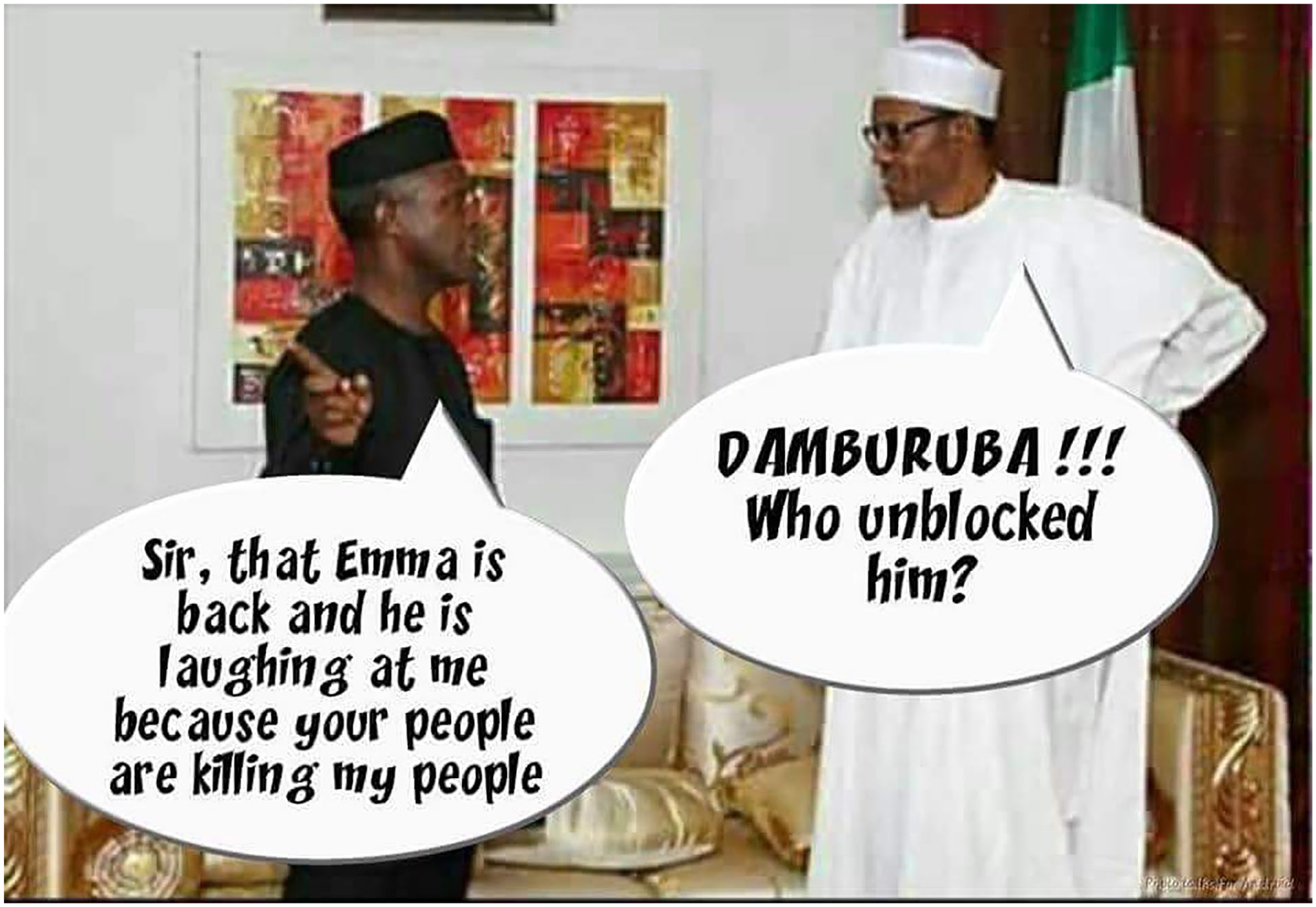
Zamfara story.

Adamawa story.
The image in Figure 1 depicts the Vice President, Prof. Yemi Osinbajo (Non Fulani), complaining to his boss, President Buhari (Fulani) about a social media commenter named Emma who was ridiculing the VP because the President’s people (herdsmen) were killing VPs’ people (non-Fulani). To further enact this stance, President Buhari’s response was not targeted at addressing the problem but only furious for unblocking Emma on social media. Recall that President Buhari’s administration has attempted regulating or restricting people’s access to social media like the earlier proposed social media regulation bill and the recent ban on Twitter in the country.
This second image as seen in Figure 2 equally depicted FEG as land grabbers with the assistance of their trade union, Miyetti Allah as well as the Federal government.
However, Pro Fulani disaligned with this stance by terming some of the news reports as lie or fake news: “Why is Channels TV and other Southern media always lying. . .” and “May God punish those of you breaking this fake news as you can see in the pictures it was Fulani villages that was attacked by armed militia”; and recounted the story from different angle, “an eye witness told us that it is Bachama militia that attacked Fulani in their sleep, But with hatred that beclouds your sense of reasoning, you chose to turned the story upside down!”; or described the attacks as mere “reprisal attacks.” Those who disassociated themselves from this narrative also blamed The Channels TV for over coverage of Fulani related killings even though denying the fact that herdsmen have been involved in a number of killings: “People should short up here, no one is condoning killing from any facet of this country, but why do you only report and support killings made in the name of Fulani. . .” and “Channels TV you have to be careful the way you report your news everything in Nigeria now is herdsmen, do herdsmen go about in the bush on motorbike?”
The Fulanization/Islamization stance is premised on the shared belief in many quarters that herdsmen are usually Fulani and the victims of farmers-herders attacks are usually non-Fulani; the sitting President of the country (Muhammadu Buhari) is also of Fulani origin coupled with the common view among many that most of his security chiefs and other top government officials who seemed to have failed to address the security situation are predominantly Fulani. More so, the patrons of Herdsmen’s largest umbrella body (Miyette Allah) are Fulani, including the President who is believed to own a herd and was once their patron. Therefore, it is assumed that there is an ethnic conspiracy by the Fulanis, from the top to the herders, to use violence to strike fear among these farming communities in other to lay claim to land resources (Enor et al., 2019; Onoja, Bebenimibo, & Onoja, 2020).
Political conspiracy/leadership failure
Political motivation and/or leadership failure have been tipped in many quarters as the root and most times immediate causes of the crises between farmers and herders in Nigeria. According to this school of thought, killings associated with the clashes were fueled by political party members to discredit each other during and after electioneering period. This stance was also maintained by some of the commenters who assert that the killings associated with the attacks were some spiritual sacrifices for electoral victory: “MUMUhadu BOKOhari needs more human blood to sacrifice to Allah in order to win second term till 2023. . .” This was further depicted in some of the image where President Buhari and his political party, All Progressives Congress (APC) were illustrated to be walking on human bodies with blood stains to 2019 election or killing people with dagger to pave way for victory at the poll. The commenters also aligned with the stance that the killings were aimed at getting voting advantage in some areas: “they kill and then come to tell you the present govt can’t secure your lives. These are sponspored killing in the quest for power targeted at zones with vote advantages aimed at selling the current governmentt as bad. . .”; and at times, the killings were taken to mean the work of the opposition party “No killer herdsmen but PDP [People Democratic Party] looters militias!”
Some commenters equally aligned with the stance that suggest dearth of quality leadership in Nigeria as one exclaimed that “#we have no leader yet #.” For instance, some of the commenters described Nigerian leaders as “crude,” “incompetent,” and “worthless” “without proactive inputs and productivity” who often misplaced their priorities as “People are loosing their lives daily, yet the government is not concerned about that, but they are busy sending troops with sophisticated weapons to Ekiti state where there’s no crisis.” Another called on all Nigerians “to go down on bended knees and beg this government [President Buhari led Federal Government] to work, be effective for once fight this criminals na. . .bikonu [please]. . .”
This finding upholds earlier findings like Ahmed et al.’s (2019), Enor et al.’s (2019), and Onoja et al. (2020) who individually and collectively argued that Farmer-Herder clashes were political weapon used by politicians to either bring down or enthrone leaders and political parties. They also argued that the clashes could be engineered for the purpose of monetary allocations, just like the amnesty program introduced in the Niger Delta to curb Niger Delta militant under former President Goodluck Ebelle Jonathan’s administration. In the same vein, Enor et al. (2019) assert that “herdsmen attacks are. . . political violence sponsored by some elements within the country, north or south of the divide, in other to advance their premeditated and unscrupulous agenda however defined” (p. 279).
National disintegration
Another stance that emerged in the analysis of the selected corpus is that of national integration. Since Biafra was declared in 1966 and subdued in 1970, call for disintegration of the country into different ethnic enclaves have been echoed in many public discourses on national security, economy, and unity of the country. This stance was equally alluded to and maintained by some of the online commenters who commented on the farmer-herder clashes related news stories under investigation. Going through the selected corpus, one could identify calls for disintegration:
15. Nigeria accept division and have your life, don’t allow this politician to play with your life.
16. . . . divide this nation, then join them [Fulani] with wild animals if they need more numbers
17. I advise all indigenous population in this British contraption call Nigeria to rise up and emancipate their people, self-determination is the solution, the earlier the better
18. It’s a price they must pay for one Nigeria because when you make stupid bargain, definitely you will pay stupid price
19. . . .Biafra is the last hope
20. Hahahah the zoo[Nigeria] must fall, free Biafra or wait for the second king pharaoh of Egypt and Israel
Implication to Research and Practice
This paper has expanded the existing literature on discourse/conflict within Nigerian social media space. It clearly demonstrates that the study of discourse use in conflict situations could be extended to audience’s online feedback on security news reports. In that, it has contributed to the emerging literature on audience construction of conflict and peace through the use of language in conflict time. The findings from this study equally portend some policy implications for media actors in the country. The paper implied a need for the government agencies, the mass media and social media operators to be proactive in their regulation and conflict reporting/discourse on social media. It equally underscored the need for more political and legislative intervention in audience discourse on conflicts in Nigeria. The paper also revealed a need for review in the approach of the mass media and by extension, social media users to be conscious in their discourse on farmer-herder clashes to forestall hasty generalization or taking sides on issues relating to the clashes but to promote a more objective and solution-driven discourse.
Conclusion/Recommendations
We found that rather than contributing objectively to the understanding of the current security challenge posed by the Farmer-Herder incessant violent conflicts across the country, online audiences’ discourse on related news stories were crafted to enact and/or reproduce social dominance against the Fulani ethnic group which were challenged, albeit insignificantly, by few of the dominated group members who interpreted the online audiences’ discourses on farmer-herder clashes as dominant act.
We observed that the enactment and reproduction of social inequality against the Fulani ethnic group were successful because of limited access to the discourse genre by the dominated FEG. The study revealed that the dominated FEG had little or no access to social media genre compared to the dominant non-FEG largely because they were less educated, live predominantly in rural areas where telecommunication network was always a challenge, and they mostly lack the technical know-how to utilize the social media gadgets. To this end, discourse resisting or challenging the social inequality appeared to be relatively scarce within the social media sphere. Again, we found that the tactical deployment of justification or legitimation of inequality by the dominant NFEG using the strategies of generalized “positive self-representation” and generalized “negative representation of Others” contributed to the successful enactment and reproduction of social inequality against the dominated FEG.
Using the principles of acts of stancetaking, we equally reported three distinct stances that the online audiences tend to align or disalign with in their discourse on farmer-herder violent conflicts. These include: Fulanization/Islamization, political conspiracy/bad leadership, and national disintegration.
The paper, therefore, concludes that audience discourse on herdsmen attack in Nigeria was laden with generalized negative representation of THEM (FEG) and generalized positive representation of US (NFEGs) which could undermine peaceful co-existence between FEG and other NFEGs in the country. The paper, therefore, opines that the Federal Government of Nigeria should pursue more potent social media usage policy that can forestall the use of discriminatory languages as reported in this study. Also, social media operators like Facebook, Twitter, and so on should also introduce policies that can filter and eliminate comments that tend to promote ethnic dominance and conflicts on social media as has been the case with hate speech in some countries. Besides, Channels TV should wake up to its responsibility of gatekeeping as the algorithm of social media like Facebook allows the mainstream media to delete discriminatory comments and reactions. Only through such approaches will the country attain its goal of national integration, security objectives, and continue to live together in peace and harmony.
Despite our modest contribution to the relatively insufficient research data from Nigeria in CDS and conflict studies, we would suggest further investigation into the evaluation of mainstream media discourse on the herders-farmers conflicts in Nigeria. As revealing as this paper is, there is still need for future studies to explore multimodal analysis that will adequately incorporate images in the analysis. This is because analysis of text alone may not provide complete understanding of social meaning in conflict situation except when combined with all other symbolic resources. We also propose that survey study be conducted to dig deeper into why the audience responded to the news on herders/farmers’ clashes as they did.
Footnotes
Declaration of Conflicting Interests
The author(s) declared no potential conflicts of interest with respect to the research, authorship, and/or publication of this article.
Funding
The author(s) received no financial support for the research, authorship, and/or publication of this article.
