




Abstract
To analyze the development of contemporary nursing in Ex-Yugoslavia countries. A performance and spatial bibliometric analysis combined with synthetic knowledge synthesis were completed to profile the development of the nursing literature production, volume, and thematic content. The corpus was harvested from the Web of Science, limiting the search to the period 1991 to 2020. The search resulted in 1,380 papers. Slovenia was the most productive country, followed by Croatia and Serbia. The synthetic knowledge synthesis revealed that nursing literature production is growing both in scope and number of publications, even though thematic content differs between individual countries. Each country is focused on their local health problems. A substantial part of the research is published in national journals in national languages. However, it is noteworthy that some ex-Yugoslavian authors have succeeded in publishing their research in top English language nursing journals. The study also revealed substantial international cooperation between ex-Yugoslavian countries and individual countries in the European Union. Performance and production of individual countries in nursing research broadly correspond to their overall scientific production, economic and health determinants/indices. The countries which established nursing schools early in the 20th century were considerably more scientifically productive.
Introduction
Yugoslavia was formed immediately after World War I in 1918, first as the Kingdom of Serbs, Croats and Slovenes. It was in 1929 renamed to Yugoslavia and, after World War II, to the Federal Peoples Republics of Yugoslavia. The six constituent socialistic republics were Bosnia and Herzegovina, Croatia, Macedonia, Montenegro, Serbia, and Slovenia. Serbia contained two autonomous provinces, namely Vojvodina and Kosovo. After a political and economic crisis during the 80s, Yugoslavia broke up into six countries named above, and Kosovo proclaimed its independence in 2008. In February 2019, Macedonia was renamed to North Macedonia. The intense political and cultural changes undoubtedly influenced the knowledge development in nursing, and our study aimed to analyze the structure and content of those developments.
Historically, the contemporary nursing development in Ex-Yugoslavia countries started more than a century ago, primarily with midwifery schools, which was usual in Europe during the second half of the 19th and the beginning of the 20th century. Namely, midwifery is regarded as one of the oldest professions, preceding but related to nursing in even their earliest traditions (Teijlingen et al., 2004). Even Florence Nightingale established a training school for midwives at Kings College Hospital as early as 1862 (SIMTALK BLOG, 2020; Teijlingen et al., 2004). More precisely, in ex-Yugoslavian republics, nursing education started in
Serbia: in 1899, the first school for midwives was founded at the Department of Gynaecology and Obstetrics of the General State Hospital in Belgrade, followed by the foundation of the School for Midwives by the Red Cross Society in 1921 (Vlaisavljević et al., 2014)
Croatia: in 1921, the School for Nurse Assistants was founded; however, the nursing development roots go back to 1882, when Dr Manšek published the book Voluntary Military Health Care Service (Kalauz et al., 2012)
Slovenia; in 1927, the Nursing School Graduate Organization was established at the Institute for Maternal and Child Health (Zbornica Zveza, 2021). However already, in 1753, the first midwifery school in Ljubljana was founded on the initiative of the Austrian Empress Maria Theresa. In 2007, the first master’s degree and in 2016, the first PhD Level nursing programs were established at the University of Maribor.
More intense nursing knowledge development began after the Second world war when the new socialistic government raised the quality and scope of the health services standards. Even more intensive development followed after the disintegration of Yugoslavia when some individual republics also began to accelerate research activities in nursing and started to publish the research results in national and international scientific literature. The analysis of this literature can enable us to determine how nursing has developed and adapted to the above political and cultural changes in the past 30 years. One of the methods allowing us such kind of analysis already successfully used in nursing is bibliometrics (Kokol & Blažun Vošner, 2019). Živković and Panić (2020) have already used bibliometrics to analyze the development of science and education in Balkan countries. Additionally, some regional bibliometrics analyses in nursing and health care have been performed (Alarcon-Ruiz et al., 2019; Awe et al., 2021; Benton & Brenton, 2020; Espinosa et al., 2020; Zeinoun et al., 2020). However, none of the above studies covered the whole ex-Yugoslavia countries region or has been used for historical analysis. Consequently, this paper aims to cover this gap and provide a high-level, holistic analysis of the development of nursing to identify current strengths and future opportunities for further scholarship in this region. In that respect, we performed a performance, spatial and historical bibliometric analysis, and synthetic knowledge synthesis (Kokol, 2021) to identify the most productive countries and institutions, most prolific source titles, country cooperation, publication production trends and thematic content.
Methodology
Bibliometrics is the quantitative analysis of the bibliographic features of a body of literature like journals, monographs, reports, theses, conference papers and similar (Hawkins, 2001; Pritchard, 1969). One of its main advantages is domain independence. It has been already successfully used in nursing (Kokol & Blažun Vošner, 2019). In addition to the conventional bibliometric analysis, we also performed the synthetic knowledge synthesis (Blažun Vošner et al., 2021) of the produced nursing research literature and identified historical roots using RPYS (Reference Publication Year Spectroscopy; Thor et al., 2018). Both methods have already been successfully applied in nursing (Blažun Vošner et al., 2019, 2021).
Search Strategy and Data Analyses
The various corpora of publications employed in this study were retrieved from the Web of Science (WoS) bibliographical database (Elsevier, the Netherlands) on June 6, 2021, for the period 1991 to 2020. We used two bibliographic collections, namely the Core Collection (WoS CC) and All Databases (WoS AD). WoS AD covers more source titles but lacks some of the bibliometric attributes provided by WoS CC. Those attributes include who is the corresponding/first author, references, or attributes needed for advanced bibliometric mapping. Both collections were searched using the Advance search command TS = Nursing, limiting the search to nursing topic papers. No additional search limitations were set. The complete WoS CC based search corpus was used for the content analysis of the publications from the whole region and historical root identification. The corpus was further partitioned into seven country corpora, one for each ex-Yugoslavian country. These corpora were used for the county-specific research content analysis. The subsequent corpus was formed by removing all publications where the corresponding/first authors affiliation was geographically not located in an ex-Yugoslavian country. This corpus was used to analyze and compare the publication bibliometric features per country, like the average number of authors, citations, references or pages per paper. The WoS AD corpus was used for descriptive, spatial and thematic bibliometric analysis for the whole ex-Yugoslavia region and to identify historical roots.
Methods and Tools
We used the WoS Refine function and MS Excel (Microsoft, United States of America (USA)) for the descriptive and spatial bibliometric analysis. For the Excel-based analysis, publications meta-data was exported to Excel, where trend analyses of publication characteristics were performed.
Historical roots of the nursing knowledge development in ex-Yugoslavia were identified using the approach called Reference Publication Year Spectroscopy (RPYS) (Rhaiem & Bornmann, 2018). RPYS analyzes reference publication years found in the extracted corpus of nursing publications (the WoS CC corpus for the whole region) and aggregates them over time in a spectrogram. Peaks on the spectrogram indicate historical roots. In addition, we used the RPYS tabular output to identify early historical roots. The software we used for the RPYS analysis is called CRExplorer (Thor et al., 2018).
Triangulating bibliometric mapping/visualization and knowledge synthesis leads to the so-called synthetic knowledge synthesis. One of the more popular knowledge synthesis methods, especially in nursing, is content analysis. Its main advantages are that it is content-sensitive, highly flexible, and can be used to analyze many types of data, either in an inductive or deductive manner (Kyngäs et al., 2020). Furthermore, it has been shown (Alfonzo et al., 2014; Kokol et al., 2017) that visualizing bibliometrics items (i.e., keywords, countries) on various landscapes can make the content and knowledge structures of research literature more comprehensible. Proximity reveals associated items, cluster colors significantly related items, size of nodes popularity, and link thickness the strength of relationships). In our study, the bibliometric mapping was performed using VOSViewer software version 1.6.15 (Leiden University, the Netherlands) (van Eck & Waltman, 2010). The synthetic knowledge synthesis was performed using the algorithm below:
Harvest the research publications produced in Ex Yugoslavian countries.
Condense and code the content using bibliometric visualization. Authors’ keywords were selected as candidate codes because they most concisely present the content of a publication (Železnik et al., 2017).
Cluster the codes using VOSViewer and induce a clustered author keywords landscape.
Analyze the connections between the codes in individual clusters and map them into sub-categories.
Analyze sub-categories and label clusters with themes.
Country cooperation was analyzed using the country cooperation landscape based on co-authorship. Hot topics were identified using the approach proposed by Kokol et al. (2018).
Results
The search in WoS AD resulted in 1,380 publications. There were 1,127 articles, 119 review papers, 21 editorials, 18 letters, 15 case reports, 15 clinical trials, 8 books, and 308 other types of publications (please note that WoS can categorize a single publication in more than one category). The number of retrieved publications for ex-Yugoslavian countries is shown in Table 1. The search in WoS CC resulted in 1,068 publications—686 of those have corresponding or first authors from ex-Yugoslavian countries.
Bibliometric Characteristics of Publications Where Corresponding or First Authors Are Affiliated to an Ex-Yugoslavian Country.

The first nursing paper published in ex Yugoslavian countries indexed in WoS was published in 1991 by Croatian affiliated authors (Figure 1). The paper presented a study about chromosomal abnormalities among nurses occupationally exposed to antineoplastic drugs (Milković-Kraus & Horvat, 1991). After that, the number of publications grew slowly until 2004, the trend remained linear, but the growth rate became steeper. In 2020 we can note a slight decrease in productivity. According to the ratio between articles, reviews and conference papers and the literature production’s linear trend, nursing research is in the second of four stages of the Schneider scientific discipline evolution model (Shneider, 2009). That means that the country-specific nursing research terminology and methodologies are starting to be standardized. Furthermore, the domain-specific original knowledge generation is heading toward more intensive research productivity. The positive research productivity trend is the largest in Slovenia and lowest in Kosovo and Montenegro.

The trends in scientific literature production in ex YU-countries.
Bibliometric characteristics of publications where corresponding or first authors are affiliated to an ex-Yugoslavia country are shown in Table 1. The average number of authors per paper ranges from 3.33 (Slovenia) to 4.82 (Bosnia and Hercegovina). The average number of references per paper ranges from 25 (Macedonia) to 76 (Kosovo). The average number of citations per paper ranges from 0 (Kosovo) to 19.49 (Serbia). On average, the longest papers are published by Montenegro authors (n = 14.67) and the shortest by Macedonian authors (n = 5.75).
Historical Roots
The RPYS analysis revealed six historical roots. The oldest root publications were two Florence Nightingale papers from 1859 and 1863, namely Notes on Nursing (Nightingale, 1859) and notes on Hospitals (Nightingale, 1863), followed by the Croatian professor dr. Lobmayer publication Midwifery, published in 1889. The next root emerged 100 years later, in 1988 and was concerned with the statistical analysis in behavioral sciences (Cohen, 1988). The last two roots date to 2010 and 2014 and are related to obesity prevention in schools (Brug et al., 2010) and nurse staffing (Aiken et al., 2014).
Spatial distribution
The geographical distribution of nursing research literature production of the countries from the region of ex-Yugoslavia is shown in Table 2. Slovenia was the most productive country, followed by Croatia and Serbia. Those three countries’ share of papers exceeds 60%. The literature production in the above three countries was substantially more extensive than in the rest of the region. Most cited publications were written by authors from Serbia, Slovenia and Croatia.
Geographical Distribution of Nursing Research Literature Production in Ex-Yugoslavian Countries.

The top 10 most productive institutions were the University of Zagreb (n = 183), University of Ljubljana (n = 176), University of Maribor (n = 155), University of Belgrade (n = 113) and University Medical Centre Ljubljana (n = 74). Among the 10 most productive institutions, the majority are located in Slovenia (n = 4), Croatia (n = 4) and Serbia (n = 2). The most cited institution is the University of Belgrade (n = 2,063), followed by the University of Zagreb (n = 2,040), University of Ljubljana (n = 1,746), University of Maribor (n = 963), and the Clinical Centre of Serbia (n = 786).
The most prolific source titles regarding the whole ex-Yugoslavian territory, publishing 20 or more publications, were: Acta Medica Croatica (n = 62), Zdravstveno varstvo 34, Studies in Health Technology and Informatics (n = 30), Nurse Education Today (n = 28), Collegium Antropolgicum (n = 22), European Journal of Cancer (n = 20), and HealthMed (n = 20). There are four local professional journals publishing papers in national languages among them. The most prolific source titles per individual country are listed in Table 3. The majority of more prolific journals are national journals from different health sciences or medical sciences fields. Slovenia, Croatia, and Serbia were the most productive when publishing in nursing-specific international journals. Those journals are Nurse Education Today (n = 28), Nursing Ethics (n = 13), International Nursing Review (n = 11), Journal of Advanced Nursing (10), and Journal of Clinical Nursing (10).
Most Prolific Source Titles.

Synthetic knowledge synthesis
Synthetic knowledge synthesis revealed that nursing research in Ex–Yugoslavian countries is mainly focused on the following themes (Figure 2): Occupational exposure of health workers (dark blue color), Education of health professionals (green color), Nursing education, research and informatics (light blue color), Job satisfaction of health personal (yellow color), Quality of life (orange color), Care for elderly (Scarlett color) and Quality of healthcare performed by multidisciplinary teams (Red color).
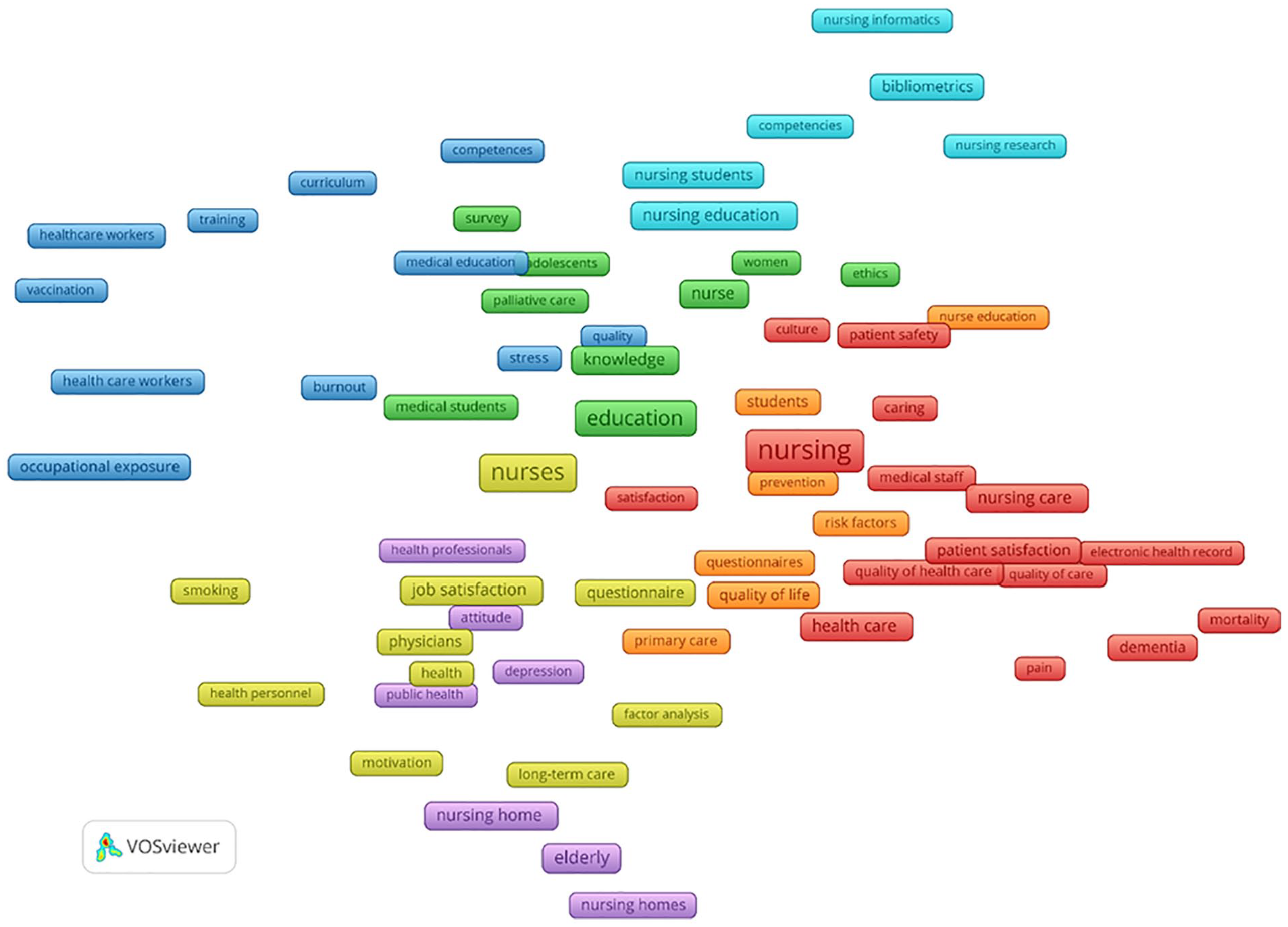
The authors’ keywords cluster landscape.
The thematic content of nursing research in the individual ex-Yugoslavian countries is shown in Table 4. The analysis of the table reveals that each country has its country-specific research focus.
Thematic and Content Comparison of Nursing Research in Ex-Yugoslavian Countries.

The early research (before 2012) in the ex-Yugoslavia region (Figure 3) was concerned with occupational exposure/satisfaction of health workers, curriculum development and nursing informatics and Education (Violet color). Between 2012 and 2016 (Blue and green color), the research was focused on similar themes; however, new research themes, like care for the elderly, vaccination, palliative care, primary health, quality of life and quality of care, became popular. In the recent period, some hot topics emerged. Most popular are bibliometrics, pain management and long term care (Yellow color).

The timeline of the nursing knowledge development in the Ex-Yugoslavia region.
Covid 19 Research
Despite not explicitly emerging on figures above, Covid 19 research was one of the hot research topics resulting in 22 papers. Croatia and Slovenia were the most productive, with 10 and 8 publications. The main research themes were nurses’ burnout and stress, and sentiment toward vaccination. A large EU Horizon 2020 project STAMINA (Smart Support Platform for Pandemic Prediction and Management) is in cooperation with EU partners also running in Slovenia.
Country cooperation
The ex-Yugoslavian countries were internationally active (Figure 4)—they established a cooperation co-authorship network of 88 countries. Among ex-Yu countries. most co-authorship links were instituted by Serbia (n = 66) followed by Croatia (n = 63), Slovenia (n = 61), North Macedonia (n = 55), Bosna and Herzegovina (n = 33), Montenegro (n = 16) and. Kosovo (Teijlingen et al., 2004). The strongest links between ex-Yugoslavia countries were established between Slovenia and Croatia (n = 32). The strongest link was between an ex-Yugoslavia country and non-ex Yugoslavia country between Croatia and England (n = 40).
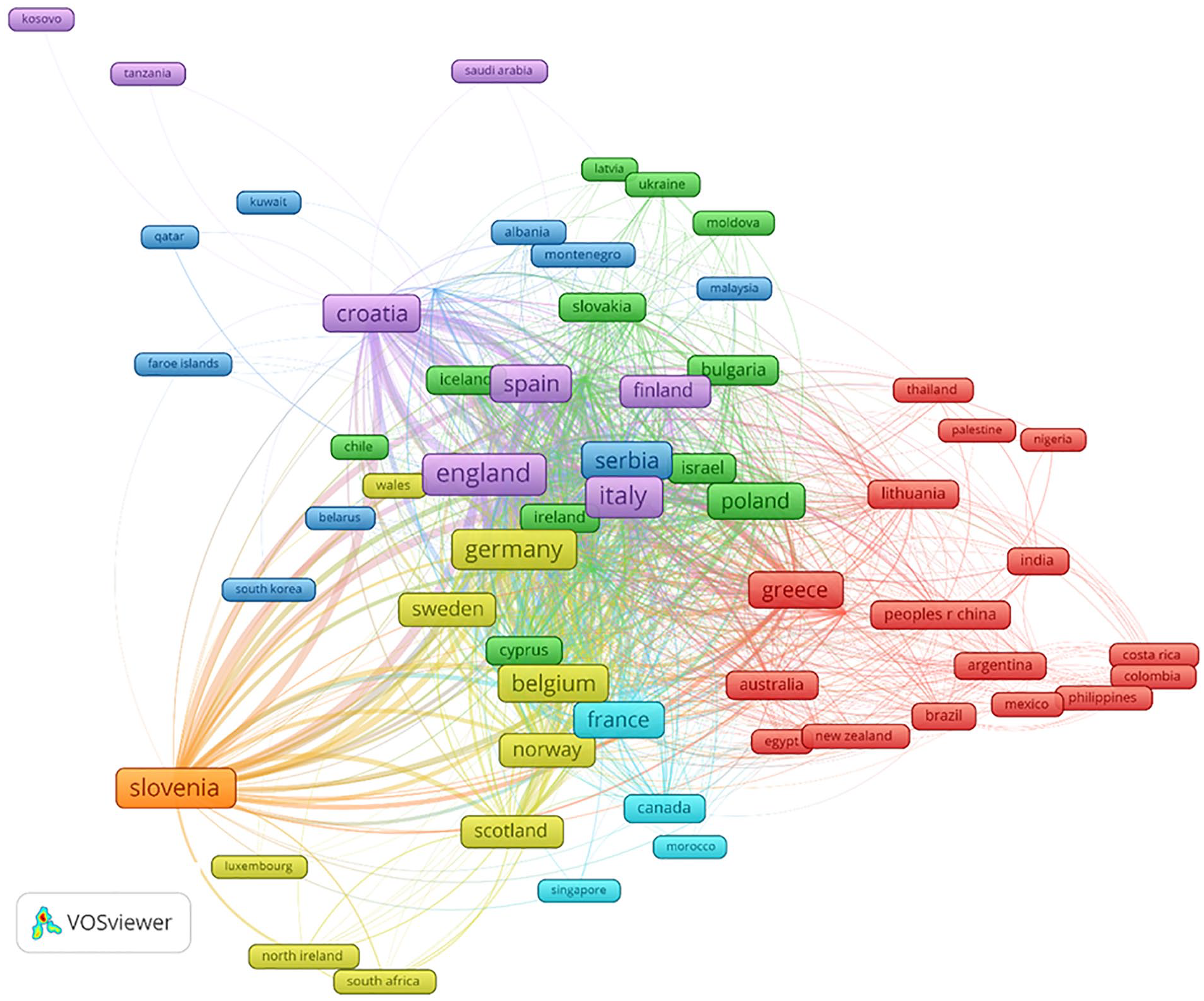
The international collaboration of Ex Yugoslavian countries.
Discussion
Performance and production of individual ex Yugoslavian countries broadly correspond to the overall scientific production of those countries, where Croatia is on 50th rank, Serbia 52nd, Slovenia 53rd, Bosnia and Herzegovina 96th, North Macedonia 98th and Montenegro 122nd. It is also interesting to note that the countries that established nursing schools early in the 20th century are significantly more scientifically productive than those established after the second world. This observation seems logical as nursing research is an essential part of the educational process. This process also empowers nurses to perform the research (Tingen et al., 2009) and is closely related to knowledge and professional development. The ex-Yugoslavian countries with higher economic determinants/indices are considerably more productive. This observation correspondences with the Kokol et al. (2019) study about the relationship between country and health determinants and nursing research productivity. The observation is also compliant with the study on the research productivity of Arab countries regarding COVID-19 research (Zyoud, 2021).
A substantial part of the research is published in national journals in national languages. However, it is noteworthy that some ex-Yugoslavian authors have succeeded in publishing their research in top nursing English language journals like the International Journal of Nursing Studies, Journal of Advanced Nursing, Nursing Education Today and Nursing Ethics. Strong international cooperation emerged in the region, whilst strongest between ex Yugoslavian countries themselves, but notable cooperation also exists with some EU countries. The strong international cooperation might help researchers extend their success in publishing in top impact nursing journals in the future. Comparing nursing to medicine, molecular biology and genetics, where discoveries are made daily, nursing advances slower.
Consequently, publishing in more general and extremely high impact journals like Nature, Science, The Lancet, JAMA, or New England Journal of Medicine is hopefully yet to come. Till then, the large body of high impact nursing journals enables the former Yugoslavian countries’ nursing researchers to present the outcomes of their research to the global scientific community. To enable such publishing endeavors, not only international but interdisciplinary research must emerge in the region. Accordingly, policymakers in national and international funding agencies and bodies should focus on including nursing in interdisciplinary research grants calls. Additionally, the preparation of high-quality nursing research publications requires significant effort and time. However, it is worth doing because publishing in high-impact journals enables researchers to generate further funding and thus support collaborative research needed to achieve the above goals and, most importantly, improve region health determinants (Grant & Buxton, 2018). Our study also showed that m
Our analysis demonstrated that ex Yugoslavian countries nursing research is growing both in scope and number of publications, even though research content differs between countries. It seems that each country is focused on their local health problems. Given the increasingly global nature of nursing research, these findings highlight another need for region and EU policymakers and funding bodies, namely to allocate research funding in such a manner that it will support the inclusion of ex-Yugoslavia countries’ nursing research into the broader scientific community. The above will enable the translation of global nursing knowledge to the region and enable region researchers to contribute to the development of global nursing knowledge. On the other hand, we shall not forget about the political, economic, and cultural differences between ex-Yugoslavian countries. Nursing research in the region should contribute to culturally appropriate nursing care that will improve health and well-being throughout the region. For example, Islamic patients should receive nursing care according to Islamic principles, beliefs, and values, not only in their home countries but also in their neighboring countries, further emphasizing the need for knowledge transfer between ex Yugoslavian countries and worldwide.
Study Limitations and Strengths
Our study did have some limitations. First, using other bibliographic databases like Scopus might lead to different results because different databases use different categorizations and standards for country and institution names and differ in the list of information titles covered. Additionally, the synthetic content analysis was performed on authors’ keywords only; it is, therefore, possible that the results could have been different if the whole publications had been available for analysis. The synthetic content analysis enables the minimization of the interpretative bias. However, some bias is still possible and may affect the outcomes of the content analysis. Moreover, although the number of publications in indexed journals is a good indicator of knowledge development in nursing, it is not the only one. On the other hand, the holistic bibliometric analysis has never been performed for the region of ex-Yugoslavian countries. The study also revealed several characteristics and specifics of ex-Yugoslavian countries’ nursing research. It enabled us to identify similarities and differences between countries, which is another strength of our study.
Conclusion
Our study revealed some interesting facts about nursing research in the ex Yugoslavia region, which might enable researchers, academics, clinical nurses, policymakers, funding agencies and government leaders to enhance the efficiency of future studies and understand further applications of nursing research for improving health determinants and well-being. Understanding the nursing knowledge development in the region and the differences between countries might be beneficial from the scientific point of view and for evidence-based policy-making. To improve nursing research, researchers in the region, especially from low and middle-income countries, must develop collaborations with high-income countries and focus on integrating nursing research into interdisciplinary knowledge development endeavors. Collaborative and interdisciplinary research contributes to a more comprehensive understanding of nursing science problems and might contribute to building a shared base of data, innovations, evidence, and research paradigms. Finally, we must state that more research funds should be dedicated to researching this important topic.
Footnotes
Author Contributions
PK prepared the paper outline and gathered and analyzed the data, HB cooperated in data analysis, discussion and paper preparation, DŽ and JZ cooperated in the interpretation of the results and the paper preparation.
Declaration of Conflicting Interests
The author(s) declared no potential conflicts of interest with respect to the research, authorship, and/or publication of this article.
Funding
The author(s) disclosed receipt of the following financial support for the research, authorship, and/or publication of this article: The study presented in this paper was partially funded by the European Union’s Horizon 2020 research and innovation programme project STAMINA under grant agreement No 883441.
