




Abstract
This study focused on the roles of entrepreneurship and gender in the relationship between achievement motivation and entrepreneurial intention. Specifically, we tested a moderating role of gender and examined the moderated mediating role of entrepreneurship by gender in the relationship between achievement motivation and entrepreneurial intention. Based on the secondary data from the 2017 Korea Entrepreneurship Survey on 10,000 people, a conditional process model 15 (Hayes’ PROCESS macro) analysis was used to test the direct and indirect paths with respect to gender differences. The results indicate that the conditional direct effect of achievement motivation on entrepreneurial intention was not significant for women, but it was significant for men. Results also confirmed that the indirect effect of achievement motivation on entrepreneurial intention via entrepreneurship was stronger for women than for men. Therefore, the moderation hypothesis and the moderated mediation hypothesis were supported. The study contributes to the explanation of the black box between achievement motivation and entrepreneurial intention by emphasizing the role of gender as a moderator and entrepreneurship as a mediator of this relationship. This study focused on and confirmed the role of gender previously neglected in the relationship between achievement motivation and entrepreneurial intention and the role of entrepreneurship as a mediator to promote entrepreneurial activity among women. Therefore, this study extends existing research results by elaborating the relationship between achievement motivation and entrepreneurial intention.
Keywords
Entrepreneurship is a driving force of the global economy, attracting the attention of many researchers and practitioners because economic and social environments are changing. Entrepreneurship plays an integral part in national sustainability by promoting competition, innovation, and changes in market structure (Audretsch et al., 2002; Collins et al., 2004). In particular, women’s entrepreneurship has attracted scholarly attention in terms of contributions to national economic growth and diversity (De Bruin et al., 2006; Naguib & Jamali, 2015; Ramadani et al., 2015; Tsyganova & Shirokova, 2010). However, because the debate on entrepreneurship is mostly about men, some limitations apply to our understanding of women’s roles (Ahl, 2006; Brush, 2006; Tsyganova & Shirokova, 2010). Birley (1989) pointed out that an increase in women entrepreneurs reflects a changing society and emphasizes the need for research on women’s entrepreneurship (Ahl, 2006). Therefore, it is important to take a gender perspective on entrepreneurial activities to respond to current changes.
Entrepreneurial success is related to the entrepreneur’s strong achievement desire. It is important to understand the motives of entrepreneurs to promote and inspire entrepreneurship because identifying the motives and encouraging motivation might stimulate entrepreneurship and, ultimately, entrepreneurial intention. In addition, the motives behind entrepreneurship are considered important influences on success (Begley & Boyd, 1987).
Studies about motivational characteristics of entrepreneurship might help identify business opportunities and identify individuals suitable for start-ups (Shane & Venkataraman, 2000). Personal characteristics, such as motivation, could determine the individuals best suited to support an organization’s success and those who might initiate organizational entrepreneurship. However, despite the potential value, the role of individual traits, such as motivation, in corporate activities is unclear (Shane & Venkataraman, 2000). Therefore, it is necessary to understand the relationship between motivating factors, such as achievement motivation and entrepreneurship.
Many previous studies have focused on personal characteristics (e.g., achievement motivation, locus of control, and so on) as factors antecedent to entrepreneurial intention (Collins et al., 2004; Munir et al., 2019). It generally is believed that achievement motivation positively relates to an entrepreneurial career path and performance (Collins et al., 2004). However, previous studies on the relationship between achievement motivation and entrepreneurial intention tended to control for gender effects. In addition, although gender differences in entrepreneurship and entrepreneurial activities are widely recognized and studied, the reasons for these differences are not clearly understood (Tsyganova & Shirokova, 2010).
Achievement motivation and entrepreneurial intention might differ by gender because women are more risk-averse or fearful of failure than men (Grilo & Irigoyen, 2006). In addition, previous studies have found that entrepreneurship and entrepreneurial intention are lower for women than men (De Bruin et al., 2006; Nowiński et al., 2019; Zhao et al., 2005). However, few studies have addressed specific gender differences in the relationship between achievement motivation and entrepreneurial intention. Moreover, previous studies confirmed that variables such as entrepreneurial attitude (Maharani et al., 2020), locus of control(Ida Ketut, 2019), entrepreneurial passion(Saif & Ghania, 2020), and self-efficacy (Akhtar et al., 2020) play a mediating role in the relationship between achievement motivation and entrepreneurial intention. However, studies on the mediating effect of entrepreneurship on these relationships are not well known, and there are few studies on the moderating effect of gender on these relationships. Therefore, research is needed to understand the gender differences in the motivational factors that promote entrepreneurship (Ahl, 2006; Brush, 2006), particularly regarding the relationship between achievement motivation and entrepreneurial intention mechanisms and whether there are different relational paths for women and men.
This study focused on gender differences in the influence of entrepreneurship on the relationship between achievement motivation and entrepreneurial intention. First, we analyzed the moderating influence of gender on the relationship between achievement motivation and entrepreneurial intention. Then, we examined whether an indirect effect of entrepreneurship on the relationship between achievement motivation and entrepreneurial intention differed by gender. The paper discusses the implications of the results and considers future research. This study on entrepreneurship with a focus on gender is important because it contributes to expanding entrepreneurship theory.
Literature Review and Hypotheses Development
Achievement Motivation
Recent studies on entrepreneurship mostly took the macro-environmental perspective (Collins et al., 2004; Shane et al., 2003). However, Shane et al. (2003) suggested that to expand entrepreneurship theory it is necessary to understand the motivation of people who want to be entrepreneurs. Thus, achievement motivation might be important in entrepreneurial intention.
Achievement motivation theory is widely recognized as about a need for achievement (McClelland, 1965b). Need for achievement refers to individual desires to set challengeable goals for high performance and, then, achieving those goals as the most important way to engage in achievement motivation (McClelland, 1965a; McClelland et al., 1953). He pointed out that people with strong desires for achievement tend to focus on goals, set adventurous goals, set challenging goals, and be engaged in their work. Thus, organizations or societies of people with high levels of achievement motivation rapidly grow, and people with high levels of achievement motivation are likely to become successful entrepreneurs.
In addition, achievement motivation is a critical characteristic that influences individual intention in the workplace and entrepreneurship. Individuals with high levels of achievement motivation are relatively likely to participate in innovative activities that involve subsequent planning (Kerr et al., 2017; Vodă & Florea, 2019). In other words, people with strong desires for achievement are more likely to become entrepreneurs. Similarly, Lee (1996) stated that achievement motivation is important for coping with challenging situations, and Nathawat et al. (1997) indicated that the lower the need for achievement, the lower the performance and expectations, and the higher the probability of failure.
Achievement motivation is associated with entrepreneurial intention (Karabulut, 2016; Kusmintarti et al., 2014). Achievement motivation is about individuals’ drive to succeed, and people with high achievement motivation are ready to succeed through high levels of entrepreneurship. These people want to be entrepreneurs and they can start their own businesses in competitive markets (Yasir et al., 2019). Previous studies have confirmed that achievement motivation has a significant effect on entrepreneurial intention (Karabulut, 2016).
Entrepreneurial Intention
Starting a new business is the process of creating an organization (Gartner et al., 1992), and it can be understood as a series of processes that occur through planned and intended actions and progress over time (Katz & Gartner, 1988). Entrepreneurial intention is a key concept for understanding the entrepreneurship process (Krueger & Carsrud, 1993). It refers to intentional behaviors toward entrepreneurial activity and is the first step in the long process toward that end. Entrepreneurial intention has been defined as “self-acknowledged conviction by a person that they intend to set up a new business venture and consciously plan to do so at some point in the future” (Thompson, 2009).
Entrepreneurial intention is the most common variable used to predict entrepreneurial activity. Researchers expect behavior to be caused by intention, particularly when behavior is difficult to observe, uncommon, or when the future cannot be predicted (Fayolle & Liñán, 2014; Krueger et al., 2000). Although some studies have argued that entrepreneurial intention does not always lead to entrepreneurial behavior (Carsrud & Brännback, 2011), other studies have confirmed that it predicts entrepreneurial behavior (Kautonen et al., 2013, 2015). Moreover, to explain the relationship between attitude and behavior, Planned Behavior Theory (Ajzen, 2011) assumes that future behavior is preceded by current intention, so the stronger the intention to perform a given behavior, the greater the likelihood that behavior will be executed. Therefore, this study predicted future entrepreneurial behavior by measuring entrepreneurial intention.
Entrepreneurship
Research on entrepreneurship is critical for at least two reasons (Shane et al., 2003). First, entrepreneurship contributes to economic growth by driving innovative and technological changes (Schumpeter, 1942). Second, entrepreneurship is important to entrepreneurs and necessary for understanding the role of entrepreneurship in human resource development (Zahra & Dess, 2001). Although many previous studies have defined the concept of “entrepreneurship,” its definition somewhat depends on the researcher. Schumpeter (1942) defined it as an innovative and creative behavior that continuously drives social change and creates opportunities for economic rent. Stevenson and Jarillo (1990) referred to it as an entrepreneurial process in which individuals or organizations seek new opportunities without being bound by the given resources. Besides, Baron (2008) defined entrepreneurship as exploring, finding, and moving into ideas to create new value. Taken together, these definitions indicate a comprehensive ability and attitude that constantly challenges individuals to establish and grow enterprises through innovative and progressive processes despite limited resources.
Shane et al. (2003) pointed out that the definitions of entrepreneurship used by previous studies might differ. Thus, it is difficult to derive direct implications from previous studies of other types of entrepreneurship. However, most previous studies agree that entrepreneurship has three components: innovativeness, risk-taking, and proactiveness (Covin & Slevin, 1989; Kreiser et al., 2002; Lumpkin & Dess, 1996; Miller, 1983; Shane et al., 2003). In addition, entrepreneurship has been recognized as an ability or behavior that entrepreneurs need not just at the psychological level. Some studies have highlighted competitive aggressiveness and autonomy (Lumpkin & Dess, 1996) or the need for achievement, locus of control, self-efficacy, goal setting, and so on (Shane et al., 2003). However, the tendency in entrepreneurship research is to focus on the three components of innovativeness, risk-taking, and proactiveness. Therefore, the current study defined “entrepreneurship” as “the ability and attitude required by entrepreneurs to pursue innovation, take on the risk of failure, and take initiative by responding proactively.”
Gender Differences
As pointed out above, McClelland (1965b) asserted that the motivation needed for achievement closely relates to entrepreneurial activities. Many studies support McClelland’s (1965b) claim (Akhtar et al., 2020; Ida Ketut, 2019; Maharani et al., 2020; Saif & Ghania, 2020). However, recent studies have found that entrepreneurs’ choices and behaviors vary according to personal characteristics, such as gender (Al-Dajani & Marlow, 2010; Jamali, 2009). In addition, it generally is accepted that entrepreneurial intention is higher among men than among women (Chen et al., 1998; De Bruin et al., 2007; Gupta et al., 2009; Nowiński et al., 2019; Zhao et al., 2005). It means that the effect of achievement motivation on entrepreneurial intention may differ according to gender. Thus, the relationship between achievement motivation and entrepreneurial intention might vary by gender.
Some previous studies found that the intentions of people pursuing entrepreneurial opportunities depended on opportunity costs (Amit et al., 1995), financial capital (Evans & Leighton, 1990; Harrison & Mason, 2007), relationships with investors (Alsos & Ljunggren, 2017; Brush et al., 2002), or career experiences (BarNir et al., 2011; Thébaud, 2010). Women have relative difficulty procuring financial capital, and many previous studies have found that women were disadvantaged regarding access to capital, such as angel capital (Becker-Blease & Sohl, 2007; Brush et al., 2002; Harrison & Mason, 2007), institutional capital (Brush et al., 2002; Orser et al., 2006), and bank financing (Carter et al., 2007; Eddleston et al., 2016; Muravyev et al., 2009). Moreover, women’s social networks tend to be weaker than men’s (DeTienne & Chandler, 2007; Greve & Salaff, 2003).
Furthermore, Brush (1992) found that, although men and women entrepreneurs had similar demographic, psychological, and business skills, they differed in educational background, employment, motivation (to become entrepreneurs), and in business creation and growth. Perceptions of risks and opportunities might influence an entrepreneur’s decisions in general (Shane & Venkataraman, 2000), and entrepreneurs with high achievement motivation tend to take appropriate risks. However, women are more likely than men to avoid risks, and fear of failure might hinder women’s business activities (Grilo & Irigoyen, 2006). Therefore, the relationship between achievement motivation and entrepreneurial intention might vary by gender, and the following hypothesis was derived.
H1: The influence of achievement motivation on entrepreneurial intention is different for men than it is for women.
The Moderated Mediating Role of Entrepreneurship by Gender
Entrepreneurial activities require human agency. An entrepreneurial process occurs when people act to pursue opportunities. However, because men and women have different entrepreneurial characteristics such as risk aversion or risk taking, their willingness and abilities to act on opportunities also might differ (Shane et al., 2003). The indirect effect of achievement motivation on entrepreneurial intention via entrepreneurship might be different by gender. For example, achievement motivation might directly influence entrepreneurial intention among men but not among women (Charness & Gneezy, 2012; Powell & Ansic, 1997), whereas achievement motivation might indirectly influence entrepreneurial intention through entrepreneurship among women but not among men (Charness & Gneezy, 2012; Powell & Ansic, 1997). Therefore, we devised the following hypothesis.
H2: The influence of entrepreneurship on the relationship between achievement motivation and entrepreneurial intention is different for men than it is for women.
The conceptual model of this study is shown in Figure 1.

Conceptual research model.
Methods
Sample and Data Collection
We used Korean Entrepreneurship Survey Data provided by the Korea Entrepreneurship Foundation in this study. The survey data were collected in August through October 2017 on a targeted Korean population of individuals aged 13 to 69 years old. About 10,000 valid cases were obtained through a stratified sampling method based on region, gender, and age. Estimating the population value using the result with a 95% confidence level and sampling error ±0.98% yielded the final sample, which was representative of the population. Table 1 presents the distributions of the key characteristics of the sample.
Sample Characteristics (n = 10,000).

Note. Income (monthly) is in KRW and income categories are mutually exclusive. In 2017, 1 million KRW was equal to approximately 900 USD.
Variables
The items used in this study to measure the variables were adopted from the 2017 Korean Entrepreneurship Survey (Individual). The response options on the items measuring entrepreneurial intention, achievement motivation, and entrepreneurship were on a seven-point Likert-type scale where 1 = strongly disagree through 7 = strongly agree. For the analysis, the mean scores of the multi-item constructs were calculated.
Dependent variables
Entrepreneurial intention was a construct comprised of the responses to three items: (1) “There is a wealth of opportunities for people with entrepreneurial intention,” (2) “I have the skills and knowledge to start a business,” and (3) “I am willing to start my business within three years.”
Independent variables
Achievement motivation was measured by two items: (1) “Once I have started, I will keep going to completion, even if I face difficulties,” and (2) “If there is a difficulty, I will consider other methods and try to find new solutions until the end.”
Entrepreneurship was a three-dimensional construct of nine items: innovativeness (three items), risk-taking (three items), and proactiveness (three items; Covin & Slevin, 1989; Miller, 1983). In this study, entrepreneurship variables were identified as single factors through factor analysis, and all the items of innovativeness, risk-taking, and proactiveness were measured as means (Kreiser et al., 2002).
Gender was a dichotomous dummy variable where 1 = men and 0 = women.
Control Variables
The effects of age, educational attainment, previous entrepreneurship education, and income were controlled for in the analysis. Age and educational attainment were treated as continuous variables. Educational attainment was ranked from elementary through graduate school. Entrepreneurship education was an indicator where 1 = yes and 0 = no. Income was a four-category variable of the monthly average income (see Table 1 above).
Validity and Reliability
The results of the validity and reliability tests of the main variables are shown in Table 2. To validate the instrument, data from the questionnaire were used to perform a factor analysis. Three factors with eigenvalues of one or larger were derived from the factor analysis using the varimax rotation technique. All reflective item loadings were above the 0.60, meeting the necessary criteria (significant loading should be higher than 0.5. (Hair et al., 2006)). In addition, Cronbach’s alpha was used to analyze the reliability of the instrument. Cronbach’s alpha values exceeded .70 for all factors in the analysis, indicating sufficient reliability. As a result, the validity and reliability of the instrument based on a factor analysis and a reliability test served as a good basis for hypotheses testing in this study.
Results of the Factor Analysis and Reliability Test.

Note. Factor extraction method: varimax rotation.
Assessment of Common Method Bias
Because the self-reported data of the survey might have been sensitive to common method bias, we conducted Harman’s single-factor test using the items to rule out the risk of common method bias (Podsakoff & Organ, 1986). The first factor accounted for only 33 percent of the total variance, which did not exceed 50% of the total variance, and all the remaining factors accounted for 30.266% of the total variance. Therefore, we determined that the sample was not seriously contaminated by common method bias.
Methods of Analysis
To test the two hypotheses, we used Hayes’ PROCESS macro version 3.1 (Hayes, 2013). The PROCESS Model 15 tests moderating and mediating relationships with bootstrap confidence intervals for conditional direct and indirect effects. To test
Results
Table 3 shows the descriptive statistics and correlation coefficients among all the variables used in this study. All of the correlations were weaker than .50 and, thus, within acceptable limits. All of the correlations between the entrepreneurial variables were positive, suggesting that they were somewhat interrelated; however, age was negatively related to achievement motivation, entrepreneurship, gender, and educational attainment. Specifically, looking at the correlations between entrepreneurial intention and other key variables, entrepreneurial intention positively correlated with achievement motivation (r = .171, p < .001), entrepreneurship (r = .292, p < .001), gender (r = .075, p < .001), age (r = .083, p < .001), education level (r = .037, p < .001), entrepreneurial education experience (r = .168, p < .001), and income (r = .176, p < .001).
Means, Standard Deviations, and Correlations.

Note. N = 10,000.
p < .05. ***p < .001.
Table 4 shows the results of the conditional process analysis. This model was an integrated moderation and moderated mediation regression analysis on entrepreneurial intention with achievement motivation as the key independent variable, gender as the moderator, and entrepreneurship as the mediator (Process Model 15; Hayes, 2013). The results regarding
Results of the Conditional Process Model for Entrepreneurial Intention: The Moderation and Moderated Mediation Analysis.

Note. Unstandardized regression coefficients are reported with standard errors and the p-value. The dependent variable Y (i.e., entrepreneurial intention), independent variable X (i.e., achievement motivation), mediator M (i.e., entrepreneurship), moderator W (i.e., gender), and covariates (i.e., age, education level, entrepreneurial education, and income) were controlled in the model. Estimates were calculated using PROCESS macro version 3.1. EL = education level; EE = entrepreneurial education.
p < .01. ***p < .001.
Table 5 indicates that the further conditional process (moderation) analysis based on the bootstrapping method revealed that the effect of achievement motivation on entrepreneurial intention depended on gender. Table 5 shows the direct gender difference effects. The conditional direct effect of achievement motivation on entrepreneurial intention was not significant for the women (B = −0.001, SE = 0.016, 95% CI [−0.032, 0.030]), but it was significant for the men (B = .064, SE = 0.016, 95% CI [0.033, 0.095]).
Moderating Effect of Gender Between Achievement Motivation and Entrepreneurial Intention.

Note. Conditional direct effects of the achievement motivation at value of the moderator (gender) on entrepreneurial intention. Entries are unstandardized regression coefficients. Bootstrap resample = 10,000. Conditions for moderator (gender) are female and male. SE = standard error; CI = confidence interval.
To aid interpret the moderating effects of gender on the relationship between achievement motivation and entrepreneurial intention, we divided achievement motives into three groups of low achievement motivation, mean, high achievement motivation (i.e., mean and ±1 SD about the mean), and compared the sloped of gender in the relationship between achievement motivation and entrepreneurial intention.
Figure 2 illustrates the slopes of the regression lines, which indicate that the influence of achievement motivation on entrepreneurial intention was larger for men than for women, suggesting that the influence of achievement motivation on entrepreneurial intention was valid only for the men. Therefore,

Moderating effect of gender on the relationship between achievement motivation and entrepreneurial intention.
The test results for
The indirect effects further demonstrated that the influence of achievement motivation on entrepreneurial intention through entrepreneurship was moderated by gender. Table 6 reports the different indirect effects for women and men. The conditional indirect effect of achievement motivation on entrepreneurial intention through entrepreneurship was significant for the women (B = 0.156, SE = 0.009, 95% CI [0.352, 0.426]) and for the men (B = 0.121, SE = 0.009, 95% CI [0.266, 0.339]), and the indirect effect of achievement motivation on entrepreneurial intention via entrepreneurship was stronger for the women than it was for the men (index of moderated mediation ΔB = −0.035, Boots SE = 0.012, 95% CI [−0.058, −0.013]). The additional results of the slope analysis (Figure 3) illustrate that the slope of the indirect effect was greater for women than for men. This result indicates that the influence of achievement motivation on entrepreneurial intention mediated by entrepreneurship was stronger for women than for men. Therefore, H2 was supported.
Conditional Indirect Effects of Achievement Motivation on Entrepreneurial Intention Through Entrepreneurship Moderated by Gender.

Note. Entries are unstandardized regression coefficients. Bootstrap resample = 10,000. Conditions for moderator (gender) are female (0 coded) and male (1 coded). Boot SE = bootstrap standard error; Boot CI = bootstrap confidence interval; Index of moderated mediation = difference between conditional indirect effects (effect in male minus effect in female).
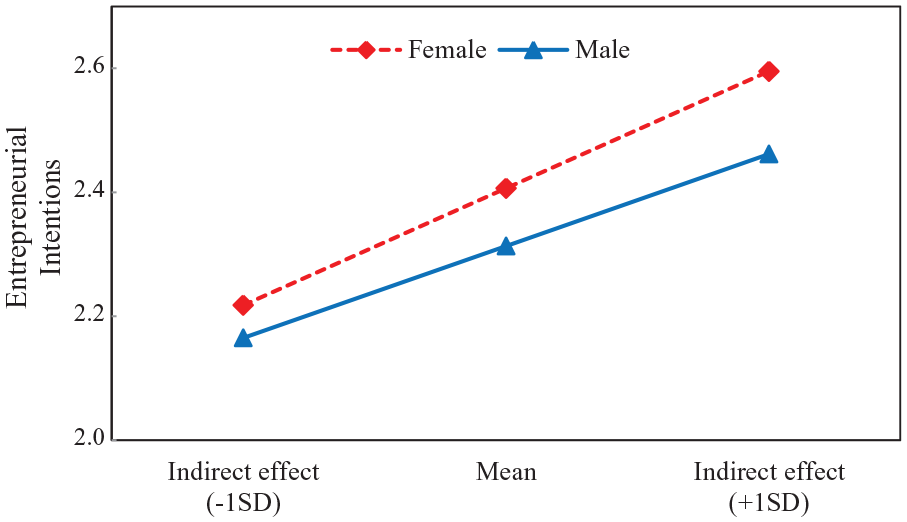
Moderated mediating effect of gender on the indirect effect of entrepreneurship.
Conclusions
Discussion and Implications
Many scholars agree that entrepreneurship is important to national economic growth (Audretsch et al., 2002; Audretsch & Thurik, 2001; Schumpeter, 1934, 1942). Entrepreneurship leads to a creative destruction process by causing constant disturbances to an economic system’s equilibrium, creating economic rent opportunities (Schumpeter, 1942). In the process of adjusting the economic equilibrium, innovation occurs and the number of entrepreneurs increases, resulting in economic growth. Thus, entrepreneurial intention creates jobs and is a driving force for national competitiveness and growth (Nowiński et al., 2019).
Recently, Korea has faced a serious unemployment crisis represented by growth without employment. To secure the national economy’s growth potential, it is necessary to manage physical capital, promote entrepreneurial intention and entrepreneurial activities at the national level, and include the public. Therefore, the Korean government is paying attention to the establishment of start-ups and policies, such as expanding public sector jobs and strengthening vocational training, to secure growth potential.
However, women’s entrepreneurship and entrepreneurial activities are low compared to those of men (De Bruin et al., 2007; Gupta et al., 2009; Zahra & Dess, 2001). Despite the increasing number of highly educated women in Korea, their participation in economic activities remains lower than in the major OECD (2018) countries. Therefore, this study focused on gender differences in the relationships among achievement motivation, entrepreneurship, and entrepreneurial intention, hypothesizing that gender differences existed. We found that the gender difference in the relationship between achievement motivation and entrepreneurial intention was significant. Achievement motivation positively influenced entrepreneurial intention among the men, but there was no significant effect of achievement motivation on entrepreneurial intention among the women. Next, we found that the indirect effect of achievement motivation on entrepreneurial intention through entrepreneurship was stronger for women than men.
This study’s results have the following theoretical and practical implications. First, they contribute to the explanation of the black box between achievement motivation and entrepreneurial intention by emphasizing the role of gender as a moderator and entrepreneurship as a mediator of this relationship. McClelland (1965b) initially associated achievement motivation with entrepreneurial activity. However, the ways that achievement motivation link to and drive entrepreneurship have not yet been fully identified. The achievement motivation initially was omitted for theoretical convenience in entrepreneurship research under the assumption that entrepreneurial intention follows almost automatically. This study focused on and confirmed the role of gender previously neglected in the relationship between achievement motivation and entrepreneurial intention and the role of entrepreneurship as a mediator to promote entrepreneurial activity among women.
This study also contributes to entrepreneurship theory. Many studies have suggested a need to study women’s entrepreneurship because entrepreneurship has mainly focused on men (Ahl, 2006; Brush, 2006; Tsyganova & Shirokova, 2010). Because we found that achievement motivation, entrepreneurship, and entrepreneurial intention are different for men and women, our findings contribute to establishing a theory on women’s entrepreneurship. The results suggest that different approaches to promoting entrepreneurial activity are needed for women and men; for example, we found that achievement motivation influenced women’s, but not men’s, entrepreneurial intention through entrepreneurship. This suggests that entrepreneurship might be more important for women than for men, and, therefore, strengthening entrepreneurship education for women should be stressed and systematic entrepreneurship educational programs provided for them. For such efforts to be effective, it is necessary to accumulate research and theory on women’s entrepreneurship.
Last, the results of this study might contribute to strengthening national competitiveness by supporting policies that encourage women’s entrepreneurial activities or labor market participation beyond general support. We argue that it is necessary to develop a policy aimed at increasing women’s entrepreneurial activities to effectively respond to the crisis caused by a shrinking working-age population in poor labor market conditions.
Although we did not hypothesize about the relationship between gender and entrepreneurial intention in this study, we found that women’s entrepreneurial intention was lower than that of men. This finding supports many previous studies (De Bruin et al., 2007; Gupta et al., 2009; Zhao et al., 2005). Women’s relatively low entrepreneurial intention was not attributed to their inherent characteristics, but to difficulties obtaining financing, lack of business skills, and social and cultural contextual disadvantages (Vodă & Florea, 2019). For example, cultural values tend to construct social roles and stereotypes regarding occupations for men and women that privilege men in business (De Vita et al., 2014). Therefore, efforts should be made to eliminate negative gender stereotypes and support women’s access to practical experience and field training opportunities to enhance their business skills. This policy orientation might ultimately contribute to national economic growth and employment diversity by encouraging women’s entrepreneurial activities (De Bruin et al., 2006).
Limitations and Future Research
Although this study helps to explain the relationship between achievement motivation and entrepreneurial intention by addressing gender and entrepreneurship, it has several limitations. The sample was entirely Korean, and the results have limited generalizability at the global level. Future research might clarify these findings and advance our knowledge by using global data. In addition, previous studies suggested that some factors that influence the impacts of other motivational factors on entrepreneurial intention should be included in statistical models (Shane et al., 2003). However, the effects of these exogenous variables were not eliminated in this study. To isolate the effects of achievement motivation on entrepreneurial intention, future studies should control for the influences of additional relevant factors that might be causally related to entrepreneurship and/or entrepreneurial intention. For example, the influences of political factors, market structure, and various resources should be controlled for.
Although this study examined gender differences, other individual-level variables, such as autonomy and personality measures, could be analyzed to obtain an in-depth understanding of gender differences in motivational factors, entrepreneurship, and entrepreneurial intention. For example, women need objective and subjective autonomy to mitigate their work-family conflicts (Thébaud, 2015). Therefore, a gender perspective on the effects of various personal motivational factors on entrepreneurial activity would enhance our understanding of entrepreneurship.
Footnotes
Author Contributions
All authors contributed to the study’s conception and design. S. Choo performed collecting data and statistical analysis; H. Kong wrote literature review and the first draft of the manuscript; all authors commented on previous versions of the manuscript. All authors read and approved the final manuscript.
Declaration of Conflicting Interests
The author(s) declared no potential conflicts of interest with respect to the research, authorship, and/or publication of this article.
Funding
The author(s) disclosed receipt of the following financial support for the research, authorship, and/or publication of this article: This research was supported by Research Program through the Korea Entrepreneurship Foundation funded by the Ministry of SMEs and Startups (2019; Grant No. KoEF 2019059).
Ethical Approval
Entrepreneurship survey data used in this study are Korea’s official statistics (No. 427001), widely used to establish and evaluate various government policies under Article 17 of Statistics Korea. A credible national institution manages this dataset. It does not collect personal and sensitive information from respondents, so there are no ethical concerns when using it for research purposes.
