




Abstract
This study examines the evolution of leader–member exchange (LMX) research. We apply bibliometrics to analyze the extant literature published from the beginning of the construct development, complementing existing qualitative and meta-analytic reviews of the LMX field. We use a combination of three bibliometric techniques—document co-citation analysis, co-word analysis, and bibliographic coupling. Our approach enables us to identify the most influential topics, determine the underlying structure and development of the field by interpreting bibliometric results against the backdrop of the invisible colleges framework, as well as detect emerging topics. We conclude by providing important theoretical and methodological implications, suggesting the emergence of new sub-fields and future opportunities for new connections among specific existing sub-streams of LMX, leadership, and management research.
Keywords
Introduction
Over the last few decades, research in leadership has grown exponentially, indicating that it can enhance positive outcomes, such as innovation and performance (Lee et al., 2020; Legood et al., 2021; Meslec et al., 2020). However, leadership as a field remains fragmented (Batistič et al., 2017), with most research exploring various leadership styles, such as transformational, transaction, authentic, and shared. Recent methodological and theoretical advances, such as multilevel and social network theories and methodologies (Carter et al., 2015; Cullen-Lester et al., 2017), have drawn new attention to less-explored complex leadership sub-themes, such as leader–follower relationships that evolve over time (Nahrgang et al., 2009). These are also referred as leader–member exchange (LMX; Graen & Uhl-Bien, 1995) and are posited as a key factor in predicting various desired individual, team, and organizational outcomes (Byun et al., 2017; Černe et al., 2013).
Various review studies, both qualitative (Buengeler et al., 2021; Henderson et al., 2009; Herman et al., 2018) and quantitative (including meta-analytical; Banks et al., 2014; Dulebohn et al., 2012; Ilies et al., 2007; Martin et al., 2016), have been done to try to capture the key theories and historical evaluation of the LMX field. However, previous reviews warned against an oversimplified understanding of the core roots of LMX, alluding to the need to provide additional layers of complexity to its development and comprehension (Day & Miscenko, 2016; Dulebohn et al., 2017), such as various properties of LMX relationships (Martin et al., 2018). A recent review (Gottfredson et al., 2020) highlights several key systemic conceptual issues related to the construct, such as unclear definition and ambiguous nomological net.
The aim of our paper is to address these ambiguities by providing an up-to-date, objective, comprehensive, and integrative review of these advances and developments. In so doing, we address the following research questions: (1) What is the intellectual structure of the LMX field and its historic development; (2) What is the current state-of-the-art of the field, conceptually; and (3) Which future research suggestions can be extracted from the current research front? We set out to answer them in the following ways, by applying three bibliometric approaches (Donthu et al., 2021; Zupic & Čater, 2015). First, we create a graphical representation of the intellectual structure and scientific communication of the LMX research area and its various sub-domains, exploring its evolution, and identifying the core theories used to inform the field based on co-citation and co-occurrence analyses. Second, we posit informed suggestions about possible future avenues of research based on bibliographic coupling.
This study intends to contribute to leadership, LMX, and general management literature in two ways. First, our review attempts to provide the needed clarity of the LMX field. Using three different bibliometric methods that allow us to tap into the past, present, and future, a broader picture can be achieved and explored—as inclusion of documents is practically unlimited—effectively trying to access research clusters that are smaller and more difficult to detect in classical review or meta-analyses (Batistič et al., 2017; Černe et al., 2016).
We will interpret the historic development of the field by building on the conceptual framework of “invisible colleges” (cf., de Solla Price, 1965; Goyanes & De-Marcos, 2020; Vogel, 2012), which is applied to make sense of the academic communication between researchers to elucidate the past of the LMX field. Exploring this allows us to present the changing perspective of emerging and shifting colleges of literature that LMX studies have cited in a specific time period. Ultimately, in this way, we portray the actual field and discuss findings against existing reviews of the LMX literature of qualitative and meta-analytic nature.
Second, the extant literature is not coherent when it comes to proposing future directions and opportunities for the LMX field. To mention just one discrepancy, reviews and other articles on one hand suggest a multi-level approach and encourage researchers to consider the organizational context more often, but on the other hand further urge academics to focus more explicitly on the followers’ perspectives, the underlying mechanisms of the development of LMX relationships, and their interactions with psychological traits (Dulebohn et al., 2012; Marstand et al., 2017; Martin et al., 2018; Matta & Van Dyne, 2020). This example shows a lack of agreement on where LMX research should go and what its role is in the leadership field and within more general management and organizational behavior domains. Which theories have objectively been the most prominent to inform the field, and what the most promising potential opportunities are for further connections, remains in the hands of a subjective interpreter.
Theoretical Background of Leader–Member Exchange Theory
Leader–member exchange theory is defined as the quality of exchange between a leader and their subordinate, and it focuses on building trust between leader and follower, with emphasis on the reciprocity of exchanges in relationships (Tremblay et al., in press; Dadhich & Bhal, 2008; McLarty et al., 2021). LMX is regarded as a relational approach to leadership (Graen & Uhl-Bien, 1995), which describes relationships that are developed over time and that exist as an exchange of the desired results between a leader and individual followers (Nahrgang et al., 2009). The basic assumption of the theory is that leaders have differentiated relationships with their subordinates and treat them differently (Martin et al., 2018), and therefore they will develop high-quality relationships only with few followers.
A high-quality relationship is described by the employee having high levels of responsibility, decision influence, and access to resources (Dulebohn et al., 2012; Hooper & Martin, 2008). This kind of relationship is often also referred to as being part of the group or being in-group, whereas a low-quality relationship shows the opposite—low levels of support to the employee, and in turn the member having low levels of responsibility and decision influence—and reflects in not being part of a group (Hooper & Martin, 2008). As a consequence, it has been argued that the relationship in the leader–follower exchange, which is marked by the quality of the relationship, depending on demanding tasks, decision-making, and emotional support, strengthens perceived safety and increases interest of employees in fulfilling their work demands (Van Den Broeck et al., 2014).
Through developing high-quality relationships, which evolve through role-making activities and exchanges between leaders and followers (Carmeli et al., 2009), leaders can foster higher levels of subordinates’ performance and job satisfaction, enhance a culture of interpersonal trust, and transfer positive psychological capital to their followers (Byun et al., 2017; Černe et al., 2013).
There is no clear consensus on what foundational theories and backgrounds informed the development of LMX theory or how the LMX debate evolved over time. Some authors (Dulebohn et al., 2017) suggest that a leader–follower relationship is based on trust and respect, and therefore the quality of the relationship is marked by social exchange, building on social exchange theory. On the other hand, others claim that LMX has foundations in role-making processes (Bauer & Erdogan, 2015). These inconsistencies also tap into perceptions of how the research domain has developed and evolved.
Historically, the first research studies about exchanges between leaders and followers were based on studies of socialization at work and vertical links between dyads (Dansereau et al., 1975; Graen & Uhl-Bien, 1995). Such research examined dyadic outcomes related to accomplishing unstructured tasks (Graen & Scandura, 1987), including individual characteristics (Turban & Jones, 1988), demographic variables (Pelled & Xin, 2000), and leader behavior and power (Yukl, 1989) that affect the relationship. Leadership models at that time did not lead to a development of organizations to a higher level. These models include assumptions that members of the organizational units are sufficiently homogeneous and that superiors behave equally toward each subordinate (Dansereau et al., 1975).
Research at this stage deals with issues such as the impact of combined high- and low-quality relationships within one working group on processes and results at a group level; it includes exploring patterns of differentiated dyads (Martin et al., 2018) within the management structure, taking into account the diversity of relationships (Bauer & Erdogan, 2015).
Although leaders may distinguish between high-quality and low-quality exchanges, the theory assumes that the level of interaction develops in a certain time frame. The quality of a relationship increases as the parties about one another and through having leaders and followers with different experiences (Nahrgang et al., 2009). The positive relationship between leader and follower increases the likelihood that the follower will tend to serve the organization and their colleagues, and reduces the likelihood of negative behavior (Huang et al., 2015; Kaluza et al., 2021; Pan et al., 2021).
This segmentation of views not only reflects what we know about LMX, how it developed, and from which key theories, but can also lead to confusion about the position of LMX in the leadership and general management fields. This disintegration can be the result of communication among scholars are particularly interested in a specific area of LMX research. However, such communication could potentially lead to new and fruitful connections within and beyond the LMX research domain to advance our knowledge. We can explore the scholarly communication in terms of both “who” and “how.” As noted by Crane (1972), the usage of key theories and methods in a specific field is driven by a small cluster of prominent scholars (the “who”). However, looking at only a few key scholars is problematic, and including more peripheral members that are indirectly linked to each other through most prominent authors is also important. Given the importance of formal publications (the “how”) for the dissemination of knowledge, allocation of resources and professional recognition seems to be important for tracking and exploring scholarly communication. Bibliometric methods are a useful approach for exploring such issues (Goyanes & De-Marcos, 2020; Zupic & Čater, 2015).
Methods
Bibliometric methods are not new (Small, 1973), but lately gained popularity with easily accessible digital databases with citation data and the development of new software and tools that are relatively easy to use (Zupic & Čater, 2015). Bibliometric mapping offers a number of opportunities because clusters revealed from the map relate to meaningful cognitive structures (van Raan, 2005). These techniques, as a function of time, have foresight potential and can be used to observe scientific advancement (Abramo et al., 2019). Applying such a methodology can improve the quality of reviews by enabling a quantitative approach, which is less subject to bias by the researcher (Zupic & Čater, 2015), suggesting that the use of these techniques complements traditional narrative reviews.
The application and combination of three bibliometric techniques in this paper allows us to trace three important aspects and aims of our research: (a) document co-citation, which explores relationships and interactions between researchers and can propagate beyond a field of research, revealing the intellectual foundations of a field, and can be used to trace a field’s evolution over time (Vogel, 2012); (b) co-word analysis, which enables us to identify key clusters of content and their connections (He, 1999); and (c) bibliographic coupling, which allows us to identify emergent topics and potential future research avenues (van Raan, 2005).
Document Co-Citation
Document co-citation is a measure of the semantic similarity of primary documents that cite the same secondary references. The higher their co-citation strength, more likely they are semantically related to each other (Small, 1973). In this analysis, the underlying assumption is that when two secondary papers are co-cited (i.e., referred to in the same document), they share content similarities, and being frequently cited together by studies in the field indicates that they represent key concepts or methods from which the development of a certain field has drawn (Small, 1973). Document co-citation changes through time as chronologically older documents accumulate more citations (Batistič et al., 2017). In this way, co-citation frequencies can shape a particular intellectual field and are helpful in detecting shifts in certain schools of thought (Prabhakaran et al., 2018). Document co-citation analysis can also reveal the intellectual foundations of a particular scientific domain by identifying its core works.
Data and Analysis
To identify our sample of primary papers, we used a keyword search for “leader member exchange” in the database Web of Science - expanded, identified as the most-used database for this purpose (Batistič & Kaše, 2015; Zupic & Čater, 2015). Then we refined our search and defined research fields and categories including business, management, economics, psychology, and multidisciplinary sciences, which revealed 2,011 primary documents (articles, books, or book chapters included in the database).
Because of the large number of unique secondary documents that is not possible to interpret in a meaningful way, a cut-off point or citation threshold, which refers to a minimum number of citations of a cited reference, was applied to the reference list (Premru, 2019, 2020). We applied different thresholds to each period to provide an insightful representation of the field and its origins in each period (Batistič & Kaše, 2015). The reason for choosing a different cut-off point for secondary documents was to limit the analysis set to a manageable size (due to software power limitations) while maintaining a broad representation of the intellectual structure of the field (Zupic & Čater, 2015). Less-cited documents are less meaningful in terms of impact in the field anyway, which increases the probability of spurious co-citation connections. The cut-off point for specific time periods also depends on researchers, which should be considered to capture as much visual information and potential for interpretation as possible (Bogilović & Černe, 2018; Zupic & Čater, 2015).
To aid interpretation and add a temporal dimension to our review, we divided the database of published primary papers into three specific time frames: up to 1999, 2000 to 2009, and 2010 to 2017. Citations need time to accumulate and are summed over a period of time. Time periods similar to other already conducted bibliometric analyses were selected (e.g., Batistič et al., 2017; Bogilović & Černe, 2018) to even up the sample size in a respective time frame and gain insight into the development of the field. We used the first interval (up to 1999; when an influential review paper on LMX by Schriesheim, Castro & Cogliser was published) to effectively capture a sufficiently large sample size of primary papers because there was a relatively small amount of papers published in that period. Of the 4,208 secondary documents, 52 met the threshold of a minimum of 10 citations. In later years, the number of publications grew exponentially, and thus we separated the remaining time frame into two intervals: 2000 to 2009 (when an influential review paper on LMX differentiation by Henderson, Liden, Glibkowski & Chaundhry was published; of the 20,571 documents, 255 met the threshold of a minimum of 15 citations) and 2010 to 2017 (of the 50,265 documents, 326 met the threshold of a minimum of 30 citations).
Once imported, that database was normalized by VOSviewer (Van Eck & Waltman, 2014), a software program that analyses bibliographic data and presents the results in various forms, such as maps, tables and networks (Castillo-Vergara et al., 2018; Hallinger & Kovačević, 2019). VOSviewer visualizes data based on influence and proximity measures (van Eck & Waltman, 2010).
In the next steps, the program arranges the primary papers in two-dimensional space in such a way that strongly related nodes, based on similarity in terms of citing (in the case of co-citation analysis) or being cited by (in the case of bibliographic coupling) similar papers are located close to each other whereas weakly related nodes are located far from each other. Lastly, the program assigns documents to a particular cluster—a set of closely related nodes, visualized by specific colors.
Results
The identified clusters suggest that the field of LMX research is not strictly segmented into well-defined, traditional, long-lasting research schools. Each period (pre-1999, 2000–2009, and 2010–2017) provided a different number of colleges. We focus on only the most important (in terms of size) colleges for each period with the aim of detecting colleges and their main characteristics in terms of theory and methodology and tracking their evolution over time. Table 1 provides a short description of research subjects and colleges.
Results of Document Co-Citation Analysis for LMX.

First Interval (Up to 1999)
Analysis of the first co-citation network (Figure 1) reveals the theoretical foundations for the development of LMX theory. We present in detail only the two most important clusters; others can be seen in Table 1. The works of Graen et al. (1982), Dienesch and Liden (1986), and Dansereau et al. (1975) represent the first identified cluster and are apparently the most important authors for the development of LMX in the first examined period, building on social exchange theory and approaching leadership as an exchange relationship. We labeled this cluster LMX—leadership as an exchange relationship; social exchange. Most research in this interval examined the quality of the leader–follower relationships (Graen & Schiemann, 1978).

Development patterns of LMX research.
The second cluster is labeled Organizational citizenship behavior (OCB); organizational commitment and support. The majority of the literature in this cluster still stems from social exchange theory, addressing understanding of social structure and underlying social processes that characterize interpersonal relations (Blau, 1994). Settoon et al. (1996) further built on social exchange and the norm of reciprocity to explain the relationship of perceived organizational support and LMX with employee attitudes and behavior.
Research by Graen and Scandura (1987), Liden et al. (1993), Wayne and Ferris (1990) marked the third cluster, referring to the early development of LMX, which began with examining supervisor–subordinate relationships. Research was focused on understanding of individual behavior for accomplishing unstructured tasks through role-making and role-routinization processes (Graen & Scandura, 1987) and on how impression-management behaviors are associated with supervisor–subordinate exchange quality (Wayne & Ferris, 1990).
Taken together, predominant background theories informing LMX research in the first interval derive from organizational psychology and social exchange, which relate to examining the underlying mechanisms of human behavior at work and dyadic interactions based on reciprocity. The first period of LMX research was clearly driven by social exchange theory and the norm of reciprocity, which shaped theoretical foundations for LMX development.
Second Interval (2000–2009)
An overview of co-citation analysis results for the second interval reveals two major clusters: Perceived organizational support and Core LMX foundations and reviews. Core LMX foundations and reviews covers an extensive body of research building on social exchange (Blau, 1994) and focusing on LMX theory review using levels and domain perspective to trace the development of LMX through four evolutionary stages (Graen & Uhl-Bien, 1995): (1) discovering differentiated dyads, (2) investigating the characteristics of LMX relationships and their implications toward organizations, (3) the development of dyadic partnership, and (4) aggregation of differentiated dyads to larger collectives (to group and network levels). Additionally, this cluster covers topics on reviewing and categorizing antecedents and consequences of LMX (Liden et al., 1997), as well as introducing a framework for understanding relationship quality based on reciprocity (Sparrowe & Liden, 1997). Specifically, describing three most common forms of reciprocity: generalized, balances and negative (Sparrowe & Liden, 1997), relying on Sahlins (1972) reciprocity continuum, capturing the full range of relationship quality.
The second cluster, Perceived organizational support, builds on works of Wayne et al. (1997), Blau (1994), and Settoon et al. (1996). Drawing from social exchange (Blau, 1994) and the norm of reciprocity (Gouldner, 1960), researchers tried to explain the relationships of perceived organizational support and LMX with employee attitudes and behavior (Settoon et al., 1996). Perceived organizational support and LMX share some conceptual similarities, however, research on the two phenomena continued independently. Adopting a social exchange framework, high levels of perceived organizational support create employees’ feelings of obligation to reciprocate the employers’ commitment by engaging in behaviors that support organizational goals. Employees are after achieving balance in their exchange relationships with organizations (Eisenberger et al., 1986; Wayne et al., 1997). Similarly, social exchange theory provides the dominant theoretical foundation for LMX (Sparrowe & Liden, 1997) and suggests that a leader–follower relationship evolves against the background of a formal organization (Graen & Cashman, 1975). LMX relationships have been shown to be related to important leader and subordinate behaviors (Dienesch & Liden, 1986; Liden et al., 1997).
In an attempt to integrate these streams, based on social exchange theory, the study of Wayne et al. (1997) serves as a bridge between the two clusters by focusing on the factors and outcomes of perceived organizational support and LMX.
Thus, in the second interval, we observe a large influx deriving from organizational psychology and organizational behavior and a key shift away from core LMX research into other topics with research based on social exchange theory and thus sharing a similar knowledge base to the field of LMX.
Third Interval (2010–2017)
The number of studies on LMX and organizational behavior increased in this segment, and the most cited authors in the third interval are Graen and Uhl-Bien (1995) with a total of 578 citations. In this interval, authors gave considerable attention to theoretical reviews of LMX, providing orientations and implications for further research. We labeled this cluster Review of LMX. In their meta-analytic review, Day (1997) examine LMX and its correlates, where results indicate significant associations between LMX and job performance, supervision and overall satisfaction, commitment, role conflict, role clarity, member competence, and turnover intentions (but not the actual turnover). The most recent meta-analytic studies offer a comprehensive empirical examination of antecedents and consequences of LMX, indicating that leader variables explained most of the variance in LMX quality, and considered other variables such as follower characteristics, interpersonal relationship characteristics, and contextual variables (Dulebohn et al., 2012). Furthermore, integrating LMX and social exchange perspectives and the multi-dimensional model of work performance to examine the influence of LMX on performance, Martin et al. (2017), in their meta-analysis, confirm that LMX is positively associated with task performance, citizenship performance and negatively with counterproductive work behavior.
With increasing examination of mechanisms that influence LMX, researchers have considered various Methodological approaches to address mediation–moderation models, statistical methods and techniques (Baron & Kenny, 1986). Additionally, the long known problem of common method bias in behavioral research is discussed. Podsakoff et al. (2003) focus on the extent to which method biases influence behavioral research results provide recommendations for selection of an appropriate procedural and statistical approaches for different types of research contexts.
Another identified cluster refers to OCB; organizational commitment, support, and trust, which is conceptually based on social exchange theory and focuses on perceived organizational support and LMX (Wayne et al., 1997), and the norm of reciprocity (Gouldner, 1960), the universal social convention that compels people to return a favor when someone has helped them, which has been the basis for social exchange theory that the LMX field has been founded upon since its beginnings.
In this time period, we continued to observe a large influx of works based on organizational psychology, organizational behavior, and leadership. This is the period in which LMX is almost fully incorporated into the leadership field. From these observations, we conclude that studies on social exchange and organizational behavior became a predominant research stream for the development of LMX from a leadership perspective.
Patterns of the Evolution of Invisible Colleges Within LMX Literature
The results of the network analysis presented in the previous section revealed the content and network structure of LMX development over time with 13 identified clusters. This section presents the evolutionary patterns of dynamic change in LMX research over three intervals based on an evolutionary framework proposed by Vogel (2012), which has previously been used in the leadership field (Batistič et al., 2017). Vogel (2012) introduced seven patterns of possible college evolvement: college appearance, transformation, drift, differentiation, fusion, implosion, and revival. The evolution of the main path of LMX shows that two different colleges, LMX—leadership as an exchange relationship; social exchange and Development of LMX; examining dyadic relationships, led to Core LMX foundations and reviews in the second interval (2000–2009), which evolved and was incorporated into Leadership styles and approaches after 2010. Figure 1 presents comprehensive summary results.
The emergence of a new college is called college appearance, in which there is no predecessor in the same field even though its foundations may be present for a while (Vogel, 2012). While examining the development of LMX theory, we observe the emergence of an additional college, Trust, after 2000. This diversification might be enhanced by the growing popularity of research focused on the nature of the relationships in organizations. Batistič et al. (2017), in their research on multi-level leadership, introduced an example of an evolutionary path in the leader–member exchange process in which they observed that the predominant definition and examination of LMX from the 1980s changed focus and started to explore trust (Trust).
College transformation is a slow or sudden change in an existing college that can result in the formation of a new college (Vogel, 2012). For example, college transformation of LMX started in the 2000s with Core LMX foundations and reviews, and the cluster underwent thematic changes that culminated in the 2010s with a transformation to Leadership styles and approaches. This showed an increasing interest in applying LMX to other sub-fields of leadership research above and beyond studies directly focusing on differential dyadic exchange between a leader and his/her specific followers, diffusing this logic into other areas of leadership.
College drift is the process by which parts of a college become incorporated into another, pre-existing college (Vogel, 2012). One example of such drift is seen in the Methodological approaches college in the first interval (until 1999) as it became incorporated into the Mechanisms and outcomes of LMX college. Most of the research in the Mechanisms and outcomes of LMX college deals with moderator–mediator variables that influence the LMX relationship (Hofmann et al., 2003) and the use of various methodological techniques in social psychological research (Baron & Kenny, 1986). In the 2010s, we observe another college drift of Mechanisms and outcomes of LMX into two different colleges: Review of LMX and Methodological approaches. Interestingly, the Methodological approaches college was encompassed by another college during the second interval (2000–2009) and later gained more attention from researchers to become a college of its own again.
College differentiation describes an evolution by which a broadly defined college splits into several new colleges, each with a more specialized focus, and indicates a pattern of divergent development (Vogel, 2012). This most obviously applies to, in the first interval, the differentiation of the OCB; commitment and support cluster into two distinct yet interrelated colleges: Perceived organizational support and OCB; fairness and justice, which share the same theoretical background of social exchange with the core LMX field. Sharing similar theoretical foundations deriving from organizational behavior and social exchange, we observe differentiation of The development of LMX; dyadic relationships into the Core LMX foundations and reviews college and Mechanisms and outcomes of LMX college. Furthermore, in the third interval, Core LMX foundations and reviews differentiated into the Review of LMX college, with considerable attention to discovering new opportunities of research of LMX.
College fusion occurs when two or more previously autonomous colleges merge into a single college (Vogel, 2012). An example of this configuration of convergent evolution is the integration of Perceived organizational support, OCB; fairness and justice and Trust from the 2000s into a new college, OCB; commitment, support, and trust, in the 2010s. Consequently, the college that was formed from the merger focused on individual and collective interpersonal relationships and thus expanded the research area of OCB with the addition of intra-organizational relations such as LMX, work relationships, teamwork, and trust within organizations. This suggests that fusion is likely to be successful if the merging colleges are, to some extent, related and open toward each other’s perspectives (Vogel, 2012). Our results suggest that this applies to the present case because OCB; commitment, support, and trust has a long tradition in the literature on social exchange and organizational behavior.
College implosion denotes a pattern of evolution when a college disappears without any successor, which is quite common in a field’s evolution (Vogel, 2012). In fact, only a few colleges survive longer than a decade, especially the ones that are more peripheral and less central, and in cases of some fields, even core foundational colleges are not immune to imploding (Batistič et al., 2017; Vogel, 2012). In the present case, results show no such implosion, instead showing an intertwining network of dynamic change of colleges over time.
College revival refers to the re-emergence of a certain college that disappeared for a while (Vogel, 2012). The Methodological approaches college is an example: it appeared in the first interval, but disappeared in the 2000s because its elements were incorporated in Mechanisms and outcomes of LMX. However, we observe its revival in the 2010s as it drifted away from the Mechanisms and outcomes of LMX college to become the third biggest cluster in that interval, in contrast to its appearance in the first period, where it had a marginal role.
Co-Word Analysis
Co-word analysis uses the most important words or keyword terms of the documents to establish relationships and consequently to reveal a conceptual structure or semantic map of a research field (Cobo et al., 2011). The highest overlap, the stronger their relation to each other, because the concepts described by those terms are closely related (Van Raan, 2014). This provides an insight of how much research fields are related to each other, with a specific set of subject-related research problems and the consideration paid to them by certain researchers (Braam et al., 1991). Co-word analysis is the only technique that uses the actual content of the documents to construct a similarity measure; the other methods connect documents indirectly through citations or co-authorships (Zupic & Čater, 2015). The output of co-word analysis is a “network” of different themes and their relationships that shows the conceptual space of a field.
Data and Analysis
The same dataset was used for co-word analysis as for the co-citation analysis, and we similarly defined three successive periods of observation: up to 1999, 2000 to 2009, and 2010 to 2017. This allowed us to identify dynamic changes. We applied the co-word analysis to primary documents using keywords assigned by the authors or journal of a publication as the unit of analysis so as to evaluate the concept rather than the document. Because of the large number of unique primary documents, a citation threshold—a minimum number of occurrences of a keyword—was applied to the reference list. This threshold was applied for the same reasons mentioned in the previous section regarding document co-citation analysis—to ensure that a comparable body of documents was analyzed from each time period. For the first interval (up to 1999), we applied as the threshold a minimum of five occurrences of a keyword and excluded the keyword “model” because it does not represent a meaningful contribution to any clusters. We obtained 38 keywords that met the threshold out of the 2,194 keywords and identified three clusters. For the second interval (2000–2009), we chose a cut-off minimum of 10 occurrences of a keyword and obtained 89 keywords out of the total 2,194; four clusters appeared. The last interval (2010–2017) offered 143 keywords that met the threshold of a minimum of 15 occurrences. Four significant clusters were identified.
We created three separate data files and facilitated visualizations in VOSViewer for each of the analyzed periods. The VOSViewer algorithm extracts pairs of keywords from primary articles and explores the frequency with which they appear in the same document. This approach is conducted on all word sequences that consist exclusively of nouns and adjectives and that end with a noun (e.g., “paper,” “visualization,” “interesting result,” and “text mining,” but not “degrees of freedom” or “highly cited publication”). Finally, the program converts plural noun phrases to the singular. VOSViewer can produce two types of graphs/maps. One is lab view, which is also referred as a network visualization, in which the size of the circles in the figure is proportional to the frequency of a keyword’s occurrence. The more often the keywords appear together, the larger their respective circles and text and the smaller the distance between the circles. The second type of visualization is a density/heat map. These maps use warmer colors and larger fonts to emphasize concepts that are frequently used, whereas words that are used only sporadically are shown in colder colors and smaller fonts.
Results
Figure 2a to c present the co-word visualization in each studied time interval. The network visualization is shown on the left side of each figure and the right side shows the density/heat map.

Co-word visualization for the time interval until 1999.
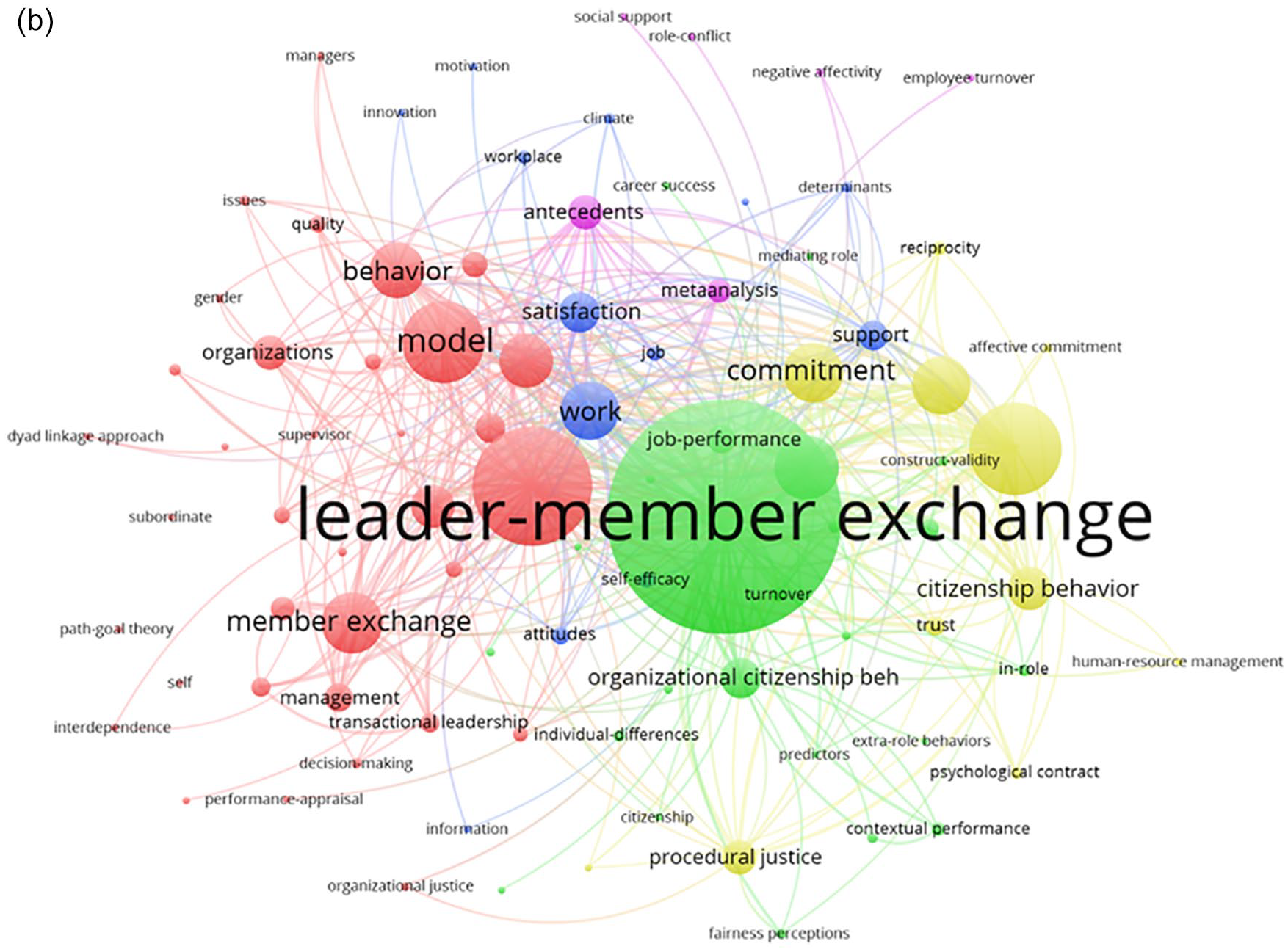
Co-word visualization for the time interval 2000 to 2009.

Co-word visualization for the time interval 2010 to 2017.
First Interval (up to 1999)
Analysis of the first interval shows 38 keywords divided into three clusters. Because of the small number of existing publications in the first period, the three clusters include a small number of items. The first cluster consists of 18 items and includes keywords such as “leadership,” “management,” and “behavior.” We labeled this cluster Management and leadership. Not surprisingly, considering the development of LMX, its early stages involved examining supervisor–subordinate relationships (Dansereau et al., 1975) and continued to approach leadership as an exchange relationship (Graen & Uhl-Bien, 1995).
The second cluster consists of 10 items referring to OCB, antecedents and outcomes of LMX, organizational commitment, and justice. Based on social exchange, we named this cluster LMX and justice. The third cluster shows the highest occurrence of the keywords “organizations,” “performance,” and “vertical dyad linkage.” We labeled this cluster Exchange and performance.
Second Interval (2000–2009)
In the second interval, two major clusters appear: Outcomes and performance and LMX. We observe that in addition to LMX research, a major research stream on mechanisms that influence organizational outcomes gained attention. The visualization shows two peripheral clusters. More research started to connect softer constructs influencing LMX relationships, such as organizational climate, motivation, and job satisfaction. Another distinct peripheral cluster was Trust, organizational support, and commitment. As noted in the document co-citation analysis, the Trust college imploded in the second interval, prompting exploration of the influence of interpersonal trust on behavior and performance (McAllister, 1995).
Third Interval (2010–2017)
Analysis and visualization show four significant clusters in the third interval. The major cluster includes 54 items and deals with Facets and mechanisms that influence organizational outcomes. Compared to the previous period, a number of publications continue to research organizational outcomes and performance. The second cluster reveals that researchers are increasing focus on leadership styles and OCB, indicating that LMX research has been successfully incorporated into the leadership field. Results are consistent with the findings of the co-citation analysis in the previous section in which we observed transformation of the LMX college from Core LMX foundations and reviews in the 2000s to Leadership styles and approaches in the 2010s.
Although LMX was applied more to the leadership field in this period, it was still significantly distinct from the main leadership cluster. LMX maintained its position as a very important research field with a specific set of subject-related research problems and defines the third cluster, LMX and social exchange.
A peripheral, emerging cluster shows the increasing interest of researchers in negative outcomes as a consequence of LMX. Other keywords connected to this cluster are job performance, abusive supervision, burnout, conflict, and work engagement.
Bibliographic Coupling
The major difference between bibliographic coupling and document co-citation analysis is that the focus of the first is to explore two primary documents that have at least one reference (secondary document) in common (Kessler, 1963). Documents are thus coupled if their bibliographies overlap, suggesting that the focus of this analysis is the citing document (primary documents) rather than the cited documents (secondary documents). The more the bibliographies of two articles overlap, the stronger their connection (Zupic & Čater, 2015). It provides a static view of the field because the coupling is established through references made by the authors of the documents involved and is thus intrinsic to those documents. It is suitable for detecting current trends and future priorities as they are reflected in the most recent publications (Zupic & Čater, 2015). This key mechanism for detecting potential future developments makes this approach very usable in research domains characterized by exponential publication activity, such as LMX. Lastly, bibliographic coupling considers documents independently of the number of citations. This counters the effect of mainstream publications being overemphasized and over-representing works that might be insignificant in the course of the field’s intellectual development.
Data and Analysis
The same dataset was used for the bibliographic coupling and the document co-citation analysis. We analyzed the period 2010 to 2017 and exported the database of target articles into VOSviewer to further emphasize the most recent period of research of the LMX fields, which could potentially give the best basis for exploring future directions of research in this field. A cut-off point, which refers to a minimum number of citations of a document, was again applied to the reference list (Černe et al., 2016) to produce a body of the most influential documents large enough to capture the main complexities of the social structure but small enough to be interpretable. We applied a cut-off point of a minimum of 20 citations of a primary document; of the 1,332 primary documents, 167 met the threshold. The same procedure described in the co-citation section was applied by the VOSviewer program. Visualization was created in VOSviewer and revealed six different clusters (Figure 3). As with Figure 2, we show the network map and the density/heat map of the given period.

Bibliographic coupling for time interval 2010 to 2017 with density representation.
Results
Analysis shows two major clusters: Organizational justice, support, and commitment and Leadership styles and approaches. In particular, the period after the 2000s is marked by the rise of social exchange theory for examining reactions to justice. Complementing previous meta-analyses, Colquitt et al. (2013) discovered that the significance of the relationships between justice, task performance, and citizenship behavior was mediated by indicators of social exchange quality (trust, organizational commitment, perceived organizational support, and LMX). Drawing from social exchange, researchers in the first cluster examine the relationship between LMX and employees’ affective organizational commitment (Eisenberger et al., 2010), proposing a concept termed supervisor’s organizational embodiment (SOE) to account for wide variation in the examined relationship. With an increase in SOE, the association between LMX and affective organizational commitment became stronger (Eisenberger et al., 2010). Another interesting topic in this cluster is examining the quality of workplace relationships that influence OCB, focusing on idiosyncratic deals (“i-deals”), which are special arrangements that individuals negotiate with their employers (Anand et al., 2010). To provide a broader viewpoint it is important to examine them form different perspectives and considering different levels of influence (Anand & Vidyarthi, 2016). Additional antecedents and behavioral outcomes of employees’ perceptions of organizational support are also examined (Kraimer et al., 2011).
The second cluster, Leadership styles and approaches, includes mostly literature and research about the influence of different leadership styles and approaches to employees’ work engagement (Christian et al., 2011), organizational behavior (van Dierendonck, 2011), and job performance (e. g. leaders might affect perceptions of autonomy and significance by actually altering objective features of jobs; Piccolo et al., 2010).
LMX manifestations and outcomes represents a third cluster. Despite the fact that LMX has been incorporated into the leadership field, it maintains a significant role as an independent research stream, including LMX as mediator/moderator in various models (Dulebohn et al., 2012) and the influence of LMX on organizational outcomes (Dulebohn et al., 2012), examining LMX differentiation (Erdogan & Bauer, 2010), and mechanisms that influence LMX quality (Zhang et al., 2012).
For the first time, Creativity and Innovation (Cluster 4) gained more attention from researchers in this field, focusing on how the leader–follower relationship influences employees’ creative behavior (Aarons & Sommerfeld, 2012).
Results reveal two peripheral clusters: Safety climate and Negative outcomes, abusive leadership, and ethics. Research on investment in employee health received more attention after the 2000s (Mearns et al., 2010), considering the importance of leadership promoting a safe climate (Nahrgang et al., 2011). Increasingly, researchers are devoting considerable attention to investigating negative aspects of leadership (Mawritz et al., 2012) and promoting ethical leadership and behavior (Hannah et al., 2013).
Discussion of Findings, Contributions, and Implications
This study provides a comprehensive literature review using three different bibliometric methods. Document co-citation analysis, applied against the backdrop of the invisible colleges framework, enabled us to explore and interpret the intellectual foundations and the field’s development. Co-word analysis provided us with the thematic, semantic insights into the actual content of the field currently. Bibliographic coupling portrayed the field’s research front and served as a key basis for making prognoses for the development of LMX research in the future. Taken together, the results of this three-technique bibliometric analysis form the basis for our study’s contributions and provide foundations for our discussion vis-à-vis the extant reviews of the field.
The contributions of this study are twofold. First, we complemented existing qualitative (e.g., Henderson et al., 2009; Herman et al., 2018) and meta-analytic (e.g., Banks et al., 2014; Dulebohn et al., 2012; Martin et al., 2016, 2018) reviews of the LMX field. To date, meta-analyses have examined the relationships of LMX and OCB (El Akremi et al., 2010; Hackett & Lapierre, 2004; Ilies et al., 2007), culture (Rockstuhl et al., 2012), job performance and satisfaction (Martin et al., 2016), and antecedents and outcomes (Dulebohn et al., 2012). On the other hand, qualitative reviews have studied LMX through four evolutionary stages (Graen & Uhl-Bien, 1995), levels of analysis (Schriesheim et al., 1999), human resource management (Bos-Nehles & Audenaert, 2019), group outcomes (Buengeler et al., 2021), and a multilevel review of its antecedents and outcomes (Henderson et al., 2009).
We offered an important methodological implication with the use of a combination of three bibliometric techniques to present a comprehensive view on LMX research. A triangulation of various methods provided a more comprehensive picture than each method applied individually, and bibliometric approaches tackling different but complementary research questions, such as in our case (past, present, and future snapshots), provided insights into a complex multidisciplinary field that LMX is (cf., Wen et al., 2017). Moreover, compared to a structured literature review, science mapping has more of a macro focus and presents the reader with a graphical description of a research field, which makes comparisons easier and less biased by researcher choices in classical review studies, such as meta-analyses (Zupic & Čater, 2015). Our findings thus have the potential to change predefined conversations within the broader leadership, narrower LMX, and general management fields regarding improving theoretical and empirical research in the colleges that have not yet fully embraced certain theoretical or methodological perspectives (e.g., multi-level analyses; Henderson et al., 2009).
A larger sample of research articles allowed us to examine the evolution of the LMX field, showing that theoretical connections propagate well beyond the inclusiveness of theories that have been part of the LMX foundations since its inception (e.g., social exchange) and touching upon various external theories (e.g., ethics and value systems). This shows the breadth and segmentation of the LMX research field, which corroborates findings of previous review studies.
However, there are also some key differences that have not been discovered/mentioned in previous studies. For example, one of the more surprising findings is that self-determination theory is not very well linked with LMX, whereas previous meta-analyses have stressed the importance of the self-determination theory that links LMX and work performance (Martin et al., 2016). Self-determination theory suggests that LMX taps into autonomy via greater job discretion provided by the leader, competence from increased feedback from the leader, and relatedness from interpersonal relationship with the leader, increasing empowerment and motivation overall. However, this theory has not been found in our results—it might be that other theories such as social exchange are more appropriate (e.g., feelings of “payback”). Furthermore, trust, fairness, justice, commitment, and support research have all recently been merged with LMX-related research, signaling that underlying mechanisms in LMX relationships could be more complex than expected (Day & Miscenko, 2016; Dulebohn et al., 2017; Tse et al., 2018). Taken together, our review findings help address a key concern of a recent critique of the concept by Gottfredson et al. (2020) by portraying its nomological net more accurately (see our co-occurrence analysis results in Figure 2a–c) and founding these results on objective indicators of impact and a comprehensive, all-inclusive approach.
Second, this study complements previous reviews by presenting the dynamic development of LMX using a framework of invisible colleges (Vogel, 2012). Based on this methodology, we identified influxes in line with previous LMX reviews as well as previously discussed, more surprising findings. Specifically, some other subfields of leadership (e.g., negative behaviors, abusive leadership) seem to heavily base their theoretical arguments on LMX logic but also look beyond them combine them with other theories such as contextual theory (Kim et al., 2021; Martinko et al., 2013). This suggests that LMX is expanding due to its complexity, starting to look beyond its foundational theories and perspectives, trying to incorporate various new views and theories that could potentially provide a sounder perception of what affects LMX and how LMX can affect various organizational outcomes (Premru, 2019, 2020). Overall, this could show that the LMX field, by looking beyond its core theories, has reached a degree of maturity (Bos-Nehles & Audenaert, 2019; Buengeler et al., 2021) and is able provide opportunities and challenge which theories from leadership and management might provide new frameworks to expand our knowledge. As a manifestation of the second contribution of this study, we provide some suggestions in the following section.
Future Research Directions
Our dynamic analysis using various bibliometric techniques and the evolutionary framework of invisible colleges reveals promising avenues for the future development of LMX research. Based on our results, we offer the following possible avenues of research for expanding LMX studies or connecting its main themes or sub-themes with leadership and management research to provide four possible theoretical and/or methodological advances.
First, we witness the growth of literature on creativity and innovation in which researchers include LMX in a model with creative performance (e.g., Atwater & Carmeli, 2009; Li et al., 2016). Although important progress has been made in the field of leadership and creativity, more studies are needed (Hughes et al., 2018; Škerlavaj et al., 2014) to add to the understanding of the underlying mechanisms by which leaders influence and encourage creative behavior. For example, the application of role-modeling (i.e., the influence of leaders’ creativity/innovation) on this behavior exhibited by the followers, its mechanisms, and boundary conditions deserve additional attention. This can be further expanded beyond the leadership field by examining how the dyadic relationship could potentially be influenced by its context (Černe et al., 2018). For example, not much is known about how work relationships are influenced by HR systems or climates (Mossholder et al., 2011), or how collaborative decision-making is shaped in the leader-follower dyad over time (Loci & Peterlin, 2021).
Second, another domain prompting increased interest from researchers, which has been revealed through bibliographic coupling, relates to examining negative outcomes, abusive leadership, and ethics. Studies regarding this topic discuss the influence of abusive supervision on employee behavior (Hannah et al., 2013; Velez & Neves, 2017). An interesting avenue for extending this line of research would be to investigate the dynamics of the reciprocal exchanges. Considering reciprocity in exchange relationships, abusive supervision might induce employees to withhold helping behaviors, resulting in engagement of employees in counterproductive work behavior (An & Wang, 2016). LMX thus represents an effective leadership approach in predicting counterproductive behaviors, and further empirical investigation is likely to provide fruitful avenues for extending leadership research (Ilies et al., 2007; Martin et al., 2016). A promising field of inquiry thus includes business ethics, the role of ethical climates, and ethical human resource management practices (Greenwood, 2013). Another angle of looking at the matter is also by proposing more research on the negative aspects of high-quality LMX relationships, as indicated by a recent critique review (Jha & Jha, 2013). Indeed, the majority of LMX research focuses on the positive outcomes or on mitigating negative ones by inducing LMX. A study into whether overly high-quality relationships might lead to issues related to holding accountability, leniency in effort and outcome evaluations, or social exclusion of other unit members is warranted.
Third, theoretical development of LMX indicates that this topic has gained more attention within the leadership field in relation to leadership styles. Our study also reveals that LMX was incorporated into the general leadership cluster in the 2010s, mostly related to transactional, transformational, and authentic leadership (Avolio & Gardner, 2005; Wang et al., 2005). Concurrent with the growth of literature on virtual leadership (Hoch & Kozlowski, 2014), virtual (team) work in organizations (Gilson et al., 2015), and distributed leadership (Canterino et al., 2020), we propose that more research is needed to examine the development of quality relationships, because there is a lack of face-to-face communication due to the increased use of electronic tools of communication (Gajendran & Joshi, 2012; Hoch & Kozlowski, 2014). This stream of research can be expanded to other management fields by the inclusion of context. This could be done, for example, by examining how relationship quality can be enhanced or hindered in virtual teams by early organizational socialization (Hung et al., 2021) or by including new research methods that can effectively evaluate communication in virtual environments, such as social network analysis (Carter et al., 2015).
Fourth, previous qualitative and quantitative analyses have also discovered a lack of longitudinal studies that examine the dynamic aspect of relationship development, which would add to the understanding of the process of LMX development (Dulebohn et al., 2012; Martin et al., 2016). It has been found that the strongest relationship with LMX quality derives from leader perspective, which could be because items in LMX measures focus heavily on leaders and are thus perceived by leaders as a self-rating of their performance (Dulebohn et al., 2012; Martin et al., 2016). Our research supports previous studies with suggested future directions, as we observed in the co-citation analysis with invisible colleges that the clusters focused on methodological approaches are consistently strong among the key influxes into the field but have mostly alluded to the examination of more complex models (e.g., moderated mediation; Tse et al., 2012) rather than fully embracing a multilevel or a longitudinal perspective.
We concur with previous review studies and suggest that a longitudinal (in particular, a social network) approach would increase our understanding of the LMX development process and its contingencies. Social network analysis (Carter et al., 2015) is especially powerful for exploring dyadic relationships because “LMX should be viewed as systems of interdependent dyadic relationships, or network assemblies” (Graen & Uhl-Bien, 1995). This finding and suggestion corresponds to a recent critique of LMX (cf., Sheer, 2015) that highlighted the fact that the focus of LMX research should be the actual exchange among leaders and followers, not merely leader and follower characteristics, behaviors and outcomes. A social network approach to the matter would enable just that.
Limitations and Conclusions
Stemming from bibliometric techniques, our review is characterized by high levels of inclusiveness, comprehensiveness and objectivity. Despite this, being based on citations as a measure of impact, bibliometric approaches have certain limitations, further suggesting that such studies should be complemented with other review methods, such as meta-analyses and narrative/qualitative reviews.
First, although the division of our observation period into three intervals showed us significant changes in the socio-cognitive structure of LMX, other choices (e.g., different keyword selections, different Web of Science categories chosen) might have led to the detection of colleges that have now remained invisible and unrevealed. Third, the resolution of the applied bibliometric method depends on thresholds defined in the course of data reduction (Zupic & Čater, 2015). Nonetheless, bibliometric approach enables us to capture the most important (i.e., most impactful) content in any of the cases, and such omissions would only be related to potentially missing out on peripheral clusters.
Second, the quantitative approaches used in bibliometric techniques do not consider the context and the intent of authors’ references to other works that can also be a result of self-legitimization strategies, micro-politics and criticisms (Glänzel et al., 2006). Furthermore, based solely on bibliometric data, we cannot determine why a certain publication was cited, and citation-based bibliometrics could be biased due to self-citation of the authors (Wallin, 2005). For example, a high citation rate could be seen as a critique rather than an affirmation.
Despite these limitations, our multi-technique review study of LMX research mapped the social structure presenting the development, current state, and future evolution of the research area. Bibliometric methods applied in this paper provided a more objective foundation for the exploration of the future prospect of the LMX field. As an extension to our contributions to the LMX research area, our review also helped position this sub-field within the broader leadership and general management fields, offering integrative directions for future research with promising avenues for development. Providing broader future guidance for the LMX field and looking at the potential intersections with leadership and management literature holds important promise for the field under examination and represents a step beyond previously published LMX review studies.
Footnotes
Declaration of Conflicting Interests
The author(s) declared no potential conflicts of interest with respect to the research, authorship, and/or publication of this article.
Funding
The author(s) disclosed receipt of the following financial support for the research, authorship, and/or publication of this article: This research was supported by the Slovenian Research Agency (Core Project Funding J5-2555 and P5-0410).
