




Abstract
The South African educational system has challenges regarding learner outcomes of previously disadvantaged schools. New thinking is mandatory, and school leadership needs to play an significant role to improve the status quo. The servant leadership paradigm may be a substantial factor to counter the challenges. A quantitative approach measured the covariation between the servant leadership paradigm and its influence on the organizational climate of private schools to learn implementable lessons. The construct of servant leadership was explored via the Servant Leadership Survey (SLS) of Van Dierendonck and Nuijten. According to Castro and Martins’s Climate Survey Questionnaire (CSQ), the organizational climate was analyzed. A total of 249 respondents, all permanently employed as educators from primary and secondary private schools, completed the survey questionnaires. It was found that private schools’ leadership exhibits the characteristics of the servant leadership practices of empowerment, stewardship, accountability, and humility. It was confirmed that private school leadership displays the organizational climate groupings of organizational image, teamwork, work environment, and leadership as priorities that increase constructive organizational climate in the school setting. Recommendation about the implication of these results to improve the disadvantaged school environment is discussed.
Keywords
Introduction
It is commonly acknowledged that the South African educational system is at a watershed due to persistent and fundamental challenges, which seem to manifest most strongly in the relentlessly mediocre learner outcomes of previously disadvantaged school environment (Swart et al., 2021). Those outcomes are undeniably a direct result of the diverse school context in South Africa, created by the systematic and structural politically driven tactic of the previous apartheid regime (Amin & Ramrathan, 2009). This separatist approach brought about a division between schools. Certain schools, where primarily white learners were accommodated, became known as “advantaged schools,” while mainly black and colored learners received their education as “disadvantaged schools.” The consequences for those schools’ teaching and learning activities were grim. Despite more than one and a half-decade without apartheid, learners can still do even basic mathematical calculations after the first five school years. There have been reports that only 50% of all school learner starters move forwards successfully in reaching and completing Grade 12 (Joubert, 2019). About the Grade 12 class of 2020, statistics indicated that 39 from every 100 learners who started their school journey in 2009, obtain their matric certificate in 2020 (Slatter, 2021). Even though several Grade 12 learners passed their final exam, many learners did not where the school system failed these learners (Slatter, 2020; Swart et al., 2021). These outcomes may well be due not only to the education system as such but also in part to the fundamental challenges faced by many schools such as poor subject content, weak pedagogical knowledge base displayed by teachers, and absenteeism, as well as the lack of political will to remedy—or the lack of ability to improve—the poor infrastructure and resources at these schools (Jansen, 2012; Moorosi & Bantwini, 2016). This situation, inherited from the gross inequalities in the past, can certainly never contribute in any way to an effective teaching and learning environment and can easily lead to disadvantaged learners and disheartened teachers (Du Plessis & Mestry, 2019; Mojapelo, 2018; Thaba-Nkadimene, 2020), and need to be addressed via academic and emotional support for both teachers and learners if learners are to achieve academic success.
There are two entities of schools in the country, namely public and private schools. Public schools consist of two divisions of which the first category (previous Model C schools), also referred to as formerly historically advantaged schools, are primarily funded by parents and alumni (Kwatubane, 2019). In contrast, the additional division of previously historically disadvantaged schools is subsidized by the Office of the Ministry of Education (Van Deventer, 2016). Learners of these previously historically advantaged schools are academically more successful than their equals of previously disadvantaged schools, their academic capabilities continuing to advance throughout their school voyage (Motala, 2014). The general perception is that those schools offer outstanding facilities and maintain a high standard of teaching and learning activities, which amounts to best practice in education (Arends & Phurutse, 2009; Brindley, 2012). Public schools in unfavorable socio-economic environments experience a shortage of finances and resources from the side of government and are characterized by unremarkable educational standards, a dearth of competent teachers, and inadequate classroom apparatus (Van Deventer, 2016). Some of the public schools in the countryside of South Africa even lack the basic services of electricity, water, safe toilets, study material, and staff who are capable to assist the learners (Swart et al., 2021). They are continually confronted with increasing economic, emotional, and social challenges. They have been described as experiencing “constant crisis” (Harris & Thompson, 2006; Proudlock et al., 2008; Shalem & Hoadley, 2009). Some of these multifaceted challenges, including quality control, new curricula, throughput rates, poverty alleviation and learners’ safety, place the leadership of those schools under tremendous pressure (Botha, 2014; Olujuwon & Perumal, 2014). Private schools, are more expensive than public schools and are perceived as offering a high standard of education, do not experience these challenges (Kwatubane, 2019). They primarily serve disgruntled citizens with public schools’ standards and quality of schooling (Kwatubane, 2019). Private schools in various countries have “better pupil-teacher ratios, higher teacher commitment, and sometimes better facilities,” as well as “considerably higher achievement” (Tooley & Dixon, 2005, p. 1). Furthermore, the private school leadership is alleged as to demonstrate a high level of dedication in preserving the status quo at those schools (Van Deventer, 2016).
Constructive school leadership is of one essence if the situation is to change for the better. Effective school leadership is amidst all school events and directs the teachers’ actions toward achieving the envisioned objectives (Van Deventer, 2016). Since school leadership has a pivotal role in improving the current situation, a special breed of leaders is unquestionably required to develop, rectify, and improve the South African educational landscape at previously disadvantaged schools. In an article aimed at revitalizing the discourse essential to a vibrant educational leadership scholarship and encouraging progress regarding the confrontation of challenges, Niesche (2018) pleads for more probing and critical questions of educational leadership. Critical perspectives are needed to lift limitations, alleviate tensions, and solve contradictions within the educational arena—especially in the current South African educational and political environment, where rapid and simple solutions are often sought to complex and challenging difficulties. Critical dialogue, which can be described as a conversation that stimulates insight and understanding of a particular topic, equally for the individuals participating in the discussion and the collective thinking of the group (Karlsson, 2001), is indispensable to overcome the parallel monologues concerning more orthodox or old-style interpretations of school leadership (Lakomski et al., 2017). Critical dialogue, then, may well lead to a change in the educational approach of schools and, in the case of South Africa’s previously disadvantaged schools, to adherence to the quality education for all learners as Constitutional promise (National Planning Commission, 2012).
Conversations alone, however, may not be sufficient within the crucial time frame. Specific competencies are required to confront change (Paruk, 2017). Authentic leaders are needed who possess clarity of purpose and the ability to cope with complexity. Men and women are needed who can be effective in rapidly changing contexts, with the non-negotiable will to mobilize and empower people to invest in the change processes. School leaders must positively influence the organizational climate and create a cycle of continuous improvement (Sanchez et al., 2020). School leadership can create an environment where teachers at previously disadvantaged schools are supported and empowered, mainly by positively engaging with their learning and teaching activities. Many challenges faced by those schools may be surmounted constructively. Motala’s (2014) statement regarding servant leadership is highly relevant: “the ubuntu philosophy, with its central values of solidarity, interdependence and especially love, can inspire and facilitate the adoption and application of these principles.”
The servant leadership paradigm may significantly relate to school environments when school leadership applies. Servant leaders appreciate, acknowledge, and realize each person’s abilities and empower them to achieve their finest potential (Greenleaf, 1991). The servant-leader considers each individual as important, and wants to empower everyone to become their optimal (Greenleaf, 1991). Teacher empowerment has positively influenced the school climate and results (Mansfield et al., 2012). The outcome may well be the realization of the ultimate goal of learner achievement and success in those previously disadvantaged schools (Sanchez et al., 2020).
All current and past endeavors should be examined to find appropriate responses to the challenges experienced by many South African schools. Research conducted at previous disadvantaged public schools found that many schools and leaderships remain caught in autocratic and bureaucratically mandated structures and organizational climates (Grobler et al., 2012). Leadership’s effectiveness—or ineffectiveness—significantly relates to the organizational environment within a school setting (Sanchez et al., 2020). It is essential to bear in mind, however, that although a more nurturing and authentic leadership style as well as organizational (school) climate may well influence those schools, the nature of schools has often inhibited the implementation of innovative and revitalizing ventures that are not part of prescribed policy directives and regulation (Xaba & Malindi, 2010).
In a study regarding the characteristics of servant leadership of principals of historical advantaged public schools in Gauteng, South Africa, teachers reported that their principals successfully put into practice servant leadership characteristics and techniques such as organizational stewardship, wisdom, and persuasive mapping in their daily actions (Swart, 2018). These practices could be partly responsible for the success stories of these public (historically advantaged) schools and their constructive ambience and excellent academic results. Although examples of innovative approaches, proactive steps and profitable risk-taking were found at three historically disadvantaged schools by Xaba and Malindi (2010), those successes are few. Specific cultural factors may influence the willingness of a school to adopt the paradigm. The servant leader needs to appreciate the cultural extents and its influence in totu to develop te best possible work environment (Hannay, 2009).
It is easy to see that the characteristics described by participants in the study of Xaba and Malindi (2010) are also part of servant leaders’ equipment. Teachers at public secondary schools and primary schools in the 2018 study reportedly perceived servant leadership practices positively (Swart, 2018). Therefore, the current research investigates the potential effect of servant leadership practices on South African privates schools. However, the point of departure is somewhat dissimilar to previous studies. Since there are schools in South Africa that seem to be producing positive educational results, Nangoli et al. (2020) question whether it might not be advantageous to investigate the extent to which servant leadership is practiced in these schools and the effects of such administration on the organizational climate of these schools? The schools performing best appear to belong to the private school sector in South Africa. Valuable lessons may be learned, and the information obtained could benefit the deeply challenged public disadvantaged schools. In South Africa and other developing countries, the private school sector is expanding with the growing desire of parents to procure quality teaching and learning activities and high pass rates for their children (Van Deventer, 2016).
For the current study, “school leadership” is perceived as one entity consisting of the principal and the school management team of private schools (Swart et al., 2021). Glisson (2007) distinguishes between organizational culture and climate, with organizational climate encapsulating the manner people perceive their workplace, and corporate culture comprising the method generally followed to get things done in an organization. For this study, the two concepts are conceived of as one entwined dynamic notion (Swart et al., 2021).
The aim of this study was fourfold:
To describe the most prominent servant leader characteristics as practiced by private schools leadership.
To define the most prominent constructs of organizational climate as implemented by private schools leadership.
To determine the correlation between servant leadership practice and the organizational climate of private schools.
To determine the influence of socio-demographic characteristics (gender, current job level, years experience, and type of schools) on the perception of the servant leadership paradigm and the organizational climate theory.
Theoretical Framework
Servant Leadership
The core of servant leadership as practiced in a school context entails to bring hope and makes a constructive change to schools (Block, 1998). As servant leadership is a critical concept in the current study, it warrants closer scrutiny. Servant leaders yearn to serve people rather than to be served (Greenleaf, 1977). Servant leadership has been defined as follows: “Servant leadership is a (1) other-oriented approach to leadership (2) manifested through one-on-one prioritizing of follower individual needs and interests, and (3) and outward reorienting of their concern for self toward concern for others within the organization and the larger community” (Eva et al., 2018). This practice enhance people’s lives, where others are mentored and guided to acquire more knowledge about servant leadership and become more service positioned (Greenleaf, 1977). The power of servant leaders lies in the aptitude to unite leadership and servanthood (Kgatle, 2018). It is a diverse and, indeed, powerful paradigm. Kgatle (2018) describes the servant leader as a model of integrity, trustworthiness, and intelligent reasoning. The spirit of servant leadership can make governance more accountable and trustworthy. The servant leader is genuine concerned about his/her follower’s hopes and needs and this characteristic differentiates this paradigm from any other leadership style (Greenleaf, 1977). “Servant leaders in all segments of society hold the key to influentially guiding themselves and the people that they serve from an uncertain present into a more hopeful future” (Greasley & Bocarnea, 2014). Research conducted in Florida, USA, showed that learners achieve at higher levels where school management teams apply the servant leadership paradigm (Laub, 2010). In Canada, likewise, research results shown that the language and nature of servant leadership offered an acceptable fitting for the educational environment (Black, 2010). Although the quoted research was undertaken in North America, the implications of the servant leader practice may also be valid. Servant leadership is effective at the various organizational levels, including schools, and this leadership style’s spillover effect has endorsed service delivering behaviors (Ling et al., 2016).
School Leadership
Leaderships of schools should be closely involved in all school activities and events. It should strive to guide teachers toward achieving common educational goals (Van Deventer, 2016). Influential school leaders uphold good quality relations with teachers inspiring them to carry out their vocation in the group’s best interest by the group’s ideals (Van Deventer, 2016). The authentic and healthy relations among colleagues strengthen collaboration and cooperation (Karadag & Ozdemir, 2015). An essential task of leadership at schools entails facilitating a constructive climate at the school where both teachers and learners are highly motivated to do well (Kalkan et al., 2020; Karadag & Ozdemir, 2015). While the school climate affects the quality of interpersonal relations, it is equally shaped by the quality of these relations (Kalkan et al., 2020). School leadership is also responsible for motivating personnel and stimulating interactions between teachers to help them achieve their objectives. As “a more engaged teacher is a less frustrated teacher” (McCarley et al., 2016), it follows that less frustrated teachers would be more engaged teachers (Swart et al., 2021). Where teachers are more supported provided by their school leadership it could lessen frustration, bring about more involved teachers, and consequently affect learners’ success, especially learners from low-income communities (G. Brown, 2015). Consistently supportive school leadership is indispensable to change the existing South African education situation for the better, and positive leadership and constructive school environments may build up the pupils’ learning ability (Oyedeji, 2017).
Organizational (School) Climate
A schools can be recognized as an organization who is dedicated to education (Robbins et al., 2008). The way people experience the work environment of schools affects the enthusiasm of the teachers, which trickles down to the classroom and leads to learners who are enthusiastic about learning (Mentz, 2014). The organizational climate of an organization is determined by the leadership, which may enhance or decrease the stability and growth of the organization (Rachmawati & Lantu, 2014). The organizational climate is strongly linked to the leader’s behavior (Novac & Bratanov, 2014). The service climate literature strongly suggests that how employees view management practices in the workplace significantly influence their responses, whether favorable or unfavorable, to management directives (S. Brown & Lam, 2008). When employees experience cohesiveness, they collaborate to achieve organizational goals. The factors that contribute most powerfully to this perception are service-oriented behaviors by leaders, good leadership-member relations, and team solidarity (Chiniara & Bentein, 2016). The approaches to and definitions of organizational climate vary, although the models endeavor to describe organizational climate display similarities. The definition of organizational climate of Glisson (2007), in Rusu and Avascilai (2014), will serve as reference for this study, namely “the employees’ subjective perceptions of how their work environment affects them as individuals.” A favorable climate creates energy within an organization so that employees are willing to do more than is expected from them (Watkin & Hubbard, 2003). The organizational climate shapes members’ attitudes and behaviors and eventually determines organizational outcomes (Fainshmidt & Frazier, 2017). The leader’ attitude play a substantial role in determining the climate of organizations (Marin-Pantelescu & Maniu, 2015). Although much of the service-climate literature relates to business enterprises, the principles apply equally in organizations such as schools. Van Deventer (2016) agrees with Mentz (2014) and provides a valid argument that teachers may be inspired or discouraged by the organizational climate. The outcome determines what occurs in the classroom.
Methodology
Research Design
A quantitative approach was used to contextualize the educational arena of the private school sector and was determined at a particular time setting. A cross-sectional study was conducted with descriptive and comparative survey designs. A quantitive approach was conducted to describe the characteristics of the servant leadership pardigm and the construct of organizational climate, there association and differences (Struwig & Stead, 2017). The results of this study assisted as exploratory foundation for the qualitative research which followed, where focus group interviews explored the constructs in this context in more depth (Swart et al., 2021).
Sampling Method, Sample Size, and Respondents
Respondents had to be qualified as teaching professionals and be proficient in English. A total of 249 out of 996 respondents from primary and secondary schools completed the survey questionnaires sent to the respondents via the electronic system of the private school entity. The respondents were all permanently employed as educators at private schools when the study was conducted. Of these 249 respondents, 76.7% were female teachers, and 23.3% were male. Two-thirds (66.7 %) of respondents’ current job level was that of teacher and one-third (33.3%) encompassed school management level. Almost two-thirds (62.7%) of the respondents had 1 to 15 years educational experience, and the remainder had additional years of experience. Approximately three-quarters of the respondents (75.1%) worked 9 years or less at their current workplace, and the others (24.9%) had worked 9 years or more in their current environment. Lastly, over half of the respondents (56.2%) were employed in primary schools and the others (43.8%) in secondary schools.
Research Materials
The servant leadership and organizational climate constructs within the education context were explored using two questionnaires:
The Servant Leadership Questionnaire
The Servant Leadership Survey (SLS) of Van Dierendonck and Nuijten (2011) was used to explore the servant leadership construct within the private school setting. The SLS explored the eight characteristics of empowerment, accountability, standing back, humility, forgiveness, courage, stewardship, and authenticity—assed by subscales.
Generally, most scales that measure servant leadership deal mainly with the “people” side of servant leadership and neglect the “leader’” part, which can give a misleading picture of the implementation of servant leadership in organizations (Swart et al., 2021). The SLS measured the relation between leader and follower as perceived by the follower. Noteworthy is the fact that one of the goals of the SLS was seen by the developers as indicating “where improvements can be made on the individual and organizational level; as such, it may also offer a valuable starting point for training and leadership development” (Van Dierendonck & Nuijten, 2011). The conclusion of Eva et al. (2018) that the SLS of Van Dierendonck and Nuijten (2011) is a validated tool for measuring servant leadership, the SLS was selected as appropriate for this study. This instrument was applied during the validation process by its authors to various contexts, including a high school setting (Van Dierendonck & Nuijten, 2011). The SLS was also utilized by Von Fischer and De Jong (2017) in an educational context to determine the teachers’s perception of their principal’s servant leadership conduct. The questionnaire consists of 30 items and uses a 5-point Likert scale ranging from strongly disagree (1) to agree (5) strongly. The participants’ responses indicate the measure to which they perceive the school leadership as demonstrating the characteristics of servant leadership.
The Organizational Climate Questionnaire
The Climate Survey Questionnaire of Castro and Martins (2010) was used to analyze the organizational climate relating to private schools according to the 12 categories of trust, training and development, transformation and diversity, job satisfaction, leadership, employee wellness, communication, performance management, remuneration and reward, teamwork, work environment, and organization image. Although a robust positive relationship between job satisfaction and organizational climate was demonstrated in the study, Castro and Martins (2010) advised that leadership should be aware that employees in specific settings have definite needs that can influence their job satisfaction levels, and that employees’s behavior can be influenced by their different perceptions of the climate within the organization. For this reason, there can be no generalized statements, and each setting—in this case, the education setting—has to be approached from its extraordinary evidence. Based on the conclusion of Castro and Martins (2010) that the CSQ is a reliable and validated instrument to measure Organizational Climate, it was decided to utilize the CSQ for this study. The questionnaire consists of 70 items that measure the 12 groupings of organizational climate and makes use of a 5-point Likert scale fluctuating from strongly disagree (1) to agree strongly (5).
Research Procedure and Ethical Considerations
Consent was obtained from the private school sector for this study. The Google Forms link system was utilized, and the questionnaires were sent to the respondents via the electronic system of the private school’s entity. The respondents received an introductory communication, disclosing the nature of the study and the process to be followed. All respondents were informed that personal information would be kept strictly confidential. Participation in the quantitative analysis was purely voluntary. Respondents were notified that they might retract from the study at any stage (De Vos et al., 2014). They were also informed that the research might be published as a journal article and discussed at conferences, seminar presentations, and academic gatherings, while ethical considerations would always be upheld. Ethical clearance for this quantitative study was obtained from the Ethical Committee of a Tertiary Institution.
Reliability of Measures
Cronbach’s alpha was used to indicate internal consistency for the subscales of the instruments used for this study (i.e., the questionnaires). Cronbach values above .7 are acceptable and suggest that the tool (questionnaire) is reliable (Field, 2018). All constructs measured by the SLS were found faithful, as all eight subscales had Cronbach’s alpha values above .7. After removing one item, all constructs measured by the OCQ had Cronbach’s alpha values above .7. A possible reason for this item not fitting within the instrument could be that this measure was tested in a different context (to the private school sector), as it is generally utilized in commercial environments.
Normality Test
Composite scores were computed for items belonging to the same construct. Since these scores are averages of items belonging to a construct, the scores are continuous, and normality must be tested. The Shapiro-Wilks test was used as this test is known to have sufficient power in detecting deviations from normality (Field, 2018). Since none of the p-values for variable distributions were more significant than .05, the null hypothesis for normality was rejected and accordingly, nonparametric tests were used.
Statistical Calculations
Descriptive and inferential statistics were applied to describe the sample characteristics and analyze the quantitative data. The Mann-Whitney (MW) test was used to test for significant differences for servant leadership scores across two categories of a variable, for example, gender (male and female) and sector (primary and secondary). The Kruskal-Wallis (KW) test was used to analyze differences across more than two categories of a variable, for example, educational level—Teachers, Heads of Departments (HODs), Vice principals, and Principals. When the KW test indicated a significant difference, ad hoc tests (pairwise MW comparisons) were performed.
Correlations
Spearman correlations were used to investigate the relationship between the servant leadership scale and the 12 different scales of the organizational climate. The nonparametric Spearman correlation was used since the scales do not have a normal distribution.
Results
The results of this quantitative study indicated that teachers in private schools perceive their school leadership teams to be implementing the constructs of servant leadership and a beneficial organizational climate in their practice.
Results for the Servant Leadership Survey
Table 1 presents information regarding teachers’ perceptions of the most prominent characteristics of servant leadership as practiced by school leadership in private schools.
Descriptive Statistics of the Composite Scores According to the Eight Constructs of the Servant Leadership Questionnaire.
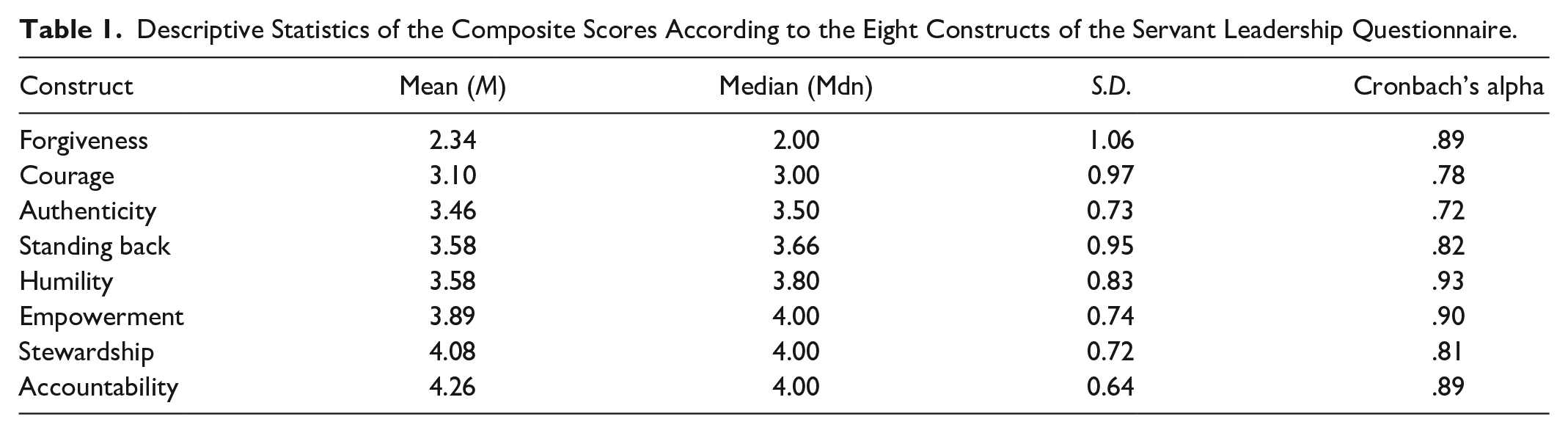
The constructs in Table 1 are ordered from the lowest mean (median) to the most necessary mean (median). The perceptions scores are the weakest for forgiveness and the highest for accountability.
Results for the Organizational Climate Questionnaire
Table 2 provides information about teachers’ perceptions regarding the most prominent constructs of a beneficial organizational climate implemented by school leadership in private schools.
Descriptive Statistics of the Composite Scores According to the 12 Constructs of the Organizational Climate Questionnaire.

The constructs in Table 2 are ordered from the lowest mean (median) to the most necessary mean (median). The scores of the perceptions are the weakest for remuneration and rewards and the highest for the organizational image.
Results for the Correlation Between Servant Leadership and the Organizational Climate of Private Schools
A total of 13 correlations were calculated to investigate the relationship between the servant leadership overall score and the 12 different groupings of the organizational climate. The correlations were all positive and ranged from .251 to .813. Since all the p-values were less than .001, all correlations were statistically significant and indicated a positive correlation between the scores of organizational climate and servant leadership. That is, a high score in organizational climate correlates with a high score on the servant leadership scale and vice versa. In addition, when the eight servant leadership constructs were associated with the 12 groupings of organizational climate, the correlations were all statistically significant (p < .05) except for the construct of servant leadership’s “courage,” which did not correlate with 10 out of the 12 groupings of organizational climate. This specific outcome can be investigated in future studies.
Further investigation of the statistics concerning the correlation between the various constructs under investigation and the participants’ demographics yielded some interesting data, which will be discussed in the ensuing paragraphs.
Gender
Statistically significant differences between female and male respondents regarding servant leadership, transformational diversity, and communication scores were found. In all cases, the mean (and median) score accorded was higher for the males, indicating that males tended to be more optimistic regarding the statements that belong to these constructs than females.
Current job level
Regarding the current job level, a statistically significant difference was found between the category teacher and principal (school management) regarding the servant leadership score, trust score, transformational diversity score, leadership score, communication score, teamwork score, and their view of organizational climate. In all cases, the principals’ mean (and median) scores were higher, indicating that the principals tended to agree statistically significantly more with the statements that belong to these constructs than the teachers.
Significant differences were also found between the categories of teacher and vice-principal regarding the servant leadership score, job satisfaction score, employee wellness, teamwork, and organizational climate score. In all cases, the mean (and median) scores were higher for vice-principals, indicating that the vice-principals tended to agree statistically significantly more with the statements that belong to these constructs than the teachers. Differences were also found between the categories of teacher and HOD regarding the servant leadership score and teamwork. In both cases, the mean (and median) scores were higher for the HODs, indicating that the HODs tended to agree statistically significantly more with the statements that belong to these constructs than the teachers.
It was interesting to note the difference in opinion between school management members. HODs differed from principals regarding the servant leadership score. Principals showed higher mean (and median) scores, indicating that principals tended to agree statistically significantly more with the statements that belong to these constructs than the HODs. The HODs did not share the same view as vice principals regarding job satisfaction, employee wellness, teamwork, and organizational climate. In all cases, the mean (and median) scores were higher for the vice principals, indicating that the vice principals agreed statistically significantly more with the statements belonging to these constructs than the HODs.
Years experience
The results indicated no significant differences in the groups’ years of experience (1–5, 6–15, and more than 15 years). This applied to respondents from both primary and secondary private schools.
Category of schools
The primary and secondary schools showed a significant opinion difference regarding the different scores of servant leadership, training and development, transformation diversity, communication, work environment, and organizational climate. In all cases, the mean (and median) were statistically significantly higher for primary schools, indicating that the teachers were more optimistic about the specific constructs measured.
Discussion
This research established that private school leadership demonstrates the servant leadership characteristics of which empowerment, accountability, stewardship, and humility were perceived as the most practiced characteristics. It was concluded that the organizational climate categories of leadership, teamwork, work environment, and organizational image were alleged as priorities that augment a positive organizational climate in the private school setting. A substantial strong positive correlation was found between the constructs of servant leadership and the organizational climate categories of private schools, specifically between the servant leadership constructs and the constructs of communication, training and development, teamwork, leadership and transformation, and diversity of private schools.
Regarding the practice of servant leadership characteristics by the school management, the current results may well be read because education is humanity’s project of hope (Chang et al., 2016). That school leaders are committed to this project in general. These results are a positive accolade for private schools, as leadership undeniably has a vital role in empowering employees to develop to their optimum potential (Krog & Govender, 2015). Empowerment follows where servant leaders focus on empowering followers and promoting personal development, which includes—among other things—autonomous decision-making, innovative implementation of activities and the sharing of knowledge (Conger, 1998; Konczak et al., 2000; Tuan, 2016). This result correlates with the argument of Kouzes and Posner (2012), who posit that school leadership needs to develop the competence of teachers to enable them to act with self-determination. Stringer and Hourani (2016) also postulate that building teacher capacity is the main task of school leadership.
Accountability means that school leadership gives responsibility for outcomes to teams and individuals while at the same time providing them with the limitations whereby they are free to accomplish the set objectives (Konczak et al., 2000). It is described as “a powerful tool to show confidence in one’s followers” (Van Dierendonck & Nuijten, 2011)—in this case, the teachers. Accountability is rated as an essential characteristic for teachers to possess as mentors of learners (Norris et al., 2017). Organizational stewardship entails that leaders take responsibility for the well-being of their organization and its participants, act as trustees, and inspire followers to do the same (Barbuto & Wheeler, 2006).
Humility involves that leaders do not think less of themselves but to a lesser extent about themselves—they don’t refute their power and are aware that they serve as instruments for their power to be passed on (Kgatle, 2018, Swart et al., 2021). Teachers perceive school leadership to practice humility, a critical strength of private schools (Vera & Rodrigues-Lopez, 2004). The school leadership practice of humility at disadvantaged schools may well lead to teachers, who have to practice multi-grade teaching (Du Plessis & Mestry, 2019), to look at their skills in perspective and acknowledge they can benefit from subject experts to become more and more subject specialists to the benefit of their learners (Kgatle, 2018). The concepts of forgiveness, courage, and authenticity ranked at the bottom, with forgiveness the lowest. These lowest ranking results may well be since most school leaders are used to bureaucracies and are not used to taking risks—some would say they do not even dare to be authentic (Levy et al., 2016; Moorosi & Bantwini, 2016).
Regarding the organizational climate, the orgnizational constructs of leadership, teamwork, work environment, and organizational image, and stood out as primacies of school management as perceived by the respondents. This may indicate school leadership that understands the necessity of these constructs to keep on moving forward to create successful environments. These findings correlate with those of Yuniarto (2018), who posits that leadership is crucial to improve the organization’s activities in totu. Positive evaluation of the competencies and effectiveness of leadership promotes the dedication of devotees (Van Dierendonck et al., 2014). Personnel who experience a positive organizational climate are pleased to be associated with the organization and serve as good marketers to promote their organization (Herrbach & Mignonac, 2006). Where the organizational environment is perceived positive; employees participate effectively at work (Robbins & Judge, 2015). Unified team members work together to accomplish the set objectives and this coherence trickles down to the support of other groups within the work environment (Chiniara & Bentein, 2016).
The aspects of trust, transformation and diversity, job satisfaction, and performance management also featured strongly. Teachers’ perception was that school leadership treats everyone equally in their management of employees, which leads to leadership being trusted. The outcome also indicates that school leadership understands, accepts, and are prepared to support transformational strategies and enterprises (Swart et al., 2021). This supports the view of Fullan (in Baldomir & Hood, 2016) that the approach to change adopted by leadership may determine the success of the change process. With the positive attributes accorded to leadership as revealed in the current study results, the outcome can only be that employees are satisfied with their career and value performance management. The aspects of training and development, employee wellness, communication, and remuneration and rewards scored the lowest regarding school management and organizational climate. This may well be due to respondents being so used to good training and development, practical communication, and reasonable remuneration compared to the experience of their public-school counterparts that they do not perceive these aspects as significant. Likewise, the low ranking of employee wellness may well indicate that teachers are content with their circumstances. This would support the finding of Broj et al. (2018) finding that effective leadership reduces employees’ turnover intention.
A significant strong positive correlation was observed between servant leadership and all the constructs of organizational climate, of which communication, training and development, teamwork, leadership, and transformation and diversity graded the highest. Teachers at private schools perceive servant leadership as a component that creates a constructive organizational climate that correlates with Sanchez et al. (2020). A positive school performance climate is generally where teachers observe that leadership is engaged in leadership practices. Research has revealed that servant leadership may inspire the organizational workforce to develop positive assessments about their work at the organizational (Wahya et al., 2019). Servant leadership creates a ripple effect that moves from the leadership to the workforce, generating increased enthusiasm that translates into improved work performance (Stollberger et al., 2019). This study found that teachers alleged the servant leadership approach as playing a constructive role in encouraging teamwork. This correlates with Liden et al. (2014) who propose that servant leaders impact individual and team performance. The distinct focus of a servant leader on serving followers’ needs and their practice of cohesiveness can indeed advance team performances (Chiniara & Bentein, 2016). Organizations worldwide have restructured teams to achieve rapid response in accomplishing goals, and private schools have also made this quantum leap (Kozlowski & Bell, 2013). The positive perception of communication indicates that school leadership understands communication as the aorta of a booming organizational climate (Swart, 2018). This correlates with Cojocaru and Constantin (2010) conclusion that communication management is the backbone of executive leadership and supports attaining goals.
The findings indicated that teachers differ significantly from principals, vice-principals, and heads of departments regarding their perception of the practice of certain constructs of the servant leadership paradigm (trust, leadership, communication, teamwork, job satisfaction, transformation and diversity practice, and employee wellness) as well as the organizational climate construct. These differences may well be due to the Dunning-Kruger effect, which entails that school management can overestimate their ability due to a cognitive bias of illusory superiority resulting from the inability of people to recognize their lack of knowledge (Kruger & Dunning, 2009). The leadership of disadvantaged schools can learn from this and not overestimate their ability to bring about transformation in their challenging context. It may be more beneficial to be humble enough to receive guidance from others and strengthen their skills. The same principle applies to the Ministry of Basic Education. Primary and secondary schools showed a significant difference of opinion regarding specific categories of servant leadership (training and development, transformation diversity, communication, and work environment) and organizational climate, with primary school teachers more optimistic about these constructs being displayed.
Implications
The results may lead to a few managerial implications for public schools, especially the previously disadvantaged school environment. First, the construct of empowerment—if implemented by school leadership of poor schools—may well motivate teachers to walk the extra mile to enhance the success of those learners who experiences barriers to learning (Walton et al., 2009)—and not only be “clock watchers” who are not as committed as teachers who love their profession and enjoy the educational arena (Maddock & Moraun, 2018). Secondly, where school leadership of disadvantaged schools implements, models, and guides the construct of accountability those school could motivate teachers to take up their responsibility of accounility and organizational stewardship and implement those constructs to the benefit of their learners. They would support learners to overcome difficulties and assist them the necessary help to overcome challenges, as a few of these learners are encouraged by their parents (Du Plessis & Mestry, 2019). These teachers may convey hope and be determined to not be guilty of absenteeism which they encounter due to the reality of hopelessness they face due to their and their learners’ circumstances (Maddock & Moraun, 2018; Swart et al., 2022). Thirdly, as leadership and teamwork showed a positive association with the organizational climate of schools, the Ministry of Basic Education and leadership of disadvantaged schools need to take note of the effects and power of the constructs of leadership and constructive teamwork, to move forward on the journey to create more successful teaching and learning environments.
Fourthly, regarding the relationship between the work environment and the school climate, the Ministry of Basic Education needs to understand that improving teachers’ work environment in disadvantaged schools is critical to give learners a fair chance of success (Maddock & Moraun, 2018). Fifthly, concerning improving the disadvantaged schools’ climate, effective leadership could create trust, good communication lines, and implementation of moral values at those schools (Victor, 2009). Trust in the leadership may encourage teachers to take initiatives to improve their and their learners’ circumstances (Swart et al., 2021). The mentioned skills may well be transferred to leaderships and teachers via development and training sessions provided by the Ministry of Basic Education to all role players. Lastly, disadvantaged schools may benefit from knowledge sharing regarding the paradigm of servant leadership and effective teamwork. Operative teamwork can enhance leadership focus by distributing tasks, influencing all learners rather than a single talented individual (Bush & Glover, 2016). In this regard, it is called upon the leadership in Basic Education to urgently convey to disadvantaged schools that they play a crucial role in inspiring team-centered school leadership (Barnett & McCormick, 2012). Although the construct of servant leadership may not solve all day-to-day challenges posed to school leadership, such as limited resources, it may well serve as a supportive paradigm that motives role players to take ownership of their challenges with resilience.
Conclusion
The school servant leadership modeling influences the school climate of private schools constructively (Swart et al., 2021). Teachers are empowered by quality mentorship to take responsibility for their accountabilities and act as reliable stewards who choose to serve learners with humility on their journey to success. The school climate gains from constructive leadership, teamwork, and a work environment that can enhance the goals of the education sector. It is believed that this study contributed to the research of the paradigms of servant leadership and organizational climate. It is believed that the outcomes of this research can serve the public-school environment, and especially the disadvantaged schools, to assist the South African school system overcome the current profound challenges.
Limitations and Recommendations
A significant limitation of the current study is that findings were attained from only one private school entity in South Africa, which means that attempts to generalize the results must be considered with caution. It is recommended that the construct of servant leadership and its possible influence on public schools’s organizational climate be rigorously investigated, especially its potential for implementation on multiple levels. The education departments of all universities might contemplate including a detailed study of this paradigm in their curricula of school management for future teacher-leaders. Primary and secondary schools showed a significant difference of opinion regarding specific categories of servant leadership (training and development, transformation diversity, communication, and work environment) and organizational climate, with primary school teachers more optimistic about these constructs being displayed. It is recommended that further studies investigate this phenomenon in more detail as it may provide essential pointers toward improving the educational system overall within private- and public-school environments. As servant school leadership shapes a constructive organizational climate where teachers and learners are inspired to succeed, the same results may well occur in the case of disadvantaged school leaderships. With supervision from the leadership in Basic Education, a more beneficial school environment for disadvantaged schools may well be achieved with fewer barriers to success for learners.
Supplemental Material
sj-xlsx-1-sgo-10.1177_21582440221096653 – Supplemental material for Roll Up Your Sleeves: Servant Leadership as a Paradigm for the Challenging South African School Context?
Supplemental material, sj-xlsx-1-sgo-10.1177_21582440221096653 for Roll Up Your Sleeves: Servant Leadership as a Paradigm for the Challenging South African School Context? by Christo Swart, Lidia Pottas, David Mare and Marien Alet Graham in SAGE Open
Footnotes
Declaration of Conflicting Interests
The author(s) declared no potential conflicts of interest with respect to the research, authorship, and/or publication of this article.
Funding
The author(s) received no financial support for the research, authorship, and/or publication of this article.

Supplemental Material
Supplemental material for this article is available online.
References
Supplementary Material
Please find the following supplemental material available below.
For Open Access articles published under a Creative Commons License, all supplemental material carries the same license as the article it is associated with.
For non-Open Access articles published, all supplemental material carries a non-exclusive license, and permission requests for re-use of supplemental material or any part of supplemental material shall be sent directly to the copyright owner as specified in the copyright notice associated with the article.
