




Abstract
The recent shift from the traditional design of citizens’ housing in the United Arab Emirates, with its generous habitable spaces, to a more compact “modern” design has been experienced in the federal housing program in the country. Despite taking the social needs into considerations, the modern designs of this housing category have been professionally developed without genuine residents’ participation especially the young Emirati women (between 18 and 24 years old) who are considered the backbone of the new Emirati families benefiting from this housing program. The research poses this question: How can young Emirati women effectively participate in the pre-occupancy evaluation of the design of the “modern” housing models? To answer this question, the comparative potentials and constraints of utilizing both the simple versus the advanced Virtual Reality (VR) design participatory tools were investigated on a design of a selected model house. Both tools have shown the same trend for the overall satisfaction/dissatisfaction of the house architectural style, the suitability of the functional areas, the spatial organization, and the sizes and numbers of windows as a source for daylighting. Still, the use of the VR has elaborated the respondents’ perceptions and hence changed some responses form satisfaction to dissatisfaction or neutral. Some technical difficulties associated with utilizing the VR tool render it a non-inclusive participatory technique. Finally, it seems that an ideal pre-occupancy evaluation tool for involving young Emirati women in their housing design is through exploiting a hybrid participatory technique combining both simple and advanced VR tools. This could accurately facilitate the pre-occupancy evaluation process while helping save some cost and time.
Introduction
Housing programs allocated for Emirati citizens in the UAE have started in 1971 with developing houses for nomadic and urban citizens. Among the various local housing authorities and programs that are currently responsible for developing citizens’ housing in the different Emirates are Abu Dhabi Housing Authority (ADHA) in Abu Dhabi, Mohamed Bin Rashid Housing Establishment (MBRHE) in Dubai, and local Housing Programs in the northern Emirates. Meanwhile, the Sheikh Zayed Housing Program (SZHP) is a federal housing authority established in 1999 to be responsible for developing professionally designed housing projects with subsidized housing units for citizens on low-income in all Emirates. Additionally, the SZHP allows better-off citizens to apply for interest-free loans which they could pay back in easy installments over 25 years (Unified Housing Portal, 2018, The United Arab Emirates’ Governmnet Portal, 2020).
Until 2005, most of the one or two floors housing units for Emirati citizens were developed on ample area plots of about 45 m × 45 m and 45 m × 60 m with gross floor areas ranging between 360 and 430 m2. As shown in Figure 1, the model house in this phase had a “fixed” design where the possibility of extension and/or change was not actually considered (Galal Ahmed, 2011).
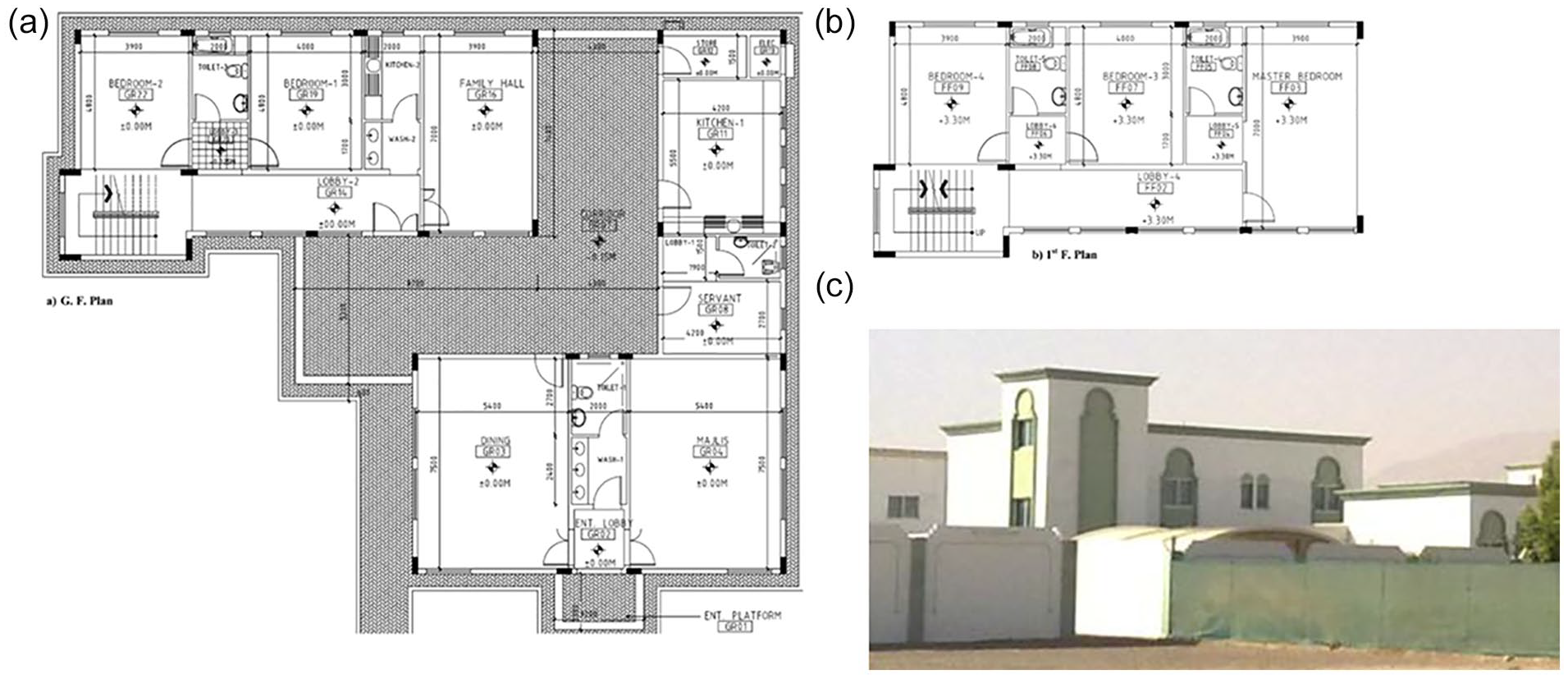
A commonly developed traditional citizens’ housing model design in the UAE: (a) ground floor plan, (b) first floor plan, and (c) exterior Façades.
In terms of its spatial organization, the design of the model houses usually contained three distinctive functional zones. The first zone is allocated for male guests, where it includes a vast reception hall (known as Majlis) connected to a dining hall, with an attached toilet and washbasins. The second zone is allocated for the house service/servants and includes besides a wide kitchen, a store, and a servant’s bedroom with a toilet. It also has access to the dining hall in the male guests’ zone. The first and the second zones occupy a separate one floor mass (Figure 1a). Meanwhile, the third zone is a family wing that contains a family living and bedrooms on a two-floors separate mass for privacy (Figure 1a and b; Galal Ahmed, 2021).
This traditional citizens’ housing phase has ended by 2005 due to the diversion of the UAE’s local and federal governments toward adopting more sustainable urban forms of housing development. The current citizens’ housing phase has been conceptualized with more compact and efficient designs where the areas of the housing plots decreased to about 36 m × 30 m or less, and the built-up area of the house reached to about 200 m2 for the one-floor housing models and to about 380 m2 for the two-floors housing models. Even though the housing models in this phase have different internal and external “modern” designs, the spatial organizations have almost kept the same three separated zones of the traditional design (male guests, service/servants, and family zones) that are subtly separated by lobbies and doors.
On the other hand, the residents have not directly participated in the design process of these housing models, which are mainly prepared by professionals on all design levels. But, in some recent projects, residents have been given the chance to select among a limited number of typical design models and/or architectural styles of the facades of their allocated houses (The United Arab Emirates’ Governmnet Portal, 2020). To facilitate this selection process, a website by the SZHP was launched to allow the prospectus residents to select among the predesigned house models based on their preferred house area, that is, actually confined by the number of family members and the financial affordability of the applicants (Sheikh Zayed Housing Programme [SZHP], 2020).
On the other hand, involving residents in the design process of their houses has been widely advocated all over the world as an essential pillar for realizing socio-culturally sustainable housing that could satisfy the specific social needs and cultural values of the residents (Congress for New Urbanism [CNU], 2018; Galal Ahmed & Parry, 2001; Sustainable Cities Institute, 2019; Transit Oriented Development Institute [TODI], 2019; UN Habitat, 2019). It is contended that when they are given the control over the design decisions of their houses, residents would be able to credibly address their real needs and accordingly contribute to shaping their housing environment (Jones & MacDonald, 2004; Smart Growth Network, 2019). Such active community participation would support local culture of its residents and create greater sense of responsibility, belonging, and satisfaction toward the local built environment (Aigbavboa & Thwala, 2011; Ammar et al., 2013; Galal Ahmed, 2012; Leung, 2005; McGill University, 2020; Reid, 2000).
In that sense, socio-culturally sustainable housing cannot be realized without empowering residents in general and women in particular. The recognition of the significance of women empowerment in all walks of sustainable development, including sustainable housing, has been globally asserted in recent international debates (UNESCO, 2019). This seems a realizable goal in the UAE especially with the officially adopted strategy for the empowerment of Emirati women through pushing all government agencies, private entities, and civil society organizations, to enable a dignified living for women by making them active participants in the country’s sustainable development process (National Media Council, 2018). This has been reflected in the UAE’s local agenda for realizing the United Nations’s 17 Sustainable Development Goals (SDGs) by 2030, especially the fifth SDG that aims to empower women and achieve gender equality. The target 5.5 of this Goal is to “Ensure women’s full and effective participation and equal opportunities for leadership at all levels of decision making in political, economic and public life” (United Nations, 2019).
The local consideration of the issue of the active involvement of women in all decision-making processes, including housing, resonates with the recent progress made in women’s development and success in the UAE as attested by several women associations in the country (Krause, 2009). Conventionally, Emirati women have always been the backbone of the Emirati family life, its social structure, and the nation’s Islamic heritage and national culture (Ministry of State for Federal National Council Affairs [MFNCA], 2008). While most Emirati women are currently well educated, thanks to the distinguished governmental efforts, but according to Jeffery (2018) Emirati women still consider the family as the core of their life, where they usually take their life decisions based on their prioritized familial duties. In recognizing this fact, the SZHP adopted a policy for prioritizing Emirati women’s needs in housing given their various marital and social status through the provision of housing units specifically allocated for Emirati single women, orphans, widows with kids, divorced with kids, married to non-Emirati citizen, and other women categories (The United Arab Emirates’ Government Portal, 2020). Still, the involvement of the Emirati women in the design of the recent modern citizens’ housing models is largely missing, and this research is a humble attempt to bridge this gap through exploring the appropriate tools for involving young Emirati women in the decisions affecting the design of their housing units, that goes beyond the current mere selection of a preprepared design model, and/or its architectural style.
Research Objectives and Main Question
The research main objective is to help the SZHP, the federal Emirati citizens housing authority in the UAE, enhance the responsiveness of the designs of its housing models through considering the opinions of the young Emirati women with an age range between 18 and 24 years, that is, close to the marriage age in the UAE. This could be achieved through defining the suitable participatory tools that could be used to identify the opinion of young women regarding various features of housing design in a pre-occupancy manner before considering these designs for construction.
Pre-occupancy evaluation seems to offer a genuine mechanism for involving the young Emirati women in the design process of citizens’ housing models. Unlike the well-known post-occupancy evaluation with its long worldwide experience in housing (see e.g., Chen, 2003; Husin et al., 2018; Ilesanmi, 2010; Jiboye, 2012; Ziama & Li, 2018), pre-occupancy evaluation helps assess the responsiveness of the housing designs to the residents’ needs, while still in the design phase. Hence, it helps avoid developing housing, that is, not satisfying these needs. In addition, exploring residents’ satisfaction, and modifying the designs accordingly, before starting the construction process helps reduce cost and time due to the later needed amendments of the irresponsive designs of the housing units (Atiyat et al., 2020). Nonetheless, pre-occupancy evaluation remains a starting point for involving Emirati women in the design of their residential built environment, that should be followed by other tactics for more genuine involvement. As suggested by Lee (2006) genuine involvement in the house design process requires a shift of designers’ tasks from “producers” of design models to “facilitators” of credible social inclusion in the house design process.
Accordingly, the research poses this question: How can young Emirati women participate effectively in the pre-occupancy evaluation of the design of the citizens’ housing models? As detailed below, the comparative potentials and constraints of utilizing both the simple versus the advanced participatory tools in housing design were investigated to answer this question. This intentional comparison is envisaged to reveal the most appropriate tool that could lead to efficient involvement of young women in the design process of their housing units.
Research Method and Investigation Tools
Conventionally, community participation in housing design has been facilitated through various verbal and visual methods. Among the frequently used verbal techniques are interviews, focus groups, and “speak out” meetings where officials can listen to members of the local community and they both mutually ask and answer questions. However, visual techniques, including interactive displays made up of plans, photos, or models, usually encourage broad involvement and interaction among the concerned stakeholders where all views and ideas of the participants are usually displayed for all (Ministry of the Environment, New Zealand Government, 2009). Accordingly, this research adopted the visual and verbal techniques as the “simple” and the most cost efficient conventional participatory tool but through individually showing and explaining to the participating woman print-outs of the enlarged colored drawings of the plans and the perspectives of the house that they are were asked to assess through the pre-occupancy evaluation sessions.
Assumingly, at the other end of the participatory tools scale bar is Virtual Reality (VR). VR has been recently advocated and utilized as the most appropriate tool for facilitating residents’ participation in housing design and its pre-occupancy evaluation. VR is briefly a visualization technology that offers a three-dimensional digital medium, which can be used to develop and review design options in any design or construction stage (Bouchlaghem, 2004). It is maintained that the need for the VR as a participatory tool chiefly stems from the significant problems facing the conventional “simple” methods for involving local community in the design process, including the lack of common language between professionals and laypeople, and the inability for laypeople to read and fully understand the design drawings. Also, while a 3D model on a computer or even a smartboard can help visualize the built form of the house itself, but it cannot help people visualize this built form in its actual dimensions (Reinwald et al., 2014). Through this advanced tool, digital design elements could be easily converted into a virtual reality world that gives context to digital information (Autodesk, 2018). Thus, residents can virtually walk around the built form and look up or down, just as they would do if it was there in real life. Ho (2019) added that VR technologies are now more commercially feasible, thanks to the recent technological advancement and affordability of the related hardware and software. Nowadays, the VR applications are steadily wide spreading and are showing dynamic development that can support effective community participation especially in architecture, construction, urban, and landscape planning (Bucolo, 2001; Navinchandra & Patel, 2002). But from another perspective, compared to the simple convectional participatory tools, the VR advanced tool will obviously impose more cost, time, effort, and logistics needed for the provision of the required hardware and software, the preparation of VR digital models, the provision of a space for the VR equipment, and training the residents on using the VR controllers.
The research adopted the pre-occupancy evaluation for a recent “modern” Emirati housing model design developed by the SZHP with a selected sample of young Emirati women, as detailed below, comparatively utilizing both the simple and the advanced VR participatory tools. The ultimate goal is to reveal the most suitable and effective tools for involving young Emirati women in the design process of citizens’ housing models. The advanced VR participatory tool was initiated through first developing a “digital twin” of the selected housing design model using Autodesk Revit 2020 as the Building Information Modeling (BIM) software. To convert the created BIM digital twin model into a VR one, the Enscape plugin for Revit was selected because of its user-friendly interface and its real-time rendering feature that automatically converts the Revit BIM model into a visually realistic VR model within the Autodesk Revit environment (Enscape, 2020). Furthermore, it can simply and quickly apply changes in the VR model. The real time rendering and the walkthrough tool of the Enscape plugin allowed the researcher to figure out further enhancement of the created BIM model of the selected model house. It also revealed the clashes and defects within this model itself.
Meanwhile, the HTC Vive set was selected as the VR visualization device for its high definition visuality and its compatibility with the other used hardware and software. A VR-ready gaming laptop, with a powerful Graphics Processing Unit (GPU), was used to efficiently facilitate the operation of the VR system. While an educational version of Autodesk Revit 2020 was used, other software and hardware costed around 2,000 USD. This logistics provided the required “virtual” real scale immersive environment for the participating young women in the pre-occupancy evaluation sessions to help them navigate and evaluate the investigated house design.
Out of the recently designed single-family housing “modern” models by the SZHP, a widely constructed model (Model 04-12), that perfectly represents the design approach of the current citizens housing phase, was selected to undertake the research pre-occupancy evaluation sessions. As shown in Figure 2, this case study model consists of two floors with four bedrooms and a total built up area of about 375 m2. The detailed functional spaces with their areas are shown in Figure 2.
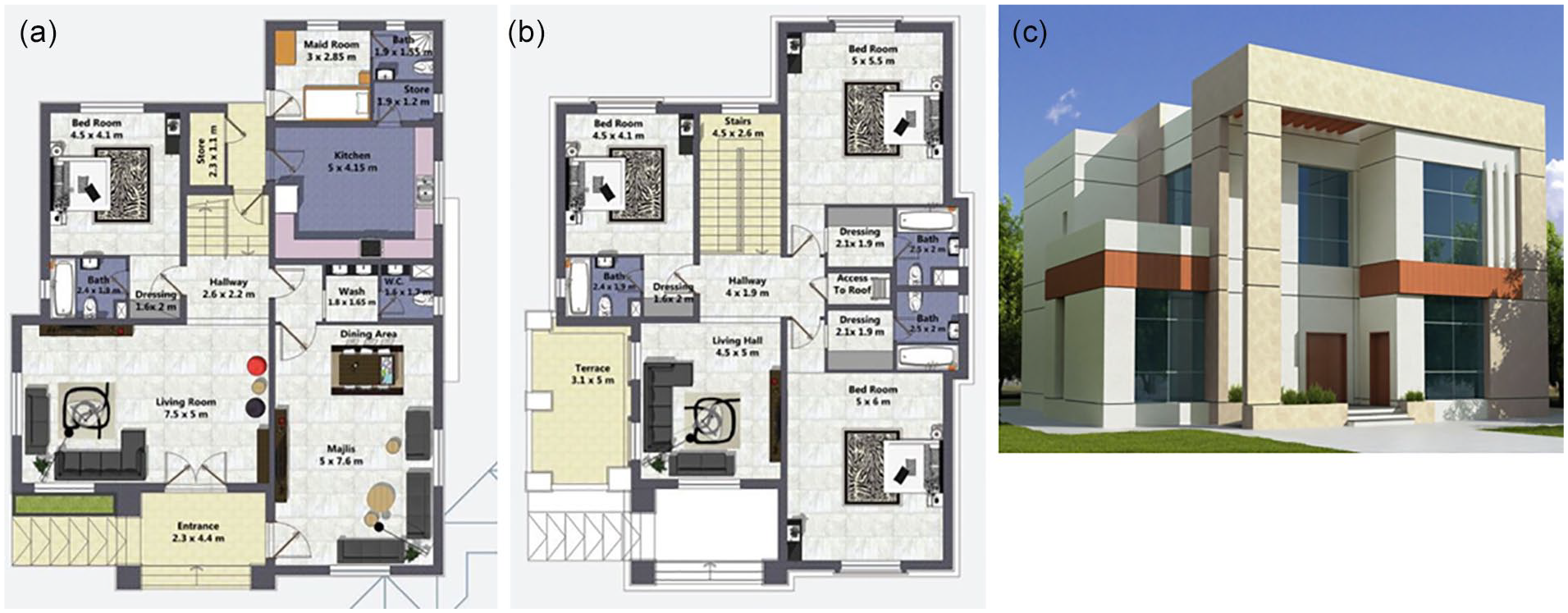
The SZHP single family housing model (04-12) consists of four bedrooms model: (a) the plan of the ground floor, (b) the plan of the first floor, and (c) the 3D drawing.
Both the simple and the advanced VR participatory tools were comparatively applied in this research in two consecutive participatory sessions with each interviewed young woman, staring with the simple tool then the advanced VR tool, to define the efficiency, the potentials, and the constraints faced during experiencing each of them. In both applied participatory tools, the simple and the advanced, each participating woman was asked the same set of questions included within a structured interview-added face-to-face questionnaire initiated to investigate the efficiency of the used tools and to explore to what extent the advanced VR helped in enhancing the perception about the various design components, if compared to the simple participatory tool.
Besides the importance of the overall house architectural style in initiating the sense of belonging and satisfying the esthetic values of the participating women, the appropriateness of various house functional spaces and their spatial relationships, especially in term of privacy, are the most essential aspects of the house design that would allow residents to undertake all the desired activities in a socio-culturally responsive manner. Furthermore, the windows of the house were also evaluated by the interviewees as they are the source of the natural daylighting penetration into the house, which is essential for psychological and mental health of the residents (Beute, 2014). Accordingly, the participatory pre-occupancy evaluation sessions of the studied housing model focused on exploring the opinions of the participating women about:
- The overall satisfaction with the external architectural house style.
- The appropriateness of the areas of the house functional spaces.
- The appropriateness of the spatial organization of the house functional spaces.
- The suitability of the number and size of the house windows.
To facilitate the exploration process, each of these four design aspects was converted into multiple relevant questions in the administered face-to-face structured interview-assessed questionnaire. The sequence of the structured questions followed the same sequence of navigating through the spaces of the selected two floors house model itself, starting from the house entrance and ending with the upper floor spaces. These, of course, are not all aspects that the participating young women could be asked about in the pre-occupancy evaluation of the house design where further issues such as the interior decoration and coloring, etc., are also important but given the limitation of time and effort, the most essential design aspects were explored here while the other design aspects could be conducted in further research. The responses of the participating young women to the questions of the administered questionnaire were quantitively analyzed and interpreted to answer the research question about the most appropriate tools for facilitating the pre-occupancy evaluation of the house design.
The four above-mentioned aspects of the house design were evaluated twice in two consecutive sessions by each of the participating young woman. This started with the simple participatory session, utilizing verbal explanation of colored 2D and 3D drawings of the house and its spaces, followed by the advanced VR participatory session. Given the time consumed in these two lengthy participatory sessions with each interviewed young woman, which eventually lasted for more than 90 minutes in average, a sample of 30 Emirati female university students who currently live in traditional citizens’ housing in different Emirates was randomly selected through an internal advertisement at the United Arab Emirates University (UAEU) calling for volunteering female students. The participating female students were selected from those studying different majors except Architecture to avoid the impact of prior experience in architectural design, so the results could be more generalizable. Selecting participants that are currently living in citizens’ housing projects was meant to pick the societal category who would be most likely living in citizens’ housing once getting married after graduation, as usual. So, they would be expectedly the most appropriate faction of women community who can take part in the two participatory sessions.
Besides the constraints of the long time of the interviews, divided between the simple and the VR participatory sessions, where the research team had to explain to the interviewees who do not have architectural design background about every aspect in the architectural drawings of the house, and the long time consumed in training the interviewees to appropriately use the VR controllers to virtually navigate the house spaces, the limited number of the interviewed sample is attributed to other reasons. First, there are some socio-cultural constraints that hindered gaining access to a wider young women population in local communities in the UAE. Getting a sample form the female students’ community was feasible because the UAEU is the main federal university, that is, allocated mainly for Emirati citizens from different Emirates of the UAE. Second, as the research interviews were undertaken at the University’s VR Lab and based on the applied University rules, it was not allowed to invite interviewees from outside the University. So, the educational status of the interviewees was confined to the University’s undergraduate junior and senior students with the age range limited to that of the university students (usually between 18 and 24 years). This age is actually close to the marriage age in the UAE and because the educational status of the Emirati females is high among this age group, so the sample seems truly representing the targeted women’s category. Third, as the students are generally busy during the academic semester, it was not easy to find volunteering students who accept participating in these prolonged interviews. All these issues affected the total number of the interviewees. Moreover, the budget of the 1-year fund of this research was limited, which also affected hiring a larger number of female Research Assistants or increasing the duration of the research. Accordingly, the results of this research should be perceived within these limitations. Nonetheless, it is hoped that the results of these in-depth investigations would give valid indications about the explored participatory tools suggested for engaging young Emirati women in the pre-occupancy evolution of the designs of their housing units.
After piloting the questionnaire with a couple of interviewees and allowing them to add comments beyond the closed questions, the final list of questions was modified to shorten the time consumed in the interview as much as possible to encourage the participating female students to take part in the interviews and to ease the data analysis. The interviewed female students were busy either with their classes or studying, so the open-ended questions were transformed into closed ones with “yes/no/to some extent” possible replies. On the other hand, encouraging the female students to participate in the experiments were achieved through recruiting three female Research Assistants who have recently graduated from the Architectural Engineering Department at the UAE University, as this helped overcome some socio-cultural communication barriers.
Comparative Application of the Two Participatory Tools: 2D/3D Drawings and VR
The shown 2D and 3D drawings in Figure 2 were used in the simple participatory sessions where the drawings of the assessed housing model, were downloaded from the website of the SZHP (2020), and then were color-printed on A3 size white papers with all needed information on the plans in terms of the names of functional house spaces and their areas. In contrast, developing the VR version of the studied model required much more preparations. First, the selected house model was converted from its original 2D and 3D PDF drawings formats into a BIM digital twin model using Autodesk Revit (Autodesk, 2020). This conversion process was far from being a straightforward process due to the lack of various detailed information in the available drawings that were essentially needed to build the BIM digital twin model precisely. To overcome this problem some assumptions were made by the researcher such as the exact clear ceiling heights, roof parapet dimensions, some doors and windows exact dimensions, and so on. The developed BIM digital twin model is shown in Figure 3.
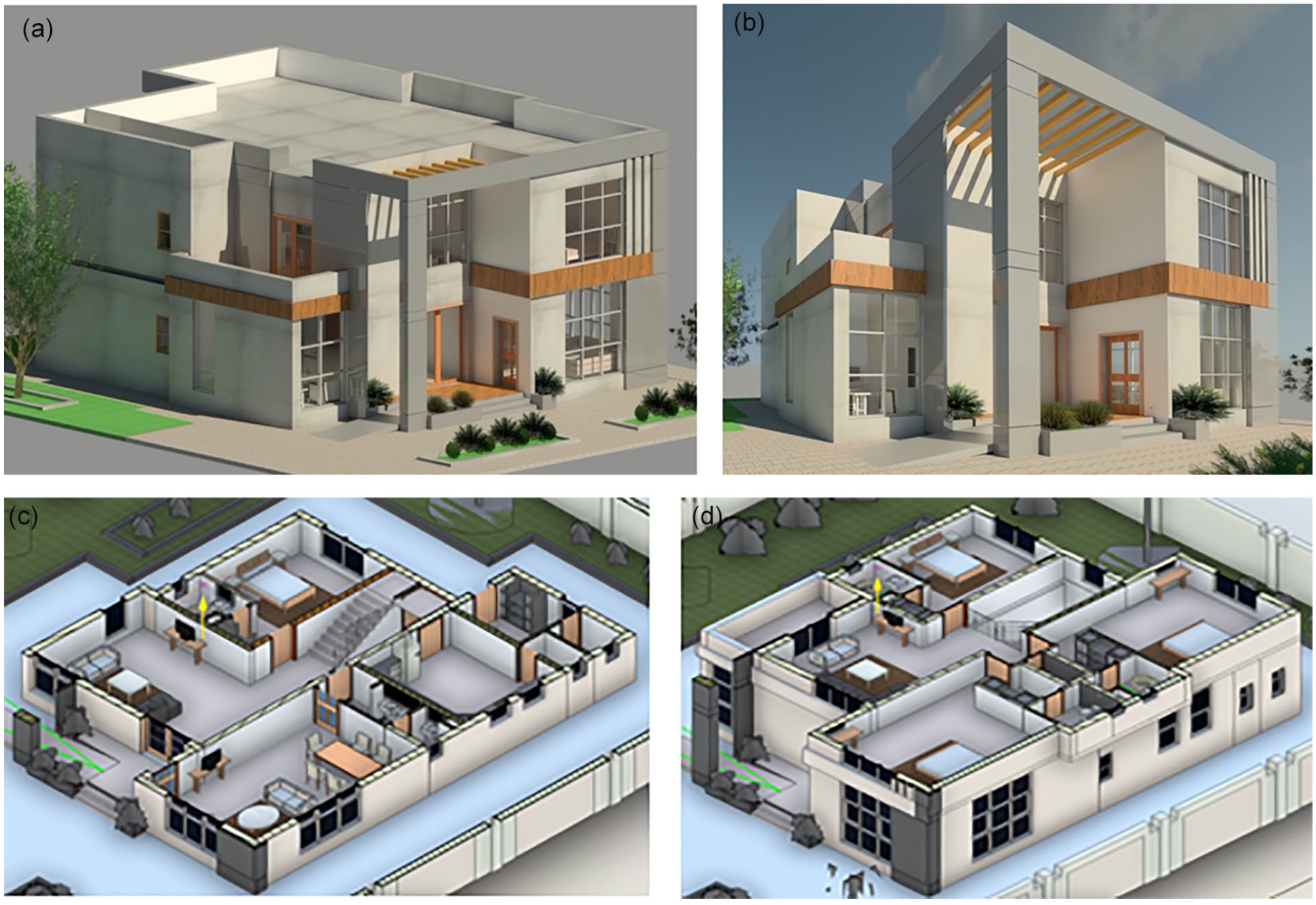
The initiated BIM digital twin model of the studied house: (a and b) the external views, (c) the furniture in the Ground Floor Plan, and (d) the furniture in the first floor plan.
To start exploring the VR model, first, the VR hardware were checked, and the graphics card driver was updated to its latest version. Finally, the SteamVR™ software was utilized to experience a 360° room-scale (HTC Vive, 2020) (Figure 4). Before conducting the interviews with the selected female interviewees, the researcher as the Principal Investigator (PI) had to train the three recruited Research Assistants, who later were responsible for training the female interviewees on how to navigate the virtual house spaces horizontally and vertically through using the handheld controllers.

Some VR scenes of the exterior and interior functional spaces of the explored house.
For the first couple of interviews, it has been observed that the time consumed in the interview far exceeded the time that the interviewed female students agreed to spend in the two-sessions interview (30–45 minutes). The main challenge though was the ability of the interviewees to undergo the VR session, especially for those who have not used such VR devices before. Wearing the VR headset for a relatively long time caused exhaustion and dizziness for some female students, which resulted in considerable delays. Based on these observations, it was decided that the Research Assistants should be ready to help accelerate the VR interview through efficiently controlling the spatial navigation path, thus, decreasing the risk of exhaustion and dizziness, as much as possible. In such a case, the handheld controllers were managed by the practiced interviewer Research Assistants instead, and thus a significant time was saved (Figure 5). Actually, the days spent in conducting these interviews were more than expected because many participating students asked for delaying their interviews due to their other academic duties, while some others apologized for conducting the interviews from the outset. Two students refused to continue their VR interview sessions after feeling too dizzy and were replaced by two other students.

The housing model pre-occupancy evaluation using the VR tool: (a) the interviewee is controlling the navigation of the house spaces and (b) the interviewer RA is leading the VR navigation.
Results
The frequency of the obtained responses from the interviews of each of the two participatory tools sessions were analyzed using Excel sheets and the results were comparatively tabulated to demonstrate the effectiveness of both participatory tools for assessing the four investigated issues as detailed in the following subsections.
The Satisfaction With the External Architectural House Style
Table 1 below concludes the results of the two interview sessions for the pre-occupancy evaluation of the overall external architectural house style of the selected modern design of the selected model house. It shows the responses of the interviewees after first utilizing the simple participatory tool through visualizing and explaining to them the A3 sized colored hardcopies of the 3D drawing of the house model. Also, the table illustrates the responses received after utilizing the VR tool. The results obviously indicated that the respondents’ recognition of the modern house style was identical in both the conventional participatory experiment and the VR one, where in both cases the interviewees liked the modern style of the house with no exception.
The Interviewees’ Responses to the Question About Their Satisfaction With the External Modern Style of the Explored House.



The Satisfaction With the Appropriateness of the Areas of the House Spaces
The suitability of the areas of the 13 house’s functional spaces of the design model were assessed by the interviewees in the two sessions. As shown in Figure 2 above, these spaces were subsumed into eight spaces in the Ground Floor (Entrance Lobby, Males’ Males’ Guest Hall [Majlis], [Family] Living Room 1, Guest Toilet, Kitchen, Store, Servants’ Zone, Guest Room) and five spaces in the First Floor (one Master Bedroom, two Bedrooms, [Family] Living Room 2 with its Terrace). The results of the two interview sessions, utilizing first the simple tools of the drawings and then utilizing the VR tool, are concluded in Table 2.
The Responses of the Interviewees to the Questions About Their Satisfaction With the Areas of the Spaces of the Explored House.



As shown in Table 2, the utilization of the VR tool, in 11 out of the investigated 13 spaces, did not change the overall tendency of the interviewees’ acceptance/rejection. But it rather affirmed slightly or significantly this tendency. In two other cases only (Family Living Room in the Ground Floor and the Store), the VR tool made the interviewees change their opinions from agreement to disagreement. The acceptance of the appropriateness of the area of the Family Living Room in the Ground Floor (28 yes, 2 no) was radically changed to rejection (10 yes, 20 no) after using the VR tool. And, for the Store, the responses changed from 18 (yes), 10 (no), and (2) to some extent, to (4) yes and (26) no. Meanwhile, in only one case, the Males’ Guest Hall (Majlis), the overall acceptance of the appropriateness of the area (18 yes and 12 no) changed to neutral (14 yes and 14 no), after using the VR tool. These results obviously indicate that both participatory tools have successfully helped the female interviewees to evaluate the appropriateness of the areas of the explored house, still the VR tool has enhanced the involvement level of the female respondents through better perception of the house spaces in a “virtual” 1:1 scale that takes the third dimension of space into consideration when evaluating the house spaces.
The Satisfaction With the Appropriateness of the Spatial Organization of House Spaces
Thirdly, the spatial organization of the house spaces especially those affecting privacy, were assessed by the female interviewees. Table 3 concludes the results of the two conducted participatory sessions.
The Responses of the Interviewees to the Questions About Their Satisfaction With the Spatial Organizational of the Spaces of the Explored House.



As illustrated in Table 3, the utilization of the VR tool in 11 out of the investigated 13 explored spaces have not changed the overall tendency of the interviewees’ acceptance/rejection responses. But again, it affirmed slightly or significantly this overall tendency. Significant and moderate increases in the interviewees’ satisfaction after using the VR tool were noticed for the locations of doors in the Entrance Lobby, the Kitchen location, the upper floor Living Room and the location of its Terrace. Meanwhile, the decrease in satisfaction was experienced in the location of the Store under the staircase. So, these changes after the second VR participatory session elaborated the respondents’ perceptions about the suitability of the spatial organization of the house spaces mainly due to the interviewees’ more precise comprehension of the spatial organization of the house when utilizing the VR tool. In only two other cases (the locations of the Guest Room and the Master Bedroom), the opinions of the interviewees were identical before and after using the VR tool.
The Satisfaction With the Number and Size of Windows, as a Source of Natural Lighting
As shown in Table 4, the suitability of the number and size of windows in eight main spaces in the design of the selected house model, where natural lighting (and ventilation) is important, was evaluated twice by the interviewees. These included four spaces in the Ground Floor and three spaces in the First Floor.
The Responses of the Interviewees to the Questions About the Suitability of the Number and Size of Windows.


It was expected that the VR tool would significantly help the interviewees to perceive the effect of the windows, as the source for natural daylighting (and ventilation when weather permits), much better through perceiving daylight in the “virtual” full scale space, where the natural lighting was adjusted in the VR software at 12:00 pm (Figure 3). But this advanced VR participatory tool did not actually change the overall tendency of the interviewees’ acceptance/rejection for six out of the eight spaces as expressed in the first simple participatory session. As in the other investigations above, the advanced VR tool just affirmed slightly or significantly the overall tendency of responses. For example, when the interviewees were asked about the suitability of the number and size of windows in the First Floor Living Room using the simple colored drawings, 22 respondents expressed satisfaction, but after experiencing the same space again in the VR tool session, this number increased to 30. The same results almost apply to the Male’s Guest Hall (Majlis), the Ground Floor Family Living Room, the Guest Room, and all the First Floor Bedrooms.
In only one case, the number and size of windows in the Staircase, the opinion of the interviewees changed from acceptance to rejection after using the VR tool and in another case, the Ground Floor Family Living Room, the overall opinion changed from neutral to rejection. So, while the use of the VR tool helped the interviewees to precisely perceive daylighting in the house spaces, it is still evident that looking at the windows in a plan or a 3D figure was still a valid option in investigating the relevant pre-occupancy evaluation for expected daylighting inside the house spaces.
Finally, Table 5 below summarizes the overall pre-occupancy evaluation results through comparatively utilizing the VR advanced participatory tool versus utilizing the simple drawings one. It is revealed that the professional design was overwhelmingly accepted for the house architectural style. The design was also significantly accepted for its areas of functional spaces except for 3 out of the 13 explored spaces (2 rejected and 1 neutral), after the VR session. Almost the same trend was observed for the evaluation of the spatial organization of the house’s functional spaces where it was accepted for 11 out of 13 spaces but was moderately rejected for only 2 other spaces. Similarly, the number and size of the windows in the eight essential habitable spaces, where natural daylight is fundamental, were widely accepted except for two spaces, one of them was slightly rejected after the VR session. Additionally, the VR tool made the interviewed young women sure about their choices where “to some extent” choice became minimal after the VR sessions.
Comparatively Summarizing the Trend of Responses in the Pre-Occupancy Evaluation Sessions Before and After Utilizing the VR Advanced Participatory Tool.

Conclusions
This research, with its limitations in mind, has comparatively explored both simple conventional participatory tools versus advanced VR tools in pre-occupancy evaluation sessions of a selected modern citizens’ housing model design. The aim was to examine the suitability of both participatory tools for involving young Emirati women in assessing the overall architectural design style of the house, the suitability of the areas of the house’s functional spaces and their spatial organization, and the suitability of the number and size of windows as a source for daylighting into the house.
The findings of this research indicate that the empowerment of young Emirati women, as an already adopted policy in the UAE, could be significantly enhanced by allowing them the chance to take part in the design process of their houses, especially for women with low-income who are usually having limited choice in discussing and participating in the design of their housing units. Despite the female interviewees’ overall acceptance of the “professional” house design in terms of the architectural style, the areas of its spaces and their distributions, and the number and sizes of windows, the pre-occupancy evaluation would help avoid inconsistency, albeit slight, between the professional design and the expectations/needs of the young women inhabitants. This would assure a socio-culturally responsive citizens’ housing “product” of the SZHP either allocated exclusively for women, as per the applied policies (single, widows, divorced, etc.), or for Emirati families, where wives are the actual backbone of these families.
In addition, the results of the pre-occupancy evaluation sessions of the explored design of the selected model house utilizing both participatory tools have successfully depicted the satisfaction/dissatisfaction responses for the discussed issues. Both tools showed almost the same trend for the overall satisfaction/dissatisfaction in most cases. Still, in some limited cases, the use of the VR tool changed the responses form satisfaction to dissatisfaction or neutral. Accordingly, one might claim that the VR tool proved being partially helpful as an advanced pre-occupancy evaluation tool and using it would be a valuable advantage to get precise pre-occupancy evaluations of housing designs. But it could be claimed also that this advanced tool is not a necessity for involving young Emirati women in this design process. Although it was not similarly precise as the advanced VR tool, the utilized simple conventional participatory tool has been largely reliable and much more economic in many aspects, as well.
Even with its proven usefulness in giving more precise reflections of the house design, one could admit that the wide implementation of the VR participatory technique would not be that easy as it might sound. The research revealed a significant technical difficulty associated with the utilization of the VR tool, including feeling of exhaustion and dizziness by some of the participants. This might render such a VR advanced tool a non-inclusive participatory technique. Furthermore, the utilization of the VR tool requires more cost, time, and effort, which are obviously not easy to provide for the citizens’ housing sector with its often burdened budget even in countries with high GDP like the UAE. In addition, the needed training for both the interviewers and the interviewees on using the VR system, and the required spaces and logistics for fitting the VR equipment, especially the base stations, would certainly add more difficulty in adopting the full implementation of such a technique.
In light of these findings, it might be argued that an ideal pre-occupancy evaluation strategy for involving young Emirati women (and maybe other categories of residents) in their housing design process is through utilizing “hybrid” participatory tools combining both the simple visualization tool, especially in evaluating the overall architectural style of the house, in addition to the advanced participatory techniques of VR for other aspects of the design, when feasibly possible. Such a hybrid tools method could considerably facilitate the pre-occupancy evaluation process while helping save some cost and time because there will be no need for developing rendered façades of the evaluated houses as 2D drawings would suffice in his case.
Other participatory activities that include selecting among alternatives of the house design elements, trade-offs among design alternatives, etc., are expected to follow the pre-occupancy evaluation of the original design, where, for example, if in the pre-occupancy evaluation the majority of the interviewees were not satisfied with the area of a specific space then the professional designer is expected to enlarge it, while considering other economic feasibility and constraints for this types of citizens’ housing as developed by public governmental institutions.
Further research is needed to tackle the residents’ participation in the assessment of other design qualities pertaining to Emirati citizens’ housing models, beyond the four investigated aspects. Also, enlarging the sample of the interviewed residents, and considering a wider variety of age/gender groups can be considered in future research. On the technical level, more advanced Virtual and also Augmented/Mixed Reality devices might be tested for an enhanced participatory experience.
Footnotes
Declaration of Conflicting Interests
The author(s) declared no potential conflicts of interest with respect to the research, authorship, and/or publication of this article.
Funding
The author(s) disclosed receipt of the following financial support for the research, authorship, and/or publication of this article: The Emirates Center for Happiness Research at the United Arab Emirates University – Grant Number: G00003226.
