




Abstract
The present study aimed to identify the problems and challenges of water resources use by the agricultural sector. The research conducted a qualitative content analysis on documents and semi-structured interviews with experts and key informants in the study site of Miandoab, Iran. Based on the results, the challenges of water resources use for agriculture include (i) the problems related to water consumption management composed of two sub-categories of encouraging farmers to participate in water consumption management and the problems related to monitoring and controlling water consumption, (ii) the problems of water resources management including the sub-categories of inappropriate management perspective on water abstraction, the problem of managing unauthorized abstractions, the problems of the infrastructure of water allocation scheduling, and (iii) the problems of farmers’ traditionalism whose sub-categories are farmers’ incorrect habits and experiences, low awareness, low motivation, and poor knowledge, as well as the problems related to their farms.
Keywords
Introduction
Water safeguards vitality, economic prosperity, ecological security, ecosystem services, and human civilizations and is the backbone of society development (Novoa et al., 2019; Zhineng et al., 2016). However, rapid population growth, rapid urbanization, increased economic development, unprecedented technological innovations, sharp changes in land cover, and climate change have caused a global crisis of water supply (Johnson et al., 2001). Presently, water resources management is faced with challenges in developing countries due to intricacies caused by the performance of hydrological cycles, socio-economic factors, perspectives, needs, and values of different stakeholders, and increasing concerns over the use of water for different purposes (Gain & Giupponi, 2015; Kotir et al., 2016; Martin et al., 2016; Valizadeh et al., 2018). Additionally, the complicated interactions and dynamic feedback among economic, social, and environmental systems make it difficult to understand the possible consequences of decisions (Sivapalan, 2015; Stave, 2015; Sterman, 2012; Zamani et al., 2016). In the past decades, several water resources management methods have been devised to cope with this global crisis of water resources management, such as water supply management, water demand management, and integrated water resources management (IWRM) (Ataei et al., 2018; He et al., 2020; Izadi et al., 2017).
Water supply management has traditionally played the main role in meeting the increasing demand for water by building dams, reservoirs, and transfer projects in order to deliver water to several users in a certain region. Water demand management emphasizes an institutional approach and water-use saving technologies, that is, soft ways such as water pricing, water rights and markets, saving, productivity improvement, and so on (Gleick, 2016; Izadi et al., 2019). IWRM is globally defined as the systemic investigation of water supply and demand, natural and human systems, and upstream and downstream communications in developing and implementing water resources policies and decisions, as well as the participation of stakeholders in water resources management processes (Allain et al., 2020; Hering & Ingold, 2012; He et al., 2020). Aimed at developing and implementing policies, processes, technologies, leadership, and organizations to understand, distribute, and improve water resources movements and characteristics to satisfy the diverse needs of human communities and ecosystems within a social responsibility, water resources management is economically sustainable and environmentally compatible (Ataei et al., 2021; He et al., 2020). Various studies have addressed the problems of water resources management in different parts of the world and have made some recommendations (Christian-Smith et al., 2012; Gleick, 2008, 2016; Hoornbeek, 2004; Liu et al., 2013; Pulido-Velazquez & Ward, 2017; Xia, 2012).
The implementation of IWRM requires performing policymaking, planning, and management as consecutive steps. The next steps include the assessment of water management issues (the issues of water resources management, the issues of water consumption management, and farmers’ traditionalism in the study site), the development of a strategic road map (how issues should be solved), the assessment of each strategy, the selection of a strategy or a combination of strategies, the development of an executive plan, the development of strategic executive operation, the appraisal and monitoring of outputs, learning from outputs, and revisions in the plan for future (Figure 1).

The IWRM framework for basin management.
These steps constitute a cycle. The cycle may, however, be cut by external pressures in practice. Nonetheless, the education management cycle in action allows learning in the process of planning and water management and using new information acquired. This means that water management can be adapted to changes in conditions, for example, policy changes, natural disasters, and population changes.
To successfully implement IWRM, the systems in charge of the development, management, and delivery of water-related services in society should be comprehensively accountable, responsible, and transparent, and should adopt a systemic view. This means that water resources should be managed by the informed participation of stakeholders, reflection on the lessons learned, and revision in policies and behaviors. It should also be noted that water resources management policies should be aligned with the development strategy and governance approach of the country. In fact, the development of clear and precise policies is usually the first step toward ensuring integrated water resources management in practice.
In addition to delivering economic, social, and cultural values, agriculture should also provide food for the growing population of the globe and supply necessary ecosystem services (Ataei & Zamani, 2015; Chaudhary et al., 2018; Ghadermarzi et al., 2020; Howden et al., 2007; Thornton, 2010). Agriculture is the main consumer of water resources throughout the world so that it accounts for about 70% of the total directly extracted water and about 90% of the indirect consumption (water evapotranspiration and water extracted from the system) and this affects water infiltration, soil moisture pattern, and runoff generation (Konar et al., 2011; Li et al., 2016; Novoa et al., 2019; Russo et al., 2014). It is projected that agricultural water demand will have been increased by 55% by 2050 with a specific increase in emerging economies and developing countries, which have presently less water stress (Gerten et al., 2011; Wang et al., 2016). As far as the increased water demand for agricultural uses is concerned, the sustainability of water resources is crucial because, to feed 9.5 billion people of the world in 2050, the world will need 60% more food (FAO, 2013). The supply of irrigation water is critical for food security (Bowmer & Meyer, 2014; Das et al., 2015) and this will persist in the future too as the share of irrigation in global food production will have been increased from the current value of 40% to over 45% by 2030 (Faures et al., 2007). This is yet of more crucial significance for ensuring harvestable crops in arid and semi-arid regions where annual precipitation is irregular in both quantity and distribution terms (Postel, 1999; Shamir et al., 2015; Singh, 2011). Nonetheless, if there is no planning and sound management, the expansion of irrigation in agriculture may reduce agricultural ecosystems (Han et al., 2011; Tilman et al., 2002). Agriculture is vulnerable to climate change phenomena (Abid et al., 2019; Elahi, Khalid et al., 2021; Tran et al., 2019). Any changes in irrigation patterns, temperature rise, drought periods, and freezing increases the risk likelihood in agricultural activities (Hunter et al., 2015).
Previous literature on agriculture has focused on the perspective of resource use (Elahi, Weijun, Jha, et al., 2019; Elahi, Weijun, Zhang, et al., 2019, 2019), allotment of farmland (Elahi et al., 2020), institutional services to manage agricultural farms (Elahi, Abid, Zhang, Ul Haq, et al., 2018), and socio-psychological factors determining farmers’ intentions to use improved grassland (Elahi, Zhang et al., 2021). Moreover, some studies have focused on the impact of wastewater use on economic losses (Elahi, Abid, Zhang, Cui, et al., 2018) and animal and human health damages (Elahi, Abid et al., 2017; Elahi, Zhang et al., 2017). Agricultural water management is a significant case of sustainable issues. Firstly, it is an issue with hot debates over it throughout the world (Temper et al., 2015). Secondly, water management systems have numerous and fundamental uncertainties (Pahl-Wostl et al., 2007). Thirdly, these systems have experienced copious failures, either socially or ecologically or both (Budds, 2009; Walker et al., 2002), which further necessitates changes (Allain et al., 2020). Given the growing vulnerability of water resources, uncertainties of climate, and complicated governance, effective water management policies should systematically consider a wider range of adaptation strategies from the perspectives of the environment, social institutions, and social-ecological systems, as well as different water resources in different activities such as supply, delivery, use, and outflow (Field, 2014; Larson et al., 2013; Nazemi et al., 2020; White et al., 2015). So, the agricultural sector, especially its irrigation-dependent sub-sectors, is a major player of IWRM (Knox et al., 2018).
Iran is a country located in the arid and semi-arid zone of the world. The recent droughts in Iran have reduced its mean long-term (50-year) precipitation from 254 mm to about 240 mm per annum, which is equivalent to one-third of the mean global precipitation and less than half of the precipitation of the Asia Continent, so it is among the low-precipitation regions of the world (Es’haghi, 2019). The statistics on precipitations and groundwater and surface water resources in Iran, as well as climate change, are also indicative of Iran’s engagement with a huge water crisis, which will cause irreparable damages to the country if not managed properly. Among different dimensions of this water crisis, “the crisis of Lake Urmia” has particularly been manifested. Many factors have been involved in the crisis of Lake Urmia drying, but many experts argue that the role of agriculture, farmers’ behavior, and excessive consumption of water in this sector cannot be ignored in this crisis (Es’haghi, 2019).
Lake Urmia in the northwest of Iran is one of the largest permanent salt lakes of the world and the largest lake in the Middle East (Karbassi et al., 2010). The lake was recognized to be of international importance by the Ramsar Convention (Convention on wetlands of international importance especially as waterfowl habitat) in 1971 and was classified among UNESCO’s nature reserves in 1976 (Kruchek, 2003). The basin of the lake is inhabited by 6 million people and is an important agricultural region (Abadi, 2019).
The present status of Lake Urmia is the result of several decades of unbalanced and unsustainable development in its basin and the unplanned exploitation of its renewable water resources. A combination of human and natural factors, such as the implementation of numerous water resources development projects, the growing development of the agricultural sector, over-abstraction of groundwater tables, changes in cropping patterns across the basin, low productivity of water consumption, and the lack of effective conservation of the basin’s environmental and ecological resources, as well as climatic fluctuations and the decline in precipitation and runoffs, are implicated for the present condition of Iran’s largest inland lake (Abadi, 2019; Alipour & Ghasemi Tangal Olya, 2015; Maknoon, 2014; Salimi et al., 2019; Shirmohammadi et al., 2020).
Based on the geographical classification of basins, the study site in Miandoab is a part of the Zarrineh-Rud River sub-basin from the big basin of Lake Urmia. In the study site of Miandoab, whose annual precipitation amounts to about 254 mm, the total net area of irrigated land is 95,242 ha of which 60,557 ha (63.58%) is cultivated by agricultural crops and 34,685 ha (36.42%) by horticultural crops (fruit trees and ornamental trees). The irrigated agricultural pattern in this region is mainly composed of wheat, barley, alfalfa, sugar beet, and sometimes tomato and the horticultural pattern mainly includes apple trees and grapevine. Alfalfa and sugar beet, whose net water requirements are 7,600 and 7,100 m3/ha, are water-intensive crops that are cultivated in a large area of the land in this region (Yekom Consulting Engineers, 2016). So, it is imperative to use water resources optimally given the role of water in crop production on the one hand and the water scarcity in the study site of Miandoab in the basin of Lake Urmia on the other. Presently, the enhancement of crop production via expanding agricultural land in this basin is strongly restricted by water supply. As such, the only way to meet the growing demand for food is to use water resources extracted for agriculture optimally, increase production per water consumption, and control wastage during crop production and consumption.
So, this research aimed to identify the issues and challenges of the consumption of agricultural water resources in the Lake Urmia basin. A contribution of the research is the use of a qualitative method to accomplish the research goal. Most studies on identifying agricultural water use challenges have employed quantitative methods and few have used qualitative methods. Also, the research focused on the content analysis of reports, documents, interviews with key informants, and the literature. On the other hand, agriculture policymakers, farmers, and executive employees were interviewed. In other words, the research population was composed of diverse groups of people and organizations.
Methodology
The sub-basin of the Zarrineh-Rud and Simineh-Rud rivers in the south and southeast of Lake Urmia is the biggest sub-basin of the Lake Urmia basin with an area of 17,563.4km2, which accounts for about 34% of the total area of the basin. Located between latitudes 35°40′ and 35°44′ north and longitudes 45°31′ and 47°22′ east, this sub-basin covers a great part of West Azerbaijan province and a small part of East Azerbaijan and Kurdistan provinces. In the basin of Lake Urmia, water is mainly consumed in the south (the study site of Miandoab) and east (Urmia) of the lake. Data from the Ministry of Energy show that these two regions account for about 40% of the water consumption of the agricultural sector in this basin (Figure 2) (Yekom Consulting Engineers, 2016).

The study site of Miandoab in the basin of Lake Urmia.
Qualitative content analysis is a method in which messages are interpreted through purposively and regularly defined characteristics (Stemler, 2001). In other words, content analysis is a systematic research method to infer textual data within smaller categories and based on predetermined principles in a replicable and valid way. Accordingly, it tries to recognize facts in order to provide a new understanding and insight of the fact, which will, in turn, guide practical actions (Krippendorff, 2012).
Given the research goal and question, the reports, documents, interviews with key individuals, and previous literature were reviewed and analyzed to attain new insight. So, key individuals from different organizations and agencies, as well as 50 farmers, were selected by the snowball technique to be interviewed about the problems and challenges of water consumption in the study site. The key individuals were from the Agriculture-Jahad Organization of West Azerbaijan province (five people), the Department of Environment of West Azerbaijan province (two people), the Regional Water Company of West Azerbaijan province (one person), the Provincial Government of West Azerbaijan province (one person), the Agriculture and Natural Resources Engineering Organization of West Azerbaijan province (one person), Agricultural Technical and Engineering Service Company (five people), Agricultural Production Cooperative Company (three companies), the Urmia Lake Restoration Program (five people), and Lake Urmia Research Institute (one person). Also, the reports, documents, and previous literature were analyzed. It should be noted that there are no strict rules as to the selection of resources for content analysis, but it is necessary to define limitations for the studied literature within a manageable structure (Krippendorff, 2012).
An important issue in content analysis is the analysis unit. The analysis unit refers to the studied subject. As such, for the sake of coding and inferring meaningful units, each document was selected as a unit of analysis because these documents as a whole were large and extensive enough and were selected as a context for the analysis unit to keep them in mind (Graneheim & Lundman, 2004). On the other hand, the meaning unit as an important part of the analysis is composed of words, sentences, statements, and/or paragraphs that are interrelated on one or more aspects of the context and/or content. The conceptualization was performed at five levels. At first, the meaning units inferred from the resources were conceptualized and summarized. Then, the meaning units were summarized within codes, the codes with similar meaning were classified into sub-categories, and finally, categorizes were formed by reducing the number of the words of the sub-categories with similar meaning with no changes in their meaning. We used the procedure presented in Table 1 for the qualitative content analysis. Also, data were managed and analyzed in the MAXQDA12 software package.
The Procedure of the Qualitative Content Analysis.

To reduce the interpretation errors and improve the accuracy of the results, the reliability and validity of the findings were examined. Reliability is defined as the stability of findings over time and in different conditions, which is obtained by the conformity of the results over replications. On the other hand, validity shows whether or not the results exactly explain the studied phenomenon. In other words, validity refers to the authenticity of the research descriptions and findings and shows the degree to which one can trust the authenticity of the results as to the participants and the fields studied. The reliability and validity of the results were ensured by the triangulation method and were enhanced by using various researchers and methods during the data analysis process.
Results
Water Consumption Manner and Social Relations in the Agricultural Lands of the Study Site
Based on the results of the interviews, the agricultural lands within the study site of Miandoab are divided into two main categories of lands inside the Miandoab irrigation network and lands outside this network. The agricultural lands that are located inside the network do not merely rely on the network’s water resources because the auxiliary network has not been completed yet and it has infrastructural and non-infrastructural drawbacks, so they are irrigated in various ways including the use of the main and auxiliary canals of the network, network drains, streams of the rivers, wells, and portable water-supply pumps located on the canals, drains, and rivers. Naturally, the water consumption system will be different given the diversity of water resources. In the agricultural lands that are located outside the irrigation network, the water requirement is supplied from seasonal rivers and wells.
The Miandoab irrigation network was constructed to supply the irrigation demand of the Miandoab plain using the Norouzlou dam (Figure 3). The main canals MC and RP transfer water from the dam to the lands located on the left and right flanks of the network. The lands watered by the network are divided into nine civil units, each unit is composed of several fields, and each field includes the farms of several villages. In the Miandoab irrigation network, Aras Exploitation and Maintenance Company (AEMC) is in charge of water delivery and distribution services. The main tasks of AEMC include:
supplying, transferring, and distributing the water of the irrigation network and delivering it to the subscribers, and collecting the water tariffs
monitoring and controlling agricultural water consumption in accordance with the cropping patterns, compositions, and density
maintaining the irrigation and drainage network
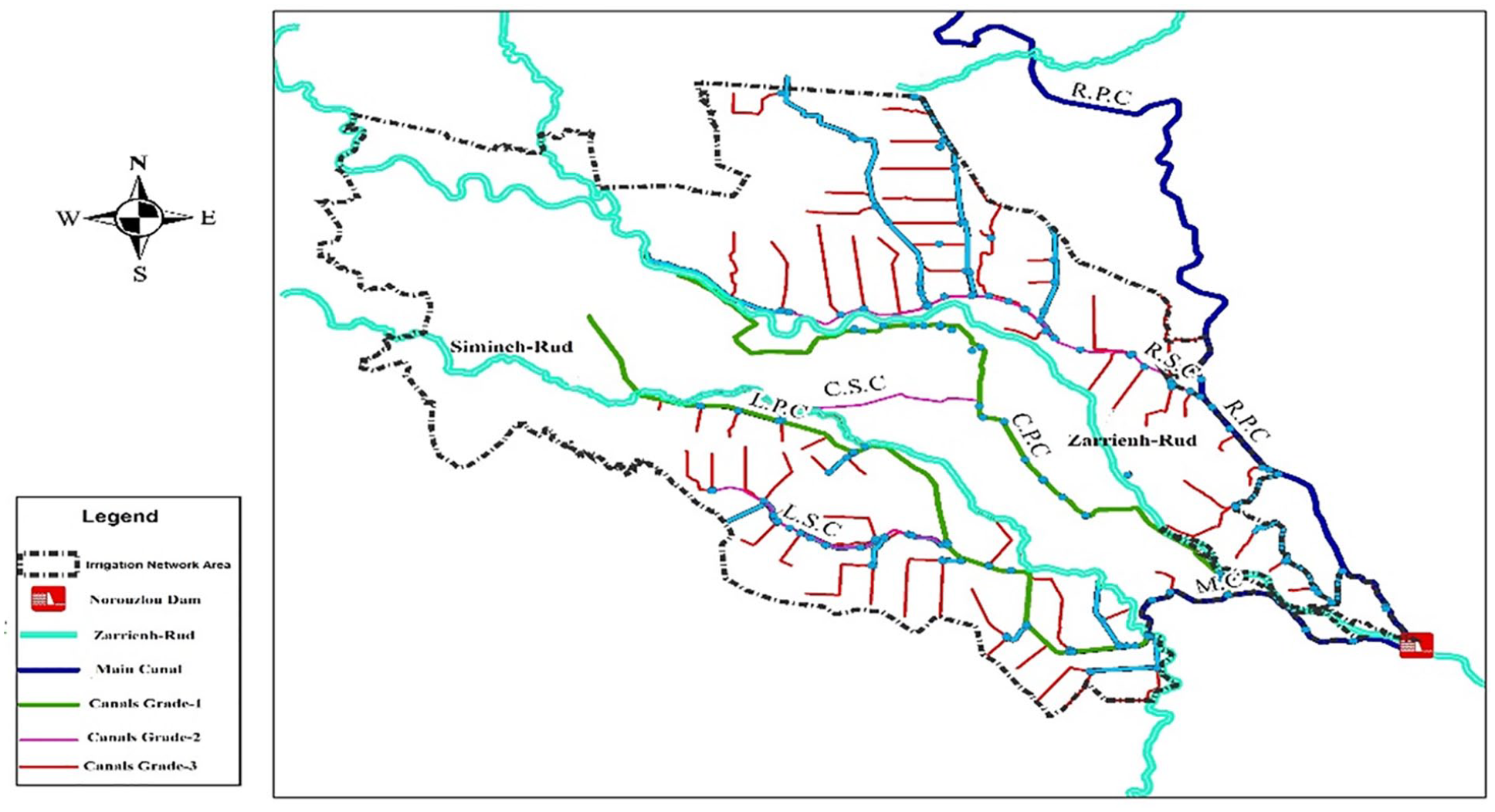
A map of the Zarrienh-Rud irrigation and drainage network in the study site of Miandoab.
The company exploiting the Miandoab irrigation network (AEMC) has organized the transfer canals on the left and right flanks and has assigned a supervisor in each flank to take care of the water distribution. In each civil unit, some water distributers (Mirāb) work under the authority of the supervisors. The number of the Mirābs is determined by the area, the number of subscribers, and the number of farms.
Presently, given the scarcity of water in the growing season, AEMC allocates water to the RP canal and the farms on the right flank of the network and the auxiliary canals of this flank for about 2 weeks and to the MC canal and the farms on the left flank and the auxiliary canals of this flank for 2 days. In the remaining days, it is allocated as the environment water right.
During the water distribution period of the main and auxiliary canals on each flank, the Mirābs open the hatches of the farms on the respective flank to establish water flow from the main canal to the canals grade-2, grade-3, etc. Since the auxiliary canals, especially grade-4 canals, have not been constructed in most civil units or cannot be watered, water is mainly directed down to the grade-2 and grade-3 canals. Furthermore, the hatches of each farm sometimes water the farms of more than one village and cover many farmers, but since the farmers using each hatch are unknown, they cannot be organized and their water consumption cannot be controlled. In other words, the Mirābs merely focus on supplying the water for the watering hatches, and in these conditions, the interaction of AEMC as a water delivering system and the farmers as water receivers has no place, and farmers generally abstract water from the canals in any possible way personally or in competition with other farmers.
One another characteristic of the activities of AEMC is that the Mirābs have no interaction and encounter with the farmers when opening the hatches and this adversely affects water consumption by the farmers. AEMC has mostly focused on identifying the subscribers, determining their cropping type and quantity to release a certain amount of water from the main canals, and calculating their water tariffs based on their data and specifications. Since the interaction of AEMC and the farmers is in the form of seller-buyer, not as the members of a whole with a common goal, it seems that AEMC is mainly concerned about selling the water and collecting the tariffs in accordance with the water stock of each period, and the crucial issue of organizing water delivery and distribution has been overlooked for different reasons. In these conditions, farmers try to supply their water needs in any possible way as they have to meet their crops’ water demands despite the water shortage for irrigating the farms and the defective mechanisms of water delivery and distribution. As such, they use various resources and ways to abstract water from the network including (i) abstraction from the transfer canals and/or main, grade-1, and grade-2 canals, (ii) abstraction from the auxiliary canals, (iii) abstraction from the main and/or auxiliary canals and rivers using portable pumps, (iv) abstraction from drains and their transfer to earthy streams, (v) abstraction from wells, and (vi) the use of pumping stations.
Social relations in the agricultural exploitation system are the mechanisms of communication and interaction between the water delivery management system and water consumption management. The process of realization of social relations in the operation of modern irrigation networks is shown in Figure 4.

The flowchart of the realization of social relations in using a modern irrigation network.
Challenges of the Use of Water Resources in Agriculture
Using the content analysis method, it was tried to review the problems and challenges of water use in the study site enumerated in reports, documents, interviews with key people, and the previous literature in order to gain new insight. It should be noted that although the previous literature contains adequate knowledge as to the problems and challenges of water use in the sub-basin of the Zarrineh-Rud and Simineh-Rud rivers, the research aimed to develop analytical insight into the study site, so inductive content analysis was employed. The results are presented in Table 2.
The Problems and Challenges of Water Use in the Study Site of Miandoab.

Given the main categories extracted from the content analysis, the challenges of water use in the study site include the problems of water consumption management, the problems of water resources management, and traditionalist farmers (Figure 5). The problems of water consumption management are composed of two sub-categories, that is, problems related to encouraging farmers to participate in water consumption management and problems related to monitoring and controlling water consumption. This reflects that there are problems at both levels of water consumers and suppliers, which is related to the lack of mechanisms to encourage farmers’ participation and use their potentials in water consumption management and the weaknesses of water distribution authorities in monitoring the manner and amount of water consumption by consumers.

The problems and challenges of water use in the study site of Miandoab.
The next group of water use problems in the study site is related to water resources management whose sub-categories include inappropriate management perspective on water abstraction, problems related to the management of unauthorized abstractions, problems related to the infrastructure, and problems related to water allocation scheduling. This category considers the managerial aspects of water resources and water allocation planning and emphasizes the lack of infrastructure and the unauthorized abstractions inside and outside the network.
The final category is traditionalism that includes farmers’ incorrect habits and experiences, their low awareness, their low motivation, their poor knowledge, and problems related to their farms. Some key challenges of water use in the study site are the farmers’ old age, land fragmentation, low farm areas, low motivation, incorrect farming and water-use habits, and poor knowledge and awareness of modern agriculture, which play a key role in the problems and challenges of water use.
Discussion
The results revealed that problems related to encouraging farmers to participate in water consumption management and monitoring and controlling water consumption were determined as problems of water consumption management. Elaiwi et al. (2020), de Paiva et al. (2020), and Pešić and Jakovljević (2020) concluded that there were various reasons that contributed to the problems of water resources use in agriculture, climate changes in the last few years, and the mismanagement of the water resources in some developing countries that faced many problems such as the increased demand on water due to the low participation of the farmers and abnormal growth of population, as well as the high river sediment and neglecting the sanitation systems and mix them with rainwater, in addition to discharging them directly to the rivers. Also, Sivakumar (2011), Tzanakakis et al. (2020), and Luo et al. (2020) illustrated that critical issues in the use of water resources included the over-abstraction of groundwater, farmers’ low water use efficiencies, lack of modern systems of control and monitoring of water consumption, and inadequate cooperation among farmers and other stakeholders. Also, Janjua et al. (2021), Colella et al. (2021), and Dhakal et al. (2021) have pointed out that strengthening the institutions and removing mistrust among the farmers are the key elements for encouraging farmers to participate in water consumption management. Roestamy and Fulazzaky (2021) stated that the challenges of managing the optimum use of water resources to fulfill the needs of various stakeholders related to technical issues, institutional frameworks, and regulatory instruments were rooted in the participation of stakeholders.
On the other hand, inappropriate management perspectives on water abstraction, problems related to the management of unauthorized abstractions, the infrastructure, and water allocation scheduling were recognized as problems of water resources management. This is consistent with the findings of Chaudhuri and Roy (2019), Chang (2020), Pešić and Jakovljević (2020), Kulmatov et al. (2020), Sahrina et al. (2020), and Abd Ellah (2020), who have found that the challenges of management of unauthorized abstractions and an inefficient as well as a carefree water-using attitude and weak infrastructures have been proven to drive the risk and need to take strategic precautions. Furthermore, Haryani (2021) pointed to the challenge of simplifying the adoption of conservation and sustainable use approaches to promoting the implementation of practices in local communities. Aivazidou (2022), Aivazidou and Tsolakis (2021), and Benabderrazik et al. (2021) have stated that we need novel solutions for effective water and stewardship that could act toward three main pillars: (i) reducing freshwater consumption and pollution, (ii) eliminating water scarcity risks for both society and industry, and (iii) supporting corporations in obtaining a water-friendly competitive profile.
The results also revealed that the farmers’ traditionalism (included farmers’ incorrect habits and experiences, low awareness, low motivation, poor knowledge, and problems related to their farms) was the main challenge of water resources use in the basin of Lake Urmia. Kakar et al. (2018), Shams and Bin Napiah (2019), Baig et al. (2020), and Pešić and Jakovljević (2020) have also found a similar finding and have stated that there is a need for instantaneous campaigns for training farmers on the efficient use of water and awareness regarding conservation of water resources. They contended that “the traditional farmer cannot, within the means available to him, increase his production. However, it is not only the means available but also the frame of mind the traditional farmer is in. For many generations, farmers have perceived their future possibilities to be very limited, and at times their expectations appeared to vanish into a bottomless pit.” Reinstorf (2021) and Syah et al. (2021) indicated that training people, using people for knowledge and information transfer, and using people as agents to bridge the gap between the global state-of-the-art science and local water resources management can be efficient ways to avoid water loss. Additionally, Wingfield et al. (2021) believed that increased efforts to train farmworkers, local management boards, and individuals about potential solutions to water-related challenges would help improve the efficiency of current practices.
The approaches pertaining to water resources delivery management include the completion of water-receiving points at delivery and consumption points, the development of a job description for the Mirābs of AEMC for water delivery to the subscriber farmers, the delivery of water based on the subscribers’ number and specifications and annual cultivated area and pattern, the establishment of electronic and smart systems of water measurement in main and auxiliary canals, and the maintenance of the main network. The approaches of water consumption management include establishing an exploitation system in water consumption and organizing water users within some associations with the membership of farmers, developing a comprehensive water-use plan, maintaining an auxiliary network with the aid of water-users associations, organizing owners’ land fragments within irrigation units, and determining representatives for the irrigation units. The framework of the target approaches is related to the activities for cropping pattern changes, plant cultivar changes, deficit irrigation, and greenhouse construction. Although these measures will play an essential role in accomplishing the goals of water consumption reduction, they will also influence the use of production factors and change traditional farmers’ income sources. If production cooperatives, water-users cooperatives, or similar irrigation organizations are founded, they can take actions for changing cropping patterns and deficit-irrigation, applying production technology, enhancing farmers’ motivation, knowledge, and awareness, defragmenting lands, and correcting farmers’ incorrect habits for saving on agricultural water consumption.
Given the issues of water resources management, the issues of water consumption management, and the traditional view of farmers in the region, IWRM can contribute to the effective, balanced, and sustainable management of the limited water resources in order to increase economic productivity and social welfare. The indices that should be considered based on the issues identified for the use of water resources in the study site include water data, evaluation tools, management levels, water consumption integration, cooperation level, stakeholders’ participation, awareness, financing, regulations, technical tools, planning, and capacity making. So, the main pillars of the implementation of the IWRM process include
laying ground by adopting suitable policies and regulations for the sustainable development and management of water resources
creating an institutional framework that can be implemented through policies and regulations
encouraging the cooperation of all stakeholders in the management process
providing infrastructure and tools required by the institutions to perform their tasks
Conclusions
The study site of Miandoab is located in the southern and western part of the Lake Urmia basin and accounts for about 40% of the agricultural water consumption in this basin. An increase in cultivated area, a change in cropping pattern from less water-intensive to more water-intensive plant species, an increase in the cultivated area of fruit gardens, and plants’ over-irrigation are some factors responsible for the unbalanced development of the agricultural sector. The study site is composed of two regions—one inside the confines of the irrigation network and the other outside it (the lands that are irrigated by seasonal rivers and streams). Since these two regions differ in water consumption and since there is no modern system of water distribution among the farms outside the network confines, the water consumption procedures in the outside farms are different from those in the inside farms, so they need different approach recommendations. Saving on water consumption in the region outside the irrigation network does not imply the effectiveness of the proposed approaches because the seasonal rivers have very limited water reserves and the farmers will be able to abstract water only in the two first months of spring. So, the adjustment of water consumption mechanisms in this part mainly relates to organizing water consumption better and distributing water fairly through repairing, ameliorating, and equipping the water entries of the canals that transfer water from barrages to the traditional streams. In this respect, the emphasis is placed on the functions of traditional water-mate groups as an organization for water distribution and use in these regions. The approaches for the farms inside the irrigation network are directly related to the implementation of technical schemes for modifying, completing, and constructing water supply and distribution structures, as well as groundwater-related structures.
Footnotes
Declaration of Conflicting Interests
The author(s) declared no potential conflicts of interest with respect to the research, authorship, and/or publication of this article.
Funding
The author(s) received no financial support for the research, authorship, and/or publication of this article.
