




Abstract
This study uses narrative inquiry to investigate the lived experiences of fathers of children with autism spectrum disorder (ASD). It aims to answer the question: “What stories do fathers of children with autism tell about their fathering experiences?” Data to inform this study was gathered through 30 in-depth interviews with 10 fathers living in Malta. A narrative analysis, which is defined as the configuration of data in chronological order, resulted in 10 stories that were written in the “third-person omniscient.” An analysis of the stories resulted in the identification of eight common “events”: (1) The diagnosis, (2) Search for solutions, (3) Relationship with spouse, (4) Communication difficulties, (5) Thoughts on fatherhood, (6) Society and autism, (7) Positive outcomes, and (8) The future. The stories illustrate the great lengths fathers of children with autism go to in order to support their children. It also provides insight into the fathers’ concerns about the future. Finally, it highlights specific support needs, such as the need for more sensitivity when communicating the diagnosis, the need for professionals to be more conscious of “professional-client” power dynamics, and the need for more complete information.
Introduction
Autism Spectrum Disorder (ASD), henceforth referred to as autism, is a heterogeneous neurodevelopmental disorder that presents with impaired social interactions and communication, as well as rigid, repetitive activity, behavior, and interest (American Psychiatric Association [APA], 2013). [N.B. The way autism is, or should be, described is lacking consensus (Botha et al., 2021). In this article, whilst acknowledging the diversity of views (see Kenny et al., 2016), person-first language (i.e., child/individual with autism) will be used for stylistic consistency.]
Caring for a child with autism is reported to have implications for parents’ social and emotional well-being (McCafferty & McCutcheon, 2020). Such implications could include a high level of parenting stress as well as depressive symptoms (Hickey et al., 2020). Equally, some parents report positive experiences of raising children with autism (Kayfitz et al., 2010; Tehee et al., 2009).
A recent study from the United States indicates that autism has an estimated prevalence rate of 1 in 54 (Maenner et al., 2020). The growing prevalence of autism (Elsabbagh et al., 2012; Ouellette-Kuntz et al., 2014) seems to be accompanied by an increased effort to understand the needs of parents of children with Autism (DePape & Lindsay, 2015). Research regarding parents has increased markedly in the past years, particularly since it is argued that an increased understanding of the challenges parents face could provide direction for research (Bonis, 2016; Hayes & Watson, 2013). Understanding the needs of parents of children with autism also has implications for decreasing parenting stress and improving the psychological well-being of parents (Hartley & Schultz, 2015). For this reason, a good number of studies focus on parental perspectives (e.g., Chu et al., 2020; Hall et al., 2017; Yaacob et al., 2021). Notwithstanding this, a great deal of literature in the field of autism, particularly that focusing on parents, tends to be deficit driven, that is, with a focus on “measuring” negative experiences of families (Potter, 2016). Furthermore, in many studies of parents of children with autism, there seems to be more focus on the experiences of mothers (Cheuk & Lashewicz, 2015).
In a 2015 meta-synthesis on the lived experience of US parents of children with autism (Corcoran et al., 2015), 14 studies were reviewed. From a total of 263 participants sampled in the 14 studies, the authors state that more mothers than fathers are captured in the research. Similarly, only 27% of the sample included in DePape and Lindsay’s (2015) qualitative meta-synthesis that focuses on parents’ experiences consisted of fathers. A more recent review of literature, titled “Parenting a Child with Autism: Considering the Stresses, Supports, and Implication for Social Work Practice (McCafferty & McCutcheon, 2020) aimed to elucidate some of the issues that these parents experience. Whilst the title suggests that parents (i.e., both fathers and mothers) are equally represented in research, the authors assert that most of the research they reviewed focused on the mothers’ perspective. Thus, it seems that we know more about mothers of children with autism than we know about fathers (Braunstein et al., 2013; Burrell et al., 2017; Lashewicz et al., 2019).
Fathers’ Support Needs
Literature indicates that fathers of children with autism require different supports than mothers (Meadan et al., 2010). These supports could include social support; practical support; respite; financial support; professional support; time for self-care; and time to self (Seymour et al., 2020). Fathers of children with autism are also reported to experience a sense of loss as they learn about their child’s diagnosis, and require effort and support for them to come to terms with the unanticipated demands associated with the observable characteristics of autism (Cheuk & Lashewicz, 2015). Furthermore, approximately one in six fathers of children with autism require additional professional support which not only focuses on psychological wellbeing but also physical health (Seymour et al., 2017).
Experiences of Fathers Raising Children on the Autism Spectrum
There is limited but growing evidence regarding fathers’ experiences of raising a child with autism (Seymour et al., 2020). Outcomes of one of the earliest studies on fathers of children with autism, carried out by Rodrigue et al. (1992) with fathers from the United States, indicate that fathers tend to experience more disruption in family planning as well as an increased financial burden when compared to fathers of typically developing children. Furthermore, the study also suggested that “Information-seeking” and “wish-fulfilling-fantasy,” that is, wishing that the stressor would disappear, were used frequently as coping strategies by fathers of children with autism (also see Pisula & Kossakowska, 2010).
A study carried out by Meadan et al. (2015) highlighted how seven fathers, from the United States, engaged in intense self-education as a coping mechanism to counteract emotions of frustration, helplessness, and anxiety that they experienced after the children’s diagnosis. In another single-case, multiple-participant, phenomenological approach case study, Frye (2016) describes how white non-Hispanic fathers of children with autism living in the United States experienced overall decreased well-being as well as grief, loss, and isolation.
Another study that explored fathers’ experiences of having children with autism was conducted by Burrell et al. (2017). This study was conducted with eight fathers (from Birmingham and London, United Kingdom) who defined their experiences of fathering a child with autism as a journey in which acceptance was the turning point at which their frustrations were reduced. Through the use of Interpretative Phenomenological Analysis (IPA), Burrell et al.’s (2017) study also described fathers prioritising independence as a goal for the children to reach, and also describe fathers in constant battle with services for their children to access appropriate care.
Paynter et al.’s (2018) study consisted of a mixed-methods study with 18 fathers from Queensland, Australia. The quantitative measures administered indicated that fathers experienced elevated levels of parental stress and elevated depressive symptoms. The qualitative interviews that were carried out with eight of the fathers highlighted experiences such as not having enough time to look after their mental and physical health. They also reported on challenges related to access to formal support. Similar challenges were also reported in Rafferty et al.’s (2020) study. However, this study also reported on the benefits of fathering a child with Autism. These were related to the quality of the father-child relationship and the pride of their child’s abilities.
In a more recent study, by Rudelli et al. (2021), 63 Swiss-Italian fathers indicated that feelings of self-efficacy, as well as their satisfaction as parents, were impacted greatly and positively, by the importance they gave to their paternal role. Furthermore, the study suggested that their children’s challenging behaviors could predict positively the caregiver’s burden whereas the assessment of social support predicts it negatively (Rudelli et al., 2021).
It is important to note that the great majority of the literature on fathers of children with autism is primarily carried out through a Western cultural lens. This issue is highlighted in Manor-Binyamini’s (2019) study, which carried out an ethnographic study with 19 fathers from Bedouin settlements in the Negev. This study highlights how Bedouin fathers intentionally and proactively sought support services for their children, despite their fear of stigma. The study also revealed the many dilemmas, pressures, and concerns that Bedouin fathers had to address, such as worrying about their child’s future, and concerns about their child’s quality of life.
Thus, this study aims to build on the growing literature on fathers’ experiences of raising children with autism. It aims to gather stories of fathers of children from Malta and in so doing contribute toward a broader and more culturally diverse perspective on such experiences.
Why Focus on Fathers?
Positive father involvement with their families may contribute toward a reduction in stress levels of both parents and creates greater family cohesion, which in turn could also have a positive effect on the child with autism (Osborne et al., 2008). Increased father involvement could also have a positive influence on a child’s social responses (Cohen et al., 2013), on language and on symbolic-play development (Flippin & Crais, 2011). It can also greatly and positively contribute to a child’s physical, cognitive, and social-emotional health (Campbell et al., 2015). Fathers could also contribute toward the psycho-social development of “atypically” developing children, and of children who encounter difficulties with communication and social interaction (Shannon et al., 2002). Such claims warrant further research on fathers’ perspectives and the experience of their involvement in the rearing of their children (Seymour et al., 2019).
Method
Rationale and Research Questions
The purpose of this study was to explore the experiences of fathers of children with autism coming from within a Maltese culture. The rationale is that an in-depth understanding of fathers’ stories could contribute toward the identification of specific support needs. Thus, this study aimed to answer the question of “what stories do fathers of children with autism tell about their fathering experiences?”
Narrative inquiry was used to prioritise in-depth descriptions over fragmented forms of knowledge (Riessman, 2008). The stories were co-constructed together with the fathers, who took on an agentic role in the creation of their narratives.
Theoretical Considerations
To address the guiding research question, Bronfenbrenner’s (1986) “Ecological Theory of Proximal Process” served as a significant foundation. This informed the researcher’s understanding of a father’s influence on the child’s proximal systems (i.e., the interaction between children and their caregivers). Furthermore, Bronfenbrenner’s (1986) theory informed the researcher’s assumption that the father-child dyad, the father-mother dyad, and the father-mother-child triad also inform a father’s experience. This theory served as a starting point and permeates almost every aspect of the study (Collins & Stockton, 2018).
Epistemological Considerations
A “relativist” epistemology, that interprets events (fatherhood and his child’s diagnosis), experiences (fatherhood and fathering), and patterns (father-child interactions) in terms of stories and discourses was used. Social constructionism is an anti-realist and relativist stance that places great emphasis on everyday interactions between people (Hammersley, 1992). In line with this paradigm, this study aimed to co-create knowledge together with the participants. In this manner, the fathers were recognized as agentic constructors of knowledge who create their realities through their words (Etherington, 2009).
Recruitment
The inclusion criteria for participants (i.e., fathers) in this study were: (1) having a child (16 years or younger) and (2) their child had to have a diagnosis of ASD (according to DSM-5 criteria) or autism (according to DSM-IV or ICD-10 criteria). Recruitment of participants was initially carried out by emailing invitations to administrative contacts at two programs, in Malta, that provide services for children with autism and their parents. The administrative contacts acted as intermediaries and distributed the study’s information letter. Subsequently, a purposive snowball sampling strategy was also utilized to expand the sample.
Participants
The 10 participants were all Maltese and were highly involved fathers from predominantly intact families and middle to high socioeconomic backgrounds and education. The age of the participants ranged between 30 and 50 years. The age of their children ranged between 5 and 13 years. The family structure of each participant varied. About 4 out of the 10 fathers fathered more than one child, some of which were not diagnosed with autism. Such factors could have impacted, or limited the width of experiences, the stories presented. An overview of the participants and their children’s, characteristics are presented in Tables 1 and 2.
Overview of the Participant’s Characteristics.

Overview of the Children’s Characteristics.

Refers to the age of the child when the interviews were carried out.
Ethical Considerations
All recruitment and research procedures performed in this study were in accordance with the ethical standards of the institutional and/or national research committee (University of Malta’s University Research Ethics Committee [UREC]). Informed consent was obtained from all individual participants included in the study and for all aspects related to recruitment, data gathering, transcription, storying of data, analysis of data, and reporting.
The names used to describe the participants in this writeup are all pseudonyms. Furthermore, some details related to the participant’s characteristics have been changed to further protect their identity.
Collecting and Recording of the Data
Mishler (1986, 1991, 2006) claims that a researcher does not find narratives, but instead, a researcher participates in their creation. For collecting the study’s data, an in-depth unstructured interviewing technique was utilized. First, pilot interviews were carried out with two volunteers who met the study’s criteria—fathers of a child diagnosed with autism. The in-depth interviews with the study’s participants were all carried out face-to-face, in English, and in a location which the participants selected (e.g., the participant’s home). The interviews were conducted by the researcher, each consisted of 60 to 90 minutes meetings, and were audio-recorded using a digital recorder, and subsequently transcribed. Three interview sessions were carried out with each participant. Thus, each participant was interviewed for a time which ranged from 180 to 270 minutes. This was necessary for the researcher to be able to build rapport with the participants, and also to capture the depth of the fathers’ narrative. None of the participants knew the researcher before the interview. The three interviews with each participant were carried out within a three-week time frame.
Storying the Data
This phase of the study drew upon Polkinghorne’s (1995) notion of “narrative analysis,” which is defined as the configuration of the data in chronological order. This configuration was predominantly organized in terms of Clandinin and Connelly’s (2000) concept of human experience, which is comprised of three axes: Interaction, Continuity, and Situation.
The transcribed interviews were read and re-read countless times. Subsequently, various excerpts of the transcribed interviews were organized in “stanzas” that demarcated the transition from one narrated event to the other. This was carried out to make better sense of the participant’s speech, which, due to the spontaneous nature of the interviews, resulted in the “narrating” of experience being somewhat disorganized. The result was an “interim narrative” that aimed to re-organize the data collected during interviews in a more meaningful discourse composition.
The “interim narratives” consequently served as the founding blueprint that guided the “creation” of the fathers’ narratives. Thus, the “interim narrative,” consisting of excerpts from the original transcripts arranged in a more meaningful way, was “churned” into storied accounts of the fathers’ lived experiences. This process is illustrated in Table 3.
The Storying of the Interim Narratives Into Final Narratives.

To proficiently display the thoughts and actions of the main character of the story, the father, as seen from a narrator’s perspective, the final narratives were written in the “third-person omniscient.” The reason for not writing the stories in the first person was to create a degree of detachment from the fathers and also from the researcher. This was because the stories are not reproductions of the participant’s, or the researcher’s, exact words. Rather, they are “assemblages” that are comprised of data gathered from the interviews (transcripts of interviews written in the first person), from the researcher’s own experience of the fathers, and the researcher’s interpretation and experience of the interviews. Thus, the narrator, from “his” overarching point of view, narrates a “collective utterance.” In this way, stories become “blocks of sensations, a compound of perceptions and affect, that can stand on their own” (Mercieca, 2013, p. 53).
The Trustworthiness of the Study
Trustworthiness refers to one’s confidence in the “truth” of the findings (Korstjens & Moser, 2018). This entails establishing that results are plausible from a participant’s perspective. To ensure trustworthiness, check-backs, which lasted anywhere from 30 to 60 minutes) were carried out with the fathers, where interim and final narratives were returned to participants for their comment and/or correction. Through these check-backs, the participants had the opportunity to read, feedback, and contribute further to the stories, and thus, they were able to scrutinize further the veracity of storied data. During the “check-backs,” questions related to the coherence of the stories reproduced (e.g., are the episodes of the narrative in sync? Are there major gaps and inconsistencies?) were asked. Herman and Vervaeck (2001) argue that the coherence of a participant’s narrative and the researcher’s analytic endeavors are significant aspects of credibility and trustworthiness, which are important aspects of qualitative research. No changes were made by the fathers as a result of the “check-backs,” even though they had an opportunity to carry out changes.
Analyzing the Stories
The analytic process consisted of identifying common storylines across the 10 stories. This was informed by Riessman’s (2008) notion of “narrative analysis,” which is described as an amalgamation of various qualitative methodologies (p. 12). This was carried out by first analyzing the headings of the stanzas that composed the 10 storied narratives. Subsequently, the units that were seen to have common or similar headings were grouped and labeled an “Event.” Thus, an “Event” consisted of a cluster of “stanzas” that focused on a similar experience. “Stanzas” are particular experiences that contribute toward the formation of the “Events.”
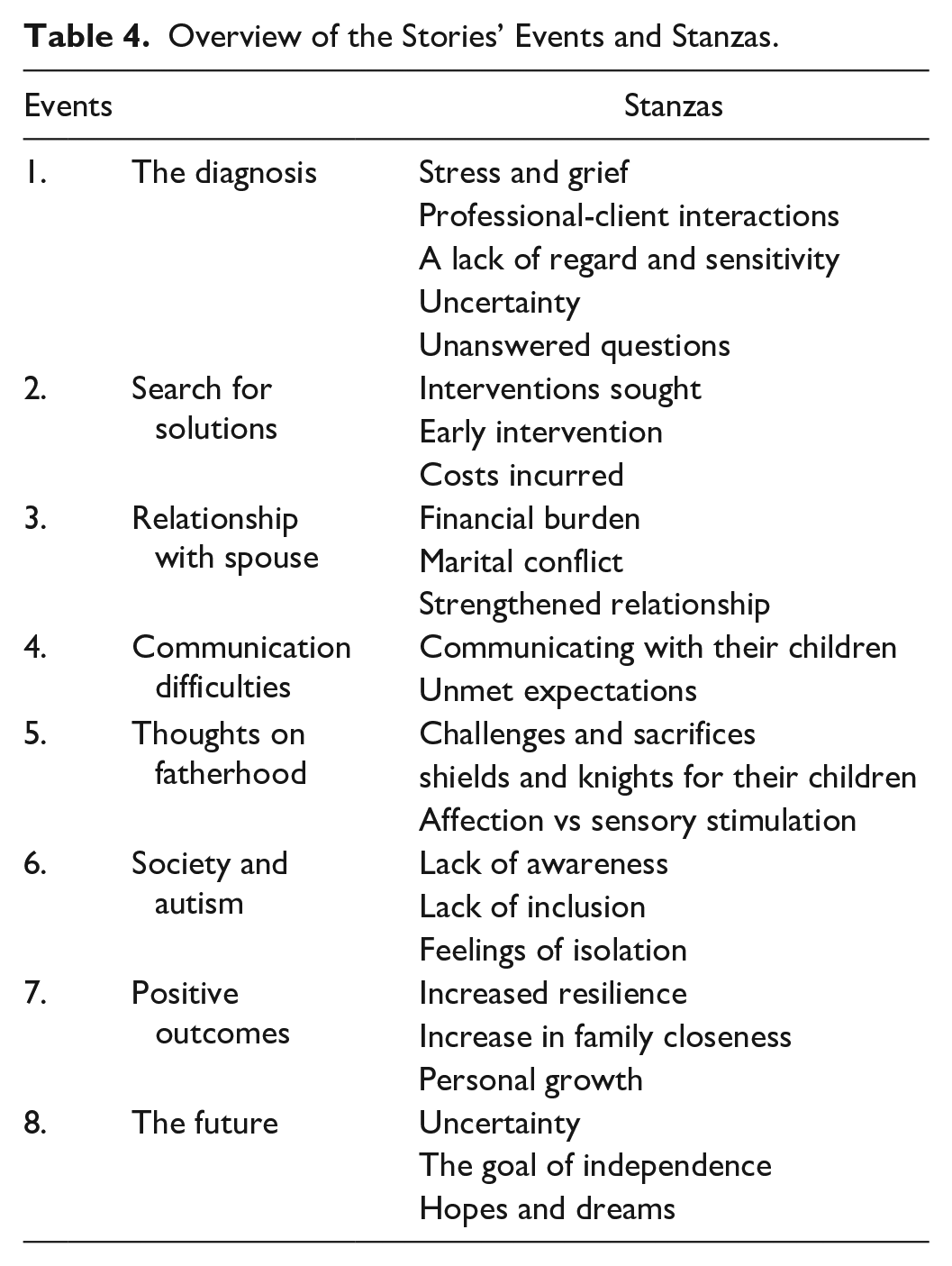
This analytic process was not aimed to deconstruct the fathers’ narratives (Riessman, 1993). Rather, it was aimed to utilize the stories to provide insight into a father’s experience whilst also maintaining contextual aspects of the stories intact. The common events identified (refer to Table 4) describe a common “storyline” that consists of some or all of the events identified. These events illustrate temporal aspects of the experience of fathering a child with autism, as described by the participants. Also, in line with Clandinin and Connelly’s (2000) concept of human experience, the events describe the participants’ past and contemporary experiences, as well as their thoughts about the future.
Overview of the Stories’ Events and Stanzas.
Results and Analysis
The central findings of this study are the stories. Due to constraints related to space, and also to further guarantee that participants are unidentifiable, the whole of the stories are not presented in this report. Rather, the Events identified are described and discussed. Table 4 displays the eight “Events” identified together with their constituting “Stanzas.”
The Diagnosis
The stories collected in this study illustrate the uncertainty that was brought about by the diagnosis of autism. Consistent with Stuart and McGrew (2009), who report that caregiver stress is highest at the time of the diagnosis, a negative appraisal of the diagnostic experience contributed further to the father’s stress. Furthermore, several unanswered questions left the fathers trying to guess what would be happening from that moment on:
Luke - . . .children with autism children do not speak; some are intelligent whilst others are not; some have certain skills whilst others have other skills; some are isolated and refuse to have any contact with people. As Luke heard these things, he asked himself: “ow, my. . .what is coming my way?” Was he not going to be able to hug his son anymore? Was Alex [his son] not going to ever hug him?
Baxter (1989, p. 259) states that professional-client interactions may be influenced by professional dominance, where stigma may be imposed by “more powerful individuals, such as professionals, against less powerful ones, such as clients. This “power differential” was highlighted in some of the fathers’ stories, who described such experience as “a lack of sensitivity on the part of those who broke the news.” This, together with the lack of information presented made the fathers’ first encounter with the word autism even more shocking:
Oliver - The way autism was depicted and described by this particular professional left Oliver in a state of shock. He was traumatised and was very emotional. He had hoped that he would have encountered an individual who empathised with him and who would have encouraged him.
Jesmond – The way that he was given the news about his son’s diagnosis, Jesmond feels disappointed and does not approve of the method used by the professional to break the news.
The fathers recount how the official diagnosis was made either by a Clinical Psychologist, an Educational Psychologist, or a Pediatrician. The moment when the fathers learnt of their children’s diagnosis featured in all of their stories:
Isaac - The moment when Isaac got the news, that his son could be on the autistic spectrum, is clearly imprinted in his mind. It was three o’clock in the afternoon, and it was a moment that he can never forget. His wife immediately started crying when the psychologist confirmed the news. Isaac put up a strong front to support his wife. However, emotions ran high that day, and he broke down in tears soon after leaving the psychologist’s office. He was shattered. It was then that he felt that he had touched rock bottom.
The Search for Solutions
The news of the diagnosis brought about a lot of difficult questions such as: “Why me?”; “Why my child?”; and “What caused autism?” The most frequently used “coping mechanism” the fathers used was a “solution-focused” coping mechanism. The stories describe how a lot of time was dedicated to providing their children with adequate care and professional support. The fathers’ overwhelming desire to support their children’s development became their main priority:
Isaac - After the initial shock of the diagnosis, Isaac got himself together and started looking for ways forward. He reasoned, that what had to be done just had to be done. . .he embarked on a voyage to help his son ‘control’ the symptoms of autism.
Oliver – A strategy that Oliver and his wife tried, with the hope of reducing the effects of autism on their children, was that of a gluten-free diet. They also consulted with a foreign doctor who prescribed various supplements, vitamins and other remedies that could help his children. They tried every possible thing. They also took up the suggestion of the foreign doctor who suggested exposure in the hyperbaric chamber. Thus, they travelled to the UK where they underwent hyperbaric oxygen therapy.
Ian – He signed both children up for a specialised programme that focused on TEACCH. They also opted to try the Sunrise programme. However, after a lot of patience, a lot of time and a lot of money, Ian felt that he did not see much improvement. Ian initially had a lot of hope before the start of each of these interventions. However, hope gradually turned into disappointment, as his expectations were not met. Ian also opted to try BioMeds and decided to purchase vials of vitamin B from the United States.
Luke – “The last time Luke and his family went to the UK for the treatment [hyperbaric oxygen therapy], his wife befriended a married couple from Sweden. The couple recommended making use of stem cell therapy. As soon as Luke heard of this possibility, he started researching the treatment. Luke was able to find a German hospital’s representative in Malta. Luke made contact with this person, who in turn told him what was needed. After the preliminary tests were done, the hospital informed Luke and his wife that the intervention was possible and informed them of the costs. The cost of the operation was around 10,000 euros.
The fathers needed to make sure that they could have enough money for the support and interventions sought. This seems to have been a great source of stress for the fathers. Furthermore, as a result of the increased working hours, which was aimed toward seeing to the bills incurred, fathers had to spend less time with their children and families:
Fred - The increased financial demands and consequent increased workload made it difficult for Fred to find time to spend with his family. The amount of time he spent away from home, because of his work commitments, afflicted Fred.
Nevertheless, the capacity to provide financially for their family could have affected, positively, their perception of competence, and adequacy as a parent. This could have in turn lowered their levels of stress (see Hartley et al., 2012). Yet, the financial burden of caring for a child with autism seems to be undoubtedly substantial.
Relationship With Spouse
Besides the financial burden of caring for a child with autism (also reported by Fletcher et al., 2012), the fathers’ “revolutionized” lives also had an impact on the husband-wife relationship:
William – As a result of all the stress and pressure they experience, William quarrels frequently with his wife. They find it very difficult to spend some quality time alone with each other and at times do not find the time to go out as a couple.
McCabe (2008) described how a child’s diagnosis of autism had an impact on the marital relationship of Chinese parents of children with autism. These findings seem to be corroborated to a certain degree in this study, as most of the fathers’ stories are suggestive of an increase in marital conflict. The fathers describe the increased restrictions in the family’s social lives. Notwithstanding these difficulties, some marital relationships were strengthened by what the fathers described as “challenging times.” However, it is important to highlight that the couples who found support from meaningful others were able to cope more efficiently with the stressors they encountered:
Rupert – Quality time with his wife is as important as quality time with his children. On Fridays, his wife and himself have a ‘no children day’. Both Rupert’s and his wife’s parents help them out with this by supervising their children. This enables them to go out and find time to nurture their relationship.
Communication Difficulties
Communication is seen as a very important attribute that contributes to the fathers’ relationship with their children (see Donaldson et al., 2011). The stories illustrate how the fathers’ relationships with their children, or lack of, were influenced considerably by the children’s difficulties with expressive and receptive communication.
William would like it if he would one day hear his son calling him “Papa” (dad). He does say “Papa” occasionally; however, he never says it spontaneously. William would also love to hear his son ask him to go for a swim or to watch a DVD. Most importantly, William would love to hear his son communicate with him spontaneously and with purpose.
Interestingly, the stories also illustrated how the lack of verbal communication impinged considerably on the fathers’ prospect of living up to their “pre-birth” expectations of what their fatherhood role could look like. That is, many of the fathers seemed to have had initial expectations that did not materialize completely.
Thoughts on Fatherhood
The extent to which the participants’ notions of fatherhood changed after their children’s diagnosis is somewhat difficult to gauge. For most of the fathers who participated in the study, fatherhood was seen as a big responsibility that comprised numerous challenges and sacrifices. One facet of fatherhood that I feel features strongly in the stories is that of men serving as “shields and knights for their children”:
William - William believes that in moments like these, as a father, he has to step up and fight for his son. He has to be like a fighting lion.
Frank - For Frank being a father also entails a certain amount of fight: fighting for his son. The fight is against bureaucracy at times and is about trying to get the right support for him at school. From an emotional point of view, he sometimes feels like punching people. Even though this has never happened, being a father, for Frank, means that he must be ready to get up and fight for his son.
Also, the difficulties and stressors experienced appear to have impacted the fathers in various ways. Some stories illustrate a father’s desire to share emotional and physical affection with his child:
John [Isaac’s son] never told his father or his mother that he loved them and never said, “love you”. That was really painful.
Frank is sometimes not sure if the physical aspect of their relationship is an expression of his son’s emotions or if it is his son’s way to obtain the sensory stimulation that he requires. This question has been lurking in his head for some time now and is yet another source of frustration. Frank believes that in the case of a neurotypical child he could easily assume that it is not a sensory issue. In the case of his son, he is unable to make such an assumption. The uncertainty surrounding this issue makes him feel as if he was in limbo.
Society and Autism
The stories illustrate how the children’s restrictive and repetitive behaviors, and at times even some self-harming behaviors, were sources of stress and frustration. Such behaviors included flapping, biting, and at times head-banging. Nevertheless, the stories illustrate how the children’s behaviors were not the greatest cause of stress for the fathers. Rather, it was people’s reaction to such behaviors that brought about a great deal of frustration and disappointment. The stories exemplify various moments in the fathers’ lives where people interpreted their children’s behaviors as being the result of bad parenting:
Isaac - What hurts Isaac is to see the stares that people sometimes give his son. For him, people’s stares at times are worse than their tongues. He doesn’t actually care about people’s opinions, but such actions towards his son do hurt him. That is why he wants to protect his son.
Luke - Luke believes that most of the general public is not informed well about the subject of autism. Some people are very insensitive towards autism and the difficulties brought by the condition.
Interestingly, Luke’s story illustrates how he tried to make sense of this apparent lack of awareness:
. . .he sympathises with these individuals, as he feels that if his son had not been diagnosed with the condition, he would have not been aware of the condition. Luke believes that when something does not affect individuals personally like the way autism has affected him and his son, they do not take an interest in learning about that condition.
Positive Outcomes
Parenting a child with autism also has a positive effect on parents (O’Halloran et al., 2013). Some of the benefits identified could be: learning through experience; children being sources of strength; an increase in family closeness; personal growth and maturity; source of pride and cooperation; and expanded social networks (Kayfitz et al., 2010). The stories gathered in this study substantiate some aspects of Kayfitz et al.’s (2010) study. The stories illustrate how fathering a child with autism, on some occasions, made the fathers more resilient (e.g., William’s story), encouraged the fathers’ personal growth and maturity (e.g., Isaac’s story), and also was a source of family closeness:
William - The circumstance and challenges that he has been through ever since being faced with the challenges brought about by a diagnosis of autism made William more resilient; more stubborn, and more determined than ever.
Isaac - Isaac feels that this experience, of fathering a child with autism, has not only been stressful. Rather, this experience has helped him grow as an individual. . .The experience of fathering a child with autism has taught him to sympathise more and understand more the experiences that people go through.
The Future
Studies such as Tehee et al. (2009) indicate that thoughts regarding the future are major sources of parental stress. This seems to be the case for many of the participants of this study. Questions concerning the future featured heavily in the fathers’ stories:
Oliver - The thought of his children’s future makes Oliver anxious. Oliver is worried about when he will one day pass away and leave his children alone. He is aware that this will happen sooner or later. However, he tries his hardest to repress this agonising thought.
. . .Alan also has some concerns about his daughter’s future. . . His sense of urgency is also motivated by the uncertainty and anxiety that arises when he thinks of the day that he and his wife will not be able to take care of Mary anymore.
Apart from worry and anxiety, the stories illustrate the fathers’ hopes for their children’s future. Some wish to see their children cured of autism. Others wish to see their children become autonomous and self-sufficient:
Oliver – The ideal situation would be that with the click of a button, he would cure them. Oliver is aware that this is only wishful thinking and not possible. For this reason, he would be equally content if his children were able to lead an autonomous life.
Frank - He hopes that in the future his son will be autonomous and independent. He has an image of his son working in computing. He describes it as a “geek type of route.
The reason behind such staunch commitment to the goal of independence is the insecurity and anxiety brought about by the question of “what will happen to my child when I am no longer around?” The stories illustrate how fathers are burdened by the thought that autism is a life-long condition. Many of the stories also illustrate how the fathers are distressed by the prospect of there not being adequate support for adults with autism. The fathers seem to be troubled by the image of their children being institutionalized in residential-care homes that are not able to see to the needs of adults with autism:
Luke - The thing that hurts Luke the most is when he hears someone saying that he can place his son in a home or an institution. The thought upsets him.
Alan - One of his greatest fears is that if she [his daughter] is not able to take care of herself, she would have to be taken in care and would have to stay there. If she is locked in an institution, she will never reach her potential. Rather, she would definitely regress. That would be Alan’s worst nightmare. He refuses to see her get locked up in an institution: “over my dead body! Never! No way!”
Discussion
The stories describe the perpetuating systems that surround a father and a child’s life—which include immediate family, community environment, and a vast and complex societal landscape—that contribute toward a child’s development and also toward the father’s wellbeing. Similar to what Cullen and Barlow (2002) reported, the stories illustrate how the high level of needs of the children, who sometimes present with 24-hour demands, could contribute toward the father’s feelings of frustration and isolation (also see Burrell et al., 2017).
The emotional roller coaster the fathers describe in their stories provides evidence of the initial overwhelming effect a diagnosis of autism has on a father and his family. The stories start by describing how the fathers reacted to the news of the diagnosis, and how the diagnosis was communicated. This information was met in a variety of ways: some with surprise, some with disbelief, and others with fear. Similar to the findings described in Frye (2016), Fernańdez-Alcántara et al. (2016), and also in Burrell et al. (2017), all of the father’s stories described initial feelings of uncertainty and even grief. Such feelings were further exacerbated by questions that followed the news of the diagnosis—such as “what is going to happen now?” and “will my child ever be independent?”—which were all pertinent but unrequited questions. The fathers’ stories also presented descriptions of “power dynamics” between professionals and clients (i.e., the fathers and their families) that could have further intensified the fathers’ feelings of isolation.
Notwithstanding the challenges brought about by the news of the diagnosis, such news triggered within the fathers a relentless search for solutions. Similar to Meadan et al.’s (2015) findings, many of the fathers’ stories highlight attempts at self-education to counteract feelings of uncertainty. Moreover, in every story, one cannot help but notice the fathers’ tenacity. This seemed to be the main coping mechanism employed by fathers in this study: that is, a “solution-focused” mechanism aimed toward concentrating one’s energy on providing support and treatments for their children. This behavior seems to have helped fathers mitigate the initial shock of the news of the diagnosis and aid the fathers in transitioning from grief toward an action-oriented emotional state. However, such behaviors could also shed light on yet another coping mechanism used frequently by fathers, which is that of “wish-fulfilling-fantasy” (see Pisula & Kossakowska, 2010), where fathers wish to see their children control the symptoms of autism. The stories illustrate how the fathers’ relentless drive toward searching for solutions “impels” them to attempt various interventions. Fathers who participated in this study seemed to be willing to attempt anything and spend enormous sums of money, to see their children progress. Thus, this highlights the need for professionals to contribute further toward exposing fathers to the evidence base available relating to treatment and interventions.
The financial demands of caring for a child with autism are ever-present in all of the stories. The increased expenses were mostly resulting from the engagement of specialists to carry out remedial therapies such as Speech Therapy, Occupational Therapy, Applied Behavior Analysis (ABA), among others. Expenses related to less known or non-traditional forms of therapies, such as hyperbaric oxygen therapy (see Levy & Hyman, 2008), bio-medical treatment (see Pacheva & Ivanov, 2019), as well as stem cell therapy (see Siniscalco et al., 2018) were also reported in some stories. Findings from an Australian study on the cost of autism (Horlin et al., 2014), indicate that the median family cost of autism in Australia is estimated to be AUD 34,900 per annum (which amounts to approximately €21,000). Such financial burden (also reported in Shave & Lashewica, 2015), on fathers and their families, was reported to have had many implications on the fathers, such as high levels of stress, less time spent with family, and higher levels of conflict with their meaningful others.
Consistent with Burrell et al.’s (2017) findings, in most of the stories in this study there seemed to be a transformational element, where fathers seemed to “rise to the occasion” and do battle for their children. Paynter et al.’s (2018) study also describes how fathers from Queensland, Australia, encountered difficulties with accessing formal support for their children. Similarly, all of the fathers in this study were required to “fight for their children,” “fight against bureaucracy,” “fight to get more resources,” “fight for more inclusion,” and “fight for a better future,” for their children. This element of “fight” begs the question of “why do fathers need to fight in the first place?” Also, “who are they fighting against?” This seems to have implications on the support systems available as well as the bureaucratic nature of these systems, which seems to be contributing toward the fathers’ feelings of isolation and their need to “fight” for the children’s voices to be heard.
The most pressing concern for the study’s participants, however, was their children’s future, and the question of “will my child be independent?” Many of the fathers described their greatest concern as being the livelihood of the children once they become adults, and once their parents will not be around anymore to care for them. “Institutionalisation” of his child was one of the father’s greatest fears. For this reason, all of the fathers have worked, and continue to work, hard to see their children develop into independent and self-directed adults. Again, this seems to place further financial demands on the father and the whole family. The question of what happens to children with autism once they become adults is under-researched (Howlin & Magiati, 2017). Volkmar and Wolf (2013) postulate:
“The outcome in autism appears to have markedly improved over the past several decades — presumably reflecting a number of factors including earlier intervention and improved treatments. At the same time, many adults, even while living independently, need some supports, and a lack of treatment research and available services limits our knowledge of this population.” (p. 80)
The concerns about their children’s future seem to be justified, especially in light of the relatively low rate of employment of individuals with autism, which is reported to be around 32% (National Autistic Society, 2016). Furthermore, adults with autism are reported to encounter increased difficulties when searching for and retaining their employment (see Frank et al., 2018; Valkanova et al., 2013).
Similar to Rudelli et al.’s (2021) findings, the challenging behaviors, communication difficulties, as well as restrictive and repetitive behaviors (RRBs), the children presented with seem to have been a cause of stress for the fathers. One of the reported causes for such “frustration” with RRBs was the fathers’ apparent lack of information and understanding about RRBs. Also, what the fathers described as “society’s reaction” to their children’s behaviors seems to have contributed greatly to the fathers’ sense of isolation. Such lack of understanding seems to be another reason why fathers felt the need to “shelter” or “shield” their children from what one father described as “people’s misinformed and judgmental glances.”
Finally, the narratives in this study also illustrate how fathering a child with autism, made the fathers’ more resilient, encouraged the fathers’ personal growth and maturity, and was also a source of family closeness. The families that had accessible and available support systems were those who reported less conflict with their partners and also reported greater family cohesion.
Implications
Whilst the narratives did have several common events, they nevertheless were relatively heterogeneous. Thus, it is difficult to come up with recommendations that could benefit all fathers or family systems. Nevertheless, this study should unquestionably encourage professionals to always be sensitive when it comes to informing fathers, and families, of their children’s diagnosis; especially since caregiver burden could be at its’ highest following the communication of the diagnosis (Stuart & McGrew, 2009). The power dynamic in the diagnostic process is also an aspect that professionals working with parents and children should be more conscious of. Such dynamic should facilitate communication, allow for adequate time for processing and questioning, and be based on high-quality information which is “easy to understand.” In other words, “it must be tailored to the individuals involved” (Abbott et al., 2012, p. 379).
Professionals could also contribute more toward increasing awareness regarding autism amongst the general public. Such contributions could play an important part in decreasing the fathers’ feelings of isolation (also highlighted by Thompson & Emira, 2011) and also contribute toward decreasing their feelings of stress. Finally, this study should also help to continue to give a voice to the fathers’ concerns regarding their children, particularly about their children’s future, which seems to be the most pressing and urgent concern voiced throughout the fathers’ narratives. Further research on adults with autism could help inform policy, whilst highlighting the support needs presented by adults (e.g., Mavranezouli et al., 2014). This could go a long way in continuing to support adults who are on the spectrum, but also support fathers and their families, who are struggling greatly with the “limbo” of their children’s future.
Limitations
Further details, beyond what is already provided, about the children’s symptomology and needs, as well as information about whether or not the children also presented with intellectual impairment, could have contributed further to understanding the factors which influence fathers’ experiences. However, the identification of the factors that contributed to the father’s experiences was not the central focus of this particular study. Nonetheless, future research could gather such information to elucidate further the relationship between symptoms of autism, symptoms of intellectual impairment and needs and experiences that ensue.
It is important to note that the sample consisted of fathers who were living in Malta. Thus, the fathers’ narratives could have been influenced by the Maltese socio-political idiosyncratic context (refer to Bezzina, 2019). Furthermore, it is also possible that the analysis does not accurately represent all Maltese fathers’ real-life experiences, as the sample of fathers recruited for this study was relatively small, and consisted mostly of fathers from intact family systems whose children were mostly males. The family structures also varied greatly, from having one child to having multiple children. Moreover, all the participants were coming from middle to high socio-economic backgrounds. In fact, the fathers that participated were comfortable talking about their stories; were confident that they could articulate their thoughts effectively; were interested in this study; and were in a position, emotionally and logistically, to participate in the study. Thus, the findings and the discussion of the findings were shaped by the participant’s unique characteristics. Thus, it is important to remember that while in this study the father’s narratives might be fairly uniform, their actual experiences would most probably present with a greater variation.
Footnotes
Acknowledgements
The author would like to thank all the fathers who participated in this study and shared their personal experiences. The author would like to acknowledge Dr. Mary Robinson (University of East London), for the expert advice and recommendations given all throughout the study. He would also like to acknowledge the support and encouragement of Dr. Duncan Mercieca (University of Dundee) who commented on a draft of the manuscript.
Anonymity
Steps have been taken to ensure that participants are unidentifiable: pseudonyms are used, and only parts of the stories are quoted in this article. The quotes used in this article are selected purposefully, so as not to compromise in any manner the participants’ identity.
Compliance With Ethical Standards
All recruitment and research procedures performed in this study were in accordance with the ethical standards of the institutional and/or national research committee (University of Malta, University Research Ethics Committee, UREC), and with the 1964 Helsinki declaration and its later amendments or comparable ethical standards.
Declaration of Conflicting Interests
The author declared no potential conflicts of interest with respect to the research, authorship, and/or publication of this article.
Funding
The author received no financial support for the research, authorship, and/or publication of this article.
Informed Consent
Informed consent was obtained from all individual participants included in the study.
