




Abstract
Communication difficulties are among the most frequent characteristics of children with autism spectrum disorders (ASD). Lack of communication can have a significant impact on the child’s life. Augmentative and alternative communication (AAC) apps are a common form of AAC interventions that involve a combination of affordable technology with software that can be utilized to assist with communication. While AAC apps have been found to have some impact on improving the communication skills of children with ASD, current research exploring this topic is still limited. Focusing on the design process of AAC apps may provide better insight into improving clinical outcomes and user success. The user-centered design process incorporates a continuous cycle of user feedback to help inform and improve the functions and the capabilities of the technology, and it is an essential component in AAC app development. This article outlines how the user-centered design process could be adopted for the development of AAC apps for children with ASD.
Autism spectrum disorders (ASD) are neurodevelopmental disorders that are often diagnosed in early childhood. Although early diagnosis and identification of the developmental disorder is common, the exact causes of ASD are still generally unknown and multi-faceted (Tchaconas & Adesman, 2013). The rates of diagnosing ASD are rapidly growing among individuals across continents, races, ethnic backgrounds, and socio-economic statuses (Centers for Disease Control and Prevention, 2012). ASD is characterized by communication difficulties, repetitive behaviors, and impairments in social interaction (American Psychiatric Association, 2000; National Institute of Neurological Disorders and Stroke, 2012). Although these three impairments occur in children diagnosed with ASD, they exist in varying degrees, and not every child on the spectrum has the same challenges. Despite these variations, difficulty or delayed language is often a core component of ASD and can have a significant effect on various aspects of a child’s life.
Communication has a multi-modal presence and affects an individual’s ability to function in their environment. It is estimated that 25% of children with ASD could be classified as nonverbal or unable to express their daily needs (Scott, Clark, & Brady, 2000). The National Research Council (2001) identified developing spontaneous communication as an important skill for children with ASD, highlighting the significance of communication skills for children on the spectrum. Children with ASD are often mainstreamed in classrooms (No Child Left Behind Act of 2001, 2002) where they may not be provided with the individual attention necessary to help them be successful in school. Communication impairment is a key factor in the child’s ability to learn. The classroom has been a common setting where communication interventions for children with ASD are often applied, and in the past 50 years, different types of interventions have been implemented in an effort to meet the varying and complex communication needs of children with ASD.
History of Augmentative and Alternative Communication (AAC) for Autism Spectrum Disorders
The American Speech-Language-Hearing Association defines AAC as an area of clinical practice that assists individuals with severe communication disorders compensate for their impairments (National Joint Committee for the Communication Needs of Persons With Severe Disabilities, 1992). AAC interventions can range from no tech to high tech and can vary greatly based on their intended purpose. The first attempts in augmenting the communication ability of individuals with ASD began in a non-technological manner, with pictures and symbols. Since the 1970s, parents and special education teachers encouraged the use of sign language and symbols to communicate (Mirenda & Erickson, 2000). In the 1980s, the use of photographs and line drawings became the symbols of choice (Ogletree & Harn, 2001), and the Picture Exchange Communication System (PECS) was developed as a multi-phase AAC intervention to help individuals with ASD communicate (Bondy & Frost, 2001). Picture-based communication approaches (such as PECS), were preferred because pictures are not transient and stay in the visual field for a longer processing time. Research studies have demonstrated the value of PECS, showing that utilization of the system improved functional aspects of communication and communication initiations in children with ASD (Carr & Felce, 2007; Flippin, Reszka, & Watson, 2010; Ganz, Davis, Lund, Goodwyn, & Simpson, 2012; Ostryn, Wolfe, & Rusch, 2008).
Despite the benefits of PECS, there were barriers that could be improved upon. For instance, the number of pictures needed as a child’s language base grew, and the time consumed to create and store these laminated images began to place logistical limits on the value of PECS. In utilizing this system, it could be difficult to maintain the increasing number of images, and instructors had no way to track these images and monitor the progress of a child. Out of this need and the improving technological capabilities, AAC technologies have emerged as tools to help address the communication challenges that many individuals with autism experience (Lubas, Mitchell, & De Leo, 2014; Shane et al., 2012). The first use of AAC technologies came in the form of AAC devices, instruments with pre-loaded software existing strictly for communication purposes. By the early 1990s, AAC devices were introduced into classrooms (Hourcade, Pilotte, West, & Parette, 2004; Ogletree & Harn, 2001), and their presence could be seen as an attempt to use technology to improve on current communication interventions. AAC devices were intended to replace printed pictures, but despite this intention, they were extremely expensive, difficult to program or personalize, not flexible enough to accommodate needs, and stigmatizing (Shane et al., 2012). Despite their technological improvement, there were still several barriers that prevented individuals from using these systems on a regular basis. These challenges could impede both parents and school systems from adopting this technology. While it seemed that parents and special education teachers believed that AAC devices were the solution for children with minimal communication skills, they would need to find funding and learn the skills to use them (De Leo, Gonzales, Battagiri, & Leroy, 2011).
In an effort to harness the value of an AAC device, but to produce a more convenient and affordable tool, AAC apps were created. AAC apps involve the combination of affordable technology with software that can be utilized to assist with communication (Lubas et al., 2014). Smartphones and tablets are types of technology that have multiple functions (such as the ability to be used as a phone or computer) but can be utilized to assist with communication. As technology continues to grow and becomes more affordable, so does the use and function of AAC apps. In February 2014, the Apple Store had listed more than 250 apps under the keyword “AAC” ranging from free to a maximum of a few hundred dollars. In Apple’s fiscal 2013, they reportedly sold 150 million iPhones, and 71 million iPads, both of which demonstrate increases since 2012 (Apple Store, 2014). As technology continues to become more affordable and available, its presence is greatly increasing in society today. It is not uncommon for individuals or families to have several mobile devices, and the function of these devices continue to serve multiple purposes, increasing the opportunity for the use of AAC apps.
Impact of AAC Interventions
Despite the increasing presence of AAC apps, even with the availability of a technological solution that is easy to use, affordable, and flexible, a large number of individuals with communication needs are still not learning how to communicate (Mirenda, 2001). With the continued growth of AAC apps, there is a need to examine the impact of these interventions. Currently, some research supports the value of AAC technologies, as Lal (2010) found that children who are minimally verbal will increase language skills when using AAC technologies. Studies have also verified the long-term outcomes of AAC use, demonstrating improvements in the users’ functional communication (Hunt-Berg, 2005; Lund & Light, 2006). A recent meta-analysis by Ganz, Earles-Vollrath, et al. (2012) found that research evidence supports the overall impact of AAC technologies on targeted behavioral outcomes, primarily communication skills. It seems possible that such technology is providing movement in the right direction; however, these interventions have not had the impact on children with ASD that they were anticipated to have (Mirenda, 2001). Although research has shown support for the use of AAC technologies for children with ASD (Ganz, Earles-Vollrath et al., 2012; Hunt-Berg, 2005; Lal, 2010; Lund & Light, 2006), it is also important to address that current AAC research for individuals with autism is lacking and may not be sufficient enough to inform the impact of AAC use on communicative capabilities (Mirenda, 2001). The research in the field that has been conducted is often comprised of single subject designs, and also lacks thorough descriptions of the participant demographics and environmental context of AAC use (Ganz, Earles-Vollrath, et al., 2012; Nunes, 2008; Pennington, Marshall, & Goldbart, 2007). In addition to this, current studies are often done in controlled and “ideal settings,” which could impede translation of findings to real-world settings (Lund & Light, 2007).
Despite the increase in available apps for AAC, there is a significant lack of attention given to the process of app development. In particular, it is essential that developers use technology to create new interventions that improve on past work, and not just re-create past interventions in the form of an app (Light & McNaughton, 2012). A potential response to these obstacles are to develop AAC apps through a user-centered design approach, with the intended users providing feedback throughout the software development process. If the proposed users (such as nonverbal children with ASD) would be unable to participate in the design process, this approach can also use proxies, individuals authorized to represent or speak on behalf of another person. Often when software (such as an app) is being developed, the intended users do not have a role in the design process, and this can significantly impair the value of software. Implementing user feedback throughout the software design process can have an impact on the user’s comfort level with the technology, attitude toward the technology, and ultimately influence their competency and success. A user-centered design approach can be an important mechanism for increasing the positive outcomes of AAC app use. In the following sections, we present an overview of the different steps in a user-centered design process, and provide a step-by-step example of an AAC app that was created through this design approach.
Method of User-Centered Design
User needs are a fundamental aspect of any product. The user-centered design approach involves the creation of a product that incorporates user-centered activities throughout the entire development process. This process involves identifying the intended users, their capabilities, needs, and expectations. A user-centered design addresses the envisioned goals that are to be met by the user through the software interaction, the tasks needed to achieve the goals, and also the environments (both physical and social) that the user interacts with in order to achieve such (Hall, 2001). For this insight to be achieved, users must participate in the development process both through designing and testing the new technology.
One of the central components in the user-centered design is the use of prototype creation. Prototyping is a quick way to incorporate user feedback into the design process. Prototypes can vary on their fidelity level (how close they are to the actual product). Conceptual prototypes can start off low in fidelity, but allow users to provide feedback on the cognitive and visual aspects of a design. The initial prototype for the user-centered design often first involves a paper version. This approach is recommended due to its simplicity and fast turn around. A paper prototype allows individuals to contribute regardless of their technological capabilities, where an operational design could be limiting if not everyone had a basic understanding of the technological system being used. Another benefit is that changes can be made quickly on paper, and that starting with a paper prototype allows individuals the freedom to be more critical (Andrews et al., 2012; Klee, 2000). Conceptual prototypes can increase fidelity through the creation of “mock-ups” that present a more dynamic visual representation of the final product, but one that is still not operational. Operational prototypes, high in fidelity, can then be created to allow users to test the functionality of the product. The user-centered design process does not specifically dictate how many and what types of prototypes must be created, but requires that user involvement occurs at every level of product development.
A user-centered design can be an extremely valuable approach to AAC app development, as it allows the user to provide feedback and input throughout the development process. The method of a user-centered design is characterized by a multi-stage process that allows input and feedback, as the developers create the product (Andrews, et al., 2012; De Leo et al., 2011; De Leo & Leroy, 2008). This approach has been used with success in different types of technological products such as website development (Andrews et al., 2012), the creation of virtual environments (Fidopaistis, Rizzo, & Rolland, 2010), and in interactive health technologies (Dabbs et al., 2009).
AAC Apps and the User-Centered Design
When specifically addressing AAC app development, there are additional considerations of the design process. After the developers determine the intended users of the app (if the app will be age specific, diagnosis specific, or can be used across different demographics), a group of users can work with developers to inform the design. An initial determination will need to be made in the method of communication, as an AAC app can vary in this aspect. Text-based input methods allow for the creation of messages through typing or combining words. This method results in a strong and clear content of messages, but can be a slow process for communication. Graphic-based methods allow for the creation of messages through combining symbols and images, and can often then be translated into speech. This type of communication affords individuals who lack language literacy the ability to communicate; however, the content and clarity of messages are often limiting (Gonzales, Leroy, & De Leo, 2009). There are pros and cons of both input methods, and a combination of the two can also be used. Determining the modality of communication is an important step in AAC app development, and such decision should be based on the capabilities of the intended user. From there, interviews should take place with users or relevant professionals who can inform the initial design idea. Then, a multi-stage prototype and user testing process occurs to receive continual user feedback on features and capabilities of the software. The steps involved in this process are as follows: (a) determine the intended user of the software; (b) interviewing users (or proxies) to inform the initial design; (c) creation of the prototype; (d) a multi-stage process of user (or proxy) prototype testing; and (e) creation of a final product. The user-centered design process integrates feedback from the user (or proxies) at every stage in the development of the software; this process is displayed in Figure 1.

Steps in the user-centered design process.
The user-centered design process is linear; however, the concept is multi-dimensional. Depending on the product and user population, the process should be adapted to the context of the purpose and type of software being developed. In the following section, we will provide a step-by-step example of the user-centered (by proxy) design process used to develop an AAC app for children with communication impairments as a result of ASD. Specific considerations of the user-centered design as it relates to an AAC app for children ASD will also be addressed.
An AAC App Designed Through the User Centered by Proxy Design
To further demonstrate the user-centered by proxy design, this process will be illustrated by addressing the development of an AAC app, called I Click I Talk. 1 The five-step process in the user-centered design approach is explained in detail in the following sections.
Step 1: Identify intended user
The first step in the user-centered design process is to identify the user of the software. The intended users of this specific AAC app are children with communication impairments due to ASD. In this case, because the intended users have severe communication impairments, this design approach requires a proxy, as the children with severe ASD are unable to verbally communicate their feedback. In the case of this software development, special education teachers, parents, and therapists were used as proxies to the target population. A child with severe ASD would utilize an AAC app with assistance from an adult (typically a teacher, parent, or therapist); therefore, it was reasonable to consider that these adults would be a valuable source of information during the design process. In addition to identifying features that would benefit the children, proxies could also inform aspects that affected their own user interface with the app.
Step 2: Interviews to inform the initial design
The initial design of an AAC app should be created after obtaining feedback from parents, therapists, and teachers regarding their needs and desired functions of a communication app for children with ASD. Throughout this process, individuals can identify many unique needs and desired capabilities of the software. Based on the initial interviews of I Click I Talk, it was clear that an app with several customizable features would be beneficial, as every child with ASD and their learning environment is unique. An example of the importance of customization is first reflected in the communication method of the app. It was initially determined that a graphic-based communication method would be used in the app, as children with severe communication impairments would not initially be able to communicate through text only. However, software should be adaptable to multiple purposes and customized features should be considered to adapt for different user needs. Therefore, after the feedback, a combination of graphic- and text-based input methods were utilized to provide an optimal learning environment for language development for each individual user. With the users, goals, and basic communication method identified, the next step in the development process was to create prototypes to continue to inform and improve on the design.
Steps 3 and 4: Prototype creation and user (by proxy) testing
Steps 3 and 4 were combined in discussion, because they involve an integrative loop of prototype development and user testing. From the information obtained in the initial interviews a prototype was created, and then special education teachers from public and private schools throughout North America reviewed this prototype to provide feedback that led to the continuous refinement of the software through semi-structured interviews. The software was developed over an iterative process of several interactive prototyping stages, with users or proxies visually reviewing and then eventually testing the software throughout the development.
The first prototype (Figure 2) created was a simple paper drawing of the communication screen that the child and adult would most often interface with when using the app. The paper prototype showed the general layout of the app, with the lists of word and image categories present on the left-hand side, a central display of images for a child to choose from (based on the category selected), and a sentence strip where these images could be moved after they were selected for communication.
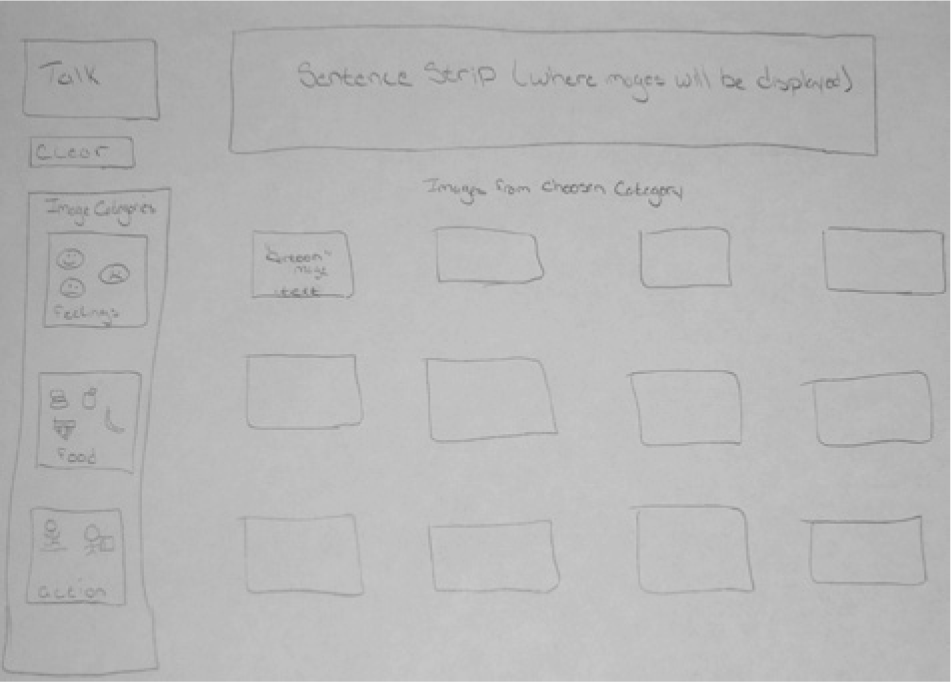
Image of the initial paper prototype.
After each prototype continued to progress, user feedback was utilized to inform the next version. The paper prototype was adjusted several times to reflect proxy feedback, and then a mock-up was created. The mock-up (seen in Figure 3) consisted of a series of photographic images of screens and interfaces. This was a non-functional series of photographic images of the layout for the app. The mock-up was another conceptual prototype; however, it offered increased fidelity of the intended layout.

Mock up of I Click I Talk that shows a series of intended screens of the app.
After the proxies provided feedback on the mock-up, an operational prototype was created, where proxies began to demo the app. The operational prototype was refined several times based on feedback, again through semi-structured interviews. Overall, the feedback provided by the teachers during the design process was twofold. First, they offered design assistance from their perspective, addressing the need for an AAC app to optimize the use of their time, by allowing for multiple children to utilize the same app, yet still allow for individual customization. Second, teachers served as proxy users for the children with autism, addressing the strengths and limitations of the children they work with. Table 1 serves as summary of key features of I Click I Talk that developed out of the user centered by proxy design.
Features of I Click I Talk That Resulted From the User-Centered Design Process.

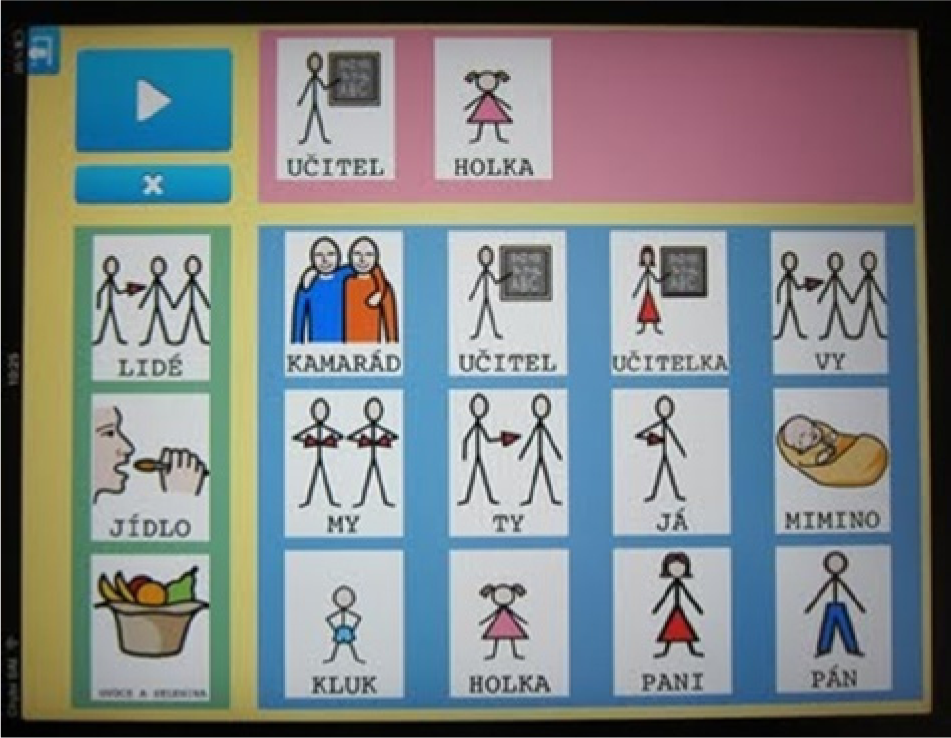
A screenshot of the main interface of I Click I Talk that is written in Czech language.
Step 5: Final product
The result of this user-centered design approach was a highly customizable app, allowing individual users to select features based on their unique needs and purposes. After a final product is created, developers can sometimes overlook a very important aspect of the process, which is addressing the dissemination and evaluation of the product. In the first step of disseminating the product, the app was made available to purchase online through avenues such as the Apple and Android stores. In addition to the mechanism to purchase the app, in this instance an auxiliary website was created to serve as a user support to the software. The goal of the auxiliary website was to provide information on the features of the app. The website also provides information on using the software, video tutorials, and offers a contact source for those who would be interested in additional training. A local dissemination approach was also enacted, as the developers reached out to local school districts and agencies that provided services for children with ASD. Local trainings were offered to assist teachers and other professionals in learning the features of I Click I Talk.
Although evaluation is not a distinct step in the process of the user-centered design, it can also be useful to address. It is important that efforts be made to verify the benefit of this approach. An attempt (although unsuccessful) to evaluate this app was made. A web-based survey was developed to assess user feedback for I Click I Talk. The survey was made available through the app website and its Facebook page for approximately 4 months from January to April 2013. Participation in the survey was voluntary, and served as an opportunity for the purchaser of the app to provide direct feedback regarding the design and capabilities of the software. The results of the survey could not be considered conclusive due to the small sample size. Despite the survey being made available for 4 months, it was only completed by 10 participants (over 3,000 copies of the app have been sold, therefore the completed surveys reflect less than 1% of users).
Discussion
Although more evaluative studies on the clinical outcomes of AAC apps are needed, research has pointed toward the importance of the user and technology interface in regard to this relationship. In the research that has shown communicative improvements, Lund and Light (2007) suggest that although studies have evaluated the clinical efficiency of AAC technologies, many studies validate AAC use under the ideal and controlled circumstances. Studies have revealed general improvements in communication through the use of AAC technologies, but research has also found that improvements are not equal across all individuals, and suggests that some benefit from AAC use more than others (Lund & Light, 2006). In an effort to further examine the impact of AAC technologies, Lund and Light looked at factors that influenced positive outcomes on AAC use. Through their research they identified three general themes that improved outcomes of AAC use: social support, personal characteristics (of the user), and services. Social support has had a positive influencing role in AAC outcomes through the role of parents and educators who can encourage the use of the technology. Personal characteristics were also found to be associated with outcomes, primarily in the sense that the users’ attitudes and positive expectations influenced the success of the individual user. Finally, the influencing role of services refers to additional training methods of the technology that are available for families and facilitators to improve their interface with the software. These three distinct themes found by Lund and Light (2007) point to one commonality, the importance of user and software interaction.
In light of the current limitations in AAC research, the design process may be an important avenue that can help lead to the creation of valuable AAC apps. Light and McNaughton (2013) suggest that current AAC delivery comes from a skewed focus of over-emphasizing the service delivery system and not users. This is an important point to address, as the user-centered design process allows the users (or proxies) to inform capabilities of AAC apps that they desire, and also attempts to increase the user’s competency in interacting with the technology. The mere presence of technology is not a simple solution in directly improving AAC outcomes (Light & McNaughton, 2013), yet if approached correctly it can be a useful avenue to further engage and highlight the needs of the user. Feature matching is a significant component of AAC use (Beukelman & Mirenda, 2013), and utilizing the process of a user-centered design approach in developing an AAC app for children with ASD can bring to light important considerations in matching the design process to specific user populations. This process can also address the need for making new AAC apps flexible enough to be customized for every child’s unique learning needs. Gosnell, Costello, and Shane (2011) highlight the importance of using a clinical framework when selecting the appropriate communication apps, given the large number of available apps. This concept further lends itself to the importance that the creation of new AAC apps serve as meaningful additions based on user needs, which again can be addressed by a user-centered design process. In addition to the primary user’s needs, AAC apps for children with autism can also be used by teachers, parents, and applied behavior analysis (ABA) therapists, so it is important to include their feedback at all levels, as they assist the child with utilizing the software. Figure 5 adapts the user-centered design approach specifically to the context of designing communication software for children with ASD.

The user-centered design process specific to an AAC app for children with ASD.
When creating AAC apps for children with autism, consideration should include a multi-disciplinary approach to user-centered design. Different types of specialists (therapists and teachers) and parents should be used to inform the design process. It is also important for communication-based software to have the ability to be used in a variety of settings in the child’s life, as a child with severe communication impairments would need to utilize AAC apps in home, school, and recreational settings. As the setting may vary, the AAC app will likely be utilized by more than one type of assisting adult, which is why it is important that feedback be provided from various types of professionals and parents. In addition to the use of AAC apps by both professionals and parents of children with ASD, it also important to acknowledge that these technologies are utilized all over the world. Therefore, the user-centered design process should provide the opportunity for AAC apps to be used by individuals who speak different languages, and to even allow for customization of regional language needs. After users or proxies have informed the software design process, the goal of the final product should be to serve a current unmet need in AAC apps. Once finalized, developers must then consider how to disseminate and market their product, and what type of auxiliary tool will be provided to assist in the use of their AAC app. Although this article and several others promote the user-centered design approach as a valuable method of product development (Andrews et al., 2012; Park, 2012; Waller, Balandi, O’Mara, & Judson, 2005); more research must be done to determine this and evaluation of such software should be conducted.
With an attempt at evaluation, it was found that it was difficult to collect feedback from app users after they have purchased the app; therefore, future app development might consider the use of data collection built within the app, or other features to track app usage. The low response rate (n = 10) of this survey could have occurred out of many reasons. First the sampling approach used. App users would only have been aware of this survey if they utilized the Facebook page or website, as a link to the survey was only available on these pages and not directly available on the app (if users purchased the app more than 2 years ago, they may not be still actively utilizing the website). Another significant barrier in obtaining results from this survey could be the lack of interest. It is common for professionals (such as speech–language pathologists, or special education teachers) to change the AAC apps they are using frequently. When a consumer buys an app, they are limited to the created capabilities of it, meaning that after the app is on the market developers often do not take feedback and make changes or improvements. Because of this, when a professional buys an app if it does not fully meet their needs, they may quickly move on to another. This potentially speaks to the importance of developers to take user feedback into consideration during the design process, as after a final product is created it will be too late. Although the survey was not successful in obtaining feedback after the development of I Click I Talk, future research on AAC apps should attempt to assess the impact of the user-centered design on user communicative capabilities, and on the self-reported competencies of software users.
Conclusion
With the increasing presence of affordable AAC apps, it is important that new apps are created with a purpose, rather than continuing to flood the market. When creating AAC apps for children with ASD, a user-centered by proxy design can help shed light on the needs for an app that does not currently exist, or highlight features that are currently effective. As technology becomes increasingly accessible, there are opportunities for non-software developers to create their own apps, and there are several apps on the market that have been created by teachers and parents of children with ASD (Light & McNaughton, 2012). This can be a significant benefit in the market; however, just as professional software developers; parents and other non-professionals could benefit from the user-centered design approach. It is a significant strength that there are several AAC apps available to choose from, and many different groups of individuals who have created such. However, a challenge with this is that it can be difficult for parents and professionals to choose the appropriate app (if any) to meet their child’s need (Bradshaw, 2013). It is not necessary that more apps need to be available for unique AAC users, it is that current apps must be better designed to maximize communication improvements for a wide range of users with diverse needs (Light & McNaughton, 2012). Utilizing a user-centered design approach can allow parents and professionals to provide their insight and feedback into the new AAC apps being developed to address any current unmet needs on the market. Until more research is conducted on the outcomes of AAC apps for children with ASD, the user-centered design process may be a good approach in improving AAC apps and attempting to bridge the gap of user interface with the software. Successful AAC use not only involves the availability of technology, but must also address feature matching, and appropriate instructional approaches. Therefore, the use of a design process that takes into account both user and instructor needs can be a very valuable process when informing future software.
Footnotes
Acknowledgements
The authors would like to acknowledge the generous support of the Modeling and Simulation Graduate Research Fellowship provided to Margaret Lubas from Old Dominion University during the academic years of 2012-2014.
Declaration of Conflicting Interests
The author(s) declared no potential conflicts of interest with respect to the research, authorship, and/or publication of this article.
Funding
The author(s) received no financial support for the research and/or authorship of this article.