



Abstract
The applicability of Lean practices has been growing in the most different types of organizations, including public ones. Considering the growing need for better and more effective management systems, the objective of this work is to evaluate the influence of Lean practices on process effectiveness. A literature review was carried out to find Lean practices applicable to the public sector organizations and to outline the hypotheses of the work. The method of work consists of a survey, whose data collection was conducted through a questionnaire. The population of the study was composed by all the administrative servants of a public institution in Brazil. A valid sample of 997 answers was obtained from the studied institution. The data analysis was carried out by means of descriptive statistics, exploratory and confirmatory factor analysis, and multiple regression. The results allow identifying a positive influence of four Lean practices on the effectiveness of processes, which are: “Continuous improvement,” “Long-term thinking,” “Leadership support,” and “Focus on the final user.” The results also showed the influence of some dummy variables, such as “time in the public service” and “being head of sector.” As a conclusion of this work, it can be stated that Lean practices act as a basis for the effectiveness of processes and may optimize operational and administrative activities in public organizations.
Introduction
Technological advances and the means of communication have facilitated the way organizations collect and process information to carry out their operational and management activities. The ability of organizations to organize and deal with this growing and necessary volume of information may influence how much they succeed in their activities and objectives. Therefore, improving or adopting new management models has been increasingly the differential of growth, and even survival, of many organizations. In this context, process-based management has been adopted in many cases as a managerial practice to organize the daily activities of organizations real-world and allow for greater clarity in the internal processing of activities and generate value to the demands of final consumers (vom Brocke & Mendling, 2018).
Public sector organizations, pressured and required for improvements in their services to society, also need to adopt new and flexible management models. Process management is being used by public institutions as a management model to achieve effectiveness, since it enables organizations to become more agile, integrated, and flexible (Mejri et al., 2018), to reduce communication problems and facilitate the interaction of activities between different functional areas (Silva et al., 2012), and also to allow the incorporation and use of new technologies (vom Brocke et al., 2014). The effectiveness of processes, in turn, can be understood as part of the planned activities that were carried out, as well as the expected results that were achieved (Seyyedamiri & Tajrobehkar, 2019).
Therefore, the incorporation and application of organizational practices from different and complementary management systems may be helpful to get better process effectiveness. In this line, the Lean thinking management discipline is very applicable to outline an effective flow of activities to be done through the detection and analysis of “value waste” activities (Noto & Cosenz, 2021). By applying Lean practices, organizations can improve processes and turn them more effective creating mechanisms to the accountability of political actors. The Lean management philosophy and the Business process management approach, despite their differences, are complementary for the purpose of improving organizational performance through continuous improvement (Maldonado et al., 2020). In the public scenario, the adoption and adaptation of practices based on the values of the Lean Management philosophy also gain space and visible in different cases and situations (Almeida et al., 2017; Caiado et al., 2020; Hussain & Malik, 2016; Juliani & de Oliveira, 2021; Piercy & Rich, 2015; Waterman & McCue, 2012).
The Lean philosophy system, in brief, means the endless search for waste elimination (Shingo & Dillon, 1989) which, in turn, can be understood as anything that adds cost, but not value, to the final customer (Ohno, 1988; Shah & Ganji, 2017). Some similarities of Lean management to process management can be considered by factors such as value generation, focus on continuous improvement, new organizational culture, improved workflow and mapping, and standardization of activities (Maldonado et al., 2020; Rymaszewska, 2017). Thus, it can be seen that there are already studies approaching these two forms of management.
However, the Lean management is a complex organizational system that requires an effective strategic approach to its implementation in a long-term thinking. Some difficulties have already been verified in organizations, what includes the public ones (Radnor & Osborne, 2013). Noto and Cosenz (2021) describe that in organizational systems with several overlapping and interconnected processes at different organizational levels, applying only a few Lean practices focused on improving a single process becomes ineffective. In some public institutions, political aspects and the change of government over time periods (i.e., 4 years) can influence the continuity of actions and changes already underway, which undermines the long-term vision essential for the Lean system.
Furthermore, even that Radnor and Walley (2008) argue that the Lean precepts serve as a basis for process management, little is known in terms of process effectiveness. For example, Christiansson and Rentzhog (2020) advise for further research about the relationship between effectiveness and team involvement performance. Sincorá et al. (2018) question the effective contribution of investments in technology platforms and enterprise resource planning systems to the managerial process. Ongena and Ravesteyn (2020) argue that process effectiveness may be acquired by enhancing quality, customer focus, and employee satisfaction. But, some of these elements are also “outputs” of internal organizational procedures. Some previous management practices are necessary to get them, and then, the Lean practices may play an important role. Therefore, to what extent can the practices of the Lean system contribute to greater process effectiveness? What is their influence on process effectiveness?
In view of these questions, the objective of this article is to evaluate the influence of Lean practices on process effectiveness. For this purpose, a quantitative study was carried out with the public servants of an institution in Brazil. The research involved basically constructs of Lean values and practices and questions related to the effectiveness of processes in the routine activities of these servants.
This study brings as its main innovation a theoretical model to measure the impact of essential elements of the Lean system on the measurement of process effectiveness. While the Lean system has gained worldwide notoriety as a management philosophy and stands out for issues such as zero waste, value addition, total quality, and excellence, its principles, practices, and values can be elementary factors for the effectiveness of processes. As highlighted by Maldonado et al. (2020), little is known about the “causal” relationship between Lean and processes and their improvement (effectiveness). Most studies are “partially formulated as actionable recommendations” (Malinova & Mendling, 2018, p. 882) to improve management processes. So, by demonstrating which Lean practices influence positively on process effectiveness, the findings of this research advance in the academic literature.
In practical terms, identifying and knowing factors that drive greater effectiveness, whether operational or managerial, helps managers in decision-making process and establishing policies and daily procedures of their team of employees to improve the work. In other words, the results allow managers to delineate new strategies to promote better actions and tasks to the related processes. In addition, this work advances knowledge about the applicability of Lean values and practices. Finally, this study can help other public sectors institutions in the improvement or transformation of their processes projects.
Theoretical Background
Process Effectiveness
Process based management is an approach that has been increasingly implemented by different organizations for providing greater efficiency and effectiveness of their processes and related activities (Kohlbacher, 2010) and can become an agile way of organizing operations and activities that transcends the traditional functional structures (Badakhshan et al., 2019). Organizations, in general, have many processes associated with their routine organization activities (Cavalcante et al., 2011). The processes may be considered as operational procedures, each one with their peculiarities, rules, and practices to deal with different situations and ensure organizational efficiency (Laudon & Laudon, 2010).
Process effectiveness, in turn, can be understood as a measure of success for the results and outputs of a given process, in which the most successful consistently generate better and faster results and outputs at lower costs (Schymik et al., 2007). In the understanding of Seyyedamiri and Tajrobehkar (2019), the process effectiveness is a measure closely aligned to the ratio of the number of tasks that were planned in a certain period and those ones that were performed in this same period. Saravia-Vergara et al. (2020) explain that to improve the effectiveness of processes it is necessary to assess the resources allocated, measurement indicators, ways of improvement and how these changes are communicated in the organization. The balance and adequacy of these elements becomes essential for the improvement of processes and its effectiveness.
Taking in consideration the elements described by Işik et al. (2013), the process effectiveness may be understood as those processes that are well done and reliable to meet the expectations of users or generate qualified results, as well as, help to eliminate waste to get low cost. Based on that, as much an organization improves the tasks and procedures of its processes, more effective will them become. For that, Maldonado et al. (2020) highlight essential elements such as a focus on customers, continuous improvement, standardization of processes and the search for lower costs. Navarro (2021) argues that process management combined with lean management has provided companies with effective solutions and results in terms of economic, time, and material resources.
The notion of process effectiveness is valid while it provides a measure of the actual effect of improvement efforts of management models and whether positive or not for the organization. It allows for tracking and monitoring what has been planned and carried out, as well as monitoring the reliability, motivation, and costs related to the processes. Schymik et al. (2007) describe that it is through effectiveness that success of the process is guaranteed because it makes it possible to analyze the best and most successful processes, those that bring more satisfaction to the client and with relatively lower costs and wastes. Those aspects are very close aligned to the principles of the Lean management system, which involves many tools and methods to combating waste and continuously obtaining effectiveness (Fiorillo Sorrentino et al., 2021), what provide the support to the development of the hypotheses and conceptual model of this research.
Conceptual Research Model and Hypotheses
The Lean way of thinking and working seeks to optimize activities that add value and eliminate or reorganize and improve those that do not add value, which may have a significant effect on productivity, cost reduction, and effectiveness (Al-Aomar & Hussain, 2019; O’Reilly et al., 2019). According to Salhieh and Abdallah (2019), the Lean philosophy has an integrated multidimensional approach that encompasses numerous management practices based on its values and principles. In other words, Lean becomes a new and different way of thinking, acting, and organizing the “productive system” that seeks to optimize actions and organizational practices for greater effectiveness and lower costs (Gupta et al., 2016; Wheeler-Webb & Furterer, 2019).
The core principles of the Lean philosophy are value, value flow, process flow, pull production, and perfection (Piercy & Rich, 2015). These principles are the drivers for implementing the Lean system in organizations. From these principles, certain practices and values are set to allow the operationalization of this management philosophy. Waterman and McCue (2012) state that to encompass this alignment about their values and practices, the Lean system can be seen as a management philosophy that includes the use of various tools and practices. Some of them are long-term thinking, waste elimination, continuous improvement, leadership support, supplier involvement, focus on clients, operational excellence, supply chain management, system view, etc, described by Womack et al. (2004), Liker (2004), Scherrer-Rathje et al. (2009), Shamah (2013), Marodin et al. (2017), Gómez-Luciano et al. (2018), Hussain and Malik (2016), Juliani and de Oliveira (2020), and Klein et al. (2021a). To the development of this study, those practices applicable to the public sector and for the studied organization were specified in the next paragraphs.
The practice of continuous improvement may be understood as a constant and “never ending” organizational activity to manage and improve processes and always keep the organization in a learning process aligned with its strategic objectives (Maldonado et al., 2020). The goal of doing more with fewer resources by linking continuous improvement activities is at the core of this management philosophy (Gupta et al., 2016; Womack et al., 2004). For this, it is necessary to involve and count on the active commitment of all those involved in the organization’s processes so that continuous improvement can be effective (Uhrin et al., 2017).
This practice is very well aligned to the pursuit of making organizational activities more effective, since it involves internal and external processes, management or operational improvements, and low or high levels to optimize organizational activities, redraw flows, reduce waste, and generate lower costs (Fiorillo et al., 2021; Klein et al., 2021a; O’Reilly et al., 2019). By continuously improving daily tasks, processes become “clearer” and more effective and the achieving of greater organizational effectiveness with less resources is allowed (Rymaszewska, 2017). Taking these points into account, the following hypothesis is developed:
H1: The practice of continuous improvement have a positive influence on process effectiveness.
The practice of continuous improvement may also result in the elimination of the different kind of Lean wastes in daily organizational activities (Klein et al., 2021b). Between the Lean practices, the elimination of waste is considered the endless pursuit of Lean management philosophy (Wickramasinghe & Wickramasinghe, 2017). In this sense, the waste elimination practice may be understood as the actions of identifying and removing unnecessary steps in organizational arrangement and its processes (Emerald Publisher, 2008) that do not add value to customers (Ohno,1988). These can be either internal or external, once wastes absorbs resources of human activities but with no value adding (Womack et al., 2004).
The elimination of waste through continuous improvement activities is considered an essential driver to processes change (Tiso et al., 2021). In practical terms, by reducing or eliminating waste in organizational processes and activities, less the organization losses with no value-added activities, and more planed tasks are performed in a certain period of time. That implies in more effectiveness. So:
H2: The elimination of waste positively influences process effectiveness.
To support a Lean journey in the organization to maintain the process improvement activities (Harris, 2006), the notion of long-term thinking is essential (Liker, 2004). Uhrin et al. (2017) stress long-term thinking as one of the main pillars of the Lean philosophy. The realization of actions and plans with a long-term focus, even if it leads to financial losses in the short term, is essential because the application of Lean requires changes in culture and in the relationship with all stakeholders, which ends up leading to long-term commitments (Ingelsson & Mårtensson, 2014; Womack et al., 2004).
Klein et al. (2021a) found in their study that long-term thinking composes a set of Lean practices that influence positively economic practices, which in turn envolve strategies and actions that improve efficiency and effectiveness. Dave (2017) exposes the necessary equilibrium within people, technology, and process, and the integration with suppliers to achieve a trusty and mutual long-term relationship to obtain as a result a stronger process improvement. In parallel, organizations built the foundation to process effectiveness. These theoretical arguments support the following hypothesis:
H3: The perception of long-term thinking positively influences process effectiveness.
In this context, the support of top management and the support of leaders is of fundamental importance to achieve this way of thinking and working (Marodin et al., 2017; Siedel et al., 2019). The influence of leadership on organizational outputs measures (like performance) was already studied (Hsieh & Liou, 2016; Ohemeng et al., 2018). The Lean leadership stimulate the cooperation of employees and leaders to continuous improvement actions in their mutual striving for perfection (Dombrowski & Mielke, 2014). Bhasin and Burcher (2006) emphasize that superiority and a hierarchical organizational approach must give way to a system of suggestions, planned discussions, and interactions between employees and senior management and sector leaders.
The leaders and top management team of an organization play a key role in providing direction, support, resources, accurate information (Juliani & de Oliveira, 2021), and problem-solving process (Caiado et al., 2020). So, they are essential to drive process effectiveness. Based on these theoretical arguments, the following hypothesis was developed:
H4: The leadership support positively influences process effectiveness.
All Lean values and practices have their place in the functional “gear” of the system, and all of them have their thinking focused on an essential element of this management model: the client or the end user. The end user (the citizen, in the case of public services) determines the value specification (Almeida et al., 2017).
The focus on generating positive results and essentially meeting the needs of the end user is the axis and central objective of every Lean initiative (Ohno, 1988; Womack et al., 2004). Balocco et al. (2019) explain that the maximization of customer value is the central idea of Lean, and at this point, it overlaps the idea of process management approach (Trkman, 2010). Both management systems take the customer as a basis to improve processes through continuous improvements procedures and thus make them more “clean,” objective and effective. By mapping processes, the organization can identify value adding activities (and non-value ones), delays, and resources employed in the system (Tiso et al., 2021) what becomes essential to optimize continuous improvements and waste elimination practices (Klein et al., 2021a). These elements interact in the Lean System to the pursued objective of higher quality and valued activities (Al-Aomar & Hussain, 2019; Rodgers & Antony, 2019) generating effectiveness. Based on that:
H5: The focus on the final user positively influences process effectiveness.
To synthetize the analysis of the hypotheses proposed in this research, a theoretical framework (Figure 1) was elaborated to demonstrate the casual relations established. It can be seen that this framework involves only a few practices of the Lean system. The reasons for these choices are two: (1) the Lean practices must be applicable to the management of public service organizations, and (2) these practices should have a justifiable theoretical explanation for a positive influence on the effectiveness of processes. For these reasons, some practices were not incorporated into the research framework.

Theoretical research model.
So, based on the literature on the subject, the central assumption of the framework is that the studied Lean practices have a direct influence on the process effectiveness, as depicted by hypotheses H1, H2, H3, H4, and H5. Thus, the Lean management practices and the conceptual background from process effectiveness were taken as the theoretical lens to develop this research model, which was taken as a parameter for the development of the data collection instrument and to answer the research objective. The next step is to validate the proposed theoretical model and test the hypotheses proposed in the study. The methodological procedures followed in the work are detailed in the next section.
Research Method
The study was carried out at the Federal Police (FP) institution of Brazil, which implemented the process management approach based on BPM in May 2014, in order to improve, optimize, and give “flow” to the activities and processes carried out. The objective is to rationalize the judicial and administrative police processes, at all levels of the organization, through the identification, the mapping, the diagnosis, and the improvement of the activities and practices related to the processes (Federal Police of Brazil, 2014). By doing this, the institution provides the servants involved in the processes with adequate training and qualification. Between some core activities of the FP of Brazil are: the combating crime, the general public security, investigations about embezzlement of public resources, the combating of corruption acts, etc. This institution works also to provide several services to people in Brazil. Some common services are emitting passports, exercise inspection in airports and ports, registering weapons, regulate migration, etc.
The study was carried out with the application of a survey. Thus, the population of this study is represented by the 8,491 “active” administrative employees (servants), affiliated with FENAPEF (National Federation of Federal Police in Brazil), which covers all Brazilian states plus the Federal District. The final sample obtained was 997 valid responses, which corresponds to a sampling error of less than 3%.
For data collection, a questionnaire was structured from previous studies, as shown in Table 1. A 10-Likert scale was used to measure the responses, where 1 means “low agreement with the content of the affirmative” and 10 means “high agreement with the content of the affirmative.”
Constructs and Number of Questions of the Questionnaire.

Source. Elaborated by the authors.
Before data collection, the questionnaire was sent to a content validation process with two experienced professors in surveys and one expert in the theme of this study. Additionally, following the recommendations of Forza (2002), a pre-test of the questionnaire was carried out with five civil servants of the Federal Police. All of them made specific notes and suggested changes to certain questions in the questionnaire, which were made to obtain internal validation. These changes did not impact the content of the questions. There were necessary adjustments to adequate the questions to the studied institution.
Once the adaptations to the instrument were made, the data collection was done online, using the “Google Forms” platform. In this way, an online version of the questionnaire was prepared, and an invitation was sent by e-mail or WhatsApp to the survey population. The answers were automatically computed in a data spreadsheet and later transferred to a Windows® Excel spreadsheet. The data obtained were analyzed using the Statistical Package for the Social Sciences (SPSS.18.0) software. Specifically in the confirmatory step, Amos™ software was used.
As data analysis procedures, the descriptive analysis of the sample was initially performed. A Exploratory Factor Analysis (EFA) was performed to the set of variables about Lean practices, once this procedure allows for analyzing the structure of interrelations (correlations) between a large number of variables, allowing to define factors with variables that are strongly interrelated (Hair et al., 2010). The Bartlett Sphericity test and the Kaiser-Meyer-Olkin index (KMO) were calculated to verify the possibility of applying the EFA. Next, the commonalities of the variables were evaluated, and those that presented values lower than 0.5 for this measure were excluded, following the recommendation of Hair et al. (2010). The Eigenvalue was adopted as the determination criterion of the number of factors, and the Varimax method was used as a rotational estimation.
After that, the Confirmatory Factor Analysis (CFA) was performed to confirm the relationship between a known and pre-established factor and the variables observed in the phenomenon (Corrar et al., 2009). Additionally, the calculation of Average Variance Extracted, and Composite Reliability was made, as well as the Convergent and Discriminant Validities. With these procedures, the best arrangement of the variables was obtained. Then, the internal consistency indicator Alpha of Cronbach was used to check the reliability of the factors (Hair et al., 2010). For the set of variables on process effectiveness, a CFA was also performed.
Finally, the linear multiple regression was used to verify the dependence of a variable on one or more explanatory or independent variables (Gujarati & Porter, 2009). In this study, this tool was used to verify the impact of Lean values and practices (independent variables) on the perceived effectiveness of process management (dependent variable) in the Federal Police institution. So, once the proposed theoretical model has only one dependent variable, a regression estimation model is sufficient and adequate. In addition, to explore the literature about the subject, the effect of some “dummy” (control) variables was tested in the regression model, keeping it simpler.
As measures to verify the assumptions (validity) of the model, the following were verified:
the multicollinearity of factors: verified by the tolerance (TOL) measure (acceptable values above 0.10) and the condition index (VIF) (acceptable values below 10) (Hair et al., 2010);
normality: Kolmogorov-Smirnov (KS) test was performed to verify the normality of the residues (the null hypothesis is that the distribution of the tested series is normal); and
homoscedasticity of the residues—tested by Pesaran-Pesarán test to verify if the variance of the residues remains constant throughout the spectrum of the independent variables used in the model (Gujarati & Porter, 2009).
Results
This section of the article is divided into three subsections. Initially, the aspects that characterize the research sample were described. In the second part, the procedures adopted in the application of EFA are explained and displayed. Each step described in the article is demonstrated. In the last subsection, the results of the regression model are demonstrated.
Study Sample
The sample investigated, as previously mentioned, was composed of 997 active Federal Police servants. Some aspects were obtained that could briefly specify and characterize the investigated sample, as presented in Table 2.
Study Sample.

Source. Research data.
Table 2 shows that the majority of the respondents are male (61.00%), and the majority of the sample population is between 38 and 43 years old (31.70%). As for the level of schooling, the majority of respondents have a degree (72.00%). Regarding the marital status of the respondents, the great majority are married or have a stable relationship with a person (55.60%).
With regard to the length of service in the FP, more than half of the respondents have been in the institution for more than 10 years. In the sample investigated, 11.70% are “head of sector.” Finally, the majority of the surveyed respondents claimed that the standardization of processes, diligences, and tasks takes place through the interest of the sector itself (52.50%), while 47.50% pointed out that there is the FP that encourages it.
Factor analysis
In this section, both Exploratory Factor Analysis (EFA) and Confirmatory Factor Analysis (CFA) results are shown. The EFA was made only with the variables to measure the Lean values and practices. The first step was the calculation of the KMO (Kaiser-Meyer-Olkin Measure) and the Bartlet sphericity tests to verify the quality of correlations between variables and data factorability. After performing the tests, the KMO presented a value of (0.893), and the Bartlet test resulted in Sig = 0.000, what indicates the factorability of the data. Then, the next procedure was the analysis of the commonalities of each factor. According to Hair et al. (2010), the variables that present a value below that of 0.5 must be removed from the factorial analysis. Therefore, based on this criterion, one variable about waste elimination was removed.
The results of Varimax rotation indicate the establishment of four factors that explain, in set, 64.84% of the total of the data variance (based on the criteria of eigenvalues greater than 1.0). The EFA indicated the grouping of variables referring to Continuous improvement and Long-term thinking in a single factor. The variables of the other three factors (Leadership support, Waste elimination, and Focus on the final user) remained grouped according to the original questionnaire. All factors presented adequate factor loadings (>0.5).
After that, CFA was performed for factors originated in EFA. However, for Continuous improvement and Long-term thinking factors, CFA was performed twice: once with them grouped into a single factor, and once considering them separated. In both situations the results were satisfactory. About process effectiveness variables, the results of CFA were also satisfactory.
So, to assess the best suitability of the constructs, the Average Variance Extracted (AVE) measure of each construct was calculated to evaluate the Convergent Validity (CV). The results demonstrated higher values than that suggested by Hair et al. (2010) (equal to or greater than .5), which indicates a high integration between the observable variables of each construct. Here, in this step, it is needed to highlight that the results indicated a better adequacy of the variables when considering each factor separately (in the case of Continuous improvement and Long-term thinking).
After that, the square root of AVE was calculated for each construct. The results are demonstrated in Table 3, which also shows the values of the correlation between constructs.
Convergent Validity and Discriminant Validity.

Note. Diagonal elements (italic)—square root of the average variance extracted (AVE). Other values—correlation between constructs—discriminant validity (DV).
By analyzing Table 3, it can be seen that the values of the correlations between the constructs, used to evaluate the DV, presented values lower than the square root of the AVE. These results corroborate the validation of the measurement model used, while they indicate that the observable variables have a greater consistency within each construct (CV results), in comparison with the interactions between the constructs (DV results).
Considering the aforementioned results, the factors with their respective variables and their factor load are presented, in Table 4. Furthermore, the mean and the communality of the variables are demonstrated, as well as the values of Cronbach’s Alpha and Composite Reliability of each of the factors.
Resulting Factors.

Source. Research data.
Note. Bold values = significant variables.
Table 4 shows that the first factor, called “Continuous improvement” presents four variables with averages between 7.65 and 7.83 and a Cronbach’s Alpha of .777 (average 7.75). This practice may be applied in internal and external organizational processes, as well as in operational and managerial activities, encouraging all participants in the organization to be more effective (Uhrin et al., 2017).
Factor 2, “Leadership Support,” have five variables, with averages between 5.84 and 6.88, with a Cronbach’s Alpha value of .909. Leadership support (which includes the organization’s top management) is an essential value of the Lean system that encourages interaction and motivation of all employees and stimulates them in suggesting improvements to the processes at all organizational levels (Siedel et al., 2019).
Waste Elimination (Factor 3) is composed of five variables that address the issue of reduction of waste in the work sector and day-to-day procedures. The averages of these variables stand between 5.81 and 6.24. The Cronbach’s Alpha for this factor is .864, but its average is just 6.04, the lowest among the factors formulated. The elimination of waste, in a few words, is one of the basic values of Lean to simplify and optimize processes (Wedgwood, 2007). Once waste is identified, the biggest challenge is to understand, find, and remove its root cause (Seddon & O’Donovan, 2009). Perhaps this is the reason that this factor has the lowest average among those obtained.
The endless transformation of waste into value from the user’s perspective (Womack et al., 2004) directs and justifies the factor “Focus on the final user.” This factor is formed by three variables, with averages standing between 8.02 and 8.05. Shamah (2013) states that the focus on the final user is essential and should not be disregarded at any time in organizations because their essence should be the satisfaction of the needs of customers (or users) through quality products and services.
Factor 5 (Long-term thinking) have an average equals 7.96 and is composed by three variables that refer to the focus on long-term thinking in an organization which is essential because, while it helps the organization to establish lasting relationships and commitment to its stakeholders, it stimulates employees in actions for continuous improvement (Womack et al., 2004).
About the factor 6 “process effectiveness,” it can be verified that the resulting Cronbach’s Alpha was .786, and an average of .724. The variable o this factor correspond to items like the processes reliability, if they are well done and expectations of users, quality of results, and low cost of processes and these items indicate a good consistency and reliability to measure process effectiveness.
The results of Table 4 also show that the Composite Reliability of all factor is adequate (>.7). From these analyses, it can be verified how the variables studied are organized into the factors, as well as their factor loads. Based on these results, the average of each factor was calculated to its composition. Based on them, the calculation of the multiple linear regression was executed, which is demonstrated in the next subsection.
The Impact of Lean Factors on the Effectiveness of Processes
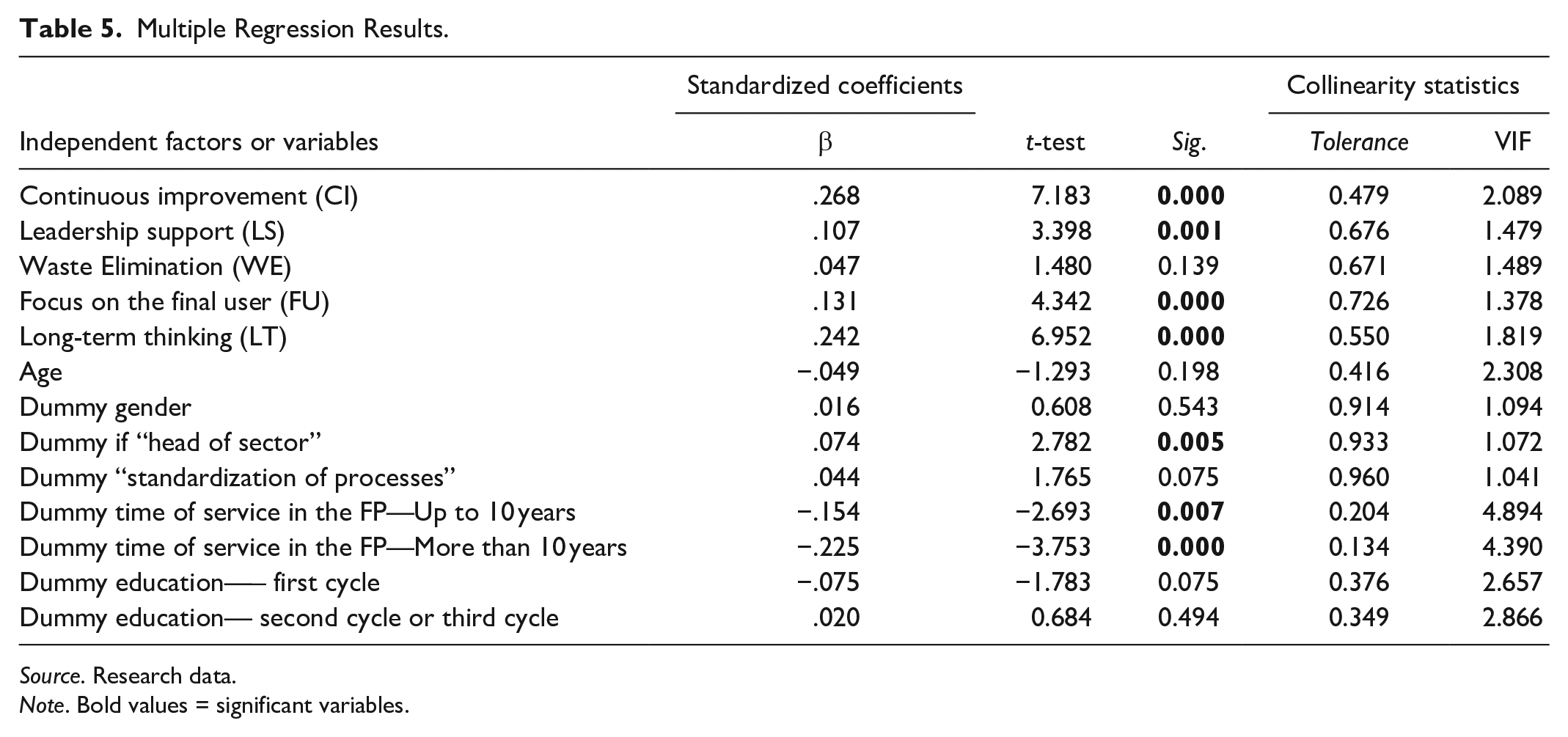
To investigate and analyze the impact that Lean values and practices (independent variables) have on process effectiveness (dependent variable), a multiple regression analysis was performed. To estimate the model, the “enter” method was used. Additionally, some control variables were also included in the model, which are: age, and dummies of gender, “head of sector,” process standardization, time of service in the FP, and education. The aim of using these additional variables is also to verify if they have some effect on the dependent variable. The results are shown in Table 5.
Multiple Regression Results.
Source. Research data.
Note. Bold values = significant variables.
The first point to note about the regression model obtained is that the Anova test was significant (value = 50.895; sig = 0.000), which indicates that at least one of the independent variables has a value statistically different from zero to explain the dependent variable. The second point to note is that a value of 0.414 was obtained for the adjusted determination coefficient (R²). This coefficient, in the conception of Hair et al. (2010), represents how much the variance of the dependent variable is explained by the independent variables; that is, it is an adjustment measure of the regression line. In other words, it can be said that 41.40% of the perception of process effectiveness in the FP can be explained by the significant independent variables of the regression model.
From the analysis of Table 5, it can be verified that four factors of Lean values and practices presented statistical significance (sig < 0.05) and, therefore, influence the effectiveness of processes. They are: Continuous improvement, Leadership support, Focus on the final user, and Long-term thinking. Among these factors, the first one exerts the greatest influence on process effectiveness (β = .268).
About the control variables, it can be verified that the dummy “head of sector” and both dummies “time of service in the FP” are significant in explaining the effectiveness of processes. Thus, the fact that an individual has a heading position in the Federal Police has a positive impact on the effectiveness of processes. The result that calls attention is that the time of service in the FP has a negative impact on the dependent variable. In other words, the more time police servants have worked, the less they contribute to the effectiveness of process management.
Specifically, about the assumptions of the regression model, it should be noted that the model does not present problems of multicollinearity since the tolerance and VIF measures presented satisfactory values. The estimated model also does not present problems of normality since the KS test performed presented a non-significant value (sig = 0.073). Therefore, the null hypothesis is accepted, and the assumption of normality of residues is met.
Finally, the homoscedasticity of the model was also analyzed using the Pesaran-Pesarán test. The result of this test presented the significant value at 5% (sig = 0.000), which refers to the rejection of the null hypothesis that the residues are homoscedastic. This means that the model presented problems regarding this assumption. In view of this, the robust HCCM (heteroskedasticity consistent covariance matrix) estimation (White, 1980) was used to calculate the regression model in this article.
So, the results of this study allow to say that four factors have a significant impact on the perceived process effectiveness at the FP. In order to demonstrate the significance of the estimated and tested relationships as shown in the theoretical model of the research (Figure 1) and to summarize the results of the tested hypotheses, Table 6 was elaborated. That table shows the values and significance of the relationship, as well as the final decision on the tested hypothesis.
Hypothesis Analysis.

Source. Elaborated by the authors.
These results demonstrate that most relations of the theoretical research model are corroborated by this study. Specifically, it can be verified that hypotheses H1, H3, H4, and H5 were confirmed, demonstrating an influence of these lean practices on the process effectiveness. These results allow a spectrum of discussions and contributions to the literature and practice on the subject, which are described in the next section.
Discussion of the Results
The results of this research reveal the impact of certain factors related to Lean practices and values on the perception of process effectiveness. The factor that most influences this causal relationship is continuous improvement (β = .268). Related to this fact, the first point to emphasize is that changes and improvements in processes must occur continuously in organizations due to the speed at which changes occur in the internal and external organizational environment, and due to the new “requests” and needs arising from customers (Brajer-Marczak, 2014). The second point to note is that, while the organization maintains the practice of continuous improvement over time, the more actions and processes can be analyzed, evaluated, and improved (Aka et al., 2020) what’s imply in greater effectiveness taking into account the results of this work.
In addition, the practice of continuous improvement over time allows the establishment of a long-term routine of continuous changes, which is very closely aligned to the second factor that influences most on process effectiveness, that is long-term thinking (β = .242). In fact, the more the improvements are accomplished, the more they will be incorporated into the way employees think and work over time. This long-term focus and way of thinking is in the essence of the Lean system, and it is necessary to obtain fruitful results in a long-term journey (Abdallah et al., 2019). By acting in this way, the organizational culture may be changed and the Lean practices gain importance in the effectiveness of processes (Ingelsson & Mårtensson, 2014; Rymaszewska, 2017).
The results of this article also indicate that the factor “focus on final user” positively affects the effectiveness of processes (the third one that most impacts this causal relationship). This factor is in the core of the Lean system functioning and its relationship with the effectiveness of processes is evidenced while the greater alignment of activities with what the final user needs, the greater is the possibility of narrowing the routine performed by servants to this end, and greater will be the effectiveness. This also makes it possible to eliminate those specific activities that do not generate value to the user, and make the processes leaner, clearer, and optimized, which will provide effectiveness. This way, it is possible to open space for continuous improvement actions, as well as to generate value to the user, which meets the postulates of Womack et al. (2004) and Ohno (1988).
The last factor analyzed in this study that has a positive impact on the perception of process effectiveness is leadership support. This support is not limited to the leaders of work teams or organizational sectors, but also to the heads and “top” management of the organization. The main element to be considered is that leadership support influences the engagement of employees in the actions outlined and provides an environment of creativity and better performance (Golden & Shriner, 2019; Mahmood et al., 2019). Leadership is another essential value of the Lean system and is also responsible for nurturing respect for people and stimulates active workers (Ingelsson & Mårtensson, 2014). The elements linked to the motivation, commitment, and engagement of the employees, directly or indirectly, are related to process effectiveness (Sandoff & Nilsson, 2016). That is why the “leadership support” factor plays an essential role in process effectiveness.
The arguments described in the previous paragraph, in a certain way, help to explain why having a “heading (leadership) position” has a positive impact on process effectiveness. Specifically, the servants who hold the leadership positions accumulate greater responsibilities and should be more responsive to the demands of the sector. In addition, the head position usually requires an individual who has more experience and greater knowledge of the processes surrounding a sector or department.
Finally, the results of this study demonstrated that the “time of service” has a negative impact on the perception of process effectiveness. This, at first, may be understood as contradictory to the natural logic of knowledge acquisition in an organization. People with more time of service in an organization accumulate more knowledge, know better the routines, and have more experience within the organization in which they work. So, they should generate a positive impact on process effectiveness.
However, some studies point out certain elements that generate disillusionment and demotivation of servants and, consequently, a negative impact on effectiveness. Ribeiro and Mancebo (2013) describe some discouraging aspects of public service and organizations like a context surrounded by limitations such as budget restrictions, inadequate or limited working conditions, few material and human resources, and the weight of the bureaucratic structure. In addition, they advocate that there is “a hostile attitude of society directed at everything that originates from the State, which preaches the valorization of the private at the expense of the public” (p. 199). Siqueira and Mendes (2009), in turn, point out that the administrative reform left servants aside to prioritize activities and tasks. This situation made the work more precarious and increased the burden on the worker, generating discouragement and difficulty in exchanging information and creativity. Some of these elements meet the arguments of Pinto and Behr (2015), who highlight the lack of recognition of public servants.
A specific result of this research is noteworthy: the fact that the elimination of waste was not significant for the analysis of the effectiveness of processes in the studied institution. Some reasons can help explain this fact. First, understanding and embedding some lean practices can take more time and effort to accomplish, requiring cultural changes by the individuals; second, according to Ohno (1988), waste can be classified into seven different classical types, and this understanding among survey respondents may not yet be clear. Many people only associate waste only to material/physical things; and third, the institution is in the early stages of its process redesign project, and thus better results can be projected over time, especially with regard to waste elimination.
All these discussed results accumulate throughout the servant’s trajectory and help explain this specific result of this research. It is important to emphasize that these results meet the principles of Lean management philosophy, and exalt the importance of new management models, new practices and values, and the change in people’s culture and thinking in the public arena, even if it becomes a long-term journey.
Conclusions
The effectiveness of processes is a recurring theme in studies due to their applicability in public or private organizations. However, this study advances the literature by investigating this theme from the perspective of values and practices of the Lean system. This study aimed to evaluate the impact of Lean practices and values on the effectiveness of processes. A survey was applied with the servants of the Federal Police of Brazil to obtain answers to this objective.
The results of the study allow us to conclude that the factors “Continuous improvement,” “Long-term thinking,” “Leadership support,” and “Focus on the final user” have a direct impact on the process effectiveness, according to the survey respondents. Therefore, this study goes beyond demonstrating how the process management approach and the Lean system overlap or differ (Maldonado et al., 2020), and shows that Lean practices and values influence and help improve the effectiveness of processes.
In theoretical terms, this study contributes by providing, from the lens of process effectiveness, the “seed” to facilitate the change to “become lean” in the public management area, as demonstrated by Radnor and Walley (2008). The findings of this study reveal a relevant relation between the two forms of management, and that Lean practices can be the basis for improving the procedures and organizational assumptions of process-based management. Also, it is important to highlight that the implementation and encouragement of other Lean practices and values, such as small group problem solving (Gaiardelli et al., 2019) and respect for workers (Cardon & Bribiescas, 2015; Shingo & Dillon, 1989) can minimize the negative effects of “time of service” on the effectiveness not only of organizational processes but of the entire “productive complex” of public organizations.
Moreover, in practical terms, the postulates of this research can be taken as the initial step of a more comprehensive management project for public organizations, which is the adoption of basic principles and precepts of Lean management. This involves a long-term change in the way people think and work. The practices of Lean philosophy are intrinsically related to the effectiveness of processes, and thus, decision-making process, leadership style, and people’s involvement are seen in another way. The traditional top-down governance system starts to give way to a bottom-up style, in which frontline workers are more valued and considered in their initiatives for change and improvement. The results also encourage leaders to foster practices such as continuous improvement, a focus on the end user, and long-term thinking among the institution’s employees, since these demonstrated a significant and positive impact on effectiveness.
Future research could be developed by extending the application of Lean Practices in the organizational environment and investigate the impact on elements related to the outputs of the administrative and operational system, and even on the effectiveness of processes. Moreover, the possibilities of study in public organizations are extended to the understanding of the “final user” perception of value in public services, through the prism of different users, such as internal users, the society, the government, or the “customer” itself. Finally, an essential study possibility is to verify why the reduction of waste has not significantly impacted the effectiveness of processes (as demonstrated in this work). Relevant insights can be discovered from this study possibility and guide public managers to waste reduction, considering the context of resource retention.
Footnotes
Declaration of Conflicting Interests
The author(s) declared no potential conflicts of interest with respect to the research, authorship, and/or publication of this article.
Funding
The author(s) received no financial support for the research, authorship, and/or publication of this article.
