




Abstract
This systematic review assesses the development of survey-based small business social responsibility (SBSR) and political activity (SBPA) research over the last 30 years. Survey research designs are a widely adopted approach to studying SBSR and SBPA, making a significant contribution to the small business nonmarket strategy (SBNS) research agenda. Survey research has been used in a quarter of the 203 SBNS research publications identified, 60% of all quantitative SBSR studies and 100% of all quantitative SBPA publications. This review identified a total of 53 survey-based studies of SBSR and SBPA in a multidisciplinary selection of 40 top journals. The SBSR articles reviewed primarily focused on environmental themes, CSR strategies, and CSR performance at the macro level and micro concerns around entrepreneurial commitment/attitudes to CSR. The SBPA articles had no clear focal phenomena. The theoretical positioning of the articles used primarily organizational and organizational field level theoretical foundations, in SBSR studies the main theory used was stakeholder approaches/theory, resource-based approaches and (meso/micro) institutional theory, while the SBPA research was clearly oriented toward resource-based approaches. The SBSR studies in contrast to the SBPA research had a far clearer set of established predictor, outcome, moderating/mediating, and control variables. In terms of survey research design the results show a consistent and ongoing improvement of the research designs, but many norms of good survey design are not yet consistently adopted in SBSR and SBPA research. Critically the literature lacks replication of results. Future studies should pursue replication studies and adopt methodological best practice.
Keywords
Introduction
The small business social responsibility (SBSR; Avram et al., 2018; Soundararajan et al., 2018) and to a lesser degree the small business political activity (SBPA; Cook & Barry, 1995; Cook & Fox, 2000; Lawton et al., 2013) research agendas have developed significantly over the last 30 years. This progress has been captured most clearly in recent SBSR review papers, which provide valuable syntheses of our knowledge and theorizing of SBSR (Avram et al., 2018; Soundararajan et al., 2018). At the same time the diverse and rich nature of methodological appraoches adopted in SBSR and SBPA research has received relatively little attention. Of the 203 SBSR or SBPA papers this study identified, 8 adopted a mixed method approach, 13 were reviews, 25 were conceptual theoretical, 14 provided commentaries or opinions, 58 took a qualitative, and 85 a quantitative approach. Survey-based studies accounting for over half of the quantitative research designs (53) in SBSR and SBPA papers.
Studying small businesses is acknowledged as challenging and the need for rigorous research methods has been called for to advance the field (Blackburn & Kovalainen, 2009; Courrent et al., 2018; Crane et al., 2018). SBSR and SBPA research is also affected by a lack of sufficient attention to the need for replications of empirical studies, which can have significant consequences for the development of “repeatable cumulative knowledge” (Bettis et al., 2016; Eden, 2002; Ethiraj et al., 2016). These represent important lacunae, that if addressed would complement prior SBSR thematic syntheses, by providing a synthesis of where the SBSR and SBPA fields have potential to develop most usefully.
The importance of survey-based studies and their now sufficiently widespread adoption in SBSR and SBPA research, is an opportunity to make such a contribution to the SBSR and SBPA literatures, by evaluating the degree to which calls for (a) improving methodological quality and (b) paying greater attention to replication of past research have been taken up by SBSR and SBPA scholars. Following the generally accepted principles for conducting a high-quality systemic review (Jones & Gatrell, 2014; Macpherson & Jones, 2010), this paper thus asks the following open main (RQ) and three sub-research (SRQ) questions:
RQ: How has the survey-based empirical literature for small business social responsibility and political activity developed over the last 30 years?
SRQ 1: How have the thematic foci of survey-based research on SBSR and SBPA developed?
SRQ2: How well does the survey-based research on SBSR and SBPA literature reflect contemporary accepted research quality standards for this type of research?
SRQ3: How should future survey-based research on SBSR and SBPA be designed to ensure high quality contributions to the literature?
To answer these questions, this review analysed 53 empirical survey-based studies, identified by searching over 40 highly regarded international journals. These articles are part of a larger set of 203 SBSR and SBPA articles identified via an initial systematic literature search and subsequent reconciliation with the previous SBSR reviews by Soundararajan et al. (2018) and Avram et al. (2018). This represents the most comprehensive list of SBSR and SBPA articles to date and is available in the accompanying Supplemental Appendix S2.
The article proceeds as follows. First SBSR and SBPA are defined. Next the different approaches for replicating prior research and the quality criteria for the methodology are discussed, followed by an explanation of the design of the systematic review. Then the search results are described, before being discussed and evaluated. The paper concludes by addressing the implications of the evaluation and providing recommendations for future research.
Small Business Social Responsibility and Political Activity
Similarly to Soundararajan et al. (2018), we did not seek to achieve definitional certainty in our understanding of the three core concepts for the review; small businesses, small business social responsibility, and small business political activity. There is no accepted definition of small businesses, reflecting the range of existing definitions and the challenges of reconciling different understandings of this type of firm across countries and sectors (Harvie & Lee, 2002; Soundararajan et al., 2018). In terms of size small businesses are synonymous with small and medium-sized enterprises (SME; Goss, 2016; Soundararajan et al., 2018), with under 250 employees. Small businesses “are generally independent, multi-tasking, cash-limited, based on personal relationships and informality, actively managed by owners, highly personalized, largely local in their area of operation, and largely dependent on internal sources to finance growth” (Soundararajan et al., 2018).
Small business social responsibility reflects the more general concept of corporate social responsibility (CSR), but with a “sensitive[ity] to the small-business context and idiosyncrasies” and can thus be understood as “as those activities of smaller organizations that result in positive social change” (Soundararajan et al., 2018). This reflects a renewed focus on the societal impact of CSR (Kudłak et al., 2022). Similarly, SBPA refers to those activities of small businesses, again acknowledging the unique nature of small businesses, reflecting the broader corporate political activity (CPA) concept. Where CPA can be defined as business activity to shape government policy so that it is favorable to firms (Hillman & Hitt, 1999; Lawton et al., 2013).
A Typology of Replication Studies
The importance of explicit and implicit replication in survey-based SBSR and SBPA studies, emerged through the relatively open research questions initially adopted. There was no prior expectation that this theme would be important. Thus to ensure the full potential of this insight is realized, the issue of replication is clarified here.
The importance of replication for ensuring the ongoing development of a cumulative body of knowledge, a more positive understanding than simply thinking of it as an attempt to overturn previous findings (Ethiraj et al., 2016), has received significant attention. This concern has been addressed in special issues of the Strategic Management Journal (Ethiraj et al., 2016), the Journal of Business Research (Easley & Madden, 2002, 2013), and a number of standalone papers (Eden, 2002; Ethiraj et al., 2016; Harzing, 2016; Hensel, 2019; Madden et al., 1995). Notably, Eden (2002) has made the point that the increasingly important contributions of meta-analysis is predicated on an active effort to replicate previous research. The lack of sufficient research attention to replication has significant implications for the development of “repeatable cumulative knowledge” (Bettis et al., 2016). Although it should be noted that Eden (2002) points to the fact that replication is often present in empirical studies, but not acknowledged.
Approaches to replication studies depend on the definition of what counts as replication (Eden, 2002). This discussion adopts the very helpful categories of Bettis et al. (2016), adapted from Tsang and Kwan (1999), see Figure 1, (i) narrow (cells 1 and 2) and (ii) broad (quasi-)replication (cells 3, 4, and 5) studies. Narrow approaches seek to replicate studies as closely as possible (Bettis et al., 2016), while broad approaches or “quasi-replications” “assess the generalizability of the results of prior studies to new contexts or the robustness of prior studies to different empirical approaches, methods, measures, and models” (Ethiraj et al., 2016, p. 2191). The implicit replication identified by Eden (2002) is often a partial quasi-replication. This type of replication is likely to result from research focusing on the same phenomena and building on previous research, it is arguably best captured by cell 5 of Figure 1, and featured by changes in both population, sample, empirical approaches, methods, measures, and models.

Narrow and broad (quasi-) replication.
Studies with similar results are not strictly speaking instances of replication, an explicit replication study has a specific prior study as reference point (Bettis et al., 2016). There is also an assumption that high quality replication needs equivalent or better-quality data than the original study, while replicating the methods and variables of the original study as closely as possible (Ethiraj et al., 2016). Narrow replication allows researchers to check for errors or falsification or the reliability and representativeness of data, but requires a high degree of similarity between the original and replicating study, see Figure 1. Quasi-replication studies can sample different populations to generalize prior findings and/or assess the robustness of prior findings to different research designs, see Figure 1, by changing the population and sample or research design in comparison to an explicit reference study or arguably implicit partial replication of earlier research.
Methodology
A systematic review is adopted to provide a “systematic accumulation, analysis and reflective interpretation of the full body of” survey-based empirical studies of SBSR and SBPA (Rousseau et al., 2008, p. 475). The approach sought to be comprehensive and transparent in identifying focal literature and the reflective interpretation of the selected studies (Rousseau et al., 2008). The search produced a list of 203 SBSR and SBPA articles, see Supplemental Appendix S2, and a final selection of 53 survey-based articles for review, see Table S3.1 in Supplemental Appendix S3. Detailed analytical tables too large for inclusion are summarized in this main paper and presented in full detail in Supplemental Appendix S4. The focal 53 survey-based articles are numbered chronologically in Table S3.1 in the Supplemental Appendix and these index numbers are included in the analytical tables in this paper to ensure full traceability; reflecting recent best practice (Martineau & Pastoriza, 2016). The focal articles are also marked with an asterisk in the reference list for this paper, reflecting best practice in Soundararajan et al. (2018) and Avram et al. (2018).
General Procedure
This systematic synthetic review adopted the four steps procedure suggested by Rousseau et al., (2008). First a main and three sub-questions for the review were formulated, debated, and revised till all authors considered them appropriate for the intended goals of the study. In a second step a comprehensive and complete set of high quality and relevant literature was identified in over 40 internationally recognized “top journals” publishing small business research. The research questions were then used, in a third step, to guide the planning, organization, and interpretation of the data collection from the selected articles and the resulting analysis presented in this paper. Finally, in a fourth step, an integrative synthesis was developed to explain the thematic and methodological consistencies, inconsistencies, and contradictions that emerged from the analysis.
Search Approach
The search approach included six steps. First, (1) suitable search terms for identifying SBSR and SBPA articles were selected. Next (2) “top journals” for the review were identified and (3) searched for all small business related articles using Business Source Premier and the homepages of the Journal of Small Business and Enterprise Development, the Journal of Family Business Strategy, and Business and Politics. The resulting literature was then (4) searched for all SBSR and SBPA papers and finally (5) reconciled with the SBSR review articles by Soundararajan et al. (2018) and Avram et al. (2018), the most recent and comprehensive reviews of this literature. Finally, (6) the identified SBSR and SBPA articles were systematically searched to identify the 53 articles with survey research designs, for inclusion in this review.
Specifying Key Search Terms
Based on the definitions of SBSR and SBPA adopted for the paper, the key search terms developed for the review were general terms that are broadly used in the literature to refer to small businesses and the two types of nonmarket activity, social responsibility and political activity of businesses. The authors relied on their knowledge of the respective literatures and experience to develop the search terms in Table 1.
Overview of Search Terms by Search Step.

Journal Selection
This review deliberately focuses on the “top journals” from five fields of business and management scholarship publishing research on small businesses, CSR and/or CPA. These outlets are broadly recognized as the most prestigious and demanding journals in which to publish, thus representing sources of high-quality articles, that are “perceived as having the highest standards for original contribution, theoretical development, and methodological rigor” (Kolk et al., 2018, p. 4). This approach reflects that of the recent review of SBSR by Soundararajan et al. (2018) and the approach adopted in the broader strategy and management literatures. The selection of the 40 main journals for the intended literature search, see Table 1, made use of a combination of journal rankings and emerging categories in previous reviews to identify journals in the fields of (i) small business journals (9), (ii) nonmarket journals (6), focusing on CSR and/or CPA, (iii) general management journals (13), (iv) strategy journals (8), and (v) managerial practice journals (4). This represents a multi-disciplinary and high-quality set of outlets, while retaining a comprehensive account of the focal small business domain (see Table S1.2 in Supplemental Appendix S1 for a full description of the selection process). To test the validity of our approach and the final journal selection, we compared it to the journal selection included in the authoritative reviews of SBSR by Soundararajan et al. (2018) and Avram et al. (2018).
Achieving and Communicating the Synthesis of the Research
The focal empirical studies represent a comprehensive accumulation of authoritative high quality empirical survey research in SBSR and SBPA. Transparency is ensured by adopted an integrative approach (Rousseau et al., 2008), triangulating across the 53 focal papers and relying on researcher judgement to achieve synthesis. A similar approach to Martineau and Pastoriza (2016) is adopted for developing the analytical tables for this paper.
Overview of the Literature Search Results
The vast majority of the survey-based studies have been published since the late 2000s, with significant waves of publication in 2009 (5), 2010 (5), 2012 (5), 2017 (6), see Figure 2, coinciding with a more general increases in publications about SBSR and SBPA. In terms of how prolific individual scholars are, there is no clear case to be made for any group of leading scholars, as it is most common for a single survey-based contribution to be made. Exceptions for SBSR include Thompson and Hood (1993), Perrini et al. (2007), Russo and Tencati (2009), Courrent and Gundolf (2009), Courrent et al. (2018), McKeiver and Gadenne (2005), Gadenne et al. (2009), Tang and Tang (2012, 2016), Torugsa et al. (2012, 2013), and for SBPA Barron et al. (2016), Hultén et al. (2012). This suggests that survey-based research designs for SBSR and SBPA studies may be associated with significant effort and challenges.

Number of papers per year.
Clear patterns are visible in the outlets for empirical surveys of SBSR and SBPA activity, see Figure 3, with the small business outlet Journal of Small Business Management (JSBM) and non-market journals Journal of Business Ethics (JBE) and to a lesser degree Business & Society (BAS) being the clearly preferred outlets; these journals published more than half the studies included in this review. Other important small business journals are Small Business Economics (SBE) and Journal of Small Business & Entrepreneurship (JSBE). The remainder of the articles are primarily published in other small business or nonmarket journals, with very few studies in more general or strategic management journals.

Survey-based SBSR and SBPA articles by search, domain, and journal.
Survey-based studies of SBSR and SBPA are almost exclusively focused on a single national context in North America, Europe, or the Asia Pacific. Exceptions are the studies by Hamann et al. (2017) on the greening of SMEs in South Africa and two studies about SBSR in India (Chahal et al., 2014; Vancheswaran & Gautam, 2011). In the Asia Pacific studies are mostly focused on China (4), Australia (4), and New Zealand (2), while the United States (17) accounts for almost all studies in North America. In Europe a far greater number of countries have received attention, especially the Netherlands (3), Italy (3), the UK (2), France (2), and Germany (2). Studies focusing on multiple national contexts have focused on France, Sweden, and the UK (Barron et al., 2016; Hultén et al., 2012) and Canada, United States, France, Germany, Hungary, and Norway (Darnall et al., 2010). In terms of the national contexts, the United States has by far the highest likelihood of benefiting from implicit replication, due to the absolute number of survey studies completed in the country.
Thematic Synthesis
We respond to the call of Soundararajan et al. (2018) for a multi-level analysis, that includes a macro-, meso-, and micro-level of analysis, in our synthesis. We adopt Scott’s (1996, 2014) conceptualization of a macro-level as the institutional environment of the firm. The meso-level or organizational level (Scott, 1996, 2014) reflects what Nicholls-Nixon et al. (2011, p. 1189) define as “capturing the relationship between the organization and its external environment (how the firm navigates the environment) and relationships between or among parts of the firm (how the firm is organized and managed)”. Soundararajan et al.’s (2018, pp. 935–936) individual-level of analysis is “concerned with a range of aspects related to individuals and their roles within organizations, particularly when it comes to organizational behavior and organizational performance.”
We further adopt analytical categories from Soundararajan et al. (2018) for structuring the review, purposefully seeking to contribute to developing a body of work, focusing on Focal Phenomena and Theoretical Foundation, Predictors and Outcomes, and Mediators and Moderators of SBSR and SBPA survey studies. In addition, we also address the Control Variables typical in SBSR and SBPA survey studies. Our review also explicitly focuses on their analytical category “Methodological Orientations,” by systematic reviewing the survey research designs in the SBSR and SBPA literatures, addressing the Sampling Strategies and Quality, Survey Instrument Development and Execution, and the Analytical Approaches of the survey research are reviewed.
Focal Phenomena and Theoretical Foundation in SBSR and SBPA Surveys
There are no survey studies that focus on a SBSR phenomenon at an institutional level, the vast majority of the studies are at the organizational level of analysis (77%) and a smaller group of studies are at the individual level of analysis (23%, see Table 2). At the organizational level there is a clear focus on environmentally related (ecological) CSR, CSR strategies, CSR performance, and finally community involvement and engagement. The breadth of the thematic foci reflects the generally accepted argument that CSR continues to remain a relatively diverse body of scholarship (Crane et al., 2015). At the individual level the thematic focus lies on entrepreneurial commitment/attitudes to CSR, and more specifically managerial attitudes to environmental sustainability. There are no survey studies that focus on a SBPA phenomenon on an institutional level, most studies focus on a phenomenon related to the organizational level of analysis, including SPBA effectiveness, SME business association affiliations, SME political intelligence and business associations, and bribery and political ties. One study includes the individual level, see Table 2, namely managerial perceptions of business associations. Leaving no clear pattern concerning SBPA thematic foci.
Multi-Level Thematic Synthesis of SBSR and SBPA Survey Research: Focal Phenomena.

Note. (1) The associated studies are indicated by their numbering in Supplemental Table S3.1, this is done in the interests of clarity and space in the table.
(2) Analytical Categories from Soundararajan et al. (2018).
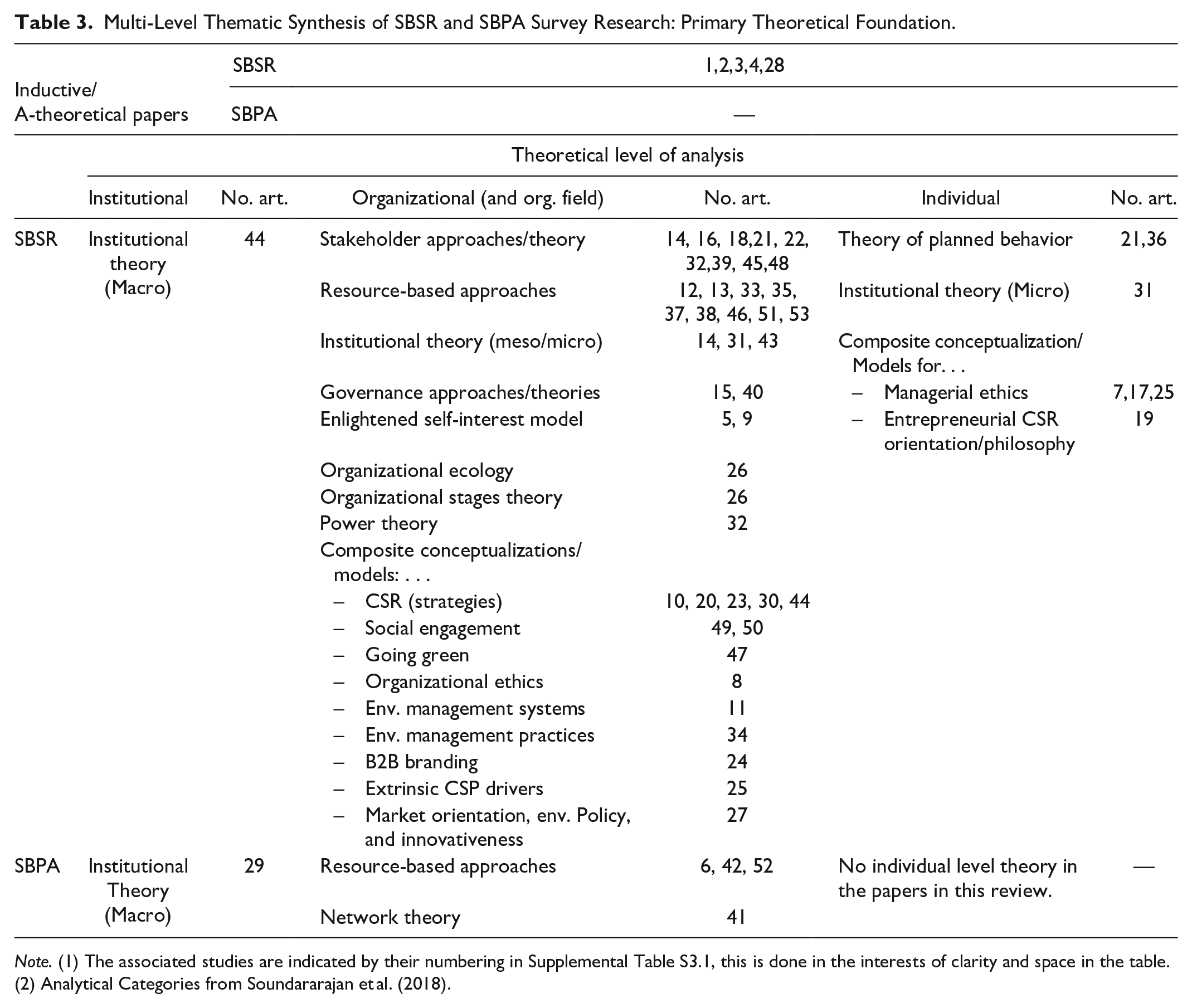
At the institutional level of analysis both the SBSR and SBPA studies adopted macro institutional theory (see Table 3). A SBSR study compares the effect of institutions across subnational regions in Switzerland (Lorenz et al., 2016) and a SBPA article compares France, Sweden, and the UK (Hultén et al., 2012). Institutional theory was however only the third most common theoretical foundation at the organizational level for SBSR studies, after stakeholder theory/approaches and resource-based approaches, both of which have increasingly gained in popularity, reflecting broader trends in the (international) strategy, and business and society literatures. Resource-based approaches were clearly preferred in the SBPA literature at the organizational level, with network theory adopted once. There were no SBPA studies at the individual level of analysis, while the SBSR did include theories at this level, including the theories of planned behavior and individual level institutional theory.
Multi-Level Thematic Synthesis of SBSR and SBPA Survey Research: Primary Theoretical Foundation.
Note. (1) The associated studies are indicated by their numbering in Supplemental Table S3.1, this is done in the interests of clarity and space in the table.
(2) Analytical Categories from Soundararajan et al. (2018).
The SBSR literature at both the organizational level, as well as individual level, included a large number of studies where composite models drawing on different strands of theorizing were employed, see Table 3. The majority of these, especially at the individual level, were written in or before 2012, the exception are two studies on social/community engagement (Park & Campbell, 2017; Stoian & Gilman, 2017). This again speaks to the complexity of the social responsibility phenomenon. A limited number of studies also include theories at different levels of analysis, reflecting recent calls for more such work (Soundararajan et al., 2018). Cordano et al. (2010) combine stakeholder theory and the theory of planned behavior to study the greening of SMEs. Peterson and Jun (2009) integrate institutional theory and a composite model of entrepreneurial CSR to explore entrepreneurial commitment to CSR as a philosophy, see Tables 4 and 5. While Darnall et al. (2010) combine composite models of CSR strategies and entrepreneurial CSR to research proactive SME environmental strategies. These multi-level studies however remain rare, and it is worth noting that a number of papers do not have theoretical foundation; these are, with one exception, papers between 1980 and the early 1990s.
Multi-level Thematic Synthesis of SBSR and SBPA Survey Research: Summary of Predictors.

Note. (1) The full detailed summary tables for all predictors, outcomes, moderators, mediators, and controls for the studies in this paper are available in the Supplemental Material. These more detailed tables include the numbering of individual studies, as per Supplemental Table S3.1, to ensure clear traceability of the analysis to the original sources.
(2) Analytical Categories from Soundararajan et al. (2018).
Despite there being no explicit attempt at either a narrow or quasi-replication study among the 53 papers reviewed, a comparison of the theory adopted and thematic foci at the organization level suggests that there are some patterns that could be argued to represent implicit quasi-replications. These studies by focusing on different research designs and populations contribute to the generalization of theory/phenomena combinations and the assessment of these combinations. Three groups of studies can be identified, those drawing on stakeholder theory/approaches to understand CSR related to the natural environment (Darnall et al., 2010; Gadenne et al., 2009; Tang & Tang, 2012, 2016). Those that draw on stakeholder theory/approaches to understand CSR performance in India (Chahal et al., 2014) and Malaysia (Nejati et al., 2017). The third group of studies has adopted the resource-based view to study CSR strategies (Arend, 2014; Stoian & Gilman, 2017; Torugsa et al., 2012, 2013). The combinations of theoretical perspectives and thematic foci of the remaining studies are more diverse and fragmented. There is also no clear sense of these choices actively reflecting a concern for the need to replicate previous studies, further support an argument that any replication in the SBSR and SBPA literatures is implicit quasi-replication.
Predictors and Outcomes of SBSR and SBPA Surveys
It is challenging to draw any strong conclusions about the robustness of the vast majority of the variables identified, as both predictors and outcomes, based on the relatively limited adoption in the focal studies. What is clear is that SBSR research at both the organizational and individual levels has made most progress in identifying some robust predictors of CSR activities. This represents a very limited implicit partial quasi-replication and suggest the need for far more systematic evaluation of the robustness of variables as predictors through more purposeful replication studies. Most implicit quasi-replication outcomes are organizational level variables for SBSR.
At the institutional level of analysis, see Table 4, legislation in a SBSR study and policy-maker preferences in a SBPA paper are two highly related predictors of the respective phenomena. Two further SBPA articles also include respectively a country-of-origin influence and an external event effect (a financial crisis) as predictors of SBPA activities. The vast majority of the predictors are at the organizational level of analysis, reflecting the above theoretical and thematic foci.
The SBSR organizational level predictors include, in descending frequency, firm size, stakeholder pressure, perceived benefits of CSR and family (involvement) ownership as the most common predictors. A further five predictors adopted in two studies are also identified, see Table 4. A total of 53 organizational level predictors that were only tested once are identified. Reflecting the infancy of the survey-based SBPA literature, a total of 11 organizational level predictors were identified, all in a single study. The SBPA literature did not include any individual level predictors and the SBSR studies showed a similar pattern at the individual level to the organizational level, with respondent attitudes to CSR, respondent age, level of experience, level of education being used more than once, and 14 predictor variables included in only one study. These findings reinforce the primacy of the organizational level in survey-based studies of SBSR and SBPA and reflects the dominance of stakeholder-based, resource-based, and institutional theory in contemporary theorization.
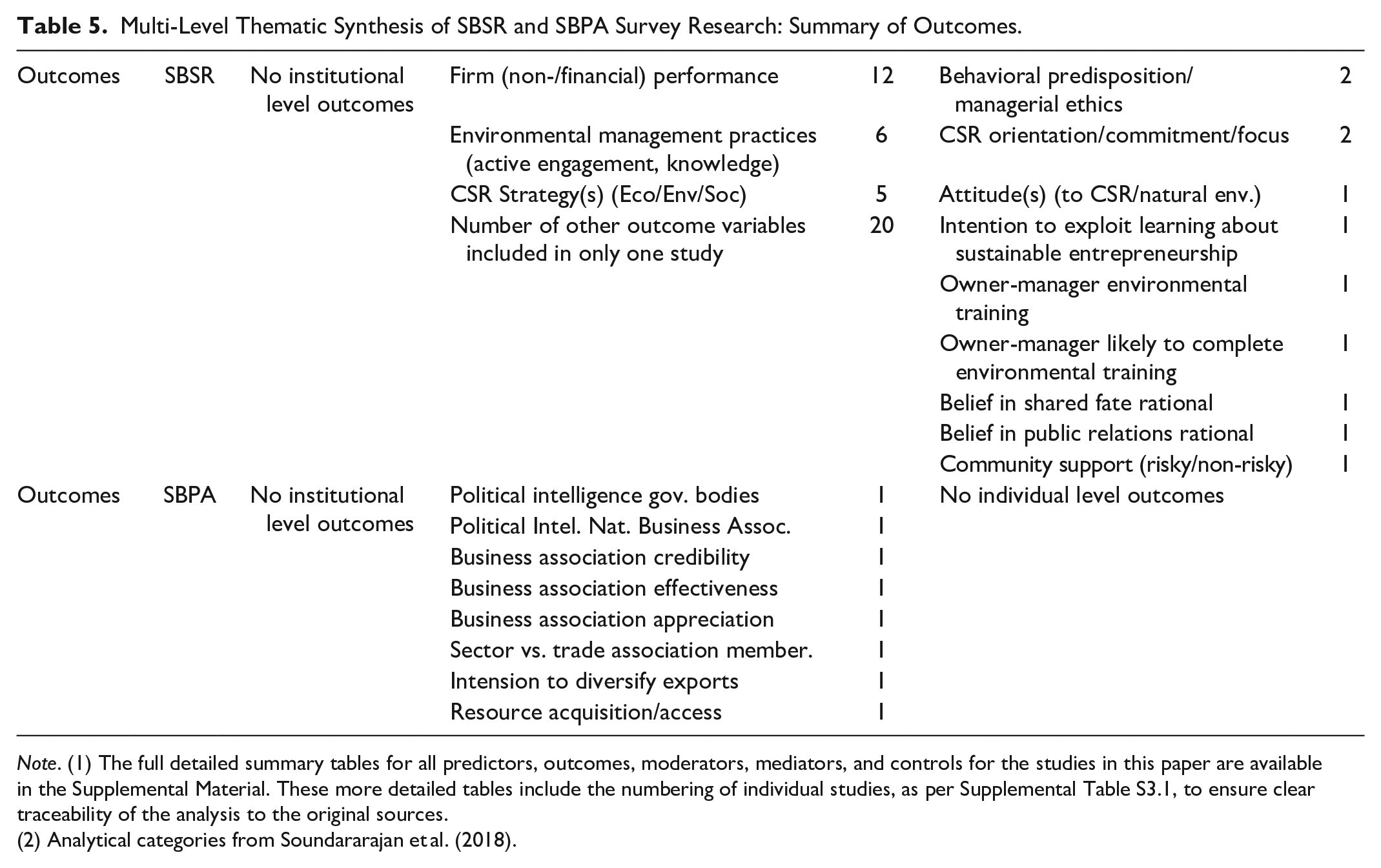
The studies do not include any institutional level outcome variables for either the SBSR or SBPA papers, see Table 5. The SBSR organizational level outcomes used more than once, include both non-financial and financial firm performance measures, environmental management practices, economic, environmental and social CSR strategies, environment sustainability orientation, employee development CSR practices, and customer centric CSR practices. An additional 32 outcome variables were found in only one paper. The SBPA studies only included organizational level outcome variables, with no repetition across any studies, including firm financial performance, firm innovation performance, intension to diversify exports, resource acquisition and access, and political intelligence source. The SBSR research included individual level outcomes, such as managerial ethics, CSR commitment, intention to exploit learning about sustainable entrepreneurship, and owner-manager likely to complete environmental training. At the individual level of analysis there was no repeated adoption of any of the outcomes across the studies.
Multi-Level Thematic Synthesis of SBSR and SBPA Survey Research: Summary of Outcomes.
Note. (1) The full detailed summary tables for all predictors, outcomes, moderators, mediators, and controls for the studies in this paper are available in the Supplemental Material. These more detailed tables include the numbering of individual studies, as per Supplemental Table S3.1, to ensure clear traceability of the analysis to the original sources.
(2) Analytical categories from Soundararajan et al. (2018).
Moderators and Mediators of SBSR and SBPA Surveys
There are limited instances of implicit partial quasi-replication for SBSR studies of firm size as a moderator and mediating variable of CSR strategies and a number of CSR practices. This suggests significant potential for narrow replication of earlier studies and quasi-replication to better understand the moderating and mediating effects related to SBSR and SBPA.
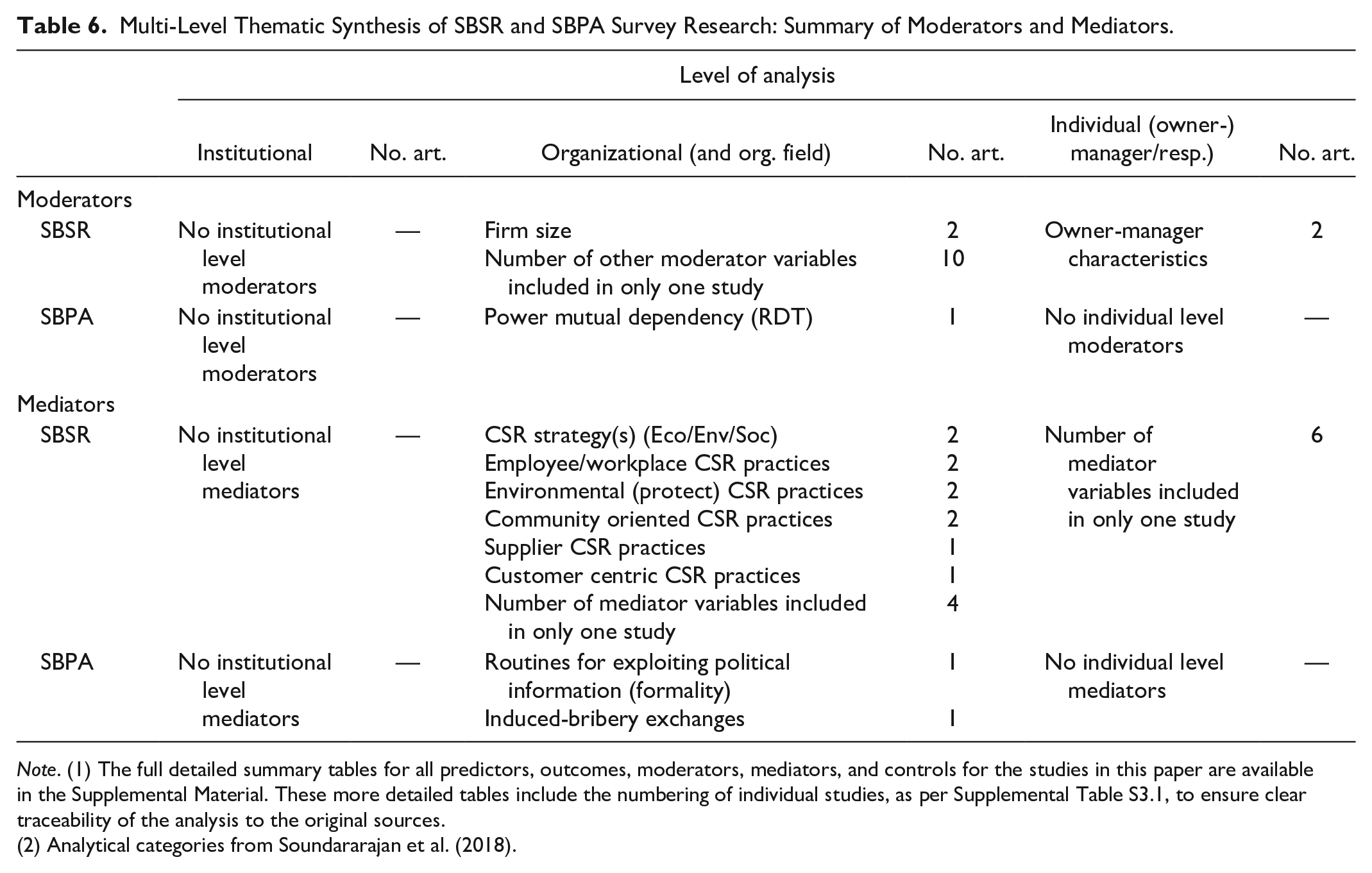
Neither the SBSR nor the SBPA studies include institutional level moderators or mediators, while at the individual level of analysis a small number of SBSR studies include owner-manager characteristics and the perceived ease of using learning about sustainable entrepreneurship. Interaction effects in both the SBSR and SBPA survey-based research are predominantly studied at the organizational or organizational filed level of analysis, see Table 6. At the organizational level of analysis, firm size is the only moderating variable used in more than one study of SBSR, reflecting the frequent adoption of firm size as a control variable (see below), while a further 20 moderating variables are incorporated in only a single SBSR paper. One SBPA paper includes a moderator, namely power mutual dependence (Wang & Clegg, 2018).
Multi-Level Thematic Synthesis of SBSR and SBPA Survey Research: Summary of Moderators and Mediators.
Note. (1) The full detailed summary tables for all predictors, outcomes, moderators, mediators, and controls for the studies in this paper are available in the Supplemental Material. These more detailed tables include the numbering of individual studies, as per Supplemental Table S3.1, to ensure clear traceability of the analysis to the original sources.
(2) Analytical categories from Soundararajan et al. (2018).
While a greater number of moderating variables are identified, a larger number of mediating variables have also been included in more than one SBSR study at the organizational level of analysis, namely economic, environmental, and social CSR strategies, employee/workplace CSR practices, environmental (protection) CSR practices, and community-oriented CSR practices. A further 6 mediators are adopted in a single SBSR study (see online Supporting Materials file for details). At the organizational level of analysis, the SBPA survey studies include routines for exploiting political information and induced-bribery exchanges as mediators in two separate studies.
Control Variables in SBSR and SBPA Surveys
The most adopted and well replicated control variables across both SBSR and SBPA are organizational level variables, firm size, firm age, and industry/sector. In fact, these three variables are by far the most adopted of all variables across the 53 studies, representing the most robust measures in SBSR and SBPA survey research. At the individual level SBSR studies have initial limited adoption of five variables in two studies. There is thus meaningful implicit partial quasi-replication for the firm size, firm age, and industry/sector variables, providing evidence for their robustness as variables in SBSR and SBPA survey research.
At the institutional level of analysis control variables in SBSR studies include cultural systems in a study of Swiss SME CSR (Lorenz et al., 2016) and the country of origin in a comparative study of proactive environmental strategies (Darnall et al., 2010). The country of origin is also used in two comparative studies of SBPA (Barron et al., 2016; Hultén et al., 2012), see Table 7.
Multi-Level Thematic Synthesis of SBSR and SBPA Survey Research: Summary of Controls.

Note. (1) The full detailed summary tables for all predictors, outcomes, moderators, mediators, and controls for the studies in this paper are available in the Supplemental Material. These more detailed tables include the numbering of individual studies, as per Supplemental Table S3.1, to ensure clear traceability of the analysis to the original sources.
(2) Analytical categories from Soundararajan et al. (2018).
Reflecting the dominance of the organizational level, control variables are actively drawn from this level of analysis and with a high degree of consistency, see Table 7. The variables for firm size, firm age, and the industry or sector in which the firm operates are clearly key control variables for nonmarket SBSR and SBPA phenomenon. Slack/availability of resources, representing the next most important control variable. Control variables at the organization level adopted in at least three and up to four different SBSR articles, include firm performance, industry dynamism and hostility, ownership (public/private/family), and export orientation. Control variables at the organization level adopted in two SBSR studies include export orientation/intensity, number of shareholders/owners, general economic conditions, industry hostility, (managerial) locus of control, and geographic location (region). Unique controls at this level in only 1 study include 21 in SBSR and 2 in SBPA articles.
Individual level controls adopted in two SBSR studies include CEO values, self-deception (social desirability), impression management, respondent position/role, and owner-manager gender. Individual level controls adopted in a single SBSR paper, include owner-manager age, and entrepreneurial orientation. In the SBPA studies the individual level controls adopted in a single paper include respondent years of employment and perceived unethicality.
Sampling Strategies and Quality in SBSR and SBPA Surveys
The review of the technical aspects of the studies’ research designs begins by considering the sampling strategies and their reporting for the studies across the five time periods; before 1999 and four time periods of 5 years from 1999 to 2018. These time periods are adopted across the analytical tables, allowing a structured assessment of the research design choices and development.
Sampling Approach and Sample Description
There is significant potential in SBSR and SBPA research for improving the reporting of the sampling methods adopted in the reviewed studies, see Table 8, this is critical if the replication of previous studies is to be facilitated. The three most common are convenience (two articles), random (10), and stratified (6) sampling, with other approaches or combinations of approaches adopted in six papers. Critically in 30 papers the sampling approach is not specified, and this is consistently the case in each of the four time periods since 1999, with between 25% and 68% of studies not reporting the sampling approach. Relatedly across all time periods a total of 21 (40%) studies discuss the representativeness of the sample. All articles however identify the realized sample (53 articles) for the study, but the response rate is only reported in 36 articles. One would expect the sample size to be describe in all 36 articles, but it is only addressed in 30 papers.
Overview of Sampling Strategies and Characteristics.

Test for Biases in Sample
Replication studies are assumed to need equivalent or better quality data than the original reference study (Ethiraj et al., 2016), the systematic adoption of tests for biases in SBSR and SBPA studies represents one manner in which this could easily and meaningfully achieved. The most common and well-established tests for sample biases (Judge et al., 1982) that SBSR and SBPA studies could adopt are summarized in Table 9.
Overview of Sampling Quality.

Nonresponse bias, addressing the degree to which “there was a systematic difference in characteristics between responders and non-responders” to the survey (Sedgwick, 2014, p. 1) was most commonly included, typically via a t-test, while a number of studies used another test. Studies adopted a t-test most actively during the period 2009 to 2013, which is also when the bias was most actively evaluated. Since 2014 other tests have been preferred to t-tests, but the bias has also only been assessed in 38% of the studies, see Table 9. Given the significant number of studies that include factor analyses, it is unsurprising to see Harman’s single factor test actively calculated, as part of the assessment of common methods bias. A number of biases associated with the respondent are also assessed, including single respondent bias and social desirability, a concern when the topics covered in a survey address sensitive information (Krumpal, 2013), and self-selection bias. A total of 13 papers conduct no tests for biases, see Table 9. This suggests the systematic and comprehensive inclusion of tests for sample biases as a clear approach for realizing equivalent or better quality data than original studies in replication of SBSR and SBPA research.
Survey Instrument Development and Execution
Especially in narrow replication, but also in quasi-replication studies, replicating the methods and variables of the original study as closely as possible is critical (Ethiraj et al., 2016). The manner in which a survey is developed and executed can have significant consequences for the quality of the data that is subsequently collected, which affects the quality of the data in the replication study. Realizing close replication of the methods and variables of an original study requires clear and detailed description of the survey instrument and its operationalization in the original publication. This practice has improved over time in the focal papers and increasingly provides the needed information for meaningful replication studies.
The development of the survey is reviewed by considering the source of constructs and items used in the survey and the degree to which the items included in the survey instrument are specified. The operationalization of the survey is captured by reviewing (a) the operationalization of items, (b) the treatment of multi-lingual surveys, (c) the presentation of an exemplary survey instrument, and (d) the inclusion of a pretest of the survey instrument in the study, see Table 10. These design choices and their reporting contribute to construct validity and the reliability of the study and its subsequent replicability. These are essential for enabling high quality replication studies.
Overview of Survey Instrument Development.

With the exception of six articles, the source of constructs is predominantly based on academic literature. In 11 articles a qualitative pre-study was conducted to facilitate the construct and item development. The items are fully specified in 35 articles, partially in 15 papers, and not at all in 3 studies, which are—as would be expected—all rather older studies (Besser, 1999; Brown & King, 1982; Thompson & Hood, 1993).
The operationalization of items shows a clear preference for Likert scales, followed by dichotomous scales. A small number of papers use alternative scales, such as a semantic differential (Panwar et al., 2017) or ranking scales. It is noteworthy, that despite providing a full specification of items in the article, not all of these papers include a discussion of the operationalization of the items. An exemplary survey instrument is provided in 50 of the articles.
As shown in Figure 4, the articles under review also include multi-country studies. Hence, the treatment of multilingual surveys is considered an important quality factor (Douglas & Craig, 2007; House, 2014) in this review. A translation of the survey instrument is addressed in 9 papers and the full survey instrument provided in the Supplemental Appendix in 16 papers. Finally, pretests or pilot surveys are described in 17 studies, the vast majority of which are studies from the two most recent time periods covering studies in the period 2009 to 2018.
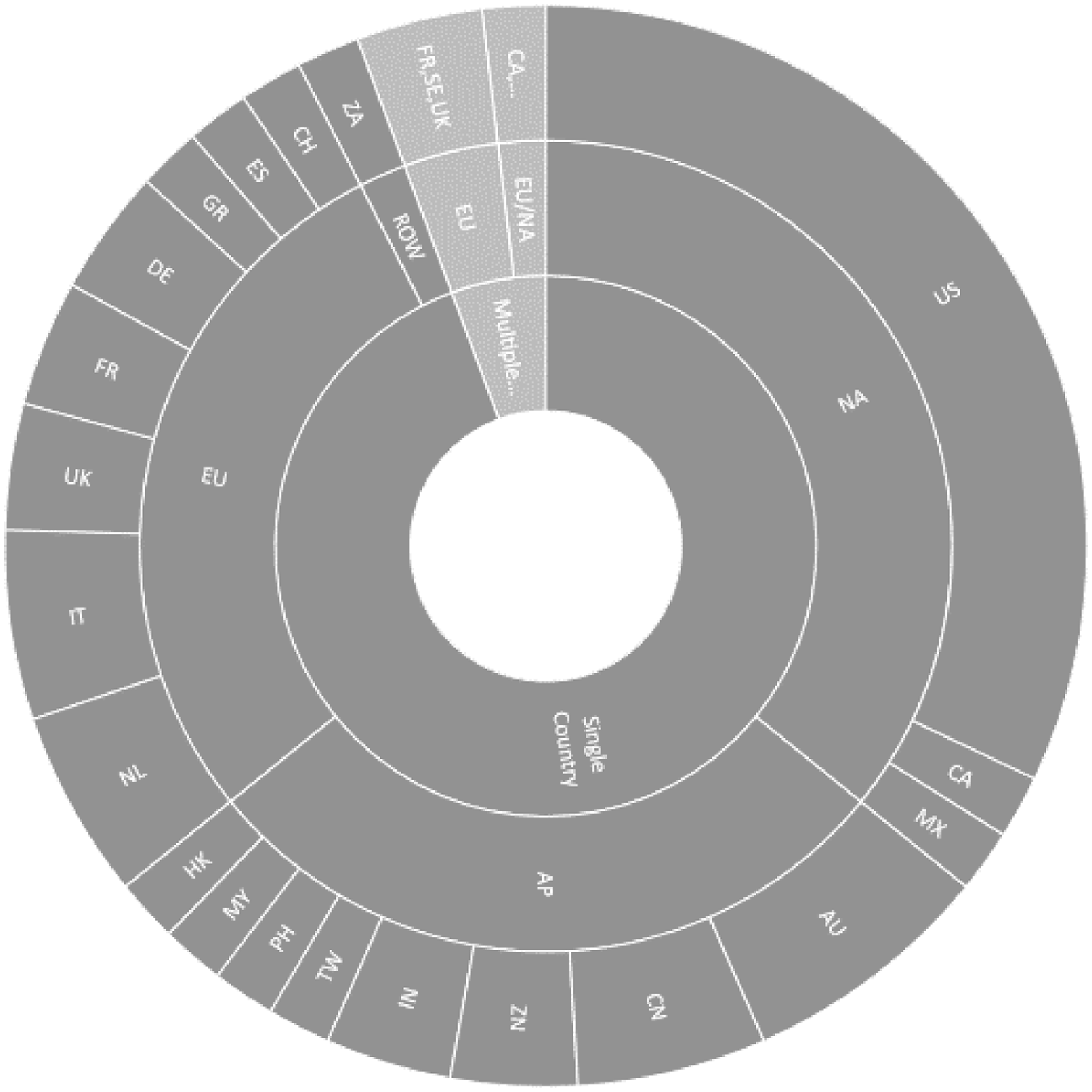
Geographic focus of sample for study.
The review of how surveys were executed, includes the deployment approach used and the use of reminders and incentives, see Table 11, to encourage participation. The dominant method for executing the survey data collection is a postal survey, followed by telephone survey, and online survey implementations. Table 11 suggests that telephone interviews are declining in popularity and increasingly replaced by online surveys. Some studies apply a multi-method deployment, for example, sending out several waves of surveys in various forms, including paper surveys personally distributed during an event. A reminder is mentioned by 20 articles, while the use of an incentive to increase response rates is declared only in one study.
Overview of Survey Execution (*Unknown (Survey Data)).

Best practice in other academic fields that are more advanced in the sophistication of their survey instrument development and execution, suggests that SBSR and SBPA research has significant opportunity in this respect for realizing equivalent or better quality data than original studies in replication studies, by more systematically addressing these concerns and adopting best practice. Building on the progress already identified in this review.
Survey Analytical Approach
The overarching pattern in the analytical approaches adopted is one of increasing complexity, see Table 12. At the same time a number of studies have used less complex analyses as part of multi-part analyses to great effect, in the most recent period 2014 to 2018. A number of studies have included descriptive statistics effectively to establish phenomena new to the SBSR and SBPA research agendas. In all cases bar the very first study reviewed, descriptive statistics have been used in combination with another technique, such as multiple regression analysis (Graafland et al., 2003), principle components analysis (Déniz & Suárez, 2005), multivariate analysis of variance (McKeiver & Gadenne, 2005), two-stage least squares (2SLS) regression (Meiseberg & Ehrmann, 2012), factor analysis (Lorenz et al., 2016), and logit multiple regression analysis (Cassells & Lewis, 2017).
Overview of Primary Data Analysis Approach.

Note. (1) The table focuses on the primary analytical test used for the study, it does not include descriptive and correlation analyses for example if these were a pre-step to the primary analysis (e.g., regression).(2) The associated studies are indicated by their numbering in Supplemental Table S3.1, this is done in the interests of clarity and space in the table.
The category of analytical approaches that includes comparison of means and univariate and multivariate analysis of variance is for all intents and purposes no longer applied in SBSR and SBPA survey research, this reflects the more general strategy literature were these techniques made significant impacts but have now been surpassed by inferential analytical approaches. Arguably this is a healthy development for the fields of SBSR and SBPA, reflecting the development of the fields and researchers over time. The continued use of descriptive analysis in some studies speaks to the need to continue to draw on less sophisticated techniques when introducing new phenomena. In the fields of SBSR and SBPA, where very limited replication has taken place to date and the reviewed studies would seem to cover a very broad range of topics it is thus not surprising to observe even in recent work substantial descriptive analyses.
The time period 2009 to 2013 shows a significant increase in the adoption of goodness of fit approaches, a quarter of the studied in the time period using this approach, similar to the other more consistently used factor analysis and regression analyses, see Table 12. The goodness of fit analysis has also been combined with analyses using factor analyses (Darnall et al., 2010) and correlation analysis (Harms et al., 2010). Tests of association, including correlation analysis, as the primary analytical approach and not a pre-step to for example a regression analysis are rare, as are cluster analyses. By far the most common analytical approaches across all the time periods in descending order of frequency are exploratory or confirmatory factor analysis, multiple regression analyses, structural equation modeling, logit/logistic multiple regression analysis, and regression analysis.
This suggests that the robustness of earlier studies could with quasi-replications, adopting more advanced techniques, be assessed for contemporary relevance with significant impact on both SBSR and SBPA agendas. While more generally the needed information for especially quasi-replication of studies in terms of the analytical approach is available.
Discussion of Findings
None of the articles reviewed explicitly sought to narrowly replicate a previous paper, but a number of different forms of implicit quasi-replication have been identified. While a small number of studies actively called for replication to validate their findings. These calls tended to emphasis a narrow replication with the same research design and population but different sample, or a quasi-replication using the same research design, but different population and sample. Thompson et al. (1993) note the need to take their findings as preliminary till larger scale (more cities) replication is done. Muller and Kolk (2010) suggested replication of their study in other countries or sectors in the same focal country. Tang and Tang (2012) encourage the replication of their study with a larger sample and note their findings may not be valid across all contexts. Campopiano et al. (2014) call for the replication of their study with a sample including both family and non-family firms. Panwar et al. (2017) called for replication of their study in large firms.
The themes and topics covered in the SBSR and SBPA literature suggest that it is certainly no longer the case that small businesses have received only limited attention, as argued in Thompson and Smith (1991), but at the same time the 203 articles we identified are unlikely to reflect the full range of work that needs to be done on SBSR and SBPA. Our review suggests a shift in focus from ethics and CSR to a more strategic understanding of SBSR and SBPA in the 53 survey-based research. The literature increasingly also does not address the longstanding theme of how similar small and large business are in terms of CSR and CPA (Thompson & Smith, 1991) as a central concern. But clearly a focus on key stakeholders has persisted over the last three decades (Thompson & Smith, 1991). This reflects a growing interest in how well the societal impact of SBSR is understood in current research (Lindeque & Samuel, 2022).
Survey-based research can have the greatest impact on the SBSR and SBPA research agenda in future by pursuing three avenues of research. Survey-based studies still have the room to contribute by addressing as yet unstudied themes and topics, such as societal impact (Kudłak et al., 2022; Lindeque & Samuel, 2022). Survey researchers could also contribute to the broader SBSR and SBPA literatures by seeking larger samples for more generalized findings and at the same time current SBSR and SBPA research has significant need for replication studies given the large number of variables only included in a single study. The SBPA research should address new topics and generalizing existing qualitative studies, while the SBSR agenda may have the greatest impact by focusing on the generalization of qualitative studies and replication of existing survey-based research.
The research designs for SBSR and SBPA studies have become more sophisticated over the last 30 years. Although some areas show significant potential for improvement, with limited additional effort in terms of the research design. Many of these areas for development to some or even a large degree reflect the concerns raised by Thompson and Smith (1991). This including a definition of SME, accepting the challenges that are associated with this, but recognizing the benefit of a clear articulation of the understanding of the authors. The current approach to reporting the sampling strategy for survey-based studies of SBSR and SBPA, should far better reflect norms of best practice, by more systematically and consistently being described. There is a real opportunity to improve the quality of samples by more consistently adopting tests for sample biases, adopting validated constructs and items in new studies, and using accepted techniques for increasing response rates.
Cornerstone Findings and Recommendations for Review of Survey-Based Studies of SBSR and SBPA
The central findings of our review can be summarized with the following cornerstone findings.
Conclusion
This article provided a systematic and comprehensive review of 53 survey-based SBSR and SBPA articles in over 40 top journals across multiple disciplines. This has allowed a number of key findings to be identified and three recommendations for future research efforts using survey-based designs to be made. These three recommendations reflect the consistent finding across the papers that there is a need for more replication studies, given the development of survey-based SBSR and SBPA research over the last three decades. Finally, the review has allowed a comprehensive list of 203 SBSR and SBPA studies to be identified and made available in the Supplemental Material.
Limitations
It was not possible to systematically compare the thematic foci in the survey-based SBSR and SBPA studies to the qualitative studies thematic foci. Future reviews should seek to identify SBSR and SBPA phenomena that have received significant attention in qualitative studies so that they can be addressed with survey research. It has not been possible to review the best practice in other fields of management and strategy research with advanced best practice for survey-based research, to suggest what might be useful to adopt in SBSR and SBPA studies. Future reviews could seek to identify these techniques. Finally, the review has not addressed the effect sizes and significance levels for individual variables, although this might be very useful to know when considering which to include in future studies.
Supplemental Material
sj-docx-1-sgo-10.1177_21582440221085020 – Supplemental material for Small Businesses’ Social Responsibility and Political Activity Survey Studies: A Review, Synthesis, and Research Agenda
Supplemental material, sj-docx-1-sgo-10.1177_21582440221085020 for Small Businesses’ Social Responsibility and Political Activity Survey Studies: A Review, Synthesis, and Research Agenda by Johan Lindeque, Olga Samuel and Corin Kraft in SAGE Open
Footnotes
Declaration of Conflicting Interests
The author(s) declared no potential conflicts of interest with respect to the research, authorship, and/or publication of this article.
Funding
The author(s) received no financial support for the research, authorship, and/or publication of this article.

Supplemental Material
Supplemental material for this article is available online, it includes detailed analytical tables too large for inclusion in the main paper and thus presented in summary form, a list of the 203 SBSR or SBPA papers this study identified and the indexed articles reviewed in this paper, noted in italics in the analytical tables to improve traceability of the review.
References
Supplementary Material
Please find the following supplemental material available below.
For Open Access articles published under a Creative Commons License, all supplemental material carries the same license as the article it is associated with.
For non-Open Access articles published, all supplemental material carries a non-exclusive license, and permission requests for re-use of supplemental material or any part of supplemental material shall be sent directly to the copyright owner as specified in the copyright notice associated with the article.
