




Abstract
In recent research on information systems (IS), the advantages of social networking sites (SNS) in the education field have received widespread attention. However, excessive use of SNSs will negatively impact students academic performance, leading to the discontinuation intentions of social media. Therefore, this study aims to investigate an extended research model drawing on the stress-strain-outcome (SSO) theory and transactional model of stress to examine the adverse effect of SNS stressors on academic performance. The required data from the target population was collected through a structured questionnaire. The valid sample size of this study was n = 505 respondents. The data were analyzed using structural equation modeling (SEM) in AMOS (version 23.0) to examine the study hypotheses. The results confirmed that the SNS stressors, namely, social overload, information overload, and system feature overload, induce strain in terms of poor academic performance by generating feelings of guilt. It also unravels the effect of guilt feelings on discontinuance intention indirectly. This study offers imperative theoretical and practical implications.
Keywords
Introduction
Nowadays, people are more and more inclined to encourage their virtual social relations and virtual life on the existing ubiquitous SNSs, for example, Facebook, Twitter, YouTube, and WhatsApp. Social networking sites (SNS) enrich their users with multiple usage and functions, creating a platform for establishing and continuing relationships (Manago et al., 2012), sharing of information (Zhang et al., 2016), and enjoyment (Van Den Bulck, 2004). Due to the rapid penetration of mobile applications, a shift from static desktop-based personal computers to mobile devices provides an ease to social media users. They are becoming free and flexible to engage in social media whenever and wherever they like (Zhang et al., 2016). However, maintaining social connections in the face of chronic illness or disability is a challenge; thus, a few individuals are at a disadvantage.
From an educational perspective, the motivation for the adoption and continued use of SNSs has received scholarly attention, for example, Brandtzæg (2012). However, this clarification is inadequate without seeing the negative results most often overlooked in education information system (IS) research, especially in developing countries. At present, there is little focus on the link between a social network and academic performance and little understanding of the negative impact of SNSs on academic performance (Cao et al., 2018). For example, studies have shown that time spent on SNS is associated with lower Grade Point Average (GPA); (Kirschner & Karpinski, 2010), less peer connection (Barker, 2009), and lower self-esteem (Shaw & Gant, 2002). However, the total time spent on SNS does not seem like the only factor in the problem of SNS usage (Muench et al., 2015). Similarly, the high use of SNSs is not itself problematic (Turel & Serenko, 2012). On the contrary, certain personal vulnerability factors explore the adverse psychological influence of SNS use, such as depression, anxiety, and stress (Bhagat, 2015; Tangmunkongvorakul et al., 2019). Although these research streams have provided thoughtful attention to IS and academic performance; however, the causes and consequences are not comprehensive, and there is still a considerable gap, which needs to be filled by scholars.
Like SNSs usage and its adverse consequences are affecting academic performance, much less in the know about SNS discontinuance intention at the personal level (Turel & Serenko, 2012). Inadvertent outcomes from SNS use might not always be apparent, but several potential negative outcomes have been explored in pervasive SNSs; exemplified by distraction, wastage of time, generation of negative emotions, social overload, and loss of control (Maier et al., 2015; Ravindran et al., 2014). According to Cho (2015), such a discontinuation intention is mainly a thoughtful effort to deal with the disturbances caused by the excessive use of SNS. These distractions can lead to feelings of guilt surrounding users’ reflections about SNS usage patterns. These feelings of guilt can determine a curative behavior as a way to improve the system’s usage patterns, which seems to be somewhat problematic, such as the excessive time spent using SNS (Turel & Qahri-Saremi, 2016). Little attention is paid to these emotional reactions during stressful situations, often triggered when the user feels the difference between the actual self and the desired self (e.g., poor academic performance). Some researchers identified the relevance of problematic patterns of SNS usage with the moderating role of guilt resulting in intention to discontinue the use of SNSs, for example, Turel and Qahri-Saremi (2016). However, none has specifically explored the discontinuance intention because of poor academic performance. This is an imperative novel phenomenon that needs to be studied, and our research helps to bridge this gap.
Seeking that intention to discontinue use results from personal, self-evaluated guilt and poor academic performance, it is important to investigate poor academic performance in terms of psychological and technical stress. In this regard, the stress-strain-outcome (SSO) theory offers a concise and structured way to examine the impact of technical characteristics as environmental stimuli on users’ virtual experiences and their intention to abandon social media (Zhang et al., 2016). In the current study, we argue that social overload, information overload, and system feature overload stressors affect the students’ academic performance, thus inducing strain. Moreover, we also examined the users’ psychological reactions because of poor academic performance as outcomes in terms of guilt feelings and SNS discontinue intent. We address two research questions to measure above mentioned research gap: (1) what are the key SNSs associated factors affecting academic performance (2) what role of guilt feelings is associated with poor academic performance and in influencing discontinuance intention. Therefore, our research begins with demarcating SNS stressor inducing strain in poor academic performance, thereby triggering psychological outcomes in the form of the moderating role of guilt and discontinuance intention.
Related Research and Theoretical Background
Stress-Strain-Outcome Model
This study applies the SSO model based on a framework proposed by Koeske and Koeske (1993). Substantial input from the environment plays a significant role in creating addictive behavior (Turley & Milliman, 2000), which is eventually associated with automatic or habitual control by external stimuli (Hogarth & Chase, 2011). Within the SSO framework, stressors were described as environmental stimuli supposed to be annoying and possibly disruptive by the social media user. The effect of stress imbalance on an individual’s life perceived overload and low level of self-control may turn into a psycho-physiological reaction, namely, strain. Strain creates a chaotic effect on an individual’s attention and emotion, which was triggered by stimuli (Gökçearslan et al., 2018; Koeske & Koeske, 1993). In contrast, outcomes represent the psychological and behavioral impact of strains, such as attitudes or behavioral intentions.
Scholars have extended the applicability of the SSO model to computer-mediated environments. For instance, (Maier et al., 2012) used the SSO model to test the social overload on SNS users when it is perceived as a strain by users. The researchers have employed this model in the manner by which techno-stressors, such as techno-overload and techno-invasion, convert strain aspects and tactic choices into unfavorable workplace issues (Ayyagari et al., 2017; Luqman et al., 2020; Podsakoff et al., 2007; Zhang et al., 2016). We aimed to examine SNSs stressors that are directly related to student academic performance and indirectly to the perceived guilt feeling which moderates the user’s behavior in the future as an outcome, that is, discontinuance intention. The research results of Karpinski et al. (2016) emphasize the positive and negative relationship between various social network activities and academic performance, especially the cross-cultural academic and social purposes. In the current study, discontinuance intention is seen as reactions associated with guilt feelings of being performed poorly in academia due to negative consequences induced by excessive usage of SNSs. Little attention to date has focused on SNS stressors as determinants of poor academic performance, thus revealing a research gap.
Stressor-Strain Process
In IS research, stressors are referred to as technology-induced events, demands, stimuli, or conditions that create stress (Ragu-Nathan et al., 2008) and of various types. The more the users use social media for gratification, the more they become dependent on this platform, thereby possibly inducing psychological distress among the SNS users. Overload is a key element promoting such negative consequences (Moore, 2006).
Based on the law of diminishing marginal return and existing literature, it has been proved that when the technology use exceeds the optimal level, it might induce adverse consequences in the form of technology overload (Karr-Wisniewski & Lu, 2010). Rapid evolution in information technology, overload perspective has been drawn increased attention in the existing literature in a different context such as work overload information overload, communication overload, social overload, and knowledge overload (Eppler & Mengis, 2004; Hunt & Newman, 1997; Maier et al., 2012, 2015). Overload is a state of a discrepancy between environment and individual capacity to handle, which have a different meaning in a different based specific context. Prior studies have identified three main types of IS overload such as social overload, information overload, and system feature overload (Cao et al., 2018; Jones et al., 2004; Karr-Wisniewski & Lu, 2010; Luqman et al., 2017; Maier et al., 2015; Ragu-Nathan et al., 2008; Turel et al., 2017; Wang & Gu, 2019; Zhang et al., 2016). In our study, overload refers to the overuse of the environment as well as the state encouraged by the level of inward SNS stimuli that surpasses the user’s capacity in the SNS setting, thereby causing negative consequences.
Based on Karr-Wisniewski and Lu (2010) framework, we use these three types of a stressor as antecedents of poor academic performance. Social overload was primarily estimated as a sociological perception by McCarthy and Saegert (1978) to describe “the negative effects of population crowding.” It indicates that people must increase social contacts and interactions. They are inclined to spend more time and attention on preserving these affairs, leading to mental and psychological distress. SNS users embedded in social networks receive several messages depending on the number of friends, which produces a perpetual obsession that generates expectations obligating users to respond to another message on time (Manago et al., 2012). To meet these expectations users, pay attention by postponing an important task, which increased the energy requirement results in social overload (Maier et al., 2012). Instead of applying communication overload, we employed social overload, which is most suitable for this study. Communication overload is usually investigated in an organizational context (Karr-Wisniewski & Lu, 2010), but in SNS, socializing is the main feature, that’s the reason we use social overload. Thus, we defined social overload as a negative psychological and behavioral significance induced by the extreme use of SNS for a social purpose.
Information overload is referred to as “the state induced by a large amount of information generated on SNSs, which beats the capacity a user can process” (Jacoby, 2002). With the development of communication technology, massive amounts of information are shared on different SNS such as ideas, opinions, making rituals, engaging in debates, viewing pictures, and using content shared by other users (Brandtzæg, 2012). This increased amount of information is inducing information overload (Eppler & Mengis, 2004) because the human mind has limited processing power (Jones et al., 2004). Meanwhile, massive information might bring physical or mental illness by introducing the concept of information fatigue syndrome (İçellioğlu & Özden, 2014).
System feature overload is a feature of technology and is caused by the use of technology (Ragu-Nathan et al., 2008). In SNS settings, system feature overload is the nature of psychological stress linked to a technology-induced stimulus, and features provided by the SNS platform exceed the users’ capacity to handle. Users of SNSs frequently encounter system updates and modifications in SNSs. In this way, users tend to give more attention to coping with SNSs features and functions, thereby suffering the anxiety of stress (Ayyagari et al., 2017). This is also constant with human mind processing’s limited capacity (Jones et al., 2004). The cognitive overload theory also proposes that redundant characteristics would divert the users’ attention and enhance cognitive load resulting in poor individual performance (Oviatt, 2006).
Akin to SNSs, users receive numerous extraneous notifications, social demands, and irrelevant information (Luqman et al., 2017), and to fulfill these social demands, process all the shared knowledge and cope with the technological updates of the SNS platform, distract the users from their original task, thereby affecting the academic performance. Those mentioned above negative psychological consequences attributed to social media were recognized, but their collective impact on academic performance has not been examined. We adapted the framework of Karr-Wisniewski and Lu (2010) and proposed three types of stressors in SNS perspectives to the examined effect on academic performance.
Strain-Outcome Process
A possible outcome of perceived stress is strain (Weiss, 2006). The strain can be demonstrated by burnout, which we consider to be emotional exhaustion, as a mediator of the impact of perceived stressful events on attitude and behavioral outcomes (Koeske & Koeske, 1993). Prior studies pointed out that SNS addiction leads to distraction, failure in completing the task, lower productivity, thereby increasing the level of strain (Cho, 2015; Mohammadi et al., 2018). Lack of time management, leisure activities, and anxiety were also strong predictors of poor academic performance (Misra, 2010). Poor academic performance is always associated with negative feelings such as frustration and fear because it relates to punishment from others takes a form of disrespect, rebuke, or moral punishment, which further increases the level of strain (Al-Zoubi & Younes, 2015). Hence, it is practical to accept that poor academic performance is a strain, as we proposed in our theoretical model.
According to Koeske and Koeske (1993), results refer to “enduring behavioral or psychological consequences of prolonged stress and strain, such as physical or psychological symptoms that often warrant the attribution of a disease category.” In the context of SNS, individual satisfaction with social media usage may influence the user to act again, whereas, if dissatisfaction occurs, it may increase the probability of stopping the usage behavior (Bhattacherjee, 2001). Discontinuing intention is particularly prevalent among social media users induce by stressful events since they get rid of these negative consequences (Luqman et al., 2017). Research on academic stress has examined different aspects of stress, which include stressors such as depression and state of anxiety (Bhagat, 2015), time mismanagement (Misra et al., 2000), and strain such as dissatisfaction (Zhang et al., 2016). Stress may also adversely affect the students’ academic performance, thereby resulting in a lack of study engagement and poor academic performance (Baker, 2004). This study investigated how social overload, information overload, and system feature overload influence the student’s academic performance, thereby, intention to quit. Thus, we adopted discontinuance intention as a behavioral outcome in our research model.
Additionally, SSO integration with guilt builds on the concept that guilt feelings can enlighten the rational and reasoned base deliberation process. Guilt could also be steered by rational moral reflections, which also instruct their development and is considered as a reasonable assumption (Kaiser et al., 2008). Moral emotions trigger self-abasement that might be positive or negative. Unfavorable self-evaluation triggers negative emotions in guilt that accord to escape from problematic behavior (Reeve & Nix, 1997). To cope with unpleasant feelings, people come to devise several actions plan that assesses the favorability of their emotions and imaginations. The well-documented evidence in behavioral studies examined the effects of emotions in rational decision-making, including guilt (Loewenstein, 1996). It is relatively new in IS research and certainly rare concerning IS discontinuance intention (Turel et al., 2017). As described earlier, “psychological strains are effective reactions, including attitudes or emotions,” and are echoed in decaying satisfaction, commitment, or depression (Weiss, 2006). Our study partially bridges this gap to develop and validate the theoretical model regarding the way guilt feelings moderate the key users’ self-moral reflections regarding SNS quitting intention.
Research Model and Hypotheses Development
We develop an SSO research model and first conceptualize users’ psychological health as aspects of social media strain (Podsakoff et al., 2007). After that, we propose that SNS stressors negatively influence academic performance, thereby reducing intention with the moderating role of guilt feelings. The research proposes that the fundamental behavioral illnesses offer an extrapolative element for user vulnerability to excessive social media use. The overall conceptual model is given in Figure 1.

Research model based on stress-strain-outcome.
“Interaction” has been labeled as a key element of SNS adoption, which enables two ways of the channel of communication between friends, family, and organizations. Users received several messages if they have a large social network (Mangold & Faulds, 2009). Excessive use of SNS can lead to a continuous obsession to respond timely and mental preoccupations, which means that students may progressively form clusters in their long-term retention and behavioral propensities linked with these rejoinders through SNS stimulation. For example, stimulant prompts (such as friends updating status, receiving messages, or SNSs friends sharing news/pictures) can galvanize the allied clusters. Such overuse of SNS creates strong craving to use SNS even during lecture time. The perpetual obsession with responding promptly diverts the attention from and communication with their instructor and interferes with their performance, learning a task, and completing the assignments (Aljomaa et al., 2016). Moreover, the “always connected” phenomenon has been discussed in the popular press, highlighting continue distraction from important life events by interruption of from multiple social networking websites, the source of distraction from all hour of the day, and that they carry with them wherever they go (Zheng & Lee, 2016). Psychological consequences experienced attributed to the excessive use of SNS to communicate with friends, making the social connection and maintaining. These social ties isolate them from real-world interaction and interrupt their actual work by sending text messages, commenting on status, and viewing their recent posting on SNS (Luqman et al., 2017). Social media has a significant positive correlation with the teacher-student relationship (Šerić, 2019, 2020). However, social overload occurs when demands imposed by receptions and maintenance negatively affect users’ health, thereby distracting them from their original task. The use of social media for non-academic purposes and social media multitasking have a significant negative impact on academic performance (Lau, 2017; Turel & Qahri-Saremi, 2016). Thus, we can expect that social overload most likely has a negative influence on academic performance. Hence, we hypothesized:
Information overload arises once human information processing capability surpasses the essential boundaries (Eppler & Mengis, 2004). With the development of information technology, a massive amount of information is shared on social media. A large number of shared contents on SNS might be detrimental to student life because of an inability to distinguish valid and invalid information (Ragu-Nathan et al., 2008). Specifically, it can be predicted that information overload may affect the students’ academic performance due to the limited capacity of human mind processing (Jones et al., 2004), which might induce mental illness because of information fatigue syndrome (Luqman et al., 2020). Hence, we hypothesized:
System feature overload is similar to technostress; it is a negative state triggered by threats to information technology artifacts, thereby leading to anxiety, mental fatigue, and inefficiency (Salanova et al., 2013). Uncontrolled uses of technology trigger negative emotions “that decrease psychological comfort, leading to neglect of the imperative parts of individuals” lives such as work, family, and school (Zheng & Lee, 2016). Moreover, technological characteristics cause SNS stress as these networks are attributed to complexity and uncertainty rising from regular updates (Ayyagari et al., 2017). The prior research examined system feature overload in a business context, which is negatively correlated with the employee’s productivity and lower satisfaction (Ragu-Nathan et al., 2008). Though a new system update and feature update may attract the users, too many features and frequent updates may lead to adverse consequences, thereby affecting the performance (Thompson et al., 2005). It means that SNS users lean towards stretching more weight to capabilities instead of usability and after that, suffer from stress (Maier et al., 2015). This is also allied with the limited capacity model and cognitive load perspectives, which describe that the human mind has limited processing capacity (Lang, 2000). Moreover, according to Oviatt (2006), unnecessary SNS features distract the users, increasing the cognitive load and lowering performance. Thus, it is reasonable to assume that system feature overload most likely affects the students’ academic performance. Hence, we hypothesized:
Academic performance is the extent to which a student achieves short-term or long-term educational aims, typically examined by a self-reported GPA. Poor academic performance might trigger extreme negative emotions. For example, if one failed to achieve the desired results as he/she was expecting, it will induce unpleasant feelings and emotional strain (Bandura, 1982). We argue that technology overload reduces one’s academic performance due to the dearth of attention and preoccupation with SNS, which might distract the student from their original task, thereby lowering the academic performance. Failures trigger strong negative emotions, which might create distress among the users. Negative emotions are disruptive, and distress is unavoidable for humans, and one can avoid it in the future. Based on the studies of technology acceptance (Bhattacherjee, 2001) and user resistance (Kim & Son, 2009), we refer this to discontinuance intention, which reflects individual intention to quit the SNS use by changing their behavioral pattern. Moreover, the coping model of stress proposed by Beaudry and Pinsonneault (2017) argued that individuals engaged in adaption strategies when they observe stress or negative disruptive emotions.
By rationale above, we can predict that SNS stressor-induced strain in the form of poor academic performance and students try to avoid it in the future; thereby discontinuing the use of SNS will be the possible way to overcome the strain. Thus, this study also imagines a negative implication on academic performance with SNSs discontinuous usage intention in the future. Therefore, we hypothesized as follows:
Negative emotions can directly stimulate decision-making and reduce the effects of reflections on the decision (Ravindran et al., 2014). Emotions, especially negative ones associated with the action, may drive the individual consideration to reflection allied with the accomplishment. These happen because negative emotions are highly accessible to cognitive deliberations and provide highly accessible information for correct decision-making (Mayer et al., 2001). Meanwhile, guilt is a hostile feeling linked with a precise behavior (e.g., poor academic performance, in this study context), perception regarding the merit of termination of problematic behavior should be increased. In line with Jones et al. (2004), who recommends that a person tries to adopt behavioral or emotional coping strategies to seek to alleviate the hostile feelings of turnover and absenteeism. It is likely that guilt arises when academic achievements are decreased because of using SNS. They will pay more attention to their coherent thinking about ending the reason for guilty behavior and terminating the use of SNS (Ragu-Nathan et al., 2008). It is claimed that guilt feelings can enhance the audacity of SSO theory (being strain) and discontinuing the use of SNS will be the possible way to avoid guilt feeling in the future (Turel, 2016). Thus, we hypothesized:
Methodology
Research Settings and Participants
Participants were SNSs users and students from various universities in Pakistan. The respondents were engaged by visiting scheduled classes and requesting volunteers to participate in the survey. Before visiting the classes, institutional permission was obtained. Thus, by adopting a convenience sampling method that was eventually established into snowball sampling, more instructors recommend another instructor who was willing to participate in the study (Goodman, 2006). A short explanation of the questionnaire was included in the survey to develop a brief understanding. GPA is used to record students’ academic performance. Because of data sensitivity, participants were confident that data collection, storage, and reporting would be private. We exclude respondents who were not willing to report their GPA. We used the pen-paper method to collect data from various departments that belong to various Universities in Pakistan. Students completed and returned the survey at the time of recruitment.
The instruments used in this paper were well-established and underwent the translation process. After that, we pilot tested the questionnaires. The results were deemed reliable with acceptable Cronbach’s alphas, means, and factor loading. A questionnaire was then distributed among 600 university students, and the useable survey responses received constituted an 84.1% (N = 505) response rate, and 52.1% were female. Most of the participants belong between the age of 20 to 30 years.
Measures Development
The measurement scale adopts reliable research tools to confirm the validity of the content (see Table 1 list of items used). Questions that best capture the social overload perspective were adapted from (Luqman et al., 2017; Maier et al., 2015); whereas information overload was adapted from Chen et al. (2009), and the system feature overload scale was adapted from Karr-Wisniewski and Lu (2010). The scale of discontinuance intention was adapted from Luqman et al. (2017) and Ravindran et al. (2014). Self-reported guilt feelings were taken using the items of the “positive and negative affect schedule” (PANAS-X) by Watson et al. (1999). Self-rated items reasonably measured the guilt feelings, which have been shown reliable and valid across the context, including SNS (Turel, 2016).
Measurement Items.

Academic performance is measured by the overall level and the term-based performance, not by the level of a particular course, assuming that the negative consequences can reduce academic performance diagonally on the board and not essentially in terms of scores in a particular course. Therefore, consistent with the previous study, for example, Turel and Qahri-Saremi (2016), we applied multiple-objective GPA scores, that is, the whole GPA program. Therefore, at two points in time, two objective measures are adopted; namely, students’ GPA in the first semester and students’ cumulative GPAs at the semester ends at t2 in which the study was accomplished. Guilt responses were also taken within the week of the semester results announcement at t2, and they were requested to reflect their emotions in the latest performance presentation. Because this period allows them to rationally salvage their emotions in the face of poor academic performance due to the use of SNS. Reporting on the last week or “last few days” emotion creates the utmost reliability score, related negative emotions grounded on the other time-frames, such as “last month,” or “today” (Watson et al., 1999). The demographics of the participants are given in Table 2.
Demographics of Participants.

Data Analysis
Firstly, multivariate analysis is performed to eliminate probable SNS-based dissimilarities. It elaborated on the commonly experienced SNS as a fixed factor, age, and gender as covariates, and model’s items as dependent variables. The commonly used SNS was no significant impact on the model’s items (Pillai, 2004; Pillai’s trace test = 0.031; F = 1.413, p > .10). Thus, assuming there are no SNS-based dissimilarities in the collected data, further analysis can be used. Then, structural equation modeling (McEachan et al., 2011) with SPSS (version 25) and AMOS (version 23.0) was used to examine the hypotheses.
Results
Measurement Model
An initial CFA was conducted for all the research model items to analyze the commonality and significance of values of the correlation between the items. We have excluded social overload one item due to the low value of commonalities from the final analysis. Then we tested the convergent validity of the constructs and found reliable results (Fornell & Larcker, 1981). All the items exhibit good results, such as factor loading was >0.70, composite reliability score was >.70, average variance extracted (AVE) values were greater than 0.50, and Cronbach’s alpha values were also higher than .70. The overall results are shown in Table 3. We also analyzed model fit indices that will assess the measurement model (χ2/df, RMSEA, IFI, TLI, and CFI were 2.56, 0.056, 0.938, 0.929, and 0.938, respectively).
Item Loadings, Cross Loadings, Reliability, and CFA Results.
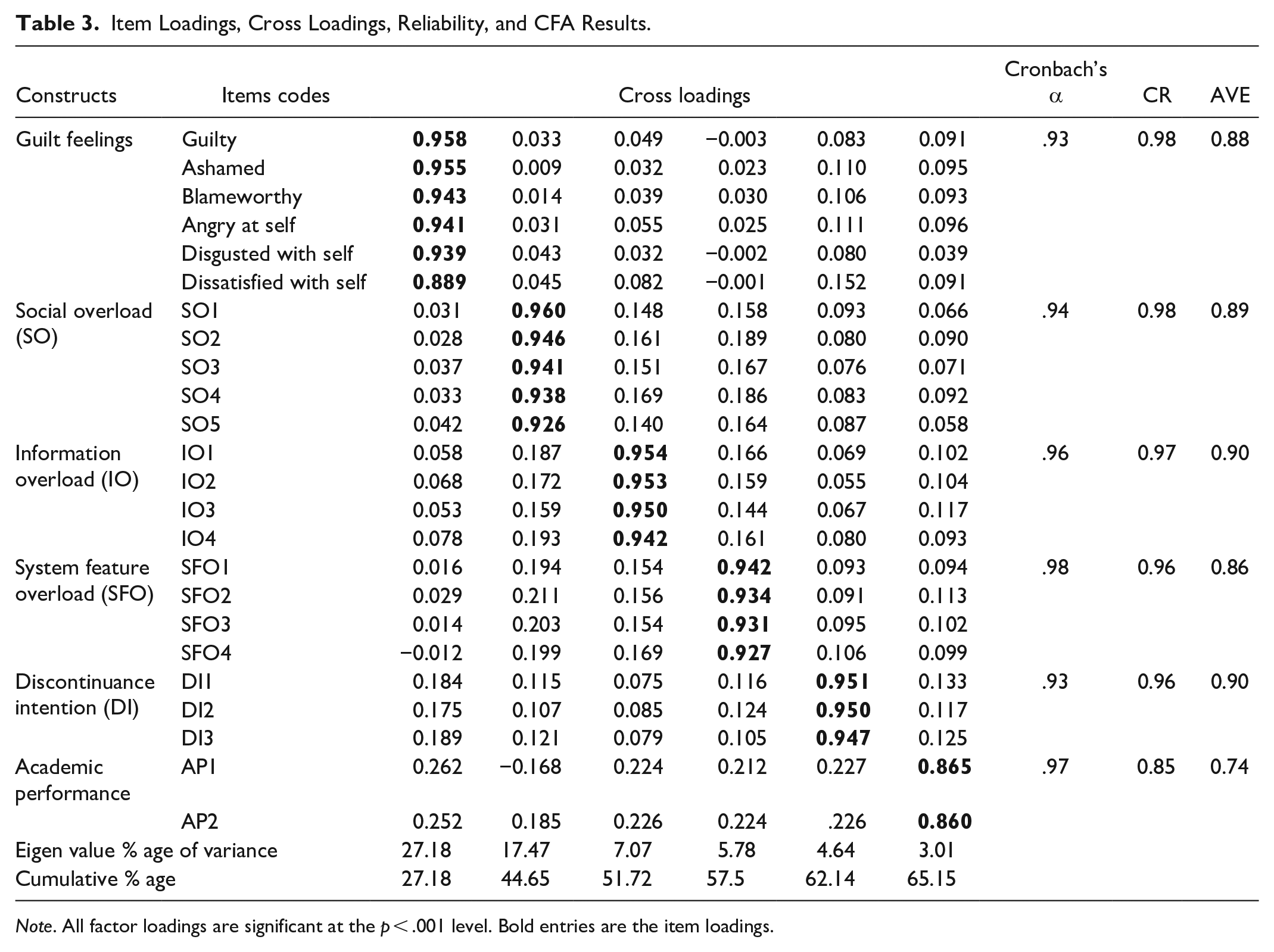
Note. All factor loadings are significant at the p < .001 level. Bold entries are the item loadings.
Since self-reported data was gathered in a cross-sectional survey, there may be common method bias problems (Podsakoff et al., 2003). By using the method of Liang et al. (2007) to assess the common method bias, this study confirms that the largest variance explained by individual factor was 27.1%, indicating that common method bias was not a hazard. As reflective construct may be influenced by multicollinearity, we tested the presence of multicollinearity between the constructs. The regression analysis results described that values of the variance inflation factor (VIF) are ranged from 1.18 to 1.29. This result was under the threshold of 3.30 (Diamantopoulos & Siguaw, 2006) and provided support for the lack of multicollinearity in the research model. Moreover, the results of descriptive statistics and discriminant validity measuring by AVE’s square root are under the prescribed values, shown in Table 4.
Descriptive Statistics, Correlation Matrix, and the Square Root of AVE.
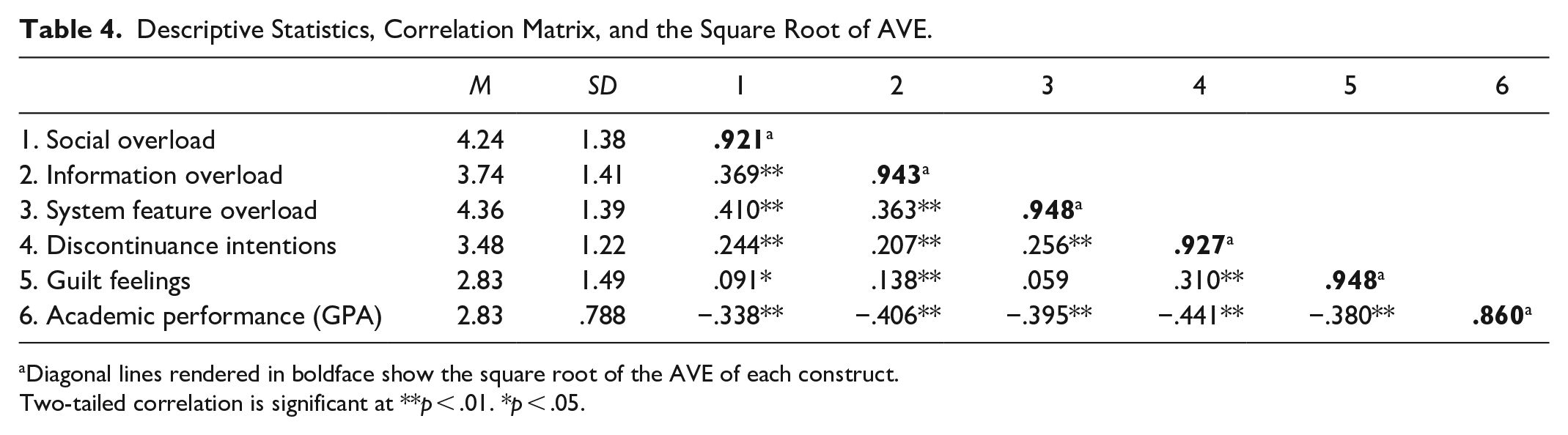
Diagonal lines rendered in boldface show the square root of the AVE of each construct.
Two-tailed correlation is significant at **p < .01. *p < .05.
Structural Model
To acquire a more parsimonious model for assessment, the full model was first to run in AMOS. The dimensions were disaggregated. Figure 2 displays the results of the main effects model. All of the relationships are significant such as social overload (H1: β = −.141, p < .01), information overload (H2: β = −.267, p < .01), and system feature overload (H3: β = −.240, p < .001) have significant negative impact on academic performance, which supported H1, H2, and H3. Academic performance (H4: β = −.329, p < .001) affect the discontinuance intention significantly, which validated H4. All control factors had no significant influence on discontinuance intention. The variance explained by academic performance and discontinuance intention is 23.7% and 31.7%, respectively. The model fits indices that assess the structural model (χ2/df, RMSEA, IFI, TLI, and CFI were 2.37, 0.077, 937, 928, and 0.939, respectively).

Results for empirical analysis.
Moderating Effect of Guilt Feelings
The bootstrapping approach has been applied to inspect the role of guilt as a moderator of the association between academic performance and discontinuance intention, as described by Preacher and Hayes (2008). In keeping a view of the hypotheses H5, we found that guilt feelings significantly interact with academic performance to influence one’s discontinuance intention (H5: β = .193, p < .001). The plot, given in Figure 3, recommends that a higher level of intention to discontinuance is related to poor academic performance; discontinuance intention is likely to be triggered when SNS users have a high level of guilt feelings.

Moderating results.
Discussion and Conclusion
Grounded on the SSO framework, this research inspected how SNSs stimuli turned into stressors, inducing feelings of strain in terms of poor academic performance and how its further influences students’ discontinuance intentions with the mediating-moderating role of guilt feelings. As a whole, the study investigated six hypotheses and showed that all relationships are significant. As expected, examined SNS stressors, namely, social overload, information overload, and system feature overload, positively impact academic performance. This approves from recent research on the use of SNS and academic performance, which suggests that stress and anxiety caused by SNS use can have a negative impact on academic performance (Kirschner & Karpinski, 2010). Cognitive preoccupation is another reason for this negative relation; that is, SNSs stimuli promote students to gradually form clusters in their long-term memory and behavioral predispositions related to these responses. For example, stimulant cues (such as friend status updates, notifications, or SNSs friends sharing news/pictures) can galvanize the linked cluster. These results lead to a strong desire to use and a prompt response that produces a continuous obsession that needs energy, leading to diverse psychological impressions such as social overload and fatigue. These psychological values will eventually influence students’ cognitive ability and lead to poor academic performance and consistent with the results (Turel & Qahri-Saremi, 2016), who determined that preoccupation with individual minds caused by SNSs can negatively affect academic performance.
Our results showed that students with a high degree of guilt feelings due to poor academic performance are more likely to have SNS discontinuance intentions. Findings reveal that guilt feelings have a moderating effect between academic performance and discontinuance intention which is recently concluded by Turel (2016), who anticipated that guilt is a self-reflective ethical feeling that can affect user cognitive behavior related to attitude and control perception concerning the discontinuance turns in partial moderation effects. This finding further suggests that users with different SNSs can and do replicate the way system usage has become a value system. When they do not meet the standard, they will face pressure, which will affect their academic performance. This strain of poor academic performance develops feelings of guilt, which in turn acts indirectly (through the change in attitudes) or indirectly to influence students’ future intention to use SNSs. This finding is further endorsed by previous research on guilt’s impact on substantial behavior changes (Kaiser et al., 2008). Additionally, guilt feelings highlight perceived discrepancy and drive the user to restore the desired state, likely to terminate the problematic behavior. Guilt can enhance the motivation and ability to discontinue intention to terminate the guilt-generating behavior in the future (Mayer et al., 2001).
We found that student with poor academic performance is more inclined toward discontinuance intention. Discontinuance intention may involve many emotional and psychological processes, as we did in our study. Our finding explained that poor academic performance triggers strong unpleasant feelings in the form of guilt among the students that moderate the relation with discontinuance intention. Thereby students will engage in adaptation strategies to cope with these unpleasant feelings in the future and overcome the drivers of poor academic performance to terminate the problematic behavior. The SNS users may feel this way of social overload, information overload, and system feature overload is because of incapability to manage the enjoyment, information, and social contacts. Time spent with activities above was negatively predictive of overall GPA, thereby causing dissatisfaction and affecting one’s performance (Junco, 2012; Kirschner & Karpinski, 2010). In addition, our findings, namely “discontinuance intention,” also hypothetically sanction the conclusions of Ravindran et al. (2014), who explored that users are inclined with the change in their behavior to evade fatigue from the use of SNS.
Implications, Future Research, and Limitations
Theoretical Implications
The study discussed theoretical implications; firstly, in its place of concentrating on the positive side, the research can extend the existing literature of IS on the dark side, which is relatively overlooked the conceptualizations; drivers and consequences of SNS use Tarafdar et al. (2013). We examined the antecedents of poor academic performance as SNS stressors and used outcomes to highlight the behavioral outcome as a coping strategy to avoid stressful events. In particular, this study extends the etiology of problematic SNS use, both theoretically and practically, and explores its possible adverse effects in the field of academic performance. By taking the SSO framework, this study highlighted the SNS stressors. It contributed a clear and more comprehensive understanding of problematic SNS use, which induces strain in the form of poor academic performance. The antecedents of poor academic performance should not be ignored, especially when induced due to an imbalanced pattern of SNS usage.
Secondly, this study supplements the literature of IS and SSO theory to a certain extent, especially finds that SSO theory is not only an appropriate means to explain discontinuous use of SNS, but also can be used to identify key factors such as social overload, information overload, and system features overload. It is more appropriate than other behavioral planning-based factors, such as satisfaction and usefulness. The use of SNS appears to be ratified without appropriate planning or thoughts that are usually termed less rational. SSO theory is a better one in explaining the less rational type of behavior than planned behavior. This is an important contribution to SNS use literature that has mainly relied on planned behavior research (Bhattacherjee, 2001).
Thirdly, in addition to the importance of SSO theory, this research also subsidizes developing an understanding of discontinuance intention and the underlying mechanism involved. We considered different discontinuance intentions behavioral patterns such as suspending the usage, rationalizing the usage, and permanently leaving the use of SNS which is consistent with the prevailing scholars in IS (Ravindran et al., 2014). Additionally, the moderating role of guilt feeling strengthened the intention to discontinue the use of SNS for those who encounter poor academic performance due to SNS stressors, which is also an important contribution to extant literature. In other ways, it implies that SNS users adopt discontinuance intention as a coping strategy to get rid of a stressful situation in the future and it is not only determined by dissatisfaction based on their academic performance (Zhang et al., 2016).
Finally, we have contributed by examining the three types of a stressor (social overload, information overload, and system feature overload) as social media-related stressors and investigating the effect on academic performance. The stressor above is common among the virtual community and discussed in the IS research (Luqman et al., 2017). These three types are rarely discussed in the realm of academic performance, and outcomes reveal that all three categories of stressors are a vital source of SNS associated with overload affecting the students’ academic performance. Moreover, our study also shows the importance of stimulus properties with the help of SSO frameworks such as notifications of status updating or sharing of news or pictures from the network’s friends in influencing academic performances. This finding contributes to IS research and highlights the dark side of SNS use by indicating mental preoccupation due to SNS stimuli, thereby affecting academic performance. Specifically, our finding shows the direct negative link SNS stimuli on the preoccupation with SNSs and affecting the academic performance to deviate the attention.
Practical Implications
This research also suggests an array of practical implications for SNS providers, users, and educational institutions for monitoring the adverse effects of SNS use. Firstly, our findings reveal that the association of SNS stressors and academic performance is due to the imbalanced usage pattern. The SNS vendors can diminish stress induced by SNS usage by assembling it easier to monitor and handle their use.
Secondly, this research has a great significance for educational institutions to help students control the awkward SNS use behavior in the classroom and other places. Educational institutions can hold seminars to elucidate why overuse of SNSs is perilous, why students should be attentive and evade it, and prevent its adverse effects. Even a minor drop in SNS use can improve students’ academic performance. It is important to emphasize the requirement for efficient education in schools, universities, and even in the workplace regarding the negative individual significances of overuse, adaptation to SNS.
Finally, this study emphasizes the significance of the rational decision view, a relatively new phenomenon in IS research directions, which mainly emphasized the adoption and continuation of intention, particularly in education. Present empirical evidence covers the existing literature that users should control their behavior when using SNS to avoid hostile feelings, that users may feel cured and harm academic performance.
Limitations and Future Research
Our lagging survey data do not permit causation testing because they may be affected by confounding structures and do not provide clear directional information about the direction of influence between the measured constructs. Further research should adopt the dissimilar data collection method to attain rich information about causation between different variables and the influence direction. Moreover, the impact of social overload, information overload, and system feature overload can be measured in another field of life, for example, work, or real-life interactions. The “tipping point” at which users start suffering stress is required to be examined systematically in the future. Moreover, we have used age and gender as control variables; future research should address and control others as factors associated with using SNS such as smoking, drinking, and the students’ prior performance. These factors might help to highlights additional consequences allied with poor academic performances.
Footnotes
Declaration of Conflicting Interests
The author(s) declared no potential conflicts of interest with respect to the research, authorship, and/or publication of this article.
Funding
The author(s) disclosed receipt of the following financial support for the research, authorship, and/or publication of this article: Financial support from the National Natural Science Foundation of China (Project no. 71991464/71991460 and 71921001) are gratefully acknowledged.
